

Crypto World
Kraken to buy stablecoin payments firm Reap in $600 million deal: Bloomberg



Kraken parent company Payward agreed to acquire stablecoin-focused payments firm Reap Technologies in a $600 million cash-and-stock deal, Bloomberg reported Thursday, citing Payward and Kraken co-CEO Arjunt Sethi.
The acquisition values Payward stock at $20 billion and marks Kraken’s first infrastructure acquisition in Asia, according to the report. Sethin told Bloomberg the deal is also the company’s third-largest to date.
Reap, based in Hong Kong, provides cross-border and business payments infrastructure that connects traditional financial systems with digital assets. The company focuses heavily on stablecoin-powered settlement and business-to-business payment flows.
“If you take Europe out, the fastest growing market is Asia, not just revenue but also asset-on-platform,” Sethi told Bloomberg. “They have already done it in Asia. They can expand into the US overnight with us.”
On Tuesday at Consensus Miami 2026, Sethi announced Kraken is “about 80% ready” to go public, highlighting the company’s initial public offering (IPO) plans as it rolls out a new partnership with MoneyGram aimed at solving crypto’s “last mile” problem.
The Reap deal announcement also follows Payward’s April 17 deal to acquire digital asset derivatives platform Bitnomial for up to $550 million, in a cash-and-stock transaction that values the firm at $20 billion. Bitnomial, founded over a decade ago, is the first crypto-native platform to secure all three licenses required to operate a full-stack derivatives business in the U.S. It has approvals to operate a designated contract market, a derivatives clearing organization and a futures commission merchant. The acquisition effectively shortcuts years of regulatory buildout for Payward as it expands its U.S. footprint.
The acquisition announced Thursday expands Kraken’s footprint in Asia, which has emerged as one of the fastest-growing regions for crypto adoption and stablecoin activity.
Reap was founded by Daren Guo, who previously launched Stripe’s Asia-Pacific business, and Kevin Kang, a former investment banker, according to the company’s website.

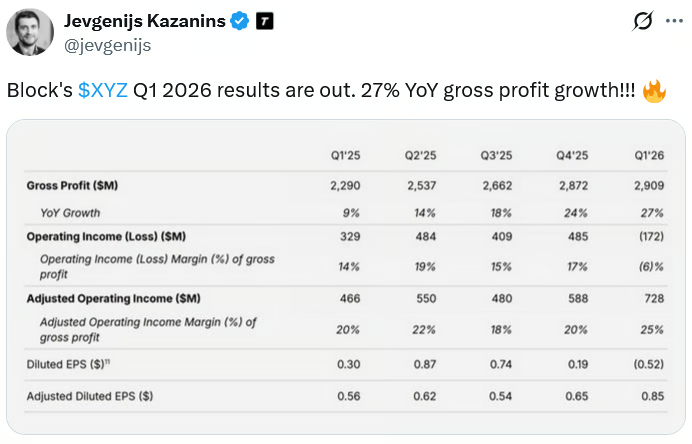
Jack Dorsey’s payments firm Block rose 7.9% in after-hours trading as its Q1 earnings surpassed analyst estimates, despite posting its first loss in three years.
Block’s Q1 earnings came in at 85 cents per share, beating the Zacks consensus estimate of 68 cents per share. Investors responded positively, driving Block shares to $75.70 after hours, Google Finance data shows.
“This quarterly report represents an earnings surprise of +25.68%,” said Zacks Equity Research on Thursday. “Over the last four quarters, the company has surpassed consensus EPS estimates two times.”
Expanding Bitcoin’s use into the payments space has been a key area of focus for Dorsey, who previously argued that widespread payment adoption is needed to fulfill Satoshi Nakamoto’s original vision of Bitcoin as a peer-to-peer electronic cash system. In late April, Block noted that over 800,000 US-based merchants have enabled Bitcoin transactions for everyday purchases.
Block reports first quarterly loss in three years
The earnings beat came despite Block reporting its first quarterly loss since 2023, driven by a 23.8% drop in the price of Bitcoin over the three-month period.
Q1 net loss was $309 million, which included a $172.8 million bitcoin remeasurement loss on the 8,883 Bitcoin it held as of March 31.
Bitcoin revenue from Cash App and other Block products fell to $1.8 billion from $2.33 billion a year ago.
Block attributed the fall to “Bitcoin trading dynamics” and a “strategic decision to reduce the fee” charged on certain Bitcoin transactions on Cash App.
Block’s gross profit rises 27% in Q1
Block’s Q1 gross profit — net sales minus cost of goods sold — reached $2.9 billion, up 27% from a year earlier.
Bitcoin payments in Cash App contributed $63 million to Block’s gross profit, while Square had no meaningful impact on Block’s Bitcoin business.
Avory & Co. founder and chief investment officer Sean Emory said “Block had a strong quarter,” having “beat and raised” its guidance.
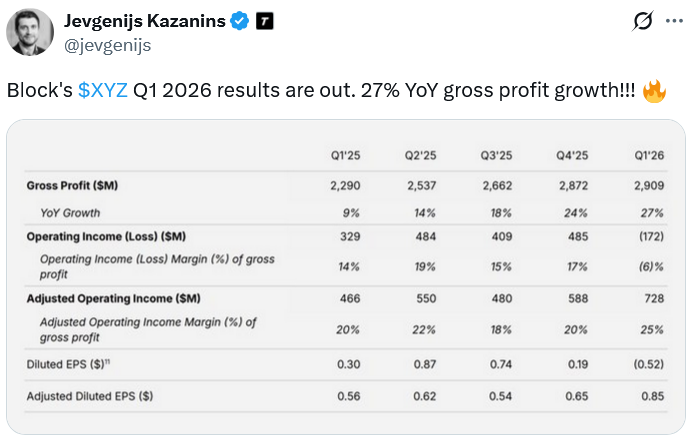
Source: Jevgenijs Kazanins
The quarter also included a restructuring overhaul in late February, when Dorsey announced about 4,000 staff cuts, representing roughly 40% of the company’s workforce, as part of a plan to rely more on AI in search of greater operational efficiency. Block’s operational expenses rose 57.2% year-on-year to $3.08 billion in Q1.
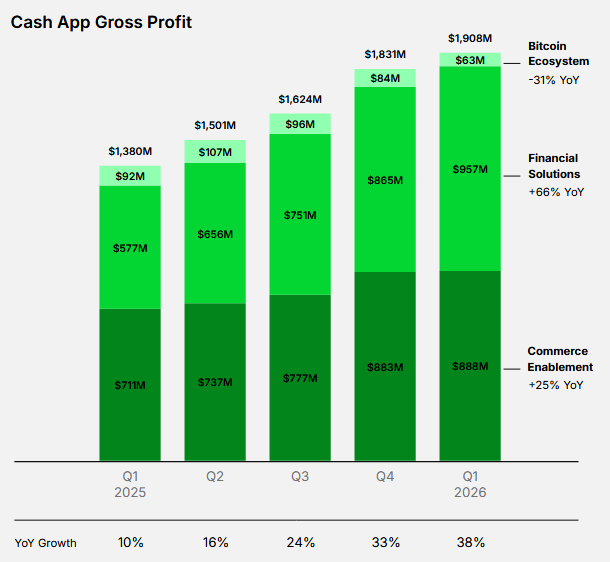
Cash App’s quarter-over-quarter change in gross profit. Source: Block
Block expands Bitcoin offerings
In late April, Block launched a proof-of-reserves for its corporate Bitcoin treasury and for users to confirm Bitcoin balances on Cash App and Square as part of a push to increase transparency with its customer base.
Related: Bitcoin exchange reserves fall to two-year low after $8B exodus
In the same announcement, Block unveiled a Bitkey hardware wallet with a touchscreen to verify transactions and a new feature on Cash App allowing certain users to automatically convert payments into Bitcoin.
It also started offering 5% Bitcoin cash back rewards for Square merchants and raised customer withdrawal limits fivefold to $10,000 per day and $25,000 per week, extending Dorsey’s push to broaden Bitcoin’s role in everyday payments.
Magazine: Guide to the top and emerging global crypto hubs — Mid-2026

Coinbase Global Inc. entered 2026 with a sobering first-quarter performance, delivering a net loss and revenue figures that underscored the headwinds facing the crypto industry. The exchange posted a $394.1 million net loss for Q1, marking a second consecutive quarterly loss after a $667 million shortfall in Q4 2025, and a meaningful drift away from profitability despite revenue coming in below expectations.
The company reported revenue of $1.41 billion for the quarter, trailing consensus estimates of around $1.5 billion. Earnings per share stood at a loss of $1.49, compared with analysts’ expectations for a positive 36-cent print. The quarterly results arrive as macro conditions remained challenging for crypto trading and related services, weighing on Coinbase’s topline and margins alike.
On the call accompanying the release, Coinbase CFO Alesia Haas stressed the broader market backdrop, noting that “macro conditions were genuinely tough” and that the total crypto market capitalization and overall trading volume declined by more than 20% quarter over quarter. The numbers reflect a wider crypto winter in early 2026, even as the company has sought to diversify beyond pure spot trading into other asset classes and services.
Following the report, Coinbase’s stock traded lower in regular hours and slid further in after-hours trading, dipping under $184. The retreat comes as investors weigh not only quarterly performance but the company’s longer-term plan to navigate a market where trading activity has cooled and competition for revenue sources has intensified.
Coinbase’s quarterly challenges come as peers in the crypto ecosystem also grapple with slower revenue and tighter spreads, forcing many to reconfigure operations and human resources. The stock has fallen more than 14% this year, prompting a series of strategic adjustments designed to conserve cash and explore new growth avenues.
Looking ahead, Coinbase is pursuing a broader strategy to diversify beyond a single focus on spot crypto. Chief executive officer Brian Armstrong told investors that the world economy is moving on-chain, and Coinbase was built to capitalize on that transition. He framed the current period as an interim phase in which some asset classes outperformed while spot crypto assets lagged, with the expectation that diversification would eventually yield a more balanced trajectory over time.
That pivot toward a multi-asset platform aligns with a broader industry conversation about tokenized finance and adjacent revenue streams. In recent quarters, Coinbase has signaled interest in markets that extend beyond traditional spot trading, including prediction markets and other services that could complement trading activity. The company has also taken steps to constrain costs as part of a broader effort to return to a more sustainable earnings trajectory.
The market backdrop outside Coinbase has been mixed. Rival Robinhood Markets also reported softer-than-expected first-quarter results, with crypto revenue and trading volumes shrinking versus a year earlier. Industry analysts have suggested that the decline in crypto stocks presents a potential entry point for investors seeking exposure to the tokenization narrative, a view that Bernstein conveyed in March. The research firm argued that the downturn in crypto equities could be an opportunity to gain exposure to a broader shift toward tokenized finance — including stablecoins and prediction markets — that could gain traction in the coming years.
From a regulatory and adoption standpoint, Coinbase’s push to broaden product lines could help mitigate volatility tied to crypto price swings by generating revenue from non-trading services. The company also faces ongoing scrutiny around exchange operations, user protection, and the regulatory clarity required to support a more expansive suite of financial products tied to digital assets. Investors will be watching closely how new business lines perform and whether they can scale in a market where trading activity remains uneven and capital costs have risen.
In a quarterly filing that accompanied the earnings, Coinbase reaffirmed the numbers and provided the formal context for these results. The company’s Q1 2026 10-Q lays out the period’s performance and offers a window into the balance sheet, cash burn, and the company’s ongoing cost-control initiatives. For those seeking to review the official documentation, the filing is available here: Coinbase Q1 2026 10-Q.
As Coinbase navigates these headwinds, investors will be looking for concrete signs that the company can translate its strategic ambitions into tangible revenue streams. The first-quarter miss highlights the gap between the pace of strategic diversification and the immediate earnings trajectory that investors have grown accustomed to in a year of crypto market volatility. The company’s leadership will need to demonstrate that the contemplated shift toward a multi-asset platform can begin to offset declines in core trading activity, particularly if market conditions remain challenging in the near term.
Analysts’ take on the quarter remained mixed, with some noting the difficulty of beating revenue expectations in a slowing market. The Q1 2026 results also come after a period during which Coinbase announced cost-reduction measures, including workforce reductions, to align its cost structure with a slower revenue environment. The company disclosed that it laid off approximately 14% of its workforce, roughly 700 employees, as part of an ongoing effort to protect margin during a period of slower top-line growth.
For now, the path forward hinges not only on market conditions but on execution across new product lines and services. Armstrong’s message to investors — that the on-chain economy will continue to expand and that Coinbase was built to participate in that expansion — remains the north star for the company. The question for investors is whether the diversified approach will translate into a sustainable uplift in revenue and profitability as the broader crypto cycle evolves.
Looking ahead, readers should monitor Coinbase’s progress on cost discipline, the performance of new business initiatives, and how the company hedges against ongoing volatility in crypto markets. As the sector recalibrates, Coinbase’s ability to monetize non-trading activities and scale new products could determine whether the stock can weather the current downturn and participate in a future upswing as tokenization and on-chain finance gain broader traction.
Key takeaways
- Q1 2026 results show a $394.1 million net loss for Coinbase, extending a loss streak from Q4 2025, with revenue of $1.41 billion versus roughly $1.50 billion expected.
- Analysts anticipated earnings per share of 36 cents, but Coinbase reported a loss of $1.49 per share, contributing to a subdued reaction in after-hours trading and a stock price below $184.
- Macro headwinds were cited as a major factor, with total crypto market capitalization and trading volume down more than 20% quarter over quarter.
- Cost-cutting and strategic diversification are central to Coinbase’s plan, including layoffs of about 700 employees (roughly 14% of the workforce) and pivoting toward multi-asset offerings and services beyond spot trading.
- Industry context suggests mixed signals: peers like Robinhood also reported softer results, while analysts at Bernstein argued the downturn may create opportunities to tap into tokenization themes and a broader on-chain economy.
Q1 results and the market backdrop
Coinbase’s first-quarter performance arrived amid a crypto market backdrop that has yet to regain its footing. The company’s CFO underscored the macro challenges during the earnings call, reiterating that a meaningful portion of the revenue softness stemmed from a broad decline in crypto activity. The revenue miss was not just a function of weaker trading volumes but also a softer contribution from non-trading lines, illustrating the difficulty of maintaining profit margins when core activity contracts.
Despite the disappointing quarter, Coinbase’s leadership emphasized a strategic shift toward a broader asset-classes approach. Armstrong framed the current period as a phase where the ecosystem is evolving, with spot crypto assets lagging while other assets may contribute more meaningfully to the platform’s revenue mix over time. This multi-asset strategy, if executed effectively, could reduce sensitivity to price swings in the underlying crypto market and create a more resilient business model.
Moving beyond spot: diversification as a growth lever
The push to diversify aligns Coinbase with a broader industry thesis that tokenized finance and on-chain services will become a core driver of value creation. In the near term, the company is testing and expanding into new product areas that could complement trading activity and broaden the addressable market. Such a transition is not guaranteed to bear fruit quickly, but it represents an important strategic hedge against persistent volatility in spot markets.
At the same time, cost discipline remains a practical necessity. The decision to trim the workforce is a blunt acknowledgment that growth in an uncertain macro environment requires tighter expense management. Investors will want to see if these reductions translate into improved unit economics and whether the company can fund its expansion into new lines without compromising risk controls or user experience.
What to watch next
As Coinbase charts its path through 2026, investors should monitor several key developments: the performance of non-trading revenue streams, the pace and impact of ongoing cost initiatives, regulatory developments that could unlock or constrain on-chain products, and the degree to which the broader market recovers and supports trading volumes. The company’s quarterly progress on its multi-asset strategy will be particularly telling, as this plan represents both an opportunity to stabilize revenue and a test of management’s ability to execute beyond the traditional exchange model.
In case readers want to review the formal quarterly documentation, Coinbase’s Q1 2026 filing is accessible here: Q1 2026 10-Q.
Further context on the quarter’s expectations and peer performance can be found in market coverage surrounding Robinhood’s comparable results and Bernstein’s commentary on crypto equities and tokenization themes. These perspectives underscore a sector-wide pivot toward new revenue engines even as traditional trading volumes remain volatile.
Overall, Coinbase’s Q1 2026 results crystallize a transitional moment for the company and the crypto ecosystem: a time of deliberate restructuring and strategic experimentation, set against a backdrop of ongoing market headwinds and regulatory evolution. How quickly the new growth pillars can scale will shape the trajectory of Coinbase’s earnings power in the quarters ahead.
What remains uncertain is how smoothly the new initiatives will integrate with the existing platform and whether investors will see a clear path to profitability as macro conditions evolve. For now, the market will watch closely for signals that the diversification strategy is gaining traction and that cost controls are translating into measurable improvements in margins.
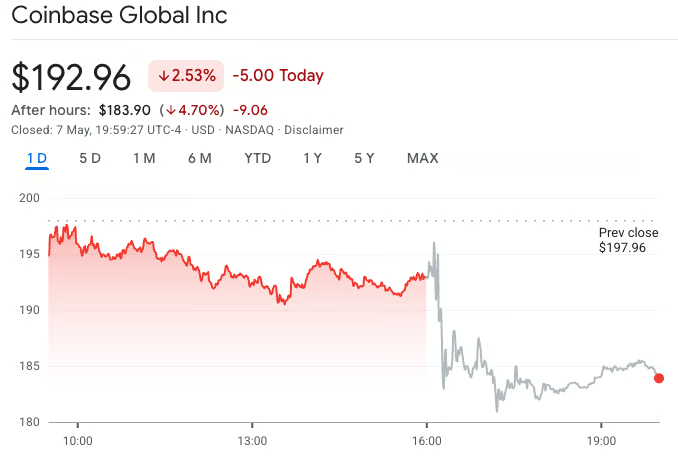
Coinbase shares slid Thursday after the US crypto exchange reported a steep first-quarter loss while revenue missed Wall Street expectations.
Coinbase reported a net loss of $394.1 million in Q1, its second consecutive quarterly loss after reporting a $667 million loss in Q4 2025. It swung from a $65.6 million profit a year earlier.
“Macro conditions were genuinely tough,” Coinbase chief financial officer Alesia Haas told investors on an earnings call. “Total crypto market cap and total crypto trading volume were both down more than 20% quarter-over-quarter.”
Coinbase’s earnings come as other crypto companies have also struggled to turn a profit in the first months of 2026 as a crypto market slump pushed some traders to other investments.
Meanwhile, Coinbase’s Q1 revenue was $1.41 billion, missing analyst estimates of $1.5 billion. Transaction revenue slumped 40%, while subscription and services revenue — representing its business outside trading — fell 13.5% from a year earlier.
Its earnings per share were a $1.49 loss, compared to analysts’ expectations of 36 cents per share, which saw Coinbase dropping by 4.7% after hours on Thursday to under $184.
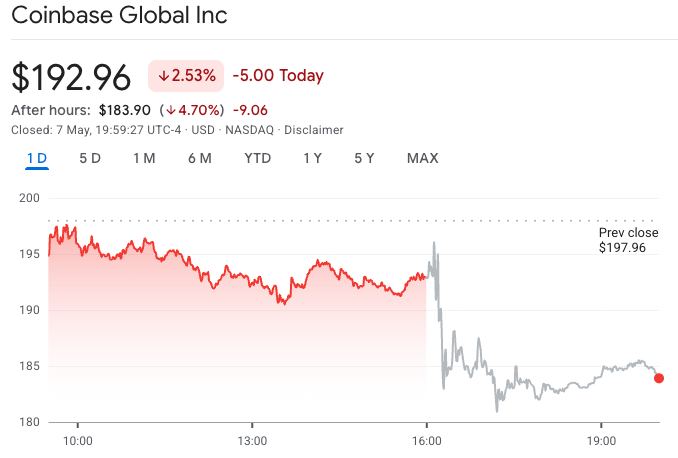
Coinbase shares fell in regular and after-hours trading on Thursday amid the company’s first-quarter earnings. Source: Google Finance
Coinbase’s stock has fallen more than 14.5% this year, prompting the exchange to pursue new business lines such as prediction markets and cost-cutting measures, including laying off 14% of its workforce, or about 700 employees, on Monday.
Despite the company’s earnings, CEO Brian Armstrong struck an optimistic tone on the earnings call, telling investors that “the world economy is moving on-chain, and Coinbase was built to capitalize on this transition.”
He added that over the past year, Coinbase has aimed to transition from “a primarily spot-focused crypto platform into a place where you can now trade any asset class.”
“We’re in kind of this interim period where spot crypto assets were down a bit, other asset classes were up. As we diversify, these things will get balanced out, where we’ll just be in a more upward channel over time,” Armstrong added.
Related: Block Inc rises 8% as Q1 gives ‘earnings surprise’ despite Bitcoin dip
Coinbase rival Robinhood Markets also missed estimates for the first quarter last month as its crypto revenue and trading volumes nearly halved from a year earlier.
Bernstein said in March that the decline in crypto stocks presented a more attractive entry point for investors seeking exposure to the current hot theme of tokenization and maintained a bullish rating on Coinbase and Robinhood.
It argued that the companies offered investors exposure to a broader shift toward tokenized finance, including stablecoins and prediction markets, which it expected to gain traction in the coming years.
Magazine: Guide to the top and emerging global crypto hubs — Mid-2026


American Bitcoin posted an $81.8 million net loss in Q1 2026, even as the Trump-backed miner set a new quarterly production record of 817 BTC and cut its mining cost by 23%.
Summary
- American Bitcoin reported an $81.8 million net loss in Q1, up from a $59.5 million loss in Q4 2025.
- Bitcoin fell 22% during the quarter, triggering a $117.2 million non-cash impairment charge on the company’s holdings.
- The company mined a record 817 BTC and reduced its cost per coin to $36,200, a 23% improvement from $46,900 in Q4 2025.
American Bitcoin reported a net loss of $81.8 million in Q1 2026, driven by a 22% bitcoin price decline that triggered a $117.2 million non-cash impairment on its digital asset holdings. Revenue from mining fell to $62.1 million from $78.3 million in the prior quarter.
Despite the headline loss, CEO Mike Ho pushed back. “Strip out the non-cash mark-to-market adjustment on our Bitcoin required by FASB,” he said, “and the underlying business was profitable and we did not sell a single coin.”
Gross mining margins held above 50% and the cost per coin fell to $36,200, a 23% improvement from $46,900 in Q4 2025.
Record production, widening paper losses
American Bitcoin mined 817 BTC in Q1, its highest quarterly output to date, and purchased an additional 803 BTC for its treasury. Total holdings reached 7,021 BTC as of March 31. Co-founder Eric Trump told Consensus Miami on Wednesday:
“In just over eight months as a public company, we have become the 16th largest bitcoin holder globally and scaled to more than 28 exahash of capacity.”
The company completed the deployment of 11,298 new Bitmain miners in early March, bringing its total fleet to 89,242 machines and 28.1 EH/s of capacity. Operating expenses for the quarter totalled $150.7 million.
ABTC shares fell roughly 7% in pre-market trading after the results missed analyst estimates by 17%. As crypto.news reported, ABTC debuted on Nasdaq through a reverse merger in September 2025, briefly pushing Eric Trump’s paper stake into billionaire territory before a sustained selloff.
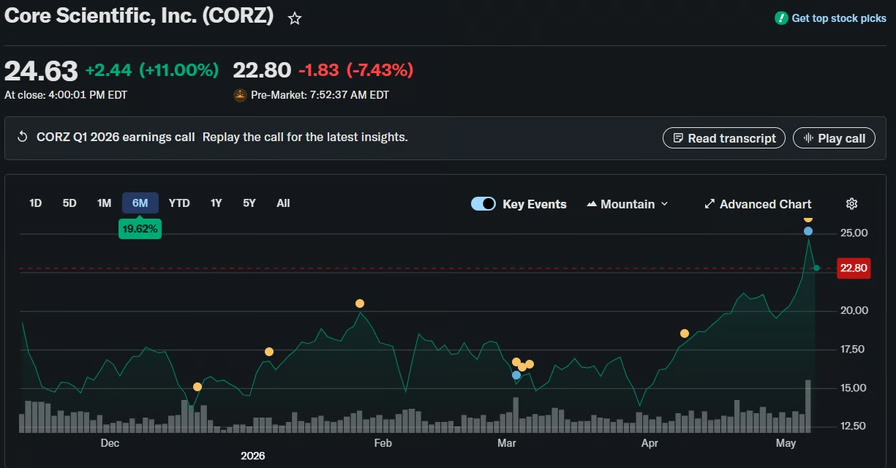
Core Scientific (CORZ) reported a $347.2 million first-quarter net loss as its Bitcoin self-mining revenue fell sharply and high-density colocation became its largest revenue source.
In its earnings report published Wednesday, the company reported a net loss of $1.06 per diluted share for the quarter. A year earlier, Core Scientific reported diluted earnings of $1.24 per share.
Core Scientific said the loss included $266.5 million in non-cash impairment charges and a $30.8 million non-cash loss from changes in the fair value of warrants and contingent value rights.
Revenue rose to $115.2 million from $79.5 million a year earlier, but fell short of analyst expectations. Zacks Equity Research said analysts expected $120.2 million in revenue, with Core Scientific’s results coming in about 4.1% below expectations.
The results show Core Scientific’s transition from a Bitcoin miner into an AI infrastructure company, with high-density colocation now generating most of its revenue. The shift gives the company a larger business, but it also highlights how its legacy mining operations have weakened.
Bitcoin mining revenue falls
Core Scientific’s digital asset self-mining revenue fell to $30.1 million from $67.2 million a year earlier, with the company mining 279 Bitcoin (BTC) during the quarter, down 45% from the same period in 2025. According to its 10-Q filing, Core Scientific sold 2,385 Bitcoin during the quarter for $208.3 million to fund planned capital expenditures and other cash needs.
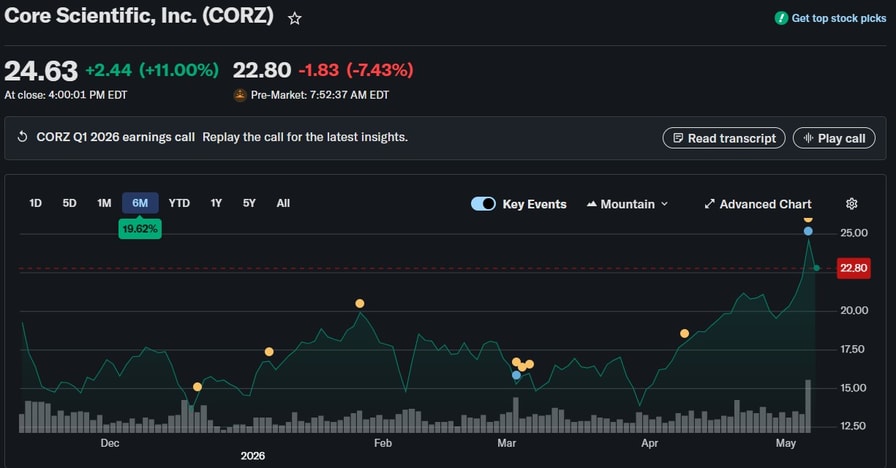
Core Scientific’s six-month price chart. Source: Yahoo Finance
Despite the weaker mining results, Core Scientific’s shares have gained over the past six months. Yahoo Finance data shows CORZ closed at $24.63 on Wednesday, up about 19.6% over six months, before falling 7.43% to $22.80 in pre-market trading at the time of writing.
In a separate announcement, Core Scientific said it plans to scale its Muskogee, Oklahoma, campus to about 1.5 gigawatts of gross power, or about 1.0 gigawatt of leasable power, partly through the planned acquisition of Polaris DS. The company has also started construction on a second, unleased 82.5-megawatt building at the campus.
Related: Trump-linked American Bitcoin reports $82M Q1 loss, revenue miss
Core Scientific expands AI-linked colocation business
Core Scientific’s first-quarter growth came from high-density colocation rather than Bitcoin production, with the company’s mining revenue and Bitcoin output falling while its AI-linked hosting business generated most of its revenue.
The company said its colocation revenue rose to $77.5 million in the first quarter from $8.6 million a year earlier, driven by additional billable customer power capacity delivered during the quarter.
The company said it was billing for 243 megawatts of capacity as of March 31, representing about $350 million in average annualized colocation revenue.
The revenue shift follows a series of hosting agreements with CoreWeave. In June 2024, Core Scientific said it signed 12-year contracts to deliver about 200 megawatts of infrastructure to host CoreWeave’s high-performance computing operations.
The companies later expanded the relationship. In an SEC filing in February 2025, the companies said CoreWeave’s total contracted high-performance computing infrastructure with Core Scientific had increased to about 590 megawatts across six sites.
Magazine: Guide to the top and emerging global crypto hubs: Mid-2026


Blockstream CEO Adam Back told Consensus Miami 2026 that bitcoin is winning a security war against DeFi, and that pension funds and sovereign entities are the next buyers.
Summary
- Adam Back argued at Consensus Miami that Bitcoin’s simpler architecture is pulling institutional capital away from DeFi platforms hit by repeated smart contract exploits.
- He outlined Bitcoin adoption in three waves: retail ownership, spot ETF access, and now institutional allocation through managed portfolios and sovereign entities.
- Back estimated roughly 200 bitcoin treasury companies exist globally and said BlackRock model portfolio allocations have not yet fully taken effect.
Blockstream CEO Adam Back argued at Consensus Miami 2026 that Bitcoin’s comparatively simple network architecture is separating it from more experimental blockchain ecosystems that have suffered repeated smart contract failures.
Back described the dynamic as Bitcoin winning “the DeFi security war,” as institutional investors grow more sophisticated in understanding where security risk actually sits. “Bitcoin infrastructure is much more simple, robust, security first,” he said.
Back said institutions are no longer trying to reshape Bitcoin into traditional finance infrastructure. Instead, he argued, they are adapting themselves to Bitcoin’s incentive structure and conservative security model.
That dynamic, he said, opens the door for Bitcoin-native tokenization and DeFi systems that prioritize safety over rapid experimentation, using layer-2 solutions such as Blockstream’s Liquid Network.
The three waves of bitcoin adoption
Back outlined Bitcoin adoption as occurring in three sequential waves: direct retail ownership, spot ETF access through brokerages and advisers, and now institutional allocation through managed portfolios, pension funds, and sovereign entities.
“The model portfolios that BlackRock and others are putting out,” he said, “those allocations haven’t taken effect yet,” suggesting the largest wave of institutional capital has not yet arrived.
Back also estimated roughly 200 bitcoin treasury companies now exist globally, including BSTR, the firm he leads as CEO.
He described BSTR as a more actively managed approach to bitcoin exposure, intended to generate returns through both holdings and fund management strategies rather than passive accumulation. The comments came as bitcoin traded above $81,000 at the time of the Consensus session.

TLDR
- American Bitcoin increased its Bitcoin holdings to more than 7,300 BTC valued at about $592 million.
- The company produced 817 Bitcoin in Q1 2026, marking its strongest quarterly output to date.
- American Bitcoin also purchased around 803 Bitcoin during the quarter to expand reserves.
- Total Bitcoin reserves grew by roughly 1,600 BTC in a single quarter.
- Satoshis per share rose to about 663, reflecting a 20% increase.
American Bitcoin Corp. expanded its Bitcoin reserves beyond 7,300 BTC after a record production quarter. The Nasdaq-listed miner valued its holdings at about $592 million. Co-founder Eric Trump confirmed the figures and said the company maintained its accumulation strategy.
American Bitcoin Expands Holdings and Production
American Bitcoin began building its Bitcoin position in mid-2025 and accelerated purchases in early 2026. The company now ranks as the 16th largest corporate Bitcoin holder. Eric Trump said, “Our Bitcoin accumulation strategy remained intact despite a challenging market environment.”
During Q1 2026, the company produced about 817 Bitcoin, its strongest quarterly output. It also acquired around 803 Bitcoin through targeted purchases. Total reserves grew by roughly 1,600 Bitcoin during the quarter.
The company reported that Bitcoin price declined about 22% quarter over quarter. Despite weaker prices, American Bitcoin continued expanding its balance sheet. It confirmed that satoshis per share rose to about 663, up nearly 20%.
Management linked the increase in satoshis per share to faster Bitcoin growth than share count expansion. The company said this metric reflects shareholder exposure to Bitcoin reserves. It maintained that production and purchases supported reserve growth.
Operational Gains Lift Efficiency and Capacity
American Bitcoin reduced its mining cost per Bitcoin to about $36,000 in Q1 2026. The figure marked a 23% decline from the previous quarter. The company attributed the drop to improved fleet efficiency and cost control.
Mining gross margins held near 52% despite lower Bitcoin prices. Revenue reached about $62 million compared with $78 million in Q4 2025. The company reported a net loss of roughly $82 million for the quarter.
American Bitcoin expanded its owned fleet to about 89,242 miners. Total capacity reached around 28.1 EH/s, up nearly 12% from the prior quarter. The company energized new capacity at its Drumheller site.
The Drumheller expansion added about 3.05 EH/s from next-generation miners. Following deployment, operational hashrate reached roughly 25.0 EH/s. The company confirmed that this level reflects continued scaling of its mining platform.
American Bitcoin stated that it will continue operating its expanded fleet. It also confirmed that reserve totals exceeded 7,300 BTC at quarter’s end. Eric Trump reiterated that the company remains focused on disciplined growth.

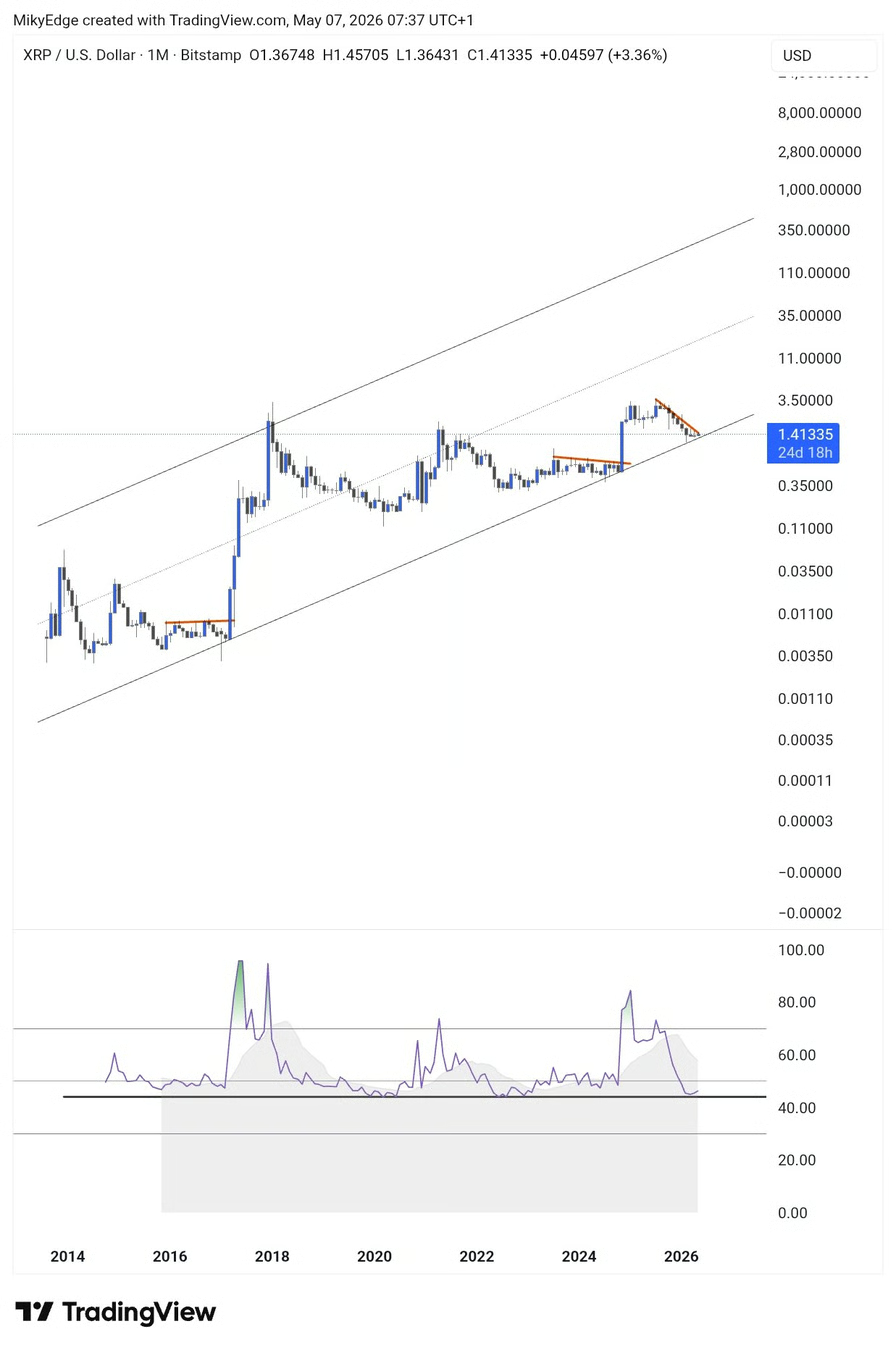
XRP (XRP) is testing a key long-term support level that has historically preceded major rebounds, according to a monthly chart shared by analyst MikybullCrypto.
Key takeaways:
- XRP has jumped by roughly 30% from its February lows.
- Multiple fractals suggest the price is bottoming out, supported by strong XRP ETF inflows.
XRP chart hints at rebound toward $12
Milkybull’s chart shows XRP trading inside a rising channel that has guided price action since 2014. XRP is now near the channel’s lower trendline around $1.30–$1.40, a zone that previously acted as a launchpad for large upside moves.
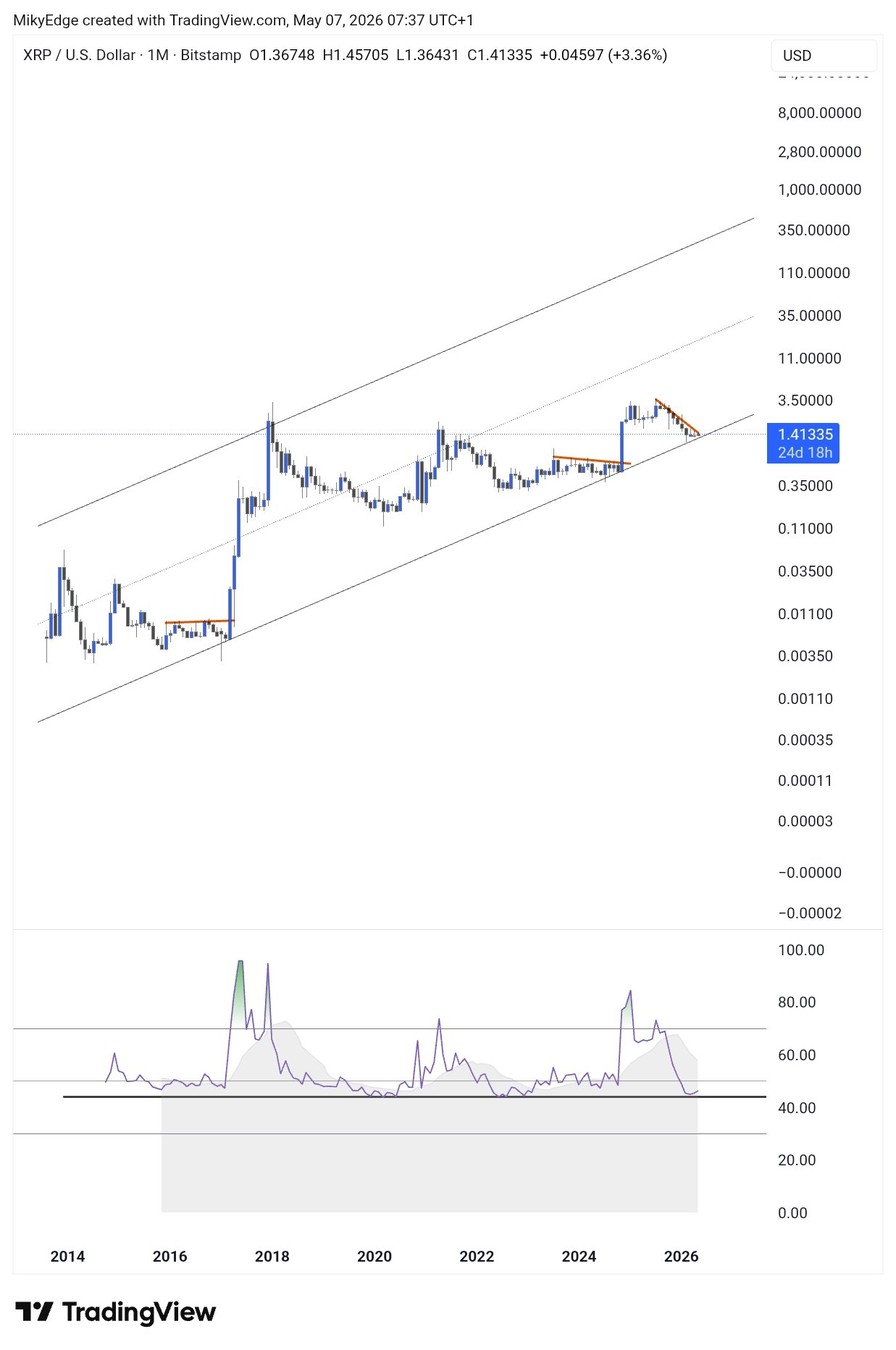
XRP/USD monthly chart. Source: TradingView/MilkybullCrypto
The analyst says XRP is “probably going to $12,” a level that roughly aligns with the channel’s midpoint.
Momentum indicators support the rebound thesis. XRP’s monthly relative strength index (RSI) has cooled toward a historical support area near 40–45, similar to levels that appeared before past rallies.
In a Thursday post, analyst JD pointed to the same RSI support zone as a potential “cycle bottom” signal for XRP.
His two-week chart shows XRP breaking out of a multi-year symmetrical triangle, then pulling back toward the breakout area.
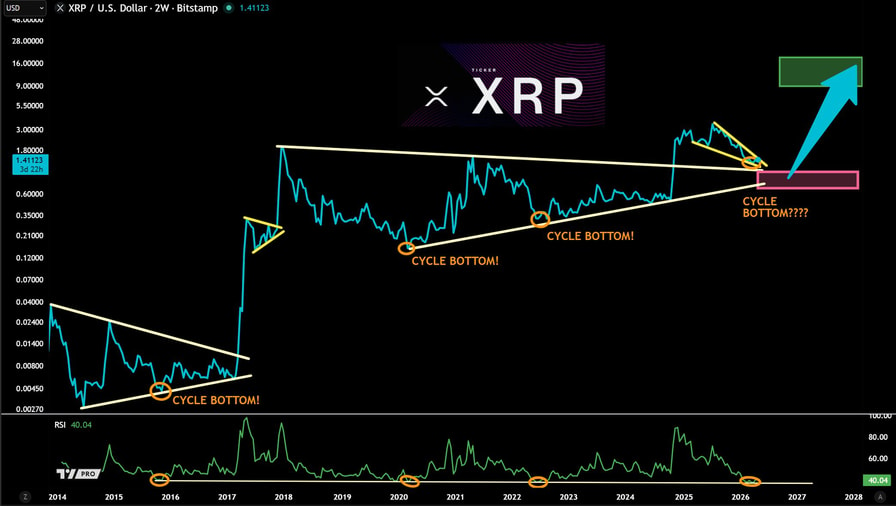
XRP/USD two-week chart. Source: TradingView/JD
The chart’s projected green target zone aligns with the $8–$14 range, implying strong upside if XRP holds the retest zone.
The bullish outlooks follow XRP’s sharp rebound in recent weeks, up by about 30% from its February lows at around $1.11.
Related: XRP price copies 2025 chart fractal that last time sparked 66% gains
In the period, XRP has largely benefited from renewed risk sentiment led by the US–Iran ceasefire, as well as market-specific fundamentals.
These include Rakuten Wallet’s XRP integration, which expanded the token’s reach in Japan, and $81.6 million in April inflows into US spot XRP ETFs, their strongest monthly total of 2026.
In the first week of May, XRP ETFs have attracted $28.17 million in inflows already.
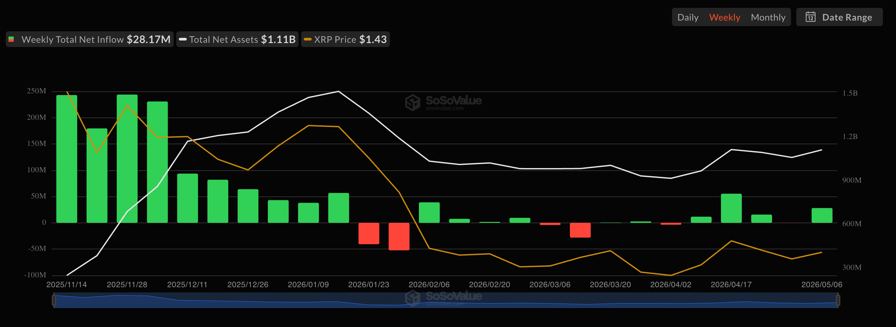
US XRP ETF net flows. Source: SoSoValue
XRP still risks 2022-style bear market repeat
However, the bullish XRP setup is not guaranteed. The bears will try to pull the price down below the channel support. This would invalidate the bullish structure and put XRP at risk of deeper losses.
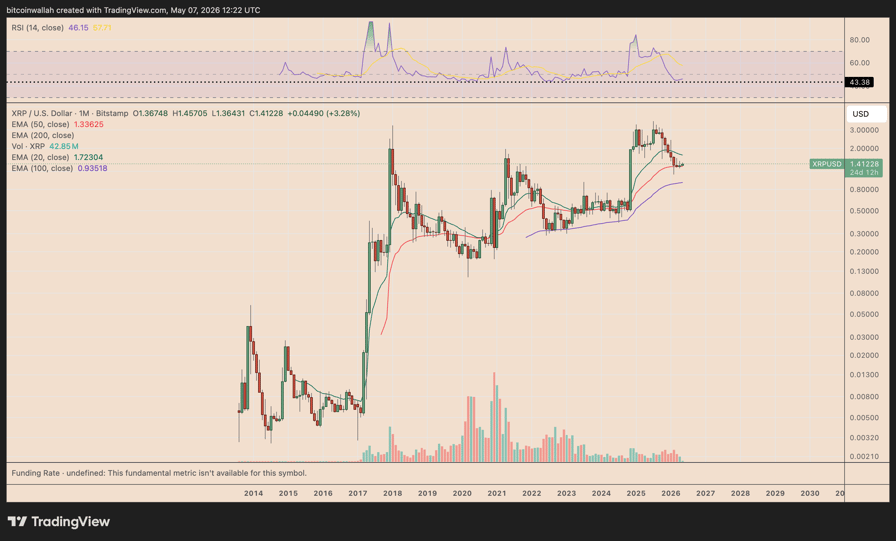
XRP/USD monthly chart. Source: TradingView
The support overlaps closely with XRP’s 50-month exponential moving average (50-month EMA, the red line) near $1.33.
Losing this support cluster shifts focus toward the 100-month EMA (the purple line) near $0.93, implying a roughly 30% drop from current levels. A similar plunge occurred during the 2022 bear market.
Crypto World
Clarity Act edges toward Senate markup as stablecoin fight narrows options for crypto yield


Stablecoin yield compromise puts CLARITY back in motion.
Summary
- The CLARITY Act is moving toward a key Senate Banking Committee markup expected as soon as mid-May, with a fragile compromise on stablecoin rewards clearing the way for a vote.
- Draft text would effectively ban interest-like yield on stablecoin balances across exchanges and brokers, forcing CeFi and parts of DeFi to rethink reward products that compete with bank deposits.
- Prediction markets now put the odds of the bill becoming law in 2026 at roughly 55%, as regulatory momentum converges with parallel efforts like FIT21 and the SEC‑CFTC joint token taxonomy.
The CLARITY Act, a sweeping U.S. digital asset market structure bill, is inching closer to its next procedural test in the Senate after negotiators released compromise language on stablecoin rewards that had stalled progress for months. CryptoSlate reports that senators Thom Tillis and Angela Alsobrooks unveiled revised text last week targeting yield on stablecoin balances, raising expectations that the Senate Banking Committee could finally take up the bill the week of May 11 following an April delay. A policy note from Brownstein Hyatt Farber Schreck notes that H.R. 3633, the House version of the CLARITY Act, passed the House in July 2025 by a 294–134 bipartisan vote and cleared the Senate Agriculture Committee in January 2026, but has repeatedly slipped in Banking over stablecoin language.
The current draft goes hard at that issue. According to Fintech Weekly, a recent version of the Digital Asset Market Clarity Act text reviewed in closed-door Capitol Hill sessions would prohibit offering yield “directly or indirectly” on stablecoin balances and ban anything “economically or functionally equivalent to bank interest.” The provision applies not only to issuers but also to exchanges, brokers and affiliated entities, closing the structural workarounds that had allowed platforms like Coinbase to continue passing stablecoin rewards to users even after the earlier GENIUS Act restricted issuers themselves.
CryptoRank, citing Senate staff and industry sources, says the latest compromise narrows but does not eliminate yield: Banking Committee staff have floated language that may still allow rewards tied to promotional programs or non-interest-like incentives, but the thrust is clear—no more passive, deposits-style interest on stablecoins that might compete head-on with bank savings products. That is exactly what major U.S. banks lobbied for, with TheStreet reporting that large institutions have warned lawmakers the CLARITY framework “may not fully protect deposits or limit risks” unless it clamps down on token yields that look like shadow banking.
What CLARITY means for BTC, ETH, stablecoins and DeFi
For the broader crypto market, the CLARITY Act is part of a broader regulatory convergence. Galaxy Digital notes that CLARITY is advancing alongside the Financial Innovation and Technology for the 21st Century Act (FIT21), which the House passed in May 2024 by a 279–136 vote to divide jurisdiction between the SEC and CFTC based on whether a blockchain is “functional” or “decentralized.” That combination, plus a March 2026 joint SEC‑CFTC interpretive release creating a five-category token taxonomy and explicitly naming 16 assets as digital commodities, is laying the legal foundation for assets like bitcoin and ether to sit firmly under CFTC oversight while a long tail of tokens remain securities.
Brownstein’s April 2026 update underscores that CLARITY is now less about “if” than “when,” though time is tight heading into the U.S. election cycle. KuCoin’s legislative tracker frames the status as “pending” but shifting toward inevitability, with a provisional timeline of a Senate Banking markup in mid‑March or mid‑May, a full Senate vote by late spring and a potential presidential signature in June that would trigger a provisional registration period for digital asset intermediaries.
Near term, the most direct market impact is on stablecoin economics and yield-bearing products. A Payments Association analysis argues that as regulation tightens, banks will be able to issue their own stablecoins and integrate them into settlement and treasury operations, while non‑bank issuers shift toward fee-based models rather than interest-like rewards. For centralized exchanges, a CLARITY-style ban on stablecoin yield would force a pivot from “earn” products that simply pass through issuer rewards toward more complex structures—staking, basis trades, or tokenized credit—that may fall outside the bill’s definition of deposit-like returns.
Prediction markets already reflect the stakes. CryptoRank notes that Polymarket traders now put the odds of CLARITY becoming law in 2026 at about 55%, up nine percentage points in a single day after the stablecoin yield compromise text surfaced. As FinTech Weekly’s tokenization hearing coverage put it, the U.S. is in a rare “legislative window” where the SEC‑CFTC taxonomy, Nasdaq’s approval of tokenized securities trading, a dedicated House tokenization hearing, and an imminent CLARITY markup are all converging in the same quarter. If that window closes without final passage, U.S. crypto markets will remain on what Galaxy calls “borrowed time”—operating under patchwork enforcement and ad hoc guidance rather than the statutory clarity that could finally anchor bitcoin, ether, stablecoins and DeFi inside a coherent federal regime.
TLDR
- Coinbase reported a net loss of $394.1 million in the first quarter of 2026.
- The company recorded a $482 million loss on crypto assets held for investment.
- Total revenue fell 31% year over year to $1.41 billion.
- Transaction revenue declined 40% to $756 million during the quarter.
- Subscription and services revenue dropped 14% to $584 million.
Coinbase reported a $394.1 million net loss in the first quarter of 2026 as crypto prices fell sharply. The exchange also posted lower revenue and weaker transaction income during the period. However, Chief Executive Brian Armstrong outlined plans to reduce reliance on spot crypto trading.
Coinbase Reports Q1 Loss as Crypto Holdings Weigh on Earnings
Coinbase recorded a net loss of $394.1 million for the first quarter of 2026. The company attributed the result to falling cryptocurrency prices during the period. It also reported a $482 million loss on digital assets held for investment.
Total revenue reached $1.41 billion, which marked a 31% decline year over year. Transaction revenue dropped 40% to $756 million as trading activity slowed. Subscription and services revenue fell 14% to $584 million.
In the first quarter of 2025, Coinbase earned $66 million in net income. The latest result marked its second consecutive quarterly loss. In the previous quarter, the company posted a net loss of $667 million.
Bitcoin prices fell from above $97,000 in January to near $63,000 in early February. By the end of the quarter, Bitcoin traded below $70,000. The broader crypto market moved lower during the same period.
CEO Outlines Strategy to Expand Beyond Spot Trading
Armstrong said the company will diversify its revenue sources beyond spot crypto trading. He stated that Coinbase aims to support trading in derivatives, commodities, and futures. He also said the platform will expand into prediction market event contracts.
“Despite the crypto market being down, the fundamental growth of the onchain economy is strong,” Armstrong said in a video on X. He added that eventually “all of finance” will move onchain. He said Coinbase built its business to capture that shift.
The company reported an 8.6% share of global crypto trading during the quarter. It also posted adjusted EBITDA of $303 million, down from $930 million a year earlier. Stablecoin revenue rose 11% to $305 million.
Armstrong also highlighted efforts to support regulated stablecoins and AI-driven payment options. He said Coinbase aims to become a destination for compliant digital dollar products.
Block Shares Jump on Strong Quarter Despite Bitcoin Dip

Sabrina Carpenter Revives Bling Ring Scandal

Could cruise boat hantavirus be the next global pandemic? Experts sound off on if Covid-era lockdowns could return

Manchester United reach agreement with Casemiro over contract clause amid transfer speculation

US brings back mandatory military draft registration

Steven Gerrard disagrees with Gary Neville over ‘shock’ Chelsea and Arsenal claim | Football
![BITCOIN: CRAZY!!!! THIS IS CRAZY!!!! [trades]](https://wordupnews.com/wp-content/uploads/2026/05/1778214197_maxresdefault-80x80.jpg)


-

 NewsBeat4 days ago
Channel 5 – All Creatures Great and Small series 7 new post
-

 Crypto World20 hours ago
Upbit adds B3 Korean won pair as Base token gains Korea access
-
 Tech6 days ago
Trump’s 25% EU auto tariff breaches Turnberry Agreement that also covers semiconductors and digital trade
-
 NewsBeat21 hours ago
NCP car park operator enters administration putting 340 UK sites at risk of closure
-
 Sports6 days ago
Paul Scholes issues Marcus Rashford reality check as agreement emerges over Man United star
-

 Entertainment6 days ago
Met Gala 2026 Rumored Guest List Is Turning Heads
-

 Business7 days ago
Strait of Hormuz Blockade Persists Amid US-Iran Standoff, Sending Oil Prices Soaring
-

 Entertainment6 days ago
Kylie Jenner Hit With Second Lawsuit From Ex-Housekeeper
-
Entertainment6 days ago
New on Prime Video in May 2026 — Full List of Movies and Shows
-

 Tech7 days ago
Meta ends Sama contract after Kenyan workers report seeing intimate footage from Ray-Ban smart glasses users
-

 Sports6 days ago
Cavaliers vs. Raptors Game 6 live score, updates, highlights from 2026 NBA playoffs first-round series
-
 Sports6 days ago
David Benavidez responds to team Canelo saying the fight will never happen
-
Entertainment5 days ago
New Netflix Movies in May 2026 — My Top 3 Picks to Stream
-

 Entertainment5 days ago
Melissa Joan Hart and More Stars Attend 2026 Kentucky Derby
-
 Sports6 days ago
IPL 2026: ‘Love you darling’- Hardik Pandya’s reaction to MS Dhoni steals the show |Watch | Cricket News
-

 Entertainment6 days ago
Young and the Restless Next Week: Cane Arrested & Matt’s Deadly New Scheme!
-

 Business5 days ago
Luka Doncic Injury Update: Doncic’s Hamstring Recovery Slows Lakers’ Hopes Against Thunder: Can He Run Yet?
-

 Sports7 days ago
Bayern won’t hand bottom side Heidenheim ‘gifts’ despite PSG game
-
Crypto World5 days ago
Pi Network Mandates Protocol 23 Upgrade for All Mainnet Nodes Before May 15 Deadline
-

 Sports7 days ago
What Preity Zinta Said After Punjab Kings’ First Defeat Of IPL 2026
You must be logged in to post a comment Login