

Crypto World
Hot air at AWS causes Coinbase outage



Coinbase stopped working for over seven hours on Thursday after hot air in an Amazon data center threw its cloud services into disarray.
The exchange’s users found themselves unable to buy or sell crypto, while order book prices displayed hundreds of dollars higher than rival exchanges Binance and Hyperliquid.
The cause? Coinbase blames “increased temperatures in the affected AWS service.”
Amazon Web Services (AWS), which is one of the largest providers of cloud infrastructure that keeps much of the internet ticking over, claims to have suffered from a “thermal event” in one of its data centers in Northern Virginia.
Read more: Blockchain ‘alternative’ to Amazon Web Services just another crypto scam
The increase in temperature apparently affected its cloud hosting hardware, leading to a loss of power.
AWS quickly got to work on a solution, and as of this morning said it was “actively working to bring additional cooling system capacity online, which will enable us to recover the remaining affected racks in a controlled and safe manner.”
Amazon notes that its data centers rely on evaporation cooling, a system that involves filters in its air conditioning units being “dampened” with water, cooling any hot air that comes in and evaporating the water in the process.
Read more: Major crypto exchanges suffer complications after AWS outage
Whatever the fix was to the cooling system, it seems to have paid off as Coinbase noted in the last two hours that, “All markets have been re-enabled for trading on Coinbase Exchange.”
Before this, it said that it was working to re-enable trading and that it would have to place all markets “in ‘Cancel Only’ mode before we move to re-enable trading.”
After this, it moved the markets into “auction mode.”
AWS outage adds to Coinbase’s growing problems
The entire debacle adds to a pretty bad start to 2026 for Coinbase. It fired 14% of its staff last week, and suffered $394 million in losses during the first quarter of 2026.
Software engineer Gergely Orosz picked up on this, noting how the hours-long outage makes for “unfortunate optics for Coinbase… a few days after their CEO said how non-technical teams are shipping code to production.”
He said, “This outage is because Coinbase seems to have a hard dependency on AWS, and when AWS (or a part of it) is down, so is Coinbase,” adding that the whole thing is “terrible advertising.”
Crypto exchanges have already suffered outages related to AWS before in 2025, which caused Binance to suspend its withdrawals and caused issues for KuCoin, MEXC, and Rabby wallet.
In this case, data centers within the Singapore region had experienced a power loss, causing knock-on disruptions to firms reliant on AWS data centers within the area.
Got a tip? Send us an email securely via Protos Leaks. For more informed news and investigations, follow us on X, Bluesky, and Google News, or subscribe to our YouTube channel.


In this video, we’ll explore the key economic events and market trends, shaping the financial landscape. Get ready for insights into financial markets to help you navigate the week ahead. Let’s dive in!
In this episode of Market Insights, Gary Thomson unpacks the strategic implications of the most critical events driving global markets.
👉 Key topics covered in this episode:
✔️ US Inflation Rate
The US inflation report on 12 May could become a key short-term catalyst for the dollar, especially as markets remain cautious amid geopolitical uncertainty and steady Fed policy expectations. While headline inflation has accelerated due to rising energy prices, traders will closely watch whether inflationary pressures continue to build. Will persistent inflation support the US dollar, or will markets continue to expect no Fed rate changes this year?
✔️ UK GDP Data
The British pound is showing relative strength ahead of the UK GDP release on 14 May, with recent GBP moves largely driven by US dollar dynamics and improving UK economic data. As traders assess quarterly and annual growth figures, the release could trigger heightened volatility in GBP pairs. Will strong GDP data support a sustained recovery in the pound, or will broader market uncertainty limit further gains?
✔️ US-China Meeting
Attention will also turn to the reported meeting between Donald Trump and Xi Jinping on 14-15 May in China. While the event itself may not trigger major volatility, any comments or signals on trade, geopolitics, or global cooperation could influence overall market sentiment and risk appetite. Will the meeting help ease geopolitical concerns, or add further uncertainty to global markets?
To summarise, the market outlook remains driven by a combination of macroeconomic data and geopolitical developments, with no clear dominant trend yet established.
In this environment, traders closely monitor incoming data, being flexible and getting ready for short-term volatility.
Gain insights to strengthen your trading knowledge.
💬 Don’t forget to like, comment, and subscribe for more professional market insights every week.
Watch it now and stay updated with FXOpen.
This article represents the opinion of the Companies operating under the FXOpen brand only. It is not to be construed as an offer, solicitation, or recommendation with respect to products and services provided by the Companies operating under the FXOpen brand, nor is it to be considered financial advice.
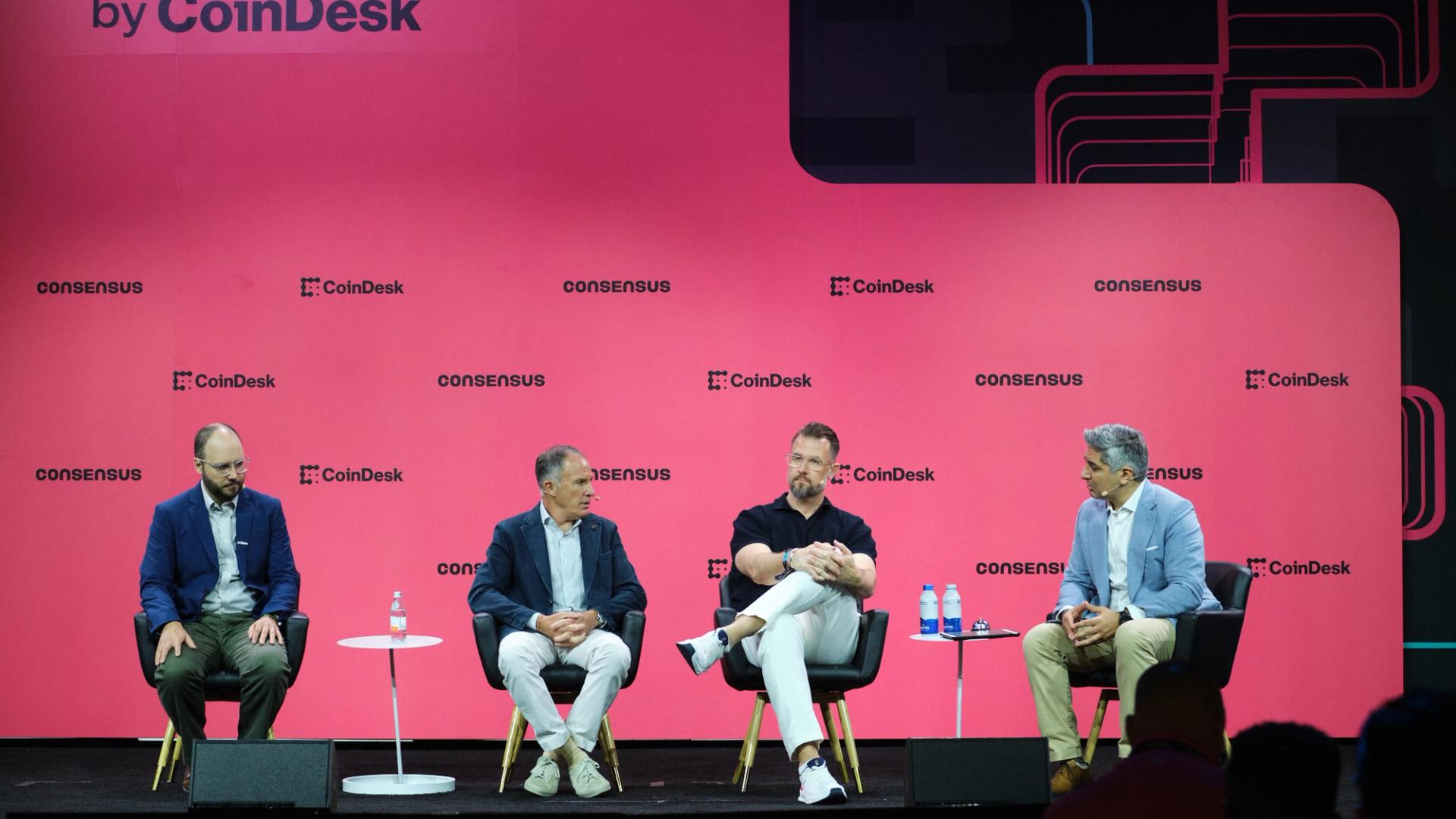
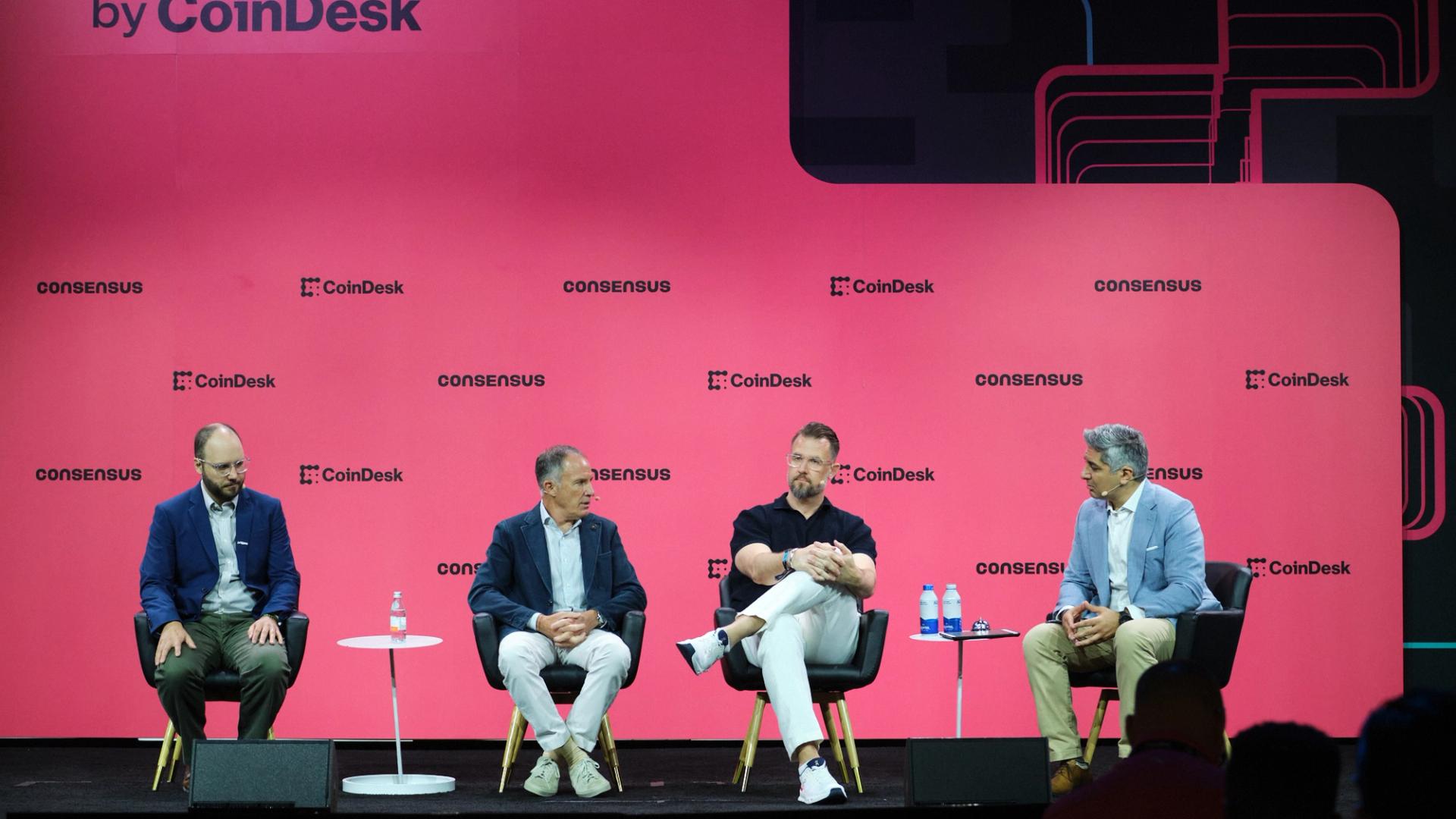
Stablecoins have moved from crypto niche to an institutional priority, but the next phase of adoption will depend on infrastructure, privacy and real-world usability, executives from MoonPay, Ripple and Paxos said at Consensus Miami 2026.
Richard Harrison, MoonPay’s vice president of banking and payment partnerships, said traditional finance firms are entering stablecoins faster because regulation has made the market easier to navigate.
“What GENIUS brought us was clarity,” Harrison said. “It was like a permission slip for companies to enter into stablecoins.”
Harrison said stablecoins are also a natural evolution of payments, where speed and convenience have long been limited by legacy rails. Cross-border transfers can still take days and remittances can carry steep fees, he said, while stablecoins allow near-instant, one-to-one value transfer.
Still, Harrison said stablecoins represent only a small share of global remittances today and may reach roughly 10% within five years. Business-to-business payments are already a clear use case, he said, but consumer adoption remains harder.
Jack McDonald, Ripple’s senior vice president of stablecoins, said institutional customers require regulated products, strong counterparties and trusted custody arrangements before moving meaningful volume on chain.
“For institutions to really unlock the full demand … you have to be regulated at the highest level,” McDonald said.
He said Ripple is focused less on stablecoin market capitalization than on utility, including payments, corporate treasury movement and collateral use in capital markets. McDonald said Ripple’s stablecoin complements XRP rather than competing with it, because transactions on the XRP Ledger still use XRP as the native token.
Brent Perrault, senior staff software engineer at Paxos, said newer regulated stablecoins can compete by emphasizing trust, distribution and user incentives. He cited PayPal USD’s growth and large institutions such as Charles Schwab using Paxos infrastructure as signs of demand from sophisticated financial firms.
But Perrault said privacy remains unresolved. Public blockchains expose transaction amounts and flows, and partial privacy is insufficient if users eventually move between private and public environments.
Harrison compared stablecoins to electric cars: the core product works, but adoption depends on supporting infrastructure.
“How do you use stablecoin to pay your rent?” he said. “How do you use it to buy a cup of coffee?”
European Central Bank (ECB) President Christine Lagarde rejected calls for euro-denominated stablecoins, arguing they cannot strengthen the currency’s international role and could destabilize bank funding across the eurozone.
Speaking at the Banco de España LatAm Economic Forum in Roda de Bará, Spain, Lagarde framed the speech as a direct rebuttal of the US GENIUS Act and the argument that Europe must answer with its own dollar substitute.
Two Functions, One Policy Split
Lagarde separated stablecoins into two functions to set up her case, arguing that conflating the two has distorted European policy.
- The monetary function extends a reserve currency’s global reach.
- The technological function provides on-chain settlement for tokenized assets.
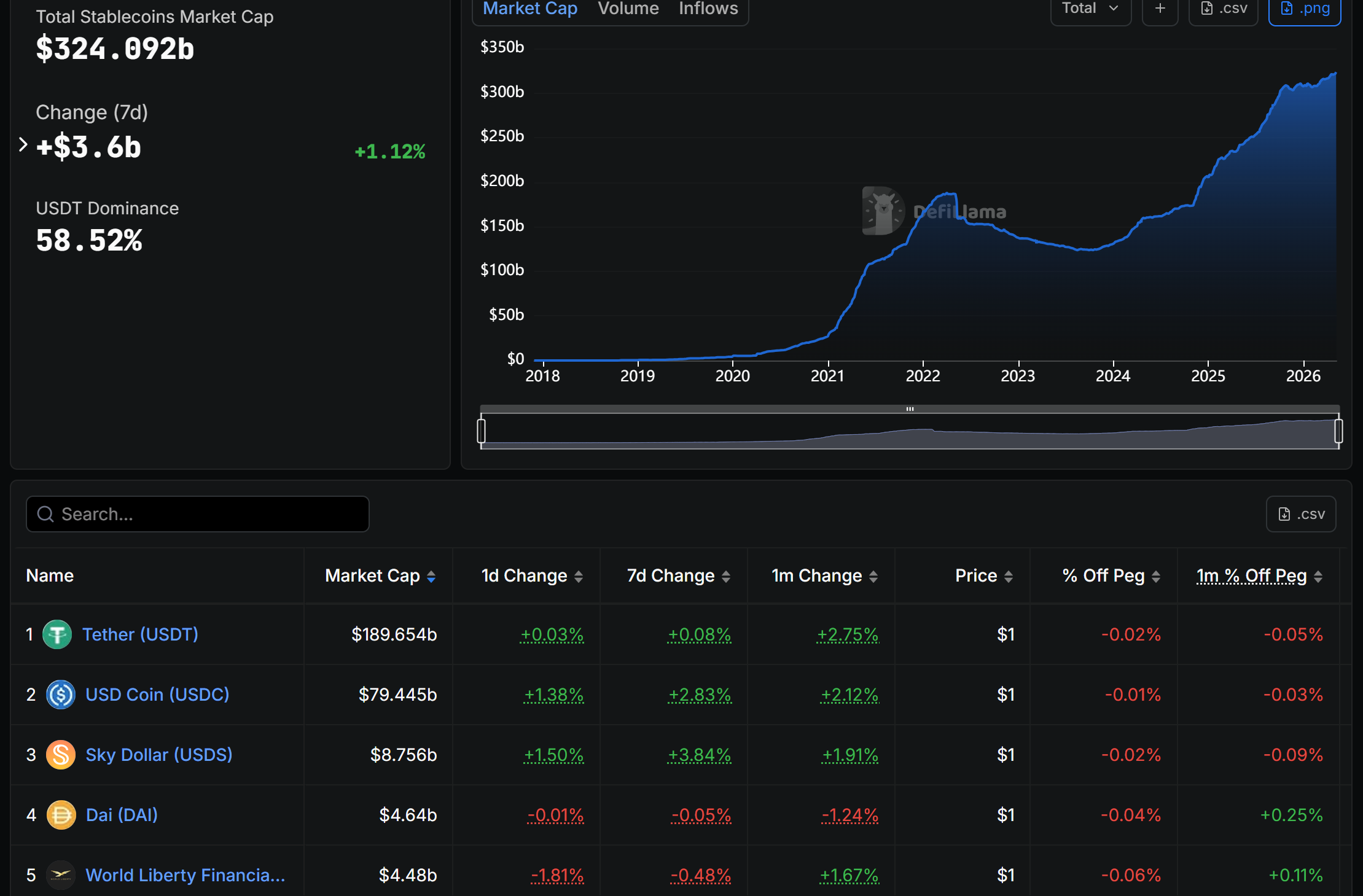
Stablecoins now top $324 billion in market value. Nearly 98% are denominated in dollars, with Tether and Circle issuing roughly 90%.

Transaction flows already hit 7.7% of GDP across Latin America and 6.7% across Africa and the Middle East. Lagarde used those numbers to show the dollar’s reach is already deeper than the euro’s outside Europe.
“Stablecoins reduce those frictions, as digital access is faster and easier than hard cash, and it reaches savers in countries where weak currencies can erode savings. In economies where access to a stable currency has historically been constrained, transaction flows already reach around 7.7% of GDP in Latin America and 6.7% in Africa and the Middle East,” she explained.
The US GENIUS Act, signed in 2025, framed federal stablecoin oversight as a tool for preserving dollar primacy. She quoted that intent to contrast it with Europe’s Markets in Crypto-Assets Regulation (MiCAR), which entered force in 2024.
Industry Challenges the Diagnosis With Europe’s Alternative Path in Focus
However, critics outside the bank ecosystem reject Lagarde’s framing, with Rand Hindi, founder of encryption firm Zama, issuing a sharp on-the-ground counterargument.
“And yet, the entire developing world is adopting the dollar thanks to USDT. This is the next petrodollar, it’s so obvious to anyone who has been on the ground…” he noted.
Hindi also pointed at dollar adoption inside the bloc itself. He claimed European startups raise, invoice, and pay in dollars and use euros only for tax obligations.
Lagarde used the speech to spotlight infrastructure work the Eurosystem already has underway. The Pontes pilot will link distributed ledger platforms to TARGET for wholesale settlement in central bank money from September.
The Appia roadmap targets a fully interoperable European tokenized ecosystem by 2028. Earlier 2024 trials settled roughly 1.6 billion euros across nine jurisdictions in 50 transactions.
Lagarde argued that a public anchor would let MiCAR-compliant stablecoins and tokenized bank deposits compete on safer ground without ceding settlement rails to dollar issuers.
The split is now explicit.
- Washington is building a dollar moat through private stablecoin issuance.
- Frankfurt is betting that public infrastructure and a deeper capital union will keep the euro relevant on chain.
Subscribe to our YouTube channel to watch leaders and journalists provide expert insights
The post Why ECB President Christine Lagarde Rejects Europe’s Answer to the GENIUS Act appeared first on BeInCrypto.
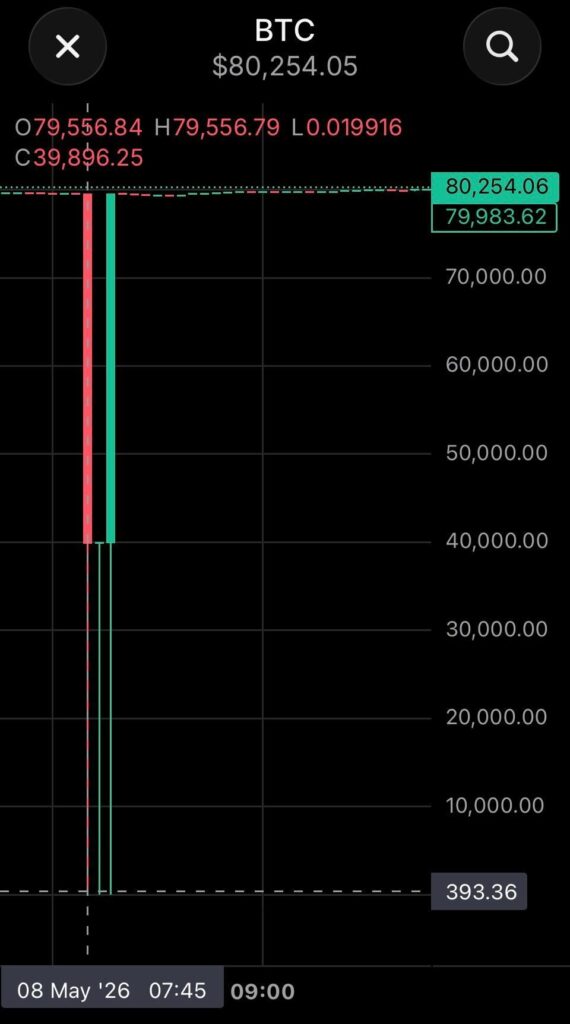
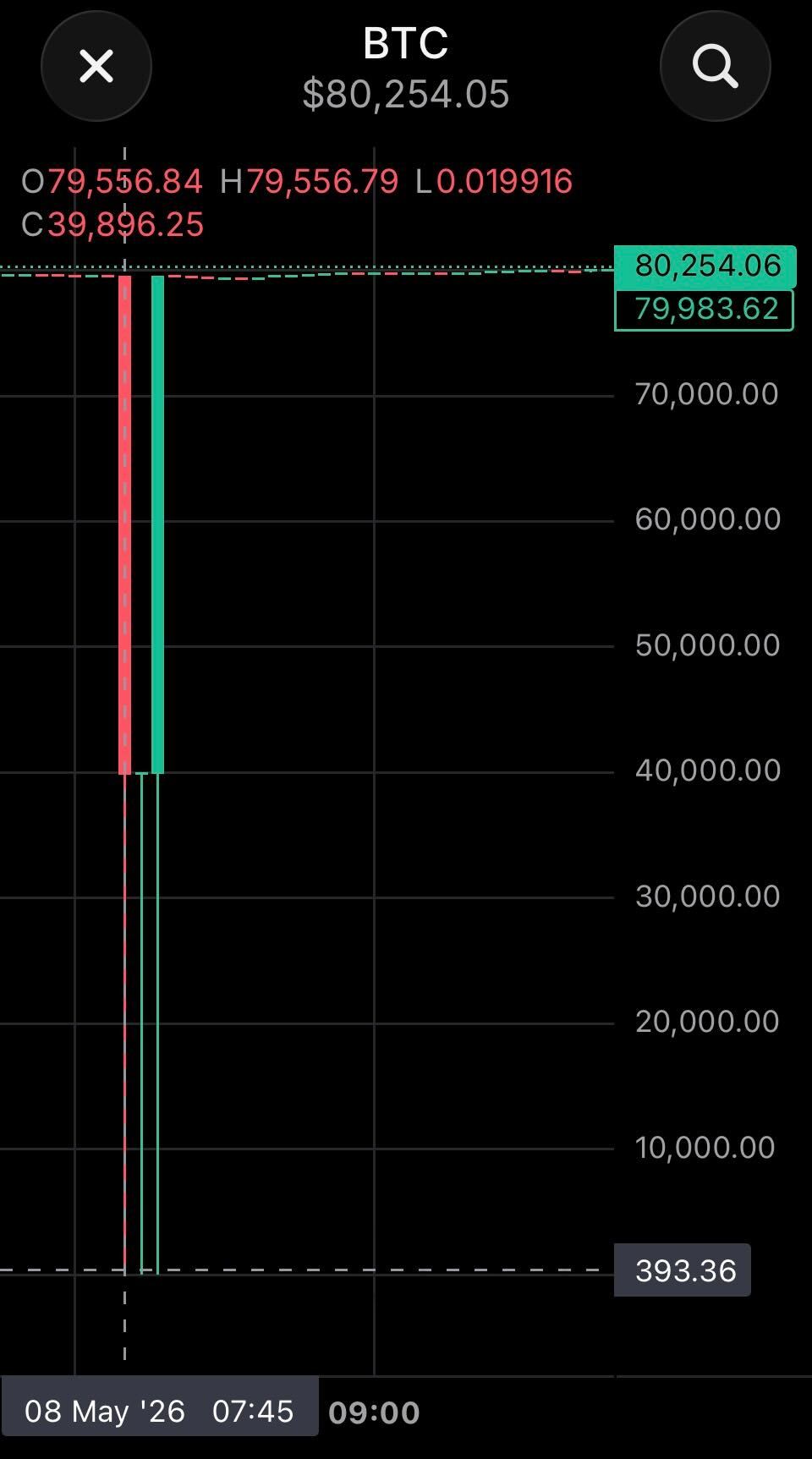
Bitcoin’s (BTC) briefly slipped from $79,000 to just $0.019 today on UK online banking platform Revolut. Mercifully, the dip lasted just a few seconds before it returned to its original price.
Using Google Chrome, Revolut displays the low between 7:45/50 GMT+1 as $73,000. However, the platform’s mobile app mobile displays the BTC drop as low as $0.019.
Revolut told Protos that the inaccurate pricing was caused by “a service disruption at a third-party provider.” It said the issue has since been solved and that it’s still “in the process of evaluating the details of the disruption.”
There was a flurry of confusion from onlookers on X this morning as they wondered whether or not a flash crash had taken place.
Many received a push notification from Revolut on their lock screens claiming that BTC had reached a 52-week low, and that the price was now $0.02. This would be closer to an all-time low.
Read more: Hot air at AWS causes Coinbase outage
All Revolut told users at the time through its support account is that it’s “currently experiencing technical issues affecting some crypto functionalities.”
However, it’s still unclear if this third-party disruption, leading to BTC’s brief cratering, was the result of a visual glitch or liquidity issues. Neither CoinGecko nor Coinbase are displaying such BTC crashes.
Visual glitches and flash crashes aren’t uncommon
Similar visual glitches aren’t uncommon in the crypto world. Binance, for example, displayed a glitch in people’s wallets last year that dropped everybody’s balance to $0.
This was caused by “network congestion,” which followed a $400 billion crash in the global crypto market just days beforehand.
In 2021, crypto exchange PDAX briefly listed BTC for $6,000, almost 90% cheaper than it was at the time. Users rushed to buy at the low price, and PDAX began suspending accounts.
The exchange then began to exchange legal threats with buyers. The listing in the end was a visual glitch.
Read more: Explained: How bitcoin market sell orders cause flash crashes
Other flash-crashes involved a sudden 10% BTC dip on South Korean crypto exchange Bithumb. The platform accidentally rewarded a user 2,000 BTC (worth $134 million at the time), who then sold it afterwards, causing the dip.
UK banks also experienced a weird visual glitch earlier this year that displayed the transactions and bank account details to random users.
People were reporting that they could see other people’s transactions, and the issue was widespread across Lloyds, Halifax, and the Bank of Scotland.
Got a tip? Send us an email securely via Protos Leaks. For more informed news and investigations, follow us on X, Bluesky, and Google News, or subscribe to our YouTube channel.
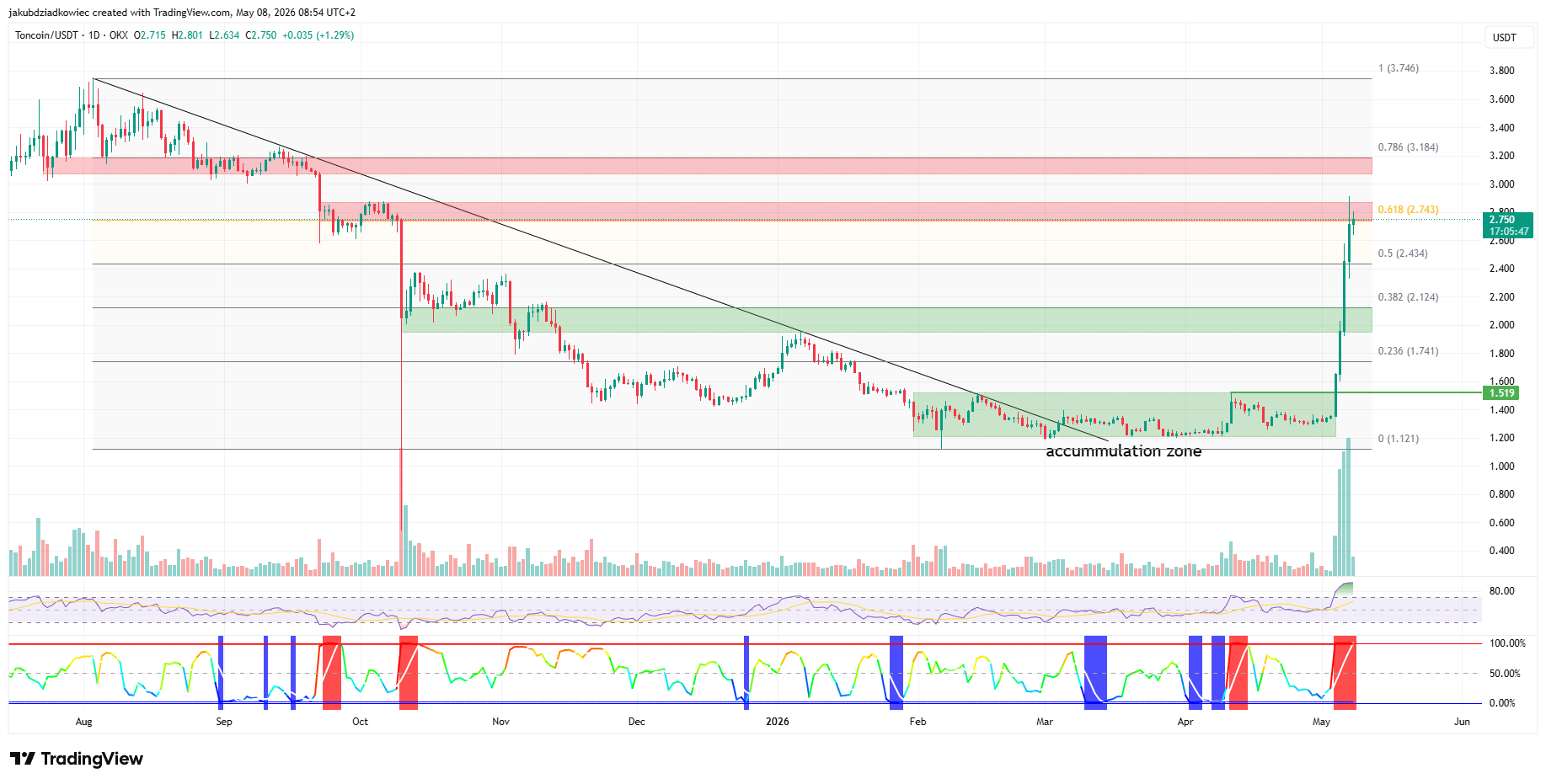
Toncoin (TON), Zcash (ZEC), and Venice Token (VVV) make up the top 3 altcoins flashing bullish daily structures this weekend. Each token enters Saturday with fresh breakouts on rising volume and clear paths toward the next major Fibonacci targets.
Each coin has cleared a critical resistance level over the past week. Supporting voices on X point to extended legs higher if current consolidations resolve in favor of buyers.
Toncoin (TON) Breaks Out Above $2.74 With Path to $3.10
Toncoin (TON) has broken out from a multi-month accumulation zone on May 4. Daily volume on the breakout candle was the largest green print on the chart since October.
Buying volume has continued to expand every session since. Price now trades at the 0.618 Fibonacci retracement at $2.74. The level is drawn from the August 2025 high down to the April low at $1.12.
A daily close above this level opens the path to the 0.786 Fib at $3.10. In the event of a correction, the first major support sits at the 0.382 Fib near $2.12.
Momentum readings have pushed near 93. The Bollinger Band Width Percentile (BBWP) also flashes extreme red readings, signaling stretched conditions. However, no bearish divergence has formed yet, which keeps the immediate trend intact.

The breakout coincides with fresh enthusiasm around the network. Telegram founder Pavel Durov has outlined a roadmap that puts Telegram itself as the largest TON validator.
Trader Zach Humphries sees the move as the start of a textbook expansion phase. He argues that TON is now testing a distribution block at $2.89. A flip of that level into support would open a longer-term path to $6.
“The expansion phase on $TON is playing out exactly as scripted… If we flip this resistance into support the path to $6.00 is wide open for the summer.”

Zcash (ZEC) Breaks $533 Resistance With $628 Next on the Map
Zcash (ZEC) has trended higher since April 13, when the price bounced off the 0.236 Fib at $317. Two days ago, the privacy coin broke through the 0.618 Fib at $533. That level also coincided with the December 29 swing high (blue circle).
The next target sits at the 0.786 Fib near $628. On the downside, the 0.382 Fib at $400 marks the first meaningful support if buyers lose control. The Visible Range Volume Profile (VRVP) shows the last significant resistance node near $690, with thin volume above that pocket.
Momentum is stretched. The 14-day Relative Strength Index (RSI) prints 86, deep in overbought territory, while BBWP also signals extreme volatility expansion.

The breakout has coincided with a sharp burst of institutional interest. Multicoin Capital disclosed a significant ZEC position at Consensus Miami this week. ETF speculation has accelerated alongside a fresh Robinhood listing.
X analyst TheMoonShow shared an hourly chart showing a tight consolidation triangle that resolved to the upside above $580.
“$ZEC looks like it’s getting ready for ATHs. Consolidated after the breakout and now looks ready for another expansion move.”

Venice Token (VVV) Pushes to $13.96 With $17.30 Target
Venice Token (VVV) is the strongest performer of the three. The native token of the Venice AI ecosystem has reached a fresh 2026 high near $13.96. Price has trended higher since the breakout on February 13.
A Fibonacci retracement drawn from the February 13 low to the current swing high reveals two key support zones. The 0.618 Fib sits at $9.30, and the 0.382 Fib rests at $6.42.
Upside targets come from external Fibonacci extensions. The 1.272 extension lands at $17.30 and the 1.618 extension at $21.52.
The 14-day RSI sits at 80 and continues to trend up without any bearish divergence. Volatility, measured by BBWP, also remains in expansion mode.

A move into the $20 zone would sit between the 1.272 and 1.618 external Fib levels. Both extensions are mapped on the daily chart. For traders eyeing the VVV longer-term path, the same structure remains intact as long as $9.30 holds on any pullback.
Top 3 Altcoins Outlook for the Weekend
All three setups remain technically aligned for upside continuation, as long as their respective breakout levels hold. A close below $2.51 (TON), $400 (ZEC), or $9.30 (VVV) would invalidate the immediate thesis. Such a move would shift focus to deeper retracements.
The bullish case rests on momentum staying expanded through Saturday and Sunday. If buyers absorb supply at the current Fib levels, each chart points to an extended leg higher into next week.
The post Top 3 Altcoins Flashing Bullish Setups Heading Into the Weekend appeared first on BeInCrypto.

The CLARITY market structure bill in the United States could be marked up by the Senate Banking Committee as early as next week, according to Kara Calvert, the vice president of US policy at Coinbase. Speaking at the Consensus 2026 crypto industry conference in Miami, Calvert indicated that momentum is building toward a committee vote, but stressed that passage will require broad bipartisan support and a solid 60 votes in the Senate.
“My prediction is that we have a markup next week,” Calvert said at Consensus 2026. “That means you need Democrats. You need a bipartisan bill, and we have all been working really hard to make sure that bipartisanship holds. I think the big question is, how do these votes shape up over the next few days?”
“That means you need Democrats. You need a bipartisan bill, and we have all been working really hard to make sure that bipartisanship holds. I think the big question is, how do these votes shape up over the next few days?”
In context, a HarrisX poll released on Thursday underscored broad appetite for clear federal crypto rules. The survey found that 70% of voters believe the US should already have enacted clear cryptocurrency legislation, and 62% regard the US as pivotal in setting global rules for digital finance.
However, the path forward remains uncertain. The CLARITY bill previously stalled in January after Coinbase withdrew its support, citing concerns including insufficient protections for open-source software developers, a prohibition on stablecoin yield, and certain DeFi regulatory gaps. As Cointelegraph reported, these issues contributed to hesitation among industry participants about advancing the legislation without further refinements.
Related coverage notes that a broader political dynamic may influence timing. A separate report cited a US senator suggesting a vote on crypto market structure could occur by August, signaling ongoing legislative attention to the sector even as specific provisions remain contested.
A key takeaway highlighted by Calvert is that the tax framework surrounding crypto remains a central hurdle to institutional adoption. The prevailing view is that coherent tax policy is often more critical to mainstream participation than the exact contours of market structure legislation. Institutional actors seeking to acquire and hold digital assets face complex tax reporting burdens that add cost and compliance risk.
Tax reporting requirements under current regulations require crypto exchanges to document numerous transactions for IRS purposes, including small-value trades. Calvert described the process as an inefficient burden that undermines the attractiveness of crypto as an asset class for institutions. In this context, several lawmakers have advanced tax reform proposals aimed at simplifying treatment for digital assets, with the Digital Asset PARITY Act among the notable efforts under consideration.
Looking ahead, Calvert estimated that tax reform discussions could gain momentum in 2026, with potential action in both chambers in the coming months. She noted that while market structure legislation remains on the congressional radar, a robust tax policy framework could have a more decisive impact on institutional participation in crypto markets.
Key takeaways
- The CLARITY Market Structure Act could receive a markup in the Senate Banking Committee as early as next week, signaling renewed congressional attention.
- passage hinges on bipartisan support and securing 60 votes in the Senate, a threshold that requires cross-party collaboration.
- Public sentiment strongly favors clear federal crypto rules, with a majority of voters supporting expedited regulatory clarity and leadership in global digital finance norms.
- Past resistance centered on protections for open-source developers, DeFi regulation gaps, and restrictions on stablecoin yields; these concerns may shape ongoing negotiations.
- Tax policy remains a primary barrier to institutional adoption, with proposed reforms toward simplifying crypto taxation and reporting highlighted as critical to broader participation.
Legislative timing and bipartisan dynamics
The forthcoming markup reflects a broader strategy to finalize a coherent federal framework for crypto markets. Calvert’s view underscores the practical challenge: a bipartisan coalition is essential to pass controversial market safeguards that touch on exchanges, developers, and liquidity providers. The Senate’s willingness to engage on a comprehensive package, rather than piecemeal provisions, will likely influence not only the CLARITY bill’s fate but also the pace of related tax and regulatory proposals.
As observers weigh the political calculus, it is clear that the administration and lawmakers are intent on avoiding a regulatory gap that could jeopardize perceived global competitiveness. The balance between investor protection, innovation, and regulatory clarity remains at the center of the debate, with industry stakeholders monitoring committee schedules and drafting discussions closely.
Tax policy and institutional adoption barriers
Beyond market structure specifics, a coherent tax regime is viewed as a pivotal enabler or constraint for institutions. The current framework, which some describe as misaligned with the complexities of digital assets, imposes extensive reporting obligations that increase administrative costs and compliance risk for banks, custodians, and asset managers. Calvert pointed to the volume of 1099-DA-style reporting as an example of how tax rules can hamper efficient participation in crypto markets.
In parallel with package discussions, lawmakers have introduced tax-focused proposals aimed at providing parity and reducing unnecessary friction for legitimate crypto activities. The Digital Asset PARITY Act—among the measures cited by industry participants—illustrates congressional efforts to simplify tax treatment while preserving compliance controls. The ongoing debate over how best to align tax policy with evolving market realities is expected to shape both legislative posture and enforcement priorities in the near term.
From an enforcement perspective, the interplay between tax policy, regulatory oversight, and market structure is material for exchanges, banks, and institutions seeking reliable, lawful access to digital asset markets. Regulatory filings and policy papers indicate a move toward greater clarity on reporting standards, transfer of value, and custody requirements—areas that directly impact licensing, risk management, and internal governance for market participants.
On the regulatory horizon, the CLARITY debate unfolds within a broader ecosystem that includes discussions on stablecoins, DeFi governance, and the scope of permissible activities for non-custodial protocols. As policymakers weigh these elements, the potential for harmonization with international standards—while preserving US innovation and market integrity—remains a central objective.
Regulatory context and market implications
The ongoing debate around the CLARITY Act sits at the intersection of policy design and practical compliance needs. For exchanges and institutions, a clear federal framework can reduce legal uncertainty, facilitate licensing, and streamline cross-border operations. Conversely, if final legislation imposes stringent restrictions on stablecoin yields or imposes expansive DeFi regulations, firms may face higher compliance costs and strategic reconsiderations about product design and market participation.
Industry observers also note that regulatory alignment with federal rules would complement international efforts, including Europe’s MiCA framework, by providing a common baseline for compliance expectations and reporting standards. While MiCA addresses certain aspects of digital asset markets within the EU, the US approach continues to emphasize a combination of specific rules for tokens, platforms, and custodial services, with enforcement priorities determined by agencies such as the SEC, CFTC, and DOJ.
In this context, the poll results indicating broad demand for federal clarity acquire particular significance: if policymakers deliver a comprehensive, bipartisan package, institutions may accelerate due diligence, risk assessments, and governance updates to align with forthcoming requirements. Conversely, protracted negotiations or partial measures could maintain a level of regulatory uncertainty that complicates capital allocation and program design for large firms and financial intermediaries.
According to Cointelegraph, the regulatory debate remains active, with stakeholders watching for signs of how the next weeks’ markup and related tax discussions might translate into concrete policy outcomes. The evolving framework will influence licensing trajectories, reporting obligations, and the risk controls that underpin institutional participation in digital assets.
Closing perspective
The next steps in the CLARITY bill process will be closely watched by market participants, policymakers, and regulators alike. A markup in the near term would signal renewed congressional attention and set the stage for negotiations on a broader policy architecture that could shape institutional access to crypto markets for years to come. While much remains unresolved, the emphasis on bipartisan support and tax policy coherence will likely determine the trajectory of US crypto regulation in the near term.
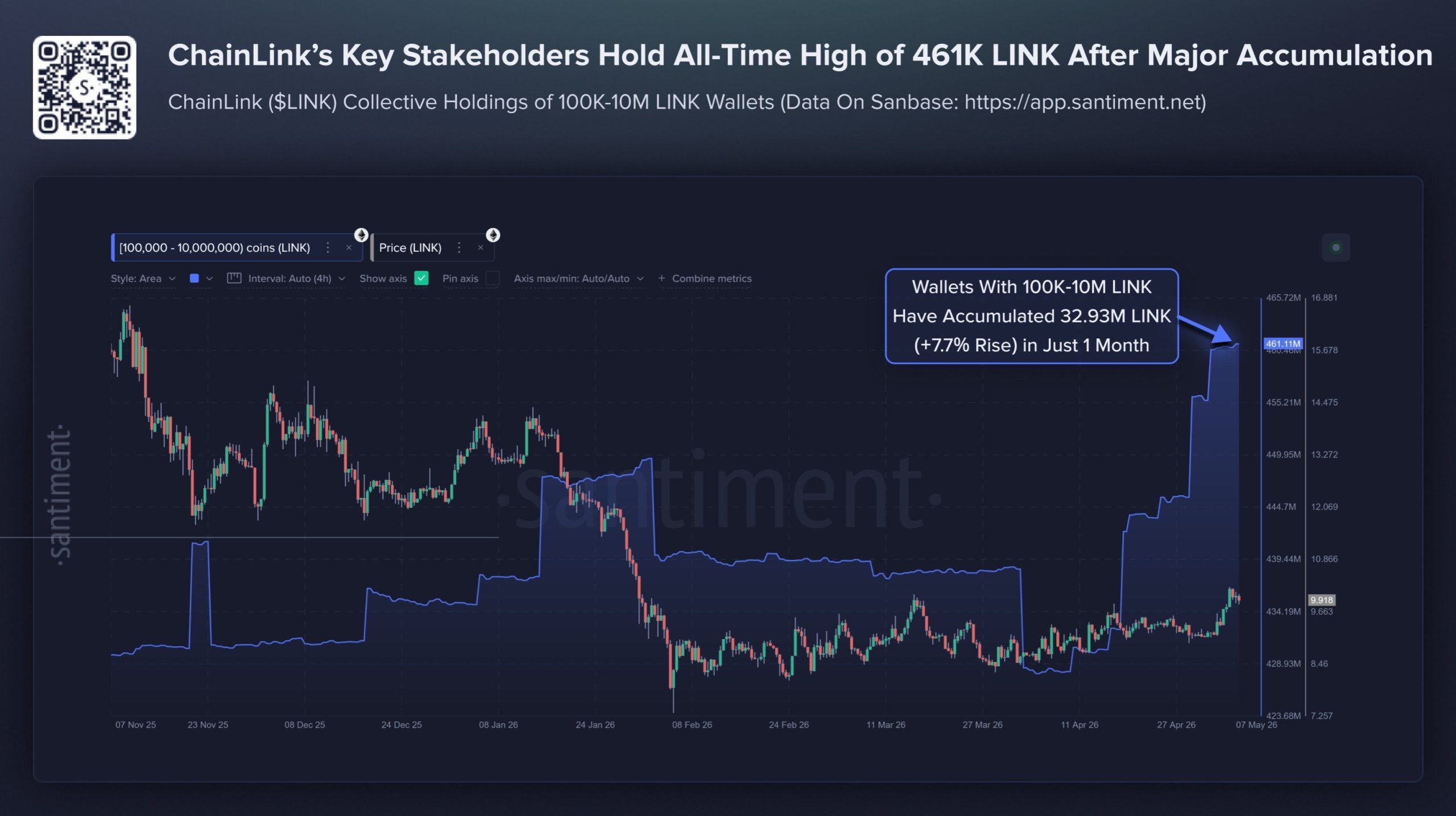
Chainlink (LINK) closes a multi-month accumulation phase as on-chain data shows whales adding 32.93 million tokens in 30 days. The setup positions LINK for a potential push toward $15.
LINK trades near $10 after a 1% pullback, with the daily chart breaking its August 2025 trendline. The four-hour structure still flashes caution after a midline rejection earlier this week.
Whales Stack 32.93 Million LINK in 30 Days
Santiment data shows wallets holding 100,000 to 10 million LINK absorbed 32.93 million coins in one month. That marks a 7.7% rise in 30 days. Collective holdings from this cohort now sit at an all-time high above 461 million LINK across roughly 461,000 wallets.
This tier matters because it sits between retail traders and exchange-controlled custodial accounts. These addresses move meaningful capital but stay non-custodial, making their behavior a cleaner read on conviction. Santiment wrote:
“Historically, when this specific tier accumulates aggressively, it tends to precede rather than react to price appreciation.”
The pattern lines up with the chart. Absorption happened through Q1 2026 while LINK traded sideways near multi-month lows. Reduced exchange supply now sets up what Santiment frames as an early-stage supply squeeze. The setup gains weight if Bitcoin (BTC) sustains its bid.

Chainlink Price Prediction Eyes $15 if $9.40 Holds
The daily chart paints a constructive picture that aligns with the on-chain signal. Chainlink broke its descending trendline drawn from the $28 high on August 22, 2025. The breakout occurred on March 15 and was retested cleanly on March 22 (blue circle).
The Visible Range Volume Profile (VRVP) places the heaviest volume support near $9.40. That zone is now acting as the base. Above the current price, the next significant volume blocks line up near $15 and $17.52.

The first measured target sits at the 0.382 Fibonacci retracement near $15.08. That marks a roughly 50% move from current levels. The next confluence sits at the 0.5 Fibonacci near $17.52, with $19.96 as a stretch target at the 0.618 Fibonacci.
The thesis is reinforced by daily RSI, which has bounced off a descending trendline drawn from July 2025. That trendline acted as resistance throughout 2026 and turned into support in early May. The shift pushed RSI back into bullish territory and printed a higher high.

A daily close below $9.40 would invalidate the bullish setup and reopen the prior consolidation range. With the broader BTC trend holding, whale accumulation combines with broken downtrends to keep LINK biased higher into the volume zones above.
Four-Hour Structure Flashes Near-Term Caution
The on-chain conviction does not translate into immediate momentum on lower timeframes. LINK has been trading inside an ascending parallel channel since February 6, showing a clear behavioral shift mid-stream.
During the first half of that span, price rode the upper portion of the channel. The upper band acted as resistance, and the midline as support. After March 26, that dynamic flipped. LINK started to trade in the lower half.
The midline now acts as resistance, and the lower band as support.

On May 6, the four-hour candle was rejected from the channel midline near $10.40. The price now struggles to confirm prior resistance at $10 as new support. MACD on the four-hour chart points to continued downside pressure.
If sellers extend the rejection, the lower band of the channel sits near $9.30. A reclaim of the midline opens the way to the upper band at $11.46. Sustained acceptance over $10 turns this near-term structure constructive again and aligns the lower timeframe with the daily breakout.
The post Chainlink Whales Add 32.93 Million LINK as Price Targets $15 Breakout appeared first on BeInCrypto.

Key Takeaways
- Daiwa Securities shifted Qualcomm’s rating from Neutral to Outperform, establishing a $225 price objective
- Shares of QCOM climbed 6% during Friday’s session after rising 5.6% pre-market from Thursday’s $202.50 close
- The chipmaker’s stock has surged more than 60% over the last month
- Second-quarter earnings showed EPS of $2.65, topping the $2.56 forecast, though revenue declined 3.5% annually
- Management authorized a $20 billion buyback program; average analyst target stands at $176.54 with a Hold consensus
Shares of Qualcomm experienced a significant 6% surge during Friday’s trading session following an upgrade from Daiwa Securities, which moved the semiconductor company from Neutral to Outperform. The firm established a $225 price objective, suggesting approximately 11% potential appreciation from present trading levels.
After settling at $202.50 on Thursday, the stock showed strength in pre-market activity with a 5.6% advance. The past month has been particularly rewarding for shareholders, with QCOM delivering gains exceeding 60%.
Louis Miscioscia, the Daiwa analyst behind the upgrade, highlighted Qualcomm’s promising revenue expansion trajectory and what he characterized as reasonable current valuation levels.
His research note posed whether the company might become the next chip sector player to experience a price-to-earnings multiple expansion, drawing parallels to Arm Holdings’ recent valuation reassessment.
Miscioscia identified an approaching investor presentation as an important near-term catalyst, where executive leadership is anticipated to detail strategic initiatives in data center processors, physical computing solutions, and edge artificial intelligence applications.
Second Quarter Results: Performance Analysis
The company delivered second-quarter earnings of $2.65 per share, surpassing Wall Street’s $2.56 projection by nine cents. Total revenue reached $10.60 billion, meeting analyst forecasts.
Year-over-year comparisons showed a 3.5% revenue contraction from the prior year period, when the company posted $2.85 per share. Forward guidance for the third quarter called for earnings between $2.10 and $2.30 per share, missing analyst expectations.
Despite the conservative near-term outlook, Miscioscia emphasized that investors should prioritize Qualcomm’s long-range growth opportunities over quarterly fluctuations.
The board of directors greenlit a substantial $20 billion stock repurchase authorization in March, representing approximately 14.5% of shares outstanding.
Analyst Community Remains Split
The broader investment community hasn’t fully embraced the bullish thesis. Wall Street’s aggregate rating on QCOM sits at Hold, with a consensus price objective of $176.54 — substantially beneath current trading levels.
Bank of America maintains an Underperform stance with a $145 target. Morgan Stanley holds an Underweight view at $146. Susquehanna assigns a Neutral rating at $160.
Conversely, TD Cowen elevated its price objective to $200 with a Buy recommendation on April 30th. The analyst community breaks down to nine Buy ratings, sixteen Hold recommendations, and three Sell opinions.
Technical indicators also present a complex picture, with overbought conditions emerging as a potential headwind following the explosive 30-day rally.
Compounding cautious sentiment, Chief Executive Officer Cristiano Amon divested 10,000 shares on May 4th at an average execution price of $180.00, generating proceeds of $1.8 million. The transaction occurred under a predetermined Rule 10b5-1 trading arrangement.
Executive Vice President Heather Ace similarly sold 3,200 shares at $177.82 on the identical date. Corporate insiders have collectively disposed of 19,177 shares worth approximately $3.18 million during the trailing 90-day period.
Qualcomm carries a market capitalization of $213.70 billion, trades at a price-to-earnings multiple of 22.04, and exhibits a beta coefficient of 1.49. The 50-day moving average registers at $138.77, considerably below the present share price.
The stock’s 52-week trading band extends from $121.99 to $223.66, indicating current prices hover near the upper boundary of the annual range.

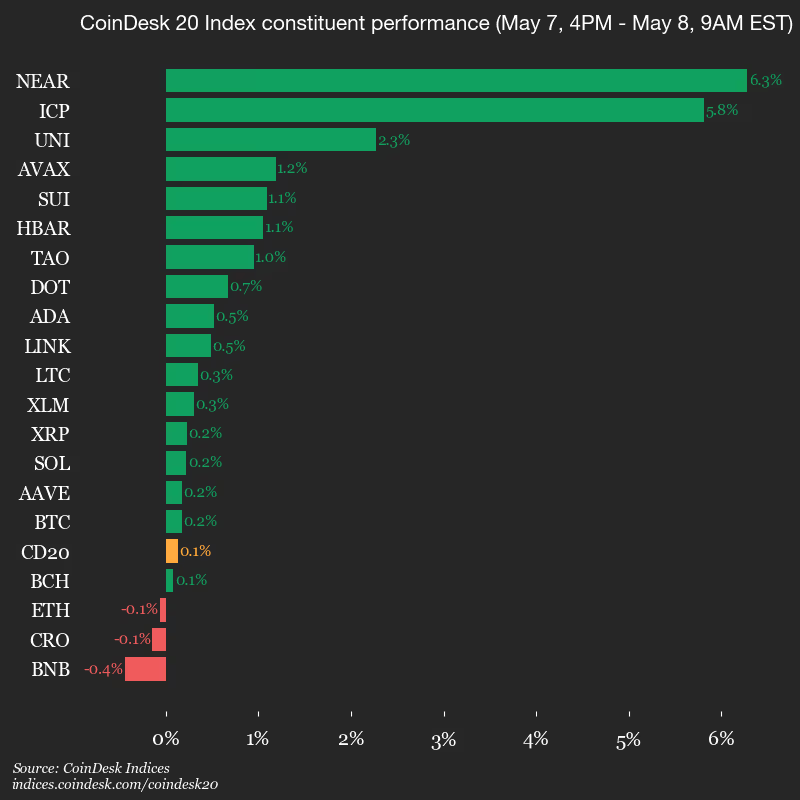
CoinDesk Indices presents its daily market update, highlighting the performance of leaders and laggards in the CoinDesk 20 Index.
The CoinDesk 20 is currently trading at 2142.44, up 0.1% (+2.73) since 4 p.m. ET on Thursday.
Seventeen of 20 assets are trading higher.

Leaders: NEAR (+6.3%) and ICP (+5.8%).
Laggards: BNB (-0.4%) and CRO (-0.1%).
The CoinDesk 20 is a broad-based index traded on multiple platforms in several regions globally.
Crypto World
Bitcoin Price Prediction: Bitcoin Falls to $79.6k as US-Iran Escalation Dents Risk Set for 6th Weekly Gain
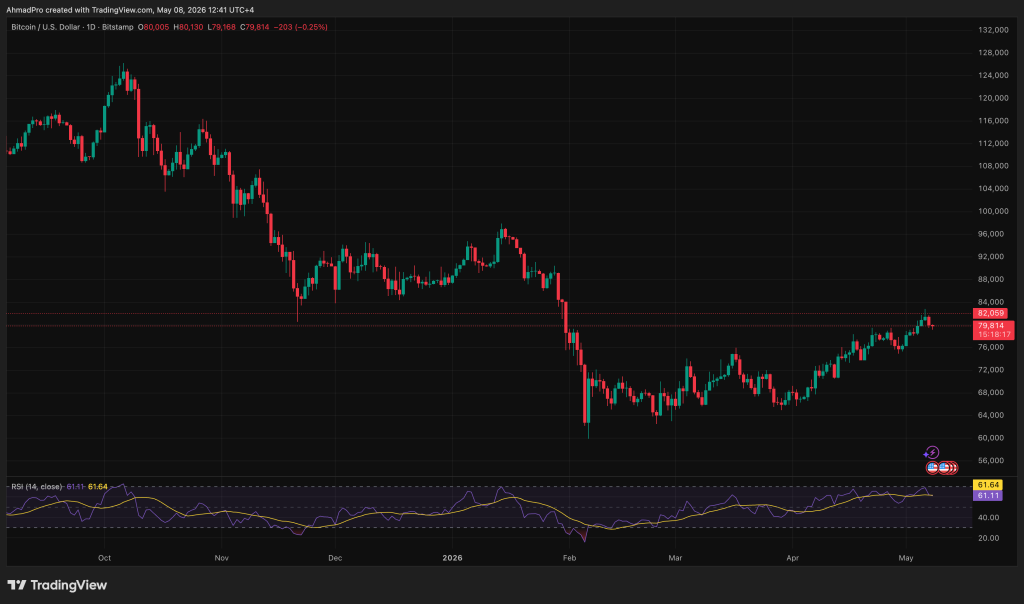
Bitcoin price slid to $79,679 Friday as US military strikes against Iranian vessels in the Strait of Hormuz triggered a broad risk-off prediction, yet the world’s largest crypto remains on track for a sixth consecutive weekly gain.
The 1.7% intraday drop looks alarming on the surface, but the weekly chart tells a quieter story. What happens at the weekend close could define whether BTC reclaims $85,000 or gives back the entire week’s advance.
The immediate catalyst: US forces struck back against Iran following attacks on three American warships transiting Hormuz, reigniting a geopolitical flashpoint that markets had largely priced out.
Compounding the pressure, Strategy Inc (NASDAQ: MSTR), the largest corporate Bitcoin holder, signaled it could sell portions of its holdings to fund dividend payments, though the scope and timing remain unspecified.
Despite the intraday weakness, BTC is still up approximately 3% on the week. The macro backdrop, institutional accumulation, improving US regulatory clarity, and residual post-ATH consolidation, remain broadly constructive heading into the weekend session.
Discover: The best crypto to diversify your portfolio with
Bitcoin Price Prediction: Can BTC Price Reclaim $85,000 Before the Weekly Close?
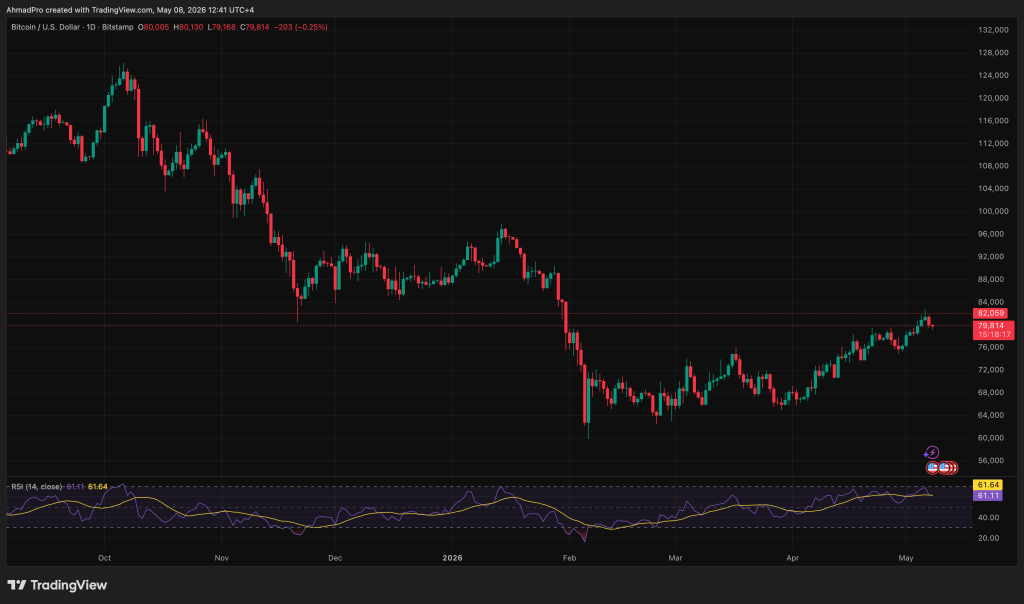
Bitcoin is trading in one of the most important structural zones of this cycle, hovering around $80K while pressure builds between key support and resistance.
The broader setup remains constructive, but only as long as $79K continues holding as the primary daily support floor. That level is doing the heavy lifting right now.
As long as buyers defend it, the post-correction recovery remains intact, with $83K–$85K still functioning as the major upside target and mean reversion zone after October’s sharp pullback.
On-chain data continues to show accumulation rather than broad distribution, which suggests larger players are still absorbing supply at current levels instead of exiting positions.
Resistance overhead remains significant, and Bitcoin needs a decisive break above that $83K–$85K region before any larger breakout narrative gains real credibility.
Until then, the market is essentially coiling. If BTC maintains this structure, the path toward stronger continuation remains open, but a breakdown below $75K would materially weaken the setup and shift focus toward the $69K long-term trendline as the next serious support zone.
Volume conditions also matter here, especially with thinner weekend liquidity increasing the probability of exaggerated moves in either direction.
The honest reality is that Bitcoin still looks structurally stronger than weaker, but this is a conditional setup where support must hold.
Discover: The best pre-launch token sales
The post Bitcoin Price Prediction: Bitcoin Falls to $79.6k as US-Iran Escalation Dents Risk Set for 6th Weekly Gain appeared first on Cryptonews.

Weekly Market Insights with Gary Thomson: US Inflation, UK GDP, and US-China Meeting

It could have been Brian Brobbey but Manchester United might finally have the right No.9

First Segment of the Fehmarnbelt Tunnel Is In Place

Manchester United reach agreement with Casemiro over contract clause amid transfer speculation

US brings back mandatory military draft registration

Steven Gerrard disagrees with Gary Neville over ‘shock’ Chelsea and Arsenal claim | Football


-

 NewsBeat5 days ago
Channel 5 – All Creatures Great and Small series 7 new post
-
 Crypto World5 hours ago
HarrisX Poll Found 52% of Registered Voters Support the CLARITY Act
-

 Crypto World1 day ago
Upbit adds B3 Korean won pair as Base token gains Korea access
-
 NewsBeat1 day ago
NCP car park operator enters administration putting 340 UK sites at risk of closure
-
 Tech7 days ago
Trump’s 25% EU auto tariff breaches Turnberry Agreement that also covers semiconductors and digital trade
-
 Sports7 days ago
Paul Scholes issues Marcus Rashford reality check as agreement emerges over Man United star
-

 Tech4 days ago
Image AI models now drive app growth, beating chatbot upgrades
-

 Entertainment7 days ago
Met Gala 2026 Rumored Guest List Is Turning Heads
-
Entertainment7 days ago
New on Prime Video in May 2026 — Full List of Movies and Shows
-

 Entertainment7 days ago
Kylie Jenner Hit With Second Lawsuit From Ex-Housekeeper
-

 Sports7 days ago
Cavaliers vs. Raptors Game 6 live score, updates, highlights from 2026 NBA playoffs first-round series
-

 Entertainment5 days ago
Melissa Joan Hart and More Stars Attend 2026 Kentucky Derby
-
 Sports7 days ago
David Benavidez responds to team Canelo saying the fight will never happen
-
Entertainment6 days ago
New Netflix Movies in May 2026 — My Top 3 Picks to Stream
-
 Sports7 days ago
IPL 2026: ‘Love you darling’- Hardik Pandya’s reaction to MS Dhoni steals the show |Watch | Cricket News
-

 Entertainment7 days ago
Young and the Restless Next Week: Cane Arrested & Matt’s Deadly New Scheme!
-

 Tech7 days ago
Mother’s Day 2026 Gift Guide: Audio to Upgrade Mom’s Lifestyle
-
 Crypto World6 days ago
Pi Network Mandates Protocol 23 Upgrade for All Mainnet Nodes Before May 15 Deadline
-

 Business5 days ago
Luka Doncic Injury Update: Doncic’s Hamstring Recovery Slows Lakers’ Hopes Against Thunder: Can He Run Yet?
-

 Business7 days ago
Can Victor Wembanyama Bring the NBA Ring to Spurs in 2026? Historic Playoff Run Fuels Title Dreams
You must be logged in to post a comment Login