

Crypto World
Senate Banking Publishes Crypto Market-Structure Bill Text Before Markup

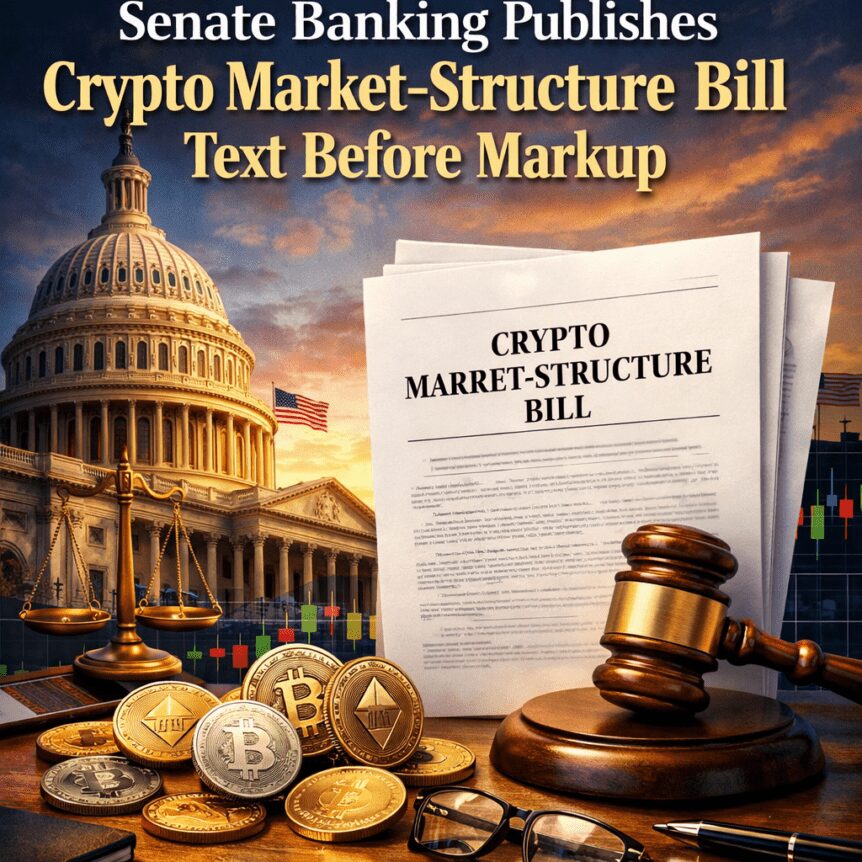
The U.S. Senate is turning its attention to the Digital Asset Market Clarity Act (CLARITY) as an anticipated Thursday markup approaches, with lawmakers weighing a text that broadens the framework for crypto market structure while surfacing questions about unrelated policy provisions. The version released by three Republican senators—marking what they say is a product of ongoing negotiations with Democratic colleagues—follows earlier drafts from mid-2025 and represents a step in recent intensive discussions over stablecoin yield and market structure governance.
According to the U.S. Senate Banking Committee release, the text will guide committee deliberations on how digital assets are supervised and regulated in the broader financial system. The bill’s release came after negotiations that extended into fall 2025, with lawmakers signaling bipartisan momentum for a markup on the measure. In parallel, some Democrats have pressed for accompanying ethics provisions to address conflicts of interest, linking the crypto policy debate to wider concerns about governance and integrity in financial legislation. As reported, the dynamics remain delicate, with discussions framed by a balance between industry structure, investor protections, and legislative oversight.
Notably, the final pages of the draft contain a housing policy element—the Build Now Act—that would create a pilot program intended to incentivize housing development within select Community Development Block Grant participating jurisdictions. This inclusion has surprised some observers, given that the core text centers on market structure for digital assets rather than housing, and has sparked questions about Senate Democrats’ appetite for attaching broader policy measures to crypto legislation. The section-by-section summary indicates the housing provisions are designed to pilot development initiatives, which could influence the overall legislative package and its political reception.
Senators Tim Scott, Cynthia Lummis, and Thom Tillis have portrayed the text as a product of ongoing bipartisan talks with their Democratic colleagues, signaling a readiness to move toward a markup on Thursday. Yet, in public comment, some Senate Democrats, including Kirsten Gillibrand, have urged that the bill not reach the floor without explicit ethics language addressing potential conflicts of interest. The tension was summarized by party-line perspectives and positioned to shape the upcoming procedural path for CLARITY.
“We have worked too hard on this bill to give up now,” said Senator Angela Alsobrooks, who sits on the banking committee and helped broker a stablecoin yield compromise with Tillis. “My hope is to get to a bipartisan markup on Thursday with a compromise on ethics.”
In the broader policy conversation, the CLARITY Act is frequently described as a vehicle to clarify and potentially expand the Commodity Futures Trading Commission’s (CFTC) oversight role in the digital-asset space, a shift often discussed in relation to where the Securities and Exchange Commission (SEC) would or would not have jurisdiction. The legislative journey has included prior committee activity—most notably, the Senate Agriculture Committee’s January markup advancing its version of the bill—but full passage remains contingent on Banking Committee action, Senate floor votes, and eventual reconciliation with the House of Representatives. The cross-chamber process mirrors the complexity of other crypto-related legislation, including past bipartisan outcomes on related measures such as stablecoin infrastructure and cross-border policy alignment.
Key takeaways
- The CLARITY Act text has been released ahead of a scheduled Senate Banking Committee markup, signaling renewed bipartisan engagement on digital-asset market structure and regulatory oversight.
- A housing-related provision—the Build Now Act—appears in the later pages of the draft, introducing a pilot program to incentivize housing development in certain Community Development Block Grant jurisdictions. The policy’s inclusion in a crypto bill raises questions about legislative scope and sequencing.
- The bill explicitly prohibits paying interest or yield on payment-stablecoins, with narrow exceptions for bona fide activities or transactions that are not economically or functionally equivalent to interest-bearing deposits. This provision directly shapes how stablecoin models may be structured or marketed in the United States.
- Provisions drawn from the Blockchain Regulatory Certainty Act aim to shield software developers from traditional money-transmitter requirements, a topic closely watched by DeFi and open-source development advocates.
- Advocacy and enforcement dynamics center on the balance between empowering the CFTC and maintaining appropriate guardrails. Ethic provisions remain a point of contention among lawmakers, with some Democrats insisting on clear ethics language before advancing.
- The overall legislative path remains complex: Agriculture Committee approval has occurred, but the Banking Committee, Senate floor, and House reconciliation are still prerequisites for any final enactment. Previous crypto measures have demonstrated that bipartisan support can be achievable but not guaranteed on procedural or policy grounds.
CLARITY Act: structure, scope, and regulatory intent
At its core, the CLARITY Act seeks to redefine regulatory posture for digital assets by clarifying which agency takes primary supervisory responsibility and by spelling out market-structure rules that would govern issuance, trading, and settlement of crypto instruments. A central element, as outlined in the text, is a prohibition on paying interest or yield on payment stablecoins. The prohibition is not absolute, however; the text allows incentives or rewards that are based on bona fide activities or bona fide transactions and that are not economically or functionally equivalent to paying interest on an interest-bearing bank deposit. The structure of this prohibition will influence how stablecoins are designed and marketed, potentially shaping issuer strategies and user expectations for on-chain payments and settlements.
In addition, the bill incorporates language from the Blockchain Regulatory Certainty Act, a provision designed to shield developers of blockchain software from being treated as money transmitters under existing statutes. This element is of particular interest to DeFi ecosystems and other open-source projects, which have long argued that broad money-transmitter designations could chill innovation. Proponents argue that such protection helps maintain near-term operational viability for developers while still enabling appropriate regulatory oversight over the broader ecosystem.
Regulatory and enforcement implications extend beyond the CFTC’s jurisdictional purview. The measure is framed in a way that could influence how responsible actors—exchanges, issuers, and liquidity providers—structure products, comply with AML/KYC requirements, and interact with banking partners. The plan to tilt certain supervisory responsibilities toward the CFTC reflects ongoing debates about investor protection versus innovation, a dynamic that has repeatedly surfaced in discussions around MiCA-equivalent regimes and U.S. market architecture.
As part of the broader policy conversation, a number of lawmakers and advocacy groups have highlighted the need for practical guardrails. The DeFi Education Fund, for example, pointed to the software-developer protections as a meaningful step toward reducing friction for compliant developers. In public commentary, the organization noted that the protections align with a pragmatic approach to innovation while maintaining a clear regulatory boundary. The latest bill text and public discussion suggest a cautious but constructive path toward balancing innovation with supervisory clarity.
Ethics, governance, and the partisan friction
The ethics dimension remains a live issue in the currency of policy negotiations. Democrats have pressed for explicit ethics provisions to address potential conflicts of interest, a concern intensified by high-profile political discussions around cryptocurrency ventures connected to public figures and their families. The absence of ethics language in the released draft has drawn criticism from some quarters. Massachusetts Senator Elizabeth Warren publicly criticized the bill, arguing that it could undermine investor protection and national financial security by not addressing ethics standards. The exchange highlighted how the crypto policy debate intersects with broader governance concerns and national policy priorities.
On the other hand, proponents emphasize a pragmatic, bipartisan approach to market structure. Senator Scott, Senator Lummis, and Senator Tillis have framed the text as a product of ongoing negotiations with Democratic colleagues, signaling a potential path to bipartisan markup. As one takeaway, the willingness to consider a stablecoin-yield compromise with Senate Democratic leadership suggests a broader readiness to reconcile technical governance with concerns about conflicts of interest. The ongoing discussion underscores the delicate balance between advancing a cohesive regulatory framework and accommodating divergent views on ethics and governance.
In the political dynamics of the process, the Agriculture Committee’s January approval and the potential for a 60-vote threshold in a full Senate passage scenario are key procedural realities. The experience of earlier crypto legislation—such as the GENIUS Act, which passed the Senate with broad bipartisan support—demonstrates that consensus is possible but not guaranteed, especially when ethics and governance topics are front and center. Observers will be watching how Thursday’s markup addresses these policy tensions and whether a bipartisan compromise can survive to final passage.
For institutions and market participants, the evolving regulatory posture around CLARITY has practical implications. Compliance teams must monitor potential shifts in supervisory expectations—particularly any transition of primary oversight responsibilities to the CFTC—and assess how these changes could affect licensing, registration, and ongoing reporting requirements. Banks and payment networks, in turn, will need to align risk management and customer due diligence with a regime that may differentiate between stablecoin models and other digital assets, while also contemplating cross-border regulatory differences that may arise in analogous regimes abroad, such as MiCA in the European Union.
As observed, the text also implies ongoing considerations about stablecoin design, product rhetoric, and the permissible nature of yield-like features. The prohibition on paying yield on stablecoins, coupled with permitted bona fide activity-based rewards, may influence issuer business models, token utility, and marketing practices. These design constraints have direct consequences for liquidity providers, custodians, and wallet providers, all of whom must maintain alignment with evolving regulatory interpretations and enforcement expectations.
Regulatory context and what comes next
The CLARITY Act sits at the intersection of U.S. regulatory modernization efforts and evolving global frameworks for digital assets. Its progression touches on issues central to MiCA-like regimes, potential SEC/CFTC jurisdiction delineations, and the broader policy objective of preventing illicit finance while enabling legitimate financial innovation. Regulators and market participants alike are watching closely for how the bill’s structure could influence cross-border activity, licensing regimes, and the calculus of risk for institutions seeking to participate in regulated digital-asset markets.
To move from proposal to law, the bill must pass through the Banking Committee, clear the full Senate, and be reconciled with a version from the House of Representatives before any presidential sign-off. The legislative timeline remains uncertain, with procedural hurdles and political considerations continuing to shape the pace and substance of crypto regulation.
For now, the latest draft represents a meaningful consolidation of several policy threads: a clearer regulatory boundary for stablecoins, enhanced protections for developers, and a continued emphasis on market structure oversight. As coverage and commentary continue, observers should monitor not only the substantive provisions but also the ethics framework that many policymakers view as essential to a credible, sustainable regulatory regime. This frame is critical for institutions seeking to align operations with evolving rules and for analysts assessing the potential long-term impact on innovation, risk management, and financial stability.
As Cointelegraph observed in coverage surrounding the markup discussions, the ethics dimension and bipartisan dynamics will likely shape Thursday’s proceedings and the ultimate trajectory of CLARITY. The ongoing debate reflects a broader inquiry into how best to harmonize investor protection, regulatory clarity, and innovation in the United States’ rapidly evolving digital-asset landscape. See the committee’s posted text and related materials for the latest details and official documentation.
Related reporting and commentary continue to illustrate the evolving stance of lawmakers toward crypto market structure, ethics governance, and the role of regulators in a shifting financial ecosystem. For context, coverage of reactions, amendments, and subsequent developments remains essential for compliance and policy teams tracking regulatory risk and strategic planning in this space. Additionally, institutional readers may find it useful to benchmark these developments against existing or proposed international standards and cross-border policy initiatives.
Source notes and further reading: the text and summary materials linked by the Senate Banking Committee; press commentary on bipartisan negotiations and ethics considerations; coverage of related legislation and committee actions; and industry commentary on software developer protections and market structure considerations. For broader context, analyses and updates from specialized outlets continue to shape the interpretation of CLARITY’s regulatory implications.


The last few months have been volatile for the price of ETH, the company stated on X on Wednesday. The asset has consolidated around bear market lows of $2,000 since the beginning of February and has yet to make any move to pre-crash levels.
Nevertheless, “the structural indicators of long-term institutional adoption of Ethereum continued to build,” stated SharpLink.
Sharplink Gaming is the world’s second-largest Ether DAT with 863,000 ETH worth around $1.89 billion. However, it has not made any further significant purchases since October 2025.
Staking, ETFs, and RWA Momentum
The firm highlighted several key metrics for its thesis, including continually increasing total value staked. Staking deposits have not slowed through bear markets, including a 50% price drawdown from the 2025 peak, it stated. There are currently 38.7 million ETH staked, worth around $89 billion, and equating to 32% of the total supply.
“Conviction in Ethereum’s yield layer is compounding regardless of price.”
Additionally, long-term holders did not flinch at the bear market drawdown, with every cohort holding ETH for more than six months holding its position through the recent volatility.
It also observed that short-term ETH holders were at breakeven with an MVRV sitting at 1.0, which indicates “recent buyers have no meaningful profit to sell, and loss-cutters have cleared out.”
“At the same time, exchange balances have fallen to 15 million ETH, a multi-year low. Less ETH available to sell. Less incentive to sell it. That is a supply constraint.”
Meanwhile, US spot ETH ETF flows turned positive in April after several months of net outflows as investors poured back into regulated ether products, even during a month that included a major DeFi exploit, it stated.
The last few months have been volatile for the price of ETH. But in parallel, the structural indicators of long-term institutional adoption of Ethereum continued to build.
A look at the data.

— Sharplink (@Sharplink) May 12, 2026
SharpLink also noted Ethereum’s dominance in real-world asset tokenization, and this week’s news that BlackRock said it would begin tokenizing an existing multibillion-dollar money market fund on Ethereum. Also this week, JP Morgan announced the launch of a second tokenized money market fund on Ethereum.
“These are not separate trends. They are the same story told in different ways,” stated SharpLink.
“Asset managers tokenizing on-chain choose Ethereum. Stablecoins settle on Ethereum. Autonomous agents operate on Ethereum.”
Meanwhile, Mike Novogratz’s Galaxy and SharpLink launched a $125 million Ethereum-powered DeFi yield fund this week.
Not Reflected in ETH Prices
Despite these solid fundamentals, spot Ether prices are still deflated. ETH fell back to its lowest level for almost two weeks, just above $2,250 in late trading on Tuesday, following the US CPI print and increase in inflation.
It managed to recover to just below $2,300 during Asian trading on Wednesday, but failed to break above it at the time of writing.
The asset has been tightly range-bound for the past month and remains almost 54% down from its all-time high in August 2025, so those institutional adoption fundamentals are not being reflected in spot markets yet.
The post Structural Indicators of Long-term Institutional Ethereum Adoption Building: SharpLink appeared first on CryptoPotato.
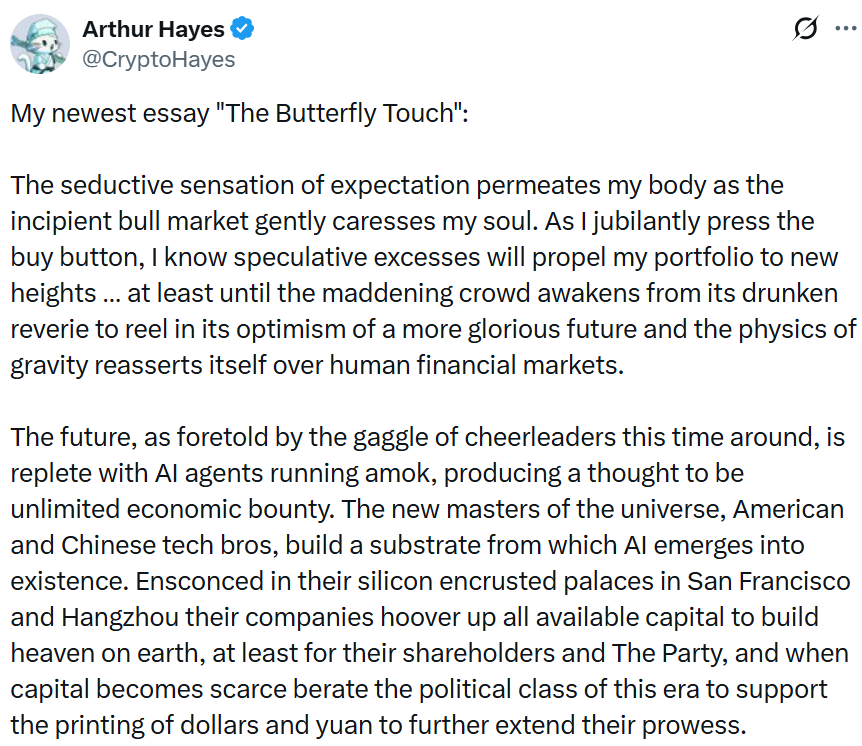
The ongoing war in Iran and the race to dominate the AI sector will result in money printing that could benefit the crypto ecosystem and push Bitcoin back to its all-time high this year, according to Arthur Hayes, the chief investment officer of crypto investment fund Maelstrom.
In a Substack post on Tuesday, Hayes said the competition between US and China to win the arms race has led both to pursue looser financial conditions and more fiat printing as the technology “directly relates to national security.”
“The combination of the political will to win the AI race and the financial will to fund the build-out with printed money and bank loans produces the perfect environment for crypto,” he said.

Source: Arthur Hayes
“There will be vastly more units of fiat tomorrow than today, and the rate of change is accelerating due to rapidly increasing yearly AI and electrification CAPEX expenditures,” Hayes added.
Most of the crypto sector registered new all-time highs last year, with the market capitalization hitting $4.28 trillion in October, according to CoinMarketCap. However, the market slumped toward the end of last year, and analysts have debated when it will fully recover.
Bitcoin to $126,000 is a “foregone conclusion”
Hayes said war is inflationary and the Iran conflict is no different. Military spending and a shift by nations toward domestic infrastructure investment rather than US Treasurys and equities will lead to further money printing.
He also predicted in March that the US Federal Reserve could ease monetary policy to help finance the country’s conflict with Iran and boost crypto.
Related: Hyperliquid’s HYPE price will increase by August, predicts Arthur Hayes
“The politicians support this money printing out of real and perceived necessity. That is why Bitcoin post-February 28th is outperforming the other major risky assets such as gold and US tech stocks,” Hayes added.
Bitcoin has traded between $79,467 and $82,496 over the past seven days, according to CoinGecko. It was trading at about $81,000 as of Wednesday, up more than 31% from its Feb. 6 low of $62,822. Gold was trading around $4,581 at the start of February and has climbed to $4,710 in the same timeframe, for a 2% gain.

Arthur Hayes said Bitcoin has been outperforming other major assets, such as gold, since February. Source: Substack
“Bitcoin bottomed earlier this year at $60,000, and with a tailwind of trillions of dollars and yuan yet to be created at its back, retaking the $126,000 is a foregone conclusion,” Hayes said.
“I expect the rally to intensify and the haters to cower in the corner as Bitcoin’s upward price trajectory turns explosive after punching through $90,000, where many call over-writers will rush to cover as their strike gets taken out.”
Magazine: Guide to the top and emerging global crypto hubs — Mid-2026


Bitcoin shrugged off the inflation scare almost as quickly as the print landed.
The largest cryptocurrency dropped to $79,879 in late U.S. hours Tuesday after the April Consumer Price Index came in at 3.8% year-over-year, hotter than economists had estimated, with gasoline prices doing most of the lift since the Iran war began. BTC recovered to $81,208 by Asian morning Wednesday, ending the session up 0.3% over 24 hours after trading a $1,400 range. The dip got bought aggressively.
Among the majors, BNB led with a 2.5% gain to $677, while dogecoin added 1.3% to $0.1114. Ether dropped 0.3% over 24 hours to $2,300 and is now down 3.2% on the seven-day, the laggard of the cohort. Solana slipped 0.6% to $95.52. XRP traded at $1.45, down 0.5% on the day.
The CPI print rattled traditional markets harder than crypto. The S&P 500 fell 0.2% and the Nasdaq 100 dropped 0.9%, with semiconductor stocks taking the brunt of the selling after weeks of outsized gains.
The rate-sensitive two-year Treasury yield held just under 4%, while Japan’s 20-year bond yield breached its January peak to touch the highest level since 1997 as elevated energy prices add to inflation pressure globally.
Asian equities clawed back early losses after the White House confirmed Nvidia CEO Jensen Huang would join President Donald Trump’s trip to China, lifting chipmaker futures.
The flows underneath crypto are still positive. CoinShares reported global crypto fund inflows of $858 million last week, with bitcoin products absorbing $706 million, ether $77 million, solana $48 million, and XRP $40 million.
The largest data point was the $14 million in outflows from bitcoin short positions, the biggest weekly short unwind of 2026. Money is leaving bearish bets on bitcoin even as the macro tape turns choppier, which is the kind of positioning shift that typically precedes upward grinds rather than capitulations.
FxPro’s chief market analyst Alex Kuptsikevich said the broader sentiment index has settled just below the midpoint of its range, recording readings of 47, 48 and 49 over the past three days, suggesting bears still have a slight upper hand.
Bitcoin “lost its upward momentum as it approached the 200-day moving average,” he said in a note, referring to the long-term trend line that smooths out short-term price noise.
“Although this line is trending downwards, the market has failed to break through it for the past six days. On the other hand, as the decline is quite modest, it resembles nothing more than a breather following a rally.”
CoinShares also noted that last week’s inflow surge came alongside a compromise on stablecoin yield treatment under the CLARITY Act, which the Senate Banking Committee is expected to consider next week. The regulatory progress is one of the few clean tailwinds the market has had since the Iran war began, and it is showing up in the flow data rather than the price action.
For now, bitcoin holding $81,000 after a CPI print this hot and a Treasury yield setup this tight is the kind of behaviour that suggests structural buyers are still active under the price. Whether that holds through next week’s Senate markup and the next round of macro data is the next test.

LMAX Group has unveiled Kiosk, a hosted portal designed for institutional clients to deposit digital assets into LMAX Custody and use them as collateral across a broad trading universe that spans spot foreign exchange, precious metals, CFDs, perpetual futures, and digital-asset markets. The platform, announced on Tuesday, provides tools for deposits and withdrawals, API credential management, WalletConnect, security controls, and treasury management, delivering an integrated on-ramp for traditional and crypto trading workflows.
Hyper-efficient collateral will be the foundation of modern, converged capital markets, and Kiosk offers a compliant way for institutions to integrate digital assets into their core trading infrastructure.
David Mercer, CEO of LMAX Group, described the platform as a practical step toward merging digital assets with conventional market infrastructure, underscoring the emphasis on compliance and operational readiness for institutions venturing into on-chain collateral.
The launch aligns with LMAX’s broader strategic push to connect traditional and digital markets, enabling crypto holdings to back trading activity across multiple asset classes. By turning digital assets into usable collateral within a regulated framework, the firm aims to streamline liquidity and custody without forcing clients to abandon established processes.
The move sits within a wider industry trend where core financial gatekeepers are exploring tokenized and on-chain collateral assets. Earlier in February, Franklin Templeton announced an institutional collateral program with crypto exchange Binance that lets clients use tokenized money market fund shares as collateral while the underlying assets remain in regulated custody. The model is designed to let institutions earn yield on regulated MMF holdings while leveraging the same assets to support digital-asset trading, without relinquishing custody arrangements.
In another signal of growing momentum, the Depository Trust & Clearing Corporation (DTCC) disclosed plans on May 4 to test tokenized securities in a pilot set to begin in July, with a broader rollout targeted for October. The plan emphasizes that tokenized real-world assets would carry the same protections and ownership rights as their traditional counterparts, a message likely to reassure institutions wary of custody and governance risk in on-chain assets.
Key takeaways
- LMAX’s Kiosk enables institutional clients to post digital assets as collateral for a wide range of trading activities, including spot FX, metals, CFDs, perpetual futures, and digital assets, via a hosted portal connected to LMAX Custody.
- The platform integrates deposits/withdrawals, API credential management, WalletConnect, security controls, and treasury management to streamline on-chain collateral within a regulated framework.
- The rollout reflects a broader trend of major financial players exploring tokenized collateral and on-chain assets to support multi-asset trading without disrupting custody arrangements.
- Franklin Templeton’s collateral program with Binance and DTCC’s tokenized-securities pilot illustrate the sector-wide shift toward on-chain collateral while maintaining traditional investor protections and custody standards.
- Regulatory and governance considerations, as well as adoption pace, will shape how quickly such cross-asset collateral facilities scale across institutions and asset classes.
LMAX’s Kiosk in the context of converged markets
LMAX frames Kiosk as a pivotal piece in its effort to blend traditional and digital asset ecosystems. By enabling institutions to deposit digital assets into custody and simultaneously deploy them as collateral for conventional and crypto-native trading, the firm signals a growing appetite among incumbents to leverage crypto liquidity within established risk and compliance frameworks. The product’s design emphasizes practical interoperability, including WalletConnect support and API credential management, which reduces friction for institutions transitioning to on-chain collateral while preserving operational controls and security standards.
On-chain collateral as a growing institutional theme
The Kiosk launch comes amid a broader industry arc where large financial players are trialing tokenized and on-chain collateral solutions. Franklin Templeton’s collaboration with Binance illustrates how tokenized money market fund shares can function as collateral, with the underlying assets retained in regulated custody to address risk and custody concerns. This approach aims to deliver yield opportunities on traditional assets while simultaneously expanding the set of assets usable as collateral for digital trading activity.
DTCC’s announced tokenized-securities pilot further underscores the sector’s shift toward on-chain representation of real-world assets. Scheduled for a July pilot with an October full launch, the plan envisions tokenized securities offering the same investor protections and ownership rights as their conventional counterparts, potentially accelerating cross-border settlement, custody, and liquidity among a broader ecosystem of market participants.
What this means for markets and participants
For institutions, Kiosk represents a practical pathway to harmonize digital-asset holdings with existing risk controls and trading workflows. If such platforms prove scalable and compliant at a broad scale, firms could see faster collateral turnover, improved capital efficiency, and new avenues to monetize crypto holdings without compromising custody or governance standards. Traders and fund allocators may gain more flexible access to collateralized liquidity, while custodians and fintech providers are pushed to strengthen security, governance, and interoperability across on-chain and off-chain environments.
However, the convergence of traditional markets with on-chain collateral also raises questions about regulatory alignment, disclosure expectations, and liability in the event of asset price swings or platform outages. As DTCC and other regulators explore tokenized assets and cross-asset collateral, market participants will closely watch how safeguards evolve, how risk is measured across multi-asset positions, and how enforceable protections translate into real-world trade execution and settlement.
For now, Kiosk stands as a concrete example of how institutions are experimenting with using digital assets to support broad collateral needs, rather than merely holding crypto for speculative purposes. The pace of adoption will hinge on continued clarity from regulators, the robustness of custody solutions, and the interoperability of cross-asset platforms with existing risk management frameworks.
Readers should keep an eye on next steps from LMAX and its peers, including how the DTCC tokenized-securities program progresses and how Franklin Templeton’s model unfolds in practice. These developments will shape the trajectory of converged capital markets and influence the evolving role of on-chain collateral in traditional finance.
Crypto World
Mitsui Digital AM Launches Japan’s First Land-Backed RWA Digital Security Tied to AEON Omiya

TLDR:
- Mitsui & Co. Digital AM launched Japan’s first land-backed digital security tied to AEON Omiya’s leasehold rights.
- The asset carries an appraisal value of 8.6 billion yen, with a minimum investment entry point of 100,000 yen.
- Investors earn a 3.4% pre-tax annual yield backed by a 50-year fixed-term lease running through June 2076.
- Unit holders receive 500 WAON POINTS annually per 10 units, linking returns to Aeon Group’s retail ecosystem.
Digital security backed by land rights is now a reality in Japan. Mitsui & Co. Digital Asset Management has launched a tokenized product tied to AEON Omiya’s land.
The company describes this as Japan’s first digital security backed by low-lying land assets. The property carries an appraisal value of approximately 8.6 billion yen. Investors can enter from 100,000 yen, with an expected annual yield of 3.4% pre-tax.
Investment Structure and Asset Details
The investment targets the land beneath AEON Omiya, located in Kita-ku, Saitama City. The site spans about 46,475 square meters and holds an appraisal value of roughly 8.6 billion yen.
Mitsui & Co. Digital AM described the move as “a new small-lot model for real estate investment,” marking a new direction for tokenized assets in Japan.
Aeon Retail Co., Ltd., a core Aeon Group company, serves as the lessee on this asset. A 50-year fixed-term leasehold agreement runs from June 2026 to June 2076.
This long-term lease provides investors with a reliable source of monthly land rent income throughout the holding period.
Since the offering covers only land and not the building above it, repair cost exposure remains minimal. The product is structured with income gain as the primary objective.
The company noted the design is “structured with an emphasis on income gain,” reducing the burden typically associated with direct property ownership.
The product issues a total of 356,000 units, with a minimum entry point of 100,000 yen. Redemption is scheduled for July 31, 2031, covering an operating period of roughly five years and one month. Mitsui & Co. Digital AM offers the product through its alternative investment platform, ALTERNA.
Blockchain Infrastructure and Investor Benefits
The digital security runs on the iBET for Fin blockchain infrastructure, developed for financial applications in Japan. It is structured as tokenized securities through a beneficiary securities issuance trust scheme. This setup ensures the product meets Japan’s existing regulatory framework for real estate digital securities.
Investors holding 10 or more units receive 500 WAON POINTS as an annual benefit. WAON is the loyalty program linked to the Aeon Group’s broad retail network.
The company confirmed that “500 WAON POINTS are awarded as a preferential treatment every year for each 10 units held,” adding non-financial value to the product.
Omiya serves as a major transportation hub where more than 10 rail lines converge, including the Shinkansen. Kita Ward, Saitama City, continues to record steady population growth, supporting demand for large commercial facilities.
Mitsui & Co. Digital AM noted that the area is “expected to continue to have residential demand as the population continues to grow.”
New family-oriented condominiums are also under construction in the surrounding area. This residential development is expected to bring consistent foot traffic to AEON Omiya over time.
As a result, the commercial facility is well-positioned to maintain stable occupancy throughout the investment period.



US April inflation rose 3.8% year-over-year, outpacing 3.6% wage growth and reigniting fears that the Iran war energy shock is bleeding into food, transportation, and core consumer prices.
Bernstein, however, told clients Tuesday that tokenization platforms can sidestep the macro repricing, reiterating its $67 price target on Figure Technology Solutions (FIGR) and signaling 72% upside despite the deteriorating backdrop.
Energy Shock Bleeds Into the Real Economy
Headline US CPI rose 3.8% in April, above the 3.7% consensus, while wages climbed just 3.6%. Many US workers are losing purchasing power for the first time in roughly three years.
Energy CPI rose 3.8%, and food prices climbed 0.5%, with average US gasoline now near $4.50 a gallon, up from $3.14 a year ago. President Trump floated a temporary suspension of the federal gas tax to relieve pressure on drivers.
Plastics and manufacturing costs are rising as Iran war supply disruptions ripple through global chemical inputs, lifting the risk that price pressure spreads beyond energy and food.
The US has delayed a plan to suspend beef import tariffs that Trump pitched as a grocery price fix.
Markets Reprice for Sticky Inflation
The Bank of Japan signaled rate hikes could come as soon as June, with one policymaker citing the oil shock as justification for near-term tightening. UK 30-year yields hit their highest level since 1998.
Hot inflation is the latest argument for the Federal Reserve to delay rate cuts further into 2026, with dollar strength and elevated bond yields historically pressuring risk assets.
“While April CPI inflation rose to 3.8%, inflation is much higher in many basic necessities. This has driven cumulative inflation since 2020 to +29%, meaning goods that cost $100 in 2020 now cost $129 today. Inflation remains a major issue for Americans,” analysts at the Kobeissi Letter indicated.
The S&P 500 is still up 8.3% year-to-date despite the macro tape.
Bernstein analysts led by Gautam Chhugani argued that Figure’s blockchain-based loan origination platform is insulated from the macro repricing, with Q1 tokenization volumes rising 113% year-over-year to $2.9 billion.
Whether the repricing extends into core CPI or eases with an Iran ceasefire will determine how aggressively the Fed tightens through summer, and whether Bernstein’s macro-immune tokenization thesis holds.
The post US Inflation Just Beat Wages, But Bernstein Says One Stock May Escape the Pain appeared first on BeInCrypto.
Crypto World
Bitcoin Rallies on Aggressive Spot Demand as Market Absorbs U.S. Economic Data: Bitfinex

Following a period of speculation-driven surges, bitcoin (BTC) appears to be rallying due to spot demand. Within a short time, spot demand metrics have shifted from contraction to growth. This development comes as the crypto market digests U.S. economic data.
According to the latest Bitfinex Alpha report, the ongoing bitcoin breakout reflects a widening gap between historical information about the U.S. economy and rapidly deteriorating sentiment evident in consumer data. This macro dynamic is significantly affecting risk assets like BTC and driving their prices higher.
BTC Sees Structural Improvement
Since the beginning of April, the crypto market capitalization has risen by $200 billion, following a 12% BTC rally that led to the strongest monthly performance in a year. By early May, BTC had broken above $80,000 – a level not touched since January 31. The move cleared the $78,000–$79,000, which had a dense overhead supply zone. Although the digital asset traded around $80,900 at the time of writing, the rally pushed it close to $83,000.
Bitfinex analysts have stated that the move marked a structural improvement and shifted BTC above a major aggregate cost-basis level near $79,800. This price doubles as the True Market Mean, which BTC has now reclaimed.
The most interesting part of this rally is that it was driven by aggressive spot demand. CryptoPotato reported last week that the market was not positioned for a surge above $80,000 due to weak demand.
Spot Demand Recovers
On-chain data shows that spot Cumulative Volume Delta (CVD) rose sharply after May 8, reflecting buyers absorbing supply at premium levels. Additionally, order books moved from bid-skewed to more neutral. Spot demand has stemmed from exchange-traded funds (ETFs) and from open-market accumulation.
As of two weeks ago, Michael Saylor’s Strategy was also a major driver of spot demand. However, there is less momentum from the company’s end because the purchases have been linked to the yield-bearing product, STRC. Unfortunately, the stock has not traded at or above its $100 par value, which is a threshold required for Strategy to purchase more BTC. In fact, the business intelligence entity is even looking to sell some of its bitcoins.
Nevertheless, conviction buyers, who are entities that accumulate BTC and rarely sell regardless of price, have increased their holdings. Analysts say they currently hold roughly 4 million BTC, following their largest surge since the COVID-19 crash. Historical data show that such growth from this cohort often precedes major price recoveries.
The post Bitcoin Rallies on Aggressive Spot Demand as Market Absorbs U.S. Economic Data: Bitfinex appeared first on CryptoPotato.


JPMorgan has filed to launch the JPMorgan OnChain Liquidity-Token Money Market Fund (JLTXX), a tokenized Treasury vehicle on Ethereum powered by Kinexys Digital Assets.
According to the filing with the US Securities and Exchange Commission (SEC), under normal conditions, the fund invests only in US Treasury securities and Treasury-collateralized overnight repurchase agreements.
JPMorgan Files To Launch A Second Tokenized Treasury Fund on Ethereum
The prospectus further says the fund will invest in a manner that satisfies eligible reserve requirements under the GENIUS Act, the US stablecoin law passed in July 2025.
“The Fund invests in a manner intended to satisfy the requirements for eligible reserve assets that stablecoin issuers are required to maintain under the Guiding and Establishing National Innovation for U.S. Stablecoins Act (otherwise referred to as the GENIUS Act) and regulations adopted thereunder, to support investment in the Fund by stablecoin issuers seeking to comply with such requirements,” the filing reads.
Follow us on X to get the latest news as it happens
JPMorgan’s prospectus signals that JLTXX will start on Ethereum but may expand to other networks. The launch deepens the bank’s tokenization push, alongside similar initiatives from institutional players such as BlackRock.
JLTXX would be JPMorgan’s second tokenized money market fund on Ethereum after My OnChain Net Yield Fund (MONY). The bank launched it in December 2025 with an initial investment of $100 million.
Why Ethereum, Again
Ethereum hosts the majority of distributed tokenized real-world asset (RWA) value tracked by RWA.xyz. The network currently accounts for more than 53.99% of the distributed RWA market share and supports around 846 tokenization projects,
The chain has become the leading settlement layer for institutional issuance, including funds from BlackRock and Franklin Templeton. Insights from BeInCrypto’s Expert Council indicated that institutional preference for Ethereum is less about ideology and more about institutional risk management, comfort, and defensibility.
“I think Ethereum probably wins for the next little while on the back of TradFi getting involved. As banks and other build stuff on blockchain space, it’s almost all going to happen on Ethereum for the next couple of years, I think,” Geoff Kendrick, Global Head of Digital Asset Research at Standard Chartered, told BeInCrypto.
Kendrick expects Ethereum to win the bulk of TradFi flows over the next couple of years.
Subscribe to our YouTube channel to watch leaders and journalists provide expert insights
The post JPMorgan Picks Ethereum Again in New Money Market Fund Filing appeared first on BeInCrypto.
Crypto World
Solana price retreats from $100 after rejection, will upcoming SMA crossover trigger rebound?
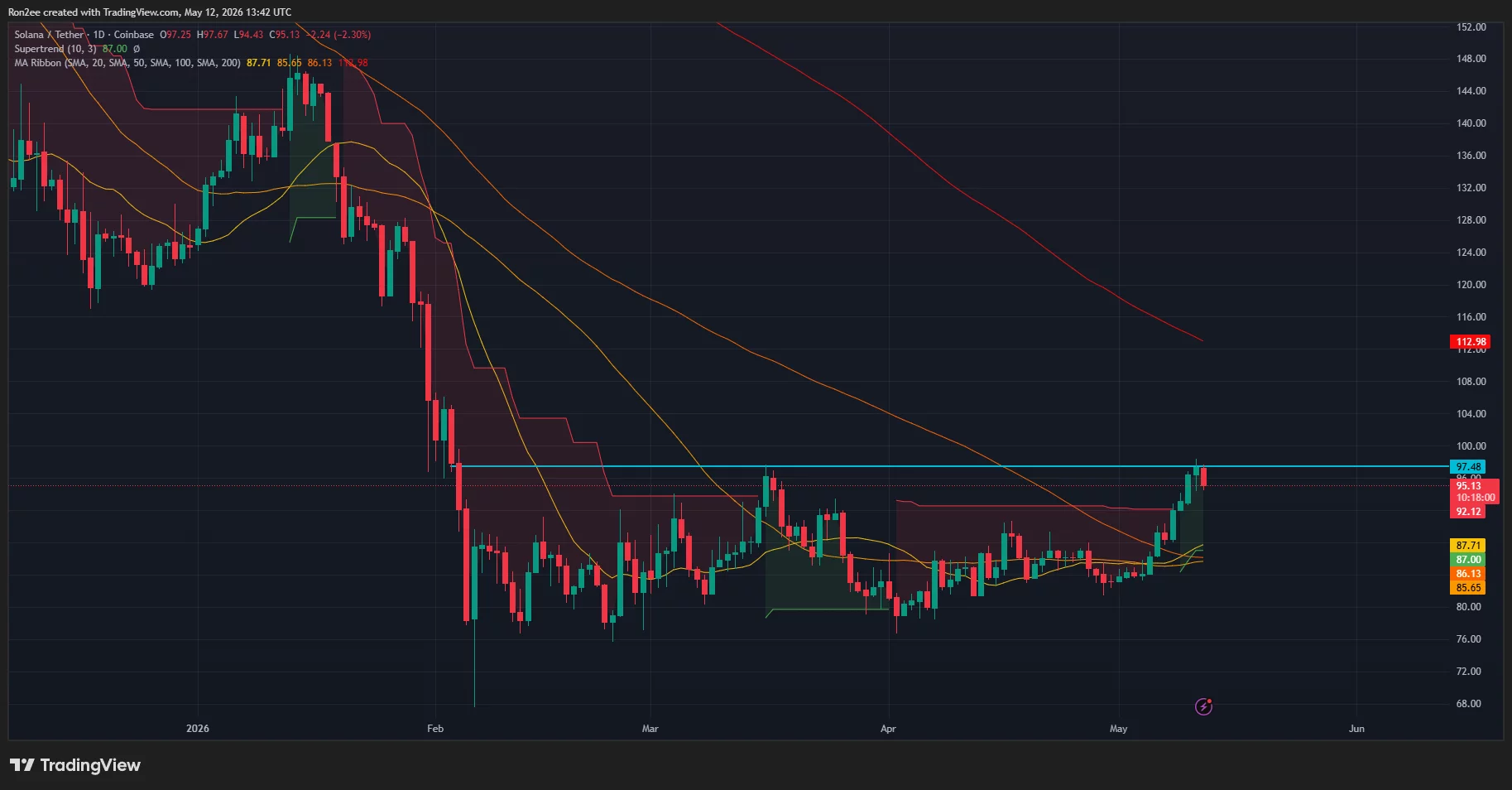
Solana price pulled back on Monday after facing rejection near the key $100 psychological level, though traders continue watching a potentially bullish moving average crossover that could support another upside attempt.
Summary
- Solana price pulled back toward $95 after facing rejection near the key $100 psychological resistance zone.
- SOL continues trading above its 20-day, 50-day, and 100-day SMAs, with a bullish crossover now approaching.
- A breakout above $100 could open the door toward the $112–$115 region, while $85 remains key support.
According to data from crypto.news, Solana (SOL) traded around $95 at press time on May 12 after briefly climbing as high as $97.6 earlier in the session. The token remains up sharply from its April lows near $80 despite the latest rejection from the upper resistance zone.
The recent cooldown comes as broader crypto market sentiment weakened following Bitcoin’s retreat below the $82,000 level amid rising geopolitical uncertainty tied to renewed U.S.-Iran tensions. Risk appetite across altcoins also softened after investors began locking in profits from last week’s rally.
Despite the pullback, Solana continues to show signs of improving technical structure after reclaiming several important moving averages over the past two weeks.
Market sentiment around the Solana ecosystem has also remained relatively stable as on-chain activity gradually recovers. While decentralized application volumes remain below peak levels seen earlier this year, network usage and validator participation have stopped deteriorating at the same pace witnessed during the first quarter correction.
At the same time, derivatives positioning has started improving modestly, with futures activity stabilizing after weeks of subdued participation. Traders now appear focused on whether Solana can establish support above the mid-$90 region before another breakout attempt toward $100.
Solana price analysis
On the daily chart, Solana recently broke above the important resistance cluster near $92 before rallying toward the $97–$100 region, where sellers quickly stepped back in.
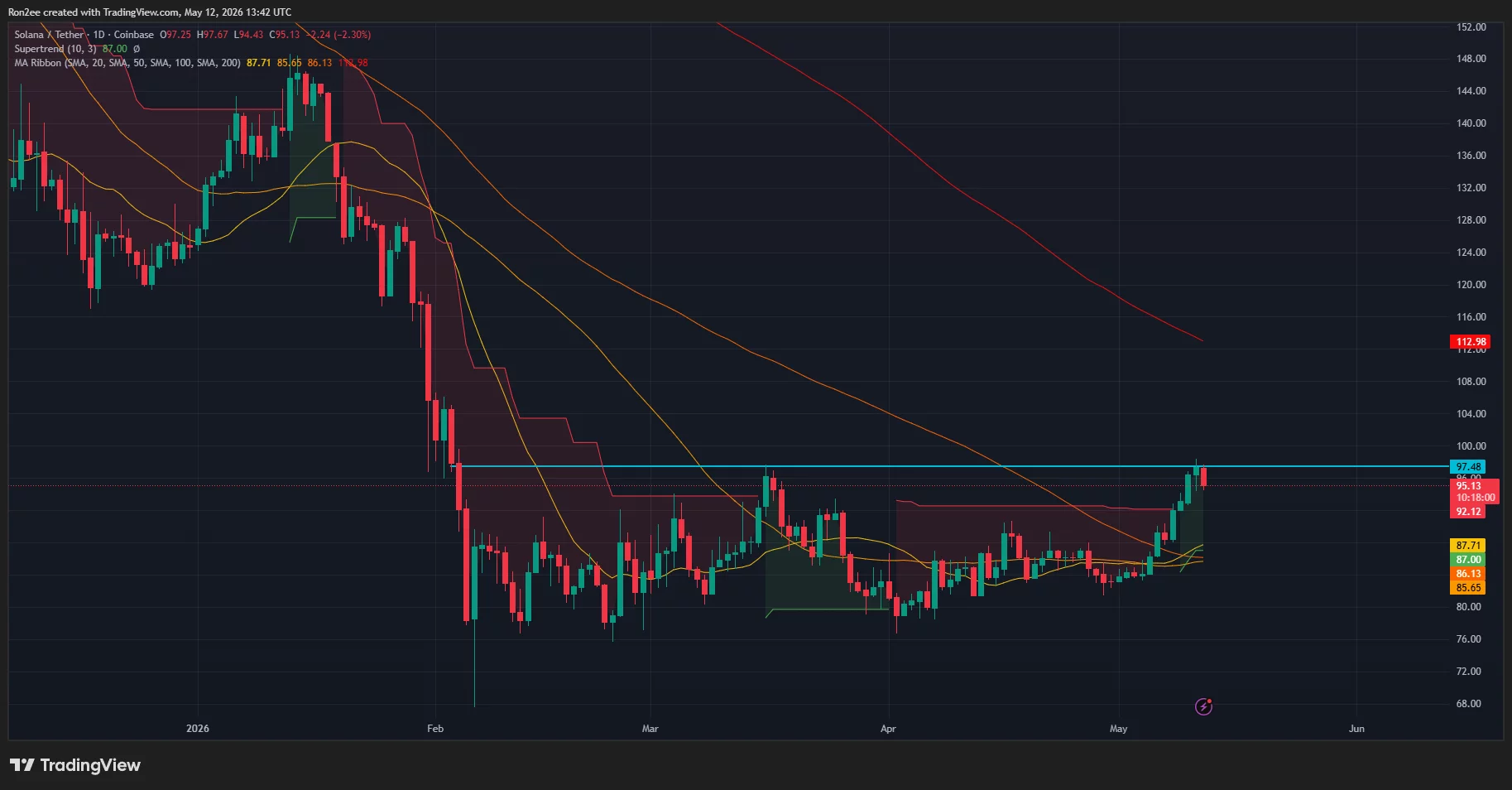
However, the broader structure still appears constructive as SOL continues trading above its 20-day, 50-day, and 100-day simple moving averages, which are now tightly compressed between roughly $85 and $88. The close convergence between these moving averages often signals that momentum is preparing for a larger directional move.
Notably, the 20-day SMA is now approaching a bullish crossover above the 50-day SMA, which could strengthen short-term bullish momentum if confirmed over the coming sessions.
The Supertrend indicator has also flipped green for the first time since January, suggesting that buyers may gradually be regaining broader trend control after months of bearish pressure.
Still, the higher timeframe trend remains somewhat cautious as Solana continues trading below its downward-sloping 200-day SMA near the $113 region, which remains a major long-term resistance barrier overhead.
If bulls manage to reclaim momentum and push above the recent high near $97, the next major upside target could emerge at the psychological $100 level. A successful breakout above that region may then open the door toward the $112–$115 resistance area near the 200-day SMA.
On the downside, failure to hold above the moving average cluster near $85–$88 could weaken the bullish setup and potentially trigger a pullback toward the $80 support region, where buyers previously stepped in aggressively.
Disclosure: This article does not represent investment advice. The content and materials featured on this page are for educational purposes only.


BlackRock has filed a second Securitize‑powered tokenized fund with the SEC, signaling BUIDL’s $2.3B success is becoming a repeatable on‑chain RWA product line, not a pilot.
Summary
- BlackRock has submitted a new tokenized fund application to the SEC, again tapping Securitize as its on-chain infrastructure partner, marking the asset manager’s second move into the tokenized fund space.
- The filing builds on the success of BUIDL, BlackRock’s first Securitize-powered tokenized fund launched in 2024, which has grown to roughly $2.3 billion in assets under management.
- The new application signals that BlackRock is treating tokenized funds as a repeatable product line rather than a one-off experiment, accelerating the broader race among traditional asset managers to bring regulated on-chain investment products to institutional clients.
BlackRock has filed a new tokenized fund application with the U.S. Securities and Exchange Commission, once again choosing Securitize as the infrastructure provider, according to reporting by The Defiant. The filing has not yet been approved, and details on the fund’s target asset class, chain deployment and fee structure remain limited in the public record, but the move confirms that the world’s largest asset manager — overseeing more than $11.5 trillion in assets — is moving from pilot to product line in the tokenized fund space.
The new application leans on a relationship that has already produced one of the most successful tokenized fund launches in history. BlackRock and Securitize co-launched BUIDL, the BlackRock USD Institutional Digital Liquidity Fund, in March 2024 on Ethereum, initially targeting accredited investors with a $5 million minimum and a focus on short-term U.S. Treasury exposure. BUIDL has since grown to approximately $2.3 billion in assets, making it the largest tokenized Treasury fund globally and the clearest proof point that institutional demand for on-chain, yield-bearing dollar instruments is real and scalable.
Securitize, which serves as BUIDL’s transfer agent and tokenization platform, has built its business around being the regulated middleware between traditional fund structures and public blockchains. The firm is registered with the SEC as a transfer agent and operates a broker-dealer, giving it the compliance infrastructure that large asset managers need before they can list tokenized products to institutional clients. By returning to Securitize for a second filing, BlackRock is effectively endorsing that compliance stack as fit-for-purpose and signaling that it does not intend to build its own on-chain fund infrastructure from scratch.
Tokenized funds as a product line, not a pilot
The broader context matters here. BlackRock’s second filing arrives as the tokenized asset market is accelerating across multiple fronts simultaneously. A recent crypto.news story on Ondo Finance’s tokenized stock bridge detailed how the RWA tokenization market has scaled past $1.5 billion in TVL for equities alone, while a separate story on DTCC’s tokenized securities platform showed how post-trade infrastructure giants are now building the settlement rails that would make multi-billion-dollar tokenized fund flows operationally viable at scale.
For BlackRock, the strategic logic of a second tokenized fund is straightforward: BUIDL proved the model works for short-duration Treasury exposure, and a second product allows the firm to test a different asset class, duration profile or investor base on the same regulatory and technical architecture. The move also puts competitive pressure on Franklin Templeton, whose BENJI tokenized money market fund was an early BUIDL rival and whose XRPZ ETF recently led XRP spot inflows, and on Fidelity and State Street, both of which have filed or hinted at tokenized product ambitions of their own.
At a policy level, the filing lands in the same week that the CLARITY Act is heading to Senate Banking Committee markup and the White House is pushing for Trump to sign a crypto market structure bill before July 4, a convergence that turns BlackRock’s SEC submission into more than a routine product launch. As a crypto.news story on BNY’s Abu Dhabi digital asset custody expansion illustrated, the largest names in traditional finance are no longer hedging their blockchain bets — they are building production infrastructure and filing with regulators, treating tokenization as the next decade’s core product category rather than an emerging technology experiment.

Why was an Egyptian mummy stuffed with a fragment of Homer’s Iliad?

Biggest CBD property deal in three years
Structural Indicators of Long-term Institutional Ethereum Adoption Building: SharpLink

Manchester United reach agreement with Casemiro over contract clause amid transfer speculation

US brings back mandatory military draft registration

Steven Gerrard disagrees with Gary Neville over ‘shock’ Chelsea and Arsenal claim | Football

Crypto Market Alert: CPI Data, Fed Updates, and Global Geopolitics Explained

Breaking News for XRP & Crypto #xrp #ripple #crypto #xrpnews #bitcoin #btc #cryptocurrency #eth #sol

Don’t let scammers STEAL your HOUSE!!! #money #finance #home #scam #asset
-
 Crypto World5 days ago
HarrisX Poll Found 52% of Registered Voters Support the CLARITY Act
-

 Fashion4 days ago
Weekend Open Thread: Marianne Dress
-

 Crypto World6 days ago
Upbit adds B3 Korean won pair as Base token gains Korea access
-
 NewsBeat6 days ago
NCP car park operator enters administration putting 340 UK sites at risk of closure
-

 Fashion1 day ago
Coffee Break: Travel Steam Iron
-

 Fashion2 days ago
What to Know Before Buying a Curling Wand or Curling Iron
-

 Tech3 days ago
Auto Enthusiast Carves Functional Two-Stroke Engine from Solid Metal
-

 Politics1 day ago
What to expect when you’re expecting a budget
-

 Politics4 days ago
Politics Home Article | Starmer Enters The Danger Zone
-
 Business4 days ago
Ignore market noise, India’s long-term story intact, say D-Street bulls Ramesh Damani and Sunil Singhania
-

 Crypto World7 days ago
BlackRock CEO Larry Fink Discusses a New Asset Class
-

 Tech2 days ago
GM Agrees To Pay $12.75 Million To Settle California Lawsuit Over Misuse Of Customers’ Driving Data
-
 Sports7 days ago
NBA playoff winners and losers: Austin Reaves is not loving Lakers vs. Thunder matchup, but Chet Holmgren is
-

 Entertainment6 days ago
Sarah Paulson Called Out For Met Gala ‘Hypocrisy’
-

 Entertainment5 days ago
General Hospital: Ric & Ava Bombshell – Ric’s Massive Secret Exposed!
-

 Politics5 days ago
Simon Cowell Says He Was ‘Horrible’ To Susan Boyle During BGT Audition
-

 Crypto World6 days ago
Robinhood says Wall Street is building onchain
-

 Entertainment6 days ago
Bold and Beautiful Early Spoilers May 11-15: Steffy Revolted & Liam Overjoyed!
-

 Sports6 days ago
UEFA Champions League final schedule, teams, venue, live time and streaming | Football News
-

 Entertainment6 days ago
Why David Letterman Called CBS ‘Lying Weasels’
You must be logged in to post a comment Login