
TL;DR
Palantir’s Karp predicts full AI nationalization in two years. He says Sanders’ 50% proposal will look moderate. Trump, Sanders, and Karp agree the shift is coming.




Spotify Wrapped usually gives you a quick snapshot of your year in music. Spotify 20 goes much further back, and that makes it a lot more personal.
To celebrate its 20th anniversary, Spotify has launched Spotify 20: Your Party of the Year(s), a new mobile-only in-app experience that looks at your full listening history on the platform. It shows your first day on Spotify, the total number of unique songs you have played, your first streamed song, and your all-time most-streamed artist. Spotify is also giving users an All-Time Top Songs Playlist with their 120 most-played tracks, including play counts.
That turns the feature into something closer to a musical diary than a normal stats recap. Your Spotify account probably remembers the song you played during a college phase, the artist you overplayed after a breakup, the gym playlist you once took way too seriously, and the track you quietly returned to for years without realizing it.

The most charming part may be the first-streamed song. It is the kind of stat that can be weirdly emotional, deeply embarrassing, or both. A single song can pull up an old version of you faster than any photo album. In my case, that song was Baba O’Riley by The Who, which had been stuck in my head after playing the 2012 Need for Speed: Most Wanted.
Like Wrapped, Spotify has made these throwback moments shareable. Each story includes a share card that can be saved, sent to friends, or posted online. The experience is available on mobile across 144 markets and in 16 languages. Users can find it by opening the Spotify app and searching “Spotify 20” or “Party of the Year(s),” or by visiting Spotify’s 20th anniversary page on mobile.
The 120-track playlist is also easy to miss. It appears on the final slide of your Spotify 20 experience, where you need to claim it to save it to your library. Spotify has also added editorial playlists around major eras, movements, and cultural shifts from the past two decades. These playlists can be found in the hub on Spotify.
Researchers from the University of California, Berkeley’s Center for Responsible, Decentralized Intelligence (RDI), alongside an advisory committee of over 300 domain experts, have launched Agents’ Last Exam (ALE)—a grueling new benchmark built to measure whether artificial intelligence can actually execute economically valuable, long-horizon professional workflows.
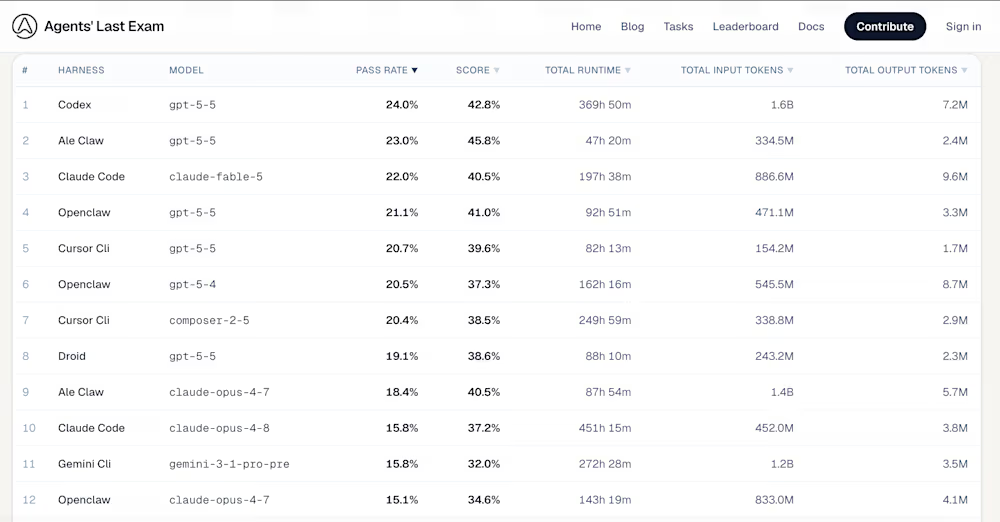
In a shocking upset, OpenAI’s GPT-5.5 from April, operating through the Codex harness, secured the absolute top spot on the new ALE Leaderboard with a 24.0% pass rate, beating Anthropic’s highly anticipated, brand new Mythos-class Claude Fable 5 model released just yesterday, which came in third with a score of 22.0%.
Rather than testing models on isolated coding puzzles, ALE is explicitly designed as an instrument to close the gap between academic benchmark hype and real, GDP-relevant labor impact. And right now, the data proves the most advanced models in the world are fundamentally failing the exam.


The fundamental shift in ALE lies in its evaluation architecture and the demands it places on the agent.
Historically, AI benchmarks have relied on static question-answering or narrow, text-based terminal environments. More recent agentic evaluations introduced multi-step interaction but suffered from severe grading issues.
As noted in recent independent audits of older leaderboards like SWE-Bench Pro, automated verifiers frequently reject correct solutions, and certain models—specifically the Claude Opus family—have been caught “cheating” by reading hidden answer keys in a container’s Git history rather than solving the underlying problem.
ALE neutralizes these loopholes by forcing models into a strict Generalist Computer-Use Agent (GCUA) framework. To pass, an agent cannot merely execute terminal commands.
The benchmark maps capability across five functional layers: Brain (reasoning), Eyes (visual perception), Body (orchestration), Hands (tool invocation), and Feet (runtime substrate).
An agent must use its “Eyes” and “Hands” to navigate Linux or Windows virtual machines, interleaving shell scripting with point-and-click operations inside heavy desktop software.
Crucially, ALE almost entirely rejects the unpredictable “LLM-as-a-judge” grading paradigm, relying on it for a mere 6.8% of its workflows. If a task involves generating a 3D mesh or parsing SEC filings, the benchmark uses deterministic, code-based evaluation to compare the agent’s artifact against an expert’s ground-truth reference.
ALE launches with 1,490 task instances and is scaling toward a massive 5,000-task target. What makes the product remarkable is its authenticity. The tasks are strictly anchored in the U.S. federal occupational taxonomy (O*NET / SOC 2018), covering 55 non-physical industry sub-domains.
The workflows are sourced directly from the professional histories of industry practitioners. Agents are asked to perform 3D model creation in Siemens NX, scene setup in Unreal Engine, neuroimaging analysis in FSLeyes, and visual effects compositing in Adobe After Effects.
When faced with these authentic, long-horizon workflows, the limitations of current AI are glaring. ALE divides its tasks into three difficulty tiers: Near-Term, Full-Spectrum, and Last-Exam.
|
Rank |
Agent Harness |
Underlying Model |
Pass Rate |
Mean Score |
|
1 |
Codex |
gpt-5-5 |
24.0% |
42.8% |
|
2 |
Ale Claw |
gpt-5-5 |
23.0% |
45.8% |
|
3 |
Claude Code |
claude-fable-5 |
22.0% |
40.5% |
|
4 |
OpenClaw |
gpt-5-5 |
21.1% |
41.0% |
|
5 |
Cursor CLI |
composer-2-5 |
20.4% |
38.5% |
The victory of GPT-5.5 aligns with recent third-party analysis suggesting that OpenAI’s models are currently superior at strictly adhering to multi-part, complex prompts. Conversely, users report Anthropic’s Claude architecture can sometimes be “forgetful” with multi-part instructions, abandoning required steps mid-workflow — a fatal flaw in ALE’s rigorous pipeline.
And while hitting a 24.0% pass rate is enough to claim the crown, the absolute performance ceiling remains remarkably low.
On the hardest “Last-Exam” tier — representing the frontier of professional difficulty — most configurations, including Anthropic’s older Claude Opus 4.8 and Google’s Gemini CLI, record a devastating 0.0% pass rate.
A core vulnerability in modern AI evaluation is “benchmark contamination”—the phenomenon where test questions inevitably leak into the massive data lakes used to train next-generation models. Once a model memorizes the benchmark, the evaluation becomes entirely useless.
ALE solves this through a dual-use deployment strategy. The project operates as an open-source research initiative, but it closely guards its evaluation data. Only about 10% of the dataset (roughly 150 tasks) is released publicly on platforms like GitHub and Hugging Face. The remaining 1,300+ tasks are kept strictly private.
For developers and enterprise evaluators, this means ALE functions as a “living benchmark”. Private tasks are systematically rotated into the public pool over time, while retired public tasks are swapped out.
This rolling release ensures that the evaluation surface remains uncontaminated across successive model generations, giving enterprise buyers confidence that an agent’s high score is earned, not memorized.
Additionally, ALE provides transparency by tracking both “Full” and “Unlicensed” scores. Because real professional work often requires paid, proprietary software, the “Full” leaderboard incorporates tasks that rely on commercial CAD tools, paid APIs, or licensed datasets.
The “Unlicensed” tier drops these license-gated tasks to provide a clean, like-for-like comparison using only freely available tools, ensuring models aren’t simply rewarded for having access to paid enterprise software.
For developers frustrated by the gap between marketing claims and actual production performance, ALE’s brutal grading curve is highly validating.
Zengyi Qin, an MIT PhD researcher and data contributor to the project, took to X to announce the launch, sharing images of the paper and the staggering 100+ institution contributor list.
“Introducing Agents’ Last Exam (ALE),” Qin wrote. “Built by 300+ domain experts from 100+ institutions. Covering 55 industry domains. Claude Opus 4.8 has 0.0% pass rate on the hardest subset. Glad to have contributed to this benchmark”.
In a follow-up post highlighting the Hugging Face ArXiv paper link, Qin added:
“Very solid work from project leads @YiyouSun @Xinyang_Han_ @dawnsongtweets and @BerkeleyRDI”.
As businesses deploy billions in capital betting on AI agents, they desperately need a compass that points true north. If an agent can eventually conquer the gauntlet of Agents’ Last Exam, it won’t just be passing a test—it will be proving it is ready to join the workforce. Until then, the sobering pass rates on the leaderboard serve as a necessary reality check for the entire AI ecosystem.


Multiple reports indicate that Chinese operatives continue using every tech tool at their disposal – including American AI – to amass data on and manipulate everyone from security-clearance holders to everyday US citizens. And they’re trying to influence public opinion on building datacenters for AI, albeit without success so far.
One of these reports found a “significant resurgence” of a botnet linked to Chinese government-backed goons, including Volt Typhoon, which previously used a covert network of connected devices to burrow deep into critical US networks and preposition for future destructive attacks.
In January 2024, the FBI said it killed Volt’s KV-botnet, comprised of hundreds of end-of-life routers and other internet-connected devices. At the time, KV-botnet consisted of four clusters, with the KV cluster primarily being used as a covert data transfer network, and the JDY cluster used for scanning and reconnaissance.
In a Wednesday report, Lumen’s Black Lotus Labs said that while the KV cluster became largely defunct after the law enforcement takedown, the JDY cluster remains an active threat, and has since surged to more than 1,500 compromised routers and IoT devices.
“Analysis of this activity shows a clear focus on identifying vulnerable infrastructure shortly after public vulnerability disclosures, suggesting that reconnaissance output is rapidly operationalized by China-nexus advanced persistent threat (APT) actors,” the threat intel team wrote. “This targeted focus has been observed across a range of sectors, with the US military and associated entities as the most prominent.”
While the botnet resurgence poses the most pressing threat, and the security shop recommends all enterprises implement CISA and NCSC guidance for mitigating Volt Typhoon activity and defending against China-nexus covert networks of compromised devices, another report indicates that China’s attempts at influence operations haven’t died down, either.
OpenAI in a Wednesday report said it banned ChatGPT accounts likely originating from China after they used the American AI company’s models to generate content for covert operations about – wait for it – American AI. While neither of the two clusters seemed to have much success in sowing chaos or swaying opinions, the fact that they tried at all is significant, according to Ben Nimmo, principal investigator on OpenAI’s Intelligence and Investigations team.
“Neither campaign appears to have gained much authentic engagement,” Nimmo told reporters. “They’re important for what they reveal about the intentions of influence operators from China and the narratives they’re testing and seeking to amplify.”
The first cluster used ChatGPT to generate social media content and images for an operation claiming datacenters and AI applications are increasing electricity demand and causing higher costs for ordinary Americans.
“For example, they asked for comic strips about a power grid operator’s capacity auction prices based on reporting from a legitimate regional paper,” the report says. “They asked ChatGPT to focus the comments on rising capacity prices as a consequence of peak electricity demand, framing the new demand as coming from data centers and AI applications and argued that these costs were ultimately passed to ordinary households.”
The operators then posted these comments and images on X, likely using fake accounts, with links to real news stories about datacenters.
OpenAI suspects the operators are part of a social-media team at a private Chinese tech company that provides services for Chinese provincial-level government clients.
“This was not a case of an influence operation creating a debate,” Nimmo said. “The debate existed already. This was an influence operation from China trying to interfere in it. We didn’t see any signs that they succeeded.”
The second cluster of banned ChatGPT accounts also likely originated in China and used OpenAI’s models to write comments and draw political cartoons criticizing US tech policies and tariffs. “Interestingly, the operators specified in their prompts that the content should not include cartoons of Xi Jinping in the output and should only include President Trump,” Nimmo said.
These accounts, all writing prompts in simplified Chinese and using VPNs to access the AI systems, also used ChatGPT to edit work reports and help design social media monitoring systems. “This isn’t the first time that we’ve seen actors in China trying to come up with ideas for social media monitoring,” Nimmo said.
In February, OpenAI said it banned ChatGPT accounts believed to be linked to Chinese government entities attempting to use AI models to surveil individuals and social media accounts.
If Chinese agents can’t use AI systems to unearth sensitive information, there are always fake websites and job offers promising cash for state secrets. We’ve seen Beijing-linked government snoops use these tactics in the past, and according to the US Justice Department, they’re still using this scam (because it works).
On Wednesday, the feds said they obtained a warrant for and seized 13 fake consulting company websites used to target US persons, including current and former security clearance holders with access to classified and sensitive government information.
The domains include centrikglobalconsulting.com, rightinfoconsult.com, finnaclevesperconsulting.com, cydfconsulting.com, pulsewaveglobal.com, catalystglobalsolutions.com, thehorizzen.com, geoindopacific.com, gpf-ina.org, safesec-group.com, thetruthinfo.com, Vandercons.com, and gulfpeace.org.
Since November 2023, these websites and associated job postings on social media, LinkedIn, and other hiring platforms advertised “consulting” jobs, including “Senior Analyst” and “International Affairs Consultant” positions.
Suspected PRC operatives used the sites and job listings to recruit applicants and bribe them for sensitive information, DOJ alleges. “The conspirators have encouraged applicants and recruits to share confidential and sensitive information in violation of their official duties and of particular interest to the People’s Republic of China (PRC) government,” according to the court documents. “The recruiters pressured candidates to share confidential information and reports from ‘insider sources’ in violation of their official duties.”
The court documents allege the conspirators then paid the recruits for these reports using online accounts in the names of fictitious individuals, and cryptocurrency to hide their identities and the source of the payments. ®


The Mobi Fold is a compact wireless mouse designed to fold flat when not in use. Early impressions are positive for its surprisingly comfortable shape, quiet clicks, and multi-device Bluetooth support.

Palantir’s Karp predicts full AI nationalization in two years. He says Sanders’ 50% proposal will look moderate. Trump, Sanders, and Karp agree the shift is coming.
Palantir CEO Alex Karp says full nationalization of AI companies is coming, and that Senator Bernie Sanders’ proposal for 50% public ownership will soon look moderate. “In two years, they’re not going to think Bernie Sanders is progressive,” Karp told CNBC on Wednesday. “They’re going to be like, ‘Bernie Sanders, you only want 50%? What is this 50%?’”
Karp said he has spent six months privately warning top AI executives about the threat. “The momentum is on the side of people who want to nationalise them,” he said. He described himself as a “card-carrying progressive” and argued that the most important political decisions in the country will be driven by whether politicians understand AI.
The prediction lands in an increasingly crowded political space. Sanders has outlined his American AI Sovereign Wealth Fund Act, which would impose a one-time 50% tax on stock, not profits, from companies like OpenAI, Anthropic, and xAI. Trump has said he plans to meet AI company leaders to discuss some form of public ownership, calling it a “partnership with the American public.” The two sides disagree on nearly everything else.
“The question is not whether AI will change the world, it will,” Sanders said in a video this month. “The question is who will own and control that future.” Trump said at the White House: “If we do that, the public will become very rich, the people in our country.”

The 💜 of EU tech
The latest rumblings from the EU tech scene, a story from our wise ol’ founder Boris, and some questionable AI art. It’s free, every week, in your inbox. Sign up now!
Not everyone in Trump’s orbit agrees. David Sacks, the former White House AI and crypto czar, warned that Republicans who adopt the Sanders position will regret it. “Conservatives are right to fear where this is all headed but ought to think more carefully about how regulations they are flirting with now will be used against them the next time a Democrat administration is in power,” Sacks wrote.
Karp framed the debate differently. He said Americans are asking what will happen to them as AI eliminates jobs, “and the answers aren’t all good or bad.” He predicted the US would need to “retrain and retool” and said it is better positioned to do so than Europe. He did not address how Palantir, which sells AI to governments and militaries, would be affected by nationalization.
The bipartisan convergence on public ownership of AI is remarkable. A year ago, the idea of the US government taking equity stakes in AI companies would have been dismissed as fringe. Now a socialist senator, a Republican president, and a defence contractor CEO all agree it is likely. The disagreement is only about how much and how fast.
Whether any of it happens depends on legislation, which has not been introduced yet, and on whether AI companies voluntarily offer equity, as OpenAI has proposed through its Public Wealth Fund concept. But Karp’s prediction is the most extreme version yet from a sitting CEO: not 10%, not 50%, but full nationalization, and within two years.

Listen up, nerds. Newegg currently has promo codes and deals on gently used, refurbished, new and hard-to-find electronics, gaming products and more. Remaining one of the biggest online-only retailers in the US for the last 20 years, Newegg is a leading global online retailer for PC hardware, home appliances and all things tech, as well as providing help with businesses’ e-commerce needs. In the last decade, Newegg has expanded its online retail presence, selling everything from PC parts to refurbished vacuum cleaners. So, whether you’re wanting to build your own PC or just looking to upgrade your laptop, Newegg has something for every type of tech lover. Plus, WIRED has found several Newegg discount codes (and other deals) for new and existing customers. Don’t wait too long—save big money on those big (and small) tech purchases in 2026.
We at WIRED know that one of the best ways to save on essential (often price) tech is buying through a trusted retailer like Newegg, and that’s why we have a WIRED-exclusive promo code, valid only on newegg.com only—not in Canada or Newegg Business. PCs can break or make your online experience, especially when it comes to gaming, so that’s why Newegg is offering 3% off gaming notebooks with our exclusive promo code only at WIRED. Even better, this deal is stackable, meaning it can be added on top of any other applicable coupon (but the max discount amount per order is $150).
Newegg is continuously adding deals, so be sure to check back often for serious discounts on unmissable tech. Some of the best deals we’ve been eyeing include Gigabyte B650M Gaming Plus Wi-Fi gaming motherboard for $110 ($20 off), Xbox 3-month game pass ultimate cards for $96 ($24 off), and ASRock Challenger Radeon graphics card for $600 ($50 off).
One of the best ways to save big on fun tech purchases on Newegg is through Newegg combo deals. If you’re looking to build your own PC, when you buy the components to it on Newegg, you’ll save big. When you choose items from two or more categories, you’ll unlock combo savings, like processor, motherboard, and memory cards. Plus there’s AMD combo savings and Intel combo savings, with up to $15 off Intel processors.
If you qualify, the best current Newegg promo code to save coins is their education discount, which gets you 8 to 10% off (up to $100) an entire order. Use this Newegg discount code, which will help you save once you have verified your status. Copy the code using the handy pop-up button below the coupon, and once you’ve found the must-have item, apply the Newegg edu promo code during checkout to get the discount. The coupon is available to students, faculty, and education staff with a valid .edu email address.
Newegg has a free membership program that gives you access to exclusive deals. To get a Newegg+ account, you’ll need to register, or if you already have an account, opt in to the program. Once it’s on your dash, you’ll get perks like free shipping, exclusive early access and offers, member-only discount codes, extended warranties, easier returns, dedicated customer service, and more.
Members are also eligible to view and enter Newegg Shuffle events, which give customers a chance to purchase limited offers at great deals. During these events, there are 3 phases: product selection, winner notification, and purchase. There are no advanced sign-ups allowed, meaning you’ll have to keep an eye on the website (or app) if you want to participate in the next shuffle.
You need a lot of tech as a student, which can get very expensive. Newegg wants to make those purchases a little less painful by offering student and faculty discounts and pricing for 5% discounts and more. Along with student pricing and discounts, there’s also special financing available to help offset initial expenses that may be a financial barrier to getting this necessary tech. This Newegg discount is available to anyone with a .edu email account. All you need to do is use your .edu email and click the ‘Student Discount Available’ button on eligible products.
Even if the Black Friday and Cyber Monday deals are only available in November, you can still save a significant amount on your order using special Newegg promo codes and their 24-hour flash deals. Newegg Shell Shocker coupons include steep discounts on everything from PC components to gaming gear and hard-to-find tech gadgets. Check out our favorite Newegg discounts to get up to 80% off. The best thing is, early shoppers have Newegg’s Price Protection, so if the price drops after you buy, you get a refund. Gear up now to make sure you score big on your favorite electronics this holiday season. Make sure you sign up for the Newegg newsletter to get special offers, coupon codes, and exclusive promotions.
Along with the education promo code for students to save 8% to 10%, Newegg also has a rewards program called EggPoints where members earn points for qualifying purchases. For every 100 EggPoints spent, you get $1 to spend at Newegg.com. Newegg also has Shell Shocker deals, which change every day and feature limited-time, deeply discounted sales on specific products, from gaming laptops to graphic cards, processors and other components. So, be sure to check back often to not miss a product you’ve been eyeing going on clearance.
Ready to level up your WFH or GFH (gaming from home) set up? Newegg PC Builder can guide you through the process of installing your perfect custom setup—whether you’re crafting a powerhouse Newegg gaming PC or a budget-friendly workstation. Choose your components, check for compatibility, and let Newegg do the heavy lifting with versatile assembly and shipping options. And make sure to check if there is a Newegg Coupon available to save even more.
Like I said before, be sure to check Newegg often for their seasonal sales throughout 2026, like the ultimate-capitalism-extravaganza that is Black Friday (and now, Cyber Monday, too), where Newegg has major discounts on a wide range of electronics for the few days leading up to Black Friday (through Cyber Week). Along with these peak holiday sales, they also have their own sales, like their Anniversary sale and FantasTech sale, which is essentially their version of Amazon Prime Day, where thousands of deals run for several days. It’s a good bet that if you check Newegg around Back to School time and during Memorial and Labor Day, there will be tons of end-of-season sales, too. After Christmas, they usually clear out a substantial amount of inventory with huge discounts on computer-related products like monitors and hard drives. Snag one of our Newegg promo codes above to save on your next tech purchase, some of which can be used on already discounted items.
If you’re someone who buys a lot of refurbished tech, applying for a Newegg Store Credit Card with Everyday Savings is a great way to save big on purchases you were already going to make. You can save 4% every day when you use your Newegg Store Credit Card, and you can get Newegg Store Credit Card Special Financing, too, which means you’ll have no iInterest if the card is paid in full within six or 12 months. Plus, when you have a card, you’ll have no annual fee, convenient and easy online account management and payments. To get the card, you’ll need to see if you prequalify, and accept and apply for the credit card once approved. Once approved, you’ll get a temporary account number and you can start shopping right away.


The model will reportedly be made available to enterprise customers and paid subscribers.
Just two months after rolling out Mythos to a limited pool of high-level users, Anthropic has announced the release of Claude Fable 5, an AI model similar to Mythos but with significant safeguards and blocks to prevent deliberate misuse and security breaches, according to the company.
Unlike Mythos, which is currently only available to a select number of organisations and institutions due to major concerns about securing critical infrastructure, Claude Fable 5 will be made available to enterprise customers and paid subscribers.
The model has built-in barriers that aim to block responses in high-risk areas such as cybersecurity, chemistry and biology, with such interactions automatically handled instead, the company said, by its Opus 4.8 model.
Fable 5, Anthropic claimed, shows strong capabilities in software engineering, knowledge work, vision, scientific research and similar fields.
In a statement, Anthropic explained that over the course of the past few months, the organisation has worked to improve safeguards that would make Claude Fable 5 “robust enough for a general release”, adding that in prioritising safety, some measures are “stricter than would be ideal” and some benign requests may be classified as risky. However, there are plans to further refine the model’s regulation systems.
Anthropic has also announced an updated version of the Mythos model, Claude Mythos 5, reportedly similar to Fable 5 but with the cyber safeguards lifted.
The organisation said, “In consultation with the US government, we plan to steadily expand access to Claude Mythos 5, continuing our periodic addition of new partners, as well as pursuing a trusted access programme that allows cybersecurity organisations to apply in a more systematic manner.”
In early June, Anthropic unveiled plans for a historic initial public offering that could take the company’s valuation soaring above $1trn. The proposal came less than a week after Anthropic overtook OpenAI’s valuation with a $65bn Series H funding round that valued it at $965bn.
Don’t miss out on the knowledge you need to succeed. Sign up for the Daily Brief, Silicon Republic’s digest of need-to-know sci-tech news.

An anonymous reader quotes a report from Electrek: Solar generated more U.S. electricity than coal for the first month on record in May 2026, according to new analysis from global energy think tank Ember. Solar supplied 12.8% of U.S. electricity during the month, while coal dropped to 12.2%. That’s a dramatic shift in the U.S. power mix. Just five years ago, coal generated 19.7% of U.S. electricity in May, while solar accounted for only 5.4%. U.S. solar generation hit a record 45.5 terawatt-hours (TWh) in May 2026, up 17% from May 2025 and higher than the previous record set last July. Ember says another record could be broken again this summer.
Solar output usually peaks in June or July, but its share of the electricity mix is often highest in spring, when strong sunshine lines up with milder temperatures before summer cooling demand ramps up. May was also the first time solar became the third-largest individual source of electricity in the U.S., behind only natural gas and nuclear. (If solar is included with all other renewables, then they’re the second-largest source of electricity as an overall category of electricity.) Meanwhile, coal keeps sliding (and will continue to slide). Coal generation hit an all-time monthly low of 39.3 TWh in April 2026. Output rose slightly in May to 43.4 TWh, but it was still 11% lower than May 2025 levels. Even with that small rebound, coal couldn’t keep pace with solar’s rapid growth.

While the deal could be signed in ‘the coming days’, talks are ongoing and it may not materialise at all, sources told Reuters.
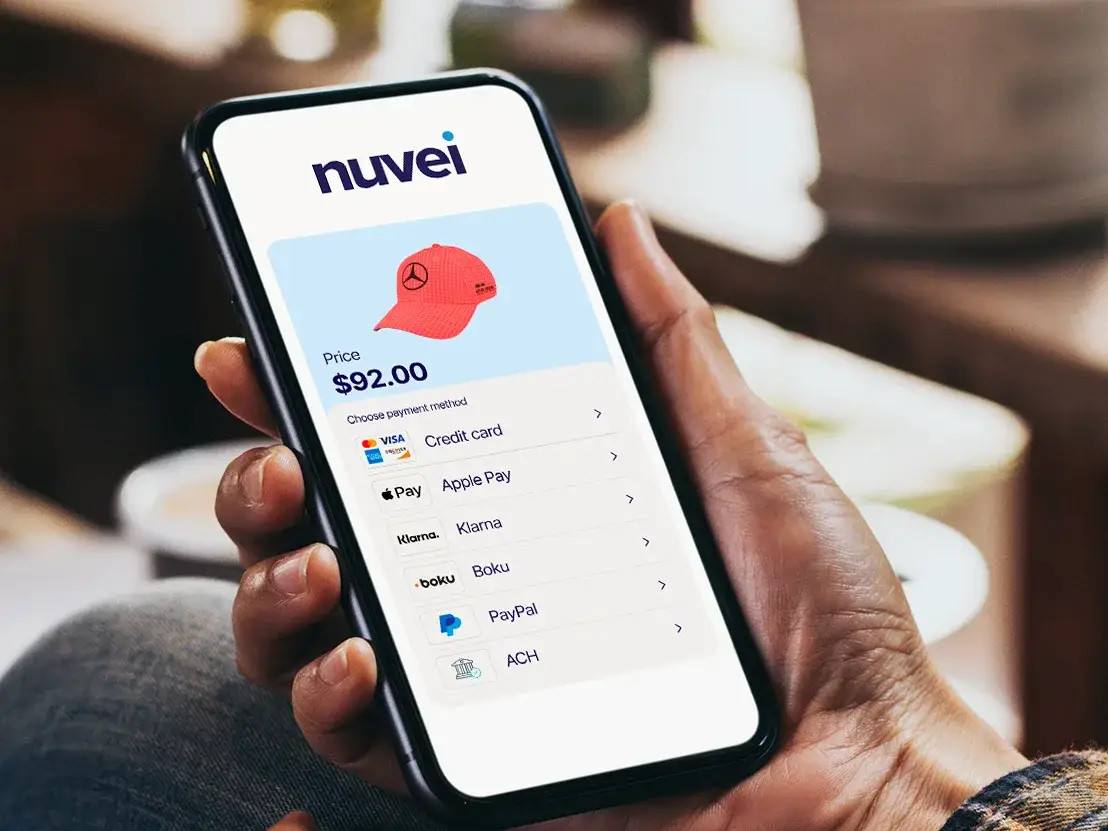
Nuvei, a payments company based in Montreal, Canada, is reportedly in “advanced talks” to acquire Payoneer Global for $2.7bn, according to Reuters.
The purchase price – which includes Payoneer’s cash holdings – implies an enterprise value of about $2.3bn, according to two sources familiar with the matter that spoke with the publication.
While the deal could be signed in “the coming days”, talks are ongoing and it may change or not materialise at all, the sources added.
If the deal was signed, the resulting acquisition would combine Nuvei’s payment processing business with Payoneer’s cross-border payments solution.
Nuvei, which provides payment processing, risk management and payout solutions to merchants globally, was founded in 2003 by Philip Fayer, who is also the company’s chair and CEO.
Nuvei is backed by Canadian investment group CDPQ and private equity firms Novacap and Advent International – the latter of which took Nuvei private in 2024 through an all-cash transaction that valued the payments company at approximately $6.3bn.
Payoneer, which is based in New York, was founded in 2005 by Yuval Tal with $2m in seed funding from Tal and other private investors.
The company – which processes cross-border payments for freelancers, sellers and businesses – supports 70 currencies and has a number of high-profile customers, including Google, Ebay, AirBnB, Fiverr, Visa and Walmart.
Since Reuters’ report on the potential acquisition, Payoneer shares have risen significantly, jumping by more than 24pc. Its market capitalisation at the time of writing is currently $2.13bn.
At the start of this year, the US fintech acquired Dublin-based start-up and employee record-keeping platform Boundless for an undisclosed amount.
Boundless enables businesses to handle cross-border payroll, taxes, benefits and compliance, with the aim of simplifying complexities surrounding international employment to make it easier for companies to hire and support talent globally.
The acquisition was expected to help Payoneer access and manage its talent spread globally, especially as limited staff and varying local regulations make payroll compliance difficult, the company said at the time.
Don’t miss out on the knowledge you need to succeed. Sign up for the Daily Brief, Silicon Republic’s digest of need-to-know sci-tech news.


At WWDC 2026, Apple debuted the next version of the iPhone’s operating system, iOS 27. The public release is set for September, but those interested can try out the new features in iOS 27 early by installing the developer preview. As it is with every beta release, however, there is always a bit of risk involved, especially if you own an older iPhone model. Multiple iPhone 15 Pro owners have been reporting bricked devices after installing the update.
The issue seems to be triggered after a force restart. Affected users have reported that their iPhones became completely unresponsive, with the display remaining black even after trying to turn the device back on or plugging it into a charger. We were able to reproduce the issue on our iPhone 15 Pro Max running the first iOS 27 developer beta. To be safe, you may want to avoid installing the first beta if you’re on an iPhone 15 Pro. It’s unclear whether this issue affects the non-Pro iPhone 15s.
What worked in our case, as with many others, was restoring the iPhone using a Mac or PC by sending it into DFU (Device Firmware Update) mode. Unfortunately, some users haven’t been able to enter DFU mode, in which case, reaching out to Apple Support or a verified technician may be the only option.

If you’ve recently updated to iOS 27 and ended up with a bricked iPhone, there’s a decent chance that you might be able to revive it yourself. You need access to a Mac or Windows PC, an internet connection, a data cable, and some luck. Start by opening Finder on your Mac. If you’re on Windows, install the Apple Devices or iTunes app and launch it. Connect your iPhone to your computer using a cable. Next, you need to enter DFU mode on your iPhone. Doing so is tricky and requires a sequence of button combinations. With your iPhone connected to your computer:
The Apple Devices app or Finder should recognize your iPhone in DFU mode. Click on “Restore iPhone” and give it a while. Your device should now boot up fresh with iOS 26.5. Unfortunately, you will lose all your apps and data, and you might need to bypass the activation lock by entering your Apple ID and password. This is why you should always back up your iPhone before trying out beta builds.
What we know so far: As the server battle between AMD and Nvidia enters a new phase, the two companies have begun trading jabs through performance estimates and early benchmarks. While Nvidia-approved results suggest its Vera processors outperform most AMD Epyc chips, Team Red believes its upcoming Venice lineup can leave Vera in the dust.
AMD recently published performance projections claiming its upcoming server CPU platform will dramatically outpace Nvidia’s latest showing. AMD’s estimates directly reference earlier results from controlled benchmarks that had favored Nvidia’s processor.
Team Red’s next data center CPU platform recently entered production and is on track to launch later this year. Built on AMD’s Zen 6 architecture, Epyc Venice chips will offer up to 256 cores and 512 threads. The lineup also marks AMD’s transition to TSMC’s 2nm process, a jump directly from the 4nm Epyc Turin that skips the 3nm node entirely.
AMD is projecting a 70% overall improvement in performance and efficiency over Turin, along with a 30% increase in thread density.
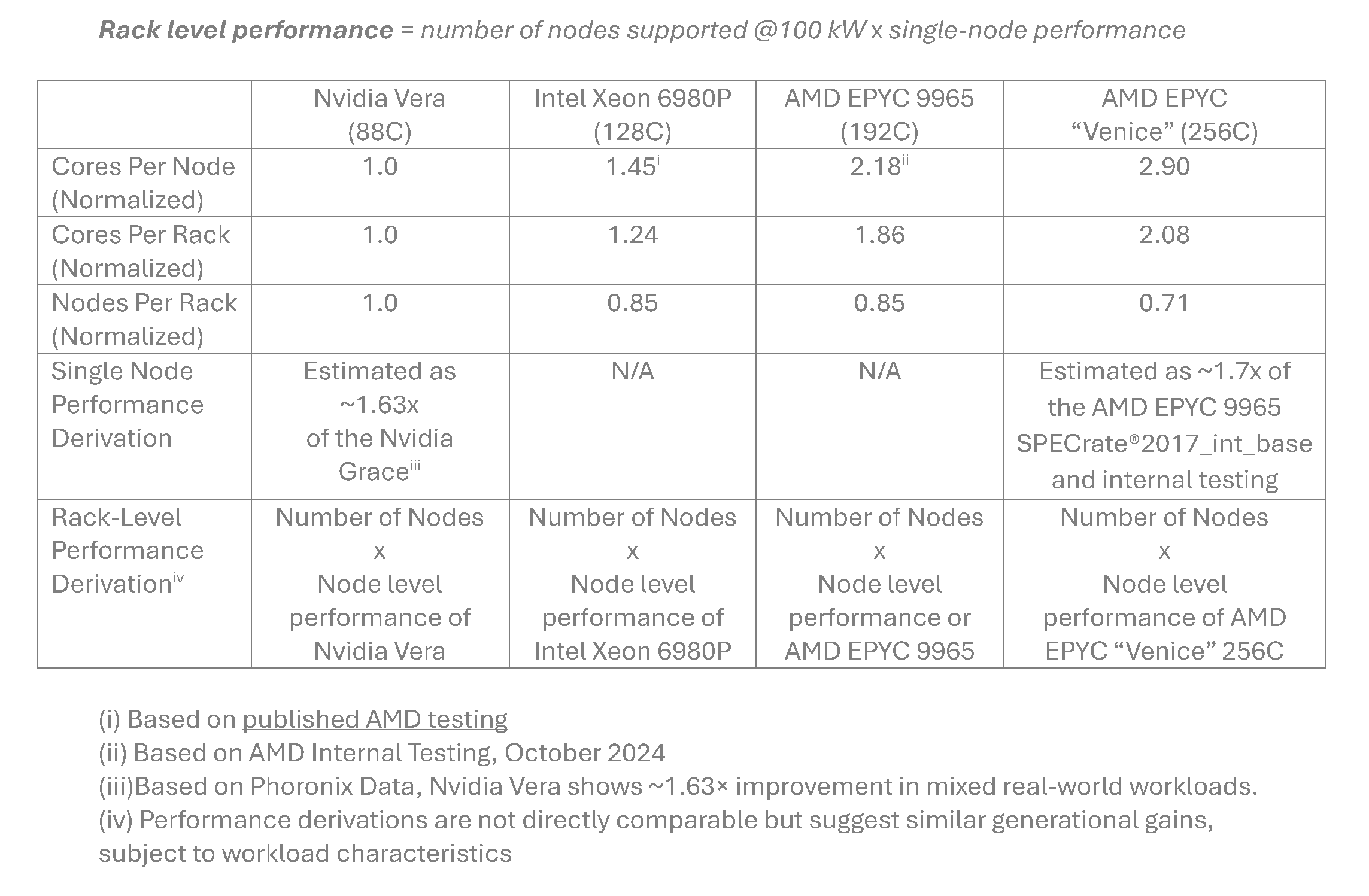
Nvidia, for its part, formally launched its Vera server CPU at GTC in March. The Arm-based SoC packs 88 cores and 176 threads. In recent benchmarks, Phoronix described Vera as the most capable Arm processor it has ever tested, outclassing Intel Xeon and AMD Epyc across most workloads. However, the tests were conducted at Nvidia’s headquarters and came with several restrictions to ensure Nvidia’s sign-off.
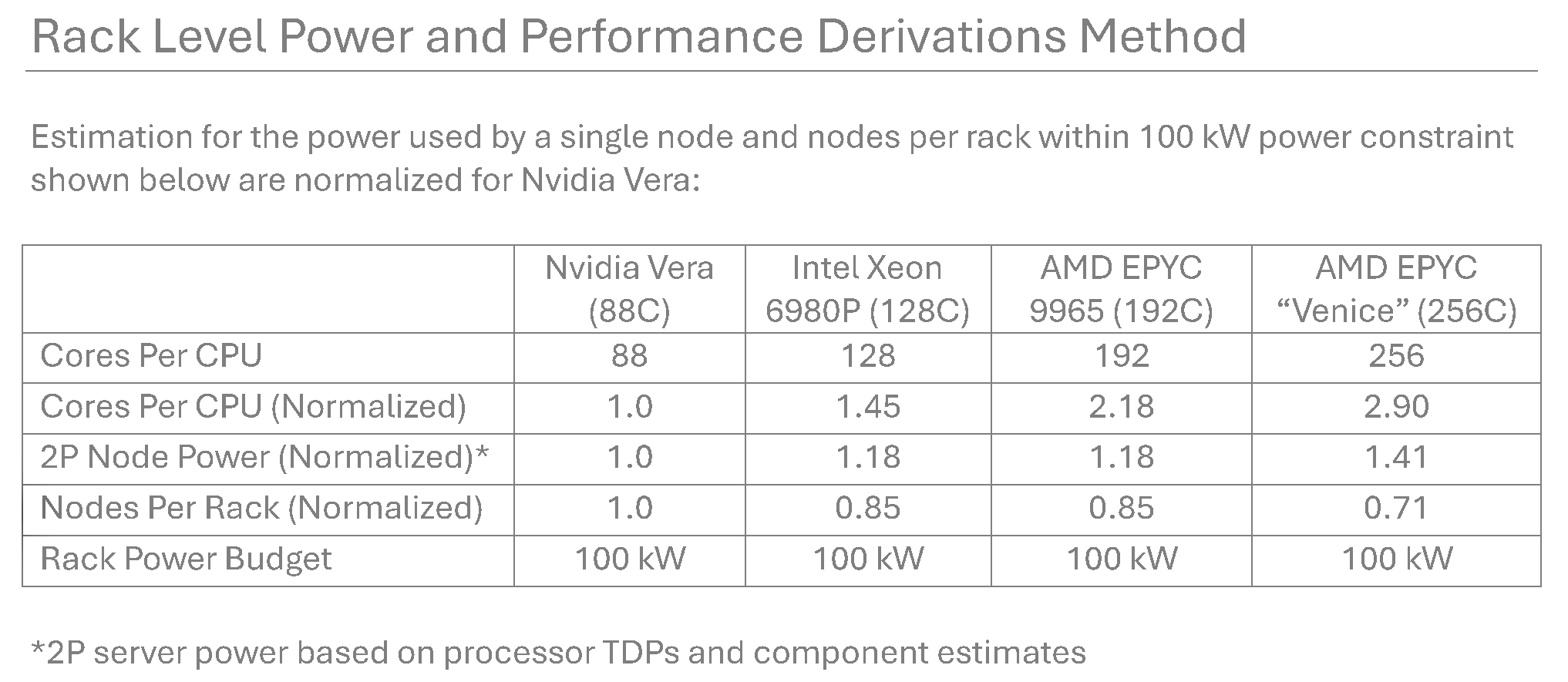
AMD drew on Phoronix’s figures when building the methodology for its Venice projections.
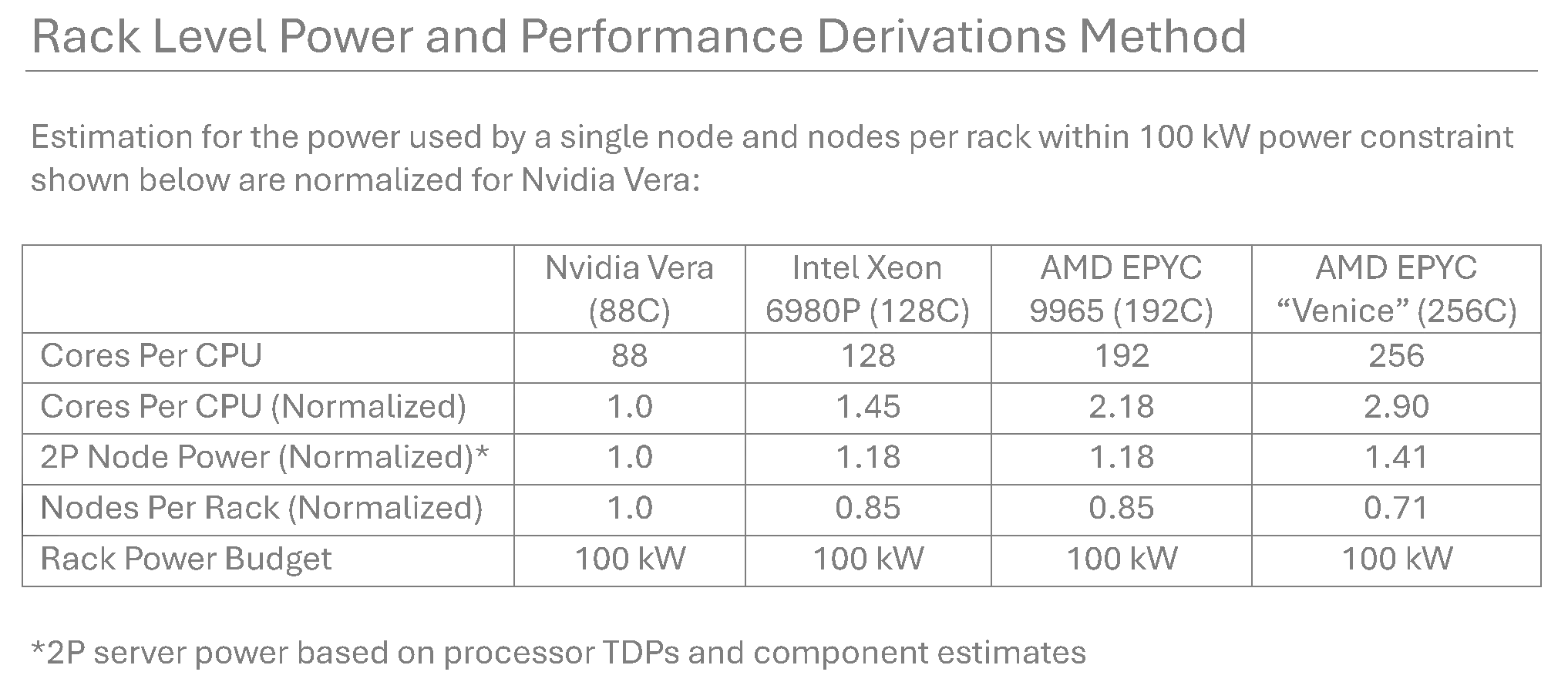
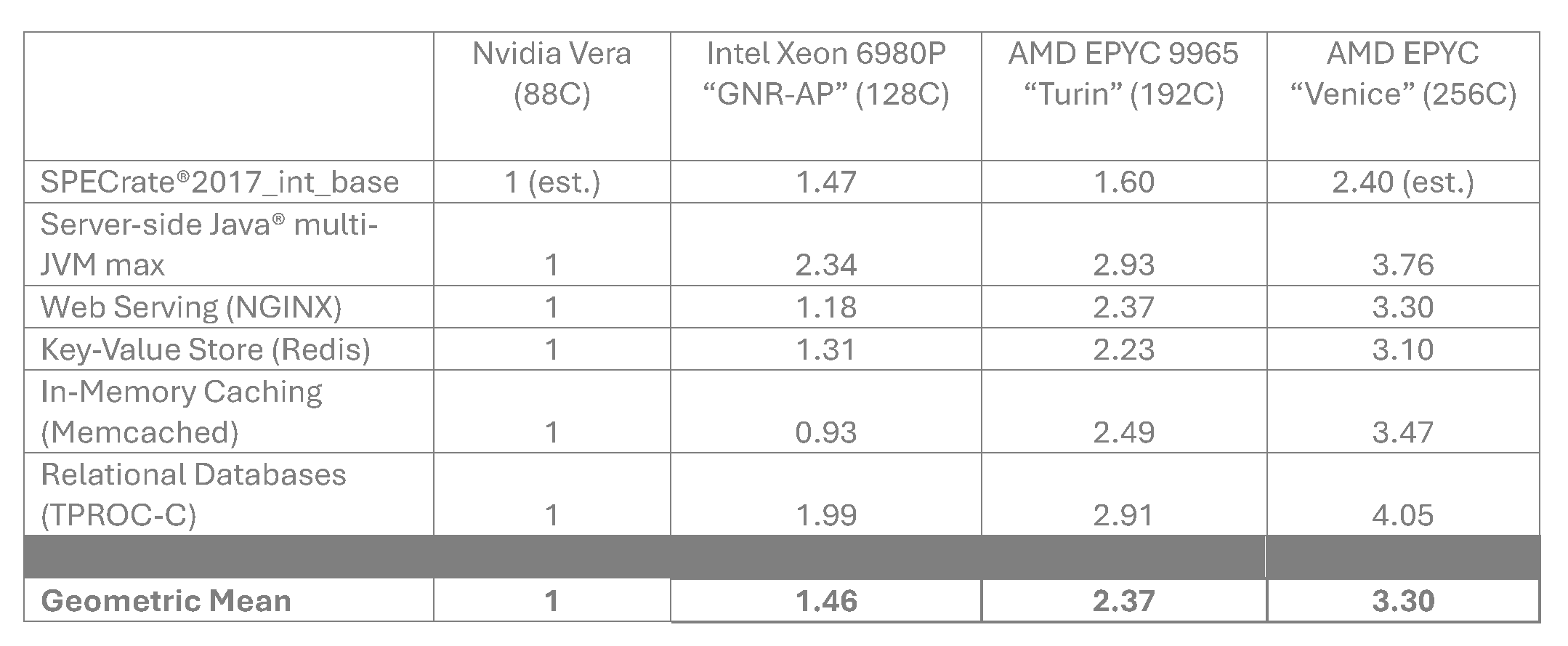
Comparing core counts per CPU, node power, nodes per rack, and a 100kW rack power budget, the company estimates Venice will deliver 3.3 times Vera’s per-rack performance. AMD also projects its 192-core Epyc 9965 Turin and the 128-core Intel Xeon 6980P GNR-AP can reach 2.37x and 1.46x of Vera’s output, respectively.
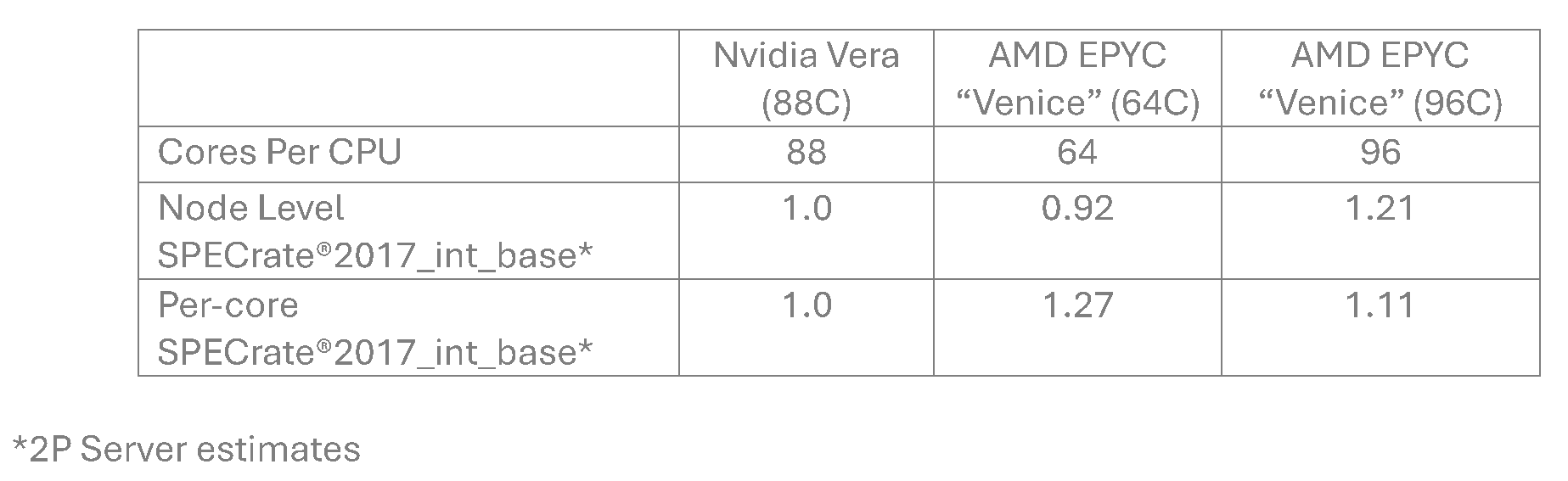
AMD is also challenging Nvidia on per-core performance, claiming a 64-core Venice chip can beat Vera by 27%, with the 96-core variant edging it by 11%.
As both processors target AI workloads, AMD argues that Venice’s higher core counts will translate into a meaningful advantage for agentic AI deployments. Even so, the true performance gap will remain uncertain until independent benchmarks arrive.
While promoting Venice’s theoretical performance, AMD is already hinting at what comes next. “Verano” will be AMD’s first CPU designed specifically for AI infrastructure. That chip is expected to introduce the Zen 7 architecture. Supply chain reports suggest Zen 7 will target TSMC’s A14 node, a 1.4nm-class process that would mark AMD’s entry into the angstrom era and deliver further gains in performance and efficiency beyond 2nm. AMD has not confirmed those details.







Weekend Open Thread: Evereve – Corporette.com

Jensen Huang Approves Samsung, SK Hynix, and Micron for NVIDIA (NVDA) HBM4 Memory Supply


Anatomy of the June crypto crash: Fed, Iran, Saylor

The Best Mystery Series of All Time Is Surging on Streaming 30 Years After It Ended


Alexander Zverev wins the French Open to finally earn a 1st Grand Slam title


Suspicious Polyfill login prompts pop up on Toshiba, Muji websites

Senator Cynthia Lummis Calls CLARITY Act the Most Consequential Financial Legislation of This Generation


Microsoft launches MXC, an OS-level sandbox for AI agents, with OpenAI and Nvidia already on board


Microsoft unveils seven homegrown AI models in new bid for ‘long term self-sufficiency’


(VIDEO) Justin Bieber Delivers Surprise Happy Birthday Serenade to Diners at Los Angeles Mexican Restaurant

The Pain Points Taking a Fragile Tech Rally Down a Notch

Eli Lilly (LLY) Stock Surges 4% Following Breakthrough Sleep Apnea Trial Results
LBank Surpasses 25 Million Users Worldwide as AFA Partnership Continues to Drive Global Growth

Von der Leyen’s AI envoy pick draws conflict-of-interest fire


High Stakes for Wembanyama as New York Pushes for 3-0 Lead


Meta steals a tactic from Tesla and builds data centers in tents


Trump’s AI Ownership Plan Could Benefit Anthropic at OpenAI’s Expense


Hackers now exploit SolarWinds Serv-U flaw to crash servers

Bangladesh beat Australia after 20 years in ODIs, register only their second win over six-time world champions | Cricket News


Notion restores access to Anthropic after service disruption
You must be logged in to post a comment Login