
Related: These 16 Wedding Guest Dresses That You’ll Even Wear After the Ceremony
Advertisement



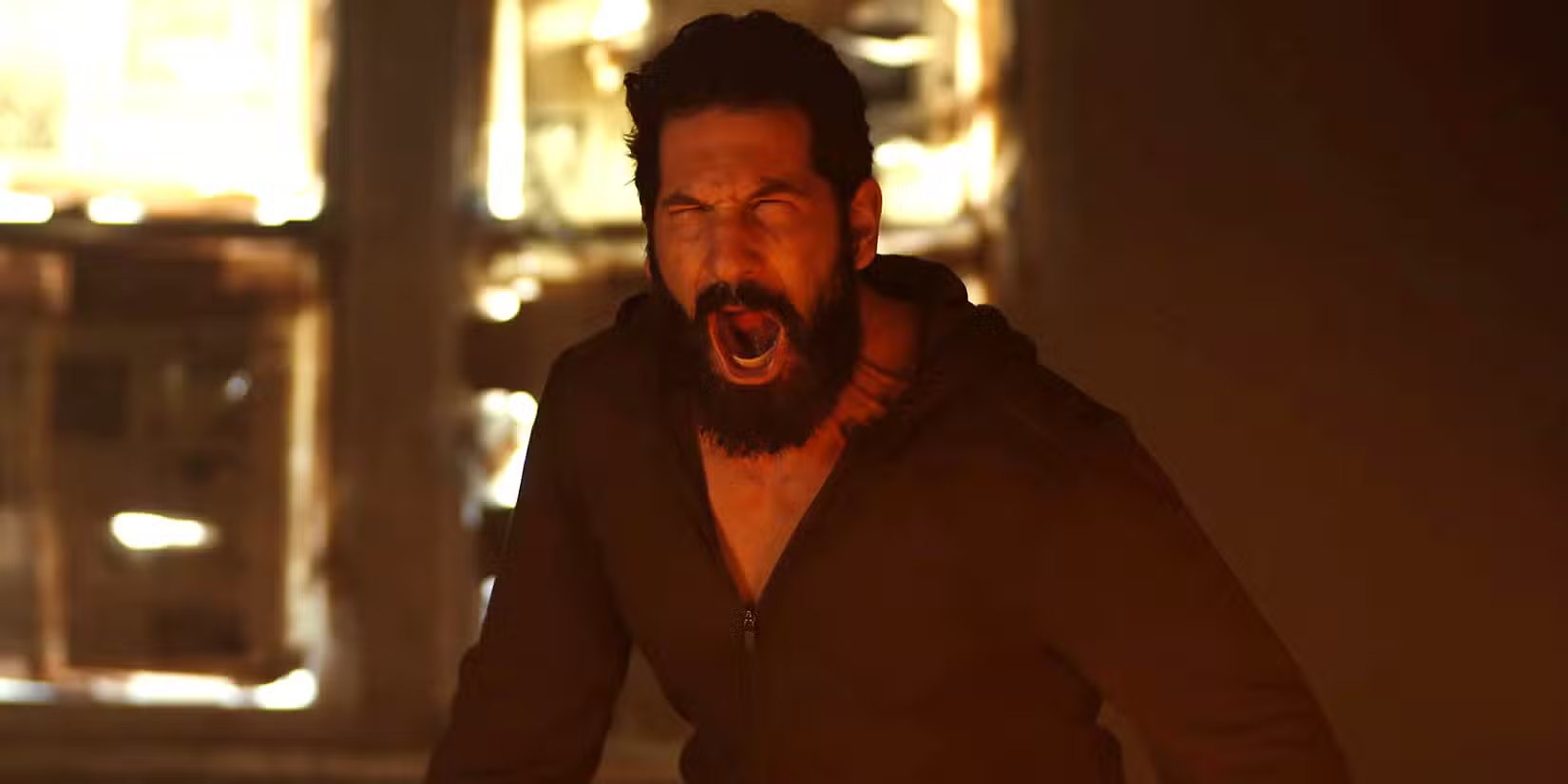
The last time we saw Frank Castle (Jon Bernthal) was at the end of Season 1 of Daredevil: Born Again, where the anti-hero was locked in one of Wilson Fisk’s (Vincent D’Onofrio) cages, but with the return of Season 2 this year, the Punisher was curiously missing from the lineup of heroes protecting New York. Now, after The Punisher: One Last Kill, we know where he’s been the entire time. In a violent and action-packed hour of television, Marvel gives us an intimate look into where Frank has been since the cage. While the special covers a lot of ground, it also dives deep into Frank’s psyche, something fans haven’t witnessed since the end of the original Netflix Punisher series.
One thing that becomes immediately obvious in One Last Kill is that this is the darkest version of Frank Castle we’ve ever seen. Gone is the snarky, gruff brawler that trades quips with Daredevil (Charlie Cox); this is Frank at his lowest. He’s spent the last few months killing every member of the Gnucci crime family, the last people responsible for the deaths of his family. The streak of vengeance has done a number on his psyche. He’s not only hallucinating the ghosts of his comrades, like Curtis (Jason R. Moore), but also his wife and children.
As a man on a mission, Frank is completely checked out of everything around him. His actions against the Gnucci family have thrown New York into chaos, especially in the neighborhood of Little Sicily, where crime runs rampant. People are getting beaten up, robbed, and even killed without a second thought, but it’s all going over Frank’s head. It’s a stark contrast to Matt Murdock, who can’t help but help everyone around him, even when he’s not able to, and shows the different headspaces of the two characters. It’s not until Frank is literally forced to act that he finally picks up a weapon and becomes the Punisher again.

One Last Kill once again focuses on Frank’s trauma and specifically the loss of his family. Director Renaldo Marcus Green penned the script with Bernthal, and the two have left no room for subtlety when it comes to Frank’s character. Unfortunately, by this point, it’s very familiar ground. It proves that the series needs to let Frank grow beyond his trauma. It’s beginning to make him feel one-note, and the special essentially knocks you over the head to remind you that this is a man in a bad mental state.
The problem here is that this has been Frank’s storyline since we first met him in Daredevil Season 2 over 10 years ago. Since then, we’ve seen him reconcile his past with his present in various ways, but One Last Kill needs to be the last time it’s revisited. Clocking in at under an hour, One Last Kill itself feels very much like a standalone episode or a one-shot comic rather than a true special, like it could be tacked onto Daredevil: Born Again if the season had been longer. Half of the episode is pure action while the other half is pure angst, giving the viewer little time to actually feel settled. It also feels like a bit of a reset for Frank, but as he’s had several of these for his character by now, we can really only hope the change is permanent this time.

If Disney+ has been getting flak for making their shows too sanitized, that fear has been officially assuaged (if Fisk crushing a head with his bare hands didn’t do it for you). One Last Kill is unrelentingly vicious when it comes to violence. Within the first ten minutes, we watch an unhoused man get beaten up while his dog is tossed into oncoming traffic. The violence of the special is stomach-churning, especially when there’s no Frank to come in and save the day.
When Frank is confronted by Ma (Judith Light), the matriarch of the Gnucci family, he is finally knocked back into focus. And when Frank goes full throttle, it feels like he’s as invincible as Luke Cage (Mike Colter). Bernthal adds a good amount of grunting and struggling, but at this point, the number of injuries Frank has sustained while continuing to keep fighting is superhuman. At one point, he falls from a roof down to the ground and manages to get up and walk away like it’s nothing. He gets stabbed, slashed, shot, and punched, all while inflicting lethal violence on whoever dares to charge at him.

“Frank Is in My Bones”: Jon Bernthal Confirms He Is Co-Writing ‘The Punisher’ Special
Jon Bernthal makes his writing debut with a new Punisher project, finally telling Frank Castle’s story his way. Discover what’s coming.
As was the issue with the first season of Daredevil: Born Again, this once again feels a bit like Disney overcompensating. Showing sequences of Frank killing mercenaries, almost like a video game, while Hatebreed‘s “I Will Be Heard” blasts, feels a little too on the nose. It’s an impressive bit of violence, showing how creative Frank can be at killing people, but it eats up almost the entire half of the episode, oftentimes becoming redundant.

What saves One Last Kill from being too one-note is, of course, Bernthal’s acting. Green splices in memories of Frank’s kids and his wife Maria (Kelli Barrett) to show us just which demons continue to haunt him, but it’s the quiet scenes he has alone that are the most tragic. His loneliness is suffocating, turning him into a hermit, one who can’t escape the ghosts of his past and doesn’t seem to want to. While these scenes, along with the ones of Curtis and his fellow marines, can feel almost oppressively sad, there is one moment that becomes a turning point for Frank.
Deborah Ann Woll appears near the halfway mark as Karen Page, her presence shaking some sense back into Frank and offering a reprieve from his extremely dour mood. Although it’s short, it acts as a transitional scene between the two halves of the episode as well as Frank’s past and his future. By the end of the special, the stage has been set for Frank’s appearance in Spider-Man: Brand New Day, while also bringing in potential regulars for Frank’s own story, including Light’s Ma and Andre Royo‘s Dre, a local storekeeper who shares some strong moments with Frank.
Ultimately, it’s clear that what makes The Punisher work is still the star at the center of it. Bernthal has a very lived-in approach to Frank, one that manages to make his depressing scenes feel somewhat fresh despite retreading the same ground. As much as Cox has perfected the different sides of Matt Murdock, Bernthal has really honed in on what makes Frank tick, and his presence alone makes One Last Kill worth watching.
The Punisher: One Last Kill is now streaming on Disney+.

May 12, 2026
60 Minutes
Reinaldo Marcus Green
Reinaldo Marcus Green, Ross Andru, Jon Bernthal, Gerry Conway, John Romita Sr.
The Punisher
The mockumentary format of filmmaking, specifically for sitcom television, is one of the most popular and quickly growing. It’s been around for quite some time, but gained extreme popularity through smash-hit shows like The Office and Parks and Recreation. The mockumentary style has become super beloved. For comedy specifically, the format helps people feel a bit more connected and believe in the content a bit more.
Mockumentary grounds whatever it’s showcasing in reality—even when what’s on-screen doesn’t happen in real life. The style attempts to showcase what’s being depicted as if it’s a documentary on real-life events. This helps bring audiences into new environments, and they are able to buy into them a lot easier than otherwise. The characters feel a lot more genuine, as well. All reasons why mockumentaries are so abundantly popular.
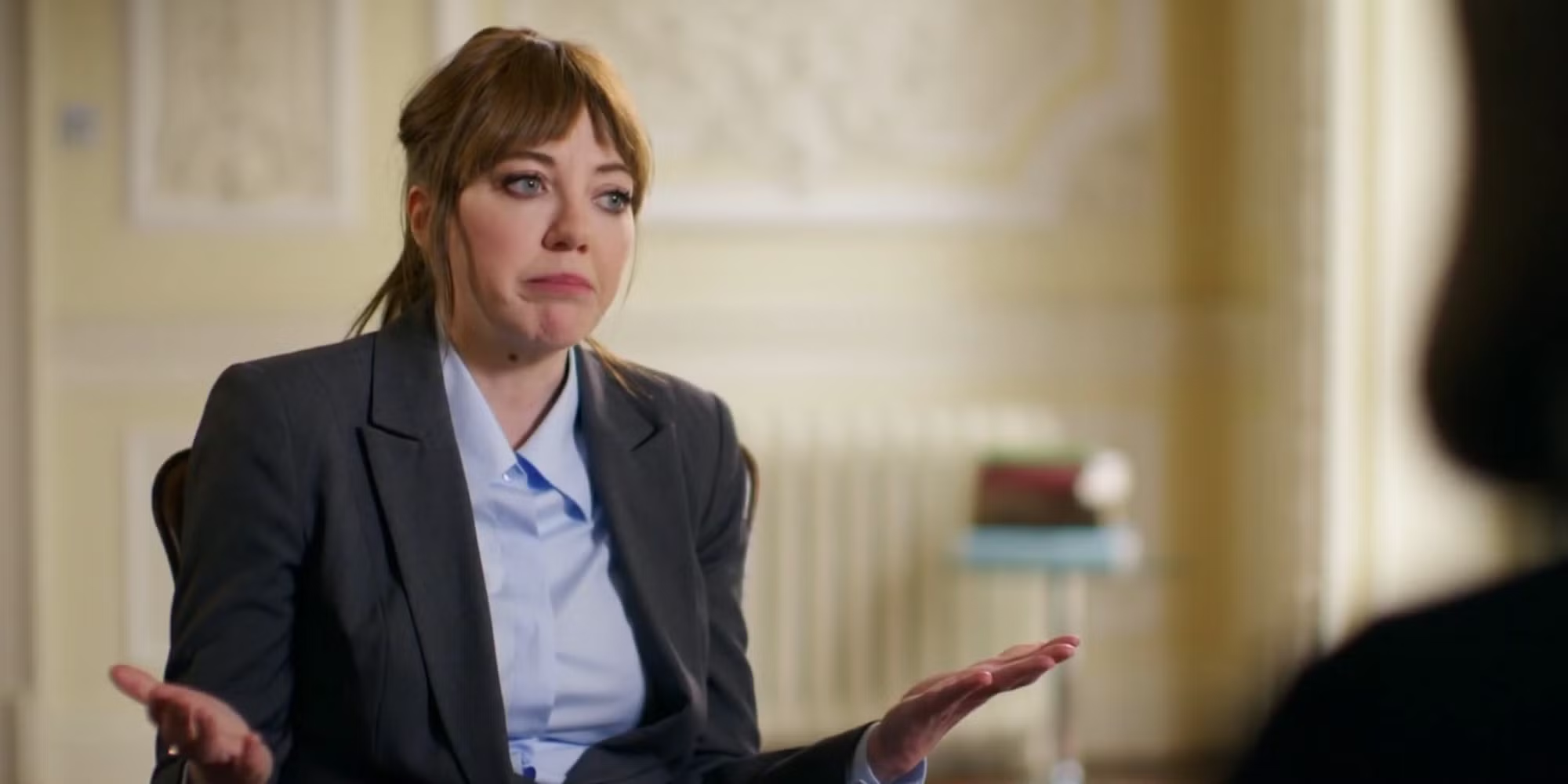
Historical documentaries are the most famous and well-known documentaries out there. Cunk on Earth takes this concept and absolutely makes fun of it through the wonderful performance by Diane Morgan. Covering real-world historical events like the fall of the Roman Empire and the Dark Ages in a comedic documentary.
What makes Cunk on Earth even funnier is the fact that when they’re performing these hysterical interviews, they’re interviewing actual experts on the topics they’re covering. This makes Cunk asking her absurdist questions even better, because who would ask these kinds of things to real experts on things like the Roman Empire? Cunk. Cunk would.

There’s no man who can do a deadpan performance quite like Nathan Fielder (mainly because there’s no beating Aubrey Plaza and Jenna Ortega). Unlike YouTube pranksters, Nathan for You puts Fielder in front of real people to pull off his performances, which makes his bits even funnier. He has some absurd schemes that are so comical that they actually sometimes work, which not only adds to hilarity but is genuinely impressive.
Nathan for You has some absolutely iconic episodes across its four-year run. But not only is it humorous, but some of his pranks and bits act as subtle social commentary on things like capitalism and gullibility in the general population. The series (and Nathan Fielder himself) expertly raises the stakes and makes things continuously more ridiculous as they move forward.

Abbott Elementary has completely taken over the television space in the last few years. Following the lives of teachers at the titular elementary school, Abbott Elementary depicts the hilarity and ridiculousness that occur when one becomes an elementary school teacher across its seasons.
While the events of the series are fictional, the conflicts and events within the series are very real. Being a teacher is not easy, and while this is an absolutely hilarious comedy, it’s also a love letter to teachers everywhere. They’re raising the next generation of children, and this leads to some of the best moments in the show as it comments on and makes fun of real things, like when they commented on kids picking up social trends in Abbott Elementary Season 1, episode 11, “Desking.”

Alongside the obvious contenders of The Office and Parks and Recreation, Arrested Development is one of the most popular mockumentaries out there. Arrested Development sets itself apart, however, by not following a lot of the typical tropes found in a mockumentary. Normally, a series in this style commonly cuts to interview segments within the episode, but Arrested Development opts not to do this.
While it’s not formatted like a typical mockumentary, it finds itself being one because the characters within it commonly acknowledge that they are being filmed, and they’re on a television show. Many consider this to be one of the best shows of the last few decades, and for very good reason. The writing is exceptional, and with performances from the likes of Jason Bateman and others, it’s excellent.

Families are troublesome. Everyone can easily attest to this statement in some way, shape, or form. Together, Christopher Lloyd and Steven Levitan brought a series to life that depicts the ridiculous nature of all types of families—the nuclear family, mixed families, and families led by a gay relationship. Its first few seasons were critically praised all-around for the exceptional episodes it brought forth.
The writing for Modern Family is sharp, witty, and smart. A huge part of this is because co-creator Christopher Lloyd got his start by writing on the critically acclaimed Golden Girls. Over the course of its run, it won over 20 Emmys and was highly noted for its wonderful cast and their great performances.

The common debate among the mockumentary fan base is whether The Office or Parks and Recreation is the best of the best. This is a very valid debate, as this 2009 series is simply one of the best of the 2000s. Much like its rival, it has one of the best casts on television with the likes of Amy Poehler, Nick Offerman, Aziz Ansari, Rashida Jones, Chris Pratt, Adam Scott, and genuinely so many more that either got their big start here or had a career-defining role.
Following the escapades of the Parks and Recreation Department in the fictional town of Pawnee, Indiana. What’s fun about this show is that audiences know that what’s being depicted is at least a little accurate, as the creators of the series actually studied local politics and even interviewed local politicians and government workers to make sure what they were making had authenticity to it.

What We Do in the Shadows is a hilarious supernatural mockumentary that follows vampire roommates Nandor the Relentless (Kayvan Novak), Laszlo Cravensworth (Matt Berry), Nadja (Natasia Demetriou), Colin Robinson (Mark Proksch), and their familiar Guillermo (Harvey Guillén). Tasked with conquering the New World—an assignment they’ve entirely forgotten—they go through modern life in Staten Island and deal with everything from awkward city council meetings to supernatural turf wars with werewolves, witches, and ghosts.
Over six riotous seasons, the FX show became a fan favorite thanks to the funny dynamic between its main characters. Satirizing both supernatural lore and the mundanity of being human, it expands on the world and original concept of the 2014 New Zealand film. What We Do in the Shadows is now a modern classic that concluded with a bittersweet finale that captures how it can strike both a humorous and heartfelt note.

Trailer Park Boys is easily considered one of the best mockumentary sitcoms of all time. The reasoning for this bold claim is largely because of the charm brought forth through its lower budget. Trailer Park Boys is a series that is known for being primarily improvised with its dialogue. This led to some of the funniest interactions on 2000s television.
It’s packed to the brim with recurring gags, surprisingly deep storytelling, and somehow stayed super unchanging in its quality over its entire run from 2001 to 2007. The fact that this show could have such a low budget and stand up against and even above most mockumentaries is astounding and proof of its caliber.

The Office is known as one of the best of the best because it genuinely revolutionized and redefined the entire mockumentary format. It threw its cast members onto a grand stage, stayed consistently superb, had amazing performances, spectacular screenwriting, and cast chemistry unlike any other.
What makes The Office even better is the fact that each character has a defined and true character arc amidst the absurdities at play. So, not only does it end up being an incredibly funny show, but people truly grew emotionally invested in The Office‘s likable characters. This not only kept them engaged through hilarity, but also because they wanted to see where these people would go with their lives.

Curb Your Enthusiasm is both Larry David and the mockumentary format’s magnum opus. There hasn’t been a show quite like Curb Your Enthusiasm to this day. Larry David knows how to do good comedy, if that wasn’t proven by his work on Seinfeld, Curb Your Enthusiasm is the perfect example of his comedic prowess.
What makes Curb Your Enthusiasm different from other improv-heavy mockumentaries is the fact that it is an almost fully improvised show. Scenes are merely outlined, and the actors take them from there. Larry David takes this concept and absolutely runs with it. This has led to some of television’s funniest moments of all time.

2000 – 2024-00-00
HBO Max
Jeff Schaffer
Robert B. Weide, Larry Charles, David Steinberg, Bryan Gordon, Alec Berg, Andy Ackerman, David Mandel, Barry Gordon, Cheryl Hines, Dean Parisot
:max_bytes(150000):strip_icc():format(jpeg)/conan-1-a5845c0cec12480f80431ffcef6ab1ee.jpg)
The Oscars aired a sketch spoofing Sean Penn’s death scene at the end of “One Battle After Another,” with the Academy disposing of O’Brien in the comical scene.
For decades, “The Brady Bunch” has remained one of television’s most replayed family sitcoms, turning its cast into permanent pop culture icons long after the series ended.
However, behind the nostalgia and endless reruns, one of the show’s stars is revealing a much sadder reality.
Eve Plumb recently admitted that despite the sitcom’s lasting success across generations, the actors are no longer seeing meaningful money from it.
Her revelation has sparked fresh conversation about how television contracts once worked, especially compared to the massive payouts stars from modern sitcoms still receive today.
Plumb is pulling back the curtain on what “The Brady Bunch” cast actually earned from one of television’s most replayed sitcoms.
The actress, who famously played middle daughter Jan Brady, recently addressed the subject while promoting her memoir, “Happiness Included: Jan Brady and Beyond.”
In the book, Plumb joked about the financial reality behind the show’s lasting popularity. “If I had a dime for every rerun episode, I’d pay off the national deficit. I don’t,” she wrote per the Daily Mail.
Plumb later doubled down on the statement during an appearance on the “PauseRewind” podcast. “To be clear, we don’t make residuals,” she explained.
The revelation shocked many longtime fans, considering “The Brady Bunch” has remained a television staple for decades through syndication and streaming reruns.
The ABC sitcom originally aired from 1969 through 1974, but its cultural footprint never really disappeared.
Plumb is not the only “Brady Bunch” star who has spoken openly about the show’s lack of long-term financial rewards.
Susan Olsen, who played Cindy Brady, previously explained why the cast no longer receives rerun money.
Appearing on Oprah Network’s “Where Are They Now,” Olsen revealed that the issue stemmed from television rules that existed before 1973.
According to the star, actors at the time were compensated only for a limited number of rerun broadcasts.
She explained the cast was only “paid for reruns for the first 10 runs.” After that, the payments completely stopped. “So [we’ve] made no money since then,” Olsen said.
The residual checks reportedly dried up entirely in 1979 despite the sitcom continuing to air across networks for decades afterward.
Barry Williams, who portrayed Greg Brady, also previously addressed the surprisingly modest paychecks the cast received during the sitcom’s original run.
In his 1992 memoir “Growing Up Brady: I Was a Teenage Greg,” Williams explained how dramatically television salaries have changed since the 1970s.
“Salaries for sitcom actors have changed considerably since the ‘70s,” he wrote. The actor revealed that during the show’s last season, the highest-paid child actor on the series earned just barely over a thousand dollars per week.
“In our fifth and final year, the highest salary among us kids was $1,100 a week,” he shared. Although Williams acknowledged that earning roughly $24,000 during the final season was “not bad for a teenager,” he also noted the money disappeared quickly after taxes, commissions, and family expenses.
“It was enough to indulge in toys, but hardly enough to carry you through the slow periods that inevitably followed,” he explained.
The original cast also included Maureen McCormick, Mike Lookinland, and Christopher Knight, all of whom became permanently linked to their iconic Brady characters.

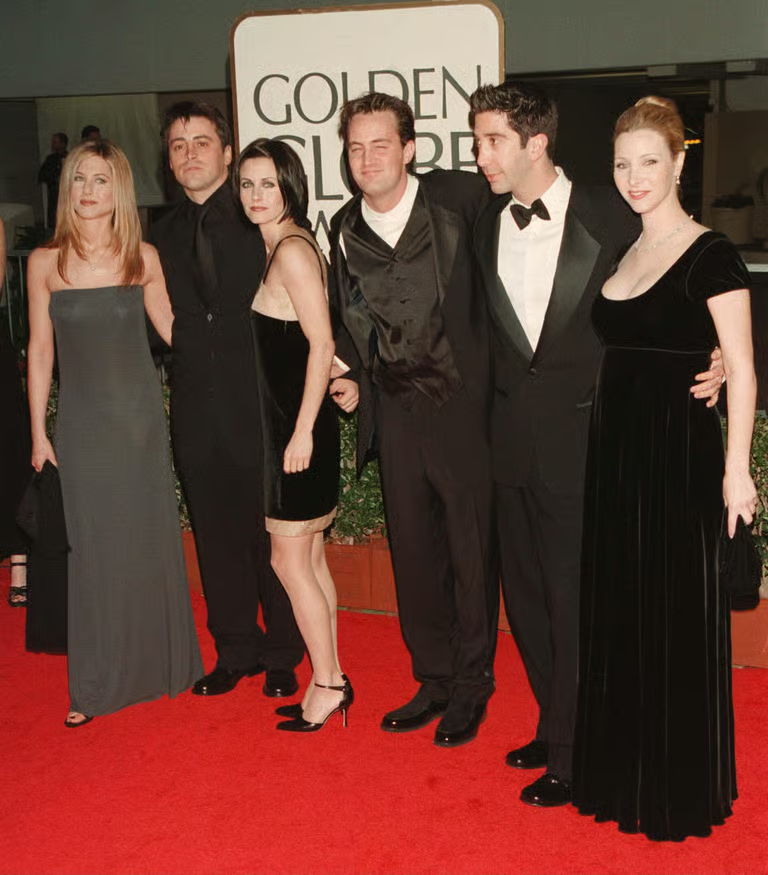
The whopping financial difference between “The Brady Bunch” cast and modern sitcom stars became even more noticeable after Lisa Kudrow recently discussed “Friends” residuals.
Kudrow admitted that she and her co-stars still earn massive payouts from reruns of the beloved NBC comedy.
The actress, who played Phoebe Buffay from 1994 to 2004, starred alongside Jennifer Aniston, Courteney Cox, David Schwimmer, Matt LeBlanc, and the late Matthew Perry.
Unlike the Brady cast, the “Friends” stars famously negotiated together throughout the show’s run. Their salaries eventually climbed from $22,500 per episode during the first season to a staggering $1 million each by the final two seasons.
Reports have also claimed the cast still earns around $20 million annually from the show’s continued popularity. The stars later reunited for HBO Max’s 2021 reunion special and reportedly received $2.5 million each for the appearance.

In April 2025, Olsen opened up about the lasting impact of being typecast as Cindy Brady, admitting the role followed her long after “The Brady Bunch” ended.
Speaking on “The Real Brady Bros” podcast with former co-stars Williams and Christopher Knight, Olsen reflected on constantly being cast as the “ditzy” or “stupid” child, saying, “That’s just how my career was, and it was something I had to accept.”
As reported by The Blast, she recalled how frustrating it was to play a character so different from her real personality, with Williams telling her she was “so much smarter” and “edgier” than Cindy.
Olsen also shared that even her son eventually noticed the pattern after watching one of her old Disney movies, joking, “So you always play the stupid child.”
The actress admitted the role affected her deeply as a child, explaining she dreaded returning to public school because classmates treated her like Cindy in real life and teased her over the character’s “stupid” moments and lisp.
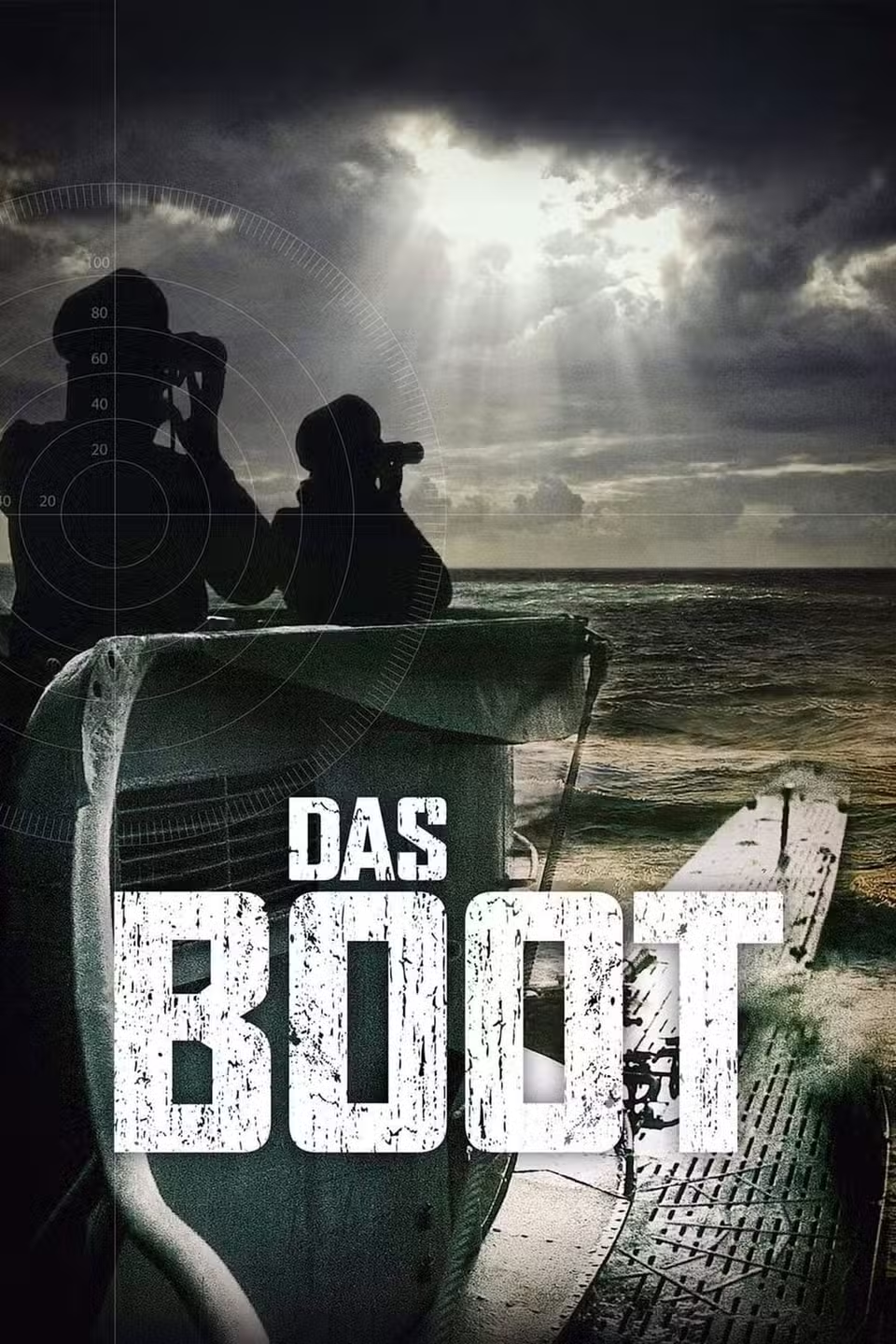
As long as the earth remains, human conflict will never fully disappear. It is a part of our existence and oftentimes, we choose war as a means of resolution. For those who are unaware, war is brutal, destructive, exhausting, and, more often than not, utterly meaningless. However, humans always seem to find themselves in one conflict or the other. While some wars are localized, others have global ramifications and none quite as cataclysmic as World War II. The conflict played out across various locations across land, air and sea, reshaping the global order in its aftermath. Several creatives have told stories about the defining conflict of the 20th century, with Wolfgang Petersen’s 1981 World War II picture Das Boot, one of them.
The Oscar- and Golden Globe-nominated masterpiece would go on to inspire a 2018 series of the same name, which continues to highlight the senseless reality of the entire conflict. With two storylines running parallel on land and sea, Das Boot sees its dialogue authentically switching between English, German, and French, even as the story follows the crew of a German U-boat embarking on its first voyage in 1942 and a young woman caught between the Gestapo and the French Resistance on land. The original Das Boot film from 1981 grossed $85 million, making it a global blockbuster and earning six Oscar nominations. The film stands apart in the crowded sea of submarine war movies and the series is just as impressive.
Now, the 2018 Das Boot series is making a streaming return, having been on Hulu previously. According to a new report, Kino Lorber’s MHz Choice will have all four seasons of the classic WWII U-boat series, including ones that have never previously streamed in the U.S. MHz Choice will welcome the first season of the drama series on July 7 with the second season following on August 4, with two episodes, then installments launching weekly. However, the release dates for Seasons 3 and 4 have not been made available yet.
A big-budget European show, Das Boot assembled an impressive cast from Germany, France, the UK and the US to tell its tale, including Vicky Krieps (Phantom Thread), Tom Wlaschiha (Game of Thrones), Lizzy Caplan (Masters of Sex), Vincent Kartheiser (Mad Men), James D’Arcy (MARVEL’s Agent Carter), Thierry Frémont (Juste un regard), August Wittgenstein (The Crown), Rainer Bock (Inglourious Basterds), Rick Okon (Tatort), Leonard Scheicher (Finsterworld), Robert Stadlober (Summer Storm), Franz Dinda (The Cloud) and Stefan Konarske (The Young Karl Marx). Andreas Prochaska, whose credits include Das finstere Tal (The Dark Valley) and Das Wunder von Kärnten (A Day for a Miracle), directed the series with Tony Saint and Johannes W. Betz as the head writers.
Season 1 of Das Boot arrives on MHz Choice in the US on July 7. Stay tuned to Collider for updates.

November 23, 2018
Andreas Prochaska
Johannes W. Betz, Tony Saint
:max_bytes(150000):strip_icc():format(jpeg)/Billy-Bob-Thornton-051226-1-e45dac106f994bb4a5c72a1874815c62.jpg)
The “Landman” star got candid about his beliefs on the “Howie Mandel Does Stuff” podcast.

Us Weekly has affiliate partnerships. We receive compensation when you click on a link and make a purchase. Learn more!
Getting dressed up for a wedding sounds fun until you’re staring at a closet full of clothes and somehow still have nothing to wear. After spending way too much time searching for a flattering, comfortable option to wear to multiple summer weddings, I finally found this bodycon wrap dress that completely solved my outfit dilemma without blowing my budget.
The midi style has that rare combination of being fitted enough to feel polished while still comfortable enough to wear for hours of dancing, sitting and outdoor ceremonies in the heat. The wrap-style ruching creates a super flattering silhouette, while the bodycon fit gives it a sleek, elevated look that works for everything from beach weddings to cocktail receptions.
Get the Lillusory Bodycon Midi Dress for $25 (originally $30) at Amazon! Please note, prices are accurate as of the publishing date but are subject to change.
One of my favorite things about the dress is how versatile it feels. Depending on how you style it, it can easily work for formal weddings, date nights, bridal showers or even vacations. I paired it with strappy heels and gold jewelry for one wedding, then rewore it later with flat sandals and a denim jacket for dinner with girlfriends.

Wedding season is officially in full swing — and if you have a calendar full of ceremonies and zero clue what to wear, don’t panic. Amazon is literally a gold mine for stylish, affordable wedding guest dresses that look way more expensive than they are. Whether you’re headed to a casual beach celebration or a […]
The stretchy material also makes a huge difference when it comes to comfort. Unlike stiff occasion dresses that feel restrictive after an hour, this one moves with you and hugs the body in a flattering way without feeling too tight. The ruched wrap detail adds shape while helping smooth everything out, which makes it especially confidence-boosting for events where you know photos will be taken all night. Plus, the gold buckle detail helps draw the eye in to your cinched waist!
Many Amazon shoppers were just as impressed with this dress, especially given the affordable price. One reviewer wrote that the “fabric was beautiful and wrinkle-free right out of the vacuum-packed bag.” Another shopper loved how the stretchy fabric complements the body and said it was “super comfortable . . . for the price!!” A third reviewer called this the “optimal summer body-contouring” dress.
If you still haven’t found your summer wedding guest dress, consider this your sign to stop stressing. This flattering wrap dress checks every box, and you’ll probably end up wearing it long after wedding season ends.
Get the Lillusory Bodycon Midi Dress for $25 (originally $30) at Amazon! Please note, prices are accurate as of the publishing date but are subject to change.
Looking for something else? Explore more summer wedding guest dresses here, and don’t forget to check out all of Amazon’s Daily Deals for more great finds!

From travel plans to gift shopping, prepping for an upcoming wedding can be stressful enough — and that’s without worrying about getting a dress tailored. When you’re a petite fashionista, it almost always comes with the territory, but these wedding guest dresses prove otherwise. After a peruse through Amazon, we discovered a few short gal-friendly […]
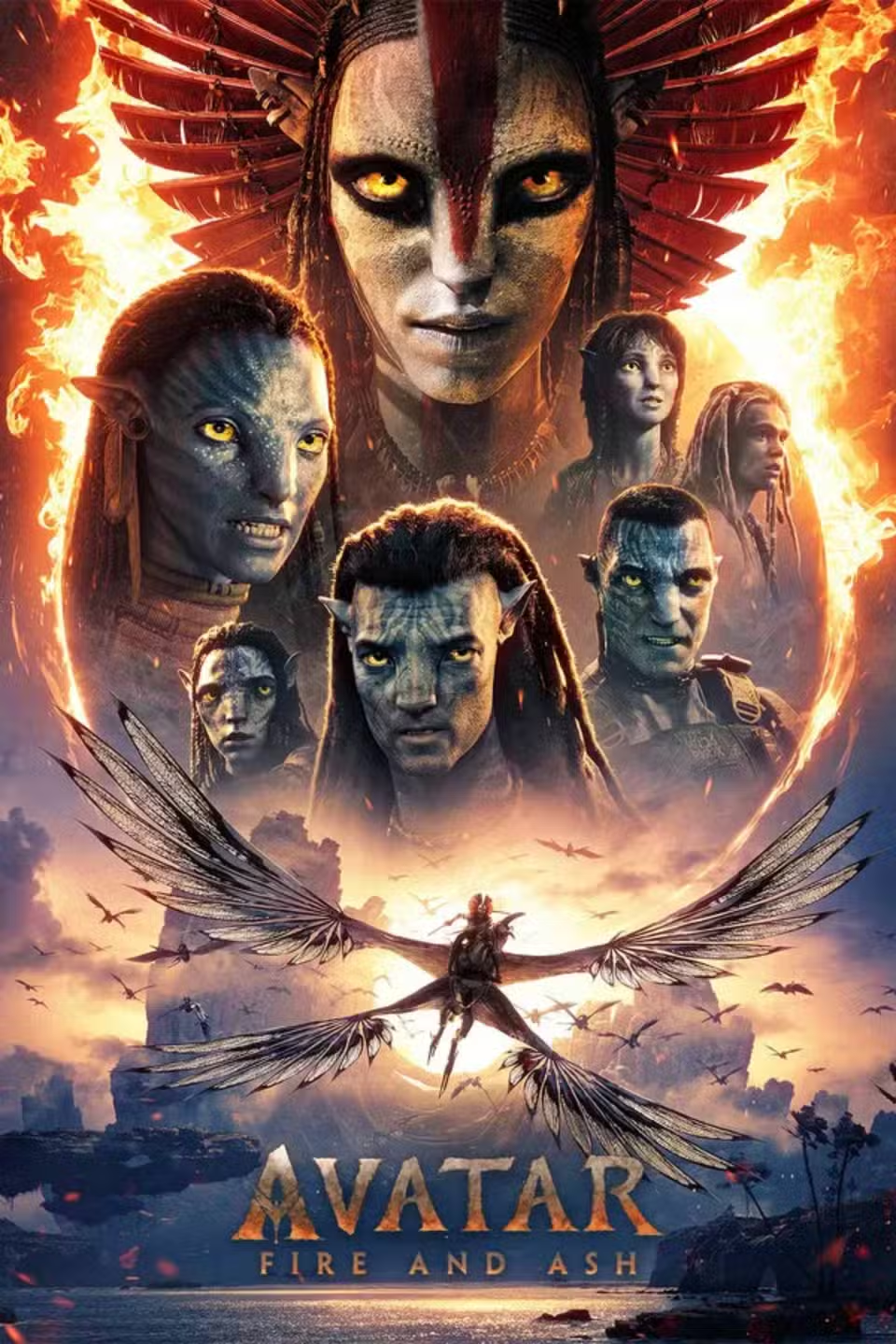
No studio does fantasy and sci-fi blockbusters quite like Disney. From the Marvel Cinematic Universe to the Star Wars saga to Pirates of the Caribbean, the studio has a long track record of building franchises that dominate the global box office and keep audiences coming back. But last year, there was one movie that stood apart as a true standout hit for the studio, and it came from one of the most ambitious sci-fi franchises ever put to screen.
This series has basically become James Cameron’s magnum opus. He famously put several other films on the back burner, including his producing proAlita: Battle Angel, so he could fully focus on this franchise. And that commitment clearly paid off. Every single film in the franchise has consistently broken the billion-dollar mark at theaters, and the latest sequel pushed that legacy even further by introducing its darkest, meanest chapter yet.
That film is Avatar: Fire and Ash, the third installment in the Avatar franchise. It became the third-highest-grossing film of 2025 with a worldwide box office of $1.48 billion. The film was later released digitally in March and has been a consistent performer on digital rental and purchase platforms. According to FlixPatrol, it ranked in the Top 10 this week in 14 countries on Amazon Prime Video Store and in 60+ countries on Apple TV Store. It is also currently the #1 most popular movie in the United States on both platforms.
Cameron has confirmed that the Avatar franchise will span four sequels in total, with Avatar 5 serving as the final film that wraps up the story. Before Fire and Ash was released, Cameron was candid about the stakes, saying that the sequel needed to make serious money to justify moving forward with Avatar 4 and 5. He even said he was ready to walk away from the franchise and write a book to resolve the story if the films did not get made. The CGI-heavy films are extremely expensive to produce, and every dollar spent definitely shows up on the screen, but that scale also means a billion dollars at the box office may not be enough to guarantee a sequel.
While Fire and Ash was the third highest-grossing film of its year, the box office tells a concerning story when viewed as a trend. The original Avatar made $2.92 billion worldwide. The Way of Water made $2.33 billion, which was already a step down. Fire and Ash landed at $1.48 billion, nearly a full billion less than its predecessor even though that is over 3x its reported budget. That is a steep decline across three films. On the more reassuring side, Disney’s updated release calendar from March 20 still has Avatar 4 and 5 dated for 2029 and 2031, which confirms that Fire and Ash was enough of a success to keep the franchise moving forward. But a lot is now riding on Avatar 4 to reverse the trend, and if it releases and underperforms, the road to a fifth and final film could get very complicated.
Avatar: Fire and Ash is available to rent or purchase on the Apple TV Store.

December 19, 2025
197 Minutes
James Cameron
Amanda Silver, Rick Jaffa, James Cameron, Josh Friedman, Shane Salerno
Jon Landau, James Cameron
The movies released in the ’90s have a bigger cult-favoritism than any other era. Now that’s mainly because a lot of the people who watched them now have a good standing on social media so they have a bigger voice and take pride in their era. However, it’s important to note that the remakes from ‘90s movies almost always feel like they were made by people who could identify the brand but not the voltage. They know the title. They know the poster image. They know the broad setup people remember. The popular girl makeover story. The house party chaos. The cool dead guy in face paint. But what they do not know is the pressure system inside those movies.
The ’90s were weirdly specific. Teen movies had insecurity in them. Studio thrillers had sweat in them. Action movies had philosophy hiding inside stupidity. Family films had earnestness without apology. Even the glossy stuff usually had some emotional impurity to it, some embarrassment, ache, lust, identity panic, or wounded sincerity that made the whole machine hum. And most of their remakes kept sanding that away. Especially the 10 on this list don’t feel like new versions of old stories but replicas made from memory by someone who only saw the trailer and that’s why they’re treated far more harshly than any other decade.

This one is bad in the most modern, airless way possible. She’s All That is not some sacred text, and I am not pretending it is. It is a glossy teen comedy with all kinds of late-’90s artificiality built into it. But it understands one thing the remake does not: adolescent humiliation is real even when the movie is being silly. Laney Boggs (Rachael Leigh Cook) matters because the movie knows that being unseen is not just a premise trick. It is an emotional position. Zack Siler (Freddie Prinze Jr.)’s bet has actual cruelty in it because the film understands social hierarchy as a teenage religion.
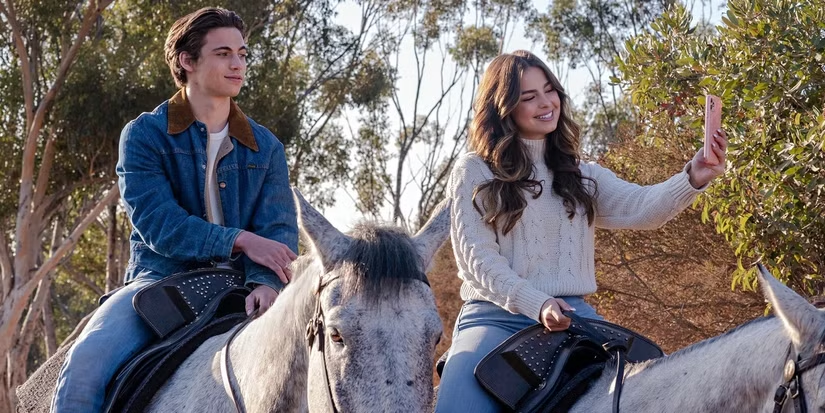
He’s All That turns all of that into influencer-era flatness. The whole movie feels pre-filtered. Padgett Sawyer (Addison Rae) should feel like somebody whose popularity is always one public disaster away from collapse, but instead she mostly feels like a concept carrying brand-level anxiety. Cameron Kweller (Tanner Buchanan), meanwhile, is supposed to be the real person she learns to see, and the film never gives that dynamic enough awkwardness, sting, or mutual vulnerability to become emotionally persuasive. The makeover plot becomes even more insulting when the movie itself has no real idea what interior transformation even looks like. It confuses optics with identity, which would be interesting if the script knew it was doing that. It does not. It just lives there.

The original House Party is so alive. That is the thing people forget when they reduce it to a fun party movie. It is alive in its feet, in its music, in its flirtation, in the sense that one night can still feel socially enormous when you are young. The energy is not only in the party. It is in sneaking toward it, risking punishment for it, dressing for it, fantasizing about it, hoping this one night might shift your status, your luck, your romantic life, your whole self-image. That is why the original works. The house party is not in the background. It is the event around which youth organizes meaning.
The remake feels like it thinks celebrity cameos + nostalgia + studio chaos = vibe. It does not. Kevin (Jacob Latimore) and Damon (Tosin Cole) never really generate that nervous-goofy-host energy the original had. The script keeps inflating the premise into a larger, shinier, more self-aware comedy machine, and the result is actually smaller. A house party movie needs social texture. It needs that feeling that every room contains a slightly different danger, opportunity, embarrassment, or thrill. This one keeps giving you bits, references, and spectacle without ever turning the house into a living ecosystem of comedy and desire. It feels rented.

What made the original so lovable is how completely it understands teenage panic as administrative comedy. A group of kids are abandoned for the summer, the babysitter dies, and suddenly the oldest daughter has to bluff her way into adulthood through work clothes, office politics, sibling management, money stress, and mounting deception. That premise works because it taps directly into one of the greatest teenage fantasies: that adulthood is a costume you might somehow pull off if the emergency is bad enough. It is funny because it is desperate.
The remake gets some of the broad mechanics right and still misses the desperate comic pulse. Tanya Crandell (Simone Joy Jones) should feel like a young person improvising her way through systems she has no business navigating, terrified of being exposed and exhilarated by competence she did not know she had. Instead the movie often feels too aware of its own update. Too polished around the edges. Too eager to look contemporary rather than letting the old panic engine roar again. The family dynamic never gains the same scrappy pressure either. In stories like this, domestic mess has to keep knocking into public performance until the whole thing becomes one big balancing act. Here the balance feels less precarious, which means it is less funny and much less thrilling.

Some remakes are bad ideas at the level of instinct, and The Crow is one of them. Not because no one else is allowed to touch it, but because the original is fused to a very particular wound. It is not merely a revenge fantasy with goth style but grief turned into weather. It is love lingering so violently it crawls back into the world in smeared makeup and black leather. It is sincere in a way later movies are often too embarrassed to be. The city looks spiritually spoiled. Eric Draven (Brandon Lee) feels less like a character than a romantic curse.
The remake tries to deepen Eric and Shelly by giving them more relationship scaffolding, more mutual destruction, more overt modern darkness. But that is exactly the trap. It starts building psychology where the original had myth. Eric (Bill Skarsgård) needs to feel like love and death have fused into one impossible figure. He cannot just feel troubled, damaged, sad, sexy, traumatized, or doomed in a recognizably contemporary way. He has to feel operatic. The remake keeps dragging him back down to earth. And once The Crow becomes earthbound, it stops hovering in that wounded comic-book afterlife where it was born to live. Then it is just another revenge movie trying on somebody else’s coat.

The original Jacob’s Ladder is not good because it has scary imagery. That is exactly the wrong way to read it. It is terrifying because it is built around Jacob Singer (Tim Robbins)’s consciousness that can no longer stabilize reality. Trauma, war guilt, bodily panic, spiritual dread, memory fragmentation, all of it folds into one ongoing experience of psychic and existential dislocation. The movie makes confusion feel wounded rather than clever. Its horror is not just that Jacob sees terrible things. It is that he cannot trust time, selfhood, or the moral shape of his own life anymore.
The remake takes a premise about unstable consciousness and somehow makes it feel much more ordinary. Jacob Singer (Michael Ealy) is still moving through trauma, but the script keeps translating the material into a more digestible grief-mystery form. That is death for this story. Jacob’s Ladder should feel like reality has become spiritually infected. Every hallway should feel one step away from revelation or collapse. The remake has some moments of unease, though it keeps wanting to resolve, clarify, and modernize the pain into something less metaphysical and therefore much less haunting. The original hurts because it feels like a man’s soul is caught in the machinery of memory and death. The remake hurts because it reminds you how rare that kind of ambition is.

There is almost something cruel about how useful this remake is as an argument. People kept saying the script was basically the same, as if that settled anything. But that is exactly why the remake is such a fascinating failure. It proves that writing is not just plot. Writing is tonal emphasis, expressive exaggeration, musical lift, line delivery, comic timing, visual rhythm, the amount of emotional elasticity the world allows. The original The Lion King is a myth pushed through animation into something ceremonial and intimate at once. Scar (Jeremy Irons)’s bitterness has theatrical poison in it. Mufasa (James Earl Jones)’s death. Simba (Matthew Broderick)’s shame. Rafiki (Robert Guillaume)’s guidance has play and wisdom tangled together. The whole thing sings because the writing is living inside performance and shape.
The remake preserves the map and drains the blood. The realism approach traps the material in the wrong visual philosophy from the start. These characters are supposed to embody emotions at full size. Instead, they often look and move like animals burdened by a story that needs more face than they are allowed to have. Scar’s manipulation shrinks. Mufasa’s death still lands because the bones are immortal, but the ache is less lyrical. Simba’s exile becomes less like a wound he is hiding from and more like a series of required story beats. The movie keeps proving, scene after scene, that reverence is not enough. You have to know what kind of exaggeration myth requires.

This one makes me especially angry because the original already had the hard thing figured out. Mulan works because it binds a personal shame story to a war narrative without losing either. Mulan is trying and failing to perform the version of womanhood her society demands, then makes the most dangerous decision of her life out of love for her father, and has to survive a war machine that was never built to recognize her intelligence, nerve, or value. It is clear, forceful writing. Her growth emerges through action, concealment, adaptation, humiliation, and earned ingenuity.
The remake seems embarrassed by some of that structure. It starts elevating Mulan (Liu Yifei) into something more innately exceptional, more mythically preloaded, more destiny-coded, and in doing so it weakens the exact thing that made the original so satisfying. She should become formidable through pressure, not arrive half-transcendent. Once that shift happens, the story’s relationship to gender, effort, disguise, and tactical intelligence starts wobbling. And the supporting ensemble never forms the same emotional ecosystem around her. The camp in the animated film becomes a place where identity is tested. Here it feels more like a corridor toward grander abstraction. The remake keeps reaching for epic nobility and loses the scrappier, more human triumph that made Mulan beloved in the first place.

The original Total Recall is one of those stories where the trashiness is part of the intelligence. It is sweaty, nasty, funny, violent, politically cluttered, and constantly unstable in exactly the right way. The brilliance is that you can never fully detach the action from the identity crisis. Douglas Quaid (Arnold Schwarzenegger) is trying to become more, escape his life, recover the truth, and the movie keeps asking whether the “truth” is just another fantasy package customized to his appetite. That ambiguity gives the whole thing acid in its blood.
The remake turns all of this into sleek forward motion. It keeps the memory premise, the hidden identity stuff, the authoritarian world, the woman-who-might-be-wife and woman-who-might-be-ally machinery, but it does not know how to make paranoia feel dirty or existential. Douglas Quaid (Colin Farrell) is more grounded in the conventional sense, less bizarrely destabilized, and the whole movie pays for that choice. This remake version feels like a competent fugitive-action film borrowing a legendary premise without really surrendering to its sickness — too polished to hallucinate.

This one is a perfect example of a remake that thinks intensity is the same as pressure. The original Flatliners is messy, sure, but it understands that its premise is fundamentally obscene. Young medical elites are stopping their hearts to peek behind death like it is a locked lab door they can hack. There is arrogance in that. Hunger. Narcissism. A spiritual trespass disguised as intellectual curiosity. That is why the movie stays interesting even when it wobbles. It knows these people are not just doing an experiment but violating a boundary.
The remake cleans that up in exactly the wrong way. It gives you the premise, the escalating hauntings, the guilt manifestations, the peer-group disintegration, but it feels much more like a polished consequence machine than a true descent into the forbidden. The characters are too legible in the wrong way. The aftereffects are too narratively organized. The whole thing starts behaving like death is punishing them with personalized content, which is much less disturbing than the original’s larger feeling that they have opened a spiritual wound in themselves. Science-fiction thrillers about death should not feel this administratively neat. The dead deserve more mystery than that.

This had to be number one, not because it is technically the clumsiest remake here, but because it misunderstands its original at the deepest possible level. Kathryn Bigelow’s Point Break is not just about extreme sports, surfing, bank robbers, and an undercover FBI agent. It is about seduction through risk. It is about masculinity becoming a spiritual hunger. It is about Johnny Utah (Keanu Reeves) being drawn not merely into a case, but into a worldview embodied by Bodhi (Patrick Swayze), a worldview where freedom, danger, transcendence, criminality, and self-annihilation all start blurring together. It is feverishly sincere about that. That is why it lasts. It is ridiculous and absolutely convinced of its own inner weather.
The remake sees the adrenaline surface and thinks that is the core. So it gives you bigger stunts, more global motion, more extreme everything, and almost none of the dangerous intimacy. Johnny Utah (Luke Bracey) is flattened into a much duller action-template protagonist, and Bodhi (Édgar Ramírez) is too abstract, too generalized, too content to be an eco-spiritual action-guru shape rather than a charismatic force. The whole thing loses the seductive madness that made the original hum. And once Johnny Utah is no longer psychologically seduced, the entire story collapses. The original is obsessed with obsession. The remake is obsessed with footage. That is why it belongs at the bottom. It misses the religion of the thing.

December 25, 2015
114 Minutes
Ericson Core
Kurt Wimmer
Some movies are just purely horrifying. Since the dawn of cinema, horror has been at the forefront of entertainment, delivering some of the most spectacular and terrifying films in history. They captivate audiences, sending a shiver down their spines at how thrilling and creepy they can be.
Yes, the horror genre is full of some truly frightening movies, but which ones stand out as the most chilling? The following entries are top contenders for the scariest of all time. They’re iconic and unquestionably disturbing stories that have endured throughout the decade, continuing to scare viewers and filling them with unimaginable terror. They have retained their ability to scare and are as effective today as when they first came out. From James Wong‘s Final Destination to William Friedkin‘s The Exorcist, here are the scariest movies from horror cinema.

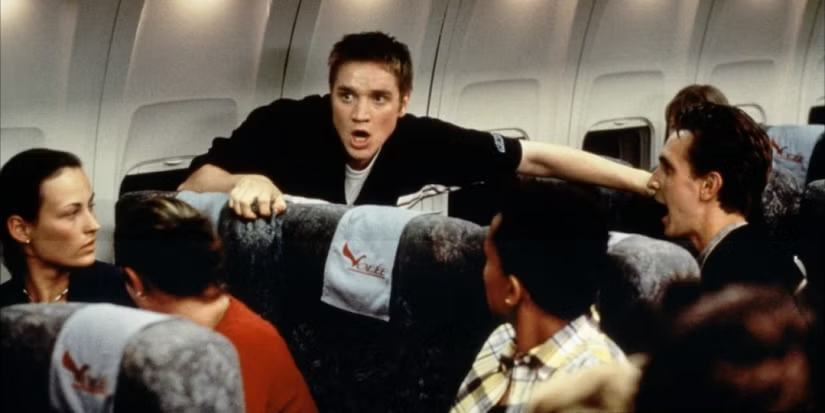
From director James Wong, the 2000 horror thriller Final Destination is a paranoia-inducing modern classic that made audiences everywhere afraid of their surroundings. It begs the ultimate horrifying question: how can you escape something that’s after you if it is literally death itself? For high schooler Alex Browning (Deven Sawa), that question is on his mind. After having an ominous premonition of a plane disaster, he narrowly avoids the tragedy along with a lucky few. But when the survivors slowly die in gruesome freak accidents, Alex suspects the real personification of the Grim Reaper is reclaiming the lives that were never meant to get off that plane.
Final Destination is a hair-raising thrill ride full of epic suspense, unexpected scares, and plenty of shockingly gory kills. It keeps viewers on edge with its chilling premise and a fantastic horror villain in the form of Death, who is unstoppable, unavoidable, and always comes back. This film shows some horror that can’t be outrun, and that’s the scariest kind of horror this is. While not exactly a perfect film, Final Destination has scared the wits out of audiences for generations since the early 2000s, even spawning one of the most successful and long-running franchises still going strong today.

One of the most effective slow-burning mystery thrillers of all time, Roman Polanski‘s 1968 masterpiece Rosemary’s Baby is a timeless film that can still creep under your skin. Mia Farrow commands the screen, giving one of the most solid horror performances of the 20th century as Rosemary Woodhouse, a soon-to-be mother, slowly unraveling as her difficult pregnancy, coupled with her apartment tenants’ strange behaviors, causes her to believe sinister forces are trying to take away her unborn child.
This is a masterclass in set-up and payoff, featuring a perfect escalation of terror that ultimately leads to a horrifying yet satisfying conclusion, which has since become a standout in the horror genre. Rosemary’s Baby is effective at giving the audience an unsettling mystery to follow. It knows how to slowly scare you with its mounting suspense and subtle moments of dread. Truly, it’s a timeless terror that doesn’t lose its ability to freak viewers out.

1999 was a cruel year for horror; the genre was changed forever with the release of The Blair Witch Project, the supernatural thriller that birthed the booming found-footage craze. It’s revolutionary for its time, as viral marketing and word of mouth truly amplified the hype, making audiences at the time genuinely feel like the horror they were about to see was real. It documents three amateur film students as they encounter something terrifying while searching for a local witch legend in the woods of Maryland.
Today, the buzz surrounding The Blair Witch Project‘s marketing has since died down, but the terror still lives on. The hand-held technique, coupled with the raw, realistic dialogue and acting, still makes it feel that it has some connection to real life. It’s also a masterclass in dread, as the slow build-up to the three characters’ haunting doom feels prevalent throughout the runtime. While some find The Blair Witch Project polarizing, as either you love it or hate it, there’s no denying its success and influence changed the horror landscape, and it remains eerily realistic even today.

In 2004, audiences were dared to play a game, and the horror world was changed forever. James Wan, the legend behind some of modern horror’s most chilling masterpieces, delivered Saw, a psychologically twisted, shockingly gory, and nail-bitingly suspenseful mystery thriller that later came to define early 2000s horror cinema. Leigh Wannell and Cary Elwes star in this dark tale of survival as two men, who’ve each done terrible things in the past, wake in a dirty, locked bathroom and soon realize they’re unwilling participants in a game of life-or-death against the mysterious Jigsaw (Tobin Bell) serial killer.
It’s a spine-chilling, iconic shocker, featuring some of the scariest plot twists in recent movie history. Saw ushered in a new age of horror at the turn of the 21st century, with its gritty tone and graphic violence, reinvigorating the splatter subgenre. It takes you on an intense mystery as you follow along with the two men as they discover why they are there and just who the Jigsaw killer really is. By the frightening finale, you’ll be left completely frozen in terror. And this effect still persists even after rewatches.

Highly regarded as one of the most claustrophobic horror movies in history, Neil Marshall‘s The Descent is a film guaranteed to leave some viewers sleeping with the lights on. It follows a group of friends as they descend into an uncharted cave system in the Apalachian Mountains. But, after a sudden cave collapse, they soon realize they’re not alone in the dark.
The Descent is honestly too hard to watch at times, as the extreme violence and gory effects, coupled with the uncomfortably cramped setting and psychological tone, make it a truly nightmarish experience. It’s an intense survival tale that gets more bloody, horrific, and mind-bendingly twisted as the story progresses.

From the brilliant mind of one of the all-time greatest filmmakers of the 20th century, Stanley Kubrick, comes his eerie adaptation of horror novelist Stephen King‘s The Shining. Hailed as horror royalty, it’s a chilling, slow-burning horror masterpiece full of dread and mounting tension. Featuring two magnificent performances by Jack Nicholson and Selly Duvall, it follows a struggling writer as he slowly succumbs to madness and turns on his family after being influenced by the sinister ghosts of a desolate mountain resort.
This thought-provoking psychological masterpiece has become an essential part of horror and pop culture. It’s a perfect example of suspense and tension building used to enhance the horror elements of the story. It’s also incredibly ambiguous, leaving unanswered questions about whether it’s more psychological or supernatural. Though King has had some hard words about the changes and ambiguity of this story, this version of The Shining is undeniably frightening and complex. There are so many moments that have audiences gasping and coming back for more.

The ultimate creepy kid movie, the late Richard Donner‘s The Omen, is a terrifying supernatural horror thriller that came to define the genre in the 1970s. A paranoia-inducing tale with shocking twists and intense dread, it sees Academy Award-winner Gregory Peck in a heartbreaking role as an American Ambassador who slowly uncovers a devastating secret that he’s being used to raise the devil’s son to take over the world.
It’s a nail-biting thriller with mounting suspense and unending dread. There’s a lingering sense of doom throughout this story, and it keeps rising with every scene and every shocking death. Coupled with a compelling and undeniably frightening supporting performance by the then-young Harvey Stephens as the sinister son of satin, Damien Thorn, The Omen is a creepy classic that continues to leave shivers down audiences’ spines.

As the only horror film to win Best Picture, and one of only three films to win the big five at the Academy Awards, The Silence of the Lambs is an undeniable masterpiece that deserves all of its acclaim. Directed by the late Jonathan Demme, this fascinating crime thriller features two powerhouse performances by Jodie Foster and Sir Anthony Hopkins in a thrilling mystery that follows an FBI trainee as she plays an intense game of wits with a brilliant convicted murderer to help her locate another serial killer.
With hair-raising suspense and grisly violence, The Silence of the Lambs is quite intense and shocking, one of the most edge-of-your-seat horror movies of all time. Sir Anthony Hopkins intimidates viewers with his Oscar-winning performance as the cunning and ruthless Dr. Hannibal Lecter. Every second of his screen time is tense, and he seems to control every moment, despite the fact that he spends most of the time behind bars. There’s a great feeling of terror in this masterpiece, and it hasn’t diminished in the years since its release. It’s only gotten more compelling and terrifying.

One of the most unbelievably terrifying films in recent memory, Demián Rugna‘s unusually disturbing supernatural thriller When Evil Lurks is a devastating watch that gets more shocking and unflinching with every second. It follows two farming brothers in Argentina as they accidentally ignite a terrible series of events after they unsuccessfully try to dispose of a bloated, demonically possessed body.
This brings new levels of demonic terror. When Evil Lurks never lets up in intensity and dread. It’s often cited as being mean-spirited and bleak, featuring a plot that seriously has no chance of a triumphant finale for the main characters. The deaths are nightmare-inducing, and there are moments here that are unbelievable and striking enough to evoke a sense of absolute terror. There’s nothing else quite like it.

A highly influential masterpiece, the late Sir Alfred Hitchcock‘s greatest contribution to horror, Psycho, is truly a necessary watch for fans of the genre. A prime example of brilliant tension and psychological terror, it follows a shocking crime as a thieving woman checks into an isolated motel in the California desert, owned and operated by a timid young man who’s not as harmless as he appears to be.
Psycho is scary in many ways, from its incredible suspense to thrilling mystery to even Anthony Perkins‘ career-defining performance as the deeply disturbed Norman Bates. It’s an unforgettable, hair-raising classic that’s only gotten better and more terrifying with age. And, of course, it is remembered the most by audiences for Psycho‘s iconic shower scene, which is one of the most significant moments in cinematic history.
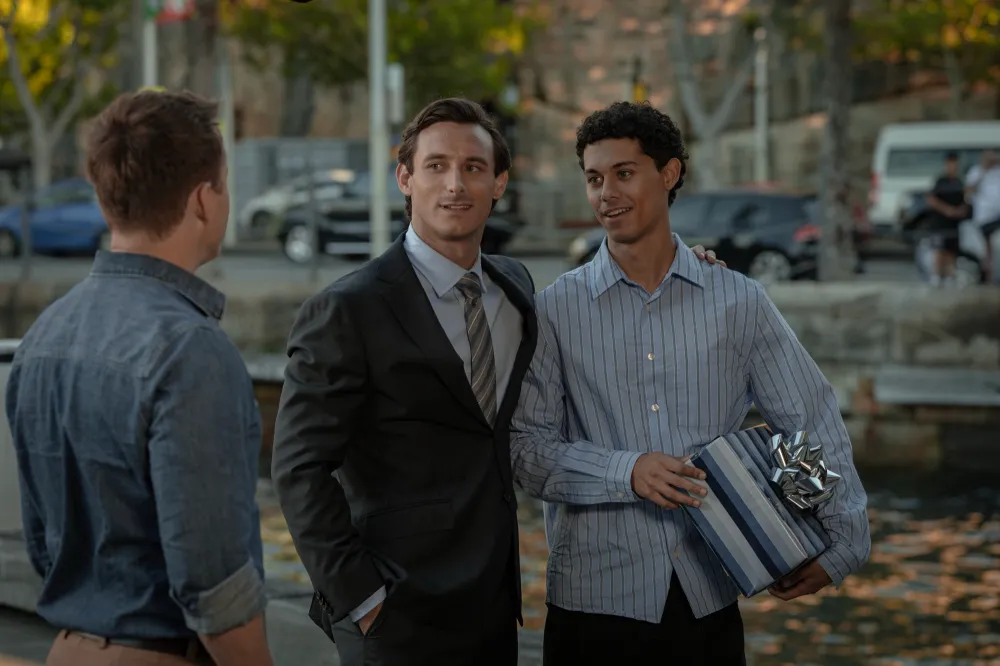
NCIS: Sydney season 3 ended with one case seemingly closing and another up in the air — literally — but it’s the possible romance between Mackey and JD that has fans talking.
Warning: Spoilers below from NCIS: Sydney season 3, episodes 19 and 20.
During the two-part season 3 finale, which aired on Tuesday, May 12, fans watched as Special Agent Michelle Mackey (Olivia Swann) took down The Collective’s lead man, Lee Meyers (Angus Sampson), before corrupt government official US Drug Czar John Callaghan fled Australia with the drug dealer’s intel.
“She gets the last word with Meyers. So I think in Mackey’s world, that’s a success,” Swann, 33, exclusively told Us Weekly of the two-part conclusion that resulted in Meyers being back in custody. “We do leave a little kind of cliffhanger for things to come, which is always exciting.”
Swann noted that the cliffhanger has a lot to do with Callaghan escaping on a private plane after he orchestrated a prisoner switch — Meyers for Mackey’s ex and the father of her child, Ryan Brady (Ryan Panizza) — that gets messy. The good news? Mackey planted her cellphone on the plane before jumping off with Ryan in her arms.
“I think her decision to do that is, again, a very kind of maverick rogue move,” Swann explained. “And I feel like it was just done in the spur of the moment kind of thing.”
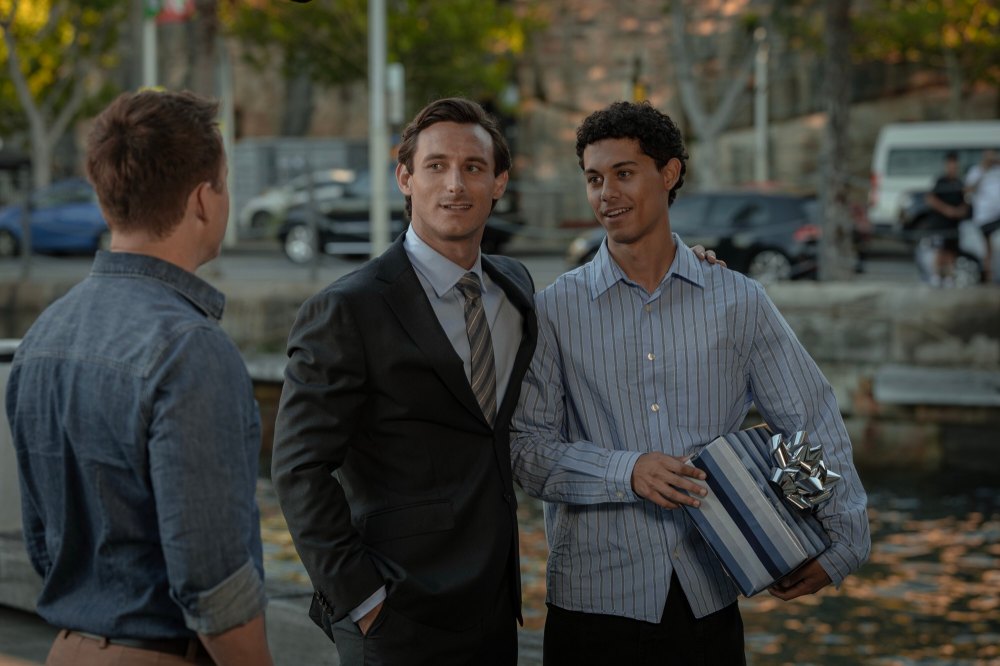
Ryan Panizza as Ryan Brady and Noah Eid as Trey Mackey. Daniel Asher Smith/Paramount+
The actress added that Mackey “teasing JD” by playing coy with what happened to her phone is “just so very Mackey” and a story line that “will be something that hopefully we see” when season 4 premieres in 2027.
While the action comes first on NCIS: Sydney, Swann teased that Mackey’s undeniable chemistry with Jim “JD” Dempsey (Todd Lasance), which is evident during the finale, will be touched upon next season as well. (During Mackey’s son Trey’s 18th birthday bash, she tells JD, he’s a “catch” and they exchange a cheeky look.)
“We are really focusing more on character connections and really building those this season,” Swann confirmed to Us. “So, that very much centers around Mackey and JD. Take with that what you will.”
She pointed out that viewers saw “ a lot more closeness between the two of them” during season 3, including seeing their “trust constantly growing” and their bond “deepening.”
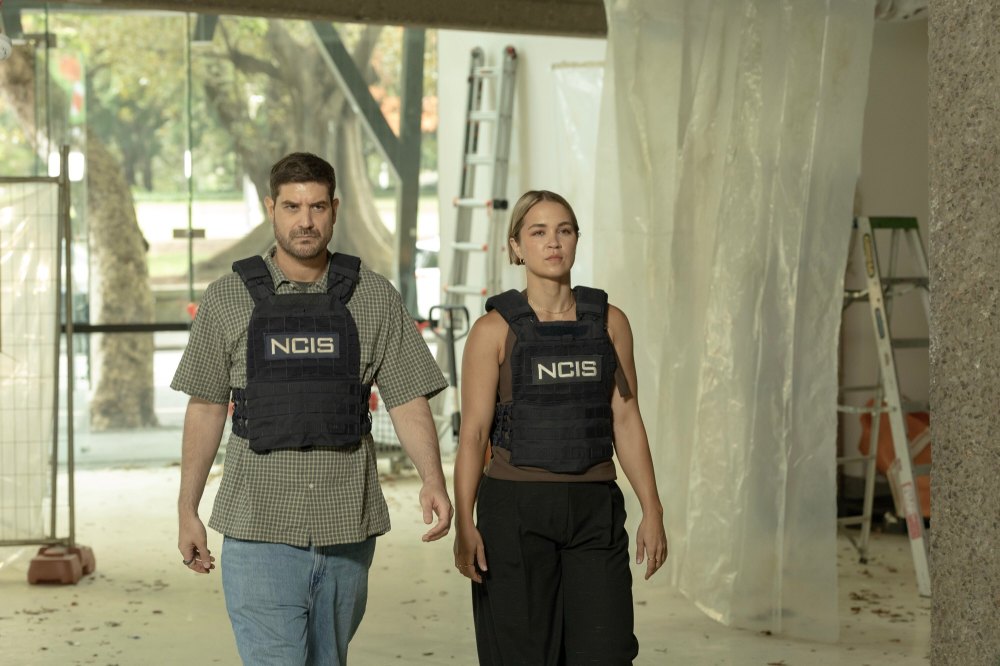
Claude Jabbour as Travis ‘Trigger’ Riggs and Tuuli Narkle as AFP Liaison Officer Constable Evie Cooper. Daniel Asher Smith/Paramount+
“I’m looking forward to seeing where that goes in [season] 4,” Swann confessed, teasing that if Mackey and JD become a couple they “maybe would be surprised at how much their protection level would shift.”
She explained, “I think a lot of what they have is very unspoken and kind of subconscious with each other. If that were to shift into something more overt, I think they’d kind of be taken by surprise at how kind of big and deep the feelings might be.”


Swann also noted that the dynamic between teammates Evie Cooper (Tuuli Narkle) and Travis “Trigger” Riggs (Claude Jabbour) will be a big plot point next season after Trigger told Evie — and no one else — that he accepted another job, which opened up the possibility of a budding romance.
“It is interesting to understand a little bit more of Evie’s psyche to do with Trigger leaving for work, and how that affects her moving forward,” Swann said, confirming that fans will “see a little shift” in how Evie “operates” and in her “bravado” if in fact Trigger does leave the team as their resident bomb guru.
Season 4 of NCIS: Sydney will premiere on CBS sometime in 2027 as part of the network’s midseason lineup.






HarrisX Poll Found 52% of Registered Voters Support the CLARITY Act


Weekend Open Thread: Marianne Dress


Upbit adds B3 Korean won pair as Base token gains Korea access

NCP car park operator enters administration putting 340 UK sites at risk of closure


Coffee Break: Travel Steam Iron


What to Know Before Buying a Curling Wand or Curling Iron


Auto Enthusiast Carves Functional Two-Stroke Engine from Solid Metal


What to expect when you’re expecting a budget

Ignore market noise, India’s long-term story intact, say D-Street bulls Ramesh Damani and Sunil Singhania


Politics Home Article | Starmer Enters The Danger Zone


BlackRock CEO Larry Fink Discusses a New Asset Class


GM Agrees To Pay $12.75 Million To Settle California Lawsuit Over Misuse Of Customers’ Driving Data


Sarah Paulson Called Out For Met Gala ‘Hypocrisy’


General Hospital: Ric & Ava Bombshell – Ric’s Massive Secret Exposed!


Simon Cowell Says He Was ‘Horrible’ To Susan Boyle During BGT Audition


Robinhood says Wall Street is building onchain


UEFA Champions League final schedule, teams, venue, live time and streaming | Football News


Bold and Beautiful Early Spoilers May 11-15: Steffy Revolted & Liam Overjoyed!


Why David Letterman Called CBS ‘Lying Weasels’


Sister Wives: Tony Flings Shade at Robyn in New Post


You must be logged in to post a comment Login