YORK store Boyes was renowned for its Christmas displays.
In the 1920s and 30s, children went on rides through the store with themes such as ‘A trip to the Moon’ or’ A journey below the sea’.
And today, we share precious memories of working at this iconic shop, Boyes in Bridge Street.
After the Second World War, children walked rather than rode, passing a series of tableaux, before meeting Father Christmas in his grotto.
The grotto was quite a remarkable affair – a series of scenes depicting Santa Claus’ journey from the Arctic to the home of an English boy and girl.
With his reindeer and a train of other faithful friends, Santa Claus travelled from one little scene to another and eventually descended a chimney.
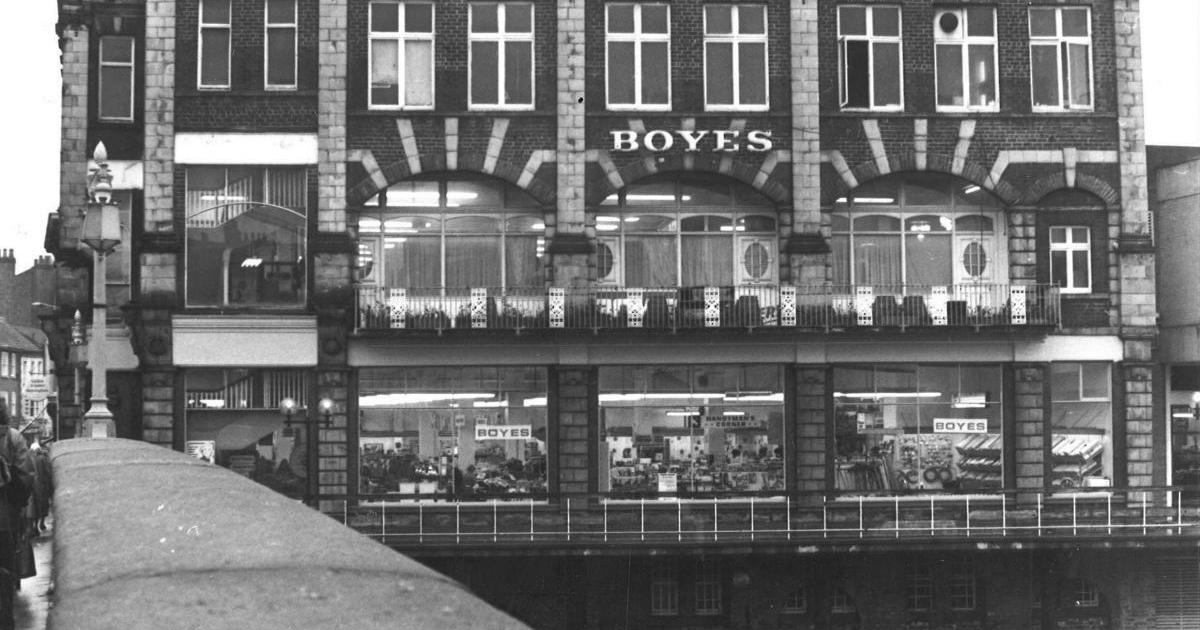
![]() Boyes by Ouse Bridge in York in the 1960s or 1970s
Boyes by Ouse Bridge in York in the 1960s or 1970s
The mechanism behind this panorama was a complicated arrangement, consisting of a bicycle chain driven by an electric motor, and was constructed from ‘odds and ends’ by the store’s engineer.
Similarly, the shop windows were always dressed for Christmas with impressive displays, including model railways, waterfalls and Alpine scenes.
Dougie Weake has vivid memories of working at Boyes in Micklegate. He started in the tools department on the first floor in 1965 at the age of 15.
“We had everything that you would expect – wallpaper, paint, brushes, screwdrivers, screws, you name it – on these old, rickety, wooden counters, that must have been there since the store opened in 1912. The staff were amazing. It became a very, very close-knit family. Boyes was a family department store and we were all part of this family.
![]() Shoppers queue outside Wright’s pork butchers and pie shop in Bridge Street next to Boyes.
Shoppers queue outside Wright’s pork butchers and pie shop in Bridge Street next to Boyes.
“The Bargain Basement was probably the busiest of all the departments in the store. People would go down for the bits of cloth, which they made into a fancy dress or curtains or whatever. It was a rummage and there were people fighting over the same cloth. On the top floor, we had the staff canteen, segregated, with girls at one side, boys the other. You could see each other through the serving hatches.”
Boyes always went big at sales. They had, for example, the ‘red-hot sale’, when they hired a fire engine and drove around the streets of York with big signs.
Read more:
Or the ‘monster sale’ with a flatbed truck and a big papier mâché monster on the back, with staff throwing sweets to passers-by and attracting people to come to the sales.
Dougie continued: “Christmas was massive. Before I started in the display department, Bob [Gibson] built a cowboy village in the new part of the store – saloon bar, jail, etc. George Boyes said: ‘We need an actor to play a cowboy’. So of course muggins here got the job!
“I was tall and thin as a bean pole. They hired a costume – six guns, hat, boots, the whole thing – and I walked around the store inviting people with children to go up and see Father Christmas in the jail and have an orange juice or sarsaparilla in the saloon bar.
“They also hired a horse which I rode around town as Hank Beanpole, to attract people to come and see Father Christmas. I’m still called ‘Hank Beanpole’ by people who knew me then.”
Susan Major is part of the Clements Hall Local History Group’ in York.
For more stories and photos of this area of York, the Clements Hall Local History Group’s latest book Micklegate, The Great Street of York, is out now. It costs £15, and is available at Waterstones in the city centre and at Monks Cross; the Amnesty bookshop on Micklegate; Pextons Hardware, and Frankie & Johnny’s Cookshop on Bishopthorpe Road.





















































You must be logged in to post a comment Login