

Crypto World
New York Judge Pushes Back Hearing for Aave’s Bid to Unfreeze $71M in ETH

A New York judge has delayed a decision on Aave’s emergency bid to unfreeze $71 million worth of crypto tied to victims of the $293 million Kelp DAO hack, asking for additional information ahead of a new hearing in June.
Aave has sought to use $71 million in ETH that Arbitrum froze to assist with recovery efforts following the Kelp DAO hack, one of the worst DeFi hacks this year.
However, US law firm Gerstein Harrow LLP filed a restraining notice at the start of May, arguing its clients have a claim to the funds. Aave then filed an emergency motion to get the funds unlocked, arguing that user liquidations and potential DeFi market destabilization could occur if the funds are not unlocked soon.
According to documents filed Wednesday in the Southern District of New York, Judge Margaret M. Garnett said Aave had not adequately outlined how “compounding losses” on user funds could “occur if the restraining notice remains in place” in its filing earlier this month.
Judge requests more information from both sides
Judge Garnett acknowledged that the case is complex and that there are risks for the victims, and called for additional briefings from both sides to further outline their cases.
“The court recognizes the risk of potential near-term harm to Aave LLC and Aave Protocol users. Due to the complexity of the issues raised in the parties’ motions and at oral argument on May 6, 2026, and the extremely abbreviated timeline on which they were briefed, the Court orders the parties to submit supplemental briefing,” Judge Garnett said.
The judge outlined six key points on which the court wants more information, including whether the hacking transactions are governed by New York’s shelter principle; the legal distinction between fraud and theft and what interest hackers have in stolen assets; which law controls creditor priority over the frozen assets; whether a constructive trust would be an appropriate remedy and whether Aave or Arbitrum can identify individual victims to return the assets on a pro rata basis.
Aave and Gerstein Harrow will now have until May 22 to submit their briefs, with the hearing scheduled for June 5.
Related: DeFi can freeze stolen funds, but not everyone agrees it should
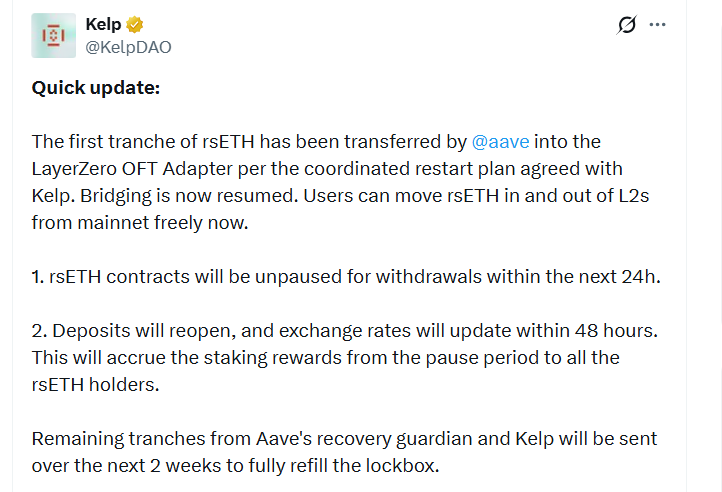
The case comes amid broader Kelp DAO recovery efforts. Kelp and Aave announced Tuesday that they had taken important steps to restore the backing of rsETH.
The hacker’s rsETH have been burned on Arbitrum, while the lost tokens, worth about $278 million, will be restored over the next two weeks via funds from the Aave Recovery Guardian multisignature wallet.
Once the associated smart contracts are reactivated, all rsETH uses will return to normal.

Source: Kelp DAO
Magazine: AI-driven hacks could kill DeFi — unless projects act now


BTC USD is bleeding from two wounds. Bitcoin price is trading below 50% of its all-time high, as the usual institutional backstops are stepping away, tipping the prediction scale bearish. Alarming?
Analysts at Glassnode flagged the collapse in a recent market update: “As BTC broke down from the mid-$70Ks toward $60K, net inflows from corporate treasury firms fell sharply, with daily purchases slowing to a fraction of their recent pace.”
Digital asset treasury (DAT) demand from firms like Strategy that accumulate BTC as a core business has practically evaporated in June. The buying spree is down from multiple instances of $500 million+ in daily accumulation through April and May.
I was never a huge fan of DATs, but I supported the idea. These entities were pure holders, much more stable than people buying and selling ETFs or speculating on exchanges… even closer to the original hodlers, the OGs. — Rezo
The whole model was buy and hold, raise capital, buy… pic.twitter.com/PGI9O7BINU
 ₿RRR (@rezosh) June 9, 2026
Strategy itself disclosed it sold 32 BTC in the final week of May, then re-entered during the dip with a $100 million purchase, yet it failed to arrest the slide below $60,000. Two demand pillars, one crack.
Discover: The Best Crypto to Diversify Your Portfolio
Bitcoin Price Prediction: Recover to $100,000 Or $75,000 Retest Next?
Bitcoin is navigating its most technically fragile zone since the cycle’s early days. Price is hovering near $62,000, well below the psychologically critical $70,000, and a deeper correction under $75,000 breached.
Bernstein maintains a constructive long-term view, calling the current cycle “elongated” and pointing to “more sticky institutional buying” as an offset to retail outflows, with a 2026 target of $150,000 and a cycle extension scenario near $200,000 by 2027. Standard Chartered echoes that range. Published 2026 forecasts span $75,000 to $225,000, a gap wide enough to drive a truck through.

Federal Reserve rate-cut expectations are explicitly tied to Bitcoin’s Q4 upside case across multiple outlooks. Without this catalyst, the path of least resistance remains sideways to lower.
Bitcoin needs its ETF inflows to stabilize, corporate treasury buying resumes above $200M/day, and rate cuts materialize. If those happen, BTC could target above $100,000 by year-end. But it seems likely that demand will recover slowly and see BTC consolidate between $60,000–$70,000 through the summer.
Discover: The Best Token Presales
Bitcoin Hyper Targets Early-Mover Upside as Bitcoin Tests Key Levels
Spot BTC at $62,000 offers range-bound risk at a $1.3 trillion market cap. The asymmetry isn’t what it was at $16,000. That’s not a bearish call on Bitcoin, it’s simple math about where the leverage lives in this cycle.
Bitcoin Hyper ($HYPER) is positioning as infrastructure for Bitcoin’s next evolution: the first-ever Bitcoin Layer 2 with Solana Virtual Machine (SVM) integration, promising sub-second finality and low-cost smart contract execution while preserving Bitcoin’s underlying security.
The project has raised closer to $33 million at a current presale price of $0.0136, with 36% APY staking rewards available during the raise. Key features include a Decentralized Canonical Bridge for trustless BTC transfers and high-speed transaction execution that outperforms Solana on latency.
Research Bitcoin Hyper before the presales end.
The post Bitcoin Price Prediction: Not Just ETFs, Corporate BTC Buying Spree Has Collapsed appeared first on Cryptonews.


BitGo has introduced Lightning Earn, a product that lets institutional clients allocate Bitcoin to Lightning Network routing channels.
Summary
- BitGo introduced Lightning Earn for institutional Bitcoin routing fees.
- Amboss Rails manages liquidity across Lightning Network payment channels.
- Fees come from routed Bitcoin payments, not token rewards.
The product uses Amboss Technologies’ Rails platform to manage liquidity routing across Lightning payment paths. Participants earn fees in Bitcoin from routed payments while using BitGo custody accounts.
BitGo links custody accounts to Lightning routing
BitGo designed Lightning Earn for corporate treasuries and institutional allocators that already hold Bitcoin through its custody platform. Clients can place Bitcoin into Lightning Network channels used to route payments between connected nodes. The routing activity generates fees paid in native Bitcoin, rather than tokens or synthetic rewards.
The company said clients access the product through existing BitGo custody accounts. BitGo also said custody controls, governance steps, and compliance workflows remain in place during deployment. The structure allows institutions to use Bitcoin for routing liquidity without moving assets into external retail wallets.
BitGo CEO Mike Belshe said Rails gives clients a way to deploy Bitcoin “without compromising custody or governance.” The company also placed part of its own treasury into Rails. BitGo said the allocation helped test the process before wider institutional use.
Amboss Rails manages liquidity across payment channels
Amboss Technologies provides the Rails platform behind the routing function. Rails helps allocate Bitcoin liquidity across Lightning channels where payment flow requires capacity. The system connects institutions with routing paths that need capital to process Bitcoin payments.
Amboss CEO Jesse Shrader said BitGo’s integration of Rails shows that “Lightning is fit for institutions.” He also said institutional capital can support enterprise-scale Bitcoin payments. The statement relates to liquidity deployment, not guaranteed returns.
Lightning Network routing fees depend on payment activity across connected channels. Participants receive fees when their liquidity helps move payments between nodes. BitGo said the product does not use synthetic assets, token incentives, or derivative yield products.
Lightning Earn uses Bitcoin fees instead of token rewards
The product differs from yield products that depend on lending, staking, or third-party token rewards. Lightning Earn relies on routing fees from payment traffic across Lightning channels. All earnings remain denominated in Bitcoin.
BitGo said its regulated trust bank controls continue to govern the deployed assets. The firm also said clients retain ownership of Bitcoin used in routing channels. Governance rules apply across all allocations made through the product.
Amboss said Rails supports liquidity allocation across Lightning Network endpoints. The company also said the platform helps payment channels access routing capacity. BitGo’s Lightning Earn product is now available to institutional clients through existing custody accounts.
President Donald Trump nominated former SEC Chairman Jay Clayton as Director of National Intelligence on Thursday. Clayton authorized the agency’s landmark lawsuit against Ripple in 2020, making him one of the most consequential regulators in XRP’s history.
The nomination requires Senate confirmation. Clayton currently serves as US Attorney for the Southern District of New York and would replace acting appointee Bill Pulte.
Why Jay Clayton Still Divides the XRP Community
The SEC filed its complaint against Ripple Labs on December 22, 2020, Clayton’s last full day as chairman. The agency alleged the company raised $1.3 billion through unregistered XRP sales.
It also said executives Brad Garlinghouse and Chris Larsen made roughly $600 million in personal sales.
Garlinghouse repeatedly accused Clayton of hypocrisy, arguing the chairman treated XRP more harshly than Bitcoin (BTC) or Ethereum (ETH). J
udge Analisa Torres later ruled that only Ripple’s institutional sales violated securities law. She fined the firm $125 million in August 2024, far below the nearly $2 billion the SEC wanted.
Both sides dropped their remaining appeals in 2025. XRP traders shrugged off Thursday’s news.

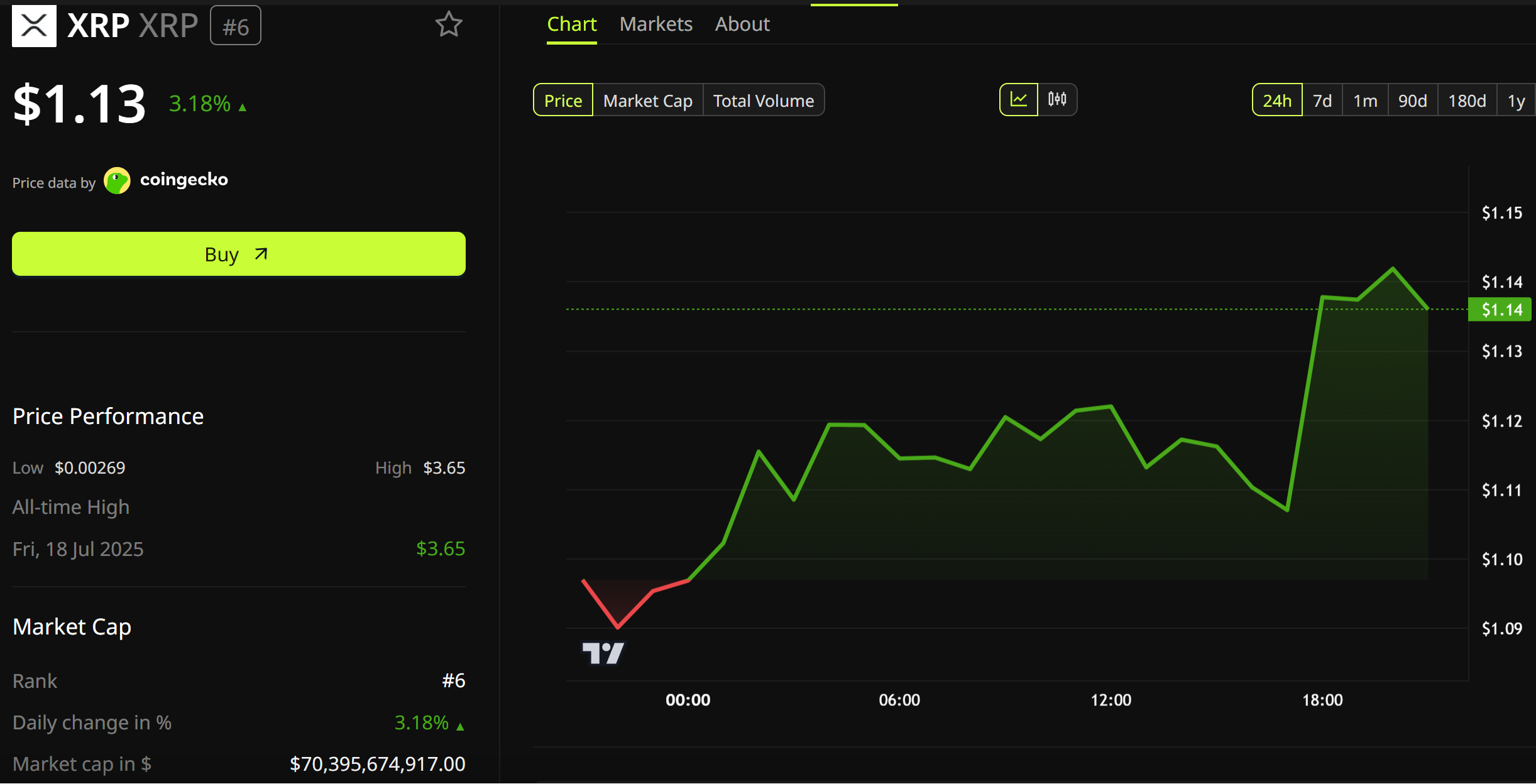
The token gained nearly 4% on Thursday to trade near $1.13, holding its spot as the sixth-largest cryptocurrency at a $71 billion market cap.
Follow us on X to get the latest news as it happens
A Steadier Pick After the Pulte Backlash
Trump handed the role to Federal Housing Finance Agency Director Bill Pulte on an acting basis earlier this month.
Crypto markets cheered the acting pick because of his pro-crypto mortgage policies. However, Pulte’s lack of intelligence experience drew bipartisan objections.
House Democrats blocked a short-term FISA Section 702 extension on Thursday in protest.
Clayton offers Senate Republicans an easier path. Lawmakers confirmed him 61-37 to lead the SEC in 2017.
Federal judges later named him SDNY attorney after his 2025 nomination stalled. Still, critics note he also lacks any intelligence background.
“I am pleased to announce the Nomination of very Highly Respected Jay Clayton, former Chairman of the Securities and Exchange Commission… to be the next Director of National Intelligence and, importantly, to serve in my Cabinet,” Trump wrote in a Truth Social post announcing the decision.
Confirmation hearings will now test Clayton on surveillance and national security.
XRP holders, meanwhile, will watch whether their old adversary leaves financial regulation behind for good.
The post Trump Picks Former Ripple (XRP) Foe Jay Clayton for Top Intelligence Role appeared first on BeInCrypto.


Tether Investments said it led a $1.4 billion funding round for Neura Robotics, a German startup developing AI-powered humanoid robots, in what it called one of the largest investments into physical AI on record.
The funding, announced Wednesday, was projected to value Neura between $9 billion and nearly $12 billion when it first became public last November. Other participants in the round included Qualcomm Technologies, Amazon and NVIDIA, Neura said in a post on its website.
Neither Tether nor Neura responded immediately to a CoinDesk request for further information.
“AI is moving from the digital world into the physical world,” David Reger, founder and CEO of Neura Robotics, said in a statement. The company recently said it aims to produce 5 million robots by 2030 with about $1.2 billion orders already.
Tether, the issuer of the USDT stablecoin, is building its own technology right into Neura’s systems. The robots will receive their own independent digital wallets, allowing them to be paid automatically the moment they finish a job. They will also be able to make electronic payments to other machines, cutting out human managers, paperwork and bank delays.
Under CEO Paolo Ardoino, the El Salvador-based company is spending in a range of industries outside of the immediate crypto sector. Its growing portfolio includes investments in agriculture, brain tech and sports. The company made over $10 billion in profit in the first nine months of 2025 by investing rese
Coinbase CEO Brian Armstrong says the exchange won approval to offer true global crypto perpetual futures in the US. He calls the clearance the product of years of quiet regulatory work.
Armstrong laid out the road ahead in a post on X this week. The clearance itself arrived in late May with little fanfare.
Coinbase Perpetual Futures Bring Global Liquidity to US Traders
The Commodity Futures Trading Commission (CFTC) issued a no-action letter on May 29. The relief allows Coinbase to route US customers to perpetual contracts on Deribit, the Dubai-based platform it acquired last year. As a result, Coinbase Financial Markets became the first US-regulated firm to offer this access.
The company confirmed the CFTC clearance covers both perpetuals and options. Until now, US traders had no compliant route to these products. Together, the two categories represent roughly 80% of global crypto trading volume.
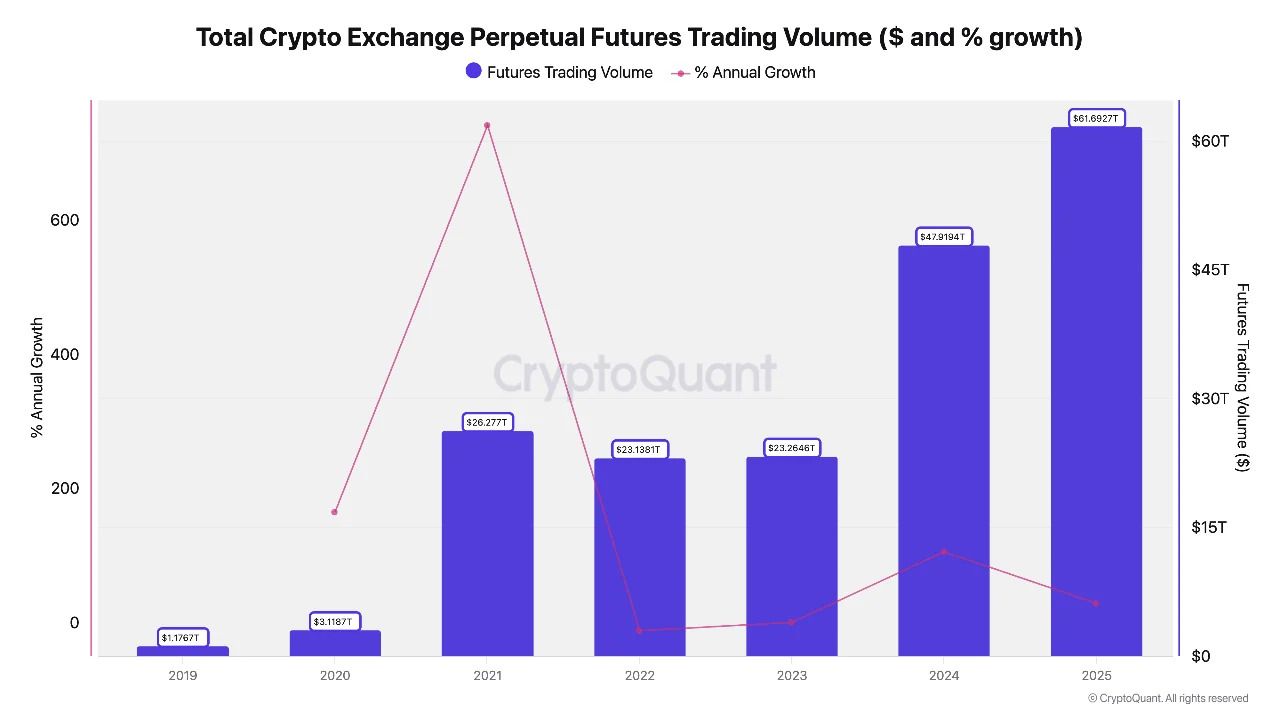
The market behind the decision is enormous. Perpetual futures volume reached $61.7 trillion in 2025, up 29% year over year.

Therefore, Armstrong frames the approval as pooled global liquidity arriving through a compliant US channel.
Notably, the regulator moved fast once Coinbase asked. It answered the request within a day and published a 16-page framework. In addition, the agency said perpetual contracts tied to other assets will face a case-by-case review.
“Coinbase got approved to offer true global crypto perps in the US. This took many years of work, and we’re the first to offer this global liquidity to US users.”
Armstrong stated in his post on X.
Armstrong Rejects Claims Coinbase Is Moving Away From Crypto
Some critics argue the company has drifted from its crypto roots. However, the Coinbase co-founder firmly rejected that view. Instead, he said the firm uses crypto to upgrade every traditional financial service. The message extends his earlier plan to update the financial system across eight areas.
Clear Rules Could Bring More Crypto Jobs to the US
The CEO also framed the win as a jobs story. For example, he pointed to Coinbase’s new office in Charlotte, North Carolina, as evidence of a growing US footprint.
According to Armstrong, clear rules make it easier for the industry to build in the United States. That clarity, he argues, can create more American jobs. The stance aligns with Coinbase’s support for the CLARITY Act and its push for faster crypto rules abroad.
Attention now turns to asset selection, since Coinbase has not finalized which perpetual contracts US customers will see first. Meanwhile, rival exchanges may pursue similar relief, which would test how long the first-mover advantage lasts.
The post Coinbase CEO Armstrong Talks About Perpetual Approval: What Comes Next? appeared first on BeInCrypto.


SpaceX has priced its shares at $135, according to a filing with the U.S. Securities and Exchange Commission on Thursday, setting the stage for one of the most closely watched public market debuts in recent years.
The company sold 555.6 million shares at that price, raising $75 billion, making it the largest IPO ever, easily topping Saudi Aramco’s $30 billion in 2019.
The Elon Musk-led aerospace and satellite company is expected to begin trading on Nasdaq on Friday under the ticker SPCX, giving public investors their first opportunity to buy shares. Based on the offering price, SpaceX will enter the public markets with a fully-diluted valuation of roughly $1.8 trillion.
The valuation is a pricey one, given SpaceX produced roughly $19 billion in revenue last year, driven by launches, government contracts and its rapidly growing Starlink satellite internet business.
Also notable is the company’s sizable bitcoin holdings. SpaceX held 18,712 bitcoin as of March 31. That would be valued at just under $1.2 billion at BTC’s current price around $63,500.
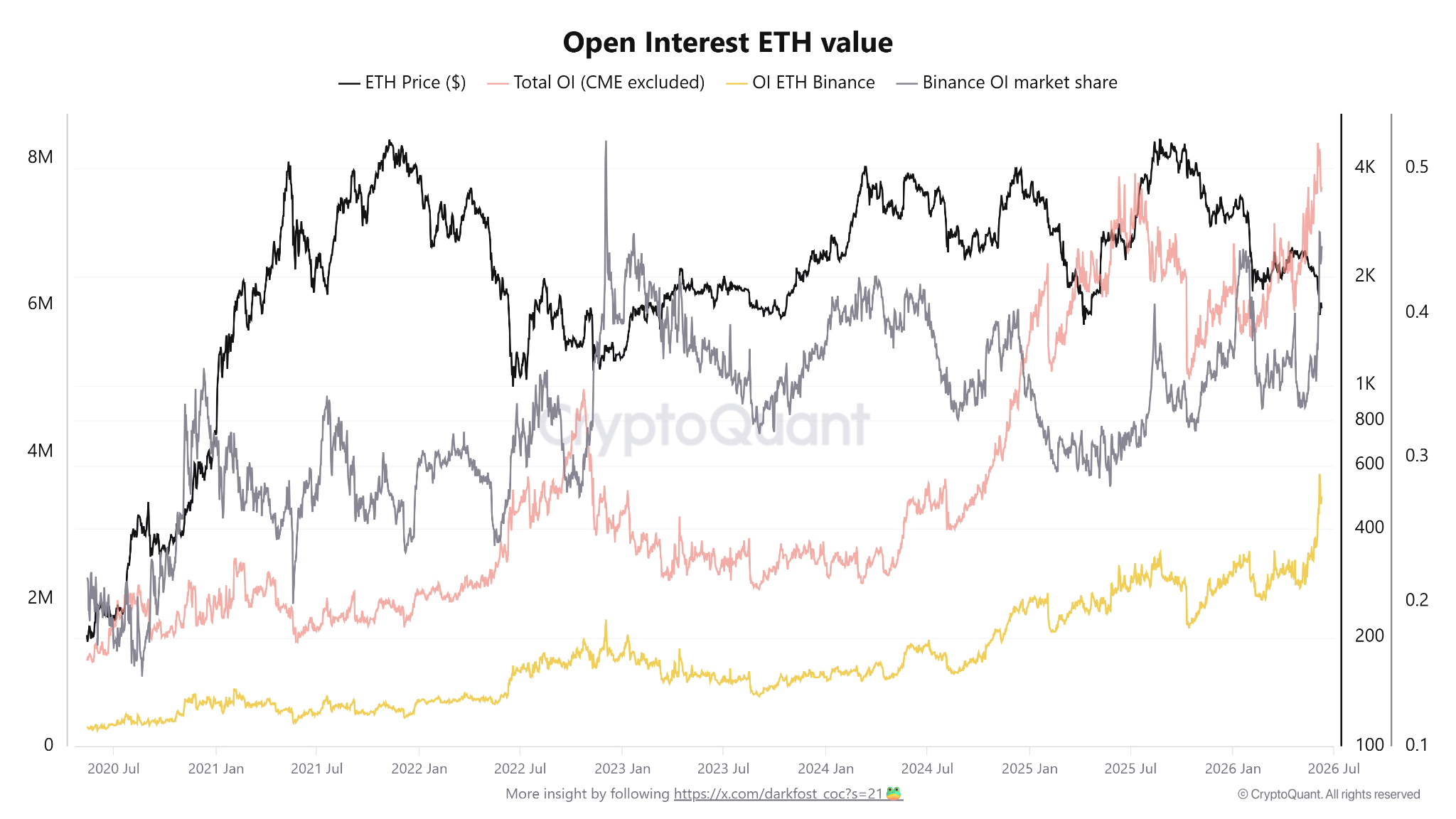
Ether (ETH) traders are increasing their leveraged long positions despite ETH price being down 44% in 2026. Ether’s futures open interest at Binance has climbed to a record 3.7 million ETH, with the exchange accounting for more than 44% of total Ether futures.
Crypto analyst Darkfost noted that Ether futures activity has improved despite rising uncertainty driven by geopolitical tensions and weakening economic conditions.
The analyst noted that Binance now holds nearly 3.7 million ETH in open futures contracts, marking a new all-time high for Ether open interest on the exchange.
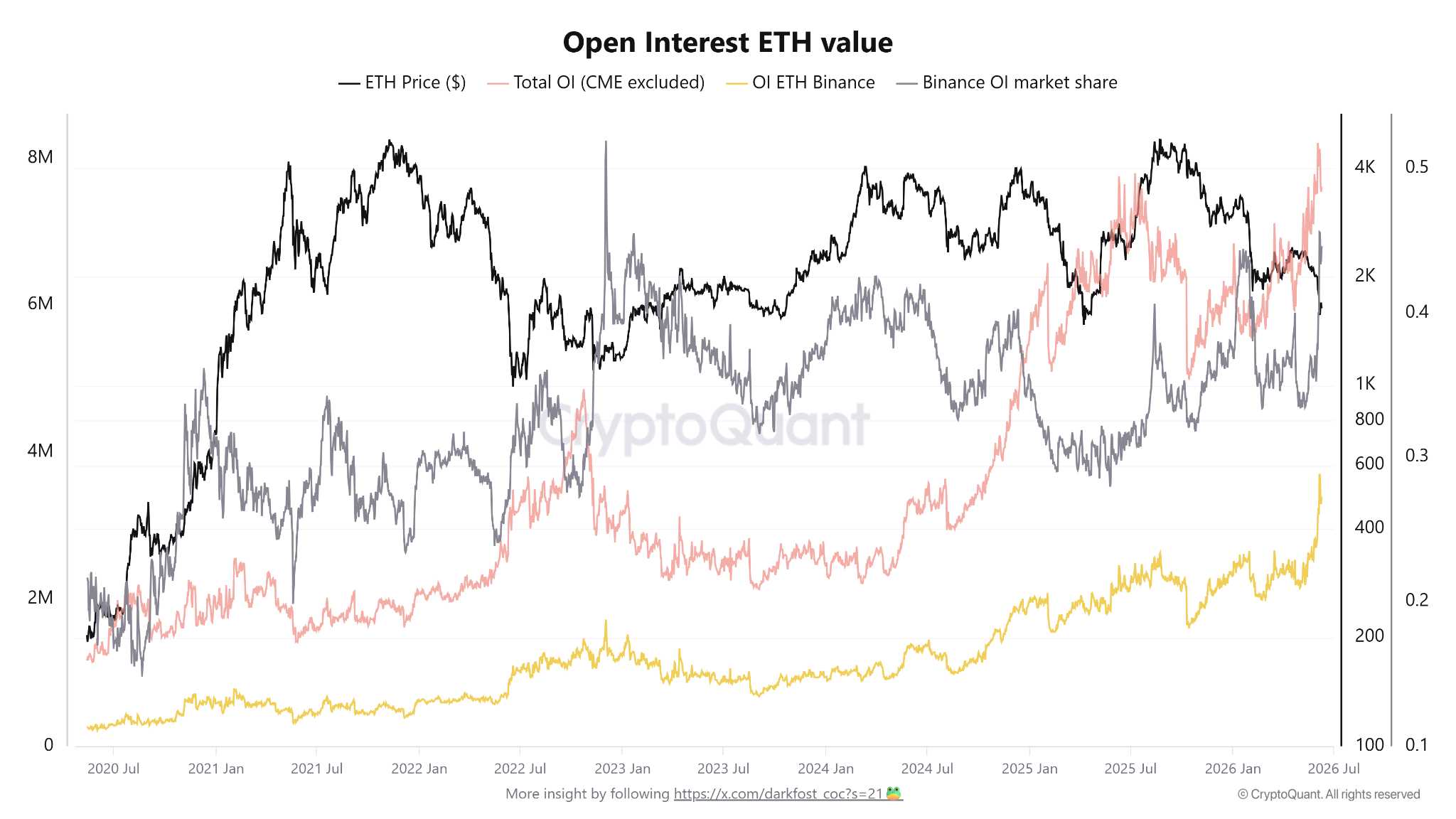
ETH open interest value on Binance. Source: CryptoQuant
Improving risk appetite for long positions also emerged as Binance’s weekly average taker buy-sell ratio increased to 1.0 from 0.95 after months of seller-led activity. A reading near 1.0 points to a more balanced market after a prolonged period of selling pressure.
The trend extends beyond Binance. Across all exchanges, the taker buy-sell ratio has risen to 1 from 0.94 over the past two weeks, indicating that buyers are becoming more active in market orders than sellers.
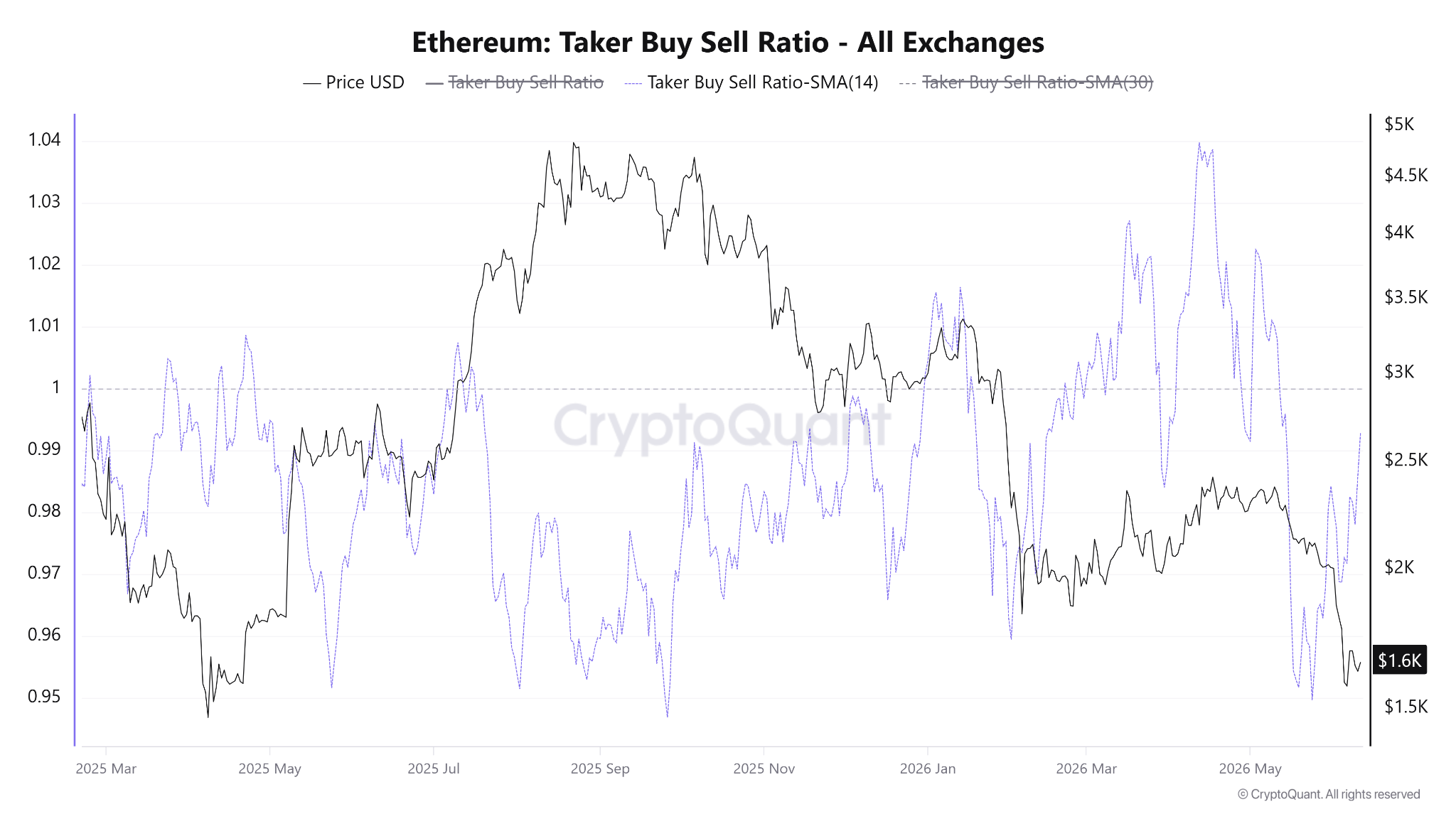
Ether: taker buy sell ratio across all exchanges. Source: CryptoQuant
At the same time, the speculative activity is accelerating faster than spot demand. Binance’s perp-spot volume imbalance indicator climbed to roughly 0.90, close to a record high, while its 30-day Z-score reached 2.53.
Perpetual futures volume stood near 5.57 million ETH compared with about 290,000 ETH in spot trading. This indicates leveraged participation is expanding far more quickly than activity in the underlying market.
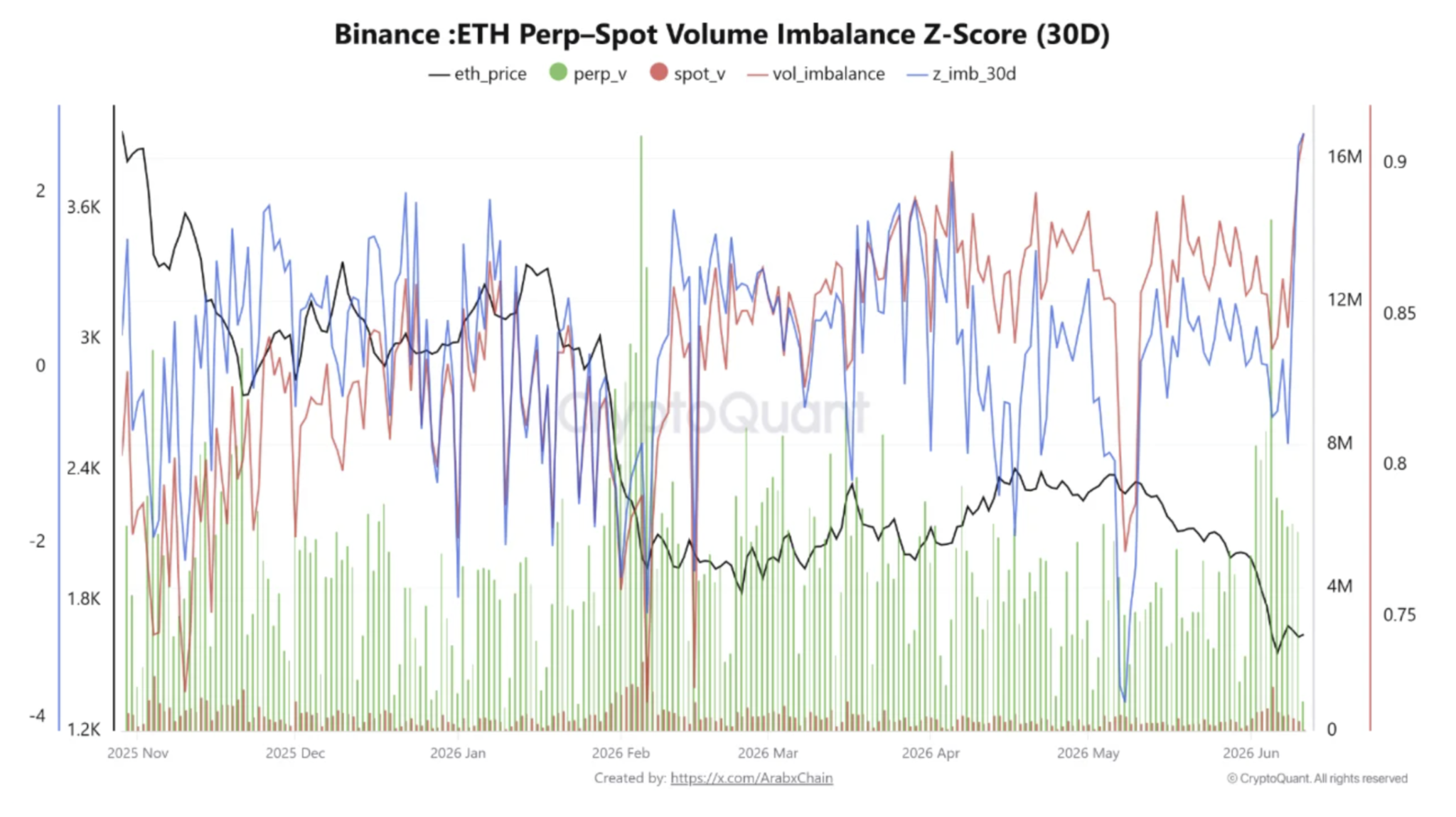
ETH Perp-Spot volume imbalance indicator. Source: CryptoQuant
Related: Audiera’s AI token BEAT beats Bitcoin, Ethereum as price surges 1,500% in a month
ETH liquidation risk remains on both sides
Market analyst Amr Taha highlighted a growing split in exchange positioning. Binance recorded a 30-day open interest increase of 616,400 ETH, its strongest reading since 2019. During the same period, Gate.io posted a decline of 631,700 ETH.
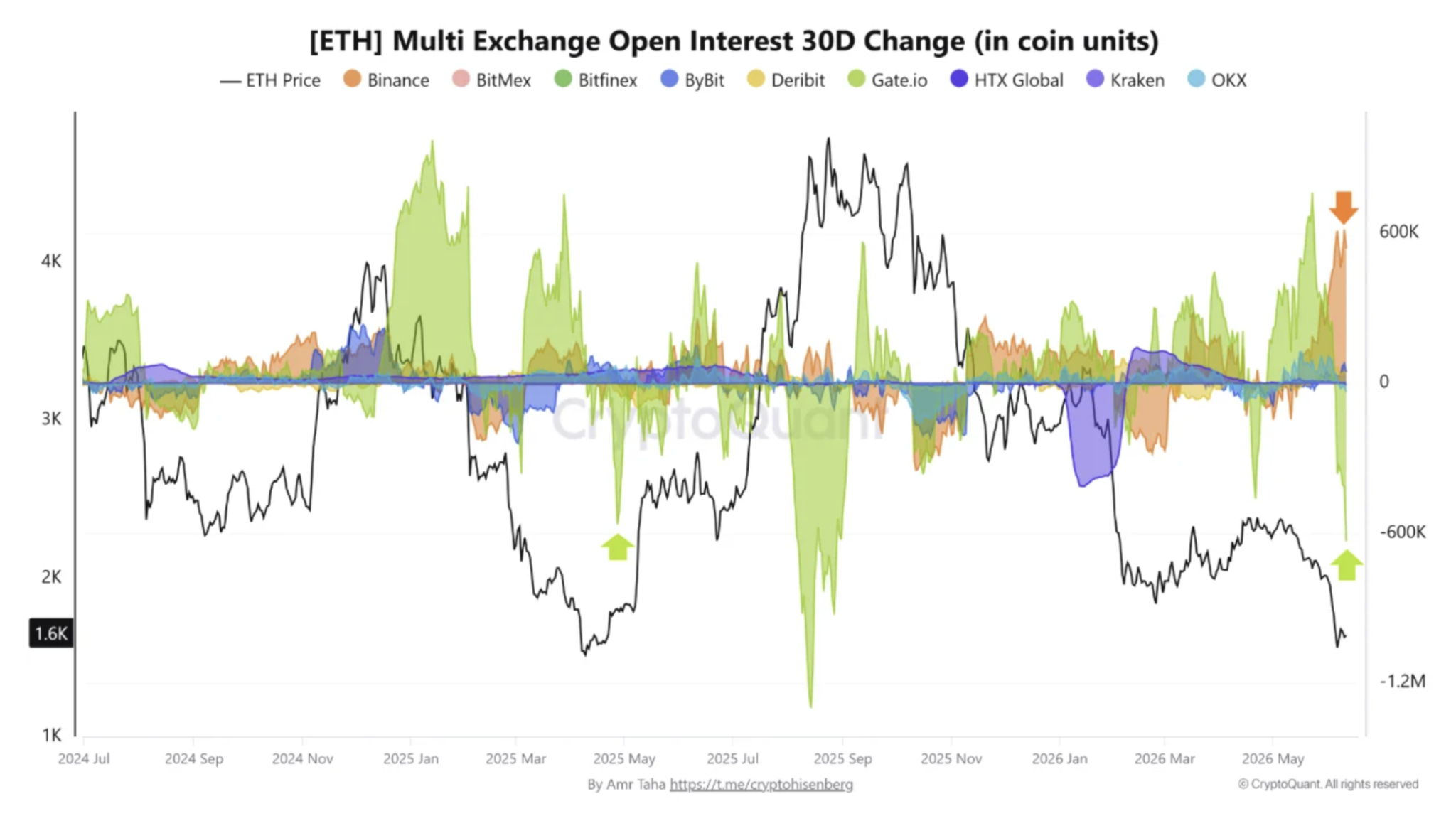
Multi-exchange open interest 30-day change. Source: CryptoQuant
Liquidation heatmaps show nearly $8 billion in short positions clustered between $2,200 and $2,400. Those levels stand out as key liquidity zones if ETH price begins to push higher.
However, near-term positioning remains heavily leveraged on both sides. Roughly $1.72 billion in cumulative long liquidations sits below the current price of $1,500, while nearly $1.90 billion in short liquidation exposure is concentrated near $1,800.
The narrow gap between those pools highlights a market where both bullish and bearish positions carry significant liquidation risk.
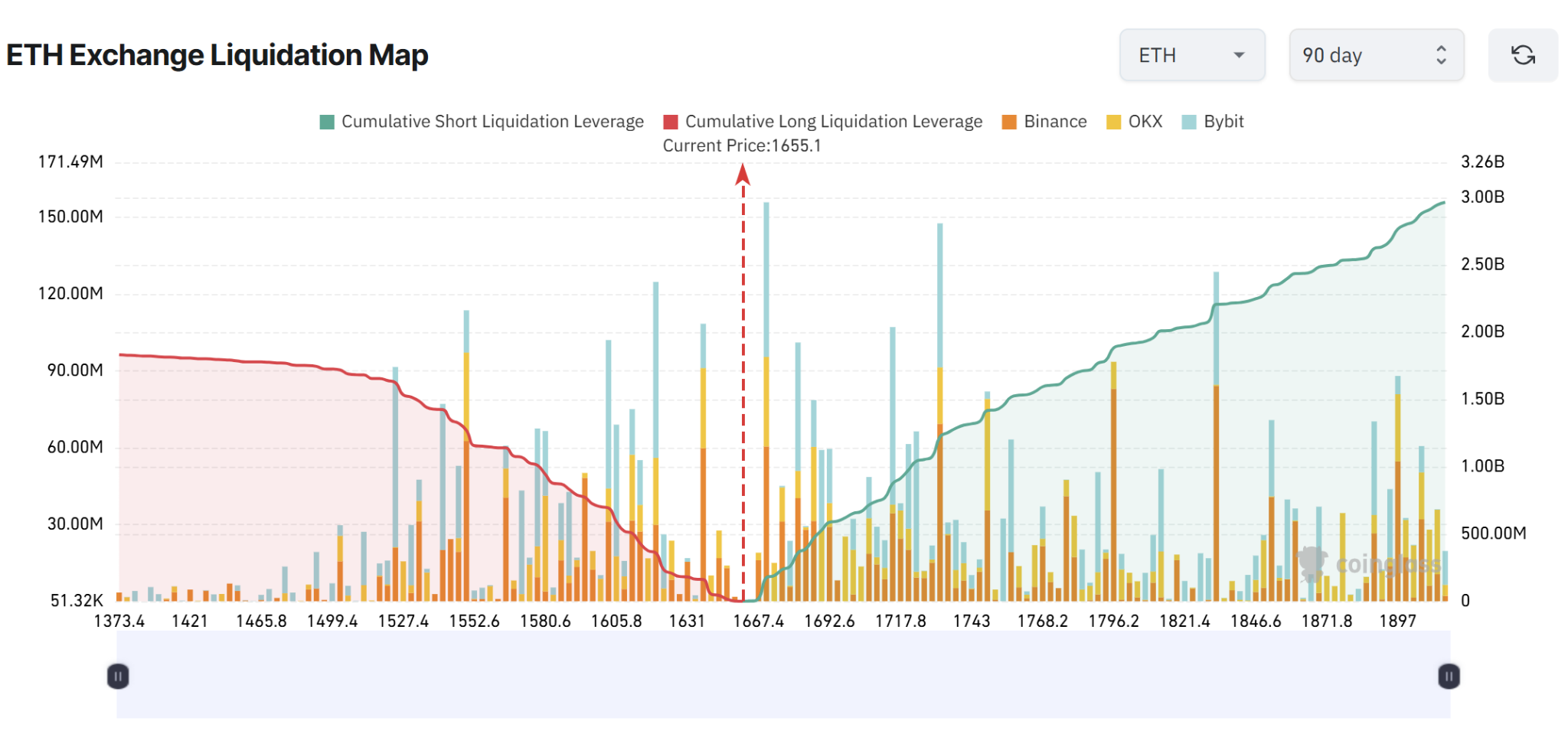
ETH liquidation map. Source: CoinGlass
Related: ETH crash to $1K looms if key support breaks: Will futures traders step in?

Ripple CEO Brad Garlinghouse posted a single word, “True,” in response to Flare co-founder Hugo Philion’s observation that the entire crypto industry is now scrambling to become what XRP was always criticized for being.
Philion’s original comment cut straight to the point: “When XRP and Ripple kind of started out, they were accused of being the banker coin. Now, everyone in the entire industry is desperate to be the banker coin.”
Garlinghouse’s public endorsement, backed by reports of Ripple deploying $4 billion in XRP holdings toward mainstream institutional finance, frames this less as a narrative shift and more as a belated market correction.
An X post summarizes it bluntly: “They mocked the vision. Now they’re copying it.”
Real-world assets, bank-integrated infrastructure, and institutional liquidity rails, which once XRP’s niche, are now the most crowded pitch in crypto.
Discover: The Best Crypto to Diversify Your Portfolio
Garlinghouse, Ripple, and XRP Price
XRP is barely holding above the psychologically critical $1.00 handle, with price consolidating in a tight range that technicals describe as bullish compression. Key support sits in the $1 zone, a prior consolidation band that has absorbed selling pressure through cycles.
Volume remains elevated relative to XRP’s ETF baseline, suggesting sustained interest rather than a dead-cat bounce. Transaction demand data indicates the $1.00 support level carries real on-chain significance, not just chart psychology.

At current levels, the risk/reward favors watching the $1.2 breakout level closely before adding exposure.
The banker coin narrative is now the consensus, which means the rerating from fringe institutional asset to mainstream financial infrastructure is largely priced in. The asymmetric upside that early XRP holders captured, buying into a vision the market hadn’t yet accepted, no longer exists at its current price.
Now, can XRP run back above its all-time high? Only time will tell
Discover: The Best Token Presales
The post Garlinghouse of Ripple Agrees Wall Street Is Copying XRP’s Banker Coin Model appeared first on Cryptonews.

Binance has announced a $250,000 humanitarian contribution to support frontline response efforts against an ongoing Ebola outbreak affecting the Democratic Republic of Congo and Uganda. The exchange said the funds will be divided equally between the Uganda Red Cross Society and Doctors Without Borders, known internationally as Médecins Sans Frontières (MSF).
What the donation will support
The company said the funding is earmarked for activities such as emergency medical care, prevention and public-awareness campaigns, contact tracing and containment work, and provision of sanitation supplies and personal protective equipment for health workers. Binance framed the contribution as a rapid-response intervention to shore up services in high-risk and underserved areas where healthcare access remains limited.
Outbreak context and operational constraints
Health authorities have linked the recent cases to the Bundibugyo Ebola virus, for which there is currently no approved vaccine or targeted antiviral treatment. That profile heightens pressure on local health systems, particularly in eastern DRC where insecurity and limited infrastructure complicate response operations. MSF has reported concern about the speed and geographic spread of the outbreak, including cross-border transmission into Uganda, and has emphasised the need for swift action to prevent escalation.
Operationally, donations that finance protective equipment, sanitation, community outreach and contact tracing can improve immediate containment measures. However, humanitarian responders frequently highlight that resources alone are not a silver bullet: access, security, logistics and sustained funding streams all influence whether short-term grants translate into lower transmission.
Why a crypto firm is stepping in
Binance has been expanding its footprint across African markets through initiatives tied to education, digital skills and financial inclusion. This contribution follows a pattern of technology and crypto companies engaging in corporate social responsibility and emergency aid, often to complement work by established humanitarian organisations.
For Binance, supporting recognised responders such as MSF and national Red Cross societies helps direct funds to organisations with operational experience and logistics networks already in place. The company has also publicly urged other firms active in the region to consider similar support during humanitarian crises.
Industry and reputational implications
Donations by major crypto platforms carry both practical and reputational effects. On the practical side, funds can supply critical items that immediate responders need. From a reputational perspective, contributions to humanitarian causes can bolster a company’s public image and relationships with governments and civil-society actors—important in jurisdictions where crypto regulation and licensing are evolving.
At the same time, observers note potential limits. A $250,000 pledge, while useful for targeted activities, is modest relative to the scale of nationwide outbreak responses and the sustained funding those efforts typically demand. How companies balance short-term aid with longer-term development or health-system strengthening will shape whether their interventions are perceived as substantive or largely symbolic.
What this means for responders and the region
For frontline organisations, rapid injections of cash can enable faster procurement of supplies and quicker expansion of outreach in specific communities. MSF and national Red Cross societies often operate in volatile environments where formal procurement channels and local markets may be disrupted; unrestricted funds or targeted grants for equipment and awareness campaigns can therefore have a direct impact on response speed.
Nonetheless, containment of Ebola outbreaks relies on coordinated multi-agency efforts, steady surveillance and community trust. Financial contributions from private companies are most effective when they align with national and international response plans and when they are delivered through partners with local operational capacity.
Looking ahead
Binance’s contribution highlights a growing trend of crypto-sector actors participating in humanitarian financing, particularly in regions where they have commercial or strategic interest. For policy makers and aid organisations, the emergence of new private donors offers additional resources but also underscores the need for transparent coordination, accountability and sustained engagement to ensure that funds strengthen resilience rather than only addressing immediate gaps.
As the outbreak evolves, the priority for health agencies and their partners will remain rapid detection, treatment where possible, and measures to break chains of transmission. Private donations can support those goals, but they are one element within a broader, resource-intensive public-health response.
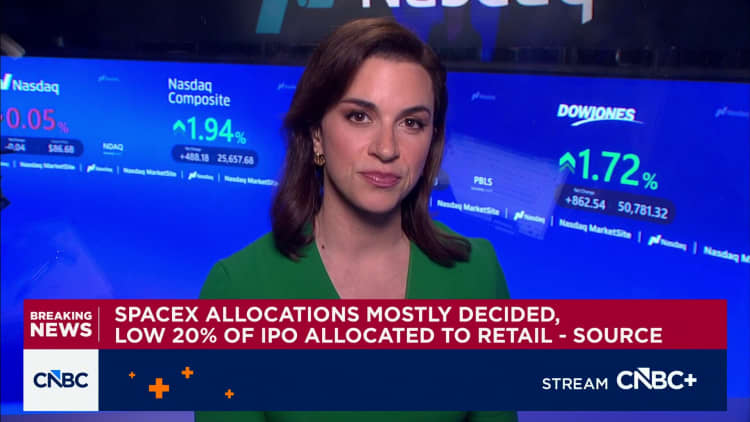

SpaceX is allocating a smaller-than-expected portion of its blockbuster initial public offering to retail investors, according to a person familiar with the matter.
The Elon Musk-led company plans to direct a percentage in the low 20s of the offering to retail buyers, including international individual investors, online brokerages and private-bank clients, the person said.
The allocation is below earlier expectations that roughly 30% of the deal would be reserved for retail investors.
The allocation decisions are almost finalized and could still change, the person said.
SpaceX is set to begin trading Friday, in what is poised to become one of the largest public offerings in history. The company is expected to be valued at about $1.8 trillion.
The reduced allocation suggests institutional demand for the shares has been strong as investors compete for access to the hottest IPO in recent years. Even with a smaller allocation, the retail tranche would still rank among the largest ever for a U.S. IPO of this size.

Mexico vs South Africa LIVE: World Cup 2026 result, latest updates and fan reaction

Mortgage rates climb as homebuyers push past market jitters
Bitcoin Price Prediction: Not Just ETFs, Corporate BTC Buying Spree Has Collapsed



-

 Fashion6 days ago
Weekend Open Thread: Evereve – Corporette.com
-
 Crypto World6 days ago
Jensen Huang Approves Samsung, SK Hynix, and Micron for NVIDIA (NVDA) HBM4 Memory Supply
-

 Crypto World4 days ago
Anatomy of the June crypto crash: Fed, Iran, Saylor
-
 Entertainment5 days ago
The Best Mystery Series of All Time Is Surging on Streaming 30 Years After It Ended
-

 NewsBeat4 days ago
Alexander Zverev wins the French Open to finally earn a 1st Grand Slam title
-

 Tech6 days ago
Suspicious Polyfill login prompts pop up on Toshiba, Muji websites
-
 Crypto World5 days ago
Senator Cynthia Lummis Calls CLARITY Act the Most Consequential Financial Legislation of This Generation
-

 Tech7 days ago
Microsoft launches MXC, an OS-level sandbox for AI agents, with OpenAI and Nvidia already on board
-

 Tech4 days ago
Microsoft unveils seven homegrown AI models in new bid for ‘long term self-sufficiency’
-

 Business6 days ago
(VIDEO) Justin Bieber Delivers Surprise Happy Birthday Serenade to Diners at Los Angeles Mexican Restaurant
-
 Business5 days ago
The Pain Points Taking a Fragile Tech Rally Down a Notch
-

 Business4 days ago
High Stakes for Wembanyama as New York Pushes for 3-0 Lead
-
 Crypto World3 days ago
Eli Lilly (LLY) Stock Surges 4% Following Breakthrough Sleep Apnea Trial Results
-

 Tech6 days ago
Von der Leyen’s AI envoy pick draws conflict-of-interest fire
-

 Tech6 days ago
Meta steals a tactic from Tesla and builds data centers in tents
-
 NewsBeat4 days ago
Alexander Zverev conquers demons and outlasts Flavio Cobolli to win French Open for first major title
-
Crypto World6 days ago
LBank Surpasses 25 Million Users Worldwide as AFA Partnership Continues to Drive Global Growth
-

 Tech6 days ago
Hackers now exploit SolarWinds Serv-U flaw to crash servers
-

 Crypto World4 days ago
Trump’s AI Ownership Plan Could Benefit Anthropic at OpenAI’s Expense
-
 Sports2 days ago
Bangladesh beat Australia after 20 years in ODIs, register only their second win over six-time world champions | Cricket News
You must be logged in to post a comment Login