

Crypto World
US Senate Banking Committee Votes to Advance Crypto Market Structure Bill

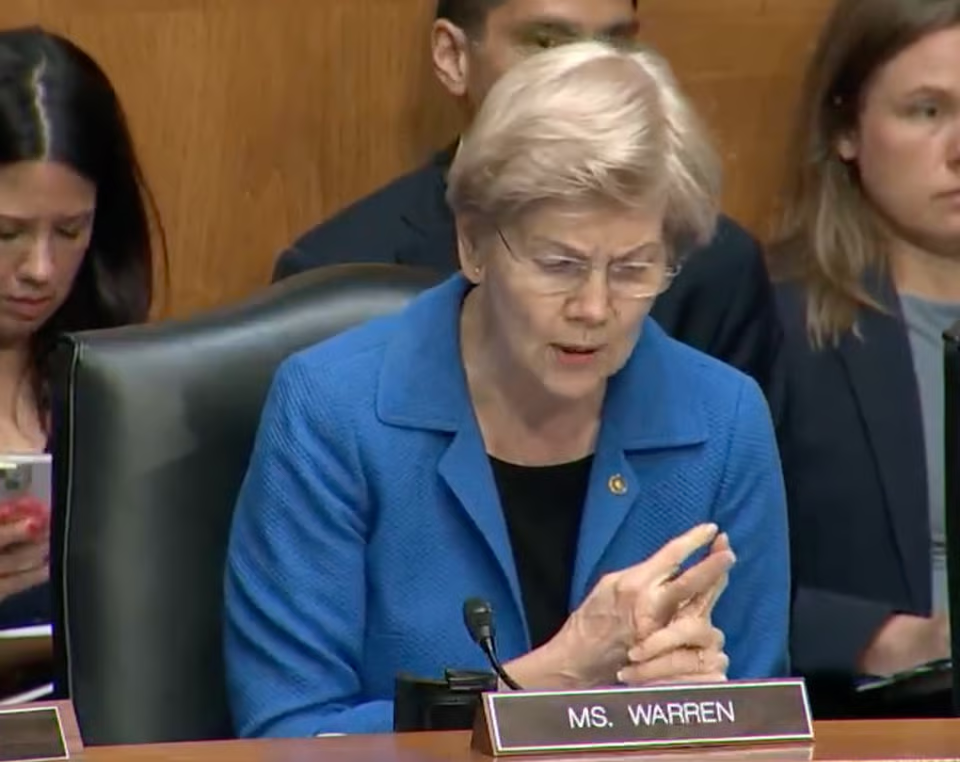
US lawmakers in the Senate Banking Committee held a markup for a long-awaited crypto market structure bill, marking a pivotal step toward Congress’ effort to establish regulatory clarity for digital asset companies and markets.
In a Thursday session of the US Senate Banking Committee, all 13 Republican members and two Democrats voted to advance the Digital Asset Market Clarity Act (CLARITY), with nine Democrats also voting no on the bill.
Senators Ruben Gallego and Angela Alsobrooks sided with Republicans to vote yay. The vote came after lawmakers proposed more than 100 amendments to the crypto bill, ranging from provisions on stablecoin yield to ethics restrictions.
In opening statements before the vote, committee chair Tim Scott said that the bill was focused on protecting consumers, keeping innovation in the US, and safeguarding national security in regards to digital assets.
Ranking member Elizabeth Warren said that the bill was “written by the crypto industry for the crypto industry,” adding that it would allow Republican lawmakers to “grease the skids” for US President Donald Trump’s “crypto grift.” “Nothing made it into this bill that wasn’t approved by the crypto industry,” said Warren.

Senator Elizabeth Warren addressing lawmakers at the Thursday markup. Source: US Senate Banking Committee
Senator Cynthia Lummis, one of the legislation’s chief Republican advocates, pushed back against many of Warren’s concerns, saying CLARITY was a “pro law enforcement” and “pro consumer” bill.
Senator Jack Reed, a Democrat, said that the bill was not an example of bipartisan work, given that Scott had “arbitrarily” dismissed consideration of amendments Democrats had proposed.
Related: Ethics remain sticking point as crypto market structure bill goes to markup
With the advancement of CLARITY in the banking and agriculture committees to address laws and regulations in the Securities and Exchange Commission (SEC) and Commodity Futures Trading Commission (CFTC), respectively, the bill is expected to head for a floor vote in the Senate soon.
The bill will need 60 votes to pass. the Senate. The US House of Representatives will then need to approve the amended legislation.
“I think it’s so difficult to get Senate floor time, and if they get something through the Senate that has the votes, I think the House will probably pass that identical language, and then it will be able to go on to the president’s desk for a signature,” Solana Policy Institute President Kristin Smith told Cointelegraph before the markup.
Several amendments were debated and dismissed at markup
Many of the amendments proposed at markup were either adopted or failed along partisan lines, addressing different aspects of regulating the crypto industry.
Among those considered at markup included provisions on sandboxes for AI by Scott and ones on “tokenization loopholes” and money laundering by Warren, who cited reports that Iran was collecting tolls in crypto for ships using the Strait of Hormuz and otherwise evading sanctions.
Lummis said that CLARITY would address the regulation of crypto mixers in response to Warren’s proposed amendment. Scott’s amendment was included, while Warren’s failed.

Senator Cynthia Lummis addresses the Senate Banking Committee. Source: US Senate Banking Committee
Another amendment by Warren included a demand for US banking regulators to report on information related to deceased sex offender Jeffrey Epstein, whom she described as an “early backer of crypto.”
Lummis said the provision was not related to digital assets and should not be included. Lawmakers voted along party lines, and the amendment failed to pass. Republicans also voted against amendments proposed by Reed on stablecoins and digital dollars.
Senator Catherine Cortez Masto, a Democrat who expressed general support for the CLARITY Act at the markup, introduced an amendment that would give law enforcement more authority over crypto-related cases. The amendment failed along party lines.
Democratic Senator Tina Smith proposed an amendment to prohibit federal agencies from bailing out crypto companies if another market crash were to occur. Calling it a “preventative measure” in response to volatility in the crypto markets, Smith and all Democrats voted in favor of the amendment, which failed along party lines.
Ethics still a concern for Democrats
The committee also considered an amendment from Democratic Senator Chris Van Hollen over Trump’s potential conflicts of interest with the crypto industry through his family’s World Liberty Financial business and memecoins.
Republican Senator Bernie Moreno and Scott defended the president, accusing Van Hollen of “ad hominem” attacks. All 13 Republicans voted against the provision.
“The people involved directly in making these policies, from the president to the Congress, should not be able to be issuers of these particular assets and coins,” said Van Hollen.
Senator Raphael Warnock withdrew an amendment in response to what he called “pure corruption” by the Trump administration, adding that he would not support any bill without these carveouts.
Warren echoed these concerns in a separate amendment, which would continue to fund the Consumer Financial Protection Bureau in response to the administration’s attempt to shutter the agency since 2025.
Magazine: eToro founder timed Bitcoin top perfectly due to belief in 4 year cycles

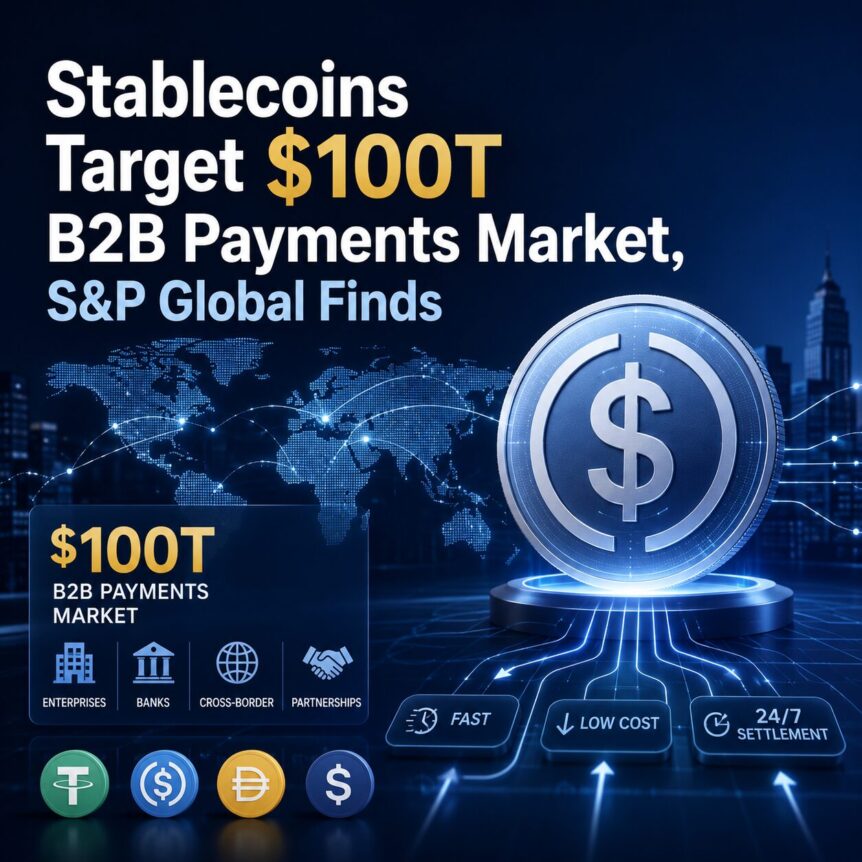
A new analysis from S&P Global Market Intelligence finds that stablecoins are increasingly positioned as an alternative settlement rail for the $100 trillion global business-to-business payments market. The report argues that the digital tokens could reduce settlement times, lower fees and add transparency for cross-border supplier payments, payroll and intercompany treasury operations, though broader adoption will hinge on regulatory clarity and banking partnerships.
Why stablecoins are drawing enterprise interest
Corporates and payment processors face persistent frictions in B2B flows: long settlement windows, opaque fees, multiple intermediaries and foreign exchange volatility. According to S&P Global Market Intelligence, these pain points make cross-border supplier payments, contractor payroll and intercompany transfers natural targets for tokenised settlement rails. The report estimates that global B2B payments exceed $100 trillion annually and notes that the current stock of circulating stablecoins stood at roughly $269 billion, with a projection to reach about $434 billion by 2028, reflecting growth in issuance and on‑ramp infrastructure.
Speed and cost are the principal advantages cited. On‑chain transfers can settle near instantaneously compared with multi-day correspondent banking flows. Embedded dossiering and ledger-based records also promise clearer audit trails for reconciliation. For treasurers, the ability to move liquidity quickly between legal entities and currencies could materially change working capital models.
Primary use cases identified
S&P Global Market Intelligence highlights three B2B scenarios where stablecoins are gaining traction:
Cross-border supplier payments. This is identified as the leading short-term use case. Providers are combining traditional bank accounts with digital wallets to route payments over stablecoin rails, aiming to cut intermediary fees and reduce FX exposure. The analysis cites firms such as Sokin, dLocal, Convera (in partnership with Ripple) and OpenFX as examples of platforms embedding stablecoin rails into existing payment workflows.
Payroll and contractor disbursements. For firms managing global payroll and gig-worker payouts, stablecoins can enable 24/7 disbursements, faster access to funds and the option for recipients to hold or convert tokens locally. The report notes integrations and pilots involving payroll firms and card networks, including Rise, Bitwage, Remote, Visa, Mastercard, Episode Six, Stripe and Worldpay.
Intercompany settlement and treasury automation. Large enterprises with numerous subsidiaries can use tokenised transfers to streamline internal funding, reconciliation and liquidity sweeps. S&P’s analysis points to examples where treasury teams leverage stablecoins and private/on‑permissioned tokens for automated transfers, citing vendor partnerships such as Trovata with Paxos (USDP). The report also references corporate use cases reported in the market, including the use of JPM Coin for internal liquidity movements and instances where companies have experimented with stablecoins for FX hedging.
Infrastructure and industry partnerships
Adoption depends on a layered ecosystem of wallets, custody, compliance tooling and payment orchestration. The report describes how payment providers are either building in‑house stacks or partnering with infrastructure specialists to simplify enterprise integration. Names mentioned include Bridge (associated with Stripe), BVNK, Fireblocks and Zero Hash—firms that supply custody, tokenisation infrastructure and settlement plumbing.
Major payment networks and processors are also participating, seeking to bridge card rails and bank accounts with tokenised flows. That participation can accelerate on‑ramps for corporate customers but also raises questions about interoperability between permissioned bank tokens, public stablecoins and existing correspondent banking networks.
Regulatory and operational hurdles
While the technology addresses clear operational frictions, S&P Global Market Intelligence emphasises that regulatory clarity remains a decisive factor. Compliance requirements around anti‑money laundering, sanctions screening, custodial arrangements and issuer reserve disclosure will influence which stablecoin models are acceptable to banks and corporates. Counterparty risk and issuer stability also remain material concerns: corporates must assess credit and operational exposures when choosing tokenised rails.
Integration complexity is another practical barrier. Enterprises often require reconciliation with ERP systems, legal alignment across jurisdictions and predictable FX conversion paths. Building or sourcing orchestration layers that coordinate on‑chain settlement with off‑chain banking is therefore a critical implementation step.
Market implications and what to watch
If the dynamics S&P Global Market Intelligence outlines play out, stablecoins could reshape treasury operations and cross-border cash management over the coming years. Cost reductions and faster settlement would benefit multinational firms and payment platforms, while new entrants could capture value by offering integrated wallets, conversion services and compliance tooling.
Key indicators to monitor include regulatory guidance in major jurisdictions, issuance growth among regulated stablecoin providers, and the pace at which incumbent banks and payment networks embed tokenised rails into corporate products. The projected increase in circulating stablecoins to roughly $434 billion by 2028, as reported by S&P, suggests providers and infrastructure partners expect significant growth—but that expansion will depend on demonstrable compliance, interoperability and client demand.
Any data or examples cited in this article are attributed to S&P Global Market Intelligence.
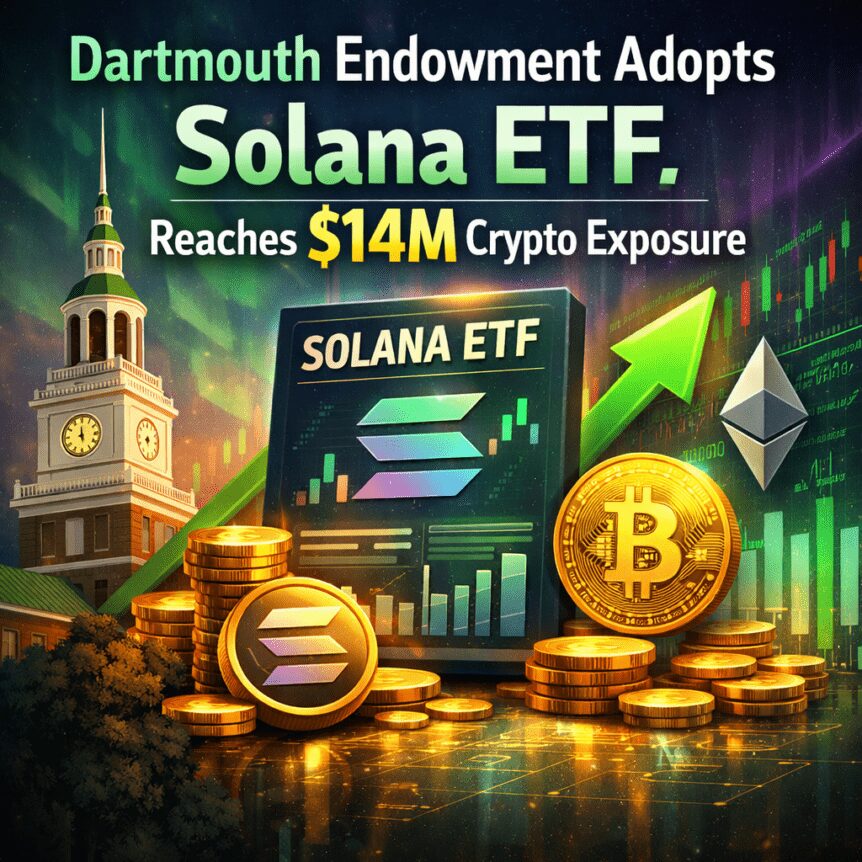
Dartmouth College’s $9 billion endowment has quietly expanded its exposure to digital assets, reporting new crypto-related holdings in a recent SEC filing. In a Form 13F covering the quarter ended March 31, 2026, the trustees disclosed positions across three cryptocurrency-focused exchange-traded funds (ETFs): about $3.3 million in the Bitwise Solana Staking ETF, roughly $3.5 million in the Grayscale Ethereum Staking ETF, and approximately $7.7 million in BlackRock’s iShares Bitcoin ETF.
The figures mark a shift from January, when the endowment’s crypto footprint was skewed toward larger holdings in BlackRock’s Bitcoin ETF (over $10 million) and the Grayscale Ethereum Mini Trust (about $5 million). The newer disclosures show a more diversified but still modest stake in regulated crypto vehicles within Dartmouth’s multi-billion-dollar investment program.
These details come as U.S. universities increasingly experiment with regulated access to digital assets. Dartmouth’s move follows Harvard’s reported crypto exposure, with its own endowment reported to hold BlackRock’s iShares Bitcoin Trust and Ethereum Trust, as part of a broader institutional push into crypto—an evolution previously documented in coverage of Harvard’s 2025 and 2026 positioning.
Source data and implications are anchored in the SEC filing and related coverage, illustrating a growing appetite among large, fiduciary portfolios to access crypto through permitted, exchange-traded vehicles rather than direct holdings. For context, the SEC began approving spot Bitcoin ETFs in January 2024 and has since extended approvals to other crypto-asset baskets, including Ether, Solana, Dogecoin, and XRP-related products, with additional applications under review.
Key takeaways
- Dartmouth’s endowment now holds approximately $3.3 million in the Bitwise Solana Staking ETF, $3.5 million in the Grayscale Ethereum Staking ETF, and $7.7 million in BlackRock’s iShares Bitcoin ETF, according to the SEC filing for the quarter ended March 31, 2026.
- January 2026 holdings showed a larger allocation to BlackRock’s Bitcoin ETF (over $10 million) and roughly $5 million in the Grayscale Ethereum Mini Trust, indicating a shift toward a broader, stake-based crypto approach rather than concentrated bets.
- Harvard’s endowment has been cited as holding positions in BlackRock’s Bitcoin Trust and Ethereum Trust, underscoring a broader trend of top-tier university funds pursuing regulated crypto access.
- The regulatory backdrop supports this trend, with the SEC having approved spot Bitcoin ETFs in 2024 and gradually expanding to other crypto-linked ETFs, even as ongoing market flows remain volatile.
- Bitcoin-related ETF activity has shown notable daily outflows in recent weeks, with a report noting $635.2 million in daily outflows—the largest such move since January—contextualizing the risk environment behind these allocations.
Dartmouth’s crypto exposure deepens as endowment reallocates to staking ETFs
The latest 13F filing shows Dartmouth anchoring a modest yet meaningful exposure to staking-focused crypto ETFs. The Bitwise Solana Staking ETF offers exposure to Solana via a staking strategy, while the Grayscale Ethereum Staking ETF provides exposure to Ethereum staking mechanics. BlackRock’s iShares Bitcoin ETF remains the largest single crypto position among the three, highlighting a preference for regulated, exchange-traded vehicles that provide liquidity and governance familiar to an endowment investor.
Compared with January, the endowment’s crypto lineup has become more diversified but with smaller single-name bets than before. This pattern may reflect a cautious approach that weighs liquidity, transparent pricing, and fiduciary oversight—factors increasingly prioritized by large public and private endowments when allocating to digital assets.
Universities and crypto: a signal of deeper institutional interest
Dartmouth’s disclosure sits within a broader arc of institutional adoption. Harvard’s reported positions in BlackRock’s Bitcoin and Ethereum Trusts were highlighted in coverage surrounding its substantial $57 billion endowment in 2025. The move signals that major universities are testing the viability of regulated crypto access as a complement to traditional asset classes, a shift that could influence the broader risk preferences and governance standards across the higher-ed investment community.
Investors watching these developments may interpret them as a growing endorsement of listed crypto access vehicles as a way to gain regulated, price-tick exposure to digital assets without holding tokens directly. The trend also aligns with an industry effort to broaden participation from large pools of capital, including endowments, foundations, and pension funds, into more mature and compliant crypto investment formats.
Regulatory backdrop and market context
Since the SEC started approving spot ETFs tied to Bitcoin in January 2024, the landscape has slowly broadened to include products linked to Ether, Solana, Dogecoin, and XRP, with more applications under review. The ongoing evolution of ETF availability is relevant for institutions weighing crypto allocations because it offers regulated, transparent access routes that fit traditional fiduciary frameworks.
In the market backdrop, recent ETF actions have been accompanied by notable capital moves. Bitcoin funds recorded about $635.2 million in daily outflows—the largest one-day pullback since January—following earlier outflows of more than $800 million on a previous date, driven in part by sector-wide momentum shifts and price dynamics. At the time of this report, Bitcoin traded around $81,237, up roughly 2% over the prior 24 hours, brushing the 200-day exponential moving average, a key technical support. Still, BTC remains below the 365-day EMA and far from the 2025 all-time high near $126,000 reached in October.
These market conditions underscore the complexity facing institutional allocators: while price action and volatility persist, regulated ETF structures can provide a framework for cautious, long-horizon exposure to digital assets as investor demand grows and regulatory clarity deepens.
Looking ahead, readers should watch how more university endowments calibrate their crypto programs as regulators refine product approvals and as institutions balance risk with potential yield. The coming quarters will reveal whether the Dartmouth-size experiment becomes a broader blueprint for scaled, governance-forward crypto access within legacy-investment portfolios.
Crypto market analysts say increasing altcoin performance and volumes on Binance, a rising altseason index and a strengthening TOTAL2 macro structure are early signs that the market could enter an altseason in 2026.
Key takeaways:
- Altcoin recovery signals emerge, hinting at a potential altseason in 2026.
- Rising altcoin trading volume on centralized exchanges and AltSeason Index point to possible capital rotation from Bitcoin.
- Altcoin market cap chart shows improving technicals.
Altcoin market shows early signs of recovery
Crypto analyst Darkfost said that macroeconomic uncertainties surrounding the ongoing US and Israel-Iran war saw the altcoin sector correct by more than 50%.
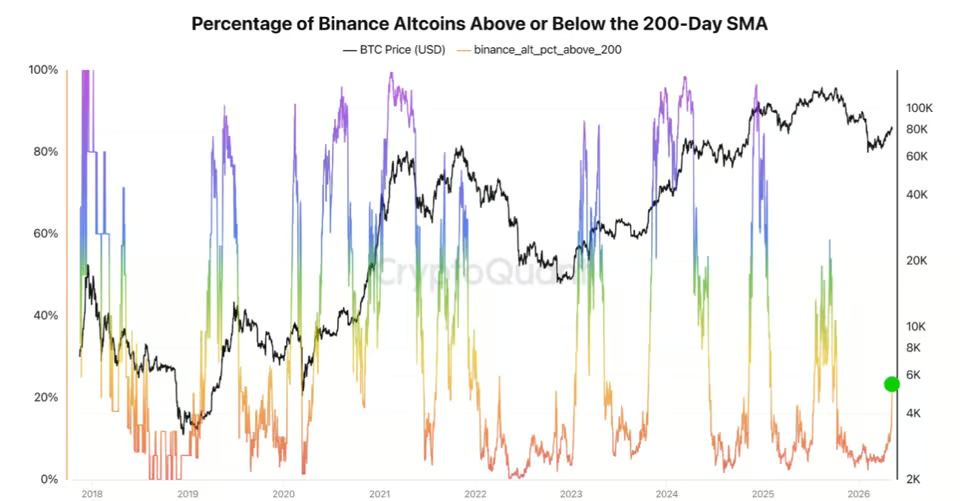
However, the sector appears to be quietly “awakening” as the percentage of altcoins on Binance trading above their 200-day moving average (MA) increased to 21%, levels last seen in September 2025, suggesting that “investor interest in altcoins appears to be gradually returning,” Darkfost said in a Quicktake note on Wednesday, adding:
“This represents a crucial indicator for those looking to gain exposure.”

Performance of altcoins on Binance. Source: CryptoQuant
Darkfost cautioned that it’s still too early to call for an altseason as the metric remains below the levels seen in mid-2025 and Q4 2024, when most altcoins traded between 60-80% above their 200-day MA.
Meanwhile, fellow analyst CryptoOnchain pointed to rising activity on centralized exchanges (CEX) as another sign of increasing momentum in altcoins.
According to the analyst, altcoin trading volume, excluding the five largest cryptocurrencies, has increased steadily over the past few weeks. The chart below shows the appearance of an Altcoin Volume Increasing Trend (yellow bars), which occurred when the 30-day MA for altcoin trading volume crossed above its 365-day MA.
Historically, when this metric flashes yellow, “it signals a clear rotation of capital from major caps into mid and low-cap altcoins,” the analyst said, adding:
“If this momentum is sustained, it could serve as a strong confirmation that a broader altcoin rally is underway.”

CEX volume ratio vs. Top 5 crypto. Source: CryptoQuant
Altcoin season “approaching”
The 90-day AltSeason Index also climbed to 28.6, its highest level in months. The index tracks whether a majority of altcoins outperform Bitcoin over the last 90 days.
“The altseason is starting quietly,” CryptoQuant analyst CW8900 said in a recent Quicktake note, referring to the “rapid rise” in the index over the last few weeks, adding:
“The real AltSeason is approaching.”

Altcoin season index. Source: CryptoQuant
Although the index has been recovering, its value of 28.6 means only 28.6% of the top 50 cryptocurrencies by market capitalization have outperformed Bitcoin over the last 90 days. This falls short of the 75% “altseason” threshold, according to Blockchaincenter.
These include ZCash (ZEC), Bittensor (TAO) and Morphor (MORPHOR), which are up 98%, 72% and 68% over the last three months, compared to Bitcoin’s (BTC) 17% gains.

Top 50 Performance over the 90 days. Source: Blockchaincenter
CW8900 added:
“The indicator also shows that there was no real AltSeason in this cycle. The period when the AltSeason Index reached its highest point was early 2024, and even that value was relatively low compared to previous AltSeasons.”
Altcoins show signs of bottoming out
Data from TradingView showed TOTAL2 — the cumulative market capitalization of all cryptocurrencies except Bitcoin — bouncing off the lower trend line of a multi-year broadening wedge that has defined its price action since mid-2022.
In a Wednesday post on X, analyst cryptocupra said TOTAL2’s breakout could mirror the 2021 breakout and rise as high as $8 trillion, adding that “altseason is inevitable.”

Altcoins market cap, TOTAL3. Source: X/1000xgirl
Nebraskangooner’s chart showed TOTAL2 breaking above the upper boundary of an ascending triangle on the daily time frame.
TOTAL2 is “breaking out from this bottoming pattern, the analyst said in a recent X post, adding:
“Altcoin market primed for more upside as long as this breakout holds.”

TOTAL2 daily chart. Source: X/Nebraskangooner
Fellow crypto analyst GorkemCrypto also shared a bullish argument with a 2021 fractal that projects Bitcoin dominance falling to 40% as capital rotates into altcoins.

Bitcoin dominance. Source: X/GorkemCrypto
However, as Cointelegraph reported, the Bitcoin Dominance Index has climbed to its highest level since November 2025. BTC dominance has been climbing since 2023, suggesting that the current trend still favors BTC over altcoins.
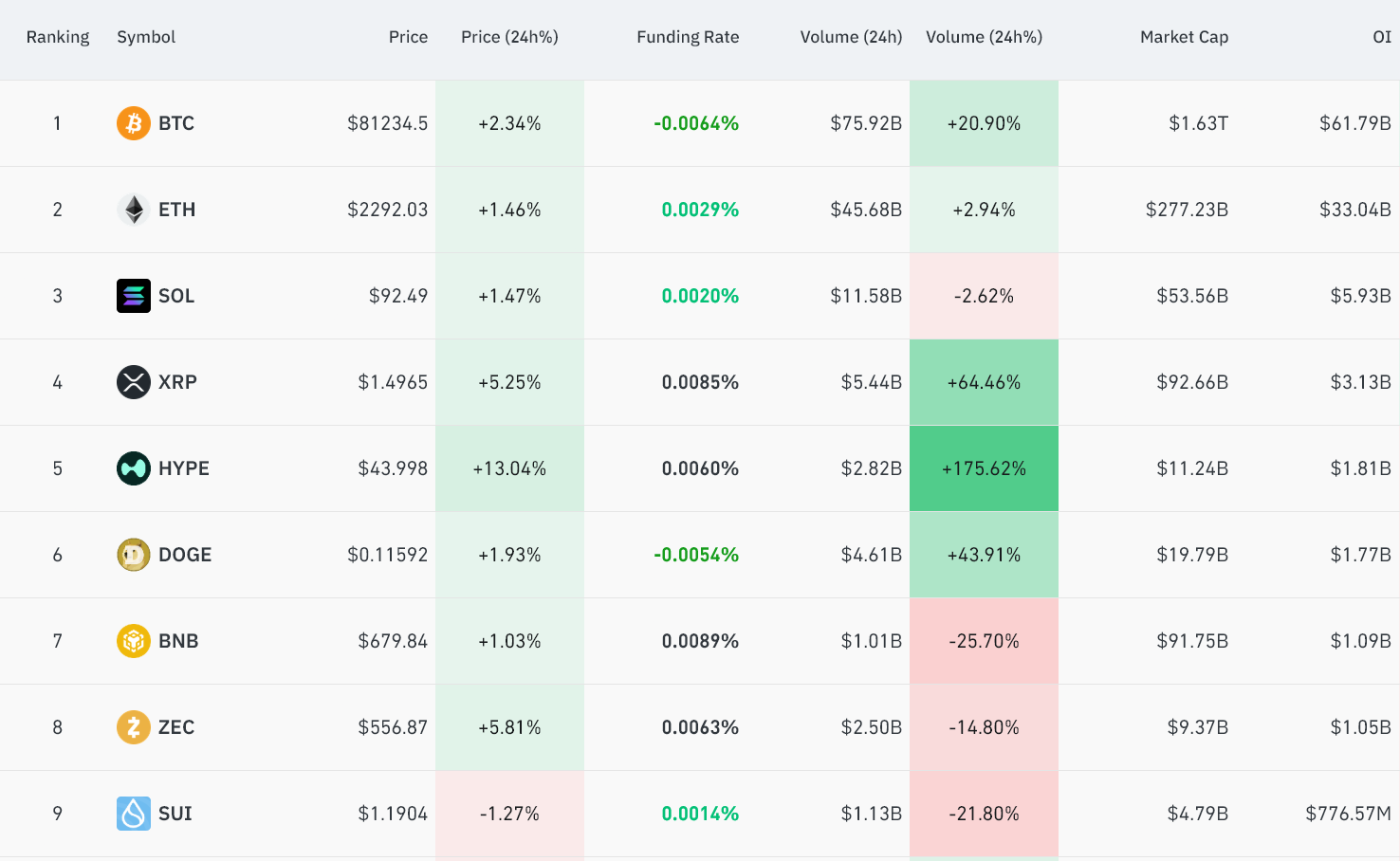
Dogecoin has overtaken Bitcoin, Ethereum, and XRP in futures market activity, according to the latest CoinGlass data.
Open interest in Dogecoin futures rose 5.09% over the past 24 hours. Open interest measures the total value of active derivatives contracts and is often used to track trader conviction and short-term market momentum.

DOGE Leads the Futures Market
Dogecoin’s futures open interest reached $1.79 billion, while daily futures volume climbed to $3.99 billion. That marks an 81.62% increase over the same period.
The contrast with the rest of the market is clear.
Bitcoin’s open interest fell 0.36%, while Ethereum’s rose only 0.94%. Both assets were trading lower, with daily price declines of about 1.46%.
Solana showed weaker momentum. Its open interest dropped 5.96%, while its price fell 4.21%. XRP also lost traction, with open interest down 2.52% and price down 1.81%.
As a result, Dogecoin is standing out in a market where traders are reducing exposure to several major crypto assets.
The latest data suggests that traders are still willing to take leveraged bets on DOGE, even as risk appetite cools elsewhere.
That does not guarantee further upside, but it shows that Dogecoin currently has stronger futures momentum than many larger assets.
What Comes Next for DOGE?
Dogecoin traded near $0.11328 at the time of analysis, according to BeInCrypto data. The memecoin was up 1.03% over the past 24 hours.
That made DOGE one of the few major crypto assets by market capitalization still trading in positive territory.
The combination of spot price strength and rising futures activity supports a short-term bullish reading. Dogecoin has broken away from the weaker trend seen across much of the market.
However, leverage remains the main risk.

A rise in open positions can accelerate gains when price moves higher. It can also deepen losses if the market turns quickly. Forced liquidations could add pressure if DOGE loses key support levels.
For now, traders are watching whether Dogecoin can hold the $0.11 level. Continued inflows into futures markets would also be important.
If both conditions hold, Dogecoin could continue to outperform the broader crypto market in the short term.
The post Dogecoin Leads Crypto Futures Activity as Bitcoin, Ethereum, and XRP Cool appeared first on BeInCrypto.

JPMorgan Chase increased its reported holdings in several Bitcoin exchange-traded funds (ETFs) in the first quarter, led by a 174% jump in its position in BlackRock’s iShares Bitcoin Trust (IBIT), according to a 13F filing published Wednesday.
The bank increased its position in IBIT from around 3 million shares in Q4 2025 to 8.3 million shares, according to the filing.
The increase added about $162 million in reported value, based on filing data, despite Bitcoin price falling by more than 22% in Q1, according to CoinGlass data.
The filing also showed broader activity across crypto-linked assets, including new and expanded positions in funds tied to Ethereum and Solana, alongside rotation in equities tied to miners and companies with digital asset exposure.
The filing points to selective growth in JPMorgan’s reportable crypto-linked holdings during a weak quarter for digital assets, when Bitcoin prices fell and US spot Bitcoin ETFs recorded net outflows.
Bitcoin ETF bets expand sharply beyond BlackRock position
Beyond its increased stake in BlackRock’s iShares Bitcoin Trust, JPMorgan also expanded exposure across several other spot Bitcoin ETFs, including the Fidelity Wise Origin Bitcoin Fund (FBTC) and the Bitwise Bitcoin ETF (BITB).
Holdings in BITB surged nearly 900%, rising from 4,872 shares to 48,258 shares, adding roughly $1.51 million in reported value. The bank’s FBTC position increased about 450%, from 3,996 shares to 22,196 shares, worth about $980,000 in added value.
Related: Jane Street slashes Bitcoin ETF holdings, adds Ether funds in Q1 2026
Additionally, JPMorgan significantly increased exposure to the ProShares Bitcoin Strategy ETF (BITO), which tracks Bitcoin futures rather than holding spot BTC directly. The bank’s BITO holdings surged from just 40 shares to 1,302 shares, a gain of more than 3,000%.
Mixed altcoin ETF activity across Ethereum, Solana and XRP
JPMorgan also showed uneven activity across altcoin-linked ETFs in the first quarter, with new positions added in some funds while others were fully exited.
The bank initiated a position in the Bitwise Solana Staking ETF (BSOL), buying 47,460 shares worth about $523,000, marking its first reported exposure to a Solana-focused ETF product.

Source: The Bitcoin Historian
At the same time, JPMorgan increased its exposure to Ethereum-linked ETFs, including a 36% rise in the iShares Ethereum Trust (ETHA) to 266,734 shares, alongside a sharp increase in the Bitwise Ethereum ETF (ETHW).
Related: Wells Fargo boosts Ether ETF exposure in Q1 2026, rotates BTC holdings
On the other hand, the filing showed a full exit from XRP-linked exposure, with the bank reducing its Bitwise XRP ETF (XRP) position from 3,870 shares to zero.
In line with the bullish BTC ETF buying, JPMorgan also slightly increased its position in Strategy, the world’s largest public Bitcoin holder.
The bank’s crypto-linked equity positions were otherwise mixed, with reductions in Robinhood Markets as well as Coinbase, Galaxy Digital and Bitdeer Technologies Group. At the same time, JPMorgan added to positions in Block, MARA Holdings, Core Scientific and PayPal.
Magazine: Strategy reveals why they would sell BTC, Trump Media posts loss: Hodler’s Digest, May 3 – 9
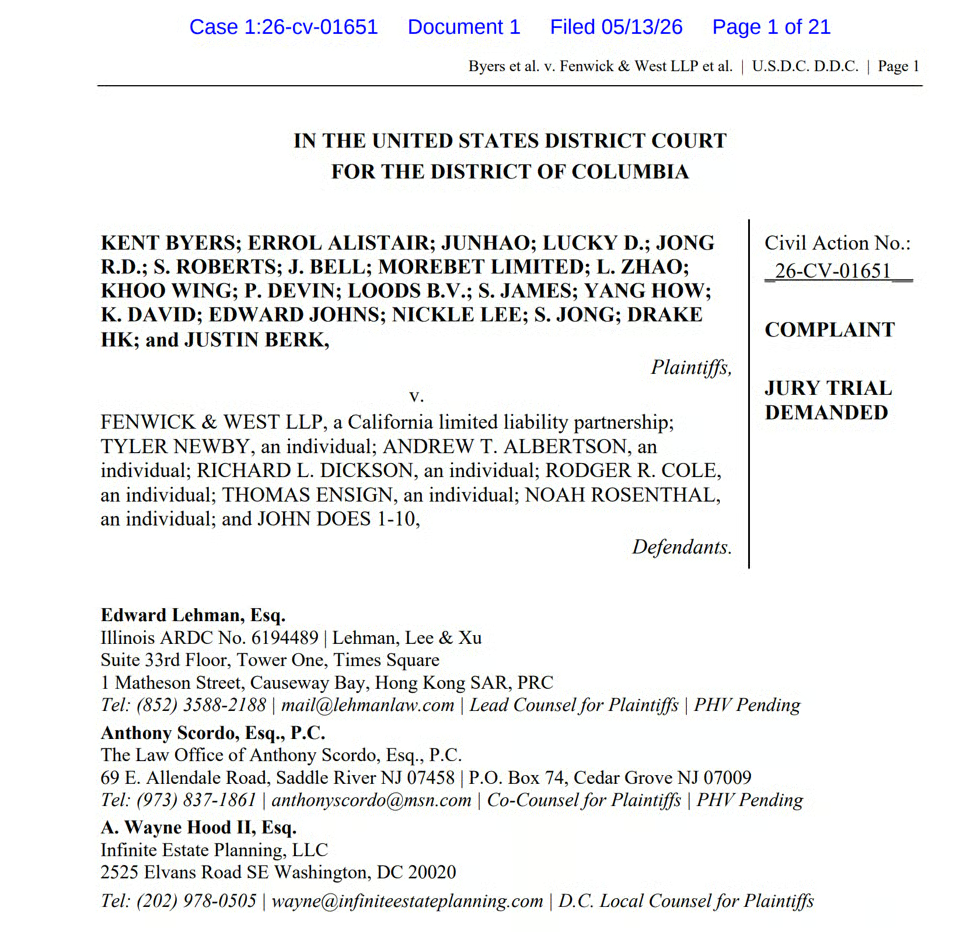
A group of 20 victims from five countries or jurisdictions has filed a $525 million lawsuit against Fenwick & West LLP, one of Silicon Valley’s top tech law firms, accusing it of helping conceal the FTX fraud.
The complaint, filed Wednesday in the US District Court for the District of Columbia, names the firm alongside six individual defendants. The plaintiffs say they lost their life savings when FTX collapsed, claiming that Fenwick’s involvement gave the exchange a false air of legitimacy that kept them from pulling their money out.
At the center of the case is testimony from Nishad Singh, FTX’s former director of engineering, who pleaded guilty to fraud charges and testified at Sam Bankman-Fried’s criminal trial. Singh said he personally told Fenwick attorneys that customer funds were being misused, and instead of walking away, the firm advised on how to hide it.
The complaint goes further. It says Fenwick attorneys set up North Dimension Inc., a Delaware shell company that posed as an electronics retailer but funneled over $3 billion in stolen customer funds. The firm also allegedly implemented FTX’s Signal auto-delete messaging policy, the same system federal prosecutors said helped the fraud go undetected by regulators and investigators.
Related: FTX estate misses out on $3B Cursor stake value after $200K sale in 2023
Examiner found Fenwick “intertwined” in FTX’s wrongdoing
A court-appointed bankruptcy examiner, whose report came out in 2024 after reviewing more than 200,000 documents, found that Fenwick created the corporate structures for both FTX and Alameda Research, formed shell entities to obscure money movements, and drafted backdated agreements to cover illicit transfers, the complaint states. The examiner concluded the firm was “deeply intertwined in nearly every aspect of FTX Group’s wrongdoing,” the lawsuit reads.
“These findings are those of a court-appointed officer based on documentary evidence in federal bankruptcy proceedings to which Fenwick was a party,” the lawsuit added.

FTX victims file lawsuit against Fenwick. Source: CourtListener
After FTX filed for bankruptcy in November 2022, Fenwick scrubbed all mentions of the exchange from its website. The firm also quietly hired top-tier law firm defense lawyers at Gibson Dunn before any civil lawsuit was filed against it, per the lawsuit.
The plaintiffs are bringing seven claims against Fenwick, including malpractice, fraud and gross negligence. They are seeking compensatory damages exceeding $525 million, return of all legal fees Fenwick earned from FTX and punitive damages against partners Tyler Newby and Daniel Friedberg for “deliberate and reckless individual professional conduct.”
Related: Sam Bankman-Fried withdraws motion for a new trial, still asks for new judge
Judge denies SBF’s bid for new trial
Last month, a federal judge denied Bankman-Fried’s bid for a new trial, calling his claims of new evidence baseless. Judge Lewis Kaplan, who sentenced the former FTX CEO to 25 years in prison in 2024, said Bankman-Fried’s argument that three former FTX executives could counter the government’s case was without merit, noting that he knew all three witnesses well before the trial.
Bankman-Fried had argued that Ryan Salame and Daniel Chapsky could challenge the government’s claims about FTX’s insolvency, and that Nishad Singh changed his testimony under pressure from prosecutors. Kaplan dismissed those claims as “wildly conspiratorial and entirely contradicted by the record.”
Magazine: How crypto laws changed in 2025 — and how they’ll change in 2026


Best Institutional Tokenization Platform is an award category within The BeInCrypto Institutional 100, an annual research-driven program recognising institutional digital asset excellence across 26 categories and six pillars.
Institutional tokenization platforms provide the issuance, infrastructure, and distribution rails for real-world assets on public and permissioned blockchains. These platforms support tokenized fund shares, government securities, private credit, equities, and structured products.
This category sits under Pillar 4: Tokenization & On-Chain Finance. The 15 platforms below are listed alphabetically and are not ranked. A shortlist will be named in May 2026, with the winner announced at Proof of Talk in Paris on June 2–3, 2026.
Key Facts
- Long list: 15 platforms across institutional issuance, RWA blockchains, DeFi-native tokenization, white-label infrastructure, regulated exchanges, and tokenized credit platforms
- Initial pool: More than 30 firms screened; 15 advanced to the long list
- Order: Listed alphabetically, not ranked
- Scoring: 50% quantitative data · 50% Expert Council
- Criteria assessed: Total value tokenized, institutional adoption, asset class breadth, regulatory framework, technical infrastructure, growth velocity, ecosystem reach
- Data sources: rwa.xyz, DefiLlama, SEC EDGAR, MAS, FINMA, FCA, VARA, BVI FSC, ADGM, SFC, BaFin, audited filings, S&P, Moody’s, Particula, PitchBook, Tracxn, and Crunchbase
| Platform / Issuer | HQ & Listing | Reach | Platform Structure | Representative Work |
|---|---|---|---|---|
| Anemoy — JTRSY, JAAA | BVI Anemoy Capital SPC |
BVI FSC-licensed JTRSY received $400M from Spark Grand Prix; JAAA passed $1B TVL |
Niche tokenized fund structurer Centrifuge V3 ecosystem |
JTRSY rated S&P AA+f / S1+ Janus Henderson acts as sub-investment manager via Tabula |
| Backed Finance — xStocks, bCSPX, bIB01 | Zug, Switzerland FINMA-aligned; Kraken-acquired Dec 2025 |
130+ tokenized stocks live $25B+ exchange volume and $3.5B+ on-chain volume since Jun 2025 |
Tokenized equities issuance xStocks Alliance ecosystem |
JTRSY rated S&P AA+f / S1+ Janus Henderson acts as a sub-investment manager via Tabula |
| Brickken — Token Suite | Barcelona, Spain Private company |
€22.5M post-money valuation $41M on-chain TVL and $450M+ tokenized across 16 countries |
Enterprise tokenization SaaS Multi-chain white-label platform |
Co-author of ERC-7943 Atlas Frontier framework launched with MANTRA |
| Centrifuge — V3 Protocol | Berlin / Zug, Switzerland k/f labs legal entity |
$1.6B TVL Eight networks live; 21 independent audits |
Multichain DeFi-native RWA protocol Proof-of-Index with S&P DJI |
Powers JTRSY, JAAA, and ACRDX Top-five fund tokenization platform by TVL |
| DigiFT — RWA Exchange | Singapore MAS RMO + CMS; HK SFC dual-licensed |
xChange unified execution layer launched in March 2026 Nasdaq partnership for tokenization technology |
Regulated on-chain RWA exchange Institutional tokenization platform |
Partners include UBS, Invesco, Wellington, DBS, CMBI, and BNY Founded in 2021, led by Henry Zhang |
| Figure / Provenance — OPEN, YLDS | New York Nasdaq: FIGR |
$21B+ loans originated on Provenance Number-one non-bank HELOC lender in the US |
Tokenized credit and equity platform Purpose-built L1 through Provenance |
Distributes UBS uMINT tokenized fund bEQTY with BNY launched Jan 2026 as an active tokenized equity income product |
| Franklin Templeton — BENJI/FOBXX | San Mateo, USA NYSE: BEN |
$1.68T parent AUM BENJI suite $1.98B AUM across nine chains and Canton Network |
Multi-chain tokenized fund platform SEC-registered investment company |
First US-registered fund using public blockchain record-keeping Ondo partnership announced Mar 2026 to tokenize five ETFs |
| Maple Finance — syrupUSDC | Sydney / New York Private company |
$2.4B+ TVL $7B+ bridge volume in Apr 2026 |
Institutional credit tokenization Multi-chain across Ethereum, Solana, Arbitrum, and BNB Chain |
Revolut listing added Apr 2026 access to 70M+ users Maple CCIP Receiver launched Jan 2026 |
| Ondo — OUSG, USDY, Global Markets | New York Private company; ONDO publicly traded |
$2.75B+ platform TVL USDY above $1B across nine chains |
Tokenized treasuries and securities platform Multi-chain market access |
Ondo Global Markets crossed $1B TVL in May 2026 SWEEP fund with State Street and Galaxy seeded with $200M |
| OpenTrade — Sierra Protocol, SIERRA | London, UK Private company; Circle spinout |
$200M TVL $250M+ 2025 volume; $30M+ total funding |
B2B2C yield-as-a-service API-first tokenization stack |
Assets custodied at JPMorgan, Barclays, Fidelity, Wilmington, and Sygnum Backed by a16z, Mercury, Notion, and Circle Ventures |
| Plume Network — Plume Genesis | San Francisco, USA SEC transfer agent; ADGM-licensed |
$645M+ tokenized 280K+ RWA holders; 180+ projects on network |
Purpose-built RWA blockchain Full-stack RWAfi infrastructure |
Integrated WisdomTree funds, Apollo assets, and Invesco-linked exposure KRW1 stablecoin built for Korean institutional access |
| Polymesh / Polymath | Cayman Islands Polymath public via AnalytixInsight RTO |
200+ tokens deployed Republic $2.6B sponsored investments |
Purpose-built L1 for security tokens Five-pillar native architecture |
Partners include BitGo, Zodia, GK8 by Galaxy, tZERO, and Paysafe Confidential Assets launched on DevNet in Dec 2025 |
| Securitize — Tokenization Platform | Miami / Dubai SEC broker-dealer, transfer agent, and ATS |
$4B+ AUM About 20% RWA market share; deployed across 10+ chains |
Institutional tokenization platform Broker-dealer and ATS combined |
Powers BUIDL, ACRED, SCOPE, SKHC, and VBILL SPAC transaction announced in Oct 2025 |
| Superstate — FundOS, USTB, USCC | New York SEC investment adviser and transfer agent |
USTB and USCC combined above $1B AUM FundOS live on Solana and Ethereum, with Base planned |
White-label tokenization infrastructure FundOS platform |
$32B+ RWAs tokenized via ERC-3643 Apex provides fund administration and custody at a multi-trillion scale |
| Tokeny / Apex Group — ERC-3643 | Luxembourg Apex Group subsidiary |
$32B+ RWAs tokenized via ERC-3643 Apex provides fund administration and custody at a multi-trillion-dollar scale |
ERC-3643 / T-REX standard creator Institutional tokenization operating system |
Apex Digital 3.0 launched in Jul 2025 SkyBridge $300M tokenization announced in Aug 2025 |
About This List
The BeInCrypto Institutional 100 — Institutional Tokenization Platform (2026 Long List) identifies platforms that issue, custody, settle, and distribute tokenized real-world assets. These assets include money market funds, US Treasuries, private credit, equities, commodities, and structured products.
Coverage spans institutional issuance platforms, purpose-built RWA chains, DeFi-native multichain protocols, white-label tokenization infrastructure, regulated digital securities exchanges, and institutional credit or equity tokenization stacks.
The category scores platform-level capability. Pure product issuance without a distinct platform identity is evaluated under Category 3.1: Best Digital Asset Product.
Methodology
This category is evaluated under Track A of the BeInCrypto Institutional 100 methodology: 50% quantitative metrics and 50% Expert Council scoring.
Assessment spans seven criteria: Total Value Tokenized, institutional adoption, asset class breadth, regulatory framework, technical infrastructure, growth velocity, and ecosystem reach.
Data was verified using rwa.xyz, DefiLlama, SEC EDGAR, MAS, FINMA, FCA, VARA, BVI FSC, ADGM, SFC, BaFin, audited filings, third-party ratings from S&P, Moody’s, and Particula, partnership announcements, and private-market sources including PitchBook, Tracxn, and Crunchbase.
The post BeInCrypto Institutional Research: 15 Leading Tokenization Platforms appeared first on BeInCrypto.
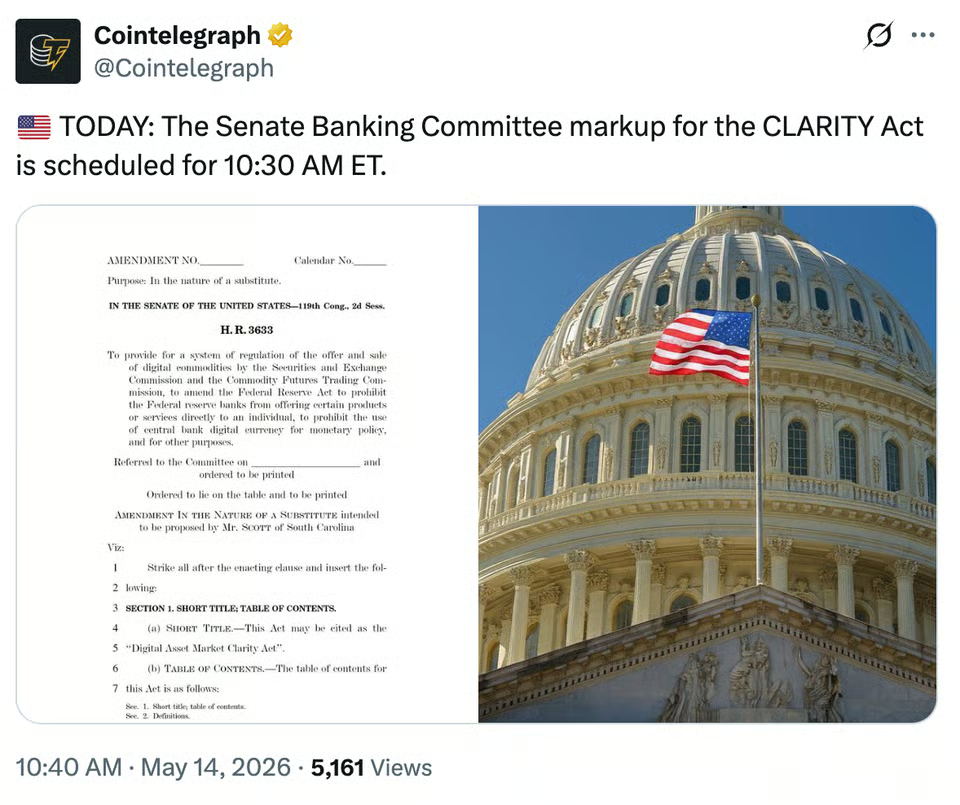
Bitcoin (BTC) bulls made another attempt to reclaim the $80,000 level on Thursday, as traders expect price swings before and after the CLARITY Act vote.
Key takeaways:
- Odds of the CLARITY Act being signed into law in 2026 rose to 67% in May.
- BTC price must hold $78,000-$79,000 as support for a bullish push to $84,000 or higher.
A 67% chance the CLARITY Act is signed into law in 2026
The CLARITY Act, a proposed US bill that would set clearer rules for how regulators oversee the crypto market and stablecoins, is scheduled for a Senate Banking Committee markup vote on Thursday.

Source: Cointelegraph
Prediction market traders say that there is a 67% chance that the CLARITY Act will be signed into law in 2026, according to Polymarket.

Odds of the CLARITY Act being signed into law in 2026. Source: Polymarket
Traders on rival site Kalshi price-in the odds of the Act becoming law before August and Dec. 31, 2026, at 62% and 67%, respectively.
If the CLARITY Act passes, it could clearly classify Bitcoin as a digital commodity under the Commodity Futures Trading Commission (CFTC) oversight, reducing legal uncertainty for the industry and further legitimizing crypto in the US.
Related: Bitcoin to $100K in Q2? Strategy’s STRC unlocks potential to buy 3K BTC in two days
Bitcoin is expected to react positively, similar to the GENIUS Act signed in July 2025, which provided the first major US stablecoin framework. Bitcoin was already trading near all-time highs and climbed further amid regulatory optimism.
MN Capital founder Michaël van de Poppe was bullish, saying:
“Big day today with the CLARITY Act vote. Might be a historical day for everyone involved in Crypto and could, very well, signal the start of a stronger cycle.”
Analyst Sharky predicts a muted immediate pump, with the real strong move coming “90 days later, when institutional money finally has legal clarity.”
Not all analysts were optimistic about the event, however, with trading resource Material Indicators saying the passing of the CLARITY Act is “somewhat baked-in to $BTC price,” adding:
“Passing it will likely deliver a knee-jerk reaction from the market that pumps price briefly, but like all narratives, that rally will fade.”
As Cointelegraph reported, some traders expect a quick move in Bitcoin price toward $90,000 following the CLARITY Act vote, supported by improving market conditions and easing selling pressure.
Analysts highlight key BTC price levels to watch
Bitcoin may have delivered an impressive bounce to $82,000 last week, but the bullish sentiment was dampened by resistance from the 200-day moving averages around this level.
The support at $78,000 remains key for bulls, representing the short-term holder realized price and the true market mean.
This coincides with the 21-week exponential moving average (green line), as highlighted by analyst Rekt Capital in the chart below, saying:
“Downside wicking below it would be fine as long as price ends the week with a weekly candle close above the EMA to confirm it as retested support.”

BTC/USD weekly chart. Source: X/Rekt Capital
Bitcoin’s realized price by age cohorts reveals another major level of support sitting further down: the cost basis of the 1-week-to-1-month investor cohort at $76,900.
“The momentum of the ongoing rally has been driven largely by a wave of accumulation over the past 30 days,” Glassnode said in its latest Week Onchain newsletter, adding:
“This cohort’s cost basis now sits at approximately $76.9K, forming the most immediate support floor in the short term.”

Bitcoin realized price by age. Source: Glassnode
On the upside, the cost basis of investors who accumulated BTC during the November 2025-February consolidation period at $86,900 represents the “most probable near-term resistance zone as these holders approach breakeven and face a growing incentive to distribute into strength,” the onchain data provider added.
Crypto trader and analyst Daan Crypto Trades said a break above $82,000 will see BTC rise to fill the CME gap at $84,000, eventually “continuing quite a lot higher” from that point.

BTC/USD daily chart. Source: X/Daan Crypto Trades
As Cointelegraph reported, key support levels for the bulls were the 20-day EMA at $79,000 and the 50-day SMA at $74,000, while bears were expected to defend $84,000.
The T3 Financial Crime Unit, a joint initiative backed by Tether, Tron and blockchain analytics company TRM Labs, says it has helped freeze more than $450 million in assets linked to suspected criminal activity since its launch in 2024.
The group said in a Thursday release shared with Cointelegraph that it has worked with law enforcement agencies across 23 jurisdictions to target funds tied to alleged drug trafficking, exchange hacks, North Korea-linked activity, terrorist financing and violent “wrench” attacks, including kidnappings and extortion.
The unit focuses on Tether’s USDT stablecoin activity on the Tron blockchain and says it has been able to freeze assets within 24 hours in multiple emergency cases at the request of authorities. T3 FCU said it intercepted 43.9% more illicit proceeds in 2025 than in the previous year.
The announcement comes as TRM Labs estimates that overall illicit crypto flows reached a record $158 billion in 2025, according to the release, highlighting the growing pressure on stablecoin issuers and blockchain networks to strengthen compliance and cooperate more closely with law enforcement.

The T3 Financial Crime Unit (T3 FCU). Source: Tether
The group was cited earlier this year by the Financial Action Task Force as an “invaluable resource” for law enforcement and highlighted in FATF reporting on public-private partnership models.
Related: Europe sees ‘hyperconcentration’ of crypto wrench attacks as losses hit $101M
T3 figures follow broader USDT freeze activity
The new figures also follow separate onchain data from security firm BlockSec on Friday, showing that more than $500 million in USDT had been frozen over a recent 30-day period.
Cointelegraph reached out to Tether to ask how the $450 million in assets linked to T3 FCU’s work intersect with Tether’s broader blacklisting and freezing activity across chains, and how much of the total relates specifically to Tron-based USDT, but had not received a response by publication.
The company was also asked how it balances an expanding compliance and asset-freezing toolkit with criticism from parts of the crypto industry that such powers increase centralization risk and may undermine the permissionless nature of stablecoin transfers on networks like Tron.
Tron, which positions itself as a low-cost settlement layer for stablecoins, told Cointelegraph it is an “agnostic technology provider” that cannot directly monitor every user or block every transaction, and that the means to identify and stop illicit activity sit with partners such as Tether, TRM Labs and law enforcement.
Asia Express: North Korea denies crypto hacks, Upbit’s bank tests Ripple
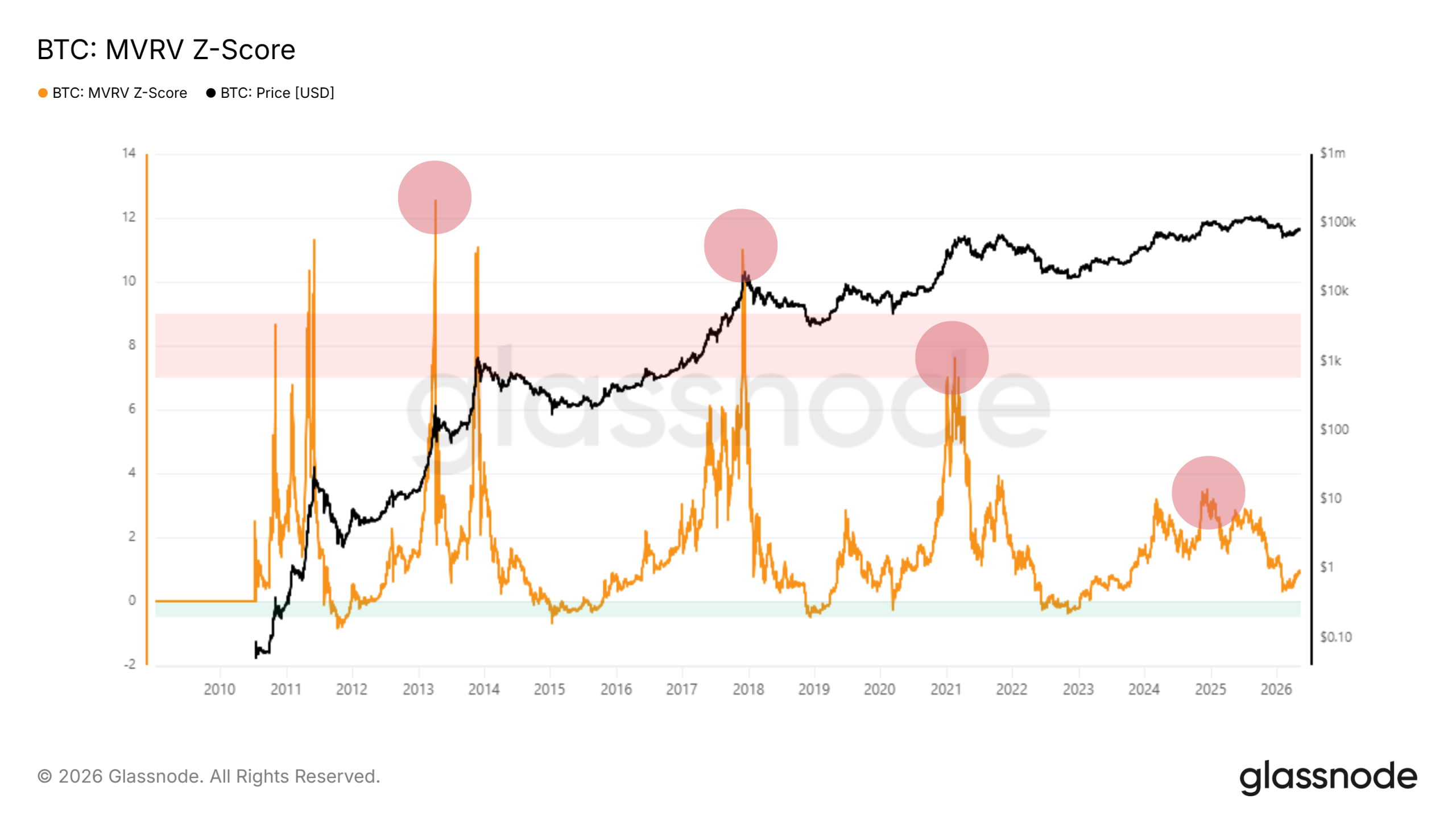
Bitcoin (BTC) is breaking from the cycle playbook that defined every prior peak. On-chain data shows the metrics that flagged earlier tops remain quiet, even with BTC above $81,000.
The MVRV Z-Score, exchange balances, and spot ETF holdings suggest a structural shift rather than a typical late-cycle phase. Retail signals remained quiet while institutional accumulation reached record levels.
Bitcoin Cycle: The MVRV Z-Score That Never Fired
The MVRV Z-Score measures the gap between Bitcoin’s market value and its realized value. Readings above 6 have historically marked cycle tops. Readings near zero have flagged accumulation phases.
Glassnode data shows the metric peaked near 3.5 in the post-halving run. That sits well below the 12, 11, and 7 readings that capped the 2013, 2017, and 2021 cycles.
Past cycles produced their tops while the Z-Score climbed into the red zone above 6. The 2017 top printed at 10. The 2021 top printed near 7. This cycle never approached either reading.
As of May 14, 2026, the Z-Score sits close to 1. The signal that flagged every previous euphoria phase has stayed silent through the entire move from the 2022 lows.

For the metric to confirm a classic top, it would need to push back above 3.5. A sustained move toward 6 would historically precede a multi-month correction.
This compression suggests realized capitalization has grown fast enough to absorb price gains. The mania divergence that defined past peaks has not appeared.
Exchange Supply Continues to Drain
The exchange balance chart shows the same structural break from a supply angle. Glassnode tracks total BTC sitting on monitored exchanges across the entire market history.
Reserves peaked above 3.3 million BTC in early 2022. They have declined steadily since, sitting near 3 million BTC in May 2026.
Meanwhile, the price climbed during that same window. Bitcoin broke through prior cycle peaks and reached $126,000 in October 2025, all while available exchange supply contracted.

A falling float alongside a rising price suggests buyers are moving coins directly into custody. The pattern matches the whale-accumulation signal from large wallet cohorts.
For this trend to flip, exchange balances would need to climb back above 3.2 million BTC. Such a move would suggest distribution from holders who have absorbed coins over the past three years.
Spot ETFs Now Hold Roughly 1.3 Million BTC
US spot Bitcoin ETFs did not exist before January 2024. Glassnode aggregated balance data shows the group now holds close to 1.3 million BTC.
That figure represents roughly 6.5 percent of the circulating supply. BlackRock’s IBIT remains the dominant fund, followed by Fidelity’s FBTC and Grayscale’s combined products.
Accumulation persisted even during periods when price stalled, suggesting allocation decisions rather than retail chase behavior. ETFs have absorbed BTC at a rate that often exceeds daily mining issuance.
Marginal buyers compete for a shrinking pool of available coins. That math explains how price can rise without the on-chain participation that defined previous cycles.

However, the thesis is structural rather than directional. The same forces that have muted retail euphoria could also mute a typical late-cycle correction.
ETF flows can reverse. Concentrated institutional ownership introduces new risks tied to allocation rebalancing and macro liquidity conditions.
What the data shows is that historical thresholds may no longer map cleanly to this market.
The post On-Chain Data Proves Bitcoin Cycle Has Changed appeared first on BeInCrypto.

The Batman Fixes The Dark Knight’s One Fatal Mistake

Play-Off Hopes Alive After Stunning URC Run

Garmin Instinct E Aims to be the Rugged Smartatch That Lasts Weeks and Tracks Everything That Matters

Manchester United reach agreement with Casemiro over contract clause amid transfer speculation

US brings back mandatory military draft registration

Steven Gerrard disagrees with Gary Neville over ‘shock’ Chelsea and Arsenal claim | Football


-
 Crypto World7 days ago
HarrisX Poll Found 52% of Registered Voters Support the CLARITY Act
-

 Fashion6 days ago
Weekend Open Thread: Marianne Dress
-

 Fashion3 days ago
Coffee Break: Travel Steam Iron
-

 Fashion4 days ago
What to Know Before Buying a Curling Wand or Curling Iron
-

 Tech5 days ago
Auto Enthusiast Carves Functional Two-Stroke Engine from Solid Metal
-

 Politics3 days ago
What to expect when you’re expecting a budget
-
 Business6 days ago
Ignore market noise, India’s long-term story intact, say D-Street bulls Ramesh Damani and Sunil Singhania
-

 Politics6 days ago
Politics Home Article | Starmer Enters The Danger Zone
-

 Tech4 days ago
GM Agrees To Pay $12.75 Million To Settle California Lawsuit Over Misuse Of Customers’ Driving Data
-

 Crypto World6 days ago
PROS explodes 48% as Upbit and Bithumb listings ignite demand
-

 Crypto World5 days ago
CZ says US crypto rivals tried to block Trump pardon
-

 Tech3 days ago
GM agrees to $12.75M California settlement over sale of drivers’ data
-

 Sports7 days ago
Bayern Munich vs PSG UEFA Champions League SF2 live match time, streaming | Football News
-

 Entertainment6 days ago
YNW Melly Denied Bond Again Ahead Of Double Murder Retrial
-
Tech7 days ago
The Most Exciting Apple Products In The Pipeline For 2026 And Beyond
-
Crypto World6 days ago
The Hantavirus Danger: Can a Potential Outbreak Spark a New Meme Coin Frenzy?
-

 Crypto World6 days ago
Kraken Parent Seeks OCC Charter, Signaling Regulated Banking Access
-

 Politics7 days ago
David Attenborough ‘Overwhelmed’ By Love Shown Ahead Of 100th Birthday
-

 Sports6 days ago
After Waka Waka, Shakira now drops first teaser for FIFA WC 2026 song | FIFA World Cup 2022
-

 Crypto World7 days ago
Here’s Why Cristiano Ronaldo and Taylor Swift Lost Millions of Followers on Instagram
You must be logged in to post a comment Login