

Crypto World
Here’s Why Cristiano Ronaldo and Taylor Swift Lost Millions of Followers on Instagram



Meta wiped millions of fake followers from the accounts of celebrities like Cristiano Ronaldo, BLACKPINK, and Taylor Swift this week as its AI moderation systems scaled up across Facebook and Instagram.
The cleanup is part of a wider Meta push that introduced AI tools aimed at impersonation, scam ads, and coordinated inauthentic behavior on its apps.
The Great Purge of 2026 Hits Celebrities on Instagram
Celebrities, including Kylie Jenner, Ariana Grande, Justin Bieber, Selena Gomez, Virat Kohli, and Priyanka Chopra, all saw their numbers drop, with some losing millions overnight.
The wave followed Instagram’s May 5 policy update and a new moderation system trained to spot fake engagement patterns and predict user age.
K-pop and football accounts have long been favored grounds for bot farms inflating reach for crypto promotions, fake giveaways, and sneaker scams. A sweep of this size shows how deep automated activity had spread inside the platform’s biggest profiles.
Meta’s broader cleanup removed 10.9 million accounts tied to scam centers in 2025 and 159 million scam ads, according to its update. The company says 92% of those ads were taken down before any user reported them.
Crypto Promo Bots Sit at the Center of the Meta Sweep
Crypto scam farms have been heavy users of Meta surfaces. Fake influencer profiles push token presales and airdrop hoaxes, impersonating figures like Elon Musk and Vitalik Buterin. They have saturated comments under celebrity posts for years.
The new detection model targets that pattern, scanning bios, behavior signals, and image context. It flags impersonators of brands and public figures.
The move arrives at a sensitive moment for Meta’s wider crypto plans. The company recently rolled out stablecoin payouts in USDC for creators in Colombia and the Philippines. A cleaner ad and creator surface helps Meta court-regulated payment partners as it scales its blockchain push.
The post Here’s Why Cristiano Ronaldo and Taylor Swift Lost Millions of Followers on Instagram appeared first on BeInCrypto.

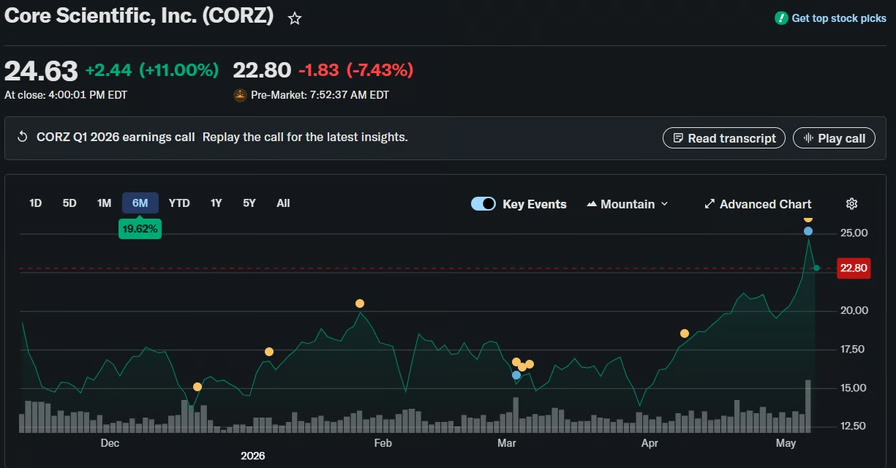
Core Scientific (CORZ) reported a $347.2 million first-quarter net loss as its Bitcoin self-mining revenue fell sharply and high-density colocation became its largest revenue source.
In its earnings report published Wednesday, the company reported a net loss of $1.06 per diluted share for the quarter. A year earlier, Core Scientific reported diluted earnings of $1.24 per share.
Core Scientific said the loss included $266.5 million in non-cash impairment charges and a $30.8 million non-cash loss from changes in the fair value of warrants and contingent value rights.
Revenue rose to $115.2 million from $79.5 million a year earlier, but fell short of analyst expectations. Zacks Equity Research said analysts expected $120.2 million in revenue, with Core Scientific’s results coming in about 4.1% below expectations.
The results show Core Scientific’s transition from a Bitcoin miner into an AI infrastructure company, with high-density colocation now generating most of its revenue. The shift gives the company a larger business, but it also highlights how its legacy mining operations have weakened.
Bitcoin mining revenue falls
Core Scientific’s digital asset self-mining revenue fell to $30.1 million from $67.2 million a year earlier, with the company mining 279 Bitcoin (BTC) during the quarter, down 45% from the same period in 2025. According to its 10-Q filing, Core Scientific sold 2,385 Bitcoin during the quarter for $208.3 million to fund planned capital expenditures and other cash needs.
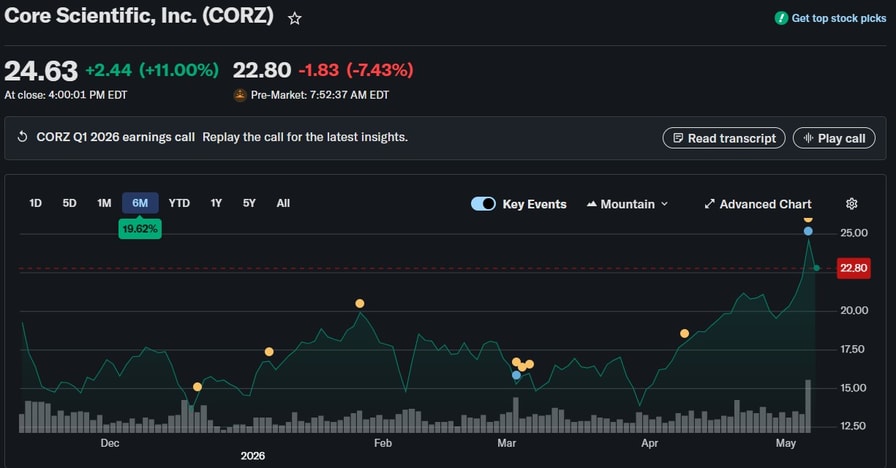
Core Scientific’s six-month price chart. Source: Yahoo Finance
Despite the weaker mining results, Core Scientific’s shares have gained over the past six months. Yahoo Finance data shows CORZ closed at $24.63 on Wednesday, up about 19.6% over six months, before falling 7.43% to $22.80 in pre-market trading at the time of writing.
In a separate announcement, Core Scientific said it plans to scale its Muskogee, Oklahoma, campus to about 1.5 gigawatts of gross power, or about 1.0 gigawatt of leasable power, partly through the planned acquisition of Polaris DS. The company has also started construction on a second, unleased 82.5-megawatt building at the campus.
Related: Trump-linked American Bitcoin reports $82M Q1 loss, revenue miss
Core Scientific expands AI-linked colocation business
Core Scientific’s first-quarter growth came from high-density colocation rather than Bitcoin production, with the company’s mining revenue and Bitcoin output falling while its AI-linked hosting business generated most of its revenue.
The company said its colocation revenue rose to $77.5 million in the first quarter from $8.6 million a year earlier, driven by additional billable customer power capacity delivered during the quarter.
The company said it was billing for 243 megawatts of capacity as of March 31, representing about $350 million in average annualized colocation revenue.
The revenue shift follows a series of hosting agreements with CoreWeave. In June 2024, Core Scientific said it signed 12-year contracts to deliver about 200 megawatts of infrastructure to host CoreWeave’s high-performance computing operations.
The companies later expanded the relationship. In an SEC filing in February 2025, the companies said CoreWeave’s total contracted high-performance computing infrastructure with Core Scientific had increased to about 590 megawatts across six sites.
Magazine: Guide to the top and emerging global crypto hubs: Mid-2026


Blockstream CEO Adam Back told Consensus Miami 2026 that bitcoin is winning a security war against DeFi, and that pension funds and sovereign entities are the next buyers.
Summary
- Adam Back argued at Consensus Miami that Bitcoin’s simpler architecture is pulling institutional capital away from DeFi platforms hit by repeated smart contract exploits.
- He outlined Bitcoin adoption in three waves: retail ownership, spot ETF access, and now institutional allocation through managed portfolios and sovereign entities.
- Back estimated roughly 200 bitcoin treasury companies exist globally and said BlackRock model portfolio allocations have not yet fully taken effect.
Blockstream CEO Adam Back argued at Consensus Miami 2026 that Bitcoin’s comparatively simple network architecture is separating it from more experimental blockchain ecosystems that have suffered repeated smart contract failures.
Back described the dynamic as Bitcoin winning “the DeFi security war,” as institutional investors grow more sophisticated in understanding where security risk actually sits. “Bitcoin infrastructure is much more simple, robust, security first,” he said.
Back said institutions are no longer trying to reshape Bitcoin into traditional finance infrastructure. Instead, he argued, they are adapting themselves to Bitcoin’s incentive structure and conservative security model.
That dynamic, he said, opens the door for Bitcoin-native tokenization and DeFi systems that prioritize safety over rapid experimentation, using layer-2 solutions such as Blockstream’s Liquid Network.
The three waves of bitcoin adoption
Back outlined Bitcoin adoption as occurring in three sequential waves: direct retail ownership, spot ETF access through brokerages and advisers, and now institutional allocation through managed portfolios, pension funds, and sovereign entities.
“The model portfolios that BlackRock and others are putting out,” he said, “those allocations haven’t taken effect yet,” suggesting the largest wave of institutional capital has not yet arrived.
Back also estimated roughly 200 bitcoin treasury companies now exist globally, including BSTR, the firm he leads as CEO.
He described BSTR as a more actively managed approach to bitcoin exposure, intended to generate returns through both holdings and fund management strategies rather than passive accumulation. The comments came as bitcoin traded above $81,000 at the time of the Consensus session.

TLDR
- American Bitcoin increased its Bitcoin holdings to more than 7,300 BTC valued at about $592 million.
- The company produced 817 Bitcoin in Q1 2026, marking its strongest quarterly output to date.
- American Bitcoin also purchased around 803 Bitcoin during the quarter to expand reserves.
- Total Bitcoin reserves grew by roughly 1,600 BTC in a single quarter.
- Satoshis per share rose to about 663, reflecting a 20% increase.
American Bitcoin Corp. expanded its Bitcoin reserves beyond 7,300 BTC after a record production quarter. The Nasdaq-listed miner valued its holdings at about $592 million. Co-founder Eric Trump confirmed the figures and said the company maintained its accumulation strategy.
American Bitcoin Expands Holdings and Production
American Bitcoin began building its Bitcoin position in mid-2025 and accelerated purchases in early 2026. The company now ranks as the 16th largest corporate Bitcoin holder. Eric Trump said, “Our Bitcoin accumulation strategy remained intact despite a challenging market environment.”
During Q1 2026, the company produced about 817 Bitcoin, its strongest quarterly output. It also acquired around 803 Bitcoin through targeted purchases. Total reserves grew by roughly 1,600 Bitcoin during the quarter.
The company reported that Bitcoin price declined about 22% quarter over quarter. Despite weaker prices, American Bitcoin continued expanding its balance sheet. It confirmed that satoshis per share rose to about 663, up nearly 20%.
Management linked the increase in satoshis per share to faster Bitcoin growth than share count expansion. The company said this metric reflects shareholder exposure to Bitcoin reserves. It maintained that production and purchases supported reserve growth.
Operational Gains Lift Efficiency and Capacity
American Bitcoin reduced its mining cost per Bitcoin to about $36,000 in Q1 2026. The figure marked a 23% decline from the previous quarter. The company attributed the drop to improved fleet efficiency and cost control.
Mining gross margins held near 52% despite lower Bitcoin prices. Revenue reached about $62 million compared with $78 million in Q4 2025. The company reported a net loss of roughly $82 million for the quarter.
American Bitcoin expanded its owned fleet to about 89,242 miners. Total capacity reached around 28.1 EH/s, up nearly 12% from the prior quarter. The company energized new capacity at its Drumheller site.
The Drumheller expansion added about 3.05 EH/s from next-generation miners. Following deployment, operational hashrate reached roughly 25.0 EH/s. The company confirmed that this level reflects continued scaling of its mining platform.
American Bitcoin stated that it will continue operating its expanded fleet. It also confirmed that reserve totals exceeded 7,300 BTC at quarter’s end. Eric Trump reiterated that the company remains focused on disciplined growth.

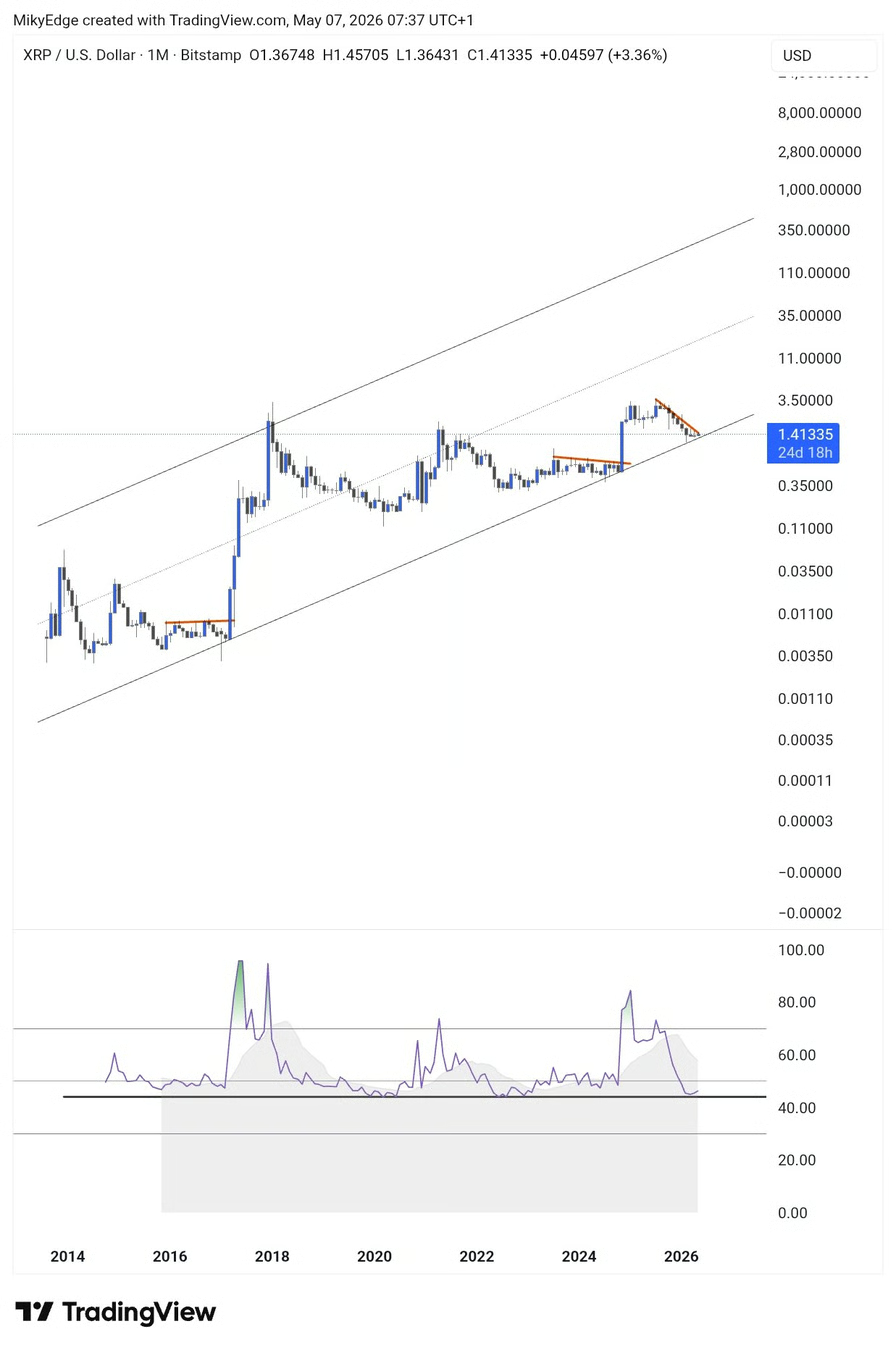
XRP (XRP) is testing a key long-term support level that has historically preceded major rebounds, according to a monthly chart shared by analyst MikybullCrypto.
Key takeaways:
- XRP has jumped by roughly 30% from its February lows.
- Multiple fractals suggest the price is bottoming out, supported by strong XRP ETF inflows.
XRP chart hints at rebound toward $12
Milkybull’s chart shows XRP trading inside a rising channel that has guided price action since 2014. XRP is now near the channel’s lower trendline around $1.30–$1.40, a zone that previously acted as a launchpad for large upside moves.
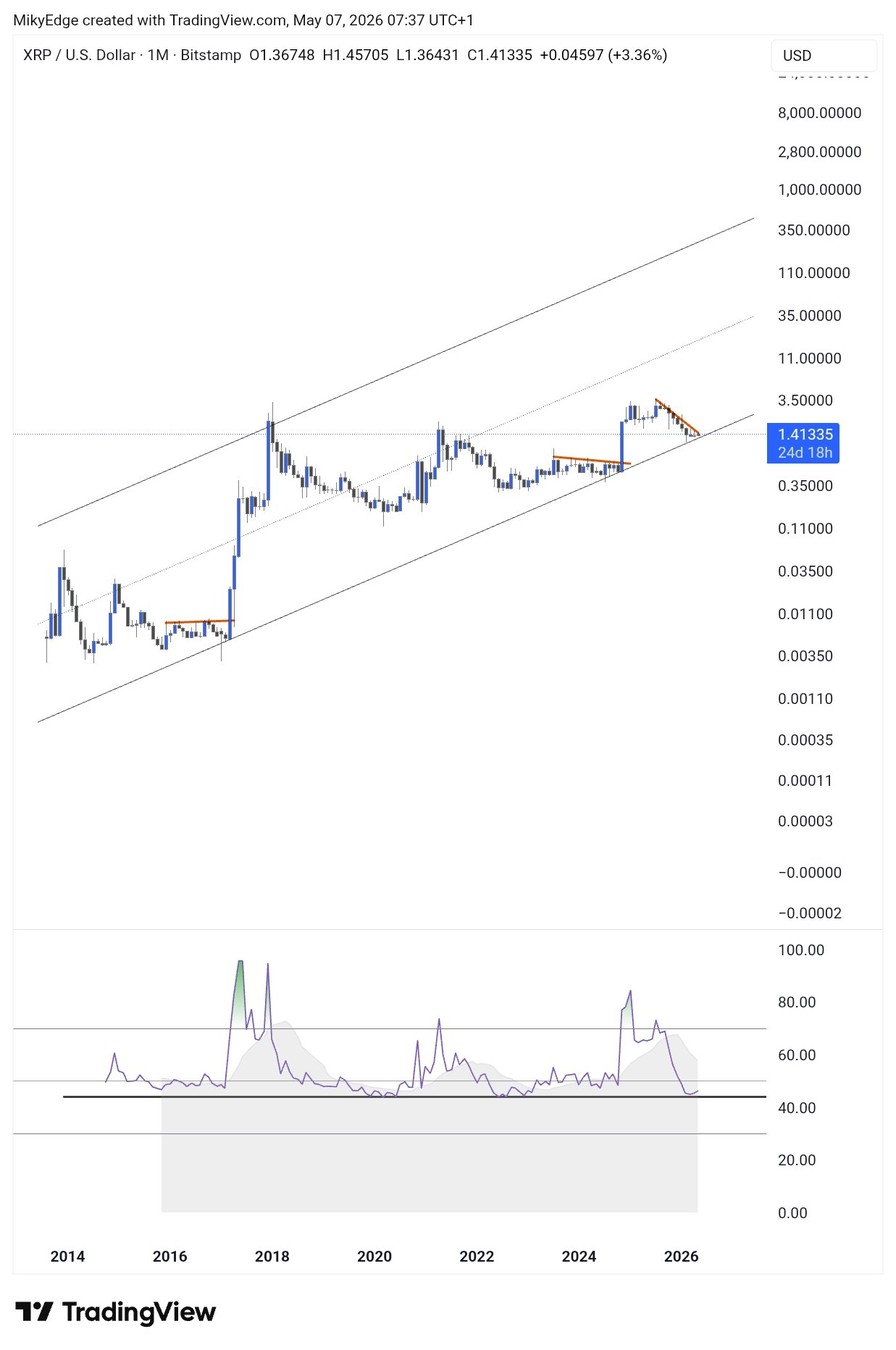
XRP/USD monthly chart. Source: TradingView/MilkybullCrypto
The analyst says XRP is “probably going to $12,” a level that roughly aligns with the channel’s midpoint.
Momentum indicators support the rebound thesis. XRP’s monthly relative strength index (RSI) has cooled toward a historical support area near 40–45, similar to levels that appeared before past rallies.
In a Thursday post, analyst JD pointed to the same RSI support zone as a potential “cycle bottom” signal for XRP.
His two-week chart shows XRP breaking out of a multi-year symmetrical triangle, then pulling back toward the breakout area.
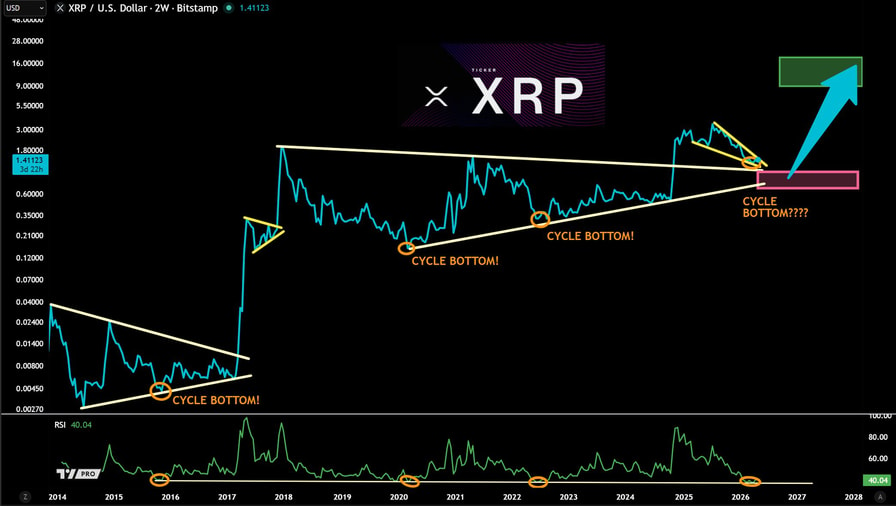
XRP/USD two-week chart. Source: TradingView/JD
The chart’s projected green target zone aligns with the $8–$14 range, implying strong upside if XRP holds the retest zone.
The bullish outlooks follow XRP’s sharp rebound in recent weeks, up by about 30% from its February lows at around $1.11.
Related: XRP price copies 2025 chart fractal that last time sparked 66% gains
In the period, XRP has largely benefited from renewed risk sentiment led by the US–Iran ceasefire, as well as market-specific fundamentals.
These include Rakuten Wallet’s XRP integration, which expanded the token’s reach in Japan, and $81.6 million in April inflows into US spot XRP ETFs, their strongest monthly total of 2026.
In the first week of May, XRP ETFs have attracted $28.17 million in inflows already.
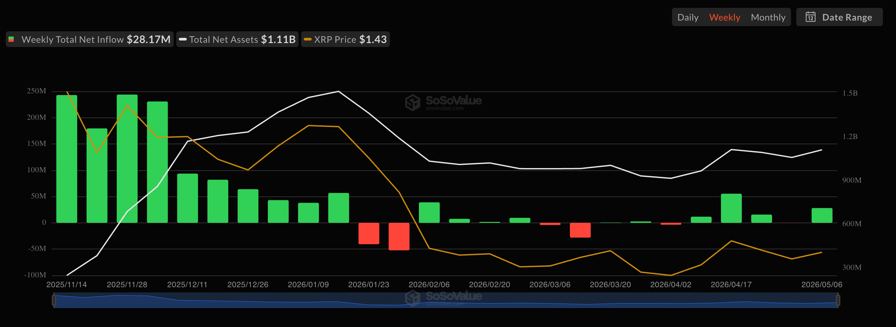
US XRP ETF net flows. Source: SoSoValue
XRP still risks 2022-style bear market repeat
However, the bullish XRP setup is not guaranteed. The bears will try to pull the price down below the channel support. This would invalidate the bullish structure and put XRP at risk of deeper losses.
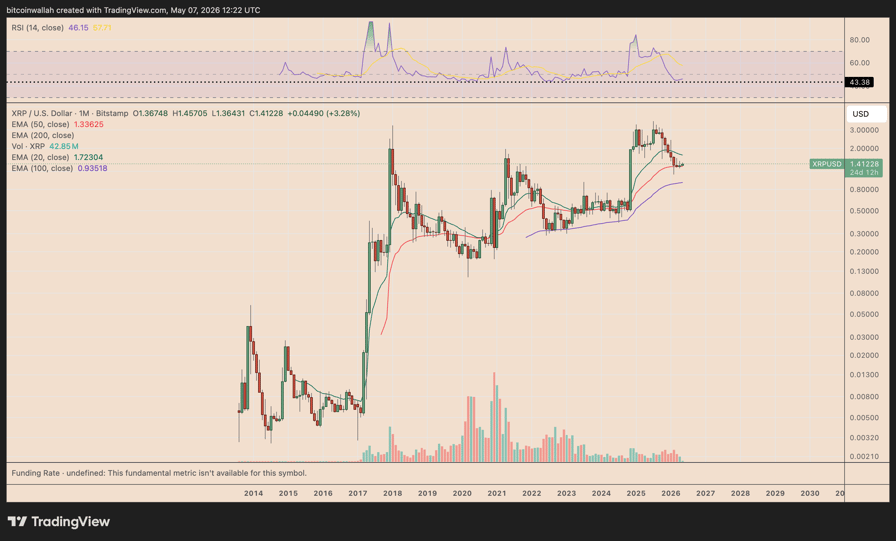
XRP/USD monthly chart. Source: TradingView
The support overlaps closely with XRP’s 50-month exponential moving average (50-month EMA, the red line) near $1.33.
Losing this support cluster shifts focus toward the 100-month EMA (the purple line) near $0.93, implying a roughly 30% drop from current levels. A similar plunge occurred during the 2022 bear market.
Crypto World
Clarity Act edges toward Senate markup as stablecoin fight narrows options for crypto yield


Stablecoin yield compromise puts CLARITY back in motion.
Summary
- The CLARITY Act is moving toward a key Senate Banking Committee markup expected as soon as mid-May, with a fragile compromise on stablecoin rewards clearing the way for a vote.
- Draft text would effectively ban interest-like yield on stablecoin balances across exchanges and brokers, forcing CeFi and parts of DeFi to rethink reward products that compete with bank deposits.
- Prediction markets now put the odds of the bill becoming law in 2026 at roughly 55%, as regulatory momentum converges with parallel efforts like FIT21 and the SEC‑CFTC joint token taxonomy.
The CLARITY Act, a sweeping U.S. digital asset market structure bill, is inching closer to its next procedural test in the Senate after negotiators released compromise language on stablecoin rewards that had stalled progress for months. CryptoSlate reports that senators Thom Tillis and Angela Alsobrooks unveiled revised text last week targeting yield on stablecoin balances, raising expectations that the Senate Banking Committee could finally take up the bill the week of May 11 following an April delay. A policy note from Brownstein Hyatt Farber Schreck notes that H.R. 3633, the House version of the CLARITY Act, passed the House in July 2025 by a 294–134 bipartisan vote and cleared the Senate Agriculture Committee in January 2026, but has repeatedly slipped in Banking over stablecoin language.
The current draft goes hard at that issue. According to Fintech Weekly, a recent version of the Digital Asset Market Clarity Act text reviewed in closed-door Capitol Hill sessions would prohibit offering yield “directly or indirectly” on stablecoin balances and ban anything “economically or functionally equivalent to bank interest.” The provision applies not only to issuers but also to exchanges, brokers and affiliated entities, closing the structural workarounds that had allowed platforms like Coinbase to continue passing stablecoin rewards to users even after the earlier GENIUS Act restricted issuers themselves.
CryptoRank, citing Senate staff and industry sources, says the latest compromise narrows but does not eliminate yield: Banking Committee staff have floated language that may still allow rewards tied to promotional programs or non-interest-like incentives, but the thrust is clear—no more passive, deposits-style interest on stablecoins that might compete head-on with bank savings products. That is exactly what major U.S. banks lobbied for, with TheStreet reporting that large institutions have warned lawmakers the CLARITY framework “may not fully protect deposits or limit risks” unless it clamps down on token yields that look like shadow banking.
What CLARITY means for BTC, ETH, stablecoins and DeFi
For the broader crypto market, the CLARITY Act is part of a broader regulatory convergence. Galaxy Digital notes that CLARITY is advancing alongside the Financial Innovation and Technology for the 21st Century Act (FIT21), which the House passed in May 2024 by a 279–136 vote to divide jurisdiction between the SEC and CFTC based on whether a blockchain is “functional” or “decentralized.” That combination, plus a March 2026 joint SEC‑CFTC interpretive release creating a five-category token taxonomy and explicitly naming 16 assets as digital commodities, is laying the legal foundation for assets like bitcoin and ether to sit firmly under CFTC oversight while a long tail of tokens remain securities.
Brownstein’s April 2026 update underscores that CLARITY is now less about “if” than “when,” though time is tight heading into the U.S. election cycle. KuCoin’s legislative tracker frames the status as “pending” but shifting toward inevitability, with a provisional timeline of a Senate Banking markup in mid‑March or mid‑May, a full Senate vote by late spring and a potential presidential signature in June that would trigger a provisional registration period for digital asset intermediaries.
Near term, the most direct market impact is on stablecoin economics and yield-bearing products. A Payments Association analysis argues that as regulation tightens, banks will be able to issue their own stablecoins and integrate them into settlement and treasury operations, while non‑bank issuers shift toward fee-based models rather than interest-like rewards. For centralized exchanges, a CLARITY-style ban on stablecoin yield would force a pivot from “earn” products that simply pass through issuer rewards toward more complex structures—staking, basis trades, or tokenized credit—that may fall outside the bill’s definition of deposit-like returns.
Prediction markets already reflect the stakes. CryptoRank notes that Polymarket traders now put the odds of CLARITY becoming law in 2026 at about 55%, up nine percentage points in a single day after the stablecoin yield compromise text surfaced. As FinTech Weekly’s tokenization hearing coverage put it, the U.S. is in a rare “legislative window” where the SEC‑CFTC taxonomy, Nasdaq’s approval of tokenized securities trading, a dedicated House tokenization hearing, and an imminent CLARITY markup are all converging in the same quarter. If that window closes without final passage, U.S. crypto markets will remain on what Galaxy calls “borrowed time”—operating under patchwork enforcement and ad hoc guidance rather than the statutory clarity that could finally anchor bitcoin, ether, stablecoins and DeFi inside a coherent federal regime.
TLDR
- Coinbase reported a net loss of $394.1 million in the first quarter of 2026.
- The company recorded a $482 million loss on crypto assets held for investment.
- Total revenue fell 31% year over year to $1.41 billion.
- Transaction revenue declined 40% to $756 million during the quarter.
- Subscription and services revenue dropped 14% to $584 million.
Coinbase reported a $394.1 million net loss in the first quarter of 2026 as crypto prices fell sharply. The exchange also posted lower revenue and weaker transaction income during the period. However, Chief Executive Brian Armstrong outlined plans to reduce reliance on spot crypto trading.
Coinbase Reports Q1 Loss as Crypto Holdings Weigh on Earnings
Coinbase recorded a net loss of $394.1 million for the first quarter of 2026. The company attributed the result to falling cryptocurrency prices during the period. It also reported a $482 million loss on digital assets held for investment.
Total revenue reached $1.41 billion, which marked a 31% decline year over year. Transaction revenue dropped 40% to $756 million as trading activity slowed. Subscription and services revenue fell 14% to $584 million.
In the first quarter of 2025, Coinbase earned $66 million in net income. The latest result marked its second consecutive quarterly loss. In the previous quarter, the company posted a net loss of $667 million.
Bitcoin prices fell from above $97,000 in January to near $63,000 in early February. By the end of the quarter, Bitcoin traded below $70,000. The broader crypto market moved lower during the same period.
CEO Outlines Strategy to Expand Beyond Spot Trading
Armstrong said the company will diversify its revenue sources beyond spot crypto trading. He stated that Coinbase aims to support trading in derivatives, commodities, and futures. He also said the platform will expand into prediction market event contracts.
“Despite the crypto market being down, the fundamental growth of the onchain economy is strong,” Armstrong said in a video on X. He added that eventually “all of finance” will move onchain. He said Coinbase built its business to capture that shift.
The company reported an 8.6% share of global crypto trading during the quarter. It also posted adjusted EBITDA of $303 million, down from $930 million a year earlier. Stablecoin revenue rose 11% to $305 million.
Armstrong also highlighted efforts to support regulated stablecoins and AI-driven payment options. He said Coinbase aims to become a destination for compliant digital dollar products.


Executives at federally regulated banks told a Consensus Miami 2026 panel that crypto companies are increasingly seeking bank licenses as the industry moves toward regulated financial infrastructure.
Summary
- Panelists at the Consensus Miami 2026 Policy Summit said the push for bank licenses is accelerating among crypto firms under the current regulatory environment.
- A bank charter gives crypto companies direct access to client deposits, reduces borrowing costs, and pulls operations out of regulatory grey zones.
- The session follows a broader Trump-era deregulatory shift that has encouraged firms to pursue national and state bank charters.
Executives at federally regulated banks told the Consensus Miami 2026 Policy Summit on Thursday that the number of crypto companies seeking bank charters is rising sharply, as the industry pursues regulated status to gain credibility and reduce costs.
The session formed part of the Day 3 policy agenda, which also featured discussions on PAC spending, midterm strategy, and crypto legislation.
A bank charter gives a company direct access to customer deposits, federal oversight, and the legal authority to offer banking services.
For crypto firms, the appeal is structural: chartered status reduces borrowing costs, moves operations out of regulatory grey areas, and signals legitimacy to institutional clients who remain cautious about unregulated counterparties.
As crypto.news reported, at least half a dozen crypto industry executives confirmed in early 2025 that their firms saw an opportunity under the Trump administration to apply for banking licenses.
What is driving the charter push
The Office of the Comptroller of the Currency reversed its anti-crypto stance and permitted banks to engage in cryptocurrency-related activity including stablecoins operations and custody. Law firm Troutman Pepper Locke said it was “working on several applications now,” according to filings.
World Liberty Financial applied for a national trust bank charter through its WLTC Holdings entity in January, making it one of the most high-profile applications to date, even as Senator Elizabeth Warren called for the OCC to pause the review.
As crypto.news documented, chartered crypto firms can offer services like loans and deposits that previously required costly third-party arrangements, with SoFi’s relaunch as a nationally chartered bank offering crypto trading the most prominent recent example.
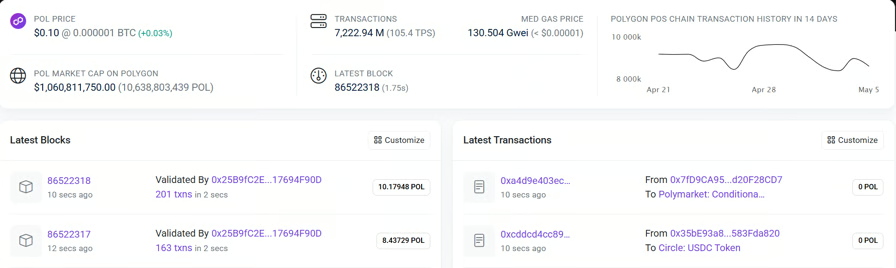
Blockchain layer-2 (L2) network Polygon reduced its average block time by 250 milliseconds to 1.75 seconds, marking its first block-time reduction since genesis as the network pushes deeper into stablecoin payments and settlement infrastructure.
Polygonscan shows that the latest blocks on the network were created in 1.75 seconds. The upgrade means that Polygon can process around 14% more payments per second, reaching a maximum theoretical throughput of about 3,260 transactions per second (TPS), according to Polygon software engineer Lucca Martins.
Shorter block times can help transaction backlogs clear faster, reducing the duration of network congestion and subsequent transaction fee spikes, which is particularly important for high-frequency use cases such as payments, stablecoins or decentralized finance (DeFi) trading.
The upgrade comes as Polygon makes efforts to position itself for use cases targeting more institutional adoption, such as private stablecoin payments. On Tuesday, Polygon introduced a new wallet feature that enables users to privately route stablecoin transactions through a shielded pool verified by zero-knowledge proofs.
The upgrade is part of the Polygon Improvement Proposal PIP-86, a two-step motion that seeks to further reduce block time to 1.5 seconds and scale down checkpoint rewards to maintain the Polygon (POL) token emissions at the target 1% after the block time reduction.
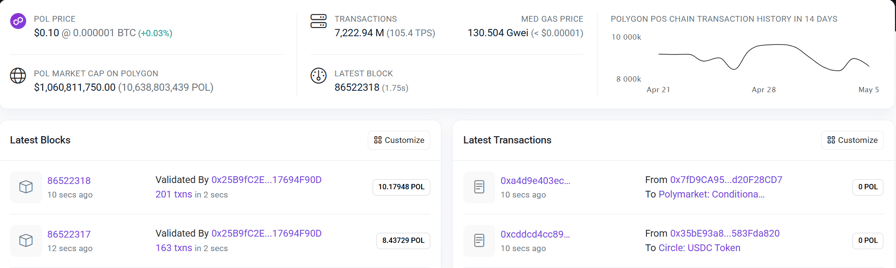
Polygon blockchain explore, latest blocks, production time. Source: Polygonscan
Cointelegraph reached out to Polygon for comment on its block time reduction plans, but had not received a response by publication.
Related: Morgan Stanley takes on crypto trading rivals with E*Trade pilot
Polygon targets private stablecoin payments to onboard institutions
Polygon’s new wallet feature is part of an aim to onboard more institutional users as it hides senders, receivers and amounts onchain while maintaining compliance through Know Your Transaction (KYT) screening and auditable files.
The feature introduces more privacy for businesses transacting with stablecoins, according to Polygon community lead Smokey.
Despite the upgrade, Polygon’s (POL) token remained stagnant over the past 24 hours and traded at $0.09 at the time of writing. The token is down 54% over the past year, CoinMarketCap data shows.
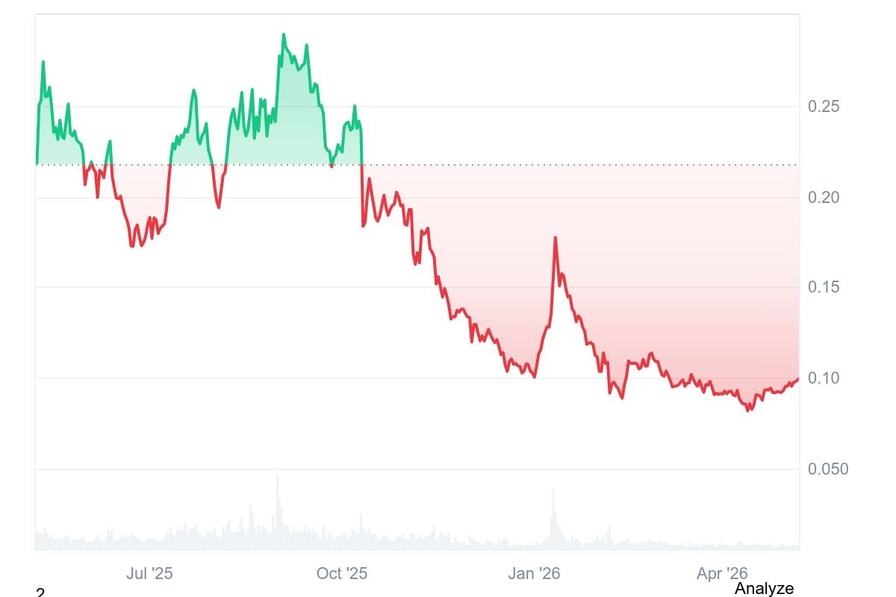
POL/USD, one-year chart. Source: CoinMarketCap
Polygon has also integrated with large credit card providers. On April 29, global payments giant Visa expanded its stablecoin pilot to include support for Polygon Base, the Canton Network, Arc and Tempo.
Launched by Visa in 2023, the pilot allows partners to settle transactions through stablecoins rather than traditional banking rails, to evaluate whether stablecoins can offer faster settlement.
TLDR
- Amazon Web Services launched Bedrock AgentCore Payments to support automated USDC transactions for AI agents.
- The company partnered with Coinbase and Stripe to provide wallet infrastructure and blockchain payment rails.
- Developers can choose between Coinbase and Stripe wallets and fund them with stablecoins or fiat.
- Coinbase enabled agentic micropayments through the open x402 protocol governed by the x402 Foundation.
- The system allows AI agents to pay for APIs, web content, and digital services in real time.
Amazon Web Services has launched a payment feature that lets AI agents transact using USDC stablecoins. The company partnered with Coinbase and Stripe to provide wallet infrastructure and blockchain payment rails. The rollout introduces Amazon Bedrock AgentCore Payments for automated micropayments across digital services.
Amazon Web Services Rolls Out AgentCore Payments with Coinbase and Stripe
Amazon Web Services introduced Amazon Bedrock AgentCore Payments to support agent-driven transactions. The company said the system allows agents to access and pay for web content and APIs. It also enables payments for MCP servers and other agents through integrated wallets.
AWS built the feature with Coinbase and Stripe, which supply wallet infrastructure and payment rails. AWS said, “We’ve built these capabilities in partnership with Coinbase and Stripe.” The company added that the tools let agents instantly access and pay for resources they use.
Developers can choose either a Coinbase wallet or a Stripe wallet within AgentCore. They can fund wallets with stablecoins such as USDC or with fiat currency. The system processes micropayments that can measure fractions of a cent.
USDC and x402 Protocol Enable Agentic Payment Infrastructure
Coinbase confirmed that developers can create agentic payment solutions using the x402 protocol. The protocol allows AI agents to send micropayments through USDC stablecoins. USDC is issued by Circle and serves as Coinbase’s preferred stablecoin.
Coinbase said, “x402 itself is an open, neutral protocol governed by the x402 Foundation.” The company stated that both AWS and Coinbase hold membership in the foundation. This governance model aims to support open standards for agent transactions.
Stripe also supports blockchain-based agent payments through Tempo’s Machine Payments Protocol. Tempo describes its system as an HTTP-native standard for machine transactions. The protocol operates in a manner similar to Coinbase’s x402 framework.
AWS said the new feature marks the first managed payment capability built for autonomous agents. The company stated that agents can use wallets to execute direct payments for services. This setup removes manual steps in digital transactions.
Developers building on Amazon Bedrock AgentCore can integrate real-time micropayments. The system lets agents pay for APIs and other digital tools automatically. Coinbase and Stripe manage wallet operations and transaction routing.
Recent projects have also given bots access to virtual Mastercard and Visa cards. These tools expand payment options for automated systems. However, AWS focused its rollout on stablecoin and wallet-based infrastructure.
The launch follows similar moves in cloud and blockchain services. The Solana Foundation recently released a solution for agent access to Google Cloud services. AWS now provides its own infrastructure through Bedrock AgentCore Payments.
AWS said the platform supports funding wallets with stablecoins or fiat. The company designed the feature to operate within its managed Bedrock environment. Coinbase reiterated its support for the x402 protocol in its Thursday statement.
21Shares debuted the first US ETF tracking the Canton Network on Thursday. The launch lands as retail interest in the institutional chain catches up to its on-chain dominance.
The 21Shares Canton Network ETF trades on Nasdaq under the ticker TCAN with a 0.50% expense ratio. The fund holds at least 80% of its assets in Canton Coin (CC), the network’s native token.
Canton Network’s Hidden Scale Outpaces Its Profile
ETF Analyst Eric Balchunas confirmed the listing soon after the open on May 7, 2026. Early trading placed TCAN near $24.76 with NAV close to $25.
The fund packages exposure to a chain that now settles more than $350 billion in daily repo volume. Broadridge’s distributed ledger platform alone runs more than $6 trillion in monthly repo flow on Canton. Backers and active institutions include DTCC, Goldman Sachs, JPMorgan, Microsoft, Nasdaq, Visa, and Broadridge.
“Wall Street is already on-chain. $350B settles daily on Canton, with over $6T in tokenized real-world assets and institutions like JPMorgan and DTCC building in production,” Canton Network stated recently.
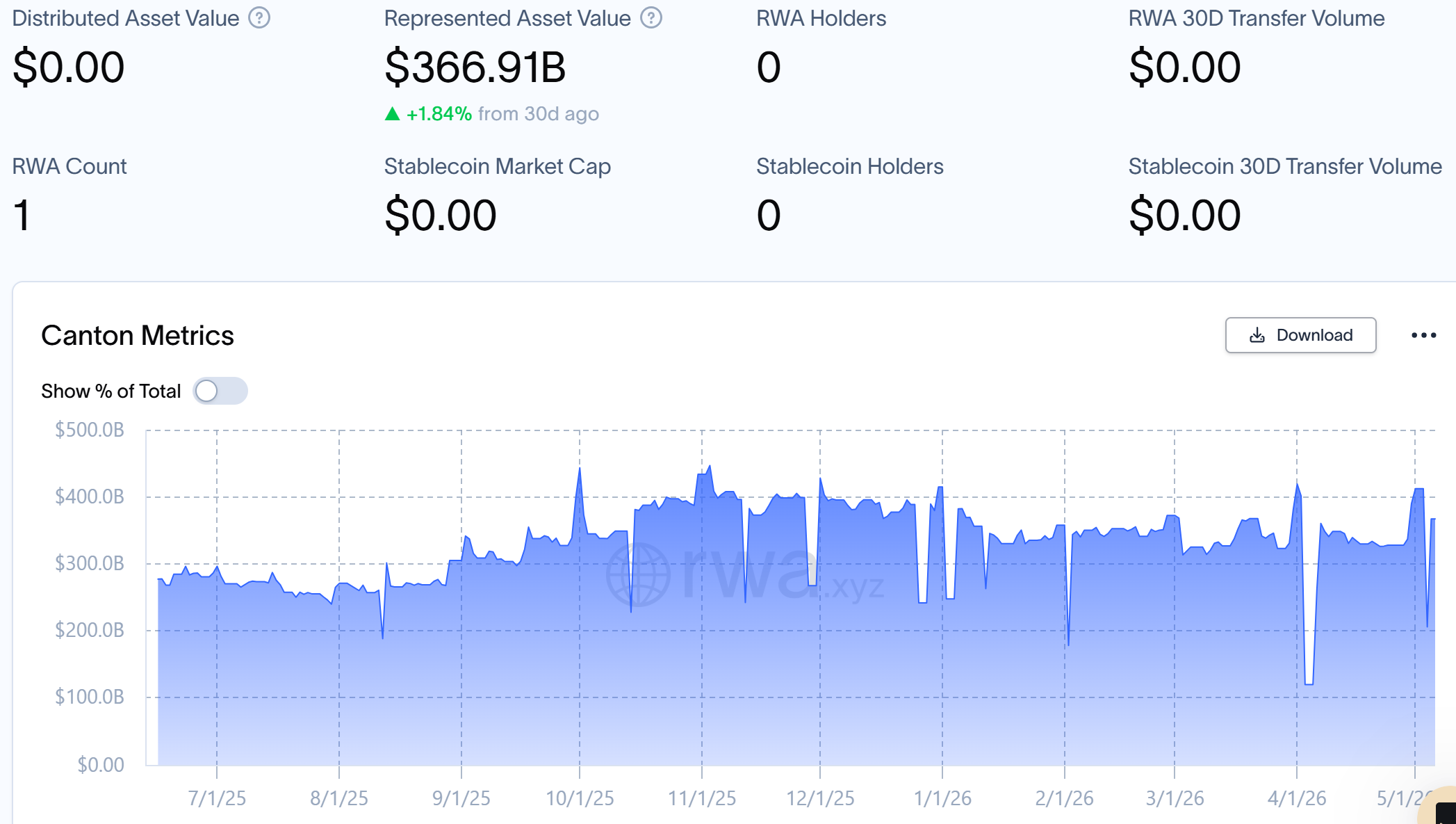
Real-world asset value on the network sits at $366.9 billion as of this writing, putting the Canton ahead of every other chain in tokenized RWA value.

Those figures sit on top of throughput most public blockchains would call inadequate. Canton processes only five to seven transactions per second in live use.
A Kaiko report called Broadridge’s repo platform on Canton the clearest case of distributed ledgers improving TradFi.
Matt Mena, a 21Shares research strategist, argued in late 2025 that Canton may rank among crypto’s most undervalued assets.
TCAN is 21Shares’ first US fund tied to a permissioned institutional chain. The firm has run a Canton Network ETP on Amsterdam under the ticker CANTN since November 2025. Earlier US altcoin filings from 21Shares include Dogecoin and HYPE.
Retail Signals Start Catching the Story
The institutional dominance has been hidden in plain sight. Investor Quinten Francois described Canton as the “silent giant” of institutional blockchain in late 2025. He framed the network as one beginning to wake up.
Several retail-side indicators have moved in the same direction since late 2025. Google trends data shows search volume for Canton has climbed steadily into 2026.
The token’s burn/mint ratio has stayed elevated, with more CC burned than minted across recent periods.

The 2026 real-world asset thesis has positioned Canton as a candidate beneficiary. Some commentary cites the absence of major exchange listings as a reason the token still has room to run.
An ETF Without a Coinbase or Binance Listing Behind It
Canton Network’s CC altcoin remains absent from Binance and Coinbase. The listing gap has constrained retail price discovery despite the network’s institutional volume.
TCAN gives US investors a regulated wrapper without requiring direct token custody, an unusual sequence in altcoin ETF history.
However, not all market participants buy the institutional billing, with some contending that Canton functions more like a directed acyclic graph than a true blockchain.
“Canton is retardio, total solutionism every step of the way, masked by specious “compliance” arguments that wither under the slightest scrutiny. It is not even a blockchain but actually a DAG,” one user stated.
The next test is whether TCAN demand converts the late-2025 rally and rising search interest into sustained inflows.
DTCC’s tokenized US Treasury go-live on Canton is targeted for Q2 2026, a near-term catalyst with deeper institutional implications.
CC is still pre-listing on the largest centralized venues. The 21Shares fund stands as the most accessible regulated path into the asset for now.
The post 21Shares Lists Canton Network ETF as Retail Signals Catch Up to Institutions appeared first on BeInCrypto.

Leon Panetta on Iran, Ukraine and the new global power struggle

WNBA roster tracker: Every team’s roster finalized for opening night

Maker Revives the True Voice of Steam Locomotives with 3D-Printed Train Whistles

Manchester United reach agreement with Casemiro over contract clause amid transfer speculation

US brings back mandatory military draft registration

Steven Gerrard disagrees with Gary Neville over ‘shock’ Chelsea and Arsenal claim | Football


-

 NewsBeat4 days ago
Channel 5 – All Creatures Great and Small series 7 new post
-

 Crypto World19 hours ago
Upbit adds B3 Korean won pair as Base token gains Korea access
-
 Tech6 days ago
Trump’s 25% EU auto tariff breaches Turnberry Agreement that also covers semiconductors and digital trade
-
 NewsBeat21 hours ago
NCP car park operator enters administration putting 340 UK sites at risk of closure
-
 Sports6 days ago
Paul Scholes issues Marcus Rashford reality check as agreement emerges over Man United star
-

 Entertainment6 days ago
Met Gala 2026 Rumored Guest List Is Turning Heads
-

 Business7 days ago
Strait of Hormuz Blockade Persists Amid US-Iran Standoff, Sending Oil Prices Soaring
-
Entertainment6 days ago
New on Prime Video in May 2026 — Full List of Movies and Shows
-

 Entertainment6 days ago
Kylie Jenner Hit With Second Lawsuit From Ex-Housekeeper
-

 Tech7 days ago
Meta ends Sama contract after Kenyan workers report seeing intimate footage from Ray-Ban smart glasses users
-

 Sports6 days ago
Cavaliers vs. Raptors Game 6 live score, updates, highlights from 2026 NBA playoffs first-round series
-
 Sports6 days ago
David Benavidez responds to team Canelo saying the fight will never happen
-
Entertainment5 days ago
New Netflix Movies in May 2026 — My Top 3 Picks to Stream
-

 Entertainment5 days ago
Melissa Joan Hart and More Stars Attend 2026 Kentucky Derby
-
 Sports6 days ago
IPL 2026: ‘Love you darling’- Hardik Pandya’s reaction to MS Dhoni steals the show |Watch | Cricket News
-

 Entertainment6 days ago
Young and the Restless Next Week: Cane Arrested & Matt’s Deadly New Scheme!
-

 Business5 days ago
Luka Doncic Injury Update: Doncic’s Hamstring Recovery Slows Lakers’ Hopes Against Thunder: Can He Run Yet?
-

 Sports7 days ago
Bayern won’t hand bottom side Heidenheim ‘gifts’ despite PSG game
-
Crypto World5 days ago
Pi Network Mandates Protocol 23 Upgrade for All Mainnet Nodes Before May 15 Deadline
-

 Sports7 days ago
What Preity Zinta Said After Punjab Kings’ First Defeat Of IPL 2026
You must be logged in to post a comment Login