

Tech
Bari Weiss Let Benjamin Netanyahu Pick His Own Softball Interviewer


from the billionaire-pseudo-journalism dept
What’s left of CBS News recently landed an interview with Israeli Prime Minister Benjamin Netanyahu. It’s a bit of a doozy (transcript, video). There’s a part where Netanyahu tries to blame foreign social media bot farms for the rise in people disgusted by his government’s carpet bombing of children. There’s a part where he pretends to not actually want billions in U.S. taxpayer dollars.
And there’s this part where he likens himself to Churchill and makes some strange comments about Hitler:
PRIME MINISTER BENJAMIN NETANYAHU: They implant themselves among civilians, you know, so that they have civilian casualties and they can put it on the tube or in your cell phone. So, yes, I mean, I don’t know how to fight it. I mean, Churchill, without cell phones and without digital campaigns and farm bots was labeled a warmonger in the 1930s because he said, “You have to stand up to Hitler.”
MAJOR GARRETT: Hitler, right.
PRIME MINISTER BENJAMIN NETANYAHU: And they accused him of being a warmonger. And Hitler didn’t even say “death to America, death to Britain,” you know. I– I think he might have planned it, but he didn’t say it. And still they accused him of that.
The interviewer, Major Garrett, spends absolutely no serious time pushing back against the claims Netanyahu makes. Or meaningfully addressing indisputable evidence that the Israeli government has engaged in widespread genocidal war crimes on the U.S. taxpayer dime. When Netanyahu tries to dismiss the massive civilian casualties in Gaza, Iran, and Lebanon as minor and innocent mistakes, Garrett has no response.
Garrett doesn’t normally work for 60 Minutes. He was brought on board from elsewhere within CBS because Netanyahu specifically asked for him. According to Oliver Darcy’s excellent media newsletter Status, 60 Minutes correspondent Leslie Stahl was trying to land the interview with Netanyahu when Weiss intervened and shuffled the interview over to Garrett, causing (more) internal anger:
“But behind the scenes, Status has learned that famed “60 Minutes” correspondent Lesley Stahl had also been gunning for the interview but was upstaged by CBS News boss Bari Weiss, who booked Netanyahu herself and handed the interview to Garrett, who is notably not a “60 Minutes” correspondent. The move sparked hostility and amplified the already strained relationship between Weissand the reporting team at the iconic newsmagazine.”
Not so iconic anymore.
The New York Post (for what it’s worth) also indicates that Netanyahu got to select his interviewer as a condition of CBS landing the interview. Weiss, a self-described “Zionist fanatic,” was hired by right wing billionaire Larry Ellison specifically for this sort of softball treatment of global autocrats, and had already been under fire for censoring stories that displeased the Trump administration.
There’s been a mass exodus at CBS for months as actual journalists bristle at the obvious shift toward soggy corporatist agitprop under Weiss. While Weiss was hired on to modernize CBS and make autocratic billionaire ass kissing exciting, viral, and good for ratings; the whole experiment has been a monumental failure so far, with CBS News recently seeing its lowest ratings in a quarter century.
Weiss rose to prominence at her weird little troll blog Free Press, which obviously hasn’t translated well to running a television network. Case in point: Weiss’ preferred new CBS News anchor, Tony Dokoupil, is having to broadcast the network’s coverage on Trump’s China visit from Taiwan because Weiss and friends failed to secure his visa on time for the trip. This mirrors other similar competency issues like Weiss making last-minute unapproved changes to teleprompter text that screws up broadcasts.
Beyond the clownish nature of it all, it remains an open question who this sort of stuff is actually for (beyond the extremely rich people endlessly trying to control information flow). Despite having a massive fortune, Ellison seems incapable of creating propaganda people actually want to watch, and even their target audience — center-right bigots with impaired critical thinking faculties — aren’t tuning in because they have a universe of other terrible (but far more entertaining) choices.
Like Jeff Bezos’ sad and desperate effort to repurpose the Washington Post into what now feels like a satirical billionaire-coddling rag, all the money in the world can’t seem to produce class warfare agitprop actual human beings want to consume. Almost as if the behaviors of the global authoritarian extraction class are starting to reach a point where they’re simply too heinous and ham-handed to spin.
Filed Under: bari weiss, benjamin netanyahu, gaza, journalism, larry ellison, major garrett, media, propaganda, softball interviews, war crimes
Companies: cbs, cbs news, paramount

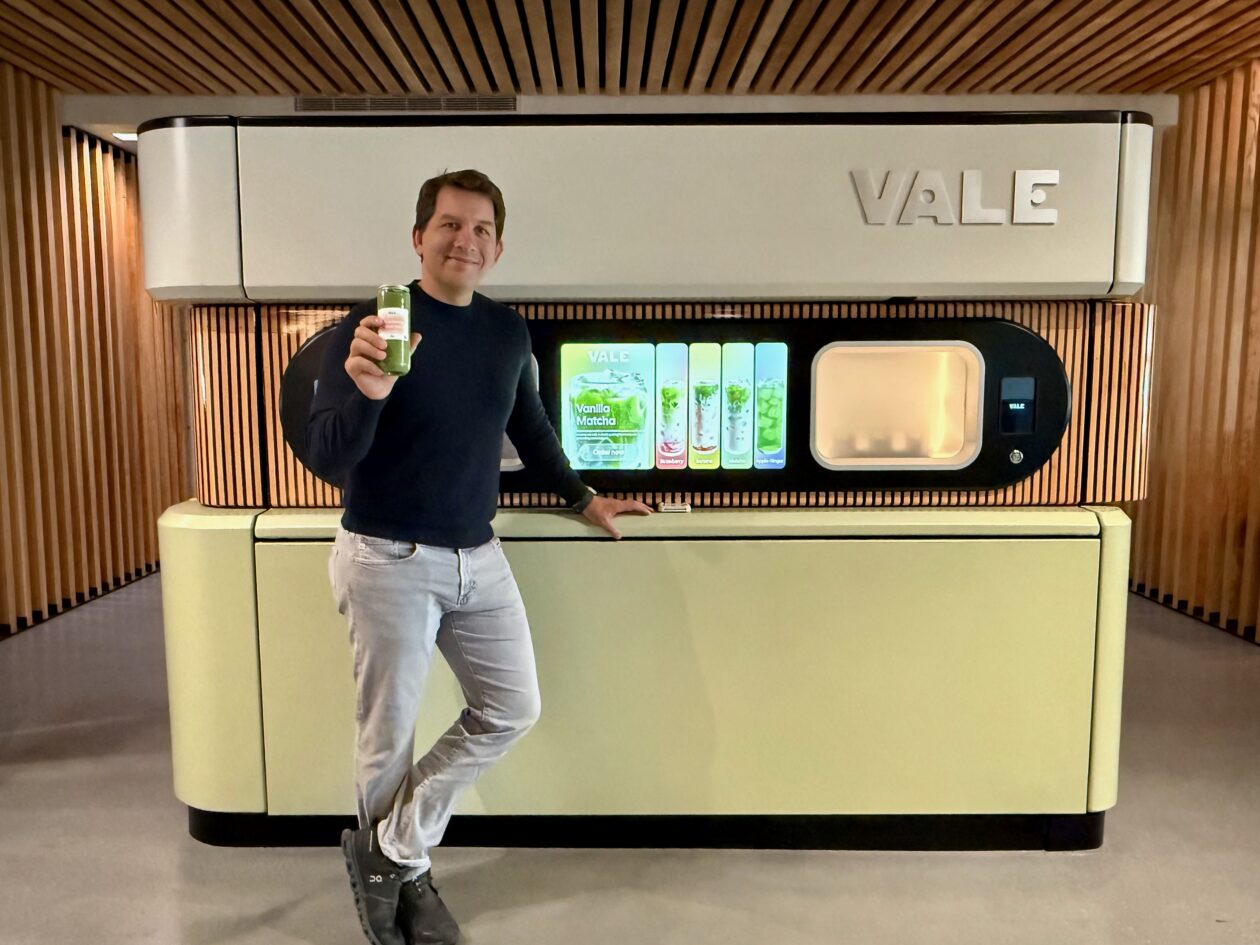

Luke Larson used to get a charge out of working on Tasers and body-worn cameras for law enforcement at Axon. Now he’s buzzing over matcha, the ancient Japanese green tea powder that devotees say delivers calm, focused energy without the jitters of coffee.
Larson’s ambition is noteworthy in its own right as he plans to build Vale into a Seattle-born beverage empire — think Starbucks, but make it matcha — scaling from a handful of local cafes and mobile bars to a nationwide network of thousands of automated machines.
It’s a move he’s pulled off before. As president of Axon, Larson helped grow the company from roughly $100 million to $1 billion in sales before stepping down in 2022.
Larson sees Vale as sitting at the intersection of consumer products, hospitality, technology and automation — and a chance to build something from the ground up.
“While other companies are leaving Seattle, we’re investing in Seattle,” Larson told GeekWire from Vale’s Pioneer Square headquarters, where he’s especially bullish on hiring tech talent from companies including Starbucks, Amazon and Microsoft.
Body cams to matcha bars

Larson, who grew up in Forks, Wash., served two tours in Iraq as a Marine Corps infantry officer and he was awarded the Bronze star with V for valor on his first tour. He joined Axon in 2008 and was product manager for the company’s first cameras.
He rose to president at Axon in 2017 and helped build out the Scottsdale, Ariz.-based company’s significant engineering presence in Seattle. Alongside its mission to build tools and technology to help de-escalate police use of force, Axon attracted attention in Seattle for its geeky spaceship-themed office and its unique recruiting tactics.
In 2022, Larson left Axon following a health scare, taking a six-month medical leave before relocating with his wife and three daughters to Switzerland for a two-year sabbatical — time that gave him space to think about his next chapter.
It was during that period that Larson first tried matcha, at the urging of his wife and sister-in-law. His initial reaction wasn’t promising — he didn’t like it. But an introduction to chef Jeffrey Hayden, a Culinary Institute of America graduate who had worked at Michelin-starred restaurants, convinced him that high-quality, cold-served matcha was a different experience entirely.
Larson returned to Seattle with a new company idea, and last year launched Vale, opening its first cafe in South Lake Union in May 2025.

While a second cafe is in the works on First Hill, Vale’s growth target is more pronounced. The company this summer will operate 23 portable, staffed matcha bars with plans to scale to 100 by year’s end and 1,000 by next year. To support that growth, Vale recently leased 36,000 square feet of production space south of downtown Seattle — a space formerly used by Atomo Coffee as a roastery.
Hayden serves as the startup’s head of craft and Vale has 73 employees, roughly half of them frontline matcha bar workers, with the rest split among software engineers, mechanical engineers and roboticists. Former Axon leaders include CTO Jay Reitz and Sydney Siegmeth, head of people and communications.
Larson, who is the majority investor, plans to keep the company private for another two years before seeking outside capital.
His longer-term play involves robots.
Larson wants to build out a network of automated self-serve matcha machines that he envisions in office towers, apartment buildings and other spaces that wouldn’t support a traditional cafe.
Matcha from a machine

Vale sources ceremonial-grade matcha from Shizuoka, Japan, a region Larson likens to the Pacific Northwest, sitting at the base of Mount Fuji. Hayden leads a team that has developed a specialty drink menu — from classic cold matcha to lattes and seasonal creations like a tiki-themed summer drink — served across the cafe, matcha bars and machines through a single mobile app.
Next to Vale’s HQ in the lobby of an office building at 505 First Ave. S., just a block from Lumen Field, sits a futuristic-looking matcha-dispensing machine. With its smooth finish and rounded edges, it’s about the size of a small car, with a touchscreen centered between two frosted panels that reveal a drink-delivery portal.
A peek inside the back of the machine reveals a robotic arm that moves from end to end. First it applies a personalized label to a plastic vessel to match what the customer typed in. Next it fills the container with the drink of choice from a selection of 10 automated taps. The container is then topped with a soda-can-style aluminum lid before it’s placed in the window for retrieval.

Larson envisions the machine as something like a “Star Trek” replicator, where the technology fades into the background and the focus stays on the customer experience.
“We want to shatter your expectation of what can come out of a machine,” he said.
A $7 strawberry matcha latte tasted by GeekWire came pretty close to doing just that. Flavored with oat milk, the iced, fruity, creamy drink was a nice surprise compared to more traditional hot and bitter matcha I’ve previously sipped from a straw.
Larson hopes the taste lands equally well with a generation of consumers increasingly drawn to matcha as an alternative to coffee — particularly younger drinkers who prefer cold beverages and are wary of the jitters that can come with a caffeine habit.
He’s betting Seattle is the right place to find them, and to build the team to serve them, as Vale plans to hire up to 100 people over the next 12 months.
“I believe that Seattle’s best years are ahead of it,” Larson said. “To build the type of company that I want to build, I don’t think there’s a better city in the world.”


SpaceX’s historic IPO just got super-sized, after the public offering’s underwriters exercised their option to purchase the maximum amount of shares — bringing the total amount raised to $85.7 billion.
Elon Musk’s space-and-AI company had initially raised $75 billion, which was already enough to make it the largest IPO windfall ever.
SpaceX has said it plans to use the proceeds from this IPO in a variety of ways. The company plans to extinguish around $20 billion in debt related to legacy loans tied to X, the social media company formerly known as Twitter, and Musk’s AI company xAI — both of which were combined into SpaceX before the IPO.
Funds will also be used to expand SpaceX’s AI compute infrastructure, enhance its launch infrastructure, and improve Starlink.
SpaceX’s stock started trading on the Nasdaq exchange on Friday. The company finished the day with a valuation of more than $2 trillion, and Musk became the world’s first trillionaire. Shares climbed higher on Monday, helping SpaceX eclipse the valuation of chipmaker TSMC.

Salesforce acquires Fin, the customer-service AI company formerly known as Intercom, in a deal worth about $3.6bn. The CRM giant signed a definitive agreement on Monday, it said, to fold Fin’s “customer agent” technology into Agentforce, its own fast-growing AI-agent platform.
Fin’s pitch is autonomous support.
Its AI Agent handles customer queries end-to-end across live chat, email, WhatsApp, SMS, phone and Slack, and Salesforce says it resolves, on average, 76 per cent of support volume without a human. It runs on Fin’s own model, Apex, which the company says it post-trained specifically for support and which it claims outperforms frontier models from OpenAI and Anthropic on resolution.
Fin brings more than 30,000 business customers with it.
The deal is expected to close in the fourth quarter of Salesforce’s fiscal 2027, subject to regulatory clearance. Salesforce says it will not change its FY2027 guidance or its buyback plans.

The 💜 of EU tech
The latest rumblings from the EU tech scene, a story from our wise ol’ founder Boris, and some questionable AI art. It’s free, every week, in your inbox. Sign up now!
Why Salesforce acquires Fin instead of out-building it
Salesforce is not short of agents. Agentforce, its own platform, hit $1.2bn in annual recurring revenue in the first quarter, up 205 per cent year on year. So this is not a company filling a hole. It is buying speed.
Agentforce is the deeply customisable, enterprise-grade option, powerful but slower to stand up. Fin is the opposite: packaged, pre-trained and live in days, which suits smaller and mid-market firms that want a working support agent now. Buying Fin lets Salesforce sell both, from a drop-in support bot to a bespoke enterprise build, rather than forcing every customer down the heavyweight path.
“We’ll help companies of every size seize this opportunity,” chief executive Marc Benioff said.
A rival, and its own model, absorbed
The target is a pointed one. Fin, under co-founder and chief executive Eoghan McCabe, has spent years positioning itself as the company that defined the customer-agent category, often at the industry’s expense.
Intercom only renamed itself Fin, after its AI agent, in May. Now the agent, the brand and the team are Salesforce’s. “We can deploy it far and wide at a rate far faster than we could have ever achieved on our own,” McCabe said.
There is a quieter prize, too. Fin launched in 2023 on OpenAI’s GPT-4 and later leaned on Anthropic’s Claude, then built Apex, its own post-trained support model, to cut that dependence. Salesforce is buying not just an app but a proprietary model tuned for one job. It slots into a wider land-grab in agentic AI, where the big platforms are racing to own the software that does the work, not just the software people work in.
The test now is integration: whether a packaged agent built outside Salesforce still feels fast once it is wired into Salesforce’s data, security and governance stack.


Presented by Splunk
AI has changed the economics of cyber deception.
An attacker can now generate thousands of convincing phishing lures, fake identities, and tailored pretexts before a defender finishes a single change-control cycle. That is the new security challenge: deception got faster and cheaper, while verification did not.
Much of the discussion around AI for defense centers on detection models. Detection matters, but it is not the only bottleneck. The deeper constraint is evidence: where data lives, whether it is available when needed, how quickly it can be correlated, how long it is retained, and whether analysts or agents can trust what they retrieve.
Defense in the AI era is a data problem before it is a detection problem.
The defender’s advantage is truth
Attackers can afford to lie at enterprise scale. They can test endless combinations of messages, identities, domains, and attack paths, and most can fail at almost no cost.
Defenders do not have that luxury. Their advantage is truth: quickly knowing what happened, where, when, which identity was involved, which assets were affected, what changed, and what business process may be at risk.
That truth must be documented, governed, auditable, and defensible. Attackers are using AI to scale deception, impersonation, social engineering, and speed. Defenders need AI to scale verification.
The goal is not just to act faster than the attacker. It is to take action that people and machines can trust.
Fragmented data breaks modern defense
Consider a suspicious login from a contractor account. On its own, it is just another authentication anomaly. To know whether it matters, a security team may need identity history, endpoint activity, cloud access logs, ticketing records, asset ownership, configuration changes, network telemetry, and business context.
If those records sit in different tools, expire at different times, or require multiple teams to retrieve, defenders are not investigating the incident. They are negotiating with their own data estate.
When signals can be reached in place and correlated quickly, the issue is no longer just whether the login looks unusual. It becomes whether the enterprise has enough evidence, in enough context, to take action it can defend.
That challenge grows more urgent with AI assistants and agents. AI can only reason over what it can retrieve in time to matter. If the data is partial, stale, fragmented, unavailable, or stripped of context, AI does not create truth. It accelerates uncertainty.
The system of record must become a defensive control plane
For years, enterprises treated security platforms, SIEMs, and data lakes as passive repositories: places to store data for later search and analysis. That model is no longer enough.
What organizations now need is a defensive control plane: a layer that connects what happened, what it means, and what the enterprise is allowed to do about it. In architectural terms, it ties together raw machine data, business context, and policy. It does not just store evidence. It makes evidence usable for decisions and actions that must be explainable and trusted.
In practice, that means doing four things well: preserving evidence, reaching data wherever it lives, adding business context, and governing action. More on each below.
The old system of record answered one question: What is the official record?
A defensive control plane answers the questions that matter operationally: What happened? What does it mean? What evidence supports that conclusion? And what action can we trust?
AI does not reduce the need for authoritative records. It raises the standard for what those records must do.
A defensive control plane must do four things
-
Preserve evidence. Logs, metrics, traces, events, identity records, configuration changes, tickets, and asset state all help establish what happened. Their value often becomes clear only after an incident begins.
-
Make data accessible wherever it lives. Security-relevant data is already spread across object stores, cloud platforms, operational tools, and business systems. Moving every byte into one place is often too slow, too expensive, and too difficult to govern. The better model is to bring analytics to the data.
-
Add business context. Correlating machine data with business information turns “anomaly on host X” into “the system supporting payment services for top accounts is being probed.” That is what allows organizations to prioritize correctly.
-
Govern action. In the agentic era, systems will do more than summarize incidents. They will enrich alerts, open cases, trigger workflows, isolate assets, update policies, and escalate decisions. Enterprises need to know what evidence an agent used, what policy governed the action, whether it stayed within scope, and how the decision can be reviewed afterward.
The real SOC problem is not too little data
Modern SOCs are not suffering from a lack of data. They are suffering from a lack of usable context.
According to the Splunk State of Security 2025 report, SOC analysts continue to struggle with too many alerts (59%), too many false positives (55%), and alerts that lack context (46%). The issue is not data volume. It is the difficulty of turning fragmented signals into trusted decisions.
Today, analysts are left stitching together context manually, pivoting across disconnected tools, and making high-stakes decisions without the full picture in time. Even as AI improves, outcomes still depend on whether humans are willing to approve changes across fragmented environments.
This creates a daily crisis of context. Teams are forced to make consequential decisions based on data they cannot easily see, correlate, or trust. The result is latency, inconsistency, missed opportunities, and unnecessary risk.
Trusted action is the durable advantage
A data fabric architecture offers a way forward by creating a unified, intelligent layer across data sources spanning SecOps, ITOps, and NetOps. The goal is not centralization for its own sake. It is to break down silos and deliver context-rich insight at the speed AI-driven operations require.
This is an operating model before it is a product. AI-driven defense depends on a foundation that can preserve evidence, reach data where it lives, add context, and maintain a reviewable link between data, decision, and action. That is the architectural shift behind Cisco Data Fabric powered by the Splunk Platform, which brings together machine data, federation, business context, governance, and provenance to help teams move from signal to trusted action.
Attackers will keep making deception cheaper, faster, and more personalized. Defenders do not win that race by generating more noise. They win by making truth faster, and by grounding every action in evidence that people and machines can trust.
Learn more about the Cisco Data Fabric powered by the Splunk Platform.
Seth Brickman is VP, Global Product – Splunk Platform, Cisco.
Sponsored articles are content produced by a company that is either paying for the post or has a business relationship with VentureBeat, and they’re always clearly marked. For more information, contact sales@venturebeat.com.

Samsung’s next foldable line-up may have just leaked ahead of schedule. A new image appears to show screen protectors for the upcoming Galaxy Z Flip 8, Galaxy Z Fold 8 and Galaxy Z Fold 8 Ultra side by side.
While leaked screen protectors aren’t usually the most exciting reveal, this one offers an early look at how Samsung could be reshaping its foldable range.
Most notably, the Galaxy Z Fold 8 appears wider and slightly shorter than previous models. Meanwhile, the Fold 8 Ultra looks set to sit in a class of its own.
If the leak is accurate, it suggests Samsung is putting more distance between its standard Fold and Ultra models. The company may no longer treat the Ultra as a simple spec bump. That could help the company better compete. After all, rivals such as Apple, Xiaomi and Vivo continue to push into the foldable market.
The image was shared by well-known tipster Ice Universe and appears to show noticeable differences between the two Fold devices. The standard Fold 8 looks broader than before. This could make the outer display feel more like a traditional smartphone screen. It may also feel less like the narrow panels found on earlier Galaxy Fold devices.
Beyond the redesigned shape, previous leaks have pointed to several upgrades for the Fold 8. These include a less visible display crease, a 4,800mAh battery and a weight of around 201g.
The Galaxy Z Flip 8, meanwhile, is expected to be a more modest update. Rumours suggest Samsung has tweaked the hinge design to make the clamshell foldable slightly thinner when closed. Additionally, the company is also shaving off a little weight. The biggest changes may come under the hood. Reports point to Samsung’s Exynos 2600 chip in Europe and South Korea. In other markets, there may be a Snapdragon 8 Elite Gen 5 for Galaxy processor.
Samsung expects to officially unveil the Galaxy Z Flip 8, Galaxy Z Fold 8 and Galaxy Z Fold 8 Ultra at its next Unpacked event on July 22. The company will reveal these alongside the Galaxy Watch 9 and Galaxy Watch Ultra 2.




AI AND ml
PwC says AI hiring jumped 61 percent despite wider slowdown in vacancies, with employers increasingly looking for workers who can use AI rather than build it
Britain’s AI jobs boom is creating a two-track labor market, according to PwC, which just so happens to make a healthy living helping companies navigate AI-driven transformation.
The consulting giant’s latest AI Jobs Barometer found hiring for AI specialists in the UK jumped 61 percent over the past year, rising from 112,000 roles in 2024 to 180,000 in 2025, even as overall job vacancies across the economy fell by 6.6 percent.
That headline figure is the sort of thing consultancies put in press releases, but the more interesting bit comes later.
PwC’s analysis suggests employers aren’t rushing to hire hordes of machine learning engineers and model builders. Instead, they’re increasingly looking for people who can use AI inside existing professions and business functions. The firm found that so-called AI user roles grew by almost 66,000 positions during the year, while AI developer roles increased by just 2,600.
After years of declaring that AI will revolutionize everything from accounting to sandwich-making, companies appear to have reached the awkward stage where somebody actually must make the technology useful.
PwC argues the result is a “two-track” labor market. Jobs where AI helps skilled workers automate repetitive tasks and focus on higher-value work are growing faster than roles where the technology mainly makes tasks easier and lowers barriers to entry.
According to the report, roles most enhanced by AI have grown by 39 percent since 2018, compared with 17 percent growth in jobs where AI is primarily simplifying work.
The firm’s wage data tells a similar story. Jobs requiring AI skills now command an average wage premium of 34.2 percent, up from 11 percent a year ago. Consumer market companies are offering premiums as high as 64 percent, while government and public sector employers top out at 12 percent.
That’s certainly good news for workers with AI skills. It’s also not the sort of conclusion likely to upset a firm that advises clients on AI strategy for a living.
The findings land against a backdrop of growing anxiety about AI’s impact on employment. Recent polling found one in five Britons believes AI-driven layoffs could eventually trigger civil unrest, while another survey found that office workers are already spending nearly six hours every week checking, correcting, or redoing work generated by AI tools.
For all the excitement around AI, the hiring surge appears to be concentrated in a surprisingly old-fashioned category: people who know what they’re doing. ®


SOFTWARE
Linux app packaging rethink could leave alternative-init distros in the cold
Flatpak development has been very quiet for years. Discussions about a next-generation take are happening – and some of the signs are worrying if, like many FOSS folks, you are systemd-intolerant.
In the course of researching our article on MX Linux 25.2, we came across an interesting Reddit discussion from last month, which in turn led us to a Flatpak development blog post from late last year.
It looks like a team is collecting ideas for what is currently called “Flatpak-NG” – as in next generation. If this solidifies into code, this may form the basis of Flatpak version 2.
The blog post isn’t very informative, but the Reddit thread links to the video of a presentation from last month’s Linux App Summit in Berlin, which spells things out more clearly.
The Flatpak-NG idea involves handing off a lot of the isolation in Flatpak from the current bubblewrap layer to an as-yet-unwritten systemd component that the developers are currently calling systemd-appd. This would considerably simplify Flatpak, and enable it to do more isolation, including virtualizing the network stack – but at the price of making Flatpak 2 depend on systemd. A developer who was at the talk, Jorge Castro, later explained and confirmed this in a Fediverse thread.
The teams behind other init systems could, of course, write their own replacement for the notional systemd-appd, but that would be a substantial amount of work. The tool that provides the new init-switching functionality in MX Linux 25.1 and 25.2, init-diversity, currently supports six other init systems besides systemd, and we’ve seen little sign of them cooperating to create an alternative to systemd that provides even a subset of its wider functionality.
Flatpak is widely used and supported. Not all distros include it by default, but it’s the only widely adopted alternative to Canonical’s Snap packaging system.
Snap is more versatile: it works fine with shell programs, and even the kernel can be packaged as a Snap, which is how Ubuntu Core handles it. Snap’s implementation is much simpler and cleaner than Flatpak’s, as is the distribution model – which, as we’ve reported before, is entirely open source. The only proprietary part is Canonical’s Snap Store website. The trouble is, the louder advocates in the peanut gallery rarely even think about things like implementation details; they just get upset about more visible things that are easier to understand – such as who owns a website.
There are other alternatives out there, such as AppImage, 0install, AppDir, and GNUstep’s implementation of NeXT and Apple’s .app format. We have compared these in detail before.
Only two really have wide adoption, though. There’s Snap, which Canonical claims has more users simply because Ubuntu has more users than all the other desktop distros put together, and there’s Flatpak, which is used by every other distro with any kind of cross-distro package support.
The snag is, if Flatpak 2 does arrive in a year or two, and requires systemd, then that could spell the end of Flatpak support on many systemd-free distros. That includes MX Linux, Alpine Linux, Devuan, Slackware, and many other smaller projects. For many of these, Flatpak is a lifeline: the only way to access much of the wider Linux app market.
It’s not so much that the Flatpak-NG team is the “A-Team,” but the only team. In the original A-Team, Colonel John “Hannibal” Smith was wont to say “I love it when a plan comes together.” We suspect a lot of people will not love it if this plan comes together. ®

According to the companies, it would create the third-largest player in US TV.

The Fox Corporation announced it will be acquiring Roku, best known for its streaming device ecosystem. Subject to approval, Fox will pay about $22 billion for Roku, or $160 per share.
“This is a defining moment for Fox and a natural extension of the deliberate and focused strategy we have been executing for nearly a decade,” CEO and Executive Chair of Fox, Lachlan Murdoch, said in a statement. “Today, we take the next step: bringing together the most valuable live content portfolio in video consumption with the preeminent streaming platform through which America watches it. This combination will transform the scope of our company into high-growth verticals and yield a step change in our overall growth profile.”
The two companies claim that Roku will still operate as its own “partner-friendly platform.” The Roku Channel currently serves over 100 million households worldwide. Fox states that it will have a greater scale with Roku, reaching audiences for live content and streaming. It also gives Fox access to the “high growth” area of advertising and streaming subscriptions. On this note, the company points to the deal enhancing its “long-term growth profile” across streaming and TV.
Fox is paying with a combination of cash and some of its Class A common stock. Roku CEO and founder Anthony Wood said in the release.”I’m incredibly proud of what our team has built and the combination with Fox is an extraordinary opportunity to accelerate our vision, scale faster and innovate more aggressively for viewers, partners and advertisers.” The companies claim that combined, it would create the third-largest entity in US TV based on viewer share and yes, the deal is subject to regulatory approval.
Roku just updated its homescreen last month — the first time it’s done so in a decade. It brought features like increased personalization and a “top picks” section, but overall it doesn’t look hugely different.
Razorpay, the Bengaluru payments company, has filed draft papers for an initial public offering through India’s confidential route, according to people familiar with the matter. The filing moves one of the country’s larger fintech firms a step closer to the public markets, without yet putting its financials on public display.
The confidential mechanism, which Indian regulators have permitted in recent years, lets a company submit a draft red herring prospectus to the Securities and Exchange Board of India and the exchanges while keeping business, operational, and financial detail out of public view until later in the process. It buys time and discretion, which is why a string of well-known names have used it.
People familiar with the plans put the issue at between Rs 5,000 crore and Rs 6,000 crore, which at the upper end is roughly $700m, and suggest a listing could value the company at Rs 50,000 crore to Rs 60,000 crore.
Those figures come from sources rather than from Razorpay, and the company has not confirmed them. The size and terms can change before the offer is made public.
The 💜 of EU tech
The latest rumblings from the EU tech scene, a story from our wise ol’ founder Boris, and some questionable AI art. It’s free, every week, in your inbox. Sign up now!
Razorpay was founded in 2014 by Harshil Mathur and Shashank Kumar and built out from payment acceptance into banking, payouts, payroll, and lending. It was valued at $7.5bn in a December 2021 round, a mark set during the last cycle of large private fintech valuations.
The listing has a longer backstory in the company’s corporate structure. In 2025, Razorpay completed a reverse flip, shifting its parent’s domicile from the United States back to India, a move that carried an estimated $150m tax bill and is a near-prerequisite for an Indian listing. The confidential filing is the next item on that checklist.
Razorpay would join a run of Indian technology firms that relocated their domicile home before listing, a pattern driven by the depth of India’s retail investor market and by regulators’ preference for domestic incorporation.
The reverse flip is the costly part of that decision, since it crystallises a tax charge, but it is the price of access to the exchange on which these companies increasingly want to trade.
The 2021 valuation is the figure that hangs over the listing. At $7.5bn, it was set at the top of the last funding cycle, and the valuation reports now circulating, at the rupee equivalent of roughly $6–7bn at the upper end, would mark a more sober number than the private peak. That gap, between a late-cycle private mark and what public investors will pay, is the question many of this cohort of fintechs are testing as they come to market.
What comes next is procedural. Under the confidential route, a fuller prospectus and the financials it contains become public at a later stage, before the offer opens. Until then, the headline numbers remain attributed to people who know the plans rather than to the company.

Coffee town meets its matcha: Robots help power ex-Axon leader’s Seattle beverage startup Vale

Donald Trump celebrates 80th birthday with UFC show on White House lawn
Bitmine stock jumps 8.2% on $10.4B ETH holdings disclosure

BloFin War of Whales 2026 Grand Prix opens registration for $5M trading championship

Blockchain.com files with SEC for U.S. IPO

Israel says it has killed new Hamas military leader in Gaza City airstrikes

IT’S OFFICIAL: THE FED IS MOVING $3 TRILLION INTO RIPPLE XRP!?

Apex Bank Assam Preparation 2026 | Financial Awareness Last Minute Best Prep + Free MCQs PDF

#cryptocurrency | SUUQA LACAGAHA INTERNETKA AH OO HADDA DHALINYARADU AY AAD UGU LOOLAMAYAN.
-

 Business23 hours ago
No Jackpot Winner as $257 Million Prize Rolls Over to $269 Million Monday Draw
-

 Crypto World4 days ago
Oppenheimer backs SpaceX as $70 billion retail frenzy builds
-

 Crypto World4 days ago
Markets Rally as SpaceX IPO Looms Amid Iran Tensions and Inflation Surge
-

 Fashion3 days ago
Weekend Open Thread: Tuckernuck – Corporette.com
-

 Sports7 days ago
FIFA WC 2026 Group C: Morocco, Scotland challenge Brazil’s hunt for glory | FIFA World Cup 2022
-
 Crypto World15 hours ago
Zimbabwe Requires Crypto Businesses to Register Annually Under New FIU Regulations
-

 Entertainment6 days ago
The Ryan Gosling True Crime Thriller On Netflix That Gets Even Stranger, Stream It Now
-
 Sports6 days ago
Bangladesh beat Australia after 20 years in ODIs, register only their second win over six-time world champions | Cricket News
-

 Tech3 days ago
This Week In Security: Microsoft On Microsoft, Register Your Domains, Linux On ARM, And FreeBSD Joins The File Cache Club
-

 Tech3 days ago
NanoClaw integrates JFrog registries to secure AI agent downloads
-

 Crypto World2 days ago
Bitget enters Argentina’s regulated crypto market through PSAV registration
-

 Politics4 days ago
Politics Home | Healey Resignation Is “Colossal Failure Of Government”, Says Former Labour Defence Secretary
-
 Tech4 days ago
Dutton Ranch star claims they ‘didn’t see any disruption’ on set following Chad Feehan’s exit from Yellowstone spinoff fueled by Taylor Sheridan clash rumors
-

 Tech5 days ago
‘This is Seattle’s position on AI’: City Council votes unanimously to pause big new data centers
-

 NewsBeat4 days ago
El Nino has formed in the Pacific and could set records, forecasters say
-
 Entertainment4 days ago
Donnie Wahlberg & More Heat Up Las Vegas at Circa’s Barry’s Downtown Prime
-

 Sports4 days ago
First Time Since 1971: Australia Register Historic Low In ODI Cricket
-
 Tech4 days ago
Opendoor Ends India Operations, Fueling a Bigger Conversation About AI and Outsourcing
-

 Politics4 days ago
Belfast burns, while Met chief points finger at Iran and Russia
-

 NewsBeat3 days ago
FBI searches office of Ohio voter registration group
You must be logged in to post a comment Login