Diana Henry is the Telegraph’s much-loved cookery writer. She shares recipes each week, for everything from speedy family dinners to special menus that friends will remember for months. She is also a regular broadcaster on BBC Radio 4, and her journalism and recipe books, including Simple and How to Eat a Peach, are multi-award-winning. A mother of two sons, Diana can satisfy even the fussiest of eaters.
A parish council was informed about the concerns by a resident who independently tested samples of soil
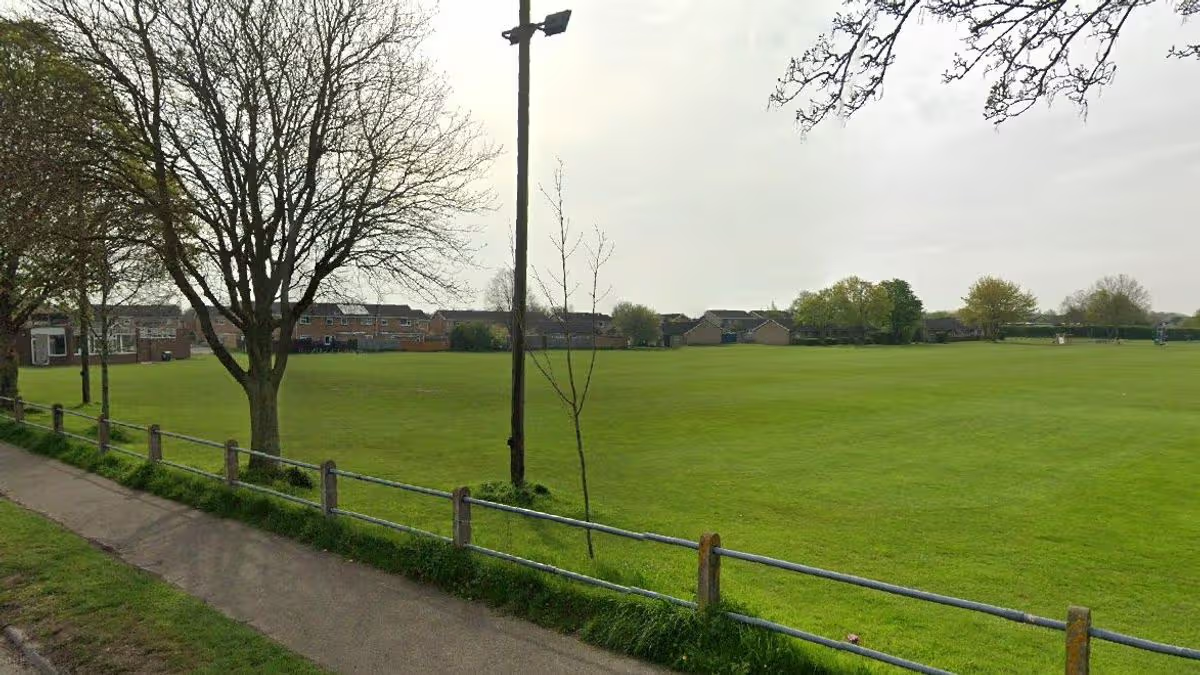
A recently opened skate park in a Cambridgeshire village has closed after the presence of asbestos was confirmed. Lynton Way Skate Park in Sawston has temporarily closed after asbestos was found in the soil surrounding the skate park.
Advertisement
Sawston Parish Council was informed by a resident who independently got samples and arranged for them to be tested. Following this, the parish council said they “acted immediately” and the skate park, which opened in April 2026, was closed while further testing was carried out.
According to the council, results confirmed asbestos in two small areas specifically within small fragments of debris found on site.
A spokesperson for Sawston Parish Council said that “Enviornmental Health has advised that asbestos only poses a risk if it becomes airborne” and that “the majority of the area around the skate park is not contaminated”.
Specialist contractors are due to remove the affected material and replace the soil on Monday, May 18. Until the works are complete, the affected area will remain securely fenced off.
Advertisement
New topsoil is being supplied from a “reputable, quality-assured source, screened and independently tested to meet British Standards”, the council assured.
The parish council spokesperson added: “We appreciate that this closure is disappointing, particularly so soon after the skate park was opened. However, these precautionary measures are being taken to provide an additional level of assurance over and above standard practice and to ensure public safety.
“At each point, the Council has followed the advice and recommendations of the Environmental Health officers. Once the Parish Council is satisfied that the remediation work has been completed to the appropriate standard, the skate park will be reopened.”
A soap star being probed by cops for child sex offences against five teenage boys remains on bail despite being arrested more than 18 months ago
18:49, 15 May 2026Updated 18:57, 15 May 2026
A soap star previously accused of child sex offences against five teenage boys still remains under investigation 18 months after being arrested. The household name was arrested in October 2024 but has been on bail since. It is understood he has been reinterviewed since then over the claims, which date back to the 1990s when the man had major roles in some of Britain’s most popular television shows.
The police force investigating the actor, who can’t be named for legal reasons, has confirmed that inquiries are ongoing, and he remains on bail. Guidance suggests suspects can generally be on bail between three to nine months before needing to be charged or released.
The original bail period can be extended to six months by an inspector, nine months by a superintendent, with further extension needing Magistrate court approval. Detectives have spent time since his arrest analysing computers and documents which they seized upon his arrest.
Advertisement
The star was initially held for several hours before being released on bail. His family, including his partner, were left stunned by his arrest and he is also understood to be shocked by the historic allegations, which he denies. The five alleged victims are now all adults.
A police spokesman initially said in October 2024: “A man has been arrested on suspicion of historical child sex offences involving five victims. Officers investigating allegations relating to the 1990s detained a man. He was arrested on suspicion of several sexual offences relating to five men who were teenage boys at the time of the alleged offending. He has been conditionally bailed while enquiries continue.”
After inheriting her late father’s house, Doctor Todd realised that she’d need a fair bit of cash to do it up. With her pension pot small due to going into early retirement, she turned to her favourite past time – blackmailing someone – in order to raise the funds.
Charity was only able to find £5k for Doctor Todd, and took the approach of threatening her to try and scare her away from the village. This appeared to do the trick, as Caitlin later told Vanessa Woodfield (Michelle Hardwick) about her plan to leave today.
Advertisement
But this evil surgeon isn’t going anywhere just yet.
Advertisement
Manpreet gossiped a little too hard (Picture: ITV)
In this evening’s episode, Doctor Todd went for lunch with Manpreet Sharma (Rebecca Sarker) prior to her exit. As they chatted about Caitlin’s potential romance with Vanessa, Ryan Stocks (James Moore) was sat nearby doing some pub admin.
Ryan started chatting to Manpreet about Charity, but he accidentally made a comment about his mum that caused Caitlin’s ears to prick up. She was under the impression that Charity is just a barmaid at the Woolpack, but discovered from Ryan and Manpreet’s conversation that she actually owns half of the establishment.
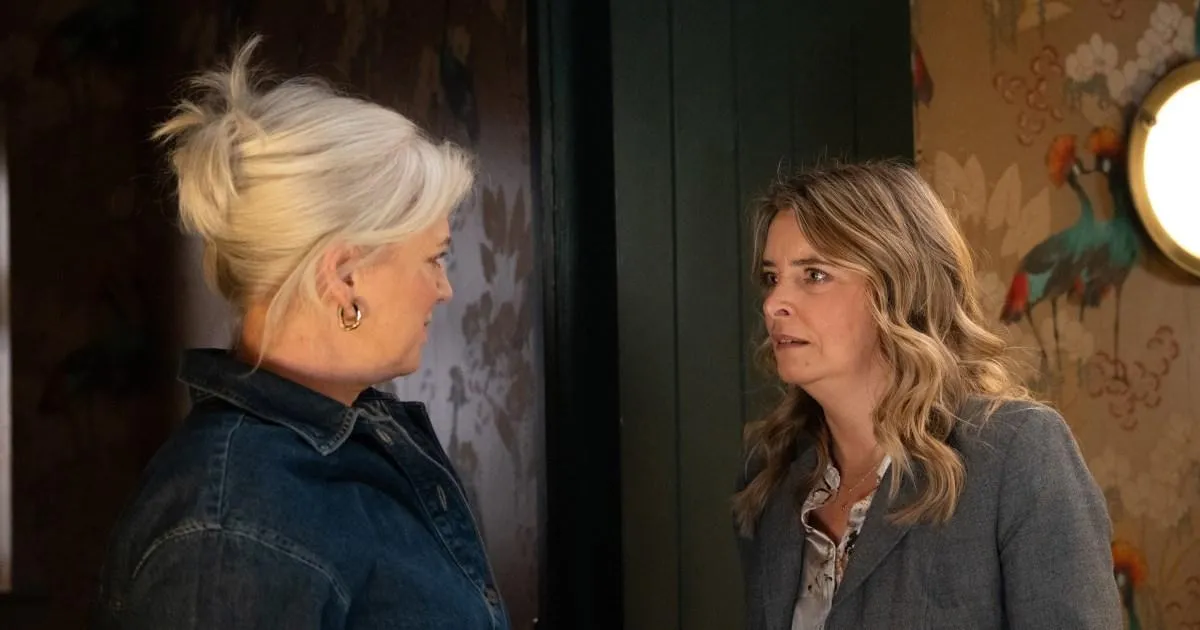
Arriving in the pub, Doctor Todd took pleasure in telling Charity that it’s now going to take a six figure sum to keep the secret hidden about baby Leyla. Charity was absolutely horrified – but also knew that Caitlin was being completely serious.
Doctor Todd knows exactly what she wants (Picture: ITV/Metro)
Next week, it will feel as though the only option Charity has is to sell her shares in the pub. She heads to see Kim Tate (Claire King), aware that if she buys, Kim will give her the money within Doctor Todd’s timeframe.
Discussing these upcoming scenes, star Emma Atkins said: ‘She’s [Kim] like, “Why?” Charity’s not willing to divulge, she’s like, “You don’t need to know”. Kim’s like, “Oh, I think I do. Nobody in their right mind would sell their share of this great hub, the epicentre of the village, why?” “You don’t need to know,” and she will not let the guard down, she won’t let her mask slip.
‘She’s just suggesting that she wants less responsibility in her life, and obviously the audience will know why. So, yeah, she’s definitely suspicious. At the moment, I think she is the only one.’
Katie Price has left fans confused after appearing to backtrack on the travel ban imposed on her husband Lee Andrews, who is yet to leave Dubai and spend time in the UK
Daniel Bird Assistant Celebrity and Entertainment Editor
Despite Andrews, a British national, sending a video to Katie and the ITV team the night before, stating he was at the airport, he failed to show up for the interview. A furious Katie explained that Lee missed his flight saying his businesses are based in the United Arab Emirates.
Andrews, who claims he’s a multi-millionaire, later told his social media followers he was in Muscat Airport, waiting for a flight – despite appearing to actually be in Terminal Two of Dubai International Airport.
Advertisement
Katie told GMB hosts Susanna Reid and Ed Balls that her husband didn’t have a travel ban – despite the programme informing her that a Foreign and Commonwealth Office spokesperson had confirmed they had offered assistance to a British man detained in the United Arab Emirates.
However, despite Katie saying Lee didn’t have a travel ban, she has backtracked on her comments from several weeks ago. Speaking on her podcast just four weeks ago, Katie was asked by her sister Sophie about Lee’s travel ban.
The former model said: “You can get a travel ban over anything in Dubai … a parking ticket, or if you owe a bill or something, electricity. You can get a travel ban after absolutely anything, like breathing the wrong way; they’re so strict.”
Advertisement
However, this week, Katie completely brushed off any concerns about Lee’s travel ban and instead, was hopeful that he will be in the United Kingdom next week. “I just want him here just to visit here and just to shut everyone up that he can get here that’s all,” she said on her podcast.
“So next week when we do the pod we’ll know if he’s come to England or not and see what is said. That’s all we need to say about Lee, there’s nothing really anymore I want to say about Lee. But yes, he’s made me look like a d******* and made himself look like a d*******. I was interrogated, which is fine, anyone can ask me questions, I can only answer the things I know.”
Advertisement
In the comment section, one fan said: “Surely, if there are zero issues, he’d jump on a plane, like the rest of us! The fact that he has lied about which airport he’s at and NOT arrived in the UK is proof enough that he’s using Kate.”
A second person wrote: “The roof on his video saying his in Muscat was the roof from Dubai airport!!” Another said: “Next week he still won’t be here! His travel ban won’t just vanish to shut everyone up.” Meanwhile, a fourth said: “Her sister is so wise to this b******t, Katie deserves so much more.”
Katie has since explained on social media that Lee would no longer be posting on his Instagram page. She wrote: “Due to all the madness of trolling, people’s speculation and media frenzy that as a married couple we have both decided @wesleeandrews is taking a break from social media and we are keeping things between us for now as it’s our life and marriage and are very happy.”
The wife of a U.S. Army sergeant has been released from federal immigration custody after a month-long detention, according to the office of U.S. Sen. Tammy Duckworth. Deisy Rivera Ortega’s release follows an intervention by the Illinois Democrat.
Her husband, Sgt. Jose Serrano, an active-duty soldier stationed in Texas who completed three tours in Afghanistan, had previously informed The Associated Press that immigration agents arrested Rivera Ortega on April 14. This occurred during an appointment with immigration services as she sought to advance her application for permanent residency.
Sen. Duckworth, a combat veteran herself, personally contacted Department of Homeland Security Secretary Markwayne Mullin on Wednesday to advocate for Rivera Ortega’s release. She was subsequently freed on Thursday evening.
The Department of Homeland Security (DHS), which oversees U.S. Immigration and Customs Enforcement (ICE), confirmed her release. A spokesperson stated: “Rivera-Ortega has been released from ICE custody with a GPS tracking device, mandatory home visits, and ICE office check-ins. She will receive full due process.”
Advertisement
According to the DHS, Rivera Ortega entered the U.S. illegally in 2016, and a judge issued a final order of removal for her in December 2019 (Joe Raedle/Getty Images)
The family of Rivera Ortega did not immediately respond to a request for comment.
Serrano, who is stationed in the Fort Bliss area, and Rivera Ortega have been married since 2022. According to the DHS, Rivera Ortega entered the U.S. illegally in 2016 and a judge issued a final order of removal for her in December 2019.
Rivera Ortega, who was employed by two hotels, held a military spouse ID card and a valid work permit, according to Duckworth’s office. She had been applying for the parole-in-place program designed to shield the immediate relatives of military family members from immigration enforcement as they took steps to adjust their legal status.
Last April, DHS eliminated a 2022 policy that considered military service of an immediate family member to be a “significant mitigating factor” in deciding whether or not to pursue immigration enforcement. The administration’s new policy states that “military service alone does not exempt aliens from the consequences of violating U.S. immigration laws.”
According to DHS, more than 100 immediate family members of military veterans have been placed into removal proceedings under the Trump administration’s mass deportation agenda.
Advertisement
Following public outcry and intervention from congressional leaders on both sides of the aisle, spouses of veterans and active duty U.S. soldiers have been released from federal immigration custody in some cases.
It was Saturday morning on May 2 when he mowed the lawn. Nothing unusual there – except it’s May – the month when we are not supposed to mow at all.
The annual No Mow May campaign, led by wildlife charity Plantlife, urges people to leave their mowers in the shed during May to allow grasses and wildflowers to flourish. I’m all for that – I will do almost anything to encourage nature. We’ve got wild areas all around the garden, birds nesting under our roof tiles, squirrels with their own feeding station, a wildlife pond, insect houses – you name it. But the lawn is another matter.
I like lawn to be lawn. Lush and green, preferably with stripes. Watching the Masters golf tournament at Augusta last month I stared longingly at the pristine, vibrant green acres. “Why can’t we have grass like that?” I asked my husband, before spending at least an hour Googling ‘lawn care’.
That resulted in a trip to Screwfix where I bought a raker and scarifier at a bargain price, with good reviews all round. After the mow it was put to use, de-mossing and raking. Then, on bank holiday Monday, we spiked it and scattered sharp sand before re-seeding.
Advertisement
I stare enviously at golf courses. (Image: Pixabay)
I worried for my sanity, after getting excited in shops, when faced with boxes covered in pictures of perfect lawns, accompanied by words such as ‘superior’, ‘thicker’ and ‘stunning’. Did I need Miracle-Gro? Of course. What about Speedy Speed? Definitely. Or Pure Green? By the time we left I felt quite light-headed.
Twenty years ago, before we moved to a house with a garden, I would have scoffed had anyone said I would become a lawn-obsessive. It’s something I have long associated with older men. My dad used to have conversations with passers-by about what setting he had the lawn mower on to keep his grass looking good. Now I am having similar chats with my neighbours.
One chap who lives nearby recently led me round the back of his house to reveal the most beautiful swathe of verdant grass. My jaw dropped. “What do you do to get this?” I asked, to be told it’s in the hands of professionals. I couldn’t wait to tell my husband. “Do you think we should get people in?” I asked him. He didn’t reply.
He isn’t on the same page as me regarding our lawn. He would be perfectly happy letting moss take over. “I like moss, and it’s a natural process,” he says. That’s all well and good, but I don’t want a moist, spongy, squelchy surface underfoot every time I walk across the grass, and aside from that, I genuinely like grass. I like the feel of it, it’s the perfect base on which to spread a rug or set up a picnic table. Moss isn’t.
Advertisement
So lawn it is, and it needed a cut. It’s not that I have completely disregarded No Mow May. Last year, against my wishes, we embraced it. We left the lawn unmown until June. When we finally got the mower out, it resembled the Serengeti. We needed a scythe. I also fretted about frogs and toads being hidden in the longer grass and mown over. With short grass at least we can see small creatures.
With its scarified patches, our lawn doesn’t look great at the moment, but I am sure it will be worth the effort and become the showpiece garden I dream of. I do worry for my sanity, however.
Lischinsky and Milgrim were leaving when the suspect fired 20 shots, killing them both, prosecutors allege. They were in a relationship and Lichinsky had bought an engagement ring, planning to propose to Milgrim on an upcoming trip to Israel, according to CBS News, the BBC’s media partner.
Summer, sun, and rail disruption await in London (Picture: In Pictures via Getty Images)
The capital’s key railway stations will close for three weeks this summer, spelling trickier travel through central London.
The UK’s massive and ageing rail network needs almost constant TLC, and most of it coincides with holiday seasons to avoid the brunt of disruption on commuters.
Upcoming major works will shut Charing Cross and Waterloo East stations next month for a chunk of 22 days.
Let’s take a look at what’s coming up and how you could best avoid the mayhem.
Advertisement
When are Charing Cross and Waterloo East closed?
The planned works will affect Waterloo East as the pedestrian bridge to Waterloo and other crossings will be upgraded (Picture: Maureen McLean/Shutterstock)
The stations will be closed from Sunday, July 26 until Sunday, August 16, along with some weekends on either side, Network Rail said.
The closure has been planned during the summer holidays to minimise disruption.
Why are Charring Cross and Waterloo East closing over the summer?
The closure is part of £20 million railway upgrades being carried out by the South Eastern Railway.
Engineers will have to replace around 1.2 miles of tracks on the 36-year-old track, which sees heavy usage, and this can be done only without trains running.
How busy are the London stations?
London Charing Cross recorded around 19.7 million journeys through its barriers in 2024/25, up from 17.7 million passengers the previous year.
Advertisement
Much smaller Waterloo East saw 6.8 million entries and exits in 2024/25.
They both pale in comparison to the UK’s busiest station, London Liverpool Street, which had 98 million journeys, followed by Waterloo with 70.4 million according to the latest figures.
Advertisement
They will also revamp sections of platforms at Charing Cross, and do structural repairs on the pedestrian bridge between Waterloo East and Waterloo stations.
Latest London news
To get the latest news from the capital, visit Metro’sLondon news hub.
Advertisement
Where are trains diverted to?
There will be no trains going to or departing from Charing Cross or Waterloo East, so passengers should plan ahead.
Trains will be diverted to other nearby stations, including London Victoria, during the closure (Picture: Reuters)
Southeastern services will be diverted to London Victoria, Cannon Street, and Blackfriars.
Scott Brightwell, the train services director on the South Eastern Railway, said: ‘By consolidating the work into 22‑day closure, supported by preparation and follow‑up weekends, we can complete the work more quickly and with less disruption overall than the alternative options of 60 weekend closures or four to five 9-day closures.
‘We have planned the closure for the summer, when passenger numbers are around 20 per cent lower and schools are closed, to help manage the impact on customers.
There are also Tube strikes in the pipeline, but they won’t coincide with the planned railway upgrades (Picture: Reuters)
Is there other travel disruption in London this summer?
A sweeping Tube drivers’ strike is set to go ahead next week between Tuesday, May 19 and Friday, May 22.
Another strike by Tube drivers who are members of the RMT is planned between June 16 and June 19.
The Scottish FA says referee John Beaton and his family “spent last night at home under police surveillance following a leak of personal details online”.
The association says that it is calling for “tolerance and perspective to prevent any further, unthinkable escalation”.
Beaton has faced criticism following the award of a late penalty, which was converted, in Celtic’s 3-2 win at Motherwell on Wednesday.
The incident at Fir Park, which involved VAR, was the latest in a series of controversial refereeing decisions as the Scottish Premiership title race reaches its conclusion.
Advertisement
Celtic’s win kept them within a point of leaders Hearts. Those two sides meet at Celtic Park in Saturday’s final top-six fixtures.
“The Scottish FA condemns in the strongest possible terms attempts to compromise the safety of match officials,” said the SFA, which organises refereeing in the SPFL.
“Such vigilantism, motivated by decisions perceived to be right or wrong on a field of play, is a scourge on our national game and we are grateful to Police Scotland for their swift intervention.
“As we approach what should be an exciting finale to the season, we ask those who have personalised and hyperbolised their opinions, those who have sought the easy way out by attributing defeats to perceived refereeing errors, and those who have approved incendiary statements and posts to reflect on their contribution to creating an environment of intimidation, fear and alarm.”
For more than two decades, I have studied a condition that shapes the lives of about 10-13% of women. This condition causes complex, wide-ranging symptoms such as irregular periods, excessive hair growth, weight gain, acne and difficulty getting pregnant.
Until a few days ago, I called it polycystic ovary syndrome, or PCOS. But from now on, I – along with my colleagues, doctors and patients – will call it something different: polyendocrine metabolic ovarian syndrome, or PMOS.
The renaming was announced in a consensus paper just published in The Lancet. It is the result of a process that has taken over ten years, involved more than 22,000 people across six continents, and brought together 56 patients and professional organisations.
Some readers will see “PMOS” and wonder why scientists have spent so much energy on changing just three letters. As one of the researchers involved, I want to explain why this small change is, in fact, a very big one – and why we hope it will lead to better care for patients.
Advertisement
A name that didn’t fit
The old name was a historical accident.
When the doctors who first studied the condition examined affected ovaries under the microscope – and later by ultrasound – they saw clusters of small, fluid-filled sacs they thought were cysts. So the label “polycystic” stuck.
But those structures are not actually cysts. They’re immature egg follicles that have stalled at an early stage of development. Crucially, many people who are diagnosed with PCOS (now PMOS) do not even exhibit these abnormalities in their ovaries.
The name “PCOS” focused attention on a part of the body that, for many patients, is the least of their problems. And it implied the condition was solely a gynaecological issue. In reality, it’s a complex hormonal and metabolic disorder that begins early in life and lasts a lifetime.
Advertisement
Decades of research, including work done in my laboratory at Karolinska Institutet, has shown that the condition involves a range of interacting disturbances.
Levels of male hormones (androgens) are often elevated in those with the condition. The brain’s signalling to the ovaries is altered. The body’s response to insulin is blunted as well, which is why people with the condition have higher rates of type 2 diabetes, obesity, fatty liver and cardiovascular disease. There is also an increased risk of depression, anxiety, sleep apnoea and endometrial cancer.
That is why the new name has three parts.
“Polyendocrine” reflects the multiple hormonal systems involved. “Metabolic” recognises the lifelong risk of diabetes and heart disease. “Ovarian” maintains the link to ovulation problems and infertility, which remain core features.
The consensus process behind the change was unusually rigorous. Patients and doctors from every world region were surveyed in successive rounds, with their answers shaping the options offered in the next round’s survey. More than 14,000 people, over half of them living with the condition themselves, voted on candidate names. The final agreement was reached in February this year.
Why a name matters for care
A name is not just a name. It tells doctors where to look, tells researchers what to study, and tells people with PMOS what to expect.
Under the old label, many women were told their symptoms were a fertility issue or a weight issue. Diagnosis took, on average, more than two years – and up to 70% of patients reported initially being dismissed or misdiagnosed before finally getting a diagnosis.
Few were warned about their lifelong increased risk of metabolic disease. In many parts of the world, care was fragmented among gynaecologists, endocrinologists, dermatologists and mental-health professionals, with no one taking responsibility for the whole patient.
Advertisement
With PMOS, the multi-system nature of the condition is now recognised in the name. I hope this means general practitioners will check insulin, blood sugar, blood pressure and mental wellbeing when examining and diagnosing patients – not only looking at their menstrual periods.
I hope as well that the condition’s name change means teenage girls, who often show the earliest signs, will be identified and supported sooner. And that researchers find it easier to secure funding to study the metabolic, cardiovascular and neurological aspects of the disorder.
The name change may also empower women living with PMOS in seeking a diagnosis or treatment.
The diagnostic criteria for PMOS remain the same. If you already have a PCOS diagnosis, it will now be referred to as PMOS. You won’t need to undergo any new tests or attend new appointments.
Advertisement
The transition will be phased in over the next three years through updated clinical guidelines, medical education and international disease-coding systems.
We have not solved this condition. There is still no cure, and the first-line treatment is still lifestyle change – supported when needed by medications such as hormonal contraceptives, metformin (which can help control blood sugar) and, more recently, GLP-1 receptor agonists (which can help with managing blood sugar and may also lead to weight loss).
But getting the name right is the foundation that everything else rests on. After almost a century of mislabelling, we finally have a name that matches the science. I hope this name that will help the 170 million women living with this condition get the care they have always deserved.




























































You must be logged in to post a comment Login