

Crypto World
Ripple’s Banking Partner, Cross River Bank, Emerges in Elon Musk’s X Money Stack


TLDR:
- Cross River Bank is listed as the issuer for X Money’s Visa Debit and Flex card beta products.
- The U.S. bank previously integrated Ripple’s payment protocol for cross-border transfers in 2014.
- No official material confirms XRP, RLUSD, or Ripple infrastructure inside X Money payments.
- X continues building its payments expansion through regulated banking and traditional card rails
Ripple-linked Cross River Bank X Money Visa Debit Card Beta is drawing fresh attention after leaked beta materials revealed a notable banking partner.
The development has renewed market focus on X’s payments expansion and Ripple’s long-standing banking relationships.
Cross River Bank Appears in X Money Beta Structure
As X continues to expand into payments, using a licensed banking partner, beta images linked to X Money show Cross River Bank as the issuer behind Visa Debit and Flex card products.
Many fintech companies rely on similar partnerships to issue cards, process payments, and manage deposits under regulatory frameworks.
Moreover, Visa integration suggests the product is built around familiar financial rails. Users would likely use standard debit functionality rather than crypto-native payment tools during the early rollout phase.
So far, the leaked materials only confirm the issuer relationship. There is still no public reference to blockchain settlement, digital asset functionality, or token-backed payments inside the beta environment.
The latest development is notable because payments remain central to Elon Musk’s long-term plans for X. A card-based financial product supports the broader goal of transforming the platform into a financial ecosystem.
Meanwhile, market participants continue watching for further disclosures. Future updates could provide more detail on account features, regional access, and possible expansion of X Money services.
For now, Cross River Bank’s presence remains the most concrete takeaway from the beta materials. That alone has been enough to spark fresh conversations across both fintech and crypto circles.
Ripple History Revives XRP Speculation
Attention around this rollout intensified due to Cross River Bank’s earlier relationship with Ripple. Back in 2014, the bank integrated Ripple’s payment protocol for faster international settlement flows between the United States and Europe.
That collaboration made Cross River one of Ripple’s earlier banking partners. Because of this history, the bank’s role inside X Money quickly triggered renewed discussion among XRP traders and market analysts.
However, the historical link does not confirm current integration, and no verified XRP support exists within X Money’s card or payment infrastructure at this stage.
This distinction remains important. Debit card systems can function entirely through banking rails without relying on XRP, RLUSD, or blockchain-based settlement mechanisms.
Still, the overlap is enough to keep the crypto market interested. X’s broader payments ambitions naturally create speculation whenever familiar digital asset names enter the conversation.
XRP traders continue monitoring whether future X Money disclosures introduce blockchain-linked features. Until then, the story remains centered on infrastructure rather than token adoption.



The broader crypto market may be experiencing bearish conditions, but XRP whales appear to be in a league of their own. Latest on-chain data suggests this cohort of investors is selling fewer tokens on exchanges, raising the question of whether they are becoming more confident in the asset.
According to an analysis by CryptoQuant researcher Pelinay, decreased selling from XRP whales, coupled with stronger demand, could trigger a rally and help the sixth-largest cryptocurrency revisit the $1.8-$2 range.
Binance Records Subdued Whale Inflows
Pelinay’s analysis cited data from the world’s largest crypto exchange, Binance. Transfers of more than 1 million XRP started to decline in 2025 and have maintained that trend this year. Before the decline began, these forms of transfers were dominant on charts during certain periods, reflecting huge inflows from whales and institutional addresses.
The inflows remained consistently high between 2021 and 2025, indicating that most of these market participants used Binance.
After a 2025 peak, the 1 million+ XRP inflows began to slow down, reflecting weakening selling pressure from large holders. The decline intensified after U.S. authorities approved spot XRP exchange-traded funds (ETFs), indicating a reduced willingness among whales to offload their holdings.
XRP Price Still Down
Evaluating historical data, there is a clear trend of sharp spikes in the 100,000-1 million XRP and 1 million+ XRP inflows preceding major market downturns. This means inflows from these investor cohorts have increased selling pressure to the point where the asset takes major hits.
“At the far right of the chart, no such extraordinary surge is currently visible. As a result, on-chain data does not point to aggressive whale selling or widespread profit-taking at this stage,” Pelinay stated, referring to the Binance XRP inflow chart.
Although whales have been selling less XRP since 2025, the asset’s price has still retreated from the $3 region. At the time of writing, XRP was trading around $1.10, down 10% weekly and 5% in 24 hours. Pelinay attributed this price movement to leverage liquidations and broader market weakness due to the bear cycle.
At the end of the day, XRP can only climb higher if demand becomes stronger and inflows into Binance remain poor. This is because the available supply will continue to decrease while demand accelerates.
“As long as there is no renewed surge in the 1M+ XRP inflow category, this constructive market structure may remain intact,” the analyst added.
The post Ripple Whales Refusing to Sell? Why Declining Binance Inflows Could Boost XRP to $2 appeared first on CryptoPotato.
Crypto World
The U.S. CPI scenario that could send the BTC price tumbling below $60,000: Crypto Daily
Bitcoin is wobbling near $61,000 and data due later today could push it over the edge along with the wider crypto market.
The U.S. consumer price index for May is due to hit the wires at 8:30 a.m. ET. The figure is expected to show the cost of living in the world’s largest economy rose 4.2% year-on-year, a three-year high, following April’s 3.8% reading, according to Reuters.
That would put inflation more than two full percentage points above the Fed’s 2% target. Concerns the Fed is likely to raise interest rates are already weighing on bitcoin, and more evidence is likely to send the largest cryptocurrency even lower.
That said, bitcoin’s reaction will depend less on the headline figure and more on what’s underneath it.
The key question is whether inflation broadened across multiple categories or remained concentrated in energy. If it’s the latter, markets may well dismiss the print as a transitory effect of the first-quarter spike in oil prices driven by the war with Iran.
This looks plausible given the CBOE Oil Volatility Index (OVX) has already cooled to pre-war levels and WTI crude fell over 16% to $87 a barrel last month. It continues to trade around those levels.
“A 0.3% MoM core inflation reading (consensus est.) could prompt a small initial rally in rates, if driven by transitory factors (e.g., fuel surcharges),” MUFG Research said. “But if inflation broadens out, it will impact a market already on edge triggering a minor sell-off.”
For bitcoin traders, a hotter-than-forecast figure across several sectors raises the probability of a break below $60,000. According to CME Fed fund futures, traders are already pricing in a year-end rate at least 25 basis points higher than the current 3.50%-3.75% range.
A downside surprise, on the other hand, could trigger a relief rally, especially given BTC is looking oversold on key indicators, such as the RSI.
Either way, volatility is likely to be elevated. The direction is the CPI’s to decide. Stay alert!
Read more: For analysis of today’s activity in altcoins and derivatives, see Crypto Markets Today . For a comprehensive list of events this week, see CoinDesk’s “Crypto Week Ahead.”
What’s trending
Today’s signal

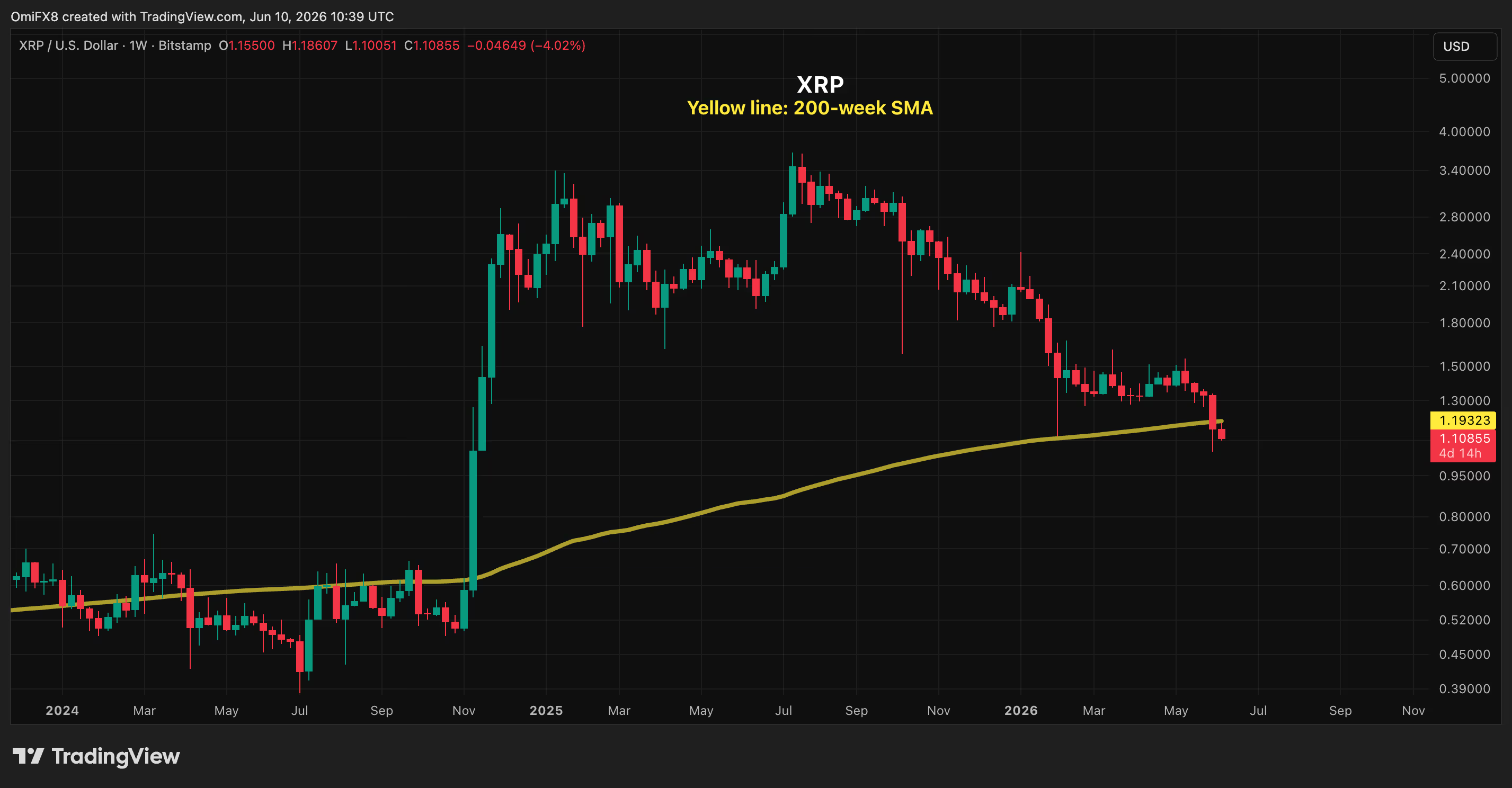
The chart shows XRP’s weekly price action in candlestick format since late 2023.
Prices for the payments-focused cryptocurrency have dipped below their 200-week simple moving average (SMA) in a sign of a deepening bear market. This puts XRP at a disadvantage relative to bitcoin, which is still trading around its 200-week SMA.
The breakdown signals there’s potential for a deeper slide toward next support at $0.95, the high hit three years ago. This is the level where sellers overpowered buyers in July 2023, reversing the bounce at that time.

Anthropic has released the first public version of its Claude Mythos-based model under the Fable 5 banner, a move that has crypto users weighing the potential for powerful AI-driven vulnerabilities against the safeguards designed to mitigate misuse. Even with embedded guardrails, industry participants worry that such capable AI could lower the barrier to discovering and exploiting weaknesses in crypto systems.
Anthropic disclosed last month that its Mythos family had identified more than 10,000 high- or critical-severity vulnerabilities in “systemically important software,” a claim that has sharpened scrutiny over a public release. On Tuesday, the company asserted that Fable 5 is “made safe for general use” and includes safeguards that reroute sensitive topics—such as cybersecurity—to a separate model, Claude Opus 4.8. Yet Anthropic acknowledged, “Releasing a model this capable comes with risks. Without safeguards, Fable 5’s capabilities in areas like cybersecurity could be misused to cause serious damage.”
The crypto community’s reaction has been cautious at best. As AI-driven tooling increasingly targets crypto platforms—sometimes enabling rapid reconnaissance, vulnerability discovery, or operational manipulation—analysts point to empirical hacks and loss data to illustrate the stakes. In April, the total value stolen in crypto hacks reached $629.7 million, the highest monthly tally since February 2025, a development analysts linked—at least in part—to advancing AI-assisted attack methods.
Key takeaways
- Anthropic publicly released Claude Mythos’ Fable 5, the latest high-capability iteration offered for general use, with safety rails that redirect sensitive cybersecurity inquiries to Claude Opus 4.8.
- The company emphasizes safety, but warns that powerful models can still be misused to exploit crypto ecosystems if proper defenses are not maintained.
- Crypto practitioners express persistent concern: tools that lower the cost and skill barrier for bug discovery could transform both defensive audits and offensive exploits, particularly in DeFi.
- Industry voices offer a spectrum of views—from alarm about increased attack surface to skepticism that Mythos’ bug-hunting prowess will translate directly into more DeFi exploits.
- Anthropic plans restricted access for a small group of cybersecurity and infrastructure providers to Mythos 5 with safeguards lifted in certain areas, highlighting ongoing debates about governance and exposure.
Public release and guardrails: what changes for crypto researchers and hackers?
Fable 5 represents the publicly accessible layer of Claude Mythos, designed to operate alongside the company’s existing guardrails. Anthropic’s framing suggests that while the model is powerful enough to analyze complex software and generate insights, it deliberately channels cybersecurity-related queries away from the main assistant toward a protected variant. The aim is to balance broad usability with risk containment, particularly given the sensitive nature of security research and the potential for dual-use applications.
However, the topic remains contentious in crypto circles. The release has revived conversations about whether publicly available AI tools should be trusted to surface critical weaknesses or inadvertently enable attackers to automate reconnaissance, vulnerability analysis, and even exploit development. The tension is stark when viewed against recent threat data and the rising sophistication of AI-assisted security testing.
Voices from the frontlines: competing assessments of risk
Simon Dedic, founder of Moonrock Capital, captured the unease in a series of posts, arguing that Fable 5 could dramatically lower the cost and skill required to identify exploitable flaws in smart contracts. “For DeFi, this should be a massive wake-up call. Unaudited protocols will become sitting ducks. Known exploits will get replayed on forks around the clock. Even small projects will get targeted simply because trying costs next to nothing now,” he wrote online. The implication is that the barrier to finding and exploiting bugs could shrink, potentially accelerating both defensive and offensive cycles in DeFi security.
Not all voices share that alarm. Curve Finance co-founder Michael Egorov offered a more tempered view, suggesting that Mythos’ track record of finding bugs in other software might not seamlessly translate to discovering vulnerabilities in DeFi smart contracts. He noted that the scale of code in the targeted software matters: Mythos identified vulnerabilities in software with millions of lines of code, whereas smart contracts in DeFi are typically much smaller. “Both humans and ‘usual’ AI perfectly fit that code in context and can reason well about it,” he said, signaling that the direct translation of Mythos’ strengths to DeFi threats may be overstated for now.
Beyond DeFi-specific concerns, Egorov warned of broader operational-security vectors, such as compromised multisig keys or supply-chain attacks on frontend dependencies, which could become more prevalent in a world where AI-assisted analysis accelerates vulnerability discovery. He argued that while the risk landscape would inevitably shift, outright catastrophic DeFi hacks might not materialize in the same fashion as large-scale software breaches.
Context: Mythos findings in the wider ecosystem
May’s disclosures from Anthropic highlighted Mythos’ breadth of capability, revealing thousands of critical findings in important software via Project Glasswing. In the realm of open-source software—which underpins a significant portion of crypto protocol infrastructure—Mythos reportedly identified around 6,200 high- or critical-severity vulnerabilities across more than 1,000 projects. This backdrop underscores the tension between openness, speed, and security in crypto engineering, where open-source components are ubiquitous and critical to security posture.
For crypto projects, the takeaway is not simply a warning about AI-powered bug hunting but a prompt to rethink defense-in-depth, vetting processes, and the governance of open-source dependencies. If an AI model can surface vulnerabilities across diverse systems rapidly, project teams may need to raise their security bar for code audits, dependency management, and prompt patch adoption, while also considering privileged access controls and wallet-security hygiene in day-to-day operations.
Access, governance, and the path forward
Anthropic confirmed that a “small group” of cybersecurity and infrastructure providers would gain access to Claude Mythos 5—the same base as Fable 5 but with safeguards lifted in limited areas. This approach aims to balance the broader public utility of the model with controlled exposure, allowing vetted institutions to push the boundaries of security research while preserving guardrails for the general user base. The arrangement mirrors ongoing debates within the AI and crypto communities about who should have access to powerful tools and under what conditions.
The conversation remains unsettled as the industry weighs potential benefits—accelerated discovery of vulnerabilities, improved security tooling, and more robust defensive capabilities—against risks like misuse, privacy breaches, or unauthorized system manipulation. The evolving dynamic invites further scrutiny from regulators, platform operators, and developers who must balance innovation with responsible stewardship.
For crypto stakeholders, the immediate takeaway is pragmatic: while powerful AI like Mythos can accelerate security work, it also intensifies the need for disciplined operational security. Practitioners are advised to maintain best practices—revoke unused wallet approvals, reduce exposure by minimizing on-chain value during high-risk experimentation, and consider hardware wallet recovery and cold-storage measures during periods of heightened AI-assisted threat activity.
In the coming months, observers will watch how firms implement governance around AI-assisted security testing, how asset custodians adapt to emerging risk vectors, and whether regulatory bodies issue more explicit guidelines on the permissible use of advanced AI in crypto security research. The balance between enabling powerful tooling and safeguarding user funds remains the central question for builders, users, and investors navigating this evolving frontier.
As the AI-security narrative unfolds, readers should stay attuned to updates on who gains continued access to Mythos 5, how the guardrails evolve, and what concrete incident data emerges as crypto teams adapt to a world where AI-assisted vulnerability discovery becomes routine rather than exceptional.
TLDR:
- One compromised developer machine exposed seven private keys tied to Humanity Protocol’s infrastructure.
- The attacker drained 141M H from the ETH bridge and minted 300M H on BSC using stolen Safe owner keys.
- No smart contract bug was involved — every attacker action used legitimate, compromised private keys.
- The BSC H token remains unrecoverable as the attacker still controls the ProxyAdmin and can mint freely.
Humanity Protocol confirmed on June 9, 2026, that a single compromised developer machine was the source of a coordinated cross-chain attack.
An attacker obtained seven private keys from one infected device, enabling unauthorized control over critical protocol infrastructure on both Ethereum and BNB Chain.
The incident resulted in losses exceeding $31 million and a near-total collapse of the H token’s market value.
One Device, Full Protocol Access
The investigation confirmed that a developer’s machine was infected with malware, giving the attacker complete root access.
During the Humanity Protocol mainnet launch in approximately June 2025, several private keys were inadvertently backed up to that same device.
Those keys included the admin hot wallet key, three ETH Safe owner keys, and three BSC Safe owner keys — seven in total, all stored on one machine.
Founder Terence Kwok acknowledged the breach publicly, stating: “We’ve detected a security incident involving the compromise of private keys belonging to a member of the Humanity Foundation. As a precaution, please do not interact with the bridge or any liquidity pools until we confirm it’s safe.” The team added it was already working with security experts at the time of that statement.
Because all seven keys resided on one device, a single point of compromise handed the attacker full operational control. The attack was not the result of a smart contract bug.
Every transfer, Safe transaction, and proxy upgrade the attacker executed used legitimate credentials, making early on-chain detection nearly impossible.
Three Attack Vectors, One Stolen Key Set
The first attack began on June 8, 2026, when the attacker used the compromised admin hot wallet key to transfer 6,045,060 H tokens directly to an aggregation wallet on Ethereum. That transaction required no contract interaction — just a stolen key and a direct outbound transfer.
The second vector followed hours later. Using three of the six stolen ETH Safe owner keys, the attacker assembled an offline Safe transaction and transferred Bridge ProxyAdmin ownership to their own wallet.
They then upgraded the bridge contract to a malicious implementation and swept 141,182,632 H in a single transaction. The entire ETH bridge lockbox was drained within minutes of the ProxyAdmin transfer.
The third vector targeted BNB Chain. Three BSC Safe owner keys — a completely separate set from the ETH compromised keys — were also stored on the same device.
The attacker used those keys to seize the BSC ProxyAdmin by the same method, then called mint() three times, producing 100 million H per transaction.
On-chain analyst Specter flagged the early stages of the attack on X, writing: “It appears that wallets linked to, or that have interacted with, @Humanityprot are being compromised. So far, more than 17 wallets holding $H tokens have been drained, resulting in total losses exceeding $5 million.”
Total BSC mints ultimately reached 300 million H, pushing the pre-attack supply of 141 million to 441 million — a 213% increase.
What Was Saved and What Remains at Risk
Not all protocol infrastructure was affected. The ETH H token contract remained untouched throughout the attack, as its ProxyAdmin was controlled by a clean 4-of-7 Safe.
On June 9, that Safe successfully froze the ETH H token by upgrading it to an implementation that blocks all transfers. The canonical Arbitrum bridge, holding approximately 87 million H, also remained unaffected.
However, the ETH bridge and the BSC H token contract remain fully under attacker control. The BSC ProxyAdmin has not been recovered, and the attacker retains the ability to mint additional H tokens at any time. Around 21.74 million H also remained in the aggregation wallet as of June 9, pending liquidation.
The Humanity Protocol private key compromise reflects a human and operational security failure. The investigation report stated the attack “was made possible entirely by key compromise resulting from inadequate key storage practices,” noting that production-grade signing keys were backed up to a general-purpose development machine rather than isolated hardware.
The attack may have been planned well in advance, as the attacker held all seven keys before executing coordinated moves across two chains within a 15-hour window.

A coalition of crypto policy advocates has asked the U.S. Treasury to narrow a proposed AML and sanctions framework for stablecoin issuers under the GENIUS Act, warning that broad secondary-market obligations could disrupt permissionless blockchain infrastructures and the broader DeFi ecosystem. The Hyperliquid Policy Center (HPC) and venture firm Paradigm filed their joint comment this week, urging regulators to focus compliance on the primary market while taking a limited approach to secondary activity.
In their submission, the groups support FinCEN’s logic of concentrating obligations on issuers that hold customer information in the primary market, and applying a more restrained scope to secondary-market activity where issuers would only see wallets and transactions. They argued that the same principle should guide AML and sanctions requirements for stablecoins operating in permissionless environments, where visibility into end-users is inherently limited.
According to Cointelegraph, the Treasury’s April proposed rule aims to implement GENIUS Act provisions by requiring stablecoin issuers to have the capability to block, freeze or reject transactions that violate U.S. law or sanctions on both the primary and secondary markets. The HPC-Paradigm letter frames this as a potential overreach that could expand an issuer’s compliance perimeter beyond what is feasible or fair in a permissionless setting.
The authors contend that the proposed rule would sweep secondary-market activity into an issuer’s enforceable domain, a territory they say issuers cannot meaningfully police. They also warn that treating smart contract interactions as sanctionable activity—regardless of issuer relationships or visibility into the transacting parties—could create a chilling effect on open, programmable money and incentivize issuers to migrate away from open networks toward permissioned environments.
If such a shift were to occur, the groups warned, US-regulated stablecoins could retreat from decentralized finance, leaving a void filled by unregulated offshore or non-dollar alternatives. The argument reflects broader concerns among open-architecture advocates that heavy-handed compliance obligations in the secondary market would erode the openness of DeFi protocols.
Key takeaways
- The HPC-Paradigm coalition urges the Treasury to tailor GENIUS Act AML/sanctions rules to emphasize primary-market obligations for issuers, with a limited role for secondary-market enforcement.
- Proponents warn that sweeping secondary-market coverage would be difficult for issuers to police in permissionless networks and could penalize smart contract interactions without issuer visibility.
- There is concern that aggressive secondary-market rules could push stablecoins toward permissioned environments, undermining DeFi and potentially creating non-dollar or offshore alternatives.
- The GENIUS Act was signed into law last year, with implementation expected by January 2027; regulators and lawmakers are still refining related rules, including ongoing CLARITY Act discussions in the Senate.
Regulatory context and the path forward
The letter from HPC and Paradigm sits within a broader regulatory discourse on how to regulate stablecoins, open networks, and DeFi without compromising financial integrity or innovation. The GENIUS Act directs stablecoin governance and enforcement considerations, while federal agencies map granular implementations across primary and secondary markets. In parallel, a larger crypto policy debate is unfolding in Congress around the CLARITY Act, which would address platform-liability for developers and potentially set boundaries on money-laundering and sanctions enforcement for open-architecture protocols. Some lawmakers are pressing for a Senate vote on the CLARITY Act before the next elections, signaling that policy alignment remains unsettled as timelines approach the January 2027 milestone.
From a regulatory perspective, the debate underscores a tension between robust enforcement capabilities and preserving the open, permissionless nature of digital assets. Institutions and regulated entities—exchanges, banks, and other market participants—are watching how regulators translate GENIUS Act provisions into concrete, risk-based requirements. The debate also touches on wider questions about licensing, supervisory oversight, and the balance between on-chain transparency and the practical limits of identifying end-users in permissionless ecosystems.
For policymakers, the central issue is how to deter illicit finance and sanctions evasion without undermining innovation or driving activity into opaque or offshore channels. For regulated firms, the key concern is ensuring that compliance obligations are clear, proportionate, and enforceable in a way that aligns with existing AML/KYC frameworks and cross-border regulatory differences. The GenIUS Act and related proposals thus sit at the intersection of enforcement risk, open financial infrastructure, and the evolving architecture of digital assets.
Closing perspective
As the regulatory process unfolds, observers should monitor how the Treasury and federal agencies calibrate primary versus secondary-market obligations for stablecoins, and how that calibration might affect the openness of DeFi and the competitiveness of US-regulated issuers. The coming months are likely to reveal amendments aimed at balancing enforcement with the preservation of open, interoperable blockchain ecosystems.
Ethereum remains under significant selling pressure after losing a major support area and extending its decline toward the lower boundary of its broader trading range. While buyers have managed to defend the range lows for now, the market structure continues to favor the bears unless ETH can reclaim several key resistance levels overhead.
Ethereum Price Analysis: The Daily Chart
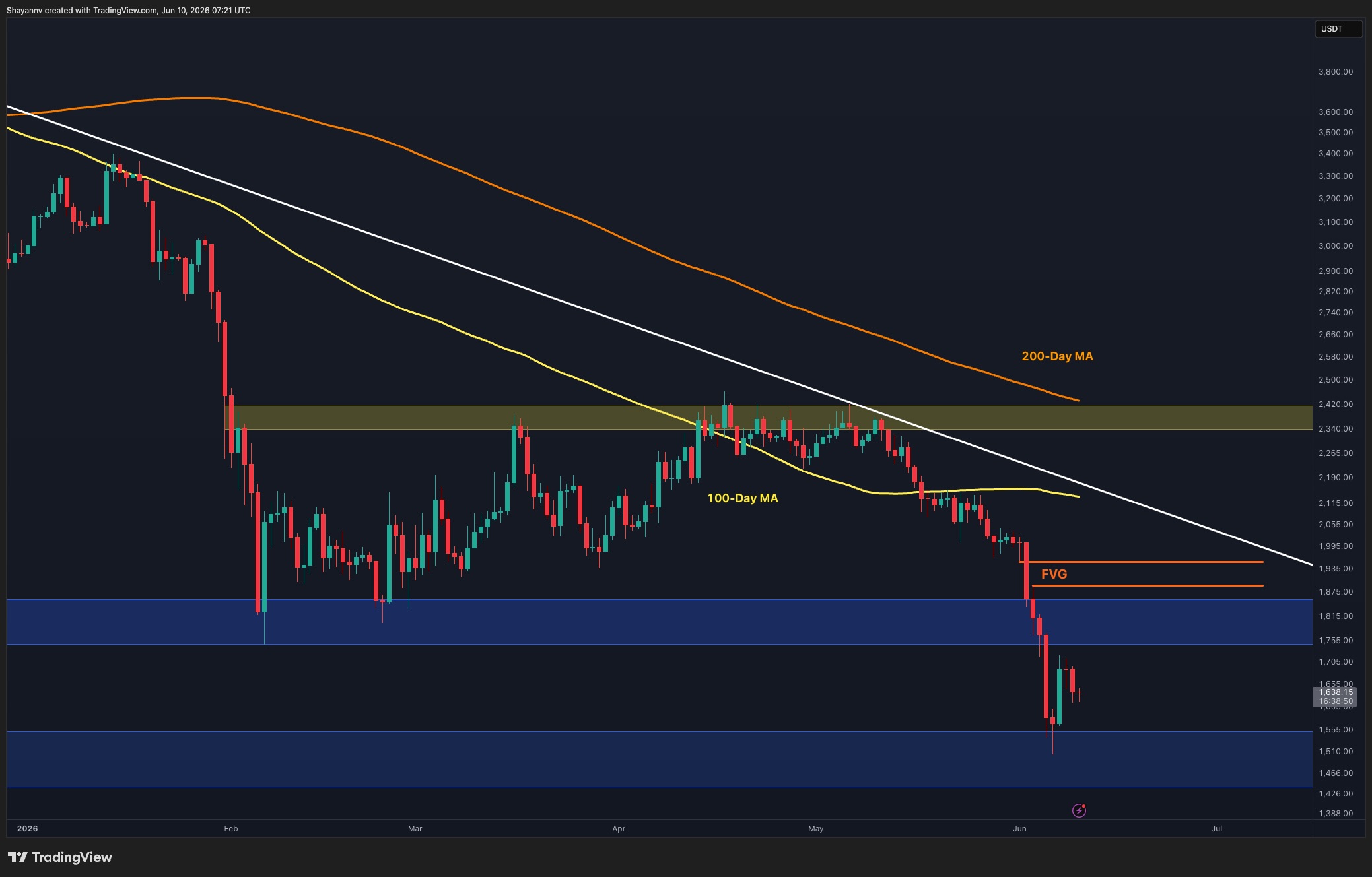
On the daily timeframe, ETH remains trapped within a broad range defined by the upper blue resistance zone around $1.75K-$1.85K and the lower blue demand area near $1.45K-$1.55K.
The recent breakdown below the upper range support marked an important structural shift. ETH lost the $1.8K region and quickly dropped into the lower portion of the range, eventually finding demand just above the lower blue box around $1.5K. The sharp rejection from that zone confirms that buyers are still defending the range floor, preventing a deeper bearish continuation for now.
However, the broader trend remains weak. The asset continues to trade beneath the descending long-term trendline as well as the 100-day and 200-day moving averages, all of which are sloping lower. This alignment suggests that sellers still maintain control despite the recent bounce.
As long as ETH remains between the two blue zones, the market can be viewed as range-bound rather than trending. The lower blue box around $1.45K-$1.55K remains the primary support area, while the upper blue box around $1.75K-$1.85K now acts as the first major resistance.
ETH/USDT 4-Hour Chart
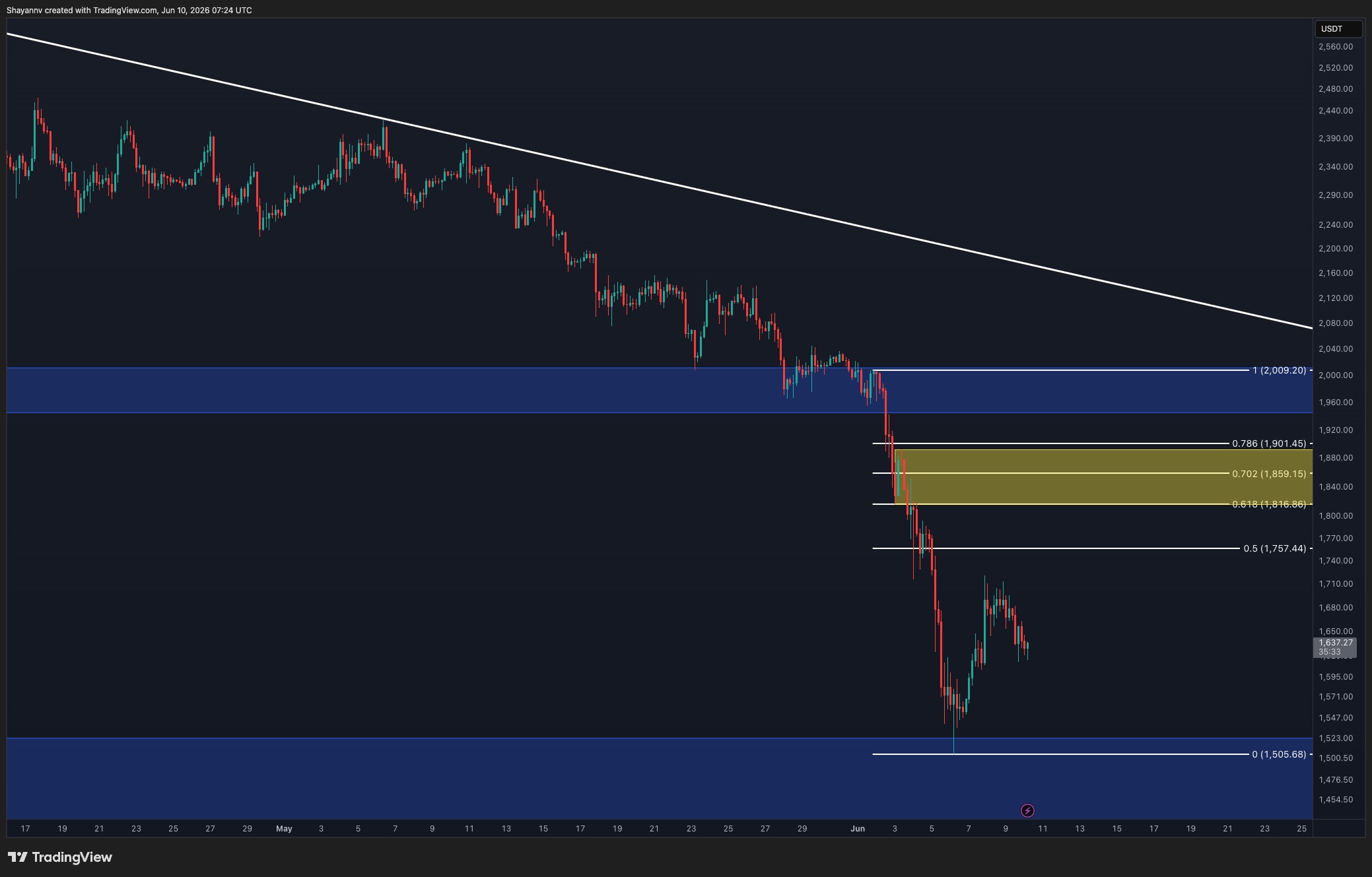
The 4-hour chart provides a clearer view of the recent capitulation and subsequent rebound. After breaking below the $2K support area, ETH experienced an aggressive sell-off that drove the price directly into the lower daily demand zone. The recovery that followed appears corrective so far, with the asset still trading beneath several important Fibonacci retracement levels derived from the latest decline.
The key area to watch is the Fibonacci resistance cluster between $1.82K and $1.9K. This zone contains the 0.618 retracement around $1.82K, the 0.702 level near $1.86K, and the 0.786 retracement around $1.9K. The concentration of these levels creates a notable supply region where sellers may attempt to re-enter the market.
Given the current structure, a continued relief rally toward this Fibonacci cluster appears possible before the next major directional move develops. Such a pullback would also align with the previous breakdown area, making it a technically significant resistance zone.
If ETH is rejected from the $1.82K-$1.9K region, the recent rebound could ultimately prove to be a bearish retest within the broader downtrend. On the other hand, a decisive break above $1.9K would weaken the bearish structure and open the door for a move toward the $2K-$2.05K resistance region.
Sentiment Analysis
The Binance liquidation heatmap highlights a notable concentration of liquidity resting between $1.7K and $1.8K.
This liquidity cluster aligns closely with several technical resistance levels visible on the price charts, including the 0.5 Fibonacci retracement near $1.76K and the lower portion of the broader Fibonacci resistance zone extending toward $1.8K. Such confluence often attracts price action as the market seeks nearby liquidity pools before establishing its next directional move.
From a derivatives perspective, the presence of dense liquidation levels above the current market price suggests that a short-term liquidity-driven squeeze remains possible. A move into the $1.7K-$1.8K area could trigger a wave of liquidations and fuel additional upside momentum toward the higher Fibonacci levels near $1.86K-$1.9K.
As a result, the liquidation profile supports the possibility of a relief rally in the near term, although the broader trend remains bearish until ETH can reclaim the major resistance cluster overhead. The interaction between the $1.7K-$1.8K liquidity pocket and the Fibonacci resistance zone may ultimately determine whether the current rebound evolves into a larger recovery or merely another lower high within the prevailing downtrend.

The post Ethereum Price Prediction: How Close Is ETH to a Sub-$1.5K Breakdown? appeared first on CryptoPotato.
Crypto World
DeFi’s Middleware Revolution: The Invisible Layer Powering the Future of Decentralized Finance

Introduction
Decentralized Finance (DeFi) has evolved far beyond its early foundations of lending, borrowing, and token swapping. While much attention is often directed toward user-facing applications and blockchain infrastructure, a critical transformation is taking place in the middle layer of the ecosystem. This shift, commonly referred to as the middleware revolution, is creating the infrastructure that enables DeFi protocols, blockchains, and applications to communicate, automate, and scale more efficiently.
Middleware has become the connective tissue of decentralized finance, allowing complex systems to operate seamlessly while improving user experience, security, and interoperability. As DeFi continues to mature, middleware may prove to be one of the most important sectors driving the industry’s next phase of growth.
What is DeFi Middleware?
Middleware refers to the technology layer that sits between blockchains and end-user applications. Rather than directly interacting with the blockchain, developers can leverage middleware solutions to access data, execute transactions, manage automation, and connect across multiple networks.
In traditional software systems, middleware enables communication between applications and databases. In DeFi, middleware performs a similar role by simplifying interactions between decentralized applications (dApps), smart contracts, and blockchain networks.
Examples of DeFi middleware include:
- Blockchain indexing and data services
- Oracle networks
- Cross-chain communication protocols
- Automation and execution layers
- Identity and compliance infrastructure
- Developer APIs and SDKs
These services operate largely behind the scenes but are essential for delivering seamless decentralized experiences.
Why Middleware is Becoming Critical
1. Solving Blockchain Complexity
Modern DeFi users interact with multiple chains, liquidity pools, lending platforms, and yield strategies. Without middleware, developers would need to build custom integrations for every protocol and blockchain.
Middleware abstracts this complexity by providing standardized interfaces and data access tools. This allows developers to focus on creating innovative products instead of rebuilding infrastructure from scratch.
2. Enabling Cross-Chain Finance
The future of DeFi is increasingly multi-chain. Assets and users are distributed across ecosystems such as Ethereum, Solana, Base, Avalanche, Arbitrum, and many others.
Middleware solutions facilitate:
- Asset transfers between chains
- Cross-chain messaging
- Unified liquidity access
- Shared application logic
By enabling interoperability, middleware helps create a more connected and efficient financial ecosystem.
3. Powering Real-Time Data Access
Reliable data is essential for DeFi applications. Lending protocols, derivatives platforms, and trading systems all require accurate information to function effectively.
Middleware providers aggregate and process blockchain data, delivering:
- Price feeds
- Liquidity metrics
- Transaction history
- Portfolio analytics
- Risk management insights
Without these services, many DeFi applications would struggle to operate at scale.
The Rise of Automated Finance
One of the most significant developments within middleware is the emergence of automation layers.
These systems allow predefined actions to be executed automatically based on specific conditions. Examples include:
- Auto-compounding yield strategies
- Automated liquidations
- Dynamic portfolio rebalancing
- Scheduled token swaps
- Risk mitigation mechanisms
Automation reduces manual intervention and enables a more efficient financial experience. As artificial intelligence increasingly integrates with blockchain systems, middleware may become the operational layer through which autonomous financial agents execute decisions.
Middleware and the AI Economy
The convergence of AI and blockchain introduces new demands for infrastructure. AI agents require access to data, liquidity, execution services, and cross-chain communication.
Middleware is uniquely positioned to serve as the bridge between AI systems and decentralized financial networks.
Potential use cases include:
- Autonomous trading agents
- AI-powered treasury management
- Automated liquidity allocation
- Intelligent yield optimization
- Decentralized machine-to-machine payments
As AI-driven economies emerge, middleware providers could become foundational infrastructure for autonomous financial activity.
Key Benefits of the Middleware Revolution
Improved Developer Experience
Middleware significantly reduces development time by providing ready-made infrastructure components and APIs.
Greater Interoperability
Protocols can communicate across ecosystems without requiring users to understand the underlying technical complexity.
Enhanced Scalability
Applications can handle increasing transaction volumes and user demand through optimized infrastructure layers.
Better User Experience
Users benefit from faster, simpler, and more intuitive interactions with decentralized applications.
Accelerated Innovation
By lowering technical barriers, middleware enables developers to experiment with new financial products and services more rapidly.
Challenges Facing Middleware Providers
Despite its growing importance, middleware faces several challenges:
Security Threats
As middleware becomes a critical infrastructure layer, it becomes an attractive target for attackers. Security remains a top priority.
Centralization Concerns
Some middleware services rely on centralized components, which may conflict with DeFi’s decentralization principles.
Interoperability Standards
The industry still lacks universal standards for cross-chain communication and data sharing.
Regulatory Uncertainty
As middleware providers become more integrated into financial systems, regulators may seek greater oversight of their operations.
Addressing these challenges will be essential for long-term adoption.
The Future of DeFi Infrastructure
The next generation of decentralized finance will likely be defined not only by applications but by the infrastructure that powers them. Middleware is transforming from a supporting technology into a strategic layer that enables scalability, interoperability, and automation.
As blockchain ecosystems continue to expand and AI-driven financial systems emerge, middleware providers may become the unseen architects of the decentralized economy. Much like cloud computing became indispensable to the modern internet, middleware could become the foundational layer that powers the future of DeFi.
Determination
The DeFi middleware revolution represents a fundamental shift in how decentralized financial systems are built and operated. By connecting blockchains, applications, data sources, and automation layers, middleware is solving some of the industry’s most pressing challenges.
While often invisible to end users, these technologies are enabling a more interconnected, scalable, and intelligent financial ecosystem. As DeFi enters its next phase of evolution, middleware may emerge as one of the most valuable and influential sectors within the broader blockchain landscape.
REQUEST AN ARTICLE

Bitcoin price is barely holding its $61,000 level as a billionaire venture capitalist, Tim Draper, made a blunt prediction. According to him, quantum computers will compromise traditional banking infrastructure before they threaten Bitcoin.
Draper, a longtime BTC bull, believes that decentralized networks carry a structural advantage over legacy finance because they don’t depend on centralized cryptographic infrastructure. Modern banks secure everything from customer authentication, payments, interbank messaging, to trading and settlement. This is the encryption system that quantum hardware could theoretically break at scale.
JUST IN: Billionaire Tim Draper dismisses the quantum risk for Bitcoin: — Bitcoin Magazine (@BitcoinMagazine) June 9, 2026
"Bitcoin is more secure than the dollars sitting in your bank account"  pic.twitter.com/aRoKMoefrl
Bitcoin’s exposure is real but narrower, concentrated in its public-key signature scheme, not in its mining process. Critically, Draper’s argument hinges on Bitcoin’s open-source governance: if a quantum threat materialized, the network could, in theory, migrate to post-quantum signatures via a protocol upgrade.
Discover: The Best Crypto to Diversify Your Portfolio
Bitcoin Price Prediction: Identifying the Next Leg
Bitcoin seven-day range is spread at $59K to $71K, reflecting just how volatile the current macro environment remains.
Technically, BTC is in a defined consolidation band. The $60,000 level is, at the moment, acting as the strongest support. Momentum is neutral-to-cautious, but bearish sentiment is building in portions of the market, though the bearish trend “is not confirmed at all.”

BTC needs to reclaim $64,000 on volume, which opens a path toward the $65,000 target, or even more ambitious $83,000 estimate. Continued current compression would likely put it sideways in the $61,500–$63,000 band, with directional resolution pending a macro catalyst.
The quantum narrative does nothing to resolve next week’s chart. But it does strengthen the thesis that BTC’s structural security story is more durable than what critics say.
Discover: The Best Token Presales
Bitcoin Hyper Eyes Early-Stage Upside While BTC Grinds Through Resistance
BTC consolidating near $61,000 means the easy money from the last cycle has already been made. Waiting for a clean break above $64,000 while sitting on the sidelines is its own kind of risk. That’s the environment where early-stage infrastructure tends to attract serious attention.
Bitcoin Hyper ($HYPER) is positioning itself at the intersection of two of the most powerful trends in crypto: Bitcoin’s security narrative and Solana’s execution speed. Hyper is the first Bitcoin Layer 2 integrating the Solana Virtual Machine (SVM), delivering sub-second finality and low-cost smart contract execution on top of Bitcoin’s trust layer.
It’s a genuine technical differentiator, as it’s not just another L2 repackaging. The presale has raised $32 million at a current price of $0.0136, with staking available for early participants. A Decentralized Canonical Bridge handles BTC transfers natively across the network.
The post Bitcoin Price Prediction: Quantum Computing Will Crack Banks Before Bitcoin appeared first on Cryptonews.

Elon Musk’s SpaceX has unleashed a wave of mega-IPO activity, with early signals pointing to enormous demand that could redefine liquidity dynamics across tech, crypto, and growth equities. Reuters reports that SpaceX’s planned public offering could raise about $75 billion, valuing the private space-and-technology company around $1.8 trillion. Investor interest appears to be running close to four times the planned size, with more than $250 billion of demand cited in the early book-building stage. Pricing is expected later this week, leaving room for late orders from large institutional players as the process nears completion.
The scale of the demand has fed broader market chatter about the liquidity implications of a post-pandemic mega-IPO cycle. In a market already battling sharp volatility, the SpaceX story is being seen as a potential driver of capital allocation that could siphon liquidity from other risk assets, including technology equities and crypto markets, at least in the near term.
Key takeaways
- SpaceX’s IPO demand is approaching four times the planned $75 billion raise, according to Reuters, positioning the deal as potentially the largest public offering in history and valuing SpaceX at about $1.8 trillion.
- Pricing is anticipated on Thursday, with final orders possibly evolving as major investors finalize allocations in the closing stages.
- Markets are reacting with volatility: US tech shares have moved lower, and crypto markets have faced notable declines, underscoring how mega-IPO hype can influence broader risk appetite.
- Pre-IPO crypto products are surging in interest, as traders seek regulated-style exposure to high-profile private companies via perpetual futures and other synthetic instruments.
- Across crypto venues, volumes and open interest in SpaceX-related derivatives highlight growing appetite for pre-IPO bets, even as spot markets digest the wider macro moves.
SpaceX IPO and the liquidity crosscurrents for risk assets
The enormous interest in SpaceX’s IPO underscores a persistent demand dynamic for growth bets that remains willing to absorb sizable risk premia. If priced near the midpoint of expectations, the deal would cap a unique era in which a private company can command a market cap approaching the trillions, even as it continues to pursue ambitious ventures in satellite internet with Starlink and artificial intelligence initiatives claimed to target a multi-trillion-dollar opportunity.
Analysts have framed the SpaceX offering as a potential “liquidity squeeze” catalyst—especially for assets most sensitive to macro swings and sentiment shifts. As funds allocate capital toward the IPO, bets placed on other speculative holdings, including crypto and tech equities, could be tempered in the short term. One market observer described the dynamic as a classic pre-mega-IPO liquidity rotation: a wave of orders from long-only funds can pull liquidity out of correlated assets as the auction sets a new reference point for investors’ risk appetite.
“Oversubscription with massive orders confirms the hype, but that excitement is sucking liquidity out of correlated risk assets today, hitting crypto hardest because it’s the most retail-driven and sentiment-tied to growth/tech narratives.”
That assessment reflects a broader sense among market participants that SpaceX’s mega-offering is less a standalone event and more a stress test of how capital shifts between private valuation narratives and public-market risk assets. While the current wave is not universally construed as the onset of a broader bear market, several traders caution that near-term liquidity could continue to rotate away from more volatile corners of the market as the pricing process concludes and initial trading commences.
Pre-IPO derivatives: crypto venues capturing the hype
SpaceX’s future growth, driven in no small part by Starlink’s satellite broadband ambitions and its AI narrative, has extended into the crypto derivatives space. Platforms have moved quickly to offer pre-IPO exposure through perpetual futures and tokenized access, allowing retail and institutional investors to gain regulated-style exposure to a private giant before its public debut.
Binance, Coinbase, Kraken, and Bybit have all introduced pre-IPO perpetual products tied to SPCX, the SpaceX ticker, in what market participants describe as a rapid response to demand for early, regulated-style participation in high-profile private equities. Since launch, pre-IPO instruments tied to SPCX have generated substantial activity—and quickly. Binance executives noted that the product line has attracted strong early traction, with cumulative trading volume surpassing $2.1 billion in roughly 18 days and participation across more than 130 countries.
On the decentralized side, Hyperliquid has also seen meaningful activity. In the past 24 hours, the platform reported around $70 million in trading volume for its SpaceX pre-IPO synthetic futures, with the current price around $157—down from about $210 at the instrument’s launch. Open interest on Hyperliquid’s SPCX market has exceeded $115 million, and the prevailing market pricing implies a SpaceX valuation approaching $1.97 trillion by some traders’ models.
Shunyet Jan, head of spot and derivatives at Binance, told Cointelegraph that the robust early engagement for pre-IPO SPCX futures reflects growing user interest in gaining regulated-style exposure to high-profile private companies via native crypto products. The parallel surge in demand across centralized and decentralized venues signals a broader appetite for “private market access” through structured instruments that blend traditional finance with crypto-native execution models.
Market context: tech volatility, crypto correlation, and what comes next
The SpaceX IPO narrative comes at a time when broader tech equities have been volatile, and crypto markets have faced multiday drawdowns. In the week leading up to the pricing window, broader tech indices showed weakness, and crypto benchmarks had shed material value as risk appetite ebbed in parallel with equity rotations. Critics and advocates alike note that the SpaceX episode could serve as a benchmark for how aggressively markets price growth expectations into new offerings—and how quickly liquidity can realign once a mega-deal begins trading.
Market observers also stress that the ultimate impact on crypto depends on several moving parts: the pace of SpaceX’s IPO pricing, the degree of liquidity drawn from correlated assets, how quickly the public market allocates capital to SpaceX post-listing, and how investors gauge SpaceX’s long-term reiteration of its growth thesis—especially around Starlink and AI ventures.
For investors watching the immediate horizon, the key questions are whether SpaceX can sustain the implied growth narrative after listing, how the pricing aligns with execution risk, and whether the near-term liquidity rotation dissipates as markets settle into the new price discovery for SPCX. The dynamic also raises a broader question for crypto markets: will the appetite for pre-IPO exposure endure, and if so, how will liquidity conditions influence the pricing and risk management of these synthetic products?
As the week unfolds, readers should monitor the final pricing levels for SpaceX and the subsequent trading dynamics. If the IPO prices near the upper end of expectations, there could be a pronounced pullback in related risk assets in the immediate aftermath, even as longer-term investors reassess SpaceX’s valuation path. The evolving interplay between traditional markets and crypto-based derivatives will likely shape risk appetite for the rest of the quarter, particularly among retail participants who drive much of the sentiment-driven volatility observed in today’s markets.
What remains uncertain is how durable the SpaceX narrative will prove once it begins trading and how much of the current liquidity churn is transitory versus signaling a broader regime shift in risk tolerance. Traders and builders should watch not only the final price and initial trade activity but also how crypto platforms adapt to ongoing demand for private-market exposure as public markets digest SpaceX’s ambitious growth plan and AI playbook.
— Article notes and data overlap from Reuters and Cointelegraph coverage illustrate a moment when SpaceX’s IPO story is reshaping conversations across both traditional and crypto markets, with early indicators suggesting a longer arc of liquidity reallocation that observers will be watching in the weeks ahead.
Bitcoin price has fallen below $61,000 on June 10 as traders cut risk exposure ahead of the latest U.S. inflation report, extending a selloff that has already pushed the crypto asset more than 50% below its October 2025 record high.
Summary
- Bitcoin price fell below $61,000 ahead of the U.S. CPI report as traders reduced risk exposure amid inflation and Federal Reserve uncertainty.
- Elevated oil prices and escalating Middle East tensions added to inflation concerns, keeping pressure on risk assets.
- Technical indicators remain bearish, with analysts watching the $60,000 support level and $55,000-$50,000 as the next major support zone.
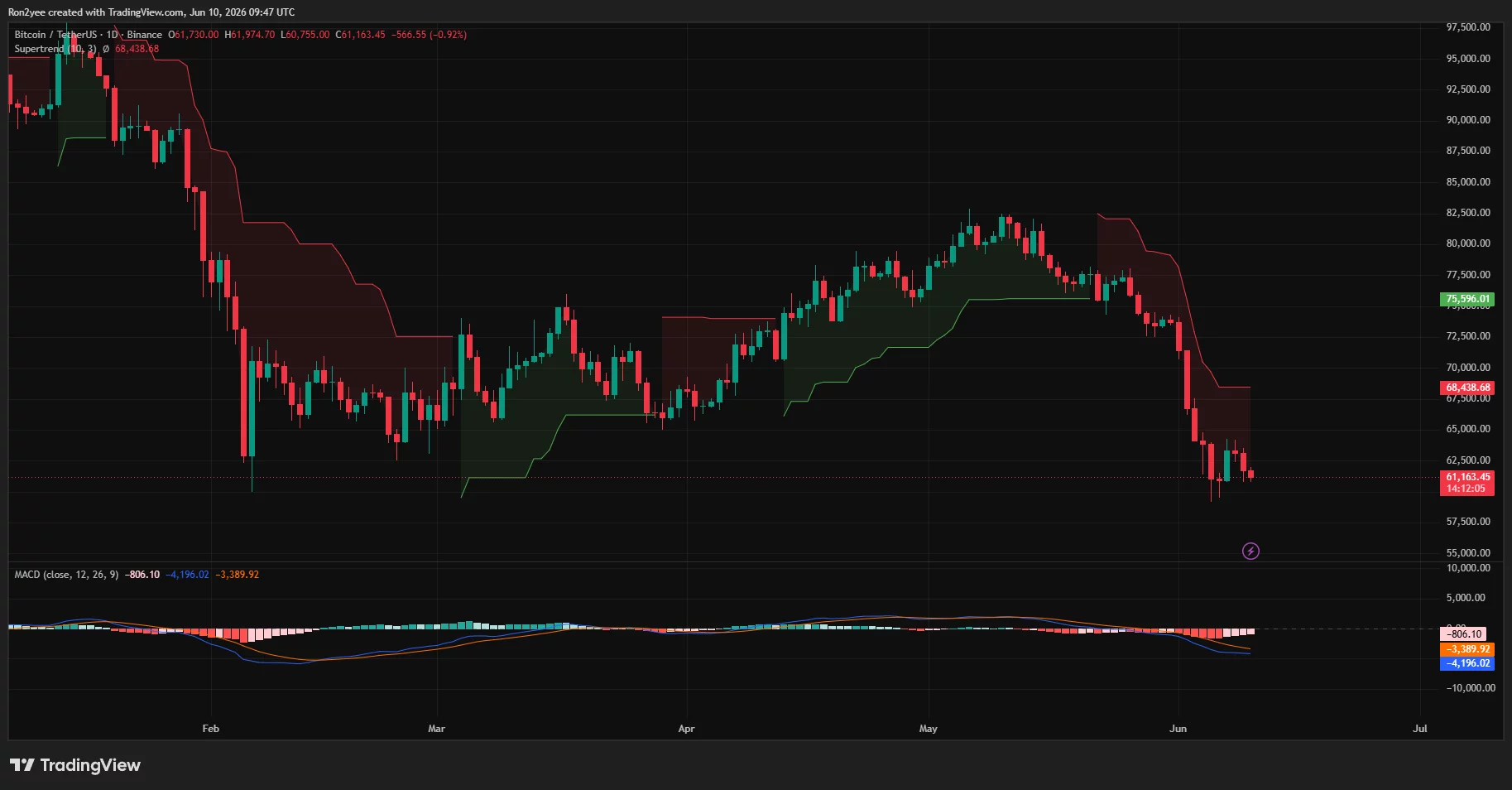
According to data from crypto.news, Bitcoin (BTC) price dropped to an intraday low of $60,755 before recovering slightly to trade near $61,200 at the time of writing. The decline came hours before the release of U.S. Consumer Price Index data, a report investors are closely watching after a series of stronger-than-expected economic indicators prompted markets to scale back expectations for Federal Reserve easing.
Futures markets have increasingly moved toward a higher-for-longer interest-rate outlook in recent weeks. Earlier economic releases, including labor market data that exceeded forecasts, encouraged traders to price in the possibility of rate hikes later this year rather than additional rate cuts, creating pressure across risk assets, including cryptocurrencies.
Inflation concerns and geopolitical risks weigh on sentiment
Adding to investor caution, oil prices remained elevated despite a sharp pullback on Tuesday. Crude oil traded around $88 per barrel on Wednesday as traders monitored growing tensions in the Middle East.
According to reports, Iran launched attacks on Bahrain, Jordan, and Kuwait after the United States carried out what it described as self-defense strikes following the downing of an American helicopter.
Energy markets have become a key focus because sustained strength in crude prices can complicate the inflation outlook. With CPI data due later in the day, traders appeared reluctant to increase exposure to volatile assets while uncertainty around both inflation and geopolitics remained high.
Institutional flows have also provided little support. Data from SoSoValue shows U.S. spot Bitcoin exchange-traded funds have experienced persistent capital withdrawals in recent weeks, removing billions of dollars from the sector and reducing a major source of demand that helped fuel previous rallies.
Weak demand conditions have also drawn attention from market participants. As previously reported by crypto.news, trading firm Wintermute said the lack of meaningful capital inflows continues to complicate efforts to identify a sustainable market bottom. According to the firm’s analysis, current buying activity remains insufficient to absorb persistent selling pressure across the market.
Wintermute also highlighted a notable liquidity gap between $50,000 and $59,000 on Bitcoin’s volume profile. The firm warned that if nearby support levels fail, the absence of significant trading activity within that range could increase the risk of a sharper move lower as sellers search for the next major area of demand.
At the same time, broader market sentiment has weakened as investors continue rotating away from speculative assets. Major equity benchmarks have also faced pressure amid rising Treasury yields and changing expectations for monetary policy.
Technical indicators point to critical support levels
Chart signals suggest Bitcoin entered the CPI event in a technically fragile position. On the daily timeframe, the cryptocurrency remains below a bearish Supertrend indicator, which currently sits near $68,400. The indicator flipped negative in late May and has yet to show signs of a reversal.
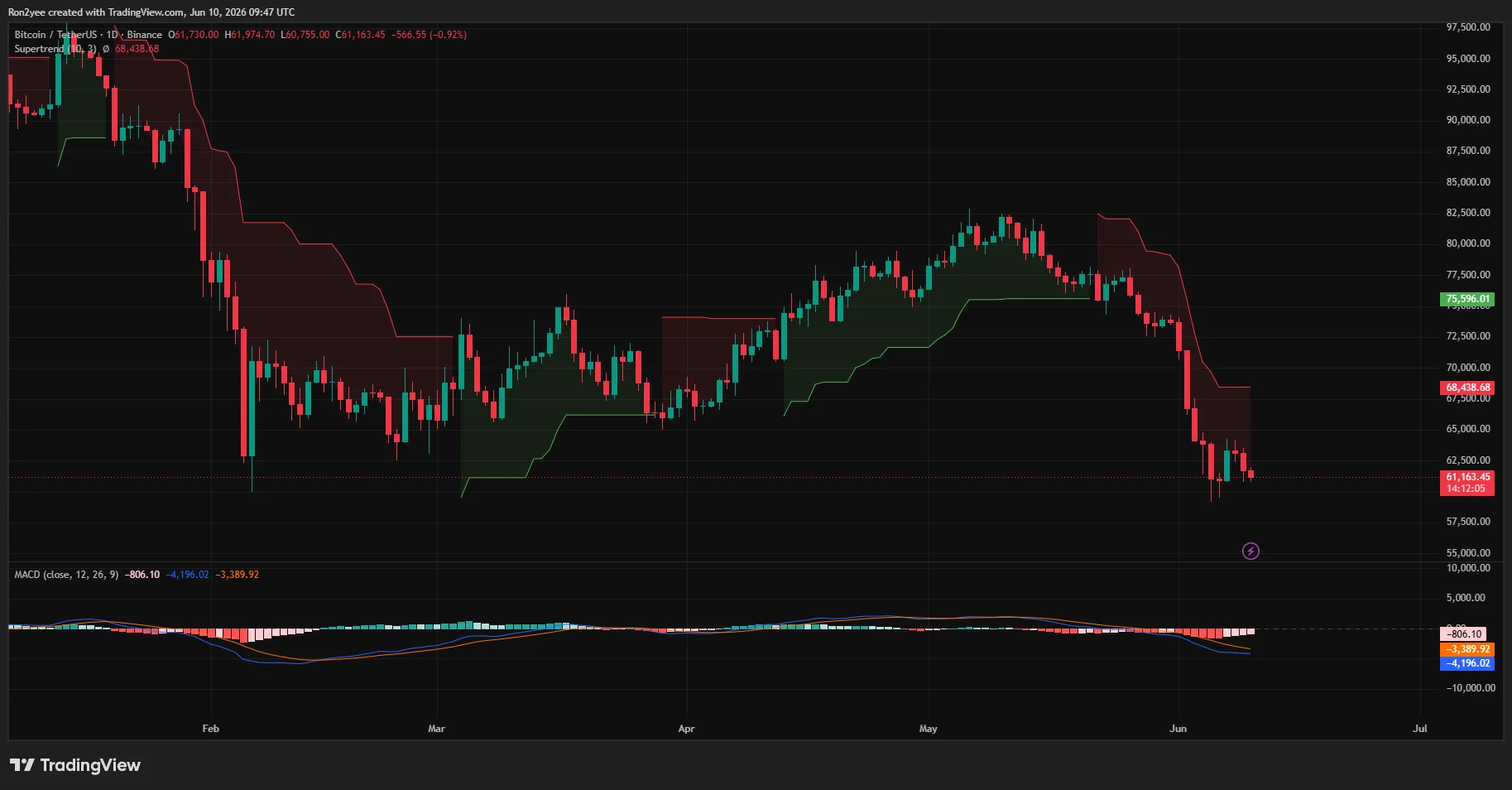
Daily price action has also produced a sequence of lower highs and lower lows since Bitcoin failed to hold above $80,000, a pattern often associated with sustained downtrends. Momentum indicators remain weak, with the daily MACD still below the zero line despite signs that selling pressure has eased slightly.
Commenting on the current setup, analyst Ted Pillows said Bitcoin could still experience a final liquidity sweep before attempting a recovery.
“A sweep of $60,000 zone could happen next, as stocks are showing weakness too. If $60,000 holds, then BTC will have a decent bounceback towards $65,000.”
Per the analyst, a failure to hold that support area could expose Bitcoin to another leg lower.
Meanwhile, fellow analyst Lennaert Snyder identified the previous day’s low near $60,800 as another important support level. Snyder noted that liquidity remains concentrated around $65,000 and above $68,000, though he maintained a bearish bias unless Bitcoin can reclaim nearby resistance zones.
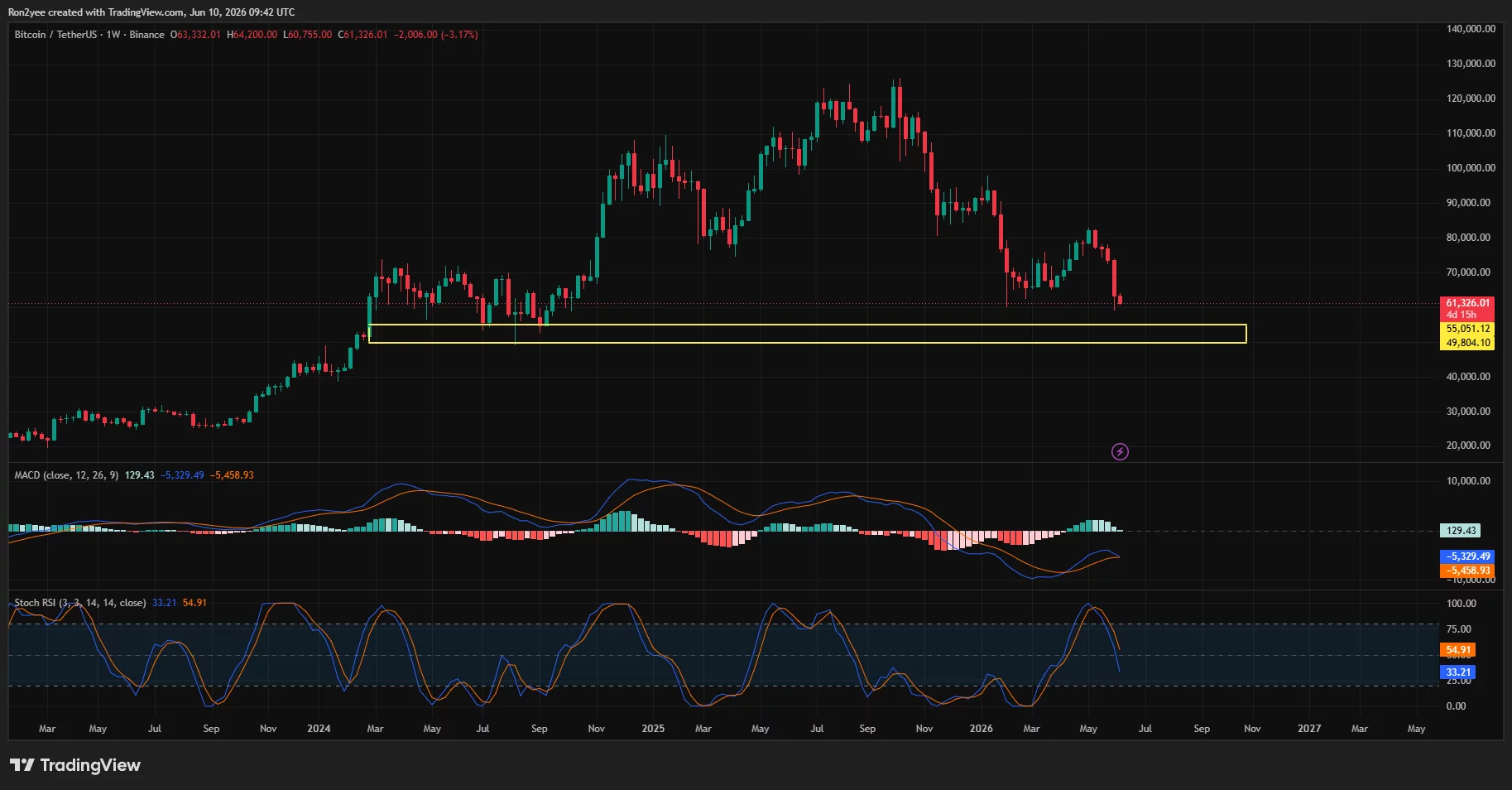
Longer-term indicators continue to highlight a larger support region between roughly $50,000 and $55,000. The weekly chart shows that the zone served as a major consolidation range throughout 2024. Should Bitcoin lose the current support area, traders are likely to monitor that range as the next major test of the asset’s market structure.
Disclosure: This article does not represent investment advice. The content and materials featured on this page are for educational purposes only.

Concord Biotech shares gain 6% after USFDA approval for Tofacitinib tablets
Ripple Whales Refusing to Sell? Why Declining Binance Inflows Could Boost XRP to $2

Meghan Markle Shares Glimpses of Home Life With Prince Harry



-

 Fashion5 days ago
Weekend Open Thread: Evereve – Corporette.com
-
 Crypto World5 days ago
Jensen Huang Approves Samsung, SK Hynix, and Micron for NVIDIA (NVDA) HBM4 Memory Supply
-

 Crypto World2 days ago
Anatomy of the June crypto crash: Fed, Iran, Saylor
-
 Entertainment3 days ago
The Best Mystery Series of All Time Is Surging on Streaming 30 Years After It Ended
-

 NewsBeat2 days ago
Alexander Zverev wins the French Open to finally earn a 1st Grand Slam title
-

 Tech4 days ago
Suspicious Polyfill login prompts pop up on Toshiba, Muji websites
-
Crypto World4 days ago
Senator Cynthia Lummis Calls CLARITY Act the Most Consequential Financial Legislation of This Generation
-

 Tech3 days ago
Microsoft unveils seven homegrown AI models in new bid for ‘long term self-sufficiency’
-

 Tech5 days ago
Microsoft launches MXC, an OS-level sandbox for AI agents, with OpenAI and Nvidia already on board
-

 Business5 days ago
(VIDEO) Justin Bieber Delivers Surprise Happy Birthday Serenade to Diners at Los Angeles Mexican Restaurant
-
 Business3 days ago
The Pain Points Taking a Fragile Tech Rally Down a Notch
-
Crypto World5 days ago
LBank Surpasses 25 Million Users Worldwide as AFA Partnership Continues to Drive Global Growth
-

 Crypto World3 days ago
Trump’s AI Ownership Plan Could Benefit Anthropic at OpenAI’s Expense
-

 Tech5 days ago
Meta steals a tactic from Tesla and builds data centers in tents
-

 Tech4 days ago
Von der Leyen’s AI envoy pick draws conflict-of-interest fire
-
 Sports19 hours ago
Bangladesh beat Australia after 20 years in ODIs, register only their second win over six-time world champions | Cricket News
-

 Business2 days ago
High Stakes for Wembanyama as New York Pushes for 3-0 Lead
-
 Crypto World2 days ago
Eli Lilly (LLY) Stock Surges 4% Following Breakthrough Sleep Apnea Trial Results
-

 Tech4 days ago
Hackers now exploit SolarWinds Serv-U flaw to crash servers
-

 Tech2 days ago
Notion restores access to Anthropic after service disruption
You must be logged in to post a comment Login