Cisco is warning that a critical Catalyst SD-WAN Controller authentication bypass flaw, tracked as CVE-2026-20182, was actively exploited in zero-day attacks that allowed attackers to gain administrative privileges on compromised devices.
CVE-2026-20182 has a maximum severity of 10.0 and impacts Cisco Catalyst SD-WAN Controller and Cisco Catalyst SD-WAN Manager in on-prem and SD-WAN Cloud deployments.
In an advisory published today, Cisco said the issue stems from a peering authentication mechanism that “is not working properly.”
“This vulnerability exists because the peering authentication mechanism in an affected system is not working properly. An attacker could exploit this vulnerability by sending crafted requests to the affected system,” reads the Cisco CVE-2026-20182 advisory.
Advertisement
“A successful exploit could allow the attacker to log in to an affected Cisco Catalyst SD-WAN Controller as an internal, high-privileged, non-root user account. Using this account, the attacker could access NETCONF, which would then allow the attacker to manipulate network configuration for the SD-WAN fabric.”
Cisco Catalyst SD-WAN is a software-based networking platform that connects branch offices, data centers, and cloud environments through a centrally managed system. It uses a controller to securely route traffic between sites over encrypted connections.
The company says it detected threat actors exploiting the flaw in May, but did not share any details regarding how it was exploited.
However, shared indicators of compromise (IOCs) warn admins to check for unauthorized peering events in the SD-WAN Controller logs, which could indicate attempts to register rogue devices within the SD-WAN fabric.
Advertisement
By adding a rogue peer, an attacker could insert a malicious device into the SD-WAN environment that appears legitimate. That device could then establish encrypted connections and advertise networks under the attacker’s control, potentially allowing them to move deeper into an organization’s network.
The flaw was discovered by Rapid7 while researching a different Cisco SD-WAN controller vulnerability, tracked as CVE-2026-20127, which was fixed in February.
CVE-2026-20127 was also exploited in zero-day attacks by a threat actor tracked as “UAT-8616” since 2023 to create rogue peers in organizations.
Cisco has released security updates to address the vulnerability and says there are no workarounds that fully mitigate the issue.
Advertisement
The company also recommends restricting access to SD-WAN management and control-plane interfaces to trusted internal networks or to authorized IP addresses only, and reviewing authentication logs for suspicious login activity.
CISA has added the Cisco CVE-2026-20182 flaw to the Known Exploited Vulnerabilities Catalog, ordering federal agencies to patch affected devices by May 17, 2026.
Indicators of compromise
Cisco is urging organizations to review logs from any internet-exposed Catalyst SD-WAN Controller systems for events that may indicate unauthorized access or peering events.
The company says that admins should review /var/log/auth.log for entries showing “Accepted publickey for vmanage-admin” from unknown IP addresses:
Advertisement
2026-02-10T22:51:36+00:00 vm sshd[804]: Accepted publickey for vmanage-admin from port [REDACTED PORT] ssh2: RSA SHA256:[REDACTED KEY]
Administrators should compare IP addresses in logs with the configured System IPs listed in the Cisco Catalyst SD-WAN Manager web UI, under WebUI > Devices > System IP.
If an unknown IP address successfully authenticated, administrators should consider the device to be compromised and open a Cisco TAC case.
Cisco also recommends reviewing SD-WAN Controller logs for unauthorized peering activity, as attackers may attempt to register rogue devices within the SD-WAN fabric.
Cisco strongly recommends upgrading to a fixed software release, as this is the only way to fully remediate CVE-2026-20182.
Advertisement
Automated pentesting tools deliver real value, but they were built to answer one question: can an attacker move through the network? They were not built to test whether your controls block threats, your detection rules fire, or your cloud configs hold.
This guide covers the 6 surfaces you actually need to validate.
Early talks have already taken place between the BBC and Channel 4.
BBC
In 1852, Marx wrote that historical events play out twice, the first time as tragedy, the second as farce. Sadly, he failed to countenance that some organizations need a third or fourth go around. Apropos of which, the Financial Times is reporting that, once again, the BBC has engaged in talks with Channel 4 with the aim of building a British alternative to Netflix. This “sovereign platform,” would pool content from the UK’s two major public service broadcasters on a single outlet. Of course, given that we’ve already seen aborted attempts to do this back in 2007 and 2017, history’s now repeating itself for a third time.
New BBC boss Matt Brittin told the government the BBC has “had a discussion with Channel 4” about some sort of streaming merger. Or, at the very least, bringing some Channel 4 content over to be shown on BBC iPlayer. Talks are at an early stage and there are an “array of commercial, audience, public service and technical issues” which would need to be addressed.” But Brittin stressed the need for the UK’s media players to team up to avoid being swept away by their larger American counterparts. He said Netflix, TikTok and YouTube have shown the importance of being big enough to survive. It’s one of the big reasons Sky is buying ITV to help grow its footprint to help lure viewers who would otherwise be lured away by the temptations of the infinite scroll.
Of course, this sort of thing seems to happen once a decade, and may likely continue until the heat death of the universe. Back in 2007, the BBC, Channel 4 and ITV developed Project Kangaroo, a Netflix-like service showing 10,000 hours of on-demand content from the trio’s vast back catalogs. Unfortunately, regulators stepped in to shut the project down, fearful that it would elbow out other names in the market. Then, in 2017, the BBC and ITV tried again, launching BritBox (initially overseas), only for ITV’s eternal turmoil to kill of the brand and pull its own content under the ITVX banner in 2024. If this third attempt doesn’t somehow wind up equally bungled, then we’ll see you all back here in 2036 or so for the fourth.
In the brief history of AI security, the prompt injection has quickly become the top threat. Large language models are inherently unable to distinguish between legitimate instructions provided by users and malicious ones sneaked into emails, source code, and other third-party content the models are processing. This makes it trivial to surreptitiously inject malicious commands that the LLM readily follows.
With no way to enforce this crucial boundary between trusted and untrusted sources, AI engine developers are left to erect elaborate guardrails designed to mitigate the damage rather than solve the root cause.
To date, most prompt injections have fallen into a class known as push, in which each potential victim is targeted. For example, the adversary injects malicious instructions into an individual email or calendar invitation. Because the injection must then be sent (or pushed) to each specific target, the scale of the attack is limited, hampering mass exploits that hit the Internet at large.
Meanwhile, pull-based attacks, in which an LLM actively seeks out the adversarial prompts planted on websites, remain limited. With no way to lure large numbers of LLMs to a malicious site, these sorts of attacks don’t scale either.
Advertisement
Enter HalluSquatting
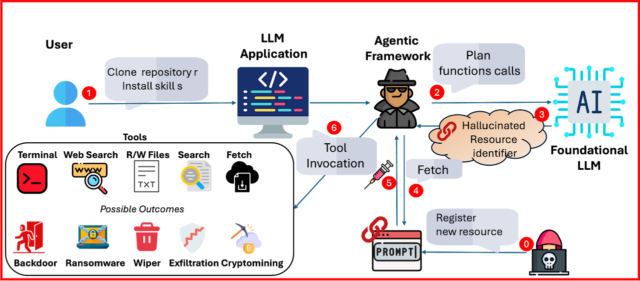
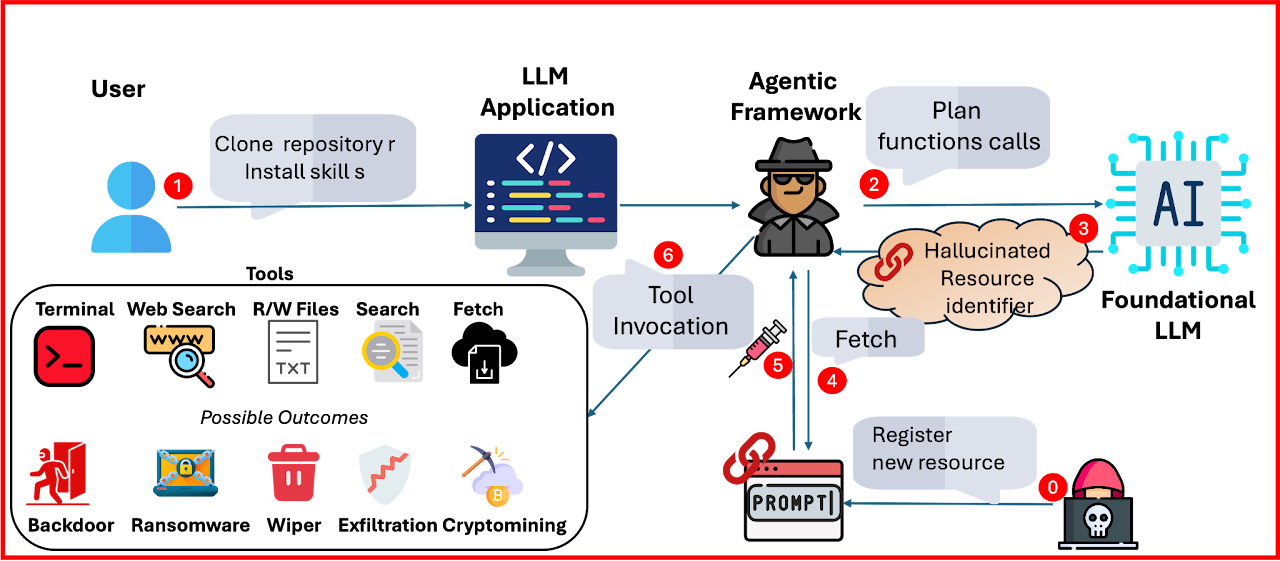
Now, researchers have devised a pull-based attack that changes all that. A new attack the researchers have named HalluSquatting has the potential to assemble massive botnets, perform large-scale DDoSes, and infect devices at scale, a first for prompt-injection attacks. The attack works against AI coding assistants and agents, including Cursor, Cursor CLI, Gemini CLI, Windsurf, GitHub Copilot, Cline, OpenClaw, ZeroClaw, and NanoClaw, which are all susceptible. In the normal course of performing day-to-day activities, these assistants and agents routinely pull code and other resources from repositories and registries.
The HalluSquatting threat model.
Credit:
Spira et al.
Advertisement
The HalluSquatting threat model.
Advertisement
Credit:
Spira et al.
Advertisement
Short for adversarial hallucination squatting, HalluSquatting is built on an LLM’s inherent tendency to hallucinate the resource identifiers hosted in repositories and registries. It works against coding agents and assistants, which commonly access high-privilege command lines to run code from third-party resources. By predicting the identifiers LLMs are most likely to hallucinate and then registering and seeding them with instructions to install reverse shells or other malicious wares, the attack can indiscriminately infect massive numbers of devices without having to target each one.
AI is scaling faster than any past tech boom, and it’s likely to produce an economic emergency — a moment when policymakers will suddenly accept big risks and big changes. The US isn’t ready.
These crisis windows open dramatically but close fast. In 2008 and 2020, near-universal cash payments and huge bailouts won bipartisan support, then vanished within months. Assuming AI will permanently shift politics toward generous policy is wishful thinking.
Today’s proposals fall short on both ends: AI labs offer sweeping ideas — sovereign wealth funds, portable benefits — with none of the detail legislation needs, while DC figures like Gina Raimondo push undersized fixes like retraining, too small for a transition that could wipe out whole categories of work.
Whoever has a detailed, ready-to-pass plan when the moment hits gets to shape it — the way TARP came straight from a “break the glass” plan drafted months earlier.
To be clear, at this point, my then-employer Vox had already sent everyone to work from home indefinitely, and it was clear something dramatic was happening. But I hadn’t yet internalized that the Overton Window in American politics had shifted dramatically.
True, there were some Republican Senators who, by 2020, were expressing more openness to safety net programs, and rethinking Reagan-style laissez-faire economics. Tom Cotton, though, was not one of these senators. I didn’t think he really had strong economic policy opinions at all; he was a defense and culture war guy. He cared about defeating China and, secondarily, defeating Woke. Universal cash handouts were not his bag. And yet here was Cotton, not just calling for near-universal cash payments, but also for welfare work requirements to be suspended and for big block grants to states to expand unemployment insurance.
If you had told me literally any of that would happen in February 2020, I would have laughed at you. But the normal rules had stopped applying. All that was solid had melted into air. Much, much bigger things were, suddenly, possible.
I’ve been thinking about that moment a lot as advanced AI models grow more and more capable, and more and more central to many businesses’ strategies. As of May, Anthropic is reporting an annualized revenue rate of $47 billion, equaling the likes of Coca-Cola and exceeding Netflix. That’s up from $30 billion a month earlier. If their revenue keeps growing at 56.7 percent a month, they will outpace Amazon, currently the highest-revenue company in the world at $717 billion a year, by late November or early December. The AI boom is already unfolding faster than the internet or mobile booms before it and may yet speed up even further. The debate over whether this tech is real and valuable is, essentially, over. The only question is what, and how large, its effects on our lives will be.
This is happening unbelievably fast, and it seems likelier and likelier that we will face a moment, like that in March 2020, when the speed and disruption of AI progress begins to constitute an emergency that policymakers will be willing to take surprisingly large risks to confront. There will likely be a moment of unusual policy freedom and flexibility, a moment which is brief — but could enable large changes for the better.
The US is currently not ready for that moment. But we need to get ready, fast. And we need your help. My colleagues at the Center for Shared AI Prosperity, a new DC-based research group, are attempting to collect a menu of detailed policy ideas that can meet this moment. In fact, we have an open Request for Ideas with funding that can go to the best proposals people submit for how to set up the tax code and safety net in a way fit for the AI era. Now is the time to act.
Advertisement
These moments don’t last forever
I sometimes talk to friends in the tech world who assume that the power and economic impact of advanced AI will permanently shift our politics, and that the policies necessary to keep everyone afloat (like, say, a guaranteed income, or a sovereign wealth fund) will materialize without much effort. After some 17 years as a journalist covering US politics and policy, I think this is overly optimistic, so say the least. Congress is like jello: flick it and it will shake, but it eventually settles back to normal.
Take Covid. Within a couple of months, the apparent consensus had evaporated, and Republicans were back to resisting safety net expansion. By May, Cotton had pivoted to pushing the No Bailouts for Illegal Aliens Act, which “amends the CARES Act to prohibit sending future funds to states or municipalities until they certify they aren’t issuing stimulus checks or other payments to those in the United States illegally.” By August he had a bill to deny virus-related federal employment funds to people convicted of federal offenses because of “riots.” The pandemic was still raging but the policy emergency, and the bipartisan window for much larger-scale action, had mostly closed.
The 2008 financial crisis offers another example. There, the window was open somewhat longer. At the very beginning of the recession, in February 2008, the Bush administration went against its normal laissez-faire commitments and supported a stimulus package championed by then-Speaker Nancy Pelosi built around per-person checks to nearly all Americans, including many of those not owing income tax. In July, President George W. Bush signed a bailout of Fannie Mae and Freddie Mac in the face of strong opposition from fellow Republicans in the House, but having mostly won over his party in the Senate.
Advertisement
In September, when Lehman Brothers collapsed and the possibility of a cascade of massive bank failures seemed very real, Bush demanded a sweeping $700 billion bailout that proposed purchasing toxic assets from at-risk banks (the “Troubled Asset Relief Program,” or TARP). As the subsequent years would demonstrate, bailing out banks failing due to their own irresponsibility was not exactly a popular position in the general public. Members of Congress are not stupid, and they realized this at the time. On September 29, the House voted down the proposal, with huge numbers of both parties defecting from Bush and Pelosi’s position. That led to a large stock sell-off that terrified lawmakers. That experience, some last-minute tweaks, and truly herculean lobbying from the administration, the Fed, and others led the House to switch course and pass the bill on October 3, though within weeks of its passage, Treasury abandoned asset purchases in favor of buying equity stakes in the banks directly.
The full course of 2008 shows the value of, and power inherent in, being prepared. The February 2008 stimulus package was very roughly improvised. It worked a little bit, but proved nowhere near big enough. If Pelosi and Bush had had a more thought-through proposal on hand, perhaps one that automatically repeated and scaled the checks depending on where the unemployment rate went, then the recession would have been much less severe and the 2009 stimulus might not have proven necessary.
TARP was an example of a case where some key actors were prepared. The structure of the program came from the “Break the Glass Plan,” a proposal put together by Bush Treasury officials Neel Kashkari and Philip Swagel in April 2008 explicitly designed as a “just in case” plan for the extreme situation where the whole financial sector needed recapitalization. That case, of course, came to pass, and because Kashkari and Swagel had a plan, there was something for Congress to quickly pass. That was good — TARP played an important role in preventing the financial crisis from worsening.
But it also meant that the plan reflected Kashkari, Swagel, and their boss Hank Paulson’s overall conservative worldview. One could imagine a plan like that which saw the US government instead outright nationalizing major banks, or imposing strict capital requirements on them in perpetuity as a condition of the bailout money, or banning them from owning hedge funds or doing speculative trading. A different administration with different views might have designed a different emergency plan — and because it was genuinely an emergency, that plan would likely have passed, with very different consequences over the next few years.
Advertisement
What stocking the shelves for AI means
One way to think of the project of AI economic policy in 2026 is as designing the equivalent of the Kashkari-Swagel plan: something detailed, opinionated, and actionable that can be deployed quickly when the situation gets dire. What that plan looks like will, of course, depend on one’s values and commitments; the America First Policy Institute’s emergency plan will not look like the AFL-CIO’s.
The Center for Shared AI Prosperity was founded with an aim to produce plans of this nature designed to make sure any economic windfall from AI is widely shared, and that workers and low-income Americans are not left behind in the transition. We were also founded out of a frustration at the inadequacy of the proposals we were seeing from two ends of the AI policy debate.
On the one side are ideas from the AI labs themselves. These tend to be ambitious — indeed ambitious enough to seem like plausible answers to a problem of the magnitude of AI completely reshaping the economy — but woefully unspecific. They more closely resemble dorm-room philosophizing rather than legislative drafting.
Advertisement
OpenAI’s “Industrial Policy for the Intelligence Age” from this past April, is one such example, laying out a number of very broad ideas: taxing capital more, a sovereign wealth fund invested in the AI economy, portable job benefits. It’s light on the specifics: What kinds of capital taxes? How big a hike is too big? How do you make health benefits portable without disrupting people’s current plans? How does the sovereign wealth fund get its money? Anthropic’s Economic Policy Framework is somewhat more specific, offering paragraphs per idea where OpenAI has a sentence or two, but still nowhere near the level of detail necessary to actually write legislation.
On the other side are proposals from within the DC policymaking world, which are firmly rooted in what seems politically viable right now but would be woefully inadequate in the face of the likely economic disruption that’s coming. Former Commerce Secretary Gina Raimondo and her group RAISE US have centered employee retraining; Raimondo’s recent New York Times op-ed centered ideas like new credentials from community colleges and expanded apprenticeship programs as the answer to mass AI unemployment. These are sensible tools for ordinary labor-market churn, but they are mismatched to a transition that could displace whole categories of work on a compressed timeline. The dawn of machine intelligence will demand more from our leaders than certificate programs.
The best case for this kind of caution is that ideas on the scale of the labs — sovereign wealth funds, universal capital accounts for all Americans, permanent relief funds for the long-term unemployed — are dead in the water in DC. Which might be true — now, at least.
But this is where Tom Cotton’s brief love of cash transfers becomes relevant. We should not overindex on the way the politics look right now. The world is about to become very strange, and we may be surprised by the scale of change in response that can earn even bipartisan support.
Advertisement
Indeed, it’s notable that both the 2008 relief measures and the 2020 CARES Act came under Republican presidents with Democrats controlling at least one chamber in Congress, which is also the likely situation after the midterms this year. Democrats are always willing to vote for big new safety net programs to protect unemployed and low-income people. But Republicans are often willing to compromise their usual anti-welfare stances when they’re the party in the White House, and their approval ratings depend on the country’s basic economic health.
What action they might take in a 2027 or 2028 featuring massive AI-based economic disruption is still unclear. But right now, we all have an opportunity to help shape it. The Center for Shared AI Prosperity is running a request for ideas, seeking proposals for shared AI ownership, new AI-related taxes and revenue raisers, and new safety net programs to share the gains widely. We want ideas from economists and think tanks, of course — but also from the labs, from independent researchers and academics, and from ordinary citizens with an interest in where this technology is going.
Stocking the shelves is hard work, and we don’t have all the answers. But you just might, and we’re going to need all the help we can get if the US is going to emerge from the AI transition as a prosperous, functional nation.
Nostalgia is fuelling Singapore’s vinyl boom & record stores are reaping the rewards
When people think of vinyl records today, they often think of a niche hobby making a comeback. But Singapore’s relationship with vinyl runs much deeper.
But today, vinyl has returned—not as a manufacturing powerhouse, but as a thriving culture.
Around the world, sales have grown for 19 consecutive years, surpassing US$1 billion in the United States alone. And in Singapore, a new generation of collectors, independent record stores, and curious first-time buyers are rediscovering what streaming can’t offer: the experience of owning music.
Advertisement
Singapore’s vinyl revival
Image Credit: Curated Records/ Cherry Lane Records
But while the numbers tell one story, the revival is perhaps best seen on the ground.
Spend a weekend afternoon in Haji Lane or Joo Chiat, browse a flea market, or wander into one of the country’s independent record stores, and you’ll find people happily flipping through crates of vinyl, admiring album artwork, and chatting with fellow collectors.
Singapore has quietly become, as Curated Records founder Tremon Lim puts it, “one of the vinyl-hunting stop-bys for travellers.”
We speak to Tremon, 42, who founded the business in 2014, and Warren Choo, 31, who started Cherry Lane Records on Carousell before opening a brick-and-mortar store in Joo Chiat in 2024, about how Singapore’s vinyl scene has evolved—and why records continue to resonate in the streaming age.
Advertisement
More people, more stores, more noise
Image Credit: TIme Out
Tremon left a six-year career in publishing to fulfil his dream of opening a record store, launching Curated Records in a small Tiong Bahru space in 2014 before relocating to its current North Bridge Road premises in 2021. Today, the two-storey shop carries more than 2,000 records.
Warren’s path into vinyl retail was more gradual. He began by selling records from his personal collection before setting up stalls at the Katong Flea Market. After falling in love with Joo Chiat’s “vintage and warm” atmosphere, he opened Cherry Lane Records there in 2024.
Despite their different journeys, both owners have witnessed the same shift: more people are walking through their doors than ever before.
For Tremon, the biggest sign of vinyl’s resurgence is how records have moved beyond specialist stores. Cafés, electronics retailers and even musical instrument shops now stock vinyl, whether as décor or merchandise. He also believes nostalgia has played a role, as more people seek out physical objects in an increasingly digital world.
Warren, meanwhile, has watched a new generation discover older music through pop culture.
Advertisement
“Queen or Michael Jackson become entry points for younger listeners who may not have grown up with that music directly,” he said. “And younger collectors are not only buying old pressings from the ’70s to the ’90s, but many are also interested in new releases from current artists.”
Image Credit: HEAR Records
That crossover between contemporary pop culture and vintage collecting is something both owners recognise.
Cherry Lane specialises in Southeast Asian heritage releases, jazz and classic rock, though it also carries selected new releases. Warren acknowledges that the recent boom in vinyl sales—driven in part by artists like Taylor Swift—has benefited independent record stores too.
Someone buys their first record because of a current artist, then they start digging deeper, and eventually they end up for hours in a shop like ours.
Warren Choo, founder of Cherry Lane
Tremon agrees. Having spent more than a decade in the business, he has watched vinyl evolve from what was once a fringe hobby into what he calls a “mature niche,” with enthusiasm today surpassing even the resurgence of the late 2000s.
Advertisement
Singapore has also become a destination for collectors from overseas.
“Singapore is one of the vinyl-hunting stop-bys for travellers,” he noted. The city’s mix of local pressings, Southeast Asian records, and well-curated vintage stock has made it worth a detour for collectors passing through.
But why buy a record when everything is on Spotify?
Image Credit: HEAR Records
On paper, the economics of vinyl can be difficult to justify.
A brand-new record typically starts at around S$38 in Singapore, with limited editions costing even more. Add an entry-level turntable—starting at around S$110—and it’s easy to argue that a S$12 monthly Spotify subscription offers far better value, giving listeners access to millions of songs at their fingertips.
But for most collectors, it isn’t a choice between vinyl and streaming. Instead, they’re embracing both.
Advertisement
Tremon notes that most vinyl collectors still subscribe to a streaming service. Streaming is where they discover new music and listen on the go, but vinyl is what they buy after deciding an album deserves a permanent place on their shelf
Streaming offers convenience. Vinyl offers an experience.
For Warren, that experience begins long before the music starts. Playing a record requires choosing an album, removing it from its sleeve, placing it on the turntable and lowering the needle. That ritual encourages listeners to slow down and give an album their full attention in a way streaming rarely does.
He believes part of the appeal also lies in the thrill of discovery.
Advertisement
Once a record walks out the door, there is no guarantee you will ever see that same copy again. Part of the appeal is that each record feels like something you have actually found. It is not just a file or a link. It has a history.
Warren Choo, founder of Cherry Lane
Image Credit: Curated Records
There’s also the question of ownership.
Warren recalled a friend once telling him that owning a vinyl record feels permanent in a way streaming never can. Digital libraries can change as licensing agreements expire or platforms evolve, but a record on your shelf remains yours.
For many collectors, especially those buying newer releases, the appeal extends beyond the music itself. Coloured and transparent vinyl, limited editions and artist-exclusive pressings have turned records into collectible objects as much as listening formats.
Tremon noted that many of these releases are produced in limited quantities, making them highly sought-after by collectors. For some buyers, the artwork, packaging and rarity are just as much a part of the experience as the album itself.
Advertisement
“A permanent niche”
Cherry Lane Records’ shop interior./ Image Credit: Corner
Both owners see vinyl as part of a broader wave of nostalgia that has also revived interest in film cameras, mechanical watches and printed books.
Warren believes what ties these hobbies together is that they demand participation. “You cannot be passive with a record the way you can with a digital playlist.”
That sense of intentionality, he believes, is increasingly valued in a world optimised for speed and convenience.
Far from being a passing trend, both owners believe vinyl has found its place in the modern music landscape.
Tremon, in particular, argues that vinyl is no longer experiencing a revival but has matured into a permanent niche. “Unless another music format comes along that’s even more fun than playing and collecting vinyl,” he reflected.
Advertisement
History has repeatedly declared vinyl obsolete—when the LaserDisc arrived, when CDs took over and when streaming appeared to remove the last reason to own physical music. Yet it has survived every technological shift.
“There must indeed be something special about it that humans just collectively, and implicitly, agree on,” Tremon said.
For now, in many homes and shops, the needle drops, and the music plays.
Read other articles about Singaporean businesses here.
Featured Image Credit: Cherry Lane Records/ Curated Records
In this economy, it only makes sense to preserve surplus food, whether it’s seasonal produce (grown yourself, foraged, or bought on sale), wild game, or even fish. You can always can or freeze your extras, but these methods require a lot of time and space. Quick to use and compact to store, a food dehydrator can also broaden your food-preservation horizons, setting you up with vacuum-sealed beans, herbs, vegetables, fruit leathers, and even entire dehydrated meals for backpacking.
I’ve always loved having a food dehydrator on hand to make bags of my own apple and kale chips, beef jerky, and dried citrus rounds for cocktail garnishes. (A mandoline slicer is a must-have if you’re getting into dehydrating.) WIRED contributing reviewer Lisa Wood Shapiro, meanwhile, is into dehydrating sweet potatoes to make natural, organic dog treats. Between the two of us, we dried, crisped, and jerked our way through dozens of pounds of produce and meats to bring you the best food dehydrators for every space and budget.
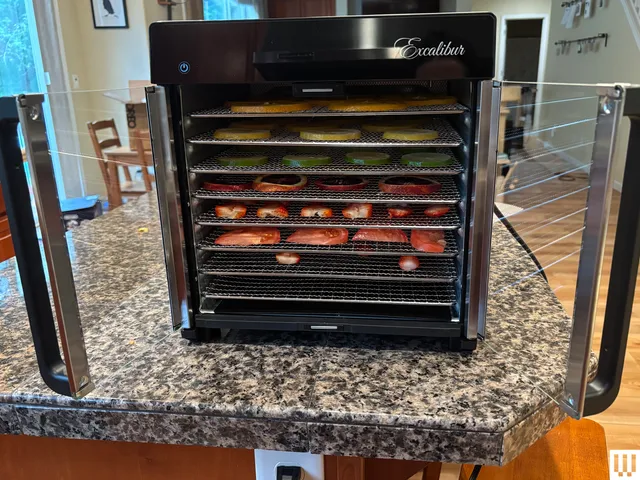
Excalibur is the OG name in food dehydrators, known for its commercial and professional units. But the company also makes a series of consumer dehydrators that offer large-tray capacities at low prices. This eight-tray, 7.2-cubic-foot model has all the modern features you’d expect: stainless steel trays (note that they’re not dishwasher-safe), a light to monitor the process, mesh and fruit-roll (which are solid) sheets, French doors, and a digital timer. You can also pause the time to add minutes if need be, and there’s a free digital recipe book (“Preserve It Naturally”) accessible via a QR code on the side of the unit.
I tested the Excalibur with fruit, tomatoes, beef, and marinated salmon, and the machine dried everything in nearly half the time as my old bargain-basement round Nesco Snackmaster (see Others Tested) did with plastic trays. Best of all? The 700-watt motor is strong but not loud. I ran it in an open-concept kitchen/living room and clocked it at 40 decibels, which didn’t even require turning up the TV. I wish the warranty were a bit longer than one year, but this is still an extremely user-friendly dehydrator that just about any casual user would be happy with.
Advertisement
Best Budget
Photograph: Lisa Wood Shapiro
Cosori
Pioneer 5-Tray Food Dehydrator
This old-school style Cosori dehydrator features stackable plastic rings and a fan in the base. WIRED contributing reviewer Lisa Wood Shapiro thought it produced consistent results for the price. She especially loved Cosori’s library of dehydrated food recipes, which were among the best she’s ever tried. (I had to peruse them myself upon this recommendation, and I’m still thinking about the recipe for dehydrating an entire batch of chili.) Drawbacks include its primarily plastic construction—though the plastic is BPA-free—and the fact that the dishwasher-safe trays don’t easily fit in the dishwasher. The cylindrical shape is harder to fit on an already full countertop, but given that it’s not the best-looking model, you’re likely storing it in the garage or basement anyway.
In late November in Jamnagar, India, the scions of two of the most powerful families in the world stood face-to-face. On one side was 30-year-old Anant Ambani, son of one of the richest men in Asia. On the other was Donald Trump Jr. For months, the Trump administration had been on the offensive against the sprawling Ambani energy empire, placing it at the center of an escalating tariff campaign against India. But after Trump Jr. touched down, the two men toured the Ambanis’ private zoo, and at night they performed a Gujarati folk dance, grinning as they moved together to the music.
Four months later, an obscure Texas startup called America First Refining announced that it had received a nine-figure investment from the Ambanis’ company. The deal puzzled numerous energy investors familiar with the project, which aims to build the first major new oil refinery in the U.S. in about 50 years. The company is run by a serial entrepreneur with a history of bankruptcy and lawsuits alleging fraud. After more than a decade of failed attempts to raise money, blown deadlines and rebrands, it had been floundering.
Advertisement
America First Refining’s unexpected breakthrough came after it forged a previously unreported relationship with Trump Jr., who secretly acquired a stake in the startup, according to records and seven people familiar with the company. The new details reveal the role the president’s son has played in a theme of Trump’s second term: overseas investors with interests before the administration putting money into the Trump family’s business interests.
Over the past year and a half, Trump Jr. has amassed a fortune from stakes in companies ranging from crypto startups to a drone business to a firearms retailer. Some firms tied to the president’s son have received contracts or other support from the federal government, part of what critics describe as a run of Trump family self-dealing. In December, Forbes estimated that Trump Jr.’s net worth had rocketed from roughly $50 million to $300 million since the election. But the Forbes figures were based on the investments that have been publicly disclosed. The America First Refining episode suggests there is much about the family business that remains secret.
The size of Trump Jr.’s stake in America First Refining and what he paid for it remain unclear. Top executives at the startup have also said that they speak regularly with Trump Jr., according to a person close to the company. And after the Ambani investment was announced, Trump Jr.’s personal lawyer took credit on social media for playing a part in the deal.
America First Refining has flexed its Trump Jr. connections during pitch meetings with foreign officials. Early last year, Trump Jr. joined the company’s leadership for a meeting in South Florida with potential investors from Saudi Arabia, according to two people familiar with the matter. Another foreign government official pitched on the project told ProPublica that the company’s team emphasized they had backing from the Trump family and suggested that an investment would help with White House access.
The Ambanis’ investment coincided with the family’s securing major U.S. policy wins that their company, Reliance Industries, had been lobbying for. “Reliance Goes From Trump Foe to Friend With Refinery Pledge,” ran the Bloomberg headline after the deal was announced. Reliance’s intent with the deal was to “smooth out” tensions between the U.S. and India, the outlet reported.
Advertisement
A Trump Jr. spokesperson said that Trump Jr. “has no operational involvement in AFR and is simply a passive minority investor in an American company that aligns with his worldview.”
“The entire premise of this story relating to Don is false,” the spokesperson said, adding, “Don does not interface with the Federal Government on behalf of any company that he invests in or advises.” ProPublica did not find evidence Trump Jr. was aware of refinery executives’ suggesting that an investment would help with White House access.
In response to detailed questions, a spokesperson for America First Refining said, “The claims in this story are false,” but declined to specify what they were referring to. The company’s CEO previously denied wrongdoing in the lawsuits against him reviewed by ProPublica, and the suits were either settled or dropped.
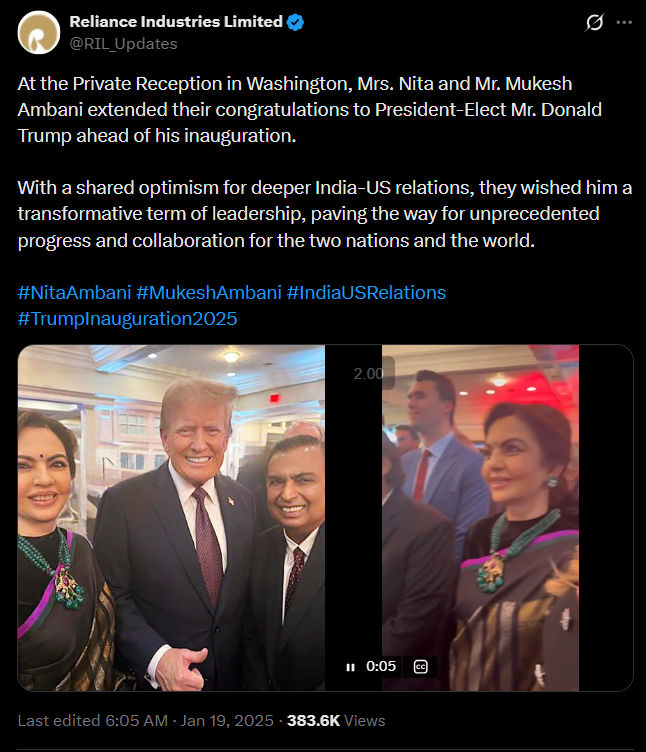
The Ambani family had long been cultivating its relationship with the Trumps. Reliance paid $10 million to the Trump Organization in 2024 as a “development fee” for a project in Mumbai, according to the president’s financial disclosure. (Despite the payment, Reliance has not yet announced a Trump project. Reliance told ProPublica that “the real estate project is real” and “remains under development.”) Ivanka Trump attended Anant Ambani’s wedding party in India that year, where guests were treated to a Rihanna concert. Anant’s father, Mukesh — who is worth an estimated $90 billion and lives in a 27-story home — came to Washington, D.C., for Trump’s second inauguration, posing with the president at a private reception.
Advertisement
But by the summer of 2025, the family was under attack from the White House. Since Russia invaded Ukraine in 2022, Reliance had reportedly made billions in profits by purchasing vast quantities of Russian oil at a discount. In August, as Trump grew frustrated with his administration’s struggles to bring the war to an end, the president doubled his tariffs on India to 50%. The move was explicitly designed to force companies like Reliance to stop buying Russian oil. White House trade adviser Peter Navarro publicly assailed “India’s politically connected energy titans” for “funding Putin’s war machine,” widely read as a reference to the Ambanis.
Amid this tension, Trump Jr. visited Anant Ambani on his November trip to India. At the end of the trip, Trump Jr.’s personal lawyer commented at a business conference in Miami: “I had a nice closing this morning with Don Trump Jr., who’s flying back from India today.” (The following week, the Texas startup — then called Element Fuels — filed paperwork to create America First Refining LLC. In an email, the attorney, John Willding, told ProPublica that there was “no transaction in India or with an Indian company that I was ever involved with.”)
Anant Ambani, who helps run Reliance’s energy business, personally worked on the Texas refinery deal for months before it was announced, a major Indian newspaper later reported.
As the Ambanis quietly finalized their deal with America First Refining, U.S.-Indian relations appeared to warm. In February, the Trump administration struck a trade deal with India, dramatically lowering tariffs, and also reportedly gave Reliance a license to buy Venezuelan oil. When the Iran war broke out and rocked global energy markets, the U.S. gave India a sanctions waiver to buy Russian crude. (The waiver was later expanded to all countries.)
In response to ProPublica’s questions, the White House said that “there are no conflicts of interest.” Reliance did not answer ProPublica’s questions about Trump Jr.’s and Anant Ambani’s roles in the investment deal, but said in a statement that the company did not receive “any unique or preferential treatment” from the U.S. government.
“There is no connection between Reliance’s investment in AFR and any unique measures associated with general U.S. trade, tariff, sanctions or licensing outcomes,” Reliance said. “The investment was evaluated and approved on its commercial merits, strategic fit and long-term value creation potential.”
Advertisement
In March, President Trump personally announced Reliance’s deal with the Texas startup on Truth Social, thanking the Ambani company for its “tremendous Investment.”
After the announcement, Willding, the Trump Jr. lawyer, shared the news on LinkedIn: “Just so proud to have been part of this one.”
Willding rowed back his claim in an email to ProPublica. “I have never worked for or advised AFR and had zero involvement in their deal with Reliance Energy,” he said. “I simply saw the press release and was excited for them.” America First Refining’s spokesperson called Willding’s comment “moronic and false.”
In June 2025, Willding registered a new entity in Wyoming called TX Fuels, LLC, listing the company’s address as Trump Jr.’s mansion in Jupiter, Florida. In his email, Willding said his “only involvement in AFR was handling the legal paperwork” for the Trump Jr. LLC’s investment in the startup.
Advertisement
Trump Jr. first hired Willding in May 2021, according tointerviews the lawyer has given. A corporate deal lawyer in Dallas, Willding has referred to himself as “outside business counsel to the Trump family” and has said he talks to Trump Jr. or Eric Trump almost daily. A former Bill Clinton and Barack Obama voter who fell hard for MAGA, the attorney has installed a portrait of President Trump over the mantel in his living room.
Willding’s practice has boomed during the second Trump administration, bringing the lawyer to Argentina, Saudi Arabia and South Korea. “Everybody in the world wants to do business with the United States right now,” Willding said at a conference in June 2025. “Every company wants to do business with the Trump family.”
There are other fingerprints of the Trump world on the refinery deal.
Howard Lutnick’s firm Cantor Fitzgerald — which his sons took over when Lutnick became Trump’s commerce secretary — is working as the financial adviser to America First Refining, including on the Ambani investment deal, Cantor Fitzgerald announced. (Cantor Fitzgerald declined to comment.)
Advertisement
And the Trump administration played a direct role helping America First Refining find potential foreign investors, according to public comments from the company’s CEO, John Calce. “We have received support from the White House,” he told a local news outlet. The National Energy Dominance Council, led by the interior and energy secretaries, has “helped us with, candidly, introducing us and helping us meet some of these people overseas,” Calce said on an industry podcast.
America First Refining has recently explored going public, according to three people close to the company. That could allow its current investors to start cashing out even if the refinery never gets built — a milestone many energy industry insiders still view as a long shot. Reliance made its investment in the startup at a valuation of at least $1 billion, according to America First Refining’s announcement.
Building a refinery at the Port of Brownsville on the Gulf Coast has been Calce’s mission for a decade. A former Yale offensive lineman, he started his career as a high school football coach after an unsuccessful attempt to make the NFL and now describes himself as a “lifelong entrepreneur.”
The project has been serially delayed, out of money, rebranded and trailed by angry former business partners. At one point, Calce’s companies were being sued simultaneously by eight other firms. In 2022, during bankruptcy proceedings for an earlier iteration of the project, the trustee appointed to impartially oversee the case sued Calce too. The trustee alleged that Calce and other insiders had improperly siphoned away cash and other assets. (Calce denied wrongdoing. The case was ultimately settled.)
Advertisement
During the Biden administration, as the company sought financial support from the Department of Energy, it pitched itself as a climate-friendly green project that would also help “people of underrepresented social demographics” in Brownsville, according to records from that period. The company failed to get enough money from outside investors, and the planned construction was delayed.
By the company’s own estimate, building the refinery will take years and cost $3 billion to $4 billion. Even if it’s built, profitability could be hard to achieve. Many energy investors told ProPublica there’s a reason the U.S. hasn’t seen a major new refinery in decades. “Refineries cost a lot of money and essentially make pennies on the dollar,” said Ed Hirs, an energy economist in Houston. “Wall Street is not going to finance a new refinery.”
Even after the start of the second Trump administration, the company was in jeopardy, according to interviews and documents. It laid off workers last year, and, by late 2025, with delays continuing to plague the refinery, officials at the Port of Brownsville believed the project looked to be dead, according to records reviewed by ProPublica.
That has not stopped Calce and his team from making grandiose claims to the public. Earlier this year,a website went live for another Calce company called Brownsville Energy Storage Terminals. It claims to have a far-flung network of oil storage terminals in places like the Netherlands and Singapore, more than 850 employees and a C-suite of experienced energy executives. But ProPublica could find no evidence that the executives are real people or that the storage terminals actually exist. The phone numbers on the website are also currently listed online as the contacts for a Houston baklava caterer, a Dallas-area taxi service and an OB-GYN office. The numbers are dead.
Advertisement
America First Refining’s political ties, though, may have boosted its standing with Texas state regulators. In February, shortly before the Ambani investment became public, the company sought an extension on its permit from the Texas Commission on Environmental Quality.
Inside the state agency, emails obtained by ProPublica show, officials scrambled to approve the request.
“Need to get this one logged and processed asap,” wrote one official.
“You are going to have to do this one. I will explain why in person in a few,” wrote another. “You can guess if you check out the name.”
Advertisement
America First Refining got its approval the next day. A spokesperson for the Texas agency did not address questions about the emails. “This request was processed quickly due to the quality of information provided,” the spokesperson said.
Just days after filing the complaint, Dan Berulis, the whistleblower, found the brakes on his car had been cut after getting into a minor accident near his home. The complaint, which went public in an NPR story the day after it was filed, caused an outcry, with members of Congresscalling for an investigation. The following month, in May 2025, FedScoop reported that the NLRB’s Office of the Inspector General (OIG) opened an investigation. It remains ongoing.
In April 2026, though, the Government Accountability Office (GAO)—a federal agency within the legislative branch that performs audits and investigations for Congress— published its own report about DOGE’s access to the NLRB’s systems, titled “National Labor Relations Board Detailees Did Not Access IT Systems Between April 16 and July 25, 2025.” The report conspicuously only covers the time period immediately following Berulis’ complaint, and does not address any DOGE activity before that point.
But nested in the footnotes of the report is another revelation: In August 2025, shortly after DOGE members left the NLRB but before the GAO’s investigators “requested to observe the systems,” the agency “deleted the team member accounts for system access after the agreement to detail DOGE team staff had expired.” Basically, this means that the digital records of what data and systems DOGE members accessed and when had been eliminated, leaving the GAO no way to confirm what NLRB staff told their investigators.
Advertisement
“I think you could imagine another situation where the footnote is the central theme of the report,” says Don Moynihan, a professor of public policy at the University of Michigan. “The report raises more questions than it resolves, such as who deleted the data.”
The NLRB enforces laws concerning unions and collective bargaining, and investigates unfair labor practices. This gives it access to the identities of whistleblowers as well as their testimony; information about trade secrets and other proprietary data that might be important in issues related to negotiations between employers and employees; and a wide variety of investigative materials.
According to Berulis’ whistleblower complaint, “DOGE officials required the highest level of access and unrestricted access to internal systems. They were to be given what are referred to as ‘tenant owner’ level accounts, with essentially unrestricted permission to read, copy, and alter data”—a level of access beyond that of the agency’s chief information officer.
In the report, GAO officials note that they “interviewed NLRB staff regarding what level of access they provided for each system to the DOGE team,” but were unable to confirm whether what they were told was true because the DOGE accounts and associated information had already been deleted from the NLRB’s systems. It’s also not clear exactly who from DOGE had access: Justin Fox, Nate Cavanaugh, and Jordan Wick were all at one point at the NLRB, but no specific DOGE members are named in the report nor in Berulis’ original whistleblower complaint.
Advertisement
The NLRB did not respond to a request for comment; neither did Fox, Cavanaugh, or Wick.
Tesla and SpaceX, both companies owned by Elon Musk, who also led DOGE, have been the subject of NLRB investigations. Earlier this year, the NLRB dropped the case against SpaceX, saying that the agency didn’t have jurisdiction over the company.
In an April statement announcing an investigation into the case’s dismissal, Democratic senators Elizabeth Warren and Richard Blumenthal wrote: “Given Musk’s extraordinary financial support for President Trump in the 2024 election, his substantial influence in the Trump Administration and interest in the NLRB’s work as head of [DOGE] … we seek answers to determine if the decision to drop the case may have been based on political considerations rather than the facts at hand.”
Volkswagen has some woolly new unofficial employees flocking to one of its European facilities. There are now 100 sheep grazing at the solar farm that powers the car company’s manufacturing plant in Poznań, Poland. Electrek reports that in addition to replacing lawn mowers, the critters are part of a bigger research project to study agrivoltaics, where agriculture and energy are farmed in the same space in a symbiotic relationship. Poznań University of Life Sciences is handling the study of the flock, exploring how the grazing activity impacts animal welfare, biodiversity, soil quality, vegetation and the microclimate at the site.
“Today, the photovoltaic farm delivers much more than green electricity. It has also become a place that supports biodiversity, local agriculture, and scientific research. The sheep grazing project demonstrates that modern industry can work in harmony with nature,” Marzena Pillich-Grońska, director of Volkswagen Poznań, said. A video posted by Quanta Energy, which built Volkswagen’s solar farm, shows some of the sheep in situ:
Advertisement
Agrivoltaics has become a compelling subject for the energy industry, allowing hybrid use of land. We’ve seen experiments with crops grown under solar panels, but the introduction of livestock seems both smart and adorable.
At most professional workstations in enterprises, you will see dual monitor setups on people’s desks.
A few years or even a decade ago, it made sense to extend the widely spread single 24-inch monitor setup, which was indeed too cramped to check your emails/notifications and work on your tasks simultaneously.
So businesses had increasingly adopted dual or multi-screen setups to increase the productivity of their workforce. More screen real estate, achieved easily.
Advertisement
Latest Videos From
Or so people thought, until the compromises started to become visible.
Paul Butler
Regional Sales Director, AOC and Philips Monitors in the UK/Ireland.
You see, you will have to work with twice the video cabling, twice the power cables, twice the power consumption.
Advertisement
If a dual-monitor setup is from different brands or models of displays, it was also not guaranteed that you will have the same resolution, same colour grading, same brightness or contrast, so it was a “stop-gap” solution to simply offer more space back then. And it worked, kind of.
In the meantime, the display market changed quite a lot. Ultrawide monitors, with a 21:9 aspect ratio, initially featured in the gaming scene for their increased immersion in games and movies, found their way into the business sector.
Sign up to the TechRadar Pro newsletter to get all the top news, opinion, features and guidance your business needs to succeed!
Advertisement
Even wider displays, with a 32:9 aspect ratio became more and more popular, since they can replace exactly two 16:9 usual monitors, with no bezel in between, offering a fully usable horizontal landscape.
In certain sectors, such as video editing and music production, where users work with long timelines, or in banking and commerce, where office workers use long and detailed spreadsheets, the entire workflow benefits from more horizontal real estate.
In my mind, I see five main topics why today businesses need to shift towards a single ultrawide or superwide display instead of multi-screen setups.
Bezels that distract
In a usual dual monitor setup, you set up the desk with two 16:9 displays side by side and place the chair in the middle of both displays to have an equal distance away from the screens. But this initial alignment already causes the first and biggest distraction.
In the middle of your central field of view, you will see the right bezel of the left screen, and vice versa. Your primary focus area is filled with bezels, in older displays even as thick as several centimeters.
If you want to use both monitors with a single program at once, such as a long spreadsheet or a video/audio timeline, this “bezel” issue alone breaks your focus and productivity, making following rows or timelines more difficult than a single monitor setup.
Advertisement
(Non-)Ergonomics that hurt
Dual setups usually mean one of two things. Either, both displays are placed side by side with a straight angle. Which means, your eyes will have more distance towards the side edges than towards the center of your field of view. Or they both are slightly angled towards the center .
In both cases, you will either keep twisting your neck left and right all day long, or you will work off axis for hours. To make matters worse, if none of the dual monitors offer an ergonomic, height-adjustable stand, with tilt and swivel capabilities, you will often try to readjust them to your posture.
A single, curved, ultrawide or superwide display simply keeps equal distance to your eyes from the sides or the center, and its curve matches the natural curvature of your eyes.
Advertisement
Panels that don’t match
In a dual setup, you will try to install two identical business monitors on a single desk. If that is not possible, there are even bigger issues to deal with. If one has a different resolution or size, you will lose the uniformity between extended screens. Texts may be differently scaled, and it is quite a distraction to move windows and programs between the two displays.
If we assume that “identical” units are set-up side-by-side, the fact that they are “identical” models alone cannot guarantee the same brightness, gamma, contrast and other visual features, since all panels in most manufacturers can show some kind of variation between panels, sometimes very little, sometimes more significant.
Some monitors offer features such as “Sync” or “Link” the displays to make them appear as uniform as possible. But, by definition, a single ultrawide or superwide panel, simply is uniform and eliminates these concerns completely.
Advertisement
Complexity of scales
With a dual monitor setup, you will need space for two stands on the desk, two power bricks on the floor, two power sockets, more video cables and more clutter, better video cards with more video outputs.
With even larger multi-screen setups, this increases linearly and can become costly, distracting and simply clutters the workspace, when it needs to be clean and minimalistic to allow users to focus on the task at hand. A single ultrawide or superwide display simply cuts the multitude of cables and all the requirements to just one connection to the workstation.
Modern business-focused 21:9 or 32:9 displays also feature KVM switches, USB-C or Thunderbolt 4 connectivity with Power Delivery, built-in USB hubs and even DisplayPort outputs thanks to the additional space on the back for these features. The USB-C or TB4 connectivity allow easy charging of connected laptops or smartphones while also extending the display, using the same cable.
Advertisement
Some fully-fledged docking models also include a built-in webcam with Windows Hello easy login, and/or a RJ-45 input to route the network connection to the computers plugged in with USB to the monitor.
In short, with a modern large ultrawide/superwide display you can replace even more peripherals than just a single extra monitor.
Cost of ownership
Bringing two panels to each desk directly means double the procurement, double the power consumption, double the devices the IT department needs to check, support, replace – multiplied across every desk in an enterprise. It can get costly and quickly unmanageable.
Advertisement
Employing “older” displays in a dual-monitor setup as a stop-gap solution becomes unsustainable in a short time with consumption figures easily doubling.
A new ultrawide or superwide display with sustainability features built-in, such as a presence sensor, or a light sensor to adjust its consumption automatically, not only offers a much more comfortable usage for the workforce but also reduces the consumption figures for years to come.
Two monitors solved yesterday’s problem at twice the cost. The businesses that are at the head of the game are the ones that have realized that one great big screen has always been the right answer from the start.
This article was produced as part of TechRadar Pro Perspectives, our channel to feature the best and brightest minds in the technology industry today.
The views expressed here are those of the author and are not necessarily those of TechRadarPro or Future plc. If you are interested in contributing find out more here: https://www.techradar.com/pro/perspectives-how-to-submit
American insurance company AssuranceAmerica has disclosed a data breach impacting nearly 7 million drivers after attackers gained access to its systems earlier this year.
AssuranceAmerica operates through a network of over 9,500 independent agents and provides auto, renters, and commercial auto insurance coverage across 14 U.S. states.
While the company has yet to publish a press release regarding the incident, it revealed in a filing with Maine’s Office of the Attorney General that the data breach has exposed the information of 6,998,886 people.
As TechCrunch first reported, AssuranceAmerica detected the breach on March 17 and found that the attackers had stolen a wide range of customer information from its systems.
“On March 17, 2026, the Company detected suspicious activity involving certain Company systems that appears to have resulted from malicious activity on March 16, 2026 that targeted one of the Company’s employees. During the investigation, the Company determined that an unauthorized third party accessed certain portions of the Company’s informational technology (IT) environment and copied certain data files,” it notes in data breach notification letters that will be sent to affected people on Friday.
Advertisement
“The Company subsequently conducted a review of the affected files to identify individuals whose personal information may have been contained within those files. Because of the nature of the files involved and the scope of the required review, this file evaluation process was only recently completed (on June 15, 2026), and we are now providing this notice.”
As the company found, the stolen documents contained a combination of affected individuals’ names, contact information, automobile insurance policy or insurance account information, driver or vehicle information, claims-related information, and driver’s license numbers.
Since it detected the security breach, AssuranceAmerica disabled the credentials compromised in the attack, kicked the threat actors out of its network by disabling unauthorized sessions, isolated the affected systems, and notified law enforcement agencies of the incident.
“The Company also implemented additional measures designed to enhance the security of its IT systems and data, including resetting passwords, deploying enhanced monitoring and threat detection tools, and providing additional instruction to personnel regarding cybersecurity threats,” it added.
Advertisement
AssuranceAmerica also advised affected customers to immediately alert their financial institution if they detect any suspicious activity after reviewing credit reports, bank accounts, and other financial statements.
Last month, American insurance giant Aflac also disclosed a data breach after attackers compromised its Japanese subsidiary’s systems, stealing the personal and bank account information of 4.38 million customers.
Security teams log 54% of successful attacks and alert on just 14%. The rest move through your environment unseen.
The Picus whitepaper shows how breach and attack simulation tests your SIEM and EDR rules so threats stop slipping by detection.














.jpg)









































You must be logged in to post a comment Login