

Crypto World
Bridge hacks back in vogue as Verus exploit brings 2026 total to $329M



The blockchain bridge connecting the Verus and Ethereum networks has been exploited for over $11 million.
One of eight bridge hacks so far this year, this latest incident brings the running total of funds lost to almost $329 million.
DeFiLlama data shows Verus as the 58th largest blockchain by total-value-locked ($22 million); its website promises “security without the audits.”
In addition to the hack, Verus’ blockchain explorer shows block production stopping approximately 12 hours ago.
According to a screenshot posted by the Verus X account, the network halt is due to “most block-generating nodes taking themselves offline” following the attack.
Read more: DeFi projects lose $6M in fresh string of exploits this week
Blockchain security monitoring platform Blockaid, which flagged the loss, suspects that the root cause is similar to the 2022 hacks of the Wormhole and Nomad bridges.
The firm explains that three of the bridge’s verification steps worked correctly, but it failed to check that the parameters of the source chain transaction matched the payouts on Ethereum.
It estimates the vulnerability, which cost the attacker just $10 to exploit, is mitigated by 10 lines of code.
The hacker’s address on Ethereum received ETH, as well as tBTC and USDC, which were swapped to ETH.
Keep up to date on the day-to-day of crypto hacks with Protos’ new hack tracker, which has 79 entries since the beginning of 2026.
Read more: Crypto hackers snatch over $1B in 68 incidents this year
Troubled waters
Multi-million dollar bridge hacks were once the scourge of the crypto industry.
In 2022, a particularly bumper year, hacks of Qubit, Wormhole, Ronin, Harmony, Nomad and BNB bridges raked in a combined total of $1.9 billion. Of these, all but Ronin and Harmony were smart contract exploits.
In recent years, however, attackers have mostly moved onto new vectors to secure the biggest paydays.
Bridge exploits have been replaced by complex social engineering and supply-chain compromises, a speciality of the DPRK-linked Lazarus Group. Such schemes have been responsible for hefty losses from Bybit ($1.4 billion), and Drift Protocol ($280 million).
Crypto audit firm Peckshield estimates that the Versus incident brings the total lost to bridge hacks so far in 2026 to almost $329 million.
Read more: DeFi sector in $14B meltdown as $290M rsETH hack fallout burns Aave
The losses are dominated by a single incident, April’s $290 million rsETH hack, with fallout affecting the entire DeFi sector.
Other notable incidents this year include Hyperbridge’s $2.5 million loss, which came just days after joking about being hacked for April Fools’ Day, and Friday’s $10 million hack of THORChain, which has repeatedly faced criticism itself for inaction over its use to launder illicit funds.
Got a tip? Send us an email securely via Protos Leaks. For more informed news and investigations, follow us on X, Bluesky, and Google News, or subscribe to our YouTube channel.

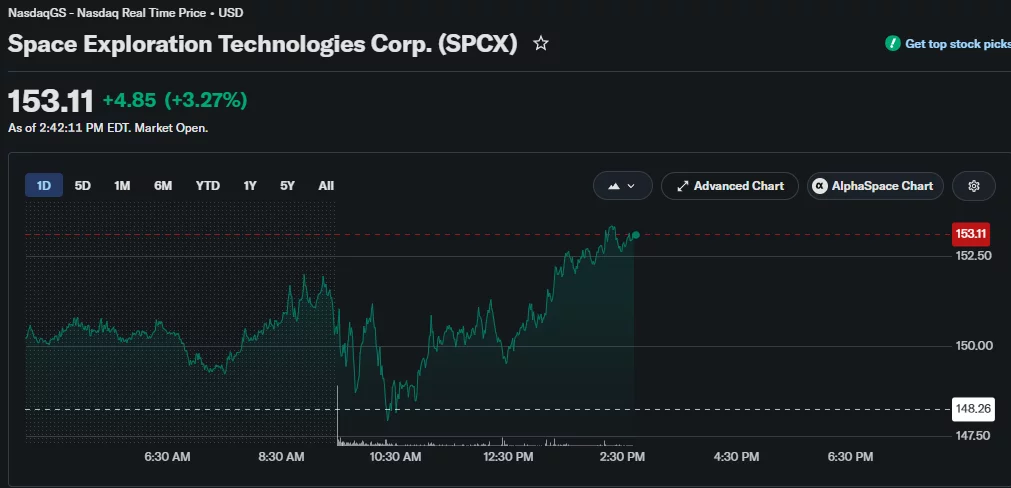
SpaceX shares have gained fresh momentum after Raymond James initiated coverage with an $800 price target, implying about 440% upside from current levels.
Summary
- Raymond James initiated SpaceX with a Strong Buy rating and an $800 price target, implying about 440% upside.
- Wall Street support strengthened as Morgan Stanley, Goldman Sachs, Citigroup, UBS, and Wells Fargo also issued bullish ratings.
- SpaceX expanded its Starlink plans, Ark Invest added shares, and the company’s Bitcoin holdings remained in focus.
According to Raymond James, the brokerage has started coverage of SpaceX with a Strong Buy rating and an $800 price target, making it one of the most optimistic forecasts issued by a major Wall Street firm.
The target came as SPCX traded around the $153 level on Thursday after rising about 3.2%, following a difficult stretch in which the stock had fallen more than 25% from recent highs despite joining the Nasdaq-100, as previously reported by crypto.news.
The brokerage linked its bullish outlook to three long-term businesses that it believes could support future growth. Raymond James pointed to the continued development of Starship, the expanding Starlink satellite internet network, and the company’s potential to become a major global infrastructure provider through its launch and communications operations.
Wall Street support for SpaceX continues to grow
Fresh optimism from Raymond James builds on a series of positive ratings issued by other investment banks in recent days. Morgan Stanley began coverage with an Overweight rating, assigning a base-case price target of $300 and a bull-case target of $600.
Goldman Sachs also initiated coverage with a Buy rating and a $205 target, while Citigroup started coverage with a Buy recommendation and a 12-month target of $200. UBS and Wells Fargo also launched coverage with positive recommendations, adding to institutional support for the newly listed company.
Although Raymond James’ forecast stands well above those targets, the latest recommendation has added to expectations that analysts continue to see substantial upside even after SpaceX’s recent share price volatility.
Separately, Cathie Wood’s Ark Invest has continued increasing its exposure to SpaceX. According to reports, the investment firm bought 153,084 shares across its ARKK, ARKQ, and ARKX exchange-traded funds. Based on SpaceX’s closing price of $148.30, the purchase was valued at roughly $22.7 million.
Starlink expansion and Bitcoin holdings stay in focus
Operational developments have also remained active. SpaceX has filed an application with the U.S. Federal Communications Commission seeking approval to deploy as many as 100,000 third-generation Starlink satellites, a move that would significantly expand its satellite internet network if approved.
The company has also maintained a rapid launch schedule. Reports show SpaceX deployed 1,589 Starlink satellites during the first half of 2026, surpassing the previous first-half record of 1,489 launches achieved in 2025.
Outside its space business, SpaceX recently drew attention in the cryptocurrency market. As crypto.news reported, a wallet linked to the company transferred $88 worth of Bitcoin on July 8, ending six months without on-chain activity.
Data from Arkham Intelligence showed SpaceX still holds about 18,712 BTC, valued at roughly $1.16 billion, while the receiving wallet contains 614 BTC worth about $38 million.
Investors are also tracking developments tied to Elon Musk’s artificial intelligence ecosystem after SpaceXAI disclosed plans to release Grok 4.5 to the public.
Despite the growing list of bullish analyst calls, some investors remain cautious. Critics argue that SpaceX’s valuation already prices in much of its expected expansion, while others say the company’s first public earnings report will provide a clearer basis for assessing whether current expectations can be justified.


The Trump White House has rejected accusations that it is refusing to nominate Democratic commissioners to the Securities and Exchange Commission and Commodity Futures Trading Commission as the Senate moves closer to debating the CLARITY Act.
Summary
- White House says it requested Democratic nominees for the SEC and CFTC but has not received any names.
- CLARITY Act negotiations continue as lawmakers debate ethics rules, DeFi provisions, and regulatory appointments.
- Senators Cynthia Lummis and Ron Wyden have defended different parts of the bill ahead of a Senate vote.
According to a letter sent by the White House to Senate Majority Leader John Thune and Senate Democratic Leader Chuck Schumer, the administration said it had already asked for suitable Democratic nominees for both the SEC and the CFTC but had not received any names in response.
The letter pushes back against criticism that the administration is deliberately leaving seats vacant at two agencies expected to oversee large parts of the digital asset market if the CLARITY Act becomes law.
With the Senate still yet to schedule a floor vote on the market structure bill, the exchange over regulatory appointments has added another issue to negotiations already facing time pressure. As crypto.news reported earlier, lawmakers are working against the Senate’s Aug. 7 recess, leaving a limited window to move the legislation forward.
Senate negotiations continue before floor vote
Although the White House defended its position on the nominations, it remains unclear whether the disagreement will influence support for the CLARITY Act. Lawmakers from both parties are still negotiating several outstanding provisions, including an ethics section that has become part of the broader talks.
Separately, law enforcement organizations have argued that the bill’s decentralized finance provisions could make investigations into illicit finance more difficult. Those concerns have become another point of discussion as senators continue to negotiate the final language before any vote is scheduled.
At the same time, debate over protections for blockchain developers has continued. As crypto.news reported earlier today, Democratic Sen. Ron Wyden urged Thune and Schumer to preserve Section 604, known as the Blockchain Regulatory Certainty Act, in any future version of the CLARITY Act.
In a letter to the Senate leaders, Wyden argued that legal protections for non-custodial blockchain developers should remain part of the legislation as negotiations continue.
Pro-crypto senators defend key provisions
Meanwhile, Sen. Cynthia Lummis publicly defended the CLARITY Act after Sen. Elizabeth Warren criticized the proposal, arguing that it would create opportunities for sanctions evasion.
In a post on X, Lummis responded that both lawmakers want bad actors held accountable but differ on how to achieve that outcome. She pointed to Section 303, saying it would authorize new crypto sanctions targeting Iran, while Section 305 would allow major cryptocurrency exchanges to stop illicit funds before they reach North Korea.
Lummis has also warned that Congress may not get another opportunity to pass comprehensive digital asset legislation before the end of the decade. In an earlier X post, she argued that failing to pass the CLARITY Act would leave the United States following rules written by other countries instead of establishing its own regulatory framework.
For now, the White House’s defense of its nomination process, ongoing negotiations over key provisions, and competing arguments from lawmakers have all become part of the political backdrop as the Senate prepares for its next steps on one of the crypto industry’s most closely watched bills.
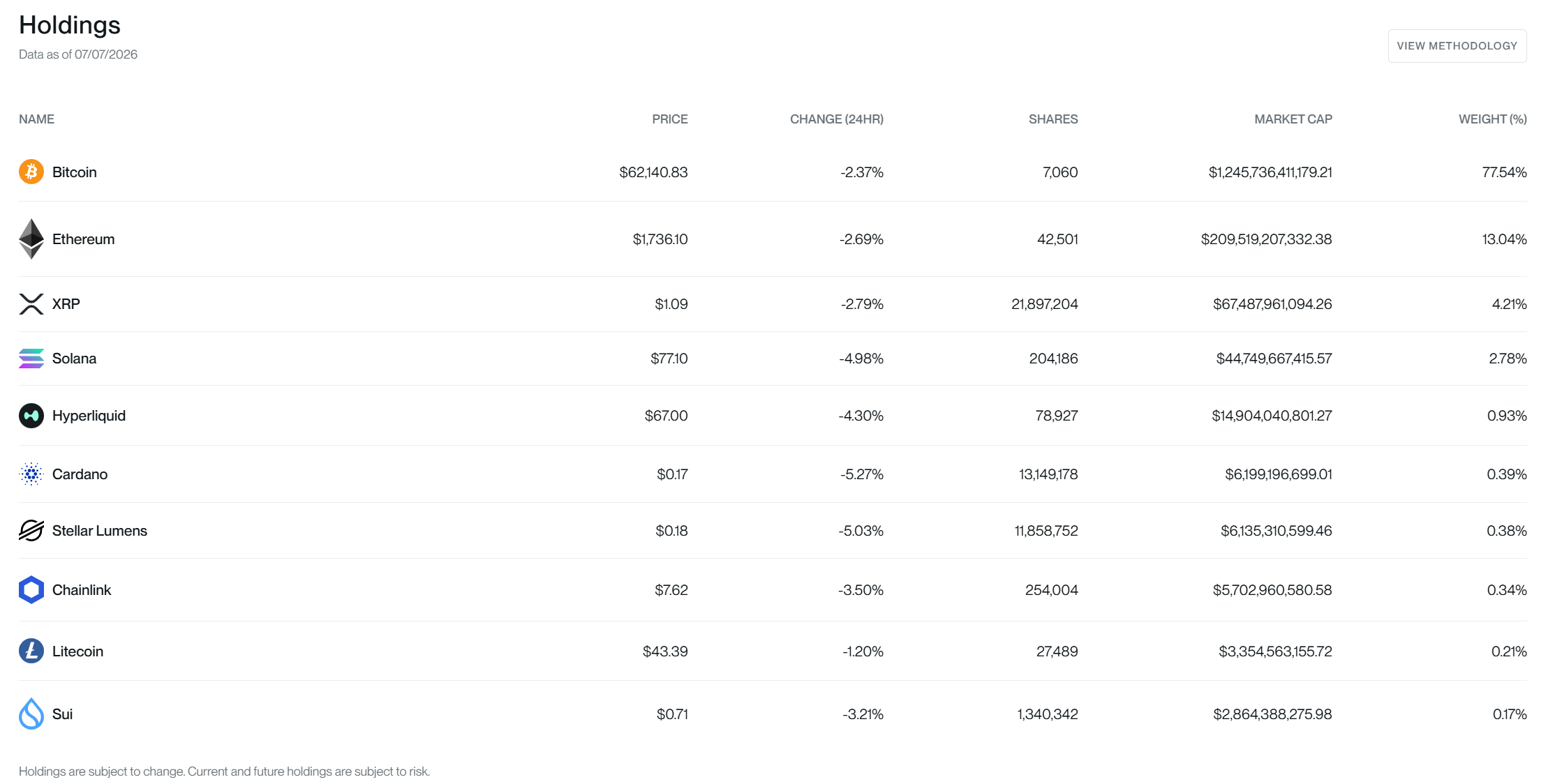
Bitwise has dropped Polkadot (DOT) and Avalanche (AVAX) from its flagship Bitwise 10 Crypto Index ETF (BITW). Hyperliquid (HYPE) and Stellar (XLM) were added to the fund’s latest monthly rebalance.
BITW works like a crypto stock index fund. It automatically holds the 10 largest eligible coins by market cap, so investors gain exposure to HYPE and XLM without buying them directly.
Why Hyperliquid and Stellar Entered the Bitwise 10 Crypto Index ETF
Bitwise’s rebalance results show HYPE entering at a 0.93% weight and XLM at 0.38%. That makes HYPE the fund’s fifth-largest holding, ahead of Cardano (ADA), Chainlink (LINK), Litecoin (LTC), and Sui (SUI). Bitcoin (BTC) still accounts for 77.54% of the fund.

Hyperliquid earned its seat through sheer size. The token ranks 10th among all cryptocurrencies at roughly $15 billion, according to BeInCrypto Markets data. HYPE trades near $67.92, weeks after hitting a new all-time high of $76.70 on June 16.
The project runs the dominant decentralized exchange for perpetual futures, a popular type of crypto derivative. It leads that perp DEX race by a wide margin.
Stellar ranks 18th overall, but Bitwise’s eligibility screens lift XLM into the qualifying group.
What the Exit Means for DOT and AVAX
The removals reflect rankings, not a verdict on either project. Both tokens led the 2021 bull market. DOT peaked at $54.98 in November 2021 but now trades near $0.83, a 98% fall that leaves it ranked 53rd. AVAX topped $144 the same month and has since lost 95%, sitting at $6.76, 32nd.

Neither network loses anything on-chain. Staking, development, and payments continue unaffected. Both coins had joined BITW at its NYSE Arca debut in December 2025 and lasted roughly six months.
Will Hyperliquid Keep Its Seat?
The near-term answer looks like yes. HYPE’s $15 billion market value is 10 times DOT’s, five times AVAX’s, and more than double Stellar’s $6.2 billion. A challenger would need to close that gap before the rankings flip.
Demand signals also point the right way. Recent crypto ETF flows showed HYPE products drawing fresh capital while Bitcoin funds recorded outflows. Bitwise even runs a dedicated spot Hyperliquid ETF, BHYP.

The main threat comes from within. Only about 22% of HYPE’s 1 billion maximum supply is circulating today, and its fully diluted value of nearly $64 billion is over four times its market cap.
BeInCrypto’s Hyperliquid price outlook flags those scheduled unlocks as the key risk, since new supply can pressure prices.
DOT’s slide from launch roster to 53rd shows how fast the table can turn. For now, HYPE holds the strongest hand among BITW’s smaller holdings, provided demand keeps outrunning its unlock schedule.
The post Bitwise Drops 2 Altcoins From Flagship Crypto ETF: Will Hyperliquid Keep Its Seat? appeared first on BeInCrypto.
![World's daily on-chain volume, showing the pre-prank peak, Source: Dune/ario_57]](https://wordupnews.com/wp-content/uploads/2026/07/9bf00bf07a9042d7bfc0990ea56902d6.webp)
World, a week-old Solana (SOL) prediction market, staged a fake exit. On July 8, it said it was leaving Solana for Robinhood Chain, then admitted the whole thing was a crypto prank the following day.
The gag drew millions of views and briefly fooled parts of the crypto industry. It also divided opinion on whether staged deception is smart marketing or a costly gamble for a young platform.
How the Crypto Prank Spread
World went live on Solana on July 1 inside the Phantom wallet, with Chainlink (LINK) handling data and settlement. Solana’s official account had promoted the debut just a week earlier.
Days later, the project told followers it was leaving for Robinhood Chain. It thanked the Solana Foundation and posted a polished logo for the supposed move.
The target made the fake believable. Robinhood Chain is a real Arbitrum-based Layer 2 that launched on July 1 for tokenized stocks.
That same week, the network set a record daily volume of $563.9 million, according to DefiLlama. Meme coins, not tokenized stocks, drove the frenzy. It was arguably crypto’s hottest new chain.
Several outlets reported the migration as fact. Within a day, World revealed the joke.
The reception split. Solana co-founder Anatoly Yakovenko amplified the gag, and CoinGecko co-founder Bobby Ong called it sharp marketing.
“I’m still trying to figure out if they moved to Robinhood Chain or staying at Solana. I think this is a parody and they are actually staying on Solana. I guess it triggered many folks and got them the attention that they really want, which is all that matters in consumer tech,” Ong remarked.
Critics, however, saw a bait-and-switch that erodes trust in a product handling real bets.
Follow us on X to get the latest news as it happens
Did the Joke Pay Off?
The on-chain record complicates any victory claim. An independent dashboard built by analyst ario_57 tracks World’s activity. It shows roughly $4.37 million in notional volume. Daily users peaked near 3,000 since the July 1 launch.
![World's daily on-chain volume, showing the pre-prank peak, Source: Dune/ario_57]](https://assets.beincrypto.com/img/-avHN9_82Fzf-o66hJTGVAYBSIg=/smart/9bf00bf07a9042d7bfc0990ea56902d6)
Yet that volume crested around July 6, two days before the stunt. The cumulative totals cover the full launch week, not one viral afternoon. The prank coincided with World’s momentum. It did not create it.
The 2.3 million views were World’s own tally, a measure of attention rather than adoption. Meanwhile, prediction markets face fresh scrutiny, raising the cost of any misstep in trust.
For now, World has crypto’s attention and a working product behind the gag. Whether that attention becomes lasting users is the question the coming weeks will answer.
The post Worst Crypto Prank Ever? Viral Prediction Market Pulls Off Shocking Joke appeared first on BeInCrypto.

- Solana (SOL) is up 18.5% over the past 30 days.
- Analysts are watching the $85–$90 resistance zone.
- B3 futures and FullSend add to Solana’s momentum.
Solana has regained momentum after a difficult stretch earlier this year, with the token climbing back above the $77 mark and extending its monthly recovery.
At the time of writing, SOL is trading at $77.73, up 0.8% over the past 24 hours after moving between $76.25 and $78.62 during the session.
Over the past month, the cryptocurrency has gained 18.5%, while its two-week performance stands at 21.6%.
The recent recovery has renewed interest in Solana’s outlook, particularly as technical indicators, institutional activity, and network developments begin to align.
While the token remains well below its all-time high of $293.31, several analysts believe the current trend has created room for further upside if key resistance levels are cleared.
Technical picture points to key breakout levels
SOL’s latest rally follows a rebound of roughly 38% from its recent low near $60, bringing renewed attention to the asset’s technical structure.
The recovery also marked Solana’s first positive monthly performance in several months, suggesting that selling pressure has eased.
Market analyst Ali Martinez has identified the $85 to $90 region as an important resistance zone.
A sustained move above that range would bring the psychologically significant $100 level back into focus.
SOLANA: BIG SUPPLY WALL
Solana is currently attempting to reclaim a resistance zone between $79 and $85.
According to URPD data, roughly 105 million SOL were transacted within this range, establishing a dense supply cluster.
Reclaiming this zone as support clears the overhead… https://t.co/CZXB9kPtOz pic.twitter.com/jiZI3GJ8z4
— Ali Charts (@alicharts) July 8, 2026
Another closely watched analyst, Michaël van de Poppe, has highlighted the importance of the $73- $76 area, describing it as a major support zone that continues to underpin the broader recovery.
According to Poppe, as long as that area remains intact, the longer-term structure remains constructive from a technical standpoint.
Things start to become interesting here for $SOL.
If it is able to hold between $ 73- $ 76 and bounce back upwards, it is a strong signal that the markets are ready to run to higher than $100.
If that doesn’t happen, boy, we’ll be seeing new lows across the board. pic.twitter.com/XRz4iMfxY6
— Michaël van de Poppe (@CryptoMichNL) July 8, 2026
Attention has also shifted to Solana’s performance against Bitcoin.
The SOL/BTC trading pair has shown signs of strengthening after spending months in decline.
According to technical analysis, a breakout above the long-term resistance around 0.00140–0.00145 BTC could indicate improving relative strength for Solana compared with Bitcoin.
If that breakout is confirmed, technical projections place the next major value area between $140 and $150.
Those levels are based on historical trading activity rather than guaranteed price targets, meaning further confirmation would still be needed before the market could sustain such a move.
At the same time, focus is on the $75 to $78 range as an important near-term support area.
Holding above that zone would help preserve the current recovery, while a break below it could slow bullish momentum.
Institutional adoption continues to expand
Beyond price action, Solana has also benefited from growing institutional participation.
Brazil’s stock exchange, B3, recently expanded its regulated cryptocurrency derivatives offering by introducing Solana futures alongside Ethereum futures and Bitcoin options.
The contracts are settled in US dollars and reference Nasdaq’s digital asset benchmark prices.
Each Solana futures contract represents 5 SOL, giving professional investors another regulated instrument for gaining exposure to the asset or managing risk through hedging strategies.
B3 also reduced the size of its Bitcoin futures contracts to improve accessibility, a move that reflects broader efforts to increase participation in regulated crypto derivatives.
The expansion places Solana alongside Bitcoin and Ethereum within one of Latin America’s largest regulated exchange environments.
While derivatives products do not directly determine price direction, they typically improve market efficiency by expanding trading and hedging opportunities for institutional participants.
Recent infrastructure developments have also focused attention on Solana’s ability to support high-volume financial applications.
Privy, the wallet infrastructure provider acquired by Stripe, has partnered with Jito Labs to launch FullSend, a transaction routing system designed specifically for the Solana blockchain.
Instead of relying solely on traditional RPC infrastructure, FullSend routes transactions directly to the validator responsible for producing the next block.
According to the companies, the system has been operating in production since January and has processed millions of transactions with 99.999% landing reliability.
The technology also reduces transaction inclusion latency to approximately 50 milliseconds, compared with roughly 200 milliseconds or more under conventional routing methods.
For developers building payment platforms, trading applications, or financial services, those improvements reduce failed transactions during periods of network congestion while simplifying transaction management.
Developers using Privy’s wallet infrastructure receive these routing improvements without implementing additional software.
The announcement also highlights Privy’s growing reach following its acquisition by Stripe.
The company supports approximately 140 million accounts across applications that collectively process billions of dollars in monthly transaction volume.
The immediate focus now remains on whether buyers can push the token above the $85–$90 resistance range.
A successful breakout would place $100 at the centre of market attention, while continued strength in the SOL/BTC pair could reinforce the view that Solana is beginning to outperform Bitcoin once again.
Crypto World
Billions flowing out of bitcoin ETFs and private credit funds suggest rising market risks


Average requests rose to 10.3% of shares from 9.7% in Q1, but ranged widely (1.3%–38.1% at Blue Owl’s OTIC), Fitch said. Many requests were follow-ups from investors who were only partly satisfied last quarter. New inflows fell by about 56% on average, so most funds saw net outflows of roughly 3% of the prior quarter’s net asset value.
What’s concerning, for private credit, is that Fitch expects continued redemptions in the months ahead.
“With BDCs capping redemptions at 5% quarterly, unfulfilled requests will lead to persistent elevated redemptions for many firms in the coming quarters,” ratings agency Fitch warned,” the ratings agency said.
Same story, different structures
Bitcoin ETFs are liquid, exchange-traded vehicles, where outflows directly impact the spot price of BTC. Private credit BDCs are the opposite: illiquid, long-duration lending vehicles with built-in quarterly gates.
Still, the fact that investors rushed for exit in both at the same time does point to broader caution around liquidity and risk appetite.
Amid all this, energy markets continue to send risk-off signals, with the U.S. Strategic Petroleum Reserve at its lowest level since 1983. So, if the energy market remains disrupted, the government now has significantly less buffer to flood the market with oil and keep prices lower.

Bitcoin’s market appears to be in the later stages of a bear market, but the signals confirming a broader turnaround have not yet emerged. On-chain data shared by Glassnode shows the asset has recovered from $57,800 to nearly $63,000 over the past week, but it remains below both the True Market Mean of $76,600 and the Short-Term Holder Cost Basis of $72,200.
This leaves the asset in a “deep value” zone.
BTC Bottoming
Bitcoin has now spent about five months trading below both of these levels – one of the longest discount periods in its history. According to Glassnode, such long periods have historically provided the foundation for cyclical bottoms as investors accumulate at prices below the average cost of recent buyers and the broader active market. However, a further decline toward the Realized Price of roughly $53,000 remains possible.
The report identified long-term holders as the primary source of current selling pressure. Since early February, the share of realized value attributed to long-term holder losses has increased from 15% to 43%, which makes this cohort’s capitulation the largest contributor to downside pressure. These investors largely bought near the cycle peak and, after holding through months of losses, are increasingly selling as the downturn tests their conviction.
Glassnode said that this steady wave of distribution has prevented Bitcoin from reclaiming the upper end of its current trading range. The report added that long-term holders’ realized losses, measured on a 30-day moving average basis, recently climbed to around $280 million per day, which is the highest level since December 2022. This was the second major spike recorded during the current bear market.
Unlike the previous spike, however, this wave of capitulation has not yet begun to cool. Glassnode believes that a decline in this metric will be necessary before a credible transition back to bullish conditions can be considered.
Off-chain indicators also continue to point to weak institutional demand despite exhibiting modest improvement. The 30-day average of US spot Bitcoin ETF net flows has remained negative since mid-May. The average daily outflows declined from a peak of $193 million in early June to approximately $88.9 million.
While the slower pace of withdrawals is viewed as a “tentative positive,” institutions are still reducing exposure overall, which means demand has yet to stabilize. ETF trading activity also remains low, as daily volume ranges between $650 million and $950 million, roughly 80% below the $4.4 billion daily peak recorded in October 2025.
According to the report, both stronger trading activity and a return to neutral or positive ETF flows would be needed to confirm renewed institutional participation.
Defensive Positioning
Derivatives markets present a mixed picture. The options put/call ratio has fallen to 0.56, its lowest level this year, while perpetual futures funding rates indicate traders have cautiously rebuilt long positions after earlier de-risking. Despite this, the options market remained defensive.
“The 25-delta skew, the premium of downside protection over upside, is bid across every tenor. Every selloff since the winter has re-bid it, and late June’s spike to 24% was the most defensive the front end has been since the February selloff. Traders are still paying up to hedge each dip, even as the book leans long.”
Bitcoin also trades about 6% below the options market’s aggregated max pain level of $66,000, the price at which the greatest number of outstanding options would expire worthless and around which spot price has often gravitated as expiry approaches.
The post Bitcoin Is in Deep Value Zone, Yet $53K Drop Cannot Be Ruled Out appeared first on CryptoPotato.

Key Highlights
- Milwaukee Bucks forward Kyle Kuzma toured IBM’s Thomas J. Watson Research Center, sharing his quantum computing experience with his 1.3 million X platform followers.
- The tech giant clarified the laboratory visit wasn’t sponsored — Kuzma initiated contact after publicly showing interest in quantum technology on social platforms.
- Wall Street consensus rates IBM as “Moderate Buy” with a $306.47 average price target; Bank of America recently upgraded its forecast to $330.
- Sumitomo Mitsui Trust Group decreased its IBM holdings by 3.8% during Q1, divesting 91,570 shares, while institutional investors maintain 58.96% ownership.
- The company announces Q2 2026 financial results on July 22; shares began Thursday trading at $302.18, declining 1.3% intraday.
International Business Machines enters earnings reporting season amid a distinctive convergence of events — including a high-profile facility tour, dividend increases, and active analyst coverage.
International Business Machines Corporation, IBM
Kyle Kuzma, who plays forward for the Milwaukee Bucks, recently explored IBM’s Thomas J. Watson Research Center and documented the experience for his 1.3 million X platform audience. He expanded on the visit through a Monday LinkedIn update, stating: “Quantum could end up being the foundation that expands what AI is even capable of.”
IBM informed Barron’s that Kuzma’s visit materialized after the athlete publicly demonstrated curiosity about quantum computing technology via social channels. Company representatives verified no financial arrangement supported the visit.
Shares commenced Thursday’s session at $302.18, registering approximately 1.3% decline during trading. This valuation positions the stock considerably below its 52-week peak of $332.46, while maintaining distance above the $212.34 annual low.
The technology giant schedules its Q2 2026 earnings announcement for July 22. During the previous quarter, IBM delivered earnings per share of $1.91, surpassing analyst expectations of $1.81 by $0.10. Total revenue reached $15.92 billion, exceeding the projected $15.60 billion and representing 9.5% year-over-year growth.
Wall Street’s Perspective
Current analyst coverage includes sixteen Buy recommendations and nine Hold ratings. The overall consensus classification stands at “Moderate Buy” with a $306.47 average price objective.
Bank of America elevated its price forecast to $330 in recent activity. Barclays commenced coverage during June with an “overweight” designation and $350 target. JPMorgan upgraded from neutral to overweight in late June, increasing its projection from $270 to $291.
Bearish sentiment exists among some analysts. KeyCorp downgraded to “sector weight” coinciding with JPMorgan’s upgrade. HSBC transitioned from “reduce” to “hold” during April, adjusting its target upward from $218 to $231.
Sumitomo Mitsui Trust Group reduced its IBM allocation by 3.8% throughout Q1, liquidating 91,570 units to conclude the quarter holding 2,348,360 units valued at approximately $569 million. Institutional investors collectively control 58.96% of outstanding shares.
Quantum Computing Enters Mainstream Consciousness
Kuzma’s facility tour represents another indicator that quantum computing technology is penetrating broader public awareness. A $2 billion federal government investment package materialized in May, accompanied by two executive directives addressing quantum advancement. IBM separately unveiled plans for an independent quantum chip manufacturing facility supported by $1 billion Commerce Department funding — an announcement that propelled the stock to its strongest weekly performance in over twenty years.
Kuzma maintains an established pattern of technology company visits. He toured Meta’s corporate headquarters in late June and recently shared photographs featuring equipment from Lunar Outpost, an emerging company holding a $220 million NASA agreement.
Industry analysts and quantum computing executives consistently emphasize that genuine sector validation originates from revenue-generating customers — not celebrity endorsements. Current end users predominantly comprise academic institutions and government agencies, rendering consumer-oriented publicity primarily a brand awareness strategy.
IBM additionally increased its quarterly dividend distribution to $1.69 per share, distributed June 10, up from the previous $1.68. The annualized dividend yield currently stands at 2.2%.
The corporation also introduced compact z17 and LinuxONE 5 computing systems this week, alongside unveiling Project Lightwell, an open-source security framework addressing software supply-chain vulnerabilities.


StarkWare co-founder Eli Ben-Sasson argues that quantum-safety for Bitcoin is more likely to arrive through ZK STARKs—especially when used to compress the huge signature data expected from post-quantum (PQ) schemes—rather than by simply expanding blocks or accepting slower throughput. He also suggested that Adam Back, founder of Blockstream, aligns with the core idea, though Cointelegraph reported no response from Back to its outreach.
The broader debate has resurfaced this week as Ben-Sasson also drew attention for a separate, contentious proposal on X: raising Bitcoin inflation to 4% annually. However, his technical case for ZK STARK aggregation rests on a concrete concern—PQ signatures are far larger than today’s ECDSA/Schnorr signatures—and the resulting trade-offs for network capacity and decentralization.
Key takeaways
- Post-quantum signatures are much larger than Bitcoin’s current signature schemes, potentially forcing major capacity changes.
- ZK STARK aggregation could compress many large signatures from a block into a much smaller proof, reducing on-chain data pressure.
- Simply increasing block size is an alternative, but it may raise costs for nodes and revive decentralization concerns.
- Bitcoin’s governance and Script limitations are the main bottlenecks for adding native STARK verification at the base layer.
- StarkWare’s roadmap points to a different approach via account abstraction, making post-quantum upgrades operationally easier on systems like Starknet.
The core constraint: PQ signatures don’t fit like today’s
Ben-Sasson’s argument starts with the mismatch between Bitcoin’s existing cryptographic footprint and the expectations around post-quantum schemes. Adding PQ signatures “by itself,” he says, does not make the chain quantum-safe in a practical sense; it introduces an engineering problem first: the new signatures are orders of magnitude larger.
According to the article, the current set of PQ signatures approved by the US-based National Institute of Standards and Technology (NIST) are roughly 10 to 100 times larger than Bitcoin’s prevailing ECDSA and Schnorr signatures. The practical risk is throughput and verification overhead—one oft-cited concern is that a block could end up supporting far fewer transactions.
Ben-Sasson’s counterproposal is to move the bulk of that data off the chain and replace it with a compact cryptographic statement. In his view, the signatures for all transactions in a block could be aggregated into a single ZK STARK proof, which would be significantly smaller than including the original signatures. That, he argues, could preserve or even improve effective efficiency compared with a naive on-chain PQ upgrade.
“If they don’t allow for ZK STARK aggregation, then definitely it will be a very unfortunate move because it won’t really solve the problem … where the problem is ‘can everyone actually use Bitcoin?’” Ben-Sasson said.
“So for that you need massive scale. And for that, you need things like signature aggregation and just increasing the block size isn’t enough.”
Block size as the “simple engineering” fix—and why it’s controversial
One alternative Ben-Sasson acknowledges, via commentary from other experts, is increasing Bitcoin’s block size. The dispute is not about whether it works—it’s about the cost structure and the governance path.
Marin Ivezic, author of PostQuantum.com and founder of Applied Quantum, told Cointelegraph that Bitcoin’s SegWit scheme reduced the impact of larger signatures by up to 75%. But Ivezic’s modeling of NIST’s ML-DSA-44 scheme (described in the article as having 2,420 bytes per signature) suggests block capacity could drop to roughly 500 to 700 transactions under those conditions—down from 2,500 to 3,000 “today.”
That figure is what makes block-size debates feel inevitable: if PQ signatures drive transaction sizes sharply upward, the network needs somewhere for that data to go. Yet, as the article notes, critics see block growth as a blunt instrument because it pushes more storage, bandwidth, and verification work onto all nodes. Over time, that can mean higher operating costs and potentially less hardware diversity—an outcome that opponents argue could shift Bitcoin toward centralization.
The article also points to Blockstream Research’s recent experiments compressing hash-based post-quantum signature schemes for Bitcoin. It cites SHRINCS and SHRIMPS, with “everyday” signatures said to be around five times larger than current Bitcoin signatures, and up to 40 times larger in recovery scenarios such as wallet resurrection. The implication is that even with compression, larger signatures remain a throughput challenge unless block sizes increase.
“Raising capacity natively is the simple engineering answer and the hardest governance answer,” Ivezic said. “We just don’t have time for those debates.”
Why ZK aggregation could matter more than capacity alone
The attraction of ZK STARK aggregation is not simply that it is smaller. It’s that it changes the economics of what must be stored and verified by nodes.
At a high level, ZK proofs let one side prove that some statement holds without exposing all underlying details. In the Bitcoin setting described in the article, a STARK proof could certify that the necessary conditions for multiple transactions—tied to signatures—are satisfied, without requiring the chain to carry the full set of individual signature bytes.
The operational claim from Ben-Sasson is that generating a proof for a single block is a job that likely needs to be done once (with optional redundancy), and that the proving hardware could be far cheaper than commercial mining setups. The article further notes that verifying proofs could be feasible on very modest devices, pointing to Lean Ethereum’s specification benchmarks—where proving equipment is described as potentially under $100,000 and verification could run on almost any equipment, even something like a Raspberry Pi.
Ben-Sasson also argues the momentum for ZK STARKs existed among early Bitcoin developers. He claimed that figures such as Greg Maxwell and Mike Hearn were “very bullish about ZK STARKs,” citing their belief that STARKs provide post-quantum security without trusted setup. In the article, he adds that he thinks Bitcoin Core developer Luke Dashjr and Adam Back are aligning more with the idea, though Cointelegraph states it did not receive a response from Back.
One complication raised in the article is that Ethereum researcher Justin Drake has described a desire for Bitcoin to adopt Lean Ethereum’s ZK proof aggregation approach. However, political constraints might make that difficult to implement in practice—even if the technical path exists.
What would it take for Bitcoin to verify STARKs?
The question for Bitcoin is less about whether ZK STARKs are cryptographically credible and more about whether Bitcoin can verify them in a practical, acceptable way. That brings the discussion to Bitcoin Script and governance.
The article suggests a more politically pragmatic starting point may be re-enabling OP_CAT, an opcode Satoshi introduced and later removed. Ben-Sasson argues that if OP_CAT is enabled, it could unlock capabilities needed for STARK proofs and aggregation and thereby support post-quantum security.
Still, while OP_CAT drew attention in earlier months (as the article frames it, 12 to 24 months ago), it has “lost momentum” more recently. It remains a governance-dependent path, with Bitcoin’s deliberative culture cited as a key factor.
Beyond OP_CAT, the article mentions other proposals such as OP_STARK_VERIFY, an opcode-oriented idea designed to verify STARKs more efficiently on Bitcoin, and a concept called BitZip associated with Ethan Heilman. Heilman’s framing (as quoted in the article) outlines two broad routes: enhancing Bitcoin with general-purpose opcodes to support rollup-like constructions, or supporting STARKs at the consensus layer. He also referenced weaker aggregation schemes—like CISA (Cross Input Signature Aggregation)—as potential partial help.
Even if the crypto is strong, the practical gating factor is that Bitcoin Script cannot verify STARKs today. The article quotes Ivezic’s assessment that a base-layer STARK verifier is realistically a 2030s governance conversation, noting that consensus-layer changes carry far more surface area than small signature-related opcodes—even ones like OP_CAT that have already faced years of debate.
By contrast, the article highlights that other networks may find post-quantum transitions easier. It notes that Ethereum is targeting 2029 for post-quantum transition and that Solana has experimented with post-quantum signatures. For Starknet specifically, the article ties StarkWare’s three-phase quantum-secure transition to native account abstraction, which allows upgrades of underlying cryptography without forcing every user to migrate accounts manually.
“On Starknet, we have this big advantage that we have already native account abstraction and smart wallets, which means that nothing is enshrined so its very easy to upgrade the wallets and the infrastructure to be post quantum.“
The strategic implication, as Ben-Sasson presents it, is that post-quantum roadmaps on networks without flexible account layers could be “extremely hard,” while Starknet’s design choices reduce lock-in risk.
For Bitcoin readers, the next watchpoints are straightforward: whether any OP_CAT-related or STARK-verification discussions regain momentum, and whether the community gravitates toward aggregation-first proposals that preserve decentralization—rather than defaulting to block-size increases that may raise node burdens. The cryptography may be solvable, but Bitcoin’s ability to verify it at scale hinges on governance and Script capabilities.

June was not kind to Cardano’s native token, whose price briefly crashed below $0.14, marking the lowest point since 2020.
Fortunately for the bulls, the asset started July on the right foot, temporarily recovering to roughly $0.20, and is currently trading at around $0.17, representing a 14% increase over two weeks.
It will be interesting to see whether ADA can extend its positive momentum in the following months and reclaim the major milestone of $1 before the end of the year. Below is the perspective of three of the most widely used AI-powered chatbots.
Possible But Quite Difficult Task
ChatGPT estimated that ADA could reach $1 sometime this year, but warned that this will be extremely challenging given current levels. OpenAI’s platform claimed that the biggest problem is usage, noting that Cardano’s ecosystem and activity still look small relative to the valuation needed for such a milestone.
“$1 is possible only in a full bull scenario — Bitcoin strong, altcoins rotating, ETF optimism rising, and Cardano showing real DeFi/stablecoin growth. A more realistic recovery path would first be $0.30–$0.50. If ADA clears that zone with volume, then $0.75–$1 becomes a serious target. If the broader market stays weak, ADA may struggle even to reclaim $0.30,” it stated.
Perplexity also didn’t rule out the possibility, but argued that an explosion of that magnitude would require three things to happen simultaneously: Bitcoin-led market strength, a clear acceleration in the Cardano ecosystem, and a major re-rating of large-cap altcoins.
The chatbot claimed that the most realistic scenario for ADA this year is to reach a maximum of $0.80, as it could spend parts of the year closer to $0.30-$0.50, especially if catalysts like CME futures, Hydra, and improved DeFi usage start to matter more.
Uphill Battle
Google’s Gemini said an ascent to $1 for ADA in 2026 is mathematically possible but highly improbable. The chatbot addressed the ongoing problems of Cardano, which continues to struggle with user growth, DeFi traction, and actual daily transaction volume compared to its competitors like Solana and Ethereum.
Moreover, Gemini touched upon Charles Hoskinson’s recent statements, which have posed hurdles to ADA’s price action. Recall that Cardano’s founder shocked the community last month when he said he’s “taking a break” and warned of an upcoming “wave of failures in the ecosystem.”
“>”Hoskinson is known for his unfiltered, highly transparent communication style. While his supporters praise his honesty, markets hate uncertainty. Right now, Cardano is going through a painful transition phase, and Hoskinson’s public commentary is magnifying those growing pains,” Gemini stated.
The post Can Cardano (ADA) Reclaim $1 in 2026: 3 AIs Weigh in appeared first on CryptoPotato.
Pulse Space wins $40M contract from Space Force to work on space laser power system

Dune: Part Three Director Denis Villenueve Teases New Film As Trailer Is Released

Global Passport Index 2026: Ireland beats UK again

No Jackpot Winner as $257 Million Prize Rolls Over to $269 Million Monday Draw

Renter of Home in Anne Heche Crash Denies Settlement With Son

Weekend Open Thread: Staud – Corporette.com

Warren Buffett’s 7 Simple Money Habits That Can Make You Wealthy | Financial Wisdom Everyone Should

BREAKING : CRYPTO REGULATION IN INDIA || UPDATE

Devenir millionnaire en travaillant chez Costco ! #costco #management #finance #salaire
-

 Fashion6 days ago
Weekend Open Thread: High Hopes
-
 NewsBeat5 days ago
Taylor Swift and Travis Kelce wedding staffer hilariously struggles to keep her cool while checking in megastars
-

 Crypto World6 days ago
Standard Chartered Secures MiCA License as ESMA Adds 37 New Crypto Firms
-

 Fashion3 days ago
Open Thread: What Great Books Have You Read Recently?
-

 Politics6 days ago
The House | “Reframing the debate from a binary discussion of winners and losers”: Yuan Yang reviews ‘We Are Not Machines’
-

 Fashion8 hours ago
Loro Piana Fall 2026 Enters Houston’s Art Scene
-

 News Videos3 days ago
Whats Hidden Inside This Cash Register? #treasure #reselling #money
-
 Tech2 days ago
Anthropic’s new “J-lens” reveals a silent workspace inside Claude that mirrors a leading theory of consciousness
-
 Crypto World6 days ago
ESMA Expands Crypto Register by 37 Firms Following MiCA Transition Period
-

 Business3 days ago
AXT Shares Jump Nearly 14% as Semiconductor Materials Maker Rebounds on AI-Linked Indium Phosphide Demand
-

 Sports2 days ago
Joshua Pacio ‘more complete’ ahead of ONE rematch vs Malachiev
-
Crypto World3 days ago
SK hynix (000660.KS) Stock Dips as $28B Nasdaq ADR Offering Drives AI Memory Expansion
-

 Crypto World4 days ago
South Africa proposes crypto tax guidance under existing rules
-

 News Videos3 days ago
Best Time to Enter Small Caps Right Now? Another Bull Run? | Financially Free
-

 Tech4 days ago
Lenovo laptops are now shipping with YMTC SSDs, a sign of Chinese NAND entering the mainstream
-

 Business7 days ago
What a 10 Percent Drop Means for Buyers, Sellers and Renters
-
Sports2 days ago
We have punished the disrespect
-

 Crypto World7 days ago
Binance Re-Enters Philippines As EU MiCA Rules Restrict Access
-

 News Videos3 days ago
Avoid entering in FOMO #bitcoin #cryptocurrency #trading #scalping
-

 Crypto World6 days ago
Alibaba bans Claude Code over alleged backdoor security concerns
You must be logged in to post a comment Login