

Crypto World
New Fed Chair Swearing-In Dampens Rate-Cut Prospects for Crypto


Kevin Warsh is poised to be sworn in as the next chair of the U.S. Federal Reserve Board of Governors this Friday, a pick that could tilt policy toward a more accommodative stance in the eyes of President Donald Trump. The Senate voted to confirm Warsh largely along party lines, setting the stage for a leadership change that has already sparked debate about whether the Fed will lower interest rates in the near term despite current market expectations for a hold.
Trump has repeatedly argued that the central bank should be cutting rates, a drumbeat that has shaped both political rhetoric and investor sentiment. As Warsh steps into the chair’s role, market watchers will be watching not only for formal policy signals but also for how the new leadership interprets the Fed’s mandate in a way that could influence borrowing costs and risk asset pricing in the months ahead. The next major policy decision point remains the Federal Open Market Committee’s (FOMC) meeting scheduled for June 16, when traders will scrutinize new guidance in the context of a potentially shifting rate path.
Key takeaways
- Warsh is set to take the helm of the Federal Reserve, with expectations that his leadership could influence the direction of U.S. monetary policy.
- Markets express a cautious split: prediction markets place the odds of a rate cut before 2027 at roughly 38.2%, down from near certainty earlier this year.
- In contrast, the CME FedWatch tool continues to signal a high likelihood that the policy rate, currently 3.50%–3.75%, remains unchanged through the summer, with expectations of little to no movement into July.
- During Warsh’s confirmation process, concerns were raised about potential conflicts of interest, highlighted by remarks from lawmakers about his proximity to crypto and tech interests, underscoring the broader scrutiny of top financial regulators’ disclosures.
- With Warsh’s swearing-in imminent, lawmakers are pressing for timely CFTC nominations as part of a broader push to clarify U.S. market structure for digital assets and to address regulatory questions around prediction markets and crypto platforms.
Warsh’s ascent and policy outlook
Warsh’s confirmation signals a transition at the helm of U.S. central banking. While the Fed has navigated a complex inflation and growth backdrop in recent years, the new chair’s approach will be closely watched for how aggressively policy levers could be adjusted in response to evolving economic data. The immediate policy question, however, remains whether the Fed will pivot toward rate relief in the near term or maintain a cautious stance while inflation and growth readings come into sharper focus. The FOMC’s next meeting on June 16 will be a critical moment for readers seeking to gauge how a Warsh-led Fed might balance price stability with the need to support a slowing economy.
Market sentiment ahead of the swearing-in reflects a tension between political expectations and monetary policy signals. The president’s public commentary has consistently urged rate cuts, creating a frame in which Warsh’s chairmanship could be interpreted as a commitment to more dovish policy. Yet investors must weigh this against the Fed’s broader objective of inflation containment and the possibility that a new leadership approach could still hinge on incoming data, not political timing alone. That cross-currents dynamic is why traders will be attuned not just to the Chair’s statements, but to the committee’s communicate-and-respond style as data evolves.
Markets, bets, and the rate-path debate
Two analytical channels offer contrasting pictures of where policy might head. On the one hand, prediction markets have priced in a materially lower probability of an imminent rate cut, reflecting a more cautious or data-driven outlook. Kalshi’s market for a rate cut before 2027 shows roughly 38.2% odds, a significant pullback from February’s near-certainty levels. This reflects a broader recalibration among traders who treat rate-path expectations as sensitive to the incoming data and the Fed’s evolving narrative under a new leadership regime. For context, Kalshi’s rate-cut market is publicly accessible and used by participants to hedge or speculate on policy moves as the cycle unfolds. Kalshi.
Meanwhile, the CME Group’s FedWatch tool remains more sanguine about the status quo in the near term. The current reading assigns a 98.8% probability that the Fed does not change policy rates through June, with a similar likelihood (>94%) continuing through July. In practical terms, traders are still largely expecting rates to hold at 3.50%–3.75% at the next few meetings, even as a new Fed chair takes the helm. The juxtaposition highlights how markets can price in different trajectories depending on whether they prioritize the idea of a policy pivot or the commitment to a patient, data-responsive approach. CME FedWatch.
What this means for investors in the crypto and broader risk-asset space is nuanced. A potential shift toward easier financial conditions could buoy sentiment for higher-beta assets, including crypto, but the trajectory will still be tethered to inflation data, employment trends, and the Fed’s confidence in its inflation framework. Traders should watch for how Warsh’stone in forthcoming communications aligns with the data flow from upcoming inflation readings and growth indicators.
Disclosures, conflicts, and regulatory tensions
Warsh’s confirmation hearing touched on questions of conflicts of interest and insider risk. Massachusetts Senator Elizabeth Warren voiced concern that confirming Warsh could lead to favorable regulatory accommodations if connections to crypto or Wall Street circles were construed as a risk to impartial policy. Warsh had disclosed assets exceeding $100 million ahead of the hearing, including holdings in AI and crypto-related ventures, underscoring the ongoing scrutiny surrounding regulators’ personal investments. The discussion underscores a broader theme in crypto governance: the delicate balance between expertise, independence, and the perceived risk of regulatory capture. Cointelegraph coverage of the disclosure outlines the context of such concerns.
The same moment also features a country-wide focus on the U.S. commodities regulator, the CFTC, and its stance on new market structures for crypto. Since December, the CFTC has been led by Michael Selig, Trump’s nominee, who has taken a relatively aggressive posture toward predicting-market platforms like Kalshi and Polymarket, even as state authorities challenge advances in sports betting regulation. The leadership gap at the CFTC has left lawmakers pressing for a broader panel to address urgent regulatory issues as the Digital Asset Market Clarity Act (CLARITY) moves through the legislative process. Lawmakers on the House Committee on Agriculture urged Trump to nominate a full slate of CFTC commissioners to provide clarity and a steady hand on rulemaking as the crypto and prediction-market ecosystems continue to evolve. Cointelegraph coverage.
The regulatory storyline matters for crypto users, developers, and investors not only because it shapes how digital-asset markets may be structured in the future, but also because it frames the risk and compliance environment in which innovative platforms operate. Kalshi and similar prediction-market venues have become flashpoints for regulatory debates, with questions about whether such markets fall under securities, commodities, or a bespoke category for digital-asset-based markets. The CLARITY act’s fate and any CFTC decisions will influence market design, listing standards, and the degree of federal oversight that crypto markets face in the coming years.
What readers should watch next
As Warsh steps into the chair, all eyes will be on how the Fed’s policy narrative evolves in the face of incoming data and political expectations. The June 16 FOMC meeting will be the immediate inflection point, but the longer arc will hinge on how the new leadership interprets inflation signals and growth momentum. On the regulatory front, the pace of CFTC nominations and any progress on the CLARITY framework will shape the structural context for crypto markets and prediction platforms alike. For market participants, the tension between rate-path expectations and the regulatory timetable will frame how crypto and other risk assets move in the weeks and months ahead. Investors should stay tuned to official communications from the Fed and to updates on CFTC leadership and CLARITY-related discussions as the regulatory landscape continues to tighten around the digital asset space.



Irish authorities have recovered another 500 BTC from wallets tied to convicted drug trafficker Clifton Collins.
Summary
- Irish authorities recovered another 500 BTC, raising total seized funds from Collins wallets to 1,500 BTC.
- Arkham data shows roughly 4,500 BTC still tied to dormant wallets linked to the case.
- Europol’s cybercrime unit helped investigators access wallets once believed unreachable due to lost private keys.
The Criminal Assets Bureau said in a Facebook statement that the latest seizure was made with support from Europol’s European Cybercrime Centre.
The latest recovery brings CAB’s total in the Collins case to 1,500 BTC. The bureau said the Bitcoin was identified as proceeds of crime. It marks the third 500 BTC recovery from the same wider wallet cluster this year, after earlier seizures in March and May.
Case traces back to lost private keys
The Collins case became known because the Bitcoin was long believed to be out of reach. The Irish Times reported in 2020 that Collins bought most of the coins in late 2011 and early 2012 using proceeds from cannabis sales. He later split more than 6,000 BTC across 12 wallets, with 500 BTC in each wallet.
According to that report, Collins printed the private keys on paper and hid them in the aluminum cap of a fishing rod case at a rented home in County Galway. The property was later cleared after his arrest, and the fishing gear was believed to have been taken to a dump. The keys were then viewed as lost.
Europol support remains central
Europol has helped Irish investigators in the wallet recovery work. The Irish Times reported in March that CAB accessed the first 500 BTC wallet with support from Europol’s European Cybercrime Centre. Garda Headquarters said at the time that Europol provided “highly complex technical expertise and decryption resources” for the operation.
As previously reported, Irish authorities first accessed a lost Bitcoin wallet tied to Collins in March. That wallet held 500 BTC and was part of the same 6,000 BTC stash. The recovery was notable because the funds had been viewed as locked for years.
Dormant wallets still hold large value
As crypto.news reported in May, the seizure later reached 1,000 BTC after CAB and Europol secured a second 500 BTC wallet. At the time, Arkham said another 500 BTC had moved from the Collins-linked entity after years of inactivity.
The latest move raises the total known recovery to 1,500 BTC. Onchain data from Arkham still tags wallets linked to Collins and shows remaining activity tied to the entity. Lookonchain also said in a July 2 post on X that another 500 BTC had been deposited to Coinbase Prime, while about 4,500 BTC remained in wallets linked to the case.
Recovery keeps case under scrutiny
The Collins case remains one of Ireland’s best-known crypto crime recoveries because the funds were tied to old private-key storage and years of inactivity. Each wallet recovery reduces the amount still considered dormant, but a large balance remains under watch by onchain analysts.
The case also shows how law enforcement agencies are using technical support and blockchain tracking in asset recovery. CAB has not fully explained how investigators gained access to the latest wallet. For now, the confirmed recoveries show that Bitcoin once viewed as lost may still be reachable when agencies combine legal seizures, cybercrime support, and onchain tracing.
The U.S. Securities and Exchange Commission (SEC) is studying a more orderly process for ETF approvals as the agency faces a sharp rise in new product filings.
Summary
- SEC officials want a clearer ETF process as crypto and prediction market filings increase sharply.
- Confidential filings could protect ETF issuers from copycats before new products become public.
- Prediction market ETFs remain under review while regulators seek feedback on novel fund structures.
Bloomberg ETF analyst Eric Balchunas said in a post on X that SEC Investment Management Division official Brian Daly said the agency receives about 200 ETF applications each month.
Daly made the comments during a Trillions interview with Balchunas and Joel Weber. According to Balchunas, Daly said the SEC “did a bad job with crypto” and wants to rebuild trust through an “orderly process” for novel products, including prediction market ETFs.
Confidential filings under review
Balchunas said in a second post on X that the SEC is also considering confidential ETF filings. The idea would allow some issuers to file products privately before their applications become public. That could protect early ideas and reduce copycat filings.
The SEC raised a similar issue in its public review of novel ETFs. As crypto.news reported, the agency asked whether ETF filings should stay confidential for part of the 75-day review period before becoming public. The agency said this could give applicants more room to develop products without rushing incomplete filings into the market.
Prediction market ETFs remain paused
The review comes while prediction market ETFs remain under SEC scrutiny. As crypto.news reported, the SEC delayed several prediction market ETF proposals while seeking public input on how event-based funds should be regulated. Bitwise, Roundhill Investments, and GraniteShares had filed products tied to elections and other event contracts.
The SEC’s official June 30 request asks for feedback on ETFs that invest in innovative assets or use novel strategies. SEC Chair Paul Atkins said ETF innovation depends on a “consistent, transparent, and efficient regulatory framework.” Daly also said ETF assets grew from $4 trillion in 2019 to more than $12 trillion at the end of 2025.
Crypto ETFs add to the filing wave
The agency’s review also matters for crypto funds. As previously reported, the SEC approved the T. Rowe Price Active Crypto ETF, a multi-asset product that may hold Bitcoin, Ethereum, XRP, Solana, Dogecoin, Shiba Inu, and other assets. That approval showed how crypto products are moving beyond single-asset funds.
Other issuers are also testing the new ETF path. Bitwise filed an S-1 for a spot SUI ETF, while the SEC’s generic listing standards have shortened parts of the approval process for qualifying products. The rising number of applications has made process questions more urgent.
The SEC is also reviewing wider digital asset rules. Previously, crypto.news reported that Atkins backed a limited innovation exemption for tokenized securities. That work sits beside the ETF review as the agency tries to support new products while keeping investor disclosures clear.
For ETF issuers, confidential filings could change how new products reach the market. For investors, the main question is whether the SEC can speed up reviews without weakening oversight. The current review shows the agency is trying to avoid another uneven approval cycle as crypto, tokenization, and prediction markets enter the ETF market.


CACEIS, the custody banking arm of Crédit Agricole, is in exclusive talks to acquire French crypto investment platform Meria, according to a BlockStories report.
Summary
- CACEIS is reportedly targeting Meria to expand beyond crypto custody into brokerage and staking services.
- Meria’s MiCA license gives the French platform stronger regulatory access across Europe’s crypto market.
- The talks show banks are buying crypto-native firms as MiCA raises compliance pressure across Europe.
The deal has not been formally announced by either company.
Meria, formerly known as Just Mining, was co-founded by Owen Simonin, known online as Hasheur. The company serves about 150,000 users and manages roughly €350 million in assets under management, according to the report. Its main services include crypto brokerage and staking products.
A bank push into crypto services
CACEIS already has a digital asset business line focused on custody. The company says its crypto services target asset managers, institutional investors, and other clients seeking regulated access to digital assets. Its parent group, Crédit Agricole, is one of France’s largest banking groups.
CACEIS also holds French and European crypto permissions. The AMF’s public record says CACEIS Bank has been authorized to provide crypto-asset services under MiCA through the Article 60 notification route. That allows the group to offer services such as custody, order reception, and transfer of crypto-assets.
Meria adds retail reach and staking
A Meria deal would give CACEIS access to a crypto-native platform with a retail user base and staking expertise. BlockStories reported that staking is one of the activities of interest to CACEIS, as Meria serves both retail and institutional clients in that area.
The reported talks come shortly after Meria received MiCA CASP authorization in France. A market intelligence listing shows Meria SAS as a France-based MiCA Crypto-Asset Service Provider authorized by the AMF on June 22. That timing gives the platform added value as Europe’s new licensing regime takes full effect.
MiCA changes the deal market
The talks reflect a wider shift in Europe’s crypto market. The MiCA transition period ended on July 1, forcing many crypto firms to secure CASP licenses or stop serving users under the old national regimes.
MiCA gives licensed firms a European passport, but it also raises compliance costs. As previously reported, France and other EU markets have seen a divide between firms that secured authorization and those still working through the process. That gap may push banks and larger regulated firms to buy licensed crypto platforms instead of building everything internally.
Banks move closer to regulated crypto
The reported Meria talks also fit a broader pattern of regulated finance moving into digital assets. As crypto.news reported, Coinbase opened its Luxembourg MiCA hub as the EU deadline approached. The exchange used Luxembourg as its base for serving customers across the bloc under one licensing setup.
Other firms have taken similar steps. As reported by crypto.news, Ripple moved closer to full MiCA compliance through Luxembourg CASP approval, while B2C2 secured MiCA approval to expand regulated crypto trading across Europe.


The National Organization of Black Law Enforcement Executives has endorsed the Digital Asset Market Clarity Act, giving the crypto market structure bill its first formal public backing from a major law enforcement group.
Summary
- NOBLE became the first major law enforcement group to formally back the CLARITY Act.
- The endorsement challenges warnings from police and prosecutor groups over Section 604 language.
- The bill still needs Senate floor time and 60 votes before reaching final passage.
Journalist Eleanor Terrett reported the endorsement in a July 2 post on X, citing a letter sent to Senate leaders John Thune and Chuck Schumer.
NOBLE National President Reneé Hall signed the letter. According to Terrett, the group said the bill “contains several provisions” that could give law enforcement new tools while keeping existing criminal authorities in place. The endorsement arrives as Senate talks continue over crime, oversight, and developer protections in the bill.
Endorsement breaks from other groups
NOBLE’s position differs from earlier warnings by several police and prosecutor groups. Four U.S. law enforcement organizations raised concerns that Section 604 may weaken crypto crime investigations. Their concerns centered on the Blockchain Regulatory Certainty Act language inside the CLARITY Act.
Section 604 would protect some non-custodial developers and software providers from automatic money transmitter treatment. Critics argue that the language may make it harder to trace illicit finance in decentralized systems. Supporters say the section protects software builders who do not control user funds and should not be treated like banks or brokers.
DOJ pushback adds to debate
The debate widened after the Department of Justice pushed back on claims that the bill would create broad enforcement gaps. As crypto.news reported, the DOJ challenged law enforcement claims and said criticism of the bill’s crime-fighting language was not accurate.
NOBLE’s letter now gives supporters another argument as they seek Senate votes. The group said the bill does not change federal criminal tools used in money laundering, unlicensed money transmission, conspiracy, sanctions, and other cases. That point directly addresses one of the main objections raised by other law enforcement groups.
Senate clock remains tight
The endorsement comes as the bill faces a narrow window in the Senate. The CLARITY Act’s path depends on a pre-August vote because the chamber has limited floor time before recess. If the bill misses that window, its realistic path could move into 2027.
The bill also needs 60 votes on the Senate floor. As previously reported, the Senate math requires Democratic support because Republicans cannot pass the measure alone. That makes law enforcement concerns important, especially for senators focused on illicit finance, consumer protection, and national security.
Industry keeps pressure on lawmakers
Industry groups are also pressing senators to act. Stand With Crypto urged supporters in a July 2 post on X to call for a vote when the Senate returns from recess on July 13. The group argued that delay could push builders, jobs, and capital outside the U.S.
Every day without clear rules, innovation drifts overseas.
When the Senate is back from recess on July 13, Senators can vote YES on the Clarity Act to keep American builders, jobs, and capital here at home instead of heading abroad.
The window is narrow. Tell your Senators to… — Stand With Crypto🛡️ (@standwithcrypto) July 2, 2026
The CLARITY Act would create a market structure framework for digital assets and define roles for the SEC and CFTC. The bill would classify digital assets, set registration paths, and add compliance rules for crypto firms.

A pseudonymous defendant has asked a New York court to dismiss a lawsuit seeking ownership of 39,069 dormant Bitcoin addresses, arguing that Bitcoin addresses are simply public data and cannot be sued under the state’s jurisdictional rules.
In a motion filed Thursday, the defendant—using the name “John Doe 33”—contends that the plaintiff’s theory of “finding” and claiming abandoned property fails because a Bitcoin address is not a legal person or entity. The filing also challenges the effort to treat on-chain addresses as recoverable under New York lost-property law.
Key takeaways
- The motion argues that Bitcoin addresses are data strings that cannot be the subject of a lawsuit, rather than legal entities that courts can exercise jurisdiction over.
- The plaintiffs’ lost-property claim is framed as legally defective because the addresses were always publicly visible on the blockchain.
- Even if ownership were determined, recovering the Bitcoin would still require access to the corresponding private keys.
- Blockchain-linked reporting cited in the case suggests the defendant may control a long-dormant wallet holding roughly 5,000 BTC.
Why the court fight centers on “addresses” rather than keys
The lawsuit, filed in May by plaintiff “Noah Doe” along with two Wyoming-based LLCs identified as ABC Company and XYZ Company, targets what it describes as abandoned Bitcoin associated with 39,069 dormant addresses. The plaintiffs allege the Bitcoin tied to those addresses is abandoned property, which they reported to the New York Police Department before asserting claims under New York lost-property law.
In the motion to dismiss, John Doe 33 argues the complaint is legally defective for a threshold reason: Bitcoin addresses are not “persons” or legal entities and therefore cannot be sued. The filing further claims that the plaintiffs cannot establish that an address was “found,” as required by lost-property concepts, because the relevant address information has been publicly viewable on the blockchain since the coins were received.
For investors and builders, the procedural dispute matters because it goes beyond a single wallet list. It asks whether traditional legal frameworks for identifying owners and claiming property can map onto the blockchain’s structure—where addresses are public identifiers and control is enforced through private keys rather than through legal status.
The alleged “abandoned” wallets include famous names
The complaint lists 39,069 Bitcoin addresses that include wallets widely associated with well-known Bitcoin labels, such as addresses attributed to Bitcoin creator Satoshi Nakamoto and to the Mt. Gox hacker. The addresses collectively are reported—via an estimate attributed to Sani, founder of Bitcoin analytics platform Timechain Index—to hold roughly 3.7 million BTC, valued at about $234 billion at the time of that estimate.
That scale is a key reason the case has attracted attention. A ruling could influence how courts treat claims that attempt to convert blockchain identifiers into claimable “property” within existing state laws.
At the same time, the filing acknowledges a practical hurdle that remains independent of any jurisdictional debate: even if the court were to rule on ownership of the assets associated with the addresses, the plaintiffs would still need the private keys to move any Bitcoin. Without those keys, the Bitcoin remains inaccessible regardless of how a court characterizes ownership or abandonment.
Defendant says they control a long-dormant wallet
Separate from the legal arguments, the motion’s credibility is bolstered—at least in part—by blockchain data cited in public commentary. According to an X post on Friday by Alex Thorn, head of research at Galaxy Digital, blockchain information suggests John Doe 33 controls a wallet that received 5,000 BTC in April 2014 and has remained untouched for more than 12 years.
Thorn indicated the wallet’s current value is above $300 million at prevailing market prices, and he characterized the defendant as a “real holder” with meaningful standing rather than a bystander who could be targeted without any real ability to defend the claim.
Thorn also wrote that the filing helped avoid what had been described as a “near-certain” default judgment, while simultaneously challenging jurisdictional and statutory defects raised by the plaintiffs’ approach.
Dormancy data underscores why recovery questions persist
Beyond the specific defendants and plaintiffs, the broader question of what happens to lost or inaccessible Bitcoin continues to drive legal scrutiny. Bitbo data cited in the reporting indicates that about 3.5 million BTC, valued around $215 billion, have been dormant for at least 10 years, while another 6.6 million coins—worth roughly $406 billion—have been dormant for over five years.
Those figures highlight a persistent imbalance in how on-chain “time” translates to legal rights. Blockchain dormancy may signal lost control, but it does not automatically yield a mechanism for third parties to access private keys. This case, therefore, tests whether legal systems can bridge the gap between public address records and the cryptographic controls that govern ownership in practice.
For readers tracking regulation and legal precedent in crypto, the important development is not only who named which addresses, but how courts handle the mismatch between legal concepts like “found property” and the blockchain reality that addresses are public labels—while control is determined privately.
As the New York case progresses, the key questions to watch are whether the court agrees that addresses cannot be sued as entities, and—if the case survives procedural challenges—what standard it may apply to abandonment and recoverability when private keys are necessary to access any funds.


Chris Larsen has reportedly backed a derivatives startup founded by the son of US Senator Kirsten Gillibrand as lawmakers continue negotiating the CLARITY Act, a crypto market structure bill expected to shape the industry’s regulatory framework.
Summary
- Chris Larsen reportedly invested in a startup founded by Senator Kirsten Gillibrand’s son as CLARITY Act negotiations continue.
- The reported investment comes while lawmakers debate ethics rules tied to the crypto market structure bill.
- Senate Republicans are seeking Democratic support to pass the CLARITY Act before the legislative window narrows.
According to a Thursday report by Politico, Ripple co-founder and executive chair Chris Larsen was among the investors supporting the American Perpetuals Exchange Corp. (APEC), a derivatives platform founded by Theodore Gillibrand. The report said the company raised roughly $30 million, with most individual investors contributing between $5,000 and $10,000, though Larsen’s exact investment amount was not disclosed.
The reported investment comes while Senator Gillibrand remains involved in Senate negotiations over ethics provisions tied to the Digital Asset Market Clarity (CLARITY) Act. The proposed legislation is expected to affect digital asset companies operating in the United States, including Ripple.
Larsen remains closely watched by the XRP community
Separately, Larsen has remained under close observation by XRP investors because of his large cryptocurrency holdings and past wallet activity. Blockchain data previously showed wallets linked to the Ripple executive becoming active before notable political and market events.
Crypto.news reported in May that Larsen controls an estimated 2.58 billion XRP across eight wallets tracked on XRPScan, making him one of the largest known individual XRP holders. The publication also noted that dormant wallets linked to Larsen resumed activity in January 2025, transferring more than $109 million worth of XRP to exchanges including Coinbase, Bitstamp and Bybit.
Later, blockchain investigator ZachXBT reported that Larsen-linked addresses moved another 50 million XRP, with roughly $140 million eventually reaching exchanges while XRP traded near record highs.
In the meantime, Democratic lawmakers have continued pressing Republicans to include stronger ethics language in the CLARITY Act, citing President Donald Trump’s connections to the cryptocurrency industry.
The Senate has only a limited window to complete work on the CLARITY Act before lawmakers leave Washington again. Following the Independence Day recess, senators are scheduled to return on July 13 before another month-long state work period begins in August, narrowing the available time to pass the legislation before the US election period is expected to slow congressional activity.
Republican lawmakers, who hold a narrow Senate majority, have indicated they expect the bill to pass the chamber during July. Senator Cynthia Lummis said in June that negotiations were still covering ethics provisions, decentralized finance, and illicit finance issues. Because the legislation requires 60 votes in the Senate, Republican lawmakers will need Democratic support for the measure to advance.


Bitcoin options traders faced another large expiry on July 3, with 31,000 BTC contracts settling at a notional value of about $1.9 billion.
Summary
- Bitcoin options expiry keeps $60K support in focus as traders demand short-term downside protection.
- Ether options show heavier put demand, pointing to stronger hedging needs around the $1,700 area.
- Weak ETF flows and cautious derivatives positioning keep crypto’s Q3 outlook under pressure.
GreeksLive said in a July 3 update that the batch had a put-call ratio of 0.7 and a maximum pain point of $61,000.
The same update showed 135,000 ETH options expiring with a notional value of about $230 million. Ether’s put-call ratio stood at 1.29, while its maximum pain level was $1,650. The higher put ratio showed stronger demand for downside protection in ETH than in BTC.
Bitcoin reclaims $60K, but risks remain
Bitcoin moved back above the $60,000 level this week, but options data still showed a defensive market. GreeksLive said BTC gamma exposure was concentrated around $60,000, while ETH gamma exposure was centered near $1,700. Those zones may keep short-term price action tied to key strike levels.
In a separate market note, GreeksLive said BTC’s 25-delta skew remained negative across short-term maturities. The firm said puts continued to trade at a premium to calls, with the strongest demand focused on near-term contracts. That suggests traders are hedging immediate downside risk rather than changing long-term expectations.
ETF flows add pressure to sentiment
The cautious options setup follows several weeks of weak spot demand. Bitcoin recently reclaimed $60,000 after softer U.S. macro expectations and easing oil prices helped risk assets recover. However, the same report noted that U.S. spot Bitcoin ETF outflows continued to weigh on the rebound.
Previously, crypto.news reported that Bitcoin struggled to break above $60,000 as options flows and ETF selling kept buyers cautious. The report said U.S. spot Bitcoin ETFs saw nearly $1.79 billion in weekly outflows, their largest withdrawal of 2026.
Earlier expiries showed the same pattern
The July 3 expiry was smaller than last week’s end-of-quarter event, when BTC and ETH faced about $11 billion in expiring options. That larger settlement kept the $60,000 to $62,000 BTC range under close watch as traders tracked hedging flows around major strikes.
As previously reported, another June expiry put the same $60K support zone in focus. GreeksLive said at the time that downside dealer exposure was concentrated near $60,000 to $62,000. The latest data shows that level remains important even after BTC’s mild recovery.
Q3 outlook stays defensive
GreeksLive said in its July 3 post that the crypto market’s Q3 outlook remained weak as attention shifted toward U.S. stocks, artificial intelligence, semiconductors, and tokenized U.S. stock products. The firm also said Bitcoin’s “long-term downtrend has not yet ended,” pointing to selling pressure from large holders and ETFs.
CoinGlass options data also showed total BTC options open interest falling after the large quarterly expiry. Lower open interest can reduce market depth in options, but it does not remove hedging pressure when traders keep paying for puts.
Disclosure: This article does not represent investment advice. The content and materials featured on this page are for educational purposes only.
Ethereum price traded near $1,715 on July 3, according to crypto.news price data, after rising more than 6% over 24 hours.
Summary
- Ethereum reclaimed $1,700 as ETF inflows returned, but exchange netflows still warn of selling pressure.
- Monthly TD Sequential signals suggest seller exhaustion, while MACD and RSI show early recovery momentum.
- Binance withdrawal spikes point to accumulation, but rising open interest keeps volatility risk elevated.
The move pushed ETH back above the $1,700 area, a level traders have watched closely after weeks of selling pressure.
The rebound came as U.S. spot Ethereum ETFs returned to inflows. On July 2, spot Ethereum ETFs recorded total net inflows of $29.08 million, according to SoSoValue data. BlackRock’s ETHA led the group with $29.74 million in net inflows, while Grayscale’s ETHE recorded outflows of $2.75 million.
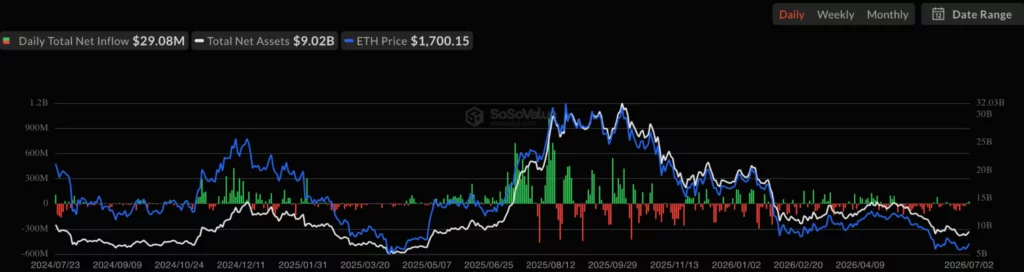
The token had already been eyeing a $1,700 breakout after July 1 ETF inflows returned. That earlier shift helped ease pressure around the $1,500 support region, but ETH still needed a stronger move above $1,700 to improve its short-term chart.
The next area to watch is $1,800. A clean move above that level could show that buyers are gaining control after the recent drawdown. Failure to hold $1,700 may return focus to $1,650 and then the lower support region near $1,500.
Ethereum Technical indicators improve
Ethereum’s short-term indicators are showing better momentum. The MACD histogram is positive near 19.33, while the MACD line sits around -49.01 and above the signal line near -68.34. That confirms the recent bullish crossover has gained strength.
The broader signal is not fully bullish yet because both MACD lines remain below the zero line. This means downside pressure has eased, but the token has not confirmed a full trend reversal. Traders usually look for MACD follow-through toward the zero line before calling a stronger recovery.
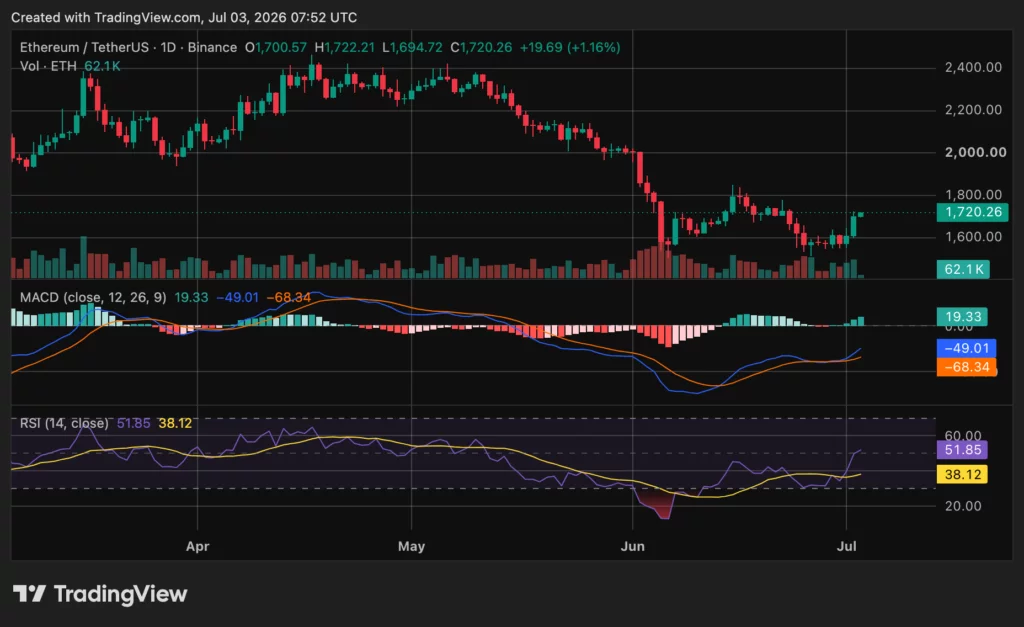
The RSI also improved. It stood near 51.85, above its moving average near 38.12. This move above 50 shows buyers are starting to regain control after a weak June.
Crypto analyst Ali Charts said the token has printed a monthly TD Sequential buy signal. In his view, the signal suggests seller exhaustion on a higher timeframe. He also said ETH is approaching a long-term support area near $1,100, which he described as the bottom boundary of Ethereum’s multi-year channel.
Ali Charts pointed to $3,000 as a mid-range recovery target if that lower channel holds. He also placed the broader channel ceiling near $5,000. Those levels are long-term technical targets, not short-term price calls.
ETH/BTC setup draws attention
Ethereum’s performance against Bitcoin is also drawing attention. Crypto Rover said an ETH/BTC golden cross is forming, with the 50-week moving average moving toward a cross above the 100-week moving average. He said the last similar signal in 2021 came before ETH outperformed Bitcoin.
That setup matters because ETH has lagged Bitcoin during the broader market decline. A stronger ETH/BTC pair would show that capital is rotating back toward Ethereum rather than only following Bitcoin’s rebound.
Derivatives data also shows rising activity. According to Coinglass data, ETH volume rose 14.48% to $44.74 billion, while open interest increased 10.64% to $24.54 billion. Options volume climbed 30.19% to $1.41 billion, and options open interest rose 6.67% to $4.43 billion.
Rising open interest can support stronger price moves when buyers lead the market. It can also raise liquidation risk if leveraged positions build too quickly. For that reason, the current derivatives setup points to more volatility rather than a clean bullish trend.
On-chain signals remain mixed
CryptoQuant analyst Darkfost said Binance ETH withdrawal transactions hit their highest level in three years. Binance reportedly logged more than 166,000 withdrawal transactions in one day as ETH rebounded from the $1,500 area.
Exchange withdrawals can point to accumulation when users move coins into self-custody. They can also show funds moving into DeFi for yield. Darkfost said some withdrawals may also reflect confusion around MiCA rules that took effect on July 1, even though withdrawals were not frozen.
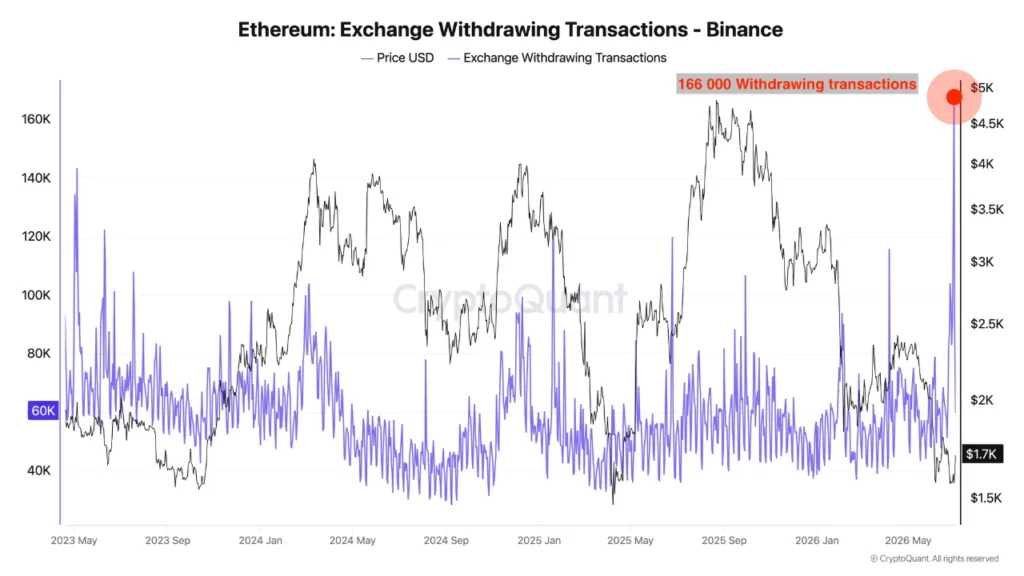
Another CryptoQuant analyst, PelinayPA, gave a more cautious reading. The analyst said Binance ETH exchange netflow remained positive at +12,938 ETH, meaning more ETH was moving into the exchange than leaving it. Positive netflow can create selling risk because coins on exchanges are easier to sell.
That contrast keeps the short-term outlook balanced. Withdrawal transactions suggest some users may be accumulating. Positive netflow and rising open interest suggest selling pressure and leverage have not disappeared.
Institutional activity adds support
Ethereum also has support from corporate and institutional activity. As crypto.news reported, Ethereum Institutional launched with backing from BitMine, SharpLink, Joe Lubin, and other contributors to support adoption by banks, asset managers, custodians, and financial firms.
BitMine has continued building its Ethereum treasury. As previously reported, BitMine added 27,084 ETH, lifting its holdings to more than 5.7 million ETH, or about 4.7% of Ethereum’s supply.
SharpLink has also kept buying during weakness. The company bought another 10,000 ETH for $16.1 million as Ethereum tested lower support.
Disclosure: This article does not represent investment advice. The content and materials featured on this page are for educational purposes only.


BTSE has officially entered Indonesia’s regulated crypto market through the launch of BTSE Indonesia after completing the rebranding of local exchange NVX.
Summary
- BTSE has launched a regulated cryptocurrency exchange in Indonesia through a joint venture and the rebranding of NVX.
- The OJK license allows the platform to offer IDR deposits, withdrawals, trading pairs, and other regulated digital asset services.
- The launch comes as Indonesia continues tightening oversight of its cryptocurrency sector with new compliance rules for market participants.
According to an official announcement issued on July 3, the new platform has been established as a joint venture between BTSE Group and PT Aset Kripto Internasional, combining BTSE’s trading infrastructure with local operations focused on customer growth, partnerships, marketing, and sales.
Operating under a license issued by Indonesia’s Financial Services Authority (OJK), BTSE Indonesia is authorized to function as a Digital Financial Assets and Crypto Assets Trading Operator (PAKD). The approval places the exchange among the limited number of regulated entities permitted to offer cryptocurrency trading services in the country while complying with anti-money laundering requirements and customer asset protection rules.
With the regulatory approval in place, BTSE Indonesia can work with Indonesian banks and payment providers to support Indonesian rupiah (IDR) deposits, withdrawals, currency conversions, and IDR trading pairs. The company said the license also creates a path to introduce additional regulated products, including futures trading, subject to rules issued by Indonesian authorities.
Under the partnership, BTSE Group will provide the exchange’s trading engine, liquidity, and underlying technology, while the Indonesian entity will manage local commercial operations using its market knowledge and domestic business relationships.
“Indonesia has everything it takes to be Asia’s next major crypto hub; the population, the demand, and now the regulatory framework. What it needs now is the right combination of global infrastructure and local expertise. That’s exactly what this joint venture delivers,” said Jeff Mei, Chief Operating Officer of BTSE Group.
According Stephanie Kusnadi, Chief Strategy Officer of BTSE Indonesia, added the integration with BTSE gives the company access to global exchange technology while allowing it to continue operating as a platform built around local regulatory requirements and user needs.
Indonesia continues tightening crypto oversight
The launch comes as Indonesia continues introducing new rules for its digital asset industry. In June, the OJK issued Financial Services Authority Regulation No. 6 of 2026, requiring social media influencers who recommend cryptocurrencies and other digital financial assets to obtain competency certification unless they already hold another qualifying license.
Under the same regulation, influencers may promote only digital assets listed on authorized exchanges, while promotional campaigns must be conducted through licensed financial services businesses that remain responsible for the content. The new requirements place additional compliance obligations on digital asset firms operating in Indonesia’s regulated market.
Last month, Cardano’s ADA collapsed below $0.14, the lowest level since the end of 2020. Meanwhile, its market capitalization briefly plummeted to roughly $5 billion, leaving the asset temporarily out of crypto’s top 20 club.
The bulls, though, managed to halt the free fall and even stage an impressive comeback. Here’s what happened and the possible catalysts behind the resurgence.
Green Week for ADA
As of press time, the token is worth almost $0.17, representing a 17% increase over the past 7 days. Perhaps the most evident reason pushing ADA higher is the broader market rebound following de-escalation news out of the Middle East.
Bitcoin (BTC) soared to $62,000, while Ethereum (ETH) surged past $1,700 amid reports that Iran and the USA are set to hold the next round of direct talks in the third week of July after the funeral of the supreme leader Ali Khamenei.
Another catalyst could be the excitement surrounding a Cardano upgrade scheduled to go live on July 6. Namely, this is the RealFi Phase 1 Testnet, described as “the first public step toward next-generation stablecoin infrastructure” on the project.
“Crypto’s clearest success story has scaled as money. But not as capital. Hundreds of billions of dollars sit idle in stablecoins: No utility. No impact on the real economy. We think that’s a problem worth solving – and the Testnet is where we start. During Phase 1, participants can explore the platform, use its core features, and share feedback that will directly shape the protocol. This is collaborative infrastructure-building in public, and we want you involved,” the announcement reads.
Speaking about the upcoming effort was Cardano’s founder, Charles Hoskinson, who called it “the largest upgrade” in the project’s history.
Numerous analysts noted ADA’s revival, arguing it has more fuel left to post further gains. X user Sssebi claimed the token “is on fire” and envisioned a short-term pump to $0.20, while Nehal predicted a jump to $0.23, provided the price holds above $0.16.
Not so Fast
ADA’s recovery shouldn’t be seen as a guaranteed start of a new bull run, as the crypto market remains quite unstable and vulnerable to another severe pullback.
The asset’s Relative Strength Index (RSI) reinforces the bearish outlook. The technical analysis tool, which ranges from 0 to 100, has risen above 70, indicating that ADA is in overbought territory and due for a possible correction. Conversely, ratios below 30 are considered buying opportunities.

The post Why is Cardano (ADA) Up 15% in a Week? appeared first on CryptoPotato.

HuffPost Headlines 7-1
Teofimo Lopez names the welterweight champion who would have beaten Terence Crawford

How Sony Manufactured Those Black PlayStation CDs in 1997

No Jackpot Winner as $257 Million Prize Rolls Over to $269 Million Monday Draw

Renter of Home in Anne Heche Crash Denies Settlement With Son

Weekend Open Thread: Staud – Corporette.com

BITCOIN SHORT SQUEEZE OVER (This is Next)!!! – Bitcoin News Today, Ethereum & Altcoins

Caleb Hammer Turned Financial Help Into Public Embarrassment…

Bitcoin & XRP Bottom for 2026? #xrp #bitcoin #btc #cryptocurrency #crypto #trading #ripple #xlm
-

 Tech6 days ago
Claude Code turned every engineer into three. Now companies need more product thinkers
-

 Tech6 days ago
Bluekit phishing kit adopts browser-in-the-middle for login theft
-

 Crypto World4 days ago
Strategy authorizes up to $1.25B in Bitcoin sales under new capital plan
-

 Fashion7 hours ago
Weekend Open Thread: High Hopes
-

 Politics13 hours ago
The House | “Reframing the debate from a binary discussion of winners and losers”: Yuan Yang reviews ‘We Are Not Machines’
-

 News Videos5 days ago
MAJOR BITCOIN & MARKET UPDATE!!!! (MUST WATCH ASAP!!!)
-

 Tech4 days ago
Anonymous researcher drops 0-day ‘exploitarium’ repo
-

 Crypto World6 days ago
Coinbase, Circle Deepen Crypto Stock Losses Despite Resilient S&P 500
-

 Business4 days ago
Australia treasurer says alleged access of prime minister’s bank data ’incredibly concerning’
-

 Crypto World7 days ago
Kraken's xStocks Opens Bending Spoons IPO Registration to EEA Retail
-

 Tech7 days ago
Russian hackers now target Signal backup recovery keys
-
 Business4 days ago
The AI boom won’t burst all at once. It will pop in ‘rolling bubbles’: Macquarie
-

 Sports3 days ago
Broncos roster: OL Ben Powers (No. 74) entering final year of contract
-

 Tech6 days ago
Silicon Valley paid to kill AI regulation, now it wants the rules back
-

 NewsBeat3 days ago
Presenter Caroline Flack’s brother Paul Flack dies aged 55
-

 Crypto World2 days ago
Binance stock trading tops $1B in first month after launch
-

 Tech7 days ago
OpenAI mulls delaying IPO over valuation concerns
-
 NewsBeat2 days ago
New exhibition reflects five decades of movement between island of Ireland and GB
-

 Crypto World2 days ago
Alibaba-affiliate Ant Group enters the humanoid robot market with 12 deals
-

 News Videos4 days ago
How to Build INSANE Live Financial Dashboards With Claude
You must be logged in to post a comment Login