Melbourne’s reputation as a global events city, from the Australian Open tennis and Formula 1 Australian Grand Prix to hosting NFL regular season games, now intersects with a different form of scale: large-scale compute, data-intensive research, and advanced engineering. Long recognized for delivering complex international events, the city is applying the same organisational capability to the infrastructure that underpins modern AI research, positioning Melbourne at the convergence of global convening and high-performance digital systems.
Consistently ranked among the world’s most livable cities, Melbourne was named Time Out’s Best City in the World in 2026, the first Australian city to hold the title.
More materially for research and innovation, Melbourne is also the nation’s fastest‑growing capital, attracting increasing concentrations of engineering and technology talent, investment and international engagement.
Advertisement
Australia’s artificial intelligence (AI) ecosystem is entering a new phase, defined less by isolated initiatives and more by the convergence of compute infrastructure, research intensity and international collaboration. Melbourne sits at this intersection.
Melbourne’s trajectory highlights what enables research at scale: access to frontier-grade compute, proximity to industry-ready infrastructure, and repeated opportunities for global research communities to convene.
Sovereign AI compute, expanding hyperscale data center campuses and a growing pipeline of international research-led conferences are reshaping the city’s research landscape. Together, these elements position Melbourne as a focal point for applied AI research, advanced engineering and data-intensive science.
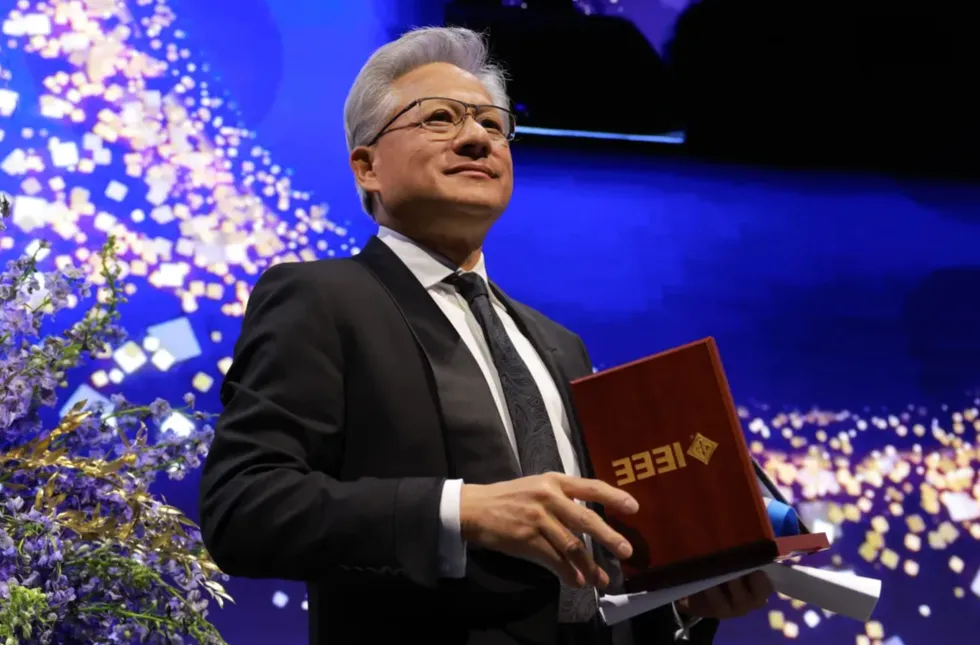
The growing global influence of AI engineering, underscored by NVIDIA CEO Jensen Huang receiving the 2026 IEEE Medal of Honor, reflects the scale of this shift. In Melbourne, these factors form a reinforcing research flywheel linking infrastructure, discovery and collaboration.
Advertisement
Rather than focusing on startup density or short-term commercial output, Melbourne’s trajectory highlights what enables research at scale: access to frontier-grade compute, proximity to industry-ready infrastructure, and repeated opportunities for global research communities to convene.
The most recent cornerstone of Melbourne’s AI capability is MAVERIC (Monash AdVanced Environment for Research and Intelligent Computing), Australia’s largest university-based AI supercomputer. Built and deployed by Monash University in partnership with NVIDIA, Dell Technologies, and CDC Data Centres, MAVERIC has been engineered specifically for large scale AI and data intensive science, with medical research representing a key priority. Indeed, in these regards MAVERIC has been designed to function as a Next Generation Trusted Research Environment thus ensuring that it is state-of-the-art and provides a safe and secure framework for the analysis of large sensitive datasets.
MAVERIC has been designed to function as a Next Generation Trusted Research Environment thus ensuring that it is state-of-the-art and provides a safe and secure framework for the analysis of large sensitive datasets.Monash University
Designed to support research projects including cancer and neurodegenerative disease detection, clinical trial analysis and drug discovery through to materials science and engineering, MAVERIC enables Australian researchers to train and evaluate large models domestically while keeping highly sensitive datasets secure and under national jurisdiction. This sovereign design is particularly relevant in fields such as medical research where privacy, regulation or intellectual property constraints limit the use of offshore cloud resources.
Monash University Vice-Chancellor and President Professor Sharon Pickering with researchers [left to right] Professor Anton Peleg, Professor Victoria Mar, Professor James Whisstock, Vice-President (Strategy and Major Projects) Teresa Finlayson, and Professor Patrick Kwan.Eamon Gallagher (Australian Financial Review)
Technically, the system reflects the latest shifts in high performance AI architecture. Built on NVIDIA GB200 NVL72 platforms and integrated using Dell’s rack scale infrastructure, MAVERIC employs closed loop liquid cooling to reduce water consumption compared with conventional air-cooled systems, aligning large scale compute growth with sustainability objectives while supporting high density, high throughput workloads.
Advertisement
Professor James Whisstock, Deputy Dean Research of Monash’s Faculty of Medicine Nursing and Health Sciences commented, “MAVERIC provides a huge leap forward in our compute capability that will revolutionize our researchers’ ability to address the most challenging and important research questions across the fields of medical research, information technology, and STEM disciplines. It will seed wonderful new cross-disciplinary collaborations, underpin the work of our best and brightest young researchers and will allow our scientists to continue to make major discoveries that positively impact the Australian and global population more broadly.”
“MAVERIC provides a huge leap forward in our compute capability that will revolutionize our researchers’ ability to address the most challenging and important research questions across the fields of medical research, information technology, and STEM disciplines.” —James Whisstock, Monash University
Monash University frames MAVERIC not as a standalone asset, but as part of the national research infrastructure, intended to strengthen collaboration across academia, healthcare, government and industry. This approach positions Melbourne at the forefront of sovereign AI enabled research in the region.
Data centre scale as research infrastructure
The infrastructure demands of modern AI research extend well beyond individual systems. Melbourne’s expanding data centre footprint now supports hyperscale compute, applied AI deployment and large-scale research workloads simultaneously.
In February 2026, CDC Data Centres opened its first Melbourne campus in Brooklyn, with two live facilities and a third in planning. Combined with CDC’s Laverton campus, Melbourne is projected to host more than 800 megawatts of sovereign digital capacity, critical for AI workloads requiring sustained access to high-density power, cooling and secure environments.
Parallel investment is underway in Fishermans Bend, where NEXTDC is developing a AUD $2 billion AI and digital infrastructure hub adjacent to the Innovation Precinct. Planned facilities include an AI Factory, a Mission Critical Operations Centre and a Technology Centre of Excellence, enabling sovereign AI, high-performance computing and cross-sector collaboration across health, defence and finance.
Melbourne hosts Australia’s largest cluster of AI firms, with 188 companies, and more than 40 data centres currently operate across Victoria. The Victorian Government has complemented this growth with an initial AUD $5.5 million investment in the Sustainable Data Centre Action Plan.
Together, these developments reinforce Melbourne’s role as a national and increasingly global hub for high-performance AI infrastructure as model complexity and infrastructure dependency continue to accelerate.
Advertisement
Applied AI research at scale
Monash University is home to MAVERIC, Australia’s largest university-based AI supercomputer, built and deployed by Monash in partnership with NVIDIA, Dell Technologies, and CDC Data Centres.Monash University
Melbourne’s research strength is underpinned by a dense university network with deep capability across AI, data science and engineering. Institutions including Monash University, the University of Melbourne, Deakin University, La Trobe University, RMIT University and Swinburne University of Technology collectively support research across machine learning, robotics, human-computer interaction, extended reality and advanced manufacturing.
This concentration fosters applied collaboration where AI intersects with medicine, sustainability, cognitive systems and immersive technologies. For visiting researchers, it provides access not only to academic expertise but also to live infrastructure environments where research can be tested and validated, reinforcing Melbourne’s position as one of the Asia-Pacific’s most integrated AI research ecosystems.
Conferences as research accelerators
Plenary session at Melbourne Convention and Exhibition Centre.Melbourne Convention Bureau
Melbourne’s selection as host city for a growing number of international technology conferences reflects the convergence of research capability and infrastructure maturity.
In September 2026, Data Center World Australia and The AI Summit Australia will be co-located at the Melbourne Convention and Exhibition Centre, bringing together global leaders across AI, digital infrastructure and enterprise technology. The pairing highlights a broader reality: advances in AI are inseparable from the infrastructure that enables them.
Advertisement
Melbourne’s expanding data centre footprint now supports hyperscale compute, applied AI deployment and large-scale research workloads simultaneously.
Research-led conferences are also expanding Melbourne’s global footprint. ICONIP 2026, hosted by Deakin University, will bring up to 700 researchers in neural networks and machine learning, followed in 2027 by IEEE VR, the leading conference on virtual reality and 3D user interfaces, attracting up to 1,000 delegates.
In this context, conferences function not simply as events, but as infrastructure for knowledge transfer, supporting standards exchange, collaboration and system-level learning at global scale.
A global platform for advancing research
Sovereign compute, data centre scale and a strong conference pipeline create a reinforcing cycle, enabling researchers to engage directly with infrastructure and industry well beyond the event itself.
Advertisement
By closing the gap between theory and deployment, Melbourne supports deeper technical exchange and more enduring global research networks.
This role was recognized in 2025 when the IEEE awarded Melbourne Convention Bureau the 2025 Organisational Supporting Friend of IEEE Member and Geographic Activities (MGA) — the first convention bureau in the Asia Pacific region to receive the acknowledgement as a result of the longstanding partnership with the IEEE Victorian Section.
Melbourne Convention Bureau (MCB) representative Fatima Aboudrar, Senior Business Development Manager, with Vijay S. Paul, Immediate Past Chair, IEEE Victorian Section, receiving Supporting Friend Member recognition in 2025.
As AI research becomes increasingly dependent on infrastructure scale, sovereign capability, and global collaboration, Melbourne is moving beyond hosting conversations to actively enabling the systems that advance AI and data‑driven research at global scale.
Conference support in Melbourne
Melbourne Convention Bureau
Advertisement
This ecosystem is underpinned by Melbourne’s highly accessible city centre, where world-class venues, research institutions and industry hubs are located in close proximity. Free public transport and a compact city footprint enable seamless movement from conference floor to real-world application.
Melbourne Convention Bureau (MCB) supports professionals in bidding for, securing and delivering international conferences across Melbourne and regional Victoria. Backed by the Victorian Government, MCB has for more than 60 years helped bring the world’s leading thinkers to the state, positioning Melbourne as a place where ideas become impact.
Amazon says it is ending sideloading on new Fire Sticks because “apps that facilitate piracy, and other apps, can carry malware,” adding that there is “a good amount of evidence” that sideloaded apps may contain unwanted code or behavior. However, the company did not provide specific examples of Fire Stick users being harmed. Ars Technica reports: Amazon has released two Fire Stick models that use its proprietary, Linux-based operating system, Vega OS. Previous Fire Sticks ran Fire OS, which is an Android fork based on the Android Open Source Project. One of the biggest differences between Vega OS and Fire OS is that the former doesn’t support sideloading. […] In a recent interview, Or Goren, editor-in-chief of Cord Busters, a UK-based streaming news outlet, noted the negative reaction to Vega being a closed OS. [Aidan Marcuss, VP of Fire TV, advertising, and Appstore] responded, per the publication, by saying that Vega OS was Amazon’s opportunity to “innovate and deliver more capabilities, even on the least expensive devices.”
He also said that making a platform around security and privacy was “sort of utmost in my mind.” The statement is somewhat ironic, considering Vega OS blocks custom launchers and other third-party apps that helped users avoid Amazon tracking and ads. Goren asked whether Amazon had evidence that sideloaded devices caused users harm. “Apps that facilitate piracy, and other apps, can carry malware,” Marcuss responded. Marcuss also said that there is “a good amount of evidence that apps can carry unwanted code and behavior on them when they’re sideloaded.”
Marcuss didn’t provide specific examples of Fire Stick users being hurt by sideloaded apps. There are some potential examples, though. In 2025, Amazon claimed to blacklist (which blocked the apps from being sideloaded to Fire Sticks) four video streaming apps for malicious behavior. At the time, AFTVnews reported that two of the apps served as residential proxy providers and were considered riskware, and that the other two had APK files that were flagged by virus-scanning tools. Safari and Chrome also flagged one of the apps’ official websites, the publication reported. And in 2018, a botnet that infected Android devices with cryptocurrency-mining malware appeared on some Fire Sticks, per discussion on XDA Forums. That said, Amazon also has a history of disabling apps that let users circumnavigate its home screen that Fire devices, including Fire Sticks and Fire TVs, have increasingly used for ads. Worth noting: developers can continue sideloading apps onto Vega OS devices if they register them with Amazon.
Baby boomers, born between 1946 to 1964, grew up in relative prosperity thanks to the post-war economic boom that the U.S. experienced after it defeated Germany and Japan. Car companies expanded production as a response to increased consumer demand, with many of them releasing affordable models that allowed more families to buy a car or two.
Because of this, many baby boomers got their first car while they were in high school. This could be either a hand-me-down vehicle they received after their family upgraded to a newer model or a used vehicle their parents specifically bought for them. There were also some who took on part-time jobs so they could save up for the car they wanted, while a lucky few were given a brand-new set of wheels of their choosing by their rich parents.
Advertisement
This generation is now 62 to 80 years old in 2026, and their high school years are already 50 years behind them. However, these are also some of the most formative years for anyone, meaning they’re likely to remember and reminisce about the first car they drove during this period. So, these are a few models that will take boomers back to their high school days — they either drove one of these cars or at least know someone who does. And whenever they see one of these on the road, they will remember what it was like during their teenage years.
Advertisement
AMC Gremlin
The AMC Gremlin is a small hatchback produced from 1970 to 1978, meaning older boomers didn’t have the chance to own one during high school. Nevertheless, those born from 1954 onwards would have had the chance to receive it at 16. Its status as an economy car meant that it was quite a popular model, although it had a rather unique, quirky look.
It’s unfortunate that the Gremlin is often lumped among the worst-looking cars from the 1970s, although it might not have been a bad car after all. But whatever the case, many high schoolers (or their parents) probably chose this as their first car specifically because of its affordability. After all, the two seats and hatchback of the Gremlin should be more than enough to ferry a high schooler and their school bag (and the occasional girlfriend) between home and school.
High schoolers who loved working on cars would also appreciate the Gremlin. While it was primarily marketed as a compact economy car, its large engine bay meant that it could accommodate more powerful engines. AMC even released a 6.6-liter V8 engine for the diminutive hatchback, so those who dreamed of a faster car but didn’t have the extra cash for a proper muscle car could get this instead. Although the Gremlin did not have the iconic status of the Mustang and is even often the butt of jokes because of its rather quirky outline, it would likely bring a lot of memories when a boomer sees one on the road.
Advertisement
Chevrolet Impala
Milos Ruzicka/Getty
The Impala is a full-sized sedan produced by Chevrolet from 1957, and it quickly became one of the iconic cars of multiple generations. Given that it was Chevrolet’s flagship model, it’s unlikely that a lowly teenager with limited resources would be able to afford one from their savings or a part-time job. High schoolers who drove an Impala around that time would either have borrowed their parents’ car or be using it after the family upgraded to a station wagon for more flexibility.
Aside from being a family car, the Impala also had a sporty variant in the Impala SS, which was arguably Chevrolet’s first muscle car. This would’ve caught the attention of high schoolers who had a taste for speed and adventure. But whether they drove their family’s old Impala to school all the time, snuck it out occasionally after their parents left home, or were dropped off at school in one before they got their license, this full-sized sedan would have left a mark in their young minds.
Just as the baby boomer generation has reached 62 years of age and older, the cars of their youth have also now hit classic status. This is probably the reason why some of the oldest generations of the Impala are worth so much today — boomers who have hit retirement age and are cashing in their pensions could now afford to buy these classics to relive their younger years.
Advertisement
Dodge Dart
Kenmo/Getty
The Dart was one of the most successful Dodge models ever sold in the U.S., so it’s likely that a baby boomer’s family would own one. While it began life as a full-size sedan in 1960, it had become a slimmer, more practical compact sedan by 1967 and continued to be produced until 1976. This combination of popularity and practicality made the Dart as one of the obvious choices for young high schoolers getting their first car.
Aside from being a great daily driver, the Dodge Dart GTS was the ride of the protagonist in the detective show “Mannix,” making it a star in its own right and increasing it desirability among young people. The company also created the Dodge Dart Swinger, which paired the smaller body of the Dart with a 340-cu.-in. V8 that hit 275 horsepower and 340 lb.-ft. of torque. This powertrain allowed the vehicle to go from naught to sixty in around 6.3 seconds and could be had with either a four-speed manual or three-speed automatic.
Advertisement
This vehicle will certainly bring back memories of the baby boomer generation’s carefree high school days, and we can see this in the going rate of these vehicles in the used market. Although these cars are at least 50 years old now, they still go for a pretty penny, with prices hovering around $35,000. If you want the ultra-rare 1968 Dodge Dart with a Hemi engine, which only had 80 units, be prepared to shell out at least $125,000 to $165,000.
Advertisement
Ford Mustang
Heritage Images/Getty
Of course, if we’re talking about some of the most memorable cars from 1962 to 1980 (the years when baby boomers turned 16), we must include the iconic Ford Mustang. This pony car arrived in 1964, with the first generation being produced until 1973, while the controversial Mustang II was built from ’73 until ’79. Even though the Mustang is still being produced today, the models made in the ’60s and ’70s would likely be the ones that would catch the attention of baby boomers.
Although the Mustang looked good and offered some level of performance, the most important feature of the Mustang for high schoolers back then was that it was affordable. A base ’65 Mustang only cost $2,500, which is about $27,000 in today’s money. This makes it even cheaper than the base EcoBoost Fastback Mustang you can get today, which starts at $32,995. If their parents were rather generous or they secured a summer job that pays relatively well, baby boomers could potentially buy a Mustang of their own.
The fifth-generation Mustang, which arrived in 2005, introduced throwback styling to the beloved pony car, and the latest Mustangs still use design cues that originated in that era. While the retro look of these newer models would remind us of the ’60s, only the original first-generation Mustang could bring back the feelings and memories our parents and grandparents had in high school.
Advertisement
Volkswagen Beetle
While the Volkswagen Beetle might not be an American car, it still left a lasting impression on American culture, particularly among young people in the 1960s and 1970s. This little vehicle became a symbol for counterculture, especially as the baby boomers are coming into age and are “rebelling” against the conservative culture that their parents had. Aside from that, it was also cheap to buy, affordable to maintain, and sipped gasoline.
Even though the Beetle is a tiny car by American standards, it still sold well among young people. After all, most high schoolers typically only need a car to go from their house to school and back, carrying their school bags with them — they don’t need the extra cargo space that pickup trucks offer, or the large legroom found in full-sized sedans. The passenger seat beside the driver should be good enough to carry their girlfriend with them when they go on a date, while they could pack in the rest of their friends in the tight back seats for a quick drive to the neighborhood diner.
The Volkswagen Beetle is still a worthy buy today, allowing anyone — from baby boomers to even the younger generations — to experience what it was like to own and drive a cheap and affordable little car that’s easy to maintain. Those who are inclined towards resto-modding could even convert a gas-powered model into an EV.
Indian supplier Tata Electronics confirmed the breach on 22 June.
A ransomware group has posted stolen images of Apple’s upcoming iPhone 18 Pro models, alongside sensitive lists of components and suppliers, Reuters has reported.
The data was taken from the tech giant’s Indian supplier Tata Electronics, which confirmed the breach on 22 June.
The leak comes as Apple is reportedly gearing up to release its iPhone 18 Pro and Pro Max this September. SiliconRepublic.com has reached out to Apple for comments.
Advertisement
Documents reviewed by Reuters showed files that map iPhone 18 Pro’s components across companies that supply them, including details of chips on its main circuit board, battery parts and camera components.
The company does not disclose detailed supplier information in its public databases, a source told the publication, adding that Apple considers the leaked information to be sensitive.
The leak also includes confidential images of the upcoming iPhone 18 Pro – reportedly a conventional grey handset with a three-rear-camera set-up and the Apple logo.
The breach threatens the security of the tightly-held chain of suppliers Apple has in place, across more than 60 countries and using millions of workers, to manufacture its products.
Advertisement
It comes after the company raised iPad and MacBook prices last week due to soaring memory and storage chip costs. Analysts expect iPhone prices, especially the Pro models, to also be affected by the chip shortage.
Meanwhile, the 2020-founded Tata Electronics – a Tata Group venture – has taken the mantle as a key player in India’s efforts to improve its devices and chip manufacturing capacity.
The company manufactures electronics, assembles, tests and provides semiconductor foundry capabilities. It has deals with global companies, including the Dutch semiconductor company ASML, Qualcomm, Intel, Tesla and Merck, as manufacturers attempt to diversify supply chains outside of China.
Reuters previously reported that a cyber group called World Leaks posted more than 200,000 files pertaining to Tata customers Apple and Tesla on the dark web.
Advertisement
The files reportedly contained design papers of older iPhones, documents from Taiwan Semiconductor Manufacturing Company and Qualcomm – both of whom supply Apple with components – as well as some data from Tesla.
Don’t miss out on the knowledge you need to succeed. Sign up for the Daily Brief, Silicon Republic’s digest of need-to-know sci-tech news.
We find the most joy using our smartphones as social media machines, but our phones also handle mundane activities like communication and navigation. If you’re on Android, you most likely default to Google Maps to plan your commutes and explore new places. While Apple Maps’ many useful features make it a compelling alternative, Google Maps enjoys a huge user base, likely because it has had a head start of more than a decade in mapping out even the most rural corners of the world.
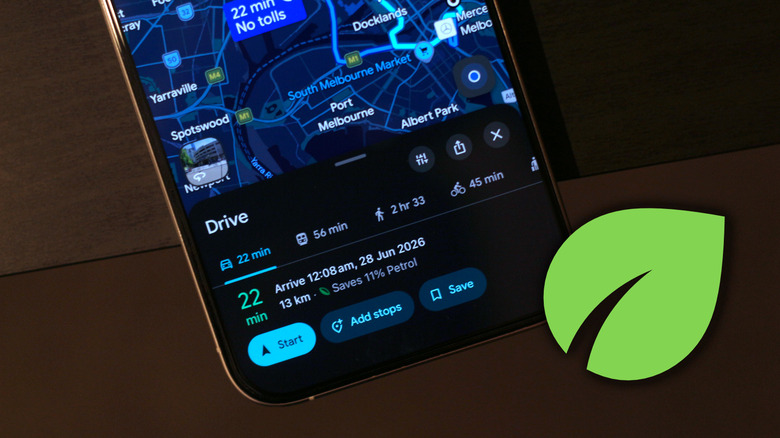
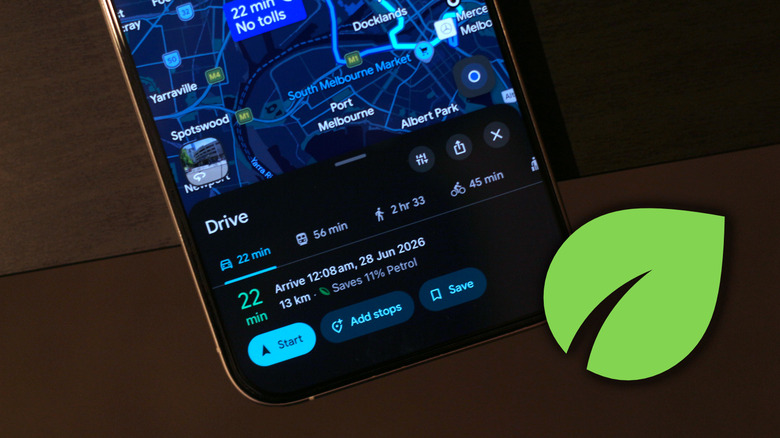
For those of us who aren’t passionate navigators, Google Maps offers a clean user interface with easy-to-understand controls. That said, there are several quality-of-life Google Maps features that are easy to miss. These are often hidden within menus or denoted by icons you might not have given much thought about. The green leaf symbol is one such example that shows up when you start picking a route to a destination. It essentially indicates that the route is the most eco-friendly option.
You can view more info about the eco-friendly route if you expand the navigation details from below. Google Maps will display how much gas you’ll be saving by picking this route and, if applicable, how much longer your trip will take compared to the fastest route. Google claims it determines which route is the most eco-friendly by taking into consideration factors such as real-time traffic and road conditions.
Advertisement
Customizing Google Maps just for you
Adnan Ahmed/SlashGear
Relying on eco-friendly routes is an effective way to save fuel in your car. You can customize your Google Maps experience to let it automatically select eco-friendly routes whenever available. To do this, open Google Maps, tap on your profile picture, head to Settings > Navigation, and turn the “Prefer fuel-efficient routes” toggle on. From now on, assuming your destination has more than one route, Google Maps will automatically put you on the one that saves the most gas.
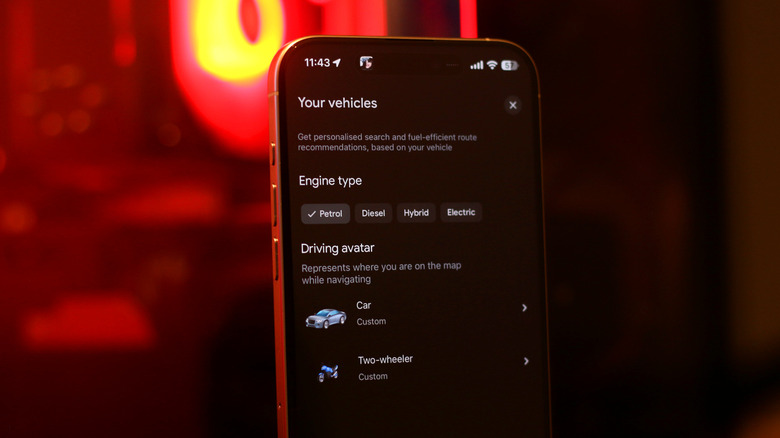
Now is also a good time to enter more details about the vehicle you’re driving, since, by default, Google Maps calculates routes assuming you have a gas or petrol-powered car. Navigate to Settings > Your Vehicles and select an engine type. Options include petrol, diesel, hybrid, and electric. This is important because Google Maps estimates eco-friendly routes based on your vehicle’s engine type. You can also select a different avatar for your car and motorcycle. This replaces the default blue navigation arrow that shows where you are on the map.
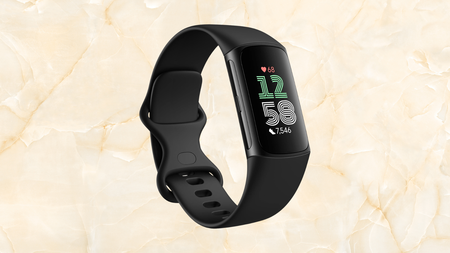
That price cut matters because the Charge 6 was never a stripped-down budget option to begin with, it is a device packed with the kind of granular detail that usually justifies a far higher price tag elsewhere.
Advertisement
Built-in GPS means the Charge 6 can map your route and pace without needing your phone tucked into a pocket or strapped to your arm, so a simple run finally feels like just a run again.
That tracking extends across more than 40 distinct exercise modes, covering everything from a casual bike ride to a full HIIT session, with key stats logged automatically against whatever personal goals you have already set yourself.
Heart rate on equipment takes things a step further, syncing wirelessly with compatible treadmills, ellipticals and rowers so the number flashing on the gym display actually matches what is happening on your wrist.
Advertisement
All of that accumulated data feeds into a Daily Readiness Score, which weighs your recent stress, sleep and activity levels to suggest whether today calls for a hard session or something gentler.
It is the sort of feature that turns a tracker from a passive logger of numbers into something that actively helps you make smarter decisions about your own training week. Sleep gets the same depth of attention, with automatic tracking building a personalised profile over time alongside a smart wake alarm that nudges you awake with a gentle vibration rather than a jarring tone.
Battery life also holds up at around 7 days per charge, which is comfortably enough to wear it through a full week, including overnight sleep tracking, without ever needing to think about a charger.
At this price, the Charge 6 covers the fundamentals of fitness tracking so thoroughly that anyone starting out, or upgrading from a much older band, will find this particular discount genuinely hard to ignore.
My camera roll has crossed 8,000 photos, and it got there by capturing random moments (only to forget them later). The problem, however, starts when someone asks me to share something specific. It could be their portrait from last weekend or the food pictures they snapped using my phone.
Finding those pictures usually means scrolling through my seemingly endless camera roll. If the photo is a month or two old, I end up scrolling past hundreds of other images to find it, and that gets old fast.
Siri AI is quite good at finding pictures
Apple tried to chip away at that problem with natural-language photo search in iOS 18.1, but it always felt like a feature that was almost there. iOS 27’s Siri AI closes the gap by adding voice search, so you can just ask out loud and let it do the hunting.
Shikhar Mehrotra / Digital Trends
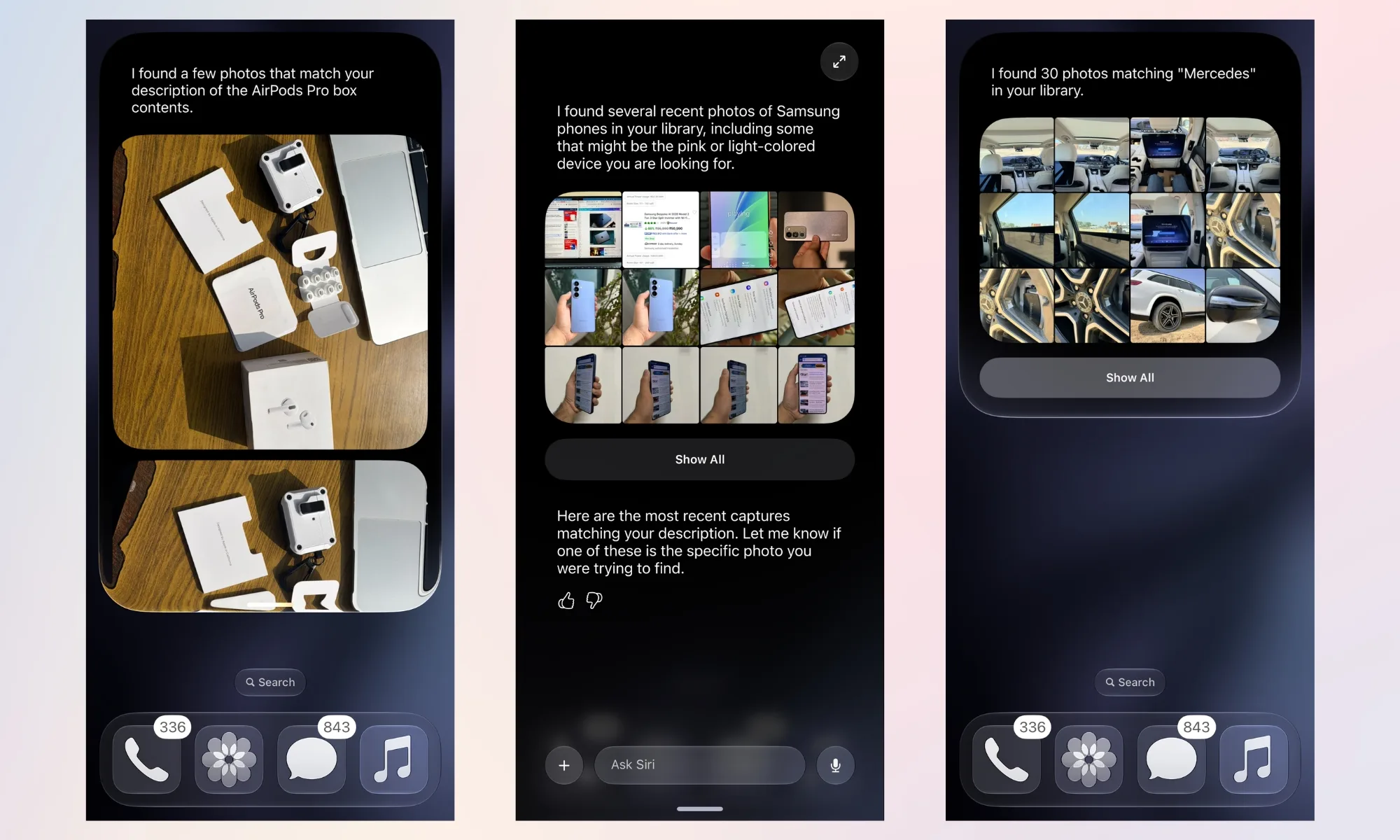
For well-defined objects, natural-language voice search via Siri works just fine. I asked Siri to show me the picture of the AirPods Pro box contents that I captured in January 2026, another for Samsung phones, and one for Mercedes, and it fetched the right results. All of these were at least a couple of months old.
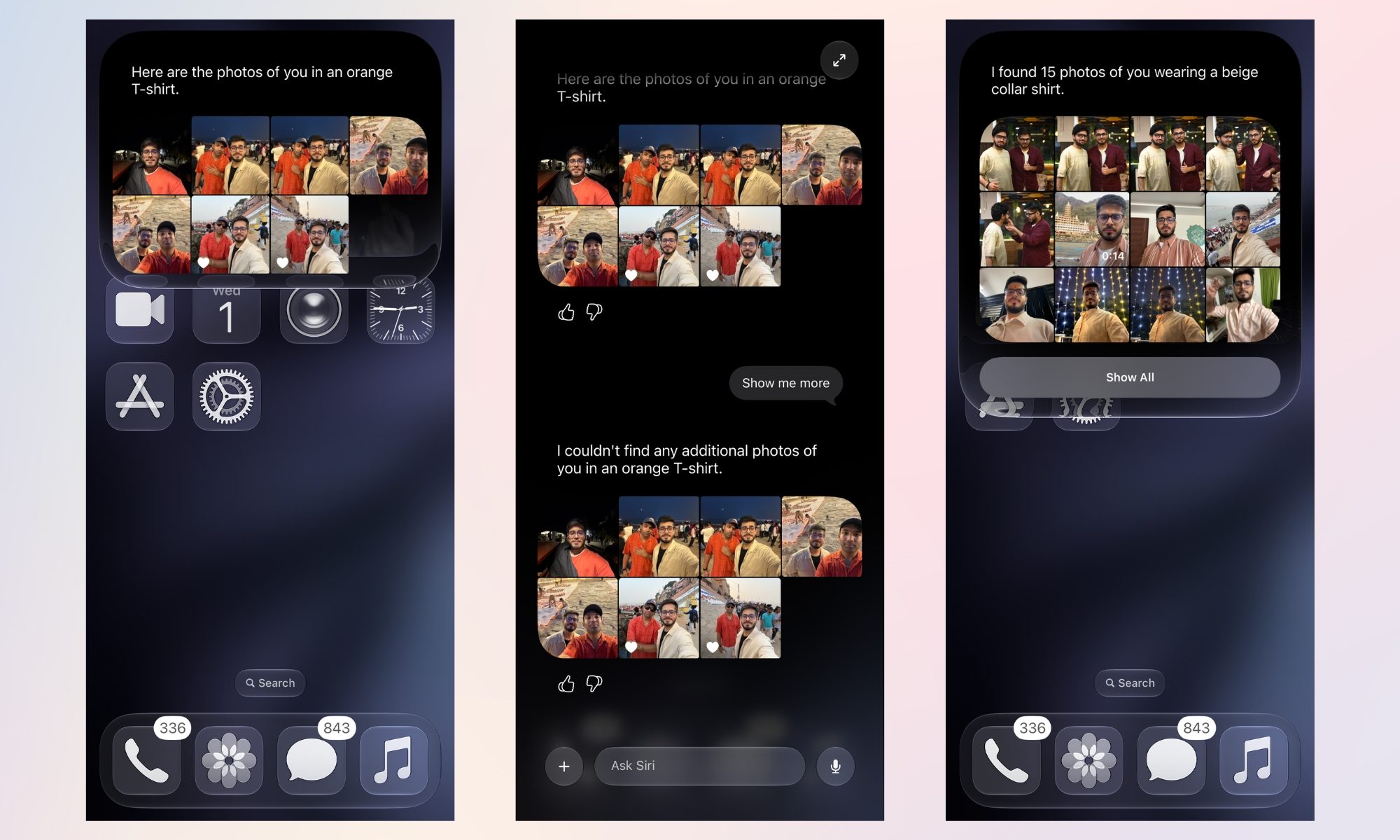
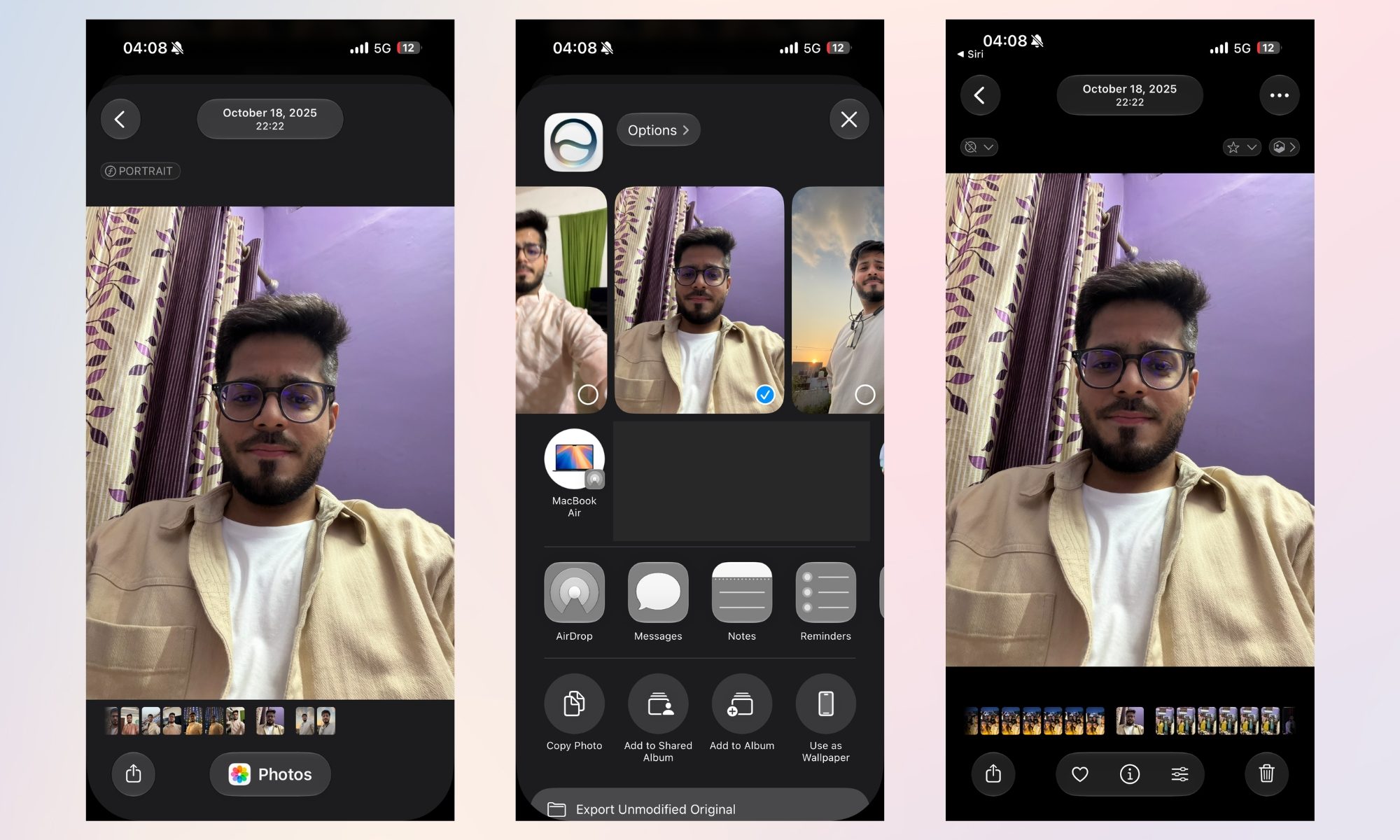
I was talking to a friend about how much I like the fabric and texture of my favorite orange and beige shirts. Instead of scrolling through the entire gallery to find it, I simply asked Siri to find the pictures where I am wearing them.
Advertisement
Shikhar Mehrotra / Digital Trends
Now, the results aren’t always to the point. As you can clearly see, the first few results contain pictures of my friend, with the other person either wearing the orange or beige shirt, and of me.
The one I was looking for, the beige shirt, is the eighth result Siri fetched (in the third screenshot). But even so, the picture was from November 2025, and I couldn’t imagine opening the Photos app and scrolling the library past around a few thousand pictures to get there.
Shikhar Mehrotra / Digital Trends
You can either share the result or view it with all photos
Tapping the picture opens it full screen, giving me the option to share it via AirDrop or another app, or to view it in the Photos app, similar to how “Show in All Photos” works for Memories or Featured Photos.
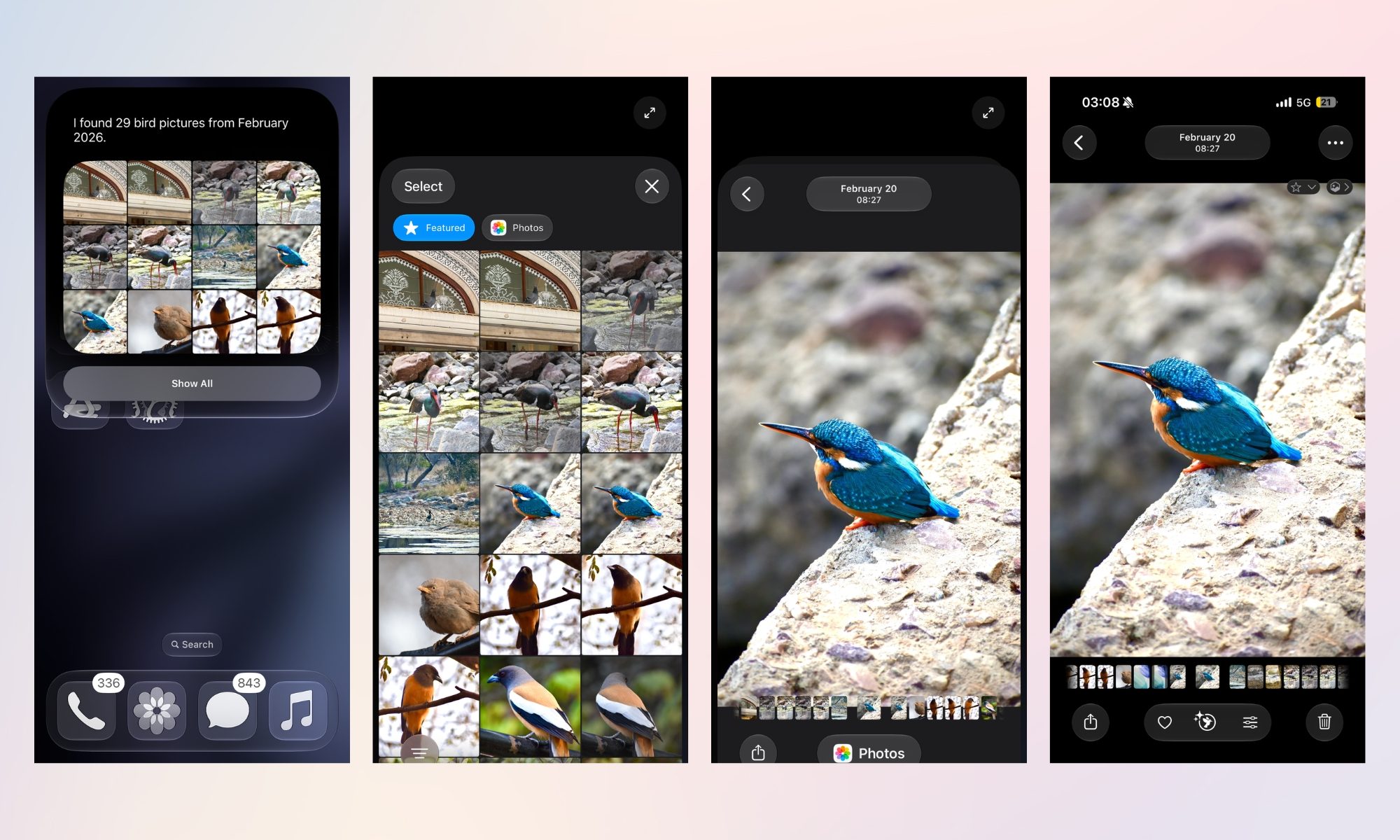
The other day, my sister asked me to share with her the pictures of birds that I captured in a national park we visited a few months ago. I immediately fired up Siri, and it fetched me the required ones without breaking a sweat.
Shikhar Mehrotra / Digital Trends
I tapped “Show All” to get a better view, selected one, and tapped the Photos button at the bottom to jump straight into the camera roll, where I could access all of them, along with a few great pictures of my family I had captured before and after.
It’s still a bit rough around the edges, though
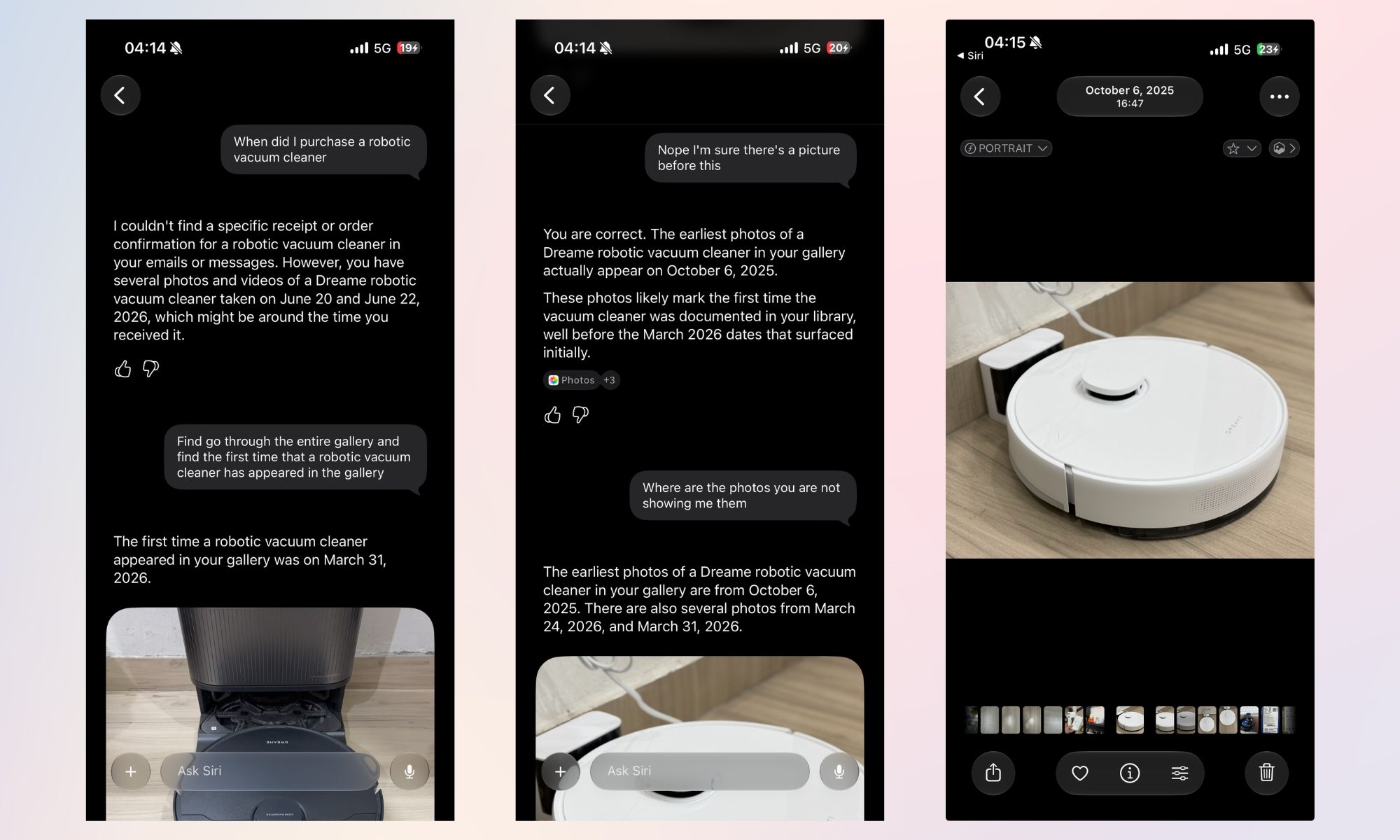
There were a few instances when Siri AI didn’t do well. For instance, I asked the AI assistant about the time when I first purchased a robotic vacuum cleaner. In response, it told me that there’s no specific receipt or order confirmation, but there are several pictures of it in my gallery.
Shikhar Mehrotra / Digital Trends
Fair enough. Then I asked it to go through the gallery and find the first time I captured a picture of a robotic vacuum cleaner, and it showed me one from March 31, 2026, even though there were multiple pictures from October 2025. It was only after I told it that Siri AI was able to surface the right pictures.
Siri might not be as accurate yet, which, given iOS 27’s beta testing phase, is something I can’t blame Apple for. But even so, the natural language image search serves its purpose: saving you from a frustrating amount of scrolling, whether you’re hunting for a needle (the picture you’re looking for) or navigating a haystack (your gallery).
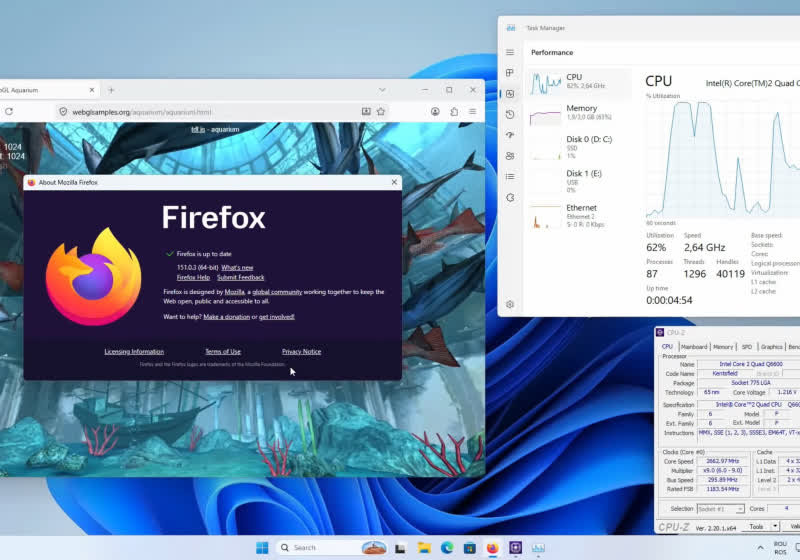
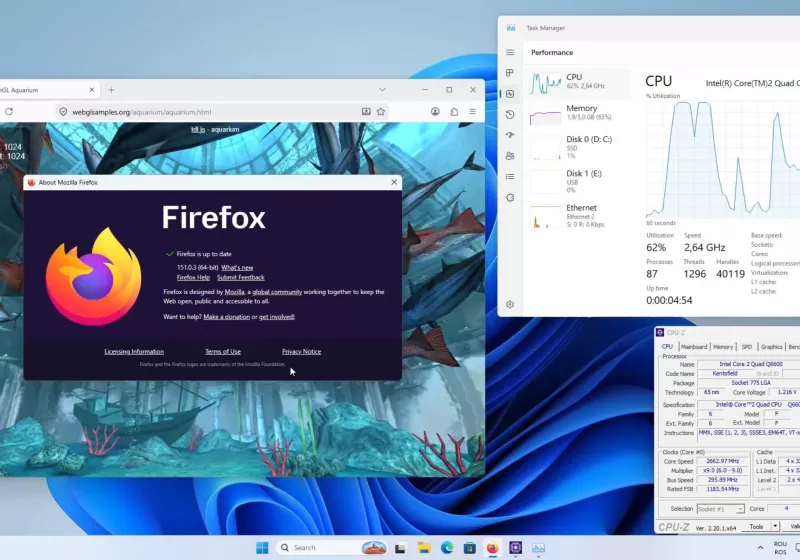
Can Windows 11 run on a 2003 motherboard, an AGP GPU (for those not old enough, that’s the slot that predates PCI Express) with no official drivers, and a slightly newer CPU rocking four 65nm cores? A retro-hardware enthusiast named Omores recently proved that it can, even as Microsoft would… Read Entire Article Source link
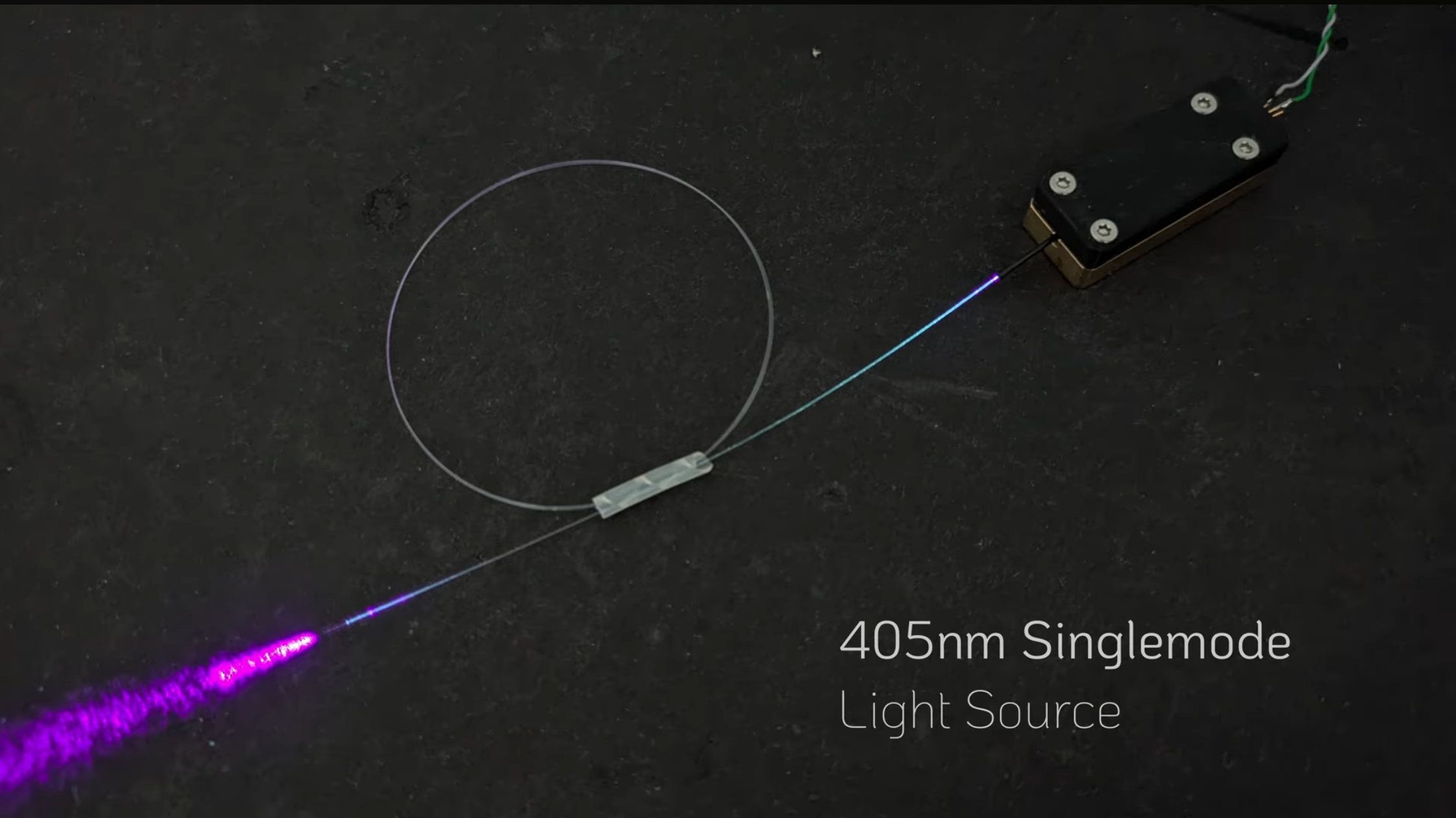
Laser diodes are convenient light sources, but for precise optical work their often-elliptical beam profile leaves something to be desired. One way to get around this is to couple the beam into a single-mode optical fiber, which then emits a circular Gaussian beam from the other end. For more advanced experiments, therefore, [Diffraction Limited] built this fiber-coupled laser source.
The simplest approach is to place the fiber directly against a light source, but this results in most of the light missing the three-micron fiber core. Optical fibers have an acceptance cone, and only light approaching from within this cone is coupled into the fiber. The design therefore uses an aspheric lens to focus light from the laser diode down to a tiny point matching the diameter of the fiber core, creating a cone of incoming light narrower than the acceptance cone.
The body of the laser source was CNC machined out of brass, with the laser-diode press-fit in one end. The lens stands in front of the diode, and was glued in place so that its focal point was just above the end of a mounting pin for the glass fiber. Positioning and fixing the fiber in place was the biggest challenge; [Diffraction Limited] could use the micro-manipulator from a previous video to position the fiber, but the UV-set glue used to fix it in place shrinks during curing, pulling it out of position. To deal with this, two set screws under the mounting pin allowed its position to be adjusted slightly after gluing. As expected, adhesive shrinkage meant that the completed source initially produced no light, but after the set screws were adjusted, the beam appeared.
Advertisement
For more on fiber-coupled lasers, check out [Les Wright]’s work. If you don’t have access to an aspheric lens, an anti-bumping bead could be a reasonable alternative.
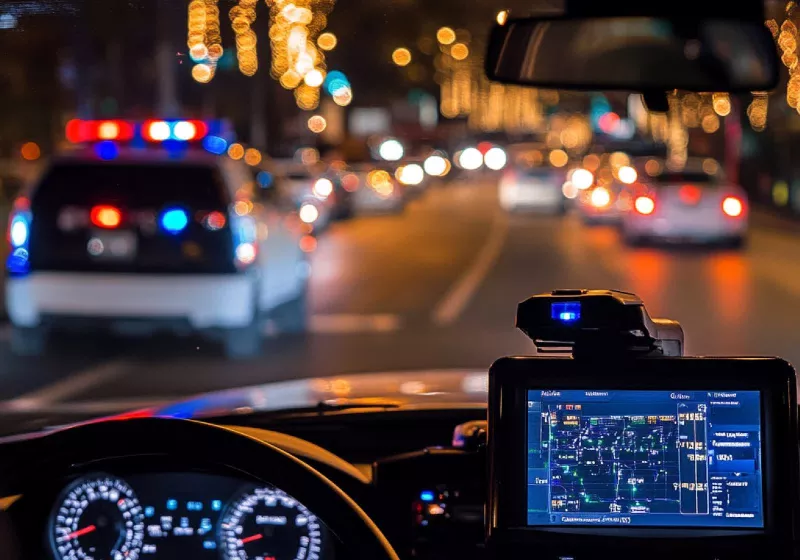
Flock Safety is squarely at the center of that debate. The Atlanta-based company has rapidly expanded by selling automated license plate readers to police departments, neighborhood groups, and private organizations. Its cameras, often mounted inconspicuously on poles, capture images of passing vehicles and convert them into searchable data points. The… Read Entire Article Source link
Qualcomm is finally getting serious about AI infrastructure, but its push into the datacenter hinges on the success of an ambitious near-memory compute architecture designed to deliver better inference economics than today’s GPUs.
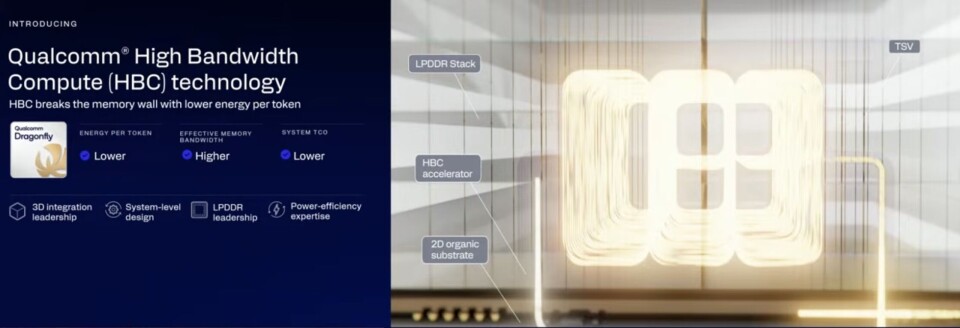
Announced during its 2026 investor day last week, the tech will see Qualcomm stack layer upon layer of DRAM on top of its XPUs to form a single unified compute and memory module it’s calling high-bandwidth compute (HBC).
“We offer all of the performance advantages of SRAM, but with the density and the memory capacity that HBM (high-bandwidth memory) stacks offer,” Tony Pialis, Qualcomm’s EVP of datacenter, claimed during last week’s investor presentation.
This technology is set to launch next year as part of Qualcomm’s AI250-series of Dragonfly rack systems, and marks a distinct shift in Qualcomm’s AI infrastructure strategy. The handset giant is no stranger to AI accelerators. Essentially every Snapdragon processor sold today ships with an NPU on board. But in the datacenter, the company has struggled to garner the same excitement as Nvidia, AMD, and even startups like Cerebras.
Advertisement
Compared to the big two’s GPUs, Qualcomm’s AI-series accelerators haven’t compared that favorably, but that could soon change as the company looks to make its mark on the datacenter.
With the AI250, the SoC maker is claiming 768 GB of memory capacity and up to 133 TB/s ofeffective memory bandwidth per card. For reference, Nvidia’s Groq 3 LPUs offer just 500 MB of SRAM and 150 TB/s of bandwidth.
If that seems too good to be true, that’s because it is. Qualcomm is leaning heavily on the word “effective.” We know that because for the AI200-based Dragonfly systems rolling out this year, they claimed 414 TB/s of “effective” memory bandwidth across all 56 chips. On its face, that seems more realistic, but actually achieving that with 8800 MT/s LPDDR5x alone would require a 6,720-bit-wide bus, which it almost certainly does not possess.
Qualcomm insists that this is the “pure physical bandwidth of the LPDDR interface,” but declined to offer any specifics as to how it’s somehow managed to achieve what Nvidia needed eight HBM3e stacks to do.
Advertisement
In any case, according to Qualcomm’s marketing materials, with the move to HBC, the AI250 will offer 18x the effective bandwidth of the AI200, while the forthcoming AI300 will deliver 54x the bandwidth. Given the context, these seem like outlandish claims, but these “effective” multipliers are really a feature of Qualcomm’s HBC architecture.
Unpacking high-bandwidth compute
Amplifying “effective” bandwidth isn’t the only party trick from these HBC-based accelerators. Qualcomm claims that by moving some of the XPU’s compute under the DRAM, it can significantly reduce the amount of power its chips consume.
On a conventional datacenter GPU, data is rapidly shuffled between HBM and the compute dies. Even using advanced packaging technologies like TSMC’s CoWoS, the power required to move this data back and forth is significant.
Qualcomm’s investor-day graphic highlights its high-bandwidth compute architecture for future AI datacenter systems. Image courtesy of QualcommImage courtesy of Qualcomm
By stacking the DRAM directly on top of some of the logic and connecting them using through-silicon vias (TSVs), the path from compute to memory is shortened considerably.
Advertisement
“Imagine working in the same building that you live in so you only travel up and down,” Pialis said. “What does that mean for the highways and the roads that connect the suburbs to the city? Guess what? The roads are clear. The value this brings to the industry is lower power consumption, less heat, and that expensive road of silicon interposer that HBM solutions use is no longer needed.”
Performing bandwidth-bound operations on the base die also has the benefit of reducing the amount of data that needs to be shuttled to and from the HBC to the SoC. In effect, memory bandwidth is amplified. This is why Qualcomm is using “effective bandwidth” so liberally.
Compared to doing all of that work on a conventional GPU or XPU with distinct HBM and compute dies, the effective bandwidth would be significantly higher, which also achieves better density than SRAM-only designs, like Nvidia’s LPUs or Cerebras’ dinner plate sized accelerators.
With that said, Qualcomm probably won’t be running its entire AI software stack on HBC. Higher memory bandwidth primarily benefits decode, when the entirety of the model’s active weights are streamed autoregressively from memory one token after another.
Advertisement
Decode isn’t particularly compute-intensive. As such, doing decode partially or entirely in HBC starts to make a lot of sense because it also avoids the thermal constraints associated with burying the compute under multiple layers of DRAM.
Qualcomm tells us that the AI250 can be used as a standalone AI accelerator, but notes it is heavily optimized around addressing bandwidth bottlenecks. So, in addition to being a dedicated inference chip, it can be used in disaggregated inference architectures that use GPUs or other Qualcomm parts for prompt processing and the AI250 to speed up memory intensive decode operations.
Peak FLOPS are notably missing from Qualcomm’s AI250 disclosures — the company declined to share specifics upon our request.
Is HBC actually a competitive advantage?
While Qualcomm is early among chip designers to make a fuss about near-memory or HBC, it’s not the first, nor is the technology beyond the means of Nvidia or AMD.
Advertisement
In fact, both Nvidia and AMD are rumored to be working with HBM suppliers and TSMC to develop custom base dies to boost the performance of their next-gen chips, though it’s still not clear how much, if any, compute has been integrated into them.
Qualcomm tells us its HBC “uses LPDDR memory in a purpose-built near-memory computing architecture that combines compute and highly-accelerated memory bandwidth within a 3D-stacked silicon design. While both HBC and HBM use stacked-memory concepts, HBC is a distinct architecture designed to address AI’s data-movement bottleneck by bringing compute and memory closer together, increasing memory bandwidth efficiency and improving energy efficiency for AI inference workloads. HBM has more stacks of DRAM, uses 2.5D interposer to route more wires, and does not do computing in the base logic die.”
AI chip startup d-Matrix is also developing accelerators that will use 3D stacked DRAM to extend their in-memory compute capabilities.
The underlying technology described by Pialis may not be as unique as Qualcomm would like investors to believe, but it shows the company hasn’t missed the boat.
Advertisement
However, Qualcomm’s ability to work with Nvidia and AMD may end up doing more to sell customers on its tech than anything. As we previously wrote, in a disaggregated AI world, Nvidia can be both a friend and an enemy.
Qualcomm finds its Mojo
In addition to teasing its upcoming AI250 and AI300 accelerators, Qualcomm’s investor day also coincided with the acquisition of AI software startup Modular.
Modular was founded by Tim Davis and Chris Lattner, the latter of whom you may recognize as the creator of LLVM, Clang, the Swift programming language, and the multi-level intermediate representation (MLIR) compiler infrastructure.
At Modular, Lattner and crew developed Mojo, a low-level programming interface for GPUs, which offered a high-performance alternative to Nvidia’s CUDA or AMD’s HIP and ROCm stacks. The big idea is that users should be able to write highly performant AI apps that’ll run regardless of the underlying hardware.
Advertisement
For Qualcomm, Mojo presents an opportunity to sidestep the CUDA moat, which has dogged AMD for so long. With Mojo, Qualcomm’s customers won’t need to choose one platform; they can develop their apps and run them on whatever compute is handy at the time.
It’s not all or nothing either. Modular should help to support heterogeneous deployments similar to what Nvidia is doing with Groq’s LPU tech, where GPUs might be used for prefill and AI250s are used for decode in whatever ratio makes the most sense for that specific application.
However, the acquisition doesn’t just buy Qualcomm a vendor-neutral programming model. The folks buying these systems are primarily concerned with one AI workload in particular: LLM model serving. For this, Modular developed a serving platform called Max. Max is a bit like SGLang or vLLM in that it’ll run interchangeably on AMD or Nvidia hardware, but because it’s built atop Mojo, it, at least in theory, shouldn’t require nearly as much hand tuning.
The offering should help Qualcomm compete in a landscape where software has become even more important than the hardware it runs on, if it manages to close the acquisition this year without regulators stepping in.
Advertisement
In any case, we won’t have to wait much longer to see the HBC in action. After launching its AI200-series racks later this year, Qualcomm plans to push its first-gen HBC-based AI250 out the door beginning in 2027, while its second-gen HBC platform is slated for 2028.
While you wait, why not read up on Qualcomm’s new datacenter CPU, which we explored in more detail last week. ®




 MAVERIC has been designed to function as a Next Generation Trusted Research Environment thus ensuring that it is state-of-the-art and provides a safe and secure framework for the analysis of large sensitive datasets.Monash University
 Monash University Vice-Chancellor and President Professor Sharon Pickering with researchers [left to right] Professor Anton Peleg, Professor Victoria Mar, Professor James Whisstock, Vice-President (Strategy and Major Projects) Teresa Finlayson, and Professor Patrick Kwan.Eamon Gallagher (Australian Financial Review)
 Total data center investment, US$ billions.Source:
  Monash University is home to MAVERIC, Australia’s largest university-based AI supercomputer, built and deployed by Monash in partnership with NVIDIA, Dell Technologies, and CDC Data Centres.Monash University
 Plenary session at Melbourne Convention and Exhibition Centre.Melbourne Convention Bureau
 Melbourne Convention Bureau (MCB) representative Fatima Aboudrar, Senior Business Development Manager, with Vijay S. Paul, Immediate Past Chair, IEEE Victorian Section, receiving Supporting Friend Member recognition in 2025.
















































You must be logged in to post a comment Login