


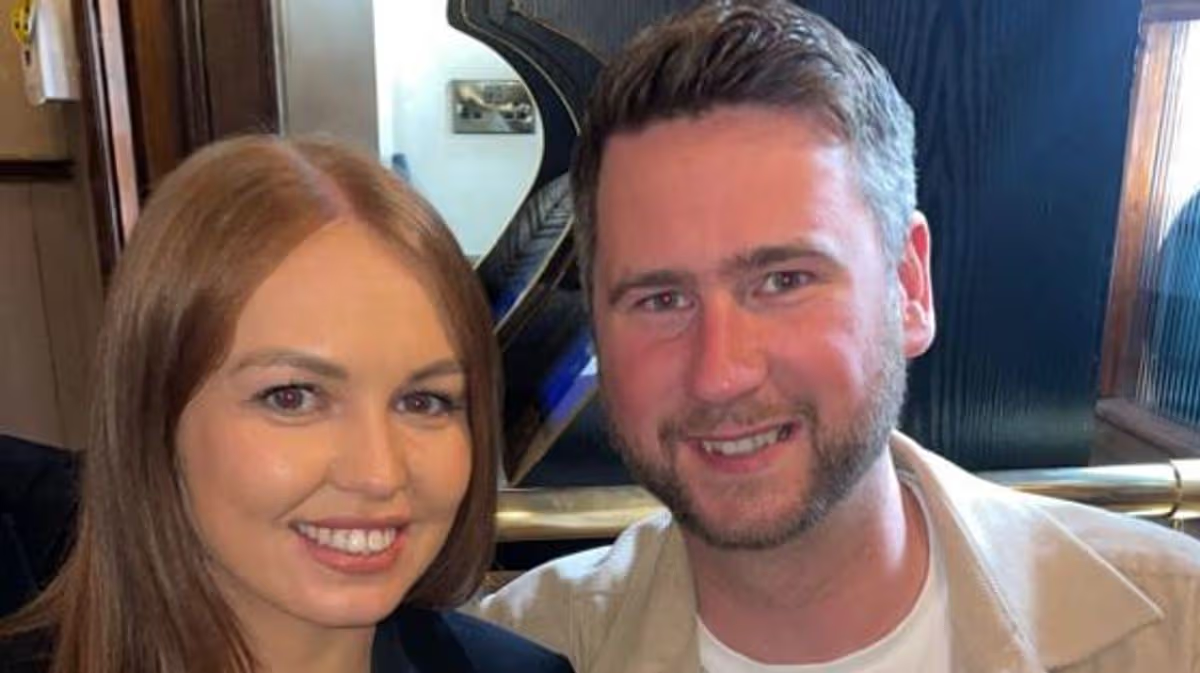
The family of a popular young woman have launched a foundation in her name to raise awareness of skin cancer after losing her to the disease.
Fiona Brady, 36, died at Altnagelvin Hospital on January 29, 2024 following a diagnosis of Stage 4 Advanced Melanoma. She was the loving partner of Gary Devenney, beloved daughter of Bernadette and Connolly, dear sister of Roisin and Gerald and godmother of Caleb.
Over two years since her passing, Fiona continues to be held closely in the hearts and minds of all who loved her.
READ MORE: ‘A doctor told me I had dementia and to go home and Google it’READ MORE: ‘I donated stem cells and offered a total stranger a second chance at life’
While Northern Ireland may not be renowned for its sweltering temperatures, skin cancer is the most common form of the disease here and accounts for over 31% of all cancers diagnosed. Over 4,000 people develop skin cancer each year and almost one in 10 of these are malignant melanoma, the most serious form.
Malignant melanoma rates have risen over the past 40 years from an average of around 100 cases per year in the mid-1980s, to over 400 in recent years, according to the Public Health Agency (PHA).
Protecting skin from damage is really important, but so is checking for changes to your skin or moles. Early detection and treatment of skin cancer can dramatically improve outcomes. Most cases of skin cancer are treatable, especially when caught early.
Fiona’s family and her partner, Gary, from Coleraine want to honour her memory by helping raise awareness of the disease and save other lives.
On May 1st they launched The Fiona Brady Foundation, to coincide with Skin Cancer Awareness Month. The aim is to shine a light on skin cancer awareness and ‘empower communities through skin cancer education and prevention initiatives’.
Gary told Belfast Live: “When I did some research, I discovered that there’s no specific registered skin cancer awareness charity in Northern Ireland.
“The NHS has a website called ‘Safe in the Sun,’ which lists all the precautions you can take etc, but there doesn’t seem to be any organisation here driving active skin cancer awareness campaigns.
“What we’re trying to do with the foundation is to make people aware of the fact that skin cancer is the highest diagnosed form of cancer in Northern Ireland above all other cancers.
“Not a lot of people realise that because we don’t live in a sunny climate but you have to be cautious all the time regardless.
“When there are awareness campaigns, they are largely during the summer, but skin cancer is not just a summer disease – it can happen all year round.
“People tend to think there is only a danger in the sun but that’s not the case,” Gary explained.
While Gary lost Fiona at only 36 and was “very young” to be affected by skin cancer, there is a misconception
“While it’s a cancer attributed to people slightly older – around 50 – there are still those below that age who are either falling away or not being heard of.
“One of the other reasons we’re launching this foundation is in the hope that when someone sees Fiona and how young, she was it will break that stereotype,” he said.
Gary also stressed that Fiona followed every precaution from doctors when it came to sun protection.
He added: “Fiona covered up, she used her sun cream, never went to sunbed, didn’t sunbathe or sit out in the sun.
“She loved being away on holidays, but she was also very cautious and wore the big floppy brim hats and a shawl over her shoulder so she wasn’t exposing herself. She took every precaution to the letter.”
The foundation has five aims, which includes highlighting the signs and symptoms of possible skin cancer.
The Fiona Brady Foundation also aims to encourage and highlight preventative measures and early detection as well as increasing access and awareness to dermatology services across Northern Ireland.
Fiona’s loved ones also want to provide a space where people and their families, who have been impacted by skin cancer, can come together to share experiences and support.
There’s also a long-term aim, with political support, of opening up information around services and policy development.
The foundation has been publishing stories on the foundation website and socials throughout the month of May from people affected by skin cancer, highlighting its impact.
Tips for protecting your skin from cancer
Check when you are most at risk from UV radiation. Levels of UV radiation are highest in Northern Ireland between March and October – even when it is cool or overcast.
If you are going outdoors, check what the UV index will be throughout the day. You can check daily and hourly UV index forecasts via most weather apps on your mobile phone.
Help protect your skin when the UV index is 3 or more by following this guidance:
- Stay in the shade between 11.00am and 3.00pm, when UV rays are strongest.
- Cover up with suitable clothing.
- Wear a broad brimmed hat and sunglasses with 100% UV protection.
- Buy sunglasses that have a CE mark or carry British Standard BS EN ISO 12312-1.
- Use sunscreen on exposed skin; an SPF of at least 30 and UVA 4 stars as recommended by the Department of Health and National Institute for Health and Care Excellence.
- Babies under six months should stay out of direct sunlight. If exposure to sunlight is unavoidable, apply a small amount of high protection sunscreen to exposed areas, such as the cheeks and back of the hands. For children over six months choose SPF 30 or SPF 50 to protect against UVB rays and minimum UVA 4 stars. Higher SPF will give more protection.
- Avoid sunburn by never allowing your skin to go pink or red in the sun. Sunburn doesn’t have to be raw, peeling or blistering skin; for people with darker skin, it might feel tender, irritated or itchy.
- Choose and use the correct amount of sunscreen – an adult needs six teaspoons distributed evenly on the body with an SPF of at least 30 and UVA 4 or 5 stars.
- Avoid sunbeds – they can cause over exposure to UV radiation.
- Check your skin at least once a month, be aware of any changes, and speak to your GP if you notice any mole changes, new moles or abnormal skin changes.
The Fiona Brady Foundation website is available to visit at https://www.fbfoundation.co.uk/ and on social media at The Fiona Brady Foundation.
Gary has also published a book of poetry, titled ‘I Talk to Trees,’ which will be available to purchase via the site, with all proceeds going to the foundation.
If you have a skin cancer awareness story and would like to get in touch with the foundation, please email: info@fbfoundation.co.uk.
To ensure you don’t miss out on all the latest from Belfast Live, be sure to make us your preferred source on Google.
















































You must be logged in to post a comment Login