

Crypto World
Solana AI Agent Economy Crosses From Experiment to Measurable Output, Messari Finds



Solana’s (SOL) AI agent activity moved beyond experimentation during the first quarter of 2026, according to Messari.
The findings come from Messari’s State of Solana Q1 2026 report, which points to application-layer activity, the expansion of the x402 payment standard, a new onchain Agent Registry, and more as evidence of the shift.
Solana’s Growing Footprint in the AI Agent Economy
In the report, Messari highlighted that application-layer activity intensified on Solana in March. PlayBabylon is one example. The multiplayer game logged 490,000 trades from 1,171 autonomous AI agents within five days of launching.
StormRae AI hosted a public red-teaming exercise that pulled in roughly 15,000 participants on the network. The Anagram team released SolanaClaw Agent, a tool that handles Solana transactions through messaging apps like WhatsApp and Telegram.
“In Q1 2026, AI agent activity on Solana advanced from experimentation to measurable economic output. The network’s sub-cent fees and sub-second finality continued to attract machine-native applications…and early metrics pointing toward what the ecosystem is beginning to call Agentic GDP, economic value generated autonomously by non-human actors,” the report read.
Follow us on X to get the latest news as it happens
Payment Rails and Identity Take Shape
In addition, Solana added support for Stripe’s Machine Payments Protocol (MPP) during the quarter. Messari notes the network is now the only major chain compatible with both MPP and the x402 standard. The latter is an open protocol for autonomous AI agent payments, originally developed by Coinbase.
The x402 ecosystem also expanded across multiple providers during Q1. QuickNode released an open-source package for agent-driven USD Coin (USDC) payments. Alchemy added similar functionality for its application programming interfaces (APIs).
The Solana Foundation also introduced an onchain Agent Registry with Quantu AI in March. The registry provides a standardized way for AI agents to establish verifiable identity across the network.
Messari highlights these developments as evidence that AI agent activity now produces measurable economic output on Solana. The report added that Solana’s performance characteristics and growing infrastructure position make it well-suited to serve as a coordination layer for autonomous economic activity.
Subscribe to our YouTube channel to watch leaders and journalists provide expert insights
The post Solana AI Agent Economy Crosses From Experiment to Measurable Output, Messari Finds appeared first on BeInCrypto.


Wall Street’s blockchain pivot just got regulatory rocket fuel. The U.S. Securities and Exchange Commission, or SEC, is preparing an “innovation exemption” that could allow trading platforms to offer digital versions of publicly traded stocks under a lighter regulatory structure. The proposal is expected as early as mid-May, according to Bloomberg Law.
According to Bloomberg Law’s report, the SEC’s framework would let platforms trade blockchain-based versions of equities around the clock with faster settlement than traditional shares. The agency already approved Nasdaq’s proposal to trade tokenized stocks in March, covering Russell 1000 components and benchmark ETFs.
NYSE’s equivalent proposal also cleared in April. The DTCC, which processes the bulk of U.S. securities, has announced limited production trades of tokenized assets beginning in July, with a broader rollout in October. SEC Chair Paul Atkins has explicitly signaled support for formal rulemaking covering onchain trading systems and blockchain settlement infrastructure, framing it as part of a sweeping “Project Crypto” initiative.
The combined weight of institutional momentum from DTCC, Nasdaq, NYSE, and ICE points to a structural shift in how the $126 trillion global equity market settles and trades.
Discover: The best crypto to diversify your portfolio with
SEC Tokenized Stock Momentum Could Reprice Blockchain Infrastructure
That regulatory clarity cuts both ways: it validates compliant onchain infrastructure while squeezing offshore synthetic structures. The winners in this environment are settlement rails, smart contract platforms, and Layer 2 networks capable of handling high-frequency, low-latency financial transactions at institutional scale.
Crypto-native infrastructure tokens with real throughput, such as sub-second finality, programmable settlement, and deep liquidity, are the logical beneficiaries of a world where equities trade onchain 24/7, benefiting RWA tokens.
— CryptosRus (@CryptosR_Us) May 19, 2026
 TOKENIZED REAL WORLD ASSETS ARE GOING PARABOLIC
$1.43B on-chain. Up 26% in 30 days. $3B in monthly transfer volume.
SEC innovation exemption coming this week. DTCC live in July. NYSE and Nasdaq building on-chain settlement.
The chart doesn't lie. RWAs are just getting… https://t.co/eFgt86aurx pic.twitter.com/lPptRxPMt6
The Senate’s advancing crypto market structure bill compounds the regulatory tailwind. Compliant infrastructure platforms could re-rate significantly as institutional volume migrates onchain through H2 2025.
However, this could not always be a fast pump for the crypto market. The price is in a multi-year adoption curve; gains would be real but gradual.
The data points to infrastructure, not specific synthetic equity tokens, as the cleaner trade. But tokens like Chainlink and Ondo could benefit.
Discover: The best pre-launch token sales
Bitcoin Hyper Targets Early-Mover Upside as Institutional Blockchain Demand Builds
Infrastructure is the trade, but established L1 valuations already reflect significant institutional optimism. Early-stage infrastructure presales offer a different upside entirely.
That’s the context for Bitcoin Hyper ($HYPER), currently raising at $0.0136 per token with more than $32 million already committed. Hyper is the first Bitcoin Layer 2 with Solana Virtual Machine (SVM) integration, combining Bitcoin’s security and trust with throughput that, by design, targets performance faster than Solana itself.
Hyper is a direct play on the programmable settlement infrastructure that tokenized securities markets will need and require. It has features like extremely low-latency Layer 2 processing, SVM-based smart contract execution, and a Decentralized Canonical Bridge for BTC transfers. Basically, it has the kind of stack that matters when institutions need fast, cheap, auditable settlement.
Staking is now live with a high 35% APY reward. Over $32.7 million raised signals a serious early conviction.
Research Bitcoin Hyper before the next price tier locks in.
The post SEC Pushes Tokenized Stocks: Wall Street’s Onchain Era Begins appeared first on Cryptonews.


Republican lawmakers in the U.S. House have pushed to turn a temporary restriction on a central bank digital currency into a permanent ban as Congress prepares to vote on a major housing bill later this week.
Summary
- House Republicans have pushed to make the proposed U.S. CBDC ban permanent in the revised 21st Century ROAD to Housing Act.
- Representative Warren Davidson said the Senate’s 2030 expiration date could create a future pathway for a Federal Reserve-issued digital dollar.
- House Majority Whip Tom Emmer has continued urging the Senate to pass his Anti CBDC Surveillance State Act after it cleared the House earlier this year.
According to Congressman Mike Flood, House lawmakers revised the Senate’s version of the 21st Century ROAD to Housing Act to remove what he described as a “backdoor green light for a CBDC” by making the prohibition indefinite rather than allowing it to expire in 2030.
The Senate Banking Committee first introduced the housing package in March as a sweeping reform bill focused on housing supply, affordability programs, mortgage access, and manufactured housing rules. Senators Tim Scott and Elizabeth Warren led the legislation, which later advanced through the Senate with an 84 to 6 bipartisan procedural vote.
Buried within the housing proposal was a provision preventing the Federal Reserve or regional Federal Reserve banks from issuing a U.S. central bank digital currency without congressional approval. Under the Senate version, the restriction would have remained in place only until Dec. 31, 2030.
House Republicans are now trying to remove that sunset clause altogether before the legislation heads back to the Senate for further consideration.
Among those backing the revised language, Representative Warren Davidson argued that the existing deadline effectively creates a future launch window for a government-issued digital dollar.
“The US House of Representatives could deliver a unifying win this week with bipartisan housing affordability legislation. Instead, they currently plan to deliver a go-live date for Central Bank Digital Currency, using housing as the Trojan Horse,” Davidson said.
In a separate statement, Davidson added that the “2030 sunset works a pre-launch development period,” while calling for a full and lasting prohibition on CBDCs in the United States.
Republicans revive anti-CBDC push in Congress
Elsewhere on Capitol Hill, House Majority Whip Tom Emmer has continued lobbying senators to pass his Anti-CBDC Surveillance State Act after the measure cleared the House in July.
The proposal would block the Federal Reserve from creating or issuing a central bank digital currency, with supporters framing the issue as one tied to privacy and financial freedom.
“The Chinese Communist Party uses a central bank digital currency (CBDC) to surveil and control its people,” Emmer said while urging Senate approval of the bill. He added that his legislation “BANS our government from ever creating this Orwellian tool.”
Previous efforts to stop a digital dollar through standalone legislation have struggled to gain traction. Senator Mike Lee earlier introduced the “No CBDC Act,” which sought to prohibit both the Federal Reserve and the Treasury Department from issuing a CBDC, though the proposal stalled in Congress.
Outside government, criticism of CBDCs has frequently centered on surveillance and state control concerns. At the same time, the Human Rights Foundation has argued that digital currencies issued by central banks could improve financial access for underserved populations while also creating risks tied to privacy and government abuse.
Data tracked by the Atlantic Council currently shows that only Nigeria, Jamaica, and the Bahamas have fully launched CBDCs, while dozens of other countries remain in pilot programs or research stages.
Crypto World
Moving Beyond HODL: ZOOMEX Launches Global “Pizza Week” Campaign Honoring Bitcoin’s First Real-World Trade


On the cusp of the global 16th anniversary of Bitcoin Pizza Day, ZOOMEX, one of the leading global digital asset exchanges, today officially announced the launch of its Pizza Week campaign. This initiative honors the historic milestone of Bitcoin’s first real-world transaction. ZOOMEX’s campaign directly targets the original vision of cryptocurrency. By showcasing its core product matrix—including ZoomCard, ZoomexStocks, and the 0-Cost Trading Competition — the platform aims to drive a comprehensive ecosystem transition for digital assets, shifting them from speculative tools to practical, everyday applications.
On May 22, 2010, a Florida programmer named Laszlo Hanyecz posted a message on the BitcoinTalk forum offering 10,000 Bitcoins for two large pizzas. A British forum user accepted, and the transaction was completed. At the time, those 10,000 BTC were worth roughly $41. At Bitcoin’s all-time high in May 2025, they would have been worth over $1.1 billion.
But the dollar value is not the story ZOOMEX is telling this week.
“The industry has spent sixteen years fixating on what that pizza would be worth today, and in doing so, it walked straight past the more interesting question,” said Fernando Lillo, Marketing Director at ZOOMEX. “Laszlo wasn’t making a trade. He was running a test. And the result of that test wasn’t a loss — it was proof that the entire idea could work. A technology that cannot interact with daily life remains a technology, not a currency. That distinction is what Pizza Week is about.”
That question has been answered repeatedly over the past 16 years. MicroStrategy, the world’s largest corporate Bitcoin holder, now holds 818,869 BTC — nearly 4% of all Bitcoin that will ever exist — acquired at a total cost of over $68 billion. The U.S. government maintains a strategic Bitcoin reserve. Sovereign wealth funds have disclosed exposure. Global crypto market capitalization stands between $2.5 trillion and $2.7 trillion, with Bitcoin representing roughly 60%. What began as a pizza order has become an asset class that governments can no longer ignore.
ZOOMEX argues that the industry has, in some ways, drifted from Laszlo’s original intent. The dominant message for years has been to hold and accumulate — to never repeat the “mistake” of spending Bitcoin. That is now changing. Monthly transaction volumes for crypto payment cards grew from approximately $100 million in early 2023 to over $1.5 billion by late 2025, posting another 211% year-over-year increase as of March 2026. A quarter of U.S. Adults now use crypto for everyday transactions, payments, and financial management.
ZOOMEX has built a comprehensive product ecosystem to address the modern era’s need for utility:
- Arena 0-Cost Trading Competition: Now open with a 600,000 prize pool. Arena provides every participant with $100–$200 in platform-funded trial capital. Zero entry cost. Same starting line. Results determined by trading volume and ROI — not by who brought the deepest pockets.
- ZoomexStocks: U.S. stock-linked assets — including Apple, Tesla, and Nvidia — accessible directly from a crypto account. No fiat conversion required. No separate brokerage account needed. The same idea as Laszlo’s pizza, evolved for 2026: crypto as a gateway, not a walled garden.
- ZoomCard: A multi-currency virtual Mastercard built in partnership with licensed financial institution UR. Supports USD, EUR, CHF, SGD, HKD, and JPY. Zero card issuance fees. Zero annual fees. Compatible with Apple Pay, Google Pay, and Samsung Pay. Crypto that leaves the chart and enters the checkout line.
The Pizza Week campaign will run across ZOOMEX’s global social media channels and include a dedicated space panel. To drive ecosystem adoption, ZOOMEX is launching a dedicated community reward pool featuring thousands of dollars in USDT incentives alongside exclusive trading coupons for all participants. The company is also producing localized content with teams in Spain and a ZoomCard promotional video demonstrating real-world crypto payments.
You can join Zoomex here
About Zoomex
Founded in 2021, Zoomex is a global cryptocurrency trading platform with over 3 million users across more than 35 countries and regions, offering 600+ trading pairs. Guided by its core values of “Simple × User-Friendly × Fast,” Zoomex is also committed to the principles of fairness, integrity, and transparency, delivering a high-performance, low-barrier, and trustworthy trading experience.
Powered by a high-performance matching engine and transparent asset and order displays, Zoomex ensures consistent trade execution and fully traceable results. This approach reduces information asymmetry and allows users to clearly understand their asset status and every trading outcome. While prioritizing speed and efficiency, the platform continues to optimize product structure and overall user experience with robust risk management in place.
As an official partner of the Haas F1 Team, Zoomex brings the same focus on speed, precision, and reliable rule execution from the racetrack to trading. In addition, Zoomex has established a global exclusive brand ambassador partnership with world-class goalkeeper Emiliano Martínez. His professionalism, discipline, and consistency further reinforce Zoomex’s commitment to fair trading and long-term user trust.In terms of security and compliance, Zoomex holds regulatory licenses including Canada MSB, U.S. MSB, U.S. NFA, and Australia AUSTRAC, and has successfully passed security audits conducted by blockchain security firm Hacken. Operating within a compliant framework while offering flexible identity verification options and an open trading system, Zoomex is building a trading environment that is simpler, more transparent, more secure, and more accessible for users worldwide.
For more info: Website | X | Telegram | Discord
The post Moving Beyond HODL: ZOOMEX Launches Global “Pizza Week” Campaign Honoring Bitcoin’s First Real-World Trade appeared first on BeInCrypto.
Key Takeaways
- Bitmine acquired 71,672 ETH in recent purchase, expanding total reserves to 5.278 million ETH (valued at approximately $11.05 billion)
- Chairman Tom Lee views current ETH prices under $2,200 as compelling entry point
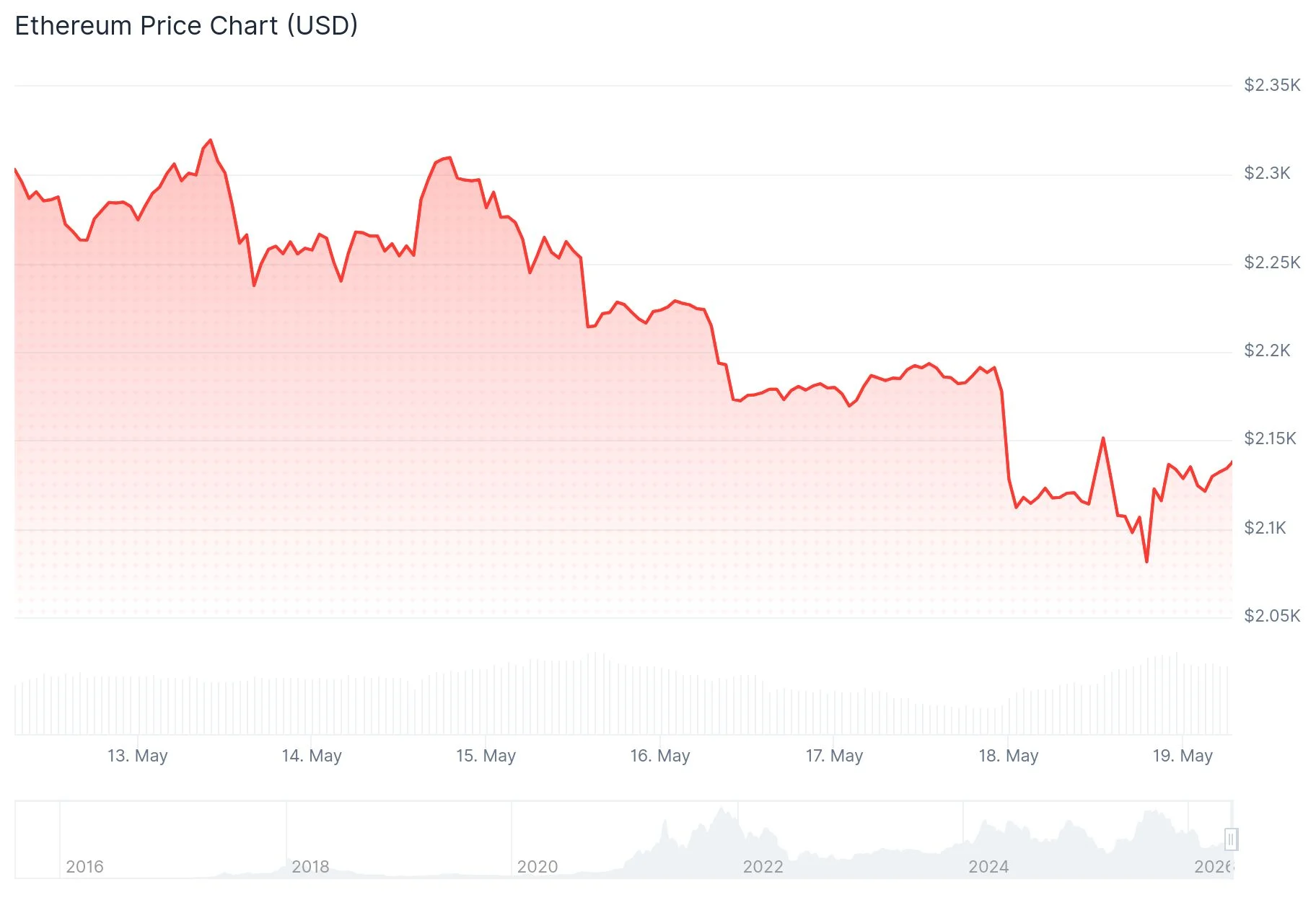
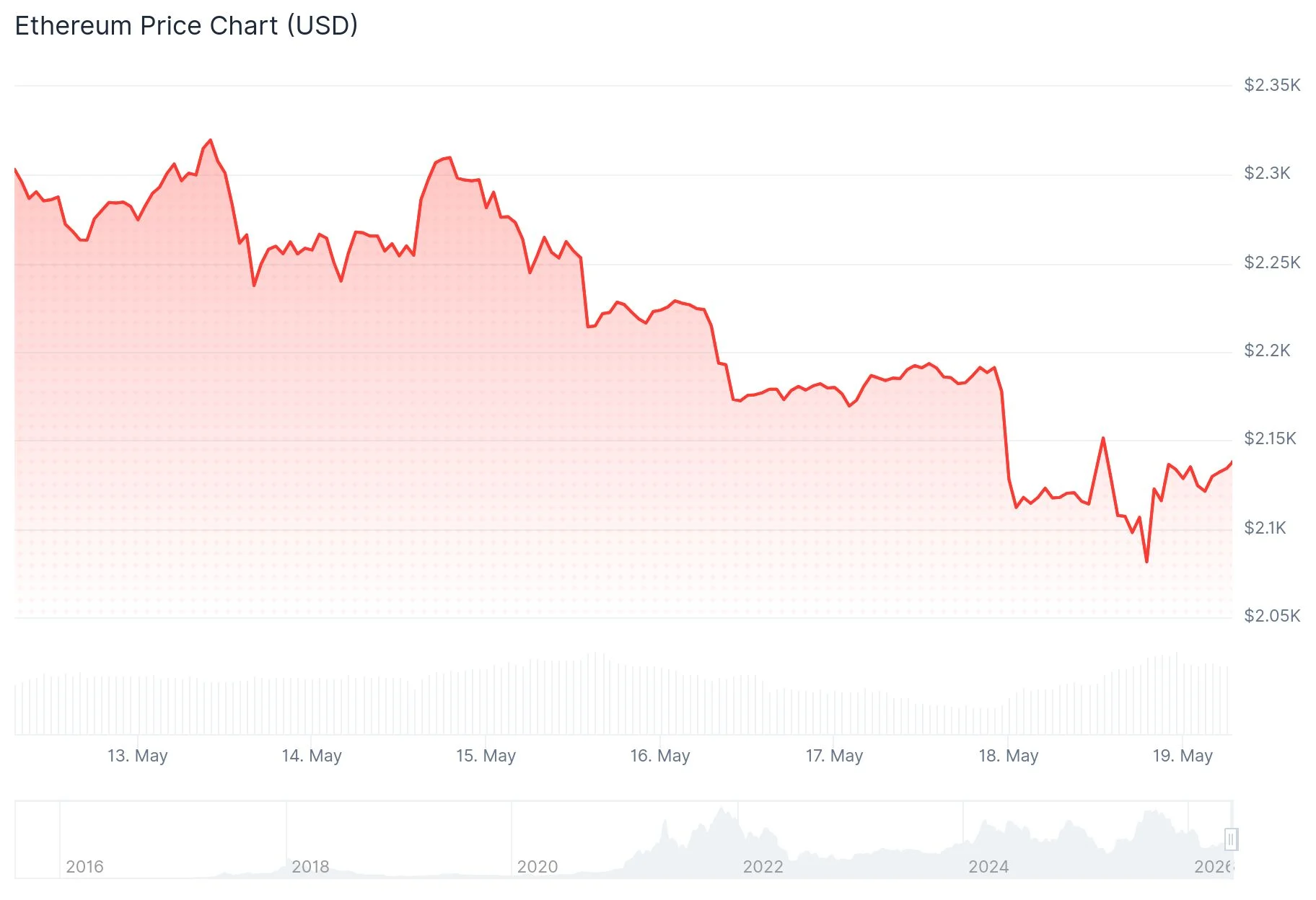
- Ethereum has declined 8.7% in the weekly timeframe, currently hovering between $2,100–$2,128
- Long-dormant Ethereum whale resumes accumulation after selling entire position twelve months ago, according to Lookonchain data
- Critical support zone at $2,108 remains in focus, with additional floors at $1,909 and $1,741 if breakdown occurs
Bitmine Immersion Technologies executed a substantial acquisition of 71,672 Ether tokens over the preceding week, elevating the company’s aggregate position to 5.278 million ETH. Based on prevailing market valuations, this cryptocurrency reserve represents approximately $11.05 billion in total value.
On Monday, Chairman Tom Lee publicly disclosed the acquisition, characterizing Ethereum’s recent descent beneath the $2,200 threshold as “an attractive opportunity.” This positions Bitmine as the world’s preeminent corporate holder of ETH and establishes it as the second-largest institutional cryptocurrency treasury globally, trailing only Michael Saylor’s Strategy.
The firm has established an ambitious objective: controlling 5% of Ethereum’s circulating token supply, which currently stands at 120.7 million coins. To achieve this benchmark, Bitmine requires an additional 756,538 ETH, bringing the target above 6 million tokens. Lee projected the company would reach this accumulation goal “sometime in 2026.”
Additionally, Bitmine has deployed 4.71 million ETH through its Made in America Validator Network (MAVAN), producing annualized staking returns of $289 million.
Market analyst Daan Crypto Trades shared observations on X, highlighting that ETH experienced a breakdown following its failure to penetrate the $2,400 resistance zone. He suggested a bullish retest of that threshold remains feasible in the early week period, though a bearish retest scenario could push ETH beneath the $2,000 mark. He emphasized that Bitcoin’s trajectory will likely dictate Ethereum’s directional movement.
Historic Whale Re-enters Market
Bitmine’s buying activity wasn’t isolated. On Saturday, blockchain intelligence firm Lookonchain identified an original Ethereum whale—who maintained holdings for more than ten years before liquidating their complete position twelve months prior—has reinitiated accumulation. This wallet acquired 1,951 ETH at an average price of $2,182. Lookonchain indicated the address “may keep buying.”
Over the last seven days, ETH has fluctuated within a $2,081 to $2,341 trading range. As of Tuesday, the asset was exchanging hands near $2,128, representing an 8.7% weekly decline.
Technical Analysis and Support Zones
From a technical perspective, Ethereum is currently challenging the $2,108 support threshold. The 20-day, 50-day, and 100-day exponential moving averages are positioned above current pricing in the $2,256–$2,338 band, forming a resistance cluster.
The Relative Strength Index has dropped into the low 30s while the Stochastic Oscillator indicates deeply oversold conditions. Should the $2,108 level fail to hold, subsequent support zones emerge at $1,909, $1,741, $1,524, and $1,405.
Ethereum reached its all-time peak of $4,946 in August 2025 but has subsequently contracted approximately 57%. Last week, Ethereum-focused investment vehicles registered net capital outflows totaling $249 million, while the past 24-hour period witnessed $322.4 million in liquidations—with long positions accounting for $296.9 million of that figure.
Lee also addressed the CLARITY Act, which advanced through the Senate Banking Committee last week. While acknowledging remaining obstacles, he expressed conviction that passage probability exceeds the 61% currently reflected on Polymarket prediction markets.

Key Highlights
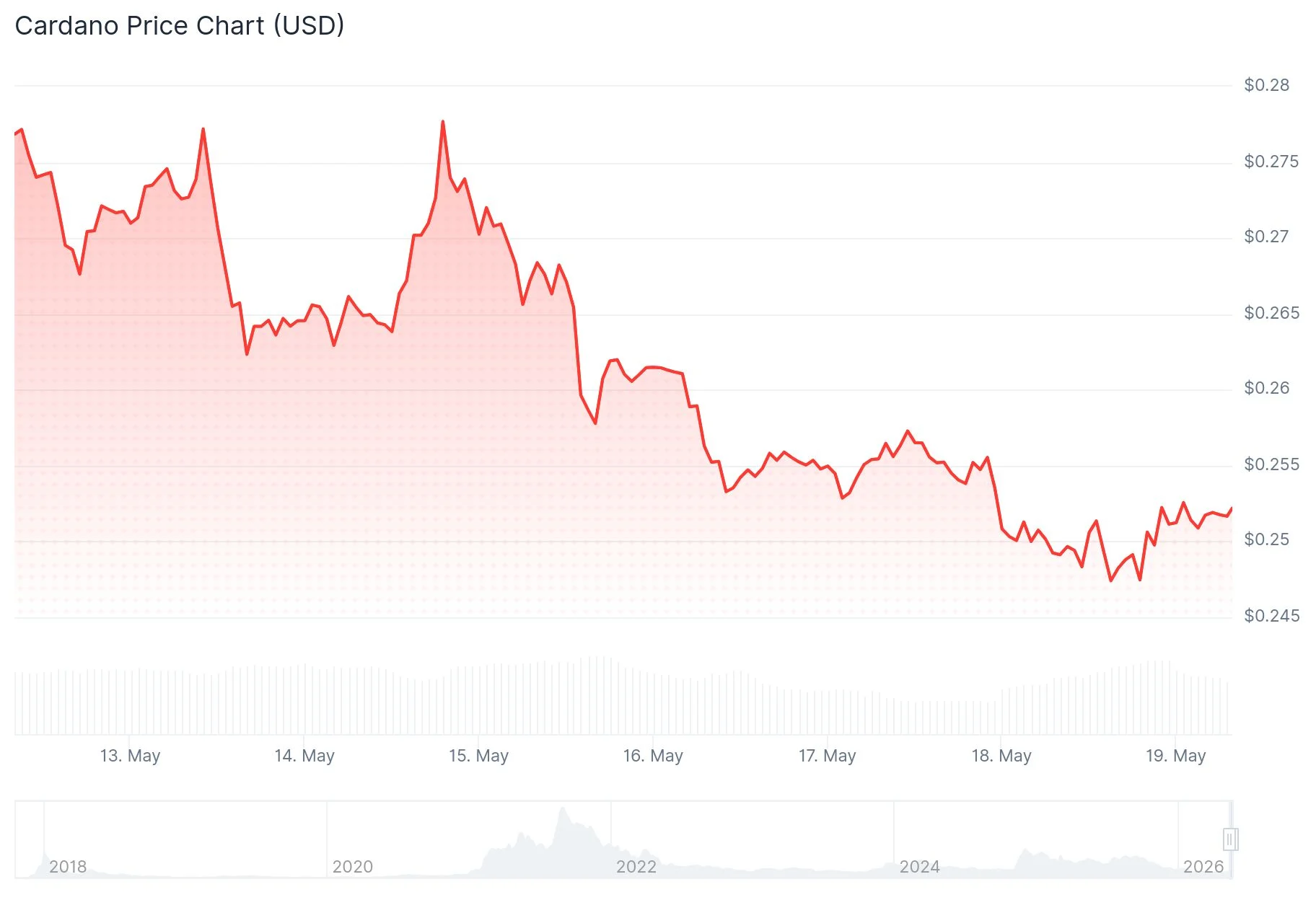
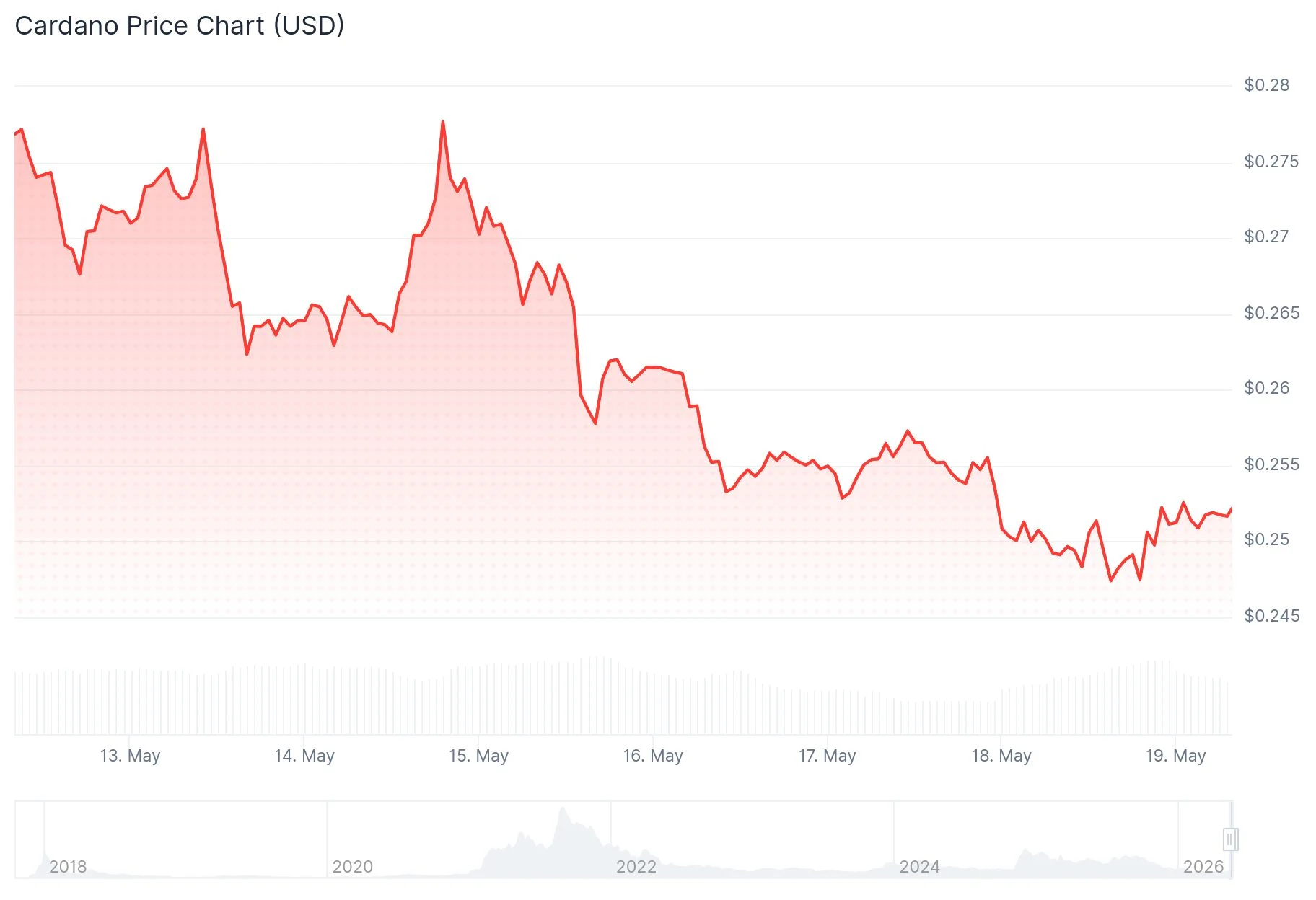
- Cardano is currently priced at $0.2520, experiencing a 1.88% decline over the past day, maintaining a $9.12 billion market capitalization
- The asset maintains position above critical support within a descending triangle formation, with potential breakout levels reaching $2.67
- Daily trading activity jumped 106.17% to reach $624.58 million, indicating intense market participation
- A new cryptocurrency index futures product from CME Group and Nasdaq launching June 8 will feature ADA
- Founder Charles Hoskinson revealed plans for quantum-resistant security upgrades, with detailed proposal coming soon
Cardano (ADA) maintains a price point of $0.2520 alongside daily trading volume of $624.58 million, marking a dramatic 106.17% volume increase even as the price declined 1.88%. The network’s valuation stands at $9.12 billion.
Market analyst Jonathan Carter observed that ADA persistently maintains its position above the descending triangle’s lower support line. This consistent defense of the critical support area indicates potential accumulation behavior among investors.
Should ADA successfully breach the triangle formation, market watchers are monitoring resistance thresholds at $0.330, $0.515, $0.810, and $1.275. Extended projections point toward a potential $2.67 target.
Derivatives open interest decreased 1.55% to $508.64 million, indicating that certain traders are scaling back leveraged positions despite rising spot market activity.
Cryptocurrency analyst CryptoPatel presented a compelling argument for long-term Cardano holders, revealing that whales now control 67% of the entire ADA supply — representing the highest ownership concentration since 2020. He established $10 as his extended price target, suggesting that large holders are systematically accumulating while smaller investors exit positions.
Major Futures Index to Feature Cardano
CME Group alongside Nasdaq will introduce a comprehensive cryptocurrency index futures product on June 8. This index will encompass Bitcoin, Ethereum, Solana, XRP, Cardano, Chainlink, and Stellar within a single contract utilizing market capitalization weighting.
Market commentator Mintern emphasized this development as an avenue for institutional investors and hedge funds to access diversified cryptocurrency exposure through a single regulated financial instrument. Cardano’s selection positions it among the premier digital assets selected for this institutional offering.
Cardano additionally generated attention this week regarding network security initiatives. Charles Hoskinson detailed the blockchain’s proactive strategy for addressing potential quantum computing vulnerabilities, characterizing it as preventive preparation rather than reactive crisis management.
Quantum Security Initiative Moves Forward
Hoskinson revealed that the Cardano community is currently participating in governance voting on a comprehensive quantum security framework. A detailed research document is anticipated next week, outlining migration pathways and cryptographic implementation standards.
He positioned the initiative as a governance exercise, emphasizing that Cardano’s established hard fork mechanisms could facilitate a methodical transition without abrupt network disruption. “The quantum threat is like an asteroid coming towards Earth,” Hoskinson remarked.
Hoskinson mentioned that Cardano might adopt elements from Bitcoin’s BIP-361 framework, which proposes a gradual migration toward quantum-resistant address structures. He emphasized that governance mechanisms exist specifically to manage coordination challenges of this magnitude.
ADA fluctuated within the $0.258–$0.28 price corridor during intraday trading. The blockchain’s upcoming direction will hinge on the governance vote results and specifications within the forthcoming research document.


The U.S. Securities and Exchange Commission has reportedly prepared an “innovation exemption” that could allow blockchain platforms to offer tokenized versions of publicly traded stocks, including tokens issued without direct approval from the underlying companies.
Summary
- The SEC is reportedly preparing an exemption that could allow tokenized trading of public company shares on blockchain platforms.
- Bloomberg reported that the proposal may require tokenized stocks to carry the same rights as traditional shares, including dividends and voting access.
Bloomberg reported on Monday, citing people familiar with the discussions, that the exemption could be introduced as early as this week as the agency explores ways to expand tokenized securities trading beyond conventional stock exchanges and into crypto-based markets.
Under the proposal, the SEC has discussed rules that would require tokenized shares issued by third parties to provide the same rights attached to traditional common stock, including voting privileges and dividend access. Sources cited in the report said tokens that fail to meet those standards could face delisting requirements.
People familiar with the matter also told the media outlet that SEC Commissioner Hester Peirce has played a central role in advancing the exemption effort, although the report noted that final details are still being negotiated and could change before any formal announcement.
Wall Street firms are pushing tokenization plans
Across the financial industry, tokenization has gained traction as firms explore blockchain systems that could support round-the-clock trading and faster settlement processes.
Earlier this year, Intercontinental Exchange, the parent company of the New York Stock Exchange, said it was preparing a blockchain-based platform designed for 24/7 trading and settlement of stocks and exchange-traded funds. The company described the project as part of its effort to modernize post-trade infrastructure using distributed ledger technology.
Elsewhere in the sector, crypto exchange Bullish strengthened its tokenization business earlier this month after acquiring transfer agent platform Equiniti in a $4.2 billion deal. Bullish is led by former NYSE president Tom Farley.
Supporters of tokenized equities have argued that blockchain-based shares could allow investors outside the United States, or users without access to traditional brokerage services, to gain exposure to public companies such as Nvidia, Google, and Tesla through crypto platforms.
Concerns emerge over issuer involvement
Even as the SEC considers the exemption, Bloomberg reported that some officials inside the agency remain opposed to allowing tokenized stock trading without direct issuer participation.
“If third parties can tokenize Apple or Amazon without the issuer at the table, there’s no theoretical limit on how many wrappers of the same company exist at once. This could create a whole new level of market fragmentation and could leave investors less certain what their shares are actually worth at any moment,” Brett Redfearn, president of crypto-native tokenization platforms, Securitize, said in a comment.
Tokenized investing has also expanded into private markets, where blockchain platforms have started offering exposure to high-profile startups before public listings.
Several companies tied to those offerings have already objected to the practice. According to previous public statements, both OpenAI and Anthropic have opposed unauthorized tokenized products linked to their valuations.
The SEC’s reported discussions around tokenized securities have surfaced only days after the Senate Banking Committee advanced the CLARITY Act, legislation that would establish a federal framework for parts of the digital asset market before heading to a Senate floor vote next month.
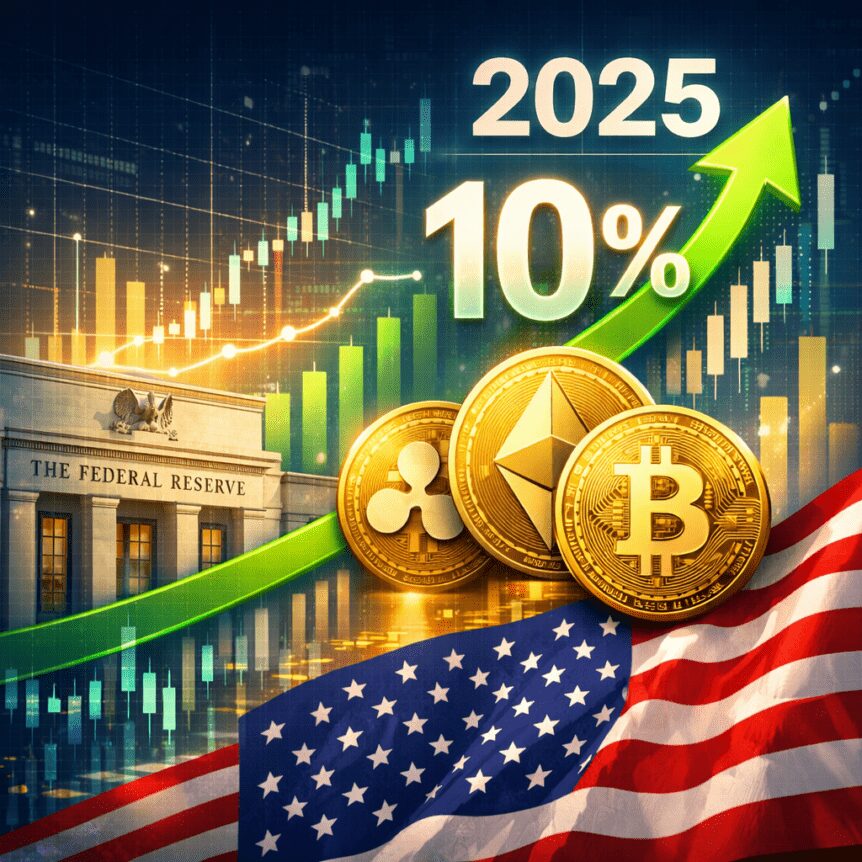
New data from the Federal Reserve sheds light on how cryptocurrency fits into American financial life in 2025. The central bank’s annual report on the economic well-being of households shows about one-tenth of U.S. adults either used or invested in crypto last year, marking the highest level in three years but remaining shy of earlier peaks.
According to the Fed’s 2025 household report, roughly 10% of adults engaged with crypto for any reason in 2025, up from the prior two years but below the 12% observed in 2021. The breakdown indicates around 9% used crypto as an investment, about 2% used it for payments, and roughly 1% sent money to family or friends using crypto. The report underscores that adoption is uneven across the population, with notable gaps between banked and unbanked consumers.
The Fed’s analysis also highlights a stronger crypto footprint among the unbanked. About 6% of unbanked adults used crypto in some capacity in 2025, compared with about 2% of banked adults. With more than a quarter of crypto users who paid with digital assets saying the business they transacted with preferred crypto payments, the report hints at a path for merchants to broaden crypto acceptance beyond speculative trading into everyday transactions.
Crypto’s role in payments is reinforced by industry efforts to integrate digital assets into routine commerce. Block, the payments and infrastructure company associated with Jack Dorsey, has supported Bitcoin and stablecoin payments for more than 800,000 U.S.-based merchants. Meanwhile, Lightspark, a Bitcoin Lightning Network startup founded by former PayPal president David Marcus, is actively pursuing broader adoption of Bitcoin payments as a mainstream option for consumers and merchants alike.
In its 2025 findings, the Fed notes that roughly 9% of respondents use crypto as an investment device, about 2% use it for payments, and 1% use it to send money to relatives or friends. The split reflects a spectrum of use cases, from investment-oriented activity to the growing use of crypto as a payment method in everyday life.
The report also highlights a potential route to broader crypto usage among the unbanked. While just 6% of all respondents used crypto for payments, the rate among the unbanked was higher, signaling crypto’s potential to serve as a financial access point for populations outside the traditional banking system. About 6% of Americans were unbanked in 2025, underscoring the size of this segment and the implications for payment rails and financial inclusion.
For those who did use crypto for payments, more than one in four cited merchants’ willingness to accept digital assets as a compelling driver. The perceived advantages often cited include faster settlement, enhanced privacy, and lower transaction costs. By contrast, fewer than 10% of businesses singled out crypto payments as a safer alternative to banks or due to distrust in the traditional banking system.
Key takeaways
- Around 10% of U.S. adults used or invested in crypto in 2025, the highest level in three years but below 2021’s peak of 12%.
- Crypto usage was notably higher among the unbanked (about 6%) than among banked adults (about 2%), highlighting potential inclusion benefits.
- Investment remains the dominant use case (roughly 9%), with payments (2%) and remittance (1%) trailing behind.
- Merchant attitudes matter: over 25% of crypto users who paid with digital assets reported that a business preferred crypto for speed, privacy, and cost savings.
- Industry push is underway to normalize crypto payments, with Block and Lightspark among the notable efforts expanding on-ramps and off-ramps for everyday usage.
- The 2025 data coincides with a leadership transition at the Federal Reserve and a shift in political sentiment toward Bitcoin, with new leadership signaling a more crypto-tolerant stance.
Policy shifts on the horizon as leadership changes begin
Beyond the numbers, the Fed’s policy narrative is likely to influence how markets perceive crypto risk and adoption. The current chair, Jerome Powell, has steered the central bank through a careful, cautious approach to crypto and digital assets. Powell’s term recently concluded, and Kevin Warsh was confirmed by the Senate to lead the Fed in the coming period. Warsh, who previously served as a Fed governor from 2006 to 2011, is widely described as more hawkish on monetary policy and fiscal restraint, with a history of calling for tighter ranges on inflation and a reduced reliance on quantitative easing.
In public remarks and past statements, Warsh has been characterized as crypto-friendly in certain respects. He has suggested that Bitcoin could play a role in market discipline and has likened it, at times, to digital gold for younger investors. If his stance translates into policy, crypto markets could see a shift in regulatory emphasis, potentially balancing concerns about risk with pathways for innovation, adoption, and broader financial participation.
The upcoming policy posture will matter for entrepreneurs and investors alike. A more crypto-inclusive framework could accelerate merchant adoption and further fortify the links between traditional payments and digital assets, while a tighter regulatory environment could temper speculative activity and alter the incentives for building crypto-enabled services.
What this means for users, merchants and builders
For everyday users, the Fed’s 2025 snapshot confirms that cryptocurrency has become a measurable, albeit still niche, channel for finance. The fact that a meaningful share of unbanked Americans is turning to crypto for payments or transfers underscores the potential for digital assets to complement or supplement conventional financial services, particularly in areas where access to banks is limited or fragmented.
For merchants and payment providers, the data points to a practical path forward: crypto can deliver tangible benefits—faster settlement, improved privacy, and lower costs—when properly integrated into point-of-sale environments. The widespread merchant coverage claimed by Block, along with Lightspark’s Lightning Network initiative, illustrates a tangible push toward real-world usage rather than mere speculation.
For developers and investors, the evolving policy landscape is a critical factor. The prospect of a crypto‑friendly yet disciplined Fed could create a more predictable regulatory backdrop, enabling builders to expand payment rails, custody solutions, and user experiences that bridge traditional finance with digital assets. Attention remains on how these dynamics interact with broader macro policy, including inflation management and the prudential oversight of payment networks and stablecoins.
In sum, the 2025 Fed report confirms a nuanced evolution: crypto is no longer a fringe asset class, but its use cases are still concentrated among specific groups and scenarios. The intersection of consumer adoption, merchant push, and regulatory development will shape how quickly digital assets move from a niche interest to a mainstream feature of daily commerce.
Readers should monitor how the incoming Fed leadership channels crypto discourse into policy actions, and how payment rails evolve to accommodate a growing set of crypto-enabled transactions across households and small businesses.
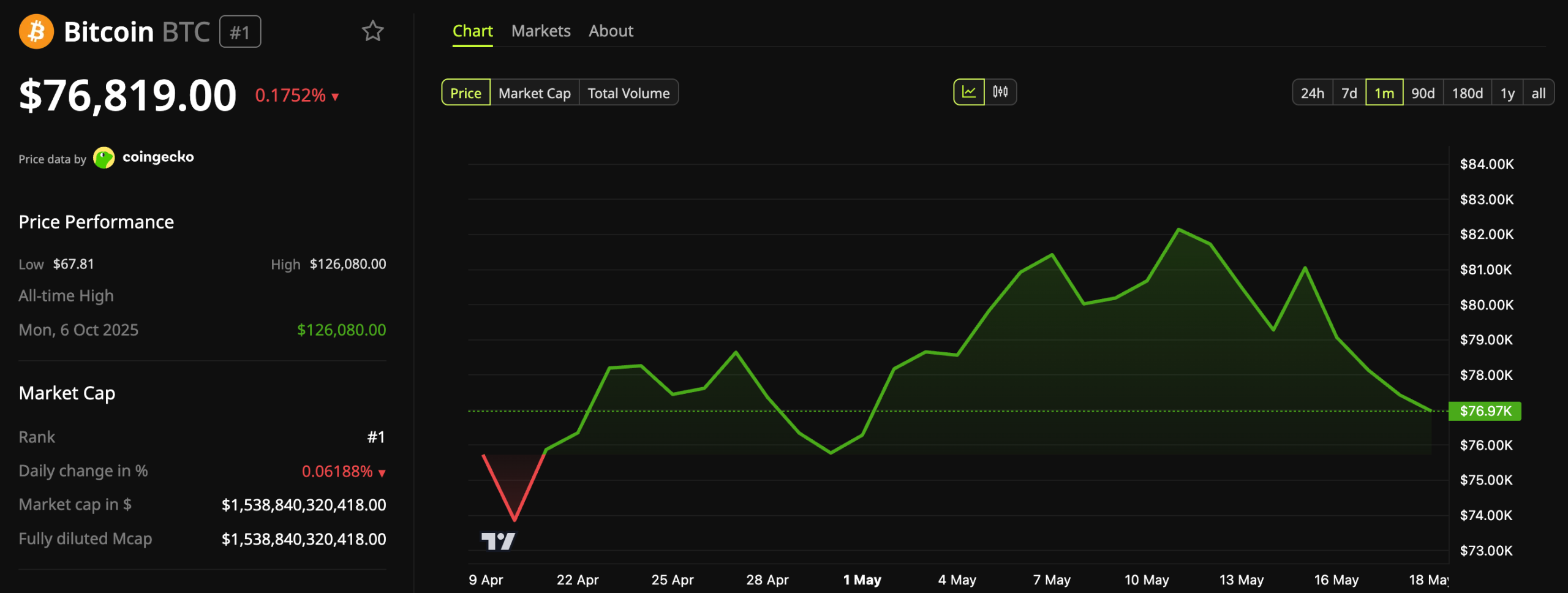
Bitcoin (BTC) slipped below $77,000 over the weekend. The cryptocurrency has now extended a four-day losing streak, erasing nearly 6% of its weekly value.
At press time, Bitcoin traded at $76,819, down 0.1752% over the past day.
Follow us on X to get the latest news as it happens

Bitcoin Loses 6% on Week as Three Bullish Signals Surface
Despite the drawdown, three quieter signals tell a different story. Wallet growth, a contrarian retail flip, and a recovering BTC/gold ratio paint an optimistic picture for BTC.
Data from Santiment shows bearish BTC commentary now exceeds bullish posts for the first time since April 21. The analytics firm treats the shift as a contrarian indicator.
“Since crypto historically moves opposite to the crowd’s expectations, this level of bearishness from retail is a great sign. As small traders sell off their coins as a reaction to this mild downswing, probabilities of a rebound are heightened while most people expect a further drop,” the post read.
At the same time, larger holders have moved the opposite way. Wallets holding at least 100 BTC have climbed to 20,229, up 11.2% from 18,191 a year ago, with each address now controlling roughly $7.7 million.
Such wallets typically belong to institutions, corporate treasuries, and long-duration holders. Their steady accumulation through volatile stretches signals confidence in Bitcoin’s trajectory.
“Historically, rising whale wallet counts are viewed as a sign that key stakeholders still have confidence in Bitcoin’s future value and scarcity. What makes this especially notable is that the growth in 100+ BTC wallets has continued during periods where retail traders have frequently shown fear, impatience, or skepticism,” Santiment said.

Research firm Delphi Digital flagged a third signal. The BTC/gold ratio has recovered 46% from its February lows and now sits near 17.6.
Gold has corrected 18% from its January peak, while Bitcoin has ground from the mid-$60,000s. The metric tracks relative strength between the two assets.
Delphi’s market strategist projects that the weekly 9- and 21-period exponential moving averages of the ratio will produce a bullish crossover in early June. Past green crosses preceded BTC rallies of 148%, 641%, and 148%.
Now, newly confirmed Fed Chair Kevin Warsh holds his first Federal Open Market Committee meeting on June 16-17. Markets are pricing roughly a 1.2% chance of a rate hike.
Whether the three signals can override macro headwinds will depend on Warsh’s debut meeting and the path of inflation through a summer still shaped by Iran tensions.
Subscribe to our YouTube channel to watch leaders and journalists provide expert insights
The post Bitcoin’s Drop Below $77,000 Hides Three Bullish Signals appeared first on BeInCrypto.

Key Takeaways
- An SEC “innovation exemption” could authorize blockchain-based platforms to trade tokenized versions of traditional stocks within days.
- The proposal would permit third-party entities to digitize publicly traded shares without requiring approval from the underlying companies.
- Financial giants like DTCC, Nasdaq, and ICE (NYSE’s parent) are already developing tokenized securities systems.
- Securitize’s Brett Redfearn cautioned that the approach risks market fragmentation and confusion over share valuations.
- Some SEC commissioners have expressed opposition to the exemption, while the CLARITY Act moves forward in the Senate.
The Securities and Exchange Commission is on the verge of implementing a transformative regulatory change that would permit stock trading via blockchain technology. Reports indicate the agency is finalizing an “innovation exemption” designed for tokenized securities, with a potential announcement expected within days.
The proposed framework would enable third-party platforms to generate digital representations of shares from publicly listed corporations—remarkably, without securing consent from those companies. These tokenized securities would be required to maintain identical rights to conventional shares, encompassing voting privileges and dividend distributions, or face removal from trading platforms.
According to individuals with knowledge of internal discussions, SEC Commissioner Hester Peirce championed the exemption initiative. The specific terms remain subject to modification before any official release.
Financial Industry Prepares Infrastructure
Numerous heavyweight financial players have already begun constructing systems for a tokenized securities marketplace.
The Depository Trust and Clearing Corporation, commonly referred to as DTCC, intends to initiate limited-scale production trading of tokenized instruments in July, followed by comprehensive deployment in October. Their architecture would support tokenized equities and exchange-traded funds using assets currently housed within DTCC’s established infrastructure.
Nasdaq has been engineering a structure that would allow corporations to create blockchain-native shares while maintaining conventional ownership protections. The securities regulator greenlit Nasdaq’s tokenized securities blueprint in March.
Intercontinental Exchange, which operates the New York Stock Exchange, has similarly revealed intentions to enter the tokenized stock space through a collaboration with cryptocurrency platform OKX. ICE disclosed in January its plan to construct a system enabling round-the-clock trading and settlement via blockchain technology.
Cryptocurrency exchange Bullish, under the leadership of former NYSE chief Tom Farley, strengthened its tokenization position by purchasing transfer agent service Equiniti for $4.2 billion this month.
Internal and External Opposition Emerges
The proposed exemption faces resistance from multiple quarters.
Multiple commissioners within the SEC harbor reservations about the initiative, according to informed sources. The agency declined to provide commentary when contacted.
Brett Redfearn, who serves as president of tokenization platform Securitize, articulated concerns regarding the authorization of third-party stock tokenization without participation from the issuing entities. He cautioned that this methodology could generate market fragmentation and create ambiguity for investors regarding the true value of their holdings.
Certain privately held enterprises have also voiced objections. Both OpenAI and Anthropic have resisted unauthorized creation of tokenized securities that track their valuations in secondary pre-IPO markets.
Potential Implications of the Regulatory Shift
Proponents of blockchain-based trading argue the technology could democratize access to American capital markets for individuals currently excluded from traditional brokerage systems. Prominent companies such as Nvidia, Google, and Tesla have been cited as examples of corporations whose shares could attract expanded international participation through tokenization.
SEC Chairman Paul Atkins has noted that existing securities regulations were not designed to accommodate blockchain architectures that consolidate exchange functions, clearing operations, and settlement processes into unified protocols. He has advocated for comprehensive rulemaking procedures instead of regulatory approaches driven by enforcement actions.
This tokenization initiative arrives as the Senate Banking Committee approved the CLARITY Act last week, positioning it for consideration during a full Senate vote scheduled for next month. Investor Kevin O’Leary and other market participants have emphasized that institutional finance will remain hesitant to embrace tokenization absent definitive legal guidelines.
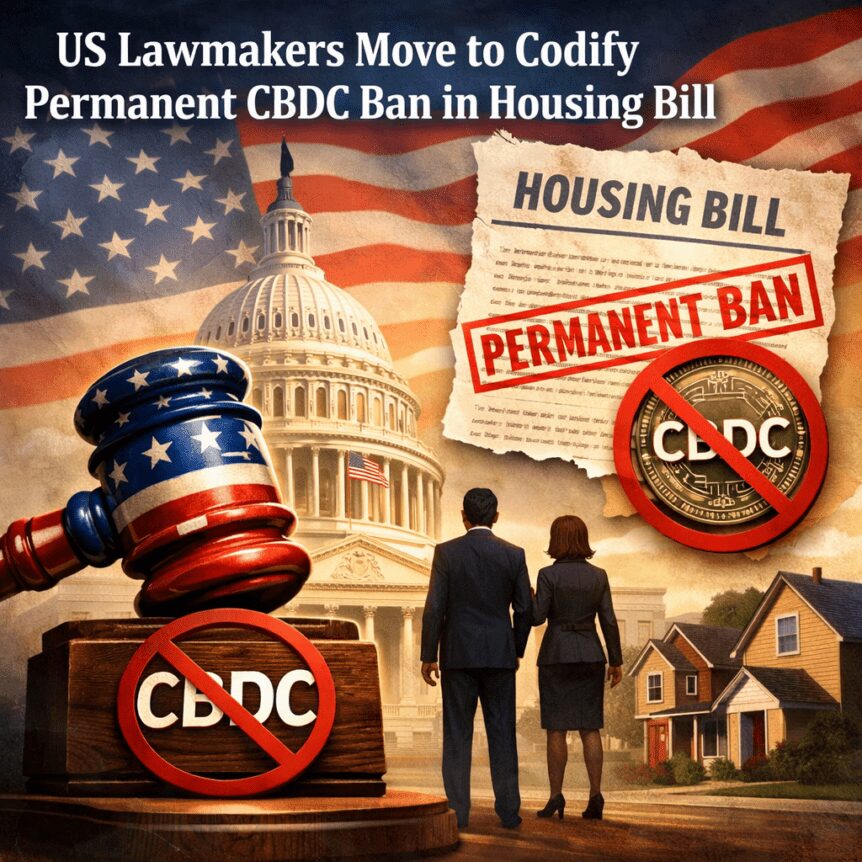
According to Cointelegraph, a bipartisan initiative in the U.S. Congress is advancing a permanent ban on a central bank digital currency (CBDC) issued by the Federal Reserve, to be codified in the 21st Century ROAD to Housing Act. The House is poised to vote on an amended version of the measure this week, following a Senate bill that would delay any CBDC issuance until December 31, 2030. The development underscores enduring regulatory and governance concerns about state-issued digital money and its implications for financial privacy, supervisory oversight, and the role of the Fed.
The amended House legislation aims to eliminate what its sponsors describe as a potential “backdoor green light for a CBDC” and seeks a permanent prohibition. The debate arrives at a moment when lawmakers are weighing how a digital sovereign currency would interact with housing programs, housing affordability policy, and broader financial-system regulation.
Key takeaways
- The House proposes a permanent ban on the Federal Reserve or its banks issuing a CBDC, embedded in the amended ROAD to Housing Act; the Senate’s March document proposed a CBDC prohibition through 2030, alongside housing program revisions.
- Key lawmakers are advancing distinct anti-CBDC positions: Rep. Warren Davidson supports a permanent prohibition, while House Majority Whip Tom Emmer is promoting an alternative “Anti-CBDC Surveillance State Act.”
- The legislation must clear both chambers before it can reach the president’s desk; passage in the House would send the measure back to the Senate for potential further changes.
- Global context remains limited: the Atlantic Council tracker identifies only three countries with official CBDCs (Nigeria, Jamaica, Bahamas) and notes 41 others in pilot or testing phases, highlighting a risk analysis framework for U.S. policy choices.
- Regulatory and compliance implications are central for banks, non-bank financial institutions, and crypto firms, with potential downstream effects on licensing, AML/KYC regimes, and cross-border operations.
Legislative trajectory and policy debate
The Senate Banking, Housing and Urban Affairs Committee released a bill in March largely focused on housing program revisions but included a section barring the Federal Reserve System or any Federal Reserve bank from issuing a CBDC or similar instrument until the end of 2030. In parallel, the House has crafted its own amended version, which Rep. Mike Flood described as reversing a perceived “backdoor green light for a CBDC” and pushing for a permanent ban. The House bill is expected to reach a floor vote this week, with prospects of returning to the Senate for potential amendments before any final enactment.
Legal and regulatory analysts are watching the interplay between the two chambers closely. If enacted, the measure would establish a statutory framework that could constrain the Fed’s monetary tools and the broader development of a government-backed digital currency in the United States. The path forward remains uncertain, given possible Senate resistance to a permanent ban and the broader policy considerations that have characterized CBDC discussions for years.
Policy positions, privacy, and governance concerns
Policy voices on both sides of the aisle have framed CBDCs as a matter of governance, privacy, and state oversight. Rep. Warren Davidson has argued that a sunset or “2030 pre-launch development period” fails to create a robust, lasting constraint on CBDC development, describing the House effort as a potential bipartisan win on housing policy that should not become a vehicle for a central-bank digital currency. He characterized the current approach as drifting toward a CBDC policy that could be construed as a functional launch date rather than a sincere ban.
On the other side, Rep. Tom Emmer—one of the House Republican leadership figures—has pressed for the Anti-CBDC Surveillance State Act, which would block the Fed from creating or issuing a CBDC. He has framed the issue in terms of privacy and governance, arguing that a U.S. CBDC could be used to surveil and control economic behavior, drawing explicit contrasts with models observed in other jurisdictions. A representative statement from Emmer included, “My Anti-CBDC Surveillance State Act bans our government from ever creating this Orwellian tool. The House passed it. Now, the Senate must act.”
“My Anti-CBDC Surveillance State Act BANS our government from ever creating this Orwellian tool. The House passed it. Now, the Senate must act.”
The policy discourse also takes into account broader privacy and civil-liberties considerations. The Human Rights Foundation has highlighted the dual nature of CBDCs: potential benefits for financial inclusion and the risks related to privacy infringement and the possibility of expanding government control. This framing informs ongoing debates about how any federal digital monetary instrument would interface with existing AML/KYC obligations, banking relationships, and cross-border payments—areas where U.S. regulatory posture increasingly intersects with international standards and comparative regimes.
Global landscape and regulatory context
Beyond the United States, global CBDC activity remains uneven. The Atlantic Council’s CBDC tracker identifies Nigeria, Jamaica, and the Bahamas as the only jurisdictions with officially deployed CBDCs, while 41 additional countries are in various pilot stages. This landscape informs the regulatory and political calculations in Washington, as lawmakers weigh the domestic benefits and risks of a sovereign digital currency against potential international policy alignments and competitive considerations.
The CBDC debate in the United States unfolds alongside ongoing regulatory discussions on related digital-finance issues, including stablecoins, cross-border payments, and the role of licensing regimes for digital-asset firms. While not all details are identical across jurisdictions, the U.S. regulatory model increasingly emphasizes a rigorous framework for oversight, protection of consumer data, and the integrity of the financial system—considerations that will shape how any future CBDC policy is designed, implemented, and if necessary, restrained.
Within the broader policy ecosystem, lawmakers and observers continue to reference regulatory pillars and cross-border dynamics relevant to MiCA-type frameworks, U.S. securities and exchange authorities, and the Department of Justice’s enforcement posture. The evolving balance between monetary sovereignty, financial inclusion, and civil-liberties protections remains central to the debate over whether the United States should, or should not, pursue a CBDC strategy at all.
Closing perspective
As Congress advances or revises these proposals, the central questions revolve around legality, governance, and regulatory alignment. Whether a permanent ban gains approval—and how it would be reconciled with ongoing domestic housing initiatives and international CBDC developments—will shape the trajectory of U.S. digital-money policy for years to come. Monitoring votes in the House, potential Senate amendments, and the administration’s stance will be essential for institutions assessing compliance requirements and strategic considerations related to central-bank digital currencies.

Unite ballots Eddie Stobart drivers who deliver to Morrisons
Here’s your chance to get InvestingPro for 2026’s lowest price BEFORE SALE ENDS
SEC Pushes Tokenized Stocks: Wall Street’s Onchain Era Begins

Manchester United reach agreement with Casemiro over contract clause amid transfer speculation

US brings back mandatory military draft registration

Steven Gerrard disagrees with Gary Neville over ‘shock’ Chelsea and Arsenal claim | Football


-

 Crypto World3 days ago
BloFin War of Whales 2026 Grand Prix opens registration for $5M trading championship
-

 Fashion4 days ago
Weekend Open Thread: Theory – Corporette.com
-

 Crypto World4 days ago
E-Estate Announces 1 Year Live: Washington DC Summit as Real Estate Tokenization Enters Its Next Phase
-

 Tech4 days ago
Tech Moves: Microsoft AI leader jumps to OpenAI; former AI2 exec joins Meta; and more
-
Crypto World6 days ago
Bitcoin Suisse expands with Digital Asset License and Investment Business Act Registration Approval in Bermuda
-

 Politics6 days ago
Pakistan to enter Chinese capital market as war inflation bites
-

 Crypto World6 days ago
Bitcoin Suisse expands with Digital Asset License and Investment Business Act Registration Approval in Bermuda
-
 Crypto World5 days ago
Google’s Gemini AI Predicts Incredible Solana Price by the End of 2026
-

 Business4 days ago
H&R Real Estate Investment Trust (HR.UN:CA) Q1 2026 Earnings Call Transcript
-

 Tech3 days ago
Google reimburses Register sources who were victims of API fraud
-

 Sports3 days ago
Napoleonic enters 2026 Doomben 10,000 field via Abounding withdrawal
-

 NewsBeat7 days ago
Comment on Keir Starmer surviving the day as Prime Minister like a turd that wont flush
-
 Entertainment5 days ago
Zara Larsson Has Blunt Response To Chris Brown Diss
-

 Fashion6 days ago
The Best-Kept Makeup Secret for a More Defined Face
-
 Crypto World5 days ago
Two AI Tokens Lead May Rally, But Risks Are Rising
-

 Politics7 days ago
The Trial of Majid Freeman, Verdict
-

 Politics6 days ago
Palestine’s flag becoming a regular sight at European football stadiums
-

 Fashion2 days ago
On the Scene at Gucci’s Cruise Show in New York City: Mariah Carey, Kim Kardashian, Lindsay Lohan, Iman, and More!
-
 Tech6 days ago
Why AI is making typography a boardroom conversation
-

 Politics6 days ago
The 81 MPs (so far) who have demanded tick-like Starmer out
You must be logged in to post a comment Login