



Connect with us
DAPA Banner
DAPA Coin
DAPA
COIN PAYMENT ASSET
PRIVACY · BLOCKDAG · HOMOMORPHIC ENCRYPTION · RUST
ElGamal Encrypted MINE DAPA
🚫 GENESIS SOLD OUT
DAPAPAY COMING

Tech

Bye-bye, Gemini CLI; Google nudges devs toward Antigravity

Published

on

AI + ML

Most users lose access June 18 – unless you’ve got enterprise creds or paid API keys

Pour one out for the Gemini Command Line Interface. Come June 18, the open source development agent will stop serving most users in favor of the new Antigravity CLI, and developers aren’t happy that the replacement is far less open than the old tool.

Google announced the Antigravity CLI at Google I/O this week, billing it as a way for the Chocolate Factory to unify its efforts in developing a command line interface for AI agents. One of the key arguments Google makes in a post about transitioning from Gemini CLI to Antigravity CLI is that the new one has improved support for multi-agent environments, but the company isn’t giving most of its users much of a choice on whether to switch. 

Advertisement

“On June 18, 2026, Gemini CLI and Gemini Code Assist IDE extensions will stop serving requests for Google AI Pro and Ultra, as well as those using it free of charge using Gemini Code Assist for individuals,” the Gemini CLI team wrote in their announcement of the transition. The change also affects Gemini Code Assist for GitHub, which won’t allow new installations beginning June 18, and will stop serving requests in the following weeks. 

Enterprises appear to be getting a pass, however, with Google noting that those using Gemini CLI or its IDE extensions through a Gemini Code Assist Standard or Enterprise license won’t see any changes in their access, nor will Gemini Code Assist for GitHub users accessing the tools through their enterprise Google Cloud accounts. 

“Gemini CLI will remain accessible via paid Gemini and Gemini Enterprise Agent Platform API keys,” Google explained. For everyone else, sorry: It’s Antigravity CLI or bust, but don’t expect the same experience.

“There won’t be 1:1 feature parity right out of the gate” between Gemini CLI and Antigravity CLI, Google added. Agent skills, hooks, subagents, and extensions are all being supported by Antigravity CLI at launch. But other stuff may take time to arrive, if it does at all.

Advertisement

Pray we don’t alter the deal any further

Take a look at the Gemini CLI GitHub page, and you’ll find all the code that made it possible – it is an open-source project, after all. Surf over to the Antigravity CLI GitHub page and all you’ll see is a change log, readme, and a GIF file demonstrating the tool’s appearance. 

That’s right: Antigravity CLI isn’t open source – at least not from what Google has published so far – and it took developers no time at all to notice.

Gemini CLI Lead Product Manager Dmitry Lyalin took to GitHub to make an announcement detailing some additional info about the forced CLI tool migration, and the comments are rife with people frustrated by the move. No small portion of the vitriol is targeted at apparent usage limits, with multiple people reporting they’d hit their weekly quota with just a couple of requests. 

The issues page for Antigravity CLI similarly has numerous posts asking Google to look into usage limits. Other posts accuse Google of using open-source contributions to improve a new closed-source product and generally express frustration with Google for killing yet another thing customers relied on. 

Advertisement

At the same time, Lyalin teased developers by telling them that, no, Gemini CLI isn’t truly gone if you’re willing to pay top dollar for it. 

“The project remains available to the community as an Apache 2.0 licensed repository with no changes,” Lyalin noted in his GitHub post. “You will continue to see us work on GitHub as we keep Gemini CLI updated with latest model releases, bugs and security fixes for our enterprise customers.”

Now please open your wallets if you want access to this open-source product. 

Google didn’t respond to questions for this story. ®

Advertisement

Source link

Continue Reading
Click to comment

You must be logged in to post a comment Login

Leave a Reply

Tech

Apple server schematics stolen in May 2026 Foxconn cyberattack

Published

on

Apple’s server designs may be at risk of exposure, because of a May 2026 cyberattack that targeted Foxconn.

Leaked documents may be tip of the iceberg in Foxconn hack, as only Apple server schematics have been shared so far. More damaging documents may come later.

On May 12, AppleInsider reported that ransomware group Nitrogen hacked into Foxconn facilities in North America. Initially, based on the available sample files, it appeared that the attackers didn’t obtain any Apple documentation.

However, additional sample files have now been provided to AppleInsider, including more than 30 confidential Apple documents, all of which appear to be genuine. We’ve analyzed the newly available sample, and while we won’t share any links, the files have all the hallmarks of genuine Apple documentation.

Advertisement

Nitrogen managed to obtain schematics detailing Apple server component designs from March 2026 and late 2025. Apple server rack specifications and manuals, from 2020 through 2023, were also stolen.

The server schematics were created using Siemens NX and are consistent with the format and style used by Apple. Dimensions for various brackets, components, and spacers are described in the documents, as is the chassis design of an internal Apple server.

Apple’s Matterhorn project and other server details

Most significant among the files taken was an overview of Apple’s Matterhorn project, detailing Apple server configurations that utilize Intel’s Whitley and Eagle Stream platforms. The document covers the specifications of Apple servers, as well as their board layout and architecture.

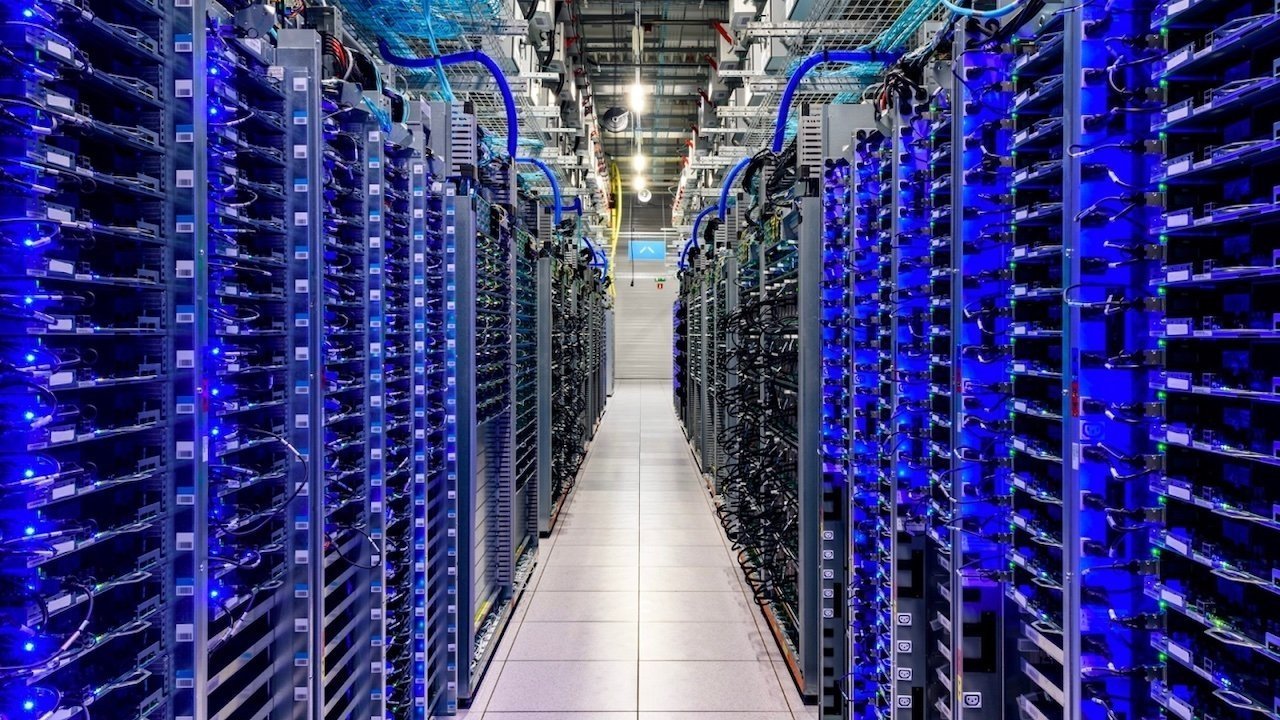
Long aisle between tall server racks glowing blue, packed with cables and hardware, in a brightly lit high-tech data center or computer server room

Files related to Apple and Google servers were stolen from Foxconn.

Advertisement

Per the document, Apple’s high-end servers used two 32-core Intel Ice Lake CPUs, more commonly known as 3rd Gen Intel Xeon Scalable processors, at 2.2GHz. They also featured 24 sticks of 128GB DDR4 RAM and Nvidia T4 GPUs, and multiple 8TB NVMe drives, among other things.

Nitrogen also acquired confidential Intel documents, detailing debugging and JTAG processes for the aforementioned Xeon-focused platforms. These files contain the security layers, board designs, and other aspects of Intel hardware.

Though these Intel-based server configurations have likely since been replaced with more powerful Apple Silicon variants, the collection of documents offers a unique look at the processing power Apple needed as recently as 2023.

As for Apple server-related guides and specification documents, Nitrogen provided four files:

Advertisement
  • Apple AC Rack Specification
  • Apple Bulk and Single Packaging Requirements
  • Apple Matterhorn RoT Mezzanine Information
  • Apple Server and Storage — Mechanical, Thermal, Industrial, and Packaging Specifications

The Apple documents themselves appear to be genuine. Three of them were written by Apple’s Data Center Hardware and Infrastructure Mechanical Development Leader, Kelly Smith. Clifford Gaw, Apple’s System Hardware Lead, wrote the fourth document in the sample.

These files detail the physical properties of the server racks Apple uses internally, from their dimensions and approved colors to the maximum weight they can carry. Also present are instructions for maintaining airflow, leveling feet, mounting side panels, conducting safety and stability tests, and more.

Nitrogen seemingly did manage to get its hands on real Apple documents. However, they’re not useful for much of anything, unless you have an Apple server lying around, or an entire rack full of them.

Absent from the sample files is anything related to the chips powering Apple Silicon-based servers or anything detailing the purpose of the servers themselves. Server chassis and bracket schematics alone won’t be a concern for Apple.

If the ransomware group actually has additional details regarding Apple Silicon servers, including their motherboard layouts, configurations, and the total number of servers produced, Apple could face issues. Rival AI companies, for instance, might copy Apple’s designs or iterate upon them.

Advertisement

Apple has arguably already fallen behind in the AI race, given that Siri‘s personal context feature announced at WWDC 2024 still isn’t here. Compromised server designs certainly won’t help.

Still, Apple isn’t the only company that has to worry about confidential files reaching its rivals. Foxconn assembles a variety of electronics, components, and products for multiple tech giants.

Aside from schematics and instruction manuals for Apple servers, Nitrogen stole documents related to confidential AMD, Broadcom, Google, Intel, Hewlett-Packard, Micron, Nvidia, Samsung, and Seagate projects.

Large glass office building with the multicolored Google logo on its facade, set against a blue sky, partially framed by green tree branches in the foreground

Internal documents related to Google servers were among the files taken from Foxconn.

Advertisement

Also among the files were documents from Altera, Ampere, Amphenol Power Solutions, Avago, Hilisin, Holy Stone Enterprise, ITG Electronics, Infineon, JCTC, Lotes, Molex, Nexperia, PennEngineering, Puya, Renesas, TA-i Technology, TXC, Walsin, Winbond, and Yageo.

Multiple documents related to the Foxconn-owned Cloud Network Technology, based in Houston, Texas, were also in the sample provided. This includes a shipping label for equipment sent by Hewlett-Packard, among other things.

AMD documents include a motherboard design guide for FL1 processors and SP5 sockets, and technical specifications for the MI300X-O Universal Base Board. The attackers acquired Nvidia documents containing printed circuit board fabrication specifications, board handling requirements, and more.

Files related to the HGX Blackwell 8-GPU, the HGX H20 8-GPU, and the HGX Hopper 8-GPU, along with documents concerning the GB NVL 72, GB 200 NVL, and GB 300 NVL72 compute trays, are present as well. There’s also a file related to the Nvidia Tesla GH200 module.

Advertisement

Documents from Hewlett-Packard and Google also pertain to server components and server designs.

Multiple Hewlett-Packard and Foxconn files, for instance, describe an enterprise server known as the HPE Hoth Tromper. Board designs for this server are also present. The Google GhostFish Fish shelf, meanwhile, is detailed in a separate test-related document.

Also obtained by the group were files detailing the technical specifications of Micron DDR4 SDRAM and Samsung’s 16GB DDR4 SDRAM modules and their various components.

Documents concerning storage devices were also present, with one file, for instance, detailing the Seagate Exos 2×18 mechanical hard drive design.

Advertisement

Nearly all of the documents in the sample provided by Nitrogen are in English and are seemingly related to Foxconn facilities in North America. However, the ransomware group also included PDFs of Foxconn emails in Chinese, though the content remains server-related.

Some of the files taken from Foxconn contain regulatory compliance information or detail hardware testing procedures.

Overall, nearly everything taken from Foxconn appears to be server-focused. There do not appear to be documents from Foxconn’s Guanlan and Zhengzhou facilities, which assemble other Apple products, like the iPhone.

There’s also nothing related to iPad, Mac, or Apple Vision Pro assembly, despite Foxconn playing a key part in the manufacturing of these device lines.

Advertisement

Foxconn’s assembly plants in North America, such as the one in Mount Pleasant, Wisconsin, or the one in Houston, Texas, don’t assemble Apple products beyond servers, so it’s no surprise that no iPhone-related documents appeared.

The full scope of the Foxconn cyberattack, however, remains undetermined, as the ransomware group responsible says it stole over 11 million files, allegedly equating to eight terabytes.

As it currently stands, it does not appear that this attack will yield any significant Apple design leaks.

Advertisement

Source link

Continue Reading

Tech

Between-Device Sharing Still Sucks | Hackaday

Published

on

Once upon a time, computing was simple. You had files on a floppy disk. If you wanted to take them to a different computer, you ejected the disk from one machine and put it in another. It wasn’t fast, but it was easy and intuitive. Besides, you probably only had one computer of your own, anyway.

Life has since gotten a lot more complex. You’ve got a desktop, a laptop, a work laptop, your personal and business phones, and a smart watch to boot. You live amongst a swirling maelstrom of terabytes of data. Despite all the technical advances that got you here, it’s still a pain to get a file from one device to another, even when they’re sitting on the same desk. Why?!

This Modern Glitch

So many buttons to share a file… just get it on to the computer!!! 

Our computers are actually very good at connecting to each other. We have Ethernet devices with auto-negotiation, WiFi and Bluetooth in just about everything, and DHCP for good measure. It’s easy to get devices on the network and online. One might think all this connectivity would make sharing data easy. But we’re not so lucky.

Let’s take a straightforward example. Just getting a JPG off a smartphone requires jumping several hurdles and a little bit of begging to the benevolent tech gods. You can plug your phone in via USB to grab files, assuming you’ve got an Android, but you’ll have to flick through menus multiple times to get it to shift into the right mode to get files off. An iPhone will allow the same but you’ll need an app to help “import” them.

You could alternatively try sending them via Bluetooth, but you’ll have to go through the hassle of pairing, which almost never works first time. You’ll also get glacial transfer speeds and watching the process fail a few times. Alternatively you might see if your phone comes with a proprietary app for transfers, or you could try waiting to sync files to a cloud service or just emailing them to yourself. The latter method will make a mess of your inbox, but at least you get the files across when you need them.

Advertisement

It Was Not Ever Thus

In the Windows 9x days, sharing files in the home was easy. Permissions were simple, but security was not up to the standards of today. 

It wasn’t always like this. Jump back a quarter century, and things looked very different. Windows 9x had a massive install base, with Windows XP just bursting on to the scene. You could still sneakernet stuff around with floppy disks if you wanted, of course. But it was also a cinch to set up simple network shares to access files across machines on a home network. It just worked.

Much the same was true of the Macintosh ecosystem. Back then, smartphones weren’t a thing, and few of us were carrying any sort of device with any real amount of data. Things like digital cameras and MP3 players would soon rise to prominence, but getting files on and off them was a dream—simply plug in, and they’d present as a USB mass storage device. No drivers, no passwords, no bloated apps. Just peace.

Of course, that would all change a few years down the line. Take the Windows world as an example. Network shares still exist, and you can set them up if that’s what you really want. Unfortunately, though, they’re so much worse than they used to be at the turn of the century. They’re buried under layers of permissions and user account nonsense that makes enabling them absolutely arcane. Only some of us run multi-user logins on individual machines, even fewer of us choose to run domain-style networks in our homes. In contrast, a lot of us would like it to be easy to pull a few files off the loungeroom computer when needed. However, doing so requires navigating passwords and accounts and setting permissions and if you get the slightest bit of it wrong, you won’t even see the shared files, let alone be able to access them. A task that used to take 3 minutes of setup now takes half an hour or more and a couple trips to Knowledgebase.
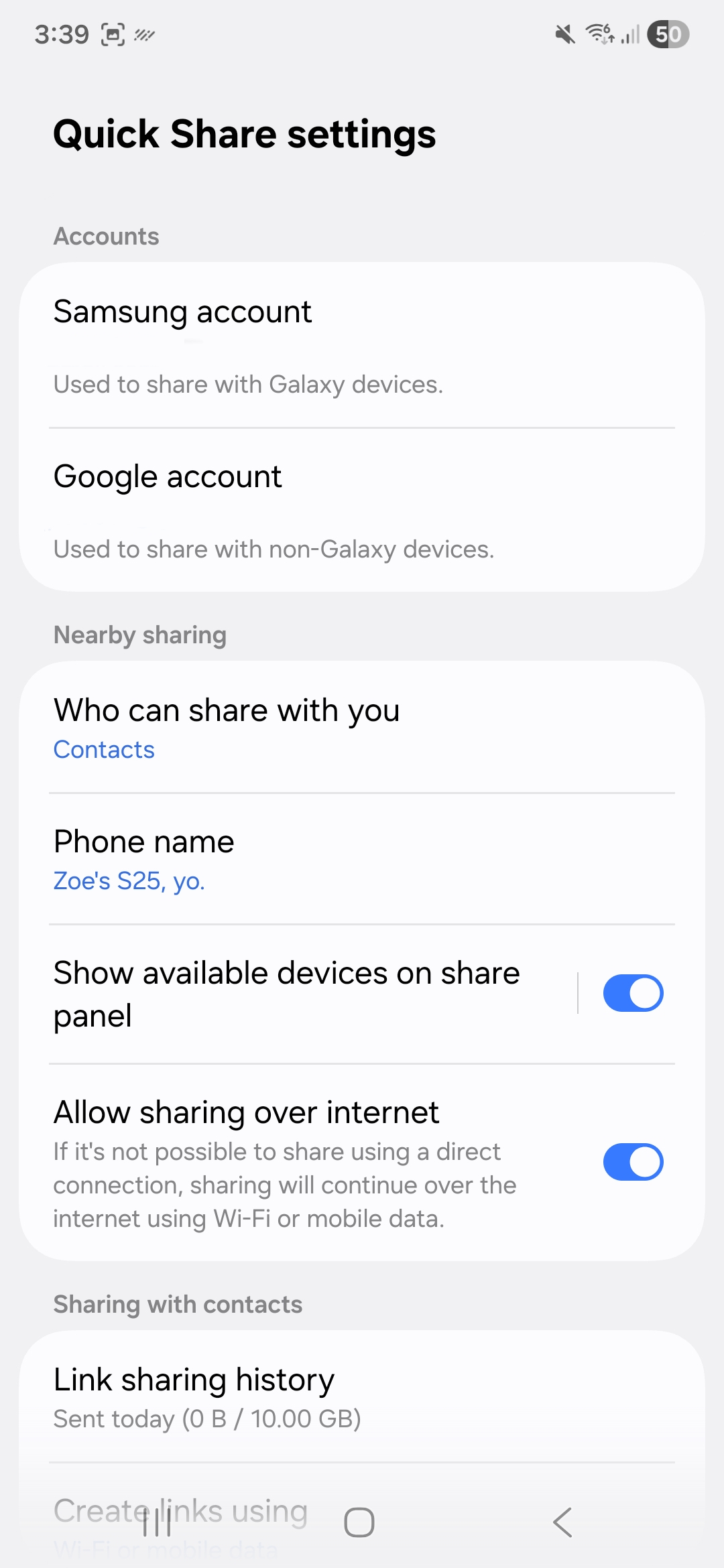
Tools like Apple’s AirDrop and Samsung’s Quick Share have attempted to solve this problem, to a degree. Ultimately, though, they have their limitations and aren’t a free-for-all for easily accessing data across devices.

It shouldn’t be like this. One can imagine a world where all our devices in the home are allowed to share files openly and freely. Imagine if you could just click into the network tab on your PC, and see everything across all your devices – your laptops, your phones, your desktops and lab machines. Imagine not having to pair your phone or fiddle with utilities or special sharing tools or, god forbid, sending files all the way to the cloud just to move them three feet across your desk. Imagine this, all your files across all your machines at the click of a button, no auth, no nonsense, whether Apple, Windows, or Android. You already have all these devices talking on the same network, so all your stuff should just be there!

Alas, we cannot have such nice things. It’s not just because Big Tech is full of mean people that want to make life worse than it used to be, but it can feel that way sometimes. Instead, it’s more because of boring, sad, practicalities that are difficult to overcome. Security is perhaps the biggest headline issue in this regard. We now use our personal computers to store more private and confidential data than ever.. This makes access control paramount to avoid bad actors getting access to compromising information. There’s also the need to prevent the easy spread of viruses, which becomes very difficult when there’s a permissive file sharing route between devices. Malware has often taken advantage of holes in network sharing protocols as a vector for infection.

Beyond this, there’s the simple problem of interoperability. There isn’t a uniform standard that would allow easy, secure file sharing across laptops, desktops, and smartphones of all makes and models. This would require a large number of different tech companies to all get together, define a solution, and agree to implement it going forward. Sadly, current thinking seems to be that the proprietary solutions we have today are “good enough.” Apple’s AirDrop or Samsung’s Quick Share will get you by if you stay in the right walled garden, for example, and neither cares much to start a dialogue to establish something better and more cross-platform. Few tech companies would be excited about opening up potential security holes by implementing a new broadly-accessible file sharing protocol, either.
Advertisement
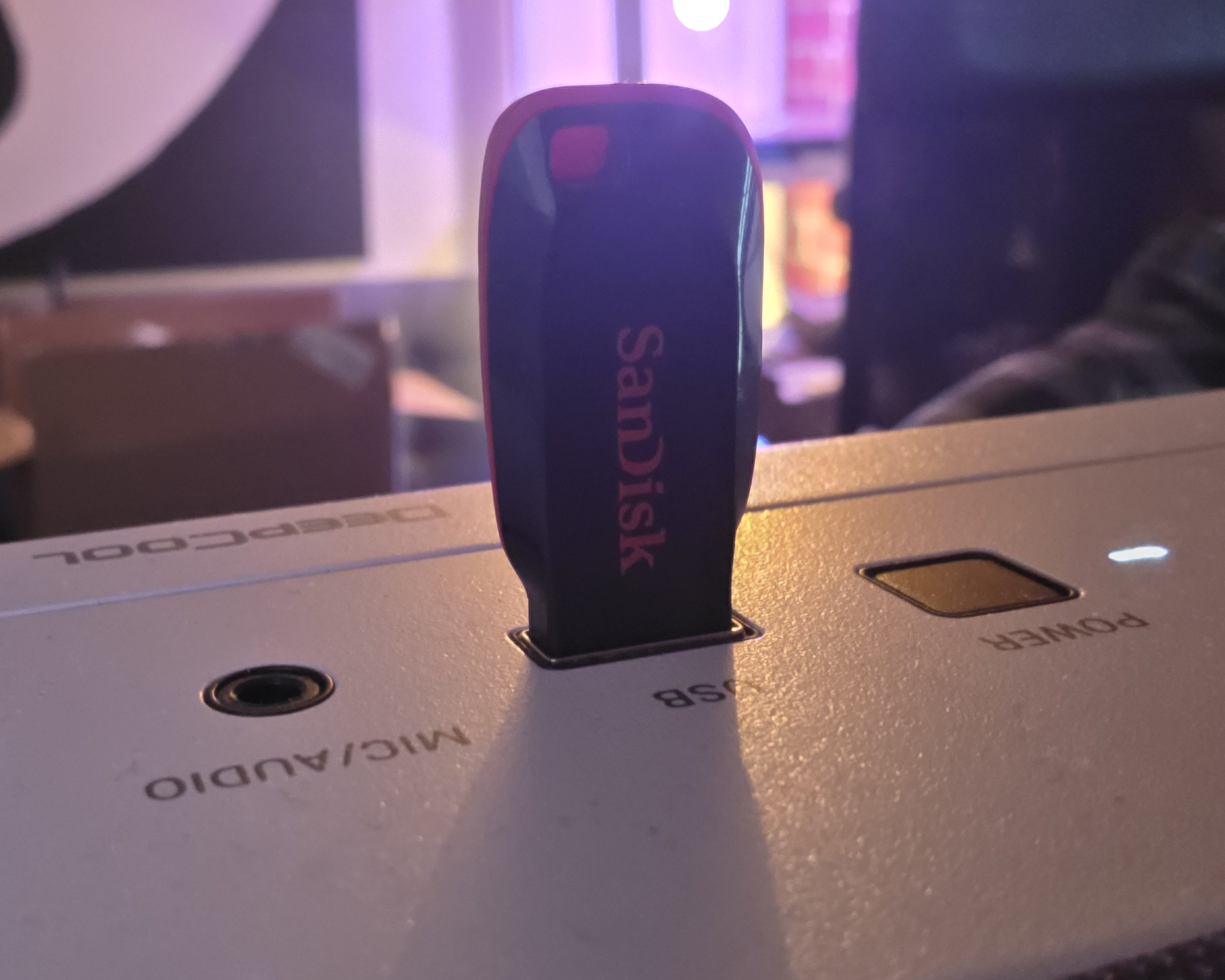
Sometimes it’s quicker to throw something on a USB drive than try and convince Windows networking to let you dump files on a friend’s laptop. You can have two computers right next to each other, on the same network, but it’s just too hard. 

Perhaps a metaphor best explains the misery we find ourselves in today. If you live in a safe town with low crime, you might not feel the need to lock your car doors when you pop down to the supermarket. It means you can get in and out of your car without fishing for your keys, which is a great convenience when you’re carrying a bunch of heavy grocery bags. At the same time, you can’t live like this in a nastier place. Bad actors will simply open your door, rifle through your car, and take anything they like. That could end badly for you.

Unfortunately, cyberspace is that nasty place. By and large, we can’t just freely share files between devices because it’s too dangerous to do so. You don’t want your bank accounts drained, or your personal photos used for blackmail, so we have to drench everything in layers of authentication, even in the privacy of our own homes. Perhaps one day there will be some framework that allows us to create a close-knit network of “trusted” devices so we can freely move data about our own protected little bubble. But until then, we’ll have to suffer with Bluetooth passcodes and proprietary apps and the fact that it’s usually quicker to email a friend a photo then to find a way to directly transfer it to their phone which is sitting right next to you. It’s an annoying problem, and one that will not easily be solved.
Source link

Advertisement
Continue Reading

Tech

Primer secures $100M Series C to fuel US expansion and autonomous AI payments

Published

on

Primer, a London-based payment startup, has announced a €86.2 million Series C funding round to expand its AI payments and finance platform. The capital will also support its market development in the US, where the company plans to grow revenue to more than a third of total revenue by 2028, supported by plans to hire up to 50 roles in the region.

Primer is a financial technology company that provides a unified payment infrastructure, enabling companies to optimize and control every step of the payment journey.

The platform offers complete visibility and control across the entire payment operations system, integrating payment orchestration, reconciliation, security, FX, and financial operations services into a single open layer. 

The company was built to solve a persistent problem: businesses having to rely on multiple fragmented providers and tools throughout the payment journey. Currently, the platform covers the merchant’s entire payment lifecycle, recording over 400 data points per transaction and handling more than 95% of customer payment volume on average.

Advertisement

The investment round was led by Sofina and Peak XV Partners, and backed by existing investors, including Balderton, Accel, ICONIQ, Tencent, and Speedinvest. With this new investment, the company has raised a total of €146.6 million, with platform adoption spanning more than 30 countries. 

Advertisement

Primer was founded in 2020 by Gabriel Let Roux (formerly of Braintree) and Paul Anthony (formerly of PayPal), and was initially backed by Balderton and Accel in pre-seed and Series A rounds. Since then, it has secured multiple investment rounds and released new products, such as Fallbacks and Network Tokenization.

In 2025, Primer launched its own proprietary agent, AI Companion, alongside Global Accounts, allowing companies to optimize and control finance across their businesses. 

With the introduction of their AI agent, they aim to solve a new issue specifically created by the rise of AI: data fragmentation across multiple systems, which can ultimately lead to major vulnerability and potentially flawed, widespread decisions.

“In the next few years, every payment decision in a large business will be initiated, optimised, or audited by AI. That shift is already underway. The question is whether the data those systems run on is complete, because when you deploy agents across fragmented data, they don’t just underperform, they make the wrong decision.

Advertisement

That’s why the next era of payments can only be built on complete, contextual intelligence. And that’s what Primer delivers,” said Gabriel Le Roux, CEO and co-founder of Primer.

The company reports that it processes billions of transactions annually for enterprise clients such as Get your guide, Dialpad, Printful, Conforama, Printify, Jackpot.com, and Maisons du Monde, among others. 

This new capital infusion will support the expansion of Primer’s AI-native infrastructure, which they expect will become the next-generation foundation that payments and finance teams will run on.

The plan is to scale its capabilities to run experiments, optimize performance, and operate autonomously to support contextual, AI-driven decision-making.

Advertisement

“We don’t want merchants chasing problems or missing opportunities. With full context across every payment, Primer Companion can act on their behalf, knowing what’s happening, why, and what to do next.” Le Roux added.

Aakash Kapoor, principal at Peak XV, stated: “As payments enter a new architectural era, that depth of context becomes critical for AI agents to make decisions.”

The US represents a massive growth opportunity for the startup, already accounting for roughly one-fifth of Primer’s revenue, with annual recurring revenue (ARR) in the region doubling year-on-year.

Advertisement

Source link

Continue Reading

Tech

Will Robotics Have a Breakthrough ChatGPT Moment?

Published

on

Over the next few decades, billions of autonomous, AI-powered robots will work alongside people in factories, perform tedious tasks in warehouses, care for the elderly, assist in unsafe disaster areas, deliver packages and food to our doorsteps, and eventually, help out in our homes. Some will look like us, and many won’t. What is certain is that regardless of form factor, robots will all rely heavily on AI in order to deliver real-world value.

In 2025, total investments in robotics companies reached a record $40.7 billion, accounting for 9 percent of all venture funding. The multibillion dollar question therefore is this: What will it take for AI-powered robots to begin to have a serious economic impact? Many of today’s robotics and AI companies are making bold claims, such as that humanoid robots will soon be coming into our homes, but there’s still a big gap between promise and reality.

The promise of robots that live and work alongside us has been the stuff of science fiction for a very long time. And while many programmers have tried to make that promise a reality, the physical world is just too complicated for traditional computer programs to handle the endless complexity it presents. Thanks to AI, robots are no longer being programmed—instead, they learn to operate in the real world. With enough practice, they can learn to perceive and understand the world around them, reason about that world, and use that reason and understanding to perform tasks that are useful, reliable, and safe.

Advertisement

The two of us have worked at the forefront of AI and robotics for the last decade, as a Professor in Robotics at Oregon State University and Co-Founder of Agility Robotics, and as former CEO of the Everyday Robots moonshot at Google X. Our experience deploying AI-powered robots in real-world settings has given us a perspective on where AI can be used to great benefit in complex robotic systems in the near term, and where we are still on the frontier of science fiction. We believe AI will enable an inflection point in robotics advances, but that it will be through the well-engineered application of coordinated systems of different AI tools rather than a single ChatGPT-style breakthrough.

As the excitement around AI is matched only by the uncertainty of what will be possible, here are five hard truths that will define AI in robotics.

1. The YouTube-to-Reality Gap Is Real

For years we have been seeing videos on YouTube with humanoid robots performing amazing moves on everything from a dance floor to an obstacle course. The inside knowledge in robotics is to “never trust a YouTube robot video.” The gap between real robots that can perform real work in unstructured human environments and carefully scripted and edited robot performances remains significant. The latest performance to get a lot of attention was a martial arts show featuring Unitree humanoid robots performing with children at the Chinese 2026 Spring Festival Gala. While impressive, this falls into a long lineage of tightly scripted robotic performances, where everything has been carefully choreographed and planned in advance. The low-level controls, synchronization, and choreography were stunning, yet the Spring Gala robot performance showed a level of autonomy and intelligence much closer to industrial robots building cars in a factory than something that will show up in your living room any time soon.

Advertisement

Seeing these kinds of demos nevertheless raises questions about where robotics really is. If robots can perform kung fu moves and do backflips and dance, why aren’t they also showing up on factory floors yet? And why can’t they do the dishes in my home after dinner? The simple answer is this: Making AI-powered robots capable of performing general tasks in varied human environments is still really hard. While impressive technological feats like those at the Spring Festival may make it look like we could be very close, the use of AI in these demos is only for low-level motor control (to keep the robots from falling over) and therefore is only a small part of the solution for robots to be general purpose in the real, unstructured spaces where we humans live and work.

2. Data Is An Unsolved Challenge

Large Language Models like OpenAI’s ChatGPT and Anthropic’s Claude were initially trained on an internet-scale database of text. The world woke up one day in late 2022 to ChatGPT demonstrating that AI computers could suddenly “speak” to us in prose or verse and about seemingly any topic. LLMs have turned out to generalize well and are now able to take multimodal input (text, images, video) and produce multimodal output. Importantly, the corpus of training data was both enormous and human-generated, which are characteristics that form the gold standard for AI training.

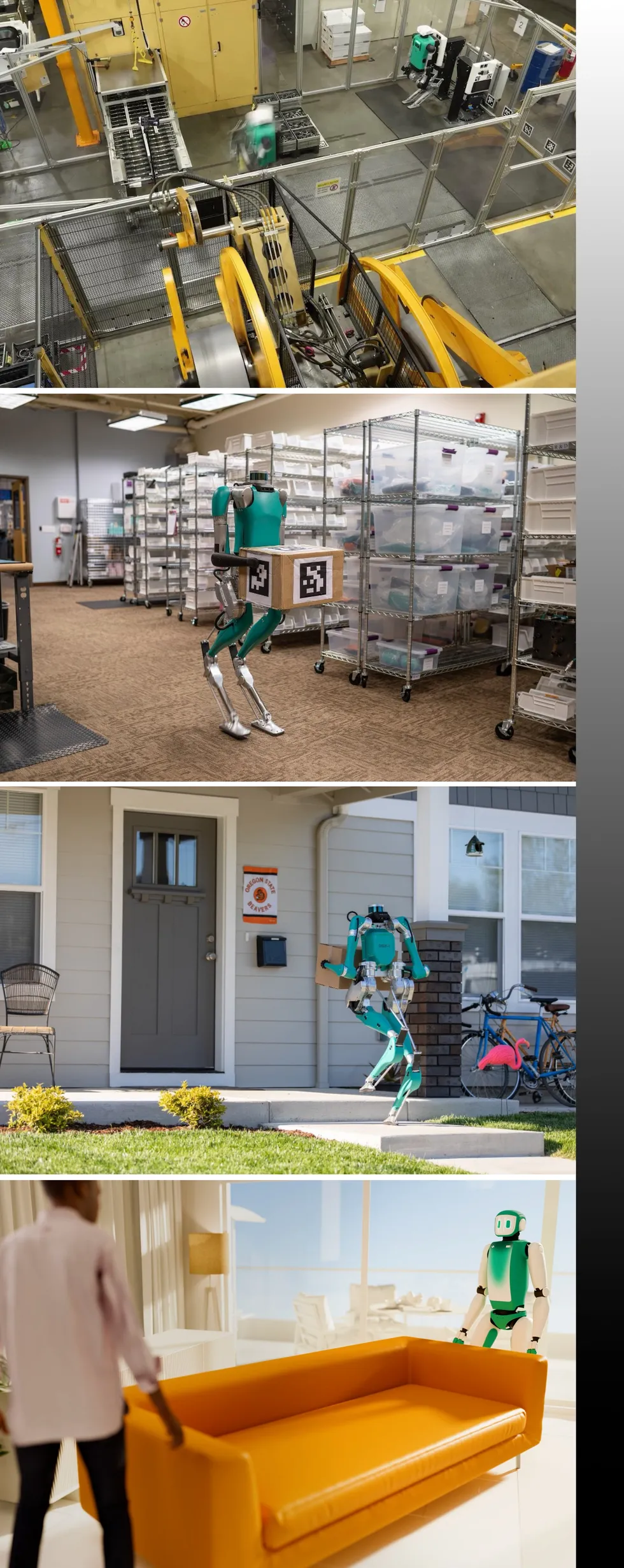
A series of four images, including robots working in a contained factory space, in an open indoor factory, outdoors in the real world delivering a package, and working with a human to move a couch in an apartment. The fastest path to robots as part of everyday life may emerge through a range of robot forms performing increasingly sophisticated applications and employing a range of AI tools.Agility Robotics

Giving AI a body (in the form of a robot) so that it can engage with people in the physical world continues to be a very difficult and broadly unsolved problem. AI models for general-purpose robotics must simultaneously satisfy multiple, often conflicting, physical, geometric, and temporal limitations while operating in unstructured, dynamic environments. In order to generalize, robot models need to be trained on data gathered in a high-dimensional configuration space, where “dimensions” represent text, lighting conditions, degrees of freedom, joint limits, velocities, force, and safety boundaries, just to mention a few. Importantly, this must be good data—it must contain many examples from what amounts to an infinite number of possible configurations in the physical world.

Since there are very few existing sources of data like this, approaches like teleoperation, video analysis, motion capture of humans, and self-exploration in simulation and in the real world are all seen as important ways to collect data. It’s a Herculean task. For example, at Everyday Robots at Google X, we ran 240 million robot instances in our simulator over the course of 2022 to collect training data, mostly to train a trash-sorting model. Similar amounts of data will be needed for every skill, to get to a similar level of capability, which is not yet human level.

Advertisement

3. There Will Be No Single Robot AI

We are far away from a moment where a single AI model might allow general-purpose robots to live and work alongside us.

General-purpose robots can have wheels or legs. They can have one, two, three, or more arms. Some have propellers and can fly, while others may be designed to operate under water. Some will drive on busy roads. The physical world is infinitely varied and complex. And then there are all the people and other animals that will be surrounding the robots. How do you train a model to operate a robot safely and reliably in all of these settings? The simple answer is, You don’t. At least not for quite some time.

We believe the winning AI architecture leading to the next big breakthroughs in general-purpose robotics will be “agentic AI” for robots, which are high-level coordinating models that can reason, plan, use tools, and learn from outcomes to execute complex tasks with limited supervision. Agentic, high-level models running on robots will invoke a system of specialized ones for different types of tasks. We will likely soon see multiple robots collaborating and coordinating with each other through their on-board agentic AI models.

AI tools are unlocking new and powerful capabilities in robotics, which in turn will enable new solutions and new markets. It’s encouraging to see these new models being made broadly available, some even as open-source solutions. This availability is akin to what happened with the internet: Real progress occurred when it became ubiquitous. We anticipate an inevitable democratization of complex behaviors in robotics with wide access to these AI tools and technologies.

Advertisement

4. Hardware Is Still Very Hard

Robots are complex systems with many parts that all need to work together with great precision. For a robot to be useful and safe, every part of it must be coordinated, from its perception systems, to the computer controlling it, all the way down to its individual actuators.

Actuators—that is, the motors and gears—are a good example of an important part of the robot where what got us here won’t get us there. The actuators used at scale by most industrial robots will not work for robots that will operate in human environments. If these robots accidentally collide with an obstacle, the resulting impacts are harsh, forces are high, and things break. Humans don’t move in this way. We are far more compliant in how we interact with the world, and we’re constantly making contact with our environment and using that contact to help us accomplish things.

Consider the challenge of inserting a key in a lock: Humans typically don’t do this by aligning the key perfectly with the keyhole. Instead, we just feel for the edge of the keyhole and jiggle the key in. Robots need to be able to operate in novel ways to achieve comparable capabilities by using a new class of actuators that are sensitive to force and able to have a compliant interaction with the environment. While these kinds of actuators do exist, they are not yet generally available at scale for robot systems designed to operate around people.

5. Real Value Comes From “Easy” Tasks

There’s a big difference between tasks that look impressive and real-world tasks that provide value. Robotics is a perfect example of Moravec’s paradox, which states that tasks that are hard for humans are easy for computers (like multiplying two big numbers), and tasks easy for humans (like a toddler’s movements) are extremely difficult for computers and robots.

Advertisement

Serving customers is an unforgiving reality check, because customers only care about solving the real problems they have. If we are to deploy AI-based robot solutions, they must outperform the way things are currently done, while demonstrating reliable performance metrics and safety. Agility Robotics’ early work to deploy our humanoid robot Digit in customer locations led to the realization that our first obstacle was safety: Robots that balance and manipulate objects in human spaces bring new types of risk to the workplace. In the first humanoid deployments, physical barriers were necessary, and Agility kicked off a multi-year engineering effort to solve the safety challenge, touching nearly every aspect of robot design and relying heavily on new AI-based approaches to human detection and behavior control.

Everyday Robots at Google deployed robots in 2019 that worked autonomously in office buildings doing chores like cleaning cafe tables and sorting trash. We quickly learned how “messy” and difficult the real world is for a robot. This experience informed the architecture and deployment of our AI systems while also gathering real-world data that could be combined with simulation data for training and improving models.

This focus on creating a product to meet specific customer needs and deploying robots in real-world settings is the only way to inform the structure of the AI tools and infrastructure for near-term utility on a path towards long-term broader capability and generality. There will be no “aha” moment, no silver bullet algorithm, and no volume of data sufficient to produce a general-purpose robot without extensive real-world experience.

Advertisement

AI Robots Are Coming, One Step at a Time

As we look to the future, there is no doubt that the world is bringing AI into the physical world through robots. We are at the beginning of a “Cambrian explosion“ of useful, intelligent machines. We believe AI is not one tool, but a huge frontier of technical approaches that is unlocking new capabilities so powerful, they will define our economy moving forward. This will happen not in one single definitive moment, but as an ongoing set of small and large breakthroughs, where AI-driven robots begin to provide real value in a few tasks, and then a few more, with impacts unfolding across numerous $100 billion-plus markets that will dramatically improve the quality of our lives.

From Your Site Articles

Related Articles Around the Web

Source link

Advertisement
Continue Reading

Tech

At Tech Alliance annual luncheon, a stark economic analysis and a call to action

Published

on

Tech Alliance CEO Laura Ruderman addresses the crowd at the 28th annual State of Technology luncheon in Seattle. (GeekWire Photo / Todd Bishop)

It’s a complicated moment in Washington, our home state, where the tech giants are strong, the satellites are abundant, and economic growth may no longer be above average.

That was the feeling walking out of the Technology Alliance’s annual State of Technology luncheon Tuesday, where a deep dive on Amazon’s Leo business and optimism about the future of the region’s satellite industry were preceded by a McKinsey analysis that gave a sobering picture of the state’s overall economic trajectory.

Washington’s economy grew 30% over the past decade, double the national average and the highest rate in the country, according to statistics presented by McKinsey partner Sarah Miller

But three headwinds threaten to cut that growth roughly in half, Miller cautioned in her remarks to the crowd: domestic migration has turned negative, the cost of living is outpacing incomes, and the state’s economy is unusually dependent on a handful of giant employers. 

The result: the Federal Reserve projects Washington’s growth will slow to roughly the national average. That means roughly 300,000 fewer jobs than the state would otherwise generate, based on the McKinsey analysis of 3.6 million people in nongovernmental jobs statewide.

Advertisement

“Growth built on a narrow foundation, concentrated in a handful of companies, one industry, one region, carries real risk and the conditions that sustain that growth are shifting,” said Technology Alliance CEO Laura Ruderman in her opening remarks before the presentation.

The Technology Alliance was founded nearly 30 years ago when a group of business and academic leaders recognized that Washington had the raw materials to be an innovation hub but needed to get organized or risk being left behind.

“That is still our mission,” Ruderman told the crowd, “and it matters now more than ever.”

Two clear messages emerged: the state needs a comprehensive economic development strategy, and it needs to invest far more aggressively in building a homegrown workforce, with stronger funding for education.

Advertisement

Larger backdrop: The report comes amid a wider debate over Washington’s economic direction. The legislature passed a 9.9% tax on income above $1 million in March, while some prominent founders and executives have been leaving for lower-tax states, raising questions about whether the region is squandering the advantages that made it an economic powerhouse.

Miller’s analysis noted that Texas has attracted more than 300 corporate headquarters in the past decade through low taxes, affordable housing, and a friendlier business environment.  

She also cited Minneapolis, which tripled its affordable housing supply to support population growth, and Illinois, which made a major public investment in a quantum and microelectronics park on Chicago’s south side.


While the state has “much to celebrate” about its economic position overall, Miller told the crowd that the firm hopes “these facts will create a burning platform for you all to work together to develop a sustainable economic development strategy for Washington.”

Advertisement

Key stats: The McKinsey analysis drilled into each headwind. In the five years before the pandemic, Washington added nearly 150,000 people through domestic migration. In the five years since the pandemic, that number flipped to negative 24,500 — meaning more people have been leaving for other parts of the U.S. than coming to Washington from other states.

People arriving in the state from outside the country are now responsible for the state’s net population growth, a vulnerability given current federal policies on immigration.

A McKinsey slide presented at the Technology Alliance luncheon shows that Washington’s top four employers account for 9% of nongovernmental jobs, two to three times the concentration of peer states.

Housing costs have risen 59% and transportation 62%, both outpacing the 33% growth in incomes. Four companies — Boeing, Microsoft, Amazon, and Providence — account for nearly one in 10 nongovernmental jobs, a concentration two to three times higher than peer states. 

Roots in education: Ruderman connected the data to what she called a talent pipeline crisis. Fewer than half of Washington’s high school graduates earn a post-secondary credential within eight years, ranking the state in the bottom five nationally. The Washington Roundtable projects a shortfall of 120,000 to 135,000 skilled STEM workers over the next decade. 

“You can’t build a world-class innovation economy in a state that graduates half of its kids into nothing,” Ruderman said in her opening remarks. 

Advertisement

The Tech Alliance is piloting a program called STEM360 this fall in South Seattle that puts STEM professionals into high school classrooms for a full day of career immersion. Ruderman asked the room to help raise $100,000 to expand to all four high school grades at the school.

Space as a bright spot: The rest of the luncheon program offered some hope in the form of the space industry. More than 10,000 satellites have been built in Washington, two-thirds of all operational satellites worldwide were manufactured here, and private investment in the state’s space startups has topped $1.6 billion in the last 18 months, according to the presentation.

Kent Mayor Dana Ralph, left, moderates a keynote panel with Amazon Leo VP Rajeev Badyal, center, and Chris Weber, Amazon Leo’s vice president for business and product, at the Technology Alliance’s State of Technology luncheon in Seattle. (GeekWire Photo / Todd Bishop)

Amazon Leo VP Rajeev Badyal told the crowd the program started in 2018 with six engineers behind black curtains in a Bellevue office building. Today the company has launched more than 300 satellites from its Kirkland factory, can produce tens per week, and plans to begin commercial service later this year.

But even the space economy conversation circled back to the luncheon’s central theme. Badyal said the industry needs to do a better job reaching students early. 

“The kids actually don’t know much about our industry,” he said.

Advertisement

Kent Mayor Dana Ralph, who moderated the keynote panel with Badyal and Chris Weber, Amazon Leo’s vice president for business and product, noted that the Kent Valley alone has more aerospace manufacturing workers than the entire state of Colorado, yet Colorado is better known as a space state.

“We’re not telling the story,” Ralph said.

RELATED STORY: Amazon Leo’s leaders provide an inside look at the satellite broadband network’s past and future

Source link

Advertisement
Continue Reading

Tech

Spy Tech: A Quiet Radio For Spies

Published

on

Normally, when you think of a radio transmitter, you want the strongest signal and range. But if your radio operator is secretly operating as a spy, broadcasting their position isn’t a feature; it is a liability. This fact didn’t escape World War II radio designers.

In late 1942, the British realized they needed a way for Special Operation Executive agents, resistance members, and other friendly forces to communicate with an aircraft without attracting undue attention. Two engineers from the Royal Corps of Signals developed a pair of transceivers — the S-Phone — operating around 380 MHz just for this purpose. Frequencies this high were unusual at the time, which further deterred enemy detection.

The output power was below 200 mW, and the ground equipment consisted of a dipole strapped to the operator. No transistors, so with rechargable batteries, the rig weighed about fifteen pounds and reused some parts of a paratrooper radio, Wireless Set Number 37. The other side of the connection was installed in an airplane.

Close Air Support

An S-Phone appears in “School for Danger,” a 1943 film.

The low power and directional antenna meant that it was nearly impossible to pick up any signal on the ground if you were more than a mile away. The airplane that the operator was facing, on the other hand, could pick up the voice signal up to 30 miles away. Unfortunately, they also had to be under 10,000 feet, exposing the plane to enemy fire.

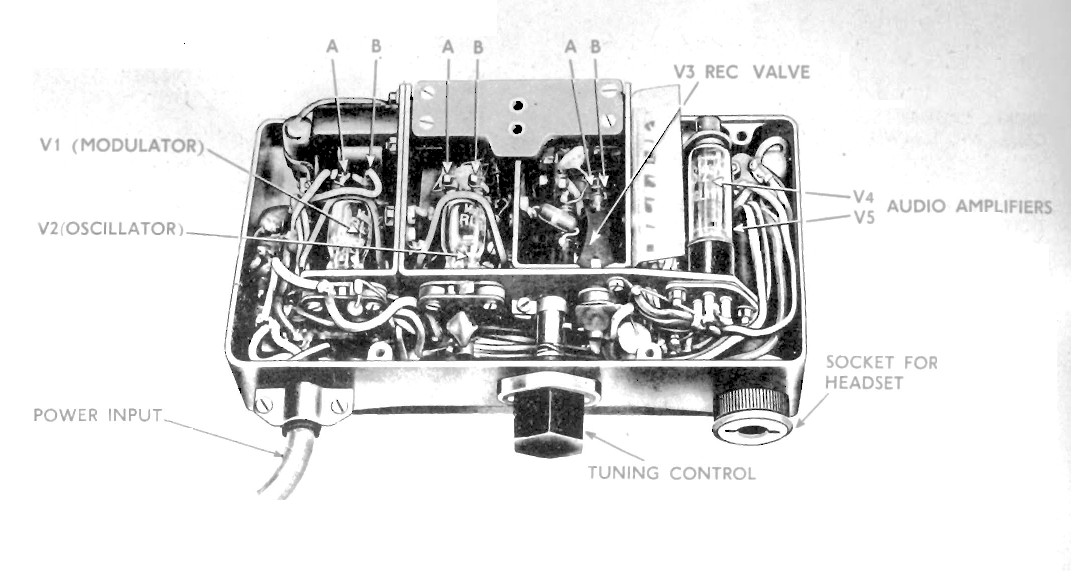
Inside the S-Phone.

The highly directional gear could give the pilot a clue that he was closing on the target, and when the signal suddenly went out, it indicated that the aircraft was directly overhead the transmitter.

The Special Operation Executive had a lot of cool gear, and you can learn more about their gadgets and methods in the 1943 film “School for Danger” that you can see below. Look for the S-Phone at around the 7-minute mark. Interestingly, the two main characters are actual Special Operation Executive agents who actually did the things that are fictionalized in the movie.

Advertisement

The CryptoMuseum has a scan of the S-Phone manual. There are many interesting tidbits there. For example, the set came with a lamp that could show if the transmitter was working. These radios used early NiCad batteries. The manual goes to great lengths to explain that you should not try adding sulpheric acid to the batteries.

Joan-Eleanor

An operator using the Joan transceiver.

Where the British had the Special Operation Executive, the United States had the Office of Strategic Services. Working at RCA laboratories, OSS engineers along with [Al Gross W8PAL] who would become a pioneer in the development of walkie-talkies, pagers, and cordless telephones, designed the Joan-Elanor, named after the engineer’s wife and a WAC member.

Joan was the field tranceiver, technically SSTC-502, while Eleanor, SSTR-6, was mounted in the aircraft. Joan weighed less than four pounds, using a super-regenerative dual triode that doubled as the transmit oscillator. Originally, the radio was set for 250 MHz, but when it was found that the Germans had the ability to receive at that frequency, they pushed Joan-Eleanor to 260 MHz.

The radio had a range of about 20 miles and, unlike the S-Phone, the aircraft could fly overhead at 30,000 feet. It also took ordinary batteries, so you didn’t need a charger as the S-Phone did.

Advertisement

The system recorded transmissions on a wire recorder in the aircraft. The intent was that agents behind enemy lines could secretly transmit intelligence reports to aircraft flying what appeared to be routine reconnaissance flights.

The radio gear was usually jammed in the rear of the host aircraft, usually a DeHavilland Mosquito, along with an operator aft of the bomb bay. The operator entered the position through a side hatch and remained there the entire flight. You can see an OSS film about the system, which was classified until 1976, in the video below.

Tech

These radios had a few things in common. Both used frequencies that were uncommon at the time, making it less likely the enemy could overhear or even detect conversations. This made it less risky to speak “in the clear” so agents didn’t need incriminating code books and cumbersome encoding and decoding steps.

Advertisement

Similarly, both systems used voice, meaning that agents didn’t need to learn Morse code. They probably needed a little training to use the equipment, but that was far easier than expecting a resistance fighter to study Morse code for weeks.

While the S-Phone depended on directionality, Joan seemed content to rely on being high in frequency. Both had to be lightweight, easy to conceal, and quick to set up and take down.

The Joan radio was critical for agents going behind enemy lines. They’d be brought to an airbase in a car with blacked-out windows to prevent them from knowing where they were leaving from. They’d be given forged papers, an entrenching tool, local money in a belt, a pistol, a food package, a silk map, and, of course, a Joan radio.

We wonder if any Joan radios were captured during the war? A lot of wartime high-tech was highly protected, and we’re sure the agents were instructed on how to destroy the radios. Spies were also famous for using suitcase or even shoe radios.

Advertisement

Source link

Continue Reading

Tech

Looking for a better broadband deal? New report shows these are the firms who might be willing to haggle for a better price

Published

on


  • 52% of customers had success negotiating with Vodafone, just 37% with BT
  • Incentives come in the form of discounts, credits and free upgrades
  • Sometimes it’s better to switch than persistently chase discounts

New research has claimed some of Britain’s biggest broadband providers might be more open to negotiation than others when customers try to reduce their monthly bills.

The survey from comparison site Go.Compare found Vodafone emerged as the easiest broadband provider to haggle with – more than half (52%) of customers said they were able to successfully negotiate a better price.

Source link

Continue Reading

Tech

Meta cuts 8K jobs worldwide, S’pore staff wake to 4AM termination e-mails

Published

on

Staff are encouraged to work from home amid the layoffs

Meta is laying off around 8,000 employees globally, as part of a restructuring aimed at improving efficiency and reducing costs as the company invests heavily in artificial intelligence (AI), Bloomberg reported.

The tech giant sent out emails in Singapore at 4AM local time on Wednesday (May 20) to employees who were being laid off. Workers in the United Kingdom, the United States and elsewhere are expected to be notified early morning on the same day in their respective time zones.

In the meantime, staff are being encouraged to work from home while the company proceeds with its layoffs.

This round of cuts targets Meta’s engineering and product teams in particular, and more layoffs could follow later in 2026, people familiar with the plans said, asking not to be named as the information isn’t public.

Advertisement

Just two days prior, Meta announced in an internal memo circulated that some 7,000 workers have been reassigned to newly formed teams that are focused on AI initiatives, including products and agents.

The company had just under 80,000 employees at the end of Mar—before reassignments and layoffs—and has committed well over US$100 billion (S$128 billion) to AI capital expenditures in 2026.

“We’re now at the stage where many orgs can operate with a flatter structure with smaller teams of pods/cohorts that can move faster and with more ownership,” Meta’s head of people Janelle Gale said in the memo, which was reviewed by Bloomberg News. “We believe this will make us more productive and make the work more rewarding.”

Chief executive Mark Zuckerberg has made AI Meta’s top priority, committing all resources to keeping pace with rivals like Alphabet’s Google and OpenAI. That focus is reshaping the workforce and operations.

Advertisement

The company has weathered waves of layoffs in recent years as Zuckerberg pushes for efficiency. He has urged engineers to use AI agents for coding and other tasks, outlined plans to track employee devices to improve the technology, and even built his own AI-powered assistant to handle some CEO duties—like soliciting employee feedback.

The changes have left Meta employees frustrated and anxious. More than a thousand signed a petition to Zuckerberg and other leaders demanding the company stop collecting device data—including keystrokes, mouse movements, and screen content—to train AI. Others have taken to social media to vent about how layoff threats have hit morale and work.

Meta’s aggressive AI spending has rattled investors, who question whether the investment will pay off. While Meta has framed the layoffs as a way to “offset” major AI costs, Evercore analysts estimate the cuts will save only about US$3 billion.

That is a fraction of Meta’s projected 2026 capital expenditures—up to US$145 billion—and the hundreds of billions more it anticipates spending on AI infrastructure before the decade’s end.

Advertisement
  • Read other articles we’ve written on tech giants here.

Feature Image Credit: Shutterstock

Source link

Advertisement
Continue Reading

Tech

Expedia acquires Dublin’s CarTrawler to expand B2B offerings

Published

on

CarTrawler purchased Paris insurtech Koala last year.

Expedia Group is acquiring Irish travel-tech CarTrawler to advance its goals of providing “the most complete” B2B travel platform. Details of the transaction were not disclosed.

Founded and headquartered in Dublin, CarTrawler connects more than 1,000 car rental suppliers and mobility providers with more than 300 travel brands, including more than 70 airlines.

“CarTrawler’s acquisition by Expedia Group is a testament to the strength of our technology, the drive of our people, our track record of innovation and our accelerating commercial momentum,” said Peter O’Donovan, CarTrawler’s CEO.

Advertisement

Alfonso Paredes, the president of B2B and chief commercial officer at Expedia Group said: “The CarTrawler acquisition is another huge, exciting step towards our ambition of building the most complete B2B travel platform.” The transaction is expected to be completed in the second half of 2026.

Expedia acquired Amsterdam-based global platform for activities and experiences Tiqets last December.

“Acquiring Tiqets helped us solve for activities at scale. Adding CarTrawler now extends that same strategy into car rentals, ground transport and Insurtech,” Paredes added. Last August CarTrawler acquired Paris-based B2B insurtech Koala to enter into the insurtech vertical.

Expedia’s latest deal comes after CarTrawler was first acquired by investment firm TowerBrook in 2020 after going through financial struggles resulting from the impact the Covid-19 pandemic had on the global travel industry.

Advertisement

Gordon Holmes, the chief investment officer at TowerBrook said: “We invested in CarTrawler in July 2020, confident that it would emerge from Covid-related industry dislocation as an industry champion.”

“The performance over the last six years, driven by innovation and commercial excellence, has exceeded all expectations.” TowerBrook had made a controlling equity investment of more than €100m into CarTrawler.

A year following the bailout in 2020, CarTrawler created 50 new roles in Dublin as part of a €10m investment package.

Don’t miss out on the knowledge you need to succeed. Sign up for the Daily Brief, Silicon Republic’s digest of need-to-know sci-tech news.

Advertisement

Source link

Continue Reading

Tech

Madison Square Garden Bans Lawyer Representing New York Cop Injured at a Boxing Match

Published

on

His client is a New York cop who was injured during a private security gig at Madison Square Garden. He sued the Garden on behalf of the cop.

Now John Scola, a lawyer well known for representing local police officers, is banned from the high-profile arena and several others owned by the famously controlling James Dolan.

For years, Dolan openly excluded entire law firms from his venues if a single attorney was in any sort of legal dispute with the Garden; those bans would then be enforced by Dolan’s increasingly sophisticated facial recognition system. What wasn’t entirely clear was whether Madison Square Garden was continuing to grow its legal blacklist. A letter to Scola, dated April 30 and reviewed by WIRED, suggested this practice continues. “Any tickets to MSG Venues,” the letter reads, “are hereby revoked.”

The ban also highlights the fissures in the multilayered relationship between New York City’s public servants and its most iconic arena. As WIRED reported last month, MSG security functionally acted as a second, unsanctioned surveillance force in midtown Manhattan—without the New York Police Department’s formal permission. (NYC mayor Zohran Mamdani called this expansion beyond the Garden’s walls “deeply troubling,” and promised further investigation.)

Advertisement

Dolan says that the biometric surveillance system is in place to stop dangerous actors from entering his properties—”if you’re a terrorist, [the list] will say that’s a terrorist,” he once told the local Fox affiliate—but the NYPD hasn’t shared facial recognition or any other kind of data with the Garden. The Garden did, however, add a New York police officer’s photo to the many, many others in its facial recognition database, as WIRED reported. “New Yorkers should be able to go to a game or a concert without their rights being violated,” New York attorney general Letitia James told the Pablo Torre Finds Out podcast in a statement. “My office is closely reviewing the latest reporting on Madison Square Garden surveillance tactics.”

On the other hand, the Garden does hire NYPD officers, through the city’s paid detail program, to augment its own security forces. That’s what happened in February of 2025, when a lightweight boxing match was being held at MSG’s then-named Hulu Theater. The audience was likely to be large and “requir[e] active crowd control,” according to the lawsuit, so the Garden brass figured they’d need eight off-duty cops to help. “Despite that determination,” the suit claims, “only two officers were actually present.” One of them was seven-year NYPD veteran John Przybyszewski.

At some point, an incident erupted near ringside.The rapper Lil Tjay seemed to spit in the face of a Garden security staffer who appeared to be trying to keep him from getting closer to the ring. Videos from the night show a chaotic scene. Lil Tjay’s bodyguards and entourage joined in the scuffle. According to the lawsuit, Przybyszewski claims he was knocked to the ground, pinned beneath several people.

Przybyszewski claims that when he got up, he was “in severe pain,” and was sent to the hospital in an ambulance. According to the lawsuit, “diagnostic imaging revealed significant cervical and lumbar spine injuries,” some of them “permanent.”

Advertisement

Przybyszewski blamed both the rapper and Garden officials. He sued Lil Tjay and Madison Square Garden. For a lawyer, he tapped Scola, who frequently represents NYPD officers in disputes with their bosses and the city. Scola filed his suit in February of this year. “Defendants made conscious operational decisions that placed Plaintiff directly in harm’s way. Those decisions caused his injuries,” the lawsuit claims.

Source link

Advertisement
Continue Reading

Trending

Copyright © 2025