Shares rallied Thursday across Asia, tracking gains on Wall Street after pressure from the bond market eased and oil prices fell back.
The advance was also powered by a stronger-than-expected quarterly report from chipmaker Nvidia, whose profit rocketed more than 200% higher in the February-April quarter from a year earlier, while revenue jumped 85%.
Nvidia has been one of the biggest beneficiaries from the boom in artificial intelligence, thanks to powerful demand for its high-end AI chips. Its shares rose 1.3% on Wednesday before its earnings report was released, but they fell 1.3% in afterhours trading after the announcement.
South Korea’s Kospi soared 8% to 7,787.74, helped by strong buying of technology shares such as Samsung Electronics, which gained 7.5% after its labor union and management reached an agreement late Wednesday that averted a strike. Shares in SK Hynix, a computer chipmaker partnering with Nvidia, surged 11.3%.
Advertisement
The Kospi has been breaching records, recently exceeding 8,000 for the first time.
Taiwan’s Taiex, also heavily weighted toward technology shares, gained 3.9% as major chipmaker TSMC’s stock gained 3%.
In Tokyo, the Nikkei 225 index jumped 3.6% to 61,930.44. The government reported that Japan’s exports rose nearly 15% in April from a year earlier, despite shocks from the Iran war.
Chinese markets were virtually unchanged, with Hong Kong’s Hang Seng flat at 25,648.28, while the Shanghai Composite index also was nearly flat at 4,162.37.
Advertisement
Australia’s S&P/ASX 200 picked up 1.6% to 8,628.80.
Oil prices were higher early Thursday, a day after Brent crude dropped 5%. Brent, the international standard, gained 95 cents to $105.87 per barrel, while U.S. benchmark crude added 92 cents to $99.18 per barrel.
Brent remains well above its roughly $70 level from before the war with Iran. Prices have been yo-yoing on rising and falling hopes that the United States and Iran can reach an agreement to allow oil deliveries to fully resume from the Persian Gulf to customers worldwide.
On Wednesday, U.S. stocks bounced back, with the S&P 500 gaining 1.1% for its first rise in four days. The Dow Jones Industrial Average added 1.3% and the Nasdaq composite rallied 1.5%.
Advertisement
Stocks got a lift from easing yields in the bond market, as the yield on the 10-year Treasury fell to 4.57% from 4.67% late Tuesday. That’s a significant move for a market that measures things in hundredths of a percentage point.
The 10-year Treasury yield had been rising from less than 4% before the war with Iran began, along with other government bond yields around the world, because of worries that the fighting will keep oil prices high, among other factors. Inflation concerns reduce the chances the Federal Reserve will cut rates this year and raise risks that that world central banks may have to raise rates in 2026.
With the easing of yields, technology stocks helped lead Wall Street higher.
Advertisement
Tech stocks leading the market included Advanced Micro Devices, up 8.1%, and Intel, up 7.4%.
Smaller companies can feel even bigger relief from lower yields than their bigger rivals because many need to borrow to grow. The Russell 2000 index of the smallest U.S. stocks jumped 2.6%, more than double the gain of the S&P 500, which measures the biggest U.S. stocks.
Red Robin Gourmet Burgers jumped 18.2%, and Cava Group rose 3.1% following better-than-expected profit reports that raised hopes households can keep spending and supporting the economy despite high gasoline prices and pessimism over the economic outlook.
Most big U.S. companies have reported better profits for the start of 2026 than analysts expected, which has helped stocks run to records. Stock prices tend to follow the path of corporate profits over the long term.
Advertisement
On the losing side of Wall Street was Target, which fell 3.9% even though the retailer reported better profit and revenue for the latest quarter than analysts expected. A new CEO, Michael Fiddelke, is trying to turn around the company and boost its revenue.
In other dealings early Thursday, the U.S. dollar rose to 158.98 Japanese yen from 158.92 yen. The euro was steady at $1.1624.
That amounts to an average of four dogs taken every day, according to police figures analysed by Direct Line, which revealed around 25,000 reported dog thefts over the past 11 years.
French bulldogs, Staffordshire bull terriers, and dachshunds remain among the most frequently targeted breeds.
Adam Burgin, head of trading and customer at Direct Line, said: “Any reduction in dog theft is welcome, but it’s important not to confuse lower numbers with lower risk.
“More than four dogs a day were still stolen in 2025 and, with over 25,000 dogs taken in the last 11 years, it’s clear this issue hasn’t gone away.
Advertisement
“Certain breeds, particularly French bulldogs and staffies, continue to be targeted, and we see the emotional and financial impact this can have on owners.
“Dog theft often results in lengthy recovery periods and, in many cases, permanent loss, especially when animals are stolen opportunistically or sold on quickly.
“While it’s encouraging to see more dogs reunited with their families, the reality is that most stolen dogs still don’t come home.
“Thieves can strike at any time, so taking preventative steps – such as keeping pets identifiable, ensuring microchips are up to date, and remaining vigilant – can make a real difference.”
Advertisement
Direct Line suggests that increased public awareness and the introduction of the Pet Abduction Act in May 2024, which made pet theft a specific criminal offence in England and Northern Ireland, may have contributed to an 11 per cent drop in thefts compared to the previous year.
Despite this decline, the insurer emphasised that the risk persists, particularly for certain breeds.
‘Mouse’ went missing in Buckinghamshire during a walk at a local golf club (Image: PA)
Staffordshire bull terriers, German shepherds, and dachshunds all saw rises in thefts, while cocker spaniels recorded the fastest year-on-year increase despite ranking eighth overall.
An estimated 344 stolen dogs, around 21 per cent, were reunited with their owners.
Advertisement
The issue remains deeply personal for those affected.
Anne Maynard’s adult female Jack Russell, Mouse, went missing from Chalfont St Peter, Buckinghamshire, in December 2023.
She said: “Every day has been a struggle.
“I still cry every day, we’ve searched so much I no longer know where to look.
Advertisement
“I’ve tried everything within my means to find her but there’s been nothing. We check every Jack Russell we see.
“We’re sent pictures which could be Mouse, they look so similar and we have to really scrutinise the photo but no sign of her yet. We will not give up.
“We have so much hope that we’ll find out what happened that dreadful day.
“Thieves have no idea what happens when they do what they do.
Advertisement
“It’s devastating, heartbreaking and life-changing.
“We just want our girl back home where she belongs.
“Someone has an opportunity to turn our lives back round again. Please give her up.”
Anne Maynard is offering a £6,000 “no questions asked” reward for the safe return of Mouse (Image: PA)
Fears of pet theft remain widespread among dog owners.
Advertisement
Half of owners surveyed by Direct Line said they worry about their dog being stolen, with 33 per cent saying they only ever walk their dog on a lead and 26 per cent supervising their dog while in the garden.
Other security measures include motion-activated cameras (18 per cent) and tracking devices (17 per cent).
Annalisa de Carteret, pet loss support manager at Blue Cross, said: “The uncertainty of not knowing where your pet is, or if they are safe, can be just as painful as bereavement, but without the closure that comes with it.
“This can make the trauma even harder to process, especially for children who may be left distressed and confused by the sudden loss of a cherished member of the family.
Advertisement
“Reaching out to someone who understands the emotional impact of losing a pet can make a real difference.
“At Blue Cross, we provide a vital lifeline for devastated owners whose much-loved companions have been stolen, offering practical support and a listening ear during an incredibly difficult time.”
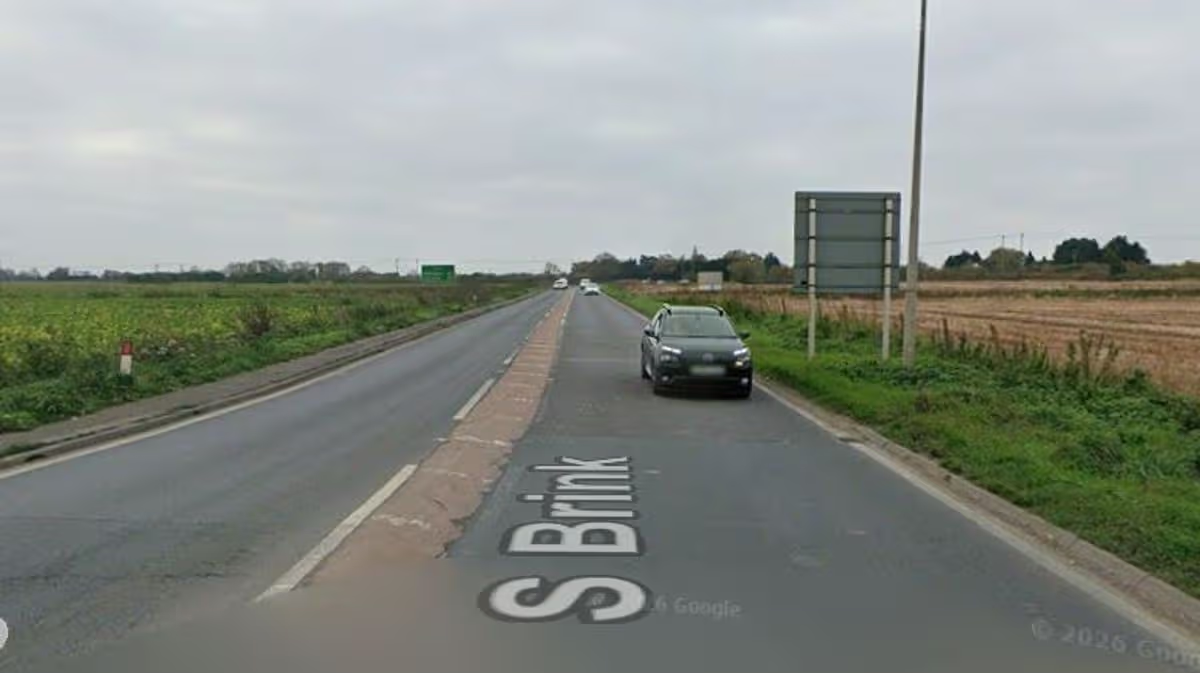
Cambridgeshire Police is at the scene of the crash. Officers have asked drivers to find alternate routes.
In a social media post, a police spokesperson said: “ROAD CLOSURE. A47 South Brink is closed in both directions following a RTC. The closure is between the roundabout at Guyhirn and the roundabout for Cromwell Road, Wisbech. Please try and find alternate routes.”
It is believed to be aimed at getting more people back to work.
The scheme, part of a wider effort to reduce the number of people claiming sickness-related benefits, will refer patients to social prescribers based in GP surgeries instead of issuing a fit note.
According to The Times, social prescribers will be able to recommend alternative routes back to employment, including exercise programmes and career coaching.
Advertisement
More than 11 million fit notes were issued last year, with almost all recipients declared “not fit for work,” effectively excluding them from further employment support.
Mental health conditions such as anxiety and depression, along with musculoskeletal problems like back pain, remain the leading causes of long-term absence from work.
GPs, nurses, and pharmacists can currently sign fit notes.
The pilot forms part of four new trials being launched across England in July by the Government, each taking a different approach to reducing the number of people signed off work for long periods.
Advertisement
In two of the trials, patients will bypass GPs entirely and be assessed by social prescribers, who will be able to issue fit notes and connect them with targeted support.
The other two trials will involve an initial GP consultation before referral to additional services.
These efforts come amid rising concern about what has been described as a “sick-note culture,” which some believe is holding back economic growth and inflating the cost of sickness-related welfare.
Advertisement
The programme will operate alongside the Government’s WorkWell scheme, introduced nationally in October 2024, which provides tailored support such as physiotherapy and counselling.
Under the scheme, individuals with depression might receive career advice or help finding flexible work, while someone recovering from an injury could be referred to physiotherapy or given a gym pass instead of being signed off work entirely.
In February 2025, 24 million people in the UK were claiming some form of benefit, including the state pension.
This is ridiculous. If a GP thinks a patient is too ill to work that should result in a sick note. Referring them to a ‘social prescriber’ could not only make the patient iller but it takes all the GPs authority away. We are set to have the biggest health crisis ever. https://t.co/j2yFRd4mW0
Of those, 10 million were of working age, and 800,000 were under the age of 16.
Universal Credit claimants recently reached a record high of 8.3 million.
The new approach represents the first major overhaul of the sick note system since sick notes were first introduced in 2010.
A separate scheme launching in November will give patients access to financial advisers or fitness coaches instead of being signed off work without further support.
Advertisement
Officials hope that by providing more holistic support, people struggling with health issues can be assisted back into the workforce rather than being left on long-term sickness benefits.
Do you think this is a good or bad thing? Let us know in the comments
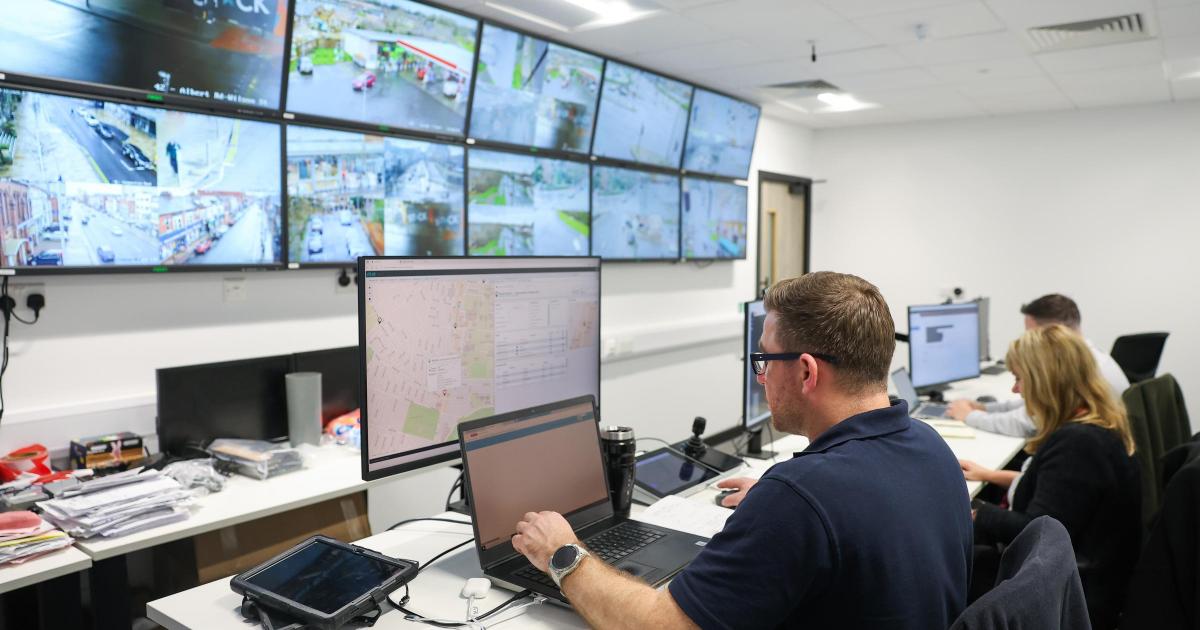
The scheme, part of the Tees Valley Fusion project, uses real-time digital technology to optimise traffic signals and improve network flow based on live road conditions.
New data reveals the system has saved 5,000 travel hours over 12 months at just six monitored sites, the equivalent of more than 200 days—or six-and-a-half months—of time saved for drivers.
Ben Houchen, Tees Valley Mayor, said: “By using new technology to tackle congestion head-on, we’re cutting journey times, easing frustration for drivers, and helping people get where they need to be quicker.
Advertisement
“These are real, measurable results—the equivalent of more than six months of waiting time wiped away.
“It shows how we’re using innovation to build a transport network that works better for motorists across Teesside, Darlington, and Hartlepool.”
The region-wide FUSION scheme, supported by the Tees Valley Combined Authority, operates across 57 coordinated sites and 196 traffic signals.
It uses Yunex Traffic FUSION Technology to automatically adjust signal timings in response to real-time road conditions.
Advertisement
Travel time reductions at specific locations include 2,780 hours saved at the A174 Parkway Junction, 715 hours near Norton Road in Stockton, and 575 hours close to Hart Lane in Hartlepool.
Other improvements were recorded near Ayresome Street in Middlesbrough (255 hours), York Road in Hartlepool (365 hours), and the South Stockton Bypass A135/A66 junction (300 hours).
The Tees Valley Combined Authority has invested more than £2 million in the FUSION project and its related Digital Twin scheme, both designed to modernise and improve the efficiency of local transport infrastructure.
Delivery has involved close collaboration with the Urban Traffic Management and Control Centre and local authority partners.
Advertisement
Councillor Steve Harker, TVCA cabinet member for transport and infrastructure and leader of Darlington Borough Council, said: “These results show how we are already harnessing technology to improve our road network.
“By working closely with our local authority partners, we’re making better use of the infrastructure we already have—and adding to it to help us keep traffic moving more efficiently to deliver benefits to everyone on our roads across the Tees Valley.”
TV legend Emma Willis will be joined by comedian Josh Widdicombe and Strictly pro Johannes Radebe, it’s been confirmed.
Advertisement
The unlikely trio have been announced after the likes of Rylan Clark, Zoe Ball and Angela Scanlon were thought to be in the running.
As excitement for the new series grows, with rumours swirling over which celebrities will be taking part, fans have shared their thoughts on the new hosts, with several suggesting it’s an “utterly bizarre” choice and that the BBC are taking a “gamble”.
However, head judge Shirley has now jumped in to defend Emma, Josh and Johannes.
Advertisement
“I think it was a surprise to everybody that it was three and not two, so now it’s where they fit and what those little changes are,” she told Metro.
“Of course, everybody loves JoJo. He’s just a well-loved figure. He’s been in Kinky Boots; he’s a professional dancer, but more than that, it’s half his character. He wears his heart on his sleeve, so it’s an absolute delight that we got him,” Shirley went on.
She admitted that she wasn’t “overly familiar” with Josh, but considers him funny and a “charming chap”, while Emma is a “doll”.
Advertisement
She declared: “I think the BBC has really got this right.”
After being confirmed as one of the new hosts, Emma said she was a “huge fan” of the show, adding: “To be stepping into the Strictly ballroom is something I can’t quite comprehend.”
Josh meanwhile said he was “giddy with excitement, honoured and a little overawed to be given the chance to step into the biggest shoes in television”, while Johannes said taking part in the show in a new presenting role “is beyond anything I ever imagined”.
Remarking on the trio, Strictly’s executive producer Sarah James said the new combination was “unexpected, but their magic was undeniable the moment they came together”.
Tess and Claudia announced they were quitting Strictly last year, saying their time on the show had been “an absolute dream” but it “feels like the right time” to leave.
They wrote: “We have loved working as a duo and hosting Strictly has been an absolute dream. We were always going to leave together and now feels like the right time.
“We will have the greatest rest of this amazing series and we just want to say an enormous thank you to the BBC and to every single person who works on the show. They’re the most brilliant team and we’ll miss them every day.
“We will cry when we say the last “keep dancing” but we will continue to say it to each other. Just possibly in tracksuit bottoms at home while holding some pizza.”
Tess – who recently gained a Guinness World Record for the longest-serving host of the same dance competition TV show – began presenting Strictly from its inception in 2004, first with Sir Bruce Forsyth, and then with Claudia when she joined as a co-host in 2014.
Strictly Come Dancing returns to BBC One and iPlayer later this year.
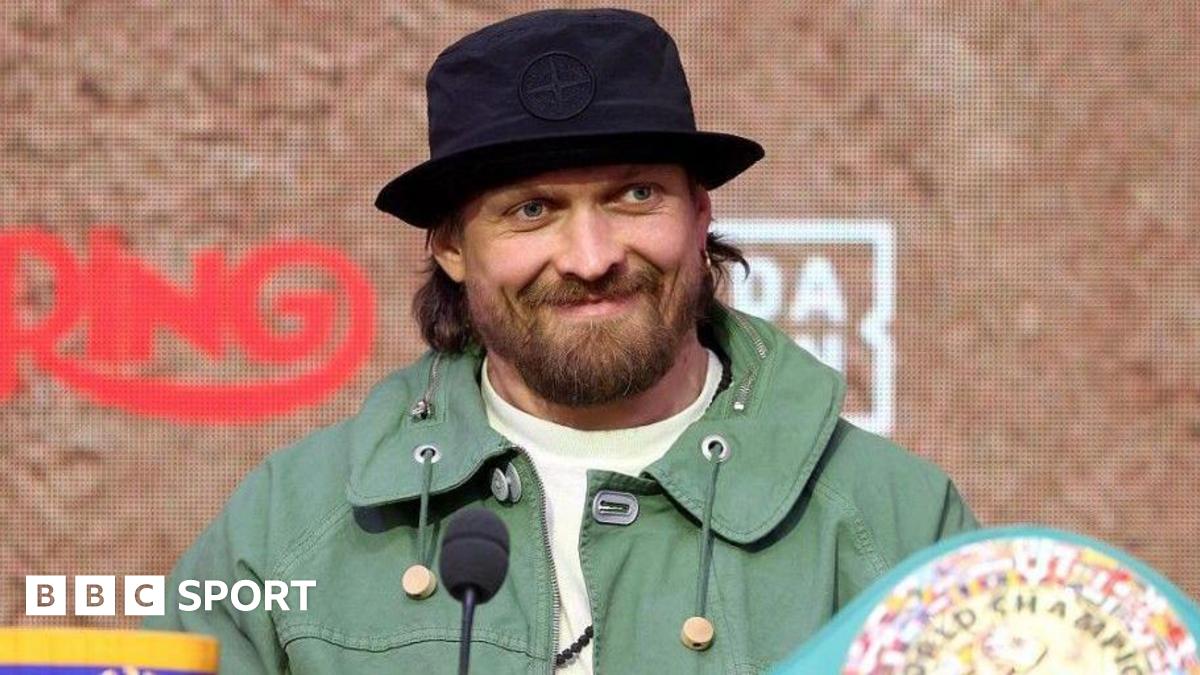
Dutchman Verhoeven, 37, boasts an impressive kickboxing resume, reigning as Glory’s heavyweight champion for 11 years and making 13 successful defences, but has boxed just once professionally – in 2014.
But Usyk’s CV in boxing is just as eye-catching – if not more so.
After winning gold at the 2012 Olympics, the Ukrainian has established himself as one of the pound-for-pound greats by achieving undisputed status at cruiserweight and, twice, at heavyweight.
Usyk, 39, has brushed aside Anthony Joshua, Tyson Fury and Daniel Dubois – beating each of the Britons on two occasions – and, despite Verhoeven’s lack of boxing experience, is approaching this bout with the same mentality.
Advertisement
“The opponent might be different but my preparations are not different,” Usyk said.
“I work hard, I do a lot of work in sparring, conditioning and cardio.
“I train like I’m fighting Tyson Fury or Daniel Dubois, because for me it’s a serious fight. It’s not fake. For me it’s not a show, it’s a fight.”
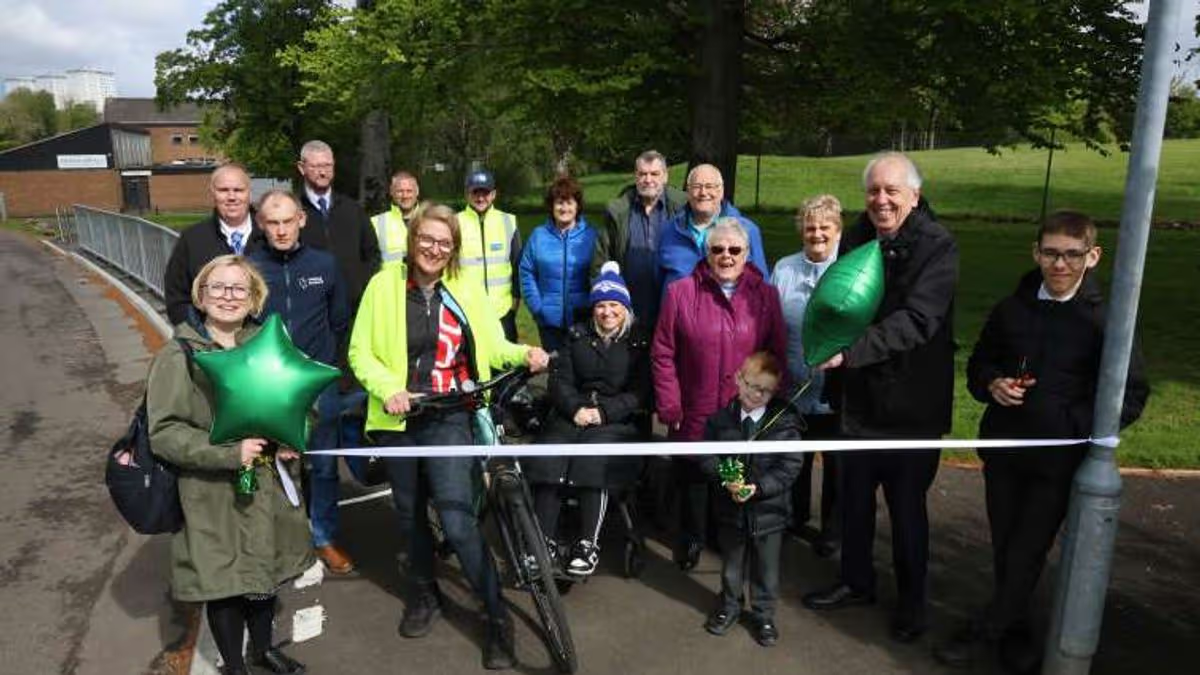
The new walkway connects St Leonards Primary School with Brancumhall recreation facilities, it will provide a safer and more accessible route for residents of all ages.
A new community path linking a primary school with popular sports and leisure facilities in East Kilbride has officially opened.
The new walkway connects St Leonards Primary School with Brancumhall recreation facilities, it will provide a safer and more accessible route for residents of all ages.
Advertisement
Pupils from the school joined local community groups and organisations for the opening ceremony, including members of St Leonards Bowling Club, local football clubs, South Lanarkshire Leisure and Culture and councillor Kirsten Robb, deputy chair of the council’s Climate and Sustainability Committee.
Councillor Robb (East Kilbride East), said: “Everyone had raised concerns about the state of the existing route so we were all delighted when the work was carried out which clearly aligns with the aims of the council’s safe routes to school programmes.
“I was also delighted that the work has been completed in time for the children and local residents to be able to take part in National Walking Month (May) and next month’s Bike Week 2026 events.”
The walkway was formally unveiled by councillor Robert Brown (Rutherglen South) , the chair of the council’s Community and Enterprise Resources Committee.
Advertisement
He said: “This new path will be a huge asset to everyone in the community, not only ensuring a safe walking route for children attending the local primary school, but also all members of the community taking advantage of all the fantastic sports and leisure facilities.”
The project received financial and practical support from the council, SPT and Walking Scotland through its Path Funding programme.
Head teacher Lorraine Leonard welcomed the completion of the route and praised those involved in bringing the project to fruition.
Advertisement
She said: “A big thank you to everyone in the community and the council teams who have made this possible.
“It will provide our pupils and their parents with a much more user-friendly route to and from school.”
Community leaders are now encouraging residents to build on the success of the project by contributing ideas for further improvements through the Brancamhall Park survey.
*Don’t miss the latest headlines from around Lanarkshire. Sign up to our newsletters here.
Advertisement
And did you know Lanarkshire Live had its own app? Download yours for free here.
Who owns a swarm of bees? And what happens when they stray onto a neighbour’s land?
In early medieval Ireland, such questions were addressed by a remarkable set of laws known as the Bechbretha, which set out the rights and responsibilities associated with beekeeping. Also known as bee-judgments, these laws formed part of the wider medieval Irish legal system, Brehon law (known in Old Irish as fénechas or customary law).
Brehon law espoused restorative rather than criminal justice and was chiefly concerned with the type of compensation to be paid for crimes committed. Most of these laws were written down in the 7th and 8th centuries, but they probably preserve much older traditions that had previously been passed down orally.
Early medieval Irish society was hierarchical. In legal cases, the amount of compensation owed or received depended entirely on a person’s social rank, with payments varying according to their status.
Advertisement
The Bechbretha provided a legal guide for lawyers dealing with cases involving bee trespass (where a neighbour’s bees came onto another’s land and supposedly stole nectar from flowers and plants), injuries or death caused by bees, beehive theft and the compensation owed in each situation.
Legal cases could be brought against beekeepers whose bees stung passersby. National Museum of Antiquities, CC BY-SA
In medieval Ireland, bees were given legal status because they were classified as domestic livestock. Like cattle, horses, pigs, poultry and sheep, they were legally protected because of their considerable value. Beekeeping produced a wide range of goods, including honey for food and sweetening, as well as mead and beer, beeswax for candles, sealants and writing tablets, and other products used in medicine, polishing, lubrication, skincare and waterproofing.
The Bechbretha also had another purpose – maintaining good relations within local communities. According to the Bechbretha and another legal text, the 8th-century Bretha Comhaithchesa, Judgements on Neighbourhood, a mutual agreement among the farming community ensured compensation would be paid if and when animal trespass, theft or injury occurred. A certain level of trust between neighbours was required for this process to work.
That said, it is one thing to show where a neighbour’s large domestic animal has trespassed or caused damage. It is something else to prove that neighbouring bees had rampaged through your flowers, stealing nectar before buzzing away with their ill-gotten gains.
Advertisement
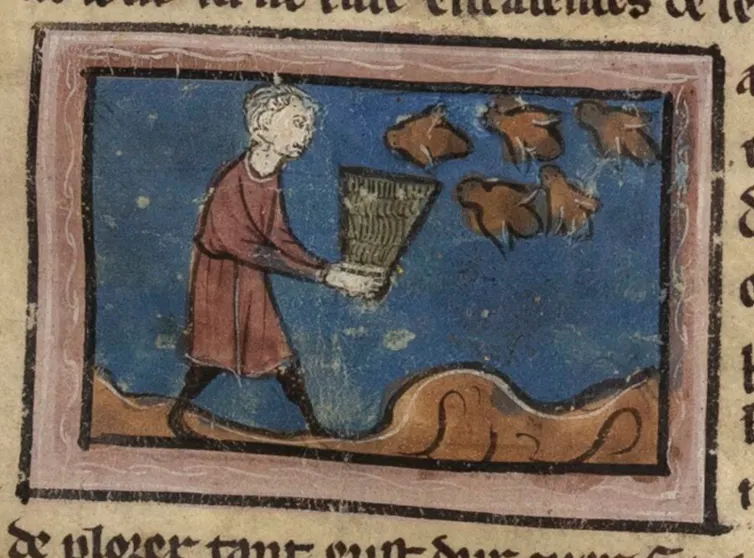
One suggestion the Bechbretha makes is to dust flour over bees, follow them to source and identify the culprits. Because honeybees tend to return repeatedly to the same nectar sources, tracking and marking them with white flour – which scatters onto the ground as they fly, leaving a visible flight path – can be effective. The laws also state that the owner of stray bees has three years to collect their honey, but by the fourth year must surrender the first swarm from that hive to the wronged party.
The Bechbretha also dealt with questions about ownership of swarms which settled and built new hives on either private or common land. The beekeeper who found the new hive was entitled to a third of the honey for three years but after that time elapsed, the landowner on which the swarm settled became its owner. Where a swarm was discovered in woodland, the finder was entitled to (almost) everything. The local church and patriarch of the finder’s kin-group were both entitled to a share.
Where hives were stolen or illegally moved and where perpetrators got stung or died from being stung, beekeepers were not held responsible. Where bees stung people without provocation, compensation was due, though if the victim killed the bee(s), their death was deemed recompense enough. Generally, for valid situations where someone was stung, killed or maimed, hives were given over in payment.
Theft of beehives carried hefty penalties, dependent on their location. The closer a hive was to a homestead, particularly a high-status one, the larger the compensation. This was usually in the form of cattle, the main currency used in pre-coinage Ireland. Theft of hives from monasteries also carried imposing fines.
That there were a set of early medieval Irish laws solely for bees reveals the high regard with which these little creatures were held. Restitution through beehives and bee produce helped the proliferation of beekeeping throughout the community. In pre-industrial, early medieval Ireland, where society’s survival depended so much upon the climate, bees were a pivotal part of the agricultural system, as they are today.
At the close of the tenth century, writers of Irish historical records documented two instances of bech-dibad – bee mortality – which resulted in mass famine and death among the human population. The fact that these disasters were recorded is significant in that it suggests an awareness about what happens if the bees disappear.
Advertisement
Today, bee colonies around the world face multiple threats – from habitat loss, climate change, toxic chemicals and deadly invasive parasites. The Bechbretha shows that if the will is there and communities are involved and feel invested, protecting our bees is possible.
The 37-year-old said she saw thousands of souls in heaven and knows she will go back there one day – but first she needs to serve her purpose on earth.
She went on to suffer years of addiction and poverty before an overdose led her to experience her parent’s excruciating joint suicide from their perspective and when she came back, her whole life changed.
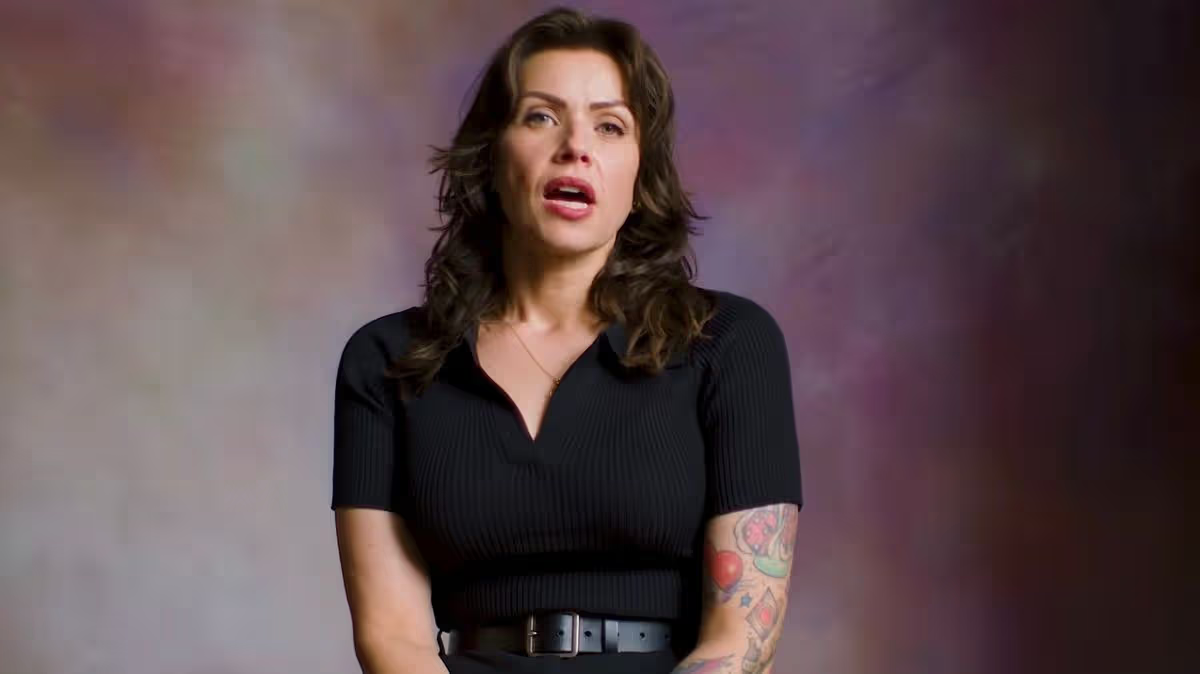
Now 37, Betty told Mayim Bialik’s Breakdown podcast: “I grew up in a really traumatising environment. It was really chaotic – it was full of physical abuse, emotional abuse, poverty, addiction.”
“And so my whole life I was just taught that if anything bad happens to you, don’t talk about it, just medicate it and sedate it.”
Advertisement
Betty said she watched everyone else in her Las Vegas family do that. Both of her parents were addicted to drugs and lived in poverty.
At the height of the OxyContin crisis in America, her parents would “doctor shop”, meaning they saw several medical professionals without the other’s knowledge. The couple would be prescribed 1,000 pills a month, they would take half and sell the rest.
Betty said: “Drugs came into my life around 12 years old – maybe by the time I was 15 I knew I was in love with substances.
“My first drug experience was methamphetamine. I was a really good student, I was a good kid, I was trying to escape the cycle of my family.
Advertisement
“I was in all of these advanced placement classes and one of these girls in my classes came over to me and she was like ‘Do you want to stay up all night and study’. This is when she tried methamphetamines for the first time.
She said she was “in love” with substances by the time she was 18, and that drugs has “swept me away.” Her first period in rehab was at 18.
When she was at rock bottom she resorted to sex work. Betty said she was stealing, lying, cheating – and that she was a staunch atheist.
Advertisement
Betty said she “saw men in this very distorted way – I was sort of an anti-feminist and had a lot of empathy for men.
“For me sex work was not an empowering thing – it was rock bottom.”
At one point was using five bags of heroin a day – and she would detox just so that she could feel the high again. She would “manipulate women and get them strung out on drugs.”
Then, at 24, she had managed to get herself clean for a week, she had just got married – and then she found her parents dead.
Advertisement
She had been with her sister when they couldn’t get hold of her mother and father. They pulled up to their house to hear the smoke alarms sounding. Horrifically, both of her parents had overdosed, and two candles had set the house on fire as they died.
Betty’s sister screamed at full volume – but Betty could not comprehend what had happened.
She said: “After my parents died there were two voices – one said ‘you have to stop using, drugs have just killed your parents. The other said: ‘you have to keep using – this is all you have left of your parents – this is their legacy.’ “
She said her mother had tried to end her own life several times but she “never in a million years conceptualised that my father could do that – never mind that they could do it together.”
Advertisement
Betty could not deal with looking after her sister and she “abandoned” her. She said: “I had dozens of jobs, marriages, divorces.” Her manifesto was “just use, destroy, over and over again.”
One day, Betty decided to take more drugs than usual once she had once again, completely changed her life and moved to New York. By this time she had been married three times.
She was in the laundromat, and started to feel a more unusual high than she usually would. She began to run home – but saw herself trapped at every corner of the street – she said she felt like she was “stuck in the Matrix.”
Then her near-death experience started. She said: “My body collapsed and I could see myself outside of myself – the first part of my experience was a life review.”
Advertisement
The experience had no chronological order because it felt like a “download.” She said her “soul came online for the first time.”
Then, horrifically, she started to see her parents’ joint suicide from their perspective.
She said: “It felt like the most agonising betrayal of life. It felt like every cell in my body was being shredded apart.”
“I saw things from their suicide that I didn’t know happened. I watched them write their suicide notes. I watched them embrace each other as their bodies started dying.”
Advertisement
She thought as she saw her parents dead, she must also be dead.
Started to hear dad’s voice chanting to her, “You are worthy of all the love in the universe.”
Betty said: “I didn’t believe that, but I followed that voice, and that’s how I ended up in the light of my near-death experience.’
She said she was on board a spaceship with thousands of other souls. She said she discovered she was “part of a tribe.” Betty said: “I have a soul family that I came here with.”
Advertisement
“Because I was a meth-head prostitute, they couldn’t show me philosophy – so they showed me things I could understand, like clips of films. So they showed me The Matrix, Inception and Dreams May Come.”
They told her these were the blueprints for the “video game we are all living inside.”
Betty said: “It felt like three seconds of time – not even a millisecond of time – but it was actually around 8 hours. But it felt like everything happened ‘instantly’.”
She said she saw the faces of the women she manipulated and “prostituted”, saying, “I was really not a good person – and here I am facing the consequences, seeing these women’s faces and their pain.”
Advertisement
Betty added: “Every soul is here to accomplish some sort of forgiveness – now I’m seeing that I chose all of it and I’m breaking free of the chains of victimisation. I’m a divine co-creator of my own reality.”
She said she didn’t want to go back – but her soul family said she said the same thing every time she came to heaven
Betty claims she was shown another baby she could be born into – it was in the hospital right next to her house and she would be born to teenage parents. She told them she didn’t want to have to start from zero.
She thought she was un-fixable – but her “soul family” told her the second half of her life would be carrying out her purpose.
Advertisement
Betty said: “I had never heard of a near-death experience before this happened to me. I didn’t believe it for months after it happened to me either.”
On initially waking up, she thought she had got so high she had hallucinated speaking to God.
She eventually stayed in rehab for 18 months and finally got clean. She said: “Withdrawal is hell, there’s nothing physically wrong with you but it feels like you’re being stabbed over and over again in your eyeball.
“It’s only a week, but people run away from that week of pain for decades. Methamphetamine totally destroyed my brain.”
Advertisement
Betty has now turned her life upside down and works with people to help them sober. She is involved in outreach and is now clean and works as a “transformation coach”.



















































You must be logged in to post a comment Login