

Crypto World
US Lawmakers Introduce Bill to Require IRS Crypto Tax Review


A bipartisan group of U.S. lawmakers has introduced the Digital Asset Protection, Accountability, Regulation, Innovation, Taxation and Yields Act, known as the PARITY Act. The measure would direct the Treasury Department to study how a de minimis exemption for digital assets might be structured and applied, signaling a cautious approach to tax policy amid a rapidly evolving crypto landscape.
The PARITY Act was introduced in the House after lawmakers published a discussion draft in March. Republican Representative Max Miller, who helped shepherd the bill, framed the move as a recognition that the tax code has struggled to keep pace with innovations in digital assets and financial technology. Democratic Representatives Steven Horsford and Suzan DelBene, along with Republican Representative Mike Carey, are among the bill’s sponsors.
The timing comes as Congress READIES further consideration of crypto regulation, with the Senate preparing to debate a broader framework for how U.S. market regulators would oversee the sector. While industry participants have long pressed for tax relief for small crypto transactions, the latest PARITY Act does not itself create an exemption. Instead, it directs the Treasury to study a potential de minimis tax relief and to provide interim guidance within 180 days on what relief might be achievable under existing authorities.
The bill also requests an examination of the compliance burden associated with reporting small crypto transactions and of how many such transactions—specifically those worth less than $200—are reported to the Internal Revenue Service. In its evaluative mandate, the Treasury would consider what the IRS would require if a de minimis exemption were enacted and what forms of abuse could arise under such an exemption.
The proposal maintains several notable provisions from the discussion draft. It preserves a framework that would treat “digital dollars like actual cash for tax purposes” under certain conditions, with regulated payment stablecoins unlikely to incur gains or losses unless the cost basis falls below 99% of the token’s redemption value. It also retains a safe harbor for trading through brokers and contemplates extending wash sale rules to crypto assets.
In commenting on the bill, Miller indicated confidence that it could pass within the current congressional term, which runs through January, ahead of the next round of elections. The measure’s House partners stressed that the study and interim guidance would help policymakers understand the potential, risks, and feasibility of a de minimis regime before any final legislative action.
As context for regulatory policy debates, observers note that the tax treatment of crypto assets remains only loosely aligned with traditional securities and commodities frameworks, raising questions about enforcement, licensing, and reporting obligations for exchanges, wallets, and other crypto firms. The Treasury’s involvement is particularly salient given its oversight of the IRS and the department’s role in interpreting tax rules for digital assets. The framing of any de minimis exemption will likely intersect with ongoing efforts to harmonize tax policy with innovative payments and trading technologies, including stablecoins that function within regulated payment rails.
regulatory filings and public commentary show a broader industry interest in tax simplification for small crypto transactions. For instance, Kraken reported to the IRS that it issued 56 million tax forms in a recent period, with nearly a third of those forms covering transactions valued at less than $1, while more than 75% related to transactions under $50. This reporting burden underscores the practical relevance of any de minimis threshold for tax administration and compliance workflows.
Australia’s tax policy discussions have also entered the crypto tax conversation, with related coverage highlighting changes to capital gains treatment that could influence long-term holding decisions. Such cross-jurisdictional comparisons emphasize the importance of coherent tax rules that can be operational for exchanges, custodians, and financial institutions engaging with digital assets. As noted by Cointelegraph, these global developments frame the policy debate in the United States while underscoring the need for careful design to prevent loopholes, misreporting, and strategic abuse.
Key takeaways
- The PARITY Act would require the Treasury to study a potential de minimis tax exemption for digital assets and to issue interim guidance within 180 days for how it could be implemented under existing authorities.
- Importantly, the bill does not create an exemption by itself but seeks to quantify feasibility, regulatory impact, and potential risks, including compliance burdens for small-value transactions.
- The proposal preserves a framework that would treat certain digital dollars like cash for tax purposes, with specific rules around cost basis and redemption value for regulated stablecoins.
- A safe harbor for broker-led trading and the potential extension of wash sale rules to crypto are retained in the draft, signaling a continued emphasis on traditional tax governance mechanics.
- Industry data cited by Kraken illustrates the scale of reporting burdens on the IRS from small-value crypto events, reinforcing the policy relevance of any de minimis design.
Legislative intent and policy scope
The PARITY Act reflects a pragmatic approach to crypto taxation: acknowledge the science and scale of digital asset markets while probing how small-value activity should be treated for tax purposes. By directing the Treasury to study a de minimis exemption and to issue interim guidance quickly, lawmakers aim to build a clearer regulatory path that could reduce administrative friction for taxpayers and tax authorities alike. This approach aligns with broader policy objectives to modernize tax rules in light of rapid digital asset adoption and the growth of decentralized finance, while emphasizing compliance and enforcement considerations for authorities and industry participants.
Regulatory implications and compliance considerations
From an enforcement and regulatory standpoint, the bill foregrounds questions about administrative feasibility and risk management. A de minimis exemption would alter the IRS’s current reporting landscape and could affect the proportionality of tax collection, particularly for the tons of small-value transactions generated by retail activity. The interim guidance contemplated by the PARITY Act would help bridge gaps between evolving market practices and tax administration, providing a reference point for custodians, exchanges, and other market participants as they adapt to any potential change in policy.
In a broader enforcement context, the proposed study comes amid ongoing legislative attention to how crypto markets should be overseen by financial watchdogs such as the SEC, CFTC, and DOJ. Tax policy is intertwined with market integrity and consumer protection: clearer guidance on reporting thresholds could improve compliance while reducing inadvertent noncompliance caused by ambiguous rules or per-transaction reporting burdens. For regulated entities, the outcome could influence licensing considerations, risk management frameworks, and the design of tax reporting processes for customers engaging in digital asset activity.
Tax treatment design and operational considerations
One notable provision considered in the draft seeks to treat “digital dollars” like cash for tax purposes, with stablecoins meeting regulatory standards not recognizing gains or losses unless their cost basis falls below a 99% threshold of redemption value. This design aims to align crypto tax treatment with tangible currency mechanics for certain regulated instruments, potentially simplifying tax accounting for everyday spending and small-scale transfers. At the same time, the bill retains a safe harbor for brokers, and it contemplates applying wash sale rules to crypto assets, signaling a careful effort to preserve familiar tax governance tools while extending them to digital assets.
Specifically, the 180-day interim guidance obligation would help determine what relief could be offered under existing authorities, including the administrative feasibility of an exemption, the scope of eligible transactions, and safeguards against abuse. The Treasury would also assess the broader administrative burden on taxpayers reporting myriad small trades and the cumulative impact on IRS resources. The aim is to deliver clarity that could support compliance programs across exchanges, wallets, and other service providers while preserving the integrity of tax administration.
Context and outlook
Policy makers have signaled continued interest in shaping a stable, predictable tax framework for digital assets, even as broader crypto regulation remains a work in progress. The PARITY Act’s emphasis on a Treasury-led study and interim guidance indicates a preference for data-driven policy design—an approach that could inform future legislative action, regardless of the election cycle. Observers note that any functional de minimis regime would require robust monitoring to deter abuse, address potential loopholes, and ensure that small-value activity does not erode tax compliance or revenue collection.
As coverage of crypto taxation evolves, practitioners should monitor the Treasury’s findings and potential subsequent amendments to tax policy and reporting requirements. The ongoing policy dialogue remains critical for exchanges, banks, and institutional participants seeking to align with evolving U.S. regulatory expectations while maintaining operational resilience in a rapidly changing market environment.
What to watch next: a Treasury-drafted interim guidance timeline, potential legislative amendments, and the degree to which any de minimis framework would be adopted in subsequent Congress sessions. The policy path remains unsettled, with careful balancing required between tax simplicity, enforcement integrity, and the innovative potential of digital assets.

Syndicate Labs announced it is winding down after five years of developing onchain infrastructure for customizable Ethereum rollups and sequencers, citing a shrinking market for rollups.
The company said on Thursday on X that the decision was necessary because “the rollup market has fundamentally shifted.”
“Unfortunately, the rollup market has shrunk dramatically. For every new rollup spinning up, several more are quietly shutting down,” it said.
Syndicate Labs is a venture capital-backed company that focuses on enabling customizable, programmable Ethereum appchains, or application-specific rollups, with smart sequencers. It raised $20 million in Series A funding led by Andreessen Horowitz in 2021.
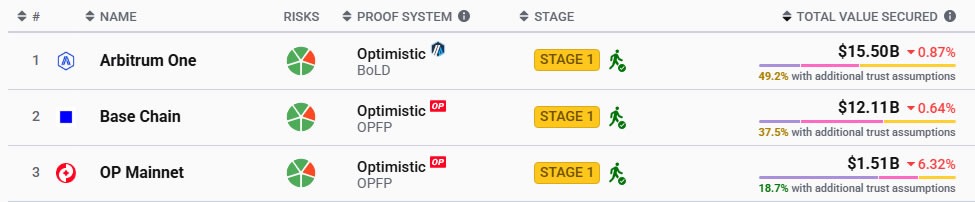
The Ethereum scaling ecosystem is dominated primarily by three players — Arbitrum One, Base and OP Mainnet — which command a 75% market share. Smaller players are slowly getting squeezed out as activity and capital concentrate among the top three.
Additionally, the total value secured across the layer-2 rollup ecosystem has declined by about 36% since its peak of just over $50 billion in October, with smaller networks losing much more as capital migrated to the industry leaders, according to L2Beat.
“L2 activity has dropped 61% since June, leaving many smaller networks as ‘zombie chains’ with minimal usage,” reported 21Shares in December.
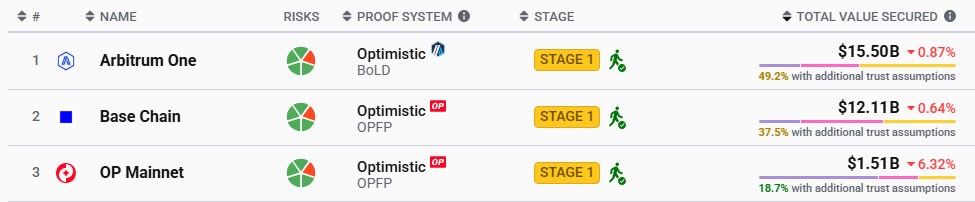
Three players account for nearly $30 billion in rollup total value secured. Source: L2Beat
Rollup market has shifted
Syndicate said the market has shifted away from its technology, “making it impossible to wait out these market conditions.”
“Instead, custom chains are being built by consulting teams from scratch, with very little reusable tech or network value.”
Related: Legend becomes latest DeFi app to throw in towel
The company said the Syndicate Network Collective is independent of Syndicate Labs, so SYND token governance is not immediately affected. It also said the decision to wind down was not influenced by the recent bridge compromise.
The Syndicate Commons Bridge on Base was exploited in late April because of a security breach and a leaked private key, resulting in the loss of 18.5 million SYND tokens worth about $330,000 at the time.
SYND fell 44% after the hack and declined another 21% over the past three hours, hitting an all-time low of $0.012 after the closure announcement, according to CoinGecko. The token is down 99.5% from its September 2025 peak of $2.61.
A year of DeFi and crypto closures
Syndicate Labs is the latest addition to a growing list of crypto and DeFi closures this year.
DeFi mobile superapp Legend announced it was winding down on May 13, citing growth and scaling problems.
Other recent closures include Solana DeFi aggregator Step Finance, DeFi derivatives protocol Polynomial, Balancer Labs, the team behind the DeFi protocol Balancer, and Seamless Protocol, a DeFi lending protocol on Base.
Magazine: 5 tech predictions the mainstream media got horribly wrong

XRP price is pinned under $1.40 while its derivatives activity explodes. Futures volume has been holding above $2 billion with steady $400 million in spot volume. Yet price barely flinched.
It has been revealed today that CME-listed XRP futures crossed $63 billion in notional volume within their first year, with 1.32 million contracts of 28.6 billion XRP traded as of mid-May.
The regulated derivatives infrastructure is clearly maturing. But spot price has been pinned for a long time, and people are questioning if the price is being manipulated.
Discover: The best pre-launch token sales
XRP Price Needs to Hit $1.50, or It Won’t Break Downtrend
XRP’s 24-hour range of $1.37 sits in a wide 7-day range that topped $1.54. The same $1.50 level that has been rejected more than a couple of times. Momentum reads as conditional: bulls need a clean close above $1.5 to invalidate the ceiling thesis.
Is not all bad for XRP, as we have identified a bull-flag structure projecting a potential move toward $1.60 in the longer time frame, implying more than 20% upside from current levels if the pattern completes with volume confirmation.

But for now, we would likely see XRP price consolidate between $1.35 – $1.45 as open interest bleeds out and traders await the next catalyst.
The derivatives overhang is the wildcard. XRP ETF demand and stagnant price action have coexisted before, a pattern that typically resolves violently in one direction. The billions in open interest show that resolution is approaching.
Discover: The best crypto to diversify your portfolio with
Bitcoin Hyper Targets First-Mover Upside
XRP’s story is essentially a maturity problem: massive institutional infrastructure, regulatory clarity, and $63 billion in derivatives activity, yet the spot price still can’t break a single all-time high.
At a market cap this size, the asymmetric upside that early XRP holders enjoyed is structurally unavailable. That’s the math. Some traders are rotating attention toward earlier-stage plays where the infrastructure narrative is fresher.
Bitcoin Hyper ($HYPER) is positioning itself as the first Bitcoin Layer 2 with full Solana Virtual Machine (SVM) integration. Hyper is powered with faster transaction finality than Solana, with Bitcoin’s security as the base layer.
The project has raised $32.7 million at a current presale price of $0.0136, combining extremely low-latency L2 processing with a decentralized canonical bridge for BTC transfers and a high 36% APY staking rewards. It targets Bitcoin’s three core limitations directly: slow transactions, high fees, and the absence of programmable smart contracts.
Research Bitcoin Hyper with full due diligence before the next price increase.
The post XRP Price Manipulated? $63 Billion Futures Surge Still Can’t Move XRP appeared first on Cryptonews.
Crypto World
A crypto whale has made a $224,000 bet that XRP’s price stays perfectly flat through June


A massive XRP derivatives play is betting that its price goes nowhere until the end of June, even as macro headwinds and regulatory developments suggest a volatility boom.
The move hit the tape on crypto exchange Deribit as a single-block trade, meaning it was a large transaction executed over-the-counter in a privately negotiated deal to prevent it drastically moving the price.
The trade likely involved a whale or an institution executing what is known as the “short straddle” strategy by shorting (selling) 1.5 million contracts of both the $1.40 call and put options expiring on June. 26.
By selling both the call and put, the trader is effectively providing insurance against sharp price movements away from the $1.40 strike. The trader received an upfront premium of $224,500 for assuming this volatility risk.
The trader will retain that amount as profit if XRP remains near $1.40 through June 26.
Hence, the bet is essentially on volatility to stay low, with prices pinned near $1.40. The payments-focused cryptocurrency has largely traded between $1.30 and $1.50 since February, according to CoinDesk data.
The strategy is not without risk. A sharp move in either direction would turn the position unprofitable, requiring the trader to cover losses owed to option buyers.
As of now, plenty of factors point to potential for volatility. Inflation concerns in the U.S. and other parts of the world are pushing up government bond yields worldwide, disincentivizing investments in stocks, cryptocurrencies and other risky assets.
Meanwhile, the Senate Banking Committee advanced the Clarity Act, a landmark U.S. legislative proposal designed to establish a clear regulatory framework for cryptocurrencies and digital assets. The bill now moves forward to a full Senate vote.
Stuart Alderoty, chief legal officer at Ripple, which uses XRP to facilitate cross-border transactions, reportedly called the banking committee’s decision a “monumental outcome” and cited the protection of 67 million American crypto holders as the bill’s purpose.
XRP is often seen as a U.S. crypto play, as Ripple is based in San Francisco and is among several firms that have received conditional approval from the Office of the Comptroller of the Currency (OCC) to establish the Ripple National Trust Bank (RNTB).


OpenAI said that an internal general-purpose reasoning model autonomously solved the planar unit distance problem, a famous open problem in discrete geometry first posed by Paul Erdős in 1946, marking the first time one of its systems has cracked a long‑standing research question without step‑by‑step human guidance
The announcement sharpens an industry argument that frontier models are moving from assistant tools to original contributors in technical fields, with implications that stretch far beyond mathematics.
A New Bar for Autonomous AI Research
The company described the result as proof that advanced systems can hold a difficult argument together, combine ideas from distant areas of knowledge, and produce work that withstands expert review. External mathematicians verified the proof, which drew on tools from algebraic number theory.
OpenAI framed the milestone as part of a longer push toward more automated research. The lab said similar capabilities could one day support work in biology, physics, materials science, and medicine, where many problems are too large or complex for traditional teams to tackle alone.
Industry Race Heats Up
The breakthrough lands during a frantic stretch for the AI sector. OpenAI is reportedly preparing an IPO filing as soon as this week, just after a US jury cleared the company in a lawsuit brought by Elon Musk.
Rival Anthropic is on track for its first profitable quarter on projected revenue of $10.9 billion, while former OpenAI founding member Andrej Karpathy recently joined Anthropic to focus on frontier model research.
Labor and Strategy Questions Intensify
Autonomous problem-solving by AI is already reshaping how executives talk about high-skilled work. Citadel chief executive Ken Griffin recently warned that agentic AI is starting to replace PhD-level finance tasks in hours rather than months.
Some observers argue the next competitive edge in AI will not come from raw model quality but from access to real-world execution data that lets systems act, not just answer.
OpenAI said human judgment still anchors the work, with researchers choosing which problems matter and how to interpret results. What the new milestone changes is the range of problems a model can credibly take on alone.
The post OpenAI Model Autonomously Cracks 80-Year Math Problem, Shifting AI Research Stakes appeared first on BeInCrypto.

Tax dodgers have started turning to Bitcoin Ordinals, BRC-20 tokens and other digital methods in an attempt to hide their wealth from tax authorities, according to blockchain analytics platform Chainalysis.
“Tax evasion and unreported income are age-old financial crimes, but the methods used to commit them are rapidly evolving,” Chainalysis said in a report Wednesday.
“As digital assets become more mainstream, bad actors frequently attempt to exploit novel technologies — such as NFTs, decentralized finance protocols, or emerging token standards — in hopes of keeping their wealth hidden from tax authorities and law enforcement.”
Tax authorities have been scrambling to catch up with technological advances and to track and apply taxes. A March study estimated that only 32% to 56% of US crypto owners report their gains. In Norway, that percentage was only 12%, according to a study from August 2024.

Source: Chainalysis
Italian authorities uncover $1 million tax evasion scheme
Chainalysis reported that Italy’s Economic and Financial Police Unit in Foggia reportedly uncovered a tax evasion scheme in which an individual allegedly used Bitcoin Ordinals and the BRC-20 token standard to hide 1 million euros ($1.1 million) in undeclared capital gains.
Introduced in 2023, the Ordinals protocol assigns a serial number to a satoshi, the smallest unit of Bitcoin, and allows data, such as images or text, to be embedded in a Bitcoin transaction. The BRC-20 standard, built on top of it, allows text inscriptions to be deployed, minted into tokens and transferred on the Bitcoin blockchain.
Italian authorities discovered during their investigation that the suspect was using the Ordinals protocol and the BRC-20 standard to create tokens, then sent them and listed them on marketplaces, according to Chainalysis.
“The assets were sold for multiples of their original cost, and the profits were routed back to the suspect’s primary wallet in Bitcoin,” Chainalysis said. “The suspect continually reinvested these earnings into new inscriptions.”
Blockchain intelligence essential infrastructure
The US Internal Revenue Service estimates that the gross tax gap, the government’s best estimate of the total tax it is legally owed but did not receive, is about $606 billion. Tax evasion tactics usually include paying in cash and underreporting income.
However, Chainalysis said using crypto for tax evasion comes with a “fatal flaw” because of the “inherent transparency of the blockchain. No matter how sophisticated a scheme appears, the underlying technology leaves a permanent immutable trail.”
Blockchain intelligence can reconstruct a financial network and cross-reference it with data that crypto exchanges are required to report to unmask transactions tied to suspected tax dodgers, according to Chainalysis.
Related: Italy’s largest bank more than doubles crypto holdings to $235M in Q1: Report
“This landmark Italian case serves as a powerful reminder for law enforcement and compliance professionals globally: the technical novelty of crypto does not equal anonymity,” it said.
“As new digital asset classes continue to emerge and generate income streams, the gap between actual on-chain wealth and declared tax positions will become a primary target for global investigative attention. In today’s financial landscape, blockchain intelligence is essential infrastructure.”
Magazine: Bitcoin ETFs bleed $1B, Aave’s $71M ETH unfreeze bid delayed: Hodler’s Digest, May 10 – 16
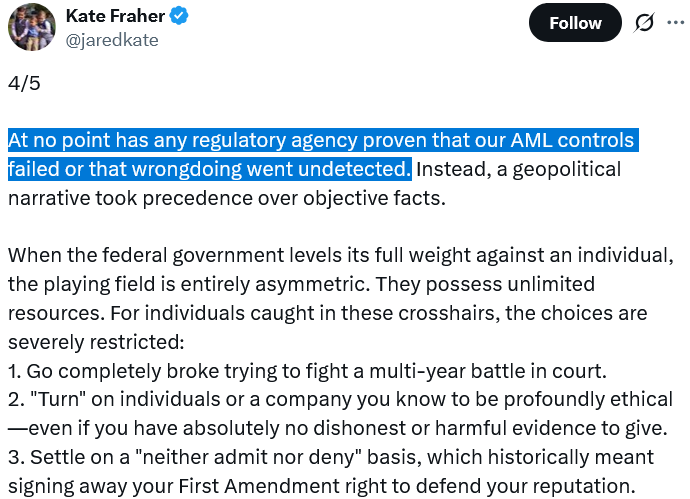
The former chief risk officer of Silvergate revealed she made the decision to settle with the US securities regulator in 2024 to avoid a “multi-year battle” in court, where she was accused of misleading investors about anti-money laundering rules and how the bank monitored crypto customers.
In her first public comments about her settlement with the SEC on Wednesday, Kate Fraher claimed that no financial agency proved that Silvergate’s anti-money laundering controls had failed, and that she only opted to settle to “move forward.”
Fraher had agreed to a civil penalty of $250,000 and was banned from serving as a company executive or board director for five years.
“The process itself is designed to apply maximum pressure, and the human costs are real. I was personally de-banked and had credit lines summarily closed—an aggressive tactic used to disrupt daily life and force compliance,” she said.
The comments provide more insight into the circumstances surrounding the wind-down of Silvergate, a crypto-friendly bank that voluntarily closed following the collapse of FTX. Fraher said her ability to comment came after the SEC rescinded the long-standing “gag rule” on Monday.
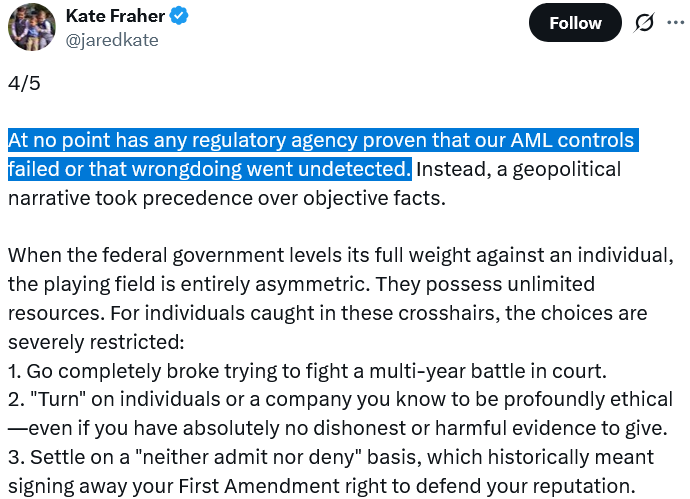
Source: Kate Fraher
Fraher said the wind-down was not because of a “bank run” or market volatility from FTX’s collapse in November 2022, even as the bank experienced a deposit run of around 70%.
Instead, Fraher said the company chose to wind down because the “broader administrative and regulatory pressure levied against the digital asset industry made operating a viable business impossible.”
Many crypto industry pundits labeled this as “Operation Chokepoint 2.0,” an unconfirmed plan in which US financial regulators cut off banking services to crypto companies in an attempt to restrict their ability to operate within the broader financial system.
Silvergate wasn’t the only crypto-friendly bank affected by the strict measures, which intensified following the collapse of FTX in November 2022.
Signature Bank and Silicon Valley Bank also shut down in early 2023, in part due to deposit runs, liquidity stress and contagion effects tied to FTX and several crypto lending platforms that went bankrupt in 2022.
Related: Trump-backed Truth Social pulls bids for crypto ETFs
But Fraher said by the beginning of 2023, it had weathered the FTX collapse by restructuring the business with “appropriate capital levels” and a “right-sized workforce” to continue operations safely.
Gag policy was unconstitutional, Fraher argues
Fraher applauded the current Paul Atkins-led SEC leadership for ending the gag rule, which she described as an “unconstitutional policy.”
“I am glad the right to speak the truth has finally been restored,” Fraher said, adding: “We must continue to talk about the long-term professional and personal toll exacted on individuals by regulation through enforcement.”
Magazine: 5 tech predictions the mainstream media got horribly wrong
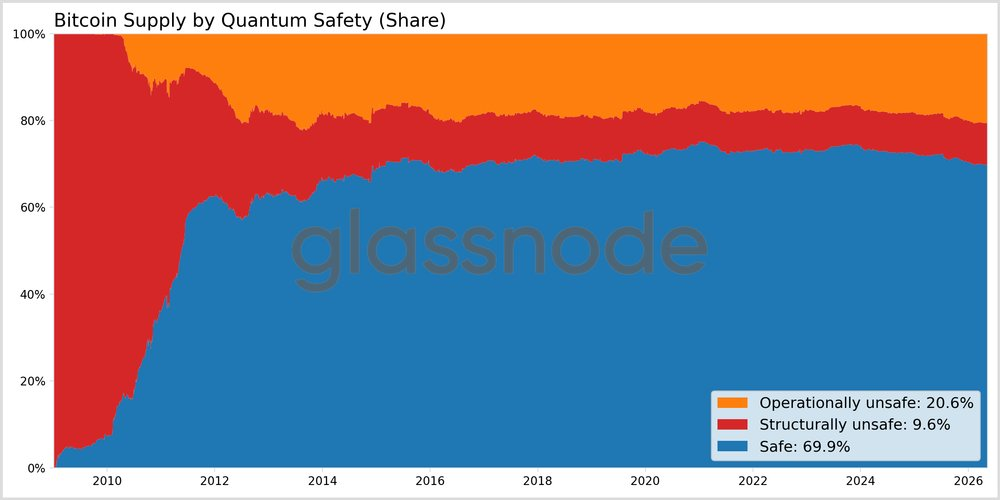
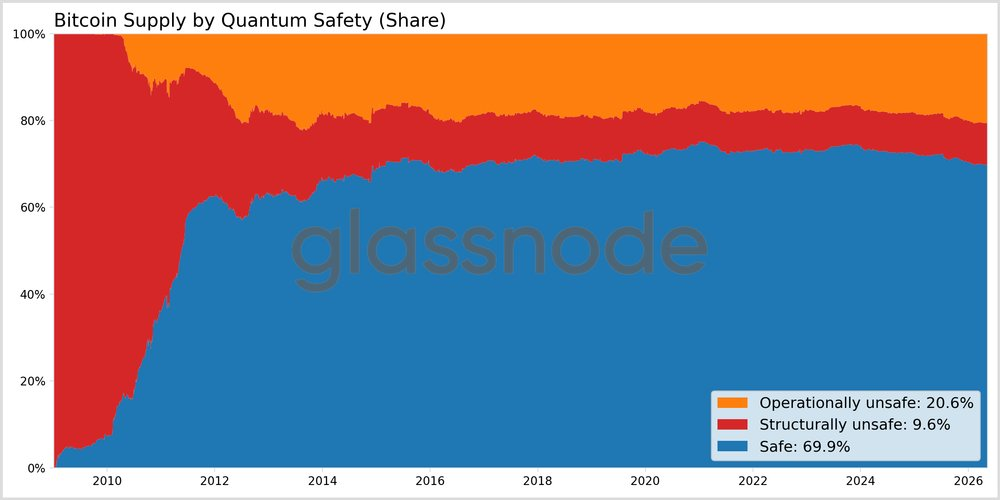
Bitcoin News: New Glassnode data puts 4.12 million BTC at quantum risk from behavioral factors alone, address reuse, partial spending, and custody practices, more than double the 1.92 million BTC exposed by Bitcoin’s older script architecture.
Combined, the two categories cover 30.2% of all issued Bitcoin, but the more urgent finding is this: the dominant source of today’s Bitcoin quantum risk is not legacy code. It is how holders manage their keys.
Discover: The best crypto to diversify your portfolio with
Bitcoin News: Two Categories of Exposure. Why Structural and Operational Risk Are Not the Same Thing
Glassnode splits quantum-exposed supply into two distinct buckets, and conflating them produces exactly the kind of vague, unhelpful headline that obscures where the real risk is concentrated.
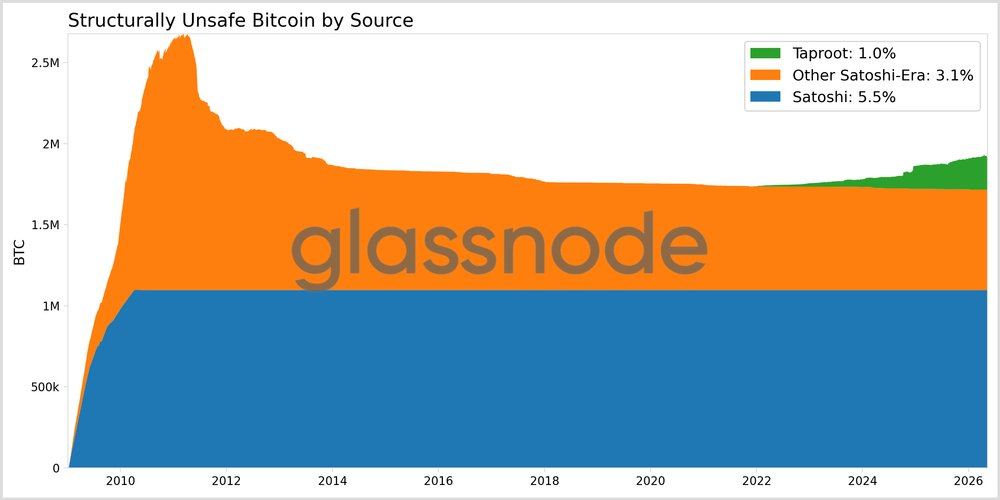
Structural exposure covers outputs where the public key appears on-chain by design, baked into the protocol itself, not the result of user behavior.
The primary offenders are Pay-to-Public-Key (P2PK) outputs, the script type used in Bitcoin’s earliest blocks, where the public key is embedded directly in the UTXO with no hash layer at all.
Also included: bare multisig outputs and, more recently, Pay-to-Taproot (P2TR) outputs, which expose the public key at rest as part of their design. Glassnode estimates structural exposure at 1.92 million BTC.
Operational exposure is a different problem. Address types like Pay-to-Public-Key-Hash (P2PKH) and Pay-to-Witness-Public-Key-Hash (P2WPKH) do not expose public keys by default; they hide them behind cryptographic hash functions (SHA-256 and RIPEMD-160) that are considered quantum-resistant under current models.
A quantum computer running Shor’s Algorithm can derive a private key from a known public key in polynomial time using ECDSA’s elliptic curve structure. But it cannot reverse a hash to discover the public key in the first place. The hash layer is a genuine protection, until it isn’t.
The protection breaks the moment a holder spends from a P2PKH or P2WPKH address. Spending requires broadcasting a transaction that includes the public key in the signature, and once that transaction is confirmed on the blockchain, the public key is permanently on-chain.
If that address then receives additional funds, address reuse, those funds are now exposed in exactly the same way as a P2PK output. The hash layer protected the coins until the address was spent from. After that, it protects nothing for any remaining or subsequent balance.
Glassnode puts operationally exposed supply at 4.12 million BTC, 2.1 times the structural figure. The firm’s conclusion is direct: “The main insight is that most current at-rest exposure is not simply a legacy script-design problem, it is a key- and address-management problem.”
Discover: The best pre-launch token sales
The post Bitcoin News: Quantum Countdown, The Data Behind the ‘20% Vulnerable’ Bitcoin Supply appeared first on Cryptonews.

TLDR
- President Trump declares Iran nuclear negotiations have reached their “final stages” while threatening fresh military strikes without agreement
- Qatar and Pakistan have developed a revised peace framework under consideration by Tehran, which remains inflexible on key demands
- Heated Tuesday phone conversation between Trump and Netanyahu revealed deep disagreements, with sources describing the Israeli leader as extremely agitated
- Tehran’s most recent proposal essentially reiterates previously rejected conditions, including demands for Strait of Hormuz authority
- Global oil markets react with Brent crude approaching $108 per barrel as the critical Strait of Hormuz stays mostly shut
President Trump announced Wednesday that diplomatic efforts with Iran have entered their concluding phase, though he cautioned that military operations may resume without a breakthrough. The ceasefire, which began six weeks ago when Trump suspended Operation Epic Fury, has yielded minimal diplomatic progress.
“We’ll see what happens. Either have a deal or we’re going to do some things that are a little bit nasty,” Trump told reporters.
The President revealed he nearly authorized additional strikes earlier this week but decided to postpone them, allowing diplomacy more breathing room. He indicated that appeals from multiple Gulf states neighboring Iran influenced his decision to cancel the operations at the eleventh hour.
A New Proposal, Old Problems
A revised diplomatic framework has been crafted by Qatar and Pakistan, incorporating feedback from regional intermediaries such as Saudi Arabia, Turkey, and Egypt. The initiative seeks to secure more definitive commitments from Tehran regarding its nuclear activities, while obtaining greater clarity from Washington on unfreezing Iranian assets.
Iran acknowledged it is examining the updated framework. However, Tehran’s counter-proposal, presented this week, essentially reiterates demands that Trump has previously dismissed. These include Iranian authority over the Strait of Hormuz, reparations for conflict damages, comprehensive sanctions removal, and complete withdrawal of American military forces.
Iran’s Foreign Ministry indicated discussions were progressing “based on Iran’s 14-point proposal.” Pakistan’s interior minister made a Wednesday trip to Tehran to facilitate mediation efforts — marking his second visit within a seven-day period.
Trump and Netanyahu at Odds
A contentious telephone exchange between Trump and Israeli Prime Minister Benjamin Netanyahu occurred Tuesday. One insider characterized Netanyahu’s reaction as having his “hair was on fire” following the discussion.
Netanyahu maintains skepticism toward the diplomatic track. He advocates for resuming military campaigns to further diminish Iran’s operational capacity and eliminate essential infrastructure.
Trump stated Netanyahu “will do whatever I want him to do” regarding Iran, while simultaneously emphasizing their positive relationship. Two Israeli officials verified that the leaders hold conflicting views on the path forward. Israel’s embassy rejected claims that the ambassador had briefed U.S. congressional members about the conversation.
Hormuz and Oil Prices
Tehran has maintained a near-complete closure of the Strait of Hormuz to non-Iranian vessels since the U.S.-Israeli military operations commenced in February. The blockade represents the most significant interruption to worldwide energy distribution in modern times.
Maritime tracking service Lloyd’s List documented approximately 54 vessel transits through the strait last week, representing roughly twice the volume from the preceding week. Iranian authorities reported 26 ship crossings within the last day. Prior to hostilities, approximately 140 vessels traversed daily.
Two substantial Chinese oil tankers transporting roughly 4 million barrels departed through the strait Wednesday, following a bilateral arrangement Iran finalized with China last week. South Korean officials confirmed one of their tankers also completed passage with Iranian cooperation.
Brent crude declined approximately 2.75 percent Wednesday, settling near $108 per barrel, although prices have maintained an upward trajectory on a weekly basis.
Trump faces mounting pressure to conclude hostilities before November’s congressional elections, as elevated energy costs are eroding Republican voter support.
Iran’s Revolutionary Guards issued a Wednesday warning that renewed U.S. attacks would trigger conflict expansion beyond Middle Eastern borders. Fresh drone assaults targeted Saudi Arabia and the UAE this week, allegedly launched by Iraq-based militant groups with Iranian connections.
As of Wednesday, Tehran continues to maintain its stockpile of near-weapons-grade enriched uranium and preserves its missile arsenal and proxy network capabilities.



Trading giant IG (IGG), which started offering cryptocurrency trading in the U.K. a year ago, said it plans to expand the service across Europe, without giving a time scale.
The European division of the London-listed investment platform will use crypto exchange Bitpanda’s infrastructure — including liquidity, trading connectivity and market data — to provide digital asset access to European investors, according to an emailed statement on Thursday.
The company reported revenue of 331.2 million pounds ($445 million) for the first quarter of 2026 this week, of which spot crypto contributed 2.4 million pounds ($3.2 million).
IG, which introduced spread betting to the U.K. in the early 1970s, is one of Europe’s best-known retail trading platforms, offering clients access to equities, foreign exchange, commodities and derivatives markets. It has 1.3 million clients globally.
Bitpanda is primarily licensed in Austria, with headquarters in Vienna. The exchange also holds licenses under the European Union’s Markets in Crypto-Assets (MiCA) regulation in Germany and Malta, allowing it to offer crypto services across the bloc.

The former Silvergate Bank chief risk officer has shed new light on the bank’s winding-down and the terms of a 2024 SEC settlement, saying she agreed to a civil penalty and a multi-year ban to avoid a protracted court battle over assertions that the bank misled investors about its anti-money-laundering rules and how it monitored crypto customers. In her first public remarks since the settlement, Kate Fraher indicated that no regulator had proven AML controls had failed, and that she chose to settle to “move forward.”
Fraher’s disclosures come as the U.S. securities regulator’s enforcement stance on the crypto sector continues to shape the industry’s access to traditional banking services. The former executive confirmed that the SEC’s action led to a civil penalty of $250,000 and a five-year ban from serving as a company executive or board director. She also highlighted the personal toll of the enforcement process, noting that she was de-banked and faced immediate credit-line closures as part of the broader pressure on crypto-related firms.
The comments arrive just after the SEC signaled a new openness in settlements by rescinding a long-standing gag rule earlier this week. Fraher, speaking after the gag rule’s removal, said she found the prohibition on discussing regulatory actions “unconstitutional” and welcomed the ability to speak more freely about the experience and its long-term personal and professional costs. Her remarks were circulated in part via social media posts, including a link to her public statements on X.
The wind-down of Silvergate, a lender that several crypto firms relied on for several years, was not framed by Fraher as a simple consequence of a bank run. While the bank did experience a deposit outflow—reported at around 70% during the wind-down—she argued that the decision to close operations in the first place stemmed from broader regulatory and administrative pressures targeting the digital asset industry, which in her view made operating a crypto-friendly business untenable in the prevailing climate. The timing followed the fallout from FTX’s collapse in late 2022 and the ensuing liquidity strains across the sector.
In the crypto policy discourse, Fraher’s account intersects with a widely discussed if loosely defined narrative often referred to as “Operation Chokepoint 2.0”—a label used by industry observers to describe efforts to restrict banking access for crypto businesses by tightening upstream financial-services channels. While the exact mechanisms and aims of such pressure remain contested, the broader takeaway from Fraher’s account is that regulatory strain, more than a single market shock, played a decisive role in Silvergate’s decision to wind down and exit the business.
Key developments around Fraher’s settlement and the gag policy
Fraher’s public comments assert that the SEC’s case did not establish a failure of Silvergate’s AML controls. She said she settled to avoid a “multi-year battle” and to move forward rather than litigate the allegations to verdict. The terms of the settlement—$250,000 civil penalty and a five-year ban from serving as an officer or director—are consistent with many enforcement actions where the regulator seeks accountability while offering a clear exit path from ongoing proceedings.
The renewed capacity to speak publicly follows the SEC’s decision to rescind the gag rule on Monday, a move Fraher framed as a step toward greater transparency in enforcement actions. Critics have argued that gag rules stifle important disclosures about regulatory actions and market practices, while supporters say restrictions can protect sensitive or confidential information. Fraher’s account, while centered on her own experience, also touches on a broader debate about how much participants in the crypto sector should be able to discuss settlements, findings, and internal risk assessments in the wake of enforcement actions.
Fraher also drew attention to the role of regulatory pressure in shaping the crypto banking landscape. She acknowledged that Silvergate weathered the initial shock of the FTX collapse and subsequently restructured with “appropriate capital levels” and a leaner workforce to operate more safely. Yet she emphasized that the drawdown of crypto-friendly banking options was driven in large part by the regulatory environment, not solely by market volatility or a single incident.
Regulatory momentum and what it means for the sector
Silvergate’s case is one notable thread in a broader pattern of regulatory risk that continues to reshape how banks interact with crypto businesses. The closures of other crypto-friendly lenders in 2023—such as Signature Bank and Silicon Valley Bank—illustrated the fragility of services available to crypto companies amid liquidity stress, depositor concerns, and the broader contagion from high-profile collapses in the sector. Fraher’s remarks underscore the tension between risk controls, enforcement expectations, and the practical needs of crypto firms seeking reliable banking relationships.
From an investor and builder perspective, Fraher’s comments illuminate several important dynamics. First, even settlements without a finding of AML failure can carry meaningful reputational and operational costs for executives and their firms. Second, the gag-rule reversal signals a potential shift toward greater candor in discussing enforcement actions, which could influence how future cases are perceived by the market. Finally, the persistent regulatory headwinds suggest that stable on- and off-ramp banking solutions for crypto firms will continue to hinge on evolving policy frameworks, not just market conditions.
As the sector digests these developments, observers will be watching for further clarity on how regulators define acceptable risk controls in crypto banking, and whether any formal guidelines emerge that explicitly address AML practices, customer monitoring, and the governance standards expected of financial institutions serving digital assets. Fraher’s experience—alongside ongoing enforcement activity—will likely influence how industry players assess compliance investments and risk-management priorities in the near term.
For readers tracking the policy front, the next note to watch is whether the SEC or other regulators publish additional guidance or reforms aimed at balancing enforcement with the practical realities of crypto-business models. Market participants will also want to monitor any new actions or settlements that signal how aggressively regulators plan to police AML controls, customer screening, and the surveillance of crypto-related activities as the industry seeks steadier banks and clearer operating rules.
Fraher’s disclosures offer a rare, candid glimpse into the personal and corporate calculus at the intersection of crypto banking and regulation. The broader question remains: how quickly, and through what contours, will the regulatory framework evolve to either shrink or stabilize the path for compliant, crypto-friendly financial services?
As the sector navigates these headwinds, investors and builders should stay attuned to policy shifts, enforcement posture, and the practicalities of banking access for digital assets. The coming months are likely to reveal whether the current climate yields a more resilient and transparent framework or further consolidation among banks willing to serve crypto clients under tighter scrutiny.

Iran football team applies for World Cup visas in Turkey amid US conflict

Anthropic Is Reportedly About To Have Its First Profitable Quarter

The Rose & Crown in Westhoughton to reopen after refurbishment


-

 Crypto World5 days ago
BloFin War of Whales 2026 Grand Prix opens registration for $5M trading championship
-

 Fashion6 days ago
Weekend Open Thread: Theory – Corporette.com
-

 Crypto World6 days ago
E-Estate Announces 1 Year Live: Washington DC Summit as Real Estate Tokenization Enters Its Next Phase
-

 Tech6 days ago
Tech Moves: Microsoft AI leader jumps to OpenAI; former AI2 exec joins Meta; and more
-

 Tech5 days ago
Google reimburses Register sources who were victims of API fraud
-
 Crypto World7 days ago
Google’s Gemini AI Predicts Incredible Solana Price by the End of 2026
-

 Business6 days ago
H&R Real Estate Investment Trust (HR.UN:CA) Q1 2026 Earnings Call Transcript
-
 Entertainment7 days ago
Zara Larsson Has Blunt Response To Chris Brown Diss
-

 Sports5 days ago
Napoleonic enters 2026 Doomben 10,000 field via Abounding withdrawal
-

 Crypto World5 days ago
BeInCrypto 100 Institutional Awards Nomination: KAST for Best Digital Assets Neobank and Best Digital Assets Fintech
-
 Crypto World5 days ago
Bitcoin Battles US Bond Nerves With BTC Price Dip Toward New May Lows
-

 Fashion4 days ago
On the Scene at Gucci’s Cruise Show in New York City: Mariah Carey, Kim Kardashian, Lindsay Lohan, Iman, and More!
-
 Crypto World5 days ago
Wall Street’s Boldest Gold Prediction Has Russians Rushing to Buy
-

 Crypto World5 days ago
ICE and CME urge US regulators to curb Hyperliquid energy trading
-

 Politics6 days ago
DWP PIP Timms review continues to be an absolute farce
-

 Crypto World5 days ago
IREN closes $3 billion convertible notes deal amid AI infrastructure expansion
-

 Fashion5 days ago
Trending Western Style Vests Perfect for Summer
-

 Entertainment6 days ago
David Letterman Returns to Late Show, Blasts Cancellation
-
Crypto World6 days ago
Lido Finance Selects Chainlink CCIP as the Official Cross-Chain Infrastructure for wstETH Security
-

 Fashion4 days ago
Amazon Sundays: Memorial Day Hosting
You must be logged in to post a comment Login