

Crypto World
David Schwartz warns of hard fork because XRP nodes won’t upgrade



More than half of XRP Ledger nodes are still running outdated software, with just six days to go before a scheduled amendment activation.
XRP Ledger co-creator David Schwartz spent the weekend talking about a hard fork and downplaying, in his view, the probability of any contentious split in XRP’s consensus due to their slow upgrades.
The ledger’s so-called “fixCleanup3_1_3” amendment cleans up a series of issues affecting NFTs, permissioned domains, vaults, and a new lending protocol. It’s supposed to activate on May 27 but ideally should hold more than 80% support from trusted validating nodes for two weeks.
The release notes, published by the XRP Ledger Foundation, tell every server operator to upgrade to 3.1.3 immediately. Any node still running older code at activation risks becoming amendment-blocked.
Amendment-blocked nodes may not validate ledgers (ledgers are the XRP Ledger’s version of blocks), process transactions, or participate in consensus.
Schwartz on the difference between a fork and a fix
Concern about a chain split in the XRP community spilled into a long thread on May 18. A critic asked Schwartz how a contested 50/50 validator split would even achieve resolution.
First, Schwartz downplayed changes to voting power, saying, “anyone can create dozens of nodes just to game the voting scheme,” and rejecting any rudimentary governance proposals akin to one vote per node.
Indeed, annual costs for running a hosted XRP validating node can be as low as a few thousand dollars — a trivial expense for a motivated attack on the $83 billion blockchain.
Schwartz then walked through his view of the consensus math.
“The validator split doesn’t matter,” he said. “All that’s necessary is that each side have enough validators to create a functional unique node list (UNL) containing validators who agree to produce a ledger stream according to their preferred rules.”
UNL strips away the convention of one vote per node. Instead, XRP Ledger node operators modify their UNL on their node’s software to prefer certain validating nodes, although almost every user adopts two particular UNLs that the Ripple-backed XRP Foundation maintains, dUNL and XRPLF.
Anyway, pressed on what a plausible fork would actually require, Schwartz estimated, “Realistically, you need to find at least a half dozen people willing to run validators to have a plausible fork.”
The reassurance lands oddly. He downplayed fears of a chain split because forking XRPL only takes half a dozen people willing to spend a few thousands dollars.
The clock is ticking
On May 17, XRPL Foundation contributor Hussein Zangana, known in the XRP community as “Vet,” posted that only “40% of the network is updated.”
His dashboard showed less than 40% of 846 XRP Ledger nodes on the new version.
By May 18, RippleX head of engineering J. Ayo Akinyele put the figure at roughly 44% and by May 19, CoinGape reported about 46%.
With less than a week to upgrade, almost half of the network is in the wrong place.
Importantly, however, all 35 seats on the XRP foundation’s super-powerful dUNL have voted in favor of fixCleanup3_1_3.
CoinGape reported 100% support among these 35 validating nodes that actually count toward practical consensus, because again, almost all XRP users adopt the XRP Foundation’s dUNL as their UNL by default.
The slow movers seem to be nodes operated by exchanges, market makers, NFT marketplaces, DEX front-ends, and other operators running their own servers. They risk becoming amendment-blocked on May 27, until they upgrade.
Read more: David Schwartz says don’t invest in Ripple
Another upgrade problem for the XRP ecosystem
This isn’t the XRP Ledger’s first amendment scare over the last 12 months.
In February, the foundation disclosed a critical signature-validation flaw in its Batch amendment. That bug let an attacker execute inner transactions on behalf of arbitrary victim accounts without their private keys.
An emergency 3.1.1 release marked Batch and a companion amendment as unsupported.
Another signature flaw forced the same patch-and-resubmit cycle on the Permission Delegation amendment in September 2025. Fortunately, that earlier bug never reached mainnet or caused losses.
Unfortunately, the fixCleanup3_1_3 amendment exists in part because earlier amendments shipped with problems. Vet has framed the current activation as routine network hygiene rather than a contentious fork.
Schwartz conceded in the same thread that XRPL goes through technical hard forks more often than most public ledgers. Indeed, there have been 25 adopted amendments to the XRP Ledger since last year.
Got a tip? Send us an email securely via Protos Leaks. For more informed news and investigations, follow us on X, Bluesky, and Google News, or subscribe to our YouTube channel.


[PRESS RELEASE – Kingstown, Saint Vincent and the Grenadines, May 21st, 2026]
NOW Wallet, a non-custodial crypto wallet focused on security, multi-chain access, and seamless DeFi experience, now has direct access to perpetual futures and prediction markets built into the app. That means platforms like Hyperliquid, Aster, Lighter, GMX, and dYdX for perps trading, and Polymarket and PancakeSwap for prediction markets — all accessible without leaving the wallet.
Perps and prediction markets
Perpetual futures (“perps”) allow users to take positions on cryptocurrency price movements without holding the underlying asset. These instruments support features such as leverage, short positioning, and continuous trading, which have contributed to their widespread use in digital asset markets.
Prediction markets operate on a different model. Rather than tracking asset prices, they reflect the perceived likelihood of specific outcomes. Participants take positions on whether an event will occur, such as a cryptocurrency reaching a certain price level, a macroeconomic development, or other predefined scenarios. Market prices adjust as expectations change, and positions are resolved once the outcome is determined.
Both segments have expanded within decentralized finance (DeFi) in recent years.
Bring this into the wallet
Until now, accessing advanced DeFi trading tools meant a fragmented workflow — separate accounts on separate platforms, funds split across multiple places, constant switching between apps and browser tabs. It worked, but it wasn’t clean.
This update brings that access into one place. Users can connect to supported protocols directly through their wallet, fund trading balances, sign transactions, and manage positions — all while keeping self-custody of their assets. No centralised exchange accounts required.
The aim is straightforward: make on-chain trading more direct, less fragmented, and actually usable on mobile.
Part of a broader shift in crypto UX
Wallets started as storage tools. That’s changing. As more users engage with swaps, staking, trading, and prediction markets at the same time, the expectation has shifted — a wallet should be the access layer for all of it, not just a place to park funds between sessions.
Adding perps and prediction markets is part of that direction for NOW Wallet.
About NOW Wallet
NOW Wallet is a non-custodial multi-chain crypto wallet supporting storage, swaps, staking, fiat purchases, and dApp access across 70+ blockchain networks.
The feature is available now in the latest version of NOW Wallet.
Users can download NOW Wallet: https://walletnow.app/
The post Perps and Prediction Markets Are Now Available in NOW Wallet appeared first on CryptoPotato.
The Trump administration’s push to choke off Iran’s crypto use is intensifying. The US Treasury has frozen nearly $500 million in regime-linked digital assets under Operation Economic Fury.
Treasury Secretary Scott Bessent disclosed the figure last week, including a $344 million seizure in the prior month. Estimates place Iran’s total digital asset holdings near $7.7 billion as Middle East tensions climb.
Inside Operation Economic Fury
Treasury officials say the campaign targets Iran’s military and the Islamic Revolutionary Guard Corps (IRGC). It also goes after regional proxies and shadow banking networks that move oil revenue.
Bessent has framed the strategy as pushing the regime into a financial crisis.
The largest single action so far was the $344 million USDT freeze on the Tron network, coordinated with Tether.
That move followed earlier US measures against Iran-linked UK exchanges accused of routing IRGC funds.
Tehran is now estimated to hold roughly $7.7 billion in digital assets, a figure cited by Fox Business reporter Darren Botelho, drawing on threat-detection data.
That total ranks Iran among the largest sovereign crypto holders tracked by blockchain analytics firms.
Bitcoin as the New Banking Workaround
The regime is leaning harder on Bitcoin (BTC) to move money outside the traditional banking system. Tehran recently rolled out a state-backed maritime insurance platform called Hormuz Safe.
The platform settles cargo ship policies entirely in BTC for vessels transiting the Strait of Hormuz.
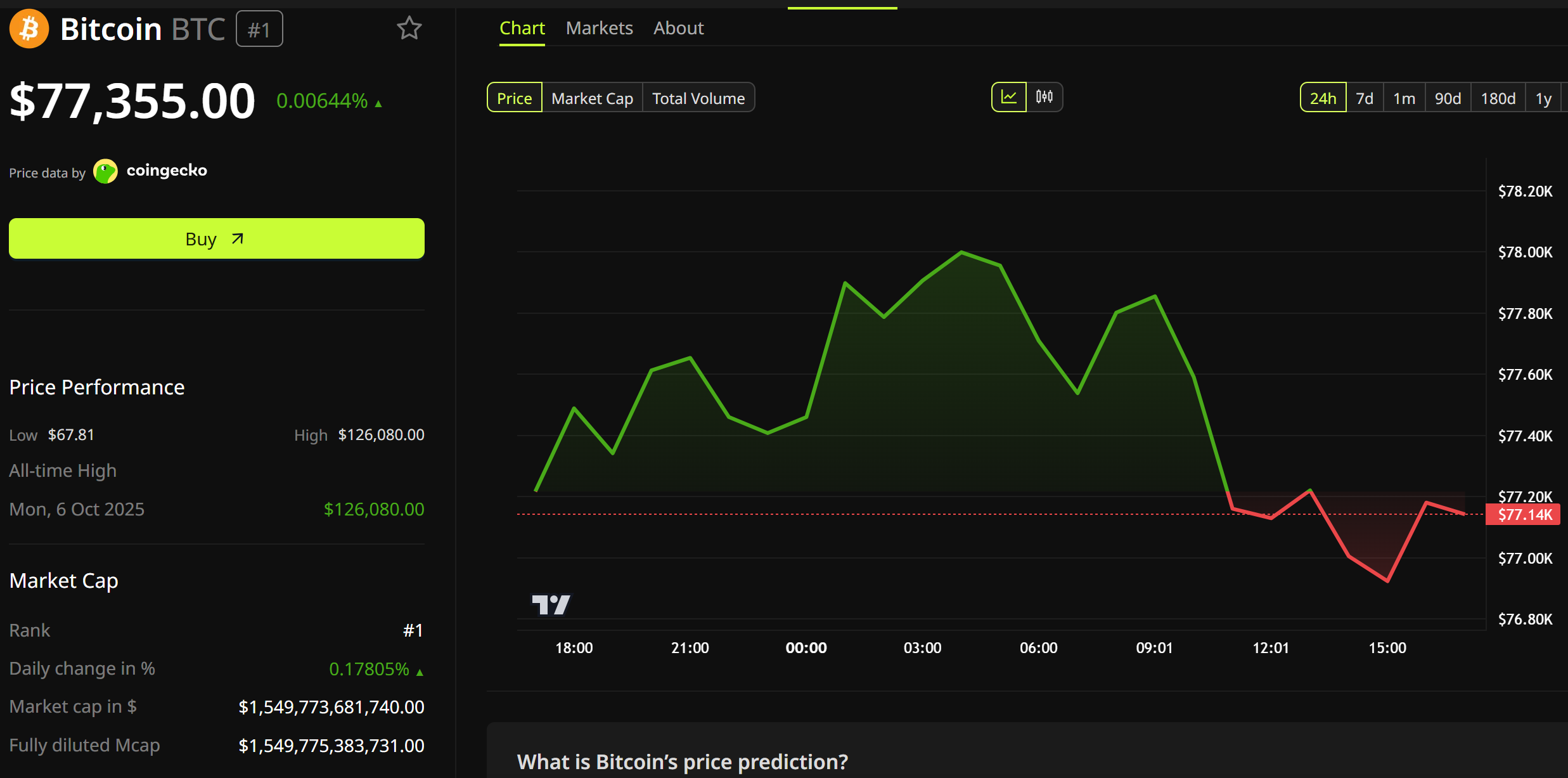
BTC traded near $77,355 at press time, up by a modest 0.006% over 24 hours, with the pioneer crypto’s role in Iran’s wartime economy adding geopolitical weight to its short-term action.

Why the Trail Favors Investigators
Despite crypto’s reputation as a sanctions workaround, US officials argue the opposite holds in practice. On-chain transactions leave permanent records that let forensics firms map wallets connected to the IRGC and Iran’s Central Bank.
“We found over and over again that they’re actually a much better asset for U.S. law enforcement and other agencies to track because you leave a lot of breadcrumbs,” Fox Business reported, citing Chris Perkins, CEO of 250 Digital Asset Management.
Traceability now favors enforcement. Industry insiders also told the network that Washington may threaten to cut crypto exchanges off from US banking.
Such a step would target firms still processing Iran-linked flows. The coming weeks should show whether the Treasury escalates to exchange operators.
How Tehran adjusts its Bitcoin-based workarounds will also come into focus.
The post US Intensifies Operation Economic Fury Targeting Iran’s $7.7 Billion Crypto Network appeared first on BeInCrypto.

World Liberty Financial’s WLFI token recently hit a huge milestone after it recorded its highest-ever realized profit event.
According to on-chain analytics firm Santiment, 1.8 billion of the Trump-linked tokens were sold at a profit on May 18, with the spike coming only weeks after WLFI hit an all-time low.
WLFI Holders Cash Out After Binance-Linked Catalyst
Alongside the record realized profit, Santiment noted that a metric that tracks tokens moving on-chain multiplied by their level of dormancy, known as “age consumed,” had also hit an all-time high of 17.4 trillion, indicating unprecedented movement of long-dormant supply.
It tied the activity to Binance launching a USD1/BTC trading pair that allowed traders to use WLFI’s USD1 stablecoin as collateral for Bitcoin futures for the first time. The analytics firm said the listing created a rare exit opportunity for long-term holders after WLFI spent months sliding lower.
“This was a major, well-publicized event that gave long-time holders a high-profile moment to finally cash out,” it wrote.
Even after the recent bounce, the token is still down more than 80% from its September 2025 all-time high near $0.33, with the situation having been made worse late last month after WLFI crashed to an all-time low near $0.05.
Per Santiment, that drop was caused by “governance drama, a controversial token unlock proposal involving 62 billion tokens, and several reports about secret token sales benefiting insiders.”
The unlock proposal in particular drew intense scrutiny from holders and even led to a public dispute with Tron’s Justin Sun, one of the biggest investors in World Liberty, who called it “one of the most absurd governance scams” he had ever seen.
He then filed a lawsuit against the project in a California federal court, which WLFI countered with a suit of its own, accusing Sun of running “a coordinated media smear campaign.”
Where WLFI Stands Now
Apart from unlocking dormant selling, the Binance listing event appears to have also coincided with a wave of other on-chain activity, including several huge USD1 burn transactions linked to World Liberty, flagged by crypto analyst CryptoNotaz.
Meanwhile, at the time of writing, WLFI was trading around $0.061, which is a nearly 12% dip over the past seven days and 22% in the last month.
Its market cap is sitting at about $1.9 billion against a fully diluted valuation near $6.1 billion, with only around 31.8 billion of the 100 billion total supply currently in circulation.
Looking at open interest, WLFI futures stand at $181.7 million according to CoinGlass. About $226,000 worth was liquidated over the past 24 hours, with slightly over $133,000 of that being long positions.
The post WLFI Holders Dump 1.8B Tokens in Record Profit Event appeared first on CryptoPotato.
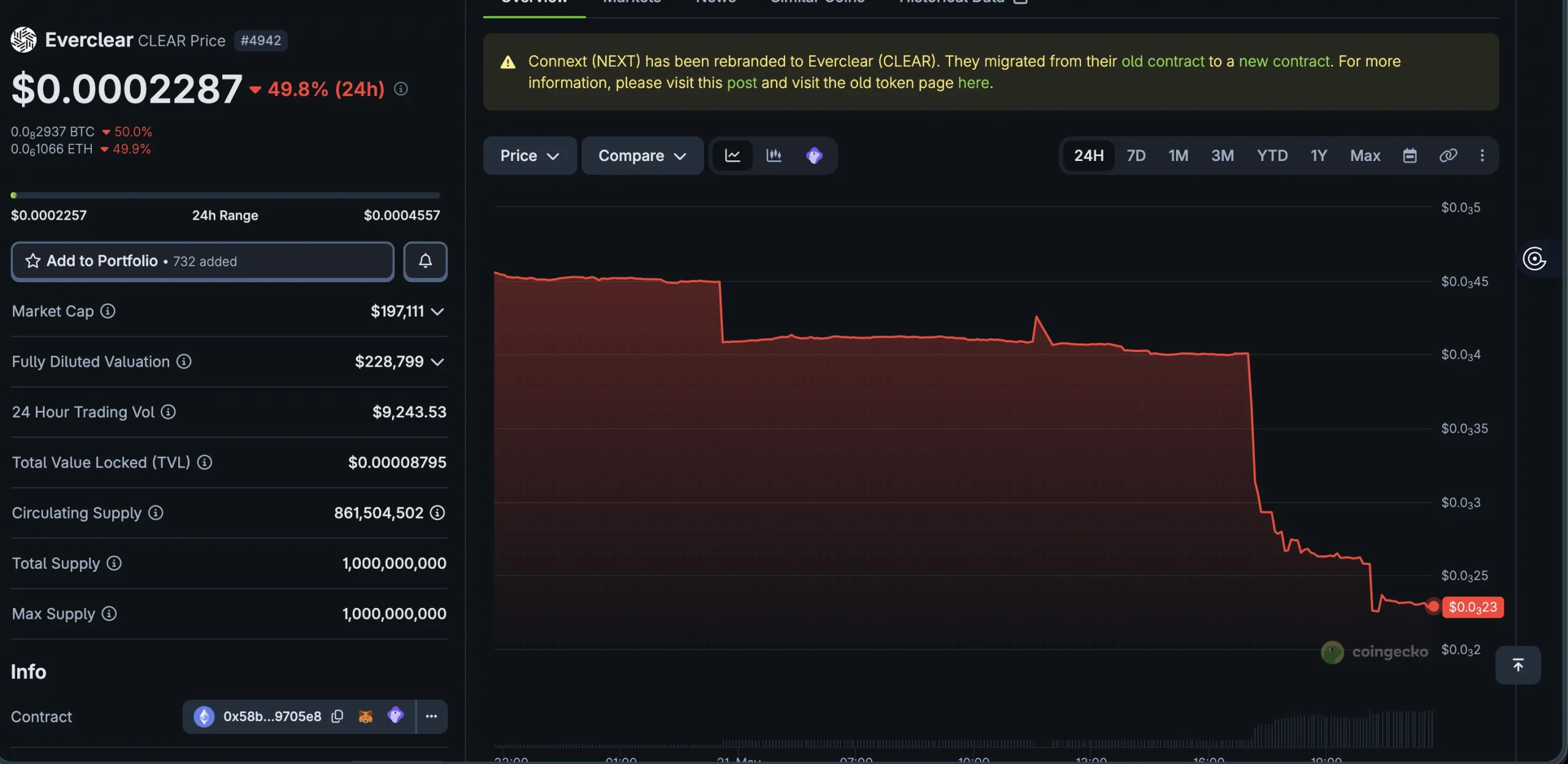
Everclear’s announcement of a full operational wind-down sent CLEAR sharply lower in the latest session.
Summary
- As of May 21, CLEAR declined to $0.0002332, down over 48% in 24 hours
- Everclear confirmed full shutdown of protocol and operations
- Project previously processed $500 million in monthly volume
- Team cites lack of sustainable revenue despite partnerships
Everclear, the cross chain clearing and settlement network backed by firms including Pantera Capital and Polychain, said it is winding down all operations after failing to build a sustainable business model.
In a stunning announcement posted to X, the team confirmed that the protocol has already been sunsetted and no funds remain locked.
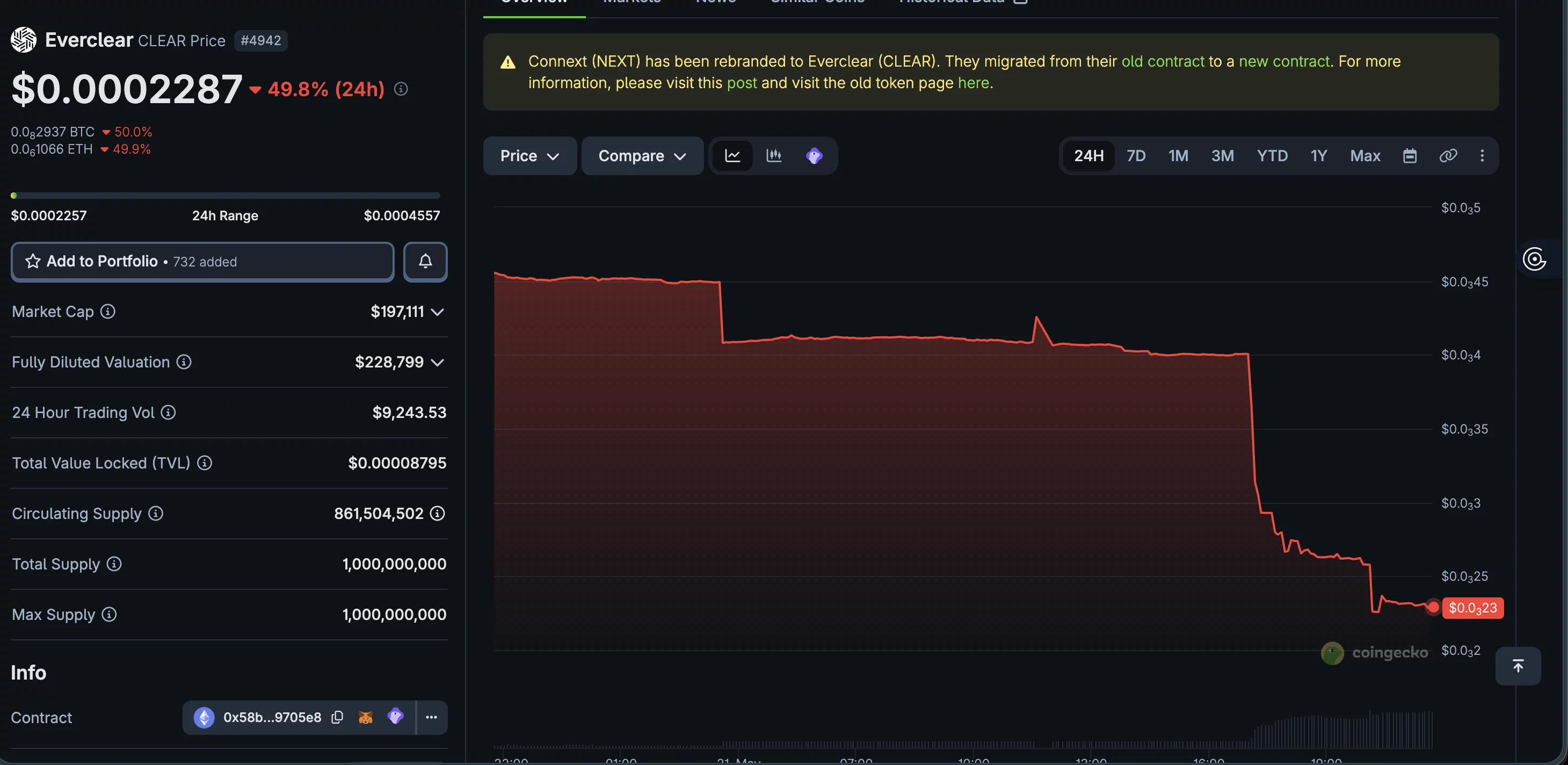
The token is currently trading at $0.0002332, down over 48% in 24 hours.
Why did Everclear shut down its protocol?
“The protocol has been sunsetted,” Everclear stated. “To our knowledge, no funds are stuck any remaining TVL was withdrawn by users and partners.”
The project, originally launched in 2017 as Connext with early support from the Ethereum Foundation, aimed to solve liquidity fragmentation across blockchains. It later rebranded to Everclear and launched its mainnet in April 2025, positioning itself as infrastructure for cross chain settlement.
Despite technical execution, the team acknowledged that demand did not translate into revenue. “Despite reaching $500M in monthly volume, the cross chain solvers segment never developed the commercial depth we needed,” the team wrote. Users, it said, were highly price sensitive, limiting monetization.
The shutdown affects not only the protocol but also the Everclear Foundation and its research arm, effectively ending all development efforts tied to the ecosystem.
What happens to CLEAR token and remaining funds?
The immediate market reaction was severe. CLEAR dropped more than 48% to $0.0002332, according to CoinGecko data, wiping out most of its remaining market value in a single session.
Everclear said it plans to use remaining treasury funds to settle liabilities. The team also floated a potential token buyback, though it emphasized uncertainty around execution. The estimated size of any buyback ranges between $50000 and $200000, a relatively small figure compared to historical funding rounds.
The project had raised capital from major crypto investors and built integrations with industry partners. However, Everclear admitted it misjudged timelines for those partnerships to go live, which ultimately strained its financial runway.
“Several significant names signed on, but we underestimated how long it would take those partners to go live and our runway ran out before they did,” the team said.
There remains a possibility, however, that the technology could survive in another form. Everclear is exploring open sourcing its codebase, according to those familiar with the matter, allowing its DAO or external developers to continue development under new leadership. The intellectual property is currently held by the Everclear Foundation.
The collapse adds to a growing list of infrastructure projects struggling to convert usage into revenue, even as networks like Ethereum (ETH) continue to dominate settlement activity. It also highlights ongoing challenges in cross chain design, an area often positioned as critical to the broader crypto ecosystem alongside assets like Bitcoin (BTC) and scaling discussions tied to Layer 2 ecosystem growth.
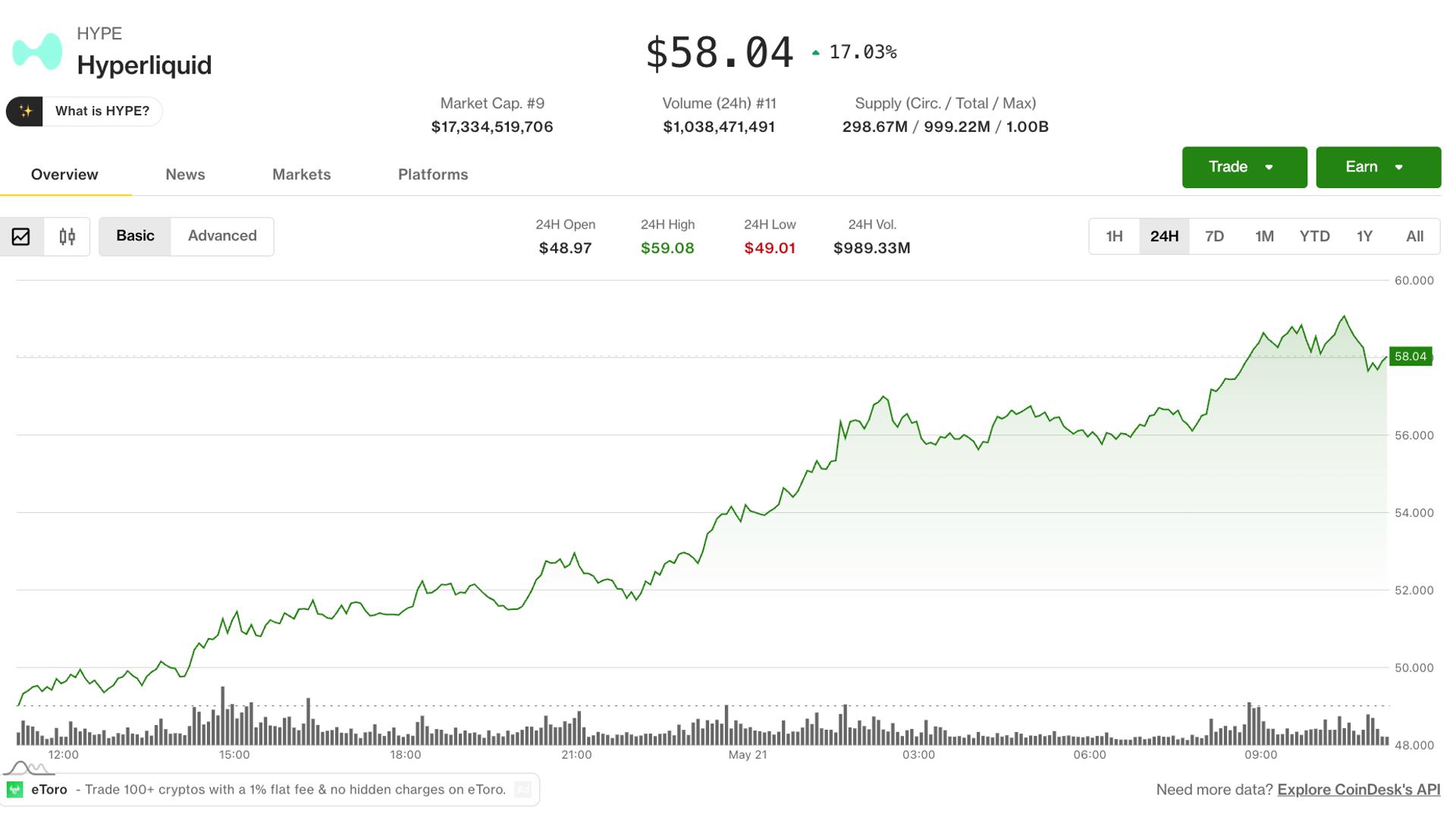
The crypto market showed signs of a cautious recovery on Thursday, with bitcoin trading at $77,900, up from Tuesday’s low of $76,100, and ether (ETH) at $2,130 after adding just 0.1% since midnight UTC.
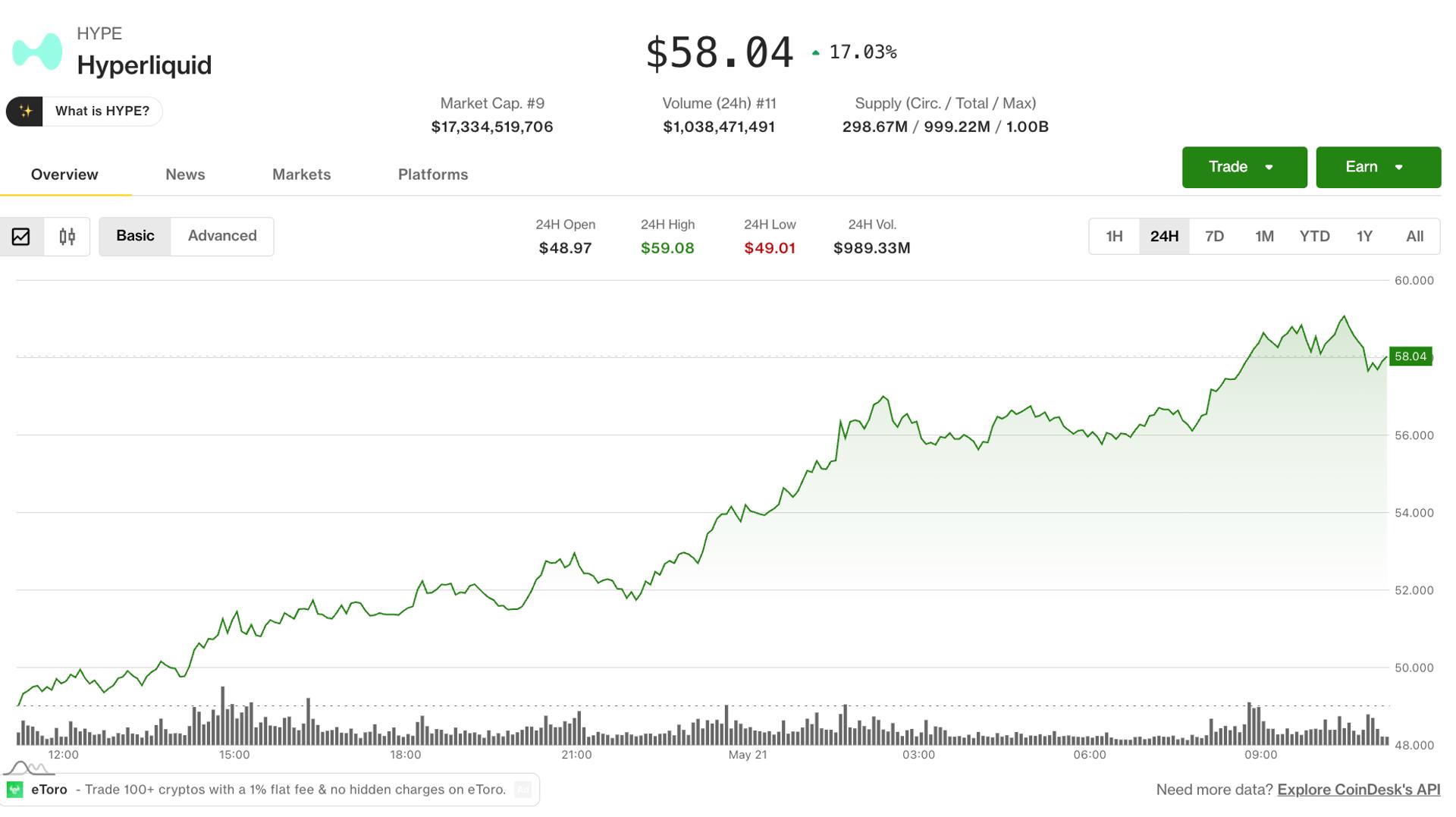
The altcoin sector remains mixed. While Hyperliquid (HYPE) rose for a fifth straight day, adding 6.5% to notch a 53% gain over the past week, privacy coins gave back a portion of Wednesday’s gains.
U.S. equities snapped a three-day losing streak on Wednesday, with the S&P 500 index 1.5% higher as investors anticipated a strong earnings report from Nvidia (NVDA), which beat forecasts with record quarterly revenues of $81.62 billion.
Oil prices dipped as U.S. President Donald Trump said a peace deal with Iran was in its “final stages,” providing a boost to risk assets.
Derivatives positioning
- Crypto futures volume increased 15% to $165.7 billion, open interest rose nearly 1% to $128 billion and liquidations jumped 72% to $266 million, ending a two-day streak of declining activity.
- Hyperliquid’s HYPE token led the top 100 coins with open interest reaching the highest level since Feb. 19. Coupled with positive cumulative volume delta (CVD) and slightly positive funding, the increase suggests aggressive market-order buyers, not passive limit order buyers, are in control without yet showing signs of overheating.
- A similar bullish trend was evident in privacy coin zcash (ZEC), which has dominated daily open interest rankings throughout the week.
- DASH futures are also heating up. Open interest jumped 38% to 1.98 million tokens, but the “boom-bust” price rejection at $54, alongside negative CVD, suggests sellers are aggressively fading rallies with market orders.
- Negative CVDs in other assets like XMR, SUI, TON, HBAR, M, BNB and CC further indicate that sellers are being aggressive with market orders rather than trading passively via limit orders.
- Bitcoin’s futures market remains stagnant with open interest trapped in the 720K-750K BTC range for a seventh day. The lack of momentum is mirrored in the ether (ETH) market.
- Ether’s 30-day implied volatility dropped to a 2026 low of 53%, breaking through floor levels established in late 2024, while bitcoin’s BVIV held steady near 40%, suggesting broad calm amid macro risks.
- In the options market, a large block trade involved the sale of an XRP short straddle, representing a high-conviction bet on the token’s spot price remaining range-bound around $1.40 through late June.
- For both BTC and ETH, the strangle has emerged as the most favored options strategy on Deribit over the past 24 hours, suggesting traders are positioning for a breakout from the current low-volatility regime.
Token talk
- HYPE is justifiably receiving plaudits this week, with a gain of more than than 20% in the past 24 hours as daily trading volume has jumped 135% to $1.3 billion.
- The CoinDesk Memecoin Select Index (CDMEME) fell 0.2% on Thursday and 0.9% over 24 hours. All the other CoinDesk benchmarks are higher over a 24-hour period, while the CoinDesk Computing Select Index (CPUS) outperformed its peers.
- A crypto analyst pseudonamed “skew” described the altcoin market as being in a “make or break” position this week, alluding to the total crypto market cap excluding bitcoin, which has posted a series of higher highs and higher lows since February.
- Speculation is ramping up again across several altcoin trading pairs, including doublezero (2Z), which has seen trading volume surge by more than 410%, leading to a 17% rise in the token over the past 24 hours.


Increasing numbers of crypto investors and execs are employing personal security as physical attacks aimed at gaining access to their or their firm’s tokens show no signs of stopping.
Indeed, the numbers of so-called “wrench attacks” have jumped in recent months, particularly in France where reports claim that there’s been one violent crypto-related robbery attempt every five days on average this year.
Prominent individuals, including Ledger’s David Balland, have been kidnapped and extorted, while in cases like the kidnapping of Nancy Guthrie, the mother of Today host Savannah Guthrie, the kidnappers appeared to request a ransom in bitcoin.
Luckily, for many at-risk execs, the firms they lead have been willing to step into the breach and swallow some of the costs incurred by keeping them safe.
Protos reviewed SEC filings to build a picture of just how much some of these companies are spending.
Coinbase spends big on Armstrong and small on Choi
Coinbase’s Schedule 14A, filed with the SEC, notes that Brian Armstrong, Coinbase’s CEO and chairman of the board, receives security paid for by Coinbase as part of his compensation.
Specifically, the form claims that in 2025, Coinbase paid $7,634,834 “in costs related to personal security measures for Mr. Armstrong.”
This is approximately $20,900 per day and a more-than-20% increase on the $6.2 million that the exchange paid to keep Armstrong safe in 2024.
Read more: Crypto execs hiring private security after high-profile kidnappings, report
Additionally, Emilie Choi, the company’s president and COO, also receives personal security.
However, this part of her compensation totals just $43,567, approximately 0.6% or a little over two days worth of Armstrong’s costs.
In 2024, approximately $78,000 was spent on Choi’s security.
Gemini defends its eponymous twins
Gemini currently pays for security for the Winklevoss twins.
Its Schedule 14A details how it pays a “$2,490,844 cost per individual for the provision of personal security services” for Cameron Winklevoss, the firm’s president, and Tyler Winklevoss, its CEO.
Each of their security costs is approximately 33% as much as Armstrong’s.
Strategy protects Saylor, but not the C-suite
Strategy’s Schedule 14A reveals that it pays for security services as part of its executive compensation.
For Michael Saylor, the chairman of the board and executive chairman, it pays $272,113 per year.
This is approximately 3.6% as much as Armstrong’s security costs, or approximately 13 days worth.
Strategy’s disclosure doesn’t seem to include security for any of its apparently far more expendable C-suite.
Read more: Doordash crypto wrench attack suspects charged, report
Circle spends a lot for Allaire and some for other executives
Circle, the firm behind stablecoin USDC, reveals in its Schedule 14A that it does pay for security.
Specifically, it reveals that it forked out $4,096,862 “for personal travel and home security enhancement” for its Chairman and CEO, Jeremy Allaire.
Outside of Allaire, it also has paid for “home security enhancements” for other executives.
Specifically, it paid:
- $106,100 for CFO Jeremy Fox-Geen
- $48,770 for COO Kash Razzaghi
- $91,372 for President Heath Tarbert
- $108,414 for Chief Product and Technology Officer Nikhil Chandhok
Crypto firms that don’t mention security for execs
Bullish’s Form 20-F doesn’t include any pay for security.
Meanwhile, none of Galaxy Digital, crypto mining firm Riot, or Trump-affiliated Hut 8 mention security in their Schedule 14A.
Nigel Farage and Christopher Harborne
Recently, British politician Nigel Farage of the Reform Party received a £5 million ($6.7 million) “gift” from Christopher Harborne, a Tether shareholder.
Farage has claimed that this gift was “a reward for campaigning for Brexit for 27 years.”
However, before he made that claim, he also explained that he was given the money so that he “would be safe and secure for the rest” of his life and further claimed that Harborne “is deeply concerned for his safety.”
Farage has become a vocal supporter of cryptocurrency, something critics have attributed to his “friendship” with Harborne.
Got a tip? Send us an email securely via Protos Leaks. For more informed news and investigations, follow us on X, Bluesky, and Google News, or subscribe to our YouTube channel.

TLDR
- Flare CEO Hugo Philion said the FAssets v1.3 upgrade makes FXRP minting simpler for XRP users.
- The new mint-to-tag model lets users mint FXRP through a single XRP Ledger transaction.
- Philion said the process uses native XRP Ledger features and does not require direct exchange integrations.
- He said Flare designed the system with minting caps, escrow protections, and emergency custody measures.
- Philion said the XRP Ledger can serve as the issuance and settlement layer while Flare provides the compute layer.
Flare CEO Hugo Philion said the network is upgrading its FAssets system to make XRP more usable in DeFi. He said FAssets v1.3 lets users mint FXRP through a simpler “mint-to-tag” process on the XRP Ledger. Philion also said Flare is building confidential compute tools for privacy-focused, institutional blockchain applications.
Flare, XRP and the FAssets v1.3 Upgrade
Philion discussed the update in an interview with XRP-focused YouTuber Crypto Sensei. He said the goal is to simplify how users convert XRP into FXRP.
Under FAssets v1.2, users had to reserve collateral and work with agents. Philion said v1.3 reduces that flow to a single XRP transaction.
He said users can send XRP to a designated address with structured memo data. That process uses native XRP Ledger features, including destination tags.
Philion said the design removes the need for direct exchange approvals or integrations. He said any exchange supporting XRP destination tags could support the process in theory.
He also said Flare built the system to limit bridge-related risks. According to Philion, the protocol uses minting caps, overcollateralized redemptions, escrow protections, and emergency custody arrangements.
Philion said Flare’s Core Vault can route funds to a regulated custodian tied to Ripple. He said that option would apply during severe protocol failures or attacks.
The interview framed the XRP Ledger as the issuance and settlement layer. Philion said Flare serves as the programmable compute layer for DeFi applications.
Flare Expands XRP DeFi and Confidential Compute Plans
Philion said Flare is also working with exchanges including Uphold on one-click XRP products. He listed staking, lending, borrowing, and loan origination among those services.
He said lending markets remain one of the largest missing pieces in XRP’s ecosystem. He pointed to Firelight and Morpho as examples of protocols built around XRP liquidity.
Philion described confidential compute as the most ambitious part of Flare’s roadmap. He said Flare 2.0 combines blockchain settlement with trusted execution environments.
Under that model, applications could process transactions privately and still prove execution on-chain. Philion said that setup could support institutional-grade DeFi use cases.
He said tokenized real-world assets issued on the XRP Ledger could move into Flare’s private environments. There, institutions could trade, borrow, or access compliant decentralized exchanges.
Philion said the structure creates a partnership model between the two networks. In his description, XRP Ledger handles issuance and final settlement, while Flare provides compute and utility.
After the interview, XRP community figure Eri reacted on social media. She said the model could help “Ripple win business” in sectors requiring confidential computing.



AmericanFortress researchers introduced a patent-pending post-quantum signature scheme that could secure the global crypto ecosystem against future quantum attacks without requiring mass fund migrations.
According to the company, the breakthrough means even Satoshi Nakamoto’s huge 1.1 million bitcoin stash, alongside nearly 5 million BTC in dormant accounts, can be saved, with a combined value of about $400 billion.
In an interview with CoinDesk, Michal Pospieszalski, CEO of AmericanFortress, explained that inactive and dormant wallets do not have to remain vulnerable to unscrupulous hackers, who could sweep up the loot and dump it onto the market with incalculable consequences.
However, Pospieszalski said a major point of confusion is the older bitcoin. Because Satoshi-era wallets are “Pre-BIP32” addresses with no seed phrase derivation and therefore cannot automatically be upgraded like the newer created wallets. Instead, the AmericanFortress’ protocol would execute a defensive freeze via a backward-compatible soft fork.
“Our quantum-resistant protocol would automatically freeze and protect those funds until governance decides what to do with them after Q-day,” Pospieszalski said, noting the community would eventually have to vote to move, burn, or redistribute the frozen assets.
“But this means even Satoshi wallets can be protected with a minor BIP, which we are working on,” Pospieszalski said. “This means integrity for Bitcoin going forward—and that’s just BTC. It applies to all other major chains as well, like Ethereum, Solana, and Tron.”
The announcement follows an $8 million seed funding raise co-led by SAVA Digital Asset Fund, Moon Pursuit Capital and 0G Labs. Along with the funding round, the firm released a cryptographic paper that identifies the specific network performance bottlenecks that have plagued other post-quantum trials.
This week, a standard quantum-security test on BNB Chain worked but significantly slowed transaction throughput by 40%.
Unlike traditional approaches that require entirely new blockchains or exhaustive address rotations, AmericanFortress’s approach uses zero-knowledge (ZK) proofs to prove master seed ownership at the point of spend. The strategy deploys three distinct solutions: Pre-BIP32 raw key protection, standard BIP32 quantum protection, and a high-speed “QBIP32” derivation scheme. Because it integrates natively with existing curves, it causes no performance degradation.
“It’s just a node and wallet software update in that order,” Pospieszalski noted.
The threat to crypto is highly concentrated, the AmericanFortress CEO said, adding that while quantum computers cannot crack master seed phrases, they can reverse-engineer individual private keys from wallet addresses whose public keys have been exposed onchain.
Research indicates that over $600 billion in crypto assets are in this precise vulnerable state, including 100% of Solana addresses, said Pospieszalski, describing this as “common knowledge.”
For active users, migrating to a quantum-proof level takes a mere 50 milliseconds via a simple wallet prompt, he explained, adding that for dormant seed-derived wallets, protection can be executed programmatically at the base layer.
Pospieszalski said the cost of this quantum-proofing is extremely low, equivalent to the price of a single rollup transaction, rather than paying for every historical transaction individually.
Pospieszalski revealed that AmericanFortress is actively licensing the SDK out to Layer 1 and Layer 2 blockchains in exchange for marketing positioning, although he said the firm is open to exclusive acquisitions.
The cryptographic methods for bitcoin are expected to be ready for discussion within the next few weeks, ahead of an official presentation on June 2 in Paris, AmericanFortress said.
Ultimately, Pospieszalski sees this as a turning point for the longevity of digital assets. “Sudden quantum proofing of BTC is now possible,” he said.

Ethereum (ETH) has lost more than half its peak value in nine months, and the buyers who normally step in to cushion the fall are nowhere to be found.
According to on-chain analyst Easy On Chain, the current situation is particularly uncomfortable not just because of the price drop itself, but also due to a growing disconnect between the derivatives market and actual spot demand.
A Market Divided Against Itself
In a market report published on May 21, Easy On Chain painted a bleak picture for Ethereum’s broader structure, saying the token has already entered a medium- to long-term bear phase after its market cap dropped from about $585 billion in August 2025 to around $255 billion this month.
Their report pointed to falling institutional participation as one of the clearest warning signs. Fund holdings, which stood above 7 million ETH in October 2025, have fallen toward the 5.5 million to 5.7 million range.
At the same time, the Coinbase Premium Index stayed negative throughout May, suggesting US-based institutional buyers have largely stepped away from the market.
Meanwhile, trading activity has also dried up, as, according to Easy On Chain, daily fund trading volume has fallen well below the yearly average, dropping into a range between $17 million and $42 million in recent months.
The analyst described the current market as a phase where “futures-driven optimism accumulates without solid spot support.”
That disconnect is becoming more visible in price action, considering the world’s second-largest crypto is down nearly 7% in the past week, more than 9% across the last month, and about 17% over one year, according to CoinGecko data.
It is also sitting more than 57% below its all-time high of nearly $4,950, which was reached in August 2025.
Technicals Lean Bearish
Several commentators on X argued the chart still looks weak despite Bitcoin reclaiming levels above $78,000. One of them, Ted Pillows, wrote that ETH “still can’t reclaim the $2,150 level” even while stocks and Bitcoin moved higher, adding that “big buyers aren’t interested at all.”
On his part, Benjamin Cowen said Ethereum may revisit its April 2025 lows near its lower logarithmic regression trend line, while analyst Cryptorphic warned that the asset breaking below a rising support trend line would open the door for a move toward the $2,050 area.
The macro backdrop has not helped. In a post on May 18, Bitmine Chairman Tom Lee attributed part of Ethereum’s weakness to rising oil prices, citing what he described as the highest ever inverse correlation between ETH and crude oil.
That same day, geopolitical pressure after US President Donald Trump issued warnings toward Iran sent Bitcoin to around $76,700 and triggered over $660 million in liquidations across crypto markets, with ETH accounting for $256 million of that figure.
The post Analyst: Ethereum Facing Silent Crisis, Hit by 55% Drawdown With No Dip Buyers appeared first on CryptoPotato.
TLDR
- Mark Cuban said he sold most of his Bitcoin after losing confidence in its hedge role.
- He stated Bitcoin failed to rise during geopolitical tension and a weaker dollar.
- Cuban compared Bitcoin’s performance to gold, which increased during the same period.
- He described the outcome as disappointing for his original investment thesis.
- Cuban had previously held about 60% of his crypto portfolio in Bitcoin.
Mark Cuban said he sold most of his Bitcoin after losing confidence in its role as a hedge. The billionaire investor cited recent market behavior during geopolitical tension as the main reason. Cuban said Bitcoin failed to act as a reliable alternative to weakening fiat currencies.
Mark Cuban, Bitcoin Hedge Narrative Comes Under Scrutiny
Cuban shared his views during an episode of the “Portfolio Players” podcast. He said Bitcoin did not perform as expected during the Iran conflict.
He stated, “When all this hit the fan with the Iran war, Bitcoin was always the best alternative.” However, he added that the asset failed to respond as he had believed.
Cuban said gold prices increased during the same period. He pointed out that Bitcoin dropped instead of rising alongside a weaker dollar.
He also said, “Every time the dollar dropped, Bitcoin should’ve gone up, and it just didn’t.” He described this outcome as disappointing for his investment thesis.
Cuban had long supported Bitcoin as a store of value. He previously compared it to gold due to its fixed supply. In a 2021 interview, Cuban said his crypto portfolio held 60% Bitcoin. He also said he had “never sold it” at the time.
Crypto Portfolio Shift as Bitcoin Underperforms Expectations
Cuban’s latest comments show a change in his stance on Bitcoin. He said he now feels less confident about its role as a hedge asset.
He clarified that he remains less disappointed in Ethereum. However, he criticized other crypto assets more broadly.
Cuban said, “I’m more disappointed in Bitcoin, not as disappointed in Ethereum and the rest.” He referred to some other tokens as “garbage.”
His earlier views praised blockchain technology and decentralized finance. He also supported Ethereum for enabling smart contracts and NFTs. Bitcoin supporters often describe the asset as “digital gold.” They argue it can protect wealth during inflation or currency weakness. However, Bitcoin has often traded like a high-risk asset. Its price has moved with broader market sentiment and risk appetite.
Recent market data shows gold rising during geopolitical tension. At the same time, Bitcoin struggled to maintain upward momentum. Cuban’s remarks add to the ongoing debate about Bitcoin’s market role. The discussion continues as crypto markets react to global economic events.

K. Michelle Reveals Why She Distrusted Porsha Williams

Inos Greek restaurant in York named in Michelin Guide

Prodalim acquires food technology company Better Juice


-

 Crypto World6 days ago
BloFin War of Whales 2026 Grand Prix opens registration for $5M trading championship
-

 Fashion6 days ago
Weekend Open Thread: Theory – Corporette.com
-

 Crypto World6 days ago
E-Estate Announces 1 Year Live: Washington DC Summit as Real Estate Tokenization Enters Its Next Phase
-

 Tech7 days ago
Tech Moves: Microsoft AI leader jumps to OpenAI; former AI2 exec joins Meta; and more
-

 Tech6 days ago
Google reimburses Register sources who were victims of API fraud
-

 Business6 days ago
H&R Real Estate Investment Trust (HR.UN:CA) Q1 2026 Earnings Call Transcript
-

 Sports6 days ago
Napoleonic enters 2026 Doomben 10,000 field via Abounding withdrawal
-

 Crypto World6 days ago
BeInCrypto 100 Institutional Awards Nomination: KAST for Best Digital Assets Neobank and Best Digital Assets Fintech
-
 Crypto World6 days ago
Bitcoin Battles US Bond Nerves With BTC Price Dip Toward New May Lows
-

 Crypto World6 days ago
ICE and CME urge US regulators to curb Hyperliquid energy trading
-
 Crypto World6 days ago
Wall Street’s Boldest Gold Prediction Has Russians Rushing to Buy
-

 Fashion5 days ago
On the Scene at Gucci’s Cruise Show in New York City: Mariah Carey, Kim Kardashian, Lindsay Lohan, Iman, and More!
-

 Entertainment6 days ago
David Letterman Returns to Late Show, Blasts Cancellation
-

 Crypto World6 days ago
IREN closes $3 billion convertible notes deal amid AI infrastructure expansion
-

 Politics7 days ago
DWP PIP Timms review continues to be an absolute farce
-

 Fashion5 days ago
Trending Western Style Vests Perfect for Summer
-

 Politics5 days ago
Watch: far-right flag-fanatics run over victim, attack locals – Setup By the Left wing for your entertainment
-
Crypto World7 days ago
Lido Finance Selects Chainlink CCIP as the Official Cross-Chain Infrastructure for wstETH Security
-

 Fashion6 days ago
Creative Ideas for Custom T-Shirts
-

 Fashion5 days ago
Amazon Sundays: Memorial Day Hosting
You must be logged in to post a comment Login