Named The Lost Feather, the arena sits within Kynren – The Storied Lands, a new daytime attraction in Bishop Auckland being developed alongside the internationally acclaimed night show Kynren.
The venue will seat 2,500 people and is part of the UK’s first live action historical theme park, which opens on July 18.
The arena’s eagle nest-inspired roof, made from thousands of interwoven timber poles, is designed to mimic a vast bird’s nest and will serve as a key visual feature of the site.
Anna Warnecke, chief executive of Kynren, said: “Today was an important moment for everybody involved in bringing Kynren – The Storied Lands to life.
Advertisement
Anna Warnecke CEO shows us The Lost Feather arena at Kynren, Picture: SARAH CALDECOTT (Image: SARAH CALDECOTT)
“Seeing the final signed timber lifted into place marked the culmination of an enormous amount of creativity, craftsmanship and teamwork.
“The Lost Feather arena is unlike anything else in the UK and really captures the ambition and imagination of this project.
“It was fantastic to share a first glimpse of the experience this morning with invited media and partners ahead of opening this summer.”
A cherry picker was used during the topping-out ceremony this morning (May 21), to lift the final log, etched with the signatures of key members of the project and construction teams into position above the arena.
Advertisement
The Lost Feather arena at Kynren Picture: SARAH CALDECOTT (Image: SARAH CALDECOTT)
Attendees included senior figures from Kynren, project teams, creatives, and specialist animal handlers.
The event also featured a preview of The Lost Feather’s live show, including bird flying demonstrations.
A pair of Parakeet’s who will be performing at The Lost Feather at Kynren Picture: SARAH CALDECOTT (Image: SARAH CALDECOTT)
Pictures from the event show European black kites soaring above the arena, macaws sweeping overhead and a Verreaux’s eagle owl flying in to meet one of the attraction’s costumed Bird Guardians.
A pair of Parakeet’s who will be performing at The Lost Feather at Kynren Picture: SARAH CALDECOTT (Image: SARAH CALDECOTT)
FOR LIVING MAGAZINE Jimmy Robinson Curator of Birds & Conservation at The Lost Feather arena at Kynren, he is pictured with a Grey African Crowned Cranes Picture: SARAH CALDECOTT (Image: SARAH CALDECOTT)
FOR LIVING MAGAZINE Jimmy Robinson Curator of Birds & Conservation at The Lost Feather arena at Kynren, he is pictured with a Grey African Crowned Cranes Picture: SARAH CALDECOTT (Image: SARAH CALDECOTT)
The Lost Feather is expected to be one of the flagship attractions at Kynren – The Storied Lands, combining live performance, large scale set pieces, birds in free flight, storytelling and immersive theming.
Advertisement
The arena is set within a landscape featuring waterfalls, lagoons and extensive planting.
The Lost Feather arena at Kynren, pictured with a Grey African Crowned Crane Picture: SARAH CALDECOTT (Image: SARAH CALDECOTT)
The show will also carry a wider message around conservation and humanity’s connection with the natural world.
The topping-out ceremony offered behind the scenes insight into the scale of ongoing work taking place across the wider site.
Further details can be found at www.kynren.com.
Advertisement
What do you think of this new attraction? Let us know in the comments.
GSC Grays gifted 16 computers to the East Durham Veterans Trust, based in Seaham, following an IT systems upgrade.
David Gray, chairman of GSC Grays, said: “We are delighted to be able to support this fantastic charity with the gift of the computers.
“The East Durham Veterans Trust delivers vital support for military personnel who have left the forces and helps them adjust to life outside the military along with their families.
Olivia Richardson, Central Operations Manager from GSC Grays handing over the computers to Andrew Cammiss The East Durham Veterans Trust (Image: Supplied)
“It’s an organisation that makes a real difference in the local community and GSC Grays are proud to play a small part in helping them continue their important work.”
Advertisement
Founded by Andrew Cammiss, the Trust is located at the Dawdon Youth and Community Centre.
Since 2021, it has supported more than 1,300 veterans and family members by providing early intervention, casework support, wellbeing programmes, and pathways into specialist services.
Their work has been recognised nationally with the trust becoming a Valour Recognised Centre, part of the government’s Veterans Strategy, delivering a nationwide network of support centres to help the 1.8 million veterans across the UK.
GSC Grays is an independent firm of Chartered Surveyors, Land and Estate Agents operating throughout the UK but principally within the North of England and the Scottish Borders.
A councillor has claimed their response on the use of the Crisis and Resilience Fund is ‘materially inaccurate’
A council row has broken out on the use of a new crisis fund to support a voucher scheme for families during school holidays. The financial support provides supermarket vouchers worth £10 per child per week, but previously they were worth £15.
Advertisement
The decision came after the government’s Household Support Fund (HSF) ended on March 31, which was previously used to fund the holiday scheme. Cambridgeshire County Council has earmarked £2.7m to fund the scheme, but there are calls to provide more funding from the Crisis and Resilience Fund (CRF) of £5.3m per year which replaced the HSF.
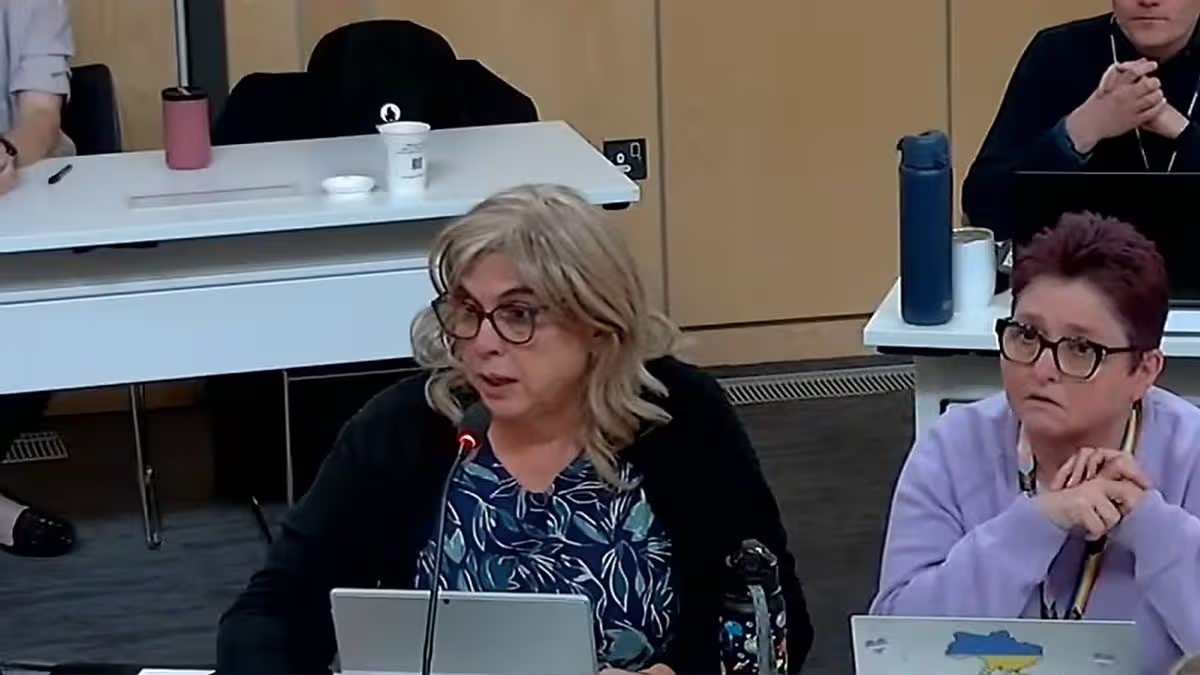
Cllr Bryony Goodliffe said that a Freedom of Information request had shown that using the fund for vouchers “was not ‘banned’” as the council leadership had said in “repeated public statements in full council, in response to public questions to council and committees”.
In a written question submitted to the county council, the Labour councillor said that as recently as March, they claimed guidance said the fund “may not be” used for the blanket provision of vouchers to those on free-school meals.
Cllr Goodliffe said the guidance actually says that it “may or may not be” used for this purpose and the FOI proves the council was told this in January 2026.
Advertisement
Cllr Alison Whelan, chair of the communities, social mobility and inclusion committee, provided a written response which said the wording had been changed on March 20.
She added: “This phrase, like its predecessor, needs to be read in context of the rest of the sentence as it makes clear that ‘blanket’ provision is not acceptable, as individual assessments are required for all support”.
She said this understanding “aligns with the interpretation by other councils” and they will be discussing how to use the CRF at a committee meeting in June.
Cllr Goodliffe, speaking at a meeting of Cambridgeshire County Council, said she believed the response “is materially inaccurate” and “therefore risks misleading the council”.
Advertisement
Cllr Whelan replied that “it’s not appropriate to comment” and “the question was asked and the question was answered”.
Prosecutors also claimed examination of his phone indicated he may have been in contact with up to 30 women
06:00, 22 May 2026
Advertisement
A Belfast man allegedly drugged and raped young women suffering from addiction as part of a campaign of sexual exploitation, the High Court heard on Thursday.
Trevor Donaghy, 45, is accused of attacking two vulnerable victims injected with substances and luring a third into prostitution.
Prosecutors also claimed examination of his phone indicated he may have been in contact with up to 30 women.
Details emerged as Donaghy, of Ainsworth Drive in the city, was refused bail on a total of 20 new charges involving three complainants.
Advertisement
He faces multiple counts of rape, supplying cocaine and administering a substance with sexual intent, along with further offences of aiding and abetting rape and controlling prostitution for gain.
Donaghy is already facing prosecution over separate allegations of trafficking another young woman with reading and writing difficulties.
He allegedly gave her drugs in return for sex and arranged to have other men pay him to sleep with her back in 2021.
Donaghy has denied those claims and described their relationship as being “friends with benefits”, the court heard.
Advertisement
While previously on bail for those charges, detectives pursued an investigation into separate complaints from three other women in connection with alleged incidents during 2021 and 2023.
Crown counsel said they were among 30 females identified following analysis of the defendant’s phone.
The others were either unwilling to engage with police, accepted being willing sex workers or denied a relationship with Donaghy.
Some have also been assessed as too mentally unwell to co-operate.
Advertisement
However, one of the three alleged victims claimed she met Donaghy as a teenager in the grip of a worsening drug addiction.
He initially provided cocaine, cannabis and pregabalin before insisting she had to “earn” her supply by having sex with him, according to her account.
The defendant also allegedly encouraged her into prostitution, posting photos on a sex worker website and lending his car to meet punters.
During police interviews Donaghy admitted supplying drugs and having consensual sex with her, but denied all other accusations.
Advertisement
A second woman claimed she was raped by him on three separate occasions.
In one incident she passed out after smoking crack at his home, the court heard, waking up the next morning naked from the waist down and in pain.
On another occasion she allegedly let him inject her with what was believed to be liquid cocaine, expecting it would give her a high.
“Instead, she became sick, dizzy and remembers asking him not to inject any more, but he continued to do so,” the prosecution barrister said.
Advertisement
“She remembers him on top of her but couldn’t fight him off and she then lost consciousness.”
The third complainant told police Donaghy attacked and raped her after she went to his house to buy drugs.
She claimed in a separate incident he provided a white bodysuit and injected her with a substance which made her drowsy.
Counsel added: “She remembered going into a bedroom and four or five men coming in one by one, unzipping the body suit and raping her.
Advertisement
“She saw the men giving Donaghy money (and) afterwards he gave her more drugs.”
Opposing bail, the prosecutor contended: “Any woman that is involved with him intimately is at risk. It is an insidious and dangerous risk.”
Defence barrister Paul Burns stressed Donaghy provided full accounts to police in which he denied allegations made against him.
Suggesting possible issues around the credibility of the complaints, Mr Burns went on: “He described a lifestyle with various women at that stage of sharing drugs and having consensual sexual relationships.”
Advertisement
Refusing to release Donaghy on bail again, Judge Patrick Lynch KC cited the risks of re-offending and interference with witnesses.
The judge also stated: “Even on his own case he is guilty of supplying drugs as a man in his forties to teenage girls.”
Asked whether he would be out campaigning in Makerfield, Sir Keir said: “Yes, and I’ve said to the whole Labour movement that I want everybody to be involved in the campaign, whatever other discussions are going on, it’s really important – that’s a straight fight between Labour and Reform.
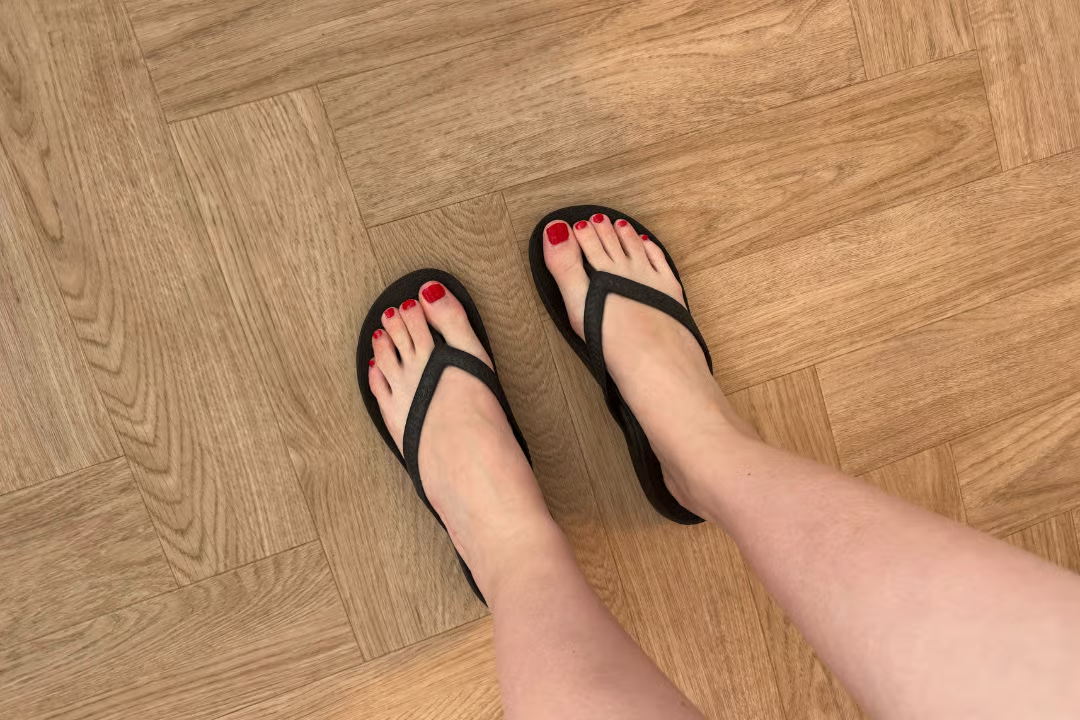
Archies arch support flip flops have quickly become my go-to, and that’s saying something, given I’m usually desperate to ditch boots and trainers the moment the sun makes an appearance.
Over the years, I’ve tried my fair share of flip flops and sandals, and the same issue keeps cropping up – they rarely offer proper arch support. That’s when I came across Archies. After seeing how much of a difference they made for my mum – who has plantar fasciitis – I tried them myself, and it wasn’t long before I picked up my first pair.
Now, I have the flip flops in three colours – white, black, coral, and pretty much wear them all summer long. There’s just the one classic, signature style available (alongside slides), and a wide range of colours, including butter yellow, brown, and hot pink.
Advertisement
Designed by physiotherapists, each pair is crafted from a single piece, giving your feet a more secure, stable feel, with no worrying about the thong pulling loose from the sole. The built-in arch support is engineered to promote proper alignment, while the closed-cell foam footbed gradually moulds to your feet, creating a fit that feels increasingly personalised with every wear.
Whether your feet are narrow or on the wider side, the straps are designed to sit securely without digging in. Although I felt the tiniest bit of rubbing for the first day of wear, there was none of that typical soreness or blisters that you get with new flip flops – a dream. Each pair’s flexible, slightly stretchy construction adapts to different foot shapes, keeping everything comfortably in place.
They’re fantastic for wear around the pool or at the beach, too. As they are crafted from one singular piece of foam, and do not contain any fabric or glued parts, they are waterproof, so can get wet and be rinsed down.
“We’ve managed to put ourselves in a position where we kind of are in the position that we are in the league, and I’ve said that we wanted to finish strong for ourselves as much as anything, so we’re approaching the game as we would any other game. There’s a lot to play for Brighton, for Bournemouth, for all the other clubs surrounding that, so we’re well aware of that.”
More than 1.7 million pensioners across Great Britain are now receiving Attendance Allowance, but claimants must report certain changes in circumstances or risk having their payments reduced or stopped
Linda Howard Money and Consumer Writer and Ashlea Hickin Content editor
20:22, 21 May 2026
Over 1.7 million pensioners throughout Great Britain are currently in receipt of Attendance Allowance, a tax-free, non-means-tested benefit available to those aged 66 and over. However, recipients must notify the relevant authorities of certain changes in their circumstances without delay — or risk having their payments of up to £458 a month reduced, suspended or even facing a financial penalty.
Guidance issued by the Department for Work and Pensions (DWP) is unambiguous: failing to declare a change could result in overpayments, fines or even prosecution. Even short-term changes, such as a period of hospitalisation, can have an impact on eligibility.
Attendance Allowance is administered by the DWP to assist pensioners with additional costs arising from disability, long-term illness or physical or mental health conditions. Following the annual uprating in April, payments now stand at either £76.70 per week at the lower rate or £114.60 at the higher rate.
Advertisement
Attendance Allowance is no longer accessible to claimants with a Scottish postcode, who instead receive Pension Age Disability Payment through Social Security Scotland. Both benefits are paid at identical rates and operate under broadly similar eligibility criteria.
DWP regulations stipulate that claimants must contact the Attendance Allowance helpline promptly should their condition change, their care needs increase or decrease, or their personal circumstances shift in any way that could affect their claim, reports the Daily Record.
If you are uncertain whether a change warrants reporting, the wisest course of action is to ring the helpline and seek clarification — as overlooking it could jeopardise your weekly payments. DWP guidance on GOV.UK also cautions: “You could be taken to court or have to pay a penalty if you give wrong information or do not report a change in your circumstances.”
The guidance proceeds to outline changes claimants are required to report, which are detailed below.
Advertisement
Reporting a change in circumstances
Should your circumstances alter, your Attendance Allowance payments may rise, fall or cease entirely.
You must contact the Attendance Allowance helpline immediately if:
The level of help you need changes or your condition worsens or improves
You go into hospital or move into a care home (you’ll need the address, dates and details of how the stay is funded)
A medical professional has said you may have 12 months or less to live
You plan to leave the UK for more than four weeks
You go into prison
You change your name, address or bank details
You want to stop your claim
Your doctor changes
Your immigration status changes
If you are uncertain whether something constitutes a change, it is preferable to contact the DWP and verify rather than risk an overpayment or suspended claim.
Reporting a change if you need more help
You should also contact the DWP if you now require additional assistance due to a disability or illness – even if you are not currently receiving that support.
This includes requiring:
Advertisement
Help with personal care such as dressing, eating, getting in and out of bed, bathing or using the toilet
Supervision to stay safe during the day or at night
You should report a change if tasks are taking considerably longer, causing discomfort, or you need physical assistance such as something to lean on.
Attendance Allowance is not restricted to physical conditions. You may also qualify for a higher rate if you need more help due to:
A mental health condition
Learning difficulties
A sensory condition, such as being deaf or blind
The Attendance Allowance helpline is 0800 731 0122 and operates Monday to Friday, 8am to 6pm.
A woman whose first job left her questioning if she was “too stupid to work” is now helping other young people who have struggled since leaving school.
Georgia Sweeney was diagnosed with dyslexia while still at school. At the age of 17, she started attending college, but the condition made her studies a challenge, and she eventually dropped out after it began affecting her mental health.
Later, she secured a six-month apprenticeship at an insolvency firm’s office. However, what started well soon changed a few months into the job.
Click here to get the biggest stories straight to your inbox in our Daily Newsletter
Advertisement
Feeling she lacked the training and experience of the person who last held her role, it all came to a head when, just 30 minutes from the end of her shift, Georgia was pulled into the main office. She recalls an upsetting meeting in which her employers raised an incident that happened while she was taking a call that afternoon.
Georgia said one manager told her she could potentially cost the business “millions of pounds” if her mistake hadn’t been spotted. She was given an ultimatum – work her two-week notice or quit. Tearfully, she grabbed the things and walked out of the office for the last time.
Georgia, who lives in Collyhurst, said: “I quite enjoyed it in the beginning. Then I found out that the person I was replacing was someone much older than me – I think they were 27.
“They were also doing an apprenticeship, but theirs was through university, and they were getting, I believe, a degree or some qualification in accounting.
Advertisement
“The workplace very much expected me to work at the same level as the person that I had been replacing, which isn’t feasible.
“I found it extremely difficult. There were many tasks that I didn’t understand, things that they expected me to know. The training was quite brief, and I was really struggling with it because I felt like I was being a burden by asking questions.
“They were also not very flexible with the fact that I’m a carer. I was a carer at that time, I’m still a carer now, and there wasn’t really any flexibility with that.
“I ended up leaving because it just made my mental health so bad. By the end I was pretty much like turning up crying in the car park outside coming into work.”
Advertisement
‘Am I too stupid to work?’
After she left the job, Georgia said her confidence crashed to an all-time low.
“I had lasted for about six months there,” she said. “Which is probably longer than I should have done. I felt it was quite damaging.
“I had no confidence in myself, thinking, how could I ever work a job when I had done so badly at my first one? Is this what everything’s supposed to be like?
“Honestly, it was like, am I too stupid to work? That’s the thought that I had for quite a while.”
Advertisement
After leaving her job, Georgia said she was in a “bad place” and ended up taking time off from education or employment while she struggled with her mental health.
While some may say Georgia was unlucky in her first work experience, the statistics show that many young people are finding themselves in career limbo. They’re not employed, in apprenticeships, or in education.
Research by Health Equals, an organisation that campaigns for health opportunities and highlights health inequalities across the UK, has revealed that young people growing up in the UK’s lowest‑income households are over three times more likely to be out of work, education or training than those from the wealthiest homes.
Often known as NEET: Not in Education, Employment or Training, the research also found that the number of NEET young people with a mental health condition has doubled over the last 15 years.
Advertisement
Of those 16-24 year olds who were NEET, 30% had a likely mental health condition in 2009-10, increasing to 60% in 2023-24.
As Georgia struggled with her confidence and mental health, her doctor put her in touch with the Manchester charity 42nd Street.
42nd Street is a young people’s mental health charity that provides free and confidential services to young people who are experiencing difficulties with their mental health and emotional wellbeing.
It was there that Georgia recommended Cognitive Behavioural Therapy (CBT). “I just wasn’t leaving the house, and I didn’t want to get up… I didn’t want to do anything,” said Georgia.
Advertisement
CBT helped her get on top of her social anxiety to the point she was able to use public transport and have the confidence to speak to people again.
“After being shouted at and things in the office I was really anxious to talk to anyone because I was like, well this person might start shouting at me again,” Georgia added.
“CBT really helped that. I was also recommended to go to night classes because I wanted to do more. As much as I wanted to go out and get a job, there was this big barrier because I’d done it before and it had all gone horribly wrong.
“So I went to night classes because there were less people. I could focus on the single subject that I wanted to do instead of having to do four or five subjects.
Advertisement
“It also gave me time to fix my mental health.”
Georgia said when her course of therapy at 42nd Street was coming to an end, she didn’t feel ready to leave, and so she started taking part in the organisation’s support groups.
Advertisement
This helped her rebuild her confidence and eventually return to education, where she trained as a youth worker. Now 26, Georgia runs women’s and youth groups and works as a Peer Consultant on an employment program, helping young people access meaningful work and understand their options.
‘They say it’s not worth their while to get a job’
Georgia now says she wants to help people in a way she didn’t get when she needed help.
Reflecting on her troubled first experience of work, she says: “I definitely think I got bad luck in replacing someone who was older than me. It was a job role that I just wasn’t fit for, and I suppose I didn’t know it at the time.
“But I definitely see young people and my peers coming to talk to me about not feeling ready to be in work.
Advertisement
“I think sometimes workplaces want people who already know what they’re doing. There’s a lack of wanting to train people. I’ve had chats with people trying to get jobs, even retail jobs, and they tend to want you to have worked at a till before, regardless of your age.
“They want you to have some knowledge and not need as much training as the next person might need.”
One of the reasons Georgia cites for why young people are getting stuck and becoming classified as NEET is a lack of entry-level jobs, particularly ones that make it worthwhile for young people to work rather than stay on benefits.
“From the young people I’ve spoken to, and that I work with, generally they say it’s not worth their while to get a job. It’s the simple fact that having a job doesn’t pay to live anymore.
Advertisement
“You know that through benefits things get paid, like housing gets paid, and you might get a cut in council tax and things like that.
“When you’re getting a job, you have to accommodate for the fact that you now need to pay all the things that your benefits are currently paying for, but you also need to afford to be able to travel to your job, you may need to afford to get better internet if you work from home instead.
“You might need extra food to take lunches. There are all these extra expenses that you have to calculate when you’re getting a job.
“If you’re under 25, minimum wage is lower for you than it is for someone over 25. And I think there’s this idea that maybe [young] people are still living at home.
Advertisement
“But for those that aren’t living at home, they either need to work more hours or get a job that’s much higher than minimum wage. Which, for anyone, even people with degrees and experience, they’re hard jobs to find.”
Georgia also feels schools could play a bigger role in preparing young people for the world of work, rather than just academic tutoring. This would include mental health and general life skills, as well as greater financial education.
“I think we’re still very much stuck on the fact that you go to high school, you go to college, you go to university, you get a job,” said Georgia.
“I talk to young people, and they are so incredibly smart, but they may have missed a year of university for their mental health and feel that they’ve completely destroyed their life already. And you know, they’re 19, 20, and they’ve kind of gone, ‘Oh, that’s it, I didn’t do the path the right way the first way.’
Advertisement
“But there are other ways to do things and just because you’ve had that break or that stop for your mental health doesn’t mean that you’ve suddenly destroyed your path or the way into work.”
Dr Luke Munford, a Health Economist at the University of Manchester who carried out the analysis for Health Equals, said: “Our analysis shows a worrying reversal in progress. After years of decline, the proportion of young people who are NEET has risen again. Even more striking is the sharp increase in mental ill‑health among NEET young people: double the rate seen among Millennials.
“The evidence is clear: government must offer a package of support to meet mental health needs, expand high‑quality training and apprenticeships, and target resources to regions and groups facing the greatest disadvantage. Without decisive action, we risk embedding inequalities that will shape outcomes for decades to come.”
Health Equals is calling for the government to invest in community-based support to get people back into employment, and work with employers and education providers to prioritise prevention to stop people from becoming NEET in the first place.
People across the UK have been issued the urgent message
The British Veterinary Association (BVA) has issued a warning on its website, advising dog owners to take precautions next week. This follows a Met Office forecast predicting temperatures of up to 32C on Sunday (May 24) and Monday, with warm conditions expected across London and rising temperatures also set for cities including Glasgow, Manchester, Aberdeen, Liverpool, Belfast and Brighton.
Advertisement
With the Spring Bank Holiday falling on May 25 for people across England, Scotland, Northern Ireland and Wales, experts are urging pet owners to be cautious over the long weekend. They recommend walking dogs early in the morning or later in the evening, and avoiding the hottest part of the day to reduce the risk of serious or potentially life-threatening heat-related illness.
Urging people to take action and walk them when it’s safe, it warns: “Each summer, vets across the country report seeing large numbers of cases involving dogs who require treatment for heatstroke, burnt paw pads, sunburn and breathing difficulties, with some dogs sadly unable to be saved as a result.
“Unlike people, dogs struggle to stay cool in high temperatures and humid conditions because they are unable to cool down quickly through sweating, making them vulnerable to overheating. Even a very short walk in the middle of the day or being locked in a car for a few minutes can be fatal.
“Panting is a dog’s main way to cool its body temperature. That is why flat-faced breeds such as English bulldogs and pugs, are at even greater risk, as their short muzzles can make breathing difficult. Overweight, old and densely coated animals are also at increased risk.”
BVA president Dr Rob Williams MRCVS said: “While many of us will be looking forward to finally enjoying a bit of sunny weather this Bank Holiday weekend and in the coming week, our pets will need extra care to be safe from heatstroke and other heat-related illnesses.
“Make sure all pets have access to fresh drinking water, good ventilation and shade from direct sunlight at all times. When it comes to walking or exercising dogs, it’s important not to take them out during the heat of the day – stick to early morning or late evening walks only, and never leave them inside a car, caravan or conservatory even for a little while.
“It helps to recognise early signs of heatstroke as quick action could save your pet’s life. In dogs, signs of heatstroke include heavy panting, drooling, restlessness, bright red or very pale gums, and lack of coordination.
Advertisement
“If you suspect heatstroke, take your dog to a cool, well-ventilated place, give it small amounts of cold water to drink if possible, and pour cold water over the body to cool it down, before contacting your vet.”
BVA’s top tips to keep dogs safe in hot weather
Use the five-second tarmac test before walks: place your palm on the pavement for five seconds. If it’s too hot for you, it’s too hot for your dog’s paws.
Never leave dogs inside vehicles. If you see a dog in distress in a hot car, call 999 immediately.
Be alert for signs of heatstroke, including heavy panting, drooling, restlessness, bright red or very pale gums, and poor coordination.
If heatstroke is suspected, move the dog to a cool, well-ventilated area, offer small amounts of cold water, and cool them with cold water. Contact a vet immediately for urgent advice.
Always ensure pets have access to fresh drinking water, good ventilation, and shade from direct sunlight. Indoors, provide cooling aids such as a fan or cooling mat.
Avoid exercising dogs during the hottest part of the day. This is especially important for older dogs, overweight dogs, flat-faced breeds, and dogs with heart or lung conditions. Walk dogs early in the morning or later in the evening instead.
The speed limits will be in place on sections of a motorway and dual carriageway in Cambridgeshire
Motorists will face reduced speed limits on a major motorway and dual carriageway in Cambridgeshire for more than a year. Reduced speed limits of 40mph and 50mph will be in ofrce on different sections of the M11 and A14 whilst reconstruction works are carried out.
Advertisement
Daily speed limits have already been put in place at different points of the A14 and M11 whilst safety works to the central barrier are taking place. Repairs to the embankment are due to begin soon with the work expected to be carried out from July 2026 until the end of 2027, according to National Highways.
Roadworks near the Girton Interchange will mean lower speed limits are applied to the A14 westbound, the M11 southbound, and the road connecting the two at Junction 14. This means that up until the end of 2027, restrictions on the southbound will be in place.
The 40mph section on the A14 westbound begins at about 400 metres east of the Girton Road Overbridge and lasts for around 800 metres, according to a traffic order. The M11 and A14 southbound carriageways will be restricted to 40mph.
The A14 westbound 50mph speed limit starts further east of the Girton Road Overbridge and stretches for about 800 metres. A traffic order notice, for the embankment reconstruction works, said that a 50mph speed limit will be in place on the “southbound carriageway of the M11 from a point 1115 metres north of Girton Interchange Underbridge, for a distance of 700m”.
Advertisement
A National Highways spokesperson said: “We will be carrying out repairs to the embankment along a small section of the southbound M11 around junction 14 to keep it safe.
“The work will be carried out using narrow lanes and reduced speed limits to minimise disruption from July 2026, and we expect this to be completed by the end of 2027.”
According to an order notice, the road that links the A14 westbound to the M11 southbound at Junction 14 will be closed overnight between the hours of 8pm and 6am or for some consecutive 24-hour periods.
Traffic would be diverted via the A14 westbound carriageway to Junction 25 at Bar Hill and return via the A14 eastbound carriageway to join the M11 at Junction 14 and continue their journey. The speed limits and closure will be clearly indicated by traffic signs.























































You must be logged in to post a comment Login