

Crypto World
Solana kept quiet about Alpenglow upgrade breakages



Anatoly Yakovenko told an applauding Consensus Miami 2026 conference earlier this month that Solana would be upgrading to Alpenglow, heralding a live testnet within a week as evidence that it’s “basically due sometime this year, I think next quarter.”
According to developers implementing that upgrade, Alpenglow actually broke while going live.
Anza, the Solana development outfit leading the rollout, left that error out of the mainstream press cycle.
Alpenglow is supposed to be the largest consensus change in Solana’s history, and is supposed to replace proof-of-history which has cryptographically ordered Solana’s network since launch.
Validators approved it in September 2025 with 98% voting in support. Anza, the dev shop, marketed the upgrade as a “100x” improvement to transaction finality, allegedly cutting transaction finalization from 12.8 seconds to about 150 milliseconds.
Yakovenko spoke at Consensus Miami on May 5, praising the potential of Alpenglow. Days later, as promised, it went live on a cluster — and promptly broke.
That day, Anza spokesperson Max Resnick broke the news about the testnet launch to Decrypt, claiming it was “a really exciting milestone” while omitting that it had actually failed and restarted.
On the Solana Foundation’s May 14 weekly validator call, Anza engineer Ashwin Sekar admitted to the real story. Over 40 nodes joined the May 11 cluster running Alpenglow.
Then the migration broke.
‘The next go-around, we were able to successfully perform’
“As usual, the first try did not work,” Sekar admitted on a May 14 call to a niche audience.
He went on to describe the incident, “There was a bug in, you know, the most recent master commit of TowerBFT and proof-of-history.”
TowerBFT is Solana’s proof-of-history-compliant consensus algorithm.
Anza pushed a hotfix and tried relaunching. Sekar added that engineers were hard at work, “We patched it.
The next go-around, we were able to successfully perform the migration.” He also disclosed a second bug, a validator that accidentally banned peer connections, which Anza patched as well.
None of those errors made it into mainstream press cycles.
Read more: Solana validator logs 32 delinquencies, foundation still claims ‘100% uptime’
Solana could upgrade beyond Proof-of-History by September
Outlets covering the May 11 activation, including TheStreet, Decrypt, CoinMarketCap, and many others reported it as a clean success. Anza’s initial framing of a well-executed migration carried through the news cycle unchallenged.
Coverage of the bug existed mostly within a small audience on YouTube who bothered to watch a recording of a validator meeting.
Yakovenko’s next-quarter claim, which he made in early May, implies a Solana mainnet activation of the Alpenglow upgrade by September 30, 2026.
Solana’s mainnet has halted multiple times in its six-year history, including at least four outages within one 12-month period.
Got a tip? Send us an email securely via Protos Leaks. For more informed news and investigations, follow us on X, Bluesky, and Google News, or subscribe to our YouTube channel.

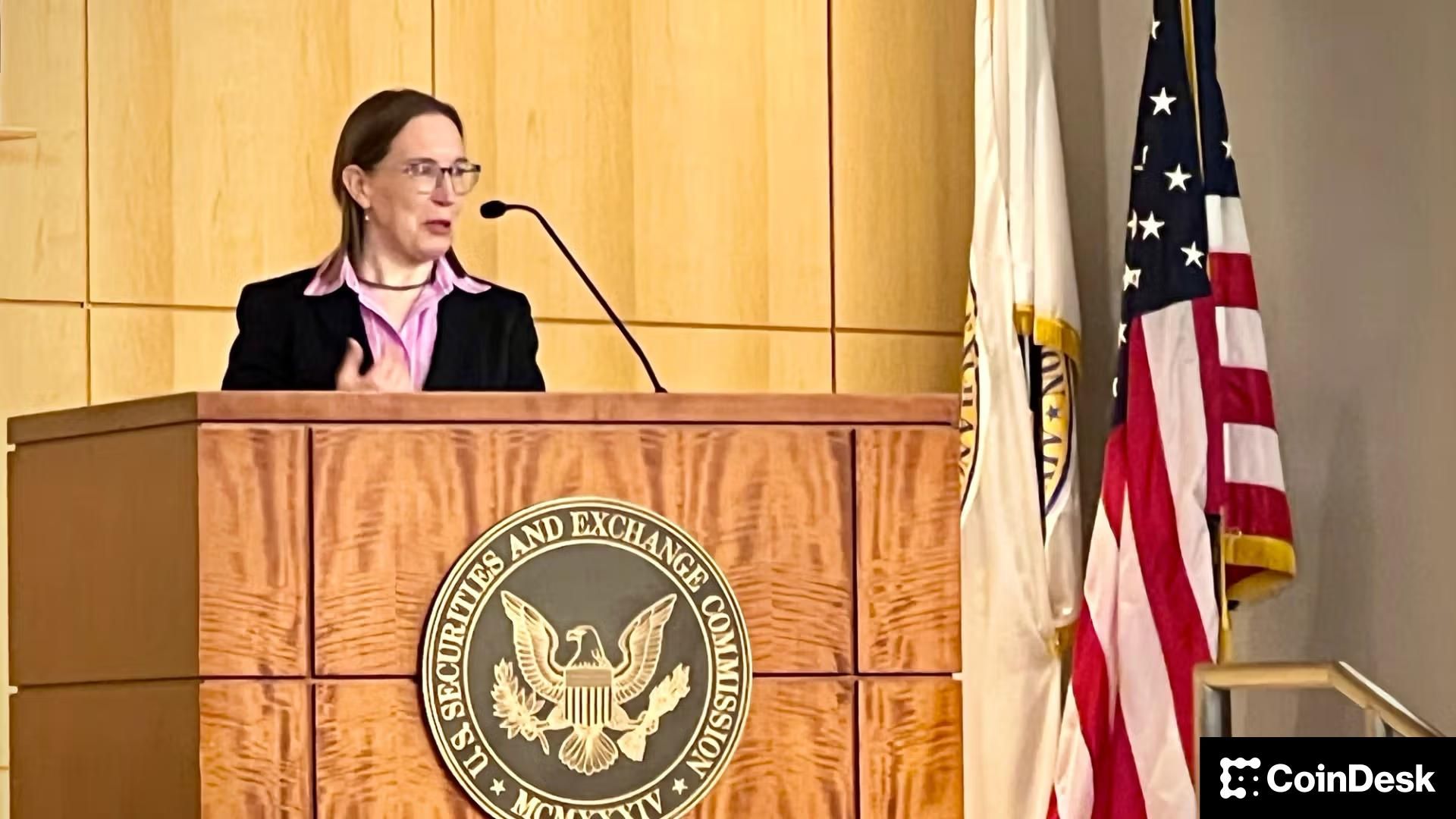

The long-awaited U.S. Securities and Exchange Commission rule to begin allowing tokenization of securities — a change that could have profound effects on the financial markets — has been facing the contentious perception it’ll allow synthetic tokens, but a commissioner has taken the unusual step to post statements about the unpublished rule to potentially counter those views.
SEC Commissioner Hester Peirce, who had pushed for safe harbors for tokenization well before the arrival of the new chairman under President Donald Trump, issued a pair of statements on social media site X on Thursday and Friday to clarify what she expects from the rule that’s set to emerge soon. Her posts suggested that the proposed rule won’t pave the way for synthetic tokenized securities — third-party tokenization that references a security but doesn’t carry the equity, voting and other rights associated with the security.
Peirce, the commissioner behind the SEC’s Crypto Task Force, wrote that she expects the coming rule would be “limited in scope & would facilitate trading only of digital representations of the same underlying equity security that an investor could purchase in the secondary market today, not synthetics.”
Peirce posted again to explain what she meant by synthetics, directing people to read the SEC’s January statement on tokenized securities, “which distinguishes tokenized versions of issuer-sponsored stocks and of stocks that SEC-registered firms hold for their customers from synthetic instruments that provide exposure to stocks.”
The flames had been fanned by Bloomberg News reporting this week that predicted the agency was leaning toward including a path for synthetic tokens tradeable on decentralized crypto platforms. Peirce said she appreciates the public’s keen interest in the rule “but not the hyperbole” about it.
Peirce did not return a request for comment about her posts.
The consequential rule will represent the most meaningful step the SEC has taken to-date to forge a new regulatory approach to crypto trading in the U.S. Chairman Paul Atkins has been saying for months that his agency is poised to release the wide-ranging proposals to provide regulatory exemption in the crypto space.
He outlined some of the effort in a March speech at the DC Blockchain Summit, saying the agency was contemplating safe harbors from certain regulatory demands for various crypto activities, including giving startups something like four years of registration exemption “provide developers with a regulatory runway during which they could work to reach maturity”; a “fundraising exemption” for certain crypto assets in which “entrepreneurs could raise up to a defined amount (say $75 million) during any 12-month period”; and an “investment contract safe harbor” to keep certain crypto assets from being defined as a regulated security, with the safe harbor triggering when the issuer finishes all their managerial efforts.
Atkins said at the time that Commissioner Peirce’s “fingerprints are all over” the SEC’s rulemaking.
While the SEC — alongside its sister agency, the Commodity Futures Trading Commission — has been writing crypto rules, Atkins and CFTC Chairman Mike Selig have said they’re doing so with the understanding that Congress is right behind them with the Digital Asset Market Clarity Act to put some of the same ideas into permanent law.
“Only Congress can ensure that regulation in this area is future-proofed through comprehensive market structure legislation,” Atkins said in March.
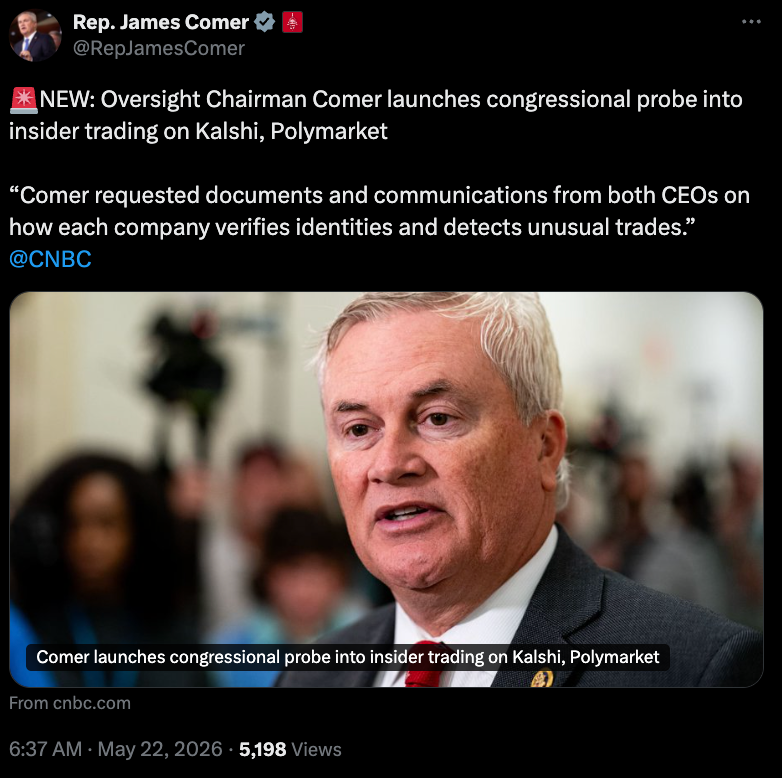
The chair of the US House of Representatives’ Oversight and Government Reform Committee sent letters to the CEOs of Kalshi and Polymarket, questioning the companies’ response to incidents of insider trading on the platform.
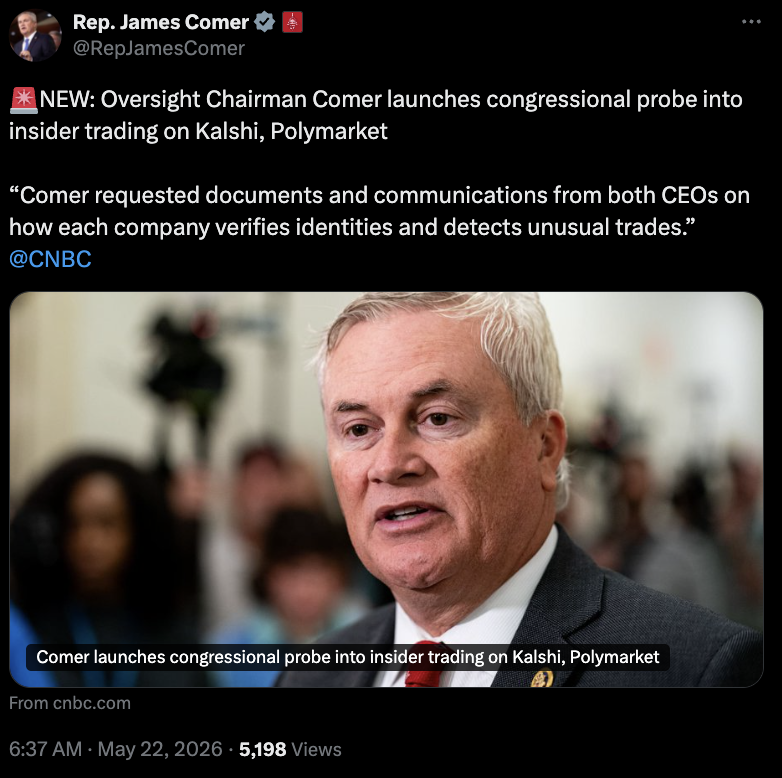
In a Friday X post, Committee Chair James Comer confirmed reports that he had sent letters to Polymarket CEO Shayne Coplan and Kalshi CEO Tarek Mansour, asking them for internal records on how the companies were handling insider trading. The Kentucky lawmaker said there were concerns in Congress over elected officials using “basic insider knowledge” to profit off the government’s actions.
“More than 80 suspiciously timed trades were placed ahead of Iran military operations,” said Comer. “Politicians and government officials with inside information are placing bets and taking profits. This insider trading must end.”
Source: James Comer
The “suspiciously timed trades” to which Comer was referring included those from a May 13 New York Times report, detailing incidents of prediction market users betting on Israel’s military actions against Iran, US President Donald Trump announcing a ceasefire in the country’s war with Iran and event contracts related to congressional elections.
Polymarket said in March that it had updated its approach to potential insider trading on the platform, while Kalshi announced in April that it had banned three US politicians for betting on their own races.
Related: Polymarket team says user funds safe as exploit losses climb above $600K
Cointelegraph reached out to Polymarket and Kalshi for a response on the House inquiry but did not receive an immediate response from either company.
US soldier who allegedly profited from Venezuela bet still in court
In April, the US Justice Department announced a criminal indictment against Master Sergeant Gannon Ken Van Dyke, a soldier who was involved in the military operation that led to the capture of Venezuelan President Nicolás Maduro. Prosecutors alleged that Van Dyke used event contracts on Polymarket related to Maduro’s capture to profit by more than $400,000 using classified information.
Van Dyke pleaded not guilty to the charges, which included commodities fraud and the unlawful use of confidential government information for personal gain. He was released on $250,000 bail and limited to traveling between areas of North Carolina, California and New York.
Magazine: ETH bears growling, Tom Lee’s buying, XRP to ‘explode’: Market Moves
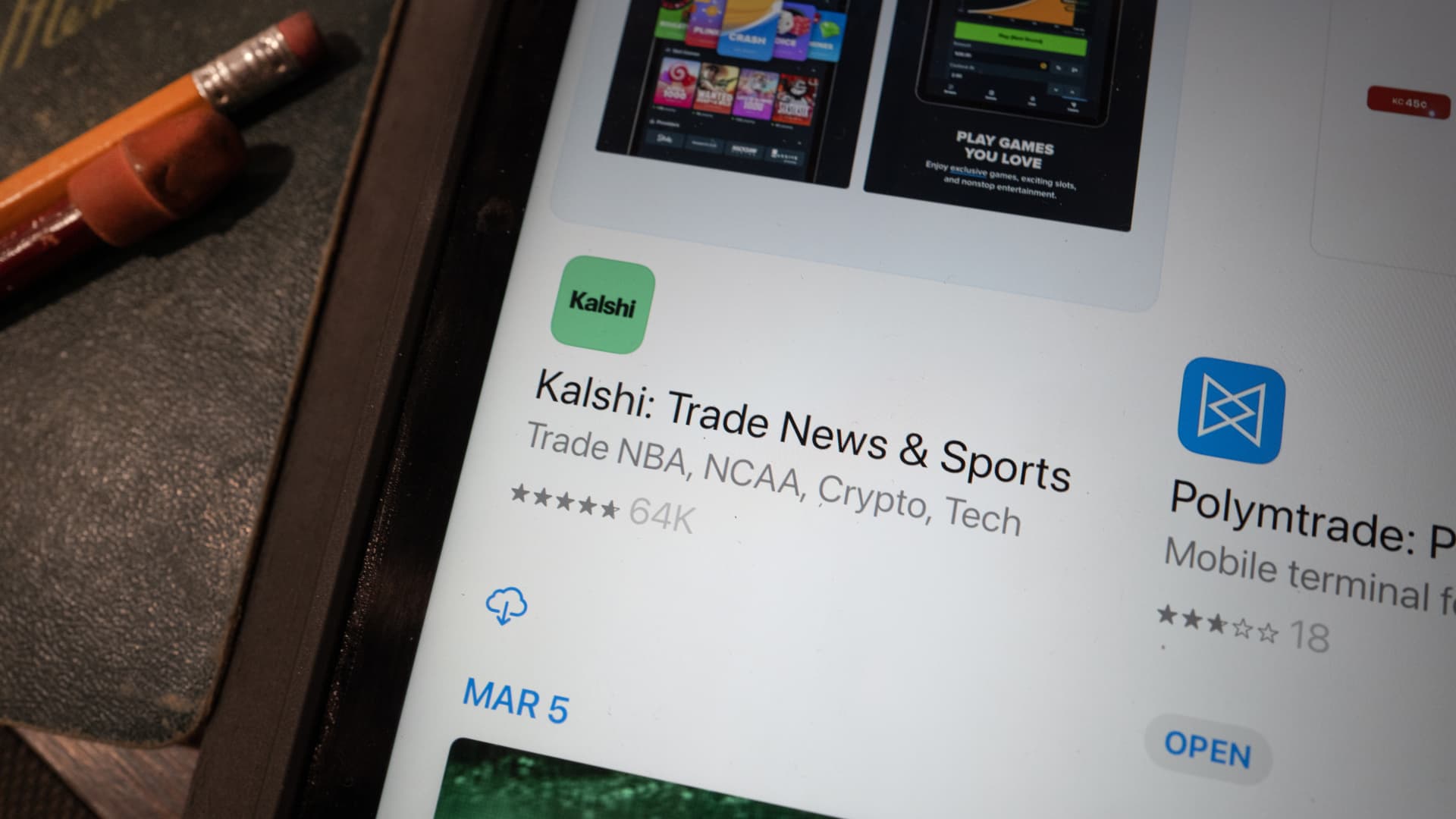
In this photo illustration, Apps for online prediction market sites are shown on an electronic device on Feb. 25, 2026 in Chicago, Illinois.
Scott Olson | Getty Images
States and the federal government may be battling over who has the power to regulate prediction markets, but the companies building them are chugging along as the platforms continue to experience huge growth.
The Commodity Futures Trading Commission and six states across the country are in lawsuits over who has the jurisdiction to develop regulations on event contracts. Seventeen states in total are challenging companies with prediction markets — like Kalshi, Polymarket, Coinbase and Robinhood — and one has moved to ban them entirely.
States are arguing that they have the ability to regulate these platforms due to their sports businesses, which they say are equivalent to gambling. Sports event contracts make up the majority of volume on prediction markets. However, the CFTC argues its right to regulate swaps and derivatives places all of these contracts under its jurisdiction.
Congress is also stepping in with its own plans. House Oversight and Government Reform Committee Chairman James Comer told CNBC’s “Squawk Box” on Friday that he is seeking information from Kalshi and Polymarket’s CEOs on their internal efforts to regulate insider trading.
But legal uncertainty isn’t halting the confidence to invest in growing these platforms, based on comments from private companies’ leadership and private ones’ valuations.
“There’s a lot of noise around the legal position-setting prediction markets,” said Flutter Entertainment CEO Jeremy Peter Jackson in its earnings call earlier this month. Flutter owns FanDuel Predicts. “Until we get through and understand ultimately what the Supreme Court says, I think we’re going to live with this uncertainty.”
Jackson said his company will continue to invest in market-making on third-party prediction market platforms, a new strategy it unveiled in its last earnings report, despite the legal questions.
People walk by a banner outside of the New York Stock Exchange (NYSE) for the IPO of Flutter Entertainment, the parent company of FanDuel, on January 29, 2024 in New York City.
Spencer Platt | Getty Images
DraftKings CEO Jason Robins said on a May earnings call that he sees the investment in the company’s prediction market platform as a long-term one.
“Obviously, there’s always the chance that something regulatory wise or other changes, but assuming a consistent environment to what we see today, I expect that we’ll continue to invest in 2027.”
Legal questions aren’t slowing down private company growth either. Kalshi said its valuation is now $22 billion after a recently announced funding round, rising from $11 billion in December. Polymarket’s reportedly $15 billion valuation is up from $9 billion in October.
Terrence Duffy, CME Group CEO — which helped develop FanDuel Predicts — said on an earnings call last month that while the legal fuss is over sports, other event contracts like on economics, politics and financial predictions are under less scrutiny. That’s why he thinks they’re growing. Bernstein estimates sports contracts will make up only about 30% of volumes by 2030.
While he disagrees with the states, Robinhood CEO Vlad Tenev said he understands their frustrations.
“I would love it if the states didn’t have concerns, but it’s also … not irrational, right?” he said on Robinhood’s April earnings call. “This is a jurisdictional dispute … and this is something that’ll play out in the coming years.”
Disclosure: CNBC and Kalshi have a commercial relationship that includes customer acquisition and a minority investment.
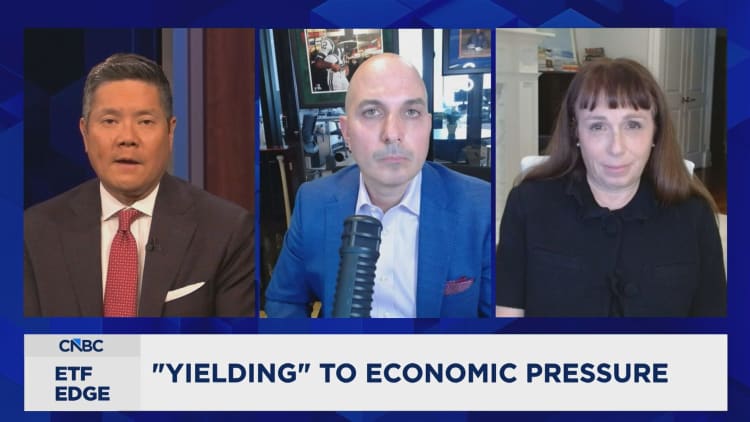

U.S. treasury bonds typically occupy a special place in an investor’s portfolio — the asset class against which all other market risk is measured. But a surge in long-dated yields is forcing investors to rethink this assumption.
The yield on the 10-year treasury recently surged to a level it had not seen in over a year, while the 30-year treasury yield this week hit a level it has not seen since 2007 — right before the financial crisis. The moves are being driven by geopolitical conflict and an oil price shock that have rekindled inflation and resulted in a growing consensus that the Federal Reserve will not lower rates at the next meeting, the first since new Fed Chairman Kevin Warsh was confirmed with a mandate from President Trump to bring rates down. In fact, traders are now betting there will be no interest rate cut over the remainder of 2026, and that a rate hike is becoming more likely. Warsh was being sworn in by Trump on Friday.
The shift in bond market assumptions is a wake-up call for investors in an asset class that has long been called a “safe haven” due to bonds’ predictable income and guarantee of the return against maturity. HSBC wrote in a note this week that U.S. treasuries are now in a “danger zone.”
On Friday, the 10-year U.S. treasury yield was at 4.57% while the 30-year treasury bond was up to 5.08%.
CHICAGO – MARCH 28: Traders in the Ten-Year Treasury Note options pit at the Chicago Board of Trade signal offers in a flurry of activity following the announcement by the Federal Open Market Committee that it was raising short term interest rates another .25 percent March 28, 2006 in Chicago, Illinois. Trading in the pit was at a trickle in the moments leading up to the announcement. The raise was the 15th consecutive increase by the Fed and the first since Ben Bernanke took over as chairman of the FOMC.
Scott Olson | Getty Images News | Getty Images
JoAnne Bianco, senior investment strategist at BondBloxx Investment Management, voiced similar concerns on CNBC’s “ETF Edge” podcast this week. “You are calling it the risk-free rate. It is not risk free. There is a lot of risk associated with this,” she said.
“Now the next likely action is they are going to be raising rates at some point, potentially starting later this year,” she said.
The bond market action leads Bianco to make two recommendations for fixed income-focused investors. While a higher yield offers investors more income, it also punishes bond prices. Bianco suggests investors focus on the intermediate part of the treasuries curve, specifically the 5-year to 7-year range. That part of the bond market lets investors “step in at these higher rates” without the price volatility that has punished holders of long-dated bonds, she said.
She also recommends investors look to opportunities in the bond market that reflect the underlying strength of the U.S. economy and corporate earnings within the investment grade and high yield markets. While it is true that corporate bonds spreads are tight, Bianco said, “they are tight for a reason.”
Corporate fundamentals and recent earnings are strong and many companies in both the investment grade and high-yield market have issued positive guidance.
Within investment grade, Bianco says BBB-rated corporates stand out as the best opportunity, and that is nothing new, she added. During almost any time period, “the coupon income advantage that you get from BBB bonds” has driven complete outperformance versus both the broad U.S. corporate index and the U.S. aggregate bond index. In corporate bonds, income is the dominant driver of total return and BBBs carry a yield premium over high-rated investment grade bonds.
An income premium comes with a higher degree of default risk, but she said while default risk is an issue investors should always be aware of, the current market environment does not suggest to her there is reason for elevated concern at this point in the economic cycle. With issuer fundamentals currently strong, she says investors are getting the income premium “without the material increase in default risk” that many assume comes with the territory.
She noted that default risk in the BBB segment of the investment grade market, while higher than AAA, is very low — under 0.3% over the past 30 years.
The high-yield market, meanwhile, where yields are as high as 12%, currently features strong average credit quality, as well as strong corporate earnings and business fundamentals from issuers. Bianco noted many issuers are focused on their leverage ratios and interest coverage, and there is more focus on refinancing in the market than on speculative on M&A and leveraged buyout issuance, with the latter having moved more to the private side of the bond market.
“The market is open for companies to refinance and we expect defaults to be well below the long-term average through the rest of the year,” Bianco said.
Sign up for our weekly newsletter that goes beyond the livestream, offering a closer look at the trends and figures shaping the ETF market.


Minnesota financial institutions can no longer afford to remain on the sidelines as Wall Street aggressively captures digital asset infrastructure, driving a state-level legislative push to halt deposit flight and insulate the local economy, a local legislator and a banker told CoinDesk.
“Over the last several years, I’ve consistently heard concerns about the increasing amount of deposit flight from local financial institutions to crypto exchanges and digital asset platforms,” said Rep. Bernadette “Bernie” Perryman (R-St. Augusta).
The lawmaker, who authored the bill recently enacted by Governor Tim Walz, paving the runway for state banks and credit unions to provide crypto custody service, explained that deposit flight has created significant challenges for Minnesota.
“When those dollars leave local institutions to crypto exchanges outside our state, there are fewer opportunities for those funds to be reinvested locally through small business lending, mortgages, and community development,” Perryman said.
From the state’s bankers’ perspective, the issue is also about remaining competitive, Meggan Schwirtz, chief experience officer at St. Cloud Financial Credit Union, told CoinDesk.
“This is no longer simply a question of ‘belief’ or consumer curiosity,” she said, “it’s a matter of commercial and competitive relevance for financial institutions.”
‘Aggressively positioning’
Schwirtz said the “reality is that large financial institutions and Wall Street firms are aggressively positioning themselves around digital asset infrastructure because they recognize the long-term implications for payments, settlement, custody, and the future movement of value.”
She also said local banks and credit unions could not “afford to ignore that shift if they intend to remain relevant to future generations of consumers.”
And Schwirtz is not wrong. Wall Street giants are increasingly deepening their crypto exposure through stablecoins and tokenization to stay ahead of the competition in the race to adopt blockchain technology.
A recent Jefferies report found that although stablecoins are unlikely to spark a sudden run on U.S. bank deposits, they could steadily erode bank earnings as they gain traction. The firm estimated that privately-issued digital dollar adoption could drive a 3% to 5% runoff in core deposits over five years, cutting average bank earnings by about 3%.
In fact, tokenization and stablecoins were the main topics at Consensus Miami this year, overshadowing all other crypto-related topics. “We’re moving into a world where essentially the entire economy is going to be tokenized,” said Joseph Lubin, CEO and founder. Meanwhile, Circle SVP of marketing Tim Queenan said institutions are increasingly exploring how to move core financial infrastructure onchain, adding that stablecoins are becoming so embedded in payments that many users no longer even think of themselves as crypto users.
Major milestone
Minnesota recently became the first Midwestern state to pass an explicit, unified legislative framework authorizing both state-chartered commercial banks and credit unions to offer cryptocurrency custody services.
The new law was signed by Governor Tim Walz last week and is scheduled to come into full force on Aug. 1, after passing with overwhelming bipartisan support in the legislature earlier this month.
Ryan Smith, chief Advocacy Officer at Minnesota Credit Union Network, said that while the passage of the law is vital, it is not the last word on crypto custody regulation.
“Federal requirements for financial institutions that offer these services will have to comply with a wide variety of federal regulations, as cryptocurrency custodians must specifically implement anti-money laundering (AML) programs, file Suspicious Activity Reports (SARs), and conduct enhanced know-your-customer (KYC) diligence.”
While digital assets remain entirely excluded from federal FDIC or NCUA insurance, local institutions are developing private compliance alternatives. Schwirtz confirmed that St. Cloud Financial Credit Union has proactively secured a strategic underwriting partnership with a Lloyd’s of London-backed insurance solution specifically tailored to their custody operations.
While more work remains to be done, state Representative Steve Elkins (DFL) hailed the new law as a major milestone, marking a significant shift in how digital assets are managed.
“The community banks and credit unions wanted to be able to offer this service for their customers and members as part of a comprehensive array of financial services,” Elkins, one of the three authors of bill HF 3709, told CoinDesk.
The new law coincided with a regulatory clampdown on all crypto ATMs and kiosks across the state. Walz separately signed a bipartisan bill (SF 3868) implementing a statewide ban on the ATMs effective August 1. One of the U.S.’s largest bitcoin ATM providers, Bitcoin Depot, filed for bankruptcy on Monday.


Cardano governance is in crisis as an 81% stake majority opposes a 32.9 million ADA research funding proposal.
Summary
- An 81% active stake majority is opposing a 32.9 million ADA proposal to fund Input Output Global’s research lab for another year through Cardano’s treasury.
- Founder Charles Hoskinson called the vote existential for Cardano’s identity as a science-based blockchain, warning scientists could leave if the proposal fails.
- The vote runs through June 8, with several dReps demanding competitive open RFP bids rather than an automatic IOG budget renewal.
A Cardano governance crisis has emerged on-chain as an 81% active stake majority is currently opposing a 32.9 million ADA proposal to fund Input Output Global’s core research team for another year. The opposition is led primarily by Japanese delegated representatives who argue the proposal lacks tight, auditable milestones.
“This doesn’t have anything to do with me. This has to do with destroying the entire core of our ecosystem. Cardano is the science coin. That’s our brand,” Charles Hoskinson said in response to the vote.
Why the IOG vote matters for Cardano’s long-term roadmap
The IOG research lab is responsible for Cardano’s peer-reviewed development approach, including the Ouroboros consensus protocol. A failure to renew its funding would leave the protocol without its primary academic development engine.
Several dReps want competing teams to bid against IOG through open RFPs rather than automatic renewal. ADA was trading near $0.25, down approximately 60% over the past 200 days.
Crypto.news has reported on Hoskinson’s earlier warning that crypto markets would get “redder,” made during a February 2026 livestream where he positioned Cardano as entering a commercialisation phase.
What the milestone controversy reveals about decentralised governance
Critics of the IOG proposal argue it lacks specific, time-bound deliverables that a decentralised treasury process should require. The sentiment reflects a broader tension in Cardano’s Voltaire governance era between institutional efficiency and community accountability.
Crypto.news has tracked Hoskinson’s January 2026 warning that White House crypto czar David Sacks should resign if the Clarity Act failed to pass. Both episodes reflect the same impatience with institutional processes that fail to deliver tangible outcomes on a predictable timeline.
The voting period runs through June 8. If the proposal fails, scientists could leave, ending the peer-reviewed research model that defines Cardano’s identity. Crypto.news has covered analysis examining the gap between Hoskinson’s ambitions and Cardano’s on-chain adoption metrics, a tension the governance dispute now makes impossible to ignore.
SpaceX named crypto billionaire Chun Wang to lead its first crewed Mars flyby. The F2Pool co-founder will pilot a roughly two-year mission beyond the Earth-Moon system, the first of its kind.
The reveal aired during SpaceX’s live broadcast of Starship V3’s first launch attempt, which was scrubbed on Thursday. The company has not disclosed a target launch window for Mars or for an earlier lunar precursor flight.
Chun Wang’s Bitcoin Fortune Funds SpaceX Mars Flyby
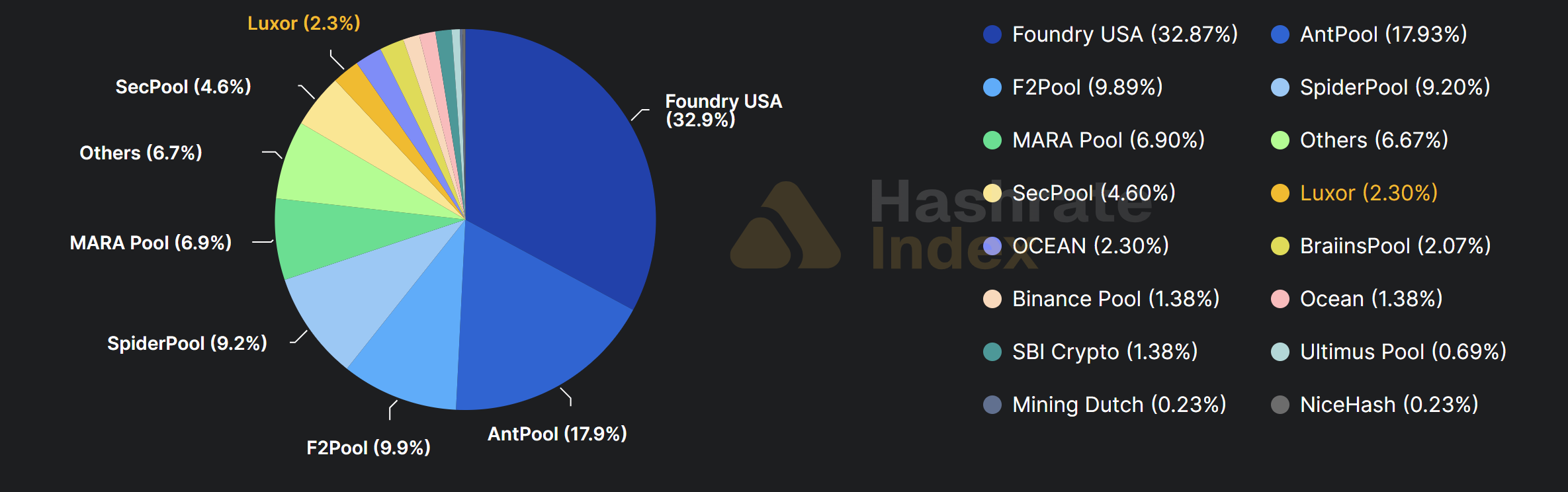
Wang co-founded F2Pool in 2013, and it remains one of Bitcoin’s top crypto mining pools. Hashrate Index places its current share at roughly 10% of network hashrate.

That share feeds scrutiny of Bitcoin mining pool concentration, where four operators dominate block production after the halving. Wang has remained tied to F2Pool while pursuing other ventures.
His wealth, built through early Bitcoin mining and pool operations, has already financed private spaceflight. Wang funded and commanded Fram2 in 2025, the first crewed polar orbit, by selling part of his bitcoin holdings.
That mission carried an all-civilian crew over both poles and made Wang the first Maltese citizen in space.
The same playbook now powers his interplanetary push, after earlier SpaceX Bitcoin transfers tied crypto treasuries to space.
Speaking from Bouvet Island in a pre-recorded video, Wang said the flyby should make Mars feel reachable. He framed the trip as a step toward future landings, not a substitute.
“So it’s going to be a flyby mission of Mars,” Wang said in a recorded announcement.
Subscribe to our YouTube channel to watch leaders and journalists provide expert insights
The schedule now depends on Starship V3, whose maiden flight slipped after Thursday’s scrub.
A second launch attempt is set for Friday evening. If Starship V3 reaches orbit, the Mars timeline moves with it. Until then, both the lunar precursor and Mars flyby remain open.
Musk’s Mars ambitions continue drawing crypto wealth into deep space.
Follow us on X to get the latest news as it happens
The post SpaceX’s First Mars Crew Includes a Crypto Billionaire and It’s Not Elon Musk appeared first on BeInCrypto.
The Micron Technology offices in San Jose, California, Dec. 16, 2025.
David Paul Morris | Bloomberg | Getty Images
Quantum stocks jumped this week on news that the U.S. government was taking equity stakes in nine companies, including IBM, as President Donald Trump’s administration continues to acquire shares of private sector companies.
So where might the government take its shopping cart next? Traders on prediction market platform Kalshi are putting money on the question.
Traders place 32% odds that IonQ will get a government stake in 2026. IonQ was one of the quantum computing companies that wasn’t part of the Thursday announcement, but its stock still jumped more than 12% on the news. Shares then rose more than 7% on Friday.
Also on the list is Anduril Industries, which traders give a 31% chance of getting a U.S. government stake this year.
Anduril is a privately-owned defense technology company based in California. Last week, the company unveiled a new funding round that doubled its valuation to $61 billion. The Palmer Luckey company has worked with the Trump administration closely, including on the proposed “Golden Dome” missile defense system.
Lastly, traders place 28% odds that Micron Technology gets a U.S. government stake. Shares of Micron have surged more than 160% in 2026 thanks to a memory shortage due to the artificial intelligence buildout.
The contracts only are resolved to “yes” if an official announcement is made or verified by the company or a government agency.”
In August, around the same time when the U.S. stake in Intel was first revealed, there were reports that the government was considering taking a stake in Micron. However, that proposal didn’t come to fruition, and the White House said it wouldn’t seek stakes in chip companies increasing investment in the U.S.
Representatives for Micron, Anduril and IonQ couldn’t be immediately reached for comment.
Disclosure: CNBC and Kalshi have a commercial relationship that includes customer acquisition and a minority investment.
The XRP price decline has intensified debate across crypto markets as Ripple’s token continues to lag behind major digital assets in 2026.
Growing frustration among traders and holders reveals a widening gap between expectations and actual market performance.
XRP Price Dropped 26% in 2026, So Far
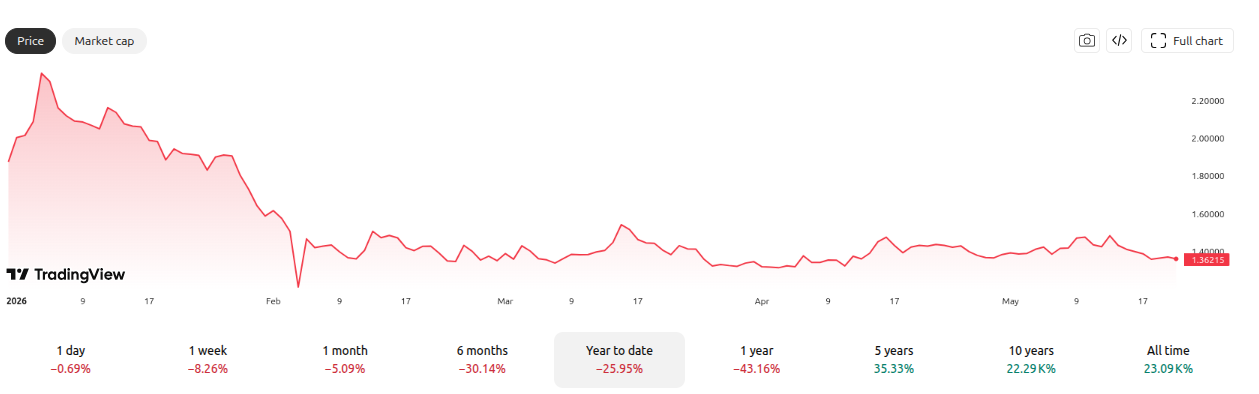
The XRP price decline reflects sustained momentum loss despite several positive developments in Ripple’s broader ecosystem. The token remains close to 26% lower year-to-date and continues trading near $1.36-$1.37.

Current market data also places XRP around 62% below its all-time high of $3.65 reached in July 2025, according to CoinGecko. Daily trading activity remains active, with volumes fluctuating between approximately $1,65 billion and $1,77 billion.
These numbers stand out because XRP experienced several major developments recently. Ripple secured important regulatory progress through its legal resolution involving the SEC.
Spot XRP exchange-traded funds also entered the market, while institutional products like Ripple Prime expanded the company’s ecosystem.
Despite these advances, price action has remained weak. XRP traded within a narrow range between $1.35-$1.38 dollars during recent sessions. Technical analysts continue describing the structure as fragile, with selling pressure dominating sentiment.
Several market observers believe the area between $1.30 and $1.35 dollars could become a critical support zone. A breakdown below that range could increase downside risk toward lower price levels.
“We have now spent 5 days beneath ascending support. $1.30 is a current guardrail. If lost, a deeper drop to the lower $1 territory is likely in the coming weeks,” analyst ChartNerdTA said.

Traders Question XRP After Prolonged Market Weakness
The discussion has become increasingly emotional across social media platforms. Many traders openly question whether Ripple’s long-term messaging aligns with actual market results.
Other users adopted much stronger language, calling the token a “scam” and accusing Ripple of relying on “cheap propaganda” rather than delivering stronger price performance.
“I’m so tired of XRP, I feel cheated, all I see about XRP is cheap propaganda”, a user on X commented.
The criticism reflects frustrations accumulated over several years. Ripple repeatedly positioned XRP as a solution for cross-border payments, emphasizing its bank partnerships, interoperability, and its role in global financial transformation.
Some retail investors expected these developments to create stronger market appreciation. Instead, XRP was among the weakest performers among leading cryptocurrencies in 2026.
“Just ask yourself, half-way into the term of a pro-crypto President, SEC etc, court case gone and clarity act on the move, ETF’s live and so on….yet xrp lost over half it’s value and is doing nothing but penny pump and dumps …how can this be anything but a scam!! Wake up!!!,” another enthusiast noted.
Critics argue that optimistic announcements often generate temporary enthusiasm but fail to create lasting price impact. This perception has gradually weakened confidence among traders seeking stronger returns.
However, supporters view the situation differently. They believe XRP is evolving into a more mature asset focused on institutional use rather than speculative momentum.
Developments surrounding the XRP Ledger, custody services, liquidity solutions, and broader regulatory clarity could support longer-term growth. Still, that institutional direction increasingly conflicts with retail expectations focused on rapid gains.
The debate now extends beyond price movement. It increasingly reflects a broader question surrounding whether adoption and infrastructure development can eventually translate into sustainable market value.
Subscribe to our YouTube channel to watch leaders and journalists provide expert insights
The post XRP Faces Growing Backlash After Dropping 26% Year-to-Date appeared first on BeInCrypto.

Key Highlights
-
Intercontinental Exchange and OKX introduce perpetual futures contracts for Brent and WTI crude oil with 24/7 availability.
-
These contracts enable digital asset traders to gain oil market exposure without dealing with expiration dates.
-
ICE supplies regulated pricing benchmarks while OKX handles crypto-based margin and platform distribution.
-
Initial rollout targets markets outside the United States to comply with current regulatory frameworks.
-
This collaboration represents a significant merger of conventional commodity markets with digital asset trading infrastructure.
Digital asset platform OKX has forged an alliance with Intercontinental Exchange to introduce perpetual futures contracts anchored to international oil pricing standards. These instruments will reference ICE Brent Crude and WTI Crude benchmarks, facilitating uninterrupted trading access for cryptocurrency market participants. Unlike traditional futures, perpetual contracts enable traders to hold positions without expiration constraints, while funding mechanisms maintain price correlation with underlying assets.
This strategic alliance merges ICE’s established regulated futures pricing infrastructure with OKX‘s cryptocurrency margin trading capabilities and global distribution network. The oil perpetual products will initially be available in jurisdictions where the exchange currently maintains regulatory authorization. This framework deliberately separates US-regulated pricing benchmarks from international crypto trading activities to satisfy compliance obligations.
Industry analysts highlight that this agreement reinforces ICE’s strategic relationship with OKX. Intercontinental Exchange maintains an equity position in OKX and obtained board representation through their comprehensive partnership arrangement. This development enables ICE to generate revenue from benchmark licensing while simultaneously extending its reach into crypto-native trading frameworks.
Contract Mechanics and Trading Access
These instruments function as non-expiring swap agreements that derive their value from ICE’s Brent and WTI benchmark prices. Funding rate mechanisms are incorporated to maintain pricing alignment between crypto markets and conventional futures exchanges. The product launch will initially exclude US markets to ensure adherence to applicable jurisdictional regulations.
Both retail and institutional market participants obtain perpetual exposure to globally recognized oil pricing standards. The perpetual contract structure facilitates around-the-clock market access, capitalizing on cryptocurrency market liquidity and existing user infrastructure. Through ICE pricing integration, OKX guarantees that contracts maintain fidelity to recognized market benchmarks.
The cryptocurrency exchange will oversee margin calculations, settlement processes, and user accessibility for these perpetual instruments. This arrangement grants traders commodity benchmark exposure without requiring physical asset custody or delivery. The approach corresponds with emerging patterns where digital asset venues provide derivatives linked to traditional commodities.
Market Impact and Future Development
Intercontinental Exchange and OKX are establishing a framework for incorporating tangible commodities into cryptocurrency markets. These perpetual instruments extend regulated benchmark utilization into digital asset trading environments. The continuous trading capability accommodates crypto leverage frameworks that users already understand and utilize.
This partnership creates pathways for accessing tokenized equity products and futures contracts pending regulatory clearance. ICE intends to introduce US-regulated cryptocurrency futures referenced to OKX spot market pricing. OKX platform users will gain access to ICE’s benchmark-linked instruments across international markets, significantly broadening market participation opportunities.
The perpetual futures offering has potential to capture high-frequency traders pursuing commodity market exposure. This initiative demonstrates the growing convergence between established commodity trading venues and cryptocurrency platforms. It establishes foundational infrastructure for deeper integration of regulated financial instruments within digital asset marketplaces.


Achieve Financial STABILITY with Ease Today?

Woman horrified at what happened next after she accidentally swallowed her AirPod
Air Canada reaches tentative deal with Unifor for 6,000 workers


-

 Crypto World7 days ago
BloFin War of Whales 2026 Grand Prix opens registration for $5M trading championship
-

 Crypto World7 days ago
E-Estate Announces 1 Year Live: Washington DC Summit as Real Estate Tokenization Enters Its Next Phase
-

 Tech7 days ago
Google reimburses Register sources who were victims of API fraud
-

 Sports7 days ago
Napoleonic enters 2026 Doomben 10,000 field via Abounding withdrawal
-

 Crypto World7 days ago
BeInCrypto 100 Institutional Awards Nomination: KAST for Best Digital Assets Neobank and Best Digital Assets Fintech
-
 Crypto World7 days ago
Bitcoin Battles US Bond Nerves With BTC Price Dip Toward New May Lows
-
 Crypto World7 days ago
ICE and CME urge US regulators to curb Hyperliquid energy trading
-

 Fashion6 days ago
On the Scene at Gucci’s Cruise Show in New York City: Mariah Carey, Kim Kardashian, Lindsay Lohan, Iman, and More!
-
 Crypto World7 days ago
Wall Street’s Boldest Gold Prediction Has Russians Rushing to Buy
-

 Crypto World7 days ago
IREN closes $3 billion convertible notes deal amid AI infrastructure expansion
-

 Fashion6 days ago
Trending Western Style Vests Perfect for Summer
-

 Politics6 days ago
Watch: far-right flag-fanatics run over victim, attack locals – Setup By the Left wing for your entertainment
-

 Crypto World1 day ago
Blockchain.com files with SEC for U.S. IPO
-

 Fashion6 days ago
Amazon Sundays: Memorial Day Hosting
-

 Crypto World7 days ago
Crypto Market Structure Bill Clears Committee; Senate Vote in Focus
-

 Entertainment6 days ago
Off Campus Easter Eggs Explained: Characters, Stories, More
-
 Crypto World7 days ago
BeInCrypto 100 Institutional Awards Nomination: KuCoin for Leader in Digital Asset Adoption and Best Trading Infrastructure
-

 Politics7 days ago
UK’s top intelligence body warns Mandelson files being withheld by government
-
 Crypto World7 days ago
Enphase Energy (ENPH) Stock Rockets 32% This Week: What’s Fueling the Rally?
-

 Politics7 days ago
Voter disenfranchising, bulldozer operations, trampling democracy in India
You must be logged in to post a comment Login