

Crypto World
DOGE Price Dumps to Monthly Lows but Dogecoin Whales Load Up


The past 24 hours (and several days) haven’t been kind to the cryptocurrency market, with many leading assets posting substantial losses.
The largest and oldest meme coin has not been spared, as it slips to just over $0.10 for the first time since April 30. Its momentum has stalled after it neared $0.12 last week, and it’s down by 10% on a weekly scale, which is the most significant decline from the larger-cap alts.
Whales Are Loading Up
Although its price has tumbled in the past several days, the overall investor behavior has been quite positive lately. Reports began to emerge in early May that Dogecoin whales had been quietly accumulating for some time, as the total holdings of wallets containing at least 100 million coins reached an all-time high of over 108.5 billion DOGE.
A few weeks down the line, another update on the matter indicated that these large investors had acquired 470,000,000 DOGE in just three days. These purchases coincided with the asset’s price revival to $0.118. Despite the subsequent retracement, whales have kept accumulating, according to data shared by Ali Martinez.
The analyst noted that large investors had purchased over 525,000,000 DOGE in the span of just four days. Such accumulations not only reduce the immediate selling pressure for the underlying asset but could also serve as an example for smaller investors who tend to follow the so-called ‘smart money.’
Whales bought over 525 million Dogecoin $DOGE in the last 96 hours. pic.twitter.com/qrz36pIalX
— Ali Charts (@alicharts) May 22, 2026
Mirroring Previous Structure
Despite the current market breakdown, several crypto analysts on X remain hopeful of a more profound rally from the leading meme coin. Nehal said DOGE is currently mirroring the moves after the August 2024 bottom when it printed 4 “strong green weekly candles, followed by 2 red consolidation weeks before a major breakout rally.”
Nehal added that Dogecoin had already marked 4 consecutive green weekly candles after the 2026 February bottom, and is currently in its second consolidation week. If history repeats, DOGE will either close the week near the open before continuing higher, or flip green immediately and accelerate “faster than expected.”
Trader Tardigrade also touched upon the meme coin’s historic performance, noting that the current fake breakdown is the third similar the asset has posted over the years. The two previous examples led to mind-blowing five-digit rallies of up to 29,000%.
“The pattern is identical. Support has been reclaimed,” they concluded.
The post DOGE Price Dumps to Monthly Lows but Dogecoin Whales Load Up appeared first on CryptoPotato.

Key Highlights
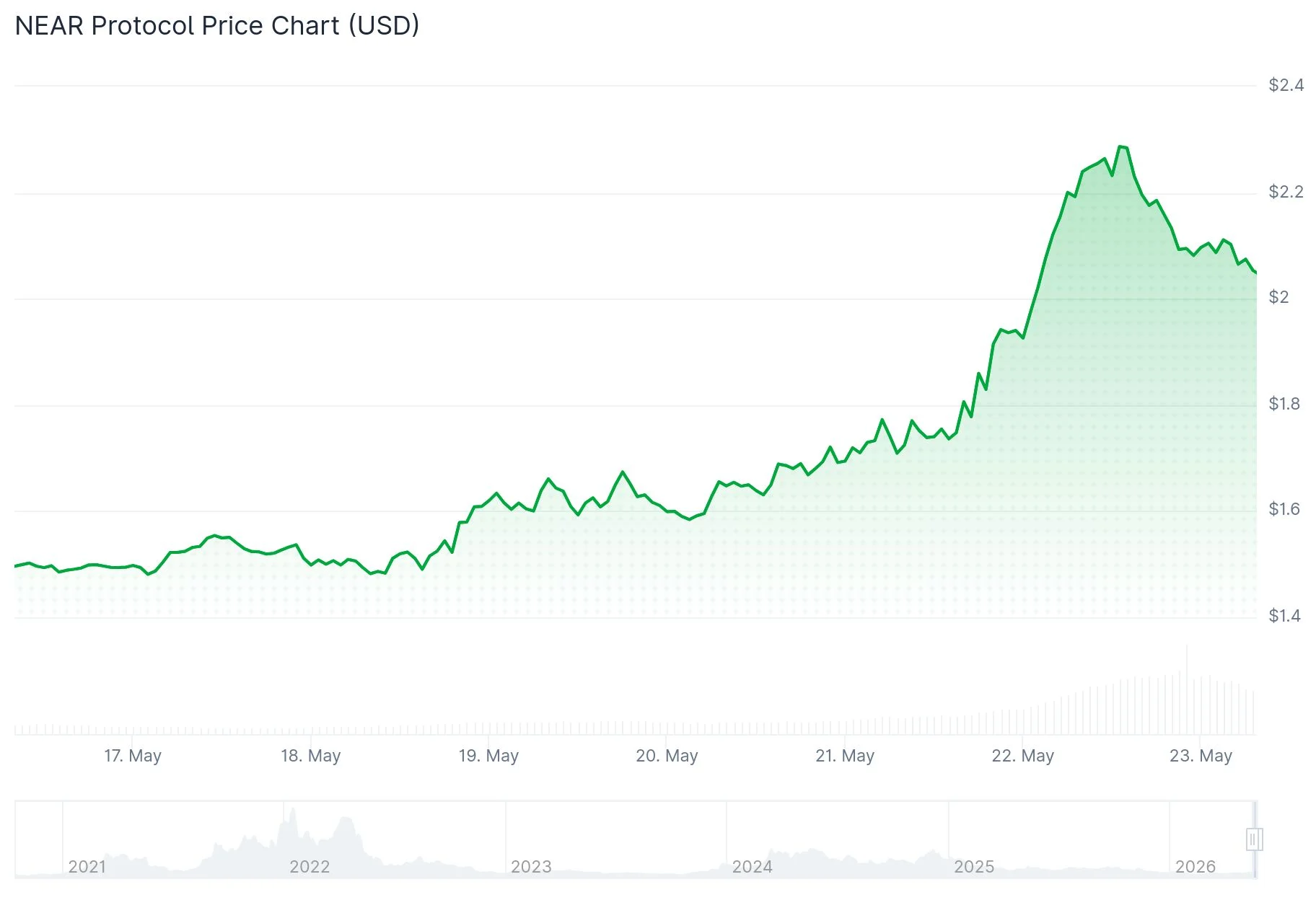
- NEAR Protocol rallied 50% over a seven-day period, reaching a six-month peak of $2.34.
- BitMEX co-founder Arthur Hayes labeled NEAR as one of three essential altcoins, sparking retail momentum.
- Bitwise’s NEAR exchange-traded product saw significant institutional capital inflows.
- The protocol unveiled upgrades focused on AI capabilities, privacy features, and dynamic resharding technology.
- Chart analysis reveals a breakout from a long-term falling wedge pattern, targeting $5.75.
NEAR Protocol delivered an explosive performance this week. The cryptocurrency surged 50% across seven trading days, peaking at $2.34 on Friday—the highest level recorded in half a year. Over the past 24 hours alone, NEAR jumped 34%, while trading volumes spiked 190% to reach $1.15 billion, indicating powerful buying pressure.
This sharp upward movement resulted in more than $9.85 million in liquidated short positions, wiping out bearish bets placed against the cryptocurrency.
Much of the momentum traces back to Arthur Hayes, the high-profile crypto investor and co-founder of BitMEX. Hayes publicly identified NEAR alongside HYPE and ZEC as the “holy trinity” of alternative cryptocurrencies. According to Coin Bureau’s post on X, this single endorsement catalyzed a roughly 30% price spike.
As one of crypto’s most influential figures, Hayes commands substantial retail attention, and his public support rapidly amplified interest in NEAR.
Institutional Capital and Network Activity
The rally extends beyond social media hype. Bitwise announced substantial inflows into its NEAR-based exchange-traded product, signaling genuine institutional appetite. On-chain researcher and former NEAR ecosystem contributor Vadim Zacodil pointed to the protocol’s token buyback program as an additional price support mechanism.
NEAR co-founder Illia Polosukhin’s expertise in artificial intelligence has positioned the project favorably during the current AI token surge. Simultaneously, other AI-linked cryptocurrencies including Grass, OpenServe, and Artificial Superintelligence Alliance (FET) recorded double-digit percentage gains within the same 24-hour timeframe.
The combined market capitalization of AI and big data cryptocurrency tokens climbed 8% to $21.44 billion in a single day, demonstrating sector-wide momentum.
Technical Developments and Price Projections
Nvidia’s impressive Q1 2026 financial results—approximately $81.6 billion in revenue with projections approaching $1 trillion for 2027—provided additional tailwinds for AI-related blockchain projects. Historical patterns show NEAR’s price sensitivity to Nvidia earnings, including a 58% surge in February following the chip maker’s Q4 2025 report.
NEAR has scheduled meaningful protocol enhancements for June, including dynamic resharding technology designed to dramatically expand network throughput. The development team has also prioritized privacy-focused features and confidential transaction capabilities—a technical challenge Vitalik Buterin has identified as critical for blockchain’s future.
MN Capital’s founder Michael van de Poppe shared on X that NEAR displays “one of the most bullish charts” currently available. He identified immediate resistance levels at $2 and the $2.25–$2.50 range, with a subsequent target near $2.75. Successfully clearing the $2.60–$3.00 supply zone could establish a path toward the technical target of $5.75 based on wedge pattern measurements.
BitMEX Research Analyst Shang Wu observed earlier this month that NEAR trades at approximately 56x annualized fees, representing a discount compared to most competing Layer 1 blockchain platforms.
By Friday’s close, NEAR Protocol’s market capitalization approached $3 billion, marking a monthly increase exceeding 50%.


Key Takeaways
- Kevin Warsh officially became Federal Reserve chairman on Friday following a 54-45 Senate confirmation, taking over from Jerome Powell.
- Market expectations have eliminated any possibility of rate cuts throughout 2026, with hike probabilities climbing.
- CME FedWatch tools indicate a 70% probability of an interest rate increase at December 2026’s FOMC gathering.
- Economic analysts suggest the Fed might implement up to 100 basis points in rate increases if inflation remains persistently above 2%.
- The new Fed chairman’s inaugural policy meeting is set for June 16-17.
Financial markets have dramatically recalibrated expectations toward interest rate increases in 2026 following Kevin Warsh’s official appointment as Federal Reserve chairman.
JUST IN: 🇺🇸 Kevin Warsh has officially been sworn in as the new chair of the Federal Reserve, replacing Jerome Powell. pic.twitter.com/H8l0qIRX9t
— CoinMarketCap (@CoinMarketCap) May 22, 2026
The swearing-in ceremony took place Friday at the White House, with Supreme Court Justice Clarence Thomas administering the oath. Warsh assumes leadership after a closely divided 54-45 Senate confirmation that followed partisan voting patterns.
During the ceremonial proceedings, President Donald Trump emphasized his expectation for independent action from Warsh. “I want Kevin to be totally independent and do a great job. Don’t look at me and don’t look at anybody. Just do your own job,” Trump stated directly to the newly appointed chairman.
The president had endured sustained criticism from Democratic lawmakers who raised doubts about Warsh’s commitment to maintaining the Fed’s institutional independence. Senator Elizabeth Warren notably described him as a “sock puppet” serving presidential interests. Warsh firmly disputed this characterization and committed to autonomous monetary policy decisions.
Trump further addressed attendees by highlighting that employment figures have reached unprecedented heights and asserting the nation could expand economically to resolve its debt challenges. “We want to stop inflation, but we don’t want to stop greatness,” he declared.
Investor Sentiment Shifts Toward Tightening
Contrary to Trump’s stated preference for reduced interest rates, financial markets are forecasting a starkly different trajectory. Current CME FedWatch data reveals a complete absence of rate cut expectations throughout the entire 2026 calendar year.
A mere 3.5% of market participants anticipate even a modest rate increase at the upcoming June 17 FOMC session. However, by July, hike probability climbs to 17%.
The December meeting commands the greatest attention. Approximately 67% to 70% of investors currently forecast an interest rate elevation at 2026’s concluding FOMC gathering. The predominant scenario involves a hike to the 375-400 basis point band, representing a 25 basis point advancement from today’s 350-375 basis point target range.
Certain economic forecasters project more aggressive scenarios. Should inflation maintain levels exceeding 2%, they anticipate the Fed could implement cumulative rate increases totaling 100 basis points. Such action would effectively neutralize the three rate reductions executed during 2025.
Policy Direction Changed Before Leadership Transition
Documentation from April’s FOMC meeting revealed the directional shift commenced prior to Warsh’s arrival. Committee members indicated that “some policy firming would likely become appropriate if inflation were to continue to run persistently above 2%.”
The meeting record also documented that numerous participants advocated eliminating wording that implied preference toward rate reductions.
Inflation anxieties stem partially from escalating oil prices, artificial intelligence-fueled demand expansion, and continuing geopolitical strains connected to US-Iran relations.
Extended-horizon markets reflect similar trends. For June 2027, traders assign just 15.8% likelihood that rates remain at 350-375 basis points. Instead, 33.4% project rates at 375-400 while another 30.2% anticipate 400-425. Some market positions even contemplate levels reaching 500-525 basis points.
Rising interest rates typically present challenges for risk-oriented assets. Bitcoin, cryptocurrency markets, and equity instruments could all encounter resistance if borrowing costs escalate throughout the coming year.
Chairman Warsh’s inaugural policy decision meeting commences June 16.
The recent streak of outflows from US-based spot Bitcoin ETFs, totaling more than $1 billion over the past trading week, suggests a potential buying opportunity for the world’s largest cryptocurrency, according to crypto sentiment platform Santiment.
“Santiment’s analysts read these flows as a counter-indicator, since ETFs disproportionately reflect retail conviction rather than smart money positioning,” Santiment said in a report on Friday.
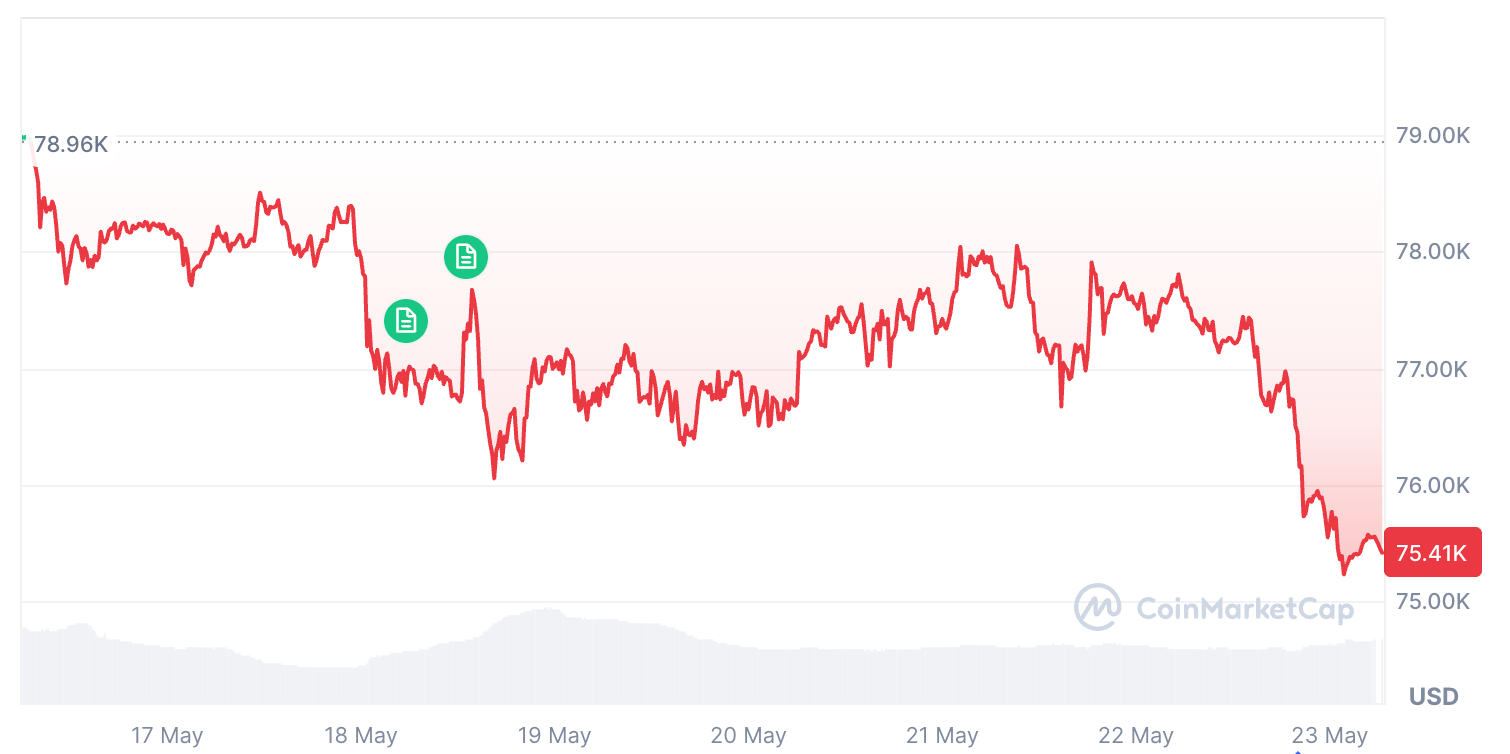
Santiment said retail investors were losing patience after Bitcoin (BTC) failed to hold above $80,000 in May. Bitcoin is trading at $75,410 at the time of publication, after reaching as high as $79,052 on May 16, according to CoinMarketCap.
Santiment’s take contrasts with broader crypto industry view
The view contrasts with the broader crypto market narrative, where consecutive days of outflows from spot Bitcoin ETFs are often seen as a bearish signal and a sign of weakening retail sentiment that could point to further downside. However, Santiment argues the recent outflows instead resemble a healthy market reset.
Bitcoin is down 4.44% over the past 30 days. Source: CoinMarketCap
“Sustained ETF outflows have historically correlated with conditions favorable for patient accumulation rather than panic,” Santiment said.
Spot Bitcoin ETFs have recorded outflows across the past six trading sessions, with the 11 funds seeing a combined $1.26 billion in net outflows over just the last five days, according to Farside data.
Bitcoin ETFs are going to pass all-time high inflows: Analyst
Some analysts anticipate the spot Bitcoin ETF outflow trend will reverse in the near term.
ETF analyst James Seyffart said on Michael van de Poppe’s podcast, “New Era Finance,” published on YouTube on Friday, that Bitcoin ETFs have now clawed back most of the $9 billion in outflows recorded between October and February.
Related: SEC’s Peirce tempers expectations over tokenized stocks exemption
“We’re around 60 billion inflows now since the ETFs’ launch. So, we’re almost at that all-time high peak,” Seyffart said.
“I think we’re going to pass it. And we have so many other ETFs coming to market,” Seyffart said.
Magazine: ETH bears growling, Tom Lee’s buying, XRP to ‘explode’: Market Moves

It was less than ten days ago when the popular cross-border token challenged the $1.55 resistance. The subsequent rejection, though, was both immediate and violent.
The past 24 hours have only intensified the retracement. Although almost the entire market is in the red today, with BTC sliding to $75,000 for the first time in three weeks, XRP’s drop is actually worse.
Whale Activity Disappears
With the token currently trading at $1.33, the 10-day chart shows a substantial 14% decline since the local peak. Moreover, XRP has dropped to its current price for the first time since April 13, marking a six-week low. Its market capitalization has dumped toward $82 billion, and the gap with BNB has only widened to over $5 billion as of press time.
What’s perhaps even more worrying is the fact that whale activity on the XRP network has declined from 157 large transactions of over $1 million a few months ago to 67 today. This 57.3% drop, according to popular analyst Ali Martinez, suggests that the underlying asset could “be entering a compression phase.”
Whales have seemingly stepped back to let “the current price range settle, which naturally reduces immediate volatility and allows the order books to mature.”
In the last 9 days, whale activity on the $XRP network has dropped from 157 large transactions worth over $1 million to just 67 today, representing a 57.3% decline.
When large-scale transaction volume thins out like this, it tells me the market could be entering a compression… pic.twitter.com/lVQGjhqVzG
— Ali Charts (@alicharts) May 23, 2026
On the more positive side, XRP saw a massive 4,300 new wallet creations in a single day earlier this week, which was the fourth-largest such spike in its network activity in 2026. According to Santiment, such network growth is among the strongest signals for possible market reversals.
But Maybe More Pain Ahead?
While weighing in on XRP’s recent price moves, fellow analyst CRYPTOWZRD warned that the token had closed bearish. They predicted more troubles ahead, especially if BTC continues to decline.
Additionally, CW said XRP continues to show an “increasing trend in short positions,” and cautioned that there are “no reversal signals in the futures market yet.” In a separate post, the analyst warned that the cross-border altcoin could fall further to $1.30.
The post XRP Plunges to 6-Week Low as Fading Whale Activity Spells Further Trouble Ahead appeared first on CryptoPotato.

MicroStrategy chairman Michael Saylor hinted at a potential shift in the company’s Bitcoin strategy, signaling that selling a portion of its bitcoin holdings this year cannot be ruled out as the firm pursues a more dynamic approach to its balance sheet. The comments come as the company leans into a programmatic framework for managing assets, cash, and debt with a long-term horizon.
Speaking on the Coin Stories podcast with Natalie Brunell and published on YouTube on Friday, Saylor described a plan to operate with a “very thoughtful” programmatic approach. He said it could involve selling some Bitcoin between now and year-end, along with a mix of equity and credit, while continuing to manage USD and cash. The goal, he emphasized, is to optimize the company’s outcomes for the long term, extending toward 2033. “Ultimately, the way to think of it is seven years out, we would like to have maximized our Bitcoin per share,” he said, underscoring a shift from Strategy’s historically staunch stance on never selling its digital assets.
Key takeaways
- Michael Saylor indicates it is “not unlikely” that MicroStrategy will sell some BTC between now and the end of the year, marking a notable departure from the firm’s long-standing “never sell” posture.
- The company intends to manage its balance sheet through a programmatic framework that could include sales of Bitcoin, as well as strategic moves in equity and debt, guided by multivariate models with a 2033 horizon.
- MicroStrategy holds 843,768 BTC, purchased at an average price of roughly $75,700 per coin, with Bitcoin trading near $75,958 at the time of publication.
- MicroStrategy’s stock traded at $159.89 at the close of Friday, having fallen about 10.9% over the prior 30 days, illustrating the disconnect that can exist between corporate treasury decisions and equity-market sentiment.
- The remarks follow prior signals from Saylor that a sale could be contemplated to safeguard the asset’s long-term value, a departure from earlier rhetoric and a reminder of the evolving nature of large corporates’ treasury strategies.
Context: a treasury rethink and long-term goals
MicroStrategy’s approach to Bitcoin has always been closely tied to its treasury management narrative, with the company accumulating a substantial stake as a corporate bet on the digital asset. The new comments place emphasis on a disciplined, data-driven process rather than a fixed, unchanging policy. Saylor described the broader plan as “a programmatic fashion where we’re running our multivariate models,” a framework intended to balance growth, liquidity, and risk across both crypto and traditional assets.
In the interview, Saylor reiterated a strategic objective articulated for years: maximize Bitcoin per share over a multi-year horizon. He stressed that the focus is on long-term outcomes rather than short-term price movements, and that any sales would be calibrated to support those outcomes. The timing of possible sales will depend on how the models signal opportunities to optimize the company’s overall performance while preserving the Bitcoin position for future value creation.
Bitcoin position and market context
According to MicroStrategy’s published data, the firm has accumulated 843,768 BTC, purchased at an average price of about $75,700 per BTC. At the time of publication, Bitcoin traded around $75,958, placing the market price near the unit cost basis but subject to the volatility intrinsic to crypto markets. The juxtaposition highlights the complexity of corporate crypto strategy: even when the price posture is near cost basis, the decision to sell or hold can be driven by broader balance-sheet considerations and long-run optimization goals.
MicroStrategy’s stock price, meanwhile, provides a different lens on the story. It closed at $159.89 on Friday, with roughly a 10.9% decline over the last 30 days, according to Google Finance data. The divergence between the equity move and the crypto position underscores a common reality for large treasury holders: corporate governance and investor sentiment can react differently to the same underlying asset, especially when the asset serves as a strategic balance-sheet instrument rather than a pure speculative investment.
Observers have long watched how MicroStrategy’s Bitcoin strategy interacts with broader market dynamics. Saylor’s recent comments add a layer of potential volatility to the company’s treasury decisions, while also signaling a willingness to adapt to changing conditions. The firm’s track record — including public disclosures of its BTC holdings and purchase history on its website — will continue to inform how investors digest any future sale announcements. For now, the plan remains a forward-looking framework rather than a concrete sale timetable, with the caveat that real-time market conditions and model outputs could alter timing and scale.
As coverage of corporate Bitcoin adoption evolves, MicroStrategy’s approach may offer a useful reference for other treasury teams weighing strategic asset management in a volatile macro environment. The combination of a disciplined model-driven process and a horizon extending to 2033 provides a blueprint for balancing exposure, liquidity, and upside potential in a high-beta asset class.
Looking ahead, market participants will be watching for any formal updates to MicroStrategy’s treasury policy, earnings commentary that clarifies sale triggers, or new disclosures that outline how the multivariate framework operates in practice. The evolution of this strategy could shape how other corporations view the feasibility and risk of maintaining large Bitcoin positions as part of their balance sheets.
Readers should watch upcoming investor communications for any concrete sale signals, as well as updates to cost-basis tracking and model-driven asset-management benchmarks. The path from talk to action remains to be seen, and the next steps will help determine whether MicroStrategy’s Bitcoin strategy becomes a recurring source of liquidity or a steady, long-horizon holding.

Strategy chairman Michael Saylor has not ruled out the company offloading some Bitcoin as early as this year, after recently softening his long-held “never sell” stance.
“I think it’s not unlikely that we’ll sell some Bitcoin between now and the end of the year,” Saylor said during an interview with Natalie Brunell published to YouTube on Friday.
Saylor said it is “also likely” that the company will sell a mix of equity and credit and manage its USD and cash holdings. “We do it in a very thoughtful programmatic fashion where we’re running our multivariate models, and we’re literally running them,” Saylor said, noting the company is focused on long-term outcomes out to 2033:
“Ultimately, the way to think of it is seven years out, we would like to have maximized our Bitcoin per share,” Saylor said.

Michael Saylor spoke to Natalie Brunell on the Coin Stories podcast. Source: Natalie Brunell
He added that an objective of the company is: “What is it that we should be doing now that’s going to maximize and optimize the company’s performance so that we’ve maxed out Bitcoin per share seven years from now.”
Strategy’s (MSTR) stock price closed the trading day on Friday at $159.89, down 10.86% over the past 30 days, according to Google Finance. It comes as the price of Bitcoin (BTC) is lower than the average price that Strategy has paid for its Bitcoin, since it began acquiring in 2020.
Bitcoin is trading lower than Strategy’s average purchase price
At the time of publication, Bitcoin is changing hands at $75,958, while Strategy has acquired its 843,768 Bitcoin at an average price of roughly $75,700 each, according to Strategy’s website and CoinMarketCap data.
Strategy’s buy announcements over the years have often been viewed by the Bitcoin community as bullish signals, but because the company has never announced a sale before, it’s unclear how the community would react.
Related: Saylor signals BTC buy as retail holders get push on STRC dividend vote
It comes just days after Saylor said he raised the possibility of selling Bitcoin during Strategy’s recent earnings call to protect the asset’s long-term interests.
“We own about $65 billion worth of Bitcoin. If the market thought we would never sell it, the credit rating agencies would say, Well then, I guess it’s not an asset,” Saylor told Scott Melker on The Wolf Of All Streets podcast published to YouTube on May 10.
Magazine: ETH bears growling, Tom Lee’s buying, XRP to ‘explode’: Market Moves


Galaxy Digital founder Mike Novogratz has appeared in court as the company fights BitGo’s $100 million claim tied to a failed $1.2 billion merger.
Summary
- Mike Novogratz testified in Delaware court over Galaxy’s failed $1.2 billion BitGo acquisition.
- BitGo is seeking a $100 million termination fee after Galaxy called off the merger in 2022.
- The dispute centers on financial statements, SEC accounting rules, and whether Galaxy validly ended the deal.
Novogratz appeared in Delaware Chancery Court this week in the long-running dispute between Galaxy Digital and BitGo. BitGo is asking the court to make Galaxy pay at least $100 million after the crypto investment firm walked away from the acquisition.
The companies agreed to the deal in 2021, when crypto valuations were still high. Galaxy later ended the merger in August 2022, after the Terra collapse and a wider market downturn. Galaxy said BitGo failed to deliver required audited financial statements on time. BitGo said Galaxy wrongly abandoned the deal.
SEC accounting rules sit at center of case
According to Bloomberg’s report, Novogratz testified that he was “pushing to get this deal done,” but said the SEC made approval difficult under then-Chair Gary Gensler. He also said Galaxy itself was not the subject of a government probe.
The accounting issue traces back to SEC Staff Accounting Bulletin 121. The Delaware Supreme Court said SAB 121 became effective shortly before BitGo’s financial statement deadline and gave guidance for public companies that safeguard digital assets.
The court also noted that if BitGo failed to submit compliant statements by July 31, 2022, Galaxy could terminate the agreement without paying the reverse fee.
BitGo says Galaxy damaged its reputation
BitGo CEO Mike Belshe testified that the failed deal hurt the company. He said “This was incredibly damaging,” according to the report, while arguing that BitGo had provided the needed information.
BitGo’s side says Galaxy’s public reason for ending the merger suggested that BitGo could not pass an audit. Galaxy disputes that view and says the contract allowed termination without the $100 million fee because the financial statements did not meet the required terms.
Court fight comes as both firms expand
The case returns at a busy time for both companies. BitGo became a public company in January and later reported $3.77 billion in first-quarter revenue, up 112.6% from a year earlier. However, its net loss widened to $60.7 million as Bitcoin treasury marks and IPO costs weighed on results.
Galaxy has also been expanding its regulated U.S. footprint. A recent market update said GalaxyOne Prime NY received both a BitLicense and Money Transmission License from New York regulators on May 18, allowing it to offer trading and custody services to institutions in the state.
The trial is expected to end this week. The judge will decide whether Galaxy must pay the $100 million fee or whether the company had the right to terminate the deal without payment.


Tokenized stocks could move trading activity away from traditional exchanges as regulators weigh new rules for onchain equities.
Summary
- Tiger Research says tokenized stocks could split exchange liquidity across competing blockchain venues and platforms.
- Revenue may move offshore if exchanges lose fee control over tokenized stock trading flows globally.
- Hyperliquid’s $2.6B RWA open interest shows demand for onchain market access is rising fast globally.
Tiger Research said tokenized stocks could create two main risks for traditional markets: liquidity fragmentation and revenue fragmentation. The report linked those risks to the SEC’s reported innovation exemption, which may allow third parties to tokenize listed stocks such as Apple and Tesla without issuer approval.
The research said traditional finance treats the break-up of centralized liquidity as a “serious structural threat.” In simple terms, trading that usually sits on exchanges such as the NYSE or Nasdaq could move across several blockchain networks and decentralized venues.
That shift could create different prices for the same stock-linked asset across venues. It could also make large trades harder if buyers and sellers spread across many platforms instead of one deep market.
Revenue could move away from domestic exchanges
Tiger Research also warned that exchange revenue could split if tokenized stocks trade on competing venues. Fees that normally flow to domestic exchanges, brokers, and clearing systems could instead move to offshore platforms or new blockchain-based markets.
The report said this issue also affects national financial competitiveness. If one country delays tokenized market rules while another moves faster, trading fees and market activity can shift across borders.
This is why the SEC’s reported exemption matters. Related coverage said the SEC may allow tokenized public stocks on blockchain platforms, but tokens may need to carry the same rights as traditional shares, including dividend and voting access.
SEC Commissioner Hester Peirce has also warned that blockchain does not change the legal nature of the asset. In a July 2025 statement, she said “Tokenized securities are still securities.” She added that market participants must follow federal securities laws when dealing with tokenized instruments.
Hyperliquid shows onchain RWA demand
The shift is already visible in crypto markets. Hyperliquid said RWA trading open interest reached $2.6 billion on May 18, setting a new all-time high and doubling from two months earlier.
Tiger Research used Hyperliquid’s growth to argue that capital is already moving toward 24/7 onchain access to real-world assets. That demand puts pressure on exchanges and regulators that still rely on older trading hours, settlement systems, and venue models.
RWA.xyz data also shows that tokenized stocks remain small but active. Its dashboard lists $1.53 billion in tokenized stock value, $3.40 billion in monthly transfer volume, and more than 272,000 holders.
Exchanges are already moving onchain
Traditional exchanges are not ignoring the shift. Reuters reported in March that the NYSE partnered with Securitize to develop tokenized versions of traditional financial securities for a future NYSE-affiliated digital platform.
NYSE planned to work with Securitize on digital transfer agent standards, trade processing, and tokenized security infrastructure. Reuters also noted that U.S. exchanges, including NYSE and Nasdaq, have been increasing efforts to put stocks, bonds, and funds on blockchain rails.
The core question is now control. If tokenized stocks develop inside regulated exchange systems, traditional venues may keep part of the flow. If third-party platforms grow faster, stock trading could become more fragmented.
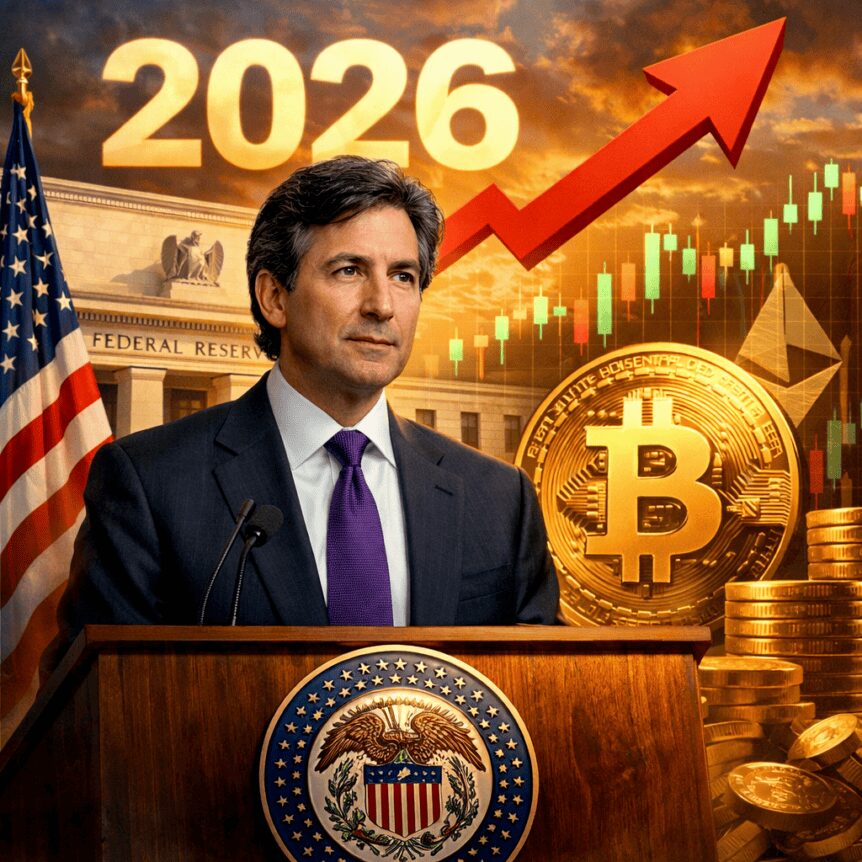
Kevin Warsh was sworn in as chair of the United States Federal Reserve, but the market’s focus quickly shifted to the policy path that will shape crypto markets and broader risk assets through 2026. The latest CME Group FedWatch data suggests investors are pricing in virtually no chance of rate cuts this year, signaling a higher-for-longer stance that could influence liquidity and risk appetite across crypto and equities.
During the swearing-in ceremony, President Donald Trump framed Warsh’s tenure as one defined by independence from the Executive Branch on monetary policy, while underscoring a belief that a booming economy should guide growth alongside inflation containment. “We want to stop inflation, but we don’t want to stop greatness,” Trump said, a line that captured the tension between price stability and growth the new administration seeks to navigate.
“We want to stop inflation, but we don’t want to stop greatness.”
Warsh inherits a policy backdrop where inflation, employment, and debt dynamics intersect with a market environment that had been pricing little relief in the near term. The Trump administration’s emphasis on growth as a lever to manage debt sits beside persistent macro uncertainty, complicating how traders read even the first signals from the new leadership at the Fed.
Key takeaways
- No rate cuts expected in 2026, based on CME FedWatch data, reinforcing a higher-for-longer policy trajectory.
- Near-term odds of a 25 basis point hike at the June meeting sit at about 3.5%, with the current federal funds target at 3.50%–3.75%.
- Probability of a rate hike at the July meeting rises to roughly 17%, and about 67% of traders expect a hike at the December meeting.
- The leadership change at the Fed comes amid inflation concerns and growth considerations, with markets parsing how the new chair’s approach will balance these forces.
- Crypto and other risk assets could face headwinds if the expected pause on rate cuts persists, as liquidity and risk sentiment remain sensitive to policy signals.
Fed leadership and policy signals
The swearing-in of Warsh as chair places the Fed at a critical inflection point. While details of his forthcoming policy communications remain to be seen, the market is already responding to the prevailing assumption that monetary easing via rate cuts is unlikely in the near term. In a regime where the Fed’s stance on inflation and growth will guide the tempo of liquidity, crypto traders are attuned to any shift in language or data that might alter the balance between price stability and economic expansion.
Trump’s remarks at the event underscored a deliberate narrative: Warsh’s independence should enable a policy path that prioritizes growth while attempting to keep inflation in check. The president’s framing, coupled with inflation and employment dynamics, creates a backdrop in which the Fed’s credibility will be tested as markets weigh the odds of future policy moves against evolving macro data releases.
Markets, rates and crypto implications
Market pricing through the CME FedWatch tool indicates a remarkably low likelihood of rate cuts in 2026. The immediate implication is a constrained environment for policy ease, which tends to support tighter financial conditions. In practice, this translates into higher real interest rates and a spotlight on the trajectory of inflation, growth signals, and debt sustainability as the Fed’s mandate remains in focus.
The June 17 FOMC meeting is seen as a potential touchpoint for a small policy adjustment, with a 3.5% probability of a 25 basis point rate hike. With the current target range at 3.50% to 3.75%, even a modest move would be read as a continuation of the higher-for-longer theme, rather than the start of a rapid easing cycle.
Beyond June, the odds shift toward a greater probability of action later in the year. A July hike carries roughly a 17% chance, while the December meeting is seen as the more likely period for a rate move, with about two-thirds of traders expecting a hike then. Taken together, the data imply a policy stance that remains tight through the year, creating a backdrop of higher borrowing costs and a slower easing pace than many crypto and equity markets had priced in during earlier cycles.
In the crypto ecosystem, this environment has a nuanced set of implications. Historically, lower interest rates have been supportive of risk-on assets, including Bitcoin and broader crypto markets, by boosting liquidity and search for yield in higher-risk corners of the market. Yet the flip side is that cheap credit can fuel inflationary pressures or misallocation if it leads to a wave of leveraged speculation. As the Fed maintains a careful watch on inflation and growth, crypto traders will be watching not only the headline rate moves but also any shifts in the Fed’s communications that could tilt expectations for the cost of capital and the availability of liquidity.
What this means for investors and builders
For investors, the current outlook reinforces the idea that capital will continue to be priced with an eye toward central bank policy and macro data. Portfolios with exposure to crypto and other risk assets may need to tolerate continued volatility as rate expectations swing with new data releases and statements from Fed leadership. The absence of imminent rate cuts suggests a period of consolidation for risk assets, even as the underlying fundamentals of blockchain networks, DeFi protocols, and institutional involvement in crypto continue to evolve.
For builders and developers in the crypto space, the environment underscores the importance of funding resilience and product-market fit independent of a passive liquidity tailwind. Projects that demonstrate real utility, robust security, and clear paths to revenue may fare better in a regime where liquidity remains tethered to policy signals, rather than a broad, rate-driven liquidity flood.
And for regulators and policymakers outside the Fed, the ongoing conversation around inflation control, debt management, and economic growth will intersect with how the crypto sector is treated within the broader financial system. As policy makers weigh the CLARITY Act and other regulatory contours, the market will assess whether legislative actions could alter the risk-and-reward dynamics that crypto projects navigate daily.
The immediate takeaway is clear: the Fed’s leadership transition arrives at a moment when policy clarity, inflation momentum, and growth trajectories will jointly shape the path of crypto and risk assets. Investors should stay attentive to the Fed’s communications, inflation prints, and any shifts in the rate-path narrative that could alter funding conditions for digital assets and their traditional counterparts.
Readers should monitor upcoming FOMC communications and macro data releases, as any hint of a policy pivot or a renewed emphasis on price stability could recalibrate sentiment across cryptocurrencies and the broader market.
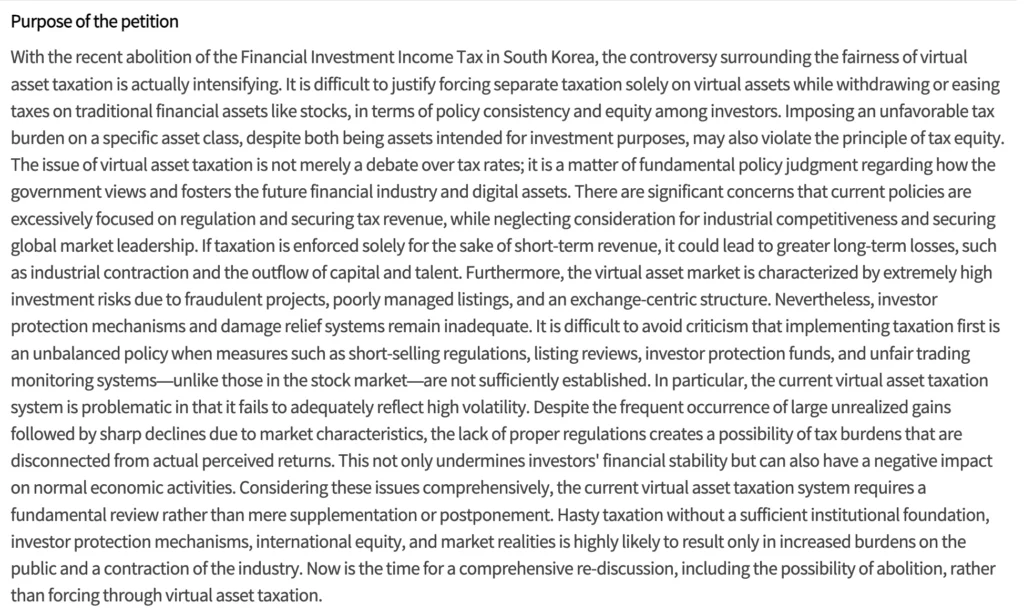
South Korea’s planned cryptocurrency tax has come under renewed political scrutiny after a public petition seeking its repeal cleared the signature threshold required for legislative review.
Summary
- South Korea’s proposed crypto tax repeal petition has crossed 50,000 signatures and moved to a National Assembly committee for review.
- The petition argues that taxing crypto gains while exempting stock and bond investment income creates unfair treatment for digital asset investors.
- South Korea is set to launch the 22% crypto tax in January 2027, with the National Tax Service already coordinating compliance rules with local exchanges.
According to South Korea’s National Assembly petition system, the motion surpassed 50,000 signatures at around 11:23 a.m. local time on Thursday, eight days after submission, automatically sending the proposal to a parliamentary committee for examination.
In the petition, an anonymous author argued that taxing crypto investors while exempting traditional financial investment income creates an unfair imbalance.
The motion pointed to South Korea’s decision to abolish taxes on gains from stocks and bonds, while virtual asset investors still face a planned 22% levy on annual gains above 2.5 million won, or roughly $1,650.
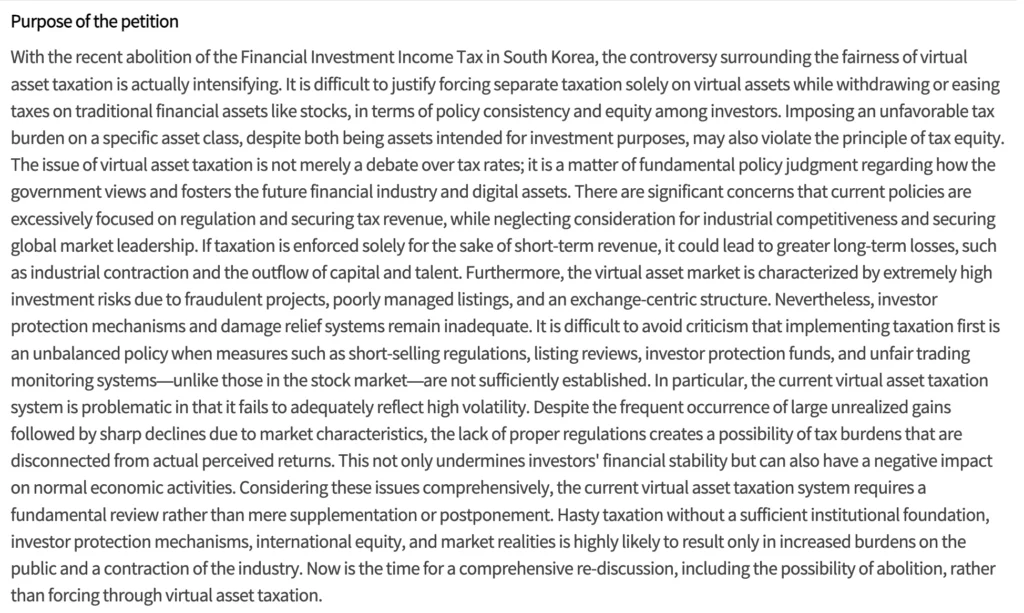
A translated excerpt of the petition. Source: South Korean National Assembly
Set to take effect from Jan. 1, 2027, the tax includes a 20% income tax and a 2% local income tax under South Korea’s Income Tax Act.
Earlier this month, Moon Kyung-ho, director of the Ministry of Economy and Finance’s income tax division, said during a National Assembly forum that the government intended to proceed with the tax as scheduled.
At the same time, South Korea’s National Tax Service has continued preparing implementation guidance with domestic exchanges including Upbit, Bithumb, Coinone, Korbit, and Gopax. Local reports previously said the agency plans to release detailed compliance guidelines later in 2026 before the first full filing period opens in May 2028 for income earned during 2027.
Petition raises investor protection concerns
Alongside criticism over tax fairness, the petition argued that South Korea’s crypto market still lacks sufficient investor safeguards. The motion cited fraudulent activity and poor-quality token listings as ongoing risks that authorities have not fully addressed before introducing taxation.
Translated text from the petition stated that the issue extends beyond tax rates and concerns how the government intends to treat digital assets and the future of the financial industry.
Additional criticism focused on market volatility. According to the motion, the current framework fails to properly account for large price swings that can rapidly alter investor positions.
Political disagreement over the crypto tax has delayed the measure three times already. Per earlier crypto.news reporting, lawmakers postponed implementation from 2025 to 2027 after debates over exchange infrastructure, reporting systems, and whether the 2.5 million won threshold was too low compared with other investment products.
More recently, South Korea’s People Power Party proposed legislation to abolish the tax before its scheduled rollout. However, the Finance Ministry’s latest public comments suggested authorities are still preparing for implementation unless lawmakers amend the law beforehand.
Elsewhere in South Korea’s digital asset sector, regulators have continued advancing new crypto oversight rules ahead of 2027. Earlier this month, the National Assembly passed amendments to the Foreign Exchange Transactions Act requiring firms involved in overseas crypto transfers to register with the finance minister.
Separately, the Financial Services Commission said on May 15 that it plans to release detailed tokenized securities rules in July ahead of amendments to the Capital Markets Act and Electronic Securities Act scheduled to take effect in February 2027. Samsung SDS is also building infrastructure for the Korea Securities Depository’s token securities platform as authorities prepare blockchain-based issuance and settlement systems.

Empyrean Solutions’ new R&D project to create 40 jobs in Cork

Who else knows someone cheap? #cheap #dad #relatable #airport #money

How Liverpool FC star Mo Salah became ‘one of the all-time greats’


-

 Crypto World2 days ago
Blockchain.com files with SEC for U.S. IPO
-

 Fashion13 hours ago
Holiday Weekend Open Thread – Corporette.com
-

 Crypto World6 days ago
Intesa Sanpaolo’s crypto holdings jump to $235M as XRP enters
-

 Crypto World17 hours ago
Space X IPO Is ‘Bad News’ for Tech Stocks: But What About Bitcoin?
-

 Fashion6 days ago
On the Scene at Gucci’s Cruise Show in New York City: Mariah Carey, Kim Kardashian, Lindsay Lohan, Iman, and More!
-

 Business17 hours ago
Dell Technologies DELL Stock Surges 15% on AI Server Momentum and Analyst Upgrades in 2026
-

 Politics7 days ago
Watch: far-right flag-fanatics run over victim, attack locals – Setup By the Left wing for your entertainment
-

 Fashion7 days ago
Trending Western Style Vests Perfect for Summer
-

 Politics13 hours ago
Makerfield: a tale of two social-media histories
-

 Fashion6 days ago
Amazon Sundays: Memorial Day Hosting
-

 Entertainment6 days ago
Off Campus Easter Eggs Explained: Characters, Stories, More
-
 Tech19 hours ago
A 0.12% parameter add-on gives AI agents the working memory RAG can’t
-
Crypto World4 days ago
Revolut Launches Dogecoin Debit Card Across UK and EU
-

 Crypto World18 hours ago
AI infrastructure race heats up as IREN pitches full-stack strategy, WhiteFiber lands $160M deal
-
Business6 days ago
Australia defends property tax changes designed to fix ‘broken’ housing
-
 NewsBeat2 days ago
Charity run by Reform leader Malcolm Offord accused of ‘law breaking’ over Scottish registration
-

 Crypto World1 day ago
Bitcoin Accumulation Weakens as BTC Realized Losses Hit $600M
-

 Sports1 day ago
2026 CJ Cup Byron Nelson leaderboard: Brooks Koepka finds putting stroke in Round 1
-

 Crypto World1 day ago
Trump Media’s Bitcoin Stash Shrinks Again as 2,650 BTC Lands on Crypto.com
-

 Politics7 days ago
Anti-Zionists attacked in Jerusalem as ethnofascists chant race-hate
You must be logged in to post a comment Login