

Crypto World
Bitcoin Sees New Monthly Low, Ethereum Dips to $2K: Weekend Watch

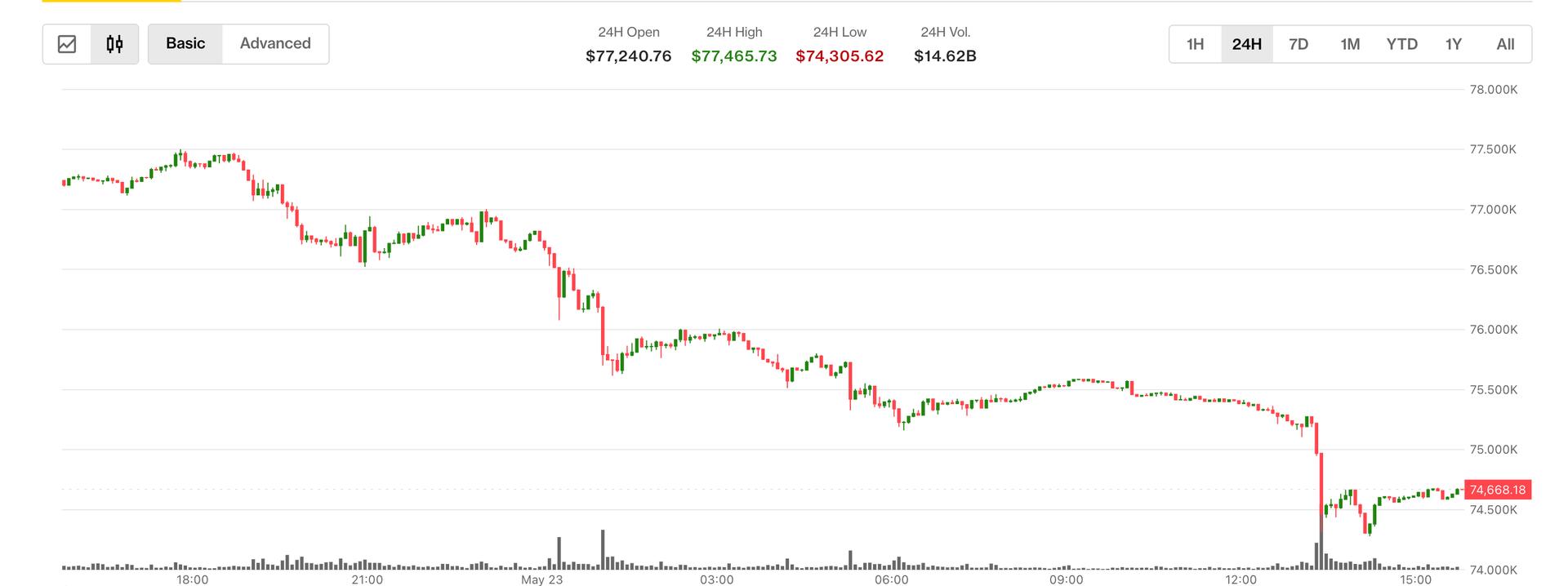
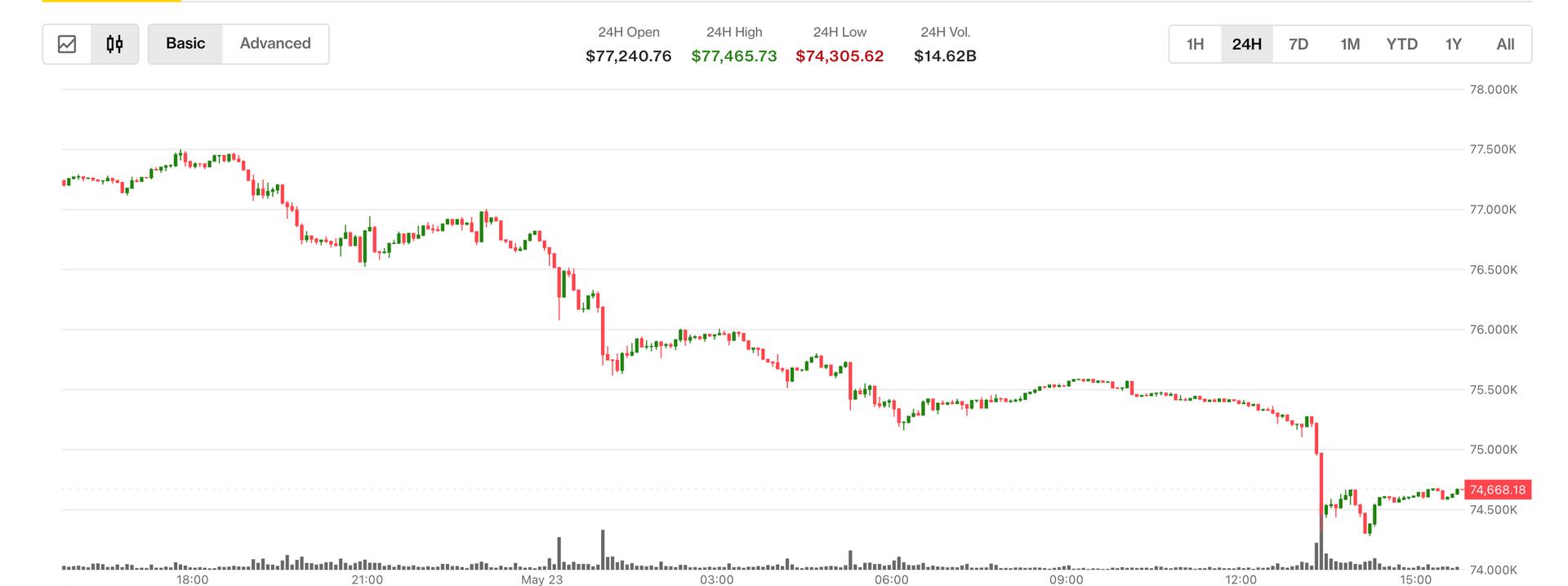
After it was rejected at $78,000 earlier this week, bitcoin’s troubles worsened with a nosedive to a monthly low of just over $74,000, where it finally found some support.
Most altcoins have followed suit on the way down, with ETH dipping to $2,000 today, BNB going down to $640, and XRP sliding to $1.31.
BTC Charts Monthly Low
The progress made on the CLARITY Act at the end of the previous week resulted in an impressive but short-lived BTC price pump that drove the asset to $82,000. However, it was almost immediately rejected at that level for the second time that week, but this correction has been a lot more painful.
The cryptocurrency first slipped to $79,000 by that Friday before it dropped to $78,000 during the weekend. The business week began on the wrong foot with a nosedive to $76,000. After it bounced to $78,000 on Tuesday and Wednesday, the bears stepped up on the gas pedal once again and didn’t allow a more impressive rebound.
Just the opposite; bitcoin dropped to $76,000 yesterday evening and kept plunging on Saturday to $75,000 at first and then to $74,200 minutes ago. The latter became BTC’s lowest price point in just over a month. Here are some possible reasons for its $8,000 drop in less than 10 days.
For now, its market capitalization has dumped below $1.5 trillion on CG, while its dominance over the alts has retreated slightly to 58%.

Alts Bleed Out
As mentioned above, bitcoin’s correction is not an isolated case. Essentially, the entire larger-cap altcoin field is in the red today. Ethereum dipped to $2,000 earlier today before it jumped slightly to $2,025 as of now. BNB is down to $640, XRP struggles to remain above $1.30, while SOL has plunged by over 6%.
Similar or more painful declines come from DOGE, HYPE, ZEC, ADA, BCH, LINK, SUI, and many others.
The cumulative market cap of all crypto assets has shed $100 billion since Thursday and is down to $2.570 trillion on CoinGecko.

The post Bitcoin Sees New Monthly Low, Ethereum Dips to $2K: Weekend Watch appeared first on CryptoPotato.


Key Takeaways
- BB shares reached a 52-week peak at $6.64, surging approximately 19% in one trading session
- Fourth quarter fiscal 2026 earnings exceeded projections: EPS of $0.06 versus consensus of $0.05, revenue of $156M compared to $142.55M forecast
- QNX business unit posted 20% annual growth, achieving record revenue of $78.7M
- Company executives announced at CIBC Technology and Innovation Conference that BlackBerry is transitioning into a phase of profitable expansion
- InvestingPro data suggests potential overvaluation; Baird maintains $5.00 target, Canaccord sets $4.40 price objective
Shares of BlackBerry soared approximately 19% to reach a 52-week peak of $6.64, extending a rally that has propelled the stock more than 75% higher year-to-date.
The dramatic upswing followed executive presentations at the CIBC Technology and Innovation Conference 2026, where company leadership informed investors that BlackBerry has entered a phase of profitable growth driven by its QNX software platform and physical AI initiatives.
The announcement resonated strongly with market participants who have been increasingly receptive to the company’s transformation toward software-centric operations.
Additional momentum came from the renewal of a critical U.S. FedRAMP cybersecurity authorization for the AtHoc platform. The Class D (High) recertification maintains BlackBerry‘s qualification for federal government contracts, providing important support for its Secure Communications division.
A reinstated share repurchase authorization, encompassing up to 26.8 million shares, further bolstered investor sentiment by demonstrating management’s conviction in the strategic direction.
Fourth Quarter Results Surpass Forecasts
BlackBerry’s fiscal 2026 fourth quarter performance exceeded analyst expectations across key metrics. The company delivered adjusted earnings per share of $0.06, topping the $0.05 consensus estimate, while revenue reached $156 million—significantly above the projected $142.55 million.
The revenue figure marked a 10% year-over-year expansion, reflecting the type of sustained top-line momentum the organization has been pursuing through its strategic transformation.
The QNX division, which develops embedded software solutions for automotive and industrial applications, delivered particularly strong results. Revenue in this segment increased 20% to an all-time high of $78.7 million. Meanwhile, the Secure Communications unit expanded 8% to $72.5 million.
Wall Street Price Targets Lag Stock Performance
Notwithstanding the market’s enthusiasm, Wall Street analyst price objectives haven’t kept pace with the stock’s ascent.
Baird maintained its Neutral stance with a $5.00 valuation target. Canaccord revised its objective downward to $4.40 while retaining a Hold recommendation.
Both price targets remain substantially beneath current trading levels, suggesting potential concerns about whether market valuations have outpaced underlying business fundamentals.
InvestingPro’s analytical framework identifies the stock as potentially trading above its Fair Value estimation, including BB among its most overvalued securities.
During the preceding six-month period, shares have appreciated nearly 49%. For the current year, gains exceed 75%. The company’s market capitalization currently stands at roughly $3.62 billion.
Daily trading volume averages approximately 15.9 million shares, while technical momentum indicators presently generate buy signals.
The primary recent catalyst continues to be the CIBC conference presentations coupled with robust QNX performance, the FedRAMP recertification achievement, and the buyback program announcement.


TLDR:
- Bloom Energy posted $751M in Q1 2026 revenue, a 130% year-over-year jump driven by AI data center demand.
- Bloom deploys fuel cell systems in 90 days versus the two-to-five years a standard grid connection typically requires.
- Oracle has committed to procure up to 2.8 gigawatts of Bloom’s systems, with 1.2 gigawatts already under contract.
- Bloom projects 30% of all data center sites will rely on onsite power as a primary energy source by 2030.
Bloom Energy is gaining ground as one of the most closely watched names in AI infrastructure. The company posted $751 million in revenue in Q1 2026, a 130% increase year over year.
Product revenue alone grew 208% in that single quarter. With full-year 2026 guidance now set at $3.4 billion to $3.8 billion, Bloom Energy is moving well beyond the margins of the AI buildout conversation.
Rapid Deployment Solves the AI Power Problem
Bloom Energy addresses a bottleneck that is slowing down data center construction across the sector. A traditional utility grid connection for a large data center typically takes two to five years to complete.
Bloom can deploy its fuel cell systems in as little as 90 days, scaling from 20 megawatts up to 500 megawatts per site.
That speed is one of the key reasons major cloud and infrastructure operators are turning to Bloom. Oracle has committed to procure up to 2.8 gigawatts of Bloom’s fuel cell systems, with 1.2 gigawatts already under contract.
Equinix, CoreWeave, and AEP — which supplies power to Amazon Web Services — are also confirmed customers.
The reliability figures are also notable. Bloom’s systems operate at up to 99.999% availability. That number exceeds what most utility grid connections can guarantee, making it a compelling option for workloads that cannot tolerate downtime.
Milk Road AI, an industry analyst account, described the investment case in a recent post: Bloom solves the single biggest problem in data center development right now — getting power fast.
Analysts at Milk Road Pro flagged Bloom Energy early. Their central thesis was that the AI energy bottleneck would become just as large an investment opportunity as the chip bottleneck. That view has since been validated by the company’s financial results and contract pipeline.
Institutional Deals and Production Expansion Signal Long-Term Growth
The scale of Bloom’s commercial agreements suggests this is not a temporary cycle. Bloom has signed a $5 billion strategic AI infrastructure partnership with Brookfield Asset Management.
Under that agreement, Bloom becomes the preferred onsite power provider across Brookfield’s $1 trillion infrastructure portfolio.
This week, a supplier to Bloom received what it described as the largest single contract in its company’s history. The contract covers switchgear manufacturing in support of a large-scale AI data center project.
On the production side, Bloom is on track to double its annual manufacturing capacity to 2 gigawatts by the end of 2026. Further scaling is planned beyond that point.
The company’s own research projects that approximately 30% of all data center sites will rely on onsite power as a primary energy source by 2030.
That market barely existed three years ago. The shift toward continuous computing — where AI models run around the clock rather than on demand — is what is driving the structural change.
Jensen Huang, CEO of Nvidia, has noted that AI computing requires up to 1,000 times more energy than traditional on-demand computing, and has acknowledged that estimate could move in either direction by another order of magnitude.
Bloom Energy’s stock has risen 1,231% over the past twelve months and is up more than 130% year to date. Those figures reflect a broader market recognition that the energy layer of AI infrastructure carries just as much value as the hardware layer above it.


Michael Saylor says a Strategy Bitcoin sale before year-end is ‘not unlikely’ in a Coin Stories podcast interview.
Summary
- Saylor told Natalie Brunell it was “not unlikely” Strategy would sell some Bitcoin before year-end, softening his long-held never-sell position.
- He said any model relying solely on equity, credit, or Bitcoin sales underperforms, and that Strategy uses a mixed capital management approach.
- Strategy holds 818,334 BTC worth approximately $65 billion and aims to maximise Bitcoin per share over a seven-year horizon to 2033.
Strategy executive chairman Michael Saylor told the Coin Stories podcast it was “not unlikely” the company would sell some Bitcoin before year-end. The comment softens his long-standing public position that Strategy would never sell.
“I think it’s not unlikely that we’ll sell some Bitcoin between now and the end of the year,” Saylor said. “Any model that we put together that’s limited only to equity or only to credit or only to Bitcoin always underperforms.”
Why Saylor says Strategy might sell Bitcoin in 2026
The comments follow Strategy’s Q1 earnings call, where Saylor said the company raised the possibility of selling Bitcoin to fund dividends, saying it would “inoculate the market.” Crypto.news has reported on that call and the $12.54 billion Q1 net loss that preceded it.
Saylor described Strategy’s capital management as programmatic and data-driven, with liabilities evaluated against a mix of cash, equity, credit and Bitcoin. Strategy holds 818,334 BTC acquired for approximately $61.6 billion at an average price of $75,527.
Saylor also confirmed Strategy does not plan to retire its STRF, STRD, and STRK preferred products, calling them useful parts of the capital structure while convertible bonds remain senior liabilities to be retired over time.
What a Strategy Bitcoin sale would mean for markets
Saylor said any sale would be small relative to Bitcoin’s daily market liquidity, estimated at $20 to $50 billion. He argued Strategy could buy roughly 20 Bitcoin for every one sold if dividends were fully funded through BTC sales.
Crypto.news has noted Saylor’s framing of Strategy’s three-layer capital structure, with Bitcoin as digital capital, STRC as digital credit, and MSTR as leveraged equity. The firm’s seven-year goal is to maximise Bitcoin per share by 2033.
Saylor said this long-term lens makes 2026 Bitcoin sales a capital allocation decision, not a reversal of conviction.
Bitcoin is rapidly losing ground as investors pull out billions of dollars from U.S.-listed spot ETFs.
The world’s largest cryptocurrency fell to $74,305 early Saturday, its lowest level since April 20, according to CoinDesk data. As of writing, BTC was down more than 3% over the past 24 hours and approximately 10% below its recent high of over $82,500 reached on May 6.
The sell-off accompanies a notable upswing in U.S. Treasury yields and parallel increases in government bond yields across developed markets, which are reducing appetite for high-risk, zero-yielding assets like bitcoin.
Investors withdrew $1.26 billion from U.S. spot Bitcoin ETFs this week, the largest single-week outflow since January, following roughly $1 billion in outflows the previous week. In total, the funds have seen more than $2.26 billion in redemptions over the past two weeks.
Meanwhile, commodities such as oil, copper, and sulfur are seeing strong flows of speculative money as markets continue to price in potential supply disruptions through the Strait of Hormuz due to the Iran conflict.
One theory also points to capital being redirected toward SpaceX’s anticipated IPO, with several blockchain-based pre-market derivatives tied to the event already seeing millions in trading volume on blockchain-based platforms.
TLDR:
- The tokenized ETF market tripled since late 2025, reaching $1.4B TVL with $400M+ in daily onchain settlement volume.
- Ondo Finance controls roughly 70% of the market with over 200 live assets and more than $1B in total value locked.
- xStocksFi surpassed $25B in cumulative transactions, powering DeFi collateral and lending for tokenized stocks on Solana.
- Analysts project $10B+ TVL by end of 2026, with a potential 50–100x rise if assets capture 0.5% of global equity AUM.
The tokenized ETF market has crossed $1.4 billion in total value locked, marking a sharp rise from late 2025. Daily onchain settlement volume across top platforms now exceeds $400 million.
Monthly transaction volume has grown 12 times over the past six months. The sector now accounts for over 18% of all relevant real-world asset flows.
Industry analysts project tens of billions in TVL by year-end as tokenized assets target even a fraction of the $120 trillion global equity market.
Ondo Finance and Key Players Drive Tokenized Equity Growth
Ondo Finance currently holds roughly 70% of the tokenized ETF market. The platform has crossed $1 billion in TVL with over 200 assets live. That dominance places it well ahead of other competing protocols in the space.
Researcher Nick posted on X that the market cap of the sector rose from just $0.62 million on July 1, 2025, to approximately $300 million by the end of Q1 2026.
That figure reflects a broad shift in how institutions and retail users are accessing equity exposure. The growth has been steady rather than driven by a single asset class.
Dinari Global operates as the first broker-dealer licensed for dShares, targeting domestic retail and platform flows.
WisdomTree Prime offers 24/7 trading and instant settlement for its tokenized Treasury and ETF products. Both firms bring regulated infrastructure to a market that has historically operated in a gray area.
Robinhood has also entered the space, offering stock tokens covering over 2,000 U.S. stocks and ETFs for European users.
All tokens are backed by Robinhood custody, which adds a layer of security and compliance. That move brings a mainstream brokerage into direct contact with onchain settlement rails.
xStocksFi Powers the DeFi Layer for Tokenized Assets on Solana
xStocksFi has recorded over $25 billion in cumulative transaction volume on its platform. The protocol issues more than 100 one-to-one backed tokens with full DeFi collateral and lending options on Solana. That positions it as a core liquidity layer for tokenized stocks in decentralized finance.
The platform’s role goes beyond simple token issuance. By supporting lending and collateral use cases, xStocksFi allows tokenized equities to function as productive assets within DeFi ecosystems. That functionality has drawn both retail and institutional participants to the Solana network.
Current projections place the sector at $10 billion or more in TVL by the end of 2026. That would represent a sevenfold increase in roughly seven months from the current $1.4 billion figure.
Over a three-to-four year horizon, capturing just 0.5% of global equity and ETF assets under management could push the market 50 to 100 times higher.
The payments, real-world asset, and institutional settlement use cases are all expanding alongside tokenized equities.
The convergence of regulated issuers, DeFi liquidity, and mainstream custodians appears to be accelerating the adoption curve faster than prior cycles in crypto.


Robinhood crypto COO Tanya Denisova is leaving the platform after more than five years.
Summary
- Tanya Denisova, COO of Robinhood Crypto, is leaving the firm after more than five years as the platform navigates a 47% decline in Q1 crypto revenue.
- Robinhood’s Q1 2026 crypto revenue fell to $134 million from $252 million a year earlier, contributing to an earnings miss reported on April 28.
- No successor has been named and neither Denisova nor Robinhood have publicly commented on the departure.
Tanya Denisova, chief operating officer of Robinhood Crypto, is leaving the company after more than five years, according to two people with knowledge of the matter. Neither she nor Robinhood has publicly commented and no successor has been named.
Robinhood’s Q1 2026 crypto revenue fell 47% year over year to $134 million, down from $252 million a year earlier. The drop contributed to an earnings miss on April 28, with Morningstar describing crypto trading as a “particular pressure point” for the quarter.
What Denisova built and why her exit matters now
Under Denisova’s operational watch, Robinhood launched commission-free crypto trading, digital wallets, and staking options. The platform also completed its acquisition of Bitstamp in 2025, significantly expanding its institutional and international reach.
Crypto.news has tracked the Q1 2026 earnings miss, with Morningstar describing crypto as a “particular pressure point.” Crypto.news has also reported on the Q4 2025 crypto revenue decline of 38%, a trend that now extends into 2026 with a steeper fall.
Crypto trading revenue is tied directly to market volatility and retail participation. In Q1 2026, Bitcoin spent most of the quarter below $80,000 and retail trading volumes contracted sharply following macro pressures at the start of the year.
Why crypto revenue fell 47% and what it means for Robinhood’s business
Robinhood’s total net revenue rose 15% to $1.07 billion in Q1 2026, meaning the overall business is growing even as crypto drags. Crypto.news has reported on the platform’s $25 billion monthly crypto trading volume in early 2026, a figure that shows volume remained large while revenue capture per trade weakened.
The leadership gap comes as Robinhood evaluates how aggressively to pursue crypto amid sustained market pressure. A 47% year-over-year revenue decline signals the platform is capturing less value from each dollar of crypto trading volume than it did in 2025, a structural challenge that any incoming COO will need to address.

Key Takeaways
- Dell Technologies shares jumped more than 16% Friday, closing near $294 and marking a fresh all-time high before the company’s Q1 earnings release on May 28.
- Year-to-date gains have reached between 130% and 140%, positioning Dell among the best-performing stocks in the S&P 500 for 2026.
- Multiple Wall Street firms upgraded their outlook, including Mizuho’s $300 price target driven by Dell’s massive $43 billion AI server order backlog.
- Competitor Lenovo reported impressive first-quarter performance with an 84% surge in AI revenue, boosting confidence in Dell’s upcoming results.
- Options traders are displaying bullish sentiment with a 0.5 put-to-call ratio and implied post-earnings targets approaching $323.
Shares of Dell Technologies (DELL) rocketed over 16% Friday, approaching $294 and establishing a fresh all-time closing high. The explosive rally extends the stock’s year-to-date advance to approximately 130–140%, marking it as one of 2026’s most impressive performers within the S&P 500.
The dramatic single-session move followed a coordinated series of bullish analyst calls, all published just days before Dell reports first-quarter financial results after market close on May 28.
Citi analysts boosted their DELL price objective to $290, highlighting the company’s strategic role in “neocloud” infrastructure buildouts and growing appetite for “sovereign AI” systems. JPMorgan chimed in with reassurance that rising memory component costs remain “manageable” while enterprise AI server demand continues accelerating.
Mizuho took the most aggressive stance, pushing its target to $300. The firm emphasized that institutional buyers are fixating on Dell’s staggering $43 billion AI server backlog rather than worrying about short-term margin headwinds.
Bank of America, maintaining its “buy” recommendation, noted observing “substantial” momentum in both AI hardware purchases and conventional PC sales during the first half of 2026, with AI server strength expected to persist through year-end.
Among the seven analysts currently covering Dell according to Visible Alpha data, six maintain buy ratings while just one holds a neutral view. Notably, the stock has already sailed past the consensus price target of $223.
Lenovo Results Provide Encouraging Preview
Competitor Lenovo delivered first-quarter numbers that further energized Dell bulls. The Chinese technology giant posted 27% year-over-year revenue growth reaching $21.6 billion, while net income doubled to $559 million. Particularly striking was the 84% explosion in AI-related revenue.
Market participants are interpreting Lenovo‘s performance as a positive indicator for Dell’s upcoming disclosure. The prevailing view suggests that if Lenovo captured such robust demand, Dell should deliver comparable or superior results given its market positioning.
Street consensus anticipates Dell reporting approximately 52% year-over-year revenue expansion for Q1, with earnings per share projected around $2.94.
Nvidia’s stronger-than-anticipated quarterly performance earlier this week provided additional momentum. Citi specifically cited those results as a constructive signal for Dell, considering the deep integration between both companies across AI infrastructure supply chains.
Derivatives Trading Signals Bullish Positioning
Options market activity reveals traders preparing for continued upside following the earnings announcement. The put-to-call ratio for contracts expiring May 29 stands at 0.5, reflecting decidedly bullish positioning. Implied volatility pricing suggests an upper target near $323, indicating expectations for a potential 10% post-earnings jump.
Technically, DELL is trading comfortably above all significant moving averages, with the Relative Strength Index hovering in the mid-70s—indicating persistent buying momentum.
Dell also maintains a dividend yielding 0.85%, offering a supplementary income element for buy-and-hold investors.
The company’s first-quarter earnings announcement is confirmed for after the closing bell on May 28.
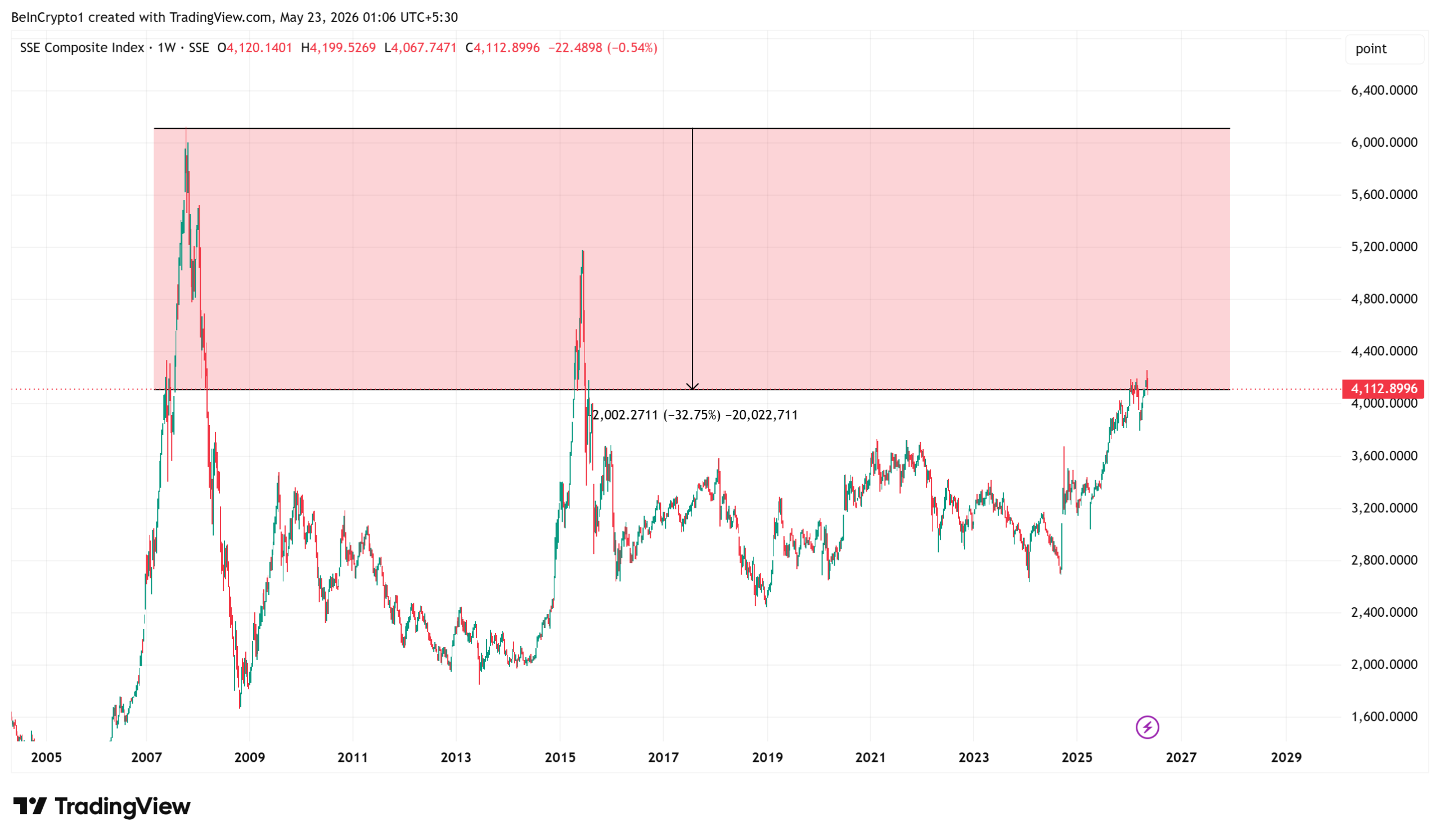
The Shanghai Composite closed Friday near 4,113 points, still about 33% below its 2007 peak, even as China’s nominal output has expanded roughly sevenfold over the same two-decade stretch.
The US benchmark has delivered upward of 600% in total returns over that period, exposing a structural gap between China’s real economy and the prices its listed companies command.

China Sees Booming Economy, Stagnant Index
China posted a record $1.19 trillion trade surplus in 2025 and grew GDP by 5% in the first quarter of 2026, according to the National Bureau of Statistics.
It has also overtaken Japan as the world’s largest auto exporter and continues to dominate global manufacturing.
Yet listed firms have not turned that production base into compounding shareholder value.
Final household consumption sits at 53% of GDP, compared with roughly 68% in the United States, capping the corporate earnings that drive equity indices higher.
Retail Flows and Frozen Household Wealth
Retail traders generate close to 90% of daily turnover on mainland exchanges, compared with about 20% in the United States.
That thin institutional base produces sharp directional moves around policy signals rather than steady capital formation, pushing some toward Bitcoin (BTC) during the Chinese stock market downturn.
Property compounds the drag. Beijing’s 2020 Three Red Lines policy triggered the collapse of Evergrande and pushed home prices in real terms back toward 2005 levels.
With about 70% of household wealth tied to real estate, more Chinese savers are now repricing luxury property and holding cash.
AI Rally Cut Short
The AI cycle was the first independent catalyst in years. DeepSeek’s R1 release in early 2025 added roughly $1.3 trillion in tech market cap before the China Securities Regulatory Commission demanded that listed firms and ETF managers disclose AI revenue inside 20 business days.
DeepSeek then launched its 1.6 trillion-parameter V4 model in April 2026 on Huawei Ascend processors, with reverberations across crypto miners and Nvidia.
The market reaction was muted. The CSRC also moved this week against brokerages Tiger, Futu, and Longbridge over cross-border trading, alongside China’s longstanding crypto ban on retail access.
Goldman Sachs forecasts another 10% drop in home prices before the property market bottoms, suggesting household balance sheets stay frozen into 2027.
Local government debt has also climbed to roughly $18.9 trillion, limiting Beijing’s room to stimulate further.
Until that flips, the gap between China’s economy and its equity benchmark is likely to persist.
The post Chinese Economy Is Booming, But Stock Markets Haven’t Recovered in 20 Years appeared first on BeInCrypto.
Crypto World
Hewlett Packard Enterprise (HPE) Stock Soars to Record Peak as Elliott Expands Position

Key Highlights
- Shares of HPE reached a record peak of $34.82 before settling around $35.10, with market capitalization at $45.07 billion
- The company’s stock has climbed approximately 98% in the past twelve months
- Elliott Investment Management expanded its position to more than 27.4 million shares, representing approximately $927 million in value
- During Q1 2026, Elliott completely divested from Bill Holdings and Sensata Technologies
- Evercore ISI maintains an Outperform rating with a $40 price objective for HPE
Shares of Hewlett Packard Enterprise reached a record peak of $34.82 during trading on May 22, subsequently climbing to $35.10. This performance represents an impressive gain of approximately 98% compared to the previous year.
Hewlett Packard Enterprise Company, HPE
This record achievement coincides with Elliott Investment Management revealing a substantial expansion of its HPE holdings. The prominent activist hedge fund increased its position from 18.6 million shares to 27.4 million shares during the first quarter of 2026. At Wednesday’s closing price of $33.80, this holding represents approximately $927 million in value.
Elliott initially established its HPE position in 2024. The investment firm has gained recognition for its activist involvement with major corporations such as Starbucks and Southwest Airlines.
Portfolio Restructuring at Elliott
While expanding its HPE holdings, Elliott executed several complete exits during the identical quarter. The firm liquidated its remaining 3 million shares in Bill Holdings and eliminated its entire 3.25 million share stake in Sensata Technologies.
Elliott had advocated for strategic changes at both enterprises. At Sensata, the firm secured a board position following the CEO’s departure in April 2024.
Norwegian Cruise Line emerged as a fresh addition to Elliott’s holdings. The firm announced an economic interest exceeding 10% in NCLH during February and acquired 13.19 million shares in Q1. As of Wednesday, this holding was valued above $445 million, constituting roughly a 2.9% ownership stake.
Elliott maintained unchanged positions in PepsiCo, Equinix, and Phillips 66.
Analyst Perspectives and Corporate Strategy
Wall Street analysts have shown increasing optimism toward HPE. Bernstein elevated its price objective to $35, citing growing demand for conventional servers linked to artificial intelligence workloads.
Evercore ISI adopted a more bullish stance, increasing its target to $40 while maintaining an Outperform rating. This revision followed HPE’s transaction involving the sale of a 13.8% ownership stake in H3C Technologies to Chinese purchasers for approximately $986.8 million.
Prior to this partial divestiture, HPE maintained a 19% stake in H3C.
The enterprise has simultaneously been broadening its distribution capabilities. Both Ingram Micro and TD SYNNEX received appointments as worldwide distributors to facilitate the delivery of HPE’s networking, cloud computing, and artificial intelligence product lines to channel partners.
Activist investor Irenic Capital has similarly established a position in the company and has engaged in direct discussions with HPE leadership.
InvestingPro data indicates HPE is trading close to its 52-week peak, although their analysis suggests the stock may be overvalued at present price levels.


Disclosure: This article does not represent investment advice. The content and materials featured on this page are for educational purposes only.
Reelrush introduces Social Launchpad on Solana, blending short-form content with on-chain markets and a trade-to-earn model.
Summary
- Reelrush is a Solana-based social platform that combines short-form video, text posting, and on-chain trading through a built-in “Trade” feature on every post.
- Users log in with an X account, get an embedded wallet automatically, and can launch token markets tied to content in seconds via an AI-assisted process.
- Each creator earns a small trading fee share, while markets start on a bonding curve and migrate to full DEX liquidity once they reach $7,000 market cap.
A video hits a million views on TikTok in under an hour. The creator gets a badge. The audience gets dopamine. The platform keeps the money. Reelrush is built around a different proposition: what if the audience could buy in instead of just watch?
That’s the core pitch of the Social Launchpad, a platform that merges short-video and real-time text posting with on-chain markets; with everything running on Solana. Reelrush is a product that deliberately feels familiar. Anyone who has used X for posting and TikTok for video already knows most of the interface. The unfamiliar part is the Trade button sitting at the bottom of every piece of content.
What it actually is
Reelrush is a social network with a built-in token launchpad. Users sign in with an existing X account. This means there no new identity to construct, no follower count to rebuild from scratch. The platform imports the user’s existing X follow graph on first login, which solves the empty-room problem that tends to kill new social apps before they get started.
Once signed in, an embedded Solana wallet is created in the background. Users don’t see a seed phrase or install a browser extension. They just see a balance. The technical layer is invisible by design.
The content model covers both sides of what dominates the internet right now. There’s a vertical video feed with full TikTok-style playback, and a parallel text feed for short posts, replies, reposts, and quotes — up to 500 characters. Every reel and every post carries the same action row: Reply, Repost, Like, Share, and Trade. That last option is the only one that doesn’t exist on X or TikTok.
Launching a market takes ten seconds
Tapping Launch on any piece of content that doesn’t yet have a market triggers a fast, automated process. An AI model reads the caption, hashtags, and video subject, then suggests a ticker and name. The platform funds and signs the creation transaction using the embedded wallet and returns a live market in under two seconds.
The creator who launched the market earns 0.5% of every trade made against it, automatically, forever and without claiming, without running anything, or without holding the token. The other 0.5% goes to the protocol treasury.
Every market starts on Meteora’s Dynamic Bonding Curve on Solana, where price moves as a function of buying and selling activity. No order book, no market maker needed. When a market reaches a $7,000 market capitalization, it migrates automatically to a full Meteora liquidity pool, at which point the token shows up on Jupiter and other DEX aggregators and can be traded from any wallet, not just from within Reelrush.
This two-stage structure is worth paying attention to. The bonding curve phase acts as a buffer against the instant rug-pull dynamic that makes a lot of early meme token markets difficult to take seriously. Successful markets earn their way to broader liquidity rather than starting there.
The feed isn’t purely a pump board
Reelrush’s “For You” algorithm combines velocity (views, watch-through rate, likes in the last 60 minutes), social (how many people in a user’s follow graph have engaged, and how close the author is to them), and market (buy pressure and holder growth on the attached token). The weights are personalized and retuned daily.
Importantly, the ranking isn’t dominated by market activity alone. A video with heavy buy pressure but low watch-through gets suppressed. A video with strong engagement and no market attached still surfaces. That balance matters if the platform is going to function as a social product rather than just a speculative leaderboard.
A few things to keep in mind
Reelrush is still in its early stages. The current roadmap puts the public launch, per-reel coins, and embedded wallets in Q2 2026, with profiles, follows, and DMs following in Q3. Holder-gated chat — a real-time channel visible only to current token holders — is slated for Q4. The project’s whitepaper honestly says that tokens attached to content can and frequently will fall to zero, and trading is highly speculative.
The concept, however, is harder to dismiss than most early-stage crypto social projects. Short video and real-time text are two of the most dominant content formats on the internet right now. The short video market size currently sits at $2.17 billion in 2026, and is expected to reach &3.37 billion by 2031. Solana’s throughput makes sub-second, low-cost settlement realistic. The gap Reelrush is trying to close — between the cultural moments that move markets and the markets themselves — is real.
Whether a single tap can bridge that gap at scale is the question the platform’s 2026 rollout will have to answer.
For more information about Reelrush, visit the official website, and read the whitepaper.
Disclosure: This content is provided by a third party. Neither crypto.news nor the author of this article endorses any product mentioned on this page. Users should conduct their own research before taking any action related to the company.
BlackBerry (BB) Stock Surges 19% to New 52-Week Peak on Bullish Outlook

Jodie Foster’s R-Rated Home Invasion Thriller Is A Masterclass Of Tension And Escalation

Nokia Stock Surges 9.55% on AI Lab Launch and Analyst Price Target Hike in May 2026


-

 Crypto World2 days ago
Blockchain.com files with SEC for U.S. IPO
-

 Fashion16 hours ago
Holiday Weekend Open Thread – Corporette.com
-
 Crypto World6 days ago
Intesa Sanpaolo’s crypto holdings jump to $235M as XRP enters
-

 Business20 hours ago
Dell Technologies DELL Stock Surges 15% on AI Server Momentum and Analyst Upgrades in 2026
-

 Crypto World20 hours ago
Space X IPO Is ‘Bad News’ for Tech Stocks: But What About Bitcoin?
-

 Fashion6 days ago
On the Scene at Gucci’s Cruise Show in New York City: Mariah Carey, Kim Kardashian, Lindsay Lohan, Iman, and More!
-

 Politics7 days ago
Watch: far-right flag-fanatics run over victim, attack locals – Setup By the Left wing for your entertainment
-

 Fashion7 days ago
Trending Western Style Vests Perfect for Summer
-

 Politics16 hours ago
Makerfield: a tale of two social-media histories
-

 Crypto World37 minutes ago
Robinhood crypto COO Tanya Denisova exits
-

 Fashion6 days ago
Amazon Sundays: Memorial Day Hosting
-

 Entertainment6 days ago
Off Campus Easter Eggs Explained: Characters, Stories, More
-
 Tech22 hours ago
A 0.12% parameter add-on gives AI agents the working memory RAG can’t
-
Crypto World5 days ago
Revolut Launches Dogecoin Debit Card Across UK and EU
-
 Crypto World1 day ago
Bitcoin Accumulation Weakens as BTC Realized Losses Hit $600M
-

 Crypto World21 hours ago
AI infrastructure race heats up as IREN pitches full-stack strategy, WhiteFiber lands $160M deal
-
 NewsBeat2 days ago
Charity run by Reform leader Malcolm Offord accused of ‘law breaking’ over Scottish registration
-

 Sports1 day ago
2026 CJ Cup Byron Nelson leaderboard: Brooks Koepka finds putting stroke in Round 1
-
Business6 days ago
Australia defends property tax changes designed to fix ‘broken’ housing
-

 Crypto World1 day ago
Trump Media’s Bitcoin Stash Shrinks Again as 2,650 BTC Lands on Crypto.com
You must be logged in to post a comment Login