

Crypto World
Bitcoin ETF outflows hit $1.26B Santiment buy signal



Bitcoin ETF outflows reached $1.26 billion over six sessions, but Santiment says the streak signals a buying opportunity.
Summary
- US spot Bitcoin (BTC) ETFs recorded net outflows in each of the six trading sessions from May 15 through May 22, totalling $1.26 billion across 11 funds.
- Santiment says ETF flows reflect retail investor sentiment rather than institutional positioning, calling the outflow streak a contrarian accumulation signal.
- Bitcoin was trading at $75,410 when Santiment published its report, down from a May high of $79,052 reached on May 16.
The 11 US-listed spot Bitcoin ETFs have recorded net outflows in each of six sessions from May 15 through May 22, totalling $1.26 billion according to Farside data.
“Sustained ETF outflows have historically correlated with conditions favorable for patient accumulation rather than panic,” Santiment said in a published report. The analytics firm argued that ETFs disproportionately reflect retail conviction rather than smart money positioning, making large outflows a counter-signal.
Why Santiment reads outflows as a buying signal not a warning
Santiment’s analysis rests on a historical pattern: Bitcoin’s strongest rallies have followed periods of heavy ETF withdrawals. The firm said retail investors grew less patient after Bitcoin failed to hold $80,000, with the current streak resembling a healthy market reset.
ETF analyst James Seyffart noted that Bitcoin ETFs have clawed back most of the $9 billion in outflows seen between October 2025 and February 2026. Crypto.news has reported on the first May outflow event, which reversed the early-month inflow trend.
What the Farside data shows across the 11 funds
Fidelity’s Wise Origin Bitcoin Fund led individual redemptions within the streak. BlackRock’s IBIT saw outflows on multiple sessions, and Morgan Stanley’s MSBT attracted positive flows on some days during the period.
Crypto.news has tracked Bitcoin ETFs ending Q1 2026 with net outflows of approximately $500 million, showing the current six-session streak continues a broader 2026 pattern of intermittent redemptions.
Santiment’s contrarian framing does not eliminate further downside risk. If Bitcoin breaks below $74,000, the outflow streak would need reassessment as a buy signal.

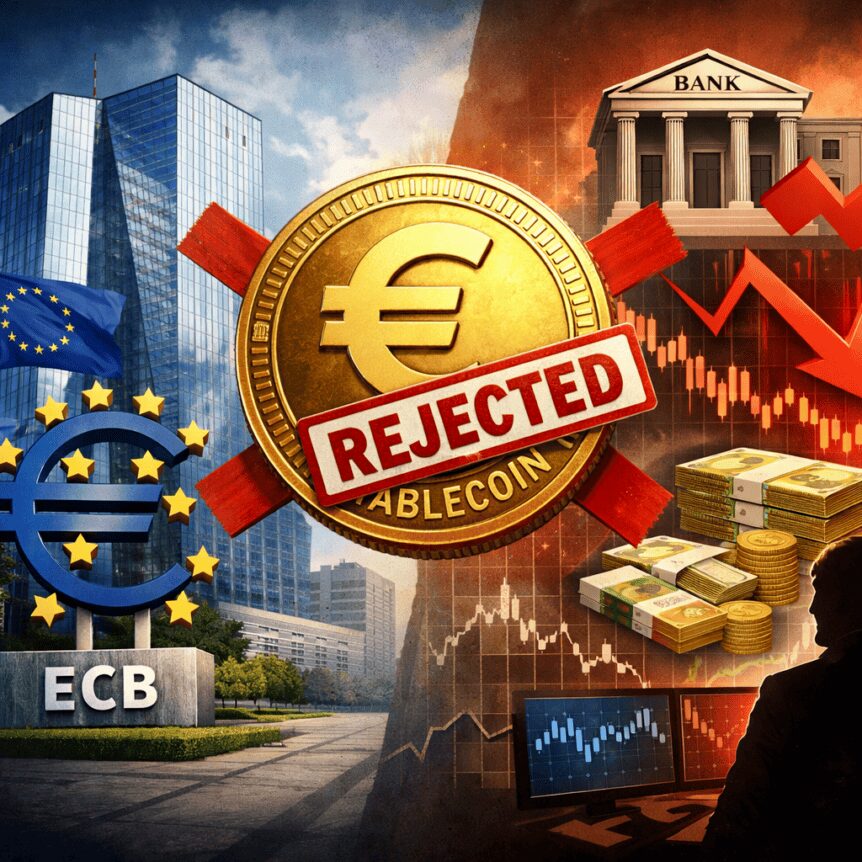
The European Central Bank (ECB) signaled serious caution on proposals to widen euro stablecoin issuance, warning that such moves could weaken bank lending and complicate the conduct of monetary policy. The concerns emerged as Brussels-based think tank Bruegel published a policy paper ahead of an informal gathering of EU finance ministers, urging lighter liquidity requirements for stablecoin issuers and even potential access to ECB funding to help euro-denominated tokens compete with dollar-backed rivals.
According to Bruegel’s analysis, Europe accounts for about 38% of global stablecoin activity, yet euro-denominated tokens represent roughly 0.3% of total supply. Circle’s EURC, the largest euro stablecoin, sits around 12th in the global ranking by market size, according to CoinMarketCap. The policy paper was presented during a two-day informal meeting of the Economic and Financial Affairs Council in Nicosia, Cyprus, and has since drawn a pointed response from the ECB leadership.
The central question debated in Nicosia was whether Europe should close the euro-stablecoin gap by extending central-bank-style support to issuers. For now, the ECB’s position appears resistant to such a shift.
Key takeaways
- ECB officials publicly warned that broadening euro-stablecoin issuance could undermine traditional banking models and complicate monetary policy transmission.
- Bruegel proposed easing liquidity requirements for stablecoin issuers and granting them access to ECB funding to spur euro-stablecoin competitiveness against dollar tokens.
- European stablecoins handle a substantial share of global activity (38%), but euro-denominated tokens remain a small fraction of supply (about 0.3%), with EURC ranking 12th globally by market size.
- ECB President Christine Lagarde led the opposition to central-bank-backed stability facilities for issuers, highlighting risks to bank deposits, disintermediation, and higher funding costs for banks.
- The debate sits within a broader policy framework, including MiCA regulation, the US GENIUS Act, and ongoing consideration of tokenized financial infrastructure backed by central-bank money.
Policy proposals and regulatory context
The Bruegel paper presented at the Nicosia meeting advocates a more permissive stance toward euro-stablecoin issuers, arguing that easing liquidity requirements and providing potential ECB funding access would help euro tokens compete with dollar-dominated equivalents. Proponents contend that an integrated, euro-backed stablecoin market could bolster EU financial sovereignty and efficiency in cross-border payments, while leveraging the ECB’s balance-sheet capacity to support liquidity needs in times of stress.
ECB leadership, however, has signaled a different path. In the discussions surrounding the paper, ECB officials underscored potential destabilizing effects of stablecoin issuance on traditional banks, particularly through the displacement of deposits from banks to stablecoin issuers. At scale, this disintermediation could raise bank funding costs and hamper the central bank’s ability to steer policy through traditional channels. Reuters reported that Lagarde and fellow policymakers questioned whether the ECB should assume a lender-of-last-resort role for stablecoin firms—a function currently reserved for regulated banks—thereby challenging a core aspect of the euro-area financial safety net.
The broader regulatory backdrop includes the EU’s Markets in Crypto-Assets framework, or MiCA, which is under review as the bloc weighs how to adapt rules for stability tokens. MiCA already imposes requirements on stablecoin issuers to hold substantial reserves in liquid assets, a regime that contrasts with the more permissive posture seen in some other jurisdictions, such as the US GENIUS Act. The Bruegel position raises a legal and policy question: should EU policy converge toward centralized funding and explicit backstops for stablecoins, or should it preserve sharper distinctions between digital assets and fiat-backed money?
Banking stability, monetary policy, and market structure
Central bankers at the Nicosia gathering largely dismissed the Bruegel notion of extending an ECB lender-of-last-resort facility to stablecoin issuers. The ECB’s stance reflects a precautionary calculus: stablecoins can alter the balance between banks and non-bank funding channels, potentially reducing the resilience of the traditional banking system and weakening monetary policy transmission mechanisms. Lagarde’s comments emphasize that, while euro-stablecoins could stimulate demand for euro-area safe assets, the associated trade-offs—especially financial stability risks, redemption pressures, and diminished policy effectiveness—outweigh the perceived benefits.
Beyond stability concerns, Lagarde has repeatedly highlighted the importance of building tokenized financial infrastructure with central-bank money at its core. She pointed to Europe’s ongoing initiatives—such as the Eurosystem’s Pontes project for wholesale settlement and the Appia roadmap for interoperable tokenized finance—as more predictable avenues for modernizing payments and settlement without compromising monetary sovereignty. This stance aligns with a policy preference for regulated, assets-backed digital finance that retains direct anchorage to central bank money, rather than broad market expansion of private-issued stablecoins.
At the same time, Bruegel’s authors cautioned that stricter EU rules relative to the United States could hasten digital dollarization, pushing stablecoin activity beyond the bloc’s borders. While some participants acknowledged the risk, others argued for targeted measures to manage redemptions from European-issued stablecoins and to limit reserve runs, thereby shielding the euro-area financial system from abrupt shifts in liquidity.
EU regulatory landscape and international considerations
The ongoing MiCA review sits at the center of EU policy discussions about crypto regulation, with implications for issuers, exchanges, and institutional players operating across European borders. A stricter regime—potentially complemented by efforts to restrict redemptions of both US- and EU-issued stablecoins within the bloc—could offer a bulwark against reserve runs but may also dampen innovation and competitiveness in a global market where dollar-backed tokens have established a deep liquidity pool.
Comparative regulatory dynamics are evident in the US framework, where the GENIUS Act and other legislative developments reflect a more permissive stance toward certain digital assets, albeit under ongoing oversight. Proponents of the euro-area approach argue that clear, robust requirements—aligned with MiCA—are essential for safeguarding financial stability and ensuring that any expansion of euro-stablecoin activity remains within the ECB’s reach to guard against macroeconomic spillovers.
Institutional implications extend to licensing, supervisory oversight, and cross-border cooperation. As European institutions weigh the balance between fostering a competitive euro-stablecoin market and preserving the integrity and resilience of the banking system, firms operating in the space should assess how MiCA provisions, any future ECB facilities, and potential liquidity or redemption controls could shape European operations, capital planning, and compliance programs.
Closing perspective
EU policymakers are navigating a delicate equilibrium between unlocking the strategic benefits of euro-stablecoins and maintaining robust financial stability and monetary policy effectiveness. The debate in Nicosia reflects deeper questions about the role of central-bank money in a digitized payments landscape and the institutional safeguards required to prevent destabilizing shifts in liquidity. As MiCA modernization progresses and cross-border dynamics evolve, banks, issuers, and institutional investors should monitor regulatory alignments, potential lender-of-last-resort considerations, and the trajectory of Europe’s tokenized-finance infrastructure—alongside ongoing assessments of how these policy choices will affect cross-border payments, reserve management, and compliance frameworks.
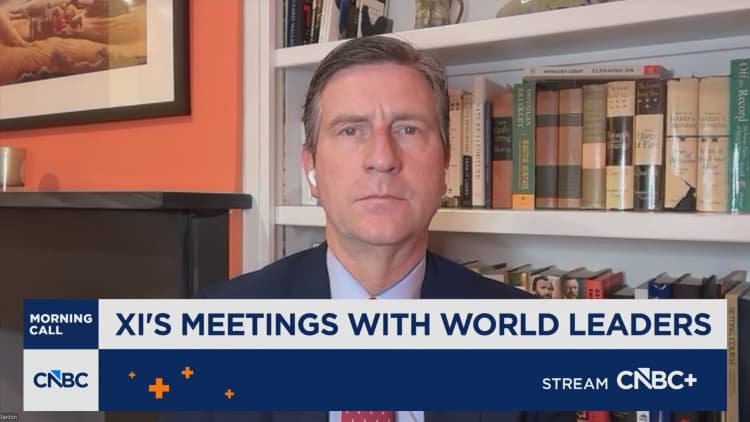
China’s Commerce Minister Wang Wentao held a press conference on May 23, 2026, at the end of the APEC trade ministers’ meeting in Suzhou, China.
CNBC | Evelyn Cheng
SUZHOU, China — Just over a week after the U.S. and Chinese presidents met in Beijing, the world’s two largest economies are sending different messages about their priorities for Asia.
First is tariffs.
China’s economy relies significantly on exports — and the free-flow trade — as it accounts for about 28% of the goods made globally, according to CNBC calculations of World Bank data.
Beijing’s statements on Chinese President Xi Jinping and U.S. President Donald Trump’s summit last week have noted how duties will remain lower for longer, while the U.S. did not mention tariffs.
Then on Saturday, China’s Commerce Minister Wang Wentao told reporters that affirming the “vision” of a free trade agreement was a key outcome of the just-concluded Asia-Pacific Economic Cooperation trade ministers meeting.
“In the context of rising uncertain and destabilizing factors in global and regional economic development, members redirected their attention to the FTAAP (Free Trade Area of the Asia Pacific) with commitment to continuing advancing economic integration through the FTAAP agenda,” Wang said in Chinese, according to an official English translation.
However, when CNBC a day earlier asked a member of the U.S. delegation about FTAAP and free trade, the response focused on balanced trade, part of the Trump administration’s rationale for tariffs.
“FTAAP, is really, it’s more an agenda than it is a kind of destination,” said Casey K. Mace, the U.S. Senior Official to the APEC Forum. He noted the U.S. has been “active” in elements of FTAAP such as competitiveness, labor standards and trade facilitation.
China is the host for this year’s APEC meetings, set to culminate in November with a high-level gathering in Shenzhen. Trump and Xi are also expected to meet alongside that event.

‘Constructive strategic stability’
Second is what’s next for the U.S. and China.
There’s little detail yet on how the two sides will move forward with implementing “constructive strategic stability,” beyond China’s purchase of 200 Boeing airplanes and $17 billion annually in U.S. agricultural products through 2028.
A Chinese readout released early Saturday said Wang met Thursday in Suzhou with Rick Switzer, the U.S. Deputy Trade Representative and head of the U.S. delegation for the APEC trade ministers meeting.
The readout said both sides hoped to reach an agreement as soon as possible on the details of economic outcomes from the Trump-Xi meeting — an indication that differences still remain.
The U.S. embassy in Beijing and the U.S. State Department did not immediately respond to a request for comment.
The AI race
Third is a broadening of the U.S. and Chinese tech race into Asia.
The APEC trade ministers’ meeting reached a “new consensus” on digital trade cooperation, Wang said.
When asked to elaborate, Lin Feng, director-general of the Chinese Commerce Ministry’s department of international trade and economic relations, noted plans to make it easier for e-commerce companies to do business in the region, and a “commitment to strengthening trade exchanges related to AI.”
Lin noted efforts to “narrow the digital divide” but did not mention Chinese AI companies in particular.
While the U.S. has restricted the ability of Chinese companies to access advanced semiconductors for training AI models, Chinese businesses have tended to release AI models that are cheap – if not free – to use, and with capabilities that increasingly narrow the gap with their U.S. rivals.
On the U.S. side, Mace emphasized plans “to continue to position the U.S. tech companies, digital companies, as the leaders in the region.”
Mace said U.S. tech firms would be giving workshops at an APEC “digital week” in Chengdu in July. While China is the host of the event, “it’s an opportunity to engage with all 21 [APEC] economies,” he added.
The U.S. is one of the 12 founding members of APEC, which was launched in 1989 in Australia as an informal forum for discussions on free trade and economic cooperation. The multilateral trade organization now has 21 members, including mainland China, Hong Kong and “Chinese Taipei,” which joined the forum in 1991.
Wang did not comment on the “urgent official business” that had prevented him from chairing the opening session on Friday.

The U.S. Securities and Exchange Commission has cleared Nasdaq’s plan to bring cash-settled Bitcoin index options to the Philadelphia Stock Exchange, a move that could broaden regulated exposure to Bitcoin for traders across institutions and retail alike.
The contracts are European-style and reference the Nasdaq Bitcoin Index, a benchmark that tracks one-hundredth of the CME CF Bitcoin Real Time Index. The index updates with data from major cryptocurrency venues roughly every 200 milliseconds. The SEC’s order granting accelerated approval was published on Friday.
Unlike options on spot Bitcoin ETFs, these are cash-settled instruments. At expiration, holders receive the difference between the Bitcoin spot price and the strike price, with no physical Bitcoin delivered and no risk of early assignment. This structure provides a streamlined route for market participants to express views on Bitcoin’s price without handling the underlying asset.
Trading will occur under the QBTC ticker on Phlx. Each contract moves in $0.01 increments, and the order sets a per-side limit of 24,000 contracts. The SEC notes this cap corresponds to roughly 0.12% of Bitcoin’s circulating supply, underscoring the scale of regulated exposure being introduced to the market.
Key takeaways
- Nasdaq’s cash-settled QBTC options cleared by the SEC for listing on Phlx, expanding regulated Bitcoin exposure.
- Contracts are European-style and cash-settled, with no Bitcoin delivery or early assignment risk.
- Minimum tick of $0.01 and a per-side cap of 24,000 contracts (about 0.12% of circulating Bitcoin).
- Trading cannot begin until the CFTC grants exemptive relief, due to Bitcoin’s commodity status and CFTC jurisdiction.
- The move reflects a broader, more crypto-friendly tilt in the SEC, including talks of policy innovations to enable tokenized trading on decentralized platforms.
CFTC relief and the jurisdiction puzzle
Even with SEC clearance, QBTC options cannot commence trading until the Commodity Futures Trading Commission provides its own exemptive relief. The CFTC’s involvement is required because Bitcoin is classified as a commodity, placing such instruments under the agency’s purview. In a filing, CME Group argued last year that these contracts fall squarely under the CFTC’s exclusive jurisdiction.
The SEC noted that Section 717 of the Dodd-Frank Act does not confine its reach to “novel derivative products” and can contemplate concurrent jurisdiction where the CFTC grants relief. The agency pointed to existing examples—such as mixed swaps and security futures—to illustrate how the two regulators can share oversight in practice.
A broader turn toward crypto-friendly regulation and innovation
The approval arrives amid a shift in the SEC’s approach to crypto regulation. Under Chairman Paul Atkins, the agency has moved to reduce select enforcement actions from the previous administration and has signaled a desire for clearer rules that foster innovation. In related coverage, the agency has been exploring pathways to facilitate blockchain-based trading and other novel mechanisms within a coherent regulatory framework.
Industry observers have noted that the SEC is actively examining an “innovation exemption” that could permit tokenized trading of public company shares on decentralized platforms, potentially circumventing company-level consent in certain scenarios. This concept, reported by Cointelegraph, highlights the push toward more permissive, yet thoughtfully regulated, on-chain financial activity. You can read Cointelegraph’s coverage on the proposed exemption here: Cointelegraph on the innovation exemption.
As the market digests this development, investors and traders will need to watch three things: whether the CFTC relief is granted on a timely basis, how liquidity and price discovery develop for QBTC, and what broader regulatory clarifications might emerge around other Bitcoin-linked derivatives. The new QBTC product sits at the intersection of regulated access, price accuracy (owing to the tight 200 ms index updates), and the evolving boundary between traditional markets and crypto-native mechanisms.
Ultimately, the QBTC rollout could offer a useful gauge of how institutional-grade Bitcoin exposure can coexist with a robust regulatory perimeter. If liquidity builds and the CFTC clears the path, QBTC may become a meaningful complement to existing futures and other Bitcoin derivatives, shaping hedging and speculation in a landscape that remains dynamic and occasionally unsettled.
Look for updates on the CFTC decision timeline and early trading activity, as well as any additional SEC policy signals that could influence the design and appetite for future crypto-linked instruments in regulated exchanges.
TLDR:
- Bitcoin fell to $74,300 Saturday as US military preparations against Iran rattled crypto markets badly.
- Nearly $945 million in leveraged crypto positions were liquidated, mostly long bets caught off guard.
- The total crypto market cap dropped 3% to $2.5 trillion within 24 hours, per CoinGecko data released.
- Pakistan and Qatar are brokering talks, but negotiators report no real progress on any drafted deal.
Bitcoin dropped below $75,000 on Friday, extending losses into Saturday as geopolitical tensions between the United States and Iran rattled crypto markets.
The broader digital asset market shed roughly 3% of its total value within 24 hours, pushing the combined market cap to $2.5 trillion.
Leveraged traders absorbed the brunt of the damage, with nearly $945 million in positions wiped out across crypto exchanges during the period.
Source: Coingecko
Geopolitical Pressure Pushes Bitcoin to $74,300
Bitcoin touched a low of $74,300 on Saturday morning as risk sentiment deteriorated sharply. Reports emerged that the US military and intelligence community were preparing for possible strikes against Iran.
CBS News cited sources who confirmed preparations were underway, though no final decision had been reached on Friday.
President Trump canceled his planned attendance at Donald Trump Jr.’s wedding and returned to the White House.
This schedule change raised concern among traders and market observers watching the developing situation. Such visible shifts in presidential movement often signal heightened urgency behind closed doors.
The White House maintained its position that Iran must not obtain a nuclear weapon or retain enriched uranium. Officials reiterated that all military options remain on the table if Tehran rejects the latest American proposal.
Iran’s Revolutionary Guard responded by warning of severe retaliation and a possible widening of conflict beyond the Middle East region.
A new US proposal was delivered Wednesday through intermediaries, including Pakistan and Qatar. Both countries are working urgently to broker a last-minute agreement between the two sides.
However, negotiators described the process as difficult, with drafts exchanged daily but no meaningful progress recorded.
Leveraged Traders Take the Hardest Hit Amid Market Selloff
The sudden drop in sentiment caught many leveraged traders completely off guard in crypto markets. CoinGlass data shows approximately $945 million in leveraged positions were liquidated during the market downturn.

The bulk of those losses came from long positions, meaning traders were betting on continued price increases.
Ethereum and major altcoins followed Bitcoin lower as selling pressure spread across the market. The total crypto market capitalization fell 3% to $2.5 trillion within 24 hours, according to CoinGecko data.
Broad-based losses of this kind typically reflect macro-driven fear rather than any crypto-specific development.
Fears around the Strait of Hormuz added another layer of concern for markets already on edge. A disruption to that critical oil shipping lane could push energy prices higher and complicate inflation expectations globally. Rising inflation tends to reduce appetite for speculative assets, including cryptocurrencies.
The fragile ceasefire reached in early April between the US and Iran had briefly stabilized conditions. That calm now appears increasingly uncertain as military preparations and diplomatic tensions run parallel.
Until clearer signals emerge from negotiations, crypto markets are likely to remain sensitive to any escalation in the region.


It’s hard to believe that it has been less than a year since Ripple’s cross-border token was riding high and tapped a new all-time high of $3.65. That was last July. A lot has changed since then, and the current landscape shows little to no indication that the bulls will reemerge and push XRP back to its former glory.
That’s why we decided to ask three of the most popular AI chatbots about their opinion on whether the token will ever go back even above $2, let alone $3 or higher.
Yes, but Not That Easy
ChatGPT’s most likely answer was ‘yes, but not anytime soon.” It believes that going beyond $2 is definitely possible, especially since the asset spent more than a year there before it lost that level several months ago. However, it’s not guaranteed in the short-term as the broader market conditions remain underwhelming, to say the least.
The AI model predicted a more “gradual and uncertain path” heavily dependent on external factors rather than pure hype. ChatGPT outlined what needed to change:
Strong overall crypto market (led by bitcoin), clear regulatory environment (such as the passing of the CLARITY Act), and sustained institutional demand.
Interestingly, Gemini’s factors for a future XRP bull run were rather similar. The only difference is that the Google AI believes XRP would need more real-world settlement involving the network behind it. As such, it also concluded that XRP still has the “structural foundation” to jump past $2. However, the days of “rocketing upward purely on legal drama and speculative frenzy are over.”
Perplexity, the last AI that we asked, shared the common opinion above, suggesting that going beyond $2 is “far from certain and may require better market conditions than investors are currently seeing.”
“The worrying path is not that $2 is impossible, but that the token seems to need a lot of help to get there, and that makes the move feel fragile rather than inevitable.”
Why $2 Matters So Much
Perplexity and Gemini answered in tandem that the psychological level of $2 is “more than just a round number.” They believe it has become a massive threshold that “traders watch closely because breaking above it would suggest stronger momentum and renewed confidence in the token.”
However, they outlined a significant problem, which has been more than evident for months: XRP has been rangebound since the February crash, and every breakout attempt has been halted at $1.6 or lower. This usually means that “the market is waiting for a major driver before making a decisive move,” which seems to be lacking at the moment.
The post We Asked 3 AIs: Will XRP Ever Break Above $2? The Answers Were Not What We Expected appeared first on CryptoPotato.

Key Takeaways
- Zoom shares surged over 9% following a Q1 fiscal 2027 earnings beat
- The company reported $1.24 billion in revenue, reflecting 5.5% growth year-over-year, while enterprise revenue expanded 7.2%
- A $51 million stake in Anthropic acquired in 2023 has ballooned to approximately $1.3 billion
- Full-year outlook upgraded with revenue projected at $5.08–$5.09 billion and adjusted EPS reaching up to $6.00
- Several Wall Street firms increased their price targets, including Rosenblatt to $130 and Benchmark to $125
Zoom shares opened dramatically higher on Friday, surging more than 9% to approximately $105.55, following the video conferencing giant’s impressive first-quarter performance and the disclosure of a remarkably profitable investment in artificial intelligence startup Anthropic.
The financial results exceeded expectations on multiple fronts. Revenue totaled $1.24 billion, marking a 5.5% increase compared to the same period last year and surpassing Zoom’s own forecast of $1.22 billion. Adjusted earnings per share reached $1.55, up from $1.43 in the prior-year quarter. The company generated $500.5 million in free cash flow, representing an 8% increase.
Enterprise segment revenue climbed 7.2% to $755.7 million, now representing 61% of Zoom’s total revenue. The number of customers with annual spending exceeding $100,000 expanded 8.2% to 4,534.
The net dollar expansion rate improved to 99% from 98%, indicating that current customers are gradually increasing their expenditures.
CEO Eric Yuan attributed the strong performance to artificial intelligence initiatives. Paid users of AI Companion experienced 184% year-over-year growth. The company’s newer AI-powered note-taking feature, My Notes, attracted 1.5 million licensed users in just four months following its debut.
“Customers are increasingly adopting Zoom as an AI-first system of action for modern work,” Yuan said.
The Anthropic Investment Windfall
The earnings narrative gained additional momentum on Friday when a regulatory disclosure unveiled the remarkable appreciation of Zoom’s Anthropic investment.
Zoom invested approximately $51 million in Anthropic during May 2023 via its Zoom Ventures investment arm. That position has appreciated to nearly $1.3 billion — representing a gain exceeding $1 billion. The initial investment was designed to facilitate integration of Anthropic’s Claude language models into Zoom’s artificial intelligence offerings.
Anthropically is reportedly nearing completion of a massive funding round potentially reaching $30 billion at a $900 billion valuation, with Sequoia Capital, Dragoneer, Altimeter, and Greenoaks each expected to invest $2 billion. Should that valuation materialize, Zoom’s stake could appreciate further.
Cantor Fitzgerald analysts observed that if the Anthropic position, estimated at $1.5 billion of Zoom’s aggregate $1.88 billion strategic investment portfolio, achieves the $900 billion valuation benchmark, Zoom’s share price could reach $116.
Updated Guidance and Wall Street Response
Management increased its full-year projections. Zoom now anticipates revenue between $5.08 and $5.09 billion, adjusted EPS ranging from $5.96 to $6.00, and free cash flow of $1.7 billion for fiscal 2027.
The company also approved a fresh $1 billion share repurchase authorization.
Wall Street analysts responded swiftly. Morgan Stanley increased its price target to $105 from $92. Rosenblatt elevated its target to $130 from $115. Benchmark raised its outlook to $125 from $121. Mizuho adjusted upward to $120, and Needham also increased to $130. Bank of America moved to $105 while maintaining a Neutral rating.
Cantor Fitzgerald, which kept its Neutral rating, raised its target to $104 from $87, pointing to growing adoption of Zoom’s CX, Phone, and AI products.
Zoom’s 52-week peak of $113.73 was achieved during Friday’s trading session.

Key Takeaways
- Ford shares surged more than 9% on May 22, reaching a 52-week peak of $14.94
- Ford Energy secured a five-year agreement with EDF Power Solutions for up to 20 GWh of battery storage capacity
- The agreement leverages underutilized EV manufacturing capacity to meet surging AI data center energy storage demands in a market valued near $10 billion
- Ford recorded a $1.3 billion noncash benefit from tariffs following a Supreme Court decision
- Morgan Stanley maintained its Equalweight rating with a $14.00 price target on Ford
Ford Motor (F) shares rallied more than 9% during Thursday’s trading session on May 22, reaching a 52-week peak of $14.94 before closing near $14.93. The dramatic surge followed the automaker’s announcement of a significant battery storage partnership that captured investor attention.
The driving force: Ford Energy entered into a five-year partnership with EDF Power Solutions to deliver up to 20 gigawatt-hours of battery energy storage systems throughout the United States. Initial shipments are scheduled to commence in 2028.
What makes this agreement particularly interesting is Ford’s strategic approach to fulfilling it. Rather than constructing new production facilities, the automaker intends to leverage spare capacity at its existing electric vehicle manufacturing plants — facilities currently operating below maximum output — to manufacture battery storage units.
This represents an efficient deployment of underperforming assets. Industry observers believe the timing aligns well with escalating demand from artificial intelligence data centers, which require substantial power storage infrastructure to maintain continuous operations.
Financial Impact of the Partnership
Industry analysts project the battery storage sector that Ford is targeting could reach approximately $10 billion in value. Should Ford Energy achieve the complete 20 GWh capacity specified in the EDF partnership, some financial models indicate it could contribute around $0.10 to Ford’s earnings per share.
While this figure alone won’t revolutionize Ford’s bottom line, it represents a meaningful strategic pivot. Market watchers are anticipating potential additional customer partnerships that could emerge following this EDF arrangement.
The stock received an additional lift from a $1.3 billion noncash benefit related to tariffs stemming from a recent Supreme Court decision. Although this doesn’t represent actual cash flow, it enhances Ford’s reported financial statements and added to Thursday’s positive market sentiment.
Speculation also emerged regarding Ford potentially pursuing new defense sector contracts, though the company hasn’t officially confirmed these reports. Market participants appeared to factor in some optimism regarding these possibilities as well.
Wall Street’s Perspective
Morgan Stanley maintained its Equalweight rating on Ford following the announcement, keeping its price target unchanged at $14.00. Notably, this target actually sits below Thursday’s closing price — suggesting some Street analysts remain cautious about whether the rally is fully warranted.
Ford’s underlying financial metrics tell a complicated story. The automaker posted a negative EPS of -$1.56 for the trailing twelve months. Its Piotroski F-Score registers at 3 out of 10, indicating some areas of financial concern. However, the price-to-sales ratio of just 0.3 appears attractive given total revenue of $189.86 billion.
The stock has delivered approximately 37% returns over the past twelve months and currently provides shareholders with a dividend yield of 4.39%.
Additionally, Ford recently completed a $1 billion note offering maturing in 2036, and conducted its annual shareholder meeting where the board was re-elected and executive compensation packages received approval. On the management front, Chief Marketing Officer Lisa Materazzo will depart on June 1, with Dean Stoneley assuming interim responsibilities.
As of Thursday’s market close, Ford commanded a market capitalization of roughly $59.25 billion.
The European Central Bank warned EU finance ministers on Friday that proposals to expand euro stablecoin issuance could weaken bank lending and complicate monetary policy, according to three sources cited by Reuters.
The pushback came in response to a policy paper prepared by Brussels-based think tank Bruegel, whose authors presented their proposals at the two-day informal meeting of the Economic and Financial Affairs Council in Nicosia, Cyprus. The paper called for easing liquidity requirements for stablecoin issuers and potentially granting them access to ECB funding, arguing that these measures were necessary if the euro stablecoin market was to compete with dollar-backed rivals.
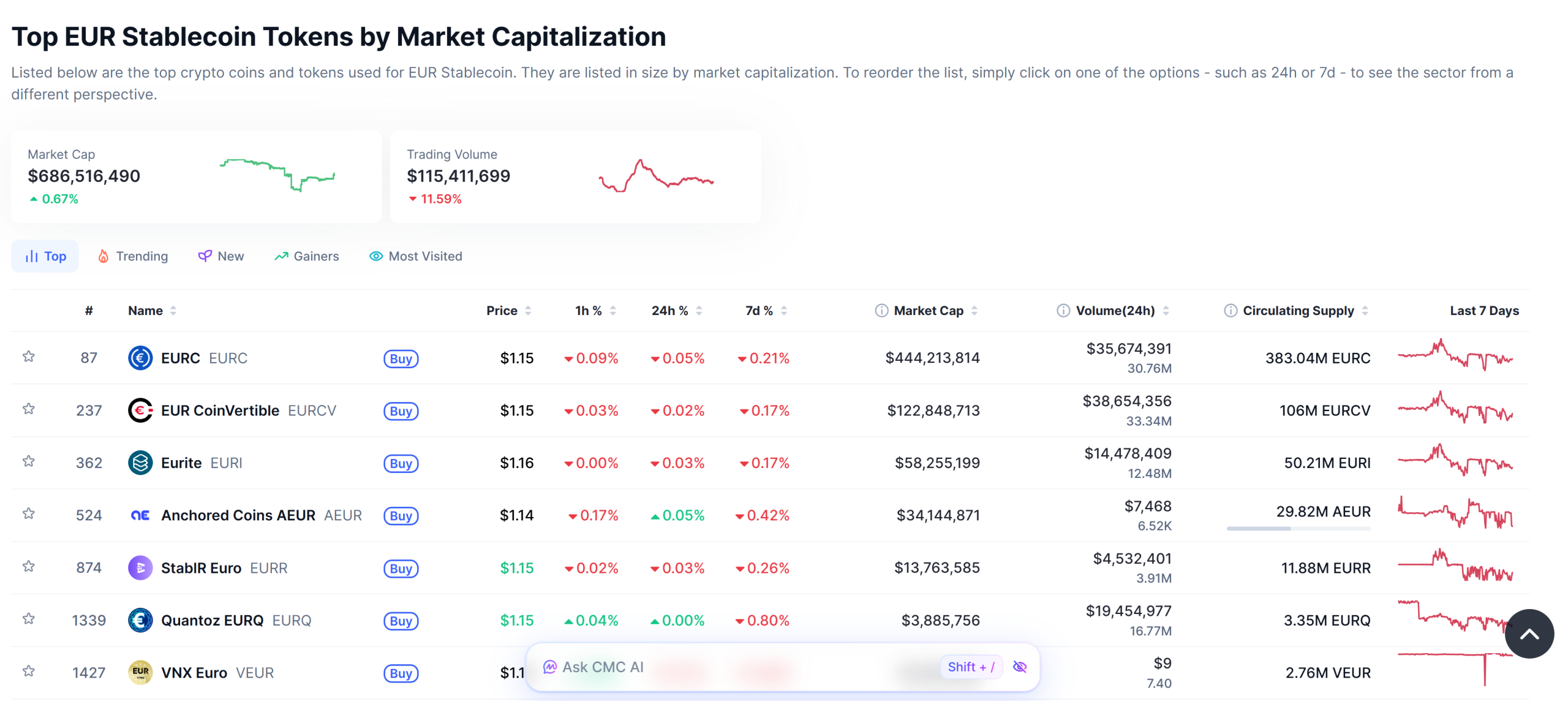
Europeans conduct 38% of global stablecoin transactions, yet euro-denominated tokens account for just 0.3% of total supply, per the policy paper. Circle’s EURC (EURC), the largest euro stablecoin, ranks only 12th globally, according to CoinMarketCap.
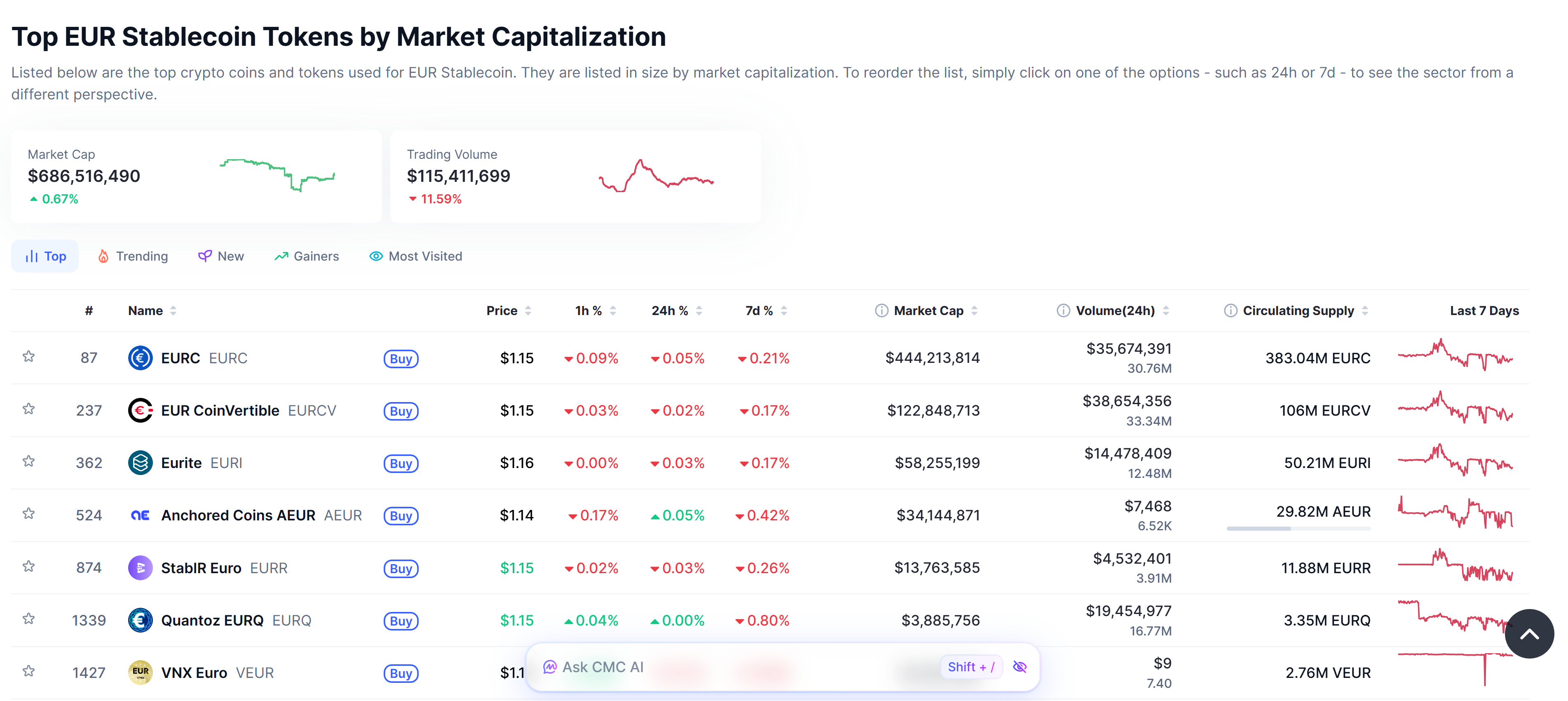
Top euro stablecoins. Source: CoinMarketCap
The question at the heart of the Nicosia meeting was whether Europe wants to close that gap badly enough to extend central bank-style support to stablecoin issuers. However, the ECB’s answer, for now, appears to be no.
Related: MiCA Made Euro Stablecoins Safe but Too Small, Report Says
Euro stablecoins could destabilize banks
ECB President Christine Lagarde led the resistance, warning that stablecoin issuance makes bank deposits less stable by transferring buyers’ funds to issuers’ accounts, according to Reuters. At scale, policymakers fear this accelerates disintermediation, raises bank funding costs and erodes the ECB’s ability to manage interest rates.
Several central bankers at the meeting also openly questioned the Bruegel proposal to position the ECB as a lender of last resort for stablecoin firms, an arrangement currently reserved for regulated banks, per the report.
In a speech at the Banco de España LatAm Economic Forum in Spain earlier this month, Lagarde argued that euro stablecoins could generate additional demand for euro-area safe assets but warned that the trade-offs, including financial stability risks, redemption pressures and weaker monetary policy transmission, outweigh the benefits.
Instead of stablecoins, Lagarde pointed to tokenized financial infrastructure anchored by central bank money as Europe’s preferred path, citing the Eurosystem’s Pontes project for wholesale settlement and the Appia roadmap for interoperable tokenized finance.
Related: European Banks Back MiCA Euro Stablecoin to Rival Dollar Tokens
EU central bankers shrug off digital dollarization fears
The Bruegel authors warned that stricter EU rules compared to the US risked accelerating digital dollarization, pushing activity outside the bloc. However, central bankers at the meeting largely dismissed that concern, with several calling instead for restrictions on European redemptions of both US and EU-issued stablecoins to guard against reserve runs, according to the Reuters report.
The debate comes as the EU reviews its Markets in Crypto-Assets (MiCA) regulation, which requires stablecoin issuers to hold large reserves in liquid assets, in contrast to the lighter-touch US GENIUS Act.
Market Moves: Why is Ethereum Foundation selling? BTC futures warning signs

Key Highlights
- Shares of NVTS climbed nearly 20% following investor conference announcements and sustained earnings-driven momentum
- First-quarter revenue reached $8.6M, exceeding forecasts; second-quarter outlook of approximately $10M surpassed Street projections by more than 11%
- Baird increased its price target from $9 to $20; Needham upgraded from $13 to $21
- Elevated short interest at 21% intensified the rally as bearish traders scrambled to exit positions
- Company secured a GaN technology licensing agreement with Cyient Semiconductors to produce India’s inaugural domestically branded GaN IC portfolio
Shares of Navitas Semiconductor (NVTS) reached a 52-week peak of $28.85 during Thursday’s trading session, climbing nearly 20% as several positive developments converged simultaneously.
Navitas Semiconductor Corporation, NVTS
The upward momentum accelerated following the company’s announcement that CEO Chris Allexandre and CFO Tonya Stevens will participate in the Craig-Hallum Institutional Investor Conference scheduled for May 28 in Minneapolis, along with the Evercore Global TMT Conference set for June 3 in San Francisco.
This conference participation news built upon recent earnings results that exceeded Wall Street projections. First-quarter revenue totaled $8.6M, surpassing analyst forecasts, while earnings per share registered at -$0.04 compared to the consensus estimate of -$0.05.
Management’s second-quarter fiscal 2026 revenue projection of roughly $10M exceeded the Street’s $8.93M estimate, suggesting sequential revenue expansion exceeding 16% alongside enhanced gross margin performance.
Wall Street analysts moved swiftly to adjust their outlooks. Baird elevated its price objective from $9 to $20, highlighting three secular expansion drivers connected to 800V AI data-center power infrastructure.
Needham subsequently increased its target from $13 to $21, emphasizing the quarterly earnings outperformance and above-consensus forward guidance as key justifications.
The semiconductor company had already established itself as one of the sector’s more notable recovery narratives. Through the current year, NVTS has advanced more than 241%.
Short Covering Intensifies Upward Movement
With short interest representing 21% of available shares as of mid-April, Thursday’s positive catalysts didn’t merely draw in fresh buyers — they compelled short sellers to unwind positions.
When heavily-shorted securities experience rapid price appreciation, forced covering can drive valuations significantly beyond what fundamental factors alone might justify, a pattern that clearly manifested in this situation.
Strategic GaN Partnership Expands Market Reach
Navitas simultaneously unveiled a licensing arrangement with Cyient Semiconductors to create India’s first domestically branded 650–700V gallium nitride integrated circuit product line.
These semiconductor components target AI data center applications, telecommunications infrastructure, rapid charging solutions, industrial power systems, and electric mobility sectors. Cyient will additionally serve as an alternative manufacturing source for selected Navitas GaN products.
This partnership introduces an expanded geographical element to NVTS’s expansion narrative and reflects increasing global appetite for its gallium nitride semiconductor technology.
From a financial position standpoint, NVTS maintains negligible debt obligations while holding cash reserves exceeding $220M, providing sufficient capital to support its gallium nitride and silicon carbide transformation without requiring external financing in the near term.
Broader equity markets contributed supportive conditions as well, with the S&P 500 advancing 0.6%, the Dow Jones climbing 0.8%, and the Nasdaq gaining 0.6% during the session.
Industry competitors including Wolfspeed and Marvell Technology continue operating within the AI power semiconductor landscape, sustaining investor focus on the broader GaN and SiC technology ecosystem.
NVTS’s current market capitalization stands at approximately $5.37B, with typical daily trading volume approaching 29 million shares. The stock concluded trading on May 22 at its 52-week peak of $28.85.


GameStop (GME) CEO Ryan Cohen publicly questioned eBay’s spending efficiency after the e-commerce platform posted a Senior Manager of Marketing Effectiveness role, citing the company’s $2.4 billion marketing budget.
The remarks extend a running public dispute between the two companies. It began with GameStop’s rejected $56 billion acquisition offer and escalated after eBay suspended Cohen’s seller account.
Cohen Questions Where the Money Goes
In response to a seller’s thread about eBay’s support failures and account access problems, Cohen posted on X that a company with $2.4 billion in marketing spend should be able to handle basic platform functions.
When a separate post flagged eBay’s new Toronto-based marketing effectiveness role, Cohen quote-tweeted it with a pointed observation that the position’s responsibilities include finding out where the money is going.
The role, listed under job code R0074539, sits within eBay’s Marketing & Communications division and reports to the Head of Marketing Efficiency. eBay’s fiscal 2025 sales and marketing spend totaled $2.4 billion.
GameStop – eBay Takeover Feud Behind the Jabs
Cohen’s efficiency critique ties to the ongoing GameStop acquisition bid. GameStop offered $56 billion in cash and stock, or $125 per share. TD Securities provided a highly confident letter backing up to $20 billion in financing.
eBay’s board reviewed the proposal and rejected the bid as neither credible nor attractive after consulting independent advisors.
Shortly after the feud became public, eBay permanently suspended Cohen’s seller account. The company said the activity posed a risk to its community.
Cohen had listed GameStop-branded items on the platform, including store signs and a square of branded carpet. The Cohen account suspension drew substantial public attention and was widely viewed as a deliberate publicity move.
With the acquisition rejected and his account banned, Cohen has turned to publicly scrutinizing eBay’s operations. The marketing effectiveness hire gives him a ready-made target.
The post GameStop CEO Questions eBay’s $2.4 Billion Marketing Spend appeared first on BeInCrypto.

US website sorry over Caitriona Balfe video edit error of Outlander star ‘calling Shotts an armpit’

Axon: The SaaSpocalypse Selloff Is The Opportunity

Ridley Scott’s Brutal Action Thriller the Critics Hated Needs To Be Rediscovered in 2026

US brings back mandatory military draft registration

Steven Gerrard disagrees with Gary Neville over ‘shock’ Chelsea and Arsenal claim | Football

Register Renaming | Hackaday

#music #vikram #automobile #money #luxury #viral #trendingshorts #lamborghinni

THE WHITE HOUSE JUST CONFIRMED XRP AS NEW CURRENCY?!

The Secret Way This Man Prints Money With A Single Rose Bush! #shorts #youtubeshorts #ytshorts
-

 Crypto World2 days ago
Blockchain.com files with SEC for U.S. IPO
-

 Fashion18 hours ago
Holiday Weekend Open Thread – Corporette.com
-

 Crypto World6 days ago
Intesa Sanpaolo’s crypto holdings jump to $235M as XRP enters
-

 Business22 hours ago
Dell Technologies DELL Stock Surges 15% on AI Server Momentum and Analyst Upgrades in 2026
-

 Crypto World21 hours ago
Space X IPO Is ‘Bad News’ for Tech Stocks: But What About Bitcoin?
-

 Fashion6 days ago
On the Scene at Gucci’s Cruise Show in New York City: Mariah Carey, Kim Kardashian, Lindsay Lohan, Iman, and More!
-

 Politics17 hours ago
Makerfield: a tale of two social-media histories
-

 Crypto World2 hours ago
Robinhood crypto COO Tanya Denisova exits
-
 Tech23 hours ago
A 0.12% parameter add-on gives AI agents the working memory RAG can’t
-

 Fashion6 days ago
Amazon Sundays: Memorial Day Hosting
-

 Entertainment6 days ago
Off Campus Easter Eggs Explained: Characters, Stories, More
-

 Crypto World1 day ago
Bitcoin Accumulation Weakens as BTC Realized Losses Hit $600M
-
 Crypto World5 days ago
Revolut Launches Dogecoin Debit Card Across UK and EU
-

 Crypto World22 hours ago
AI infrastructure race heats up as IREN pitches full-stack strategy, WhiteFiber lands $160M deal
-
 NewsBeat2 days ago
Charity run by Reform leader Malcolm Offord accused of ‘law breaking’ over Scottish registration
-

 Tech2 days ago
WhatsApp ads could make Irish debut after discussions with DPC
-

 Sports1 day ago
2026 CJ Cup Byron Nelson leaderboard: Brooks Koepka finds putting stroke in Round 1
-
Business6 days ago
Australia defends property tax changes designed to fix ‘broken’ housing
-

 Crypto World1 day ago
Trump Media’s Bitcoin Stash Shrinks Again as 2,650 BTC Lands on Crypto.com
-

 Business1 day ago
Trump Invests $1M-$5M in Kura Sushi USA Chain With 27 California Locations
You must be logged in to post a comment Login