Connect with us
DAPA Banner
DAPA Coin
DAPA
COIN PAYMENT ASSET
PRIVACY · BLOCKDAG · HOMOMORPHIC ENCRYPTION · RUST
ElGamal Encrypted MINE DAPA
🚫 GENESIS SOLD OUT
DAPAPAY COMING

Tech

Building An Analog Meter Watch

Published

on

Most conventional analog watches have two or three hands, covering hours, minutes, and seconds (where present). [Sahko] has built a different kind of analog watch that creatively displays the time with just one. 

The build is based around a simple analog coil meter, which, at its heart, just sweeps its needle across a scale based on the voltage input to the device. A Raspberry Pi Pico is employed to drive the meter through a digital-to-analog converter. Pressing the buttons on the outside of the device tells the watch to display hours, minutes/seconds, or the current month or day of the week. With a single needle, only one parameter can be displayed at a time, but that’s just a compromise you accept for having a cool unique analog dial watch.

Another cool touch in the design is that the dial backer isn’t just a printed piece of paper—it’s a custom PCB, which has a much nicer, hardier finish. The case of the watch is also CNC milled out of aluminum and bead blasted for a quality surface finish, adding a nice industrial touch to the build.

Advertisement

This is a great example of a custom watch with quality fit and finish. The attention to detail really pays off in terms of feel. We’ve seen other watch projects use similar construction techniques before, too.

Advertisement

Source link

Continue Reading
Click to comment

You must be logged in to post a comment Login

Leave a Reply

Tech

One Moving Needle Holds the Hours, Days, and Seconds on This Digital Watch with No Screen

Published

on

Digital Watch No Screen Project Build
Wearing this watch provides an initial feeling of surprise, as a single needle glides across a printed scale to reveal the exact time or date without a flashing screen or ticking hands. Sahko transformed an idea drawn years ago into a polished item that fits easily around the wrist and seems both old and new at the same time. He desired a digital watch that depended solely on analog mechanics for display.


Early drawings depicted many scales crammed onto a single dial, each controlled by a button on the housing. He then built numerous prototypes to test different housings and circuits. The first version included a compass, which was a complete failure because the meter’s own magnetic field continuously threw off the readings. The functionality was then entirely dropped in favor of simplifying the design and ensuring that everything actually worked correctly.


Google Fitbit Air – Screenless Activity Tracker with Fitness, Heart Rate, and Sleep Tracking…
  • Google Fitbit Air is the unbelievably comfortable, exceptionally smart way to transform your health[1]; and Google Health brings together effortless…
  • Unlock more with Google Health Premium: With a premium membership, get personalized coaching that’s built with Gemini and adapts to your life…
  • Comfortable fit – One Size Tracker (130-210 mm): The lightweight, micro-adjustable fit sits comfortably and quietly, so you can wear Google Fitbit Air…

Digital Watch No Screen Project Build
The meter movement is simply a salvaged 1970s amplifier component that lies in the middle of the entire setup. A current flows through the coil and interacts with a magnet, swinging the needle left and right in a smooth motion. The Raspberry Pi Pico microprocessor turns time into voltage, which is then passed to the digital-to-analog converter and, last, to the meter coil, ensuring that the needle always lands exactly on the mark. They use the same needle and arc in all modes, but the information shown differs depending on which button you press.

Digital Watch No Screen Project Build
The Pico, converter, battery, and charging circuit are all housed on a customized board that takes up little space. Sahko had the idea of printing the dial scales directly onto the board, making it incredibly durable and visually beautiful. On one side of the case, there are three buttons: one to cycle through the hours, one for the day of the month, and one to show the month or day of the week. Holding the proper combination causes the needle to sweep over the scale, marking off each second in real time.

Digital Watch No Screen Project Build
The case is machined from aluminum and has a smooth matte texture from bead blasting, making it fingerprint-resistant and comfortable against the skin. You can even put a pocket watch-style cover on the dial to protect the needle and keep it looking good. The wire spacers keep the needle perfectly level, so it never scrapes the underlying surface. The strap is made of leather and features an elastic bit in the center for easy adjusting. The leather ends simply attach to the case via magnets, making them exceedingly easy to put on and take off without the use of traditional pins or buckles.

Digital Watch No Screen Project Build
Power comes from a little rechargeable battery that can easily last the entire day. The casing includes a USB-C socket for charging, and the Pico’s programming does an excellent job of keeping the time accurate and determining which voltage range to map each reading to, ensuring that the needle always reacts swiftly. If you want to see the schematics of the whole thing, Sahko has even uploaded a set of files to GitHub that contain schematics, board designs, and the actual firmware.
[Source]

Source link

Advertisement
Continue Reading

Tech

3 MacBook games that hit harder than most movies and don’t demand gamer instincts

Published

on

A lot of people on MacBooks do not really think of themselves as gamers. Aside from a few casual titles on phones or trying out GTA or COD on their friend’s console, many don’t really get into that hobby. Macs have never had the same gaming reputation as Windows PCs, and if your idea of gaming is competitive shooters or open-world RPGs from AAA studios, it’s easy to miss out on the gems that are available on the Mac ecosystem.

But some of the best games for non-gamers are not about fast reflexes at all. They are about choices, curiosity, grief, adventure, and so much more. This is exactly why I’ve chosen these three games, which aren’t your typical hardware showcase. These go much deeper than that. Video games as an art form have been a long-standing debate, and I can’t recommend Disco Elysium, What Remains of Edith Finch, and Firewatch enough.

What stands out here is the confidence in writing and atmosphere.

Disco Elysium

Disco Elysium is one of the best arguments that games can be literature without becoming homework. Enter the underwhelming role of a broken detective investigating a murder, but that description barely covers what the game actually does. This is a game about a lot of things. From politics and addiction to identity and the horror of waking up as yourself after everything has gone wrong. There’s a combat loop here, and it’s your conversational skills.

The real battles are fought inside your head, as different parts of the protagonist’s personality play a big role in the outcome of the story. This makes it perfect for MacBook users who do not want a mechanically demanding game. You simply talk, choose, and live with the consequences. Steam describes it as having a “revolutionary dialogue system,” and seeing how you can write sweet talk, romance, and even write poetry in-game, I’d say that’s pretty apt.

Advertisement

What Remains of Edith Finch

What Remains of Edith Finch is the game I would hand to someone who says they do not have time for games. In essence, it’s a series of connected short stories and experiences that are condensed into one single game that is incredibly easy to understand. You explore the Finch family home as the titular Editch, uncovering the stories of relatives who died in strange, tragic, sometimes surreal ways.

Each interactive short story changes how you play for a little while, but none of them asks you to master complicated systems. It is experienced from a first-person perspective and ends with that family member’s death, with the larger game exploring what it feels like to be humbled by the world.

If the concept sounds heavy, that’s exactly what the devs were going for. This is from the same people who brought you other critically acclaimed titles like Outer Wilds and Stray. So it’s no surprise that there’s a strong focus on narrative. You are not just watching a family history unfold; you are experiencing it yourself and piecing it together room by room.

Firewatch

Firewatch is probably the easiest of the three to recommend to someone who wants a “normal” game but does not want stress. You play as Henry, a man working as a fire lookout in the Wyoming wilderness. Your main connection is Delilah, another lookout who speaks to you through a walkie-talkie.

While the setup is simple, the game has a very distinct feel to it. Firewatch is about isolation, emotional escape, and the danger of treating distance like a solution. This is a proper single-player experience where choices shape the narrative.

Advertisement

You can expect to explore, talk, and investigate as you slowly get pulled into something stranger. It is not difficult in the traditional sense, but you will be facing emotional challenges between two characters who aren’t honest enough to face their own lives.

For non-gamers on MacBooks, these three games are a perfect starting point. They are not about proving you are good at games. These are experiences that will make you stop and think for a while.

Source link

Advertisement
Continue Reading

Tech

Daily Deal: Headway Premium Memorial Day Sale

Published

on

from the good-deals-on-cool-stuff dept

Unlock a world of knowledge with a Headway Premium subscription. This exclusive deal gives you unlimited access to Headway’s massive library of 1500+ book summaries, with 30-50 new ones added monthly. Cover any topic you can imagine, from personal development and business strategies to health and wellness. It’s usually on sale for $60 for new users only, but for a very limited time you can get it for $47.97.

Note: The Techdirt Deals Store is powered and curated by StackCommerce. A portion of all sales from Techdirt Deals helps support Techdirt. The products featured do not reflect endorsements by our editorial team.

Filed Under: daily deal

Source link

Advertisement
Continue Reading

Tech

SpaceX files publicly for what could be largest IPO in history

Published

on

As AI rivals Anthropic and OpenAI race toward IPO, SpaceX has now filed publicly for its own listing, revealing big losses and Elon Musk’s iron grip on ownership.

In a filing yesterday (20 May) with the US Securities and Exchange Commission, SpaceX for the first time revealed its financial standing, with billions in losses recorded. It reported a net loss of $4.28bn on revenue of $4.69bn for Q1, compared with a net loss of $528m on revenue of $4bn a year ago.

Notwithstanding those losses, the IPO is expected to be the largest listing in history if Elon Musk can pull it off and raise the targeted $75bn, which would far exceed the 2019 listing of Saudi Aramco for $29bn, the current record holder for largest IPO.

The really striking element in the filing is the level to which Musk will retain ironclad control over the company, and how difficult it would be to remove him in the future.

Advertisement

As SpaceX’s “founder, chief executive officer, chief technical officer and chairman of the board” of directors, Musk’s class B shares will likely ensure board control for the foreseeable future.

This concentration of voting power means SpaceX will qualify as a ‘controlled company’ under Nasdaq’s corporate governance rules, and the company said it intends to rely on exemptions from certain corporate governance requirements that would otherwise apply.

As is fairly standard for huge IPOs in the world of Big Tech, investors buying class A shares get economic exposure to SpaceX but very limited governance rights. Musk would retain effective veto power over all major decisions, including mergers, acquisitions, executive appointments and strategic direction, regardless of how many shares the public holds.

Musk has consolidated various businesses over the past year to arrive at the huge valuation. In February, SpaceX acquired xAI, which in March 2025 had acquired X.

Advertisement

Revenue growth from SpaceX’s Starlink satellite broadband service is widely credited for the foundation of the valuation, something confirmed in the filing which shows that it accounted for some two-thirds of sales in Q1 2026. Starlink currently dominates the global satellite internet service industry, with more than 9,000 satellites in orbit and roughly 9m customers.

The massive SpaceX IPO looks set to precede expected listings by duelling AI giants OpenAI and Anthropic in the near future. According to a report in the Wall Street Journal, OpenAI could confidentially file for IPO as early as tomorrow (22 May).

Don’t miss out on the knowledge you need to succeed. Sign up for the Daily Brief, Silicon Republic’s digest of need-to-know sci-tech news.

Advertisement

Source link

Continue Reading

Tech

SpaceX IPO filing reveals Starlink’s impact, Bezos sounds off on CNBC, and Gemini owes John a beer

Published

on

This week on a supersized Memorial Day Weekend edition of the GeekWire Podcast: 

  • A massive IPO filing from SpaceX includes new details about Elon Musk’s Starlink business and its satellite factory in Redmond.
  • Jeff Bezos talks about wealth, inequality and eventually tech in an hour-long CNBC appearance.
  • John goes to World Cup ticketing hell and turns to ChatGPT and Gemini when FIFA’s support falls short.
  • And finally, a special Sam Altman/Seattle startup edition of GeekWire Trivia.

With GeekWire co-founders Todd Bishop and John Cook.

Related Links:
In memoriam:

Subscribe to GeekWire in Apple Podcasts, Spotify, or wherever you listen.

Source link

Continue Reading

Tech

Italian Authorities Shut Down Major Streaming Piracy Network

Published

on

The Cinemagoal app retransmitted content from major platforms like Netflix and Disney+.

Cinemagoal, the app known for illegally rebroadcasting streaming content from Netflix, Disney+, Spotify and more, is the latest pirate ship to sink. The Guardia di Finanza, an Italian law enforcement agency under the country’s Ministry of Economy and Finance, announced that it conducted more than 100 search and seizures across the country related to the Cinemagoal app.

The Italian authority said the app ran 24 hours a day, retransmitting access codes from legitimate subscriptions to fake accounts that streamed media to Cinemagoal subscribers. According to the Guardia di Finanza, the app’s design was smart enough to get around a platform’s security checks and didn’t require a connection to a user’s IP address, making it harder to track. Cinemagoal subscriptions went for 40 to 130 euros, between $46 to $151, a year and were paid through hard-to-trace methods, like cryptocurrency or fake foreign bank accounts, the Italian agency said.

The Guardia di Finanza initially estimated Cinemagoal’s financial harm to be around 300 million euros, or around $350 million, but is also targeting the first 1,000 subscribers who used devices for the pirating app, with fines ranging from 154 to 5,000 euros, or between $179 to $5,800. It’s not clear if Cinemagoal is gone for good, but the Italian agency said it worked with other European authorities to seize servers that contained decryption data and the app’s source code. Before the crackdown on Cinemagoal, authorities across the world have been making it harder to access pirated content online. In 2022, the popular piracy site Popcorn Time shut down in 2022, while the illegal sports streaming service Streameast was taken offline more recently in September of last year.

Advertisement

Source link

Advertisement
Continue Reading

Tech

France’s Terrible Copyright Law, Hadopi, Is Not Quite Dead

Published

on

from the put-it-out-of-its-misery dept

One of the best demonstrations that an obsession with protecting copyright’s intellectual monopoly drives politicians insane is the French law known as Hadopi, an acronym for ‘Haute Autorité pour la diffusion des oeuvres et la protection des droits sur internet’ (High Authority for the Dissemination of Works and the Protection of Rights on the Internet). The Hadopi mechanism has been trying – and failing – to police copyright’s intellectual monopoly in France for 15 years now, and it is one of the main villains in the Walled Culture book (free digital versions available).

Here’s how Hadopi’s “graduated response” approach worked when a revised version came into operation in 2010. Alleged infringers were warned twice; if another allegation was made within a year of the second warning, the subscriber’s Internet connection could be suspended. A fine of €1,500 could also be imposed. The first notices were sent out in September 2010; by December of that year, copyright companies were issuing between 25,000 and 50,000 infringement allegations per day. At the end of July 2013, Hadopi had issued 2 million first notices and 200,000 second notices. There were 710 investigations to ascertain whether those who had been accused three times should be referred to the prosecutors.

That gives an idea of the scale of the investigations into people’s everyday use of the Internet in France, and of the databases of personal data that were created. And yet the first and only disconnection order, issued in June 2013, turned out to be unenforceable, because the disconnection only applied to Web access – other services like email, private messaging, the telephone line or TV services had to be preserved somehow – and was later dropped.

By 2020, Hadopi had been in existence in various forms for a decade. Working from Hadopi’s annual report for that year, the French magazine Next INpact calculated that in total the agency had imposed €87,000 in fines. The cost of running Hadopi was picked up entirely by French taxpayers and came to €82 million. In other words, a system that had failed to discourage people downloading unauthorized copies of copyright material, had also cost nearly a thousand times more to run than it generated in fines.

Advertisement

As Walled Culture reported at the time, in 2023 the French digital rights organization La Quadrature du Net brought a challenge to the Hadopi system, still running in theory, on the grounds that it was incompatible with the two EU laws defining Europe’s data protection regime, the General Data Protection Regulation and the ePrivacy DirectiveShockingly, in 2024 the Court of Justice of the European Union (CJEU), the EU’s top court, ruled that “the general and indiscriminate retention of [Internet Protocol] addresses does not necessarily constitute a serious interference with fundamental rights”. La Quadrature du Net did not give up. Alongside the case at the CJEU, it was also taking legal action in France:

In 2019, we asked the Conseil d’État to overturn Hadopi’s central decree, which authorises the storage of personal data needed for the graduated response system (IP addresses, civil identity and downloaded material). The case was referred to the Constitutional Council and in 2020 we had our first partial victory: the Constitutional Council restricted Hadopi’s broad access to personal data (the law at the time provided that it could access “all documents”). However, despite to our initial assessment, this did not necessarily mark the end of the Hadopi.

The defeat handed down by the CJEU in 2024 offered a glimmer of hope:

The outcome was disappointing, as we lost on the principle: the CJEU agreed to weaken its case law. It accepted that access to metadata might, in certain cases, not be subjected to prior independent review. However, it required numerous conditions to this possibility, relating to both the retention of such data and the requirements for prior independent review.

Those two issues – retention of metadata and the requirement for prior independent review – have now been acknowledged as problematic by the Conseil d’État in a new ruling:

the Conseil d’État finally agreed with us on these two points. Firstly, it found that the retention of metadata is not carried out in a manner that safeguards civil liberties. The CJEU required “watertight separation” of IP addresses and civil identity data (which can be understood as two distinct databases, or files, that can only be technically correlated after a formal request for access by Arcom). The Conseil d’État notes that “no legal provision imposes such retention, under these conditions, on electronic communications operators”.

Secondly, it also notes that access to this data is not subject to independent review. It fully endorses the conclusions already made by the CJEU, that Arcom [the body that took over Hadopi’s role] cannot be both judge and jury: it cannot request access and then review the legality of that access itself, even though it is an independent authority. However, like the CJEU, the Conseil d’État considers that this lack of review is only an issue from the third access to the data onwards, the stage at which a registered letter is sent.

Advertisement

As La Quadrature du Net notes, in practical terms, this latest ruling means that Hadopi is “stalled”:

The Arcom can no longer take you to court, as the requirements set by the CJEU are not satisfied. And it can only send you an email if it has first ensured that your internet service provider has stored your metadata with a “watertight separation”. It has now been downgraded to the function of a giant spam machine.

Hadopi is not quite dead yet: the French government could try to solve the two problems pointed out by the CJEU and confirmed by the Conseil d’État, by setting up yet more independent bodies to handle these specific aspects of Hadopi. That would involve throwing even more taxpayers’ money at an approach that has not only failed completely, but which is fundamentally misguided. Clearly, trying to keep the moribund Hadopi alive in this way would be an irrational and wasteful thing for the French government to contemplate; but given this is the world of copyright, it might well try to do it anyway.

Follow me @glynmoody on Mastodon and on Bluesky. Originally posted to Walled Culture.

Filed Under: cjeu, copyright, eprivacy directive, france, gdpr, hadopi, privacy

Advertisement

Source link

Continue Reading

Tech

Ken Paxton Wanted To Crack Down On Forum Shopping. Now Lawyers Say He’s Improperly Seeking Out Favorable Courts.

Published

on

from the hypocrisy-is-bigger-in-texas-too dept

This story was originally published by ProPublica. Republished under a CC BY-NC-ND 3.0 license.

In October, Texas Attorney General Ken Paxton sued pharmaceutical companies tied to Tylenol in state court, repeating claims made a month earlier by Health and Human Services Secretary Robert F. Kennedy Jr. that the pain relief drug was linked to autism and ADHD in children.

Paxton, a close ally of the Trump administration who had already announced a U.S. Senate bid, accused drugmakers of marketing Tylenol to pregnant mothers without disclosing its dangers. “The reckoning has arrived,” the state’s attorneys wrote in the lawsuit against pharmaceutical companies Johnson & Johnson, Kenvue Brands and Kenvue Inc.

“By holding Big Pharma accountable for poisoning our people, we will help Make America Healthy Again,” Paxton proclaimed in a news release that echoed Kennedy’s slogan.

Advertisement

Paxton hired the Chicago law firm Keller Postman to argue the case in state court. The firm had served as lead counsel in a similar case about Tylenol’s safety that was dismissed a year earlier by a New York federal judge who found the plaintiffs’ expert witnesses unreliable.

But the court the attorneys chose to bring the suit in wasn’t in Austin or any of the state’s large counties that have extensive experience and multiple judges handling large, complex litigation. It was in Panola County, a community of 23,000 residents on the Louisiana border that Trump carried by 67 points two years ago and whose sole state district court judge is a Republican.

At a hearing that month in the three-story brick courthouse in the county seat of Carthage, Kim Bueno, the lawyer representing the drugmakers, accused Paxton’s office of pushing a baseless lawsuit through forum shopping — seeking out judges and juries that plaintiffs believe will be most favorable to them, rather than filing suit in the courts that most commonly handle similar cases.

“These claims have been rejected over and over and over again in courts of law by the same plaintiff’s counsel,” said Bueno, who declined an interview request. “And now they’re trying, once again, to suggest that Tylenol is harmful for women when pregnant. And it’s been soundly rejected.”

Advertisement

The case was not the first that Paxton’s office had filed in a county with little connection to the allegations of wrongdoing made by his office. ProPublica and The Texas Tribune have identified at least 30 cases filed by the attorney general over the past nine years that have a tenuous connection to the counties in which they were filed.

The filings mark a striking departure from Paxton’s previous opposition to the practice. In a 2017 legal brief that Paxton wrote on behalf of 17 states, he urged the U.S. Supreme Court to crack down on forum shopping in federal courts. The practice, he wrote, “has the pernicious effect of reducing confidence in the fairness and neutrality of our Nation’s justice system.”

Paxton’s approach also subverts what the Legislature intended when it passed a law in the 1990s that required plaintiffs to file lawsuits in counties where a “substantial” part of the alleged violation took place, according to three legal experts. That was done at the behest of conservatives who felt trial lawyers were flocking to venues favorable to them to win big damage verdicts against businesses.

“It looks like the attorney general’s office is interested in engaging in litigation games that it would otherwise decry if the shoe were on the other foot,” said Michael Ariens, a professor at St. Mary’s University School of Law in San Antonio, who has studied laws regulating where lawsuits can be filed.

Advertisement

Neither of Paxton’s Republican predecessors, Gov. Greg Abbott and U.S. Sen. John Cornyn, appears to have employed this strategy. ProPublica and the Tribune reviewed hundreds of cases filed outside of the state’s five large urban counties during their tenures. Each had a clear connection to the venue Abbott or Cornyn chose.

Neither Abbott nor Cornyn, who Paxton is trying to unseat, responded to requests for comment. Trump on Tuesday endorsed Paxton in the race.

Texas’ major consumer protection law gives the attorney general some flexibility with those cases despite the state’s broader restriction on forum shopping. The office does not have to prove that a substantial part of the events in a consumer protection case happened in the place where it files suit but can instead file in counties where a defendant has done business.

But Paxton has stretched the boundaries of that law, too, according to legal experts and to former staffers of the attorney general’s office who argued against him in court. Last year, for example, the attorney general filed a lawsuit against the gaming platform Roblox in King County, a ranching community of about 200 people east of Lubbock. Its key justification for selecting the tiny county was that residents there had internet access.

Advertisement

Paxton, who did not respond to requests for comment or to written questions, has not spoken publicly about his office’s decisions to file lawsuits in courts with little connection to the cases.

At the November hearing in Panola County, Judge LeAnn Rafferty, a Republican first elected in 2016, did not question the attorney general’s office on its venue choice but asked, “Do you disagree with the defendants’ assertion that Tylenol is the safest choice for pregnant women who have a fever?”

“It depends on — oh, you said for having a fever? That probably is true,” replied J.J. Snidow, a partner at Keller Postman. “There are not alternatives in the pain relief space to Tylenol that don’t also have risks.”

Tylenol makers, Rafferty said, already tell pregnant women to consult with a doctor before taking the drug. Rafferty declined to comment about the case. Snidow said Keller Postman had no comment. Paxton has repeatedly turned to the firm as he has grown increasingly reliant on private attorneys to litigate major cases for his office.

Advertisement

Kenvue directed ProPublica and the Tribune to a statement on its website that said there is “no proven link” between acetaminophen, the active ingredient in Tylenol, and autism. A spokesperson for Johnson & Johnson said the company has had nothing to do with making or selling the drug since splitting with Kenvue in 2023.

Rafferty threw out five of the six claims in the attorney general’s lawsuit. She dismissed one for insufficient evidence. In the other four, Rafferty ruled that the state did not have jurisdiction over Johnson & Johnson and Kenvue Inc. because they do not manufacture or sell Tylenol in Texas.

She allowed one claim to proceed that alleged Kenvue Brands had violated the state’s consumer protection act by making false claims about Tylenol’s safety.

With most of the claims thrown out, the attorney general’s office doubled down on its strategy.

Advertisement

Two weeks later, it filed a new case against the pharmaceutical companies.

This time, it chose Bailey County, a community of 7,000 residents on the New Mexico border.

Paxton’s Pivot

For decades, plaintiffs’ attorneys from across the U.S. swarmed courts in small Texas counties that had reputations for sympathetic judges and generous juries. The practice became so ubiquitous that The Wall Street Journal branded the Texas judicial system a “Wild West embarrassment.”

In 1995, Robert Duncan, then a Republican state representative from Lubbock, resolved to crack down on the practice. He authored a bill that required a “substantial part” of a lawsuit’s claims be connected to the county of filing.

Advertisement

An attorney himself, Duncan recalls traveling hundreds of miles from his home in the Texas High Plains to the Rio Grande Valley for cases that had no connection to the border region. Forum shopping, Duncan told ProPublica and the Tribune, had led to too many attorneys choosing courts where there was “no reason to be there other than the bias or prejudice of whatever the plaintiff’s lawyer is trying to establish that would favor the case, as opposed to giving the defendant a fair opportunity.”

Duncan declined to comment on Paxton’s practice of filing lawsuits in counties with little connection to the allegations of wrongdoing.

Paxton was not in the Legislature when Duncan’s bill passed but, as a freshman representative in 2003, he supported legislation that gave judges more power to dismiss lawsuits they concluded belonged in another state.

He also railed against “rampant forum shopping,” asserting that the U.S. Supreme Court in 2017 should restrict the practice after plaintiffs in patent infringement lawsuits began flocking to courts that most often ruled in their favor. The Eastern District of Texas had become the most popular venue for the lawsuits, even though few of the cases had clear connections to the area. Most cases landed on the docket of a judge based in rural Harrison County, 140 miles east of Dallas, where plaintiffs won 78% of the time, according to legal researchers.

Advertisement

That waned after justices ruled that federal courts must strictly enforce a decades-old law requiring corporations in patent disputes to be sued only in their home states.

Since then, Paxton has repeatedly engaged in forum shopping in state courts, legal experts said. In fact, his office, or attorneys on behalf of his office, have filed 11 cases in Harrison, the same county where he argued that federal courts should limit plaintiffs from filing.

“It’s hypocritical for the AG to criticize patent litigants for forum shopping but then to forum shop himself,” said Paul Gugliuzza, a professor at the University of Texas School of Law. “Forum shopping, judge shopping — it’s usually not unlawful, but it is highly opportunistic, and, in many circumstances, probably shouldn’t be lawful.”

Paxton notched one of the biggest wins of his tenure in Harrison County. He secured a $1.4 billion settlement from Meta after alleging that the Facebook parent company captured Texans’ biometric data without their consent. Paxton’s office contended in court filings that Harrison was a proper venue for the 2022 lawsuit because the company had done business in the county and a substantial part of the alleged lawbreaking occurred there. The office did not provide specifics.

Advertisement

Meta has an office in Travis County, home to Austin, not in Harrison, where only about 0.2% of Texans live, but the company did not challenge the venue. The company didn’t admit to wrongdoing in the settlement and did not respond to questions about the case. It’s unclear why its lawyers did not seek a different venue, but the judge in the case, Republican Brad Morin, denied a transfer in at least one other lawsuit involving Paxton during the Meta litigation.

Paxton has not limited his efforts to find more favorable courts solely to small counties. The attorney general has repeatedly filed cases, particularly political ones, in Tarrant, the state’s largest Republican county and home to Fort Worth.

In August, Paxton’s office chose the county as the venue to sue former Democratic U.S. Rep. Beto O’Rourke and his political organization, Powered By People, after the group helped pay expenses for Democratic members of the Texas Legislature who left the state to block the passage of new congressional maps. The maps, drawn at Trump’s behest, favored the GOP.

The attorney general’s office stated in court documents that the case had a “substantial” connection to Tarrant County because the group planned a rally in Fort Worth. When O’Rourke sought to move the case to El Paso County — where he lives and where the group is headquartered — Paxton accused him of forum shopping. O’Rourke did not respond to an interview request.

Advertisement

Paxton secured a court order in Tarrant that prohibited Powered by People from fundraising while the case was pending. But within weeks, the 15th Court of Appeals overturned the decision. It noted that Paxton was a Republican candidate for U.S. Senate, which created an incentive to blunt Democrats’ ability to campaign. The judges said the order infringed on the organization’s free speech rights before a court had determined guilt.

Legal experts say such forum shopping erodes trust in the court system. It is especially problematic when it comes from the attorney general, who is supposed to defend state laws and preserve public trust in the justice system, they said.

“It’s hard to respect the system if you think it’s being employed in a way you fundamentally think is unfair,” said Paul Grimm, a former U.S. district judge in Maryland and an advocate of restricting forum shopping.

“Not the Law”

In at least two recent cases, Paxton has tested a novel interpretation of state law governing where lawsuits can be filed. His office has argued that if a company does business over the internet, it can be sued in any Texas county.

Advertisement

One such case was a 2022 lawsuit against pharmaceutical giant AstraZeneca. Two law firms filed the case against the company under a law that allows private attorneys to sue on behalf of the attorney general. The lawsuit accused AstraZeneca of defrauding Medicaid by giving kickbacks to healthcare workers in exchange for prescribing the company’s products. The company, which did not respond to a request for comment, said in legal filings that the lawsuit sought to punish its innocuous outreach to doctors and did not identify a single patient harmed or taxpayer dollar wasted.

Paxton’s office formally joined the case in July. Attorneys working on behalf of his office argued that Harrison County was the proper venue because the firm’s website could be accessed from there, company salespeople had visited the county and a local clinic had a brochure for one of the company’s drugs.

When AstraZeneca asked Morin, the lone Harrison County judge, to transfer the case to Travis County, he refused without explanation. The company appealed and, in November, the 15th Court of Appeals overruled Morin’s decision. The court concluded that he abused his discretion in declining to move the case. Morin did not respond to a request for comment.

The court also found that Paxton’s office failed to provide proof that any of the alleged lawbreaking occurred in Harrison County. It ordered the case transferred to Travis County, where it is ongoing.

Advertisement

That month, the attorney general’s office argued that Roblox could be sued in King County, an expanse of rolling plains with no incorporated communities, because third-party retailers there sold gift cards to access the online gaming company.

Then the office made another bold claim: that companies with websites can be sued anywhere, no matter how small the county.

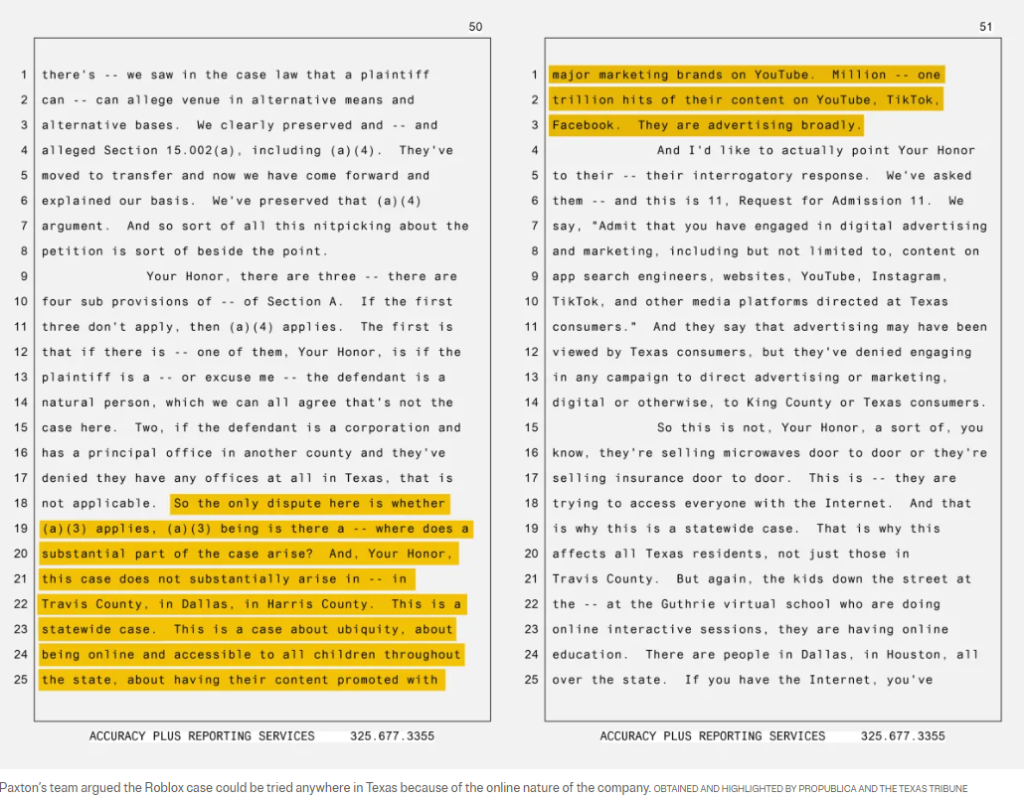
“This is a case about ubiquity, about being online and accessible to all children throughout the state,” Mark Pinkert, a Florida lawyer whom Paxton’s office had hired as outside counsel, argued at a hearing to discuss a request from Roblox that the case be moved to Travis County. “They are advertising broadly.”

Pinkert did not respond to a request for comment.

Advertisement

Roblox’s attorney Ed Burbach was stunned by the argument. He’d previously led the civil litigation division at the attorney general’s office under Abbott. The office’s longstanding practice, Burbach told the judge, was to file statewide consumer protection cases in Travis County.

This new argument by the attorney general’s office would obliterate the Legislature’s attempts to limit forum shopping by allowing any company to be sued in any county, Burbach said.

“That is simply not the law,” Burbach said, adding that most Texans, including lawmakers, would “be shocked to hear that outside counsel of the AG’s office would be arguing that.”

The judge transferred the case to Travis County, where it is ongoing.

Advertisement

Burbach declined to comment, but Paul Rogers, a law professor at Southern Methodist University in Dallas, warned of the dangers if Paxton succeeds at getting courts to side with his expansive interpretation. The attorney general, he said, would have “a lot of power to file any lawsuit, in any county, for any reason, whether the underlying lawsuit has merit or not.”

Highlighted section of a court transcript: So the only dispute here is whether (a) (3) applies, (a) (3) being is there a where does a .. in substantial part of the case arise? And. Your Honor. this case does not substantially arise in Travis County, in Dallas, in Harris County. This is a statewide case. This is a case about ubiquity, about being online and accessible to all children throughout the state, about having their content promoted with major marketing brands on YouTube. Million one trillion hits of their content on YouTube, TikTok. Facebook. They are advertising broadly.

Doubling Down

In Washington, Trump and Kennedy’s public rebukes of Tylenol have tapered off. Paxton, however, continues to vigorously pursue his lawsuit against the drugmakers in state court.

After the setback in Panola County, the attorney general’s office filed an urgent request in Bailey County, arguing that Johnson & Johnson and Kenvue should be barred from selling any products in Texas until they filed paperwork and paid a $750 fee to register with the secretary of state. (Such registration would allow Paxton’s office to strengthen its case in Panola County.)

Though Paxton’s office was already involved in a lawsuit against the pharmaceutical companies in Panola County, the attorney general’s office stated in court filings that it did not know the companies’ attorneys, so it could not notify them of the suit.

Without hearing from the drugmakers’ lawyers, Judge Gordon Green ordered the companies to register. He said they could be barred from doing business in Texas if they didn’t. Paxton proclaimed the ruling a “major win” over Big Pharma.

Advertisement

The victory was short-lived. A week later, the drugmakers’ lawyer Aaron Nielson, who had previously served under Paxton as the state’s solicitor general, attended a hearing in Green’s court. He accused Paxton’s office of sleight of hand by trying to relitigate claims that had already failed to persuade the Panola County judge.

“This is blatant forum shopping and taking another bite at the apple,” said Nielson, who did not respond to a request for comment. “They decided to bring Your Honor into this, rather than let the Court that they chose continue with its own proceedings, which we think is highly improper.”

At the end of the hearing, Green withdrew the order requiring the companies to register. He did not respond to a request for comment.

The Panola and Bailey county cases are awaiting a ruling from the 15th Court of Appeals.

Advertisement

In the meantime, the attorney general’s office tried yet another gambit in Panola, where the judge had allowed one of its original claims to move forward.

Paxton’s lawyers amended their original lawsuit in the county. They noted that Green had ordered the drugmakers to register to do business in Texas, which meant Texas now had jurisdiction to pursue the claims that had been dismissed.

They omitted the fact that Green voided that order.

By referencing the order as if it were still in effect, the attorney general’s office risks losing credibility with the Panola County judge, Gugliuzza said.

Advertisement

“If you knowingly are presenting false information to the court, that is textbook sanctionable conduct,” Gugliuzza said.

Filed Under: forum shopping, jurisdiction shopping, ken paxton, texas

Source link

Advertisement
Continue Reading

Tech

Final Fantasy XI was supposed to decline, instead the 24-year-old MMO is growing again

Published

on


The unexpected surge comes from outside the game’s original ecosystem. The Echoes of Vana’diel crossover with Final Fantasy XIV, a welcome back campaign for lapsed subscribers, and item giveaways like the Mog Bonanza weapon coupon have all pulled players in and, more importantly, kept them there.
Read Entire Article
Source link

Continue Reading

Tech

A Complete Desktop Setup That Runs Entirely on Battery Power, Thanks to an Anker SOLIX S2000

Published

on

Anker Solix S2000 Battery-Powered Desktop PC System
Gamers have always faced a choice between the freedom of a laptop and the power of a real desktop. Mryeester decided to skip the compromise. He created a full gaming station complete with internet access and a cold drink on hand that works anywhere without plugging into a wall. At the center of everything sits the Anker SOLIX S2000. This portable power station holds two kilowatt hours of energy and delivers steady alternating current through a pure sine wave.


The clean power allows the graphics card and other sensitive components to run smoothly without a care in the world. It maintains a constant output of 1500 watts and can occasionally reach a peak of 3000 watts for good measure. Solar panels may add 400 watts to the mix during the day, allowing this contraption to remain going for a much longer period of time. The PC inside has an Intel Core i5-4690K processor and an ancient NVIDIA GeForce GTX 980 graphics card. Those are both older, but they strike a good balance between delivering solid 1440p gaming performance and keeping their power demands reasonable enough so that this thing doesn’t just gobble up all the juice. Because this is a mobile rig, you’ll want to mount your standard monitor high up, as well as a Wi-Fi router, to keep everything online.

Sale


Anker SOLIX C1000 Portable Power Station with 200W Solar Panel, 1800W Solar Generator, 1056wh LFP…
  • 80% UltraFast Recharging in 43 Minutes: Be ready for adventiure in 43 minutes (100% in 58 minutes) with Anker SOLIX C1000. Just use an AC input and…
  • 10-Year Lifespan, 3,000 Battery Cycles: Anker SOLIX C1000 is built to last with over 3,000 battery cycles. So power up, day after day, for 10 years.
  • More Ports and Power for 99% of Appliances: SurgePad technology delivers 2400W. That’s enough to power 99% of appliances. And with 11 ports, you can…

Building the desk was a real adventure because you simply put a plywood surface on top of a small fridge and it produces this neat little cantilever thing that sticks out into space with no leg underneath to support it. The heavy Anker unit and PC components all lie on the base side of the fridge to balance it out and keep it from tipping over, and the fridge itself is convenient because it allows you to have a glass of water or a snack right at your fingertips.

Advertisement

Anker Solix S2000 Battery-Powered Desktop PC System
When it comes down to it, the power figures are what truly tell the tale of how practical this system is. When everything is idle and the PC is turned off, the entire setup draws about a hundred and one watts. However, when you turn on the PC, the draw increases to one hundred eighty-one watts. When you switch to Cyberpunk 2077 at 1440p, the draw only increases to around 330 watts. Those runtimes are quite impressive, especially considering that one hour of mixed use, primarily gaming, only reduced the battery by 10%. And what about overnight use, putting the PC to sleep, leaving the fridge running, and keeping the router online? The battery barely fell by 18%. Even if the solar panels are not connected immediately away, there is still enough electricity in the tank for extended sessions.

Anker Solix S2000 Battery-Powered Desktop PC System
The entire setup ends up being a little heavy because the Anker unit alone weighs thirty-five pounds, and the fridge base only adds to that. It would take some effort to move it around, but just wheeling this thing outside or to a different location seems perfectly conceivable. In fact, Mryeester was considering putting wheels on the fridge and solar panels on the back for true off-grid excursions.

Source link

Continue Reading

Trending

Copyright © 2025