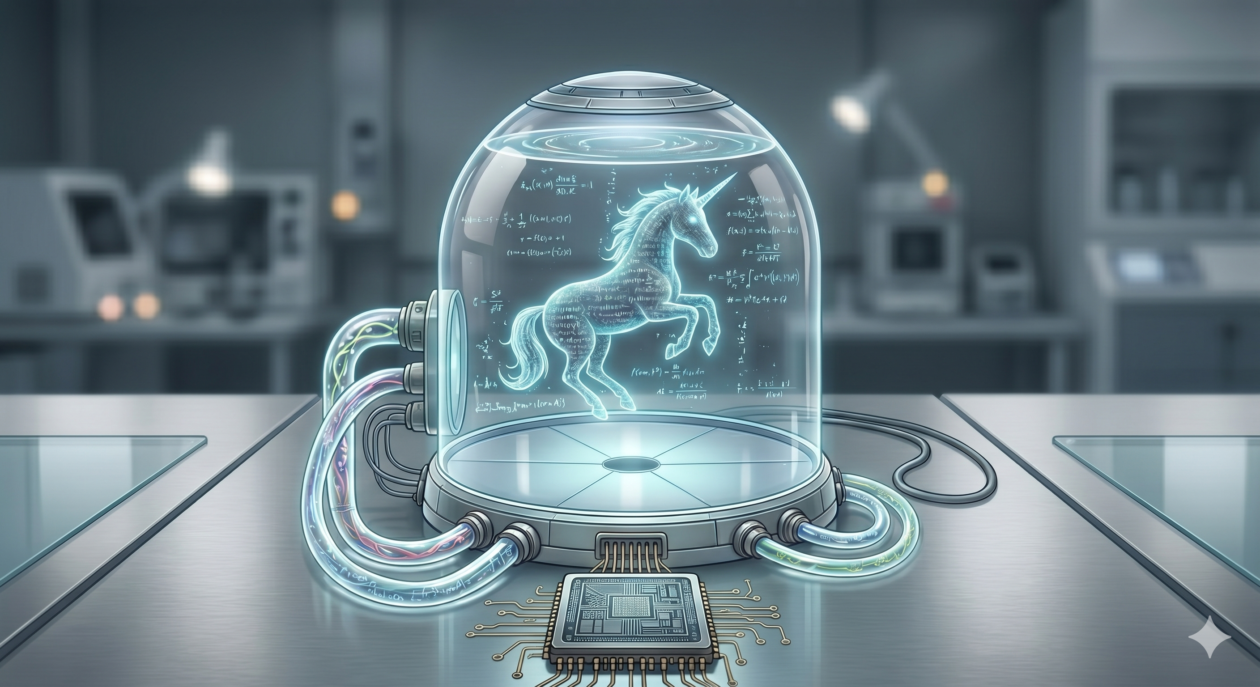
Twelve AI labs have a combined valuation larger than Ford and GM. None of them sell anything. I call them the Virgin Unicorns — valued above a billion dollars, but innocent of product or revenue.
OpenAI proved that an AI research lab with the right product could become one of the most valuable companies on earth. A dozen other AI labs are trying to repeat the trick. They have raised more than $29 billion at a combined valuation approaching $130 billion, without shipping anything a customer can buy.
Two questions are worth asking:
Why are sophisticated investors writing growth-stage checks to pre-companies?
* Limited research release. Tinker is a fine-tuning tool for researchers; Marble is a 3D-world-generation API in early partner access. Neither is a general-availability commercial product. Sources: company announcements, Bloomberg, Financial Times, TechCrunch, Crunchbase, and PitchBook reporting from 2024-2026. Valuations reflect the most recent confirmed round; figures for rounds in active negotiation are not included.
To answer these questions, let’s identify four patterns across this cohort of companies.
Pattern 1: The pedigree premium. Every founder is a recognized leader in their field, and most come from a small set of institutions. Roughly four-fifths hold PhDs, mostly in computer science from a handful of universities — Berkeley, Stanford, MIT, Toronto, Alberta, Cambridge, UCL — and most of the rest left PhDs at one of those programs to start their companies.
Advertisement
On the employer side, the concentration is tighter still. Four of the twelve companies are anchored by DeepMind alumni (Ineffable, Reflection, Ricursive, Recursive Superintelligence). Two are anchored by OpenAI alumni (Thinking Machines, Safe Superintelligence). AMI Labs traces back to Meta’s FAIR group, and Humans& draws its founders from across Anthropic, xAI, and Google. Stanford and Berkeley faculty appointments account for most of the rest (World Labs, Physical Intelligence, and Noah Goodman of Humans&).
Four institutions — DeepMind, OpenAI, Berkeley, and Stanford — have produced the founders of nearly every Virgin Unicorn in the table. Investors are pricing CVs, not products.
Pattern 2: Nvidia as kingmaker. Nine of the twelve companies in the table have Nvidia as an investor. The supplier of the picks and shovels is also an equity holder in the prospectors. Nvidia gets early visibility into the most ambitious AI bets, locks in compute commitments, and earns multiples on capital deployed at near-zero marginal cost. Selling the shovels was already a good business. Owning the mines too is unprecedented.
Pattern 3: The cap tables are unusually wide. Each round in the table includes a syndicate of ten to twenty investors — venture firms, corporate strategics, sovereign wealth funds, and individuals. Sequoia and a16z still lead. But the rounds are large enough that they require balance-sheet capital — from JPMorgan, BlackRock, Alphabet, the UK Sovereign AI Fund, Samsung, Temasek, ADIA, and Bezos personally — to fill out. That makes these rounds structurally different from classical venture financings.
Advertisement
Pattern 4: A post-LLM thesis. Every company is arguing, in some form, that the current paradigm isn’t enough — that scaling LLMs won’t reach AGI, and that something else (world models, reinforcement learning, agentic systems, AI scientists, novel chips, formal mathematical reasoning) is required. The thesis is the product. The product is a promise.
Others have dissected these unicorns:
Howard Marks, in his December 2025 Oaktree memo Is It a Bubble?, described investor behavior as “lottery-ticket thinking” — investors backing startups with no product on the dream of an enormous payoff despite an overwhelming probability of failing.
Derek Thompson, writing in October, framed the same dynamic by reporting that a Thinking Machines pitch meeting was described by one investor as “the most absurd pitch meeting” because Mira Murati “couldn’t answer any questions” about what she was building.
GeekWire’s own year-end survey of regional venture investors found the same skepticism closer to home: the bubble, they said, is most pronounced at the early stages, where AI storytelling can substitute for real traction.
The lottery-ticket framing is now conventional wisdom. But will this lottery pay out? One way to handicap the odds is to look to the past.
What history teaches us
The closest historical parallel is not the dot-com era. Webvan, Pets.com, and Boo.com failed not because they were pre-product, but because they had products and bad business models. Those companies burned capital on infrastructure and marketing, not on research.
The closer cautionary tales are the celebrity-founder pre-product flops of the last fifteen years.
Advertisement
Magic Leap raised $3.5 billion over nine years on the strength of Rony Abovitz’s prior exit and shipped a flop.
Quibi raised $1.75 billion on Katzenberg and Whitman’s pedigree and lasted six months.
Inflection AI raised $1.5 billion on Mustafa Suleyman and Reid Hoffman and was effectively absorbed into Microsoft in 2024 — its team hired, its technology licensed, its company hollowed into a shell.
In each case, founder credentials raised the money. The product never justified the valuation.
The structurally closest analogy, though, is biotech. Roughly 80% of 2021 biotech IPOs were pre-revenue. The probability that a pre-clinical drug reaches commercialization is under 10%. Development takes a decade and costs $1 billion. Yet a Bentley University study of 319 biotech IPOs from 1997 to 2016 found that the cohort produced over $100 billion in net shareholder value despite a failure rate above 50%. The winners were large enough to carry the portfolio. And many of the most successful biotechs were acquired before reaching profitability.
The Virgin Unicorns are biotech-shaped businesses. Pre-revenue, science-driven, decade-long timelines, binary outcomes, acquisition as the usual exit. But they aren’t financed like biotechs. Biotech investors release capital in milestone tranches tied to specific scientific results, and they expect most candidates to fail. Virgin Unicorn investors release capital in one large round on the strength of a CV, and price for success. Same shape of business, opposite financing logic. That mismatch is where the disappointment will come from.
Why Sequoia invests anyway
The OpenAI story counters the biotech analogy. From its 2015 founding to the ChatGPT launch in late 2022, OpenAI looked exactly like a Virgin Unicorn — pre-consumer-product for seven years, billions in capital, and only research to show for it. Then ChatGPT shipped and revenue went from zero to over $10 billion in three years. No biotech has ever scaled like that.
Sequoia and other investors writing checks to today’s Virgin Unicorns aren’t pricing for biotech outcomes. They’re pricing for the second coming of OpenAI.
The table above makes the size of that bet legible. Early-stage venture investors aim for a 10x return. Most of these twelve will return zero, so the one winner has to carry the other eleven by itself. At a $127 billion aggregate marked-up value, that means the winner alone has to produce something like $1.3 trillion in value.
That is not a forecast — it is the bet the VCs have already placed. Sequoia and a16z made exactly this kind of bet on OpenAI and Anthropic, and the on-paper returns have already vindicated it many times over. Anthropic itself looked like a Virgin Unicorn in 2022 — and then it shipped Claude and built revenue.
The historical record suggests some skepticism. But bubbles have a way of producing the occasional Amazon or Google amid the wreckage. Identifying which Virgin Unicorn will become a trillion-dollar company — a “kilocorn,” a thousand unicorns in one — is tough. Which one would you bet on?
If you don’t know where to start—and use—your HP coupon code, there’s a wide variety of options available at HP.com in terms of budget and use case, but my eye goes first to the high-end HP Omen gaming monitors, like the fantastic HP Omen Transcend 32. This 4K 240Hz monitor is a favorite among PC gamers, even among the huge amounts of OLED options out there. It can hit a peak brightness of over 1,000 nits in HDR, bringing scenes in games to life in vivid detail.
Or if you’re on the other side of the budget spectrum and just need something basic, we recommend checking out one of HP’s 27-inch 1080p monitors, such as the HP V27i G5, which typically retails for $209. It even comes with a 75Hz refresh rate, a small but appreciated bump over the standard 60Hz. We have HP coupon codes to help you save on all this tech and even more below.
$20 Off Your First Order With Our HP Promo Code
HP offers a $20 discount right off the top of your order if it’s your first time buying from HP.com. While you can’t use it in addition to the other coupons, it might be a better discount if you’re purchasing something less expensive. To get this HP promo code, your order has to be $65 or more though (before taxes and shipping), and it requires signing up for the HP newsletter.
This HP promo code is valid for a month after subscribing to the newsletter and is restricted to one per customer. If you aren’t planning to spend too much and it’s your first time buying from HP.com, this could be the way to go.
Advertisement
Top HP Coupons: Laptops for Work, School, and Everyday Use
Printers are super handy, but one of the most annoying and expensive investments you make for it is the upkeep of ink and toner. Well, the good news is that you can save up to 50% on ink right now! With HP Instant Ink, you can save time and money with this subscription service that automatically delivers ink only when you’re running low, with plans starting at less than $2 a month.
Join the HP All-In Plan Printing Subscription to Save
We all know printing is somehow one of the hardest at-home tasks we still have to do, with printers oftentimes not keeping up with the leaps and bounds contemporary technology has made. HP is hoping to change all of that. The HP All-In Plan is a convenient, stress-free printing subscription that fulfills your printing needs with just a monthly payment. The subscription includes a brand-new printer, automatic ink delivery, an option to add automatic paper delivery, and with live support. Plus, if your printer breaks or has an issue that support can’t fix, HP will send you a replacement the next business day for free. You can try the service for 30 days for free.
Save More: HP Smart Ink
At-home printers are such a huge headache. When all other home office tech seems to be living in 2087, clunky, difficult printers seem to be stuck in 1987, with constant jams, errors, and finicky ink. The HP Smart Tank printers are refillable, cartridge-free ink tank printers that deliver reliable, low-cost, high-volume printing that lasts for years. With these HP Smart Ink printers, you’ll no longer have to worry about refilling cartridges or constant low ink notifications. Welcome to the future.
Advertisement
Save 40% on Tech With the HP Student Discount
If you’re a student—or a parent to a student, teacher, school faculty, or university staff member—you’re in luck. HP is offering a serious 40% off discount on all kinds of tech, including laptops, desktop PCs, printers, and accessories. All stuff you’ll need for school, of course.
HP rebranded its laptops in 2024, introducing the OmniBooks into the world, including the premium HP OmniBook Ultra Flip. Powered by Qualcomm’s Snapdragon X chips and a killer OLED display, the OmniBook Ultra Flip would be a great laptop for college thanks to its long-lasting battery life, especially with a 40% discount for students or teachers.
It’s not just laptops though. The HP Education Program discount applies to desktop PCs, printers, and tons more qualifying products.
HP Military Discount: Get 40% Off the Latest Tech
HP offers more than just a standard military discount. The company’s exclusive military discount is extended to support active service members, veterans, and their families, but also healthcare workers and First Responders.
Advertisement
If you belong to any of those groups, the HP military discount will drop the retail prices significantly, whether you’re searching for a new laptop, PC, mouse, and many more select products at HP.com.
More HP Discounts on Gaming PCs and Free Games
HP’s high-performance gaming laptops and PCs are also included in this coupon code. HP has two brands of gaming laptops to choose from: the more affordable Victus and the higher-end Omen (both of which have been reviewed by me here). Finding a gaming laptop under $1,000 can be tricky, especially since you’ll want something that doesn’t use a 5-year old GPU and only 8 GB of memory. That’s why I’d avoid the cheapest Victus laptop here, and bump up to at least the Victus 16t-r100. That gets you an RTX 4050 and 16 GB of RAM, despite costing only $150 more.
Meanwhile, the higher-end Omen models get you access to the new RTX 50-series graphics cards, and the new multi-frame generation feature that’s got everyone talking. They also come with a 16-inch 1920 x 1200 screen with a 240Hz refresh rate, such as the Omen Max gaming laptop.
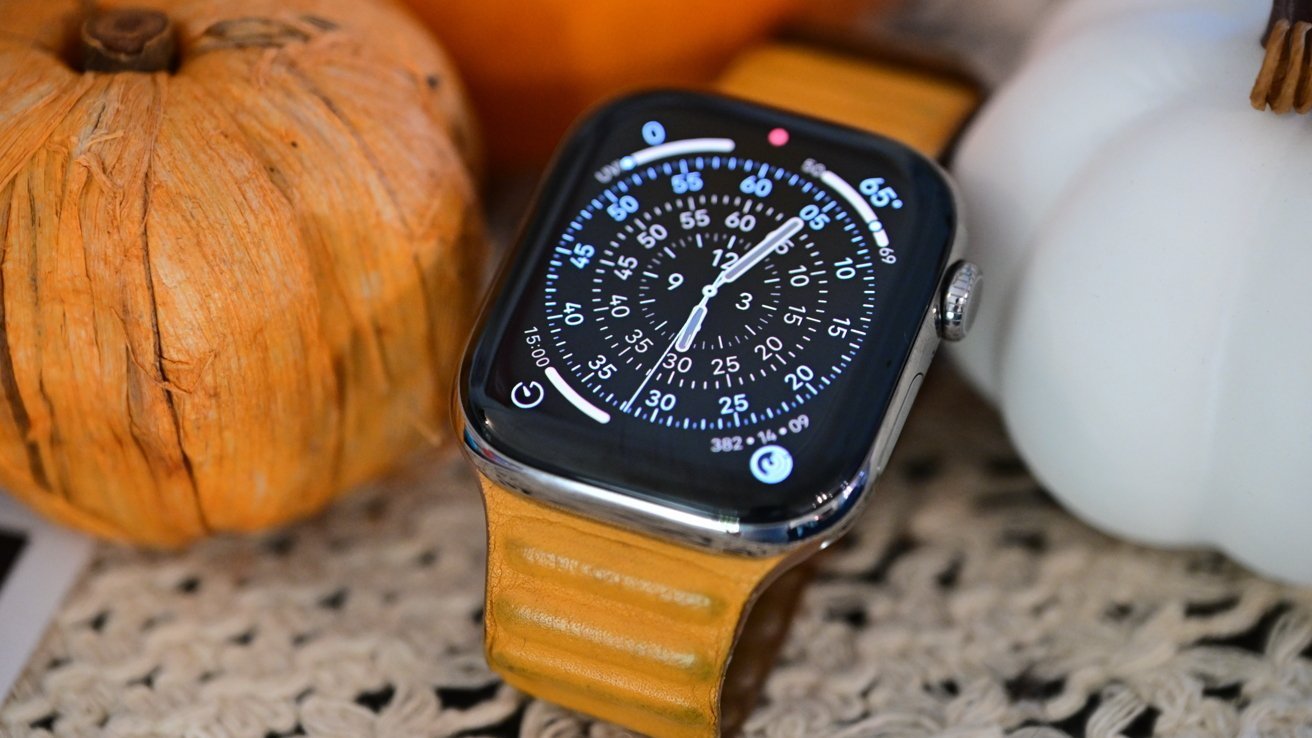
The WWDC updates for watchOS 27 are expected to be minimal thanks to Apple’s stability focus. However, Apple is rumored to be improving the heart-rate tracking with the new fall update.
The WWDC 2026 keynote is a few weeks away, and the excitement is all about AI and iOS 27’s changes. While you can expect some tweaks to watchOS 27, it seems like there won’t be that many visible changes on the way.
In Sunday’s “Power On” newsletter for Bloomberg, the watchOS update will focus on stability, performance, and refinements. There will be changes, but most will be to improve the existing features rather than add new ones to the software.
This apparently includes more improvements to the way the Apple Watch tracks the wearer’s heart rate. However, Gurman doesn’t say what this will entail.
Advertisement
Previously, Gurman wrote that Apple was porting the Modular face from the Apple Watch Ultra to the other models. This entails Apple removing a row of three small complications that appear above the time, as well as the information that surrounds the bezel.
Managerial updates
watchOS 27 isn’t the only thing that’s seeing some changes hidden or barely observable by users. There have been some more managerial changes within Apple as well.
Gurman mentions the departure of Stan Ng, who retired from his role as VP of Apple Watch and Health Product Marketing in April. His replacement covering health, home, and Apple Watch, is Kaiann Drance, a manager of iPhone product marketing who insiders believe could become the overall marketing chief.
There has also been a change in oversight for the long-running non-invasive glucose monitoring project. Apple handed control of the project from platform architecture chief Tim Millet over to Zongjian Chen.
Advertisement
Chen is the senior engineering leader managing modems and the Advanced Technologies Group. It is proposed that Chen’s involvement is an indication that Apple is getting somewhere with the technology, and may actually bring it to consumers at some point.
There have been projections of it landing in 2027, but it could easily arrive at a much later time.
A new NYT Connections puzzle appears at midnight each day for your time zone – which means that some people are always playing ‘today’s game’ while others are playing ‘yesterday’s’. If you’re looking for Sunday’s puzzle instead then click here: NYT Connections hints and answers for Sunday, May 24 (game #1078).
Good morning! Let’s play Connections, the NYT’s clever word game that challenges you to group answers in various categories. It can be tough, so read on if you need Connections hints.
What should you do once you’ve finished? Why, play some more word games of course. I’ve also got daily Strands hints and answers and Quordle hints and answers articles if you need help for those too, while Marc’s Wordle today page covers the original viral word game.
Advertisement
SPOILER WARNING: Information about NYT Connections today is below, so don’t read on if you don’t want to know the answers.
Latest Videos From
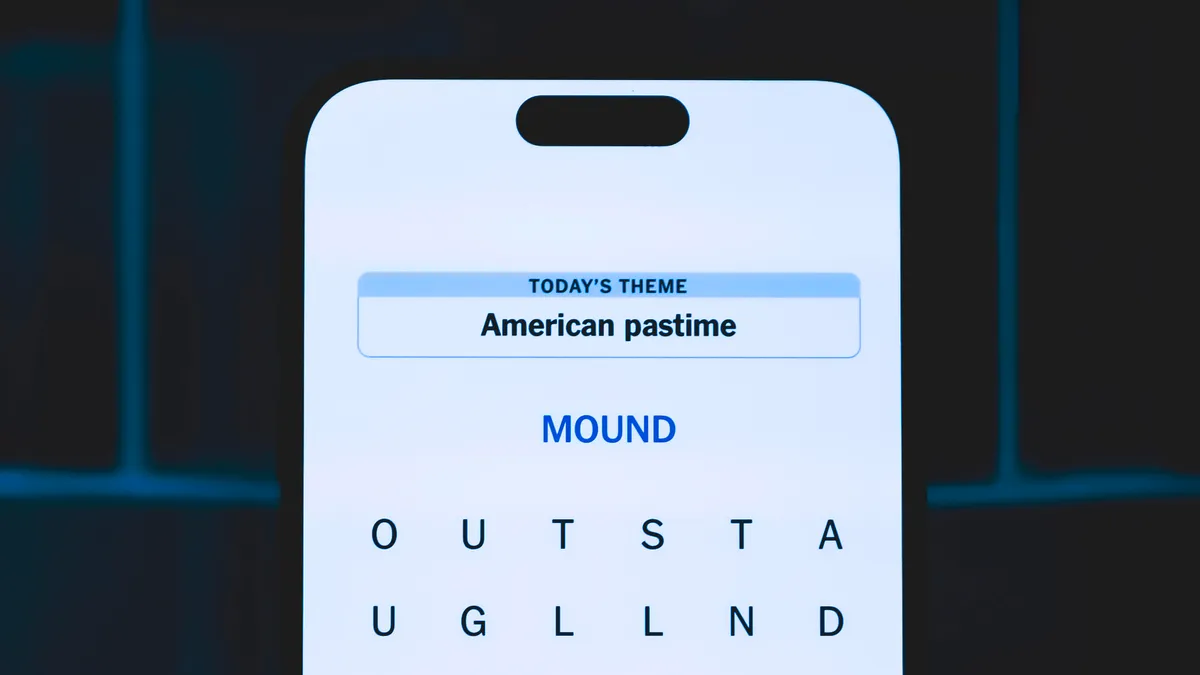
NYT Connections today (game #1079) – today’s words
(Image credit: New York Times)
Today’s NYT Connections words are…
Advertisement
BROW
CAP
LID
CYA
WHIT
ATM
PIN
JOT
LASH
LOL
SCRAP
SHIRT
STICKER
BALL
TIA
SHRED
NYT Connections today (game #1079) – hint #1 – group hints
What are some clues for today’s NYT Connections groups?
YELLOW: Free swag
GREEN: Small amount
BLUE: Text speak
PURPLE: Look for a bodypart
Need more clues?
We’re firmly in spoiler territory now, but read on if you want to know what the four theme answers are for today’s NYT Connections puzzles…
Sign up for breaking news, reviews, opinion, top tech deals, and more.
Advertisement
NYT Connections today (game #1079) – hint #2 – group answers
What are the answers for today’s NYT Connections groups?
YELLOW: COMMON PROMO ITEMS
GREEN: TINY BIT
BLUE: TEXTING ABBREVIATIONS
PURPLE: EYE____
Right, the answers are below, so DO NOT SCROLL ANY FURTHER IF YOU DON’T WANT TO SEE THEM.
Advertisement
NYT Connections today (game #1079) – the answers
(Image credit: New York Times)
The answers to today’s Connections, game #1079, are…
YELLOW: COMMON PROMO ITEMS CAP, PIN, SHIRT, STICKER
GREEN: TINY BIT JOT, SCRAP, SHRED, WHIT
BLUE: TEXTING ABBREVIATIONS ATM, CYA, LOL, TIA
PURPLE: EYE____ BALL, BROW, LASH, LID
My rating: Hard
My score: 1 mistake
My error today came because I thought I was being really clever and would get a “purple first” after connecting BROW, CYA, WHIT, PIN, thinking that they were all colors minus a letter — as in brown, cyan, white, and pink.
Crestfallen, I managed to link JOT, SCRAP and SHRED and took a lucky gamble with WHIT.
ATM, LOL, and TIA I knew as TEXTING ABBREVIATIONS, but didn’t realize that CYA was an abbreviated way of saying ‘See ya’ — although when I googled it the AI search response was that it meant “cover your ass”.
Advertisement
Yesterday’s NYT Connections answers (Sunday, May 24, game #1078)
BLUE: OBJECTS USED IN RITUAL PERFORMANCES DRUM, MASK, RATTLE, STAFF
PURPLE: POSSESSIVE ADJECTIVES PLUS A LETTER HERB, HISS, ITSY, MYA
What is NYT Connections?
NYT Connections is one of several increasingly popular word games made by the New York Times. It challenges you to find groups of four items that share something in common, and each group has a different difficulty level: green is easy, yellow a little harder, blue often quite tough and purple usually very difficult.
On the plus side, you don’t technically need to solve the final one, as you’ll be able to answer that one by a process of elimination. What’s more, you can make up to four mistakes, which gives you a little bit of breathing room.
It’s a little more involved than something like Wordle, however, and there are plenty of opportunities for the game to trip you up with tricks. For instance, watch out for homophones and other word games that could disguise the answers.
It’s playable for free via the NYT Games site on desktop or mobile.
A new experiment from cybersecurity company Surfshark suggests that even people who consider themselves savvy online users are struggling to tell AI bots apart from real humans on social media.
Of the 710 participants who took part in the study carried out with master’s students from Malmö University, only 53% correctly identified more bots than they misidentified humans. This means that nearly half (47%) failed the task altogether.
Recent industry estimates suggest bot-driven amplification now accounts for around 23% of political discourse on X during election seasons.
Advertisement
Surfshark’s own earlier research found that major platforms remove more than 6.3 billion fake accounts each year, roughly 47 times the number of babies born worldwide annually.
Even the best VPN cannot make you better at recognising an AI-written comment, and that is exactly the gap this experiment is trying to highlight.
The “Bot or Not” simulation puts you in the seat of a content moderator and asks one simple question: Can you really still trust your own instincts when you scroll?
Advertisement
Inside Surfshark’s “Bot or Not” experiment
The “Bot or Not” game is a timed, interactive simulation built by Interaction Design master’s students at Malmö University for the UNFOLD exhibition during Milan Design Week.
Advertisement
Players are dropped into a simulated social media comment section and given 120 seconds to spot 10 bot-written comments across four discussion topics.
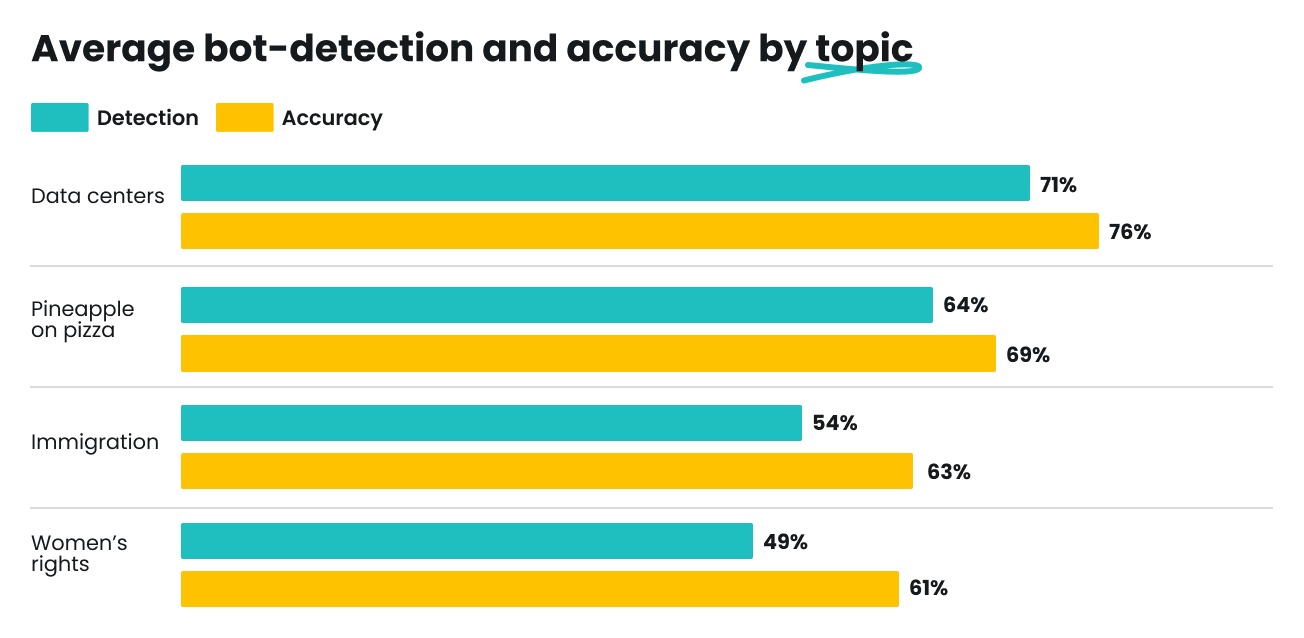
Two of those topics were deliberately “cold,” meaning low in emotional charge: data centres and the perennial pineapple-on-pizza debate. The other two were “hot” and politically loaded: immigration and women’s rights. The contrast between the four was where the most revealing data appeared.
(Image credit: Surfshark)
When participants discussed data centres, they identified 71% of the bots with a 76% accuracy rate, the strongest result in the study. Pineapple on pizza was almost as good, at 64% detection and 69% accuracy.
The moment the simulation moved into emotional territory, however, performance collapsed.
On immigration, detection fell to 54% and accuracy to 63%. On women’s rights, detection crashed to just 49%, with accuracy slipping to 61%, meaning users were both missing more bots and wrongly accusing more real humans of being machines.
Who struggles most, and how to take the test
The study also points to a clear “generational cliff” at around the age of 40. Players up to age 20 were the strongest bot-hunters in the dataset, finding nearly 65% of bots with an accuracy of more than 71%. Performance held steady through the 20s and 30s, then dropped sharply for the 41 to 50 bracket, where detection fell to 42% and accuracy to 59%. Users over 50 fared only marginally better.
Advertisement
According to Surfshark’s Research Lead Luís Costa, the takeaway is not really about reading skills or media literacy in the traditional sense. The biggest blind spot the experiment exposed was emotion: when a debate gets heated, it effectively hijacks the mental “radar” people rely on to flag suspicious content.
To push back against automated deception, he argues, what users actually need is a cooler head and a better awareness of their own vulnerabilities, not sharper textual analysis.
The “Bot or Not” game is now publicly available at botornot.one, and anyone can play it in their browser to see how they score against the original 710 participants.
The wider point of the study is harder to shake off than the score on any individual playthrough. Bots are being produced by the billions, the technology that powers them is getting better at blending in, and our own emotional reactions are the lever they are increasingly built to pull.
Advertisement
A few minutes with “Bot or Not” is a quick way to find out just how often that lever is already working on you.
Looking for the most recent Strands answer? Click here for our daily Strands hints, as well as our daily answers and hints for The New York Times Mini Crossword, Wordle, Connections and Connections: Sports Edition puzzles.
The NYT puzzle editors don’t always acknowledge the calendar or holidays, but today’s NYT Strands puzzle does just that. Some of the answers are difficult to unscramble, so if you need hints and answers, read on.
If that doesn’t help you, here’s a clue: We remember.
Clue words to unlock in-game hints
Your goal is to find hidden words that fit the puzzle’s theme. If you’re stuck, find any words you can. Every time you find three words of four letters or more, Strands will reveal one of the theme words. These are the words I used to get those hints but any words of four or more letters that you find will work:
These are the answers that tie into the theme. The goal of the puzzle is to find them all, including the spangram, a theme word that reaches from one side of the puzzle to the other. When you have all of them (I originally thought there were always eight but learned that the number can vary), every letter on the board will be used. Here are the nonspangram answers:
HONOR, VIRTUE, SERVICE, SACRIFICE, PROTECTION
Today’s Strands spangram
The completed NYT Strands puzzle for May 25, 2026.
NYT/Screenshot by CNET
Today’s Strands spangram is MEMORIALDAY. To find it, start with the M that’s the first letter on the top row, and wind across and then down.
If your first-generation Chromecast was acting a little wonky this week, don’t worry. Contrary to fears online, the 2014 device hasn’t been excommunicated by Google. In a statement to Ars Technica, a rep for the search giant explained that the issue, which was keeping the devices from being able to stream video from services like Netflix, was temporary and should now be resolved. That said, the OG Chromecast hasn’t officially been supported since 2023, so it’s not clear how much longer they will remain operational. Google be Google, after all.
After resisting for years, this week, Mozilla finally relented and brought Web Serial to Firefox. While there’s been some debate about the wisdom of letting the Internet directly talk to hardware gadgets, anyone who’s flashed Meshtastic or configured their Betaflight-powered drone from the browser can attest to how convenient it is. In the announcement, Mozilla acknowledges that “most folks won’t use this API”, but points out that the “community of builders and tinkerers” (that’s us!) is sure to be excited about the news. They’ve even teamed up with Adafruit to ensure their web-based microcontroller workflows are compatible in Firefox 151 and beyond. If you give it a shot, let us know how it goes.
Speaking of hardware support, the Linux Vendor Firmware Service (LVFS) recently picked up a couple of big-name sponsors. As reported by It’s FOSS, this week, Lenovo, Dell, and HP have signed on as Premier-level sponsors to the tune of $100,000 per year. For those unfamiliar, LVFS offers a central repository where hardware vendors can upload firmware updates. On the client side, fwupd can be used to pull these updates down automatically without having to hunt around on each vendor’s website. The experienced players don’t need a service like LVFS, but it’s certainly one of those quality-of-life improvements that make the desktop experience a bit more accessible.
While on the subject of getting hardware working, we hear that more PlayStation 5 consoles can now run Linux. Last month, a software solution for booting the operating system on PS5 consoles running the relatively ancient 3.x and 4.x firmware was released, but now developer Andy Nguyen has gotten it working on firmware 5.x and at least some versions of 6.x. That’s still considerably behind Sony’s latest release, but it does open things up for more consoles to get in on the action.
Advertisement
In space news, the successful first flight of Starship V3 has understandably dominated the headlines for the last few days, but SpaceX wasn’t the only commercial launch provider with good news this week. On Friday, Blue Origin announced they had completed the investigation into the failure of its New Glenn rocket back on April 19th and that the Federal Aviation Administration has approved its return to flight.
According to a statement from the FAA, Blue Origin “identified the direct cause of the mishap as a cryogenic leak that froze a hydraulic line and led to a thrust anomaly during the second stage engine burn.” This resulted in the payload, a next-generation communications satellite featuring a massive 2,400 sq ft deployable antenna array developed by AST SpaceMobile, being placed in an unsustainable orbit.
If you’ve always dreamed of piloting your own walking battle tank, you might finally be in luck. China’s Unitree Robotics has unveiled a mech standing 2.7 meters tall, complete with a promotional video showing it smashing cinder blocks. Because what else would you do with a robot you just paid more than half a million dollars for? Unfortunately, there isn’t much information about the bot’s speed or endurance, and a company spokesperson says the design still needs some refinement before it is ready for production. But still, we’re getting there. Might as well start saving up now.
Finally, we were thrilled to hear that the iconic soundtrack for DOOM has been inducted into the National Recording Registry by the Library of Congress. There’s perhaps no piece of software more emblematic of the hardware hacking world than the 1993 shooter, and while we don’t think that had anything to do with the decision to formally recognize the game’s heavy metal-inspired digital riffs, it will be all that much sweeter the next time we see some oddball gadget running through E1M1.
Advertisement
See something interesting that you think would be a good fit for our weekly Links column? Drop us a line, we’d love to hear about it.
Looking for the most recent Wordle answer? Click here for today’s Wordle hints, as well as our daily answers and hints for The New York Times Mini Crossword, Connections, Connections: Sports Edition and Strands puzzles.
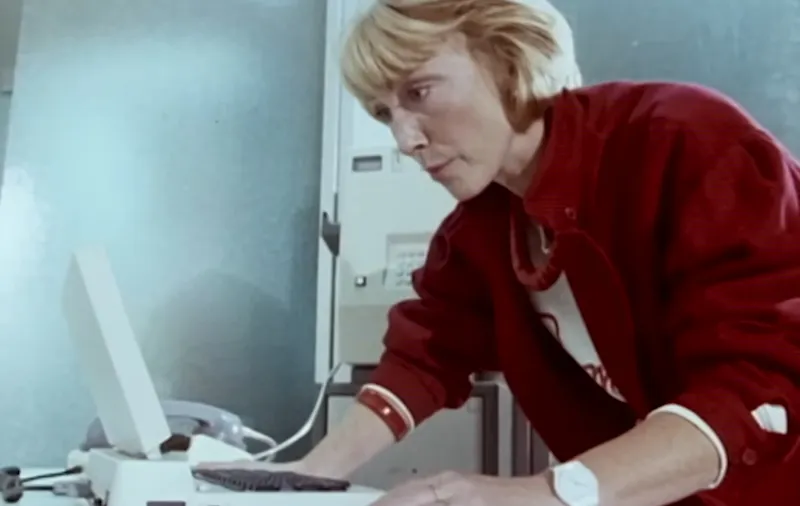
With so many online messaging services to choose from it’s almost as though the daddy of them all, email, has faded into the background as something you only use for more formal contacts. But it’s still the underpinning of much of the business world’s electronic communication and is likely to stay so for the foreseeable future. The BBC Archive takes us back to a time when email was relatively new, when in 1986 [Lesley Judd] takes a very chunky 1980s laptop on a plane from London to the Netherlands, and sends an email to her colleague at home using a payphone and an acoustic coupler.
There are so many of-their-era quirks in this film it’s difficult to pick, but little things like the aircraft still having smoking and non-smoking areas, there being no sign of a mobile telephone, or the payphone operating in Guilders rather than Euros make it from a different time. Perhaps most interesting though is the email system in use, because this isn’t an internet based service. Instead it’s using Telecom Gold, which was the UK telco BT’s online service offering to businesses, and part of the international Dialcom network. This was a commercial service which hung on until some time in the 1990s when the Internet finally displaced it.
The British writer L. P. Hartley used the phrase “The past is a foreign country; they do things differently there” as the opening sentence of one of his books, and the film below the break certainly brings that to mind. It’s a time that’s within reach, yet the changes in information technology over even the next decade or so would make the tech depicted not just obsolete but almost unrecognizable. Most of us today could sit at a 1996 laptop and send an email, but few of us would be as immediately at home with Telecom Gold.
Looking for the most recent Connections answers? Click here for today’s Connections hints, as well as our daily answers and hints for The New York Times Mini Crossword, Wordle, Connections: Sports Edition and Strands puzzles.
Today’s NYT Connections puzzle is a medium-tough one, I think. I recognized the blue category words right away. Read on for clues and today’s Connections answers.
The Times has a Connections Bot, like the one for Wordle. Go there after you play to receive a numeric score and to have the program analyze your answers. Players who are registered with the Times Games section can now nerd out by following their progress, including the number of puzzles completed, win rate, number of times they nabbed a perfect score and their win streak.
Here are four hints for the groupings in today’s Connections puzzle, ranked from the easiest yellow group to the tough (and sometimes bizarre) purple group.





















































You must be logged in to post a comment Login