

Crypto World
SEC delays tokenized stock exemption after exchanges raise ownership concerns

The U.S. Securities and Exchange Commission has reportedly delayed plans to introduce a proposed exemption for tokenized stock trading after exchanges and market participants raised concerns over investor protections and how blockchain-based ownership would function in practice.
Summary
- SEC has reportedly delayed its tokenized stock exemption proposal after exchanges raised concerns over shareholder rights and ownership verification.
- Hester Peirce said the proposed framework would likely support only issuer-backed digital versions of publicly traded equities.
- Crypto executives, including Securitize CEO Carlos Domingo, backed the delay and warned against rushing tokenized stock rules.
According to a Bloomberg report published Friday, SEC staff had already reviewed a draft framework tied to the agency’s proposed “innovation exemption,” which was expected to be released earlier this week before discussions slowed.
People familiar with the matter told Bloomberg that feedback from stock exchange officials and other market participants centered on whether tokenized equities could preserve the same legal and economic rights attached to traditional shares.
Questions were also raised over how ownership records would be verified on semi-pseudonymous blockchains and whether unauthorized firms could issue stock-linked tokens without approval from the underlying public companies.
Under the proposal reviewed by the SEC, platforms offering tokenized equities would need to ensure investors retain rights typically associated with common stock, including dividend access and shareholder voting privileges.
Earlier in the week, SEC Commissioner Hester Peirce had already signaled
that any exemption under consideration would likely remain narrow in scope.
In comments posted to X on Thursday, Peirce said she expected the framework to support only “digital representations” of equity securities that already trade in public secondary markets.
SEC discussions narrow focus to issuer-backed equities
At the same time, the latest delay has drawn support from several crypto industry executives who argued that the SEC should avoid rushing a framework for tokenized securities.
Carlos Domingo, the CEO of tokenization platform Securitize, wrote on X that regulators should ensure the exemption “applies to the right instruments,” adding that delaying the proposal would be preferable to introducing rules that create operational or legal problems.
Separately, Tom Farley, the CEO of crypto exchange Bullish, said on X that the SEC appeared to be recognizing that only public companies themselves should be permitted to issue blockchain-based versions of their shares.
Behind the discussions, the SEC has continued drawing a distinction between different forms of tokenized securities. In guidance released in January, the agency classified such products into “custodial” and “synthetic” categories.
Custodial tokenized securities are issuer-backed shares held through regulated intermediaries and provide investors with shareholder rights tied to the underlying stock. Synthetic tokenized securities, by contrast, only offer price exposure to equities without transferring ownership of the underlying shares.
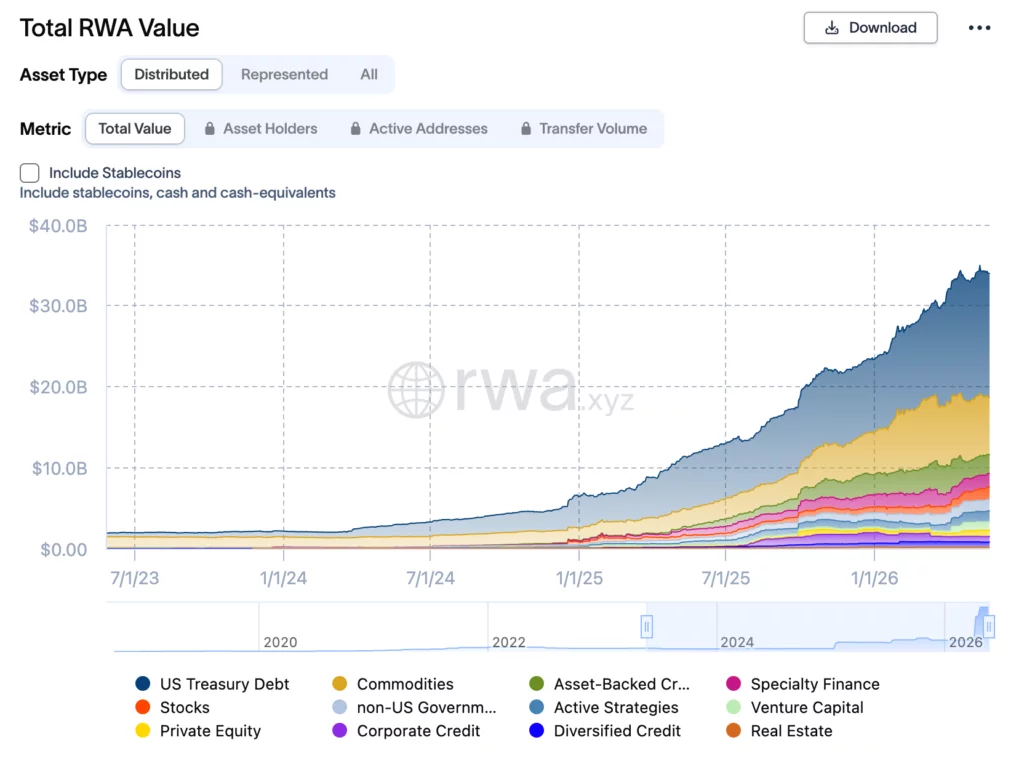
Growing interest in tokenization from Wall Street firms and crypto companies has coincided with the SEC taking a more crypto-friendly stance under the Trump administration. Data from RWA.xyz shows that tokenized real-world assets have reached roughly $34 billion, including about $1.55 billion tied to tokenized equities.
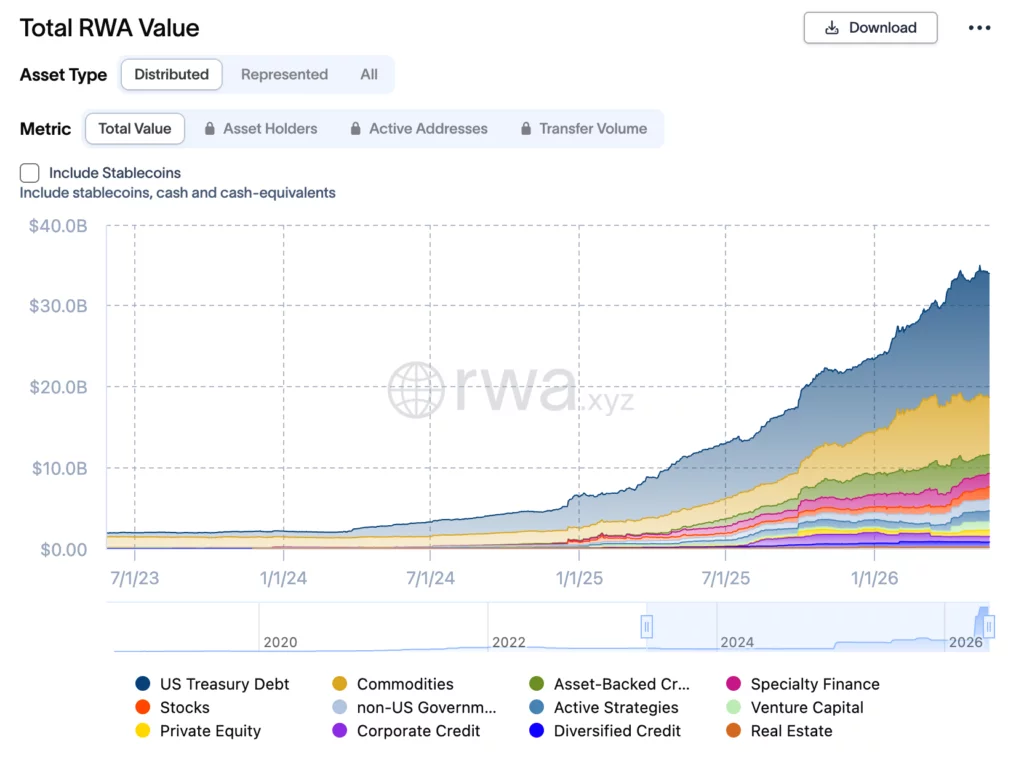
Total RWA market value. Source: RWA.xyz
Despite that growth, adoption has remained below earlier industry projections. According to a McKinsey & Company report published in 2024 tokenization could grow into a multi-trillion-dollar market by the end of the decade.


Trump’s patient Iran strategy reset the geopolitical risk premium and lifted Made-in-USA coins to watch above their May lows.
Now three US-aligned AI tokens show bullish chart setups as institutional capital rotates back to American growth and pre-IPO AI plays. Pattern breakouts and key trendline reclaims confirm the macro thaw across US AI hubs and the relevant altcoins plays.
NEAR Protocol (NEAR)
NEAR trades at $2.35 on May 25 after a 55% weekly rally. The Silicon Valley AI Layer-1 leads Made-in-USA coins to watch as Trump’s patient Iran strategy lifts risk-on flow.
NEAR co-founder Illia Polosukhin co-authored Google’s “Attention Is All You Need” paper, the foundation of modern AI. That US AI lineage attracts institutional capital rotating back to growth on de-escalation.
Want more token insights like this? Sign up for Editor Harsh Notariya’s Daily Crypto Newsletter here.

The token is up 66% over the past month, leading the AI Layer-1 cohort.
The 100%+ pole move from May’s $1.24 low coincides with the US risk-on bid building on Trump’s patient Iran signals. NEAR’s strongest leg landed between May 21 and May 24 as the de-escalation thread strengthened across US AI names.
NEAR’s price action shows a classic bull flag pattern. The pole formed from $1.24 to the May 24 peak at $2.51, a 101.72% move. The flag has been consolidating since, with sell volume dropping sharply.

A daily close above $2.42 confirms the flag breakout, opening $2.51 first, then $2.97 and $3.37. A move to $3.37 would mean a near-45% surge from the current level for this Made-in-USA coin. However, a close below $2.33 weakens the pattern and exposes $2.01.
Render (RENDER)
RENDER trades at $1.98 on May 25, slipping 1.83% on the day after an 11% weekly rally. The LA-based GPU compute network rides the US AI infrastructure rotation on Trump’s patient Iran strategy.
The network powers AI compute workloads alongside its rendering business, sitting in NVIDIA’s projected 10x annual GPU demand path.
RNDR’s rally since May 18 carried sizeable buying volume, separating it from low-conviction speculation. The weekly move tracks the broader risk-on rotation back to US-aligned AI plays. Iran de-escalation reduces the macro overhang on growth names.
The chart shows an inverse head and shoulders pattern since April 17. The pattern’s head is at $1.64, and the right shoulder near $1.72.

The neckline slopes upward because the right shoulder formed at a higher price than the head. That signals buyer absorption at progressively higher prices but raises the breakout level RNDR must clear.
A daily close above $2.44 confirms the neckline breakout and opens the path to $2.88. A close below $1.72 invalidates the right shoulder, with $1.64 marking full pattern failure for this Made-in-USA coin.
Worldcoin (WLD)
WLD trades at $0.29 on May 25, slipping nearly 4% after a 22% weekly rally. The Sam Altman-backed protocol completes the Made-in-USA AI trio on Trump’s Iran de-escalation.
The OpenAI CEO connection makes WLD a high-beta proxy for US AI dominance. The Orb device verifies humanness for AI-powered services, positioning World as the identity layer for the AI economy.
WLD’s 22% weekly rally tracks pre-IPO AI buzz around OpenAI and broader US growth rotation. Risk capital is rotating back to identity infrastructure as the Iran tail risk eases.
The chart shows a cup and handle pattern forming since May 10. The cup bottomed at $0.22 on May 16 and the right rim peaked at $0.31 on May 24. The current pullback resembles the handle, with the cup sloping upward to confirm the bullish bias.
WLD reclaimed its 20-day and 50-day exponential moving averages (EMA), price averages weighting recent candles more than older data. The 20-day EMA at $0.26 marks the floor that must hold.

A daily close above the $0.32, the 100-day EMA, confirms the neckline break and opens a 35% path to $0.42. A close below $0.22 fully invalidates the cup and handle structure.
The post 3 Made in USA Coins to Watch as US Iran War Nears End appeared first on BeInCrypto.


Fenwick & West has agreed to pay $54 million to settle a class action lawsuit filed by former FTX customers who accused the law firm of helping facilitate fraud at the collapsed cryptocurrency exchange.
Summary
- Fenwick & West has agreed to pay $54 million to settle claims that it helped FTX conceal the misuse of customer funds.
- Former FTX customers alleged that the law firm advised on legal structures tied to Alameda Research, North Dimension, and unlicensed financial operations.
According to court filings tied to the proposed settlement, the Silicon Valley law firm reached the agreement after initially trying to dismiss the case brought by former FTX users in 2023. The settlement still requires approval from a U.S. judge before it can take effect.
Former customers of the exchange alleged that Fenwick played a central role in legal and corporate arrangements that allowed FTX and its affiliated trading firm, Alameda Research, to move and commingle customer funds without proper safeguards. Plaintiffs claimed the firm helped create structures and entities designed to obscure how customer assets were handled inside the FTX group.
Court records from the original complaint alleged that Fenwick also advised FTX on legal strategies intended to avoid money transmitter licensing requirements in some jurisdictions.
Earlier filings from August 2025 added further accusations against the law firm after plaintiffs sought permission to amend their complaint using evidence from Sam Bankman-Fried’s criminal trial and the FTX bankruptcy process. In that proposed amended filing, former FTX customers argued that testimony from senior insiders and findings from an independent bankruptcy examiner showed Fenwick had become “deeply intertwined” with the exchange’s operations.
At the time, plaintiffs cited testimony from former FTX executives Nishad Singh, Gary Wang, and Caroline Ellison, who allegedly described internal practices involving improper loans, false statements, and misuse of customer funds. According to the filing, Singh told the court that Fenwick had been informed about some of those activities and advised on legal structures connected to them.
Other allegations in the amended filing accused the law firm of helping establish shell companies linked to Alameda Research and North Dimension, an entity used to route customer deposits. Plaintiffs also pointed to the use of encrypted and auto-deleting Signal chats by FTX executives, which they said Fenwick knew about during its legal representation of the exchange.
At the same time, the filing introduced securities law claims under Florida and California statutes tied to the sale of FTT tokens and other FTX-related investment products. Plaintiffs argued that Fenwick attorneys participated in designing and facilitating those offerings for investors.
Legal fallout from FTX collapse continues
Elsewhere in the FTX fallout, former FTX head of engineering Nishad Singh agreed in April 2026 to pay a $3.7 million disgorgement to settle charges brought by the U.S. Commodity Futures Trading Commission.
According to the CFTC, Singh also accepted a five-year trading ban and an eight-year registration ban as part of the supplemental consent order tied to the misuse of customer funds at FTX. CFTC enforcement director David Miller said the resolution accounted for Singh’s cooperation with investigators.
Separately, the FTX Recovery Trust has continued distributing recovered assets to former customers and creditors. In March, the Trust distributed $2.2 billion to claimants, while another reimbursement round has been scheduled for May 29.
Key Highlights
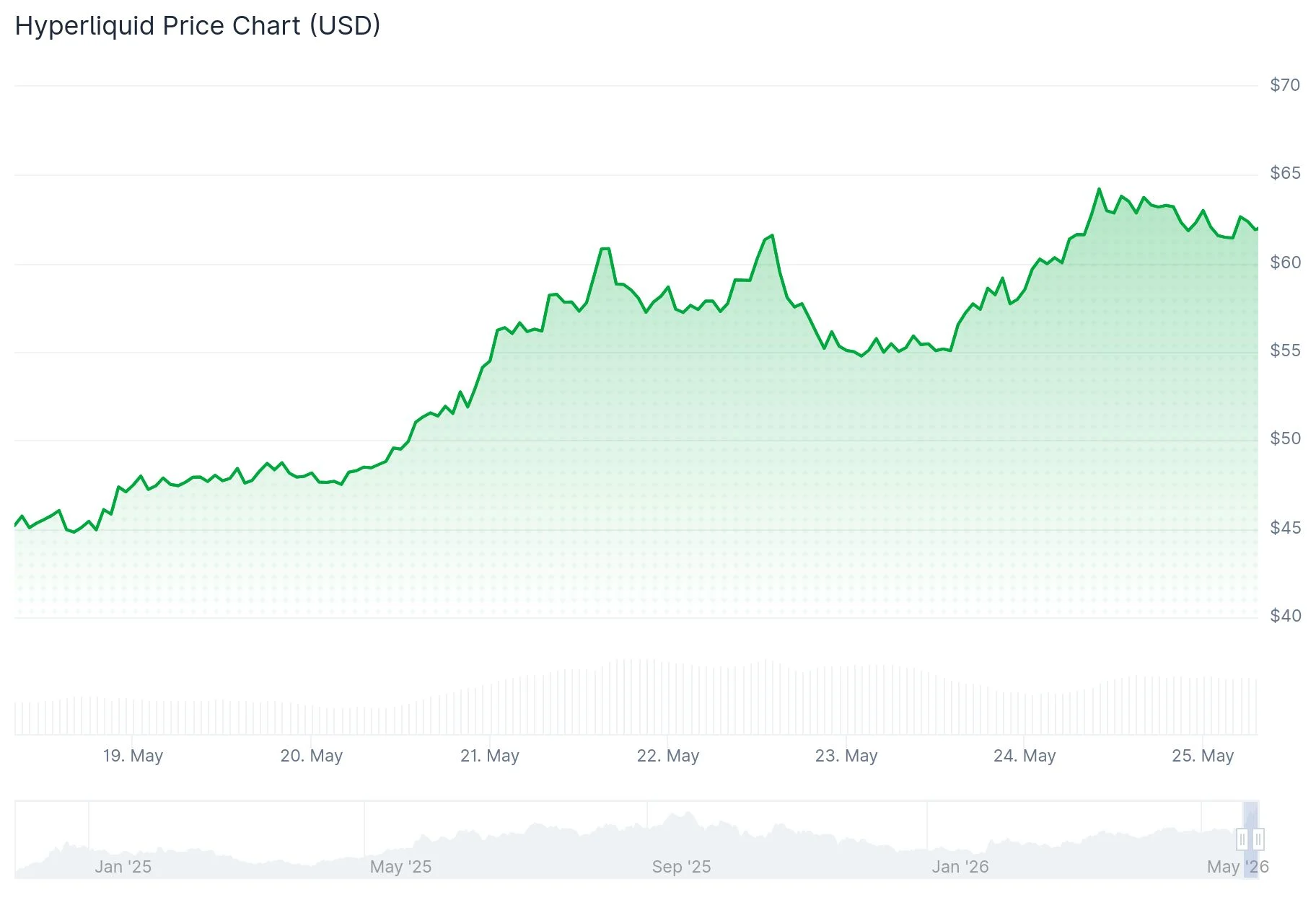
- HYPE token reached an unprecedented peak of $64.48, maintaining levels above $60 through Monday’s trading session
- Institutional investment vehicles from 21Shares, Bitwise, and Grayscale are channeling significant capital, with $72M entering the market last week
- The platform’s innovative buyback mechanism allocates 97–99% of fee revenue toward HYPE token repurchases
- Perpetual futures Open Interest surged to an all-time high of $2.95 billion, indicating robust market participation
- Market analyst Michaël van de Poppe forecasts HYPE could surpass the $100 threshold
Hyperliquid’s native token (HYPE) continues its remarkable ascent, establishing new price records driven by a confluence of institutional adoption, strategic token economics, and expanding platform utility. The digital asset peaked at $64.48 before stabilizing near the $60 level.
The competitive landscape for HYPE-focused exchange-traded products is rapidly evolving. Bitwise introduced BHYP on the NYSE Arca exchange, while 21Shares debuted THYP on Nasdaq. These investment vehicles collectively attracted $72.38 million in fresh capital during the previous week, representing a dramatic increase from the prior week’s modest $2.52 million.
Grayscale has officially entered the competition. According to Bloomberg’s ETF specialist James Seyffart, Grayscale submitted an updated registration document for a HYPE investment trust, proposing the ticker symbol GHYP. The documentation identifies Anchorage Digital Bank as the custodial partner and Bank of New York Mellon as the administrative entity.
Grayscale’s submission incorporates a staking component. Should regulatory authorities approve, the trust may be rebranded as the Grayscale Hyperliquid Staking ETF, potentially offering investors exposure to both price appreciation and staking income.
Token Repurchase Program Generates Sustained Demand
Hyperliquid employs a distinctive economic model that channels 97% to 99% of platform trading fees toward systematic token repurchases from secondary markets. Approximately 210,000 HYPE tokens were acquired through this mechanism during the past week. The platform’s assistance fund currently maintains 44.52 million tokens, with cumulative repurchases totaling 26.81 million HYPE. The aggregate value of all buyback activity has reached $1.16 billion.
Perpetual futures Open Interest climbed to a record $2.95 billion on Monday, according to CoinGlass data. Hyperliquid commands approximately 70% of the decentralized perpetual futures market and represents roughly 7% of total perpetual contract open interest across all trading venues.
Market participant LSTRADER, sharing analysis on X, observed that previous all-time high projections have already materialized. The trader suggested the current strategy involves trend following while capitalizing on temporary retracements, with additional resistance levels now in focus.
New Platform Features Drive Revenue Growth
Hyperliquid’s recently launched HIP-4 prediction market processed 6.05 million contracts on its inaugural day and equaled Polymarket’s two-week Bitcoin binary contract volume within just 48 hours. Additional product offerings generate increased fee revenue, which directly powers the token buyback system.
From a technical analysis perspective, HYPE maintains strong positioning above its 50, 100, and 200-day exponential moving averages. The Relative Strength Index registers at 75, suggesting overbought territory, while the MACD indicator confirms ongoing bullish momentum. Fibonacci extension analysis identifies critical resistance zones at $70.04 and $83.51.
Crypto analyst Michaël van de Poppe has publicly expressed his conviction that HYPE will exceed $100 in the near term.

Bitcoin whale positioning has hit a yearly high while retail demand sits at its most bearish level of 2026.
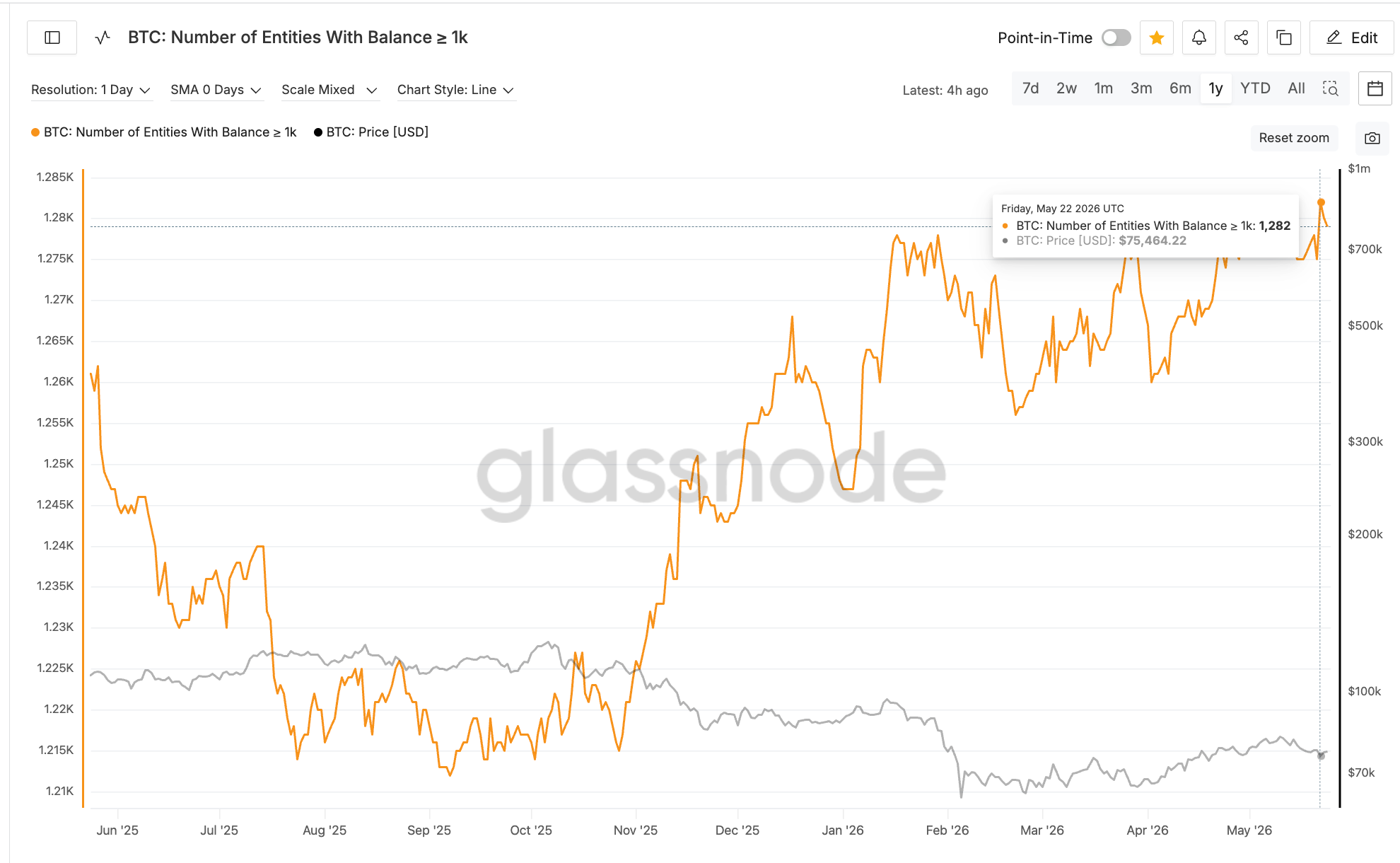
Entities holding 1,000+ BTC reached 1,282 on May 22, matching the year’s peak set on May 3. The Whale vs Retail Delta divergence is the strongest since November 2024, hinting at a proactive accumulation setup.
Retail Demand Hits 5-Month Bearish Low as Whales Quietly Accumulate
Bitcoin’s apparent demand has reached its most bearish level of 2026. But the Whale vs Retail Delta has flipped to its strongest positive divergence in 18 months. Both findings paint an optimistic picture for the Bitcoin price.
Want more token insights like this? Sign up for Editor Harsh Notariya’s Daily Crypto Newsletter here.
CryptoQuant analyst Darkfost reported on May 25 that Bitcoin’s apparent demand fell to roughly -147,000 BTC. The reading is the most bearish since December 2025, signaling new issuance is outpacing structural absorption. Darkfost framed it as a setup where sharp demand drops with excessive pessimism have historically created opportunities for patient investors.
The demand drop is primarily retail-driven. The Crypto Fear & Greed Index sits at 28, deep in fear territory as retail capitulates. Alphractal reported the Whale vs Retail Delta printed its highest positive divergence since November 2024.
Addresses holding 1,000+ BTC accumulated 47,000 BTC over the past 14 days. Strategy added 24,869 BTC last week at an average price above current spot. A dormant 2013 whale also moved 500 BTC for the first time in 12 years.
Alphractal’s Holder Sentiment metric reads 0.82. The last time it hit 0.80 during a Fear reading below 30 was March 2024. Bitcoin rallied 67% in the 90 days that followed.
The aggressive whale bid pushed Bitcoin entities holding 1,000+ BTC to 1,282 on May 22.

That matches the yearly high last printed on May 3. The on-chain reading confirms whales are positioning at record levels despite retail panic.
Large Supply Cluster at $78,258 Stands Above Spot as Key Resistance
The whale positioning aligns with a specific overhead supply zone. Glassnode’s UTXO Realized Price Distribution metric highlights a dense supply cluster at $78,258. Roughly 415,534 BTC last changed hands at this level, accounting for 2.07% of total supply.

The cluster sits as the first major resistance band above current spot. A breach of this zone would convert dormant supply into a support base. Coins last moved at this price tend to remain inactive once they trade through, reducing overhead sell pressure.
Whales appear to be building positions in anticipation of this level breaking and turning into a strong support zone. The setup’s success depends on whether spot demand returns to push Bitcoin through the cluster. For that, the Bitcoin price levels and the proactive setup need to be checked.
Bitcoin Price Eyes a Bullish Pattern Formation Above $74,177
The 12-hour chart shows how Bitcoin could break through the cluster. Bitcoin trades at $77,250 on May 25 with the chart printing an early-stage inverse head and shoulders pattern. The structure is incomplete, with the left shoulder and head visible but the right shoulder still forming.
The head bottomed at $74,177 on May 22, coinciding with the deepest sentiment drop. The first trigger for the pattern would be a rejection at the $78,125 neckline. Such a rejection would send Bitcoin into a higher low between $76,040 and $74,177 to form the right shoulder. The prospective $78,125 neckline also aligns with the supply cluster discussed earlier.

A 12-hour close above $78,125, post the right shoulder formation, followed by a clean breakout above $79,057 confirms the pattern. The measured move projects a 5% surge to $82,073 from neckline confirmation. A 12-hour close below $74,177 invalidates the structure and weakens the whale accumulation case.
Note: Even the lack of rejection at $78,125 keeps the pattern alive. It just pushes the neckline higher.
The chart, supply cluster, and whale positioning point to one read. A proactive setup is forming as whales position ahead of the breakout while retail reacts to fear.
The post Bitcoin’s Quietest Accumulation in 18 Months Is Happening Right Now appeared first on BeInCrypto.
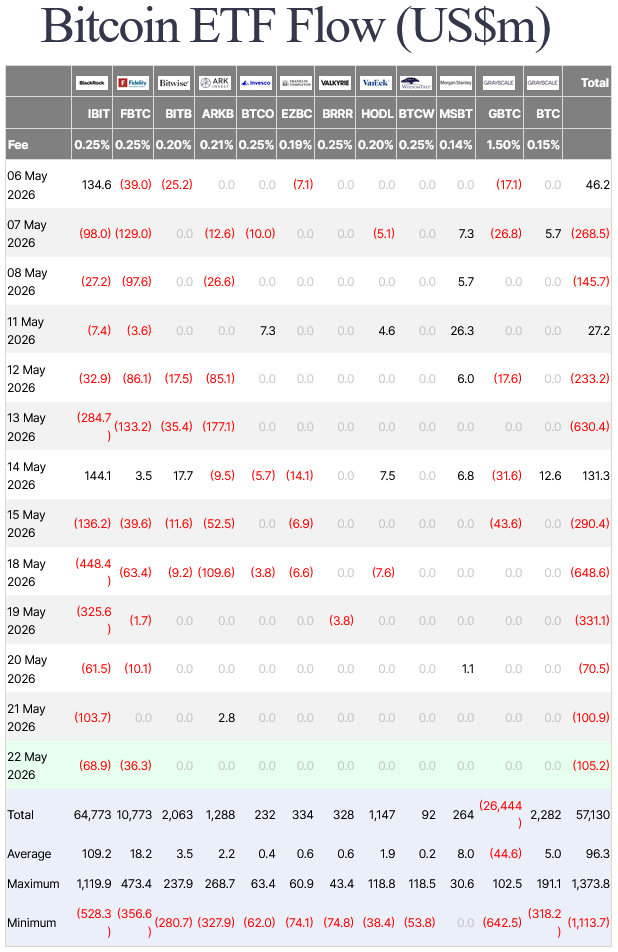
The US spot Bitcoin exchange-traded fund market is closing in on recording net outflows for this year after Friday saw the funds hit six consecutive days of outflows.
Net inflows into the Bitcoin ETFs so far in 2026 have shrunk to $536 million after the market bled another $105.2 million on Friday, as BlackRock’s iShares Bitcoin Trust (IBIT) lost $68.9 million and the Fidelity Wise Origin Bitcoin Fund (FBTC) recorded outflows of $36.3 million.
While no other US-based Bitcoin ETF registered a change in flows, Friday’s outflow contributed to the $1.55 billion that has bled out of the ETFs since May 14, the last recorded net inflow among all the funds.
Flows into the US spot Bitcoin ETFs since May 6. Source: Farside Investors
Net inflows into the US spot Bitcoin ETFs are one of the top metrics that signal how strong institutional demand for Bitcoin is and whether fresh capital is flowing into crypto.
Institutional market maker Jane Street reduced its Bitcoin ETF holdings by around 70% in the first quarter, while investment bank Goldman Sachs reduced its Bitcoin ETF position by 10%.
While the US Bitcoin ETF market is still in net inflow territory for 2026, most of those inflows have come from IBIT, which has seen net inflows of $2.7 billion so far this year.
However, its inflows this year are not on pace to eclipse the $25 billion that it took in over 2025, while most of its competitors have retraced in 2026.
The US-based spot Ether ETFs have recorded net outflows so far in 2026, while new altcoin ETFs have not captured the same demand as their predecessors.
Related: SEC seeks public comment as it weighs prediction market ETFs
One of the more positive developments has been the launch of the Morgan Stanley Bitcoin Trust ETF (MSBT), which entered the market on April 8 and has already attracted $264 million in net inflows to date.
The $264 million in net inflows already puts it above the Bitcoin products offered by Invesco and WisdomTree, which launched in January 2024.
The US Bitcoin ETF market was also expecting the Donald Trump-backed Truth Social to launch a Bitcoin product sometime this year until its sponsor, asset manager Yorkville America, requested to withdraw multiple crypto ETFs for Trump’s media company on Tuesday.
Bloomberg ETF analyst James Seyffart suspected that Yorkville America’s decision to pull out may have been due to the competitive landscape for Bitcoin ETFs, particularly with MSBT offering a market-low fee of 0.14%.
Magazine: eToro founder timed Bitcoin top perfectly due to belief in 4 year cycles
Bitcoin was slightly higher on Monday as a sharp decline in oil prices helped lift Asian stock markets.
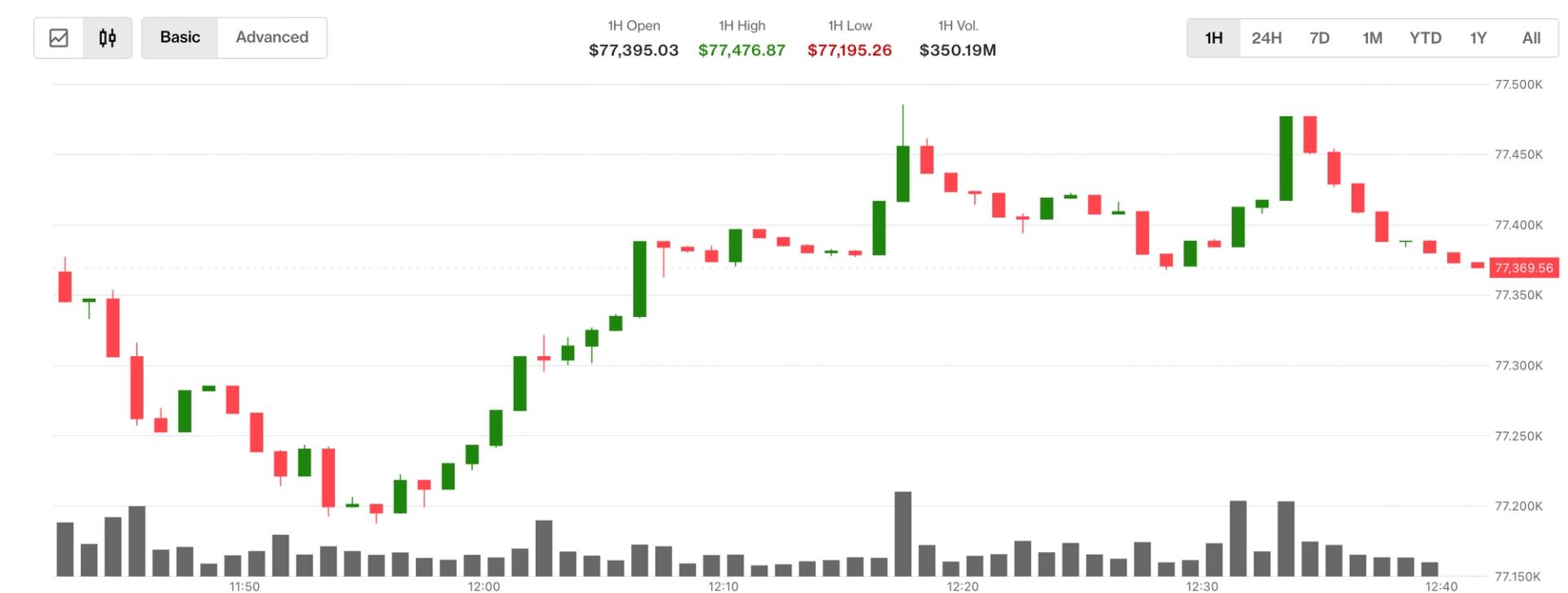
At 6:35 UTC, the leading cryptocurrency by market value traded near $77,200, up 0.4% from midnight UTC, according to CoinDesk data. At that level, bitcoin was trading just above its widely tracked 50-day simple moving average of around $76,940. Traders and chart analysts monitor this key level closely, with sustained breakouts above it typically viewed as bullish.Other major cryptocurrencies were also modestly higher.
XRP and Solana (SOL) rose 0.6% or more, while Ether (ETH) gained 0.4%. However, all three continued to trade below their respective 50-day moving averages, lagging Bitcoin on this metric.
Futures tied to West Texas Intermediate crude oil dropped more than 5% to around $91 per barrel, extending a steep slide from last Wednesday’s high above $104. Asian equities rallied, with India’s Nifty climbed over 1%, Japan’s Nikkei rose nearly 3% in early trade, and Australia’s S&P/ASX 200 added 0.4%.
These moves follow weekend reports that a deal to reopen the Strait of Hormuz, a critical chokepoint that accounted for over 20% of global oil flows before the Iran war began in late February, was in its final stages.
Last week, Iran’s IRGC claimed to have allowed passage of over 20 tankers through the strait, though that volume remains well below pre-war levels.
U.S. Secretary of State Marco Rubio said that Washington and Iranian negotiators have “a pretty solid thing on the table” and a deal to end the war between the two countries could be reached Monday. He said that the U.S. is ready top exhaust every diplomatic option but would pursue other means if a good deal could not be reached.
Analysts still maintained a cautious outlook on bitcoin, citing more than $2 billion in outflows from spot ETFs over the past two weeks.
“For crypto, the key signal is whether ETF outflows slow. Bitcoin can absorb some institutional selling if stablecoin liquidity remains firm and long-term holders stay patient. Sustained ETF redemptions would make every rally harder to hold,” Timothy Misir, head of research, BRN, said in an email.
India-based FIU-registered CoinSwitch exchange noted that finalization of a U.S.-Iran peace deal would be needed for further sustained gains.
“The sentiments improved after reports of progress in U.S.–Iran peace talks, including a possible reopening of the Strait of Hormuz, helping BTC rebound toward $77K. Still, the deal is not finalized, so traders are not fully risk-on yet. Exchange data also remains a watchpoint, with 18,528 BTC moving net into centralized exchanges, suggesting potential sell-side pressure,” the exchange said in an email.

Key Takeaways
- The convergence of artificial intelligence with quantum computing is shortening the timeline for potential threats to blockchain encryption systems.
- Adversaries are employing “harvest now, decrypt later” tactics, collecting encrypted blockchain data today for future decryption when quantum technology matures.
- The majority of blockchain platforms, from Bitcoin to Ethereum, depend on elliptic curve cryptography that quantum machines could eventually compromise.
- Machine learning technologies serve dual purposes: attackers leverage them to discover vulnerabilities while defenders deploy them for security audits and verification processes.
- Major blockchain ecosystems including NEAR, Ethereum, Solana, and additional networks are actively developing quantum-resistant migration roadmaps.
Security professionals and blockchain researchers are sounding alarms that machine learning advancements are propelling quantum computing capabilities forward at an unprecedented pace. This technological convergence is compelling cryptocurrency platforms to fundamentally reconsider their approach to safeguarding digital assets and sensitive information.
What once seemed like a distant hypothetical scenario—quantum computers posing genuine risks to blockchain infrastructure—now appears to be approaching faster than the industry anticipated, according to leading researchers.
Understanding the Fundamental Risk
The overwhelming majority of cryptocurrency networks, notably Bitcoin and Ethereum, depend fundamentally on elliptic curve cryptography to maintain wallet security and transaction integrity. A quantum computer with adequate processing capability could potentially reverse-engineer private keys from their corresponding public keys, creating pathways for malicious actors to compromise and empty vulnerable cryptocurrency wallets.
According to Alex Pruden, CEO of Project Eleven—a firm specializing in quantum-resistant blockchain infrastructure—the landscape is transforming rapidly. “Between quantum and AI, we’re going to go into a world where security, you simply cannot count on the way you’ve always done things,” he said.
What was once purely academic speculation has evolved into a concrete concern. Security professionals now highlight a troubling tactic called “harvest now, decrypt later”—where well-resourced adversaries systematically capture encrypted information in the present, banking on future quantum computing breakthroughs to unlock it.
Illia Polosukhin, co-founder of NEAR Protocol and former AI researcher at Google, expressed stark concerns about the timeline. “Everything we’re putting on the internet, if you’re identifiable as a person of interest, you can assume will be decrypted in two years,” he said. “It’s most likely happening already.”
The Dual Role of Artificial Intelligence
Artificial intelligence isn’t merely hastening quantum threats—it’s actively being deployed in current-day offensive and defensive cybersecurity operations across the cryptocurrency landscape.
From an attack perspective, AI models are demonstrating increasing sophistication in identifying security weaknesses within software systems. Pruden anticipates that machine learning will dramatically increase the frequency of successful exploits within the industry, as these systems grow more adept at discovering cryptographic implementation flaws and potentially compromising weaker security protocols entirely.
Conversely, blockchain developers are harnessing artificial intelligence for protective purposes, including automated code reviews, formal verification processes, and comprehensive testing of quantum-resistant cryptographic systems. These methodologies can identify and neutralize security vulnerabilities before malicious actors can exploit them.
Polosukhin, whose AI research work at Google dates back to 2016, emphasizes the accelerating nature of machine learning breakthroughs. “The rate of research is going to accelerate from here, and we have already seen progress that people didn’t expect would come this early,” he said.
He further highlighted a concerning cyclical pattern: artificial intelligence facilitating the development of more sophisticated quantum computers, which could subsequently enable the creation of even more advanced AI architectures.
How Blockchain Platforms Are Responding
Numerous cryptocurrency projects have moved beyond planning stages and are actively implementing countermeasures. NEAR Protocol recently unveiled initiatives to embed post-quantum cryptographic standards directly into its account architecture. This architectural decision would enable users to upgrade their cryptographic protections seamlessly without requiring asset migration to entirely new wallet addresses.
Polosukhin revealed this was an intentional design consideration from inception. “Back in 2018, when we were designing NEAR, we were like: hey, quantum will come, we should have an easy way to do it,” he said.
Ethereum, Zcash, Solana, and Ripple are similarly engaged in researching and deploying their respective post-quantum security frameworks.
The migration pathway presents significant technical challenges. Existing post-quantum cryptographic standards generally require substantially more data storage and computational resources. “The cryptography that’s currently standardized for post-quantum is very big and slow,” Polosukhin said.
Pruden articulated the paradigm shift facing the industry: cryptographic security can no longer operate on decade-long update cycles. Instead, it demands continuous monitoring, assessment, and evolution.
“Nothing is going to be as static as it’s been in the future,” he said.
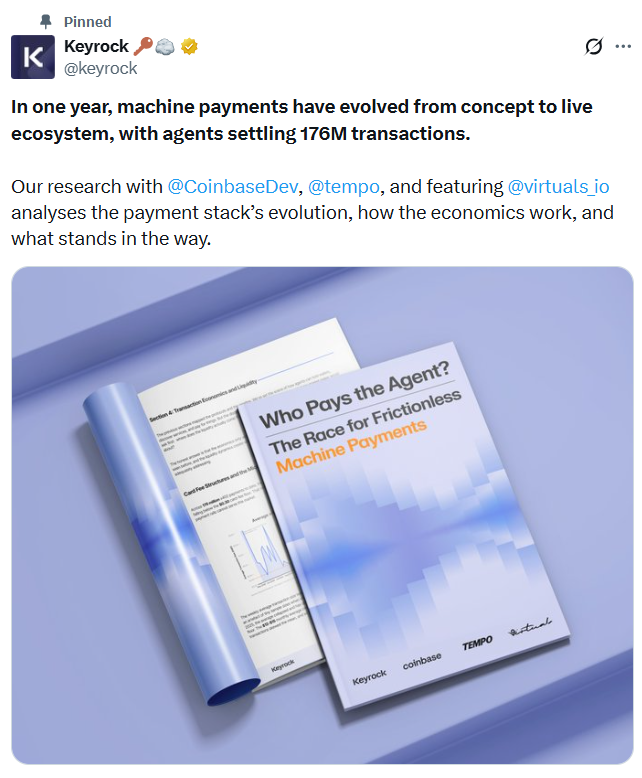
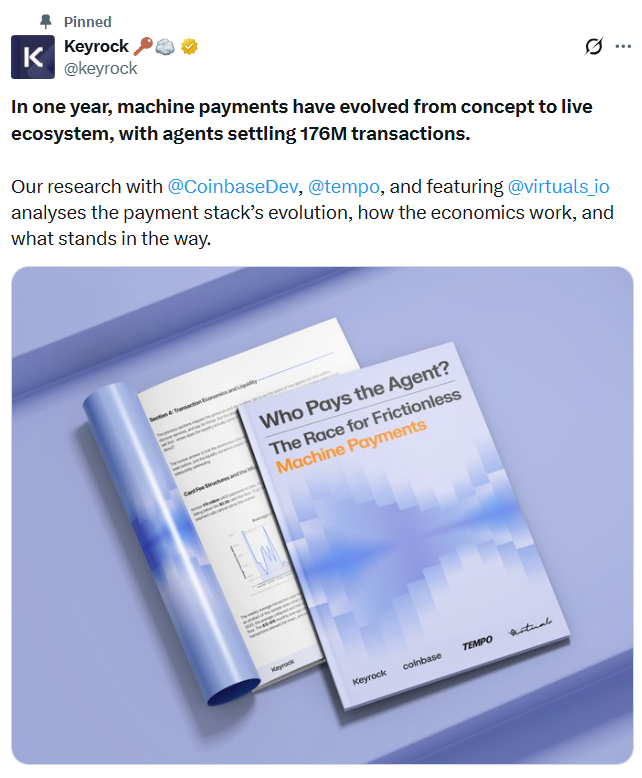
Artificial intelligence agents settling payments have gone from concept to reality in the last 12 months, with $73 million settled across 176 million transactions from May last year through April 2026, according to crypto investment firm Keyrock.
In a report released Thursday, written in collaboration with crypto exchange Coinbase and the blockchain Tempo, Keyrock researcher Ben Harvey said that “in the past 12 months, machine-to-machine payments have gone from concept to a developed ecosystem.”
“Agents have settled over $73 million across 176 million transactions, and incumbents have deployed more than $8 billion in acquisitions to secure their position in what is emerging as an entirely new payment stack,” Harvey added.
Source: Keyrock
AI agents are becoming increasingly popular among crypto users. Some crypto executives have speculated that AI agents settling transactions could drive adoption and transaction volumes, with Circle CEO Jeremy Allaire predicting in January that billions of AI agents will operate with stablecoins on users’ behalf within five years.
Traditional payment rails too slow and expensive
By the end of the first quarter this year, there were more than 104,000 agents registered across 15 or more directories and registries, according to Harvey. The average transaction size was about 31 cents.
“That number tells you almost everything about why traditional payment rails can’t serve this market. A fixed processing fee of roughly 30 cents per transaction makes sub-dollar payments uneconomical. An agent paying three cents for a weather API call can’t route through Visa,” Harvey said.
“Stablecoins won the settlement layer for machine commerce almost by default; they were the only instrument that could handle sub-dollar transactions without the economics collapsing.”
Related: Exodus launches AI agent-focused stablecoin on Solana
AI agents are also used to build Web3 applications, launch tokens and interact with services and protocols autonomously, with some platforms exploring AI for trading. Last April, a CoinGecko survey of 2,632 crypto users found that most are comfortable with AI trading on their behalf; 87% said they would let AI agents manage at least 10% of their crypto portfolio.
USDC the leading settlement option
More than 98% of settlements by AI agents were in Circle’s USDC (USDC), according to Harvey, who said this serves as both a “validation and a vulnerability” because the entire ecosystem depends on one company, carrying significant risks.
“This is a lot of dependence on a single stablecoin issuer’s reserve management, regulatory standing, and technical infrastructure. If Circle faces a regulatory challenge, a de-peg event, or even sustained downtime, the agent economy has no fallback,” he added.
“This is a systemic risk that nobody in the space is publicly discussing, and one we believe warrants serious attention as volumes scale.”
Magazine: Crypto scammers face death, Aussie CGT makes Asian hubs attractive


The European Central Bank has summoned banks to a Tuesday session over cybersecurity risks posed by Anthropic’s Claude Mythos and other advanced AI models.
Frank Elderson, vice-chair of the ECB’s supervisory board, said the regulator wants banks to accelerate the rollout of software patches to address vulnerabilities.
Why Advanced AI Models Have Banks on Edge
Anthropic released the Claude Mythos Preview in April under Project Glasswing, a restricted program. Recent evaluations show the scale of what Mythos uncovers.
The UK’s AI Security Institute (AISI) found Mythos Preview cleared 73% of expert-level Capture the Flag (CTF) challenges. No AI model could pass that benchmark before April 2025.
Mozilla shipped Firefox 150 with 271 patches for vulnerabilities found by the model, far above prior Opus 4.6 results.
Follow us on X to get the latest news as it happens
Elderson said banks must accelerate patch deployment because attackers can now reverse-engineer fixes within 30 minutes. He warned that ‘andante’ tempo is no longer enough.
“There is a whole range of issues on cyber security that we have been engaging on with the banks for years, which are all still valid, but given the progress in AI, they need to be dealt with faster,” he told FT. “In musical terms, I would say andante may have been good enough, but we need to go to presto.”
The ECB supervises 111 of the largest banks in the Eurozone. Most European lenders sit outside Project Glasswing and lack direct access to frontier models like Mythos.
Elderson wants US institutions attending Tuesday’s meeting to share testing insights with their Eurozone counterparts. He called the access gap ‘unfortunate’ but said it cannot justify inaction.
Whether finance can patch as quickly as frontier AI surfaces new exploits may determine how institutions protect client funds in the near future.
Subscribe to our YouTube channel to watch leaders and journalists provide expert insights
The post ‘Clock Is Ticking,’ ECB Warns Banks Over Mythos and AI Cyber Risks appeared first on BeInCrypto.
Fundamental Background
At the end of February, Netflix withdrew from the bid for Warner Bros. Discovery assets after WBD’s board deemed Paramount Skydance’s $31-per-share offer more attractive. Netflix chose not to raise its own bid of $27.75 per share and received compensation of $2.8 billion. The market reacted positively to the company’s exit from the months-long M&A battle, as the threat of adding more than $40 billion in debt to the balance sheet was removed.
The second key event was the company’s Q1 2026 earnings report, released on 16 April. Revenue reached $12.25 billion (+16% year-on-year), while earnings per share came in at $1.23, exceeding consensus forecasts. However, guidance for Q2 fell short of analysts’ expectations for both revenue and EPS, while company founder Reed Hastings announced plans to step down from the board in June. Together, these factors triggered a sharp negative market reaction in April.
Technical Picture
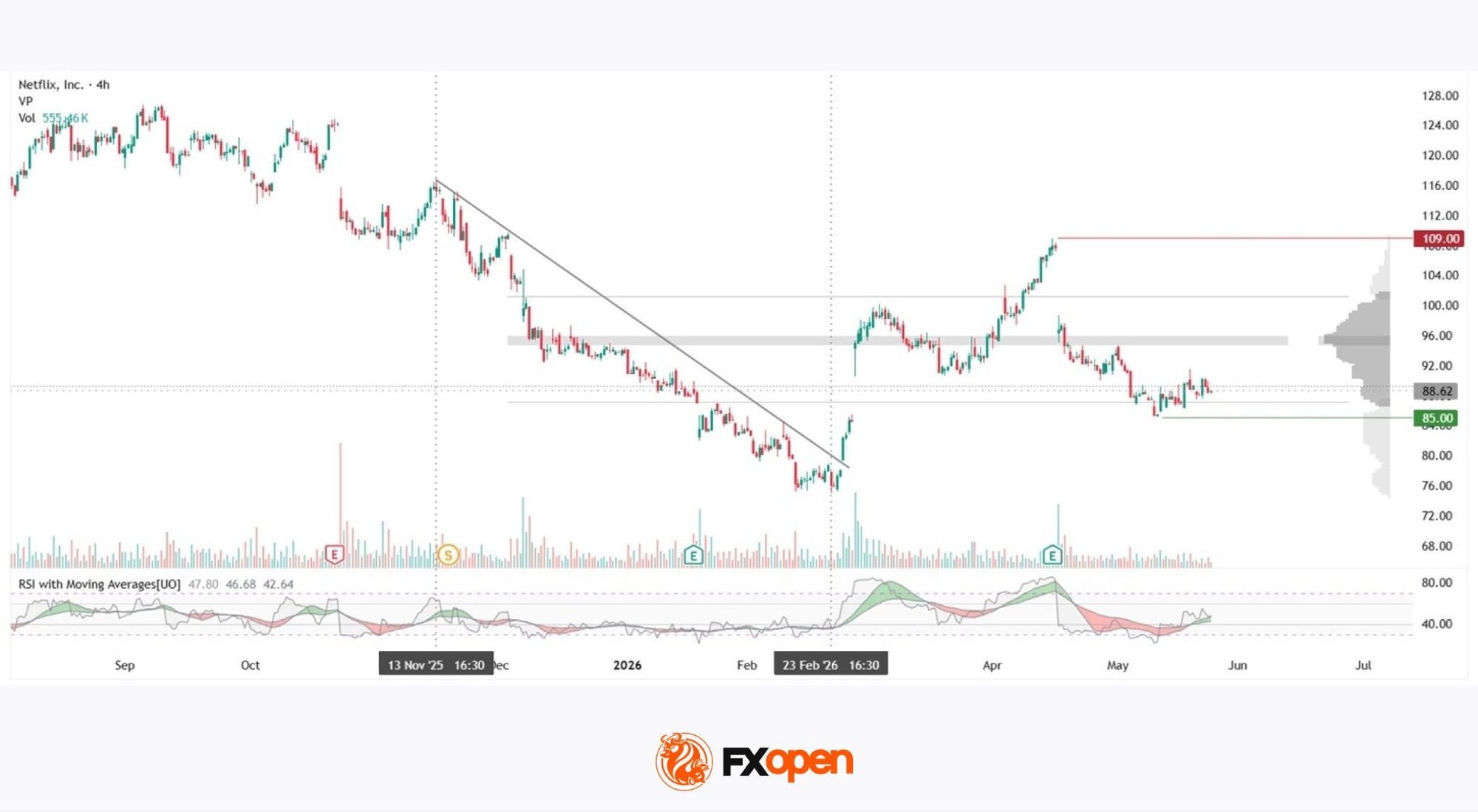
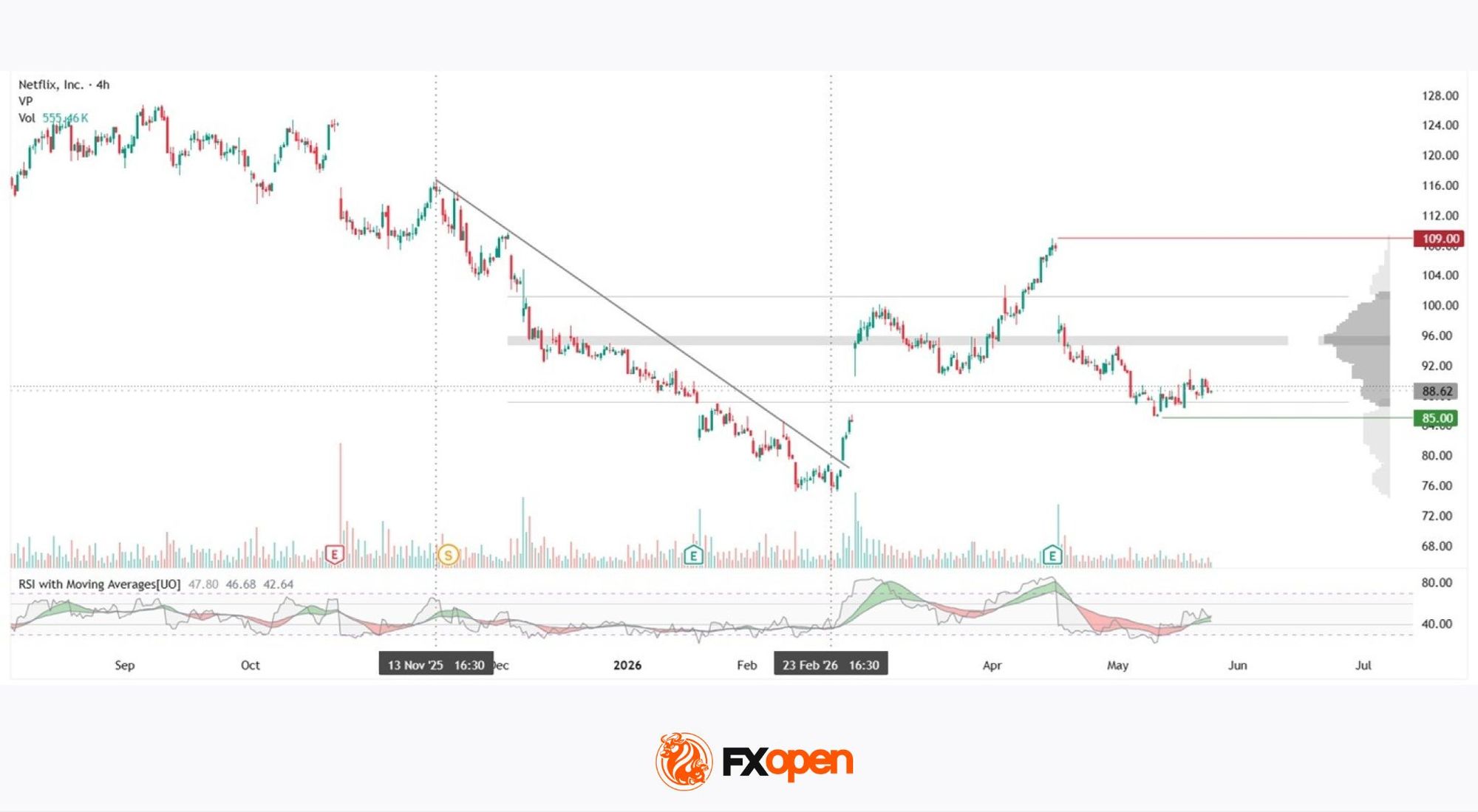
The long-term downtrend in Netflix shares began in July 2025, when the stock was trading near historic highs around $134. The period from 13 November 2025 to 23 February 2026 marked the final phase of this trend, during which the price declined towards $75.
The gap on 27 February 2026 — a direct consequence of the company’s withdrawal from the WBD deal — broke the descending trendline and was accompanied by an abnormal surge in vertical trading volume. The subsequent rally pushed the stock towards $109, which may now act as a resistance zone on any renewed advance. The gap on 17 April reversed the move lower, also on elevated volume, returning the price to the range of the current volume profile.
At present, the shares are trading slightly above the lower boundary of the profile, while the Point of Control (POC) zone lies around $94.50–$96.00 and may serve as a reference point in the event of a recovery. The $85.00 area could become the nearest significant support below the profile. RSI with moving averages currently shows readings of 47 / 46 / 42 — all three lines remain below the 50 mark and have yet to form any impulsive structure.
Key Takeaways
Netflix’s technical structure reflects two polar opposite events within the same year: the breakout of the long-term downtrend following a corporate event, and the subsequent correction after disappointing guidance. The stock’s next direction will largely depend on whether the market can hold above the lower boundary of the profile and how convincing the company’s operational progress proves to be in Q2.
Buy and sell stocks of the world’s biggest publicly-listed companies with CFDs on FXOpen’s trading platform. Open your FXOpen account now or learn more about trading share CFDs with FXOpen.
This article represents the opinion of the Companies operating under the FXOpen brand only. It is not to be construed as an offer, solicitation, or recommendation with respect to products and services provided by the Companies operating under the FXOpen brand, nor is it to be considered financial advice.

Premier League: Tottenham beat Everton to stay in top flight – Sports

iPhone Crash Detection saved driver after 330ft mountain drop

Money Bundle Cake


-

 Crypto World4 days ago
Blockchain.com files with SEC for U.S. IPO
-

 Fashion3 days ago
Holiday Weekend Open Thread – Corporette.com
-
 Crypto World3 days ago
Bitcoin Accumulation Weakens as BTC Realized Losses Hit $600M
-

 Business3 days ago
Dell Technologies DELL Stock Surges 15% on AI Server Momentum and Analyst Upgrades in 2026
-
 Crypto World3 days ago
Space X IPO Is ‘Bad News’ for Tech Stocks: But What About Bitcoin?
-

 Politics3 days ago
Makerfield: a tale of two social-media histories
-
 Crypto World3 days ago
MicroStrategy’s Saylor Says Miners No Longer Set Bitcoin Price, Another Force Has Taken Over
-

 Crypto World2 days ago
Robinhood crypto COO Tanya Denisova exits
-

 Business14 hours ago
NYT Strands Answers May 24 2026 Revealed for Puzzle No. 812 Theme Summer Essentials
-
 Tech3 days ago
A 0.12% parameter add-on gives AI agents the working memory RAG can’t
-

 Crypto World3 days ago
AI infrastructure race heats up as IREN pitches full-stack strategy, WhiteFiber lands $160M deal
-

 Tech3 days ago
WhatsApp ads could make Irish debut after discussions with DPC
-

 Tech3 days ago
You Can Now Add ChatGPT To PowerPoint
-

 Business3 days ago
Trump Invests $1M-$5M in Kura Sushi USA Chain With 27 California Locations
-
Crypto World6 days ago
Revolut Launches Dogecoin Debit Card Across UK and EU
-

 Sports3 days ago
2026 CJ Cup Byron Nelson leaderboard: Brooks Koepka finds putting stroke in Round 1
-
 NewsBeat4 days ago
Charity run by Reform leader Malcolm Offord accused of ‘law breaking’ over Scottish registration
-

 Crypto World3 days ago
Trump Media’s Bitcoin Stash Shrinks Again as 2,650 BTC Lands on Crypto.com
-

 Crypto World4 days ago
Exa Labs raises $250 million in funding led by a16z
-
Business3 days ago
Goldman Sachs reinstates Ageas stock coverage with neutral rating
You must be logged in to post a comment Login