

Crypto World
Hyperliquid debuts CPI prediction market with HIP 4 outcome contracts


Hyperliquid has launched its first US macro event market using HIP 4 outcome contracts, letting traders bet USDC on the May 2026 CPI year over year print in a fully collateralized, no liquidation format that settles on June 10 off official Bureau of Labor Statistics data.
Summary
- New CPI market uses HIP 4 outcome contracts settled on BLS May 2026 CPI YoY release
- Contracts trade as bounded probabilities in USDC, with early volume around $3,000 and open interest near $5,000
- Outcome markets sit alongside perpetuals under a unified margin system, blending crypto speed with tradfi macro events
HIP 4 is Hyperliquid’s protocol upgrade that adds “outcome contracts” to its L1, a native primitive for prediction style markets and options like products that are fully collateralized, dated, and free of leverage and liquidation risk.
On May 2, the protocol activated HIP 4 on mainnet, and MEXC reports that the initial roll out featured recurring daily Bitcoin price binaries that recorded over 6.05 million contracts and roughly 4,000 unique traders on day one, capturing about 0.7 percent of global prediction market volume.
How does Hyperliquid’s CPI outcome market work?
The new CPI market extends that template from crypto native prices to US macro data.
According to coverage of HIP 4 and outcome trading, each contract represents a discrete event that ultimately settles to 0 or 1 based on whether a predefined condition is met, with prices between 0 and 1 before resolution reflecting the market implied probability of a “yes” outcome.
For the May CPI year over year market, traders are effectively buying or selling slices of the distribution for the twelve month change in the Consumer Price Index as reported by the Bureau of Labor Statistics on June 10, 2026, with tick values and brackets defined in the market spec and all settlement keyed to the official BLS release.
Unlike perpetuals, HIP 4 outcome contracts are fully collateralized at entry: Hyperliquid’s documentation stresses that there is “no leverage, no liquidations,” and that a buyer’s maximum loss is the principal posted, while payouts at expiry are fixed based on the event result, much like a binary option.
Crucially, outcome contracts run directly on HyperCore and share the same unified margin account as perpetuals, so traders can post USDH or bridged USDC once and deploy that collateral across perps, spot and event markets without siloed balances.
In early CPI trading, probabilities have clustered in a balanced range, with order books showing roughly 34 percent to 43 percent odds across the key brackets and total traded volume just over $3,000, with open interest near $5,000 – tiny in absolute terms, but consistent with a fresh listing in a brand new product line.
Why CPI markets matter for Hyperliquid and crypto prediction rails
The CPI listing is not an isolated experiment; it is part of a broader push to turn Hyperliquid from a pure perp DEX into a full stack derivatives venue that can natively host prediction markets across crypto, macro and sports.
Binance’s explainer on HIP 4 notes that the upgrade “brings native prediction markets to Hyperliquid,” with outcome contracts designed to trade election results, sports events, Bitcoin price thresholds and “whether specific conditions are met before a certain point in time,” all with fixed expiry and no liquidation risk.
Unchained and MEXC both highlight the competitive angle: by running outcome markets in the same core engine as perps, with a unified margin account and low fees, Hyperliquid is explicitly challenging off chain prediction venues like Polymarket on UX, capital efficiency and product breadth.
Macro inflation is a natural first target.
Market outlook pieces for May and June emphasize that CPI remains the single most important US datapoint for risk assets, with recent consensus pointing to year over year readings in the 3.3 percent to 3.7 percent range and traders watching closely for signs that energy driven price pressures are becoming entrenched.
By listing a CPI YoY outcome market, Hyperliquid is essentially letting its existing perp traders express that macro view directly in the same interface where they already trade BTC, ETH and basis trades, instead of routing through an external prediction protocol or centralized broker.
In practice, that means a single USDH or USDC margin pool can now back a book of positions like long BTC perps, short ETH perps, and a “CPI above 3.7 percent” outcome contract, all risk managed by one engine – bringing a more tradfi style cross product book to a crypto native chain.
If volumes and participation grow from the current few thousand dollars in CPI bets to millions, the launch could mark the beginning of a more serious migration of macro prediction flow onto L1 derivatives platforms, blurring the line between perps DEXs and on chain prediction markets and pulling future event risk – from inflation prints to elections – directly into crypto collateral stacks.



While most of Crypto Twitter reacted enthusiastically to Ethereum co-founder Vitalik Buterin outlining a leaner, more focused future for the Ethereum Foundation (EF), the market reaction was more muted. Ether rose about 1.4% in the 24 hours after Buterin’s post, trading near $2,132 as of Monday…. Read the full story at The Defiant
Two Texas Congressional candidates supported by millions of dollars in spending from interest groups aligned with the cryptocurrency industry are headed for runoffs this week in races for the US Senate and House of Representatives.
On Tuesday, Democratic voters in Texas’ 18th congressional district will decide between incumbent Al Green and challenger Christian Menefee to run in November’s general election. Statewide, voters will choose between Texas Attorney General Ken Paxton and incumbent John Cornyn for the Republican primary for US Senate.
Both Tuesday races are runoffs after none of the candidates failed to secure a majority in Texas’ March primaries. The crypto industry, through spending on media by political action committees (PACs), has stakes in both races, which could influence policy and the makeup of Congress going into 2027.
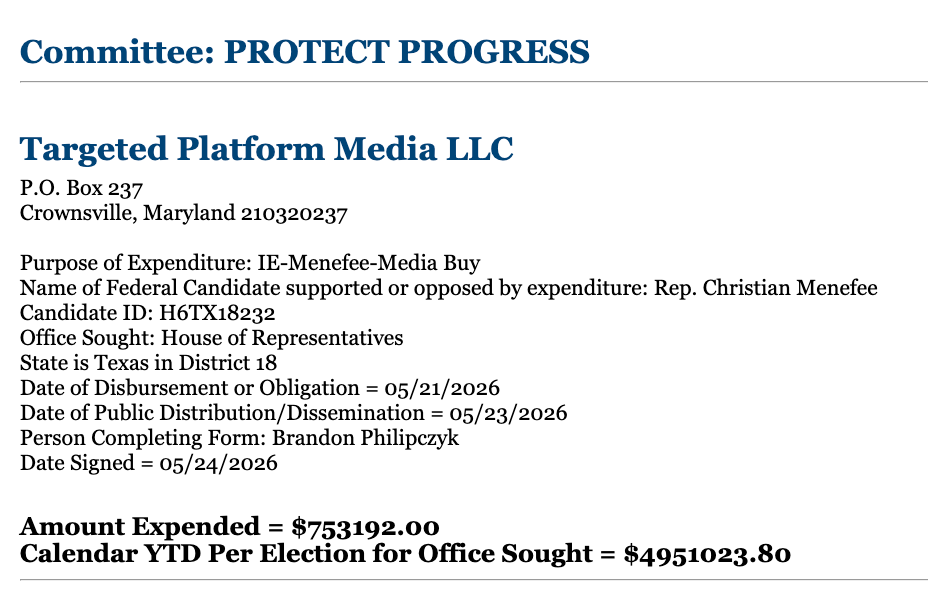
As of Sunday, Protect Progress, affiliated with the Ripple- and Coinbase-backed Fairshake PAC, reported spending $5 million to support Menefee over Green. The PAC spent $2.8 million on ads opposing Green. Menefee also has the endorsement of the Blockchain Leadership Fund, a committee backed by Anchorage Digital and Chainlink Labs, though it had not reported any expenditures as of Monday.
Source: US Federal Election Commission
The outcome of the primaries could influence who will ultimately win Texas’ 18th district and one of the state’s two Senate seats in the November general election, potentially affecting which political party controls Congress in 2027. Under a Republican majority, lawmakers have passed key pieces of legislation supported by the crypto industry, including the stablecoin GENIUS Act.
At least one of the ads funded by Protect Progress to support Menefee did not mention crypto or blockchain, but rather Green’s opposition to US President Donald Trump. Bill King, a former opinion writer for the Houston Chronicle, said in a local FOX26 segment that aired on Sunday:
“I saw 12 television commercials yesterday paid for by the Protect Progress PAC […] and that same group of people are the ones that are primarily funding Trump.”
Related: Texas Lt. Gov. calls for study of crypto, prediction markets
The Fellowship PAC, funded by Wall Street firm Cantor Fitzgerald and Anchorage, reported spending $500,000 to support Paxton over Cornyn for the US Senate seat. The expenditure came about 24 hours after Trump endorsed Paxton, saying that Cornyn had been “very late in backing” him as a Republican candidate for president.
Prediction markets heavily favor Paxton and Menefee
The Kalshi prediction market gave its users 91% and 96% chances on event contracts favoring Menefee over Green and Paxton over Cornyn, respectively.
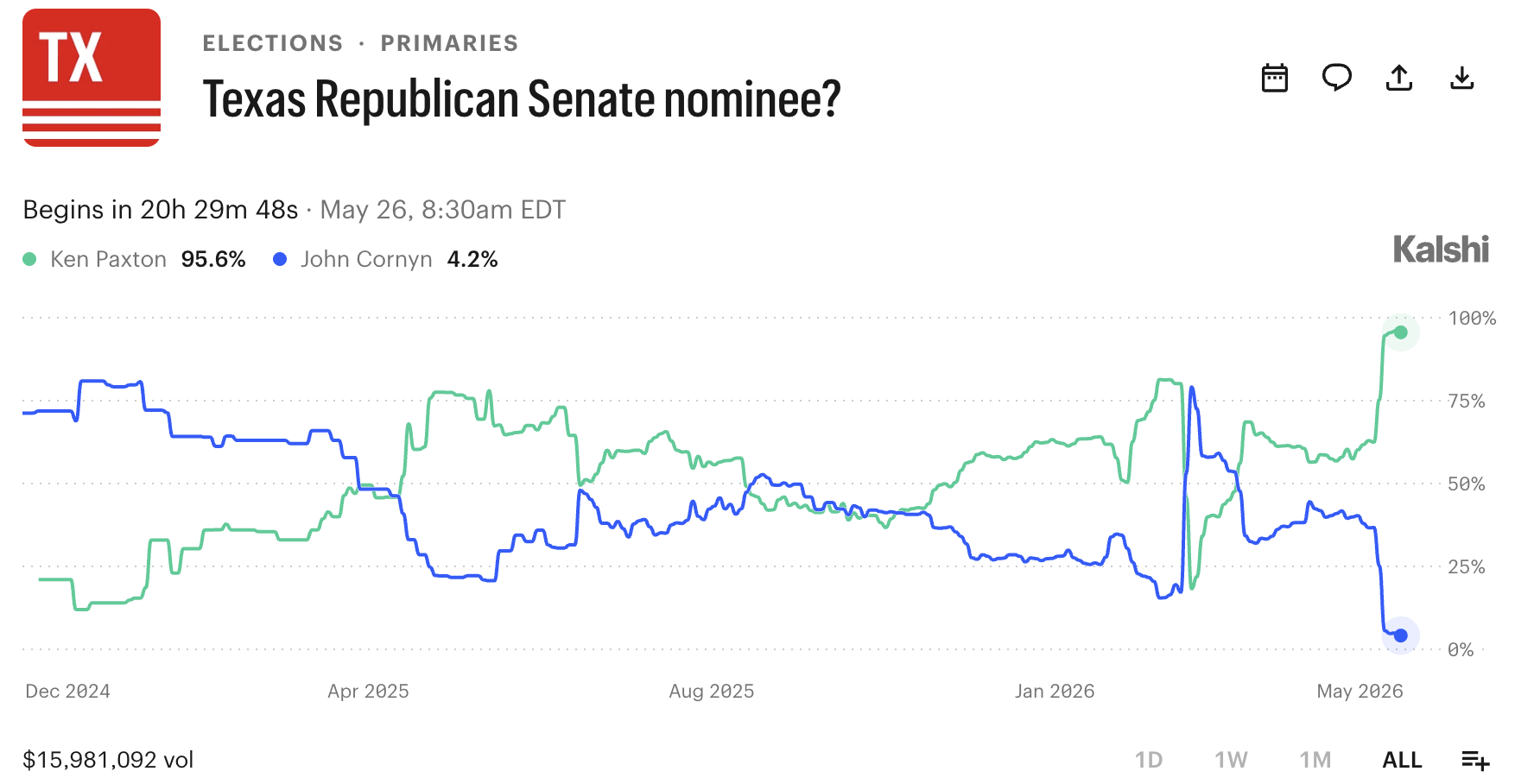
Source: Kalshi
The platform has consistently provided event contracts favoring the Democratic candidate since February, while Paxton’s odds surged above 90% for the first time after Trump’s endorsement on Tuesday, and stood at almost 96%, at last look on Monday. Bets on that race topped more than $16 million in total volume.
Rival predictions market platform Polymarket gave both candidates similar chances in Tuesday’s runoffs.
Magazine: ETH bears growling, Tom Lee’s buying, XRP to ‘explode’: Market Moves
Crypto World
XRP pre-sale surpasses $10 million, XRP holders are paying close attention to SHRMiner’s free cloud mining service

Disclosure: This article does not represent investment advice. The content and materials featured on this page are for educational purposes only.
Regulatory progress and XRP growth fuel interest in cloud mining platforms like SHRMiner among crypto investors.
Summary
- Growing regulatory clarity around crypto is increasing interest in cloud mining platforms tied to digital asset ecosystems.
- SHRMiner has launched XRP-supported cloud mining contracts that allow users to participate without owning hardware.
- The platform says its AI-powered system can redirect mining power toward higher-yield assets and settle rewards daily.
According to CNBC, following months of negotiations regarding stablecoin yield rules and decentralized finance (DeFi) regulation, the Digital Asset Market Transparency Act was passed by the Senate Banking Committee on May 14.
Senators Ruben Gallego and Angela Alsobrooks, joined by all Republican members, championed the bill’s passage. Following the vote, the price of Bitcoin briefly surged to $81,965 but subsequently retreated amid macroeconomic headwinds; the bill still requires 60 votes in the Senate as well as passage by the House of Representatives.
This cryptocurrency market news highlights the trend toward a transition to regulated legitimacy; however, regulatory clarity alone does not tell retail investors where to find the greatest returns, and as the rules become increasingly clear, the window for early positioning is narrowing.

Regulatory uncertainty has historically caused even the most astute investors to adopt a wait-and-see approach. Today, with the advancement of the CLARITY Act, the central question has shifted from whether the market can grow to which specific projects will yield returns for early-moving investors.
Amidst an environment characterized by heightened price volatility and an abundance of short-term opportunities, regulated cloud mining platforms — such as SHRMiner — are emerging as the preferred choice for investors. Users need neither to own their own hardware nor possess technical expertise; they simply need to purchase computing power to participate in mining and earn daily returns, all while benefiting from the growth potential of the XRP ecosystem.
In this environment, investors are no longer merely asking:
“Will the price go up?”
But increasingly:
“How can I generate daily profits, even without engaging in active trading?”
Against this backdrop, SHRMiner has officially launched a cloud mining rewards contract that supports XRP payments. Users simply need to use XRP to activate computing power, requiring no additional hardware or complex procedures. The system automatically executes the mining operations and settles daily earnings, enabling otherwise idle XRP assets to achieve steady appreciation.
Why has cloud mining suddenly sparked such heated discussion?
SHRMiner is a UK-based cloud mining platform dedicated to providing secure, efficient, and scalable cloud mining services to over 5 million users across more than 180 countries. Users are not required to purchase mining hardware themselves, nor do they need to bear the complex costs associated with electricity, cooling, or maintenance; instead, they can participate in Bitcoin mining indirectly simply by purchasing the hash rate contracts offered by the platform. Compared to traditional individual mining methods, this model significantly lowers the barrier to entry while simultaneously making the allocation of hash rate resources more centralized and professional.
SHR Miner’s XRP cloud mining is now live
XRP has long been recognized for its pivotal role in cross-border payments and institutional finance; now, SHRMiner’s latest innovation — user-friendly cloud mining — propels XRP into a new era.
Users can choose to mine XRP directly or leverage SHRMiner’s intelligent AI engine, which automatically redirects mining power to the assets yielding the highest returns, including BTC, XRP, ETH, DOGE, USDC, and others. Earnings are paid out daily in a chosen cryptocurrency, providing a reliable source of income regardless of market fluctuations.
Whether someone is a beginner or an experienced investor, with the SHRMiner cloud mining platform, they can easily participate in mining without the need to purchase mining hardware or possess specialized technical skills. In just four simple steps, anyone can embark on their journey toward generating passive income from digital assets.
Here is how to join SHRMiner
1. Register an Account
Visit the official website or download the mobile app. Complete registration using an email address to instantly receive a $15 reward, plus a daily login bonus of $0.60. (Click here for one-click registration).
2. Select an Investment Plan
The platform offers various plans ranging from $100 to $200,000, varying in both duration and scale; users can select the plan that best suits their available funds and target returns.
3. Supported Cryptocurrency Deposits
Participate using a variety of supported cryptocurrencies, including XRP, BTC, ETH, and USDT. The system will automatically convert your deposited assets into cloud mining hash rate.
4. Activate the Contract and Earn Returns
Once the contract is activated, earnings will be automatically settled within 24 hours. Users have the option to withdraw their profits or reinvest them to capitalize on the power of compound interest.
The primary advantage of this model lies in its significantly lowered barrier to entry. Users are not required to research specific mining hardware models or hash rate configurations, nor do they need to set up their own system environments; they simply need to register an account, deposit assets, and select a mining plan to begin generating returns.
Examples of Common Contracts:
| Contract Name | price | profit | Days | Principal + Total Return |
| New User Experience Contract | $100 | $4 | 2 | $100+$8 |
| Bitdeer Sealminer A2 Pro | $500 | $6.25 | 5 | $500.00 + $31.25 |
| Litecoin Miner L9 | $1000.00 | $13.00 | 10 | $1000.00 + $130 |
| MICROBT WhatsMiner M73 | $8000.00 | $116.00 | 30 | $8000.00 + $3480 |
| Bitcoin Miner S21e XP Hyd | $10000.00 | $150.00 | 35 | $10000.00 + $5250 |
| ANTSPACE HK3 | $30000.00 | $510.00 | 40 | $30000.00 + $20400 |
After purchasing a contract, earnings will be automatically credited to an account within 24 hours. Upon the contract’s expiration, the principal will be returned in full. The principal can be withdrawn or reinvested to enjoy the benefits of compound interest. For further details regarding mining contracts, please click here to learn more.
SHRMiner Platform Advantages:
- Supports daily automatic settlement
- No additional electricity or maintenance costs required
- Utilizes advanced ASIC mining hardware, powered by renewable energy sources including hydropower, wind power, and solar power.
- Supports Multi-Currency Mining: Earn major cryptocurrencies such as BTC, XRP, ETH, DOGE, USDC, USDT, SOL, LTC, BCH, and more.
- Equipped with SSL encryption and DDoS protection, a real-time earnings dashboard for easy monitoring of mining performance
- 100% remote access, fully accessible via the SHRMiner application or browser without hardware requirements, and 24/7 online technical support.
- Affiliate Program: The Affiliate Program allows users to earn up to 4.5% commission by referring friends, with the opportunity to earn an additional bonus of up to 30,000.
Unimaginable money-making opportunities
What sets SHRMiner apart is its extraordinary daily passive income potential; users have the opportunity to earn $8,900 — or even more — every day, thereby realizing their dream of getting rich online. Imagine generating substantial income without the need for constant effort or complex setups — that is precisely what SHRMiner offers.
Conclusion
For those who are looking for ways to generate passive income, cloud mining is an excellent option. When utilized effectively, these opportunities can help effortlessly accumulate cryptocurrency wealth on “autopilot.” Market opportunities favor the swift; now is the ideal time to capitalize on the growth potential of XRP and secure stable daily returns through SHRMiner — a key to achieving sustainable wealth accumulation.
For more information, visit the official website.
Disclosure: This content is provided by a third party. Neither crypto.news nor the author of this article endorses any product mentioned on this page. Users should conduct their own research before taking any action related to the company.

Ethereum co-founder, Vitalik Buterin, said the Ethereum Foundation (EF) is moving toward a smaller, more focused role within the broader ETH ecosystem.
Amid growing concerns around EF, Buterin stated that the organization is “not a center of Ethereum” but rather “one node, with a defined purpose, alongside other nodes.”
Smaller Ship
In his latest X post, Buterin said the board is expanding and that his own influence within the organization will continue to decrease, which he described as something he wants.
He noted that the foundation’s President Aya Miyaguchi has been carrying out much of the transition work, while his own involvement has mainly focused on technical matters. According to Buterin, the EF improved its operational efficiency and execution capabilities during 2025. However, he said he became increasingly concerned by criticism from people who questioned whether the EF’s actions truly reflected Ethereum’s stated values around decentralization, privacy, and acting as a “sanctuary technology.”
According to Buterin, EF should not become a central authority, noting that the foundation controls only around 0.16% of the total ETH supply, compared to some competing blockchain foundations that reportedly control between 10% and 50% of their networks’ tokens. He also said the EF was originally created to complete a limited set of objectives tied to ETH’s early development phases, including Frontier, Homestead, Metropolis, and Serenity, which were completed in 2022.
Buterin said the EF is now prioritizing longevity over expansion and focusing only on activities that are critical to Ethereum functioning as a censorship-resistant, open, private, and secure system. He went on to explain that this approach requires difficult decisions, including allowing respected contributors and important initiatives to exist outside the foundation to attract outside capital.
He said Ethereum should avoid competing solely on speed and scalability metrics, adding that pursuing that path would lead to “mediocrity.” Instead, he said Ethereum should focus on goals such as creating a provably bug-free Ethereum through AI-assisted formal verification, improving consensus design, and reducing reliance on intermediaries in transaction inclusion.
Buterin also said Ethereum’s long-term technical goals remain compatible with scaling improvements and high throughput through Layer 2 networks and other optimizations.
“EF will be a smaller ship than in previous years, a more opinionated one – in some cases more opinionated in ways that might be difficult to comprehend – but a longer-lasting one, and one suited to making sure that Ethereum brings something meaningful to the world.”
High-Profile Exits
EF has faced growing scrutiny in recent months following a series of high-profile departures, including Tomasz Stańczak, Tim Beiko, Josh Stark, and Barnabé Monnot. Community discussions intensified as multiple exits occurred in a short period, prompting speculation about internal instability and disagreements over the Foundation’s evolving direction.
ETH investor Ryan Berckmans asserted that the departures were mainly tied to differing strategic approaches, leadership transitions, and organizational restructuring rather than declining confidence in Ethereum itself.
The post Ethereum Foundation Is “Not the Center of Ethereum,” Claims Vitalik Buterin appeared first on CryptoPotato.

XRP is moving within a defined value zone as macro factors and on-chain activity converge, signaling a tightening liquidity backdrop for the token. On May 22, large XRP withdrawals from Binance—totaling 122 million XRP, worth about $170.8 million at then-current prices—underscored a shift by big holders away from exchange wallets, even as demand from XRP-related investment products persists.
Key takeaways
- CryptoQuant data show 122 million XRP were withdrawn from Binance on May 22, a single-day total above 100 million XRP for the first time since a February spike of 278 million XRP, valued at roughly $171 million at the time.
- Repeated withdrawals near the $1.35–$1.40 zone suggest some larger holders view this area as a value region, potentially signaling accumulation or a shift toward custody rather than immediate selling.
- US spot XRP ETFs continue to attract fresh money, with inflows reported over 16 consecutive days totaling about $116.75 million.
- Technically, XRP has traded in a tight range between $1.30 and $1.50. A sustained move above $1.50 on strong volume could unlock a higher target, with some analysts pointing to around $2.33 in a bullish break scenario.
- The Bollinger Bands remain notably tight—the tightest since mid-2024—often preceding meaningful price moves. Longer-term charts show that a successful breakout could echo past cycles that delivered sizable upside.
Whale moves in a value zone and what it signals
According to CryptoQuant, the May 22 withdrawal from Binance comprised 122 million XRP in large transactions—the largest single-day exodus above 100 million XRP since February’s 278 million XRP spike. CryptoQuant analyst Amr Taha emphasized that the price context matters: the $1.35–$1.40 range has taken on significance as a potential accumulation zone for sizable holders. In his words, the pattern of withdrawals near this price band “may indicate that some larger players view this area as a value zone.”
The liquidity shift is notable not only for the raw outflows but for what typically follows: reduced immediate sell-side pressure as holders custody funds or funnel exposure into XRP investment products. The dynamics at this juncture are being watched closely by traders who regard the zone as a fulcrum for the next move.
XRP: Whale outflows from exchanges. Source: CryptoQuant
ETF inflows reinforce growing demand in the ecosystem
Beyond on-chain movements, demand indicators from the ETF space add an important dimension to the story. Inflows into US-based spot XRP exchange-traded products have continued apace, with positive flows recorded for 16 consecutive days, accumulating roughly $116.75 million. The persistence of these inflows points to a broader market appetite for XRP exposure via regulated trackers, complementing the backdrop of on-chain accumulation.
Technical backdrop and potential price trajectory
From a chartist’s perspective, XRP/USD has been confined to a relatively narrow band since early February, trading between about $1.30 and $1.50. A close above $1.50 with convincing volume could embolden bulls to push toward the upper end of the range, with a handful of analysts outlining larger potential moves if the breakout gains traction.
Analyst ChartNerd highlighted that the $1.30 level currently acts as a guardrail. If the price slips below this support, a deeper slide toward the lower end of the $1.30–$1.50 corridor becomes more likely in the ensuing weeks. Conversely, a clean breakout above $1.50 could renew momentum and set the stage for a test of higher targets.
Historical context provides a useful frame: XRP has traded within a multi-year range from May 2022 through November 2024. Cointelegraph noted that a breakout above the previous upper bound—identified around $0.68—preceded a roughly 400% rally to $3.40 by January 2025. With this longer-term lens, a sustained breakout above the $1.50 ceiling, if supported by volume, could yield outsized gains relative to the ongoing consolidation.
Crypto Patel, another market commentator, described the current consolidation as a potential “best accumulation zone,” suggesting that the stage could be set for a renewed up-leg akin to the late-2024 breakout phase. His framework envisions upside to the vicinity of $2.33 if the market sustains a breakout with robust participation, representing roughly a 7x move from the lower end of the current range in a favorable scenario.
XRP/USD two-week chart. Source: X/Crypto Patel
Overhead resistance in the $1.40–$1.50 zone remains a practical hurdle. If buyers can muster sustained pressure and push through that region with conviction, a more decisive leg higher could follow. Conversely, failed attempts may see continued range-bound action in the near term, particularly if broader market conditions remain uncertain.
In sum, the confluence of concentrated on-chain activity, persistent ETF inflows, and a technically tight price backdrop creates a nuanced setup for XRP. While the macro narrative around liquidity and custody shifts remains supportive of accumulation, the magnitude of any new rally will likely depend on sustained buying interest and a clear breakout through the immediate resistance with accompanying volume.
Watch for the next wave of exchange outflows or inflows and any decisive price action above $1.50 with turnover that validates a fresh leg higher. If buyers fail to establish that momentum, the risk remains that XRP could revisit the lower end of the current range or revisit 1.30 as the market digests the latest liquidity signals.

Key Highlights
-
Eli Lilly shares climb following impressive VERVE-102 cholesterol reduction data
-
Heart-2 trial demonstrates significant PCSK9 protein and LDL-C decreases
-
Gene editing approach delivers promising early outcomes for cardiovascular therapy
-
Single-dose treatment shows persistent cholesterol lowering in clinical study
-
Pharmaceutical giant moves forward with VERVE-102 following encouraging Heart-2 findings
Eli Lilly (LLY) stock experienced notable upward movement, climbing to $1,065.00 with a gain of $23.35, representing a 2.24% increase during trading. The pharmaceutical giant’s shares strengthened following the disclosure of encouraging Phase 1b findings demonstrating persistent cholesterol reduction achieved by VERVE-102.
Impressive Cholesterol Lowering Results from VERVE-102
Eli Lilly experienced upward stock momentum after unveiling data for VERVE-102. The investigational therapy utilizes in vivo base editing technology to target the PCSK9 gene within liver cells. The treatment is designed to reduce LDL cholesterol following a single intravenous administration.
The Heart-2 study recruited adult patients diagnosed with heterozygous familial hypercholesterolemia or early-onset coronary artery disease. The preliminary assessment included 35 study participants treated at various dosing levels. The pharmaceutical company shared these findings during the European Atherosclerosis Society Congress.
VERVE-102 demonstrated dose-related decreases in circulating PCSK9 protein levels. Average PCSK9 reductions spanned from 51% at the 0.3 mg/kg dose up to 88% at the 1.0 mg/kg dose. LDL cholesterol reductions achieved 62% at the maximum dose tested.
Favorable Safety Profile Encourages Advancement
Eli Lilly attracted investor confidence with the trial’s favorable preliminary safety outcomes. The pharmaceutical company confirmed zero treatment-related serious adverse events occurred. Additionally, no dose-limiting toxicities emerged throughout the evaluated dose range.
Documented treatment-related effects consisted of mild infusion reactions and fatigue symptoms. Nevertheless, every study participant completed their entire scheduled dose. Furthermore, participant retention remained at 100% with no withdrawals from the Heart-2 trial.
The cholesterol-lowering effects demonstrated persistence throughout extended monitoring periods. The company documented sustained benefits extending up to 18 months post-administration. These findings provide compelling rationale for advancing the therapy into expanded clinical evaluation.
Phase 2 Trial Launch Scheduled for 2025
Eli Lilly and Company’s stock performance continues reflecting investor enthusiasm for cardiovascular breakthroughs. VERVE-102 addresses patients confronting substantial lifetime cardiovascular risk. The regulatory agency has awarded Fast Track designation for LDL cholesterol reduction in qualifying patient populations.
Heterozygous familial hypercholesterolemia impacts approximately one individual per 200 to 250 people. This genetic disorder produces chronically elevated LDL cholesterol levels and increases early cardiovascular disease risk. Coronary artery disease impacts over 300 million individuals globally.
Eli Lilly and Company stock advanced as the organization outlined its upcoming development milestone. Lilly intends to initiate a Phase 2 clinical trial before the close of this year. With this progression, VERVE-102 transitions from preliminary validation toward more extensive clinical evaluation.


TLDR
- Economist Henrik Zeberg says the current Bitcoin rally is part of a temporary B-wave bounce within a bearish cycle.
- He argues that Bitcoin may have completed a long-term fifth wave near highs above $110000.
- The analysis shows Bitcoin could rise in the short term before a deeper correction toward $41492 support.
- Bearish divergence on the RSI indicates weakening momentum despite recent price gains.
- The monthly MACD is nearing a bearish crossover similar to signals before past bear markets.
Bitcoin is showing recovery signs as it approaches $80,000, but a new warning has emerged. Economist Henrik Zeberg says the current move may precede a deeper Bitcoin crash. He believes the rally is temporary and part of a broader bearish cycle.
Bitcoin Crash Warning Linked to Elliott Wave Structure
Henrik Zeberg shared his outlook in a May 25 post on X. He described the current market move as a “B-wave” bounce. He explained that this phase often appears during broader bearish cycles. It typically creates a temporary rise before a deeper decline.
Zeberg based his analysis on Elliott Wave theory. He tracked Bitcoin’s price structure from its early market cycles. He argued that Bitcoin may have completed a long-term fifth wave. This wave likely formed near recent highs above $110,000.
According to his chart, the broader structure suggests a major top. He linked this formation to price behavior since 2012. Bitcoin price recently retraced to the 0.618 Fibonacci level near $66,426. Zeberg said this level supports a short-term rebound.
He added that the price could rise above current levels during this bounce. However, he maintained that the larger trend remains bearish. His projections showed downside targets near $41,492. He also indicated that prices could fall lower over time.
Technical Indicators Support Bitcoin Crash Outlook
Zeberg pointed to weakening momentum indicators. He said the relative strength index shows bearish divergence. This pattern occurs when prices rise but momentum weakens. It has preceded past Bitcoin market reversals.
He also highlighted the monthly MACD indicator. It is approaching a bearish crossover based on current data. Similar signals appeared before the 2018 and 2022 bear markets. These crossovers often indicate trend reversals.
Another analyst, TradingShot, shared a similar view on May 24. The analyst also cited bearish divergence on the monthly RSI. TradingShot noted that price gains were not supported by strong momentum. This pattern has historically signaled market tops.
A separate cycle-based chart added further context. It combined Bitcoin’s four-year cycles, halving events, and Fibonacci time levels. The chart suggested Bitcoin is entering a bearish phase. It pointed to a possible decline toward $50,000.
This level aligns with the weekly 350 moving average. The indicator has marked previous bear market bottoms. Bitcoin continues to trade below its recent peak above $110,000.


YZi Labs has launched YZi Talent, a recruitment platform that aggregates open roles from its Web3, artificial intelligence and biotechnology portfolio, starting with senior engineering and business leadership positions at predict.fun and AgriDynamics Robotics.
Summary
- YZi Talent centralizes hiring for YZi Labs’ portfolio across Web3, AI and biotech
- Initial roles include Backend Chief Engineer at predict.fun and founding leadership at AgriDynamics Robotics
- The platform builds on YZi Labs’ multi vertical investment push beyond pure Web3
In an official X post, YZi Labs announced the debut of YZi Talent as a dedicated recruitment platform “integrating open positions in Web3, AI, and biotechnology from its portfolio,” positioning it as a single entry point for candidates who want to work at the intersection of those three domains.
The first batch of postings highlighted in the announcement includes a Backend Chief Engineer position at predict.fun, a Frontend Staff Engineer role, and a Founding Business Leader role at AgriDynamics Robotics, a robotics venture focused on applying AI and automation to agriculture.
What is YZi Talent and which roles are live at launch?
Earlier materials from YZi Labs’ EASY Residency cohorts show both predict.fun and AgriDynamics among the companies the firm has backed: Weex’s coverage of the Season 2 portfolio lists predict.fun as “a prediction market enhancing liquidity with DeFi” and AgriDynamics as an agri robotics project working with fruit harvesting and automation.
Job listings circulated on third party sites for similar YZi Labs roles suggest the type of profiles YZi Talent is targeting.
For example, a Web3 Researcher role description notes that candidates are expected to “conduct comprehensive research on Web3 technologies, trends, protocols, and innovations” and “identify and evaluate Web3 talents, including blockchain researchers, developers, and entrepreneurs, for potential investment or collaboration,” blending technical depth with investment facing responsibilities.
A separate LinkedIn update from YZi Labs outlines broader hiring needs inside the lab itself, including Investment Directors for Web3, an Investment Associate with banking or private equity background, a Portfolio Management Lead, go to market experts, and dedicated recruiters, all framed around “backing the next generation of founders shaping Web3, AI, and biotech.”
YZi Talent is effectively the portfolio side complement to that in house hiring push, giving founders in the lab’s ecosystem a shared distribution channel for attracting senior engineers, researchers and operators.
How does YZi Talent fit into YZi Labs’ broader thesis?
YZi Labs presents itself as a frontier technology investor “at the intersection of Web3, AI, and biotech,” a positioning that has been reinforced over the past 18 months as it expanded beyond its roots as Binance Labs and brought in new general partners to drive biotech and AI exposure.
A March 2025 report on crypto.news described how YZi Labs appointed Jane He as a general partner to lead its biotechnology investments, noting that the firm was “actively seeking visionary founders driving technological advancements in Web3, AI, and biotech,” and pointing to deals in decentralized science and data sharing as early examples.
By December 2025, YZi Labs had announced investments in seventeen new projects focused specifically on those three verticals, a lineup that included AgriDynamics in agricultural robotics, predict.fun in prediction markets, Trellis Robotics in soft robotics, and Ethena Labs in synthetic dollar infrastructure.
In blog posts and conference talks, YZi Labs partners have argued that the “triple frontier” of AI, Web3 and biotech will generate new categories of applications, from tokenized data markets for medical records to AI driven on chain trading tools and robotic systems that rely on decentralized coordination.
A YouTube talk by Jane He at the DeSci Summit in Dubai framed it this way: combining AI, blockchain and healthcare can “help people share health data safely without giving up control,” allowing them to “stay anonymous, give consents through smart contracts and even get paid with tokens for helping out training a great AI model,” which she described as a “super powerful combo.”
YZi Talent slots into that thesis as infrastructure for a different bottleneck: people.
Rather than each portfolio company building its own recruiting funnel from scratch, the platform lets YZi Labs surface cross cutting job opportunities to a community of candidates who already buy into the idea that Web3, AI and biotech are converging, making it easier to match specialized engineers and operators with frontier projects that might otherwise be hard to discover.
Given the pace at which the firm has been deploying capital into new projects and follow on rounds, as seen in its support for Ethena Labs and Better Payment Network, the move to formalize a shared talent platform is a logical next step in building an ecosystem that can scale beyond capital into operational support.


AI is transforming both crypto security and crypto attacks. Here’s how Ledger is approaching AI-powered threats, human verification, and secure wallet infrastructure.
Summary
- Automated attacks and automated defenses within the crypto industry continue to escalate
- Ledger’s AI security systems are designed to keep users in control of wallet authorization
- Ledger’s strategy focuses on AI-assisted protection, not AI-controlled custody
AI can detect suspicious transactions, phishing attempts, malware, and unusual wallet behavior faster than humans. It can also help users identify fake websites and dangerous smart contracts. On the other hand, attackers use AI to create convincing phishing emails and fake support chats. It can also automate hacking attempts, generate malware, and scale social-engineering scams much more efficiently than humans, which is why crypto wallets are increasingly exposed to AI-powered attacks.
Increasing interactions through AI agents are inevitable, and crypto users are especially vulnerable, because these transactions are irreversible. This is why leading cold wallet vendor Ledger’s recently released AI security roadmap places equal focus on protection from AI scams and wallet security, building around the principle that humans must remain in control of authorization and signing.
It wouldn’t be an overstatement to say the future of crypto wallet security depends on whether AI is used more effectively to strengthen human control or to help attackers automate deception at scale.
“Humans will orchestrate that work,” says Ian Rogers, Ledger’s Chief Human Agency Officer. “AI will handle a tremendous amount of work for us in the middle, but humans will guide and verify at endpoints throughout the process.”
Stronger verification systems, hardware isolation, secure transaction interpretation, and human oversight will be indispensable features of wallet security in the future. Already considered leaders in crypto wallet security, Ledger’s new roadmap positions the brand around AI-assisted security while preserving human authorization.
Why AI is becoming a major security threat in crypto
AI is making crypto attacks more scalable by automating deception, impersonation, and social engineering. It has introduced operational security risks and virtually innumerable ways to deceive users, amplified by the fact that crypto transactions are irreversible. AI can generate malware that searches a computer for wallet files, browser extensions, or copied seed phrases, and bots automatically probing weak smart contracts or exchange APIs for vulnerabilities.
Deepfake videos of crypto-related influencers promoting “giveaways” and AI chatbots pretending to be customer support for wallets are just two sources of danger. AI phishing sites imitate exchanges, causing users to authorize irreversible withdrawals. Deepfake investment calls convince victims to transfer crypto to scam wallets with no recovery option.
Finally, the risks of agentic trading shouldn’t be overlooked. When a user tells an agent to maximize short-term profit, it might move all funds into extremely risky leveraged trades or buy manipulated memecoins based on bullish social media sentiment.
AI agents often read external data like social media posts or Discord messages, in which an attacker might have hidden malicious instructions. The combination of AI agents being able to execute financial actions and blockchain transactions being final and anonymous creates a much larger and harder-to-secure attack surface than traditional manual trading ever could.
“Five years ago we already knew at Ledger that crypto was the first step towards a greater journey of providing that same secure infrastructure for digital identity, or what we now call Proof of You,” says Rogers. “Humanity spends more and more of their time within a digital world, where their memories, value, and access is controlled by fewer centralized platforms, with hacks and phishing attempts increasing on a daily basis. Ledger’s mission is not only a nice to have, but an essential part of daily life for individuals and institutions around the world.”
Why Ledger believes humans must stay in control
In light of the ever-increasing risks, Ledger has built its AI-security roadmap around the idea that users should remain the final authority over transaction approval and wallet access. The company’s signers – Stax, Flex, and Nano Gen5 – are the first secure and intuitive touchscreens.
Ledger is bridging the gap between AI agent access to money and credentials and software-only security through hardware-anchored security, including Skills, Agent Identity, and Ledger CLIs in Q2, Agent Intents and Policies in Q3, and Proof of Human in Q4, 2026.
The Device Management Kit, available now, enables agents to use Ledger hardware for human-in-the-loop approval. Moonpay’s AI agent wallet has integrated Ledger signing to ensure that every transaction requires the user to press a physical button, and the private keys remain confined to the hardware.
Agent Intents will be able to propose actions, but the human user will review them on a Trusted Display and confirm with a physical button. These and other features reflect Ledger’s cautious view of AI autonomy and focus on authorization integrity.
How hardware wallet isolation helps reduce AI-powered threats
As AI-generated deception becomes more convincing, trusted hardware verification is assuming an increasingly prominent role in crypto security. AI increases the danger of compromised endpoints, manipulated interfaces, and deceptive applications, making trusted hardware verification more important.
Ledger wallets use Secure Element chips, which hold cryptographic data in a highly protected environment, and transactions are only signed within the Secure Element. The host computer sends unsigned transaction data to the device, and the transaction is returned to the computer without the private key. Even if malware controls the computer, it can’t extract the keys directly.
Secure wallets feature mechanisms that delete sensitive data when they detect manipulation efforts.
The protective mechanisms culminate in the principle of endpoint compromise separation, which essentially means that wallets isolate secrets and authorization processes from potentially infected devices.
How Ledger is using AI to defend against threats
Ledger’s approach focuses on using AI to improve user awareness and threat detection while preserving explicit human authorization. In other words, AI isn’t to replace user authorization, but to help humans make better decisions.
One way it can do this is by translating complex blockchain data into clear interpretations, so people know what they’re signing. AI-powered scam detection systems can identify phishing, known malicious addresses, or suspicious dApp behavior before a transaction is confirmed.
Contextual risk analysis involves evaluating transaction patterns, destination wallets, and behavioral anomalies in real time. AI models can flag things like unusual account activity and other interactions that differ from a user’s normal behavior.
These risks emerge early via user-warning systems and anomaly detection mechanisms. Final approval remains with the user.
Why the AI security arms race could reshape wallet design
The next generation of crypto wallets may be defined not only by key storage, but by how effectively they help users identify and resist AI-driven manipulation.
The concept of AI-powered attackers vs AI-assisted defenses is relevant here. Attacker uses include AI-generated malware that changes its code to avoid detection, bots that scan blockchains for wallet vulnerabilities, and automated smart contract exploit discovery.
As a defense, AI can detect unusual smart contract activity or monitor wallets for laundering patterns, such as login attempts in rapid succession from countries that are very far away from each other, followed by a large withdrawal to a new wallet.
In the past, a wallet would ask whether to approve a contract interaction, and a non-native user might not have understood what that meant. As AI increasingly informs the wallet user experience, wallet owners may soon be asked to confirm that an app is authorized to spend unlimited funds in a given cryptocurrency, which dramatically improves safety.
Instead of raw code, Ledger uses Clear Signing to make blockchain transactions understandable to users. Earlier transactions showed a hash (a string of characters), but now, you can clearly review all of the details before you sign, minimizing the risk of accidentally approving a malicious smart contract.
Ledger’s system interprets transaction intent and shows users plain-language explanations on the device screen, such as “1000 USDC transfer to wallet X.” You understand who receives funds and how much they receive. You are asked to approve a spending limit, so you also know what permissions you are granting.
One final important change involves explainable security systems. Earlier, security alerts came in the form of numerical risk scores, which didn’t mean much to users. Now, an alert might be, “This wallet interacted with a known phishing contract and received funds from a sanctioned mixer.”
Human verification as crypto’s most important security layer
Each agent must thus try to answer four pillar questions.
- Am I talking to the agent I think I’m talking to? (Solved by Agent Identity)
- How does my agent know it is actually me issuing a command? (Solved by Proof of You/Human)
- How can my agent work autonomously but keep me in the loop for what matters? (Solved by Agent Intents)
- How do I govern a fleet of agents? (Solved by Agent Policies)
In an era of AI-generated deception, keeping humans securely in control of wallet authorization may become one of the most important principles in crypto security. AI is transforming the threat landscape by generating attacks at a massive scale.
Phishing attacks, fake interfaces, deepfakes, and automated scams are becoming increasingly convincing, and the importance of trusted human authorization has never been greater. Users need reliable ways to verify what they are actually approving before any transaction is executed, which is why manual transaction authorization remains essential.
Automated systems cannot fully replace human judgment and its ability to provide contextual awareness. Verification ya and trusted interfaces are becoming foundational security requirements. Users need to know that the information displayed to them is accurate, understandable, and independently verified, which is why Ledger has been pioneering verification infrastructure, an element within the evolution of crypto security.
Secure hardware confirmation reduces the risk of manipulation by verifying transaction details and displaying them in a protected environment before approval occurs. Devices that isolate private keys and independently confirm transaction details create a trusted layer between users and increasingly sophisticated threats.
The stronger approach is not AI-controlled finance, but AI-assisted defense. AI can help detect phishing attempts, identify suspicious contracts, interpret transaction risks in real time, and improve transparency for users, but the final authorization step should still belong to the individual. This is why Ledger is combining AI-assisted threat detection with secure human authorization.
“Think of it this way: the agent logic, the model, and the tools live in the software layer,” explains Rogers. “But the moment that agent proposes to do something consequential, Ledger is the layer that ensures the right human authorized it.”
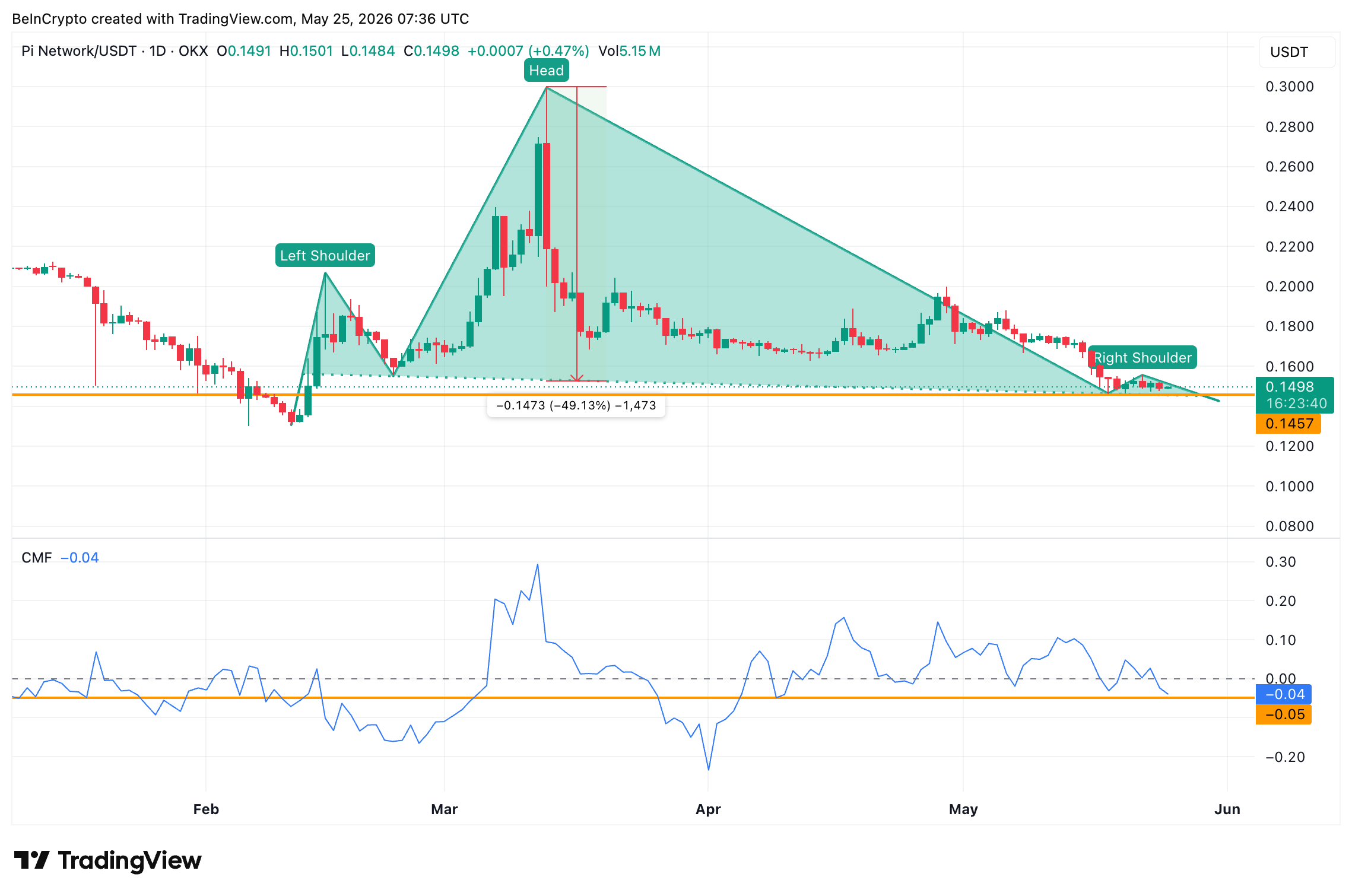
Pi Coin price is drifting toward a fresh all-time low as a bearish chart structure tightens its grip on the token, leaving the floor sitting just inches below the current price.
Three independent signals across capital flow, social activity, and smart money positioning have lined up against the token as it tests its most important support since February.
Head and Shoulders Forms as CMF Flags Capital Flight
The PI/USDT daily chart shows a Head and Shoulders pattern, a classic bearish reversal structure. The setup features a higher peak (the head) flanked by two lower peaks (the shoulders), with a horizontal neckline tying the swing lows together.
The left shoulder formed in mid-February. The head printed in mid-March near the cycle peak. The right shoulder completed in mid-May and is now rolling over.
Want more token insights like this? Sign up for Editor Harsh Notariya’s Daily Crypto Newsletter here.
Chaikin Money Flow (CMF), a volume-weighted indicator that proxies big money buying and selling pressure, has slipped to -0.04 on the daily chart. That marks the lowest reading since early April.

The indicator broke below its zero line and is now retesting its most stressed zone in roughly two months. A push under -0.05 would confirm a heavier outflow phase aligned with the pattern’s downside thesis.
Capital flight, however, does not measure how much attention Pi Network is drawing as the breakdown approaches.
Pi Network Social Volume Falls From 31 to 1
Pi Network’s daily Social Volume, a Santiment metric that counts unique social documents discussing the token across more than a thousand crypto channels, has collapsed to 1. That reading sits at the floor of the visible chart range. By comparison, the score peaked at 31 on May 8 post a brief retail rally attempt.

The roughly 97% drop in social chatter shows that retail attention has faded sharply as the price has drifted lower. Quiet markets tend to extend bearish moves because no fresh demand arrives to absorb sell pressure.
For a community-driven asset like Pi, where engagement has historically powered demand, a silent social tape is a structural warning. The token is sliding without any narrative catalyst pulling new buyers in.
The crowd has stepped back, but the question is whether informed money is doing the same.
Smart Money Index Diverges Below Signal
The Smart Money Index, an indicator that measures informed-trader positioning, sits at 0.9063 against its signal line at 0.9157.
The Smart Money line is now diverging below its signal line, a configuration that has historically preceded weaker prices when it persists. The metric slipped under its baseline relative to the signal line in early May and the gap has continued to widen.
The only feature still propping up the indicator is an ascending trendline anchored from the early-February low. That trendline is currently being tested.

A clean break under that ascending support would push the Smart Money reading to its lowest level since February 11, the same period when PI printed its all-time low of $0.130. A repeat of that backdrop would close the loop between informed money exit and a fresh price low.
With three independent signals aligned, the price chart now becomes the decider.
Pi Coin Price Levels to Watch as All-Time Low Looms
The Pi Coin price is currently fighting to defend the $0.145 neckline of the Head and Shoulders pattern. A daily close below $0.145 opens the door directly to the $0.130 all-time low, which sits roughly 13% below current spot.
The first cushion below the neckline arrives at $0.143, the 0.236 Fibonacci level of the structure. Below the all-time low, $0.129 (0.5 Fibonacci) and $0.122 (0.618) become the next stress zones.
Deeper bearish extensions stack at $0.113 (0.786) and $0.102 (1.0 Fibonacci). The pattern’s full measured-move target near $0.074 aligns with the 1.618 extension at $0.069, marking the deepest projected zone.
Every level below $0.130 would print a fresh all-time low and pull the token into uncharted territory with each breach.

A bullish reset, however, only begins on a daily close back above $0.156, the right shoulder peak. Real strength returns above $0.200, the left shoulder zone, while the full pattern invalidates only on a move above the $0.300 head.
A daily close above $0.156 separates a possible right shoulder recovery from a confirmed slide into all-time low territory.
The post Pi Coin Loses Social Pulse With New All-Time Low Just 13% Away appeared first on BeInCrypto.

Two dogs rescued from drainage ditch in North Yorkshire

Gilt Market Nerves Return To The U.K.

Ethereum's ETH Gains in Line with Market Following Vitalik Buterin's EF Vision Post

US brings back mandatory military draft registration

Steven Gerrard disagrees with Gary Neville over ‘shock’ Chelsea and Arsenal claim | Football

Register Renaming | Hackaday

The current state of the crypto market in 2026

“Small Steps Today = Financial Freedom Tomorrow” Ft Wealth Management Coach Dr Sandeep Gupta

Mukesh Ambani has a lot of money..#mukeshambani #luxurylifestyle #shortvideo #money
-

 Crypto World4 days ago
Blockchain.com files with SEC for U.S. IPO
-

 Fashion3 days ago
Holiday Weekend Open Thread – Corporette.com
-

 Business3 days ago
Dell Technologies DELL Stock Surges 15% on AI Server Momentum and Analyst Upgrades in 2026
-

 Crypto World4 days ago
Bitcoin Accumulation Weakens as BTC Realized Losses Hit $600M
-

 Crypto World3 days ago
Space X IPO Is ‘Bad News’ for Tech Stocks: But What About Bitcoin?
-

 Politics3 days ago
Makerfield: a tale of two social-media histories
-

 Crypto World2 days ago
Robinhood crypto COO Tanya Denisova exits
-

 Crypto World4 days ago
MicroStrategy’s Saylor Says Miners No Longer Set Bitcoin Price, Another Force Has Taken Over
-

 Business1 day ago
NYT Strands Answers May 24 2026 Revealed for Puzzle No. 812 Theme Summer Essentials
-

 Crypto World3 days ago
AI infrastructure race heats up as IREN pitches full-stack strategy, WhiteFiber lands $160M deal
-
 Tech3 days ago
A 0.12% parameter add-on gives AI agents the working memory RAG can’t
-

 Tech4 days ago
WhatsApp ads could make Irish debut after discussions with DPC
-

 Tech4 days ago
You Can Now Add ChatGPT To PowerPoint
-
Crypto World7 days ago
Revolut Launches Dogecoin Debit Card Across UK and EU
-

 Business3 days ago
Trump Invests $1M-$5M in Kura Sushi USA Chain With 27 California Locations
-

 Sports4 days ago
2026 CJ Cup Byron Nelson leaderboard: Brooks Koepka finds putting stroke in Round 1
-
 NewsBeat4 days ago
Charity run by Reform leader Malcolm Offord accused of ‘law breaking’ over Scottish registration
-

 Crypto World4 days ago
Trump Media’s Bitcoin Stash Shrinks Again as 2,650 BTC Lands on Crypto.com
-
Business3 days ago
Goldman Sachs reinstates Ageas stock coverage with neutral rating
-

 Crypto World5 days ago
Exa Labs raises $250 million in funding led by a16z
You must be logged in to post a comment Login