

Crypto World
Indonesia blocks Polymarket, calling prediction market online gambling in disguise



Indonesia’s Ministry of Communication and Digital Affairs has blocked access to Polymarket, saying the crypto-based prediction market amounts to online gambling under local law.
The ministry said it had cut access to the platform and was tracing affiliated social media accounts for possible restrictions across other digital channels.
Alexander Sabar, director general of digital space supervision, claimed that platforms that allow users to wager money on uncertain outcomes remain gambling products, even when they use blockchain technology or crypto assets.
Polymarket lets users trade contracts tied to real-world events, including elections, sports, crypto prices and political outcomes. The platform has grown into one of the largest crypto prediction markets, but regulators in several jurisdictions have treated parts of the business as gambling rather than financial-market activity.
Indonesia’s statement did not name Kalshi, a U.S.-regulated prediction market operator, or other platforms but said authorities would restrict similar services that facilitate online gambling.
The order could extend to other prediction-market platforms if Indonesian regulators determine that they allow users to wager money on uncertain real-world events.
Indonesia’s move follows a broader clampdown on prediction markets in Asia. India recently blocked Polymarket after authorities classified such platforms as prohibited online money gaming, with Kalshi also facing potential scrutiny. Polymarket is separately seeking approval in Japan by 2030, where strict gambling rules limit most forms of betting outside state-sanctioned activities.
The Indonesian ministry said Singapore, Brazil and India have blocked Polymarket, while Taiwan, Thailand, China and Japan have imposed restrictions under local law. The prediction market is also blocked in Ukraine, where there’s no legal way for it to come back.
The regulator urged Indonesians not to access or participate in digital betting activity, including markets that use crypto assets, citing potential financial losses and violations of Indonesian law. The ministry said it would keep coordinating with law enforcement and other stakeholders to monitor similar platforms.


Key Takeaways
- Massachusetts Senator Elizabeth Warren has formally requested the SEC postpone SpaceX’s planned June 12 public offering.
- The company aims to achieve a valuation as high as $2 trillion while securing $75 billion in capital.
- Key issues raised include Elon Musk’s concentrated voting power, dual-class stock structure, and limited shareholder protections.
- Despite political opposition, investor interest has exceeded $250 billion — surpassing the target by more than three times.
- Financial regulators are expected to proceed unless significant legal or disclosure problems emerge.
SpaceX stands on the verge of executing one of Wall Street’s most anticipated public offerings. However, a prominent lawmaker is calling for federal oversight before the launch proceeds.
Senator Elizabeth Warren of Massachusetts delivered a formal request to SEC Chairman Paul Atkins on June 10, pushing for a postponement of the SpaceX initial public offering. The aerospace company plans to price its shares Thursday evening, with public trading commencing Friday, June 12.
If successful, the offering would establish SpaceX’s market capitalization near $2 trillion while generating approximately $75 billion from new shareholders.
The Democratic senator expressed alarm that the transaction creates disproportionate risk for retail investors and pension funds, while predominantly benefiting company executives and early backers.
Corporate Structure Under the Microscope
Warren’s correspondence focuses heavily on SpaceX’s internal governance framework.
Her letter highlights Musk’s outsized voting authority, the implementation of multi-tiered share classes, forced arbitration requirements, and restrictions on stockholder proposals. These mechanisms, Warren contends, would severely constrain the influence of public market participants once shares begin trading.
The senator also challenged the company’s price tag. Her statement referenced market analysts who characterized the $2 trillion figure as “completely disconnected from reality” and “financial engineering,” particularly when measured against SpaceX’s approximately $19 billion in yearly sales.
Warren emphasized that the SEC “has an obligation to examine whether index fund managers and financial institutions participating in this offering are fulfilling their fiduciary duties to investors.”
Given SpaceX’s role as a significant Defense Department supplier, Warren additionally voiced apprehension about possible foreign capital entering the company following its market debut.
Market Enthusiasm Remains Robust
Regardless of congressional opposition, institutional interest in the offering has proven exceptional.
According to a June 9 Reuters report, SpaceX has secured commitments exceeding $250 billion from prospective investors — representing between 3.5 and 4 times the intended capital raise.
The Securities and Exchange Commission has completed its examination of SpaceX’s registration materials. Market participants are fully informed about Musk’s operational control, and the filing documents enumerate extensive risk disclosures.
Securities law specialists indicate that regulatory intervention would require evidence of material omissions, fraudulent accounting practices, or statutory breaches. An aggressive price target by itself doesn’t provide sufficient grounds for federal action.
Warren has set a June 23 deadline for the SEC’s response, requesting information about valuation methodology, corporate governance standards, protections for passive investment vehicles, arbitration policies, and allegations regarding premature information disclosure.
This represents another chapter in the ongoing tension between Warren and Musk. The pair have previously clashed over executive compensation, social media platform acquisitions, and government efficiency initiatives.
Investment commitments are scheduled to finalize Wednesday. The public offering currently remains on its original timeline.


TLDR
- Jim Cramer advised a Mad Money viewer to “buy some here” on Costco shares near $968, though he’d prefer seeing a modest pullback for better value
- Motley Fool Asset Management expanded its Costco holdings by 20.8% during Q4, purchasing 10,429 additional shares to total 60,650
- Several institutional funds expanded their Costco positions throughout Q4 and Q2, with institutions controlling 68.48% of outstanding shares
- The warehouse retailer’s most recent quarter delivered $70.53B in revenue, surpassing forecasts, though earnings per share fell short by $0.01 at $4.93
- Wall Street analysts assign an average “Moderate Buy” recommendation with a consensus price objective of $1,060.41, significantly higher than present trading levels
Costco (COST) shares began Wednesday’s session at $968.59, declining 0.6% intraday and remaining notably beneath the 52-week peak of $1,096.50.
Costco Wholesale Corporation, COST
During a recent Mad Money segment on CNBC, Jim Cramer responded to a viewer inquiry regarding the optimal timing for establishing a long-term stake. His advice was direct: purchase some shares now, while remaining hopeful for additional downside.
“I want value just like I want value at a store,” Cramer explained. He suggested the downside scenario involves the stock rallying directly to $1,025 with shareholders participating in the gains.
Cramer observed the shares currently command a 47x earnings multiple and recommended strategic patience, allowing the price to “come in a little” instead of deploying capital at a single level.
Institutional Accumulation Continues
As individual investors contemplate timing, institutional capital has been flowing into the stock. Motley Fool Asset Management expanded its stake by 20.8% throughout Q4, acquiring 10,429 shares to reach a total holding of 60,650, valued at approximately $52.3 million.
The asset manager wasn’t the only buyer. Brighton Jones increased its allocation by 12.3% during Q4. Revolve Wealth Partners grew its position by 13.1%. Additional funds elevated their holdings during Q2 as well. Collectively, institutional ownership now represents 68.48% of the company.
The stock’s 50-day moving average currently rests at $1,006.30, while the 200-day moving average stands at $965.46 — indicating shares are trading near their long-term technical support.
Quarterly Results and Dividend Increase
Costco disclosed quarterly results on May 28th. Revenue reached $70.53 billion, exceeding analyst projections of $70.12 billion. However, earnings per share of $4.93 fell one penny short of the $4.94 Wall Street consensus.
The retailer simultaneously announced a dividend increase from $1.30 to $1.47 per share quarterly, distributed on May 15th. The annualized dividend now totals $5.88, representing approximately a 0.6% yield.
E-commerce revenue surged more than 21% during the period, while gasoline volume reached all-time highs. Despite these operational highlights, shares declined roughly 5% following the announcement — suggesting the market prioritized valuation concerns over fundamental performance.
Costco also discreetly reduced prices across four Kirkland Signature items spanning food, household products, and sporting goods categories.
Wall Street sentiment remains predominantly bullish. Deutsche Bank elevated its price objective to $1,106 with a Buy recommendation. BTIG Research maintains a $1,125 target. Both Evercore and HC Wainwright continue advocating Buy ratings.
The consensus analyst price target reaches $1,060.41, supported by 22 Buy ratings, 11 Hold ratings, and a single Sell rating.
The stock trades at a PE ratio of 48.72, commanding a market capitalization of $429.55 billion. Analysts forecast full-year earnings per share of $20.38.

Bitcoin is showing signs of a capitulation phase as capital continues leaving the network and investors lock in losses across the market, according to the latest analysis by crypto analyst Axel Adler Jr.
Data suggests that Bitcoin’s Realized Cap 30D Change dropped to -1.1%. This is the first time since mid-March that outflows have reached this level.
Capitulation Signals
Realized Cap measures the aggregate value of all Bitcoin based on the price at which coins last moved, and its 30-day change is used to track whether capital is entering or leaving the network. Adler explained that Realized Cap declined by around $12 billion from its mid-May peak of approximately $1.087 trillion to $1.075 trillion.
The pace of contraction also accelerated sharply in recent days. On June 1, the indicator was still at -0.15%, but by June 8 it had fallen to -1.1%. During the same period, BTC’s price dropped from $82,000 to $63,000, representing a 23% decline. According to the analysis, the current pace of outflows is already comparable to the early stage of the March capitulation event, when the indicator eventually fell to -2.4%. This suggests there is still room for further deterioration before conditions reach the March extremes.
The first positive sign would be stabilization in the 30-day change near zero before turning upward. Until then, the market regime remains negative.
The analysis also revealed that Bitcoin’s Adjusted SOPR SMA-30, or aSOPR, which measures whether coins are being sold at a profit or loss, fell below the crucial 1.0 level on May 28 and has now remained below that threshold for 13 consecutive days.
Its current reading of 0.987 indicates that coins moved on-chain are being sold at an average loss of about 1.3%. The indicator has continued trending downward without any meaningful recovery since breaking below 1.0.
As such, a continued period with aSOPR below 1 is a classic sign of weak hands being flushed out of the market. Adler added that sellers remain in control until the indicator reverses upward and retests the 1.0 level. The analyst said the major trigger for a regime change would be a recovery in aSOPR above 1.0 alongside stabilization in Realized Cap outflows. Until those signals appear, the market remains in a capitulation regime, with the risk of deeper outflows toward the March extreme of -2.4%.
Historical Profitability Reset
Separate data from CryptoQuant revealed that Bitcoin’s Percent Supply in Profit metric is moving closer to the 45% level. This area has historically coincided with deeper corrections and capitulation phases. The decline indicates that recent price weakness is no longer affecting only a small group of holders, as a growing portion of the Bitcoin supply has now lost its unrealized profit cushion.
CryptoQuant added that similar profitability compression in previous cycles often took place as weaker hands exited the market while long-term investors gradually accumulated coins.
The post Bitcoin’s (BTC) On-Chain Data Just Flashed a Major Warning Sign appeared first on CryptoPotato.
Crypto World
North Carolina treasurer passes on SpaceX citing valuation concerns; favors OpenAI, Anthropic
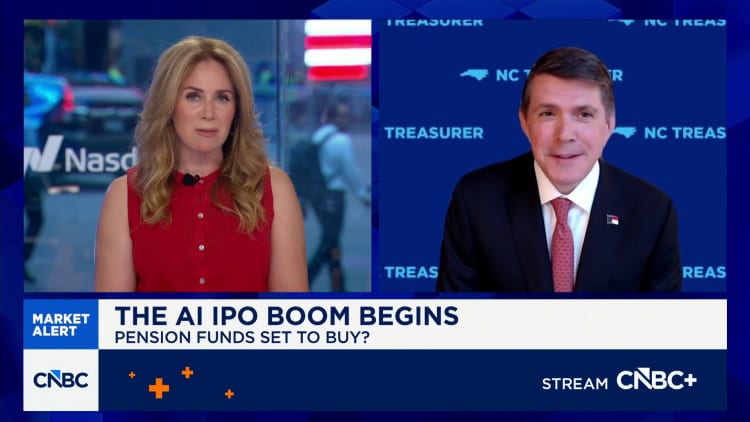

North Carolina state Treasurer Brad Briner said the year’s hottest IPO is too expensive for his pension fund to own.
Briner, who oversees roughly $200 billion for North Carolina’s teachers, firefighters and police officers, said the state has invested heavily in artificial intelligence startups OpenAI and Anthropic while avoiding a direct stake in SpaceX — expected to go public Friday — because of concerns that the Elon Musk-led company’s $1.77 trillion valuation leaves little room for future gains.
“There’s been a pricing issue that we’ve been concerned about for the last year or so with SpaceX,” Briner said on CNBC’s “Squawk Box” on Wednesday. “Elon Musk, an amazing entrepreneur, incredible technology to launch business, startling, etc. But at some point, things are fully priced. We’re trying to make a high-single-digit, predictable rate of return for our retirees. And we’ve got to consider valuation when we do that. And so, certainly, SpaceX at $1.75 trillion is a big valuation.”
SpaceX is scheduled to price its IPO on Thursday and begin trading on Friday. The rocket maker plans to sell 555.6 million shares at $135 apiece, raising about $75 billion and valuing the aerospace company at roughly $1.8 trillion.
Briner’s comments underscore a growing debate among institutional investors as SpaceX prepares for what is expected to be one of the largest initial public offerings in history. While many money managers view the company as a unique asset with dominant positions in rocket launches and satellite internet, other long-term investors are questioning whether today’s valuation already reflects much of that optimism.
The state treasurer has instead directed capital toward AI companies that he believes offer stronger risk-reward opportunities. North Carolina invested about $40 million in OpenAI and committed roughly $250 million to Anthropic earlier this year, a position he said is now worth more than $600 million.
“We saw an opportunity in Anthropic which we thought was completely mispriced earlier this year,” Briner said. “If you use that technology, you see how powerful it is.”
Rather than buying SpaceX shares in the private market, Briner said North Carolina’s pension system expects to gain exposure through index funds once the company goes public.
“We will ultimately participate in SpaceX through our index positions in our public equity,” he said, “but we don’t have any on the private side.”


Botanix is shutting down its Bitcoin Layer 2 network after a four-year experiment, urging users to withdraw their Bitcoin (BTC) and other assets before July 9, 2026.
The team said the network never found sustainable adoption despite 25 million transactions and 200,000 wallets. Its farewell post also doubles as a candid diagnosis of why Bitcoin DeFi keeps stalling.
Why Bitcoin Layer 2 Botanix Is Shutting Down
Botanix Labs announced the decision on June 9 in a lengthy statement on X (Twitter).
“It is with a heavy heart that we announce we are winding down the Botanix network. This decision is the hardest one we have made in four years…” the team wrote this in its farewell post.
Follow us on X to get the latest news as it happens
Technically, the project delivered. Its Spiderchain mainnet ran for a year with full uptime and zero security incidents.
Botanix also partnered with Chainlink, Morpho, GMX, and Fireblocks, and recently shipped BINK, a self-custodial Bitcoin neobank.
However, Botanix never launched a token, and fee income never matched costs.
After July 9, the federation will sweep any remaining Bitcoin. Other assets left on the network will become unrecoverable.
5 Hard Truths the Shutdown Reveals About Bitcoin DeFi
The team’s post-mortem distills into five lessons for builders.
- Bitcoin is still a store of value.
Most users treat BTC as a reserve asset. Therefore, demand for Bitcoin’s DeFi ecosystem remains far thinner than builders assumed.
- Convenience beats decentralization.
Wrapped BTC on Ethereum and centralized exchanges captured the real demand. Indeed, surveys show most holders ignore BTCFi entirely.
- No token meant no bootstrap.
Rejecting token incentives kept the experiment honest. It also removed the liquidity engine that kickstarts most new chains.
- Fees never covered costs.
Yield-focused holders generated little transaction volume. Combined with broader Bitcoin Layer-2 cost pressures, the network cost more to run than it earned.
- Distribution now rules crypto.
Activity keeps consolidating around exchanges, Hyperliquid, and TradFi platforms that own the user relationship, leaving standalone infrastructure rowing upstream.
Botanix insists the destination is right and the timing was wrong.
Moving forward, Bitcoin’s leap into DeFi resuming may depend on the next wave of builders arriving when real demand finally exists.
The post 5 Hard Truths Why Bitcoin DeFi Isn’t Working As Botanix Layer 2 Shuts Down appeared first on BeInCrypto.

Key Highlights
- UBS analysts elevated CAVA’s rating from Neutral to Buy with a new price target of $90, up from $85
- Shares gained more than 7% during trading despite broader market weakness
- Company unveiled “Flavor Your Future” workforce campaign, planning to recruit 2,500+ employees for 75+ new locations in 2026
- First quarter 2026 revenue climbed 32.2% compared to the prior year; comparable restaurant sales increased 9.7%
- Chief Legal Officer Joseph Kadow purchased $70,000 in company shares on the open market
Shares of CAVA Group (CAVA) rallied more than 7% during Tuesday’s session following an analyst upgrade from UBS, which moved the Mediterranean fast-casual restaurant chain to a Buy rating from Neutral while lifting its price objective to $90 from the previous $85.
The positive movement stands in sharp contrast to broader market conditions. Pre-market indicators showed the S&P 500 declining 0.3%, the Nasdaq tumbling nearly 1%, and the Dow achieving only marginal gains. CAVA’s impressive rally was clearly company-specific rather than market-driven.
According to UBS, the primary catalyst for the upgrade centers on CAVA’s sustained outperformance in comparable store sales relative to industry competitors. The investment firm recognizes a brand generating genuine customer traffic increases during a period when numerous restaurant operators face headwinds from cautious consumer spending patterns.
The timing of this upgrade reflects accumulated positive momentum. CAVA has delivered a series of encouraging operational results in recent weeks.
During the first quarter of 2026, total revenue expanded 32.2% on a year-over-year basis. Comparable store sales registered a 9.7% increase, with guest traffic contributing 6.8 percentage points to that gain — demonstrating growth beyond simple menu price adjustments. Management subsequently elevated its full-year projections across virtually all key performance indicators.
Traffic-driven expansion of this magnitude represents precisely what the investment community seeks in the current environment.
Aggressive Growth Trajectory
The Mediterranean chain recently rolled out its “Flavor Your Future” employment initiative, setting ambitious targets of recruiting over 2,500 team members to support the opening of more than 75 restaurants throughout 2026. Company executives indicate they’re already making solid progress toward achieving these objectives.
This aggressive expansion schedule demonstrates management’s confidence in the underlying profitability and sustainability of individual restaurant locations. Increasing store count, rising customer visits, and upgraded financial guidance create a compelling growth narrative.
Supporting the positive sentiment, Chief Legal Officer Joseph John Kadow executed an open-market transaction acquiring $70,000 in CAVA stock. Insider purchases of this magnitude typically attract investor attention, and this transaction strengthened the increasingly bullish perspective surrounding the company.
Trading Below Peak Levels
Despite Tuesday’s significant gain, CAVA shares remain considerably below their recent peak valuations, which partially explains why the UBS upgrade resonates with investors. The firm’s analysis suggests meaningful appreciation potential from present price levels, with the $90 target embodying this optimistic outlook.
For the year-to-date period, CAVA stock has advanced nearly 30%, accompanied by average daily trading activity of approximately 3 million shares. The company’s market capitalization currently stands at roughly $8.88 billion.
Technical indicators for the stock show a Hold signal, suggesting the UBS fundamental upgrade contrasts with a more neutral short-term technical setup. Today’s price action indicates investors are prioritizing fundamental metrics over technical patterns.
With CAVA’s valuation at $8.88 billion, the UBS price objective of $90 implies additional upside opportunity from current trading ranges.
Crypto World
Zcash (ZEC), Hyperliquid (HYPE) tokens lead losses as traders bet against a bitcoin (BTC) price bounce


The crypto market remains under pressure ahead of the pivotal U.S. inflation data, which is expected to show the cost of living rose to a three-year high of over 4% in May.
Tokens such as privacy-focused zcash (ZEC) and decentralized exchange Hyperliquid’s HYPE have each dropped over 10% in 24 hours, a signal of risk aversion in the broader market. ADA, ONDO, BCH are other losers, dropping more than 4%. The CoinDesk 20 Index fell 3% in the period.
Bitcoin has retraced to under $61,500, nearly reversing the Sunday bounce that saw prices rise above $64,000 on some exchanges. More importantly, the cryptocurrency is trading below its 200-week simple moving average (SMA), a technical line widely watched by traders.
“The history of the 200-week moving average over the last 11 years (prior to this, the market had not dipped below it) shows that the average time spent near it is almost 11 months, suggesting a very long bear market,” Alex Kuptsikevich, chief market analyst at the FxPro, said in an email.
Derivatives positioning
- Crypto futures volume over the past 24 hours rose 1.2% to $193 billion while open interest fell 1.5% to $102.27 billion. Liquidations, in contrast, jumped 38% to $418 million, with longs accounting for more than $300 million of the total as bitcoin slid back toward $61,000 yesterday.
- Bitcoin futures open interest (OI) nudged higher to 728,000 BTC from 712,000 BTC even as the cryptocurrency’s price fell. Rising OI into a price decline points to fresh short positioning, a sign traders are positioning for a further drop.
- That conclusion is reinforced by negative perpetual funding rates and a negative OI-adjusted 24-hour cumulative volume delta, the latter indicating that sellers are hitting bids at market rather than placing passive limit orders.
- Solana futures OI rose to 69.58 million tokens, up nearly 2% on the day, closing in on the record June 5 peak of 71.57 million. Funding rates and CVD are negative, mirroring bitcoin’s bearish setup .
- The bearish tilt extends across the board. Funding rates and CVD are negative for most major coins, including ether (ETH) and XRP. The lone exception is XMR, whose 24-hour CVD is narrowly positive.
- Bitcoin’s 30-day implied volatility index is 51.21%, up from 45.8% on Monday, reflecting renewed uncertainty ahead of the U.S. CPI release later today. ETH’s implied volatility index has also ticked higher.
- On Deribit, short-term puts on both BTC and ETH continue to command a notable premium over calls, a sign that downside hedging demand remains elevated. One-week implied volatility is trading cheap relative to one-week realized volatility, a setup that favors options buyers.
- In block flows, a long butterfly was structured in the July 31 expiry, involving long positions in calls at the $70,000 and $80,000 strike prices and short 2x in the $75,000 call. The trade profits if BTC consolidates around $75,000 through the end of July, implying the desk behind the position sees limited directional conviction from here.
Token talk
- Uniswap V4’s total value locked (TVL), the deposits sitting inside a protocol, appeared to explode more than 350% in a day, with DefiLlama showing roughly $2 billion of apparent inflows concentrated on BNB Chain. The jump was large enough to look like a major liquidity migration into the exchange.
- That wasn’t the case, however. The figure was not a wave of capital flowing into the protocol. CoinDesk traced the spike to the Humanity Protocol’s H token, which was hacked and minted in unlimited supply a day earlier. The worthless new tokens sat in a BNB Chain pool and inflated the dashboard’s dollar reading rather than representing real deposits. DefiLlama’s founder was contacted for confirmation.
- Santiment, a behavioral analytics platform, said the broader market selloff has reached a historic buy zone.
- The 30-day market value to realized value (MVRV), a gauge of the average profit or loss for traders who bought a token over the past month, shows the typical recent buyer underwater on bitcoin by 10%, ether by 12%, chainlink by 9%, XRP by 8%, and cardano by about 18%. The firm tags the first four “fair buy” and cardano “strong buy.”
- jumped 12% in 24 hours after the onchain lending protocol raised $175 million, one of the largest funding rounds in DeFi history, co-led by Paradigm, a16z crypto and Ribbit Capital with backers including Apollo and VanEck.
- The deal, structured as a token purchase, valued the protocol at up to $2 billion. The token later gave back some of the pop.


U.S. inflation data came in as expected on Wednesday, reinforcing the view that the Federal Reserve will keep interest rates at 350-375 bps at its June 17 meeting but is likely to increase rates by 25 bps by the end of the year.
The Consumer Price Index year over year rose 4.2% in May, according to a report from the Bureau of Labor Statistics. Economists had been expecting a rise of 4.2% following the April 3.8% increase.
On a month-over-month basis, CPI rose 0.5%, against expectations of 0.5% and against April’s 0.6% rise. Core CPI, which excludes food and energy costs, rose 0.2% in May versus forecasts of 0.3% and April 0.4%. Year-over-year core CPI was higher by 2.9% versus forecasts of 2.9% and April’s 2.8%.
While bitcoin saw a slight uptick after the data was published, it still remains under pressure. Bitcoin traded just above $61,000 following the report, mostly unchanged over the past 24 hours. U.S. stock index futures were down across the board, and the 10-year Treasury yield rose to 4.5%. WTI crude oil continues to head lower, down a further 1% on the day at $88.
Ahead of the CPI data, markets were pricing in a 98% probability that the Federal Reserve would leave interest rates unchanged at its June meeting, according to the CME Fed Watch tool.

The election season is ramping up in the United States, meaning that airwaves and social media are flooded with campaign ads.
Candidates, in addition to the political action committees (PACs) supporting and opposing them, are projected to spend a record-breaking $10 billion in ads this cycle. Some of that is going into AI deepfakes.
At least 15 AI-generated campaign ads have run since November, according to NBC News. Some have used deepfakes to portray a candidate doing or saying things that compromise their campaign’s image.
Transparency advocates say the ads, which are illegal in some states, could harm the integrity of American elections.
Ad runs afoul of local election laws
In the context of campaign ads, AI is mostly governed at the state level. Some 28 states have disclosure laws, while in two states, it is prohibited, though not totally.

In Minnesota, one ad campaign has already bumped up against local legislation. Minnesota Lt. Governor Penny Flanagan posted on BlueSky on June 3 “you might see a TV ad starring something that… kind of looks like me.”
Flanagan was referring to an ad run by a PAC supporting her opponent in the Senate primary race, fellow Democrat and US Representative Angie Craig. The ad shows Flanagan standing atop a large pile of cash, and criticizes her alleged ties to special interest groups.
“My opponent’s super PAC is using an AI deepfake of me to mislead voters. They can’t win with the truth – so they’re resorting to lies.”
“It’s disgusting. Minnesotans deserve better.”
The ad may run afoul of Minnesota campaign laws. In 2023, Democratic State Representative Maye Quade introduced a bill that bans AI deepfakes. It was passed into law, and “anyone who widely shares a deep fake within 90 days of an election” is guilty of a crime. This, provided that the person also:
- Knows or should have known the ad was a deepfake and made without the consent of the depicted person
- Acted with the intent to harm a candidate’s reputation to influence an election
The ads ran after the DFL, Minnesota’s Democratic party, nominated Flanagan, so technically it may have not violated the law. Still, Flanagan’s campaign is reportedly consulting lawyers.
Quade told local media that the ad violated the spirit of the law, and that people in general don’t like AI being used this way. “People don’t like this, broadly […] What campaign on either side of the aisle is going to help voters feel good about their candidate using this?”
Related: Prediction markets legal battles heat up in Minnesota, Rhode Island
On the Democratic side of the aisle, 40 DFL state legislators signed a letter condemning the use of AI deepfakes in campaign materials. They noted that, in 2023, “lawmakers voted nearly unanimously to ban the use of deceptive AI-generated deepfakes in elections, recognizing the threat manipulated AI content poses to voters and public trust.”
“Regardless of party, the use of AI-generated deepfakes in campaign advertising is unacceptable.”
Mark Jablonowski, the CEO of advertising firm DSPolitical, told NBC that he thinks most politicians will rise above it. “I think most campaigns on both sides of the aisle probably want to do the right thing […] There, of course, are going to be examples that you can point to where people are going about it the wrong way.”
The PAC that issued the ad, North Star Dawn PAC, did not respond to Cointelegraph’s request for comment.
What do election laws say about AI deepfakes?
As noted above, some 30 states have laws on the books regarding AI use in elections. The vast majority of these relate to simple disclosure, with many states only having civil penalties for infractions.
The Federal Elections Commission (FEC), the regulator responsible for creating funding, disclosure and other rules concerning elections. Regarding ads, the FEC told Cointelegraph:
“Commission regulations require clear and conspicuous disclaimers to appear on certain campaign advertisements, including public communications that are distributed by a federal candidate’s campaign committee.There is also a prohibition against ‘fraudulent misrepresentation.’”
Public Citizen, a consumer advocacy group, submitted a petition for rulemaking before the FEC in 2023, asking the commission to issue rules for AI. Instead, the body “decided not to initiate a rulemaking.”
“The Commission determined that the statute’s fraudulent misrepresentation ban is technology neutral, applying to all means of the specified fraud, including AI-assisted media.”
One may not expect quick action from the federal government, at least not from Congress, on AI. In 2023, Senator Amy Klobuchar and Representative Yvette Clarke, both Democrats, introduced the REAL Political Advertisements Act in their respective chambers. However, the bill failed to pass in either house.
If anything, the US Congress shows a total unwillingness to meaningfully regulate AI. Nearly one year ago, President Donald Trump signed the One Big Beautiful Bill Act into law. The final version narrowly avoided including a 10-year ban on any state and local regulation of AI, giving the industry carte blanche for anything from building data centers to how AI would be used in popular media.
Now, two Congressmen are back at it. Democrat Lori Trahan and Republican Jay Obernolte on June 4 introduced a bill that, if passed, would ban states from passing laws “targeting artificial intelligence model development.”
According to the American Civil Liberties Union (ACLU) “This could include anything from privacy regulations to antidiscrimination requirements to AI safety laws.”
The ACLU noted that the aforementioned 10-year ban was stripped from the Senate file in a near-unanimous 99-1 vote.
Jina John, senior policy counsel for AI, privacy and technology at the ACLU, said, “This draft bill fails to learn from Congress’s previous attempts to block state AI regulations. States must be able to protect their own residents from harm, hold tech companies accountable, and ensure that AI is safe and trustworthy.”
Magazine: Korea probes Polymarket users, crypto PACs sweep primaries: Hodler’s Digest, May 31- June 6
Sam Altman model ChatGPT AI just looked at an ugly Bitcoin chart and predicts for a rebound into the $80,000 to $95,000 range by September. With BTC sitting at $61,340 right now, that is a 30% to 55% climb at the exact moment sentiment feels its absolute worst, and that timing is the whole point.
The core thesis is simple. The best bull market entries almost never feel good. They show up when the chart looks broken and everyone has given up, not when price is ripping and the news is glowing.
Right now BTC price looks ugly, but the read is that this is a painful reset inside a bigger bull cycle, not the final top. That single distinction is what separates a generational buy from a falling knife, and the call leans hard on it being the former.
The bull case says ETF flows stabilize, institutional adoption keeps grinding higher, and capital rotates back into crypto once this shakeout finishes.
That mix pushes BTC back toward $80,000 to $95,000 by September. The bigger picture is even more interesting.
If historical post-halving behavior, liquidity conditions, and institutional demand all line up, the strongest phase of the cycle could land around November, with Bitcoin challenging $100,000 plus again into late 2026.
The bear case is real and worth respecting. If ETF outflows keep bleeding, macro stays tight, and risk appetite stays glued to AI and equities, BTC could slide toward $50,000 to $55,000 before a durable bottom forms.

That is the zone where the deeper flush plays out. Still, as long as Bitcoin holds major long-term support, the odds favor this being a brutal correction inside a broader bull cycle rather than the start of a multi-year bear market.
Bitcoin Price Prediction: When The Chart Looks Broken Is When The Cycle Pays
Now the chart. BTC is on the weekly and price sits at $60,800 after a steep drop from the $128,000 top set last July.
The structure is a deep correction, a clear stack of lower highs since that peak with price now sliding into a major demand zone.
Pattern wise this is a return to the wide accumulation band that runs from roughly $52,000 to $61,000, the same shelf that launched the entire last leg up.
Key support sits at $60,000, with the next floor near $55,000 and deeper demand around $52,000. Resistance stacks at $70,000, then $80,000, and the heavier ceiling at $90,000.
RSI is reading 32.79 with its signal line at 40.31. So momentum is sitting well below its average and pressing toward oversold on the high timeframe.
That wide gap of about 7.5 points shows real selling pressure short term, but on the weekly, this kind of stretch into oversold has marked major cycle lows before.
When RSI curls back above the 40.31 signal, it flips the long-term read back to bullish. Tie it together, and the chart is sitting right on the support that has historically launched the next leg. Hold this $52,000 to $61,000 band and the path back toward $80,000 and beyond opens up exactly like the prediction lays out.
You Might Like What ChatGPT AI Predicts About LiquidChain
The rotation has started. Most people will recognize it after it has already happened.
Large caps are not broken. They are capped. Bitcoin, Ethereum, and XRP are pinned under the same resistance they have been testing for weeks. The macro catalyst keeps getting rescheduled. The institutional inflows keep getting pushed back. Waiting on things outside your control is not positioning. It is just sitting still.
Capital that understands cycles moves before the next thing becomes obvious. Not after.
Early stage infrastructure works on different math. Small market cap means a modest capital rotation produces dramatic movement. Returns arise from the gap between what something is genuinely worth and what the market has priced it at. That gap closes the moment the project gets discovered. Right now it is still open.
Multi-chain fragmentation is one of the most expensive unsolved problems in DeFi. Bitcoin, Ethereum, and Solana run completely isolated systems. Every user crossing those boundaries pays for that in fees, slippage, and failed transactions. Every single time.
LiquidChain removes the cost entirely. All 3 networks in one execution layer. One deployment. Full ecosystem access. No cross-chain tax.
The presale is at $0.01454 with just over $820,000 raised. Still early. Still undiscovered.
Execution is unproven. Adoption is unknown. Established assets offer a smoother ride toward a ceiling that is already priced in. LiquidChain is a seat at a table that has not been set yet.
Explore the LiquidChain Presale
The post Nobody Predicts Sam Altman ChatGPT AI Would Say This About Bitcoin appeared first on Cryptonews.

Rich Paul Spills Rare Truth About Organic Love Story With Adele

Krish Rao – Cash Cash ( Music Video ) | Prod. by Jai
Police issue update after triple stabbing at north Manchester high school

HarrisX Poll Found 52% of Registered Voters Support the CLARITY Act

BloFin War of Whales 2026 Grand Prix opens registration for $5M trading championship

Blockchain.com files with SEC for U.S. IPO
Krish Rao – Cash Cash ( Music Video ) | Prod. by Jai

Blockchain and Cryptocurrency Explained in Malayalam | What is Bitcoin? How does it work?

China Financial Martial Law Begins, Citizens Banned from US Stocks, Middle Class Money Can’t Escape
-

 Fashion5 days ago
Weekend Open Thread: Evereve – Corporette.com
-
 Crypto World5 days ago
Jensen Huang Approves Samsung, SK Hynix, and Micron for NVIDIA (NVDA) HBM4 Memory Supply
-

 Crypto World2 days ago
Anatomy of the June crypto crash: Fed, Iran, Saylor
-
 Entertainment4 days ago
The Best Mystery Series of All Time Is Surging on Streaming 30 Years After It Ended
-

 NewsBeat3 days ago
Alexander Zverev wins the French Open to finally earn a 1st Grand Slam title
-

 Tech5 days ago
Suspicious Polyfill login prompts pop up on Toshiba, Muji websites
-
Crypto World4 days ago
Senator Cynthia Lummis Calls CLARITY Act the Most Consequential Financial Legislation of This Generation
-

 Tech3 days ago
Microsoft unveils seven homegrown AI models in new bid for ‘long term self-sufficiency’
-

 Tech5 days ago
Microsoft launches MXC, an OS-level sandbox for AI agents, with OpenAI and Nvidia already on board
-

 Business5 days ago
(VIDEO) Justin Bieber Delivers Surprise Happy Birthday Serenade to Diners at Los Angeles Mexican Restaurant
-
 Business4 days ago
The Pain Points Taking a Fragile Tech Rally Down a Notch
-
Crypto World5 days ago
LBank Surpasses 25 Million Users Worldwide as AFA Partnership Continues to Drive Global Growth
-

 Crypto World3 days ago
Trump’s AI Ownership Plan Could Benefit Anthropic at OpenAI’s Expense
-
 Crypto World2 days ago
Eli Lilly (LLY) Stock Surges 4% Following Breakthrough Sleep Apnea Trial Results
-

 Tech5 days ago
Meta steals a tactic from Tesla and builds data centers in tents
-

 Tech5 days ago
Von der Leyen’s AI envoy pick draws conflict-of-interest fire
-
 Sports1 day ago
Bangladesh beat Australia after 20 years in ODIs, register only their second win over six-time world champions | Cricket News
-

 Business2 days ago
High Stakes for Wembanyama as New York Pushes for 3-0 Lead
-

 Tech4 days ago
Hackers now exploit SolarWinds Serv-U flaw to crash servers
-

 Tech3 days ago
Notion restores access to Anthropic after service disruption
You must be logged in to post a comment Login