

Crypto World
CoinQuant trading launches AI agent architecture



CoinQuant trading platform has expanded its architecture to serve both human traders and autonomous AI agents.
Summary
- CoinQuant, with over 15,000 users since launch, is expanding its no-code AI trading platform into a unified intelligence architecture designed for autonomous AI agents.
- The platform converts plain-English strategy descriptions into complete trading systems covering entries, exits, position sizing, and risk rules, with tick-level backtesting.
- The expansion targets the emerging agent economy, where AI agents settled $73 million across 176 million blockchain transactions in the twelve months through April 2026.
CoinQuant announced the expansion of its no-code trading platform into a unified trading intelligence architecture serving both human traders and autonomous AI agents. The company has attracted more than 15,000 users since launch with a product that converts plain-English strategy descriptions into full algorithmic trading systems, including entries, exits, sizing, filters, and risk rules.
“I spoke one idea into CoinQuant, ran the test, and launched a bot on my lunch break,” said Alex K., a software engineer using the platform. The platform handles tick-level backtesting automatically from a user’s verbal or written input, without requiring coding skills.
What CoinQuant’s AI agent architecture enables
The expansion into agent-native infrastructure allows autonomous AI agents to deploy, test, and execute crypto trading strategies without human intervention at each step.
This positions CoinQuant within the fast-growing market for machine-to-machine crypto infrastructure, where AI agents settled more than $73 million across 176 million blockchain transactions in the twelve months through April 2026 according to research firm Keyrock.
The broader market CoinQuant is targeting spans more than a million potential autonomous trading agents active across crypto markets.
Crypto.news has covered the acceleration of AI-native crypto infrastructure, including MoonPay’s MoonAgents Card enabling AI agents to spend stablecoins at point-of-sale. The convergence of no-code strategy creation with agentic execution marks a structural shift in how trading strategies can be built and deployed at scale.
Why the agent economy is accelerating now
The infrastructure for AI agents to act as independent economic participants is arriving across crypto in waves. Coinbase launched agentic wallets via its x402 protocol in February 2026, processing more than 50 million transactions.
Circle launched its Agent Stack in May 2026, adding wallets, an agent marketplace, and nanopayments for sub-cent AI commerce. Crypto.news has noted MoonPay’s AI-native debit card infrastructure giving agents a live stablecoin payment rail.
CoinQuant’s approach focuses on the trading strategy layer of this stack, providing the intelligence engine that allows agents to construct and execute crypto strategies without pre-coded logic.


TLDR
- Bhutan transferred another 90 BTC worth about $7 million to a SegWit address.
- Total Bitcoin transfers from Bhutan-linked wallets have now exceeded $237 million in 2026.
- Arkham data shows Druk Holding and Investments’ Bitcoin holdings have declined by around 10,000 BTC since October 2024.
- Blockchain records indicate some earlier transfers moved funds toward wallets linked to Galaxy Digital and OKX.
- Druk Holding and Investments has not issued a public statement on the recent Bitcoin transfers.
Bhutan transferred another 90 BTC worth about $7 million to a SegWit address. On-chain data shows the total Bitcoin moved this year now exceeds $237 million. The fresh transaction has renewed focus on Bhutan’s sovereign crypto strategy.
Blockchain records show the 90 BTC left a wallet linked to state holdings. The funds moved to a SegWit address separate from three known P2SH clusters.
Those P2SH wallets have historically stored most of Bhutan’s Bitcoin reserves. The new address differs from the country’s primary sovereign holdings.
Arkham data indicates Druk Holding and Investments’ stash has declined by around 10,000 BTC. The reserve fell from about 13,390 BTC in October 2024 to roughly $233 million today.
Earlier this year, Bhutan transferred 100 BTC on April 29. That batch carried an estimated value of nearly $8 million.
At that stage, data showed more than $206.98 million had already moved since January. The steady flow of transactions has continued since then.
Bhutan Bitcoin Transfers Exceed $237M in 2026
On April 11, blockchain trackers recorded 319.7 BTC leaving a state-linked wallet. That transaction carried an estimated value of $22 million.
Reports indicate about 250 BTC from that batch entered wallets linked to Galaxy Digital and OKX. Both firms operate as major crypto trading platforms.
Also, Bhutan sold about 285 BTC in February. Those sales occurred in multiple batches during the month.
Arkham has tracked the transfers through publicly labeled blockchain addresses. The analytics platform continues to update Bhutan-linked wallet balances.
Mining Model Faces Pressure After Halving
Bhutan built its Bitcoin reserves through hydropower-backed mining operations. Druk Holding and Investments manages those activities.
Unlike other countries, Bhutan did not rely on seizures or treasury purchases. The state mined Bitcoin using domestic energy resources.
The 2024 halving reduced block rewards to 3.125 BTC per block. Mining competition increased as rewards declined.
Bitcoin price trades at $77,271 at press time and remains down nearly 12% year to date. The asset recently rebounded above $77,000 after dipping near $75,000.
Druk Holding and Investments has not issued a public statement on the transfers. The company has also not confirmed the current status of its mining infrastructure.


Texas’s political landscape is increasingly entwined with crypto lobbying as two pivotal primary runoffs approach. In the 18th congressional district, incumbent Democrat Al Green faces challenger Christian Menefee, while the Republican Senate contest narrows to Attorney General Ken Paxton versus Senator John Cornyn. Crypto-aligned political action committees have poured money into both races, illustrating how the industry aims to influence policy as the 2027 Congress and the broader regulatory environment take shape.
As of Sunday, Protect Progress, a PAC affiliated with ripple– and Coinbase-backed Fairshake, reported about $5 million in spending to back Menefee and $2.8 million in advertising opposing Green. Menefee also secured the endorsement of the Blockchain Leadership Fund, a committee backed by Anchorage Digital and Chainlink Labs, though the fund had not disclosed further expenditures as of Monday. On the other side of the ledger, the Fellowship PAC — financed by Cantor Fitzgerald and Anchorage Digital — reported $500,000 in spending in support of Paxton, arriving just after former President Donald Trump publicly endorsed Paxton and criticized Cornyn’s support timeline for Trump’s 2024 bid.
The dynamics in Texas reflect a broader pattern: crypto interests are increasingly using PACs to shape narratives and candidate support in districts and statewide races that could influence the policy direction of the next Congress. The March primaries produced runoffs precisely because no candidate secured a majority, thrusting these crypto-linked campaigns into the spotlight as Texans prepare to vote again this week.
“I saw 12 television commercials yesterday paid for by the Protect Progress PAC […] and that same group of people are the ones that are primarily funding Trump.”
The federal filings underpinning these expenditures come from the US Federal Election Commission. Protect Progress’s filings show the scale of outside money aimed at steering the Texas 18th District race, while the Fellowship PAC’s activity highlights how Wall Street–connected capital is financing Paxton’s bid in the Senate contest.
The policy stakes go beyond district lines. If Texas’s Republicans maintain the Senate majority, lawmakers have already enacted and advanced crypto-friendly measures, including legislation related to stablecoins and other digital-asset regulations. The GENIUS Act, cited by supporters as a framework for stablecoins and tokenized assets, is one such example of the policy direction that could gain momentum or face new scrutiny depending on the election outcome.
Key takeaways
- Crypto-focused PACs are directing significant sums into Texas primaries: Protect Progress backing Menefee with approximately $5 million and spending $2.8 million opposing Green, as first reported in FEC filings.
- Endorsements and industry ties shape candidate profiles: Menefee benefits from Blockchain Leadership Fund backing; Paxton’s campaign gains from the Fellowship PAC funding, tied to Cantor Fitzgerald and Anchorage Digital.
- Prediction markets reflect perceived outcomes: Kalshi places odds of 91% for Menefee over Green and 96% for Paxton over Cornyn, with total market activity exceeding $16 million in bids; Polymarket mirrors a similar assessment of the two runoffs.
- Campaign messaging crosses crypto boundaries: While some Protect Progress ads directly address Trump, others emphasize broader political dynamics that may influence crypto policy through the 2027 Congress.
- Electoral outcomes could reshape crypto policy in the near term: A Republican-majority Congress could accelerate certain crypto-friendly initiatives; ongoing debates around regulation and stablecoins remain central to the sector’s longer-term outlook.
Crypto money, messaging, and the Texas runoffs
The Texas races illustrate how crypto money is seeding political influence at both the state and federal levels. Protect Progress’s activity demonstrates a concerted effort to back a candidate perceived as favorable to blockchain and digital-asset policy, while also funding advertising that opposes Green. The FEC disclosures show a multi-million-dollar operation aimed at shaping public perception ahead of November’s general election. The specific market-facing spending and messaging underscore a broader industry strategy: leverage political access to create a more predictable regulatory backdrop for digital assets.
On the Senate side, the donation from the Fellowship PAC came in close proximity to Trump’s endorsement of Paxton, a development that activists and observers say can rapidly shift public sentiment and fundraising dynamics. Bill King, a former Houston Chronicle opinion writer, commented on the wave of Protect Progress ads, noting the overlap between the group funding Trump and the scale of its current campaign expenditures. While some ads focus on Trump or other political flashpoints, others frame cryptocurrency policy as a practical, economic concern that matters to a broad constituency.
The involvement of Blockchain Leadership Fund — a committee associated with Anchorage Digital and Chainlink Labs — signals a tangible alignment between infrastructure players and political outcomes. While the fund’s spending had not been fully disclosed at the time of reporting, its backing of Menefee points to a deliberate alignment between certain industry participants and political candidates who may adopt crypto-friendly policy perspectives.
Prediction markets as a read on political risk
Prediction markets have become an increasingly visible barometer of electoral sentiment in the crypto space. Kalshi’s contracts suggest a strong tilt toward Menefee and Paxton in their respective races. The platform has typically shown odds favoring the Democratic candidate in the Texas 18th District race since February, while Paxton’s odds surged to over 90% after Trump’s endorsement, reaching near 96% in the latest readings. Total bets on these contracts surpassed $16 million, reflecting the volume of interest from traders who weigh policy outcomes alongside political risk.
Polymarket, another platform that hosts event contracts, offered a similar framing for the Texas runoffs, indicating a broad consensus among traders about the likely outcomes. The alignment between predicted outcomes and the scale of crypto-linked spending underscores how market-based tools are being used to gauge and potentially influence political dynamics in a sector that remains highly consequential for regulatory direction.
For investors and builders in the crypto space, these market signals matter not only as anecdotal indicators of political fortune but also as a proxy for the potential policy environment in the near term. If crypto-friendly candidates prevail, there could be a clearer path toward a favorable regulatory framework or a more predictable rulemaking landscape that could affect stablecoins, exchanges, and other digital-asset ventures.
Looking ahead, observers should watch how the results in the Texas 18th District and Senate contest translate into policy momentum on Capitol Hill. The degree to which lawmakers align with the crypto industry’s priorities may depend on the resulting balance of power and the composition of key committees in 2027. As the market digests the outcome, readers should monitor updates from the Federal Election Commission for further disclosures and from prediction-market trackers for shifts in odds that could foreshadow policy pivots.
For readers tracking regulatory developments, the election’s outcome could illuminate how the industry’s capital and messaging shapes the next phase of U.S. crypto policy, including potential legislation, licensing regimes, and guidance that affect stablecoins, digital wallets, and the broader digital-asset ecosystem.
Stay tuned for results from the Texas runoff on Tuesday and the broader implications for crypto policy as the new political landscape takes shape in the year ahead.
Source notes and data references: Federal Election Commission filings detail Protect Progress and Fellowship PAC expenditures. Kalshi markets provide odds on the Texas Senate and House runoffs, with public pages accessible at Kalshi’s platform. Polymarket coverage mirrors similar probability assessments. The discussion of policy context references the GENIUS Act and related crypto legislation considerations discussed in recent coverage and sector analyses.


Coinbase executives mounted a coordinated defense of payment stablecoins, pushing back against a Wall Street Journal column. The article questioned whether privately issued digital dollars pose systemic risk to the US economy.
Chief Legal Officer Paul Grewal and Chief Policy Officer Faryar Shirzad both endorsed the Digital Asset Market Clarity Act. Their statements signaled top-level support for the market-structure bill currently working through the Senate.
The Private Money Pushback
Grewal framed stablecoin oversight as a risk-management question, not a public-versus-private debate.
The Coinbase CLO, who has pushed for regulatory clarity in past testimony, compared digital dollars to private healthcare and transportation. He argued that the regulatory floor matters more than the issuer.
“Money that’s “private” isn’t any more inherently risky than healthcare or security or transportation that’s private. It’s how you manage that risk, as well as access and oversight that matters. CLARITY promotes all this,” Grewal stated.
Shirzad expanded the argument in a longer Coinbase policy response, noting that roughly 90% of M2 already consists of privately issued instruments.
These include commercial bank deposits and money market fund shares.
Follow us on X to get the latest news as it happens
Why GENIUS Differs From Bank Rules
The GENIUS stablecoin framework, signed last July, requires payment issuers to hold cash and short-dated US Treasuries. Reserves must back outstanding tokens one-to-one.
The statute bans loans, leverage, and fractional reserves outright. Bank-style supervision would miss the actual risk profile, Shirzad said.
Commercial banks earn their regime because they lend, transform maturities, and run 10-to-1 leverage. Stablecoin issuers do none of those by law.
He also pointed to monthly reserve attestations and real-time on-chain visibility. The framework, he said, offers transparency that bank deposits cannot match.
The Political Signal
The endorsement lands while the Senate Banking CLARITY vote pushes the bill toward a full floor test. Markets are reading Grewal’s stance as a political marker.
Industry support at this stage could shape final language on stablecoin yield and market-structure rules. Only two windows before midterms remain for CLARITY to pass.
The question now is whether the Senate can reconcile its version with the House-passed bill. November will close the legislative runway.
The post Coinbase Execs Drop Crypto’s Most Bullish Stablecoin Message Yet on CLARITY Bill appeared first on BeInCrypto.
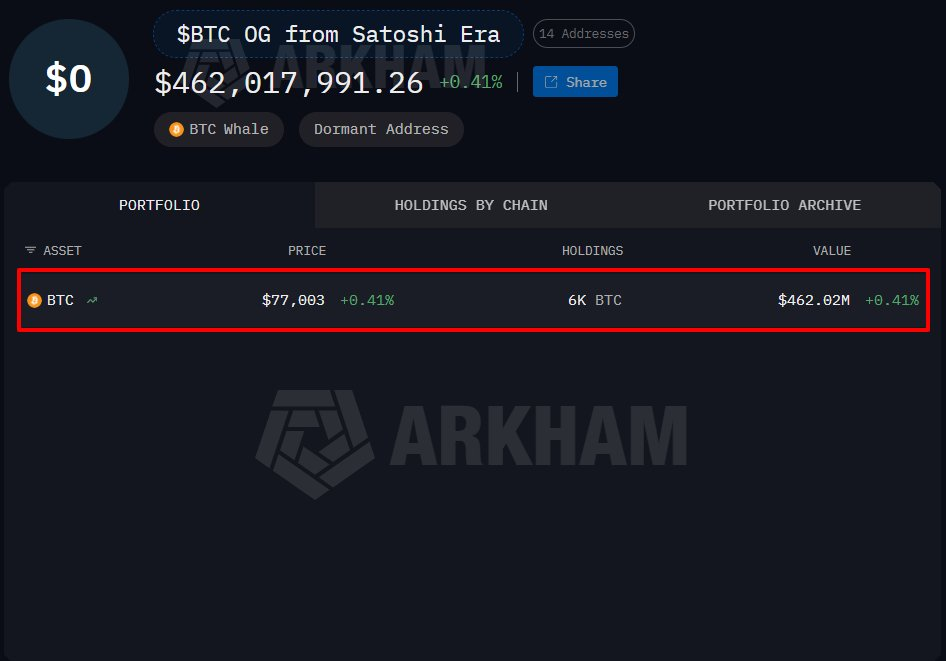
A Satoshi-era Bitcoin whale transferred 2,650 Bitcoin worth about $203 million to FalconX and Cumberland over-the-counter (OTC) trading desks, in an onchain move that may signal a planned sale or liquidity transaction from the long-dormant Bitcoin miner.
The early Bitcoin (BTC) miner transferred the funds across two transactions of 1,000 BTC each and another 650 BTC transaction on Sunday, according to blockchain data platform Arkham.
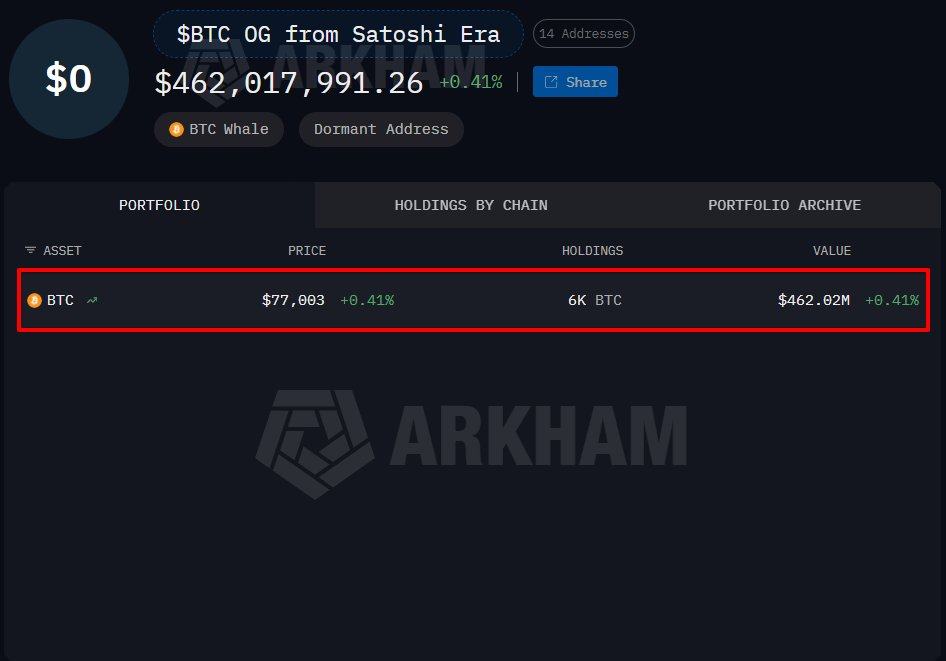
The address still holds another 6,000 BTC worth about $462 million, said blockchain data platform Onchain Lens in a Monday X post.
Transfers to over-the-counter trading desks can signal a planned sale or liquidity transaction, though they do not prove the Bitcoin has been sold. Large holders often use OTC desks to access deeper liquidity without placing visible sell orders on public exchange books.
Old miner wallets are closely watched as a source of long-dormant supply. When Satoshi-era coins move to institutional trading desks, traders often read it as a potential sign that early holders are preparing to reduce exposure.
Source: Onchain Lens
Bitcoin miners face profitability pressure
The Satoshi-era Bitcoin miner’s transfer occurred as Bitcoin’s price was stuck trading in a narrow range over the past month and fell about 0.5% to trade at $77,347 at the time of writing on Monday.
This is significantly below the average Bitcoin miner production cost of about $93,175 per BTC, according to TradingView data. The development shows that miners currently selling at these price levels are selling their Bitcoin at a loss compared to the cost of producing it.
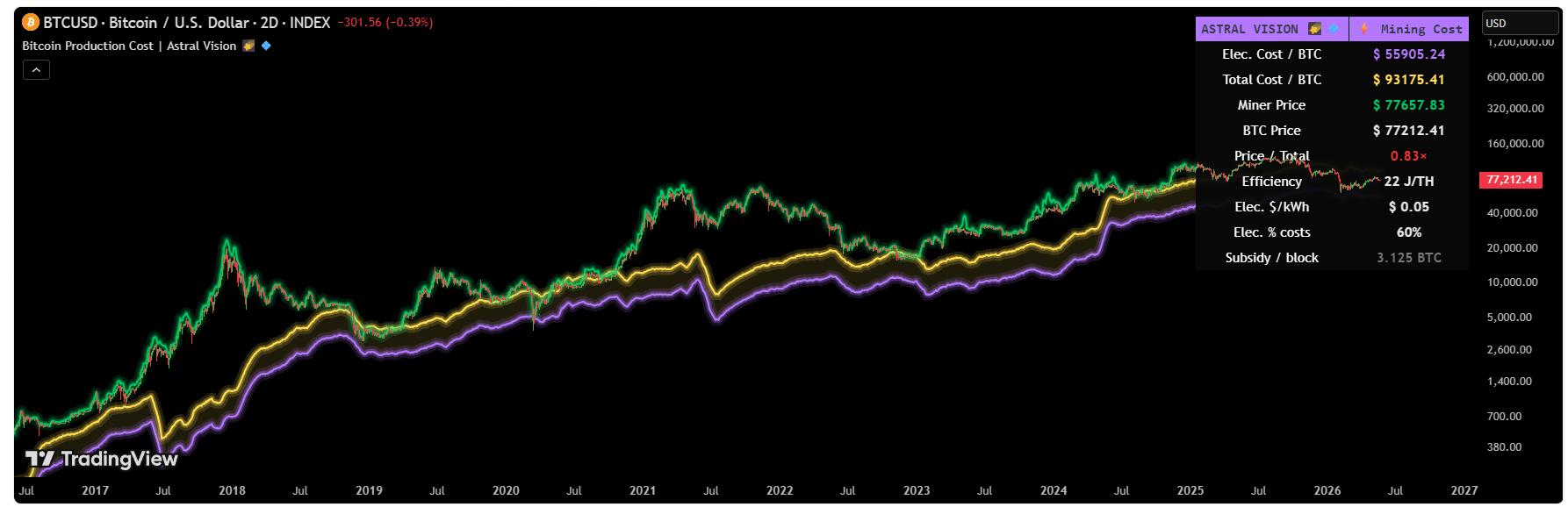
The Bitcoin average miner cost production chart. Source: TradingView
However, other analytics providers are showing different Bitcoin cost production estimates. Capriole Investment’s data estimated a Bitcoin production cost of about $57,706, while research platform CryptoRank said that public miners had an average BTC production cost of about $74,600.
When Bitcoin trades below this level, smaller mining operations may be pressured out of business, as they are forced to sell their BTC at a loss to fund operations. A March report from CoinShares found that as many as 20% of Bitcoin miners could be operating at a loss, particularly those using older mining equipment.
Related: New York lawsuit tests lost property claim over dormant Bitcoin
Some Bitcoin mining companies have started relying on new revenue models to address financial pressure.
Digital infrastructure company Soluna Holdings has offset part of its weaker Bitcoin mining revenue with its data center hosting business, which generated $6.7 million in first-quarter revenue, while cryptocurrency mining contributed roughly $2.2 million, down from nearly $3 million the year before, Cointelegraph reported on May 18.
Magazine: Bitcoin ETFs bleed $1B, Aave’s $71M ETH unfreeze bid delayed: Hodler’s Digest, May 10 – 16

NEW YORK and HONG KONG — Cyannova Capital (“Cyannova” or the “Company”), a New York-based investment firm, announces its inaugural investment fund, Cyannova Capital, LP, at its private industry reception held in Hong Kong. The fund is positioned as event-driven capital and operates as a resource integration platform, strategically leveraging the momentum of a significant global investment cycle fueled by the convergence of energy, computing, automation, and space-based infrastructure.
By leveraging a global network spanning North America, the Middle East, and Asia, Cyannova focuses on providing long-term support to its portfolio companies. Cyannova is targeting high-growth sectors that expand human productivity, including AI, renewable energy, robotics, and the emerging space economy.
At the reception, Cyannova announced that it entered into a strategic cooperation framework agreement with Butong Group (6090.HK), an emerging tech-driven lifestyle solutions provider. “Cyannova’s platform is built to do more than just deploy capital,” said Mr. Wang, Chairman of the Board of Butong Group. “Butong is proud to be one of Cyannova’s first strategic partners. They are integrating global resources to help companies scale across borders.”
Gathering over 200 business elites and strategic partners at the reception, Cyannova formally introduced its vision. The gathering featured technical fireside discussions on data center financing and the future of space-based data systems, underscoring Cyannova’s commitment to frontier technologies. The event further solidified the firm’s strategic footprint through signing ceremonies with two key partners, demonstrating its ability to foster meaningful cooperation across international markets.
“The reception was an important event to establish our credibility within the Hong Kong and broader Asia market,” said Alessandro Bianchi, Managing Director at Cyannova Capital. “The quality of the relationships formed and the strategic partners attending this event underscore the demand for a crossover investment platform focused on innovative companies. Cyannova is excited about the team we have put together, the investment themes we have chosen, and the geographies we are targeting. We are very excited to start deploying capital in the second half of 2026.”
For media inquiries, please contact:
This announcement is for informational purposes only and should not be construed as investment advice or a solicitation to invest.
About Cyannova
Cyannova Capital is a New York–based investment management firm focused on energy, computing infrastructure, robotics, and space economy. Cyannova manages a crossover investment strategy fund spanning public and private markets. The firm partners with growth-stage to later-stage companies, supporting their growth through capital and strategic insights, connecting them with new markets, strategic partners, and enabling technologies, thereby enhancing long-term investment value.
About Butong Group
Butong Group (06090.HK) is an emerging, tech-driven lifestyle company dedicated to designing, developing, and manufacturing premium nursery and family living products for global consumers. Operating primarily under its flagship brand, BeBeBus, the Group delivers high-performance, aesthetically refined solutions across key family scenarios, including travel gear, sleep systems, feeding essentials, and child care. Leveraging its proprietary advanced materials, in-house research and development, and sustainable intelligent manufacturing, Butong Group transforms functional parenting utilities into highly integrated technology experiences, driving original value and elevating everyday lifestyle standards for modern elite families worldwide.

Cyannova Capital and Butong Group (6090.HK) enter into a strategic cooperation framework agreement.

John Riggins, CEO of Moon Inc speaks at the reception event where Cyannova Capital announces its global launch.

However, this model cuts both ways. On one hand, it lets companies raise capital on a wave of market optimism. On the other, it forces them to absorb the volatility of the underlying asset when prices fall.
For a public company, the situation is even more complicated. Accounting obligations mean financial losses quickly become public, and any asset movements against that backdrop attract intense scrutiny.
The recent discussion around Trump Media & Technology Group (TMTG) shows exactly that. Amid paper losses on its crypto strategy, the company moved 2,650 BTC to Crypto.com, having previously withdrawn applications to launch its own cryptocurrency ETFs.
The market absorbed this news fairly calmly, but the obvious question remains: is this part of a trading strategy, or preparation for a forced sale of digital assets?
Behind the $200 million move
Trump Media was not created as a financial or investment entity, but rather as a technology holding company. Its flagship product is Truth Social — a social network launched after Donald Trump was banned from major platforms.
In March 2024, the company went public through a SPAC merger. Until the following spring, TMTG remained strictly within the social media sphere, and only then did management decide to pivot, beginning the formation of a cryptocurrency reserve.
For these purposes, the company raised approximately $2.3 billion through equity sales and the issuance of zero-coupon convertible secured notes.
Initially, the organization stated that it wanted to establish a Bitcoin reserve, with Crypto.com and Anchorage Digital serving as its custodial partners. In practice, the model turned out to be broader than initially declared.
The company invested in the Cronos (CRO) token, which is affiliated with the aforementioned Crypto.com, and filed applications to launch several cryptocurrency ETFs at once.
However, the cryptocurrency strategy has apparently failed to pay off.
As of December 31, 2025, Trump Media disclosed holdings of 9,542 BTC with a cost basis of $1.131 billion and a fair value of $836.4 million, alongside 756 million CRO with a cost basis of $113.9 million and a fair value of $68 million.
The company’s first-quarter 2026 report made the financial pressure even more evident. TMTG kept the same BTC and CRO balances on its books, but their fair value dropped to $647 million and $53 million, respectively.
Separately, TMTG disclosed an unrealized loss on digital assets of nearly $244 million (including pledged assets). Meanwhile, the company’s net loss is estimated at $405.9 million.
A few days after the report’s publication, the company also withdrew its applications to launch ETFs. Then, in late May, addresses linked by Arkham to Trump Media transferred 2,650 BTC to Crypto.com infrastructure — amounting to over $200 million at the market prices at the time of writing.
Some interpret such transactions as preparation for a sale or, at the very least, securing liquidity for over-the-counter (OTC) deals. However, the U.S. Securities and Exchange Commission (SEC) does not require companies to disclose public wallet addresses, which makes it difficult for outsiders to independently verify their intentions.
Companies often use such transfers to post collateral for fiat-denominated loans. In particular, TMTG said in its quarterly report that it had pledged 4,260 BTC as collateral for its convertible notes.
Another 2,000 BTC was transferred to a third-party partner as insurance for options trading. That partner also received the right to move those assets freely at its own discretion.

Excerpt from Form 10-Q. Source: SEC.
A TMTG representative also said the Bitcoin had been “transferred, but not sold,” describing the move as part of a broader trading strategy.
The market reacted fairly calmly to both the loss data and the transfer of Bitcoin to the exchange. That is likely because such an adverse scenario had already been priced in.
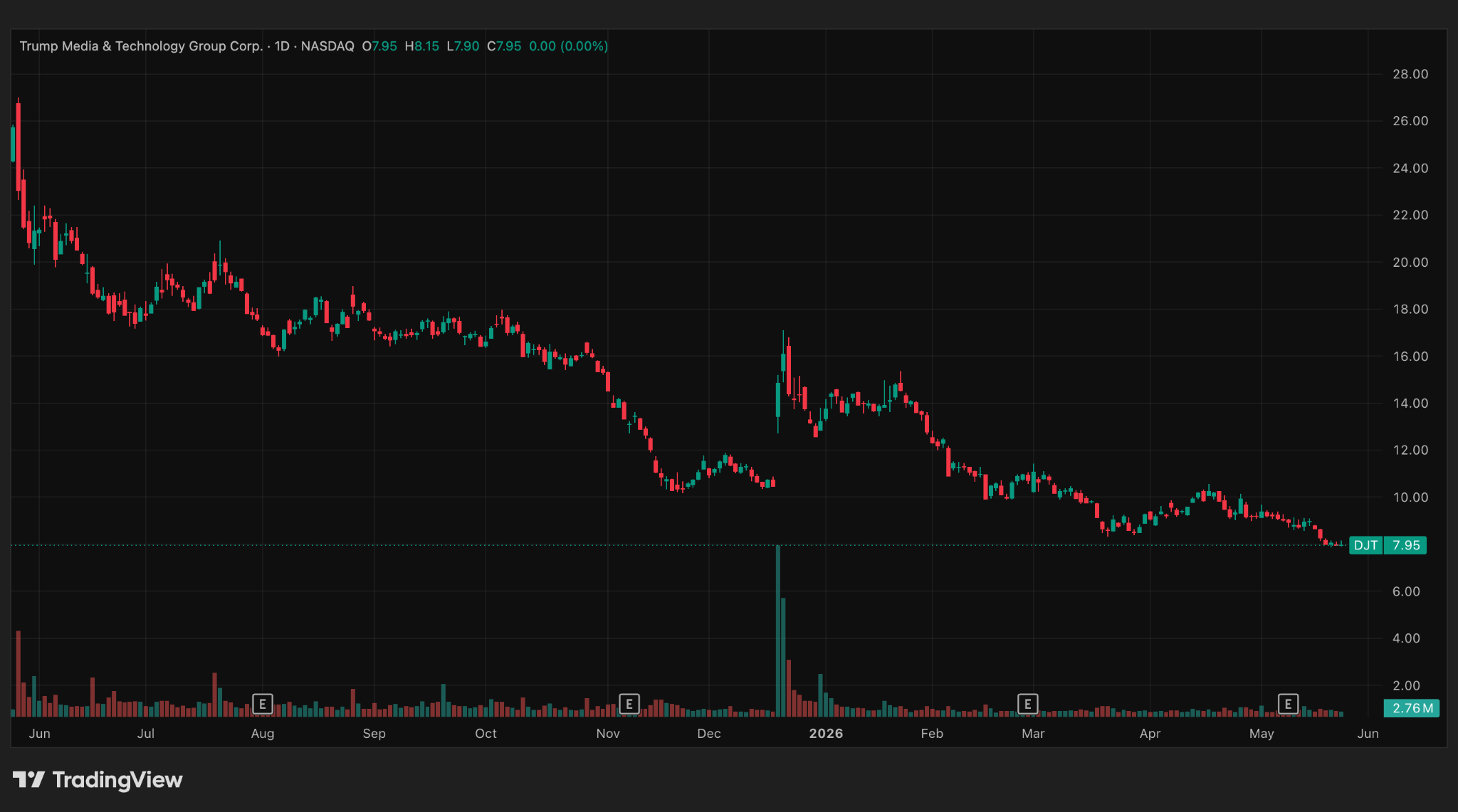
Since the beginning of 2026, the stock price of Trump Media & Technology Group (DJT) has fallen by nearly 40%. Source: TradingView.
From the outset, many analysts expressed skepticism over Trump Media’s ability to secure a foothold in an overheated crypto ETF market dominated by giants like BlackRock and Fidelity.
The situation was further compounded by the fact that TMTG’s proposed products featured virtually no structural differences from those of its competitors, relying instead primarily on marketing and the political brand.
The illusion of onchain transparency
The Trump Media case exposes a systemic issue: despite the transparency of the blockchain, tracking the actual state of corporate crypto reserves remains exceptionally difficult. A large onchain transfer can represent either a forced liquidation or a routine operational process with no underlying intention to divest the assets.
However, public company status dictates its own rules. To prevent panic among traditional investors, management is forced to explain nearly every movement of funds. Under these conditions, clear and timely communication becomes just as vital as the financial strategy itself.
Furthermore, such precedents bring a major regulatory dilemma to the surface. Should the SEC require public companies to disclose their blockchain addresses to enable a full independent audit? Or are wallets a trade secret, the disclosure of which would make executing corporate trading strategies impossible? This question remains unanswered for now.
As for TMTG specifically, the company’s crypto business does not yet look like a sustainable operation with clear economics. The deal with Crypto.com’s parent structure and the sudden withdrawal of ETF applications increasingly resemble an ad hoc search for a model to monetize a political brand, rather than a calculated, long-term strategy.
Ultimately, the main intrigue is not whether the company will sell its Bitcoin. The question is broader. Can such a structure, in principle, withstand the pressure of an aggressive crypto strategy over the long haul?
TLDR:
- Brian Armstrong says real-world asset tokenization enables instant settlement and fractional ownership globally.
- Armstrong calls for 24/7 global trading with pooled liquidity to remove time-zone barriers for all investors.
- Stablecoin payments and AI-powered financial tools are central to Armstrong’s next-generation finance roadmap.
- Sound money and innovation-friendly regulation are essential to completing Armstrong’s eight-point financial reform vision.
Coinbase CEO Brian Armstrong has outlined eight critical areas where the global financial system still needs reform.
These areas range from real-world asset tokenization to sound money principles. Armstrong shared his views publicly, drawing attention from crypto advocates and traditional finance observers alike.
His remarks point to a broader vision for a financial system that is more open, automated, and globally accessible to everyone.
Tokenization and Trading Lead Armstrong’s Reform Agenda
Real-world asset tokenization sits at the top of Armstrong’s list of necessary financial upgrades. He envisions putting real estate, stocks, bonds, and funds on-chain.
This move would enable instant settlement, fractional ownership, and wider distribution of assets globally. The reform would open investment opportunities to people previously excluded from traditional markets.
Armstrong also called for 24/7 global trading as another key upgrade to the financial system. He argued that pooling global liquidity across every asset class would improve capital efficiency.
Better leverage options and around-the-clock access would benefit both retail and institutional traders. This shift would remove time-zone barriers that currently limit market participation worldwide.
On payments, Armstrong pointed to stablecoins as the foundation for next-generation global transfers. He noted that near-instant, low-cost transactions are already possible using existing stablecoin infrastructure.
His remarks also addressed agentic payments, where AI systems transact autonomously on behalf of users. This area is growing quickly as AI adoption accelerates across financial services.
Armstrong further noted that AI-powered tools could transform risk assessment, credit decisions, and compliance monitoring. He said broader access to AI-driven financial advice would benefit underserved populations.
Everyone, he argued, deserves access to a quality financial advisor, not just the wealthy. Better fraud detection through AI would also make the system safer for all participants.
Self-Custody, Capital Formation, and Sound Money Round Out the Vision
Brian Armstrong also stressed the need for innovation-friendly regulation as a prerequisite for meaningful reform. He called for a shift away from one-size-fits-all rules toward risk-based frameworks.
These frameworks should encourage competition rather than protect incumbent financial institutions. Regulatory clarity, he added, is essential for startups building the next generation of financial tools.
Expanded access through open protocols and self-custodial wallets also featured in Armstrong’s outlined priorities.
He argued that reducing middlemen would make financial services more accessible to smartphone users everywhere.
Self-custody gives individuals direct control over their assets without relying on centralized institutions. This model aligns with the decentralized principles that underpin the broader crypto ecosystem.
Armstrong also highlighted low-cost capital formation as a tool to increase startup activity globally. He wants anyone with a viable idea to raise funds without excessive barriers or costs.
Sound money rounded out his list, with Armstrong describing it as a refuge from inflation. He said the job remains unfinished until all eight upgrades work reliably for everyone worldwide.
Crypto World
Dubai Pushes Toward a Cashless Future as Digital Payments Near 90% of Transactions by 2026

Dubai is rapidly accelerating its transformation into one of the world’s leading cashless economies, with authorities aiming for nearly 90 percent of all transactions across both public and private sectors to become fully digital by the end of 2026.
The initiative, known as the “Dubai Cashless Strategy,” was originally announced in October 2024 during a meeting of Dubai’s Executive Council chaired by Sheikh Hamdan bin Mohammed bin Rashid Al Maktoum. The long-term vision is ambitious: positioning Dubai among the top five cashless cities globally while strengthening its status as a global fintech and innovation hub.
Rather than eliminating money itself, the strategy focuses on replacing physical cash transactions with digital alternatives such as banking apps, contactless cards, QR payments, smart wallets, and AI-powered payment technologies.
According to Dubai Finance, the transition could contribute more than AED 8 billion annually to the emirate’s economy by improving efficiency, reducing operational costs, accelerating commerce, and increasing financial inclusion.
Why Dubai Is Moving Toward a Cashless Economy
Dubai’s push toward a digital-first financial ecosystem is part of a broader strategy to modernize infrastructure, support fintech innovation, and create a more connected economy.
Digital payments offer several advantages for governments, businesses, and consumers:
- Faster and more seamless transactions
- Reduced cash handling and operational costs
- Improved transparency and security
- Better integration with smart city infrastructure
- Enhanced financial tracking and analytics
- Greater convenience for residents and tourists
The strategy also aligns with the UAE’s wider ambitions around artificial intelligence, blockchain adoption, smart governance, and digital transformation.
For years, Dubai has positioned itself as a global testbed for emerging technologies. The move toward becoming a largely cashless society represents another major step in that direction.
Digital Payments Are Already Becoming the Standard
Recent developments show that the transition is already underway across multiple sectors.
One of the clearest examples came with the announcement from Parkin that cash payments at parking meters would begin to be phased out starting June 1, 2026. Drivers are now encouraged to pay using the Parkin app, SMS services, or nol cards instead of physical coins.
This may appear like a small operational change, but it reflects a much larger transformation happening throughout the emirate.
Consumers in Dubai are increasingly relying on:
- Apple Pay and Google Pay
- Contactless debit and credit cards
- Banking apps
- QR-based payment systems
- Instant transfer solutions
- Smart mobility payment integrations
The government is also encouraging businesses to modernize payment infrastructure through partnerships and fintech-focused initiatives.
In 2025, Dubai International Financial Centre (DIFC) and Dubai Finance launched workshops and programs designed to help businesses transition toward digital payment systems while introducing AI-driven financial technologies.
What This Means for Tourists Visiting Dubai
The cashless transition will not only impact residents and businesses, but also millions of tourists visiting Dubai every year.
The Central Bank of the UAE has already introduced initiatives aimed at simplifying digital payments for international visitors.
One of the most notable projects is the Tourist Identity initiative, which will allow tourists to instantly open digital bank accounts upon arrival in the UAE. Visitors will gain access to digital debit cards and essential banking services within minutes, significantly reducing the need to carry physical cash.
Tourists will also be able to access the UAE’s domestic card network, Jaywan, and use the Aani instant payment system for transfers and purchases.
Additionally, airlines including Emirates and flydubai have already partnered on initiatives encouraging digital payment adoption among international travelers.
The result is a smoother and more integrated payment experience across hotels, retail stores, transportation systems, restaurants, entertainment venues, and tourist attractions.
Potential Impact on Fintech, Crypto and Web3
While the Dubai Cashless Strategy itself is focused primarily on digital payments rather than cryptocurrencies, the initiative could indirectly accelerate growth across the broader fintech and Web3 ecosystem.
A population increasingly comfortable with digital wallets, instant payments, and app-based financial services creates an environment naturally more open to innovation in areas such as:
- Stablecoins
- Tokenized payments
- Digital identity systems
- Blockchain infrastructure
- Embedded finance
- AI-powered financial services
Dubai has already established itself as one of the world’s most crypto-friendly jurisdictions, attracting exchanges, blockchain startups, Web3 companies, and fintech entrepreneurs from around the globe.
As digital financial behavior becomes more deeply integrated into everyday life, the gap between traditional fintech and blockchain-based finance may continue to narrow.
A Glimpse Into Dubai’s Future
Dubai’s vision goes beyond simply reducing the use of physical cash.
The broader objective is to build a fully interconnected digital economy where payments, transportation, government services, tourism, commerce, and financial services operate seamlessly together.
If the strategy succeeds, paying with cash in Dubai could eventually become the exception rather than the norm.
From parking and public transport to restaurants, shopping malls, and government services, the emirate is steadily moving toward a future where nearly every transaction happens instantly through digital channels.
For residents, businesses, investors, and tourists alike, Dubai’s transition toward a cashless society may become one of the defining economic and technological shifts shaping the city over the coming decade.


Huawei may have just challenged one of the biggest assumptions driving the AI boom, that advanced chips will remain scarce, expensive, and dominated by Western companies like Nvidia and TSMC.
At the 2026 IEEE International Symposium on Circuits and Systems in Shanghai, Huawei introduced a new semiconductor approach called the Tau (τ) Scaling Law alongside a chip architecture known as LogicFolding.
Huawei Pushes Alternative Path Around US Sanctions
The company claims the technology could eventually produce chips with 1.4nm-equivalent transistor density by 2031 without relying on restricted Western lithography equipment.
The announcement immediately fueled debate across tech and financial markets because Nvidia’s massive valuation has largely been supported by the idea that advanced AI computing power will stay difficult and costly to manufacture.
US sanctions imposed since 2019 blocked Huawei from accessing advanced semiconductor manufacturing tools, including ASML’s extreme ultraviolet lithography machines.
Those restrictions were designed to slow China’s progress in AI and advanced computing.
Instead of relying entirely on smaller transistor sizes, Huawei’s new approach focuses on reducing signal delay through vertical chip stacking and shorter internal connections.
According to Huawei, LogicFolding increases transistor density and efficiency while improving chip performance without requiring the world’s most advanced fabrication equipment.
The company said the first commercial products using the technology will appear in Kirin smartphone chips launching later this year. Huawei also plans to integrate the architecture into its Ascend AI chips before 2030.
“If China can produce advanced computing power cheaply and at massive scale, the scarcity premium that justifies Nvidia’s valuation disappears entirely,” analyst Bull Theory highlighted.
The comparison echoes last year’s DeepSeek AI disruption, when Chinese developers released lower-cost AI models that challenged assumptions around expensive compute requirements.
Nvidia Still Holds Major Global Advantages
Despite the excitement surrounding Huawei’s announcement, analysts caution that Nvidia’s dominance remains intact for now.
“…the chipmaker’s AI dominance was unmatched because, unlike its capital-strained rivals, it had the resources to outpace them,” Reuters reported, citing Chris Rossbach of J Stern.
Huawei has not yet released independent benchmarks proving its new architecture can compete with Nvidia’s highest-end AI chips in large-scale training environments.
Manufacturing yields, power efficiency, heat management, and memory integration also remain unresolved challenges.
Nvidia continues to dominate the global AI market through its CUDA software ecosystem, partnerships with Taiwan Semiconductor Manufacturing Company, and leadership in hyperscale AI infrastructure outside China.
Still, the development highlights how US sanctions may have accelerated China’s push toward semiconductor self-sufficiency rather than permanently freezing the country out of advanced computing.
The coming years will likely determine whether Huawei’s architectural breakthrough becomes a genuine alternative to Nvidia’s hardware dominance or remains primarily a domestic Chinese solution.
The post Huawei Cracks the AI Chip Scarcity Story Behind Nvidia’s Massive Valuation appeared first on BeInCrypto.


Prometheum has launched new infrastructure allowing broker-dealers and RIAs to offer tokenized securities through traditional brokerage accounts.
Summary
- Prometheum launched new broker-dealer and RIA infrastructure on May 25 allowing traditional Wall Street firms to offer tokenized securities to investors at scale.
- Co-CEO Aaron Kaplan said crypto has solved tokenisation but not distribution, leaving $24 billion in on-chain securities without a mainstream investor channel.
- Prometheum operates a network of SEC-registered and FINRA-member broker-dealers supporting the full lifecycle of blockchain-based securities from issuance through settlement.
Prometheum launched new infrastructure on May 25 allowing broker-dealers and registered investment advisers to offer tokenized securities and crypto assets through traditional brokerage accounts. The company positions the launch as a bridge between blockchain-based securities and the conventional financial system.
“Crypto has solved tokenization, but it hasn’t solved distribution,” said Aaron Kaplan, co-founder and co-CEO of Prometheum. “There are tens of billions of dollars of tokenized securities already issued on blockchain rails, but almost no mainstream distribution channel to reach investors at scale.”
Why the distribution problem matters more than issuance
More than $24 billion in securities products have already been issued on blockchain networks according to RWA.xyz data. Crypto.news has tracked the rapid growth of tokenised Treasuries from $380 million in 2023 to $13.4 billion by April 2026, with tokenised equities emerging as the fastest-growing sub-sector.
The challenge Kaplan identifies is structural. Issuers can now tokenize securities relatively easily, but reaching mainstream investors requires access to regulated brokerage accounts, settlement infrastructure, and investor onboarding that most blockchain-native platforms do not provide.
Prometheum’s network of SEC-registered and FINRA-member broker-dealers provides correspondent clearing, custody, execution, and recordkeeping for third-party broker-dealers, enabling their clients to access on-chain securities within existing legal frameworks.
What Prometheum’s infrastructure adds to the tokenization market
Crypto.news has reported on BlackRock filing a second tokenised fund application with the SEC through Securitize, signalling institutional demand for regulated tokenization infrastructure is growing from both issuer and distribution sides. The Prometheum approach targets the distribution gap that well-resourced issuers still face, since retail brokerage access to on-chain securities remains limited to a small number of registered platforms.
Crypto.news has also covered Securitize’s plans to launch natively tokenized public stocks with full on-chain settlement. Whether Wall Street brokerage firms adopt Prometheum’s infrastructure will depend partly on whether the Clarity Act’s passage reduces regulatory uncertainty enough to justify the compliance investment.
Bhutan Moves Another 90 BTC as 2026 Transfers Hit $237M

Daniel Suarez Dedicates Coca-Cola 600 Race Win to Kyle Busch

Canelo delivers honest verdict on Ryan Garcia vs Conor Benn: “He’s very brave”


-

 Crypto World4 days ago
Blockchain.com files with SEC for U.S. IPO
-

 Fashion3 days ago
Holiday Weekend Open Thread – Corporette.com
-

 Business3 days ago
Dell Technologies DELL Stock Surges 15% on AI Server Momentum and Analyst Upgrades in 2026
-

 Crypto World4 days ago
Bitcoin Accumulation Weakens as BTC Realized Losses Hit $600M
-

 Crypto World3 days ago
Space X IPO Is ‘Bad News’ for Tech Stocks: But What About Bitcoin?
-

 Politics3 days ago
Makerfield: a tale of two social-media histories
-

 Crypto World2 days ago
Robinhood crypto COO Tanya Denisova exits
-

 Crypto World4 days ago
MicroStrategy’s Saylor Says Miners No Longer Set Bitcoin Price, Another Force Has Taken Over
-

 Business1 day ago
NYT Strands Answers May 24 2026 Revealed for Puzzle No. 812 Theme Summer Essentials
-

 Crypto World3 days ago
AI infrastructure race heats up as IREN pitches full-stack strategy, WhiteFiber lands $160M deal
-
 Tech3 days ago
A 0.12% parameter add-on gives AI agents the working memory RAG can’t
-

 Tech4 days ago
WhatsApp ads could make Irish debut after discussions with DPC
-

 Tech4 days ago
You Can Now Add ChatGPT To PowerPoint
-

 Business4 days ago
Trump Invests $1M-$5M in Kura Sushi USA Chain With 27 California Locations
-

 Sports4 days ago
2026 CJ Cup Byron Nelson leaderboard: Brooks Koepka finds putting stroke in Round 1
-
 NewsBeat4 days ago
Charity run by Reform leader Malcolm Offord accused of ‘law breaking’ over Scottish registration
-

 Crypto World5 days ago
Exa Labs raises $250 million in funding led by a16z
-
Business4 days ago
Goldman Sachs reinstates Ageas stock coverage with neutral rating
-

 Crypto World4 days ago
Trump Media’s Bitcoin Stash Shrinks Again as 2,650 BTC Lands on Crypto.com
-

 Crypto World7 days ago
SEC to propose tokenized stock framework as Wall Street efforts deepen: Bloomberg
You must be logged in to post a comment Login