

Crypto World
Trader Linked to Whale now down $128 million after Ethereum wipeout



Onchain analytics firm Bubblemaps says a Hyperliquid whale linked to former BitForex CEO Garrett Jin and the infamous 10 10 short trade would have been up more than $70 million if he had never traded Ethereum, but is instead sitting on roughly $128 million in net losses after catastrophic ETH longs erased huge prior gains.
Summary
- Bubblemaps estimates the trader is down $128 million overall despite earlier nine figure wins
- The whale reportedly made about $100 million shorting BTC in the October 10, 2025 flash crash
- Subsequent outsized ETH longs on Hyperliquid led to more than $200 million in realized losses
- A linked wallet has now rotated into Hyperliquid again, buying $10 million of HYPE and shorting $38 million of ZEC
In a new onchain breakdown shared on X, Bubblemaps reconstructs the PnL of the wallet cluster it associates with Garrett Jin, arguing that if the trader had simply held BTC and avoided the ETH leverage spiral, his net profit would stand north of $70 million; instead, the account is now “down $128M overall” after a brutal series of Ether trades.
The cluster has been in the spotlight since the so called 10/10 crash on October 10, 2025, when a Hyperliquid whale built massive short exposure into Bitcoin and Ethereum shortly before President Donald Trump announced 100 percent tariffs on Chinese imports, triggering a violent risk off move.
How did a 10 10 legend flip from +$70M to –$128M?
Binance Square’s retrospective on the “10 11 flash crash” notes that the whale held more than 100,000 BTC equivalent and was behind a $735 million BTC short on Hyperliquid, with Arkham Intelligence later estimating between $190 million and $200 million in profit on those shorts across BTC and ETH as prices cratered.
Yahoo Finance separately described the same trader as the “Hyperliquid whale who made nearly $200M on the Oct. 10 crash,” and reported that blockchain sleuths linked the address to Garrett Jin, though Jin denied owning the wallet while acknowledging that he knew the person behind it.
From there, the trade morphs into a case study in overconfidence.
Binance coverage of a March 2025 liquidation recounts how an address on Hyperliquid opened a more than $200 million long position on ETH using 50x leverage, staking about $4.3 million in USDC to control 113,000 ETH before being liquidated in a move that left the protocol itself with a roughly $4 million loss due to insurance fund slippage.
Panoptic’s market intelligence notes and other whale tracking reports suggest that similar oversized ETH longs followed, taking the wallet’s aggregate realized loss on ETH north of $200 million as repeated attempts to time reversals ran into continued volatility and margin calls.
Against that backdrop, Bubblemaps’ claim that the trader swung from a hypothetical +$70 million to –$128 million net is entirely plausible: the original 10 10 BTC short win was massive, but the later ETH leverage series appears to have more than erased it.
What is the 10 10 whale doing now on Hyperliquid?
Despite the drawdown, the same cluster is back on Hyperliquid with a familiar mix of high conviction bets.
Bubblemaps says a connected address has recently deposited several million dollars of collateral to the perpetuals exchange, bought approximately $10 million worth of HYPE, the platform’s native token, and opened a $38 million short position on privacy coin Zcash (ZEC).
That dovetails with other recent whale tracking reports.
Bitcoin.com News described how a trader dubbed “Evaded” accrued about $7.5 million in profit in under four days from leveraged longs on ZEC and HYPE on Hyperliquid, then rolled into a $38.63 million ETH long using 25x leverage, a position that would be automatically liquidated on a roughly 4 percent adverse move.
Whale Alert and PANews have documented the same address pattern closing profitable HYPE, ZEC and ETH longs for about $4.6 million in gains, then opening a 990 BTC short worth nearly $75 million on Hyperliquid as BTC came under pressure from ETF outflows and derivatives liquidations.
While those reports focus on a pseudonymous trader called Evaded, Bubblemaps’ new thread argues that at least one of these high frequency, high notional Hyperliquid whales can be tied through address clustering and historical flows back to the 10 10 short and the entity it links to Garrett Jin.
The picture that emerges is of a trader who oscillates between periods of spectacular success and ruinous overreach, with the core pattern unchanged: concentrated directional bets on BTC and ETH around macro events, and now similarly aggressive positioning in platform tokens like HYPE and high beta names such as ZEC.
Why this whale matters for markets
On an absolute scale, a net PnL of –$128 million is a rounding error in a multi trillion dollar crypto market, but the 10 10 whale saga is a vivid illustration of how even elite operators with accurate reads on one regime can blow up when they assume the same playbook will work forever.
It also underscores how much of the Hyperliquid and perps venue narrative is driven by a handful of very large accounts whose wins and losses can distort funding rates, liquidity and sentiment for the rest of the market in the short term, especially when they pivot from being the bid to being the offer on assets like BTC, ETH, HYPE or ZEC.
For traders watching flows, Bubblemaps’ work adds another lens: rather than treating each new whale as an isolated story, it invites you to look at the entire career arc of a wallet cluster, and to ask whether you are front running a disciplined asymmetric player or shadowing a gambler who just torched nearly nine figures trying to replay last cycle’s script.


TLDR
- A third-party module exploit drained about $3.2 million from 86 Gnosis Safe wallets.
- Squid confirmed it had no role in deploying or operating the vulnerable contract.
- The attacker bypassed security by using a fake validation string accepted by the module.
- Stolen funds were swapped through Uniswap V3 pools into a worthless attacker-created token.
- The attacker consolidated around $3.07 million in DAI into a single wallet.
A third-party module exploit drained about $3.2 million from 86 Gnosis Safe wallets across Ethereum and Base. Squid clarified it had no role in the vulnerable contract and distanced itself from the incident. Security firms Blockaid and PeckShield confirmed the attack unfolded within roughly two hours.
The compromised contract appeared on Basescan under the name SquidRouterModule. However, Squid stated the module was unrelated to its core infrastructure.
Squid Denies Involvement in Exploited Module
Squid co-founder Fig addressed the issue in a public post on X. He said, “The contract called SquidRouterModule is unrelated to Squid.”
The project explained that its core router remained separate and unaffected. It added that the team had no knowledge of who deployed the contract. The official Squid account also corrected early reports linking the exploit to its system. It stated that the module only shared the name and had no direct connection.
The team emphasized that the product was built by a third party. It said the module integrated with several protocols without prior coordination. Squid confirmed it had no contact with the developers behind the contract. The project maintained that its systems remained secure throughout the event.
Exploit Drained Funds Through Fake Validation and Swaps
According to investigators, the module accepted a caller-supplied string as proof of message security. This flaw allowed attackers to bypass signature verification. Once validated, attackers executed arbitrary calldata from affected Safes. This enabled unauthorized transfers of tokens without owner approval.
Blockaid reported that the attacker used Foundry-based exploit contracts. These contracts impersonated authorized delegates through the module’s DelegateBundler function. The attacker routed stolen assets through Uniswap V3 pools. They swapped tokens into a worthless asset labeled “u.”
After swaps, the attacker removed liquidity from those pools. They then consolidated the funds into about $3.07 million in DAI. PeckShield confirmed the funds now sit in a wallet starting with “0xa447…54859.” The firm also traced initial funding of 2.1 ETH to Tornado Cash.
The incident adds to growing crypto losses in 2026. DeFi platforms have recorded over $770 million in total losses this year. April alone saw around 30 separate incidents. These events resulted in more than $630 million drained from various protocols.
Squid recently raised $6 million in a funding round led by North Island Ventures. Ripple, Dialectic, and Borderless also participated. The project stated it has completed nine independent audits. It also reported 99.99% uptime with no prior exploit incidents.



Cross-chain compliance gaps at blockchain bridges are crypto’s most dangerous AML blind spot, ThetaRay CEO Brad Levy says.
Summary
- Brad Levy, CEO of ThetaRay, says compliance teams routinely lose visibility at blockchain bridges, the point where assets move between different chains.
- ThetaRay’s AI flagged a UK retail customer declared as a packer who received over £134,000 from 40 counterparties before executing regular crypto purchases.
- Levy says any bank with a fiat-to-crypto blind spot will face regulators treating it as a governance failure within the next 12 months.
Compliance teams monitoring crypto transactions lose the trail the moment assets cross a blockchain bridge. Brad Levy, CEO of ThetaRay, calls this the Cross-Chain Compliance Gap, the blind spot that emerges when funds move from Ethereum to a Layer 2 or alternative chain and the transaction data fragments at the crossing point.
“Somewhere between where Ethereum ends and an L2 or alternative chain begins, the data becomes fragmented as the money moves through blockchain bridges,” Levy said. In 2026, real transaction volumes are scaling through these routes and legacy banks are encountering a frontier their AML systems were never built for.
Why blockchain bridges are the gap no one is watching
TRM Labs has documented that most illicit actors in 2026 move assets through bridges and privacy tools within minutes. The structural problem: retail bank AML sees fiat, blockchain analytics tools see the crypto side, and neither sees the bridge.
“No one sees the bridge,” Levy said. “Since ThetaRay’s AI is agnostic to the rail, it provides the connective tissue that monitors the behavioral fingerprint of the individual across both worlds.”
ThetaRay recently flagged a UK retail customer declared as a packer, an occupation not associated with high-volume financial activity. The system found she had received over £134,000 from nearly 40 counterparties, including nine companies with no previous history, then executed regular crypto purchases multiple times a month, often on consecutive days.
“While traditional rule-based systems would have classified these as isolated transfers, our AI connected the dots and flagged them as an unlicensed crypto exchange or illicit investment portal,” Levy said.
Crypto.news has reported on AML becoming the dominant enforcement axis in crypto in 2026, with fines exceeding $900 million in the first half of 2025 alone.
How criminals use chain-hopping to reset their financial history
Levy describes L2s and blockchain bridges as reset buttons, resetting the financial history of funds at each hop. By the time a legacy bank flags a fiat withdrawal as suspicious, the money has already moved through multiple chains.
“Criminals understand that a retail bank’s AML system isn’t talking to a Solana explorer in real time,” Levy said. “They reset their financial history by leveraging the complexity of L2s and bridges.”
Crypto.news has tracked CertiK research showing AML enforcement overtook securities classification as the primary risk axis for crypto businesses in 2026.
What the next two years will demand from banks and regulators
Levy’s outlook for the next 12 to 24 months is a structural shift he calls “converged monitoring,” collapsing separate Retail AML and Crypto Risk teams into a single AI-driven overlay that tracks an individual’s behaviour across all transaction types.
“Having separate teams for Retail AML and Crypto Risk will no longer be a viable strategy,” Levy said. The overlay he foresees maintains a risk profile for each individual continuously, not just when they cross a monitored threshold on a single rail.
Crypto.news has covered the US Treasury proposing AML rules for stablecoin issuers under the GENIUS Act, treating payment stablecoin operators as financial institutions under the Bank Secrecy Act.
Levy sees the direction as unambiguous. “If there are any blind spots between fiat and crypto over the next year, they will be viewed as governance failures,” he said.


Stanford cryptographer Dan Boneh says Bitcoin should prepare for quantum risk now, but warns a rushed post quantum migration could cause worse failures than the threat itself.
Summary
- Boneh said “a hasty transition to post quantum, in my mind, is more likely to cause a catastrophic bug than we’ll be attacked by a quantum computer.”
- Google’s March 2026 whitepaper said breaking secp256k1 could require as few as 1,200 logical qubits and fewer than 500,000 physical qubits on some superconducting assumptions.
- The debate now centers on timing, migration design, and proposals such as BIP 361 for phasing out legacy Bitcoin signatures.
Bitcoin’s post quantum transition debate is escalating after Isabel Foxen Duke highlighted a fresh interview with Stanford cryptographer Dan Boneh, who argued that the bigger near term danger may be a buggy migration rather than an imminent quantum attack on the network.
In the interview, Boneh said, “Don’t panic, but don’t ignore,” framing quantum risk as a serious long range engineering problem rather than an immediate doomsday event for Bitcoin (BTC).
His most pointed remark was the one amplified on X: “If you try to aggressively move to a post quantum architecture, like for example by 2029, I think that would be a mistake for the blockchain,” adding that “a hasty transition to post quantum, in my mind, is more likely to cause a catastrophic bug than we’ll be attacked by a quantum computer.”
Why is Bitcoin discussing quantum now?
The immediate trigger is a March 30 whitepaper from Google Quantum AI, coauthored by Boneh, which said Shor’s algorithm against the 256 bit elliptic curve discrete logarithm problem on secp256k1 could run with “≤1200 logical qubits and ≤90 million Toffoli gates” or “≤1450 logical qubits and ≤70 million Toffoli gates.”
The paper added that, on superconducting architectures with 10−3 physical error rates and planar connectivity, those circuits “can execute in minutes using fewer than half a million physical qubits.”
Boneh told Foxen Duke that Google’s estimates matter, but he still views a cryptographically relevant quantum computer before 2035 as possible yet unlikely under current funding levels. He said anything by the end of the decade “seems very aggressive,” though not impossible if the field were treated like a national priority.
That tension has already spilled into Bitcoin governance. BIP 361, titled “Post Quantum Migration and Legacy Signature Sunset,” says more than 34% of all bitcoin had revealed a public key on chain as of March 1, 2026, leaving those UTXOs theoretically vulnerable to a sufficiently powerful quantum attacker.
What is Boneh actually proposing?
Boneh is not arguing for complacency. He said Bitcoin “will survive” quantum risk and called claims that it cannot “insane,” because the core path is already known: move users toward post quantum addresses and signatures, then phase out vulnerable legacy paths over time.
But he also criticized compressed migration windows. In the interview, he said a proposal like BIP 361 needs more complete design work and more time, while pointing to longer dated transition thinking as more reasonable.
The dispute is broader than timelines. Boneh argued Bitcoin should strongly consider hybrid signatures that combine existing elliptic curve cryptography with post quantum schemes, rather than forcing a binary jump. He also said he would prefer lattice based signatures over purely hash based designs because they preserve more room for threshold signatures and further cryptographic innovation.
That argument sits inside a wider industry push. In another crypto.news report, Coinbase advisers similarly warned that the threat is not immediate but preparation cannot wait. And in crypto.news coverage, the current consensus remained that no existing machine can break Bitcoin today, even as the estimated resource threshold is falling.

Key Highlights
-
Security Matters stock advances on growing recycling authentication demand
-
SMX shares climb as verification technology gains commercial relevance
-
Material traceability solutions enhance SMX’s position in plastic markets
-
Escalating production expenses boost demand for certified recycled content
-
Corporate brands pursue authenticated proof for sustainable plastic sourcing
Security Matters (SMX) stock closed at $7.76, registering a 2.65% increase following volatile trading that touched $7.85. The upward movement coincided with heightened commercial interest in authenticated recycled plastic systems. Escalating raw material expenses have positioned verification and supply chain transparency as critical components within the global plastics industry.
SMX (Security Matters) Public Limited Company, SMX
Security Matters Stock Benefits from Heightened Industry Cost Pressures
The recent uptick in SMX’s share valuation mirrors expanding market attention toward certified recycled plastic ecosystems. Security Matters delivers technology solutions designed to authenticate recycled material content throughout complex supply networks. Furthermore, the company’s infrastructure enables continuous material monitoring, identity verification, and regulatory documentation support.
Production companies currently contend with elevated expenses spanning energy procurement, freight operations, and petroleum-derived raw materials. These economic strains impact sectors including packaging production, consumer product manufacturing, distribution networks, food preservation systems, and healthcare supply chains. Consequently, recycled plastic alternatives have evolved beyond mere environmental marketing narratives.
Plastic materials continue serving essential functions in consumer products and commercial manufacturing. They provide product protection, prolong product viability, and underpin extensive distribution systems. Nevertheless, increasing petroleum-linked expenses are fundamentally altering corporate evaluation criteria for recycled material sourcing strategies.
Authentication Technology Emerges as Financial Management Strategy
SMX establishes verifiable identity credentials for recycled plastics through proprietary molecular tagging systems. The organization integrates imperceptible markers directly into material substrates while connecting them to blockchain-secured digital documentation. This architecture enables corporations to monitor material origins, composition percentages, custody transfers, and regulatory alignment status.
This infrastructure empowers organizations to validate procurement specifications and material authenticity. It simultaneously serves purchasing departments, compliance officers, government agencies, supplier networks, and end consumers. Additionally, authenticated documentation streams can minimize commercial conflicts surrounding recycled content declarations.
The company’s service portfolio encompasses material authentication, custody documentation protocols, digital material credentials, and comprehensive lifecycle tracking capabilities. These offerings facilitate recycled plastic integration into premium industrial applications. Therefore, verification infrastructure can accelerate market penetration during periods of intensified cost sensitivity.
Security Matters Capitalizes on Transforming Material Economics
Virgin plastic pricing typically correlates with petroleum feedstock valuations, energy market fluctuations, and logistics expenditures. Diesel fuel inflation simultaneously elevates freight costs across truck-transported merchandise categories. These dynamics cascade through packaging systems, retail operations, and consumer household goods.
This transformation signals the emergence of Economic Parity within recycled plastic markets. This concept describes the inflection point where recycled and virgin plastic cost structures begin converging. Upon reaching this threshold, authenticated recycled materials transition into strategic financial instruments rather than exclusively sustainability-driven alternatives.
SMX positions itself strategically within this evolution by emphasizing authentication, material identity verification, and comprehensive data infrastructure. Absent robust verification protocols, recycled plastic encounters skepticism and inadequate documentation standards. Through enhanced certification frameworks, organizations can deploy recycled inputs with improved confidence alongside more precise expenditure management capabilities.
Key points:
- Bitcoin needs to cross and maintain above $78,000 to start a stronger recovery toward $84,000.
- HYPE and ZEC remain strong while other major altcoins struggle to rise above their overhead resistance levels.
Bitcoin (BTC) bounced on Saturday following US President Donald Trump’s announcement in a post on his Truth Social platform that negotiations between the US and Iran were “proceeding in an orderly and constructive manner.” Buyers extended the recovery on Monday and are attempting to sustain above $77,500.
The uncertainty of the past few days has resulted in $1.55 billion in net outflows from the US BTC exchange-traded funds. Crypto sentiment platform Santiment said in a report on Friday that sharp outflows from BTC ETFs indicate retail capitulation, which has “historically correlated with conditions favorable for patient accumulation” for long-term holders rather than panic.
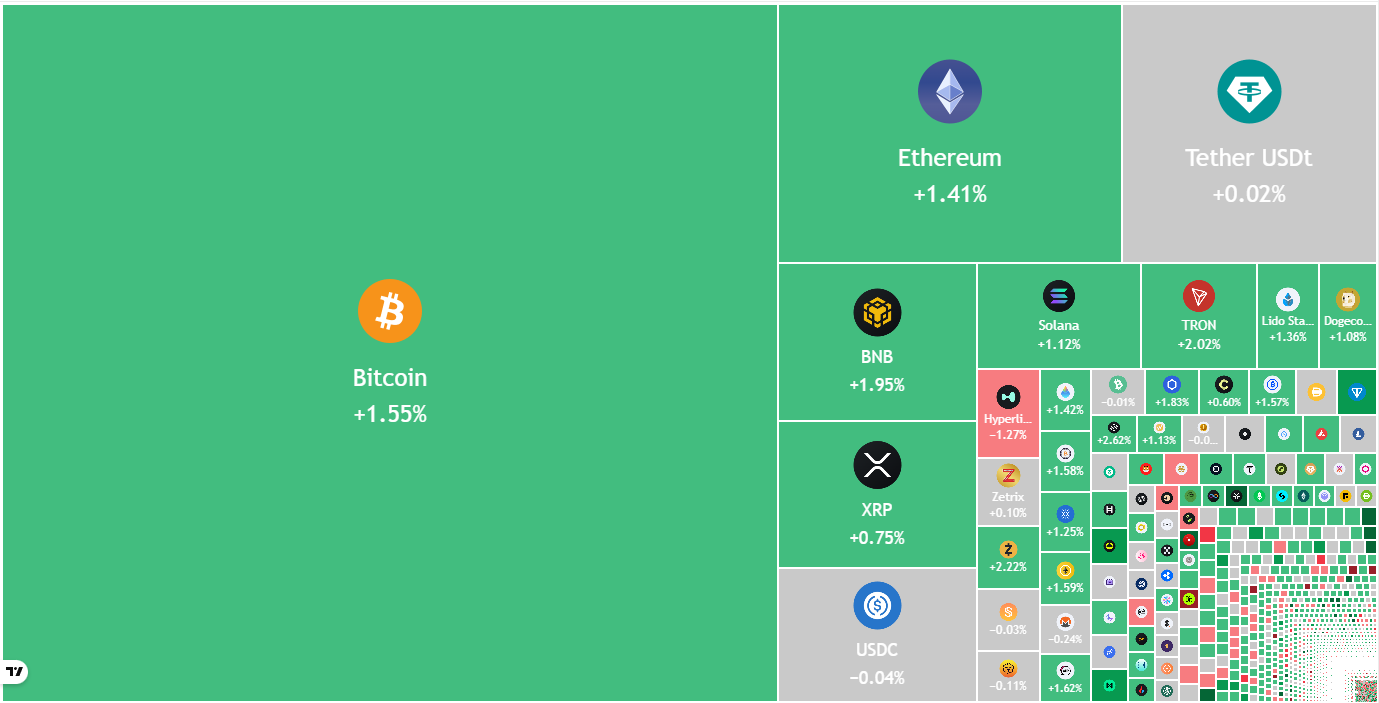
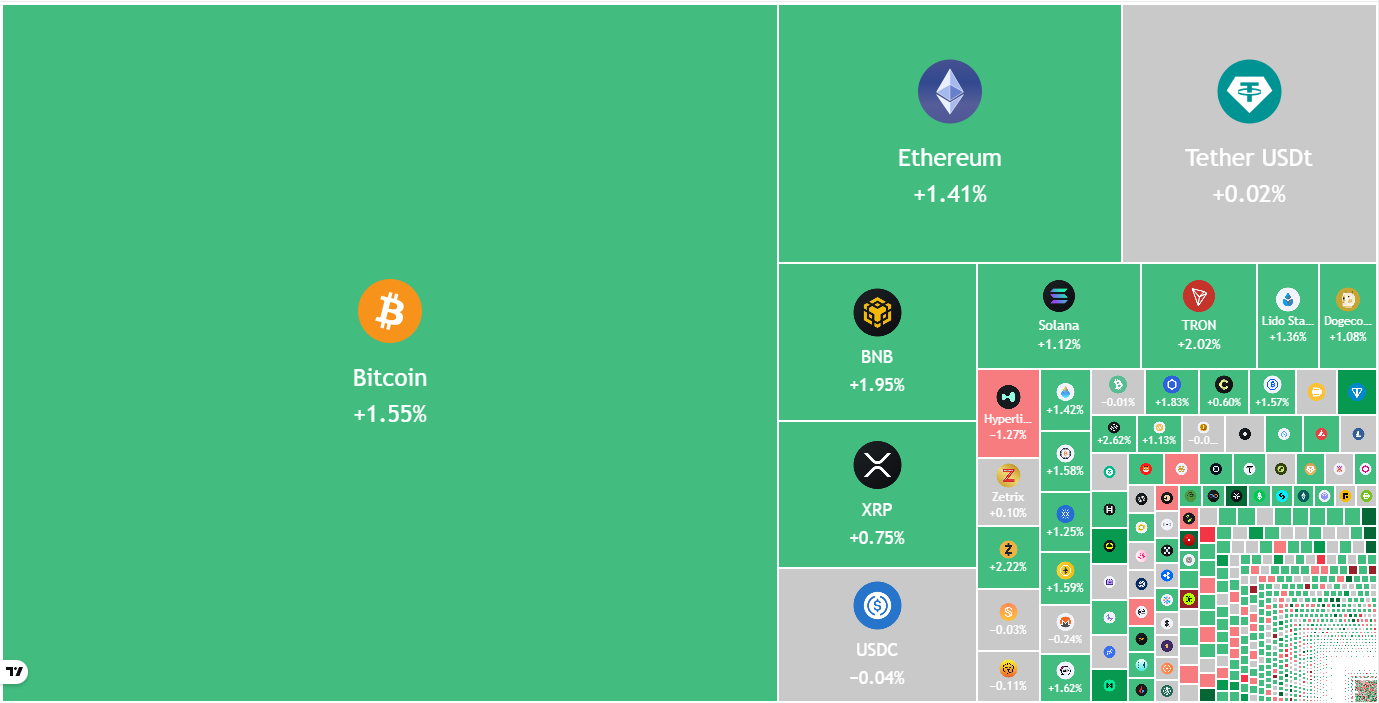
Crypto market data daily view. Source: TradingView
CryptoQuant analyst Darkfost said in a post on X that BTC’s apparent demand has dropped to about -147,000 BTC, the most bearish since December 2025. That suggests a sustainable rally would be difficult without the support of genuine spot demand. However, the analyst added that the current environment creates “interesting opportunities for long-term investors capable of remaining patient.”
Could BTC and the major altcoins break above their overhead resistance levels? Let’s analyze the charts of the top 10 cryptocurrencies to find out.
S&P 500 Index price prediction
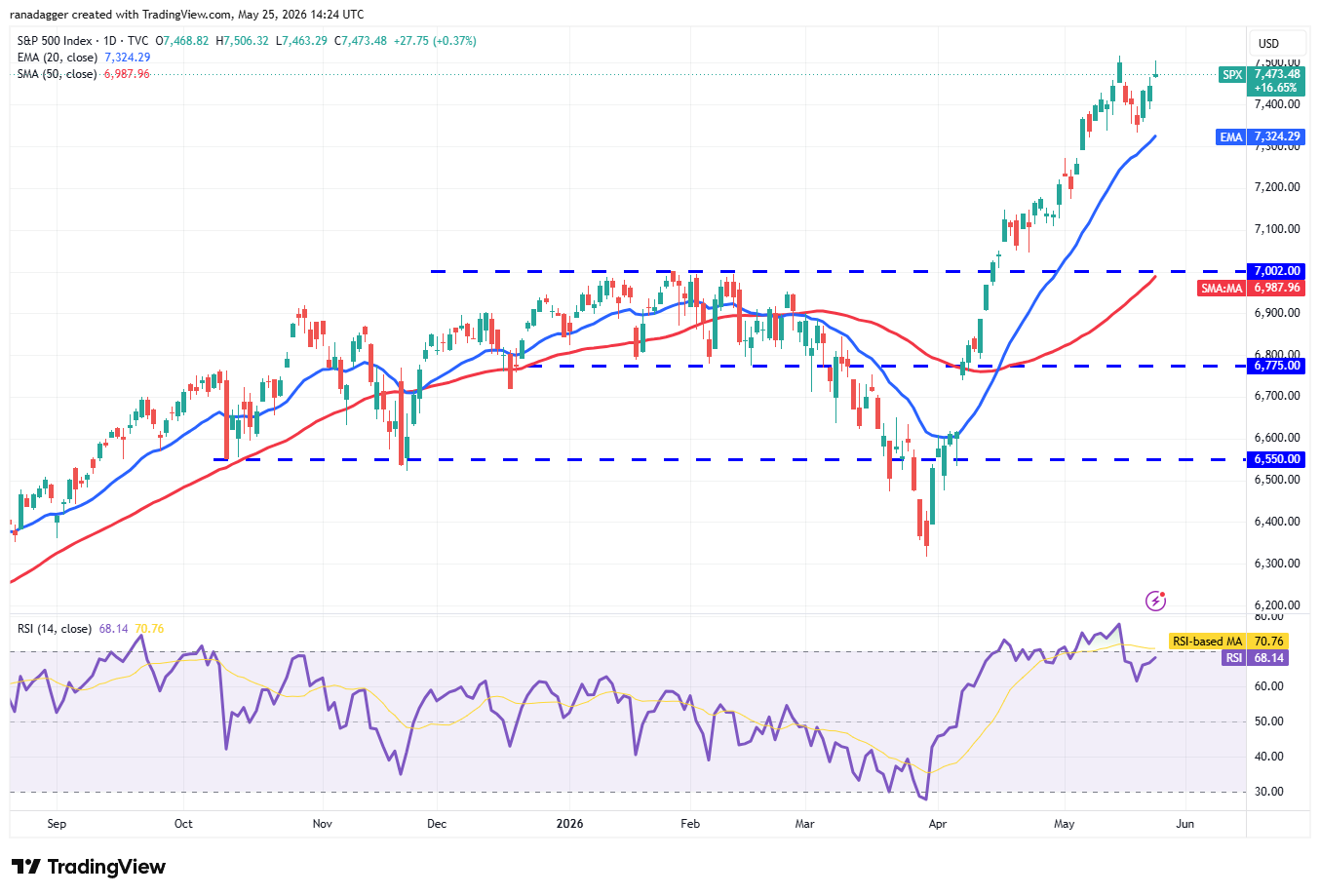
The S&P 500 Index (SPX) rallied toward the all-time high of 7,517 on Friday, indicating that buyers remain in command.
SPX daily chart. Source: Cointelegraph/TradingView
If the price rises and maintains above 7,500, the index may start the next leg of the uptrend toward the 8,000 level.
The first sign of weakness will be a break and close below the 20-day exponential moving average (7,324). Such a move suggests that the short-term traders are booking profits. That may start a deeper correction to 7,180 and then the breakout level of 7,002. Until then, all dips are likely to be viewed as a buying opportunity.
US Dollar Index price prediction
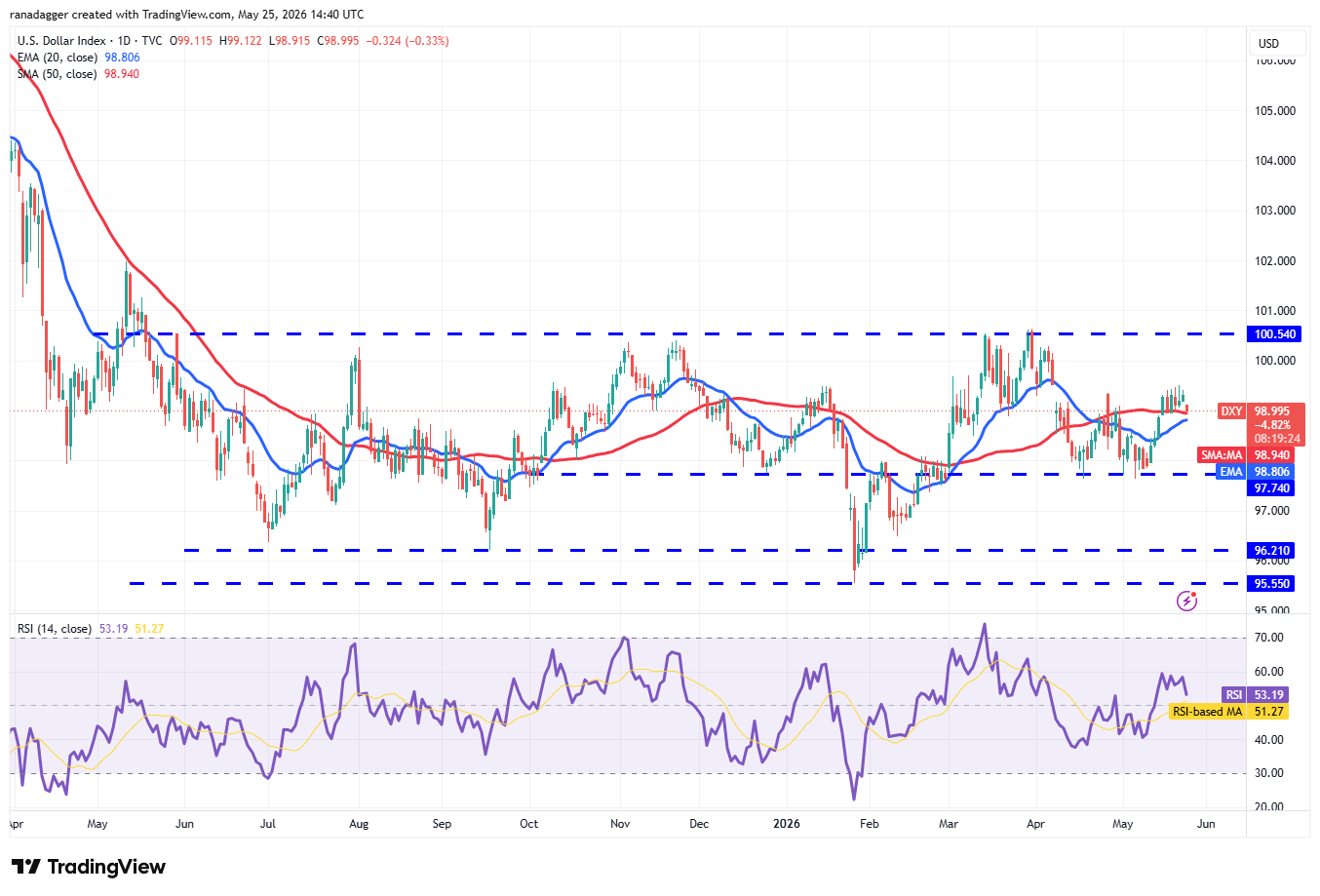
The US Dollar Index (DXY) turned down from 99.51 on Thursday, indicating that the sellers are active at higher levels.
DXY daily chart. Source: Cointelegraph/TradingView
The 20-day EMA (98.80) is expected to act as a strong support on the way down. If the price rebounds off the 20-day EMA with strength, it increases the likelihood of a rally above the 99.51 level. The index may then climb to the stiff overhead resistance at 100.54. Buyers will have to pierce the 100.54 level to signal the start of a new up move.
Sellers are likely to have other plans. They will attempt to pull the price below the 20-day EMA, opening the door to a drop toward the 97.74 support.
Bitcoin price prediction
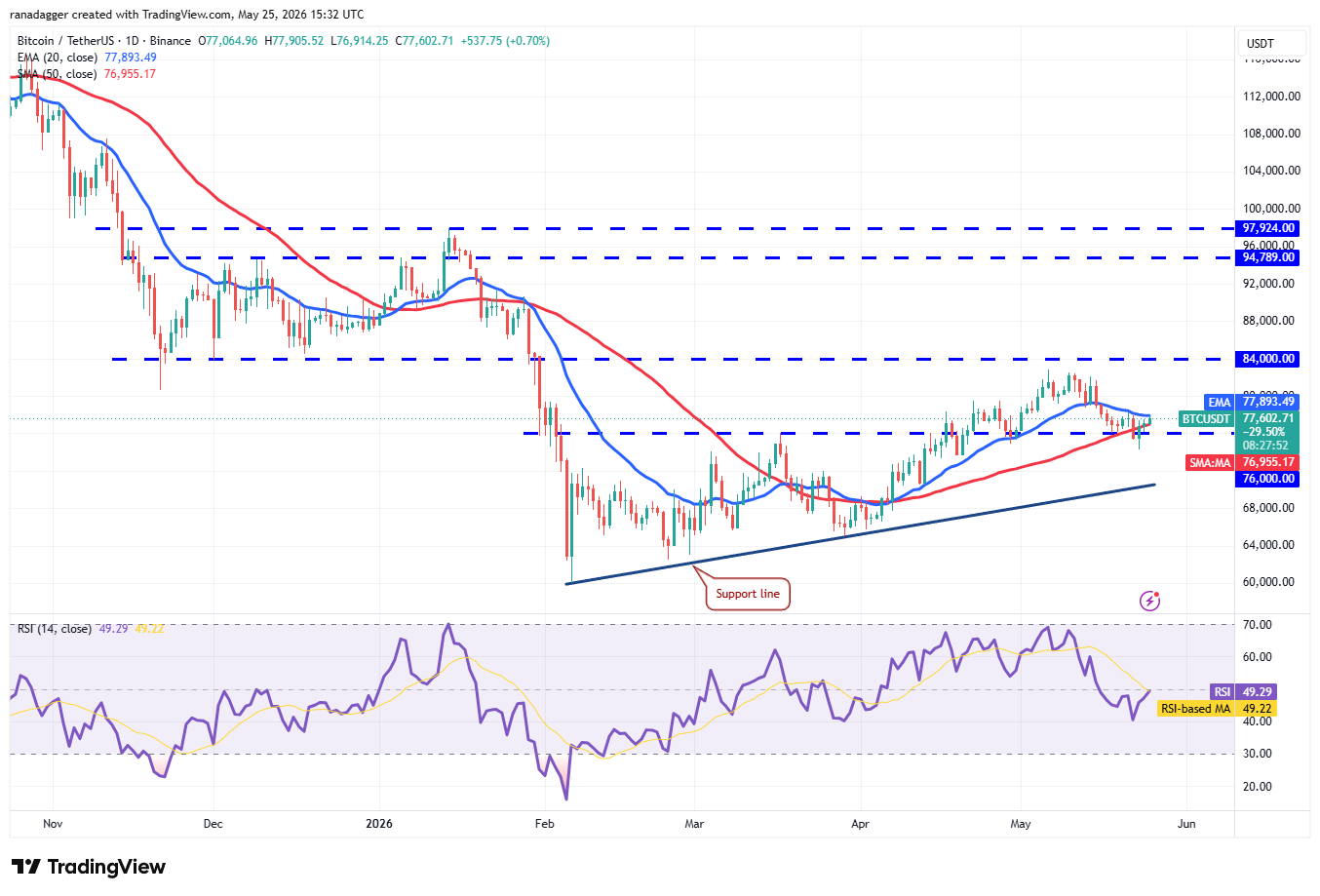
BTC closed below the $76,000 support level on Friday, but the bulls bought the dip and reclaimed it on Saturday. That shows demand at lower levels.
BTC/USDT daily chart. Source: Cointelegraph/TradingView
Sellers are attempting to stall the relief rally at the 20-day EMA ($77,893), but the bulls continue to exert pressure. If buyers propel the price above the 20-day EMA, the BTC/USDT pair may climb to $80,000 and eventually to $84,000.
Contrary to this assumption, if the BTC price declines and breaks below $74,289, it suggests the bears are attempting to take charge. The pair may then slide toward the support line, which is likely to attract buyers.
Ether price prediction
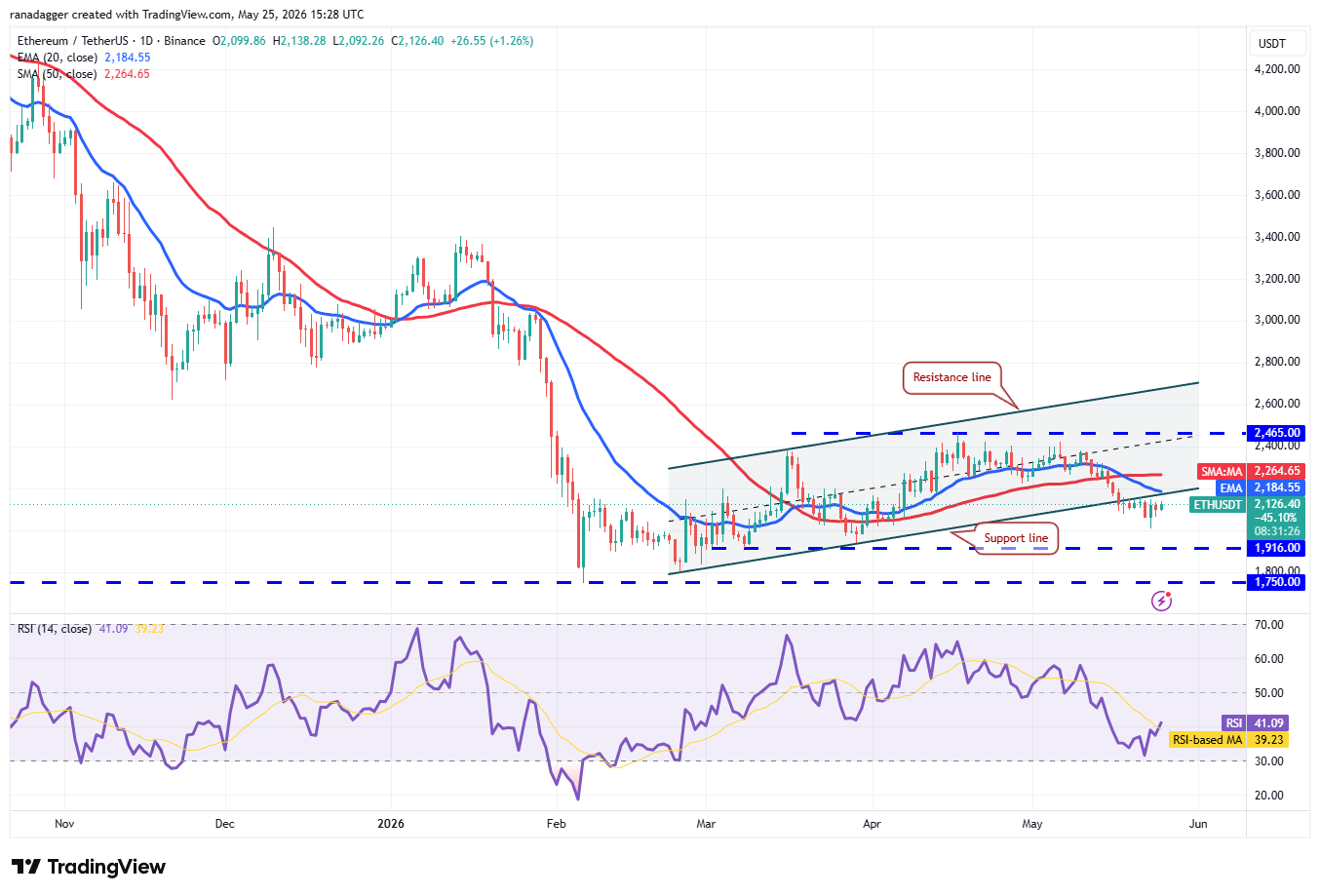
Buyers are attempting to push Ether (ETH) back into the ascending channel pattern, but the bears have held their ground.
ETH/USDT daily chart. Source: Cointelegraph/TradingView
The downsloping 20-day EMA ($2,184) and the relative strength index (RSI) in the negative zone indicate a slight edge to the bears. If the price drops below the 20-day EMA, the ETH/USDT pair may dip to the psychological level of $2,000, then to $1,916.
This negative view will be invalidated in the near term if the bulls push ETH price above the moving averages and hold. If that happens, it suggests that the market rejected the break below the support line. The pair may then ascend to the $2,465 resistance.
XRP price prediction
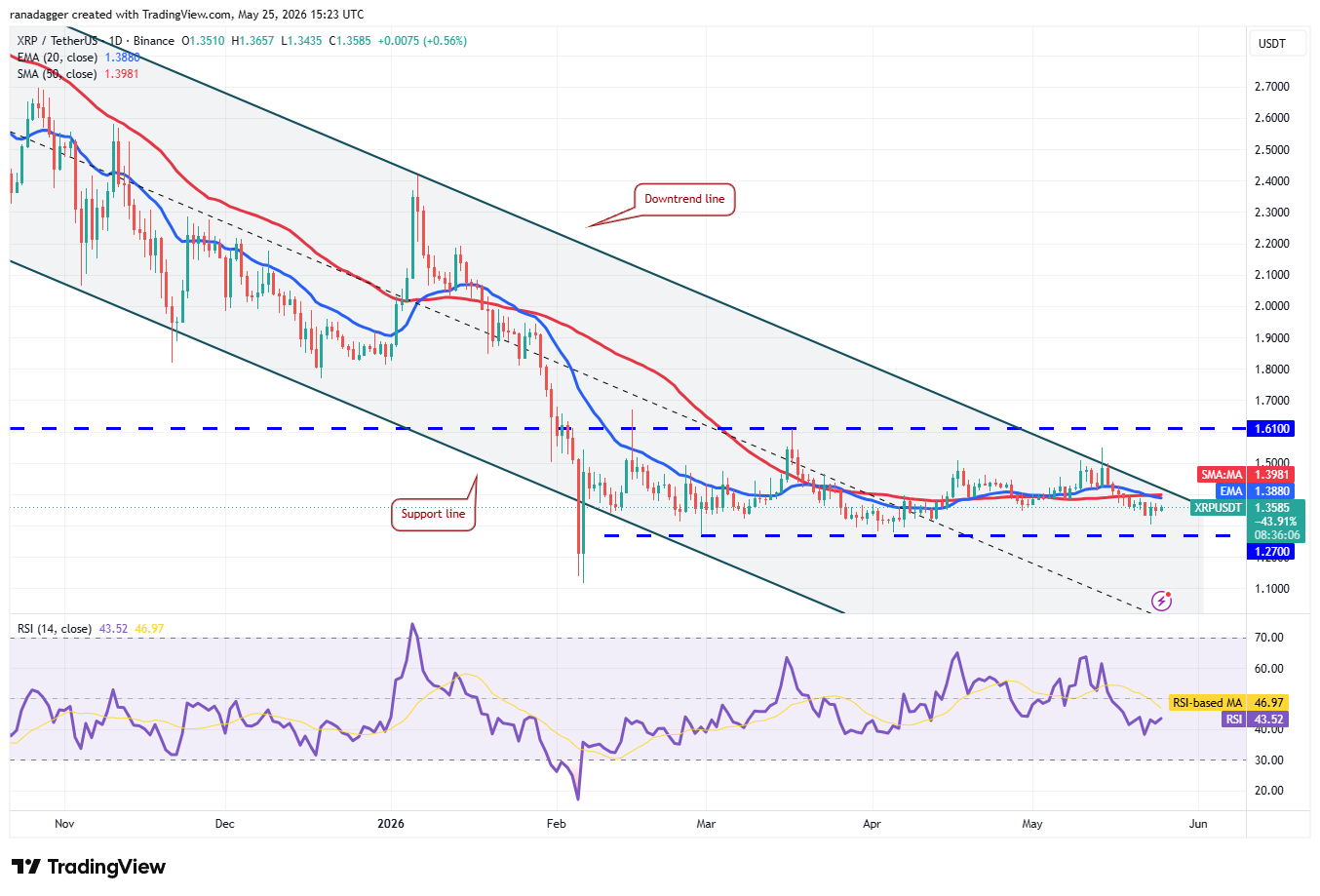
XRP (XRP) continues to trade below the moving averages, indicating that the bears remain in control.
XRP/USDT daily chart. Source: Cointelegraph/TradingView
Sellers will attempt to strengthen their position by pushing the XRP price below the $1.27 support level. If they manage to do that, the XRP/USDT pair may plummet to $1.11, then to the psychological support level at $1.
Buyers will have to achieve a close above the downtrend line of the descending channel pattern to signal a comeback. If they do that, the pair may rise to the $1.61 overhead resistance. A close above $1.61 signals a potential trend change.
BNB price prediction
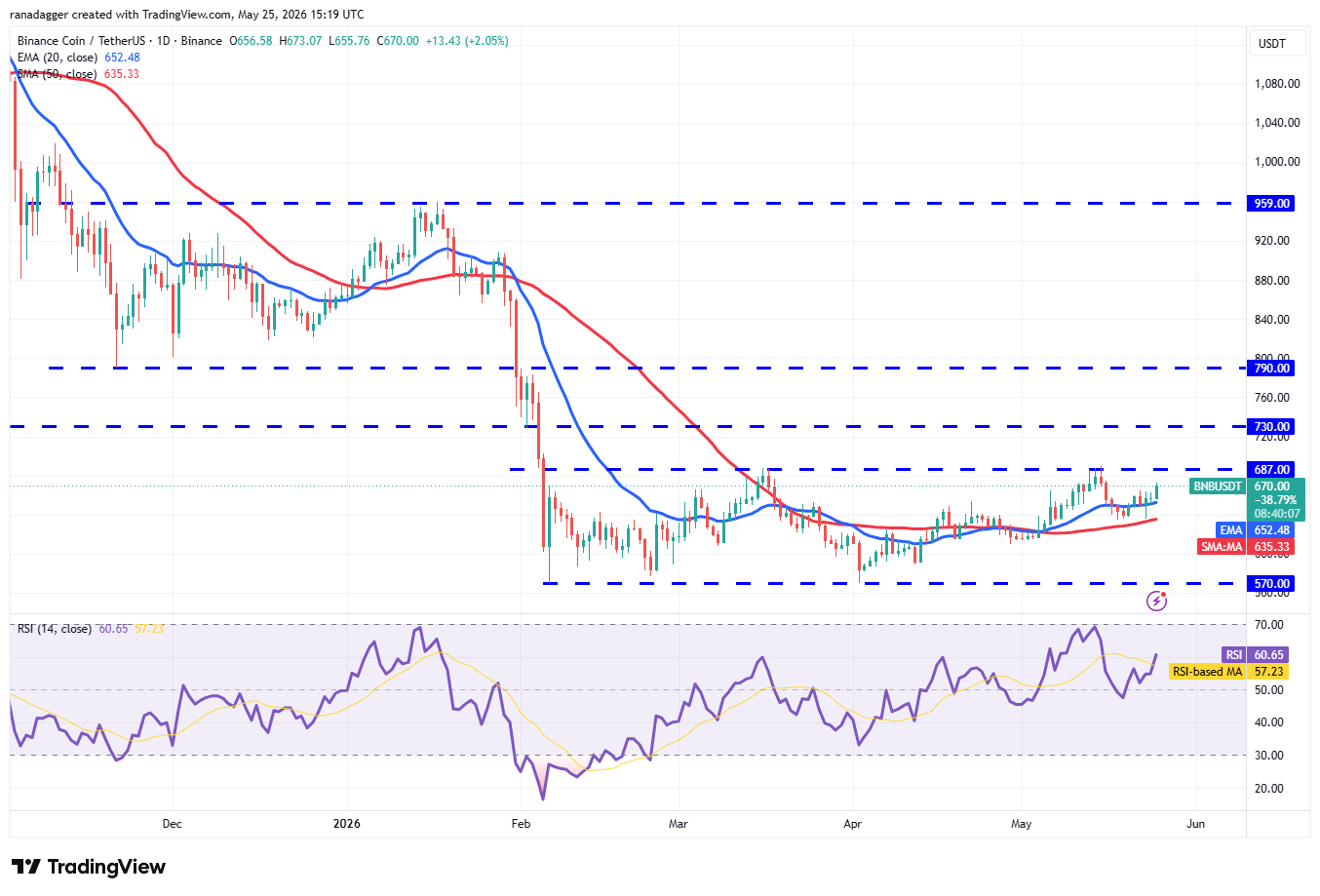
BNB (BNB) dipped below the 20-day EMA ($652) on Saturday, but the long tail on the candlestick shows buying near the 50-day SMA ($635).
BNB/USDT daily chart. Source: Cointelegraph/TradingView
The flattish 20-day EMA and the RSI just above the midpoint give a slight edge to the bulls. Buyers will have to secure a close above the $687 resistance to signal the start of a new uptrend toward $730, and subsequently toward $790.
Instead, if the BNB price declines from the $687 level and breaks below the 50-day SMA, it suggests the bears have not given up. The BNB/USDT pair may then extend its stay inside the $570 to $687 range for some more time.
Solana price prediction
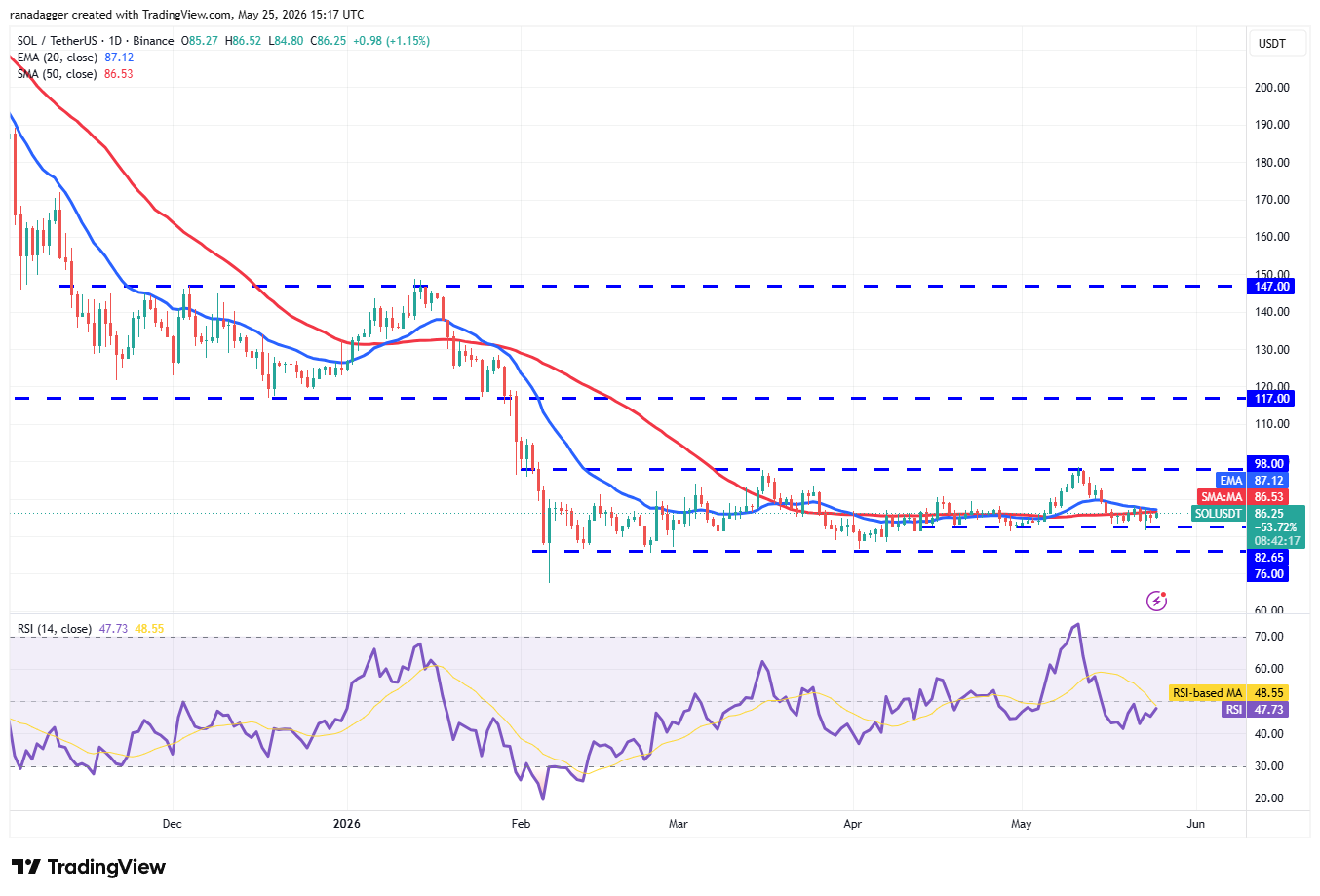
Solana (SOL) bounced off the $82.65 support on Saturday, but the bulls are struggling to clear the 20-day EMA ($87.12) hurdle.
SOL/USDT daily chart. Source: Cointelegraph/TradingView
If the price drops below the 20-day EMA, sellers will again attempt to push the SOL/USDT pair below the $82.65 support. If they can pull it off, the SOL price may plummet to the $76 support. Buyers are expected to aggressively defend the $76 level, as a close below it may sink the pair to $67.
On the upside, a break and close above the 20-day EMA suggests selling pressure is easing. The pair may then attempt a rally to the $98 level, where the bears are expected to mount a strong defense.
Related: XRP price in ‘value zone’ near $1.40 as whales pull $170M from exchanges
Dogecoin price prediction
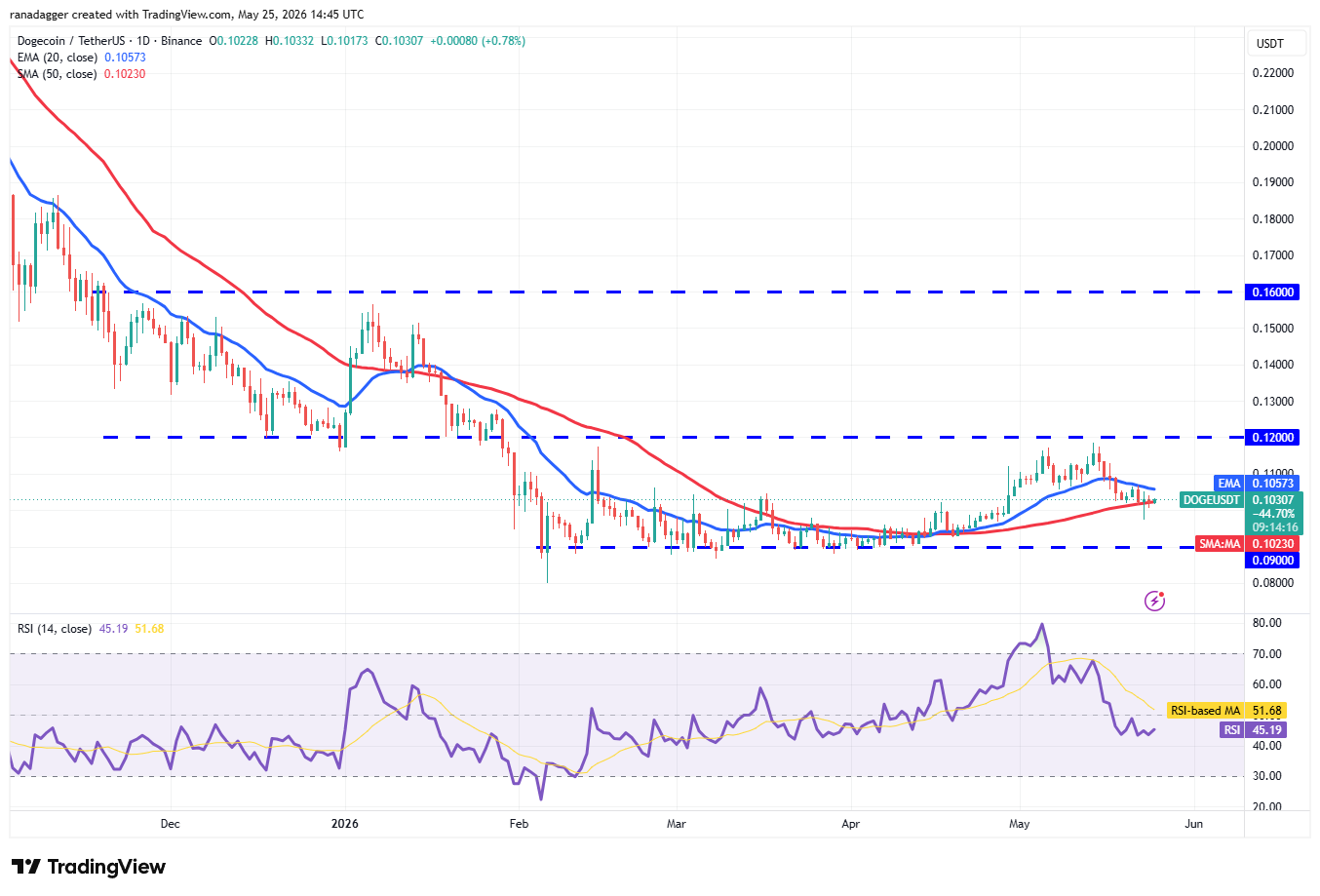
Buyers are attempting to maintain Dogecoin (DOGE) above the 50-day SMA ($0.10), but the bears have kept up the pressure.
DOGE/USDT daily chart. Source: Cointelegraph/TradingView
The downsloping 20-day EMA ($0.10) and the RSI in the negative territory indicate an advantage to bears. A close below the 50-day SMA clears the path for a drop to the $0.09 level. Buyers will attempt to keep the DOGE price within the $0.09 to $0.12 range by defending the support level.
Alternatively, a close above the 20-day EMA signals buying at lower levels. The DOGE/USDT pair may then rally to the $0.12 resistance. A close above the $0.12 level clears the path for a new up move.
Hyperliquid price prediction
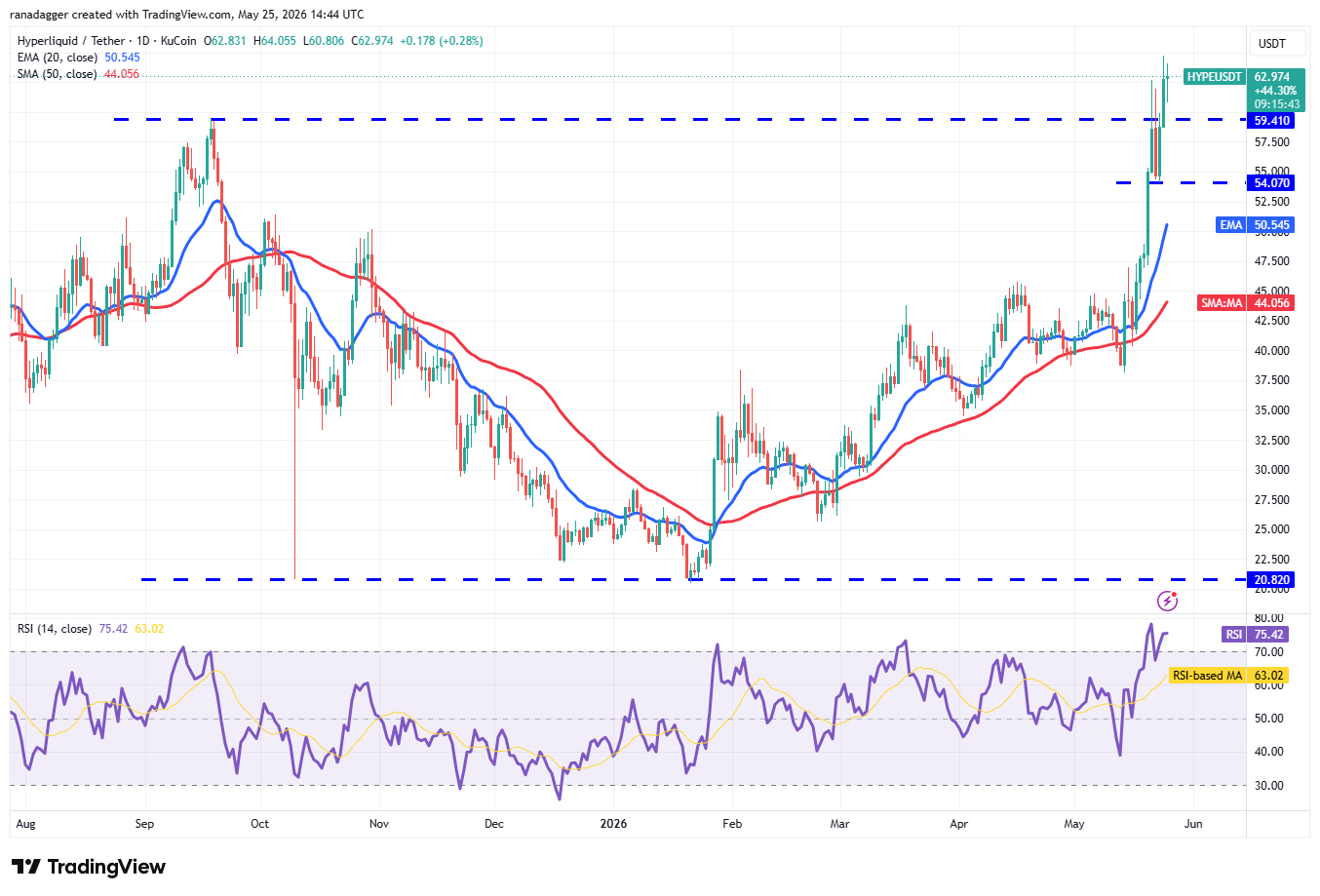
Hyperliquid (HYPE) rallied to a new all-time high of $64.72 on Sunday, indicating that the bulls remain in control.
HYPE/USDT daily chart. Source: Cointelegraph/TradingView
The HYPE/USDT pair pulled back on Monday, but the long tail on the candlestick shows that the bulls continue to buy the dips. That increases the possibility of a resumption of the uptrend toward the next target objective at $77.
The first support on the downside is the breakout level at $59.41, followed by $54.07. A break and close below the $54.07 level may start a deeper correction to the 20-day EMA ($50.54) and then the 50-day SMA ($44.05).
Zcash price prediction
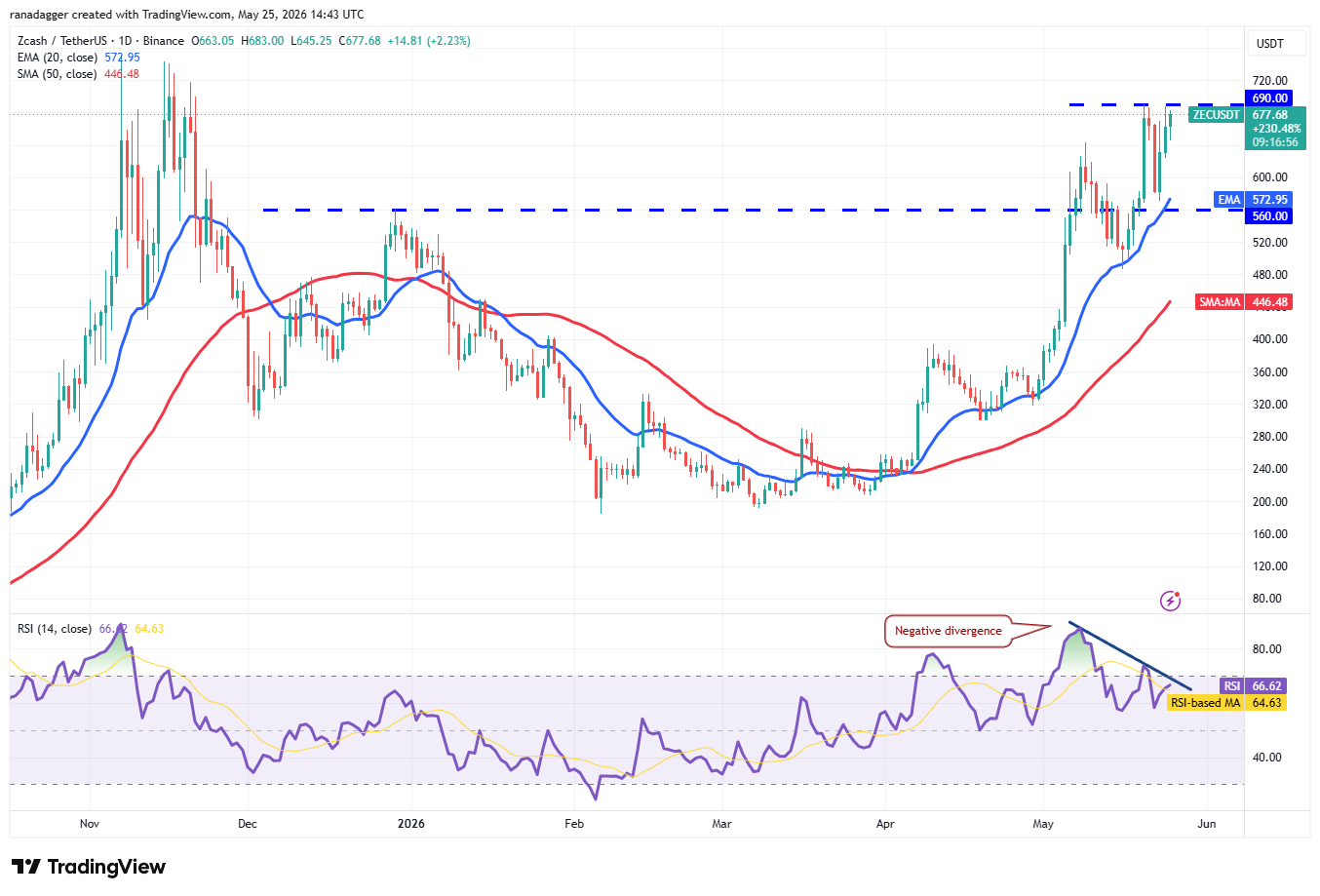
Zcash (ZEC) turned up sharply from the 20-day EMA ($572) on Saturday, indicating a positive sentiment.
ZEC/USDT daily chart. Source: Cointelegraph/TradingView
A minor negative for the bulls is the developing negative divergence on the RSI. That suggests the bullish momentum may be weakening. Sellers will have to tug the ZEC price below the 20-day EMA to start a deeper correction toward $487.
This negative view will be invalidated in the near term if the ZEC/USDT pair continues higher and closes above $690. That clears the path for a rally to $750, likely to attract aggressive selling from the bears.

Ledger has added native support for the ADI token on the ADI Chain network, a UAE-linked, Layer-2 protocol focused on stablecoins and tokenized real-world assets. The ADI Chain project is backed by Sirius International Holding, a subsidiary of International Holding Company (IHC) based in Abu Dhabi, and underpins the DDSC stablecoin ecosystem launched with First Abu Dhabi Bank. Ledger’s integration enables users to store and manage ADI through Ledger Wallet and its hardware signing devices, a step that could bolster custody and security for institutions exploring regulated stablecoins and asset tokenization. The ADI Foundation describes ADI Chain as infrastructure for regulated stablecoins and tokenized assets, with ADI serving as the network’s native gas token. The development follows a notable DDSC transfer disclosed by IHC, amounting to 110 million dirhams (about $30 million), described by the company as one of the UAE’s largest publicly disclosed stablecoin transactions.
Related coverage from Cointelegraph notes ongoing regulatory and market dynamics in the UAE and broader region as authorities navigate cross-border payments and fintech infrastructure. UAE central bank coverage and regional tensions illustrate the broader backdrop against which these institutional-led initiatives are evolving.
Key takeaways
- Ledger now supports native storage and management of the ADI token on the ADI Chain network, enabling institutional-grade custody for a UAE-backed stablecoin ecosystem.
- ADI Chain is backed by Sirius International Holding, a subsidiary of IHC, and powers the DDSC ecosystem developed with First Abu Dhabi Bank, targeting cross-border payments, treasury operations, and trade settlement.
- The 110 million dirhams ($30 million) DDSC transfer marks a landmark on-ramp for large-scale, onshore stablecoin activity in the United Arab Emirates.
- Euro-denominated stablecoins remain a minority in the overall market but are concentrated in the non-dollar segment, with regulatory developments in Europe shaping adoption and utility.
- The European Commission’s MiCA framework is under review as regulators reassess stability, reserve requirements, and interest-bearing token products, even as the euro-stablecoin collateral and settlement infrastructure expands via initiatives like Qivalis.
Ledger’s ADI integration deepens custody for UAE-backed stablecoins
Ledger’s decision to add native ADI support to its hardware wallets and signing devices signals a concrete move toward enterprise-grade custody for regulated tokens tied to real-world assets. By enabling direct storage and secure signing of ADI, Ledger positions itself as a critical interface for institutions that require robust security and compliance for stablecoins backed by regulated frameworks. The ADI Foundation emphasizes that ADI Chain serves as infrastructure for regulated stablecoins and tokenized assets, with ADI acting as the network’s gas token. For enterprises evaluating cross-border settlements and treasury operations, this integration could reduce custody friction and bolster auditability when handling regulated digital assets.
In the broader stabilization-and-asset-tokenization push, the UAE’s private and public sectors have been advancing blockchain rails intended to support regulated assets, complementing existing fiat-to-stablecoin activity. The Ledger move aligns with a trend of traditional fintech firms increasingly embracing crypto-native custody solutions to service institutional clients seeking compliant, auditable, and secure digital asset handling.
AD I Chain and the DDSC ecosystem: institutional rails for cross-border finance
ADI Chain operates as a Layer-2 architecture designed to accommodate stablecoins and tokenized assets within a regulated environment. The network is heavily tied to the stablecoin ecosystem DDSC, which was launched with First Abu Dhabi Bank, one of the region’s leading financial institutions. Sirius International Holding’s backing underscores the project’s strategic alignment with large-scale corporate entities pursuing cross-border payments, treasury operations, and trade settlement—areas where tempo, cost, and compliance are critical. The ADI token functions as the network’s gas mechanism, enabling transaction settlement and network activity as part of an infrastructure aimed at institutional use cases rather than retail speculation.
Recent disclosures of a substantial DDSC transfer—110 million dirhams, or roughly $30 million—serve to illustrate the scale of real-world activity now being channeled through UAE-backed stablecoin rails. While such figures may not represent everyday use, they highlight growing institutional comfort with cross-border, tokenized fiat constructs that can interface with traditional banking rails while offering programmable settlement and asset tokenization features.
Europe’s euro-stablecoin landscape evolves under MiCA oversight
In the broader market, euro-denominated stablecoins have long lagged behind their dollar-backed counterparts in share and liquidity. A March report from Dune Analytics, commissioned by Visa, found that euro-stablecoins account for more than 80% of the non-US dollar stablecoin sector, even as the overall non-dollar stablecoin market remains relatively small—about $1.2 billion in supply compared with a total stablecoin market exceeding $300 billion. The same analysis noted that non-dollar stablecoins process roughly $10 billion in monthly transfer volume, with euro-backed tokens increasingly used for payments, remittances, payroll, and treasury operations. The rise in euro-stablecoin activity has occurred in the context of Europe’s broader regulatory embrace of crypto assets, particularly after the Markets in Crypto-Assets Regulation (MiCA) established a formal framework for crypto asset service providers across the European Union.
Nonetheless, there is debate about MiCA’s impact on competitiveness. A separate April report from Blockchain for Europe argued that MiCA’s reserve and interest-bearing rules have made euro-stablecoins safer but less commercially competitive relative to USD-backed options. DeFiLlama data cited in the report showed euro stablecoins accounting for less than 1% of global stablecoin volume, despite the euro’s prominence in international finance. The tension between safety and scale remains a central question for euro-stablecoin adoption as the bloc continues to refine its approach to reserve management and asset protections.
Meanwhile, regulatory attention to MiCA continues. The European Commission opened a review of MiCA rules governing stablecoins, reserve requirements, and interest-bearing token products as officials reassess how the framework functions in practice. This review comes as European institutions push forward with local-currency stablecoin infrastructure and governance models. In parallel, the euro-stablecoin ecosystem appears to be expanding through regional collaboration and sector-led initiatives.
On May 20, euro-stablecoin consortium Qivalis announced a significant expansion, bringing the group to 37 member institutions after adding 25 banks across 15 countries ahead of a planned launch later this year. The move is part of a broader effort to build a regulated, euro-denominated alternative to dollar-backed stablecoins, aiming to provide a compliant, intra-EU payments backbone for digital assets.
For traders, investors, and builders, the euro-stablecoin story illustrates a clear shift toward legally vetted infrastructure that can support cross-border commerce and payroll in a consent-based, regulated environment. While euro tokens may not yet rival the scale of USD-backed stablecoins, the regulatory glide path and bank participation suggest a higher likelihood of mainstream adoption for euro-denominated digital assets within Europe’s financial system.
What this means for markets and innovation
Taken together, the Ledger integration with ADI Chain and the EU’s evolving regulatory backdrop create a nuanced landscape for institutional players. On the one hand, UAE-backed stablecoins and tokenized real-world assets are gaining traction through partnerships with major financial institutions, supported by custody providers that meet enterprise security standards. On the other hand, Europe’s MiCA regime—while increasing safety and standardization—still faces questions about competitiveness and liquidity for euro-stablecoins, even as projects like Qivalis push to deliver regulated euro-denominated settlement rails.
Investors and builders should watch how these dynamics interact with wider market maturity. In the UAE, the ADI Chain ecosystem could serve as a testbed for banking-ready stablecoins linked to real-world asset flows, including cross-border settlements and institutional treasury management. In Europe, regulatory clarity and the expansion of euro-stablecoin infrastructure could unlock new payment rails and wholesale settlement mechanisms, potentially reshaping how corporates and financial institutions approach cross-border liquidity and payroll settlement in the euro zone.
As always, the pace and scope of adoption will hinge on regulatory clarity, interoperability with existing rails, and the willingness of banks and corporates to integrate these new digital instruments into their everyday processes. The coming months will be telling as MiCA’s review unfolds and euro-stablecoin initiatives scale in practice, while UAE-backed networks continue to pursue enterprise-grade custody and settlement capabilities on a global stage.
Readers should keep an eye on regulatory developments in both the EU and the Middle East, as well as real-world usage signals from institutional ecosystems like ADI Chain and DDSC. The next milestones—broader custody support, cross-border deployments, and the evolution of euro-stablecoin infrastructure—will help determine whether these nascent rails translate into durable, scalable digital-finance architecture.
For further context on related market developments, see: the DDSC transfer coverage from Cointelegraph linked earlier, and continuing EU regulatory updates as MiCA undergoes review, which could shape euro-stablecoin growth and cross-border payments in the months ahead. MiCA rule review updates and Qivalis expands to 37 banks.
What remains uncertain is the pace at which institutional custody solutions like Ledger’s ADI support will scale to real-world enterprise deployments, and how euro-stablecoin liquidity and liquidity-provision models will evolve under MiCA’s full framework. Yet the trajectory suggests a more regulated, institutionally friendly landscape for stablecoins and tokenized assets in both the Middle East and Europe.


Paul Graham, co-founder of Y Combinator, says Warren’s anti-crypto crusade was a ‘pure own-goal’ for Democrats.
Summary
- Paul Graham posted on X that Senator Elizabeth Warren’s campaign against crypto was a “pure own-goal” that damaged Democrats without slowing the industry’s growth.
- Warren did not seek reelection in 2026 as crypto gained mainstream political and institutional acceptance under a more favourable US regulatory regime.
- Graham previously called former SEC Chair Gary Gensler’s approach “really stupid,” saying legitimate companies were stonewalled while actual frauds like FTX continued to operate freely.
Y Combinator co-founder Paul Graham posted on X that Senator Elizabeth Warren’s sustained campaign against crypto was a “pure own-goal,” characterising it as a political miscalculation that cost Democrats credibility without slowing the industry’s development. Warren chose not to seek reelection in 2026 as the regulatory environment she had fought shifted sharply in crypto’s favour.
“Warren’s anti-crypto crusade was a pure own-goal,” Graham posted, adding that the campaign had alienated voters and donors in a sector that moved toward mainstream institutional acceptance regardless.
Why Graham has been consistent in criticising anti-crypto politics
Graham’s view is a continuation of a long-standing position. He previously described Gary Gensler’s tenure at the SEC as “really stupid,” arguing the agency deliberately stonewalled legitimate businesses that wanted to comply with the law while failing to stop actual fraud.
“Legitimate companies that wanted to follow the rules, like Coinbase, were stonewalled or sued. This forced some of them to move offshore or stifle features,” Graham said in an earlier post. He cited the FTX collapse as evidence that enforcement action fell on the wrong targets while genuine bad actors operated freely.
The Warren framing follows a year in which the crypto industry spent more than $193 million in PAC money on congressional races, helped pass the GENIUS Act, and advanced the Clarity Act through the Senate Banking Committee on a 15-9 bipartisan vote. Crypto.news has covered the Clarity Act’s compressed legislative window before the 2026 midterms.
Crypto.news has also reported on AML enforcement overtaking securities classification as the primary regulatory risk axis in crypto, a shift that vindicates the argument that Warren-era securities-first enforcement targeted the wrong legal pressure point entirely.
Crypto.news has also tracked CertiK’s data showing AML fines exceeded $900 million in the first half of 2025 while SEC crypto enforcement actions collapsed by 97%.
TLDR
- Hyperliquid surged into the top 10 cryptocurrencies after overtaking Dogecoin in market capitalization.
- HYPE gained over 50% in a month as price climbed from below $38 to above $64.
- Santiment warned that strong social media optimism may not reflect actual market conditions.
- Analysts said markets often react negatively when crowd confidence becomes excessive.
- Social mentions for HYPE increased nearly seven times before dropping sharply.
Hyperliquid has extended its rally and reached new highs while entering the top crypto rankings. The token overtook Dogecoin in market capitalization as bullish sentiment spread across social platforms. However, Santiment warned that growing optimism around Hyperliquid may be outpacing underlying market data.
Hyperliquid Surge Drives Market Cap Gains and Social Buzz
Hyperliquid recorded strong gains over the past month as its native token HYPE climbed above $64. The rally pushed its market value to about $16 billion, surpassing Dogecoin.
The token gained over 50% during the past 30 days as trading momentum accelerated. Price moved from below $38 to current levels as demand increased.
Data from CoinMarketCap confirmed the asset entered the top 10 cryptocurrencies by market capitalization. The surge placed it among leading blockchain assets in the market.
Santiment reported that social media discussions around HYPE increased sharply during the rally. Mentions peaked near 1,300 on May 21, reflecting a rapid rise in attention.
The firm said social volume rose nearly seven times compared to the previous month’s average. However, activity later declined by about 70% while prices continued rising.
Santiment founder Maksim Balashevich said sentiment data showed strong optimism across crypto communities. He noted that many posts projected a price target of $250.
At current levels, reaching $250 would require a further gain of roughly 290%. Balashevich said such expectations may not align with current market conditions.
Hyperliquid Sentiment Data Signals Cooling Crowd Conviction
Santiment stated that extreme crowd confidence can lead to market reversals. The firm warned traders against treating bullish price targets as guaranteed outcomes.
In a post on X, Santiment said traders should separate fundamentals from fear of missing out. The firm added that markets often react negatively to excessive optimism.
Balashevich explained that data shows a shift in crowd behavior despite rising prices. He said “the crowd already did. Price is still moving.”
The firm recorded a sentiment balance of 402 on May 21 during peak activity. This level marked the highest reading within the tracked period.
Since then, crowd conviction dropped by about 72% while the price gained another 9%. Santiment said this divergence reflects changing market psychology.
The analytics firm emphasized that social metrics do not predict exact price outcomes. However, they help identify phases of strong or weakening trader confidence.
Hyperliquid continued trading near $64 at the time of reporting. Market data shows the asset maintaining its upward trend despite cooling social engagement.

Changpeng Zhao (CZ) has denied viral rumors of his disappearance after he was allegedly caught in a strong rip current while surfing in Dubai.
The story spread quickly across social media, with traders also rushing in to capitalize on the speculation by launching meme coins on Solana and the BNB chain.
CZ Dispels Surfing Accident Claims
WeChat users circulated the fake news in group chats over the weekend, saying the Binance founder had been surfing near Dubai’s Jumeirah Beach when a sudden rip current dragged him out to sea. The rumors even said that local Coast Guard and rescue teams had deployed speedboats, drones, and helicopters for a search operation in response to police reports.
Zhao has since dismissed the report as “fake news,” taking to his X account to point out the inconsistencies in the social media story. He clarified that while he does participate in kitesurfing, traditional surfing is a completely different sport. The Binance founder later added that whenever he goes kitesurfing, he has a dedicated safety boat following him.
“I don’t surf (kite surfing is a diff sport). Dubai is not even a surfing destination. There is Surf Abu Dhabi, world’s largest surf place, which I havent tried yet,” he wrote.
Accident Rumor Starts Meme Coin Frenzy
Traders were quick to seize the opportunity, launching several meme coins within hours of the news breaking. Tokens appeared on the Solana network, attracting speculators who rushed in to profit from the confusion.
According to data from GeckoTerminal, most of the pools on pump.fun associated with the happening failed to attract substantial liquidity, although one of the meme coins did reach over $114,000 in activity in mere hours. However, the excitement did not last long, as most of these coins lost over 40% of their value after CZ denied the rumor and confirmed he was safe.
The 49-year-old is known for his skeptical view of meme coins, accusing traders of chasing hype by launching tokens tied to his name in the past. Zhao has previously described the trend as “a little weird” and urged developers to focus on building practical blockchain applications instead.
Zhao later emphasized that he had never invested in meme coins following the TST token launch incident last year, which went viral after being promoted as linked to Binance despite having no official connection to the exchange.
The post CZ Denies Viral Rumors of Surfing Accident in Dubai appeared first on CryptoPotato.

Indonesia blocked access to Polymarket after the prediction market platform hosted wagers on whether President Prabowo Subianto would leave office before the end of his term. The action, announced by Indonesia’s Ministry of Communication and Digital Affairs (Kominfo), described Polymarket as an “online gambling site disguised as a prediction market.”
“The government will not allow any form of online gambling in Indonesia,” said ministry official Alexander Sabar, adding that activities like Polymarket involve betting and speculation on uncertain outcomes, thereby violating Indonesian law.
The move places Indonesia among jurisdictions that treat prediction markets as gambling products rather than forecasting tools, as platforms such as Polymarket and Kalshi face intensified legal scrutiny worldwide.
Key takeaways
- Indonesia’s Kominfo blocked Polymarket, labeling it an online gambling site that operates under the guise of a prediction market, aligning the platform with local gambling prohibitions.
- The trigger for the measure was Polymarket’s publication of a market tied to Prabowo Subianto’s presidency and potential early departure from office.
- Trading activity around the Indonesian political-outcome market reached over $46,000, with probabilities indicating a low but non-negligible chance of early exit by the president.
- The ministry framed the ban as a protective measure for the public and for those in the national digital space, particularly younger users.
- Indonesian action reflects a broader global trend of regulatory tightening on prediction markets, as policymakers weigh gambling classifications against forecasting utilities.
Indonesia’s legal rationale and enforcement action
The Kominfo statement made it clear that access to Polymarket and similar services would be blocked to prevent online gambling activities in the country. The ministry’s formal stance paints prediction markets as a vehicle for betting on uncertain outcomes, which conflicts with local law and public policy objectives. As cited by authorities, the intent is to shield consumers, especially younger users, from the perceived harms associated with online gambling in the digital space.
The enforcement action follows the emergence of a Polymarket market that allowed users to bet on whether President Prabowo Subianto would leave office before specified dates ahead of the end of his five-year term in October 2029. The market, introduced around May 21, presented multiple resolution dates, including May 31, June 30 and December 31, 2026, despite the incumbent term running for several more years. Reported trading volume exceeded $46,000, with implicit odds showing a roughly 1% probability for a May exit, about 2% for a June exit, and 18% by the end of 2026.
The ministry did not single out the Prabowo market by name in its statement but framed Polymarket generally as a platform facilitating online gambling. The action underscores how national regulators are increasingly scrutinizing online prediction marketplaces and, in some cases, treating them as gambling operations subject to local prohibitions and licensing regimes. The stance aligns with a broader pattern of enforcement that targets platforms offering markets tied to real-world political events or other sensitive outcomes that attract varying degrees of risk and manipulation concerns.
Prediction markets: a growing global regulatory debate
The Indonesian decision reflects a wider international context in which prediction markets face heightened regulatory risk. Proponents argue these platforms function as crowd-sourced forecasting tools and sentiment indicators, offering transparency and structured probability data for researchers and institutions. Critics counter that prediction markets can resemble gambling products and raise concerns about market manipulation, insider information, and consumer protection.
Several jurisdictions have tightened access or imposed restrictions on Polymarket and similar services. India has been cited as among the latest to restrict access, contributing to a multi-jurisdictional trend that has left Polymarket blocked in more than 30 countries at various times. Even as regulatory hurdles rise, Polymarket has signaled an interest in pursuing regulatory approvals in select markets, including Japan, highlighting a tension between enforcement actions and strategic market entry plans.
Industry observers note that policy debates around prediction markets often intersect with broader financial-law concerns, including anti-money-laundering (AML) and know-your-customer (KYC) requirements, licensing regimes, and cross-border oversight. In the United States, for example, regulatory commentary from agencies such as the CFTC has underscored tensions around the classification and oversight of prediction-related products, with some discussions prompting internal reviews and, in certain instances, personnel changes according to reports cited by media outlets.
From a regulatory design perspective, the ongoing discussion touches on how to balance innovation in forecasting tools with consumer protection, market integrity, and the risk of exploitation. The evolving policy framework is likely to influence how exchanges and prediction-market operators structure product offerings, thresholds for geographic access, and the degree of disclosure and compliance required to operate across borders. This is particularly salient for entities that seek licensing or formal recognition under regimes like the European Union’s MiCA framework, which is shaping how crypto-asset activities are governed and supervised within a single market, and for firms navigating U.S. regulatory expectations under the SEC, CFTC, and DOJ oversight.
Compliance, licensing, and operational implications for platforms
Regulators’ tightening stance on prediction markets has concrete implications for platform operators, financial institutions, and participants. For operators, the key challenges include achieving regulatory compliance across multiple jurisdictions, obtaining licenses where required, and designing products that mitigate risks of manipulation and insider trading. AML/KYC controls become central to maintaining compliant consent-based access, especially for markets tied to political events or other high-profile outcomes that could attract heightened scrutiny.
Financial partners and banks may also reassess relationships with platforms that facilitate online wagering or speculative markets on real-world events. Cross-border operations intensify the need for robust governance, transparent risk disclosure, and clear user terms that align with local gambling and consumer-protection laws. For policymakers, the central questions involve how to classify and regulate such platforms—whether as gambling services, forecasting tools, or a hybrid category—and how to harmonize oversight to prevent regulatory gaps that could be exploited by bad actors.
Industry participants and observers alike are watching how regulatory bodies translate broad policy objectives into concrete rules—licensing criteria, consumer safeguards, product disclosure standards, and enforcement mechanisms. In this context, the Indonesian case serves as a concrete example of national authorities exercising control over platforms that operate at the intersection of gaming and prediction benchmarking, with implications for global operators evaluating regional expansion and compliance roadmaps.
Closing perspective
The Indonesian action against Polymarket illustrates how regulators are increasingly willing to intervene at the platform level when online wagering on political outcomes surfaces in otherwise forecast-oriented services. As markets grow and cross-border activity intensifies, the alignment of product design with evolving legal and regulatory standards will be essential for platforms seeking legitimate access to global users, and for institutions seeking stable, compliant channels in a shifting policy landscape.

Why prompt debt, retrieval debt, and evaluation debt are quietly reshaping enterprise AI risk

Neighbours describe tell of horror moment car crashes into Belfast property at ‘dangerous’ corner
South Korea’s KOSPI hits record high on chipmaker rally


-

 Crypto World4 days ago
Blockchain.com files with SEC for U.S. IPO
-

 Fashion3 days ago
Holiday Weekend Open Thread – Corporette.com
-

 Business3 days ago
Dell Technologies DELL Stock Surges 15% on AI Server Momentum and Analyst Upgrades in 2026
-

 Crypto World4 days ago
Bitcoin Accumulation Weakens as BTC Realized Losses Hit $600M
-

 Crypto World3 days ago
Space X IPO Is ‘Bad News’ for Tech Stocks: But What About Bitcoin?
-

 Politics3 days ago
Makerfield: a tale of two social-media histories
-

 Crypto World3 days ago
Robinhood crypto COO Tanya Denisova exits
-

 Crypto World4 days ago
MicroStrategy’s Saylor Says Miners No Longer Set Bitcoin Price, Another Force Has Taken Over
-

 Business1 day ago
NYT Strands Answers May 24 2026 Revealed for Puzzle No. 812 Theme Summer Essentials
-

 Crypto World3 days ago
AI infrastructure race heats up as IREN pitches full-stack strategy, WhiteFiber lands $160M deal
-
 Tech4 days ago
A 0.12% parameter add-on gives AI agents the working memory RAG can’t
-

 Tech4 days ago
WhatsApp ads could make Irish debut after discussions with DPC
-

 Tech4 days ago
You Can Now Add ChatGPT To PowerPoint
-

 Business4 days ago
Trump Invests $1M-$5M in Kura Sushi USA Chain With 27 California Locations
-
 NewsBeat5 days ago
Charity run by Reform leader Malcolm Offord accused of ‘law breaking’ over Scottish registration
-

 Sports4 days ago
2026 CJ Cup Byron Nelson leaderboard: Brooks Koepka finds putting stroke in Round 1
-

 Crypto World5 days ago
Exa Labs raises $250 million in funding led by a16z
-
Business4 days ago
Goldman Sachs reinstates Ageas stock coverage with neutral rating
-

 Crypto World4 days ago
Trump Media’s Bitcoin Stash Shrinks Again as 2,650 BTC Lands on Crypto.com
-
 Crypto World3 days ago
Verus Bridge Hacker Returns $8.5M ETH, Keeps $2.8M as Bounty
You must be logged in to post a comment Login