

Crypto World
Inside Ibiza Tech Forum 2026: Stablecoins, RWA and the State of Post-MiCA European Crypto


The fourth edition of Ibiza Tech Forum unfolded between May 19 and May 22 across the south of the island, splitting its programme between the Caló de s’Oli Auditorium, Romeos Hotel, Hotel Bonito Ibiza, Es Jardins de Fruitera and Cova Santa.
Across four days, the forum stitched six tracks together — AI, Bank & Fintech, Smart Islands & Smart Mobility, Health Tech, Web3 & Blockchain, and SportTech — but for the digital assets industry, the gravity of the event sat squarely on Thursday, May 21.
That was the day BeInCrypto stepped on the main stage.

Ibiza Tech Forum: Two panels, one through-line
BeInCrypto Poland Editor-in-Chief Jakub Dziadkowiec hosted two of the day’s headline sessions, both at the Caló de s’Oli Auditorium.
The first, “On-Chain and Unfiltered,” was billed as a Stelar Fireside Chat and ended up being precisely that: a candid, sometimes blunt exchange with Evan Luthra (General Partner at KOL Capital) and Yana Makhnyk (CBDO at Generis) about influence, wealth, community and what Web3 actually got right. The conversation refused to flatter the room. It pushed against a comfortable narrative of the industry as a meritocracy and instead asked who actually moves capital, who builds influence, and what survives once the noise drops out.

The second was a Digital Assets roundtable — “Redefining Financial Infrastructure: Stablecoins, RWA and the Next Global Markets” — and it brought to the table the people building the rails: Sam Buxton (Founder & Chairman, Damex), Víctor Sáez (Director, Expansion & Strategic Partnerships, Kraken), Nelson Enrique Moran (Founder & Chief Innovation Officer, Trezora), María Sánchez (Investor Relations Specialist, Reental), Erick Ortiz (Blockchain Advisor, BBVA), and Christopher Siedentopf (Founder of CRS Advisory & Head of Sales at Qapture Investments).
The discussion moved past the usual stablecoin talking points and into what the infrastructure actually has to deliver — settlement guarantees, regulatory alignment, real-world asset onboarding — before the next wave of capital trusts the plumbing.
What Thursday told us about European crypto in 2026
Thursday’s programme read like an inventory of where the European crypto industry is post-MiCA. The earlier roundtable on the main stage — pointedly titled “Lost at sea no more: How Europe’s Crypto Industry Survived to See MiCA” — gathered MoonPay, Bit2me, Criptan, Bitvavo and Mandioca alongside legal counsel from Asensi Abogados. The shared subtext, audible across the day, was that European operators have stopped treating regulation as an existential threat and started treating it as a moat.
That shift showed up in adjacent sessions too. “The New Financial Backbone,” the exchanges-led panel that followed BeInCrypto’s roundtable, brought together Bitget, Bybit EU, Solana Foundation, TradingView and FX Street — the kind of lineup that would have read as aspirational two years ago and now reads as the working order. And Dynex CEO Daniela Herrmann’s quantum-computing keynote earlier in the morning underlined that the industry’s frontier is no longer “will crypto survive?” but “what stack comes next?”

Ibiza Tech Forum 2026: A different kind of conference floor
The substance of the panels was only half of what made ITF 2026 work. The island shaped the rest.
Day one’s opening at Romeos Hotel doubled as the semi-final of The Next Unicorn startup contest, and set a register the rest of the event maintained: structured by day, social by evening. Day two — anchored by Spanish-language panels on smart mobility, AI in business, predictive cities and personal branding for founders — gave way to a SportTech afternoon, a TradingView trading competition at Hotel Bonito Ibiza, and a rooftop dinner on the same property.

Day three’s networking lunch at Es Jardins de Fruitera and the Female Founders & Investors session bridged the formal programme into the closing dinner at Cova Santa, a venue whose acoustics and topography do a lot of the work that name-brand venues elsewhere have to manufacture.
The fourth day was reserved for the smallest, most senior group: a boat trip to Formentera, lunch on board, and a swim in water clear enough to make the previous 72 hours feel like a different event entirely. That contrast is the design of ITF — it gives senior operators a reason to stay through Friday, and it gives the conversations begun on stage a frame to continue in.

What BeInCrypto walked away with
Beyond the two stage appearances, BeInCrypto conducted roughly nine on-the-ground interviews and built out more than thirty C-level relationships across exchanges, infrastructure providers, asset managers and adjacent verticals — fintech, sport, longevity, AI:
- Teresa Castagnino — CEO and co-Founder at Like Group Management; Head Forbes of Mexican Caribbean
- Yossi Goldsmith and Cristo Millar — IKAL
- Iñaki Zubeldia — CEO and co-Founder at Yoseyomo and Inheritans, and Mayte Clara — Investor & Strategic Partner at Yoseyomo
- Oleg Morgunov — Head of Growth & Partnerships, Europe & LATAM, TradingView
- Jordi Urbea — CEO at Ogilvy Spain
- Javier Pastor — Head of OTC at Bit2me
- Georg Harer — Co-CEO at Bybit EU
- Daniela Herrmann — CEO and co-Founder at Dynex
- María Sánchez — Wealth Manager at Reental

Those conversations will surface in BeInCrypto coverage over the coming weeks, and several of them tracked directly back to the questions raised on Thursday’s main stage: what the post-MiCA European stack actually looks like in practice, where stablecoin and RWA infrastructure goes next, and which institutional partners are ready to operate on-chain in 2026 rather than in slide decks.
The verdict from BeInCrypto’s seat is straightforward. Ibiza Tech Forum 2026 was small enough that you could speak to whoever you wanted to speak to, serious enough that the conversations were worth having, and Mediterranean enough that the people you most wanted to follow up with were still on the island three days later. That combination is rarer than the event circuit makes it look.
For the digital assets industry, the question after MiCA is no longer whether to show up in Europe. It’s where in Europe to show up. Ibiza, on this evidence, just made its case.
The post Inside Ibiza Tech Forum 2026: Stablecoins, RWA and the State of Post-MiCA European Crypto appeared first on BeInCrypto.

On 11 June, the ECB is holding the second day of its Governing Council meeting. The interest rate decision will be announced at 14:15 CET, followed by a press conference by Christine Lagarde at 14:45 CET. Markets are focused on the possibility of a 25-basis-point rate increase to 2.25%.
The case for further tightening is supported by accelerating inflation in the euro area, driven in part by higher energy prices resulting from geopolitical tensions in the Middle East. At its 30 April meeting, the ECB paused its policy cycle but indicated that June would be an important point for reassessing the outlook. Labour market resilience and signs of second-round inflation effects have strengthened the arguments in favour of tighter policy. The tone of the press conference could shape market expectations for interest rates through the remainder of the year.
Technical Picture
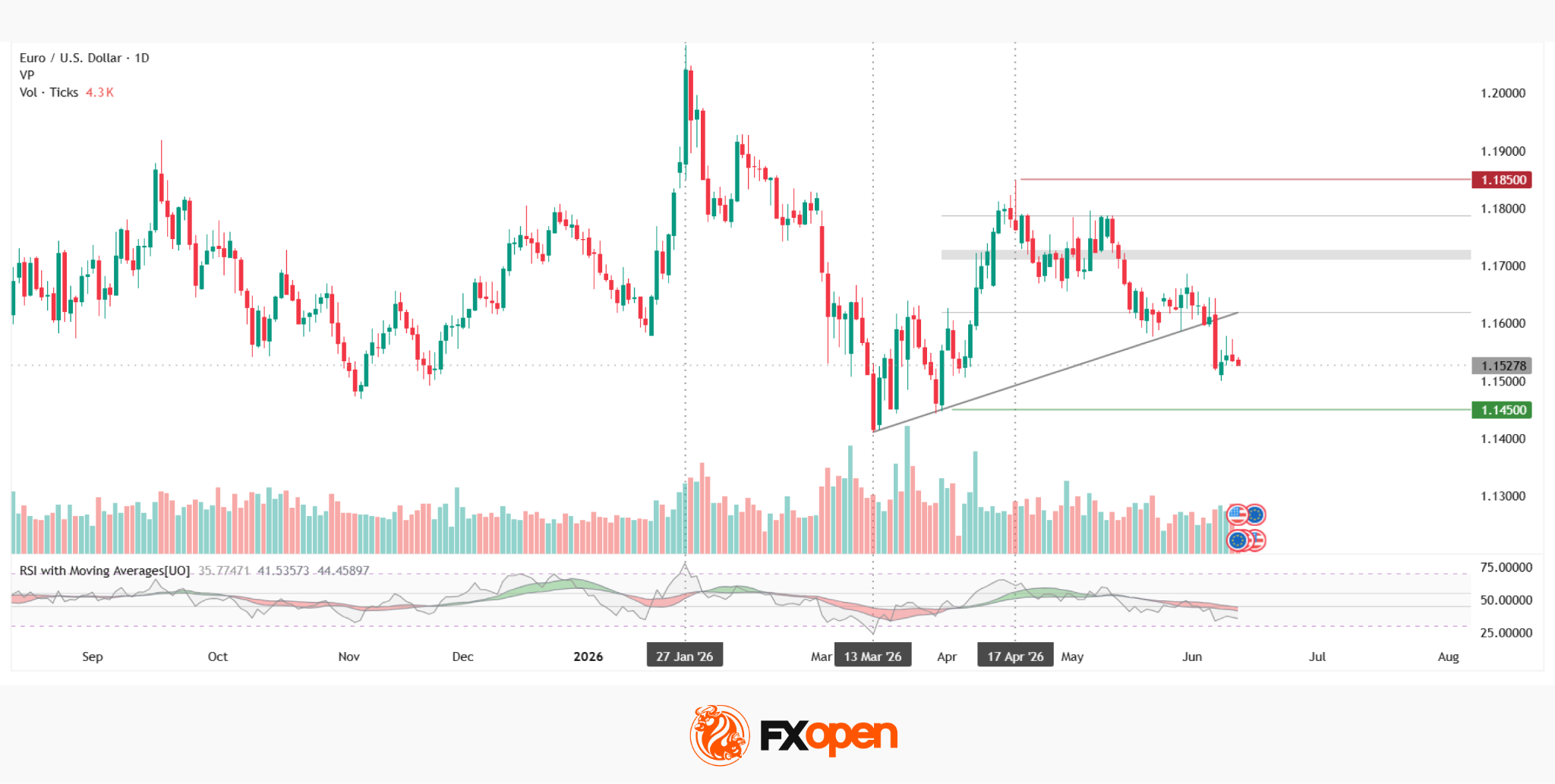
Following a peak near 1.2000 in January, EUR/USD formed a downward move towards the March lows around 1.1400 on the daily chart. An ascending trendline drawn from the March lows is currently being tested from above, with price attempting to break below it.
At the same time, the pair is trading beneath the lower boundary of the current volume profile at 1.1620, which may indicate increasing selling pressure in this area. Should the price remain below the trendline, the next downside reference point could be the green support level around 1.1450.
The red resistance zone is located near 1.1850. If the market reverses higher and manages to overcome both the point of control (POC) at 1.1720 and the upper boundary of the profile at 1.1790, this area could become the next target for buyers.
RSI + MAs currently shows readings of 35, 41 and 44. All three lines remain below the neutral 50 level, while the moving averages continue to point lower.
Key Takeaways
The outcome of the ECB press conference on 11 June may determine whether the current attempt to break the corrective trend develops into a sustained move or ends with a return to the point of control (POC) area. For now, RSI + MAs remains firmly in bearish territory.
Trade over 50 forex markets 24 hours a day with FXOpen. Take advantage of low commissions, deep liquidity, and spreads from 0.0 pips (additional fees may apply). Open your FXOpen account now or learn more about trading forex with FXOpen.
This article represents the opinion of the Companies operating under the FXOpen brand only. It is not to be construed as an offer, solicitation, or recommendation with respect to products and services provided by the Companies operating under the FXOpen brand, nor is it to be considered financial advice.
Bitcoin has lost buyers on two fronts.
The exodus from spot ETFs as a catalyst for the recent bitcoin price swoon is well documented. Less discussed is the equally steep drop in buying by digital asset treasuries, or firms whose core business is accumulating bitcoin as a treasury asset.
“As BTC broke down from the mid-$70Ks toward $60K, net inflows from corporate treasury firms fell sharply, with daily purchases slowing to a fraction of their recent pace,” analysts at Glassnode said in the latest market update.
“While companies remain net buyers overall, the decline in accumulation suggests this cohort is becoming more cautious, removing another source of marginal demand at a time when broader market sentiment remains weak,” they said.

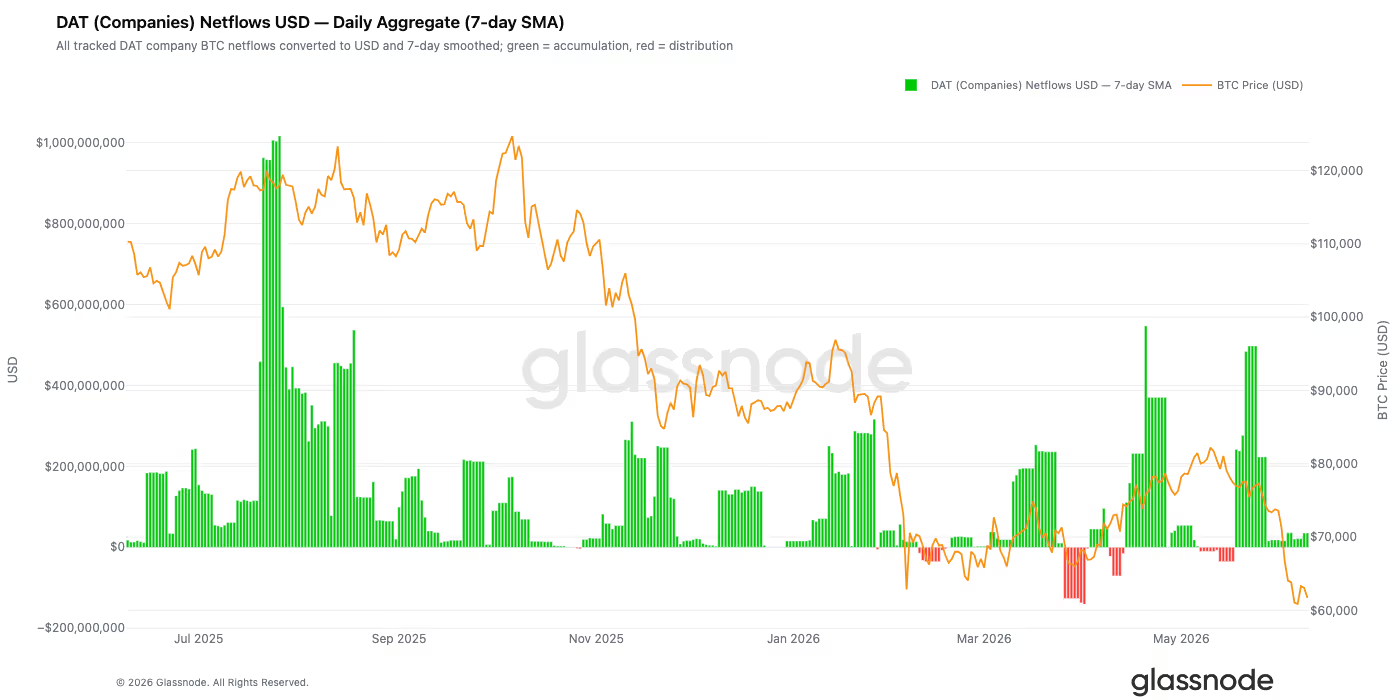
The green and red bars show the dollar value of daily net purchases by digital asset firms since June 2025, smoothed using a seven-day moving average.
The DAT demand has pretty much evaporated this month, down significantly from multiple instances of over $500 million in daily accumulation observed through April and May.
That partly explains BTC’s quick slide from $74,000 to under $60,000 last week.
Some analysts believe the sell-off was mainly catalyzed by Strategy, the world’s largest publicly listed BTC holder, disclosing that it sold 32 BTC in the final week of May. The firm, however, returned to the market during last week’s sell-off, snapping up BTC worth around $100 million. But that failed to keep prices from falling below $60,000.
As of writing, bitcoin changed hands at around $62,500.
The U.S.-listed spot ETFs remain another major headwind, continuing to bleed capital and reducing the odds of a sustained price rebound. On Wednesday, the 11 funds posted an outflow of $213.85 million, according to SoSoValue. Total redemptions have exceeded $5.72 billion since the second week of May.

Advisers to some of the largest financial institutions are taking more of an interest in stablecoins and tokenization than in Bitcoin, which could help pull crypto out of its current slump, said Bitwise investment chief Matt Hougan.
Hougan said in a note on Wednesday that he recently spoke with more than 40 advisers who were “still interested in crypto” but are “more interested today in stablecoins and tokenization than they are in Bitcoin.”
“It was pretty hard to engage with advisors on Bitcoin this week,” he said. “In call after call, they expressed much more curiosity over the real-world applications of crypto that are quickly reshaping everything from capital markets to global payments.”
Stablecoins and tokenization have recently captured the interest of Wall Street, as Bitcoin (BTC) has struggled to maintain momentum, trading down almost 30% so far this year to $62,500.
Stablecoin issuer Circle saw a buzzy initial public offering in June 2025, with its stock quickly rallying to a peak of $240 from its debut price of $31. It has since struggled amid a wider rout in crypto stocks, closing at just under $79 on Wednesday.
Tokenization is also set for a boost as the US Securities and Exchange Commission is reportedly planning to allow tokenized stock trading, which could give traditional investors confidence and spur investment.
“It’s hard to turn on CNBC and not hear someone like SEC Chair Paul Atkins or Goldman Sachs CEO David Solomon or BlackRock CEO Larry Fink talking about stablecoins and tokenization,” Hougan said. “Investors want to be a part of that.”

Matt Hougan, pictured appearing on a podcast in January, says advisers are becoming less interested in Bitcoin. Source: YouTube
He said interest in the technologies could be what pulls crypto into a bull market, which has historically been triggered by “new product breakthroughs and new types of investors.”
Related: Bitcoin may act as a ‘canary in the coal mine’ as risk-off pressure spreads
The “best hope,” according to Hougan, is that financial advisors and institutional investors make up the new crypto investment class, and their money is likely to flow into stablecoin and tokenization investments.
He said Ethereum, Solana, Canton, Chainlink and Avalanche were mentioned during his conversations, along with trading platform Hyperliquid and crypto companies Figure, Circle and Coinbase.
Coinbase and other crypto exchanges have been expanding into business lines beyond crypto trading in a bid to capitalize on investor interest in blockchain-linked services.
Many exchanges have begun to offer tokenized stocks, albeit outside of the US, which have grown in popularity as investors seek to gain exposure to popular stocks and intensely-hyped public offerings, such as SpaceX’s planned debut on Friday.
Magazine: Does ‘Paper Bitcoin’ mean there’s an unlimited supply of BTC?
In 2026, on-chain transparency has become a non-negotiable standard across the entire digital asset industry. Following years of exchange collapses such as FTX Crypto Exchange Collapse, opaque reserve reporting, and sudden withdrawal freezes that eroded trader confidence globally, the benchmark for evaluating a platform has shifted decisively. Price feeds and marketing copy no longer suffice, what matters now is what the blockchain itself says, in real time and without ambiguity.
Zoomex has embraced this new standard fully. Rather than relying on self reported figures or quarterly disclosures, Zoomex publicly attributes and maintains wallet addresses across 14 blockchain networks, all independently verifiable through DefiLlama’s CEX Transparency module. This report examines Zoomex’s on-chain footprint for May 2026, cross referenced against CoinGecko, CoinMarketCap, LiquidityFinder, and Hacken, to give traders, researchers, and institutional participants a verified, source linked picture of where Zoomex stands, not where it claims to stand.
$24MTotal On-Chain Assets (DefiLlama)
~$6.1B24h Total Volume (Spot + Derivatives)
7/10CoinGecko Trust Score
14Blockchain Networks
ZOOMEX PLATFORM OVERVIEW
Founded in 2021, Zoomex has grown into a global cryptocurrency trading platform serving over 3 million registered users across more than 35 countries and regions. The platform operates on its core philosophy of “Simple – User-Friendly – Fast,” a guiding principle that informs everything from its matching engine architecture to its user interface design.
Zoomex’s product scope in May 2026 covers spot trading, perpetual contracts (USDT-margined and inverse), copy trading, and as of this reporting period, ZoomexStocks, a new instrument category giving traders access to U.S. stock-linked perpetuals including TSLA, NVDA, AAPL, META, MSTR, and COIN, all from a single crypto account without fiat conversion. This multi-product approach positions Zoomex not merely as a crypto exchange but as a unified trading ecosystem bridging digital assets and traditional equity markets.

The platform’s technical backbone is engineered for performance. Zoomex maintains sub-10ms order matching latency, and execution tests confirm that a 1 BTC market order on Zoomex results in approximately 0.03% slippage – a figure that competes directly with much larger Tier 1 platforms. This infrastructure maturity, combined with Zoomex’s regulatory registrations and third-party security audits, forms the foundation for everything documented in this report.

ON-CHAIN RESERVES: CEX TRANSPARENCY TRACKER
Zoomex’s on-chain reserve position as of May 2026 stands at approximately $23,997,962 in verified exchange assets, independently calculated from publicly attributed wallet addresses and cross-referenced against DefiLlama’s CEX Transparency module. These funds are distributed across 14 separate blockchain networks, a multi-chain distribution strategy that reflects Zoomex’s commitment to supporting diverse user bases and asset types – rather than concentrating risk on a single chain.
Source: https://defillama.com/cex/zoomex
DefiLlama’s CEX Transparency module tracks cold and hot wallet addresses that have been publicly attributed to centralized exchanges and verified on-chain. For Zoomex, this means any interested party – trader, researcher, or institutional risk manager can independently confirm reserve figures in real time without relying on Zoomex’s own statements. This is the gold standard for reserve verification in 2026, and Zoomex meets it.
It is important to contextualize these reserve figures correctly. Zoomex’s on-chain reserve balance reflects verifiable cold and hot wallet holdings; it does not represent the full scope of Zoomex’s $50 million insurance fund, which is maintained separately as a dedicated reserve to protect users in extreme market events or operational failures. The combination of publicly verifiable on-chain reserves and a separately maintained insurance fund gives Zoomex a layered capital protection structure that distinguishes it from platforms offering only one or neither.
Source: defillama.com/cex/zoomex
EXCHANGE VOLUME: READING THE FLOW
Volume is the most scrutinized and most frequently manipulated metric in the exchange industry. For Zoomex, figures across all tracked platforms tell a consistent story of genuine, growing activity. May 2026 delivered a volatile but high-volume environment. Bitcoin reached a local high near $111,000 before correcting approximately 20%, creating exactly the kind of two-sided market that drives both spot and perpetual derivatives volume to elevated levels.

Source: https://www.coingecko.com/en/exchanges/zoomex
Zoomex’s 24-hour spot trading volume at the time of this report stands at $1.226 billion, a 13.62% single-day increase across 71 active trading pairs spanning 69 listed coins, according to data from CoinGecko.

Source. https://www.coingecko.com/en/exchanges/zoomex
On the derivatives side, Zoomex Futures recorded $5.26 billion in 24-hour trading volume across 518 active pairs, with open interest of $893 million, a figure that speaks to sustained trader positioning rather than short-term spike activity.
Across the full month of May 2026, Zoomex processed approximately $168 billion in total combined volume according to LiquidityFinder. The platform’s month-over-month volume growth of 74% is particularly significant when set against a challenging macro backdrop: in early June 2026, institutional crypto ETP vehicles reported one of the largest weekly outflow streaks of the year, with over $4.4 billion in cumulative BTC ETF redemptions during a 13-day streak. Zoomex’s volume expansion against this institutional headwind strongly suggests the platform is successfully capturing retail and active-trader flows rotating out of passive investment vehicles and into direct spot and derivatives markets.

Live figures: https://liquidityfinder.com/crypto-data/exchanges/zoomex
SPOT MARKET STRUCTURE: DOMINANT PAIRS AND FLOW PATTERNS
Zoomex’s spot market in May 2026 exhibits a healthy and structurally coherent distribution of activity. The dominant pair is BTC/USDT at $547.5 million (44.66% of total spot volume), followed by ETH/USDT at $361.2 million (29.46%) and USDC/USDT at $93.7 million (7.66%). Together, these three pairs account for over 81% of all spot activity on Zoomex, a concentration pattern that mirrors the distribution seen at larger, more established mid-tier exchanges and reflects genuine organic trading behavior rather than synthetic volume inflation.
The most structurally notable feature of Zoomex’s spot market is the USDC/USDT stablecoin corridor. With $28.8 million in +2% bid depth and $18.6 million in ask depth, USDC/USDT on Zoomex carries order book depth orders of magnitude larger than any equity-traded pair. This is not an anomaly, as it reflects a deliberate strategic positioning by Zoomex to serve users in regions where direct USD fiat rails are constrained or inaccessible, and where USDC serves as the primary USD proxy. For traders executing large stablecoin entries or exits on Zoomex, this depth means minimal slippage even at scale.
Average bid-ask spread across Zoomex’s spot markets is 0.105%, which is competitive for a platform of Zoomex’s tier and consistent with genuine market-maker participation.

Source: https://www.coingecko.com/en/exchanges/zoomex
BTC/USDT specifically maintains an extremely tight 0.01% spread, a strong indicator of active professional market-making on Zoomex’s books. CoinGecko assigns Zoomex a Trust Score of 7/10 based on volume consistency, order book depth, and cybersecurity metrics, a score that accurately reflects Zoomex’s mid-tier positioning with clear institutional-grade infrastructure components.
Spot market data: https://www.coingecko.com/en/exchanges/zoomex
ORDER BOOK DEPTH & FINANCIALS RESERVES
Order book depth is where wash-traded volume typically falls apart, fabricated fills leave no real resting orders. Zoomex’s depth figures, as tracked by CoinGecko and CoinMarketCap, reflect genuine market-maker participation across Zoomex’s primary pairs throughout May 2026.
The SOL/USDT pair on Zoomex is a notable addition to this picture: with $830,501 on the bid side and $744,007 on the ask, it demonstrates symmetric and substantial depth consistent with active professional market-maker participation rather than synthetic fills. This is exactly the kind of order book profile that institutional and algorithmic traders look for when evaluating execution venues.
The USDC/USDT corridor remains the single most structurally significant entry in Zoomex’s order book. At $28.8M bid depth and $18.6M ask depth, it functions as one of the deepest stablecoin execution venues in the mid-tier CEX segment. This depth is directly tied to Zoomex’s growing user base in Southeast Asia, Latin America, and other regions where USDC is the primary dollar-denominated settlement asset.
A closer look at Zoomex’s real-time reserve breakdown reinforces the structural integrity of its order book. As of the latest update, Zoomex’s publicly reported financial reserves total $21,097,959.53, distributed across a diversified multi-asset allocation. USDC leads at 30.49% (~$6.42M across two attributed wallet addresses), followed by USDT at 24.51% (~$3.22M), ETH at 19.10% (1,385.66 ETH valued at ~$2.33M), XRP at 13.35% (1,996,794.22 XRP at ~$2.33M), and BTC at 12.55% (25.66 BTC at ~$1.64M). This reserve composition directly correlates with the order book depth profile observed across Zoomex’s primary trading pairs — the dominant stablecoin reserves (USDC + USDT representing over 55% of total holdings) underpin the platform’s capacity to maintain deep, liquid execution on its highest-volume corridors, while meaningful ETH, XRP, and BTC on-chain balances support reliable settlement across its most actively traded spot markets.

Source: https://coinmarketcap.com/exchanges/zoomex/
MAY 2026 SPOTLIGHT: ON-CHAIN GOLD AND THE ZOOMEX STOCKS
One of the most distinctive data points in Zoomex’s May 2026 activity profile is the continued relevance of its XAUT/USDT (Tether Gold) pair as a macroeconomic hedging instrument.

Source: https://www.zoomex.com/trade/usdt/XAUTUSDT
In late February 2026, a geopolitical risk event triggered rapid capital movement toward safe-haven assets during a period when traditional gold futures markets were closed. On-chain gold assets, specifically XAUT and PAXG, were the first markets globally to reflect price changes as capital moved, and Zoomex’s XAUT/USDT pair maintained stable liquidity throughout the event, functioning as a 24/7 gold exposure mechanism when traditional markets were unavailable.

Zoomex’s structurally persistent advantage in this context is straightforward. Unlike traditional gold futures that operate within fixed trading hours and are subject to exchange closures, Tether Gold on Zoomex trades continuously, around the clock, seven days a week. Given that May 2026 saw continued macroeconomic uncertainty, including Bitcoin’s sharp correction from its $111,000 local high, the XAUT/USDT pair remained actively relevant as a hedging instrument for Zoomex traders seeking gold exposure without traditional market friction or settlement delays.
Zoomex published a dedicated analysis of this dynamic in March 2026, establishing its position as an informed commentator on the convergence of on-chain and traditional commodity markets. This kind of transparent, research-backed product development is consistent with Zoomex’s broader commitment to building a trading environment that is not only liquid but genuinely useful for active risk management.
Launched April 16, 2026 and gaining traction through May, ZoomexStocks enables users to access 12 major U.S. equity-linked assets, including Apple, Tesla, and NVIDIA, directly through their Zoomex account using USDT. No separate brokerage account required.

Unlike traditional stock trading platforms that demand lengthy onboarding, identity verification with brokers, and currency conversions, ZoomexStocks lets crypto-native users get exposure to top-performing U.S. equities in a familiar environment they already trust. Trading is available 24/7, removing the constraints of standard market hours, and to celebrate the launch, Zoomex introduced a limited-time fee rebate campaign offering up to 100 USDT in rebates. Whether you’re a seasoned crypto trader looking to diversify into equities or a newcomer wanting a simpler entry point to U.S. markets, ZoomexStocks lowers the barrier significantly by keeping everything within one unified platform.
PLATFORM COMMUNITY AND USER METRICS
Zoomex ended May 2026 with over 3 million registered users across more than 35 countries and regions. The platform’s Telegram community has grown to 69,663 members, reflecting active engagement among Zoomex’s core retail trading base.Zoomex’s daily active trader count consistently exceeds 1 million users according to independent review data, TradersUnion, making it one of the most actively used mid-tier exchanges globally by session volume. The platform regularly adds new assets based on market demand combined with rigorous vetting, as of this report, Zoomex lists 486–495 cryptocurrencies and operates across 518–575 trading pairs depending on the market segment (spot or derivatives), a figure that has grown steadily through 2026.
The post Zoomex Monthly On-Chain Report: May 2026 appeared first on BeInCrypto.
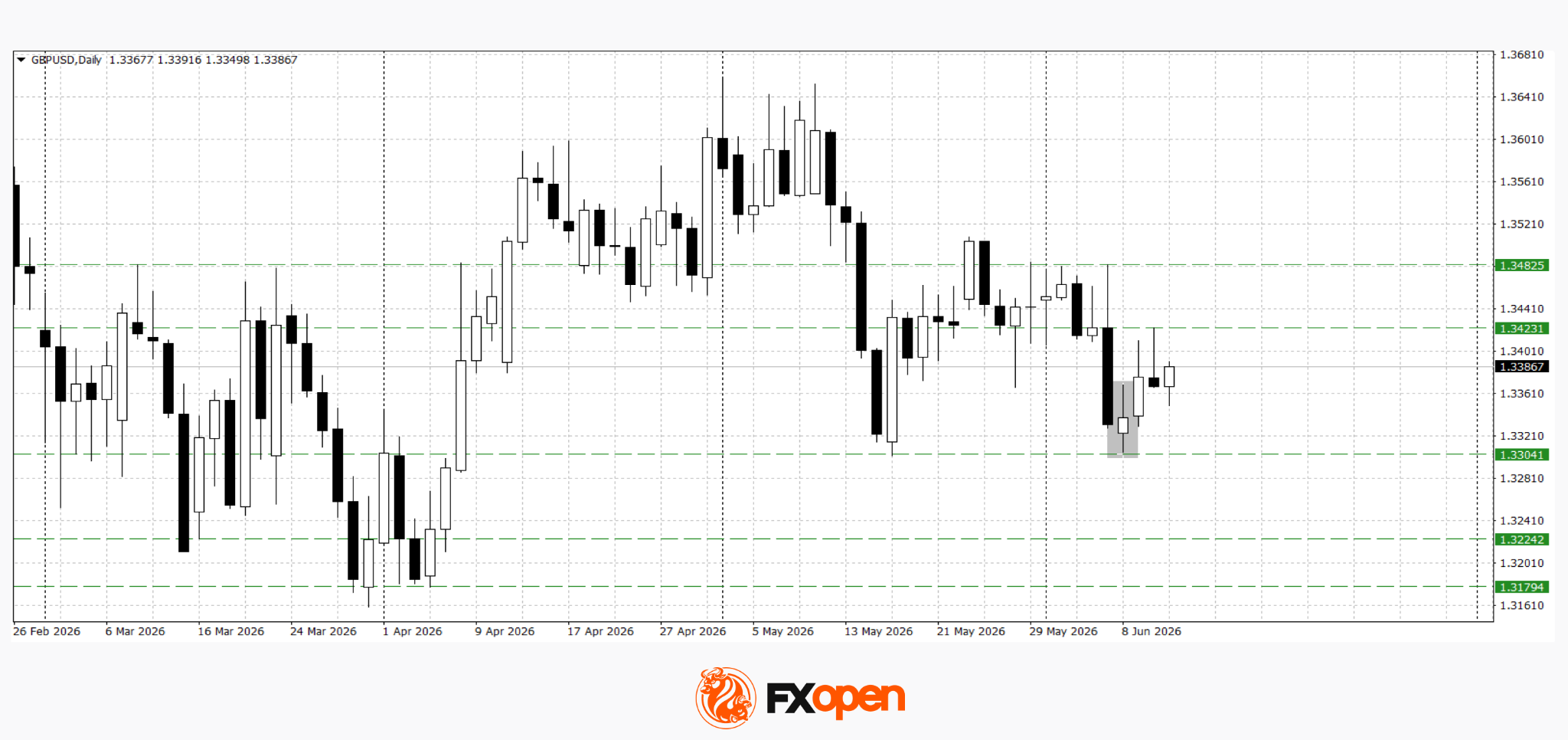
The British pound is maintaining a cautious tone following a period of elevated volatility, with market participants now focused on key upcoming UK economic data releases. Both GBP/USD and GBP/JPY are consolidating near important technical levels as investors await macroeconomic indicators that could provide clearer signals on the outlook for the UK economy and the Bank of England’s next policy moves.
The main event later this week will be the release of UK GDP data for April. Forecasts suggest the economy may contract by 0.1% month-on-month, following a 0.3% expansion in the previous month. At the same time, figures for industrial production, manufacturing output, construction activity, and the trade balance will also be published. Weaker-than-expected data could reinforce expectations of further Bank of England easing and put additional pressure on sterling, while stronger readings may support the currency and trigger a fresh wave of demand.
GBP/USD
From a technical perspective, GBP/USD remains in a consolidation phase following its recent decline. After bouncing from support at 1.3300, a bullish piercing candlestick pattern formed on the daily chart, with potential follow-through towards 1.3420–1.3480. A sustained break below 1.3300, however, could extend the downside move towards the April lows in the 1.3220–1.3180 area.
Key events for GBP/USD:
- Today at 13:00 (GMT+3): Thomson Reuters/Ipsos Primary Consumer Sentiment Index (PCSI) in the UK;
- Today at 15:30 (GMT+3): US Producer Price Index (PPI);
- Today at 19:00 (GMT+3): US Department of Agriculture (USDA) World Agricultural Supply and Demand Estimates report.
GBP/JPY
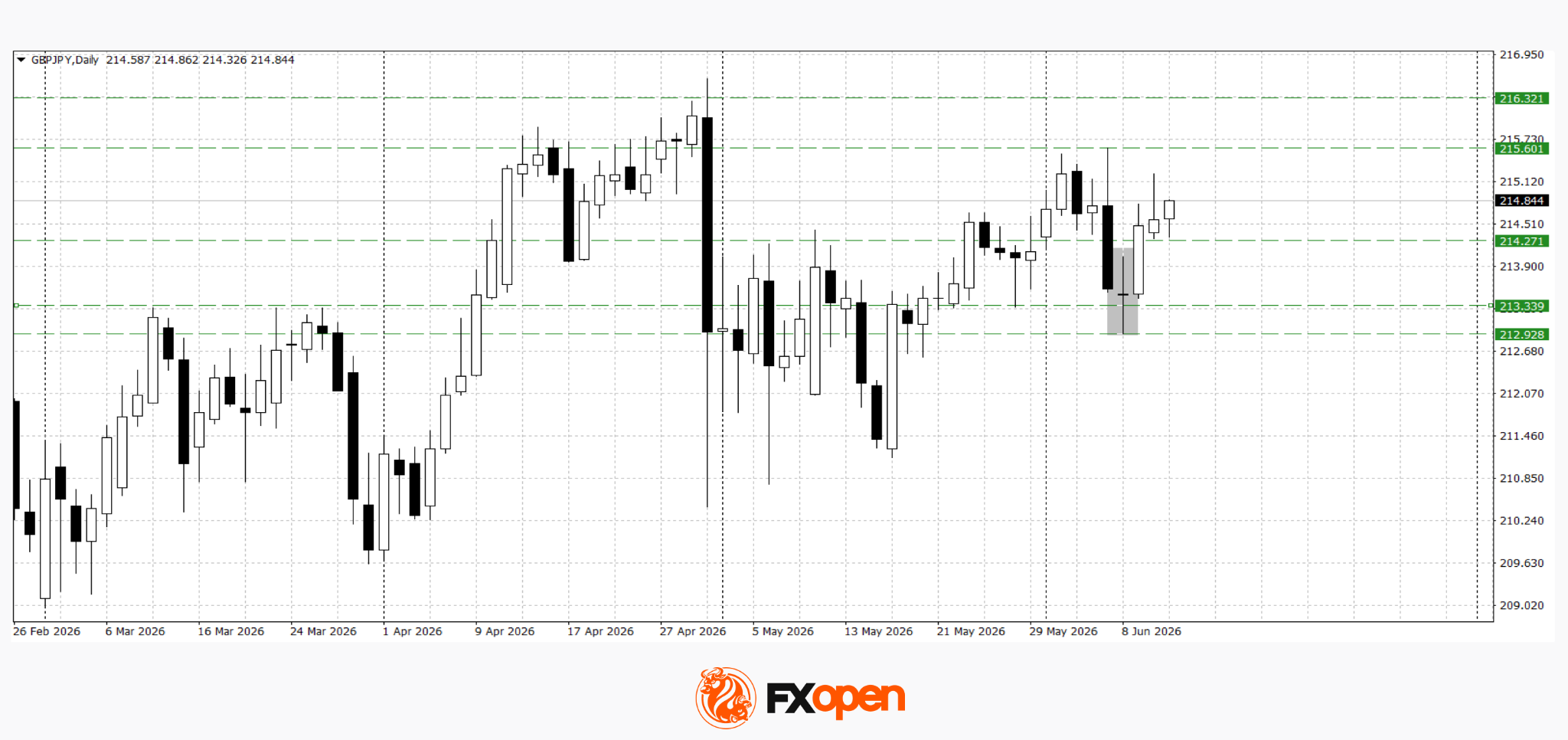
GBP/JPY is also trading in a consolidation range near important resistance levels. The pair continues to find support from persistent yen weakness, although the lack of a decisive breakout above recent highs suggests caution among buyers. Strong UK data could prompt another attempt to extend gains towards the 215.60–216.30 area. Conversely, a break below 214.20 may open the way towards 213.30–213.00.
Key events for GBP/JPY:
- Tomorrow at 07:30 (GMT+3): Japan industrial production;
- Tomorrow at 09:00 (GMT+3): UK gross domestic product (GDP);
- Tomorrow at 09:00 (GMT+3): UK manufacturing output.
Overall, sterling is approaching a key juncture where its next direction will largely depend on the state of the UK economy. Upcoming GDP, industrial production, and trade balance data could act as the main short-term drivers for GBP/USD and GBP/JPY. Ahead of these releases, markets are likely to remain cautious, with consolidation near current levels remaining the dominant scenario.
Trade over 50 forex markets 24 hours a day with FXOpen. Take advantage of low commissions, deep liquidity, and spreads from 0.0 pips (additional fees may apply). Open your FXOpen account now or learn more about trading forex with FXOpen.
This article represents the opinion of the Companies operating under the FXOpen brand only. It is not to be construed as an offer, solicitation, or recommendation with respect to products and services provided by the Companies operating under the FXOpen brand, nor is it to be considered financial advice.

Ripple CEO Brad Garlinghouse has endorsed Flare founder Hugo Philion’s claim that the crypto industry now copies the institutional vision it once mocked as a banker coin.
The exchange landed as Mastercard named Ripple among more than 30 partners in its new Agent Pay for Machines service, fueling celebration across the XRP community.
From Banker Coin Mockery to Industry Blueprint
Philion argued in a widely shared post that Ripple and XRP were ridiculed in their early days. Skeptics dismissed the token as a centralized banker coin built for traditional finance.
According to the Flare founder, the project was simply too early. Much of the industry now pursues the same institutional relationships it once derided. Garlinghouse amplified the remark on X on June 10, endorsing the assessment.
Holders treated the moment as validation. Many recalled the CEO’s viral 2024 meme of a chimp holding a sign reading “Laugh now, but one day XRP will power the world.”
However, the vindication has yet to reach the chart. XRP (XRP) trades near $1.11, down roughly 6% over the past week, even as network activity suggests growing usage.
Despite the pullback, the token holds a market cap of nearly $69 billion. That keeps it sixth among all crypto assets.
Mastercard Deal Strengthens Ripple’s Institutional Case
The timing reinforced Philion’s point. On June 10, Mastercard launched Agent Pay for Machines, a service for permissioned, machine-speed payments between AI agents. Settlement will span cards, accounts, and stablecoins.
The service credentials every agent, enforces programmatic spending limits, and handles transactions worth fractions of a cent. Mastercard chief product officer Jorn Lambert said machine payments could run at far higher volumes and far smaller values than today’s systems.
Ripple joined the initial partner group alongside Coinbase, Stripe, and the Solana Foundation.
“We’re helping build the infrastructure for trusted agent-driven payments, with the XRP Ledger and $RLUSD helping lay the foundation for the future of commerce.”
Autonomous AI agent payments already settle natively on the XRP Ledger (XRPL) using XRP and Ripple USD (RLUSD). Meanwhile, analysts expect stablecoin payment volumes to climb sharply over the next decade, and Mastercard continues to expand its crypto team.
Whether the banker coin label becomes a lasting advantage now depends on execution. The next quarters of agent-driven settlement data should reveal how much of the copied vision converts into real XRPL volume.
The post Ripple CEO Praises Mastercard Deal as Industry Copies the XRP Vision It Once Mocked appeared first on BeInCrypto.
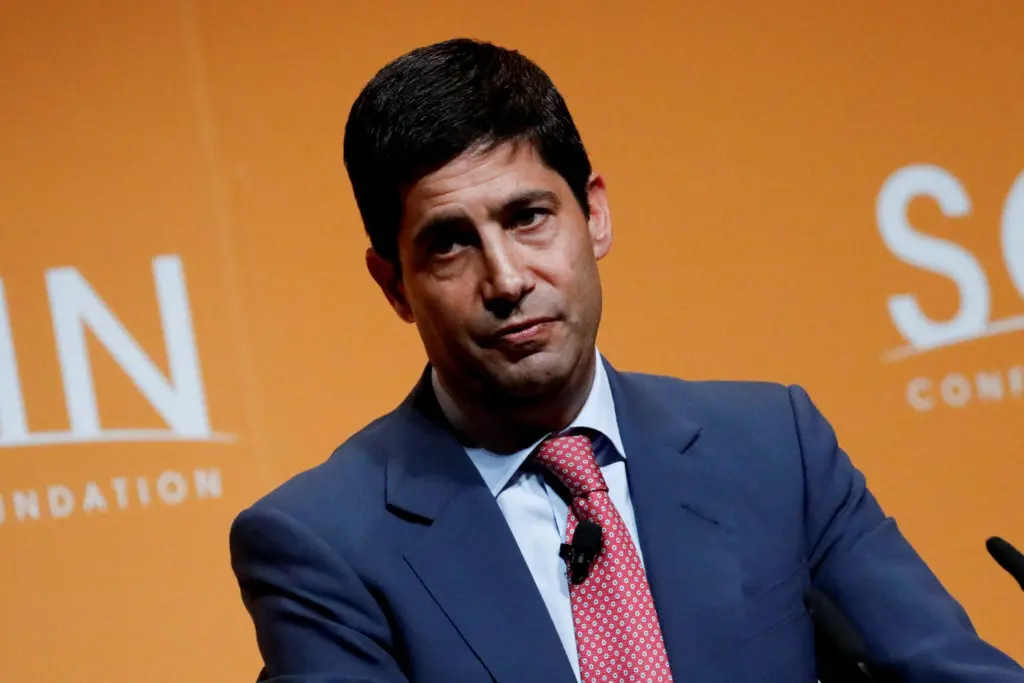
Bitcoin News: Bitcoin price is trading at $61,100 on Wednesday, down 3% over 24 hours and 6.9% on the week, as a blowout May jobs report pushed Fed rate hike odds higher and triggered a macro risk-off wave that hit every major hedge simultaneously.
Gold price fell 2% to below $4,200 an ounce. Both assets sold off in lockstep, the very scenario their proponents said couldn’t happen.
The catalyst is blunt: 172,000 non-farm payrolls in May versus a 130,000 consensus estimate, with April revised up to 214,000.
That data hardened the case for a rate cut delay into 2027 and forced markets to reprice the entire liquidity environment that floated crypto, gold, and equities through late 2025.
Discover: The Best Crypto to Diversify Your Portfolio
Bitcoin News: Is the Hedge Thesis Breaking? Rate Hike Expectations Drain Both Bitcoin and Gold
The causal chain is straightforward: a hotter-than-expected labor market eliminates the Fed’s rationale for easing, drives real yields higher, strengthens the dollar, and drains demand from non-yielding assets.
Bitcoin and gold pay nothing. When rates are rising, the cost of opportunity becomes unbearable for institutional allocators.
The 10-year Treasury yield rose to 4.54% on Wednesday. Brent crude is trading near $92 a barrel, adding an inflationary wrinkle that makes the Fed’s calculus even harder.
New Federal Reserve Chair Kevin Warsh faces a direct binary at the FOMC June 2026 meeting on June 17–18: hold and signal structural reform, or hike and demonstrate inflation discipline.
Cleveland Fed President Beth Hammack has already warned the Fed “may need to act soon.”
Wall Street Journal Fed correspondent Nick Timiraos framed it plainly on June 6, the labor market firmed up, and rate cuts aren’t coming back on the original timeline.
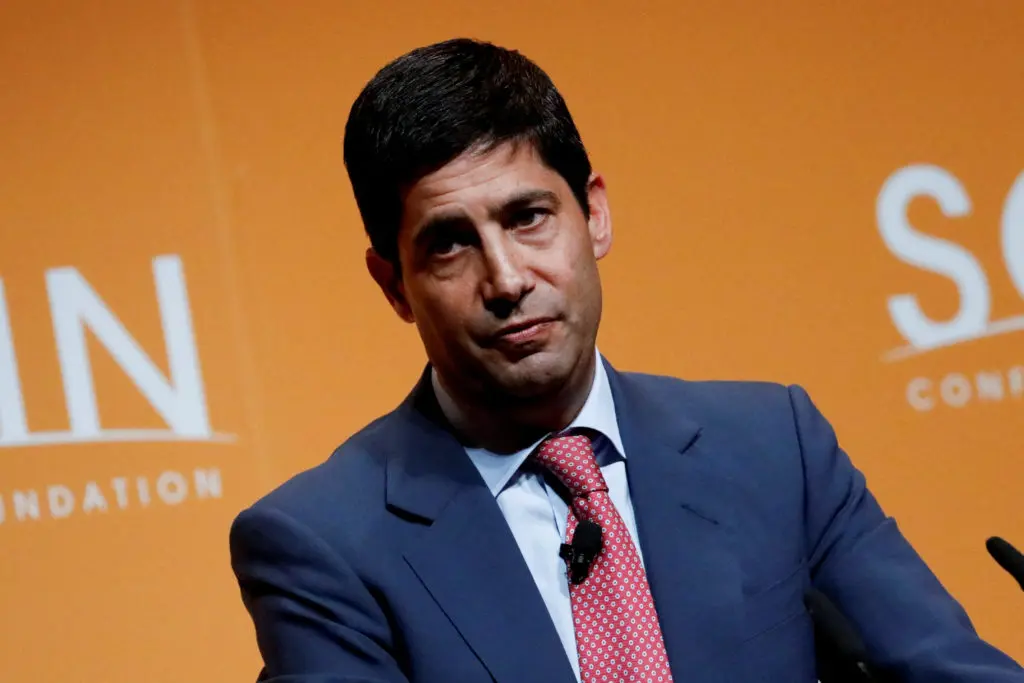
Bitcoin ETF outflows have accelerated in parallel. Diana Pires, chief business officer at sFOX, put it directly: “Buyers have stepped in after the move lower, but spot demand has yet to return in a meaningful way.”
A record outflow streak in U.S. spot Bitcoin ETF products has kept institutional money sidelined, and Strategy’s first BTC sale since 2022 further eroded the dip-buyer narrative that anchored prices above $70,000 through mid-May.
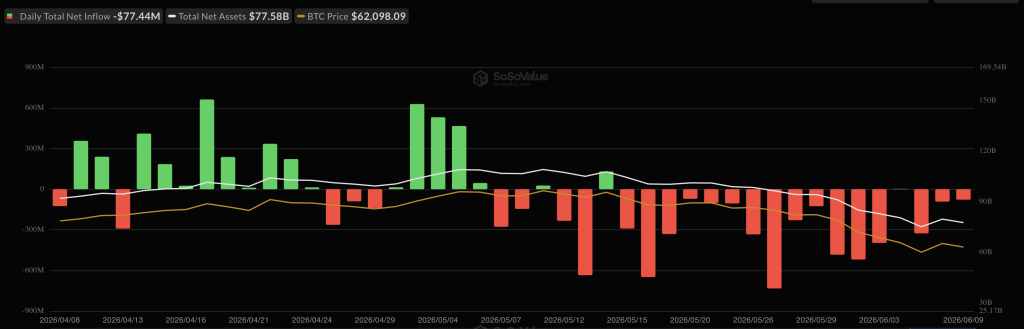
The broader market damage is severe. South Korea’s Kospi tumbled 6.3%, the MSCI Asia-Pacific gauge dropped 2.5% for its fourth loss in five sessions, and Nasdaq 100 futures pointed 0.8% lower.
More than $500 million in bearish bets were liquidated, the highest figure since April, confirming the recent bounce was a short squeeze, not fresh buying. Bitcoin’s brief rally near $62,500 failed to attract the sustained spot inflows needed to hold the level.
The gold correlation question is the sharpest one. Rolling 180-day correlations between bitcoin and gold have climbed toward 0.6, but CryptoQuant data has also recorded readings as low as –0.88 during the same cycle, illustrating how rapidly the relationship flips around macro shocks.
If the June 17–18 FOMC produces a hold with dovish language, deeply oversold technicals could trigger a sharp bounce. If Warsh hikes or signals one is imminent, the structural support floor gets tested hard.
BTC Support at $60,000: $59,735 Double-Bottom or Deeper Breakdown?
BTC is sitting at $61,146 on the daily chart, and price has now broken below the February low which was the last major support level on this timeframe, putting Bitcoin at its lowest point since mid-2024.
That February low around $61,000 to $62,000 was the line that had to hold for the recovery narrative to remain intact, and losing it with this kind of momentum is a serious structural breakdown that changes the picture significantly.
The next meaningful support is the $55,000 to $58,000 range from the mid-2024 pre-breakout accumulation zone, and that is now the target if current levels fail to stabilize.
The only marginal positive is that the sell-off from $84,000 has been steep and fast, the kind of move that can produce sharp relief bounces before any continuation, but bounces in this environment are likely to get sold rather than sustained.
Reclaiming $64,000 to $65,000 is the minimum needed to even begin stabilizing the chart, and $68,000 above that is the first level that would need to flip before recovery becomes a real conversation.
Right now, this chart is in breakdown mode, and the burden of proof is entirely on the bulls.
Discover: The Best Token Presales
The post May Jobs Report Kills Rate Cut Hopes: Bitcoin And Gold Sold Off in Tandem appeared first on Cryptonews.

Key Takeaways
- May’s annual Consumer Price Index climbed to 4.2%, marking the steepest increase in three years, with energy costs surging 3.9%.
- Bitcoin has plummeted 36% year-to-date, currently hovering around $62,000—approximately 51% beneath its record peak.
- President Trump expressed enthusiasm for the inflation figures despite gasoline prices reaching $4.15 per gallon.
- Financial markets now assign more than 70% probability to a Federal Reserve interest rate increase by year-end 2026, typically negative for cryptocurrency markets.
- Market experts believe institutional capital will remain on the sidelines until inflation demonstrates consistent downward momentum.
The United States recorded its steepest inflation increase in three years during May, sending ripples of concern through cryptocurrency markets as analysts warn of prolonged headwinds for digital assets.
The Consumer Price Index registered a 4.2% annual increase, propelled primarily by escalating energy expenditures. Pump prices nationwide now average $4.15 per gallon, representing a substantial jump from $2.98 recorded prior to the February military operations involving the US and Israel against Iran.
Energy sector inflation accelerated 3.9% during May alone, extending a pattern that has elevated crude oil valuations since military confrontations disrupted critical supply corridors adjacent to the Strait of Hormuz.
The monthly CPI measurement advanced 0.5%, following April’s 0.6% acceleration. Inflation-adjusted wages declined 0.1% for consecutive months.
When questioned about the economic indicators, President Trump informed journalists he “loves” the current inflation trajectory. He projected oil valuations would retreat following resolution of the Iranian conflict.
Implications for Bitcoin Markets
Bitcoin has endured a challenging 2026. Values have contracted 36% since January, with current trading levels near $62,000. This positions the cryptocurrency roughly 51% below its historical apex exceeding $126,000.
Market strategists argue the inflation statistics eliminate any Federal Reserve incentive for monetary easing. The central bank has maintained its current rate structure since December 2025. CME FedWatch projections indicate a 98.4% probability of unchanged rates at the June 17 policy meeting.
Nevertheless, over 70% of market observers now anticipate at least one rate elevation before 2026 concludes. Elevated interest rates typically bolster the dollar and government bond yields, redirecting investment capital from non-yielding assets like Bitcoin.
“We maintain our assessment that prevailing macroeconomic conditions represent persistent obstacles for Bitcoin,” stated Markus Thielen from 10x Research. He emphasized that institutional investors will probably defer increased allocations until inflation establishes an unmistakable downward trajectory.
Iggy Ioppe, serving as chief investment officer at Theo, characterized the CPI release as reinforcing the Fed’s “cautious, data-dependent” posture with “no urgency to reduce rates.” He observed that liquidity forecasts remain constrained while risk assets respond primarily to positioning dynamics rather than fundamental catalysts.
Precious Metals Face Similar Challenges
Gold hasn’t escaped unscathed either. The precious metal has retreated 23% from its January zenith.
Ioppe highlighted that real yields continue elevated, increasing the opportunity cost associated with gold ownership since the commodity generates no income stream. Absent anticipated rate reductions, this headwind appears persistent.
Tim Sun, senior researcher at HashKey Group, acknowledged escalating rate hike speculation while noting the actual probability of monetary tightening this year remains comparatively modest.
“Risk appetite will only genuinely reverse when inflation subsides, rate cuts materialize, and liquidity conditions improve alongside reduced capital expenses,” Sun explained.
Thielen additionally highlighted continuing vulnerabilities stemming from the Iran situation. He suggested oil supply interruptions could intensify throughout summer months, amplifying upward inflation pressures.
He characterized Bitcoin as “remaining vulnerable” with a decline beneath $60,000 appearing progressively probable in the immediate term.
Newly appointed Fed Chair Kevin Warsh assumes leadership of a central bank confronting ascending prices and deteriorating real income levels. Should the June 17 policy meeting signal forthcoming monetary tightening, analysts anticipate Bitcoin’s challenging period will persist.

TLDR:
- Gate’s TradFi volume grew from near zero to a widening share of total activity through early 2026.
- Spot trading on Gate compressed from ~35% in early 2025 to low double digits as TradFi expanded.
- Gold and silver instruments, including XAU and XAUT, now lead Gate’s TradFi volume by category.
- Equity exposure on Gate spans Nvidia, Tesla, and crypto-linked names via USDT-based fractional access.
Crypto-native investors are quietly gaining exposure to stocks and metals through their existing exchange accounts. Data from Gate shows a structural change in how users are building multi-asset positions.
TradFi instruments, once a negligible slice of overall volume, now represent a visible and growing share of activity in 2026. Metals and equities are drawing sustained participation across multiple market cycles.
Gate’s TradFi Volume Signals a Multi-Asset Shift Among Crypto Users
Futures still dominate Gate’s order book, holding around 80% of total volume. But the composition beneath that headline figure has shifted.
Spot trading compressed from roughly 35% of volume in early 2025 to low double digits. The gap was filled by TradFi instruments, which grew from near zero to a consistent and expanding band.
CryptoQuant analyst MorenoDV_ flagged this pattern in recent data. The TradFi slice has gone through several sharp expansion phases.
Each time, activity pulled back but settled at levels materially above where it started. That pattern rules out a one-time launch spike.
Users are returning to these markets repeatedly. The driver appears to be macro conditions. When equities, commodities, or monetary policy narratives generate stronger signals than crypto, traders are pivoting within the same platform.
Gate’s infrastructure makes that pivot frictionless. USDT-based access, fractional trading, and real U.S. stock exposure allow users to reposition without transferring capital to a separate brokerage.
Metals Lead TradFi Demand as Equities Build a Strategic Foothold
Gold and silver instruments are generating the majority of Gate’s TradFi volume. Tickers including XAU, XAG, and XAUT account for the bulk of metals activity.
Demand for these instruments reflects a broader search for defensive positioning and macro hedges during periods of crypto uncertainty.
Oil remains a relatively small portion of TradFi volume. Equities represent a lower share overall but carry notable strategic weight.
According to CryptoQuant data, activity is spread across technology, AI, and crypto-linked names. Nvidia, Tesla, Circle, and Coinbase-related instruments are among the tickers seeing consistent traffic.
Volume across equities remains sensitive to news events. But the spread across multiple tickers signals more than reactive trading.
Crypto users are building familiarity with stock exposure on a venue they already use.
MorenoDV_’s analysis frames this as a behavioral evolution rather than a product novelty. Investors are not stepping back from risk. They are expanding the range of instruments through which they express it.
Key Takeaways
- BTC is currently hovering around its 200-week moving average, a threshold typically observed during bear market conclusions
- Market sentiment has plummeted to 9 on the Crypto Fear and Greed Index, signaling “extreme fear”
- According to CryptoQuant analysis, Bitcoin’s realized price of $53,600 represents a possible structural floor
- May’s US CPI data showed 4.2% annual inflation, the steepest increase since early 2023, weighing on crypto assets
- Futures markets indicate renewed interest, with open interest on BTC contracts climbing nearly 2% to reach $45.71 billion
Bitcoin finds itself trading at a price point rarely witnessed outside of severe bear market conditions. As of Thursday’s session, BTC was exchanging hands between $62,150 and $62,623, reflecting a modest daily gain of approximately 2%, though still registering weekly losses.
Earlier this week, the leading cryptocurrency momentarily dipped beneath the $60,000 threshold — marking its first visit to this zone since 2024.
Data from blockchain analytics provider Checkonchain reveals that BTC has descended to levels approaching its 200-week moving average. This positioning effectively places Bitcoin within the lowest 10% of its entire historical price spectrum.
Bear market bottoms are a process, not an event.
First, price-sensitive investors capitulate. Then comes the harder phase: months of sideways action that slowly wear down the conviction of those who remain.
In our latest newsletter piece, @_Checkmatey_ examines the evidence… pic.twitter.com/ReSQFfqi5R
— _Checkonchain (@_checkonchain) June 10, 2026
The Crypto Fear and Greed Index currently registers at 9 out of a possible 100 points. This represents a decline from the previous week’s reading of 11 and a dramatic drop from last month’s 48.
According to information shared by Wu Blockchain citing CryptoQuant research, the analytics platform identifies Bitcoin’s probable floor near the $53,600 mark, which aligns with its present realized price. Julio Moreno, CryptoQuant’s research director, indicated that this realized price represents “a level that would confirm a bottom” based on historical patterns, while cautioning that it remains merely a “valuation bottom candidate” rather than a verified cycle trough.
CryptoQuant Sees Bitcoin’s Potential Bottom Near $53,600
CryptoQuant said Bitcoin’s potential bottom may be near $53,600, its current realized price, though research head Julio Moreno stressed this is only a “valuation bottom candidate,” not a confirmed cycle bottom. The firm… pic.twitter.com/2CO0ROpDJ5
— Wu Blockchain (@WuBlockchain) June 11, 2026
Moreno emphasized that genuine market recovery necessitates a “constructive demand recovery, a condition not yet visible in the data.” Recent CryptoQuant metrics indicate aggregate demand decreased by 652,000 BTC during the past week, while 30-day ETF demand growth contracted to -74,000 BTC.
Institutional Flight and Macroeconomic Headwinds
United States consumer price indices advanced 4.2% on an annual basis throughout May, representing the most rapid acceleration since the beginning of 2023. Elevated energy expenditures connected to US-Iran geopolitical tensions contributed to headline inflation growth, although core CPI figures arrived below analyst projections.
BREAKING: May CPI inflation rises to 4.2%, the highest level since April 2023.
Core CPI inflation also rises to 2.9%, the highest since September 2025.
Inflation in the US is officially back above 4% and more than double the Fed’s target.
Odds of Fed rate hikes are rising.
— The Kobeissi Letter (@KobeissiLetter) June 10, 2026
Wirex Head of Trading Yves Renno observed that Polymarket probability estimates for US Clarity Act passage in 2026 fell from 62% to 48% over the current week. He identified the upcoming June 16–17 FOMC meeting as pivotal, suggesting Bitcoin could either rally toward the $68,000–$72,000 corridor or collapse beneath $60,000 based on Federal Reserve messaging.
Exchange-traded fund outflows continue exerting downward pressure. Unprecedented net redemptions have withdrawn institutional capital from Bitcoin investment vehicles throughout multiple consecutive trading sessions.
Blockchain Metrics and Futures Market Dynamics
Market cycle specialist Benjamin Cowen maintains that Bitcoin’s four-year pattern remains unbroken and projects a probable bottom formation around October. He emphasized that Bitcoin is presently rebounding from the 200-week moving average, while price action unfolds within the Fibonacci Golden Zone on weekly timeframes.
Additional market observers have identified the potential emergence of a double bottom configuration on daily charts, supported by substantial volume clusters within the current trading range.
Information from CoinGlass demonstrates that BTC futures open interest expanded nearly 2% across 24 hours, reaching $45.71 billion. CME, Binance, and OKX platforms each recorded open interest increases of 5%, 2%, and 4% respectively.
Glassnode’s latest assessment indicates that short-term holders face unrealized losses with accelerating realized loss velocity, while options markets continue factoring in heightened risk premiums.
As of Thursday’s close, BTC maintained trading activity near $62,150, with the wider cryptocurrency market registering marginal advances insufficient to offset this week’s declines.

EUR/USD: ECB Meeting and Interest Rate Expectations

Victor Wembanyama makes stunning admission about Spurs’ hunger in Game 4 collapse

Which Warehouse Store Opened First?



-

 Fashion6 days ago
Weekend Open Thread: Evereve – Corporette.com
-
 Crypto World6 days ago
Jensen Huang Approves Samsung, SK Hynix, and Micron for NVIDIA (NVDA) HBM4 Memory Supply
-
 Entertainment4 days ago
The Best Mystery Series of All Time Is Surging on Streaming 30 Years After It Ended
-

 Crypto World3 days ago
Anatomy of the June crypto crash: Fed, Iran, Saylor
-

 NewsBeat3 days ago
Alexander Zverev wins the French Open to finally earn a 1st Grand Slam title
-

 Tech5 days ago
Suspicious Polyfill login prompts pop up on Toshiba, Muji websites
-
Crypto World5 days ago
Senator Cynthia Lummis Calls CLARITY Act the Most Consequential Financial Legislation of This Generation
-

 Tech6 days ago
Microsoft launches MXC, an OS-level sandbox for AI agents, with OpenAI and Nvidia already on board
-

 Tech4 days ago
Microsoft unveils seven homegrown AI models in new bid for ‘long term self-sufficiency’
-

 Business6 days ago
(VIDEO) Justin Bieber Delivers Surprise Happy Birthday Serenade to Diners at Los Angeles Mexican Restaurant
-
 Business4 days ago
The Pain Points Taking a Fragile Tech Rally Down a Notch
-
 Crypto World3 days ago
Eli Lilly (LLY) Stock Surges 4% Following Breakthrough Sleep Apnea Trial Results
-

 Business3 days ago
High Stakes for Wembanyama as New York Pushes for 3-0 Lead
-

 Tech5 days ago
Von der Leyen’s AI envoy pick draws conflict-of-interest fire
-
Crypto World6 days ago
LBank Surpasses 25 Million Users Worldwide as AFA Partnership Continues to Drive Global Growth
-

 Tech6 days ago
Meta steals a tactic from Tesla and builds data centers in tents
-

 Tech5 days ago
Hackers now exploit SolarWinds Serv-U flaw to crash servers
-

 Crypto World4 days ago
Trump’s AI Ownership Plan Could Benefit Anthropic at OpenAI’s Expense
-
 Sports2 days ago
Bangladesh beat Australia after 20 years in ODIs, register only their second win over six-time world champions | Cricket News
-

 Tech3 days ago
Notion restores access to Anthropic after service disruption
You must be logged in to post a comment Login