Wendel (WNDLF) Shareholder/Analyst Call May 21, 2026 9:00 AM EDT
Company Participants
Nicolas ver Hulst Sébastien Metzger – General Counsel Laurent Mignon – Group CEO & Chairman of the Executive Board David Darmon – Deputy CEO & Member of Executive Board Christine Anglade-Pirzadeh – Director of Communications & Sustainable Development and Advisor to the Executive Board William Torchiana Alain Missoffe
Advertisement
Conference Call Participants
Malcom Sossou
Conversation
Advertisement
Nicolas ver Hulst
Good afternoon, ladies and gentlemen. It’s a great pleasure to be with you this afternoon. You’ve turned up in greater numbers. So thank you very much for being with us. There are more shareholders than we have representatives of the Wendel Group. The first 2 rows are made up of Wendel people, and then the rest of the room is shareholders, and that’s great to see. So thank you very much for outnumbering us in such a way.
I’m going to be chairing today’s proceedings. Today’s assembly is now officially open. We have Laurent Mignon and David Darmon here next to me. Laurent chairs the Executive Board, and David Darmon is a member of the Executive Board and General Director. You know both of them. And to my left, Sébastien Metzger, whom you might not know. He is the Legal Director for Wendel and Secretary of the Executive Board. Sébastien is with us with his Head of Legal Director since 2008. He joined in 2008, which was a great vintage, a great year to join us and to deal with a lot of debt-related issues that we had back then. So someone who’s acquired over the years, a great deal of experience.
I would like to also thank François de Wendel, my predecessor. He’s here in the room, and good afternoon also to all the members of the Supervisory Board with the Head of the Audit Committee and
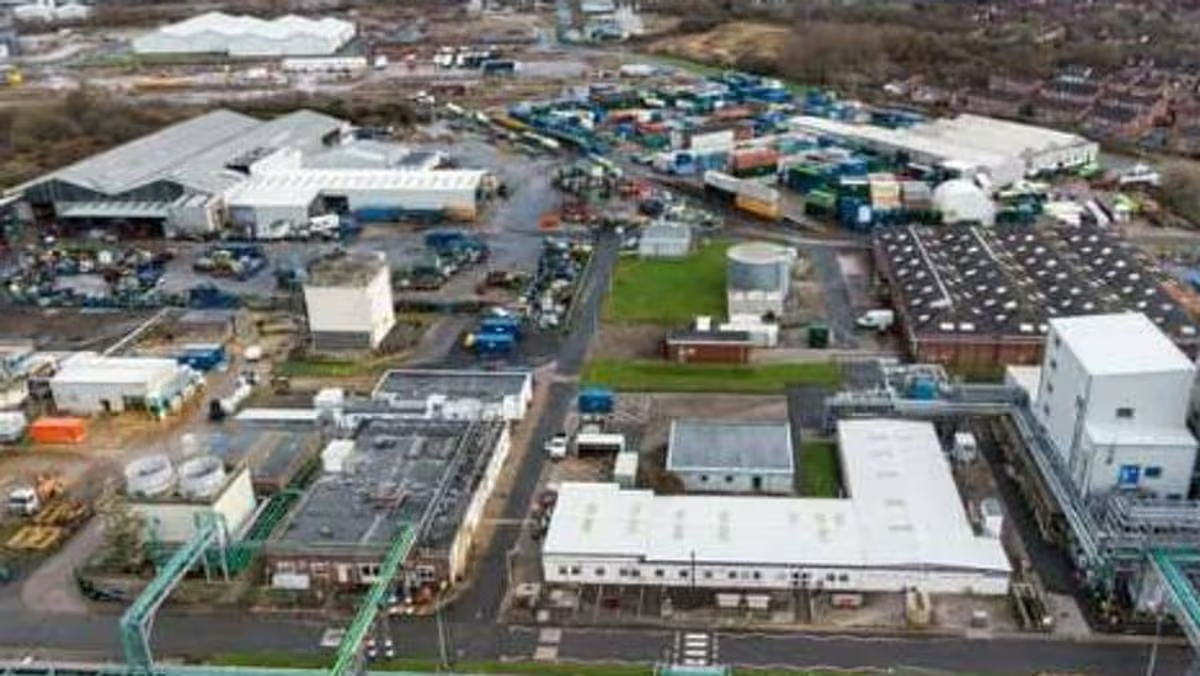
The Hillhouse Enterprise Zone estate(Image: Local Democracy Reporting Service)
A £40,000 grant is to be made available by Wyre Council to help set up a training facility at Thornton to tackle a skills gap in the area.
Advertisement
The facility will help train people up in the skills necessary to fill vacant positions within companies on the Hillhouse Enterprise Zone estate, where firms were found to be competing with each other for the same small pool of trained applicants.
Now the money will be freed up from the Hillhouse Enterprise Zone Business Rates Growth Reserve to develop proposals for the training centre.
The decision was made at Cabinet level after a report was presented by portfolio holders Cllr Peter Le Marinel (Planning Policy and Economic Development Portfolio Holder) Cllr Lesley McKay, (Resources Portfolio Holder) and Sarah Palmer (Director of Transformation and Change).
Their report recommended the award of grant to the Addison Academy, an accredited learning and staff training facility based at Hillhouse.
Advertisement
At the Cabinet meeting, Cllr McKay highlighted the ongoing skills shortages and emphasised the importance of ensuring residents had the best possible opportunities.
Cllr Le Marinel drew attention to the growing difficulty organisations faced as they competed for the same staff, which was pushing costs higher.
He said delivering a training centre via Addison Academy as soon as possible was the most effective idea.
The Academy, a sister company to the local, family-owned Addison Group of engineering and project management companies, offers hundreds of accredited and certified online training courses to provide skills needed in today’s workplace.
Advertisement
The grant funding agreement with Addison Academy will allow the commission of independent professional services to develop proposals for the training centre, which could entail a new building being created for the purpose, on the Hillhouse estate.
After the meeting, Cllr Le Marinel said: “There are just not enough people with the training and skills needed for the various companies on the Hillhouse estate, so it was agreed to try and do something about that.
“We have a situation at the moment which sees all these companies chasing the same employees and practically pinching each other’s staff, bidding against each other and pushing the costs up.
“There is a training organisation on site so it made sense to utilise them to help set this up. There would be jobs in engineering and all the other types of roles available on the estate.
Advertisement
“It will be good for the local area to offer training matched to actual jobs available locally, good for the companies and good for the Hillhouse Enterprise Zone overall.”
The funds allocated will help set up a consultation process and feasibility study into the project.
To find all the planning applications, traffic diversions, road layout changes, alcohol licence applications and more in your community, visit the Public Notices Portal.
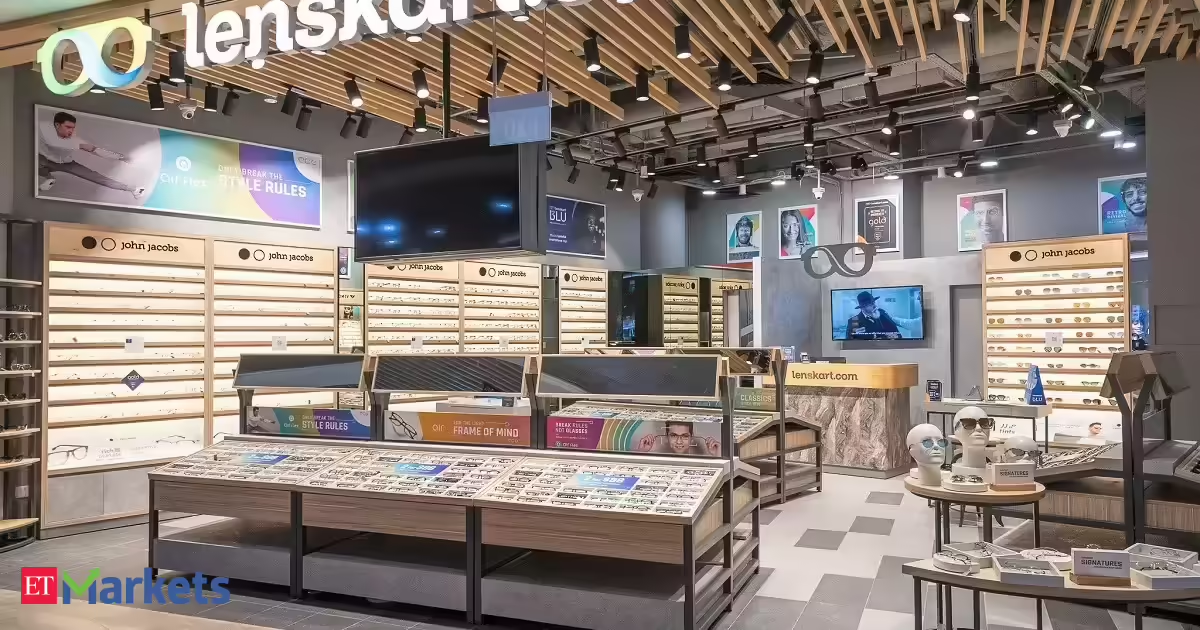
ADIA-backed Platinum Jasmine A 2018 Trust on Thursday sold a 2.3% stake in Lenskart Solutions through a block deal worth Rs 1,960 crore, according to exchange data. The investor offloaded 4 crore shares at Rs 490 apiece, translating into a total transaction value of Rs 1,960 crore.
The sale was executed at a discount of about 2% to Lenskart’s previous closing price of Rs 500.15.
The block attracted strong interest from a wide range of domestic and global institutional investors. Among the biggest buyers were Kotak Mahindra Mutual Fund, which acquired over 1.2 crore shares, Canara Robeco Mutual Fund with 32.2 lakh shares, Franklin Templeton Mutual Fund with 22.4 lakh shares, and Mirae Asset Mutual Fund, which purchased 22 lakh shares.
Insurance companies and pension funds also participated actively. ICICI Prudential Life Insurance, HDFC Life, Kotak Mahindra Life Insurance, and the National Pension System (NPS) Trust were among the buyers.
Advertisement
Foreign investors including Morgan Stanley Asia, Goldman Sachs Investments, Viridian Asia Opportunities, Integrated Core Strategies (Asia) and Ghisallo Master Fund also picked up shares in the transaction.
Live Events
The latest sale comes less than a week after another major shareholder exit in Lenskart. Earlier this month, SoftBank affiliate SVF II Lightbulb (Cayman) sold 5.65 crore shares at Rs 508.55 apiece through a block deal worth around Rs 2,873 crore. Brokerages remain constructive on the company’s long-term prospects. Elara Capital recently initiated coverage with a “Buy” rating and a target price of Rs 615, implying upside from current levels.The brokerage highlighted Lenskart’s integrated business model spanning eye testing, manufacturing, distribution and retail. It estimates the company can deliver a 25% revenue CAGR and 38% EBITDA CAGR between FY26 and FY29.
Lenskart operates more than 600 stores globally and has expanded internationally through acquisitions such as Owndays and Meller. International operations account for around 42% of revenue, while its technology-led vision care platform and backward-integrated manufacturing capabilities have helped it emerge as one of India’s largest eyewear retailers.
The summit will be held this autumn as part of a reform of vocational skills training in Wales
16:01, 11 Jun 2026Updated 16:11, 11 Jun 2026
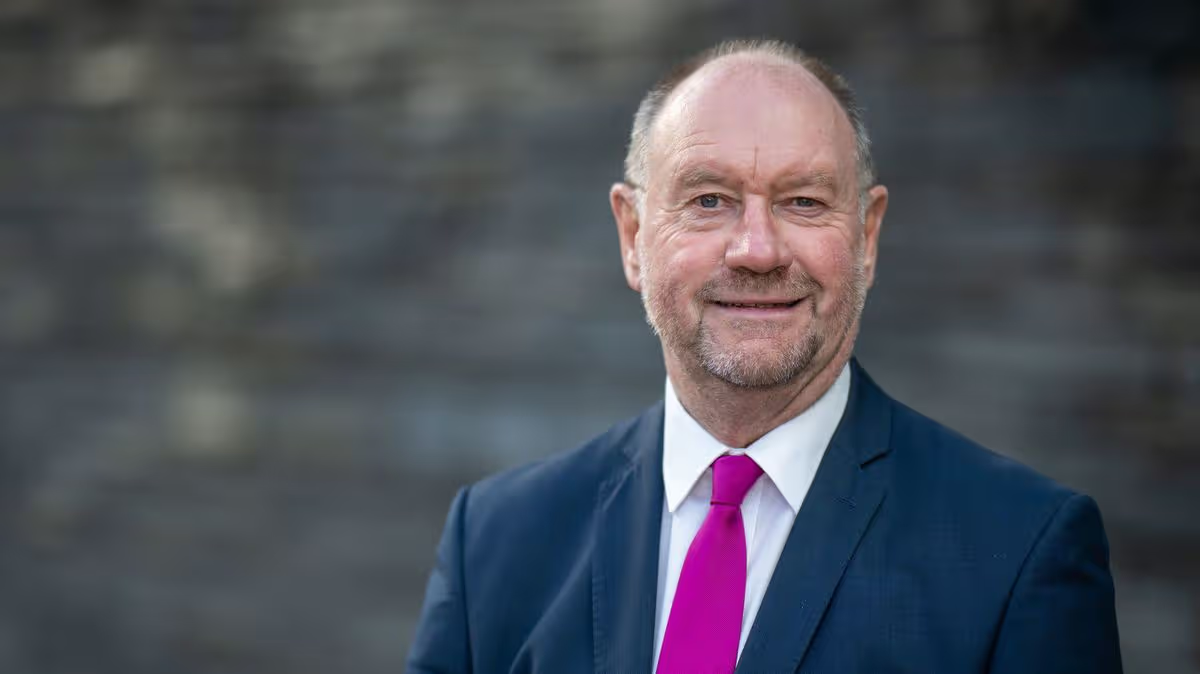
Deputy Minister for Skills and Tertiary Education Cefin Campbell.(Image: Plaid Cymru)
The Welsh Government has confirmed a future skills summit as part of its reform of vocational skills training in Wales.
Deputy Minister for Skills and Tertiary Education, Cefin Campbell, said that with a skills audit – a Plaid Cymru Senedd Election manifesto pledge- under way, the summit will be held this autumn.
Advertisement
It will bring together employers, educators, training providers, and policymakers to shape plans for reform of vocational skills training in Wales.
Mr Campbell said: “We are at a pivotal moment for skills in Wales. Wales has real strengths, a talented workforce, strong employers and excellent training providers.
“We need to make sure those strengths are fully realised. The skills audit we are undertaking will give us a clearer picture of where the gaps are and where the opportunities lie. The future skills summit will be a chance for employers, learners, and providers to help shape the reforms that follow. This is genuinely collaborative work.”
Lisa Mytton strategic director of National Training Federation for Wales , the representative body for organisations or individuals involved in the delivery of learning in the workplace, said: “This announcement is an important step towards building a skills system in Wales that is ambitious, responsive, and future focused.
Advertisement
“Apprenticeships have a vital role to play in delivering the skilled workforce our economy needs.
“The skills audit and future skills summit provide a valuable opportunity to ensure apprenticeships continue to evolve, remain relevant to the needs of employers and create clear pathways into sustainable, high-quality employment.”
The 2026 midterm election cycle could surpass the 2024 presidential cycle to reach record advertising spend for any U.S. election, according to a new report from advertising intelligence company AdImpact.
This year’s races are projected to reach $11.6 billion in ad spend, making it the most expensive cycle ever and eclipsing the $11.2 billion spent on ads for the 2024 election between now-President Donald Trump and former Vice President Kamala Harris, AdImpact estimates. The new projection is a $795 million increase from a previous projection made last year.
The midterm cycle is set to be more intense than previous cycles, with Republicans controlling both chambers of Congress. The 2022 midterm cycle drew $8.9 billion in ad spend, according to AdImpact. If the projection holds, the 2026 ad spend would be 30% higher than the last midterm election.
“From record-setting races and surging party committee war chests to a competitive landscape that continues to expand, all indicators point to 2026 being the most expensive political advertising cycle in history,” the report read.
Advertisement
AdImpact said it expects $5.6 billion to be spent on broadcast, $1.4 billion on cable, $2.6 billion on connected TV and $1.68 billion on digital.
Advertising remains a key revenue driver for media companies, with sports, live events and news attracting the most spending. Elections, particularly those that are hotly contested or in battleground states, often bring in some of the highest ad revenue for the owners of local broadcast stations across the country.
Broadcast TV remains one of the largest forces in political advertising, according to the report, comprising nearly half of the total cycle spending and driven almost entirely by state races.
States seeing the largest spend overall include California, Texas, Michigan and Ohio. Michigan, Ohio and Texas all feature competitive Senate races, while California has an expensive governor’s race.
Advertisement
AdImpact estimated that through June 1, political ad spending has reached $4 billon, a 46% increase over the same point in the 2024 presidential election cycle.
“Much of that surge is driven by a concentrated set of high-profile, high-dollar contests that materialized earlier in the cycle than is typical,” the report read.
Politicians are also relying more heavily on digital spending across platforms like Facebook, Google, Snapchat and X, expected to spend $1.6 billion in that category during the cycle, according to AdImpact.
Within the election categories, the Senate has seen a notable increase in projected political spend, expected to draw nearly $3.4 billion, with one of the most expensive races being Texas’ Senate primary, the report said. Republicans hold 53 U.S. Senate seats compared with Democrats’ 45. The Senate’s two independents caucus with Democrats.
Advertisement
In gubernatorial races, three of the four most expensive competitions on record are taking place in 2026 in California, New Jersey and Georgia, according to AdImpact.
Even down ballot spending is expected to reach record levels this year, surpassing the record set in 2022 of $3.2 billion.
The midterm election cycle’s most expensive period is yet to come, according to AdImpact. The highest spending is between August and November, accounting for between 58% and 67% of all political ad spending for the cycle, with October itself accounting for between 28% and 36% of spend as the country nears Election Day.
WASHINGTON, June 11, 2026—The conflict in the Middle East is expected to slow global growth to the lowest rate since the onset of the COVID-19 pandemic amid higher energy prices, steeper inflation, and increased borrowing costs, according to the World Bank Group’s latest Global Economic Prospects report.
Summary
The Middle East conflict is projected to slow global economic growth to 2.5% in 2026, the lowest rate since the COVID-19 pandemic, according to the World Bank Group’s latest Global Economic Prospects report. Disruptions to energy markets, rising inflation, and increased borrowing costs are the primary drivers.
Developing economies are expected to be hit hardest, with growth falling to a post-pandemic low of 3.6% in 2026. Gulf economies face near-zero growth, while rising debt levels and commodity price volatility continue to weaken fiscal positions across low-income countries. The World Bank Group has made up to $60 billion immediately available in response.
Global growth is forecast to slow to 2.5% in 2026, down from 2.9% in 2025. Forecasts for two-thirds of economies have been downgraded relative to January of this year. Global growth is expected to improve to 2.8% in 2027 but will remain 0.4 percentage point below the average during the 2010s. Weak growth in developing economies has stalled progress toward advanced-economy income levels. By 2028, developing economies other than China and India will have collectively experienced nearly a decade of no progress on narrowing their per capita income gap with advanced economies, the report finds.
“Developing countries have faced a series of challenges over the last decade,” said Ajay Banga, President of the World Bank Group. “The impact differs by country, but the basic test is the same: protect people and preserve stability today, without giving up on growth and jobs tomorrow.
In response to the current shock, we are providing liquidity where it is needed now — and we are ready with additional financing, guarantees, and private-sector solutions if pressures deepen. Our job is to help countries steady the ship, keep reforms moving, and emerge stronger on the other side.”
Ajay Banga, President of the World Bank Group
According to the report, the closure of the Strait of Hormuz has severely disrupted energy markets, with Brent crude oil prices projected to average $94 a barrel in 2026, 36% above 2025 levels, assuming the worst disruptions abate in July. Fertilizer prices are forecast to increase significantly this year, with knock-on effects for food prices. Together, these pressures are pushing up global inflation, which is expected to rise to 4.0% this year, up substantially from 3.3% in 2025.
Advertisement
Yet downside risks are significant. If energy supply disruptions prove more severe than currently assumed and are accompanied by substantial financial stress, global growth could fall to just 1.3% in 2026, and inflation would rise to 4.4%.
This year, growth in developing economies is expected to drop to a post-pandemic low of 3.6%, down from 4.4% in 2025, before recovering to 4.2% in 2027. Economies in the Gulf that are directly affected by the conflict are expected to take the biggest hit as their growth tumbles from 3.9% in 2025 to close to zero in 2026. The report predicts growth will rebound in these economies—to about 5% in 2027–28—as trade recovers and spending on reconstruction begins.
The World Bank Group is committed to supporting all developing countries as they confront crises. In response to the conflict in the Middle East, it is immediately making up to $50–60 billion available through existing instruments, including $25 billion of pre-arranged financing. This can support social safety nets for the most vulnerable people, boost fiscal capacity, and provide working capital and liquidity support for firms and farms. To date, over 30 countries are actively working with the World Bank Group to enhance readiness and enable a rapid response to the crisis under this response plan. If the conflict and its economic fallout persist, the World Bank Group can scale up its support to $80–100 billion over 15 months.
South Asia is expected to see the strongest growth of any region in 2026, but even its growth will register a significant slowdown—from 7% in 2025 to 6.3% in 2026, the report finds. Sub-Saharan Africa’s growth is also slowing, with the biggest pressures coming through inflation, including high food prices due to the fertilizer supply shortages and price hikes.
Advertisement
“The conflict has taken a toll on global activity, but every crisis also brings an opportunity,” said Ayhan Kose, the World Bank Group’s Deputy Chief Economist and Director of the Prospects Group.“This moment should be used to strengthen policy frameworks, invest in infrastructure, accelerate business-enabling reforms, and mobilize private capital to support job creation at scale.”
The report’s special-focus chapters examine fiscal challenges in developing economies. About two-thirds of developing economies—and nearly 90% of low-income countries—are commodity exporters. Yet these economies tend to have weaker fiscal positions than other developing economies, as they face more volatile and less diversified revenues. Five years after a positive commodity price shock, much of the revenue windfall is spent, rather than saved to strengthen fiscal positions. To manage commodity price volatility, policy makers should rely on frameworks, such as well-designed fiscal rules and sovereign wealth funds with clear stabilization mandates, alongside improved domestic revenue mobilization and greater economic diversification.
The other chapter explores how rising debt levels are making it harder for countries to respond to crises and invest in long-term development priorities—and driving up borrowing costs in the process. Since 2010, aggregate government debt in developing economies has climbed from under 40% of GDP to over 70%. The analysis finds that the more indebted a country already is, the more sharply its borrowing costs rise with additional debt. The effect is particularly acute in more vulnerable countries. For countries with elevated debt-to-GDP ratios, reducing debt levels can yield meaningful financial rewards: greater fiscal space to invest in infrastructure, health, and education, fueling economic growth and job creation.
Regional Outlooks
East Asia and Pacific: Growth is projected to fall to 4.2% in 2026 before firming to 4.4% in 2027.
Advertisement
Europe and Central Asia: Growth is forecast to slow to 2.1% in 2026 before edging up to 2.3% in 2027.
Latin America and the Caribbean: Growth is expected to slow to 2.2% in 2026 before rising to 2.5% in 2027.
Middle East, North Africa, Afghanistan, and Pakistan: Growth is forecast to drop to 1.6% in 2026 before recovering to 5.0% in 2027.
South Asia: Growth is projected to fall to 6.3% in 2026 before rising to 6.9% in 2027.
Advertisement
Sub-Saharan Africa: Growth is expected to edge down to 4.0% in 2026 and rise to 4.4% in 2027.
The World Bank Group is one of the world’s largest sources of funding and knowledge for developing countries. For more than eight decades, the World Bank Group has combined financing and hands-on experience to create jobs and opportunities in developing countries. We work with public and private partners to build more resilient economies—and achieve our vision of a world free of poverty on a livable planet. Our Knowledge Bank replicates and scales proven solutions to tackle the world’s most pressing development challenges.




















































You must be logged in to post a comment Login