

Crypto World
Bitcoin Four-Year Cycle Not Dead, Benjamin Cowen Says BTC Bottom Likely in October 2026

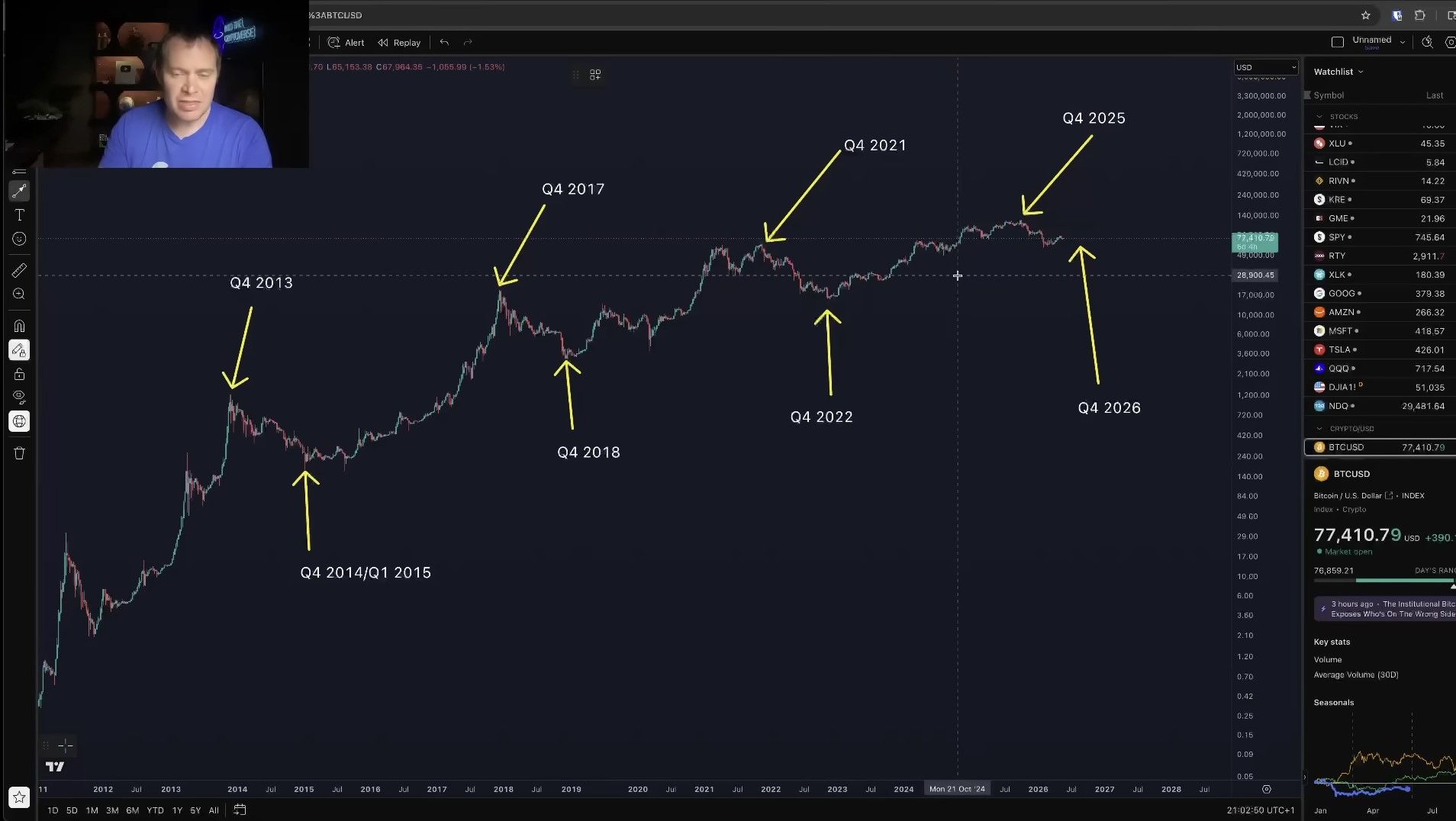
Bitcoin’s four-year cycle is alive and well, says Benjamin Cowen, founder of Into the Cryptoverse. The current top arrived within a week of historical timing, and the next bottom should follow in Q4 2026.
The analyst dismisses claims that spot ETFs, corporate treasury demand, and a Bitcoin reserve narrative have broken the pattern. Every previous cycle saw similar narratives fail before the bear market arrived anyway.
Topped When It Always Tops
In a new video, the founder of Cryptoverse pushed back on the wave of analysts declaring the cycle dead.
“Bitcoin topped within one week of when it historically tops, despite the narratives for calling the four-year cycle dead.”
The two previous cycles topped on day 1,059 and day 1,168 from the prior low. The current cycle topped on day 1,162.
Bitcoin trades near $75,650, down about 40% from its October 6 record of $126,080.

Apathy Top Does Not Cancel a Bear Market
Critics argue Bitcoin topped on apathy rather than euphoria, breaking the historical pattern. Cowen turned to S&P 500 data from 1962 to 1982. He says the four-year low cycle held even when index tops looked nothing like a blow-off.
“Topping on apathy doesn’t mean you don’t have a bear market, because you can see how in the past the stock market topped on apathy arguably and it still had a bear market.”
He sees the current counter-trend rally as weaker than the 46% bounce off the 2022 low. The 16-week run also sits inside the 15 to 25 week range seen in prior midterm-year recoveries.

Benjamin Cowen: The Invalidation Scenario
Cowen acknowledges the call could be wrong, but argues the burden of proof sits with the bulls.
“To pretend like it’s different this time because of some narrative on Wall Street would be the same mistake that people fell for last cycle and the cycle before that.”
Even in a softer outcome, he expects Bitcoin to revisit $60,000 later this year. Any durable bull market would only resume after that test.
His base case for the cyclical low is October 2026. That aligns with the midterm year pattern seen in 2014, 2018 and 2022. It also matches recent analyst predictions for the same bottoming window.
The post Bitcoin Four-Year Cycle Not Dead, Benjamin Cowen Says BTC Bottom Likely in October 2026 appeared first on BeInCrypto.



South Korean prosecutors have charged five people accused of running a rug pull on the Solana-based meme coin CATFI. The case marks the country’s first arrest and prosecution tied to a decentralized exchange scheme.
Prosecutors said the group made roughly 400 million won, or about $260,000, in illicit profits. The scheme caused 900 million won (~$650,000) in losses across 256 investors.
How the CATFI Scheme Worked
Investigators named the surname Park as the main suspect. Park ran the “Eth Father” social media account, posing as an unrelated third party who recommended CATFI to followers.
Park and his associates issued CATFI on Pump.fun, a Solana token launchpad, using about 10 million won in capital. The token was then listed on a decentralized exchange. The group relied on multiple wallets and circular trades to hide their control of the supply.
CATFI’s price climbed roughly 1,001 times within 26 hours of listing before the operators sold off their holdings. About 6,000 buyers entered the trade. The collapse left 256 investors with combined losses of 900 million won, prosecutors said.
The charges mark the first use of fraudulent trading provisions under Korea’s user protection law. The law took effect in July 2024. An earlier case under the same statute focused on market manipulation at a centralized exchange. This case is the first to target a decentralized exchange platform.
Two suspects were detained and indicted, and one was charged without detention. Two accomplices face separate charges for helping the main suspect evade investigators. Seoul’s new investigative crime unit for virtual assets led the case.
Solana has seen similar rug pulls before, but prosecutions tied to DEX activity have been rare. Prosecutors said they would respond firmly to schemes that erode market trust.
The post South Korea Makes First Arrest and Prosecution in Meme Coin Rug Pull Case appeared first on BeInCrypto.

TLDR
- Secretary of State Marco Rubio declared the Strait of Hormuz will be accessible again “one way or the other” after recent U.S. military operations targeting Iran
- Negotiated framework under discussion features ceasefire lasting 30-60 days with provisions for Iranian oil exports
- Administration officials forecast dramatic energy price drops upon strait’s reopening
- Energy sector experts caution about extended “Hormuz Hangover” with normalization potentially requiring multiple quarters or years
- Oil futures fluctuating in $90-$100 range amid ongoing diplomatic uncertainty
Secretary of State Marco Rubio issued a firm declaration Tuesday that the critical Strait of Hormuz shipping corridor will be restored to operation “one way or the other,” speaking after American military forces conducted strikes on Iran’s southern territory overnight. His remarks coincided with ongoing indirect diplomatic exchanges between U.S. and Iranian representatives in Qatar’s capital.
The strategic waterway has faced operational constraints since combined U.S.-Israeli military action against Iran commenced on February 28, initiating the current conflict. Tehran’s subsequent restrictions on maritime traffic have been a significant factor in escalating fuel costs worldwide.
Rubio emphasized that Washington’s position requires unrestricted, cost-free navigation through the strait. He condemned Iran’s implementation of passage fees, asserting that Tehran stands isolated internationally in supporting such a maritime toll structure.
Tehran has rejected characterizations of the fees as tolls, with foreign ministry representatives explaining the charges compensate for navigational assistance and environmental safeguards.
What a Deal Would Look Like
Emerging reports indicate the diplomatic framework being considered encompasses a ceasefire extension of either 30 or 60 days, during which maritime access would be restored and Tehran would receive authorization to sell oil. Discussions regarding nuclear capabilities would be deferred to subsequent negotiations.
Wolfe Research analysts characterized the proposal as a “skinny” agreement, observing that financial markets “won’t care one bit about the deferral of the nuclear file.” Their assessment is direct: strait accessibility alone would trigger favorable market responses.
President Trump indicated over the recent weekend that an announcement regarding a deal would come “shortly,” though he subsequently revised expectations, acknowledging negotiations require additional time.
Rubio stated Tuesday that finalizing any agreement would require “a few days,” even as fresh confrontations between American and Iranian military forces erupted near the strait. U.S. Central Command confirmed conducting strikes partially to neutralize Iranian vessels attempting to deploy naval mines.
Why Analysts Are Cautioning Against Optimism
Despite confident projections from administration officials, energy sector analysts are advocating measured expectations. Wolfe Research projected that replenishing commercial and strategic petroleum reserves “will stretch well into 2027.” Henrietta Treyz from AGF Investments introduced the concept of a “Hormuz Hangover,” arguing recovery duration should be “measured in quarters and years.”
Capital Economics assessed that any market surge following reopening would likely prove constrained because energy pricing won’t immediately normalize.
Administration officials have contested this conservative outlook. Kevin Hassett, director of the National Economic Council, stated on Fox Business that “as soon as the straits are open, energy prices are going to plummet like nothing you’ve ever seen before.” He projected refinery replenishment could occur within one to two months.
Approximately 1,500 vessels are currently stationed in the Persian Gulf awaiting clearance through the strait. Physical infrastructure damage to regional energy facilities compounds the projected recovery period.
Brent crude alongside West Texas Intermediate futures maintained trading ranges between $90 and $100 per barrel Tuesday as diplomatic discussions progressed.
Yardeni Research analysts identified an additional long-term consideration. Even following conflict resolution, equity markets will likely incorporate a “Strait of Hormuz premium” into oil valuations, reflecting the persistent possibility of future Iranian closures.
Iranian legislators introduced additional stipulations Tuesday, with the parliamentary National Security and Foreign Policy Committee chairman detailing confidence-building requirements the United States must satisfy before finalizing any accord.
As of Tuesday evening, no agreement had been concluded, and the timeline for potential announcements remained undetermined.

Bitcoin’s price rally that drove the asset to $78,000 yesterday came to a screeching halt after a painful rejection pushed it south by approximately three grand.
Most larger-cap alts are sluggish today, but RAIN has joined them in terms of market cap after a massive surge of over 40%.
BTC Halted at $78K
After peaking at over $82,000 a couple of weeks ago, bitcoin entered a more prolonged downtrend that drove it south hard. It was first pushed below $80,000 by May 16, then the bears initiated a few more leg downs that ultimately resulted in a massive decline to under $74,500 on May 23. This became the cryptocurrency’s lowest price tag in just over a month.
It rebounded almost immediately after Trump said the US and Iran are getting closer to a permanent peace deal. It jumped to $77,500 at the time and, after a brief retracement, spiked to $78,000 yesterday for the first time in several days.
However, reports emerged that the strikes between the US and Iran had resumed instead of a peace deal, and BTC dipped to $76,000. It plunged further to $75,200 earlier today as experts outlined a mind-blowing sale through BlackRock’s IBIT.
Nevertheless, it has rebounded slightly and currently trades close to $76,000 again. Its market cap has slipped to $1.520 trillion on CG, while its dominance over the alts has settled at 58%.

RAIN Outperforms
RAIN is by far the top performer from all top 100 alts today. It has skyrocketed by over 44% as of now and tapped a new all-time high at almost $0.012. ICP and UB have also rocketed by double digits, but nowhere near close – 15% and 10%, respectively.
In contrast, NEAR has plunged by over 8%, followed by ZEC’s 6% decline. CC, ONDO, and WLFI are also well in the red daily. Ethereum has slipped below $2,100, while XRP struggles beneath $1.35. HYPE is close to its all-time high after a 4% daily increase.
The total crypto market cap has defended the $2.6 trillion level and stands about $20 billion above it.

The post RAIN Skyrockets 40% to New ATH, BTC Price Dumps by $3K Daily: Market Watch appeared first on CryptoPotato.
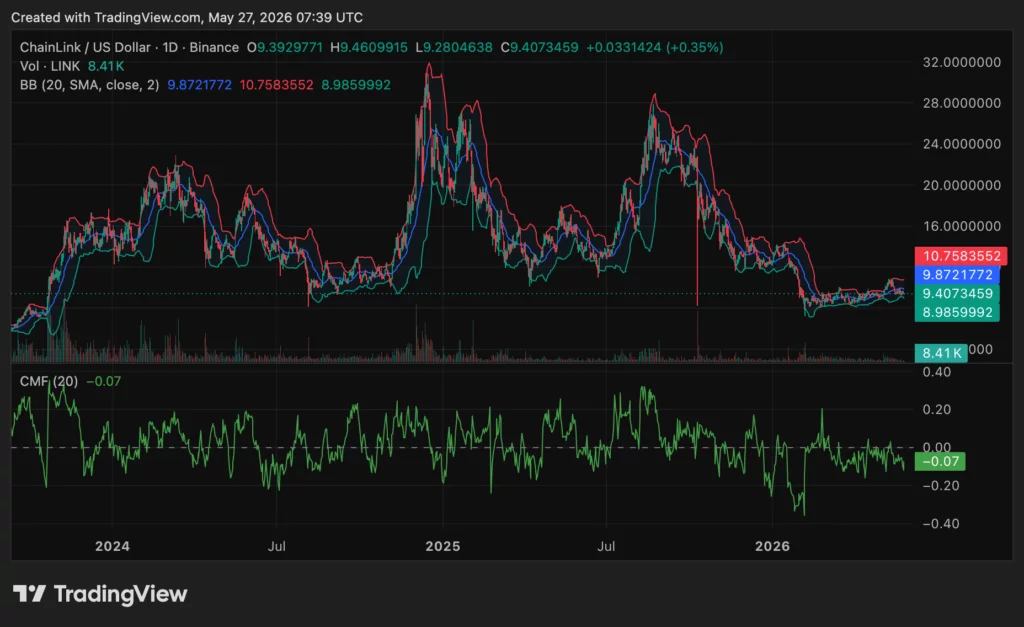
Chainlink is drawing fresh market attention after Binance outflow data showed a sharp rise in large LINK withdrawals.
Summary
- LINK exchange outflows reached 2025 highs as investors moved tokens off Binance during May trading.
- Whale wallets holding 100,000 LINK hit a record, adding pressure to the accumulation debate now.
- LINK price remains below $9.87 midline, leaving $9.65 and $8.95 as key levels for traders.
CryptoQuant analyst Darkfost said the top 10 LINK outflow transactions on Binance have climbed to their highest level of 2025.
The analyst said the largest daily outflows averaged more than 3,600 LINK through May, with several days showing more than 5,000 LINK withdrawn. Such moves often suggest investors are moving tokens away from exchanges and into external wallets for longer holding.
The broader altcoin market has also started to recover from its February low. Darkfost noted that Total3, which tracks the total crypto market cap excluding Bitcoin, Ethereum, and stablecoins, has risen more than 15% from that local bottom.
Still, the recovery remains uneven. Some tokens have strongly outperformed, while many assets continue to trade far below previous highs.
Chainlink price trades below key recovery level
The crypto.news price page showed Chainlink trading near $9.42, down 82.13% from its all-time high of $52.70 reached on May 10, 2021. Daily trading volume stood at about $293.28 million, with LINK ranking among the most actively traded crypto assets.
The token had a market capitalization of about $6.84 billion and a circulating supply of 727.09 million LINK. Chainlink has a maximum supply of 1 billion LINK, which keeps supply data in focus for long-term investors.
Technical data showed LINK trading below the 20-day Bollinger Band midline at $9.87. The upper band sat near $10.76, while the lower band was near $8.99.
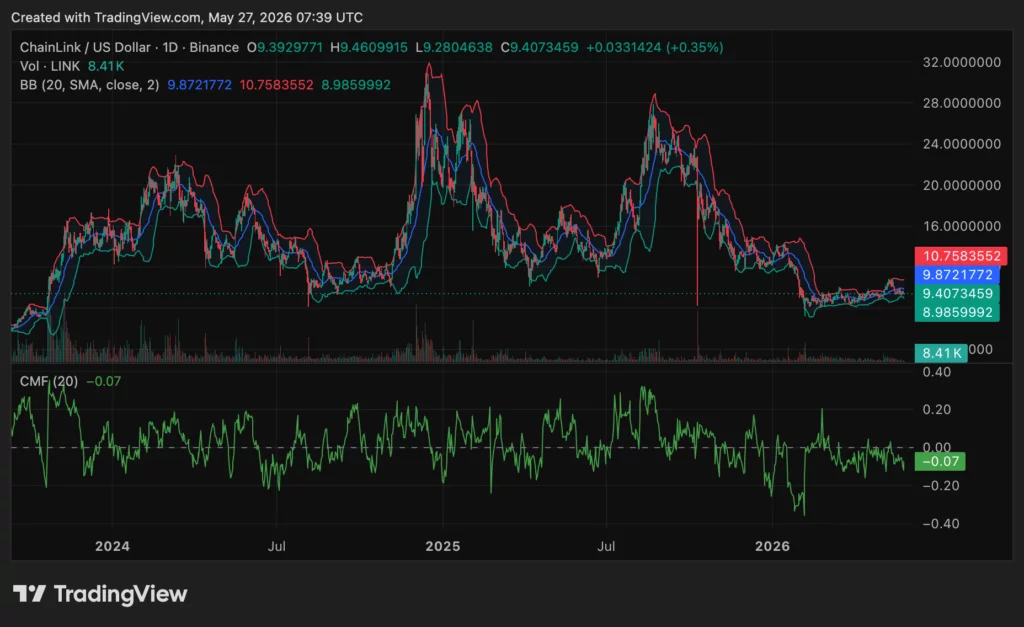
That setup shows the token is stabilizing above lower support, but buyers have not yet gained clear control. A move above $9.65, cited by CryptoWZRD as a short-term trigger, could open room for more upside. A drop below $8.95 would put support back in focus.
Whale wallets add to accumulation signal
Just 2 days ago, Santiment data also pointed to rising whale activity. The analytics platform said Chainlink now has 805 wallets holding at least 100,000 LINK, an all-time high. Those wallets have increased by 8.2% over seven weeks.
This adds weight to the exchange outflow signal. When large wallets grow while tokens leave exchanges, traders often read it as accumulation. It can suggest that large holders are preparing for a longer-term move rather than short-term selling.
However, the setup is not a confirmed reversal. Darkfost cautioned that “a single indicator alone is not enough to confirm a structural market reversal.”
That caveat matters because LINK still trades in a weak technical zone. The Chaikin Money Flow was near -0.07, showing mild negative money flow. Selling pressure remains present, even if it is not extreme.
Chainlink fundamentals remain active
Recent network data gives the price setup more context. Chainlink’s CCIP stack recently passed $110 billion in total value secured, including about $60 billion tied to cross-chain tokens and $50 billion in DeFi data feeds.
The same report noted that Chainlink had enabled $30.31 trillion in cumulative transaction value and published 19.39 billion verified on-chain messages as of late May 2026.
As earlier reported by crypto.news, Chainlink earned Deloitte SOC 2 Type 2 certification, a compliance step aimed at strengthening trust among institutional users. The report noted that CCIP had averaged about $90 million in weekly token transfers, while Chainlink infrastructure had enabled more than $28 trillion in cumulative transaction value at that time.
For now, the LINK price setup remains mixed. Exchange outflows and whale growth point to accumulation, while technical indicators show consolidation between $9 and $10. Bulls need a clean move above $9.65 and then $9.87 to show stronger recovery momentum.
Disclosure: This article does not represent investment advice. The content and materials featured on this page are for educational purposes only.
Key Highlights
- Base network from Coinbase has introduced Base MCP, enabling AI assistants such as ChatGPT and Claude to interface with cryptocurrency wallets.
- Through conversational commands, users can transfer assets, exchange tokens, view account balances and engage with decentralized finance platforms.
- Initial integration includes support for DeFi protocols such as Uniswap, Morpho, Moonwell and Avantis.
- All transactions require explicit user approval — AI assistants never gain access to private wallet keys.
- The x402 agentic payment system, which Base MCP builds upon, has recorded only $1.1 million in transaction volume during the last 30 days.
The Ethereum Layer 2 solution from Coinbase, known as Base, has unveiled Base MCP, an innovative integration that enables artificial intelligence platforms including ChatGPT and Claude to communicate directly with cryptocurrency wallets and decentralized financial applications.
This integration leverages the Model Context Protocol (MCP), an established framework designed to facilitate secure connections between AI systems and external applications.
Through simple conversational requests, users can instruct an AI agent to execute various operations including fund transfers, token swaps, balance inquiries, or transaction history reviews — all without navigating traditional cryptocurrency interfaces.
The initial release supports multiple DeFi protocols operating on Base. These encompass lending services Morpho and Moonwell, decentralized trading platform Uniswap, and derivatives exchange Avantis. Additional supported platforms include Aerodrome, Bankr and Virtuals.
Transaction Execution Process
When users submit requests, the AI assistant formulates a proposed action within the chat interface. Subsequently, the Base wallet appears in a separate window where users can either approve or reject the transaction.
Private keys remain exclusively under user control. Each operation undergoes the identical verification process used for standard Base account transactions. Additionally, asset modifications are previewed through simulation before user confirmation.
Lincoln Murr, who leads AI Product development at Coinbase, emphasized that the Base Account maintains continuity across platforms. He distinguished it from “isolated agentic wallets confined to terminal environments,” noting that trading activity, transaction records, and portfolio information remain synchronized across both the AI agent interface and the Base application.
Base positioned this release as advancing toward AI-integrated internet experiences. The organization expressed confidence that conversational agent interfaces will emerge as a primary channel for users to explore and utilize blockchain-based applications.
Development Phase and Security Considerations
Base MCP also advances the adoption of x402, an agentic AI payment framework introduced by Coinbase in May 2025. Murr characterized MCP as a “convenient wrapper” built upon existing application programming interfaces.
Combined with x402, this technology aims to facilitate small-scale cryptocurrency micropayments executed by AI agents. Nevertheless, x402 remains in nascent stages. Information from x402scan indicates the framework has handled merely $1.1 million in total volume throughout the previous 30 days.
The deployment of AI agents for cryptocurrency transactions has attracted scrutiny. Recent research from Google alongside multiple academic institutions cautioned that AI agents should be regarded as potentially untrusted system elements. Researchers emphasized that agents must maintain clear boundaries between instructions and untrusted information to prevent attackers from embedding malicious commands.
Just days ago, developer infrastructure provider Socket identified malware specifically designed to target cryptocurrency developers. This malicious software embedded concealed instructions intended to compromise AI-powered coding tools.
While Base has not addressed these particular security discoveries directly, the organization confirmed that every Base MCP transaction undergoes its established user verification protocol before any asset movement occurs.

David Hoffman, the Ethereum advocate and Bankless co-founder, disclosed last week that he sold the remaining Ether in his personal holdings. In his own words on X, Hoffman argued that the widely discussed “ETH is Money” thesis has largely run its course, and he doesn’t expect the asset to be re-rated meaningfully higher or lower by the market from here. The sale occurred on May 21, and Hoffman did not disclose the value of the tranche.
Hoffman has long been one of Ethereum’s most vocal supporters, arguing that Ethereum has earned its place in the crypto ecosystem and deserves the market capitalization it currently holds. Yet he cautioned that the window for a dramatic revaluation—either up or down—appears to be narrowing. “ETH is, to some degree, money. But not the maximally successful version that we collectively sought out to achieve,” Hoffman wrote in the post, signaling a nuanced shift in his investment stance while maintaining a bullish outlook on Ethereum’s technology and ecosystem.
“ETH is, to some degree, money. But not the maximally successful version that we collectively sought out to achieve.”
The “ETH is Money” narrative holds that Ethereum, as a decentralized blockchain with monetary properties and a built-in mechanism to resist inflation, could function as a superior store of value relative to fiat. Proponents hoped ETH would eventually command a much higher valuation, especially as the network expanded through Layer 2 solutions and tokenization use cases. In practice, however, the asset’s price history has been more ambiguous than the thesis’s sterner forecasts might have suggested.
All-time price records put Ethereum near $5,000 in August of a previous cycle, with the asset trading around the $2,000 region in recent times. This trajectory—an ascent to new highs followed by a protracted, multi-year rangebound phase—has been a source of debate among investors and builders about ETH’s role as a store of value, a currency for on-chain activity, or a utility token whose value is closely tied to network demand and use cases rather than speculative macro bets.
In his public note, Hoffman described Ethereum as “a giver, not a taker,” emphasizing that the network provides secure blockspace and supports tokenization at cost, while most fees accrue to Layer 2 networks that sit atop Ethereum. “Ethereum takes no markup for anything it does. This is the nature of open source software, and this is the power of Ethereum. Ethereum supplies its full set of incredibly important values to the world… at cost,” Hoffman stated.
Even as he pivots out of a large ETH position, Hoffman remains “massively bullish” on Ethereum’s long-term trajectory, predicting that the network will “do exceptionally well from here on out.” He contends that only a marginal portion of that success will be reflected in the token’s price, underscoring a broader dissonance between network fundamentals and market pricing in the current cycle.
The reaction among Ethereum enthusiasts and observers was mixed. Bankless co-founder Ryan Sean Adams described Hoffman’s move as the “end of an era,” highlighting the emotional and strategic shift for a community that has long treated ETH as a core political and financial asset. Former Ethereum core developer Eric Connor offered a pragmatic take, suggesting Hoffman’s sale isn’t a wholesale indictment of ETH but rather a reflection of its performance relative to broader crypto markets over recent years.
Connor argued that ETH’s lag is less about the protocol’s fundamentals and more about macro dynamics and distribution effects: a large portion of price pressure has come from the rapid creation of new wealth early in Ethereum’s bull run. “Maximalism to a single coin when it comes to portfolio management is pretty silly,” he added, hinting at a broader conversation about diversification within crypto portfolios.
Key takeaways
- Prominent Ethereum advocate David Hoffman disclosed the sale of the remaining ETH in his personal holdings, signaling a strategic repositioning rather than a wholesale rejection of Ethereum’s long-term value.
- Hoffman retains a bullish view on Ethereum’s fundamentals and network development, but says the opportunity for a significant market rerating of ETH appears to have diminished.
- The “ETH is Money” thesis remains contested: ETH’s price peaked near $5,000 in 2021, has since retreated, and currently trades in a multi-year range around $2,000, raising questions about ETH’s ability to function as a monetary store of value.
- Hoffman emphasizes Ethereum’s model of “no markup” and cost-based tokenization, with Layer 2 ecosystems absorbing most on-chain fees, a dynamic shaping perceptions of ETH’s value accrual vs. the fee capture on L2s.
- Community voices welcomed the act as a real-time reminder of portfolio diversification, with some noting that a single-asset thesis may not align with evolved market dynamics or individual risk tolerance.
Contextualizing the move amid ETH’s price narrative
Ethereum’s price journey has framed many debates about the asset’s role in crypto markets. After reaching an all-time high just below $5,000, ETH’s price retraced substantially from that peak. A prolonged period of consolidation, coupled with a burst of activity on Layer 2 networks and increasing interest in tokenization primitives, has kept ETH at the center of a wide range-bound price narrative for years. While some investors had banked on a renewed cycle of appreciation driven by macro funds and institutional demand, others argued that ETH’s on-chain activity, security guarantees, and robust development roadmap would eventually translate into outsized price gains.
Hoffman’s public liquidation and his framing of the “ETH is Money” thesis as largely realized add another data point to the ongoing discussion about what truly drives ETH value. If the market’s re-rating opportunity is indeed limited, observers will look more closely at fundamental drivers—such as Layer 2 throughput, adoption of decentralized finance and tokenized assets, and the ongoing development of Ethereum’s upgrade path—to assess whether ETH can sustain price resilience while continuing to fulfill a broad set of on-chain use cases.
Market outlook: what investors should monitor next
With Hoffman’s move, investors may watch for how ETH’s price responds to a shifting narrative about store of value versus utility. The open-source, at-cost model that Hoffman highlighted could become a focal point for discussions around value accrual in decentralized ecosystems, particularly as Layer 2 networks mature and tokenization use cases expand. As always in crypto, price behavior will reflect a blend of macro liquidity, on-chain activity, and evolving risk appetite among institutions and retail participants.
Looking ahead, readers should keep an eye on several developments: the pace of Layer 2 adoption and fee dynamics, any shifts in institutional interest in Ethereum-based products, and regulatory signals that could influence on-chain activity and tokenization initiatives. If Ethereum can demonstrate sustained growth in throughput and real-world application, it may still realize long-run value that aligns with the network’s vast developer base and user base—even if the market’s immediate re-rating potential feels constrained in the near term.
For now, Hoffman’s stance illustrates a broader theme in crypto markets: conviction can coexist with strategic adjustment. As the ecosystem evolves, investors will be watching not only price action but the health and direction of Ethereum’s driving use cases and the resilience of its decentralized governance and development model.
Crypto World
Bermuda Joins Forces With Circle, Coinbase, and Stellar to Create First Fully Blockchain-Based Economy
Key Highlights
- Bermuda has announced a collaboration with Circle, Coinbase, and Stellar to create a completely blockchain-powered national economy
- The island’s monetary authority distributed $100 worth of USDC to citizens in a pilot program testing cryptocurrency for everyday transactions
- Public services will begin accepting digital currency payments, with the motor vehicle department being the first phase
- A national digital currency, the Bermuda Digital Dollar, is under development utilizing Stellar’s blockchain technology
- Legal frameworks governing property rights, contractual agreements, and financial securities are being modernized to accommodate smart contracts and blockchain-based assets
The Caribbean island of Bermuda is advancing an ambitious initiative to transform its economic infrastructure entirely onto blockchain technology. This groundbreaking project involves strategic partnerships with Circle, Coinbase, and Stellar.
In a pioneering trial, the Bermuda Monetary Authority distributed $100 in USDC—Circle’s dollar-pegged stablecoin—to local residents through an airdrop mechanism. Recipients tested the digital currency at a specially organized marketplace where they purchased products, transferred funds peer-to-peer, or exchanged their crypto for traditional cash. Financial service providers including MoneyGram were present to facilitate these conversions.
According to Craig Swan, who leads the Bermuda Monetary Authority, the initiative aimed to simultaneously introduce both merchants and consumers to the digital payment ecosystem. This hands-on trial provided citizens with practical experience using cryptocurrency wallets and conducting blockchain-based transactions in real-world scenarios.
Transition to Digital Government Services
Bermuda’s next phase involves accepting cryptocurrency for government service fees. The Department of Motor Vehicles will serve as the initial testing ground, selected due to its substantial transaction volume since nearly all island residents possess vehicles or driving licenses. Swan indicated that successful implementation will lead to expansion across all government agencies.
Circle has established its Circle Mint platform to support digital treasury operations for government accounts. Meanwhile, Coinbase is contributing technical expertise to facilitate adoption for both institutional entities and individual users.
This strategic vision was initially unveiled at the World Economic Forum gathering in Davos. During that conference, Bermuda officials announced their collaborations with Circle and Coinbase, with the Stellar partnership for the digital currency project being added subsequently.
Introducing the National Digital Currency
Bermuda has formally announced its collaboration with Stellar Development Foundation to create a sovereign digital currency named the Bermuda Digital Dollar. This currency will operate as a stablecoin with full backing from fiat currency reserves maintained in conventional banking institutions.
Premier E. David Burt explained that Bermuda’s continued dependence on outdated payment infrastructure has resulted in excessive transaction fees for residents and hindered economic expansion. The transition to blockchain-based systems is anticipated to significantly lower these costs by eliminating costly intermediary banking processes.
Swan clarified that traditional financial institutions will continue serving essential functions. These banks will maintain the fiat currency reserves backing the digital tokens and provide localized custody solutions.
Legal Framework Modernization
Transitioning an entire national economy to blockchain infrastructure demands comprehensive legal reforms alongside technological implementation. Swan emphasized that contractual law, property ownership regulations, and securities legislation must all be revised to grant legal recognition to smart contracts.
The BMA recently concluded a pilot program where regulatory compliance requirements were encoded directly into smart contract protocols. During this experimental phase, transactions were automatically prevented when collateral reserves fell below required thresholds or when addresses triggered anti-money laundering alerts.
Bermuda is additionally creating an AI-powered payments monitoring system designed to oversee transactions executed by autonomous software agents rather than human operators.
Swan noted that smaller jurisdictions possess inherent advantages in implementing rapid changes. Bermuda’s compact population translates to fewer regulatory hurdles and accelerated deployment schedules compared to larger nations.
Bitcoin’s price tumbled to nearly $75,000 earlier, marking a decline of about 2% for the day. The move was sudden, which raised more than a few eyebrows.
Analysts have started speculating about what caused the cascading red candles, and many are pointing to the involvement of BlackRock’s spot BTC ETF, IBIT.

Largest Dark Pool Block Trade on BlackRock’s IBIT ETF
Multiple analysts noted a massive $1.289 billion IBIT block sale executed by an unknown party through a dark pool at 10:30 AM yesterday.
Popular ETF analyst Eric Balchunas said that the trade involved a whopping 29 million shares, which dwarfs all other trades for the day and perhaps ever.
Confirmed.. 29 million share trade ($1.3b) of $IBIT executed at 1030am this morning. This screen shows all the IBIT trades today by size and you can see one of these is not like the others. Price unchanged today so mkt absorbed it well. https://t.co/Otew0DWa3F pic.twitter.com/jZcoKez74K
— Eric Balchunas (@EricBalchunas) May 26, 2026
Rumors are now circulating that this move could trigger the largest single-day Bitcoin ETF outflow on record. Many traders say the block trade coincided with a sudden downside move in BTC, as seen on the charts.
It also outlines the dangers of concentrated liquidity, especially now that major institutional players have furthered their involvement in the market, as well as large corporate treasuries largely denominated in BTC.
The post The Reason Bitcoin’s Price Plunged to $75K: BlackRock? appeared first on CryptoPotato.


Bankless co-founder David Hoffman said he sold his ETH because he no longer believes Ethereum’s success will fully translate into higher ETH prices.
Hoffman, one of Ethereum’s most visible media advocates, said the “ETH is money” thesis did not collapse. Instead, he argued that it already played out. “The ETH is Money thesis didn’t fail… it played out,” he wrote.
His post lands as ETH trades near a fragile support zone around $2,050 to $2,100. The asset has struggled to regain stronger resistance above $2,300, while ETF flows and on-chain demand remain mixed.
Hoffman Says Ethereum Network Can Win While ETH Lags
Hoffman made a clear split between Ethereum the network and ETH the asset.
“I am massively bullish Ethereum,” he wrote, adding that he expects the network to perform well. But he said only a “marginal amount” of that success may be reflected in ETH.
That is the core of his argument. Ethereum may continue to dominate stablecoins, tokenization, DeFi, and Layer 2 activity. But ETH may no longer capture enough value from that growth to justify a major asset rerating.
The Value Capture Problem
Hoffman argued that Ethereum is structurally designed to give value back to its ecosystem.
He described Ethereum as “a giver, not a taker,” saying it provides secure blockspace to L2s, tokenizes real-world assets, and supports DeFi without taking much economic markup.
That view matches the current market debate. Ethereum usage remains strong across areas such as stablecoins and rollups. But L2s and applications now capture much of the activity that once supported the old fee-burn narrative.
As a result, Ethereum can grow as infrastructure while ETH fails to outperform.
ETH Faces Weak Technical Momentum
The timing also matters. ETH is trading close to a key support range after failing to build strong momentum above $2,200. Analysts have warned that a break below the current zone could weaken the chart further.
At the same time, institutional demand remains uneven. Ethereum ETFs have not delivered the consistent inflows needed to offset weaker market confidence.
A Symbolic Exit From an Ethereum Insider
Hoffman said he is not bearish on ETH. He said he wants to allocate capital elsewhere because he does not expect ETH to be “structurally rerated” higher or lower.
Still, the move carries weight.
For years, Bankless helped popularize ETH as internet money. Hoffman’s exit shows that even some Ethereum believers now question whether ETH remains the best financial expression of Ethereum’s future.
The post Why Bankless Co-Founder Sold His Entire Ethereum Portfolio appeared first on BeInCrypto.
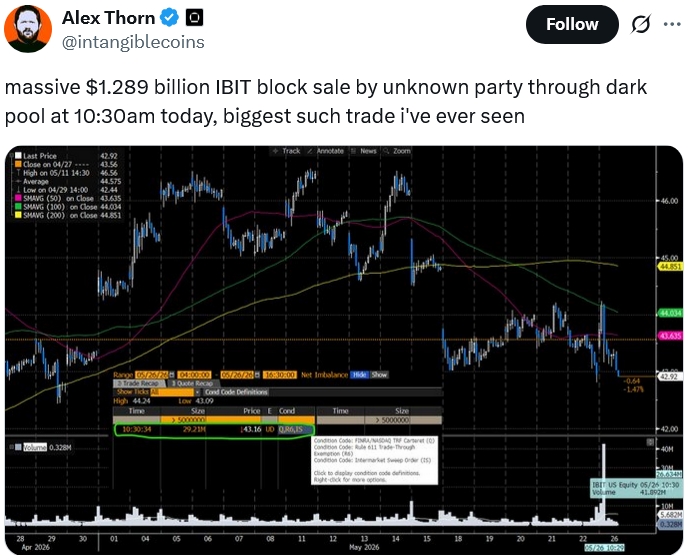
An unknown trader’s $1.3 billion sale of shares in BlackRock’s Bitcoin exchange-traded fund on Tuesday coincided with a steep fall in the price of Bitcoin, according to analysts.
A trader sold 29.2 million shares of BlackRock’s iShares Bitcoin Trust ETF (IBIT) at 2:30 p.m. UTC on a “dark pool,” a private trading platform that institutions often use to discreetly make large trades outside of public markets.
The impact of the $1.3 billion trade was immediately felt in the crypto market, with TradingView data showing that Bitcoin (BTC) fell 1.5% from $77,875 to $76,720 in a short 10-minute window after 2:30 p.m. UTC.
Bitcoin then slid further to a 24-hour bottom of $75,600 about 12 hours later, marking a 2.8% fall for the day.
Bitcoin has historically been viewed as an asset that trades outside of the traditional market, but products such as US-based Bitcoin ETFs have removed barriers for institutional investors to trade Bitcoin, and the cryptocurrency has recently traded in high correlation with US markets.
Alex Thorn, head of firmwide research at crypto investment firm Galaxy Digital, said in a post to X that it was the biggest trade he has seen made through a dark pool.
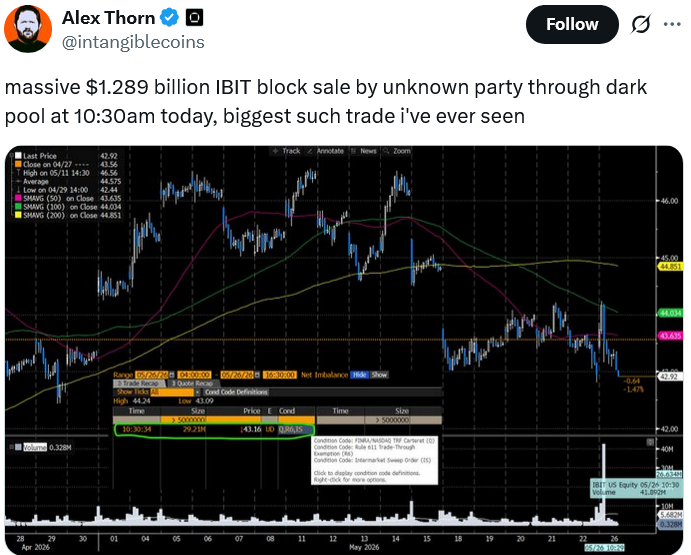
Source: Alex Thorn
Bloomberg ETF analyst Eric Balchunas also shared that the 29.2 million IBIT shares sold at $43.16 and was over 22 times larger than the second-largest IBIT sell order on Tuesday.
Related: Goldman Sachs exits XRP, Solana ETF exposure in Q1 2026
Bitcoin ETF outflow streak continues
US spot Bitcoin ETFs have now recorded eight straight trading days of net outflows, with a $333.6 million outflow on Tuesday, including a $192.4 million outflow from IBIT.
More than $2 billion has now flowed out from the ETFs since May 14, the last recorded net inflow across all the funds, a sign that institutional sentiment toward Bitcoin has weakened, with investors reducing exposure to Bitcoin ETFs at a rate faster than fresh capital flowing into the market.
Institutional market maker Jane Street reduced its Bitcoin ETF holdings by around 70% in the first quarter, while investment bank Goldman Sachs reduced its Bitcoin ETF position by 10%.
Magazine: Bitcoin ETFs bleed $1B, Aave’s $71M ETH unfreeze bid delayed

From experimentation to execution: where agentic AI is delivering real value

Bill Murray’s Forgotten 70s Feature Film Debut Changed Comedy Forever

West Ham United: Nuno Espirito Santo to stay as manager for Championship campaign


-

 Crypto World6 days ago
Blockchain.com files with SEC for U.S. IPO
-

 Fashion5 days ago
Holiday Weekend Open Thread – Corporette.com
-

 Crypto World5 days ago
Bitcoin Accumulation Weakens as BTC Realized Losses Hit $600M
-

 Business5 days ago
Dell Technologies DELL Stock Surges 15% on AI Server Momentum and Analyst Upgrades in 2026
-

 Crypto World4 days ago
Robinhood crypto COO Tanya Denisova exits
-

 Politics5 days ago
Makerfield: a tale of two social-media histories
-

 Crypto World5 days ago
Space X IPO Is ‘Bad News’ for Tech Stocks: But What About Bitcoin?
-

 Tech2 days ago
Microsoft’s quiet Claude Code retreat and the real cost of enterprise AI
-

 Business3 days ago
NYT Strands Answers May 24 2026 Revealed for Puzzle No. 812 Theme Summer Essentials
-
 Crypto World5 days ago
MicroStrategy’s Saylor Says Miners No Longer Set Bitcoin Price, Another Force Has Taken Over
-

 Tech5 days ago
WhatsApp ads could make Irish debut after discussions with DPC
-

 Crypto World5 days ago
AI infrastructure race heats up as IREN pitches full-stack strategy, WhiteFiber lands $160M deal
-
 Tech5 days ago
A 0.12% parameter add-on gives AI agents the working memory RAG can’t
-

 Tech5 days ago
You Can Now Add ChatGPT To PowerPoint
-
 Crypto World2 days ago
Nvidia (NVDA) CEO Calls on Super Micro to Strengthen Export Controls Amid Smuggling Probe
-
 NewsBeat6 days ago
Charity run by Reform leader Malcolm Offord accused of ‘law breaking’ over Scottish registration
-

 Tech2 days ago
Westone Audio and Etymotic Acquired by Fidelity Collective in Major IEM Market Move
-

 Business5 days ago
Trump Invests $1M-$5M in Kura Sushi USA Chain With 27 California Locations
-

 Sports5 days ago
2026 CJ Cup Byron Nelson leaderboard: Brooks Koepka finds putting stroke in Round 1
-

 Crypto World6 days ago
Exa Labs raises $250 million in funding led by a16z
You must be logged in to post a comment Login