

Crypto World
David Hoffman, ETH Bull, Explains Why He Sold ETH


David Hoffman, the Ethereum advocate and Bankless co-founder, disclosed last week that he sold the remaining Ether in his personal holdings. In his own words on X, Hoffman argued that the widely discussed “ETH is Money” thesis has largely run its course, and he doesn’t expect the asset to be re-rated meaningfully higher or lower by the market from here. The sale occurred on May 21, and Hoffman did not disclose the value of the tranche.
Hoffman has long been one of Ethereum’s most vocal supporters, arguing that Ethereum has earned its place in the crypto ecosystem and deserves the market capitalization it currently holds. Yet he cautioned that the window for a dramatic revaluation—either up or down—appears to be narrowing. “ETH is, to some degree, money. But not the maximally successful version that we collectively sought out to achieve,” Hoffman wrote in the post, signaling a nuanced shift in his investment stance while maintaining a bullish outlook on Ethereum’s technology and ecosystem.
“ETH is, to some degree, money. But not the maximally successful version that we collectively sought out to achieve.”
The “ETH is Money” narrative holds that Ethereum, as a decentralized blockchain with monetary properties and a built-in mechanism to resist inflation, could function as a superior store of value relative to fiat. Proponents hoped ETH would eventually command a much higher valuation, especially as the network expanded through Layer 2 solutions and tokenization use cases. In practice, however, the asset’s price history has been more ambiguous than the thesis’s sterner forecasts might have suggested.
All-time price records put Ethereum near $5,000 in August of a previous cycle, with the asset trading around the $2,000 region in recent times. This trajectory—an ascent to new highs followed by a protracted, multi-year rangebound phase—has been a source of debate among investors and builders about ETH’s role as a store of value, a currency for on-chain activity, or a utility token whose value is closely tied to network demand and use cases rather than speculative macro bets.
In his public note, Hoffman described Ethereum as “a giver, not a taker,” emphasizing that the network provides secure blockspace and supports tokenization at cost, while most fees accrue to Layer 2 networks that sit atop Ethereum. “Ethereum takes no markup for anything it does. This is the nature of open source software, and this is the power of Ethereum. Ethereum supplies its full set of incredibly important values to the world… at cost,” Hoffman stated.
Even as he pivots out of a large ETH position, Hoffman remains “massively bullish” on Ethereum’s long-term trajectory, predicting that the network will “do exceptionally well from here on out.” He contends that only a marginal portion of that success will be reflected in the token’s price, underscoring a broader dissonance between network fundamentals and market pricing in the current cycle.
The reaction among Ethereum enthusiasts and observers was mixed. Bankless co-founder Ryan Sean Adams described Hoffman’s move as the “end of an era,” highlighting the emotional and strategic shift for a community that has long treated ETH as a core political and financial asset. Former Ethereum core developer Eric Connor offered a pragmatic take, suggesting Hoffman’s sale isn’t a wholesale indictment of ETH but rather a reflection of its performance relative to broader crypto markets over recent years.
Connor argued that ETH’s lag is less about the protocol’s fundamentals and more about macro dynamics and distribution effects: a large portion of price pressure has come from the rapid creation of new wealth early in Ethereum’s bull run. “Maximalism to a single coin when it comes to portfolio management is pretty silly,” he added, hinting at a broader conversation about diversification within crypto portfolios.
Key takeaways
- Prominent Ethereum advocate David Hoffman disclosed the sale of the remaining ETH in his personal holdings, signaling a strategic repositioning rather than a wholesale rejection of Ethereum’s long-term value.
- Hoffman retains a bullish view on Ethereum’s fundamentals and network development, but says the opportunity for a significant market rerating of ETH appears to have diminished.
- The “ETH is Money” thesis remains contested: ETH’s price peaked near $5,000 in 2021, has since retreated, and currently trades in a multi-year range around $2,000, raising questions about ETH’s ability to function as a monetary store of value.
- Hoffman emphasizes Ethereum’s model of “no markup” and cost-based tokenization, with Layer 2 ecosystems absorbing most on-chain fees, a dynamic shaping perceptions of ETH’s value accrual vs. the fee capture on L2s.
- Community voices welcomed the act as a real-time reminder of portfolio diversification, with some noting that a single-asset thesis may not align with evolved market dynamics or individual risk tolerance.
Contextualizing the move amid ETH’s price narrative
Ethereum’s price journey has framed many debates about the asset’s role in crypto markets. After reaching an all-time high just below $5,000, ETH’s price retraced substantially from that peak. A prolonged period of consolidation, coupled with a burst of activity on Layer 2 networks and increasing interest in tokenization primitives, has kept ETH at the center of a wide range-bound price narrative for years. While some investors had banked on a renewed cycle of appreciation driven by macro funds and institutional demand, others argued that ETH’s on-chain activity, security guarantees, and robust development roadmap would eventually translate into outsized price gains.
Hoffman’s public liquidation and his framing of the “ETH is Money” thesis as largely realized add another data point to the ongoing discussion about what truly drives ETH value. If the market’s re-rating opportunity is indeed limited, observers will look more closely at fundamental drivers—such as Layer 2 throughput, adoption of decentralized finance and tokenized assets, and the ongoing development of Ethereum’s upgrade path—to assess whether ETH can sustain price resilience while continuing to fulfill a broad set of on-chain use cases.
Market outlook: what investors should monitor next
With Hoffman’s move, investors may watch for how ETH’s price responds to a shifting narrative about store of value versus utility. The open-source, at-cost model that Hoffman highlighted could become a focal point for discussions around value accrual in decentralized ecosystems, particularly as Layer 2 networks mature and tokenization use cases expand. As always in crypto, price behavior will reflect a blend of macro liquidity, on-chain activity, and evolving risk appetite among institutions and retail participants.
Looking ahead, readers should keep an eye on several developments: the pace of Layer 2 adoption and fee dynamics, any shifts in institutional interest in Ethereum-based products, and regulatory signals that could influence on-chain activity and tokenization initiatives. If Ethereum can demonstrate sustained growth in throughput and real-world application, it may still realize long-run value that aligns with the network’s vast developer base and user base—even if the market’s immediate re-rating potential feels constrained in the near term.
For now, Hoffman’s stance illustrates a broader theme in crypto markets: conviction can coexist with strategic adjustment. As the ecosystem evolves, investors will be watching not only price action but the health and direction of Ethereum’s driving use cases and the resilience of its decentralized governance and development model.

Crypto World
Crypto exchange HTX rejects U.K. sanction allegations, says it refused A7A5 stablecoin listing


Crypto exchange HTX rejected U.K. claims it helped Russia’s “illicit financial infrastructure” used for moving funds and sustaining the country’s war in Ukraine, saying it refused a listing application from the A7A5 ruble stablecoin.
“A7A5 was trying to list their stablecoin. However, following our rigorous internal due diligence and compliance review processes, their application was explicitly rejected,” a spokesperson for HTX told CoinDesk.
The token’s issuer, A7 LLC, is already sanctioned by many Western governments.
In a sanctions note issued Tuesday, the Foreign Office didn’t provide specific evidence of any HTX-A7A5 cooperation. The ministry said it had “reasonable grounds to suspect” HTX was assisting A7, which the U.K. says is “carrying on business in a sector of strategic significance to the Government of Russia.”
“We approached all the leading CEXes several months ago in order to list A7A5, including HTX,” A7A5 executive Oleg Ogienko told CoinDesk, using crypto terminology for centralized exchanges. “But all of them rejected our application almost at once because they are scared of secondary sanctions.”
Ogienko said he’s open to working with centralized exchanges and HTX’s refusal to list the Russian stablecoin is “bad for them.”
“Now, we do not need their listing, because our business model runs on DeFi infrastructure,” he told CoinDesk. “Nevertheless, we are open for interaction with CEXes if they want to increase their real trade volume and attract good clients.”
In an interview with CoinDesk at the Consensus Hong Kong conference earlier this year, Ogienko said he attended to meet with projects and protocols to discuss cooperation and business development.
Ogienko said A7A5 is fully compliant with Kyrgyz and Russian regulations and the principles set out by the Financial Action Task Force (FATF), which tackles money laundering and terrorist and proliferation financing worldwide.
“We do not violate any legislation,” he said.


India’s market regulator has moved ahead with a pilot project for tokenized corporate bonds, testing whether distributed ledger technology can improve liquidity and settlement efficiency in the country’s debt markets.
Summary
- SEBI has approved a pilot project to test tokenized corporate bond settlements using distributed ledger technology.
- Tuhin Kanta Pandey said the RBI is expected to finalize the framework before exchanges and SEBI move ahead with implementation.
- India continues to support regulated blockchain use cases in finance while maintaining strict tax and compliance rules for cryptocurrencies.
Speaking on the sidelines of the CareEdge Debt Market Summit in Mumbai on May 26, Securities and Exchange Board of India Chairman Tuhin Kanta Pandey said the regulator has approved a pilot initiative that will examine the use of Distributed Ledger Technology, or DLT, for the trading and settlement of corporate bonds.
During his interaction with the media, Pandey said the project would initially operate on a limited scale before any decision is taken on expanding the framework across the market. According to the SEBI Chairman, the implementation process could take between six and nine months as regulators and market participants work through multiple operational stages.
At the same time, the proposal has placed India’s approach to blockchain technology back in focus, particularly because the government continues to maintain a highly restrictive policy toward retail cryptocurrency trading while encouraging selected institutional uses of DLT infrastructure.
Pandey said certain DLT-based systems are already being used in segments such as covenant monitoring and depositories, though SEBI now wants to study whether tokenization can address long-standing inefficiencies in India’s corporate bond market.
India’s corporate bond market, estimated at nearly ₹59 lakh crore according to industry estimates cited in the additional context, continues to face low secondary market participation because many institutional investors hold bonds until maturity. Limited retail participation has also reduced price discovery and trading activity across the segment.
Under the proposed pilot, tokenization would convert traditional bond instruments into blockchain-based digital tokens capable of automated and near-instant settlements. The additional context noted that regulators are also evaluating whether fractional ownership structures could lower entry barriers for smaller investors.
Speaking about the expected benefits, Pandey said tokenization could improve liquidity and support “instantaneous autonomous settlements” within the bond market ecosystem.
RBI framework expected soon
During the event, Pandey said the Reserve Bank of India is separately working on draft guidelines connected to the framework and is expected to release the final norms shortly. He added that SEBI and stock exchanges are prepared to proceed once approvals from the central bank are finalized.
The SEBI Chairman also acknowledged risks associated with the technology, particularly concerns linked to future advances in quantum computing. According to Pandey, regulators need to examine whether developments in quantum systems could eventually affect cryptographic security used in DLT-based infrastructure.
India keeps the crypto sector in check
While India has opened the door for blockchain use cases in regulated financial markets, the country’s stance toward private cryptocurrencies remains tightly controlled through taxation and compliance rules.
Under India’s current virtual digital asset tax regime, profits from cryptocurrency transactions are taxed at a flat 30%, while a 1% tax is deducted at source for each trade. Existing rules also prevent investors from offsetting crypto losses against gains or regular income.
Meanwhile, crypto exchanges operating in India are required to register with the Financial Intelligence Unit-India and comply with the Prevention of Money Laundering Act requirements, including strict know-your-customer procedures and transaction reporting obligations.
Recent tax reporting rules have further tightened oversight. Digital asset platforms are required to submit user-level transaction data directly to the Income Tax Department, while delayed or inaccurate reporting can attract monetary penalties.
India is also integrating with the OECD’s Crypto-Asset Reporting Framework, a global data-sharing system that will allow authorities to receive information related to offshore digital asset holdings belonging to Indian residents.
By contrast, the corporate bond tokenization pilot will operate inside a permissioned and regulator-backed environment overseen jointly by SEBI and the RBI, separating the initiative from public blockchain networks commonly associated with cryptocurrencies such as Bitcoin and Ethereum.

More than 100 crypto firms and organizations led by the Digital Chamber, the Crypto Council for Innovation, and the Blockchain Association, have escalated their lobbying push on the U.S. Senate to advance the CLARITY Act, framing passage as the industry’s last realistic window to secure federal regulatory clarity before congressional momentum stalls.
The Senate Banking Committee cleared the bill in mid-May after months of bipartisan negotiations, but the floor fight has barely begun.
The stakes are concrete: for exchanges like Coinbase, Kraken, and Gemini, the bill directly protects fiat on/off-ramps that informal banking pressure has been quietly strangling for years.
Popcorn or Sour Patch Kids? Celebrity tennis matches? And a clear call for Senate action on digital assets. @RepDonDavis joins @taylorjbarr on the Hill — The Digital Chamber (@DigitalChamber) May 26, 2026
 . pic.twitter.com/pYlTR6D4Pe
Crypto-exposed equities surged on the committee vote, but analysts are already flagging the procedural hurdles that remain before the bill reaches the President’s desk.
The coalition’s April 23 letter to Senate Banking named the core grievance directly, that federal regulators, including the Fed, FDIC, and OCC have been running what the industry calls Operation Choke Point 2.0: an informal campaign to pressure banks into dropping crypto clients without formal rulemaking, without due process, and without a paper trail that advocacy groups can challenge in court.
The CLARITY Act would force that behavior into the open by mandating formal rulemaking processes to replace the current system of supervisory letters and guidance documents.
Discover: The Best Crypto to Diversify Your Portfolio
What the Coalition Is Actually Demanding – and Whether It Can Move Votes for the Clarity Act
The 100-plus signatories of the April letter include Coinbase, Circle, Kraken, Ripple, ConsenSys, Anchorage Digital, Galaxy Digital, Andreessen Horowitz, and Paradigm, a coalition spanning institutional infrastructure, VC capital, and retail-facing platforms.
Stand With Crypto university chapters also signed, signaling the campaign is running a constituent-pressure track alongside the institutional lobbying.
The Senate Banking Committee advanced the Clarity Act with a bipartisan vote. — Stand With Crypto
But the fight isn't over. The full Senate still needs to vote YES.
Call your senators NOW and tell them to vote YES on Clarity.
 (@standwithcrypto) May 26, 2026
The Digital Chamber’s Crypto Banking campaign has zeroed in on swing-vote senators in both the Banking Committee and the broader Democratic caucus, where bipartisan support is viewed as a hard prerequisite for the 60-vote threshold needed to move the bill on the floor.
The Crypto Council’s CEO has warned that without passage, “the U.S. risks losing its edge in this global competition”, a line calibrated to the national competitiveness argument that has drawn the most traction with skeptical centrists.
Treasury Secretary Scott Bessent added institutional weight at a Senate hearing on the FY2027 budget, arguing the CLARITY Act is “critical to maintaining U.S. financial leadership and the dollar’s reserve status.”

That alignment between the administration and industry lobby is notable, but it hasn’t yet neutralized Democratic concerns that the bill could weaken enforcement in a sector where President Trump’s family holds business interests.
Prediction market odds on the CLARITY Act have already shown how quickly Senate sentiment can shift, with passage probabilities collapsing sharply on earlier procedural setbacks.
Discover: The Best Token Presales
The post Crypto Advocacy Groups Launch All-Out Blitz to Secure Senate Support for CLARITY Act appeared first on Cryptonews.


Bitcoin has fallen to 13th place among the world’s largest global assets after slipping to roughly $76,000, bringing its total market capitalization down to $1.5 trillion.
BTC has struggled throughout 2026, falling 11% year to date and nearly 30% over the past 12 months, as investor capital has rotated into other high performing sectors.
Precious metals were among the biggest beneficiaries during that period. Gold surged to a record $5,600 per ounce in January before easing back to around $4,486, while silver climbed as high as $120 per ounce and now trades near $76.
The rally in metals pushed silver to become the world’s fifth largest asset by market capitalization, highlighting strong demand for traditional safe haven assets amid continued economic uncertainty.
The ongoing boom in artificial intelligence (AI) and semiconductor stocks has significantly outpaced bitcoin’s performance. The so-called “Magnificent Seven” technology companies have continued to rally, with the Roundhill Magnificent Seven ETF gaining 33% over the past year.
Semiconductor leaders such as Taiwan Semiconductor Manufacturing Company (TSMC) and Broadcom (AVGO) have both surpassed bitcoin in market capitalization, each now valued at around $2 trillion, ranking eighth and ninth globally.
Micron Technology (MU) recently became the latest semiconductor company to cross the $1 trillion valuation threshold, while Samsung, valued near $1.3 trillion, now sits just behind bitcoin.
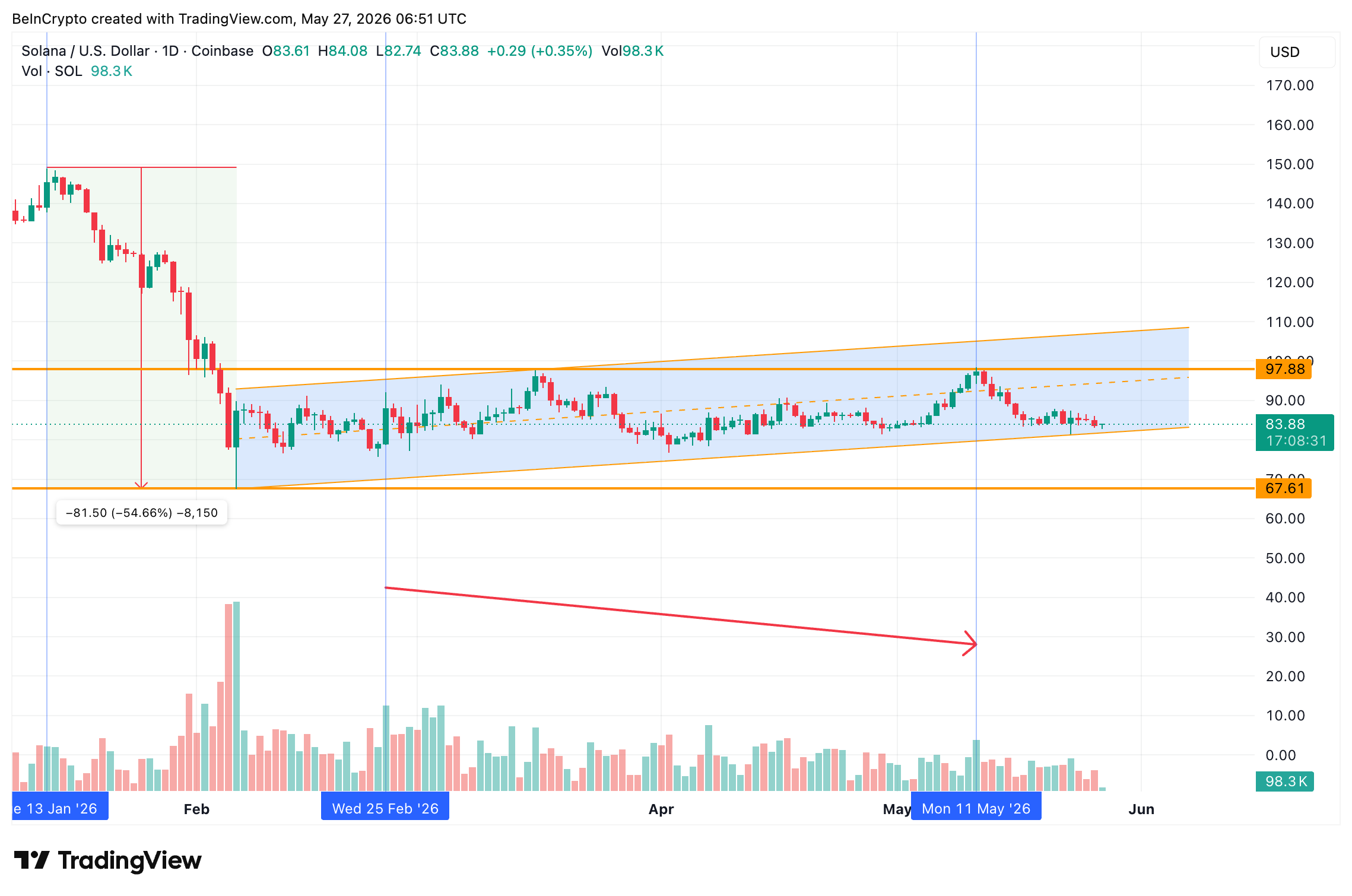
Solana price has held a rising channel for more than three months, yet the structure may be hiding the same continuation pattern that powered a collapse of over 50% from mid-January to early February.
The token sits roughly 3% above the channel’s lower trendline. On-chain data shows hodler conviction slipping and short-term holder cushion thinning. The setup is one bad day from breaking.
Solana’s Rising Channel Looks Bullish, But the Pattern Hides a Continuation Risk
Solana (SOL) has traded inside a parallel ascending channel since February 6, with the channel base anchored at the bottom of a 50%+ collapse that played out across roughly three weeks from mid-January to early February.
Want more token insights like this? Sign up for Editor Harsh Notariya’s Daily Crypto Newsletter here.
The usually bullish channel itself looks constructive on the surface. SOL has put in higher lows along the lower trendline and tested the upper trendline once.
Yet, the pattern nuance matters. A rising channel that forms immediately after a major drop is often a continuation pattern in disguise rather than a true reversal. Until SOL closes above the upper trendline, the broader bearish trend remains the higher-probability resolution.

Volume signals add weight to the warning. Buying volume has fallen steadily since early February, even as price has rallied inside the channel. That divergence shows fewer dollars supporting each fresh high at above $97. SOL is now drifting back toward the lower trendline on the same thin volume base.
The on-chain record explains why this matters now.
Hodler Accumulation Just Slipped 13%
Glassnode’s Solana Hodler Net Position Change, a metric that tracks the daily change in coin supply held by wallets that have held SOL for more than 155 days, has stayed in positive territory since early March 2026. Hodlers have been net buyers across the entire early-May rally.
The signal turned softer this week. On May 25, the daily net position change peaked near 3.2 million SOL, marking one of the strongest accumulation days of the cycle. By May 26, the figure dropped to roughly 2.78 million SOL, a 13% pullback in 24 hours.

Hodlers are still accumulating, just at a noticeably slower pace. That deceleration coincides directly with SOL’s slide back toward the channel’s lower trendline. The conviction cohort that has absorbed sell pressure across the past three months is taking the foot off the gas exactly when the chart needs them most.
The question is whether the more speculative cohort still has reasons to hold.
Short-Term Holder NUPL Sits Near Six-Month High
Solana’s Short-Term Holder Net Unrealized Profit/Loss (NUPL), a Glassnode indicator that measures whether holders of SOL coins under 155 days old are sitting on profits or losses, currently reads -0.157. The reading sits well above the deep capitulation zone visible during the February crash.
The current value also remains close to its six-month high of -0.03, printed on May 11.

This is paradoxically bearish. Short-term holders typically keep coins for two reasons. The first is high upside conviction. The second is low downside risk. Neither condition is fully met right now. The price chart is approaching a breakdown level, hodler accumulation has slowed, and unrealized losses for short-term holders are still minimal compared to historical capitulation.
A cohort sitting on small losses with weak conviction tends to sell early rather than ride out a deeper drawdown. The setup leaves a structurally large pool of supply that could exit if the trendline breaks.
The price chart now sets the trigger.
Solana Price Levels Between a 3% Break and a Channel Reclaim
Solana price trades at $83.78, sitting roughly 3% above the channel’s lower trendline near $81.24, which aligns with the 0.786 Fibonacci level of the channel’s recent April-May advance.
A daily close below $81.24 confirms the channel breakdown. The first downside level post channel breakdown is $76.61 (1.0 Fibonacci).If the breakdown extends, $63.21 (1.618 Fibonacci) becomes the next checkpoint. A full mirror of the late-January continuation move would expose $41.53 (2.618 Fibonacci), roughly 50% below current price.

The bullish reset begins with sequential reclaims. Reclaiming $84.89 (0.618 Fibonacci) stalls the immediate bearish momentum. A daily close above $87.45 (0.5 Fibonacci) is the more critical step, since that level has capped every upside attempt since May 20. Above $87.45, the path opens toward $93.17 (0.236 Fibonacci).
A clean break above $98.29 would weaken the continuation pattern entirely. For now, a daily close below $81.24 separates a routine pullback inside the channel from a confirmed continuation of January’s 54% drop.
The post The Solana Pattern Traders Love Is Actually a 50% Crash Setup appeared first on BeInCrypto.
THORChain said developers and security teams are still working to bring the network back online after the May 15 incident.
Summary
- THORChain nodes approved ADR028, moving the network closer to a staged restart after the exploit.
- The hacker bounty is now active, while protocol-owned liquidity is expected to cover remaining losses.
- Developers are preparing v3.19.0 testing as tss-lib enters a temporary closed security audit period.
In its latest update, the protocol said the focus is on restoring the network safely, “without rushing any steps.”
The update comes after THORChain’s official exploit report said the network lost about $10.7 million from one of five vaults. The report said a newly churned node operator entered the network two days before the exploit and used a GG20 Threshold Signature Scheme vulnerability to drain the affected vault. The remaining four vaults were not affected.
THORChain said nodes have upgraded to v3.18.1, a patch that also restores Rujira Network’s ability to manage credit accounts, including borrowing and repayments. The next step is cutting and testing v3.19.0, which will include more changes before any mainnet push.
The protocol said the release is expected to move to stagenet by the end of the following day, but added that an “exact timeline is yet to be confirmed.” Once the mainnet version is ready, node operators will be asked to upgrade quickly so the network can restart safely.
ADR028 approval activates hacker bounty
The latest update said ADR028 has been approved by nodes, moving THORChain’s recovery plan into its next phase. The proposal had opened for voting after the incident and set the main recovery direction for the protocol.
As previously reported by crypto.news, ADR028 was designed to restart THORChain after the exploit without minting new RUNE, selling RUNE, or diluting holders. The plan uses protocol-owned liquidity first, with any remaining shortfall spread across synth holders.
With ADR028 now approved, THORChain said the bounty window is active. That gives the attacker a chance to return part of the stolen funds. The protocol also said it plans to cover the remaining loss using protocol-owned liquidity, though final figures will be shared later.
The recovery plan also includes full slashing of the attacker’s node. THORChain previously said innocent nodes that were in the same vault would be protected, while recovered RUNE would be paired with recovered assets from the affected vault. Any surplus RUNE would be burned.
Security audit shifts tss-lib behind closed doors
THORChain also said tss-lib has been moved to closed source for a few weeks. The protocol said the move gives THORSec time to complete a full security audit without exposing active remediation work.
That decision marks a short-term shift for a protocol built around open development. THORChain said the repository will reopen after the audit is complete. The move is tied to the security review after the GG20-related exploit.
The official exploit report said automatic solvency checks detected the vault imbalance within minutes. Node operators then used manual pauses and Mimir governance votes to stop trading, signing, chain observation, and churning within about two hours of the community alert.
THORChain’s report also said v3.18.1 was released as an immediate precaution to protect remaining vaults while the investigation continues. The longer recovery path will now depend on v3.19.0, node adoption, audit work, and governance follow-through.
DeFi exploit pressure remains high
The THORChain incident first drew wider attention when blockchain investigator ZachXBT warned that losses could top $10 million across Bitcoin, Ethereum, BSC, and Base. Crypto.news reported on May 15 that THORChain paused trading and used a global emergency halt after the exploit alert spread online.
The same report noted that RUNE dropped sharply after the warning as users waited for clearer information from protocol operators. Early estimates placed the loss above $7.4 million, before updated tracking pointed to at least $10 million stolen.
The restart process now carries two tests. The first is technical: developers need to confirm that the patched releases can support safe network operations. The second is financial: the protocol must finalize loss coverage, bounty terms, and recovery figures without creating new RUNE supply.

XRP price is trading at $1.33, down just a fraction of a percent today, but the chart is coiling upward. Price has compressed into the narrowest section of a symmetrical triangle on the 4-hour timeframe, and the next 48–72 hours could define XRP’s trajectory for weeks.
Volume came in at $1.57 billion over the past day, while market cap sits at $82 billion, trailing behind BNB. Some analysts have flagged a two-week 20/50 EMA death cross as a bearish technical signal, while simultaneously noting that XRP could still rally toward the EMA cluster near $1.70.
On the weekly, $XRP printed a similar deathcross back at the lower high in Jan 2026 ($2 40), and since then, we have witnessed a countertrend rally into the 20 week EMA at $1.50, and have now seen rejection in May. Confluence with the 2 week deathcross. Monitoring. https://t.co/SPp4cYiU1j pic.twitter.com/Q4yHYZxxKa
—
 ChartNerd
  (@ChartNerdTA) May 26, 2026
The weekly chart also shows an echo pattern, with a similar death cross printed at the January lower high near $2.40, followed by a countertrend surge into the 20-week EMA at $1.50 before the May rejection.
Sentiment on altcoin markets remains mixed, but compressed volatility in XRP specifically, combined with a well-defined support floor, creates a setup that precedes a violent repricing.
Discover: The Best Crypto to Diversify Your Portfolio
Will XRP Price Break $1.45 and Trigger a Fast Leg Higher?
XRP’s current structure is a war between compression and gravity. The RSI reads 40, sitting below its moving average of 44, a lower-neutral, not yet oversold, meaning buyers haven’t capitulated but haven’t committed either. The MACD remains below the signal line with a slightly negative histogram. Weak bearish pressure, not a collapse.

Key levels are surgical as XRP price sits below MA7, MA14, and MA30, all capping upside with immediate resistance stacked between $1.34–$1.38. The major trigger band is $1.40–$1.45, defined by the 100-day moving average and the descending channel’s upper boundary.
The coin is hovering at a breakout zone with a clean close above it, opening fast upside, but rejection could also send the price back toward $1.30–$1.20.
The XRP price suggests that a decision is imminent. The triangle doesn’t lie.
Discover: The Best Token Presales
LiquidChain Targets Early-Mover Upside just Like XRP Years Ago
XRP, after a 42% annual decline, offers a potential rebound, but at an $82 billion market cap, even a 30% rally means competing capital against an asset already known globally. The asymmetric upside lives elsewhere.
Traders are increasingly rotating a portion of large-cap exposure into early-stage infrastructure with structural utility before price discovery.
LiquidChain ($LIQUID) is an L3 infrastructure project built to solve one of crypto’s most persistent structural failures: fragmented liquidity across chains. Its Unified Liquidity Layer fuses Bitcoin, Ethereum, and Solana liquidity into a single execution environment.
The plan comes to fruition. — LiquidChain (@getliquidchain) May 27, 2026
The Order evolves.  ⟁https://t.co/vqvBcdSQYC pic.twitter.com/PiWBmSBRrH
Liquid boasts a deploy-once architecture with verifiable settlement and single-step cross-chain execution. This is the missing middleware layer that DeFi has needed for years.
The presale has raised more than $810K at a current token price of $0.01463. Those numbers are early, especially with 1400% APY bonus for today’s buyer. With Liquid, developers deploy once and access all three major ecosystems. It’s a value proposition that speaks directly to the builder demand driving the next cycle.
Research LiquidChain and review the full presale details.
The post XRP Price Chart Shows Incoming Violent Rebound: Next Leg Could Be Fast and Monstrous appeared first on Cryptonews.
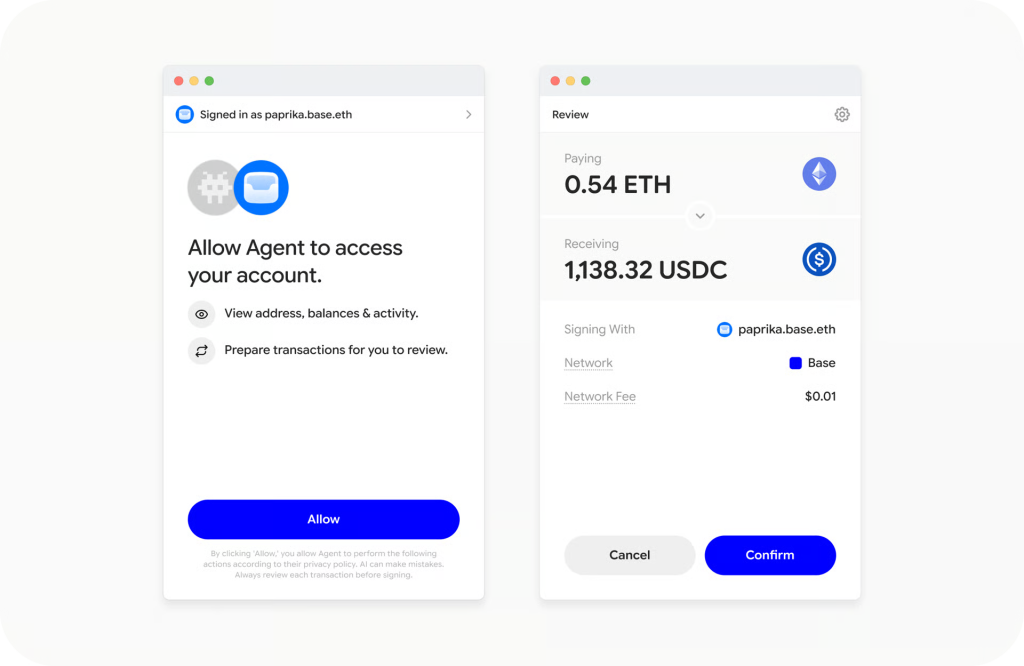
Coinbase’s Base Layer-2 has launched Base MCP, a new Model Context Protocol tool that connects Crypto wallets directly to AI agents, enabling autonomous on-chain execution without custom per-dApp integration.
The launch is the latest move in a coordinated infrastructure push from Coinbase that spans agent wallets, machine-to-machine payments, and developer tooling – all converging on Base as the execution layer.
For traders watching the AI-agent infrastructure vertical, this is not an isolated product release. It slots into a fast-expanding category of wallet-automation primitives that are drawing both developer attention and early capital across the L2 ecosystem.
Discover: The Best Crypto to Diversify Your Portfolio
What Base MCP Crypto Tool Actually Does, and Why It’s More Than a Dev Feature
The Base MCP is built on the Model Context Protocol (MCP) framework, an emerging standard that enables AI systems to communicate with external tools via a standardized interface.
Applied to crypto, that means an AI agent can check wallet balances, send funds, swap tokens, sign messages, and process payments via Coinbase’s x402 protocol, all from a Base Account, without bespoke smart contract logic per integration.
This builds directly on Coinbase’s Agentic Wallets infrastructure, unveiled in early 2025, which introduced dedicated wallet architecture for autonomous agents complete with built-in skills: Authenticate, Fund, Send, Trade, and Earn. Those wallets are gasless on Base, with USDC as the primary payment medium.

The x402 machine-to-machine payments protocol, which embeds stablecoin transfers directly in HTTP requests, had already processed approximately 50 million transactions by that point – giving Coinbase a live usage base before MCP shipped.
MCP functions as the plug-and-play interface layer sitting on top of that stack. Rather than requiring developers to wire up wallet logic per application, MCP integration makes agent-to-wallet connectivity a standard primitive.
Security is handled through trusted execution environments, where private keys are generated and stored inside a secure enclave that the AI agent never directly accesses. Per-agent spend limits and whitelisted counterparties can be enforced at the infrastructure layer – a guardrail structure aimed squarely at institutional and enterprise adoption.
Base’s position as Coinbase’s Ethereum Layer-2 gives it a specific distribution advantage here: gasless transactions and deep USDC liquidity lower the friction cost for agent-driven activity in ways that competing chains haven’t fully replicated.
Discover: The Best Token Presales
The post Base Launches Wallet-to-AI Agent Crypto Tool in Layer-2 Product Expansion appeared first on Cryptonews.
At the start of the week, the US currency continues to trade near significant levels amid ongoing uncertainty surrounding negotiations between the United States and Iran. Markets are closely monitoring reports suggesting a possible prolongation of the negotiation process and an increased US military presence in the Middle East, both of which are supporting demand for safe-haven assets, including the dollar.
Additional support for the US currency comes from rising US Treasury yields and expectations surrounding upcoming macroeconomic data releases, which could influence further market expectations regarding Federal Reserve policy.
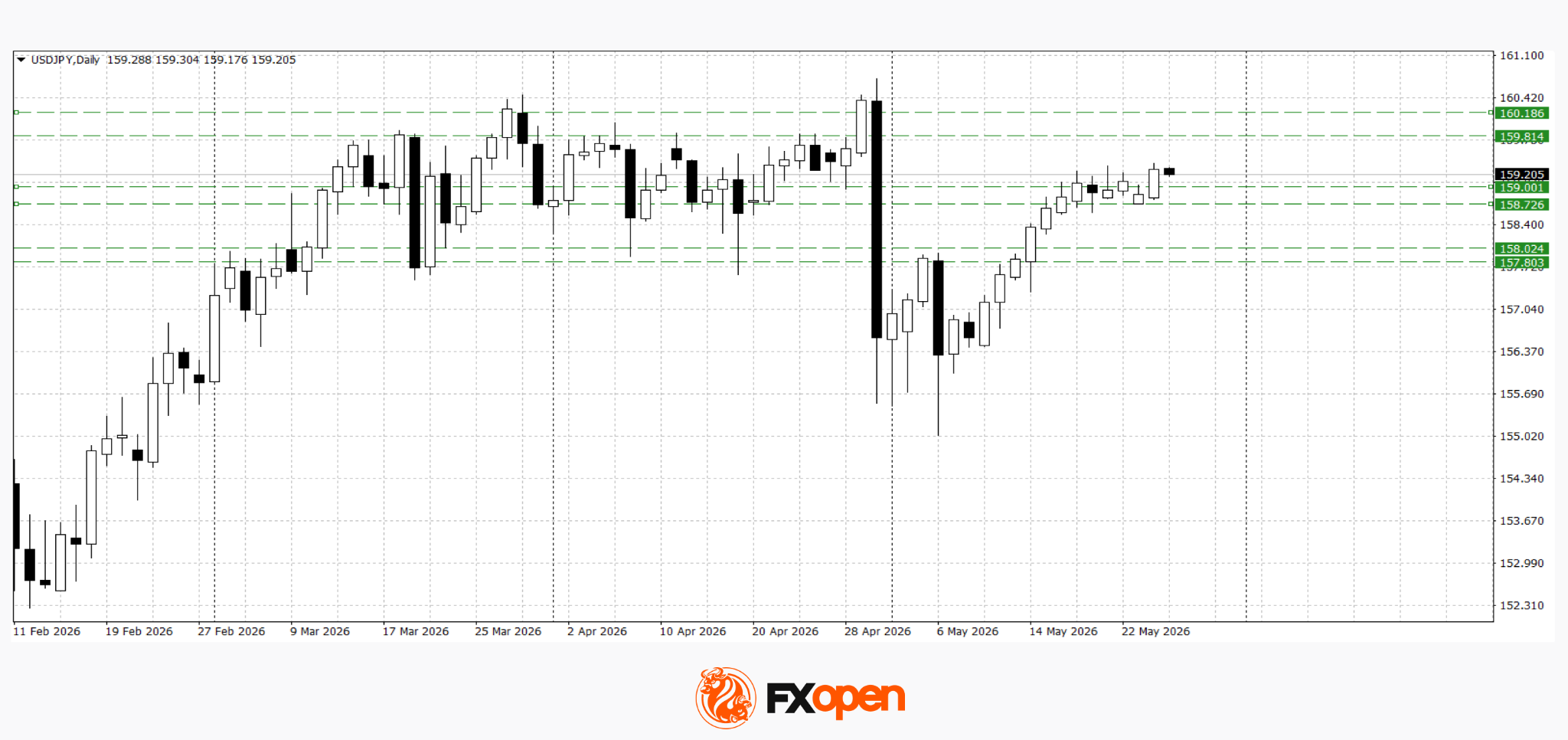
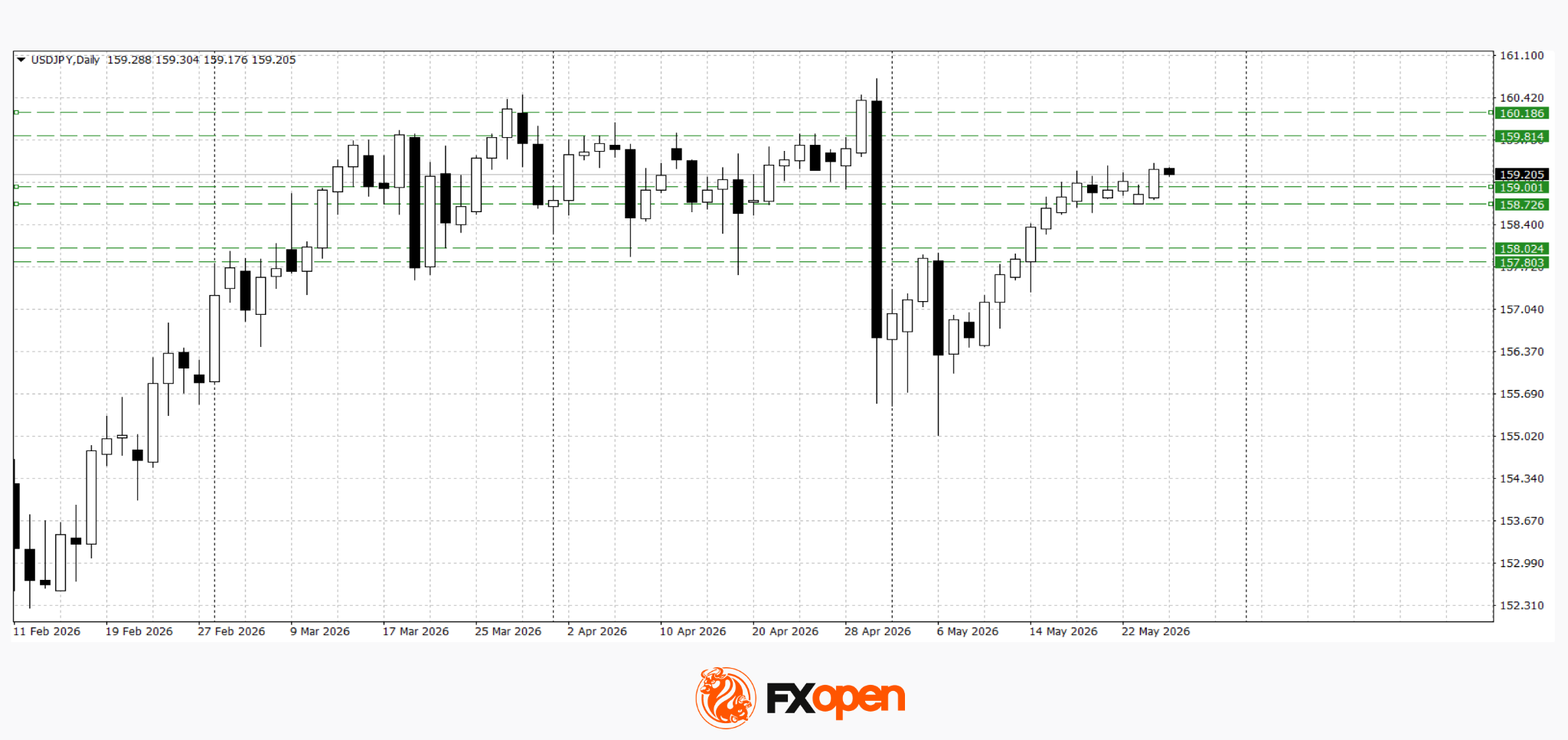
At the same time, the dollar’s movement remains mixed. Despite the recent strengthening of USD/JPY and USD/CAD, both pairs have approached important technical resistance levels, where buying activity is beginning to slow. The market is now assessing whether the current momentum can develop into a broader continuation of dollar strength, or whether the advance in the US currency will remain merely a short-term reaction to geopolitical risks.
USD/JPY
Buyers in USD/JPY have managed to establish the pair above the key 159.00 level. If the 158.70–159.00 range retains its status as support, further growth towards 159.80–160.20 remains possible. A loss of this zone could trigger a downward correction towards 158.00–157.80.
Key events for USD/JPY:
- today at 11:00 (GMT+3): speech by Dallas Fed representative Lorie K. Logan;
- today at 15:15 (GMT+3): US ADP non-farm employment change;
- tomorrow at 02:50 (GMT+3): foreign investment in Japanese equities.
USD/CAD
USD/CAD is also trading within a range after reaching major resistance near 1.3800. Should strong US data be released or demand for the dollar remain firm, the pair may consolidate above 1.3820 and continue rising towards 1.3870. Conversely, weaker interest in the US currency could push the pair below 1.3800 and towards the 1.3750–1.3770 area.
Key events for USD/CAD:
- today at 15:30 (GMT+3): Canadian wholesale sales data;
- today at 23:30 (GMT+3): weekly US crude oil inventories from the American Petroleum Institute (API);
- tomorrow at 15:30 (GMT+3): Canada’s current account balance.
Overall, the dollar continues to retain an advantage amid geopolitical uncertainty and expectations of fresh macroeconomic signals from the United States. Nevertheless, the approach of USD/JPY and USD/CAD towards key technical resistance levels increases the likelihood of the current momentum slowing, while the next directional move will largely depend on incoming US economic data and developments surrounding negotiations between the US and Iran.
Trade over 50 forex markets 24 hours a day with FXOpen. Take advantage of low commissions, deep liquidity, and spreads from 0.0 pips (additional fees may apply). Open your FXOpen account now or learn more about trading forex with FXOpen.
This article represents the opinion of the Companies operating under the FXOpen brand only. It is not to be construed as an offer, solicitation, or recommendation with respect to products and services provided by the Companies operating under the FXOpen brand, nor is it to be considered financial advice.
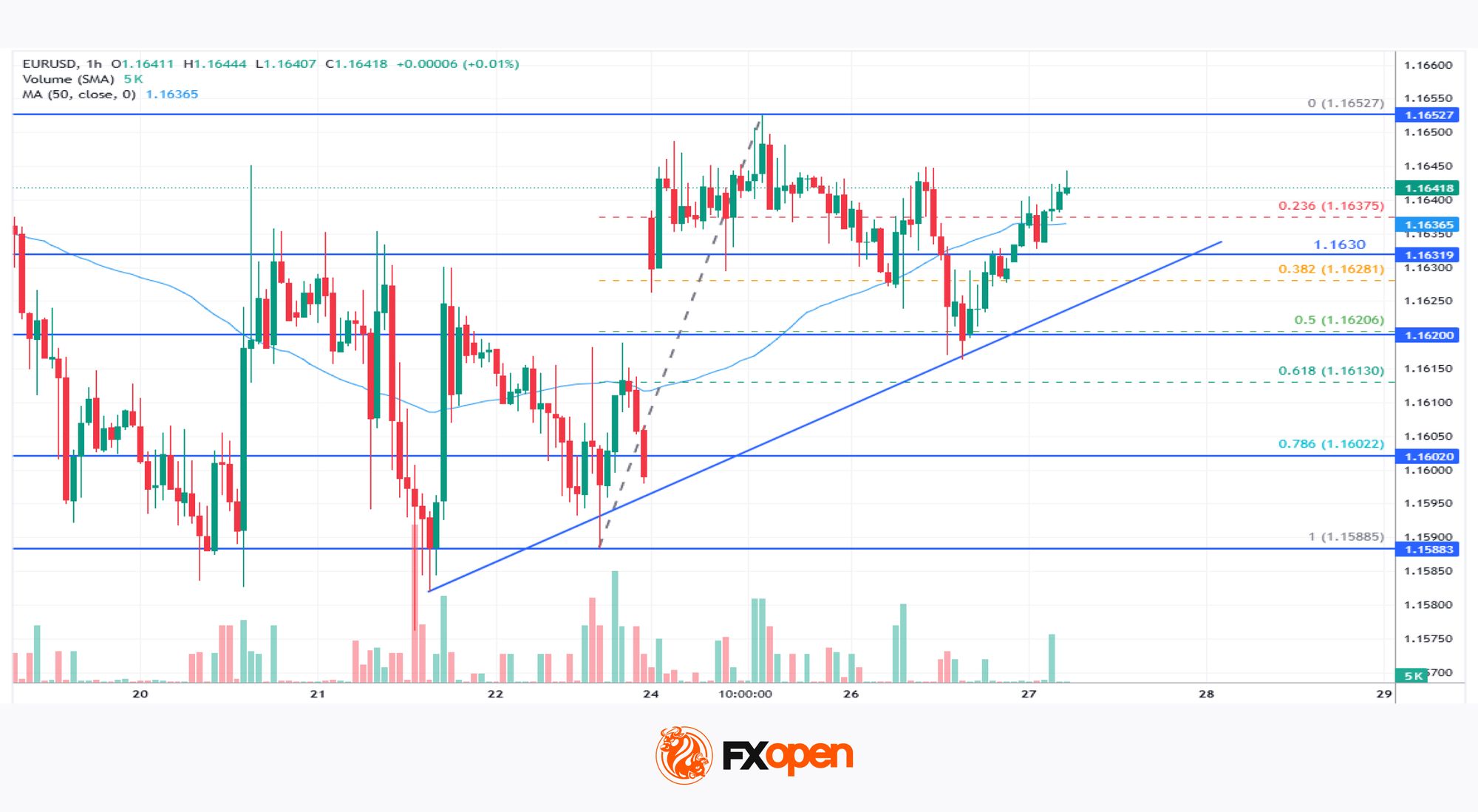
EUR/USD started a downside correction from 1.1650. USD/CHF is rising and might aim for a move toward 0.7880 or 0.7900.
Important Takeaways for EUR/USD and USD/CHF Analysis Today
· The Euro struggled to clear 1.1650 and corrected gains against the US Dollar.
· There is a key bullish trend line forming with support at 1.1630 on the hourly chart of EUR/USD at FXOpen.
· USD/CHF is showing positive signs above the 0.7830 zone.
· There was a break above a connecting bearish trend line with resistance at 0.7830 on the hourly chart at FXOpen.
EUR/USD Technical Analysis
On the hourly chart of EUR/USD at FXOpen, the pair gained pace for a move above 1.1600. The Euro tested 1.1650 and recently corrected gains against the US Dollar.
The pair dipped below 1.1635 and the 38.2% Fib retracement level of the upward move from the 1.1588 swing low to the 1.1652 high. However, the bulls were active above 1.1620. There is also a key bullish trend line forming with support at 1.1630.
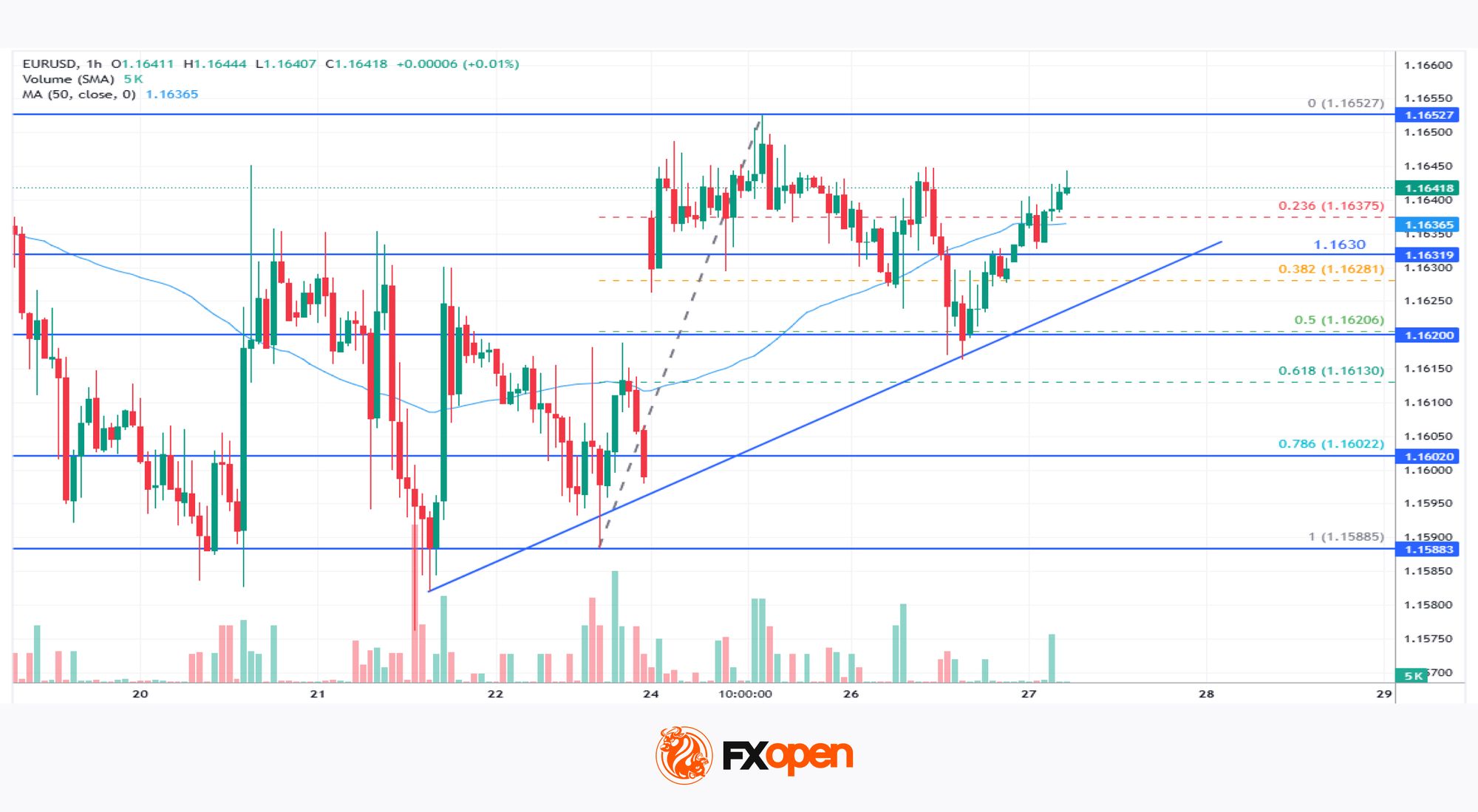
The pair is again above the 50-hour simple moving average. Immediate resistance on the upside could be 1.1650. The next key hurdle for the bulls might be 1.1675.
An upside break above 1.1675 might send the pair toward 1.1705. Any more gains might open the doors for a move toward 1.1740. If the bulls fail to push the pair above 1.1650, there could be another bearish reaction.
On the downside, immediate support on the EUR/USD chart might be near the trend line at 1.1630. The next major area of interest could be near the 50% Fib retracement level at 1.1620. A downside break below 1.1620 could send the pair toward 1.1550.
USD/CHF Technical Analysis
On the hourly chart of USD/CHF at FXOpen, the pair declined from the 0.7900 barrier and tested the 0.7810 zone. The US Dollar traded as low as 0.7808 and recently started a fresh increase against the Swiss Franc.
The pair climbed above 0.7820 and the 50-hour simple moving average. There was a break above the 50% Fib retracement level of the downward move from the 0.7903 swing high to the 0.7808 low. Besides, there was a break above a connecting bearish trend line with resistance at 0.7830.
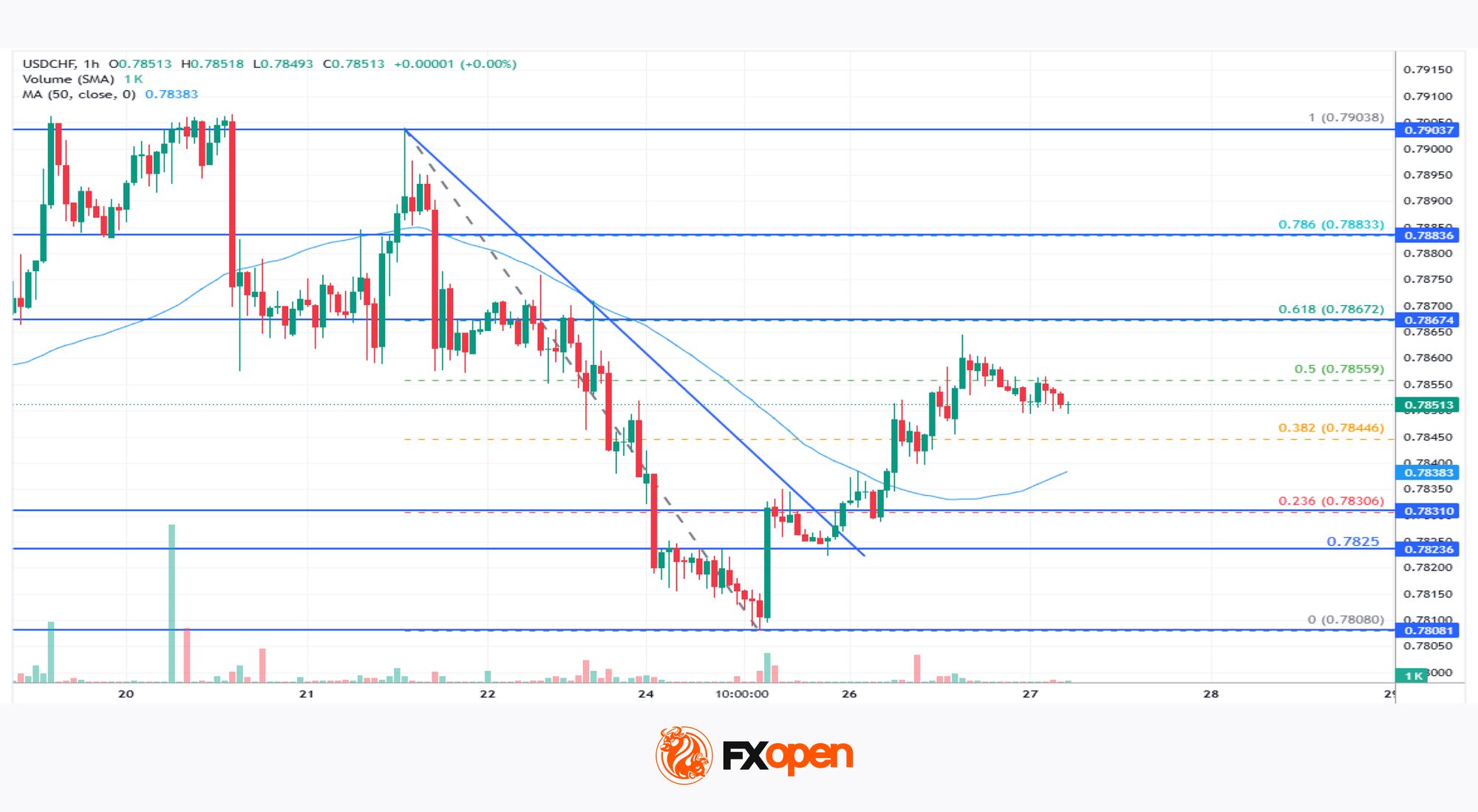
The bulls are now facing hurdles near the 61.8% Fib retracement at 0.7865. The next major area of interest could be 0.7880. The main sell region could be near 0.7900.
If there is a clear break above 0.7900, the pair could start another increase. In the stated case, it could test 0.8000. If there is another decline, the pair might test the 50-hour simple moving average at 0.7835.
The first major support on the USD/CHF chart could be 0.7830. A downside break below 0.7830 might spark bearish moves. The next major support might be 0.7800. Any more losses may possibly open the doors for a move toward 0.7765 in the near term.
Trade over 50 forex markets 24 hours a day with FXOpen. Take advantage of low commissions, deep liquidity, and spreads from 0.0 pips (additional fees may apply). Open your FXOpen account now or learn more about trading forex with FXOpen.
This article represents the opinion of the Companies operating under the FXOpen brand only. It is not to be construed as an offer, solicitation, or recommendation with respect to products and services provided by the Companies operating under the FXOpen brand, nor is it to be considered financial advice.

10 Most Perfect Romantic Movies of the Last 40 Years, Ranked

Victoria Smurfit Recalls Filming Rivals Season 2 Shower Scene

Donovan Mitchell, James Harden share desire to remain Cavaliers tandem


-

 Crypto World6 days ago
Blockchain.com files with SEC for U.S. IPO
-

 Fashion5 days ago
Holiday Weekend Open Thread – Corporette.com
-
 Crypto World5 days ago
Bitcoin Accumulation Weakens as BTC Realized Losses Hit $600M
-

 Business5 days ago
Dell Technologies DELL Stock Surges 15% on AI Server Momentum and Analyst Upgrades in 2026
-

 Crypto World4 days ago
Robinhood crypto COO Tanya Denisova exits
-

 Politics5 days ago
Makerfield: a tale of two social-media histories
-
 Crypto World5 days ago
Space X IPO Is ‘Bad News’ for Tech Stocks: But What About Bitcoin?
-

 Tech2 days ago
Microsoft’s quiet Claude Code retreat and the real cost of enterprise AI
-

 Business3 days ago
NYT Strands Answers May 24 2026 Revealed for Puzzle No. 812 Theme Summer Essentials
-
 Crypto World5 days ago
MicroStrategy’s Saylor Says Miners No Longer Set Bitcoin Price, Another Force Has Taken Over
-

 Tech5 days ago
WhatsApp ads could make Irish debut after discussions with DPC
-

 Crypto World5 days ago
AI infrastructure race heats up as IREN pitches full-stack strategy, WhiteFiber lands $160M deal
-
 Tech5 days ago
A 0.12% parameter add-on gives AI agents the working memory RAG can’t
-
 Crypto World2 days ago
Nvidia (NVDA) CEO Calls on Super Micro to Strengthen Export Controls Amid Smuggling Probe
-
 NewsBeat6 days ago
Charity run by Reform leader Malcolm Offord accused of ‘law breaking’ over Scottish registration
-

 Tech5 days ago
You Can Now Add ChatGPT To PowerPoint
-

 Tech2 days ago
Westone Audio and Etymotic Acquired by Fidelity Collective in Major IEM Market Move
-

 Business5 days ago
Trump Invests $1M-$5M in Kura Sushi USA Chain With 27 California Locations
-

 Sports5 days ago
2026 CJ Cup Byron Nelson leaderboard: Brooks Koepka finds putting stroke in Round 1
-

 Crypto World7 days ago
Exa Labs raises $250 million in funding led by a16z
You must be logged in to post a comment Login