

Crypto World
Base Launches Wallet-to-AI Agent Crypto Tool in Layer-2 Product Expansion

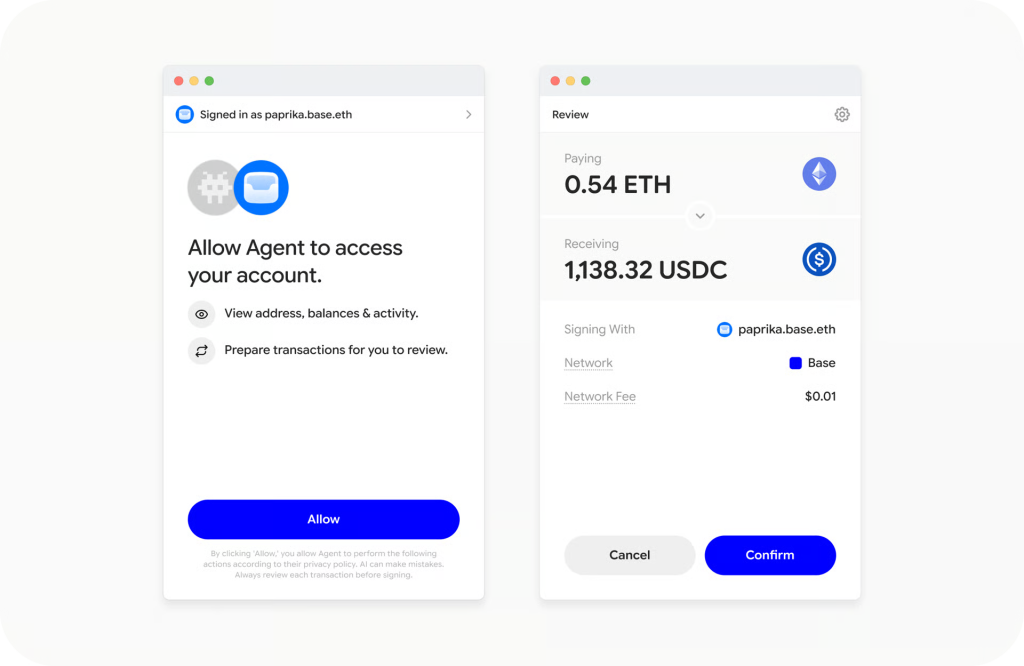
Coinbase’s Base Layer-2 has launched Base MCP, a new Model Context Protocol tool that connects Crypto wallets directly to AI agents, enabling autonomous on-chain execution without custom per-dApp integration.
The launch is the latest move in a coordinated infrastructure push from Coinbase that spans agent wallets, machine-to-machine payments, and developer tooling – all converging on Base as the execution layer.
For traders watching the AI-agent infrastructure vertical, this is not an isolated product release. It slots into a fast-expanding category of wallet-automation primitives that are drawing both developer attention and early capital across the L2 ecosystem.
Discover: The Best Crypto to Diversify Your Portfolio
What Base MCP Crypto Tool Actually Does, and Why It’s More Than a Dev Feature
The Base MCP is built on the Model Context Protocol (MCP) framework, an emerging standard that enables AI systems to communicate with external tools via a standardized interface.
Applied to crypto, that means an AI agent can check wallet balances, send funds, swap tokens, sign messages, and process payments via Coinbase’s x402 protocol, all from a Base Account, without bespoke smart contract logic per integration.
This builds directly on Coinbase’s Agentic Wallets infrastructure, unveiled in early 2025, which introduced dedicated wallet architecture for autonomous agents complete with built-in skills: Authenticate, Fund, Send, Trade, and Earn. Those wallets are gasless on Base, with USDC as the primary payment medium.

The x402 machine-to-machine payments protocol, which embeds stablecoin transfers directly in HTTP requests, had already processed approximately 50 million transactions by that point – giving Coinbase a live usage base before MCP shipped.
MCP functions as the plug-and-play interface layer sitting on top of that stack. Rather than requiring developers to wire up wallet logic per application, MCP integration makes agent-to-wallet connectivity a standard primitive.
Security is handled through trusted execution environments, where private keys are generated and stored inside a secure enclave that the AI agent never directly accesses. Per-agent spend limits and whitelisted counterparties can be enforced at the infrastructure layer – a guardrail structure aimed squarely at institutional and enterprise adoption.
Base’s position as Coinbase’s Ethereum Layer-2 gives it a specific distribution advantage here: gasless transactions and deep USDC liquidity lower the friction cost for agent-driven activity in ways that competing chains haven’t fully replicated.
Discover: The Best Token Presales
The post Base Launches Wallet-to-AI Agent Crypto Tool in Layer-2 Product Expansion appeared first on Cryptonews.


TLDR:
- SpaceX debuted at $2T and 100x revenue, dwarfing Apple’s sub-$2B IPO — a valuation gap analyst calls alarming
- Insiders hold 95% of SpaceX shares, with 93% becoming sellable by November via a compressed unlock schedule
- Retail and institutional selling to fund IPO participation is draining liquidity from the broader US stock market
- SpaceX posted $4.3B in Q1 2026 losses; cumulative losses hit $41.3B, data most retail investors overlook
The US stock market is flashing warning signs not seen since the dot-com collapse. A veteran market analyst with 13 years of experience is sounding the alarm over the current IPO boom, calling it the biggest red flag of his career.
At the center of the warning is SpaceX, going public at $2 trillion and 100x revenue. That compares to Apple’s IPO at under $2 billion and 15x revenue — a contrast that exposes how extreme current valuations have become.
Insider Structure and Unlock Timeline Set the Stage for a Selloff
The SpaceX IPO is not designed to reward new buyers. Fidelity dropped its minimum investment from $500,000 to $2,000, and SpaceX allocated 30% of shares to retail participants. Millions of new buyers were brought in just before the listing.
Insiders, however, control 95% of all shares. That represents approximately $1.66 trillion in privately held stock sitting above the market. Retail buyers are entering at peak prices while those holding the bulk of shares prepare to sell.
The unlock schedule makes the threat concrete. A 60-day lockup triggers a 20% release once the stock climbs 30%. From day 70, recurring 7% tranches unlock across days 90, 105, 120, and 135. Another 28% follows Q3 earnings.
By November, roughly 93% of insider shares become sellable. That volume hitting the market over a compressed window is a direct threat to the broader US stock market, not just SpaceX’s price.
Capital Rotation Is Already Draining the Broader Market
Institutions are not waiting. They are already shortening index inclusion timelines, selling current holdings, and raising cash ahead of forced buying tied to new listings. That repositioning creates selling pressure across existing equities right now.
Retail investors are doing the same, liquidating portfolios to fund IPO participation. The analyst draws a direct parallel to the late 1990s dot-com era, when capital rotation out of existing stocks into new listings preceded a broad market crash.
SpaceX reported $4.3 billion in losses in Q1 2026 alone. Cumulative losses stand at $41.3 billion. Most retail participants never reach that data, buried deep inside a 300-page prospectus. That information gap consistently favors insiders over new buyers.
Anthropic and OpenAI carry the same structural problem. Both trade at valuations inflated by circular investment flows involving Nvidia.
Neither has reached profitability, and current pricing requires earnings growth that analysts say is unlikely to materialize.
The analyst’s conclusion is straightforward: capital flowing into these IPOs exits the US stock market, and that exit pressure is building fast.



Robinhood Securities has received approval to serve as an IPO underwriter, CEO Vlad Tenev announced Tuesday, moving the brokerage from a distribution role into the group of firms that help bring companies public alongside Wall Street banks. Tenev posted the announcement on X Tuesday, writing that… Read the full story at The Defiant
[PRESS RELEASE – New York, United States, June 10th, 2026]
Shotgun.fun, a new trading terminal, launches today with a model that returns every fee back to the trader, ending an industry standard that has quietly extracted billions.
Every trade ever placed has made someone else money: not the market and not the protocol, but the terminal sitting between traders and execution. The fee paid on every buy, every sell, and every limit order became the status quo. Shotgun’s the paradigm shift.
Shotgun.fun is a high-performance trading terminal that returns up to 100% of trading fees to traders. Cashback starts at 50%, already higher than any other trading terminal offering, and scales with volume. Tiers are built to unlock fast. Getting to 100% is not an out-of-reach theoretical ceiling, it’s the destination.
The terminal is fully non-custodial, secured through Turnkey, ensuring keys are encrypted and accessible only to the user.
Shotgun arrives fully loaded:
- Trenches displays new launches, graduating tokens, and fresh migrations in real time, ahead of broader market visibility.
- Trader Discovery helps users find the best traders in the space and copy their moves in real time.
- Instant Trade adds one-click trading directly on the chart, no distractions.
- Limit Orders enable autopilot trading from buying the dip to stop loss, take profit, and trailing stop loss.
- Multi-Wallet Management helps users bring all their wallets into a single interface. Full control, zero friction.
- Portfolio captures full historical performance of every wallet, every token, every profit and loss.
Insiders have extracted hundreds of millions from everyday traders across recent token launches. Shotgun aims to even the playing field by shining a light on insider wallets, helping users view their trades and copy their moves in real time.
Shotgun also comes packed with a referral program that offers up to 50% revenue share across five layers of referrals, meaning users earn when their referrals trade.
Shotgun is led by Miguel Loures and Pedro Maurício, the founding team behind Pulsar Finance, a portfolio manager backed by Delphi Ventures that grew to more than one million users before being acquired by Terraform Labs. The team has been building in this space since 2020.
“Until now, traders have been treated as the product, not as users,” said Miguel Loures, founder of Shotgun. “We built Shotgun to give the power back to the people.”

Shotgun launches with support for Solana, with more blockchains and agentic trading coming soon.
About Shotgun
Shotgun.fun is a non-custodial trading terminal built for traders. Up to 100% cashback, enterprise-grade execution, and a full suite of tools built for speed, instinct, and being first.
More information available at:
Website: https://shotgun.fun/
Twitter/X: https://x.com/shotgundotfun
The post Shotgun.fun Launches as the First Trading Terminal With 100% Cashback appeared first on CryptoPotato.
Bitwise CIO Matt Hougan says financial advisors remain interested in crypto but now care more about stablecoins and tokenization than Bitcoin. He drew the conclusion after speaking with more than 40 advisors in a single day of sales calls.
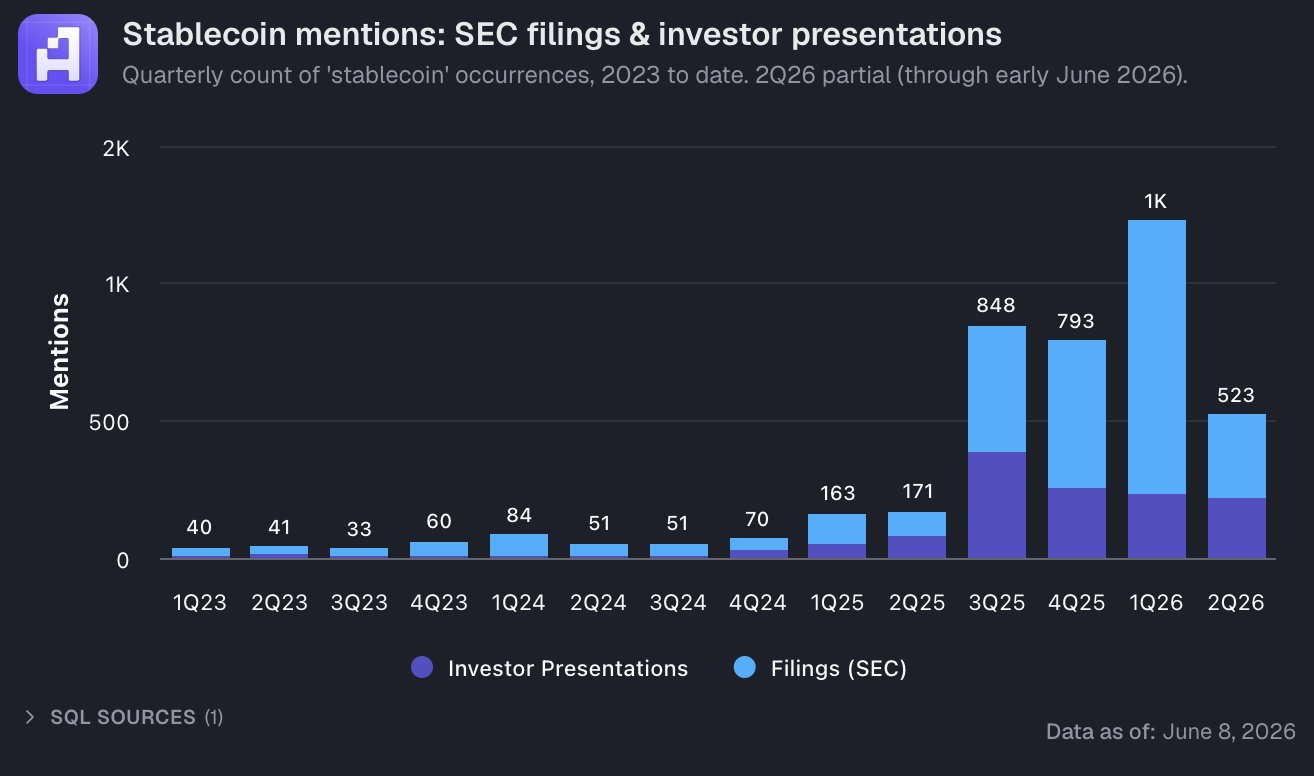
Data from analytics firm Artemis points the same way. Stablecoin mentions in SEC filings and investor presentations peaked at roughly 1,000 in the first quarter of 2026, the firm reports.

Stablecoins and Tokenization Take Center Stage
Hougan described the conversations in a memo published on June 10. Reportedly, he met eight advisory teams on Monday, his busiest single day since joining Bitwise eight years ago.
Engaging those advisors on Bitcoin proved difficult, he admitted, even at prices near $60,000 that he considers attractive for long-term investors.
Instead, conversations kept returning to payments, capital markets, and tokenized assets.
Hougan tied the shift to two forces:
- The fiat debasement trade has faded, with gold trading about 20% below its all-time high by his account,
- Stablecoin talk from SEC Chair Paul Atkins and BlackRock CEO Larry Fink has become constant on financial television.
Follow us on X to get the latest news as it happens
“If you think financial advisors are the marginal net buyer of crypto in the next cycle, the first place money would flow might be into stablecoin- and tokenization-linked investments,” Hougan wrote in the memo.
He expects that flow to favor tokenization rails such as Ethereum (ETH) and Solana (SOL), plus stablecoin-linked equities Circle (CRCL) and Coinbase (COIN).
The pattern would echo earlier cycles, he argued, including the spot ETF progress that pulled crypto out of its 2022 collapse.
Peak Attention or a New Adoption Phase
Artemis adds a measurable signal to the anecdotes, showing stablecoin references in corporate disclosures hit their highest recorded level in Q1 2026.
Regulation helps explain the timing. On February 19, SEC staff said broker-dealers may apply a 2% capital haircut to payment stablecoins, treating them as near-cash.
That guidance builds on the GENIUS Act, the 2025 law that created a federal category for payment stablecoins.
Usage data tells a similar story. A Fireblocks report based on a March 2025 survey of 295 finance executives found 49% of institutions already use stablecoins for payments.
The combination cuts two ways:
- Advisor curiosity suggests fresh capital could flow into stablecoin and tokenization plays first.
- Peaking mentions, however, may indicate the theme is already crowded in corporate communications, with stocks, gold, and Treasuries moving on-chain in practice rather than in pitch decks.
Tokenized real-world assets similarly defied last year’s downturn.
Hougan frames advisors, a group managing more than $175 trillion by Investment Adviser Association figures, as the new investor class that could end the 2026 downturn.
Therefore, their engagement matters more than usual after his earlier crypto winter call proved prescient.
The first-quarter mention peak marking saturation or the start of an implementation phase may become clearer as second-quarter filings arrive.
In the meantime, advisor demand gives the market a concrete adoption signal to track.
The post Bitwise Memo Uncovers Key Insight From 40 Financial Advisors appeared first on BeInCrypto.


Federal prosecutors have subpoenaed JPMorgan Chase, Bank of America and Wells Fargo as part of a probe into whether the banks unlawfully terminated customer accounts for political reasons, the Wall Street Journal reported Wednesday. The U.S. Attorney's Office in Washington, D.C., headed by Jeanine… Read the full story at The Defiant

Mastercard has launched Agent Pay for Machines, a payments system built for autonomous software agents. The service allows AI agents to send and receive payments without direct human action. It brings Ripple, Coinbase, and Solana Foundation into Mastercard’s push for automated digital commerce.
Ripple Brings XRPL and RLUSD to Mastercard’s Agent Pay System
Mastercard introduced Agent Pay for Machines on June 10 as a tool for machine-led payments. The system targets high-volume and low-value transactions across business and consumer use cases. It also supports automated settlement between software agents and connected machines.
Ripple will support the system through the XRP Ledger and its RLUSD stablecoin. The company said that settlement will become more important as automated commerce grows. It also sees blockchain rails as useful for fast and rule-based payments.
RippleX senior vice president Markus Infanger said XRPL and RLUSD support enterprise-grade agent payments. He said the tools offer settlement in seconds, predictable costs, and programmable compliance. The setup also creates an audit trail for automated transactions.
Coinbase Supports Open Standards for Agent Payments
Coinbase joined the Mastercard program as demand rises for faster machine payments. The company said AI agents need open and interoperable payment systems. It also pointed to programmable digital dollars as a key part of this shift.
Nina Coughlin, Coinbase’s head of Stablecoin Business Development, said AI agents are creating a new economy. She said this market needs payment tools that move faster than legacy systems. Coinbase will work with Mastercard on standards for agentic payments.
The company also highlighted x402, an open standard for internet-native payments. This framework can support automated transactions between apps, services, and agents. Therefore, Coinbase’s role adds stablecoin and standards expertise to the Mastercard system.
Solana Foundation Adds Scale for Machine Transactions
The Solana Foundation also backed Mastercard’s new agent payment system. It said automated commerce needs infrastructure that can process payments across several rails. These rails include stablecoins, cards, and other settlement networks.
Rishin Sharma, head of AI Growth at Solana Foundation, said payment systems must support different settlement options. He said AI agents need rails that operate across stablecoins and cards. He added that Solana can support such systems at scale.
Solana’s involvement gives Mastercard access to a high-throughput blockchain network. The network has positioned itself for fast and low-cost transactions. As a result, it fits use cases that depend on frequent machine-to-machine payments.
Mastercard Builds a Wider Automated Commerce Network
Mastercard said Agent Pay for Machines can set spending limits and authorization rules. The platform can also define settlement conditions before agents complete payments. These controls aim to reduce risk while supporting independent transactions.
The program includes more than 30 payments, blockchain, and fintech companies. Partners include Adyen, Stripe, OKX, Coinbase, Ripple, Cloudflare, and Solana Foundation. Mastercard is using this group to build infrastructure for autonomous digital commerce.
The launch expands Mastercard’s work with blockchain-based settlement and stablecoin payment tools. It also shows growing interest in payment systems built for software-led activity. However, the company is presenting the system as a controlled framework for business use.

Disciplined retail traders who follow the rules could probably beat the S&P 500, according to Peter Tuchman, the longest-serving floor trader at the New York Stock Exchange.
The 40-year veteran, who trades up to $1 billion in stock daily, says the COVID-era retail wave has produced a new class of smart money.
Why Tuchman Says Retail Can Beat the S&P 500
In a new interview, Tuchman said the COVID trading boom rewired who holds the edge. Commission-free apps gave anyone with a phone and $100 access to markets.
“I believe if you’re a responsible, disciplined, consistent day trader and you follow the rules, you could probably beat the S&P.”
He estimates 80 to 90% of that first meme-stock wave blew up their accounts. The survivors matured, and “there’s this new generation of retail that’s become smart money,” he said.
Some traders he mentored “are making $20 million a year now in their 20s and have these amazing communities around them.”
His claim lands days after US regulators scrapped the $25,000 pattern day trader minimum. The rule change opens unlimited day trades to accounts as small as $2,000.
Retail flows already steer index direction during major swings.
Discipline Beats Home Runs
Tuchman’s method favors small, repeatable wins over swinging for the fences. He teaches stop orders and quick partial profits at his Wall Street Global Trading Academy.
“Discipline and consistency are the key to a successful trader. Somebody who hits singles and doubles is going to be a successful day trader.”
The caveat cuts the other way. Passive investors putting $250 monthly into the S&P 500 from age 18 would reach $1.4 million by 60, he noted.
For traders chasing more, his warning stands. “FOMO, hype and hope are not sustainable trading strategies.”
The post Disciplined Retail Traders Could Beat the S&P 500, NYSE Veteran Tuchman Says appeared first on BeInCrypto.
Cryptocurrency market outflows reflect a sentiment shock, as geopolitics, rate expectations and capital rotation into artificial intelligence weigh on digital assets, according to James Butterfill, head of research at CoinShares.
In a statement sent to Cointelegraph, Butterfill said that sentiment in crypto markets has “soured drastically” after billions of dollars flowed out of digital asset investment products in recent weeks.
“This is a pure sentiment shock rather than a structural break,” Butterfill said.
Butterfill added that the correction was being driven primarily by geopolitics, with uncertainty around the Iran conflict weighing on the outlook for interest rates. He said expected rate cuts had been pushed off the table, while markets were beginning to price in the possibility of higher rates.
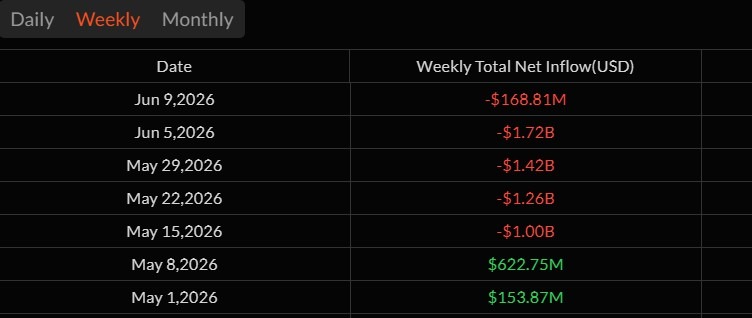
The comments follow a sharp reversal in US spot Bitcoin exchange-traded funds (ETFs), which recorded about $1.72 billion in net outflows last week.
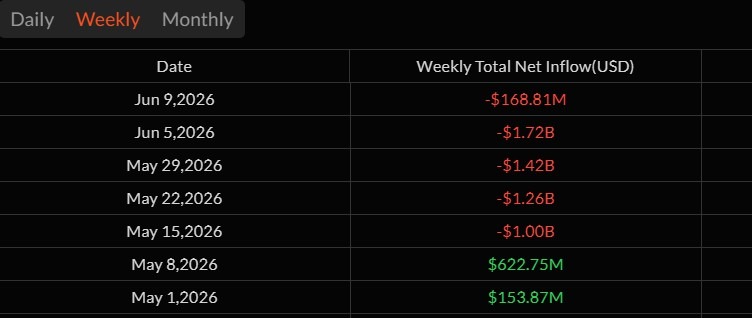
Spot Bitcoin ETF weekly flows data. Source: SoSoValue
Bitcoin rebound may still be fragile
Other analysts said Bitcoin’s recent rebound may not be enough to confirm a recovery. In a statement sent to Cointelegraph, Paul Howard, a senior director at liquidity firm Wincent, said last week’s outflows reflected institutional reactions to macroeconomic headlines, while pressure across tech-heavy markets showed the broader strain facing risk assets.
Howard said Bitcoin’s break below a key moving average suggested markets may have entered a more cautious phase, while elevated CME Bitcoin volatility pointed to continued news-driven swings. He said he remained cautious that the rebound would prove sustainable.
Related: Crypto users wary as Anthropic releases Claude Mythos with safeguards
Adam Haeems, head of asset management at crypto investment firm Tesseract Group, said that much of the market narrative had focused on Strategy’s sale of 32 BTC in late May. However, he said the sale, which raised about $2.5 million, was too small to mechanically explain the broader BTC decline.
“It unsettled confidence, because Strategy had been treated as a near one-way source of corporate demand, but it was a signal shock, not the flow behind the fall,” Haeems said.
Magazine: Vietnam preps crypto pilot, HK pushes tokenization: Asia Express

Coinbase’s vice president of tax, Lawrence Zlatkin, testified before the House Ways and Means Committee on June 9, asking lawmakers to stop requiring Americans to calculate capital gains every time they spend a stablecoin or pay a blockchain transaction fee.
His testimony came during a hearing on six standalone bills aimed at updating how the US tax code treats digital assets, covering everything from mining and staking taxation to charitable donations and broker reporting requirements.
Coinbase Presses for Simpler Crypto Tax Rules
Ahead of the hearing, the House Ways and Means Committee said it would examine legislation designed to bring “clarity, parity, and administrability” to digital assets. Representing Coinbase, Zlatkin told legislators that the current tax rules force consumers to track tiny gains and losses on routine transactions involving crypto.
According to him, federally regulated stablecoins pegged to the US dollar should be treated at par for tax purposes because they are designed to maintain a one-to-one value with the greenback.
He also argued that asking users to calculate cost basis every time they spend a stablecoin only created paperwork without generating any meaningful tax revenue. Furthermore, Zlatkin backed a proposal by Congressman Rudy Yakym to waive tax reporting on gas fees of up to $10.
He also asked Congress to create a broader de minimis exemption for small crypto purchases. Under Coinbase’s proposal, people making low-value transactions with Bitcoin (BTC) or other non-stablecoin cryptocurrencies would not have to calculate taxable gains every time they bought something.
Recall that in March this year, Coinbase CEO Brian Armstrong faced accusations of lobbying against a BTC tax exemption. At the time, he called the claims “totally false” and said that he had personally spent time advocating for a Bitcoin de minimis rule.
On mining and staking, the exchange supported a bill by Congressman Mike Carey that, if passed, would let validators defer tax on block rewards until those assets are actually sold instead of when they are received.
“A farmer is never taxed when a bushel of wheat sprouts from the ground; they are taxed when they harvest that crop, bring it to market, and execute a sale,” Zlatkin explained.
The Wash-Sale Question
Lastly, the executive reiterated Coinbase’s view on wash-sale rules, which prevent investors from claiming a tax loss if they buy back the same asset within 30 days of selling it.
While the firm has long agreed that the rules should also apply to crypto, it flagged a practical problem: that crypto trades 24 hours a day across exchanges, liquidity pools, and self-custody wallets, all at the same time, and there currently is no shared data architecture that would let anyone track wash-sale violations across that broken environment in real time.
According to the tax guru, before the rules take effect after being enacted, there should be an implementation runway of at least 18 to 24 months to allow for necessary software infrastructure to be built. He warned that forcing immediate compliance would lead to widespread reporting errors and a flood of IRS audits.
The post Coinbase Urges Congress to Treat Stablecoins Like Cash and Ease Crypto Tax Burdens appeared first on CryptoPotato.
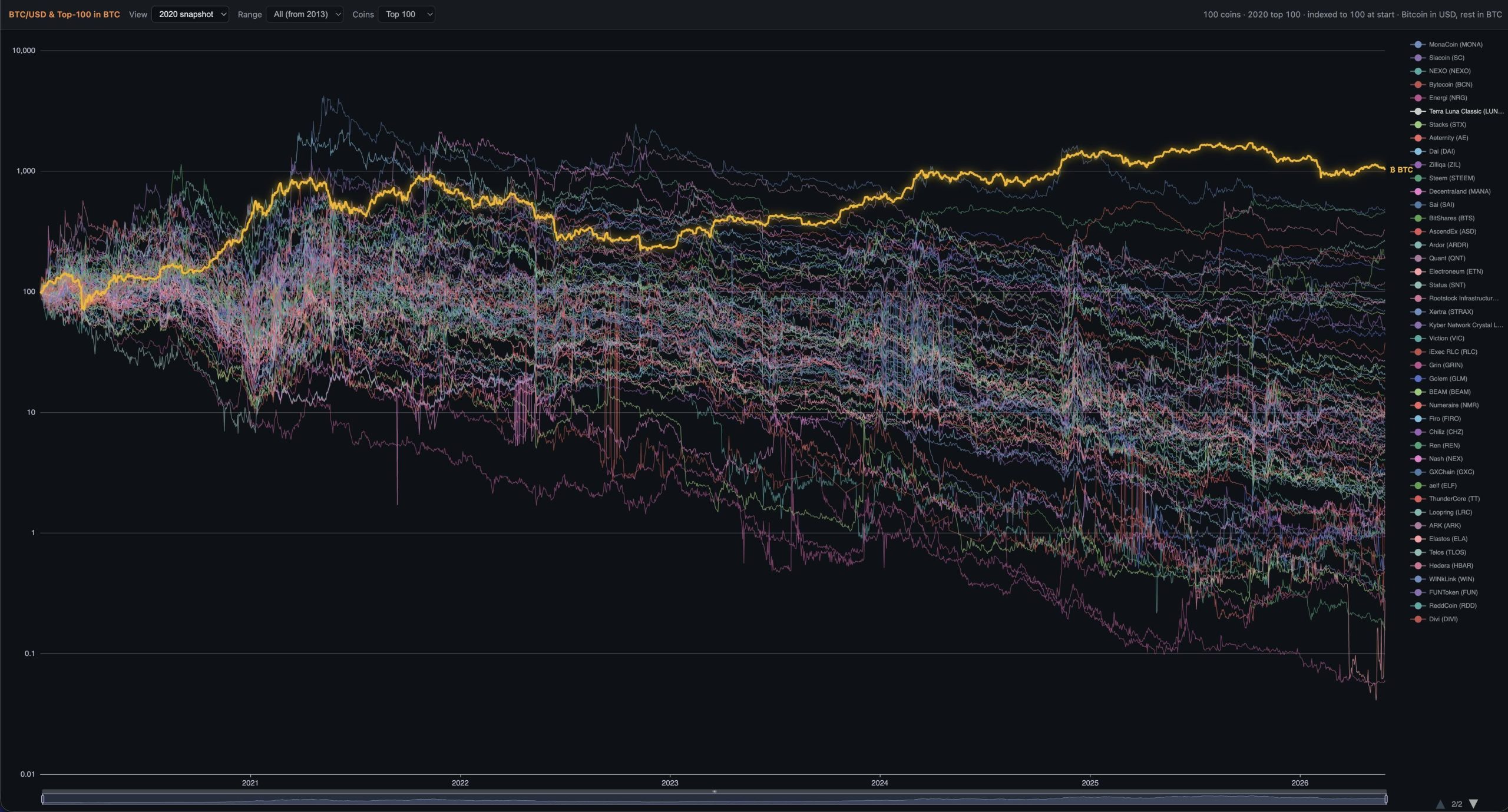
Bitcoin (BTC) has beaten nearly all of the top 100 altcoins since 2020, and chart data now points to almost 50% more downside for the broad altcoin market.
The total altcoin market cap, tracked as TOTAL2, trades near $864 billion after a steep weekly drop. Two charts explain why the pressure could continue.
Bitcoin Beat the 2020 Top 100 Altcoins by a Wide Margin
The first chart indexes the 2020 top 100 coins to a value of 100. It prices Bitcoin in US dollars and each altcoin in Bitcoin terms.
From that base, the BTC line climbed toward 1,000 on a logarithmic scale. Most altcoins, instead, fell from 100 to 10, 1, or lower. That gap means many former leaders lost 90% to 99% of their value against Bitcoin. Terra Luna Classic (LUNC) marked the most extreme collapse on the chart.
The framing matters because it measures opportunity cost. Holding most altcoins meant underperforming a simple Bitcoin position for more than five years. The chart also shows why coin selection rarely helped. Even well-known projects struggled to hold value once measured against Bitcoin.

A few names held near the starting line. However, the broad set shows years of losses for holders who skipped BTC and chose these survivors instead.
The current downturn has not reversed the trend. Bitcoin trades near $61,228, down about 2% on the day and roughly 44% over the past year. Meanwhile, altcoins have fallen harder. Over the past 30 days, BTC dropped about 24% while Ethereum (ETH) lost roughly 31%.
Total Market Cap Points to $436 Billion by July
The second chart shows TOTAL2 on a weekly timeframe with three cycle peaks. The most recent top printed at $1.77 trillion.
History gives two reference declines. The 2018 bear market fell 92% over 49 weeks, while the 2021 to 2022 drop fell 75% over 31 weeks.
Those moves average about 40 weeks in duration. Applying the more recent 75% decline to the $1.77 trillion, the top projects point to a bottom near $436 billion.
TOTAL2 currently sits at $864.73 billion, below the $942.62 billion level it just lost. The green support shelf near $494.05 billion held the prior cycle low.
A move to $436 billion would break that shelf and retest the $427.57 billion bottom from 2022. That target implies nearly 50% more downside from current prices.

The timing lines up with mid-July 2026, roughly 40 weeks from the peak. Rising Bitcoin dominance remains the main catalyst pulling capital away from altcoins.
Past cycles do not guarantee future outcomes. Spot Bitcoin exchange-traded fund flows, and broader macro conditions could shorten or deepen the move.
A weekly reclaim of $942.62 billion would weaken this bearish case. Until then, the structure favors lower prices and a delayed altseason.
The post Bitcoin Crushed Top 100 Altcoins Since 2020, But Charts Indicate More Pain by July appeared first on BeInCrypto.
US Stock Market Crash Warning: SpaceX IPO Boom Mirrors Dot-Com Era Red Flags

First war crimes complaint against UAE-backed Sudan paramilitary filed in Kenya

Haiti make change to World Cup 2026 shirt after Fifa complaint



-

 Fashion5 days ago
Weekend Open Thread: Evereve – Corporette.com
-
 Crypto World5 days ago
Jensen Huang Approves Samsung, SK Hynix, and Micron for NVIDIA (NVDA) HBM4 Memory Supply
-

 Crypto World3 days ago
Anatomy of the June crypto crash: Fed, Iran, Saylor
-
 Entertainment4 days ago
The Best Mystery Series of All Time Is Surging on Streaming 30 Years After It Ended
-

 NewsBeat3 days ago
Alexander Zverev wins the French Open to finally earn a 1st Grand Slam title
-

 Tech5 days ago
Suspicious Polyfill login prompts pop up on Toshiba, Muji websites
-
Crypto World4 days ago
Senator Cynthia Lummis Calls CLARITY Act the Most Consequential Financial Legislation of This Generation
-

 Tech6 days ago
Microsoft launches MXC, an OS-level sandbox for AI agents, with OpenAI and Nvidia already on board
-

 Tech4 days ago
Microsoft unveils seven homegrown AI models in new bid for ‘long term self-sufficiency’
-

 Business6 days ago
(VIDEO) Justin Bieber Delivers Surprise Happy Birthday Serenade to Diners at Los Angeles Mexican Restaurant
-
 Business4 days ago
The Pain Points Taking a Fragile Tech Rally Down a Notch
-
 Crypto World2 days ago
Eli Lilly (LLY) Stock Surges 4% Following Breakthrough Sleep Apnea Trial Results
-
Crypto World6 days ago
LBank Surpasses 25 Million Users Worldwide as AFA Partnership Continues to Drive Global Growth
-

 Tech5 days ago
Von der Leyen’s AI envoy pick draws conflict-of-interest fire
-

 Crypto World3 days ago
Trump’s AI Ownership Plan Could Benefit Anthropic at OpenAI’s Expense
-

 Tech5 days ago
Meta steals a tactic from Tesla and builds data centers in tents
-
 Sports1 day ago
Bangladesh beat Australia after 20 years in ODIs, register only their second win over six-time world champions | Cricket News
-

 Business3 days ago
High Stakes for Wembanyama as New York Pushes for 3-0 Lead
-

 Tech5 days ago
Hackers now exploit SolarWinds Serv-U flaw to crash servers
-

 Tech3 days ago
Notion restores access to Anthropic after service disruption
You must be logged in to post a comment Login