Officers were alerted to an incident on a path at Dunlin Brae towards Mallard Brae in Livingston at around 10.45pm.
West Lothian police have issued an urgent appeal for information after a man was seriously assaulted while out walking in Livingston on Sunday, May 24.
Advertisement
Officers were alerted to an incident on a path at Dunlin Brae towards Mallard Brae at around 10.45pm.
A 58-year-old man was walking when two young men approached him and assaulted him.
The man was taken to hospital for treatment and enquiries are ongoing to trace the two young men responsible.
The two suspects are described as around 5ft 7ins and of slim build. They were wearing black clothing.
Advertisement
Detective Constable Matt Morran said: “Enquiries are ongoing to trace the two men responsible for this attack.
“If anyone was in the area on Sunday evening and witnessed anything suspicious or has any information that may assist police enquiries, please contact Police Scotland through 101 quoting incident number 3675 of 24 May.
“Alternatively, Crimestoppers can be contacted on 0800 555 111, where anonymity can be maintained.”
Don’t miss the latest news from the West Lothian Courier. Sign up to our free newsletter
The 2026 Fifa World Cup is the biggest ever edition of the world’s most watched sporting tournament. The 48 teams taking part in Canada, the US and Mexico may find their toughest opponent is the extreme heat.
Very hot temperatures are expected across many of the states including Texas, California and Florida where World Cup games are being held this summer, with wildfire risks being highlighted in some states. The tournament kicks off on June 11.
The problems heat causes during matches were visible during the 2025 Fifa Club World Cup, played in the same summer months and across many of the same North American venues. Players and managers repeatedly referenced the stifling weather conditions.
Borussia Dortmund manager Niko Kovač said after a match in Cincinnati he was “sweating like I’ve just come out of a sauna”. Chelsea midfielder Enzo Fernández described conditions as “very dangerous”, adding that “everything becomes very slow”. Juventus manager Igor Tudor revealed that ten players asked to be substituted during a match against Real Madrid in Miami, where temperatures reached 30°C, with 70% humidity.
Advertisement
North America’s last World Cup (USA 1994) also produced memorable scenes relating to heat. German striker Jürgen Klinsmann recalled: “I played in Dallas at 120 degrees [49°C ] I was dying” in a match against South Korea. Meanwhile, Republic of Ireland manager Jack Charlton was reprimanded by Fifa officials for throwing water bottles onto the pitch to help his dehydrated players during a game in Orlando.
Extreme heat is not just uncomfortable – it threatens both health and performance. Football already has documented cases of heat-related fatigue, collapses and hospitalisations, including Guatemalan referee Humberto Panjoj collapsing during a 2024 Copa América match in Kansas City.
Heat also changes the game itself. Studies show players cover less distance, perform fewer high-intensity sprints and get tired more quickly in extreme conditions. Tired players are more prone to mistakes and injuries, while hotter matches have been linked to more penalty shootouts, as exhausted teams struggle to break each other down in extra time.
Scientists commonly use Wet Bulb Globe Temperature (WGBT) to assess heat stress. Unlike air temperature alone, WBGT combines temperature, humidity, solar radiation and wind, making it a better indicator of how dangerous conditions feel to the human body.
Advertisement
Several football governing bodies – including the global players’ union Fifpro – consider a WBGT above 28°C to be a threshold where matches should potentially be delayed or postponed.
20-year average levels of extreme heat in 16 venue citiesA chart based on author’s data measuring mean temperatures at venue cities from 2003-2022. Author, CC BY
Possible solutions?
A study I led in 2025 found that 14 of the 16 upcoming World Cup host cities are likely to exceed the extreme 28°C WBGT threshold if conditions this summer are typical. Most of the danger falls during mid-afternoon, and Fifa has clearly tried to reduce some of the risk through scheduling. Compared with the Club World Cup, matches in the hottest cities and non-air-conditioned stadiums have largely been shifted away from the most dangerous hours of the day.
Advertisement
That will help – but it will not eliminate the problem.
Some high-risk fixtures remain. Late afternoon (5pm) and early evening (6pm) matches in Miami and Kansas City carry a greater than 30% risk of WBGTs exceeding 28°C if summer temperatures are typical, rising above 50% if conditions are hotter than average. The final at MetLife Stadium in New Jersey kicks off at 3pm, when the probability of extreme heat is about 30% in a typical summer and 55% in a hot one.
Those estimates may even turn out to be conservative. Heatwaves are becoming more frequent and intense globally. The 2021 western North America heatwave shattered records by more than 4°C in some locations. A similarly extreme event during the World Cup could push lower-risk cities such as Seattle, Toronto and Vancouver into dangerous territory, while prolonging extreme evening heat in more vulnerable venues such as Miami, Kansas City and Philadelphia.
And even air-conditioned stadiums do not remove the wider public-health risk.
Advertisement
In the hottest cities such as Dallas and Houston, indoor venues may protect players and match officials during the game itself. But tens of thousands of spectators will still spend hours travelling, queueing and celebrating in dangerous outdoor heat. Many fans are older, less physically fit than elite athletes, dehydrated from alcohol consumption, or arriving from cooler climates with little acclimatisation.
The risk therefore extends well beyond the pitch.
Yet Fifa’s current heat policy remains limited. All matches will have three-minute hydration breaks midway through each half, but the threshold for stronger action remains exceedingly high. Current Fifa guidance only mandates additional precautions at a WBGT of 32°C.
Advertisement
Very hot temperatures are predicted this summer.
That figure has alarmed scientists and medical experts who have sent an open letter urging Fifa to strengthen its heat protections before the tournament begins. Their recommendations include doubling the time for cooling breaks to six minutes, lowering the WBGT threshold for intervention and introducing clearer rules for delaying or postponing matches in dangerous conditions.
It is possible matches could be delayed or postponed if WBGTs exceed 32°C. This would be a decision for Fifa – and is something they have never done before. It is worth noting that the 32°C threshold is also considerably above levels many experts consider dangerous.
It’s likely that more World Cups will be played outside the traditional summer months in future. This was the case for the Qatar World Cup in 2022, moving from June/July to November/December and is almost certain to be the case for the 2034 tournament in Saudi Arabia.
The 2026 World Cup may ultimately become a defining test for how global sport adapts in a warming world. Scheduling matches outside the hottest hours is a sensible start. But as temperatures continue to rise, timing alone may no longer be enough.
The rivalry, described as “farm wars” by Digital Spy, will focus on power struggles and land ownership, returning the show to its rural roots with a fresh twist.
Producer Laura Shaw said in an exclusive chat with Inside Soap: “Emmerdale has always been built on a hierarchy.”
Emmerdale fans to expect family rivalries over power struggles and land ownership
She added: “Robert is that tenant farmer who is still owned by the Tates up on the hill, looking down on him.
“The Dingles own their farm and the Sugdens own theirs, but the Tates owning all the land around is going to be important.”
Advertisement
Laura continued: “We’re going for a Yellowstone vibe, which will bring us lots of story in the future.”
The storyline has already seen major changes at Butlers Farm, where Moira Dingle made a deal to sell her share to the Tates while on remand for crimes she didn’t commit – human trafficking and double murder.
Butlers Farm has since been rebranded as Emmerdale Farm and is now run by Robert and Aaron Dingle as tenant farmers.
Emmerdale’s most emotional exits
Moira made the difficult decision out of concern for her unwell husband, Cain, who was struggling to manage while she wasn’t there.
Advertisement
She has since been released due to the case falling apart.
At Wishing Well Cottage, Cain and Sam Dingle plan to start their own Dingle Farm.
Natalie J Robb, who plays Moira, welcomed the change of direction, according to Digital Spy.
Ms Robb recently said: “It’s nice to be back after Moira’s time in prison.”
Advertisement
She added: “Obviously it’s going to be a big change being at the Dingles’ rather than Butlers Farm – it’s new stories.
“What’s lovely is that Moira is not in debt anymore, so she can start from scratch.
“It’s quite nice that it’s not always about money.
“Presumably she’ll be building it all up again, but that comes a bit later on.”
Tate and Sugden families to expand with two new Emmerdale arrivals
The news of the rivalries comes after Emmerdale bosses confirmed two new arrivals would be joining existing families.
Advertisement
The Tates and the Sugdens will welcome a new member each but it has not yet been decided who the new characters will be.
Emmerdale also intends to restore the prominence of the Sugdens, one of the show’s original families.
Fans can hear more from producer Laura Shaw in the latest issue of Inside Soap magazine, which is out now.
Which family is your favourite, the Tates, Dingles, or Sugdens? Tell us in the comments below.
At least 13 people were killed in central China‘s Henan province early on Thursday after an overcrowded minibus crashed into the back of a large truck.
The collision took place at 2.40am local time on a section of the G40 highway running from Shanghai to Xian in Shaanxi province, China’s ministry of public security said in a statement.
The minibus was approved to carry nine passengers but had 16 people on board at the time of the crash, the statement said. The passenger bus rear-ended a semi-trailer truck travelling ahead of it.
Following the incident, the ministry said it dispatched a working team to Nanyang to guide the investigation. The ministry said it “attached great importance” to the incident, “immediately dispatching a working group to Nanyang led by a traffic management bureau official to direct investigation and handling work”.
Advertisement
Deadly crashes are common in China, mostly due to poor safety standards and reckless driving.
In November last year, China witnessed its deadliest rail accident in more than a decade when a train ran into a group of railway workers, killing 11.
At least one person died and four others sustained injuries when a driver allegedly drove into a crowd in Chongqing in June that year.
There’s nothing worse than boiling an egg only for it to crack, but there is an easy way to prevent it.
Boiled eggs make an excellent breakfast, lunch or snack, particularly during this time of year. They’re a perfect addition to summer salads, making them an ideal accompaniment to evening meals.
Advertisement
Despite their versatility, boiled eggs can be surprisingly tricky to master. The duration you cook your boiled egg is crucial to achieving the desired outcome.
You can achieve runny yolks that are perfect for dipping toast soldiers, almost-set eggs for a sticky yolk, jammy ones ideal for scotch eggs, and a classic boiled egg that is mashable yet not dry.
There are only minutes separating the different varieties, so careful attention when cooking is essential. However, an often-overlooked step when preparing boiled eggs comes with the preparation.
Eggs can crack while boiling, causing the egg whites to leak into the pan. Water can even seep into the egg and significantly affect the flavour.
Advertisement
Fortunately, there’s a straightforward way to prevent eggs from cracking, and that’s ensuring they reach room temperature before cooking.
BBC Good Food explained: “Make sure your eggs aren’t fridge-cold – eggs at room temperature will have less of a shock when put into hot water and will therefore be less likely to crack.
“You can also use an egg pricker or pin to make a very small hole in each egg before boiling, which will reduce the chance of it cracking in the heat. Slowly lower the eggs into the water using a spoon – don’t just drop them.”
Advertisement
How to boil an egg so it doesn’t crack
Fill a saucepan with water and bring to the boil. Allow your eggs to come to room temperature if they have been kept in the fridge. If using, make a small hole in the egg using an egg pricker.
Carefully lower the eggs into the water using a spoon.
Turn the heat down to a gentle simmer and set your timer according to your desired outcome.
Cooking times for a large egg
Five minutes: just-set (not solid) white and runny yolk that’s ideal for dipping
Advertisement
Six minutes: liquid yolk and a slightly wobbly white
Seven minutes: almost set for a sticky yolk
Eight minutes: softly set and jammy to make scotch eggs
10 minutes: a classic hard-boiled egg that’s mashable, but not dry
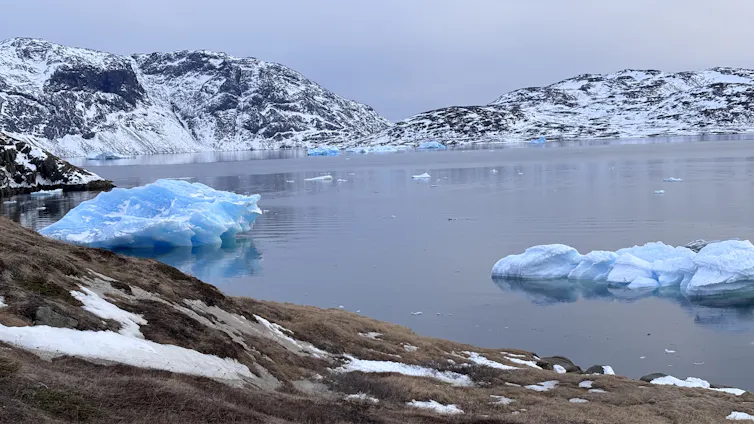
The morning sun lights up the ice-covered mountains around Narsaq, a small village in South Greenland. Turquoise icebergs float by the shores of the fjords, and seagulls gather on the cliffy rocks. An old man walks slowly along the colourful houses on the hill.
The picturesque scene feels almost surreal, but this is indeed where I find myself as a researcher of public art projects (like street art and murals) and how they shape local communities.
I am about to visit the social services and training centre for young people, “Inusullivik Piareersarfik”, where many come to prepare for the job market and engage in artistic projects in Narsaq.
Some come here because they are having a hard time. They worry about what comes next – work, school, life at home – or they are simply trying to figure out who they are.
Advertisement
For those who are having difficulties, the centre offers counselling through creative activities, where young people take classes in painting, music and carpentry.
The Narsaq village in South Greenland. Kathrin Maurer, Author provided (no reuse)
Art in local communities
I am in Greenland to study the Sanasa Art Route Project, one of the initiatives at the centre. The project brings together teenagers, artists and community workers to create large-scale murals across South Greenland.
Art has long held an important place in the communities of South Greenland, with various artists and musicians from this region helping shape modern culture and identity.
Award-winning Greenlandic filmmaker Inuk Jørgensen’s recent film Entropy, for example, explores how the destruction of the Greenland ice sheet is threatening the spiritual relationship between the Inuit and nature.
Advertisement
Illaarneq by Egede Godtfredsen. The motif is based on the myth of Sassuma Arnaa, Mother of the Sea. Kathrin Maurer, Author provided (no reuse)
Then there is singer, guitarist and producer Malik Høegh from the influential Greenlandic rock band, Sume who also hails from South Greenland, and was integral in creating the first Greenlandic long-playing vinyl record Sumut, meaning “Where to?”
Vittus Nielsen, the workshop supervisor at the centre in Narsaq, greets me warmly and hands me a cup of coffee. A group of teenagers sit nearby. They give me a slight nod, some smile.
Someone says something in Greenlandic, and the group laughs. I do not understand the words, but I am glad to be sitting among them.
Nielsen and I talk about the Sanasa Art Route Project, founded in 2018 by master painter and decorator Heidi Zilmer, who also has Greenlandic roots.
The project brings young people from several villages in South Greenland together with artists and community workers to paint vibrant murals on school walls, old factories, or harbour containers.
Advertisement
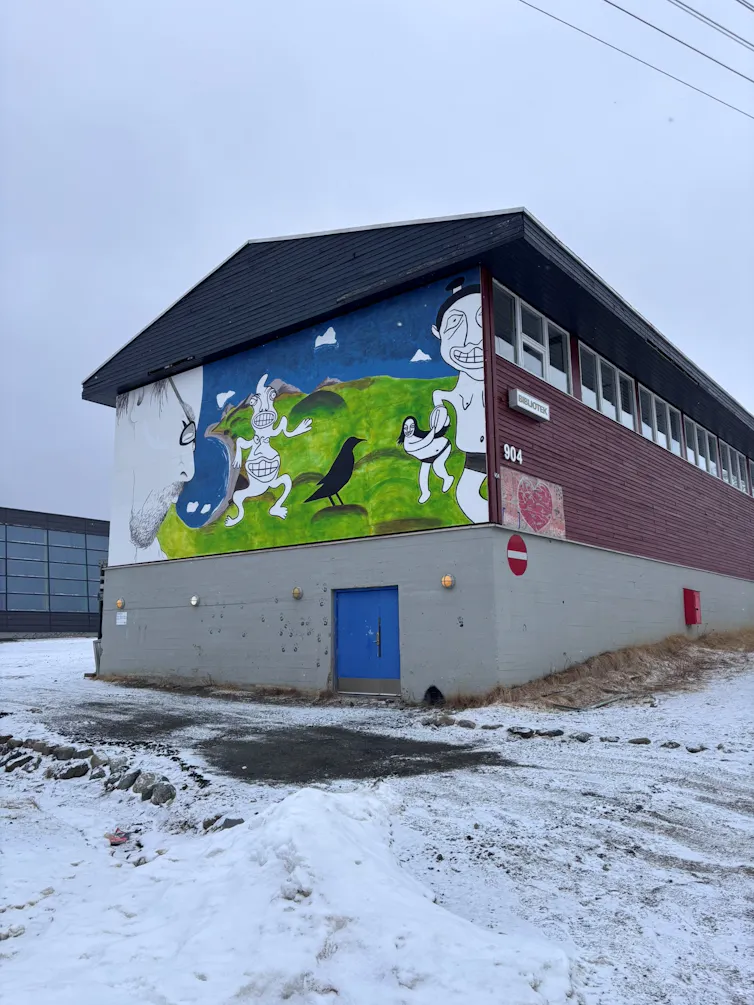
Immini Silarsuaani, ‘In his own world’, by Egede Godtfredsen, in Narsaq, South Greenland, 2019. Kathrin Maurer, Author provided (no reuse)
These murals illustrate motifs about Greenlandic identity, myths and cultural traditions – painted and developed by over 200 young adults from all over Greenland.
In times of uncertainty and political polarisation, these murals and paintings have become anchors; places where people gather, see themselves reflected and connect with each other.
Let’s build something
In Greenland, villages are often measured by large infrastructure developments, roads built, and funds invested.
But the Sanasa project shows that another form of infrastructure is just as essential. One that is visual and cultural rather than physical.
Sanasa means “let’s build something” in Greenlandic. And that is what the members of the Sanasa Art Project certainly want to do: to build a strong local community, where people feel at home, help each other and stay for future generations.
Advertisement
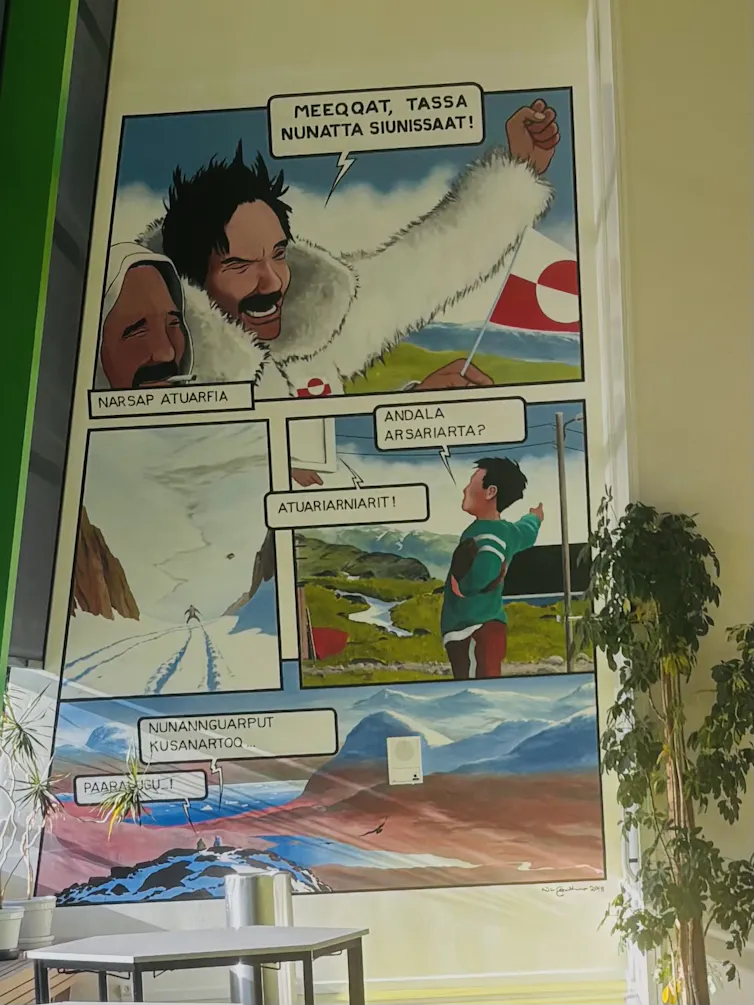
One of the murals, Andala inside the public school in Narsaq, by the artist Konrad Nuka Godtfredsen, is painted in a comic strip style. It has a clear message: education is your future.
A mural titled Kathrin Maurer, Author provided (no reuse)
In times of uncertainty
But life in Narsaq has become increasingly uncertain in recent years, as the village faces population decline and shifting infrastructure.
Just before I visited, the Narsasuaq Airport – about 18 miles from Narsaq and a former US military base – was downscaled to a heliport. This means fewer visitors for the area.
At the same time, there is the proposed mine of rare earth and uranium in the Kvanefjed area, a short distance from the village. The question of mining has raised concerns locally about contamination to the surrounding sheep farms and fisheries, prompting widespread protests.
And then there is US President Donald Trump with his repeated interest in acquiring Greenland. The capital, Nuuk, remains overrun by journalists, researchers and tourists because of this. Indeed, I saw signs at museums and cafes that state: “We do not give interviews about the political situation!”
Advertisement
The Narsaq Museum. Kathrin Maurer, Author provided (no reuse)
A guide at the Narsaq Museum – a small exhibition house dedicated to local culture, history, fashion and industry – told me:
Trump has destroyed everything. Everything. I always liked the Americans as neighbours, but now, he ruined everything. We are very worried.“
But amid these geopolitical tensions and regional challenges, I saw communities in South Greenland rediscover their resilience through public street art and find a renewed sense of hope.
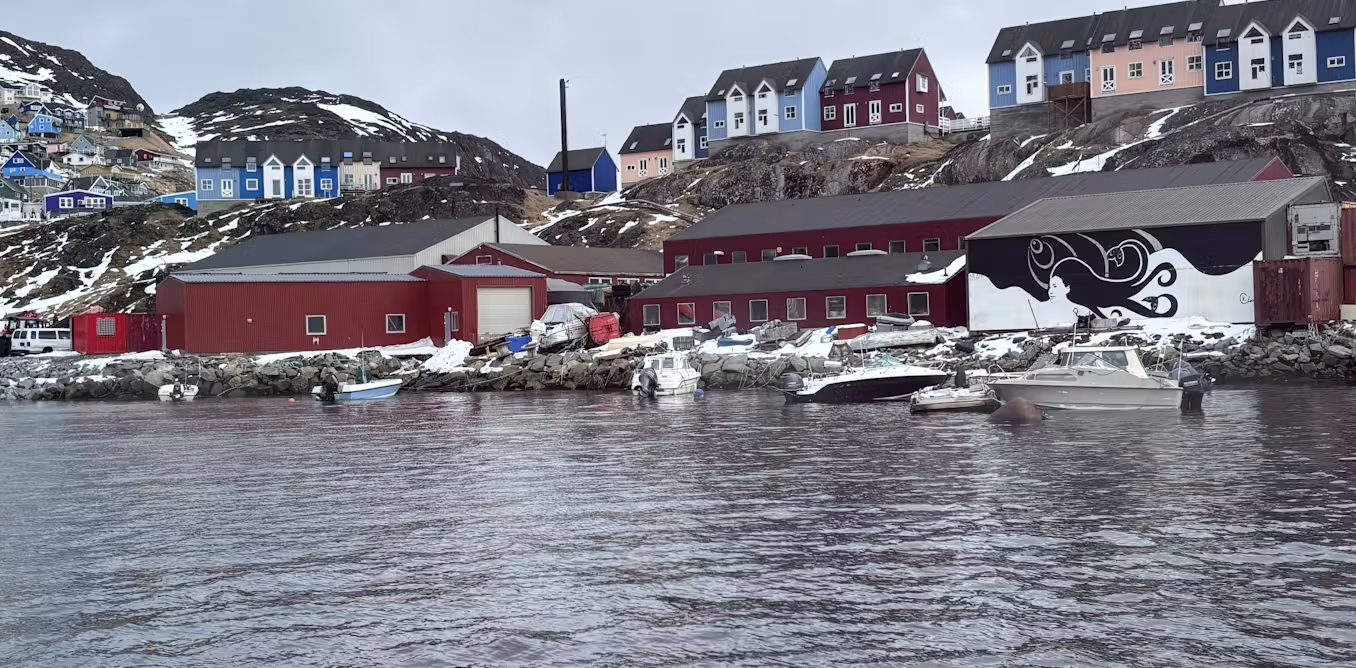
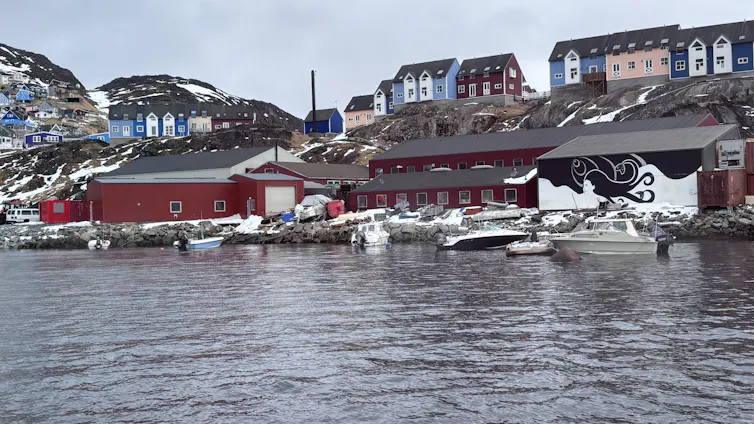
The Narsaq shoreline in South Greenland. Kathrin Maurer, Author provided (no reuse)
Art and a new airport
The next day, I take a boat to Qaqortoq, the largest town in South Greenland, where the atmosphere is noticeably different. Everybody is talking about the opening of the new Qaqortoq Regional Airport – now large enough for passenger flights, medical transport and freight. Before this, access was only possible by boat and helicopter.
In Qaqortoq, change shows up not only in infrastructure, but also in what you see around you.
The town is part of the same Sanasa Art Route Project, and murals are visible across public spaces. One of them, Arferup Pania by Hollie Kielsen Olsen, interprets a Greenlandic myth about a girl abducted by a whale.
Arferup Pania by Hollie Kielsen Olsen, under the guidance of artist Bolatta Silis-Høegh (2018). Kathrin Maurer, Author provided (no reuse)
This also relates to the famous Greenlandic myth, Sassuma Arnaa, meaning “mother of the sea”. The Sanasa Project website explains that in Olsen’s interpretation, the whale and the girl have a daughter, Arferup Pania, described as a symbol of beauty after a storm.
Olsen says that painting this mural was a way to connect her to her Greenlandic identity, and it made her feel positive about the future.
Advertisement
That is like what I experienced in South Greenland. Even in stormy times, these communities are finding beauty, reconnecting with their culture and rekindling hope through art.
This article was commissioned as part of a partnership between Videnskab.dk and The Conversation. You can read the Danish version of this article here.
Senior councillors heard this week that the company had appointed Veritau to examine decisions made at the construction company, which reported a £7.5m loss for 2025/26.
York-based Veritau, which is owned by local authorities in Yorkshire and the North-East including North Yorkshire Council, provides internal audit and counter-fraud services to public sector and private customers.
The update was given to the council’s executive committee this week by Councillor Mark Crane, executive member for open to business.
He said: “We are keeping a close eye now, as we have been for a while, on Brierley Homes.
Advertisement
“I do think, if I may say, that the appointment of the new managing director is a positive step forward and he has my confidence. He seems to have got to the bottom of the issues there and I feel that we are on a more sustainable footing.”
Mark Crane. Nyc
Cllr Crane added: “I think members should also be aware that we have asked Veritau have a look at what has gone on over recent years with a view to reporting back to the shareholder board and the executive on any recommendations and any findings that they have.
“From there, we will take the matter further if we need to. I certainly feel it’s on a stronger footing now and I don’t think you can underestimate the amount of affordable homes that are being built as a result of Brierley.”
Cllr Crane said he was unable to elaborate further on what Veritau would be looking for when contacted by the Local Democracy Reporting Service.
Advertisement
The company appointed Tony Dodds as managing director earlier this year following the departure of Stuart Ede, who left the role in January.
Brierley Homes is forecast to make a loss of £7.47m in 2025/26 — despite a profit of around £700,000 being forecast.
The council has blamed the poor performance on less income from sales than expected, increased costs and delays in the completion of homes, leading to increased overheads and interest costs.
Council chiefs have previously agreed a £27m loan facility for Brierley Homes and the plan warns that £7m of the loan may still be outstanding in five years time.
Advertisement
Gary Fielding, the council’s corporate director for resources, told the executive committee meeting that despite the loss, the company did deliver some benefits to the council, including helping to provide more affordable homes.
He added: “A point I would make is that while a £7.5m loss is clearly unwelcome, £1.5m of that was additional interest earned by the council as the funder of that loan so the net loss to the council is £6m.”
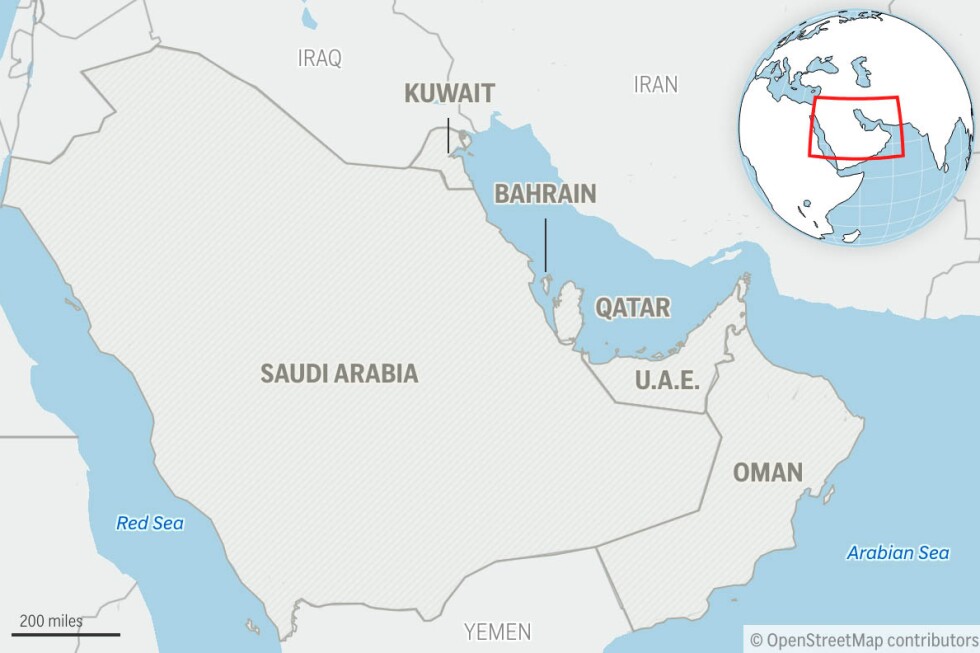
DUBAI, United Arab Emirates (AP) — Kuwait said it was targeted with a missile and drone attack Thursday, another challenge to the shaky ceasefire in the Iran war following strikes by both Washington and Tehran.
Kuwait’s military made the announcement, without providing further details on what had been targeted. Iran said hours later that it launched an attack in the region, but it did not say exactly what was targeted.
Kuwait, a close ally of the U.S., repeatedly came under fire from Iran and Iranian-backed Shiite militias in Iraq during the war.
The announcement comes as the Middle East is on the edge. U.S. President Donald Trump has expressed confidence that his administration is making headway in negotiations with Iran to end the war, but the talks remain in flux.
Advertisement
Trump is looking for an agreement that will reopen the Strait of Hormuz — through which about a fifth of all traded oil and natural gas once passed. He is also seeking to get Iran to give up its stockpile of highly enriched uranium while the Islamic Republic wants economic sanctions to be lifted and frozen assets to be released to aid its shattered economy. The war has been unpopular in the U.S., and Iran’s closure of the strait has sent oil prices skyrocketing, driving up fuel prices around the world.
As the negotiations continue, there have been several challenges to the ceasefire in recent days.
On Monday, the U.S. said it conducted what the Pentagon called “defensive” strikes on missile launch sites and minelaying boats in southern Iran. U.S. officials said late Wednesday in Washington that forces launched more strikes on Iran, shooting down four one-way attack drones that posed a threat around the strait and hitting an Iranian ground control station in Bandar Abbas that was about to launch a fifth drone.
The officials were not authorized to comment publicly and spoke on the condition of anonymity.
Advertisement
Iran’s paramilitary Revolutionary Guard via the state-run IRNA news agency acknowledged the attack around Bandar Abbas International Airport and said it launched its own retaliatory attack on the air base that launched the assault.
It did not elaborate on the target and it wasn’t clear whether that was the attack that Kuwait announced.
___
Associated Press writer Konstantin Toropin in Washington contributed to this report.
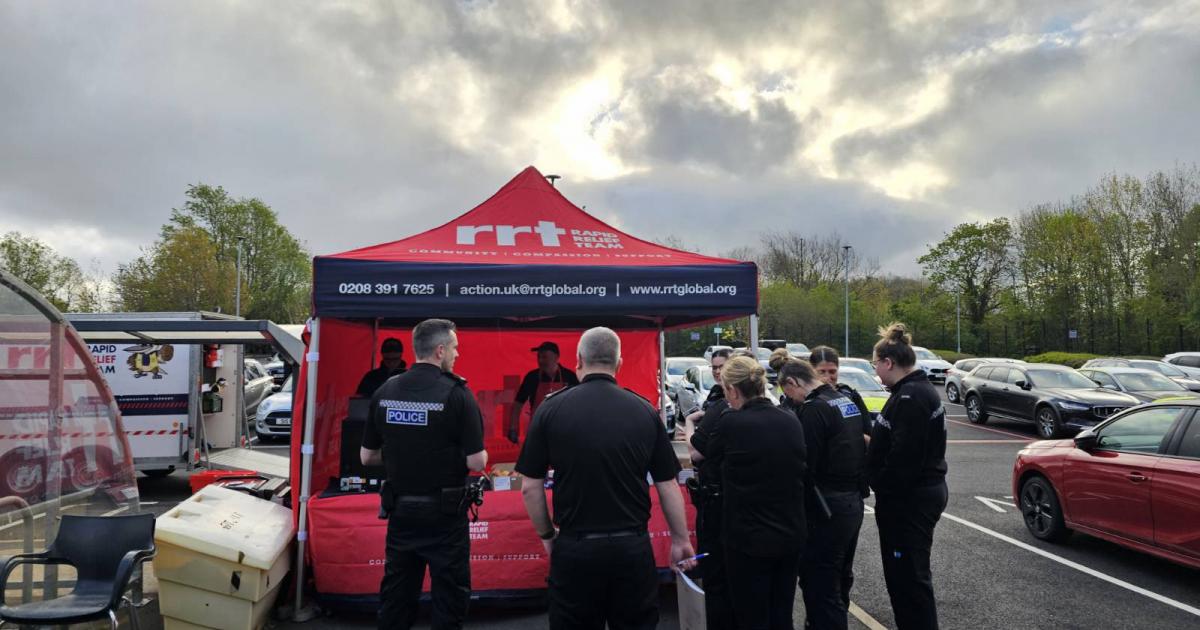
In Stockton, the Rapid Relief Team (RRT) charity partnered with the National Police Chiefs’ Council (NPCC) to organise a series of events during Police Appreciation Week, extending support to officers across County Durham and North Yorkshire.
RRT volunteers visited police stations, serving coffee and cakes while offering officers a chance to relax and feel valued for their daily efforts.
Police officers were supported during Police Appreciation Week through events organised by the Rapid Relief Team and NPCC (Image: Supplied)
Murray Johnston, RRT’s local team leader, said: “The pressures facing police officers all over the country are well documented and this week was a way to show our support in a practical way.
“It was a privilege to have the opportunity to spend time with officers in Stockton-on-Tees, thank them for their service and recognise the vital role they have in supporting local communities, often in very challenging circumstances.
Advertisement
“We hope that these events provided a small boost to officers, gave them a moment to pause and feel appreciated for the work they do in protecting communities every day.”
Three welfare events were held in County Durham and North Yorkshire, reaching more than 240 officers.
In total, RRT hosted more than 200 events across England and Wales during the week, supporting around 16,600 officers over five days.
The programme was organised in response to ongoing concerns about the stress and mental health challenges faced by those in policing roles.
Advertisement
According to the Police Federation of England and Wales’ Pay and Morale Survey 2024, 82 per cent of officers reported experiencing stress, low mood, anxiety, or other mental health difficulties.
RRT also encouraged the public in Stockton-on-Tees to take a moment to acknowledge the dedication of their local officers.
This was the charity’s largest UK operation to date, building on more than a decade of supporting emergency services and frontline organisations.
The events were coordinated with Cleveland Police to ensure that they complemented officers’ operational duties, giving them a chance to take a short break during busy shifts.
Advertisement
Superintendent Alan O’Donoghue said: “Response police officers are the backbone of day-to-day policing.
“They are the first to arrive at moments of crisis, uncertainty and vulnerability, often facing risk and complexity with limited information and under intense time pressure.
“Whether dealing with serious incidents, safeguarding those at risk, supporting victims at their most distressed, or managing emergencies that have a lasting impact on families and communities, response officers consistently demonstrate courage, professionalism and compassion.
“The RRT staff were simply outstanding – approachable, engaging and clearly driven by care and compassion.
Advertisement
“Their presence was incredibly well received, not just by me but by officers and staff across the district, and it made a real difference.”
THE pioneering and hugely influential electronic German band Kraftwerk are currently on their first UK tour for nine years.
Sadly, once again, there no visit to York with Stockton being the closest concert, so a trip to the restored Globe Theatre was needed.
Kraftwerk have not released a new studio album for well over 20 years and much of the evening’s setlist was decades older than that, but despite the material’s familiarity it succeeded in remaining fresh, perceptive, visionary and cautionary
Advertisement
Kraftwerk performing at Stockton Globe on 27 May 2026.
In their Tron-style grid-lighted suits the four members remained rooted to their podiums, anonymous and emotionless throughout the performance, the definition of man-machine music.
Although the foot of original member Ralf Hütter – now 79 – could occasionally be seen tapping away to the beat, instead of your attention being drawn to specific musicians and their antics on stage you instead became engrossed in the audio visual landscapes presented.
The vibrant visuals – which often managed to be simultaneously retro and futuristic – were impeccably paired with the pulses, beats, loop and washes of sound for which Kraftwerk are famous.
Kraftwerk performing at Stockton Globe on 27 May 2026.
During opening song Numbers the green on black retro digital graphics scrolled around the screen in hypnotic fashion before a change to yellow and white during the insanely catchy Computer World, one of the most prophetic songs written about the dangers of digital control and surveillance.
Advertisement
On Spacelab we watched the approaching earth from a spacecraft window growing closer until coastlines materialised including the UK. With an unknown destination tagged on the map the spaceship flew closer over a panoramic view of Stockton before landing outside the Globe Theatre to audience cheers.
Kraftwerk performing at Stockton Globe on 27 May 2026.
Stark red, white and black graphics occasionally resembling a Mondrian painting accompanied Man Machine but on a spellbinding version of The Model the band choose not to use custom graphics and instead performed the song while the original video played on the screen.
At one point, Hütter addressed the audience to talk fondly of the late Ryuichi Sakamoto – a friend and collaborator since 1981 when the band first visited Japan. By way of homage the group performed Sakamoto’s Merry Christmas, Mr Lawrence which was followed by dramatic versions of Geiger Counter and Radioactivity and their obvious anti-nuclear themes.
Kraftwerk performing at Stockton Globe on 27 May 2026.
Autobahn, Tour de France and Trans Europe Express revelled in the themes of transport and the unique rhythms of each – turning wheels and overtaken vehicles, trains speeding along tracks and over bridges, and the racing pulses and laboured breathing of cyclists.
Advertisement
The show appeared to finish with a sequence of Boing Boom Tschak, Techno Pop, and Musique Non Stop, with each member leaving their consoles in turn, bowing reverentially to the audience before departing, until only Hütter was left and it was his turn to depart.
The band however returned to their consoles to close the show with The Robots with their eerie robotic mannequins on the screen behind them.
It was a striking and memorable way to bring the impeccably presented experience to a close.
British singer James Blunt echoed the sentiment, pointing to practical uses in music production, such as refining backing vocals. Their remarks contradicted Sir Elton John, who told the audience in his new role as the Ivors Academy’s first president: “No matter what kind of music you write, it’s yours, you own it… It came from your soul, it means a hell of a lot to you.






















































You must be logged in to post a comment Login