

Business
BMW says humanoid robots are the future of car production

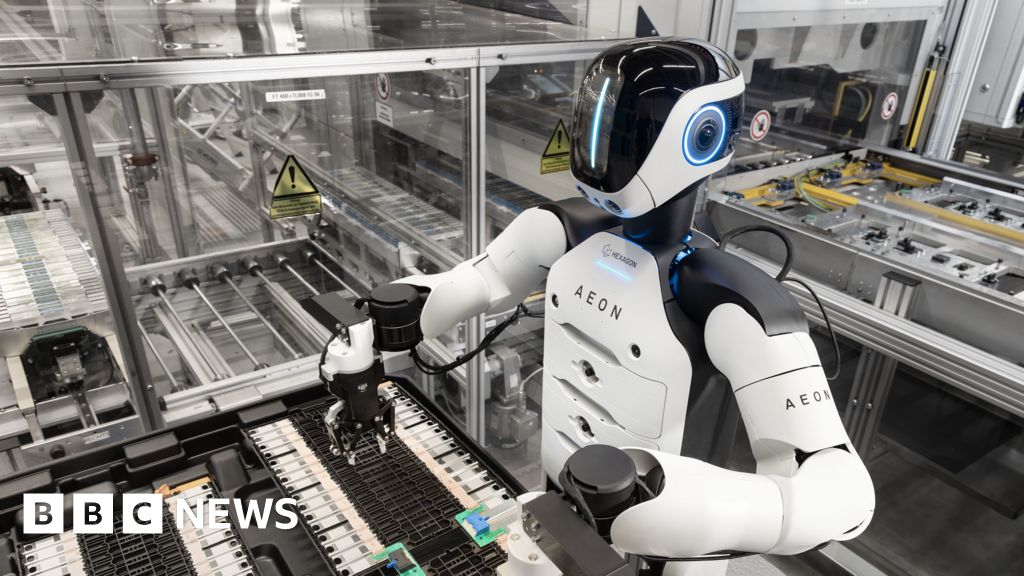
One observation from the US was that AI-based robots cope much better with variance than previous machinery. “If you changed the position of the sheet metal a little bit or you shift it, or you tilt it, with a standardised industry robot, you would have a failure,” says Nikolaides. “These humanoid robots can analyse that and they will just keep on working.”

Traders were also digesting unprecedented demand for shares in SpaceX, which raised $75 billion in an initial public offering and jumped about 20% in its Nasdaq debut.
The euro was little changed at $1.15725, hovering near a one-week high and set for a weekly gain after the European Central Bank delivered its first interest rate hike in three years on Thursday.
PEACE DEAL
Leaked terms of a proposed memorandum to end the war in the Gulf, outlined by Western, Pakistani and Iranian sources on Friday, appeared to favor Iran, drawing criticism from U.S. President Donald Trump who called the reports inaccurate. Trump’s announcement on Thursday regarding a deal had prompted Wall Street shares to rally, oil prices to slip and the U.S. dollar to fall.

Markets are pausing as they assess the prospects for peace and the impact of the SpaceX IPO, with investors watching whether funds will shift from equities or cash, said John Velis, FX and macro strategist at BNY.
“The hoped-for good news on the ceasefire in the Middle East had a big reaction overnight and I think we came in this morning and we have the SpaceX IPO and a bunch of central bank meetings next week,” Velis said.
The U.S. dollar was up 0.18% against Japan’s currency at 160.225 yen, holding near a key level that often triggers concern about intervention from Tokyo.
The pound was steady at $1.34145. Data showing the UK economy contracted in April had little impact, with markets focused on Iran talks.
The U.S. dollar index, which measures the greenback against a basket of six currencies, was flat at 99.75 after hitting a one-week low on Thursday.
Investors have tended to buy the safe-haven dollar when tensions in the Iran war flare, and sell it in favor of riskier assets such as stocks when peace talks appear to make progress.
FED IN VIEW
Data on Thursday showed U.S. producer prices increased more than expected in May, ahead of Kevin Warsh’s first rate-setting meeting as chair of the Federal Reserve next week.
Traders expect the Fed to keep rates steady at 3.5% to 3.75%, but see a greater than 50% chance of a hike by year-end. Pricing edged slightly lower on Thursday after Trump’s comments on a potential deal.
Against the Swiss franc, the dollar strengthened 0.21% to 0.79680.
In cryptocurrencies, bitcoin gained 0.40% to $63,595.26. Ethereum declined 0.29% to $1,665.87.
Private market data sector seen reaching $30bn TAM by 2030
Brent futures were down $3.34, or 3.7%, at $87.04 a barrel by 1035 CDT (1535 GMT), while U.S. West Texas Intermediate (WTI) crude dropped $3.11, or 3.55%, to $84.60. Both contracts were at their lowest prices since April 17.
“The market thinks we’re closer to the deal,” said Phil Flynn, senior analyst with Price Futures Group.
A memorandum between the U.S. and Iran to halt the war in the Gulf could be signed as soon as Sunday, a Western source told Reuters on Friday, with Geneva emerging as the likeliest venue.
Iran’s Fars news agency, however, citing a source close to the negotiations, denied that speculation.
U.S. President Donald Trump called off his threatened air strikes on Thursday, while Iran’s Mehr news agency reported that final negotiations on the memorandum would focus on nuclear and economic issues but would exclude discussions about Iran’s missile programme.
Iran’s IRNA news agency, meanwhile, said nuclear talks would take place within a 60-day period after a memorandum was signed. “Headlines are driving the market once again as confidence grows that an eventual deal will be struck and the Strait (of Hormuz) reopens,” said Tamas Varga, an analyst at PVM Oil Associates.
The caveat, however, is that global and regional oil stocks are still low and could drift lower, even with a deal, as it would take time to ensure uninterrupted oil flows, he added.
On Thursday, Iran announced a complete closure of the strait, saying it would fire on any ship trying to pass through the waterway. Traffic through the strait, which normally carries a fifth of global oil and liquefied natural gas shipments, has been extremely limited as a result of the war.
The U.S. military, however, said on social media that commercial ships continued to transit the waterway.
“We believe the market reaches an inflection point in late July if we do not see oil flows resuming before then,” ING analysts said in a note. “This is when inventory levels and seasonally stronger demand push prices significantly higher towards $120-130 per barrel.”
Goldman Sachs lowered its 2027 average Brent forecast to $80 a barrel on higher supply and lower demand, but expects prices to exceed the 2025 average on stockpiling of OECD commercial oil stocks and a security premium for disruptions.
The Organization of the Petroleum Exporting Countries lowered its forecast for 2026 world oil demand growth to 970,000 barrels per day on Thursday from a previous 1.17 million bpd – its second straight downward revision.
The producer group also said consumption would eventually rebound. It expects oil demand in 2027 to rise by 1.73 million bpd, up 190,000 bpd from its previous forecast.
Gabelli International Growth Fund Q1 2026 Commentary
BlackRock Equity Dividend V.I. Fund Q1 2026 Commentary

Stocks had rallied sharply on Thursday after U.S. President Donald Trump called off attacks on Iran and announced the two countries were close to a deal to end their three-month-old war.
However, details of such a deal were unclear. A senior U.S. official said on Friday that negotiators for the U.S. and Iran are close to the finish line of a deal that could be signed in the coming days. The official told reporters that an agreement would include a commitment by Iran to neither develop nor procure nuclear weapons and would reopen the Strait of Hormuz to normal oil traffic and lift the U.S. blockade.
But Iran’s foreign minister Abbas Araqchi said that nuclear issues will be discussed in later stages and that management of the Strait of Hormuz would not return to the pre-war era.
Still, U.S. Treasury yields rose while stocks finished higher after climbing back up from morning declines.
The SpaceX IPO was a bigger boost for stocks on Friday than the prospect of an Iran deal, said Jake Dollarhide, CEO of Longbow Asset Management in Tulsa, Oklahoma, adding that since mid-March President Donald Trump has repeatedly said that a deal with Iran was close.
“The market’s been stung more times about peace in the past. Yesterday was because Trump called off the attacks. That was a tangible result. Today we’re still waiting for proof of a deal,” he said. “The excitement about the SpaceX IPO is what’s driving the market. A healthy IPO is great for the market.”
Dollarhide said it could be a productive year for IPOs with artificial intelligence companies OpenAI and Anthropic also expected to make their debuts this year.
In their first day of trading, shares in rocket and spacecraft manufacturer SpaceX closed up more than 19% at $161.11, with the market debut pushing the company’s valuation past $2 trillion and making founderElon Musk the world’s first trillionaire.
Chris Zaccarelli, chief investment officer at Northlight Asset Management, said the successful SpaceX IPO was “a barometer for overall risk appetite and the health of the market in general.”
On Wall Street, the Dow Jones Industrial Average rose 353.51 points, or 0.70%, to 51,202.26, the S&P 500 rose 37.16 points, or 0.50%, to 7,431.46 and the Nasdaq Composite rose 79.18 points, or 0.31%, to 25,888.84.
MSCI’s gauge of stocks across the globe rose 12.69 points, or 1.15%, to 1,112.24.
Earlier, the pan-European STOXX 600 index finished up 1.88%. The European Central Bankraised interest rates for the first time in nearly three years on Thursday to nip war-driven inflation in the bud. Final inflation data from several European countries including France and Spain showed inflation accelerated in May, while official data showed Britain’s economy contracted by 0.1% in April – its first monthly drop since August.
OIL MARKETS SLIDE
In energy markets, oil futures added to Thursday’s losses. U.S. crude settled down 3.23%, or $2.83, at $84.88 a barrel after touching its lowest level in almost two months. Brent finished the session at $87.33 per barrel, down 3.37%, or $3.05.
In fixed-income markets, U.S. Treasury yields rose from one-week lows as traders kept an eye on Middle East updates and looked ahead to next week’s Federal Reserve policy meeting, which will be the first under the leadership of Kevin Warsh.
The yield on benchmark U.S. 10-year notes rose 1.6 basis points to 4.481%, from 4.465% late on Thursday, while the 30-year bond yield rose 1.8 basis points to 4.9705%.
The 2-year note yield, which typically moves in step with interest rate expectations for the Federal Reserve, rose 1.7 basis points to 4.087%.
In currencies, the dollar index, which measures the greenback against a basket of currencies including the yen and the euro, rose 0.05% to 99.78, with the euro down 0.08% at $1.1568.
Against the Japanese yen, the dollar strengthened 0.18% to 160.2. Traders are still on high alert for intervention from Japanese authorities as the yen stays close to the 160 level that many see as a line in the sand.
In precious metals, spot gold fell 0.03% to $4,212.66 an ounce while spot silver rose 0.86% to $67.93 an ounce.
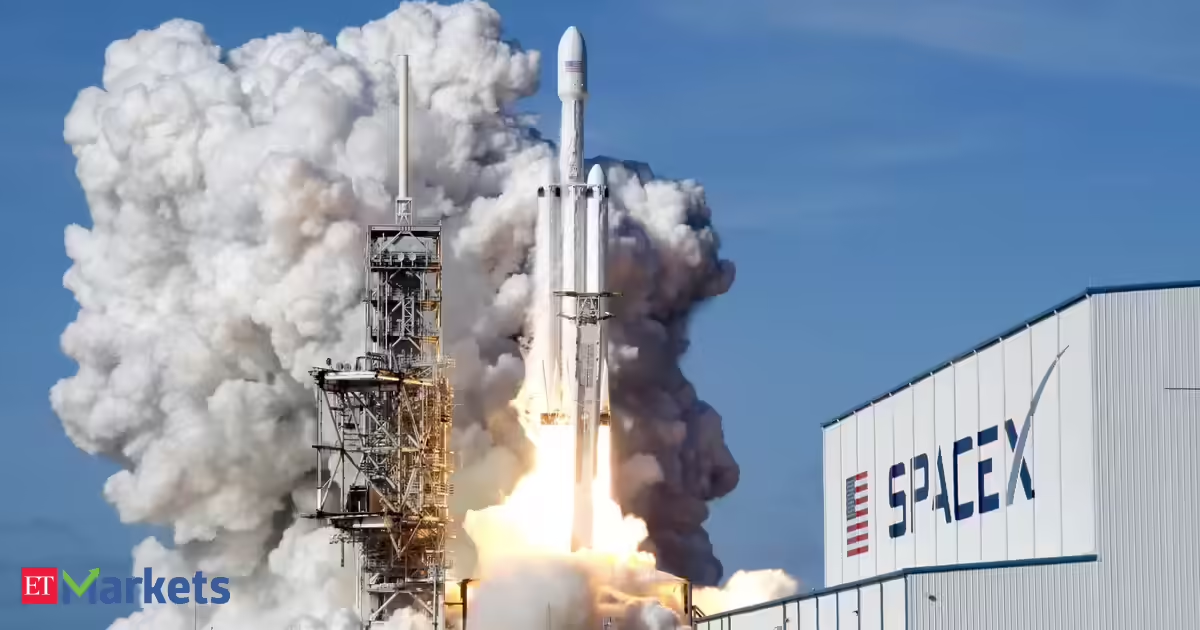
From the start, SpaceX and its underwriters had determined to set aside as much as 30% of the shares sold to the public in the IPO for retail investors. That meant that whipping up interest and buying orders from this group was crucial. Getting an allocation to the stock was competitive, and some retail investors just dived into the market to buy.
“I’m very happy with what I managed to get,” said Joseph Gutheinz, who retired from NASA as an investigator to practice law. Gutheinz did not think of trying to submit an IPO allocation request but managed to buy $100,000 of shares at $161 on Friday.
“It’s a great investment,” he said. “Win or lose, I’m happy to be invested at all.”
Retail buying was one of the factors responsible for the pop in the price of SpaceX shares, which surged 19% on their first day of trading, said Art Hogan, investment strategist at B. Riley Wealth in Boston.
“This allocation to retail is far and away the highest I’ve ever seen in my decades on Wall Street,” Hogan said. “It’s the latest, greatest shiny object for retail investors to get into right now.”
The deal became “the largest and most subscribed offering on our platform to date,” said a spokesman for SoFi, one of the retail brokerages involved in the selling group. The spokesman added that all individuals who met SoFi’s criteria received an allocation of the deal. Net buying of SpaceX shares accounted for about 4% of all single-stock retail turnover on Friday, totaling $453 million and running at 3.5 times the pace of runner-up Nvidia.
“Retail investors have shown up for SpaceX in a big way,” said Vanda Research, a firm that tracks the activity of self-directed individual investors and that spent much of Friday monitoring trading in the high-profile IPO. In the first 20 minutes of trading, SpaceX shares had vaulted to second place in the ranks of most actively purchased stocks by retail investors and by mid-afternoon was in first place, dwarfing its rivals, Vanda reported.
ALLOCATIONS FALL SHORT
Allocations, however, for some retail investors fell short of what they sought.
“Requested 250, received nothing,” one of the rare disgruntled would-be investors reported on a Reddit chat devoted to figuring out who had received allocations. “Requested 555, got 10” and “requested 1,000, got 85,” other Reddit posters noted.
SpaceX founder Elon Musk, whom the IPO has made the world’s first trillionaire, pledged in 2024 that if any of his still-private companies went public in the future, he intended to make sure that retail investors, especially holders of his other public company, Tesla, would have priority in accessing the new deal.
“Loyalty deserves loyalty,” he said in a post on X at the time.
Already, some fans of Musk and SpaceX are providing further signs of their commitment and conviction.
Clint Sorenson, chief investment officer of Ascentis Asset Management, told Reuters he offered all of his firm’s clients who had invested in SpaceX via private investment vehicles before the IPO the opportunity to hedge their exposure to the stock now that it is publicly traded. No one took him up on the idea, he said.
“Everyone wants to keep holding and celebrating right now; no one wants to even think of hedging their risk because they believe in the story so much,” Sorenson said.

I am a long-term, fundamentals-driven investor focused on identifying misunderstood businesses trading below intrinsic value due to temporary market dislocations, cyclical pressures, or investor pessimism. My investment approach combines bottom-up business analysis, capital allocation assessment, and valuation discipline with a strong emphasis on downside protection and asymmetric risk/reward opportunities. I primarily research companies operating in technology, communications infrastructure, software, industrials, and capital-intensive businesses where the market may underestimate long-term cash-flow potential. I am particularly interested in situations where short-term financial pressure obscures durable competitive advantages, recurring revenue streams, or improving unit economics. I possess a Master’s Degree in Economic Cybernetics, Statistics, and Informatics. While I would not define myself strictly as a technical expert in those disciplines, my professional background includes working across multiple roles within IT companies, where consistent incremental progress led me toward increasingly senior leadership positions. This operational and technology exposure significantly shapes how I analyze businesses, management execution, scalability, and capital allocation decisions. My research process focuses heavily on SEC filings, annual reports, earnings calls, proxy statements, competitive positioning, and management incentives. I aim to understand how businesses generate returns on capital over long periods while evaluating risks related to leverage, industry structure, regulation, and capital allocation. Through writing on Seeking Alpha, I hope to share detailed investment research, challenge consensus narratives, refine my own investment process, and engage with other long-term investors who value first principles and second level thinking and disciplined analysis.
Analyst’s Disclosure: I/we have no stock, option or similar derivative position in any of the companies mentioned, and no plans to initiate any such positions within the next 72 hours. I wrote this article myself, and it expresses my own opinions. I am not receiving compensation for it (other than from Seeking Alpha). I have no business relationship with any company whose stock is mentioned in this article.
Seeking Alpha’s Disclosure: Past performance is no guarantee of future results. No recommendation or advice is being given as to whether any investment is suitable for a particular investor. Any views or opinions expressed above may not reflect those of Seeking Alpha as a whole. Seeking Alpha is not a licensed securities dealer, broker or US investment adviser or investment bank. Our analysts are third party authors that include both professional investors and individual investors who may not be licensed or certified by any institute or regulatory body.
The weakest level was hit in the first half of the day, which prompted mild intervention by the Reserve Bank of India (RBI), traders said.
 ET Bureau
“There was also some intervention seen around 95.50 levels today (Friday). Then positive news came in about a peace deal, which supported the rupee. If Strait of Hormuz reopens, it will be coupled with the inflows from FCNR(B), which will take the rupee to 92-93 levels,” said Ritesh Bhansali, deputy CEO, Mecklai Financial Services.The rupee has weakened 0.29% since the beginning of this financial year, after sliding nearly 11% in 2025-26. Importers are largely staying on the sidelines for now, awaiting further appreciation in the rupee before stepping up hedging activity, traders said.
“Importers can wait for better levels, while exporters can hedge at upticks. 94.80 is a key level again, which will see some resistance as there will be stop-losses around it,” Bhansali said.
Brent crude, the global oil benchmark, plunged to $85.80 per barrel on Friday, hitting the lowest level in three months, after the US President said a peace agreement could be signed as early as this weekend.
The rupee had depreciated 2.2% since the start of the US-Israel war against Iran on February 28 before the Reserve Bank of India announced measures to attract capital inflow.
The sharp decline in crude oil prices, along with the measures from the Reserve Bank of India and the government announced last week, helped strengthen the rupee, traders said.
The RBI announced a series of measures aimed at attracting dollar inflows, which have helped stabilise the currency after it hit an all-time low of 96.96 per dollar in late May. “The gains seen today were all a play of Brent prices falling. If there are no further escalations, and if indeed the signing of the peace deal is close, then we can see further appreciation towards 92 per dollar,” said Sajal Gupta, head of forex and commodities at Nuvama.
Business
Kura Oncology, Inc. (KURA) Presents at European Hematology Association (EHA) 2026 Congress – Slideshow

Kura Oncology, Inc. (KURA) Presents at European Hematology Association (EHA) 2026 Congress – Slideshow

Congress Lets Decades-Old Spying Law Lapse Amid Trump’s Controversial DNI Nomination

There’s another election happening on June 18, and this one is Reform’s last chance saloon
Dollar steadies, set for weekly loss on US-Iran deal talks


-

 NewsBeat5 days ago
Alexander Zverev wins the French Open to finally earn a 1st Grand Slam title
-
 Entertainment6 days ago
The Best Mystery Series of All Time Is Surging on Streaming 30 Years After It Ended
-

 Crypto World5 days ago
Anatomy of the June crypto crash: Fed, Iran, Saylor
-

 Crypto World2 days ago
Oppenheimer backs SpaceX as $70 billion retail frenzy builds
-

 Crypto World2 days ago
Markets Rally as SpaceX IPO Looms Amid Iran Tensions and Inflation Surge
-
 Crypto World6 days ago
Senator Cynthia Lummis Calls CLARITY Act the Most Consequential Financial Legislation of This Generation
-
 NewsBeat6 days ago
Alexander Zverev conquers demons and outlasts Flavio Cobolli to win French Open for first major title
-

 Tech6 days ago
Microsoft unveils seven homegrown AI models in new bid for ‘long term self-sufficiency’
-

 Tech7 days ago
Hackers now exploit SolarWinds Serv-U flaw to crash servers
-

 Business5 days ago
High Stakes for Wembanyama as New York Pushes for 3-0 Lead
-
 Business6 days ago
The Pain Points Taking a Fragile Tech Rally Down a Notch
-

 Tech5 days ago
Notion restores access to Anthropic after service disruption
-
 Crypto World5 days ago
Eli Lilly (LLY) Stock Surges 4% Following Breakthrough Sleep Apnea Trial Results
-
 Business6 days ago
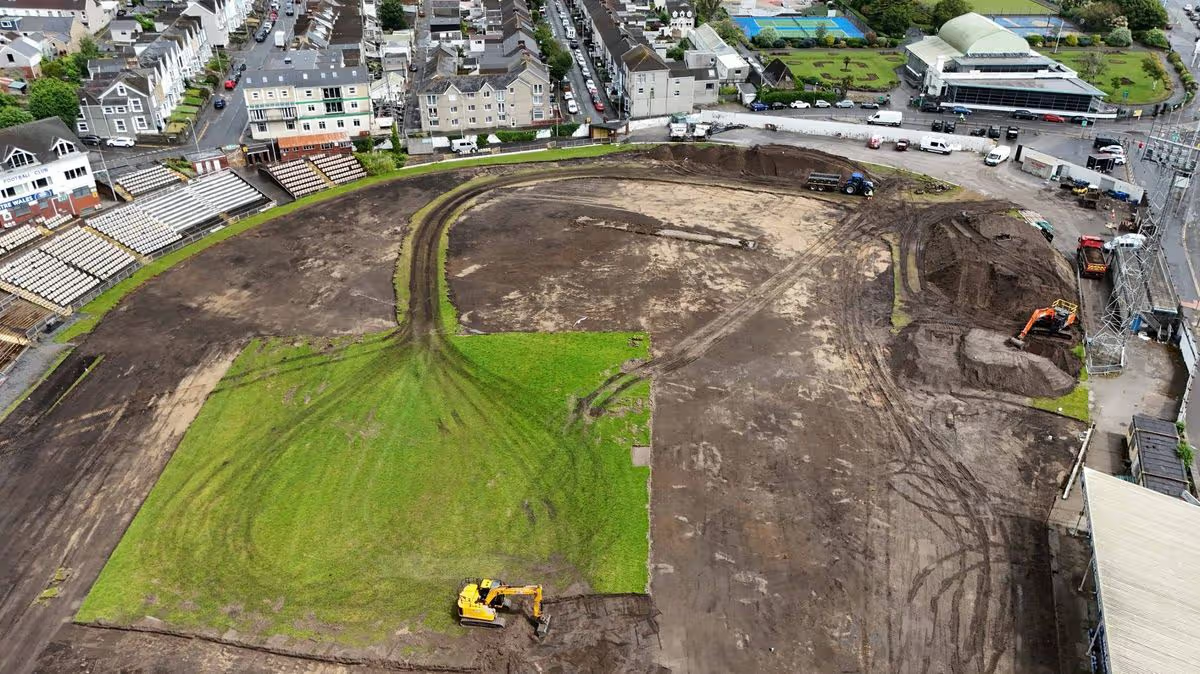
The investment to transform historic St Helen’s ground in Swansea
-

 Crypto World6 days ago
Trump’s AI Ownership Plan Could Benefit Anthropic at OpenAI’s Expense
-
 Sports4 days ago
Bangladesh beat Australia after 20 years in ODIs, register only their second win over six-time world champions | Cricket News
-

 Business7 days ago
Forensic Expert Floats Handyman Theory in Disappearance of Savannah Guthrie’s Mother
-

 Tech5 hours ago
NanoClaw integrates JFrog registries to secure AI agent downloads
-

 Tech16 hours ago
This Week In Security: Microsoft On Microsoft, Register Your Domains, Linux On ARM, And FreeBSD Joins The File Cache Club
-

 Politics2 days ago
Politics Home | Healey Resignation Is “Colossal Failure Of Government”, Says Former Labour Defence Secretary
You must be logged in to post a comment Login