

Crypto World
Claude Opus 4.8 Rolls Out: Anthropic Strikes Back in AI Race

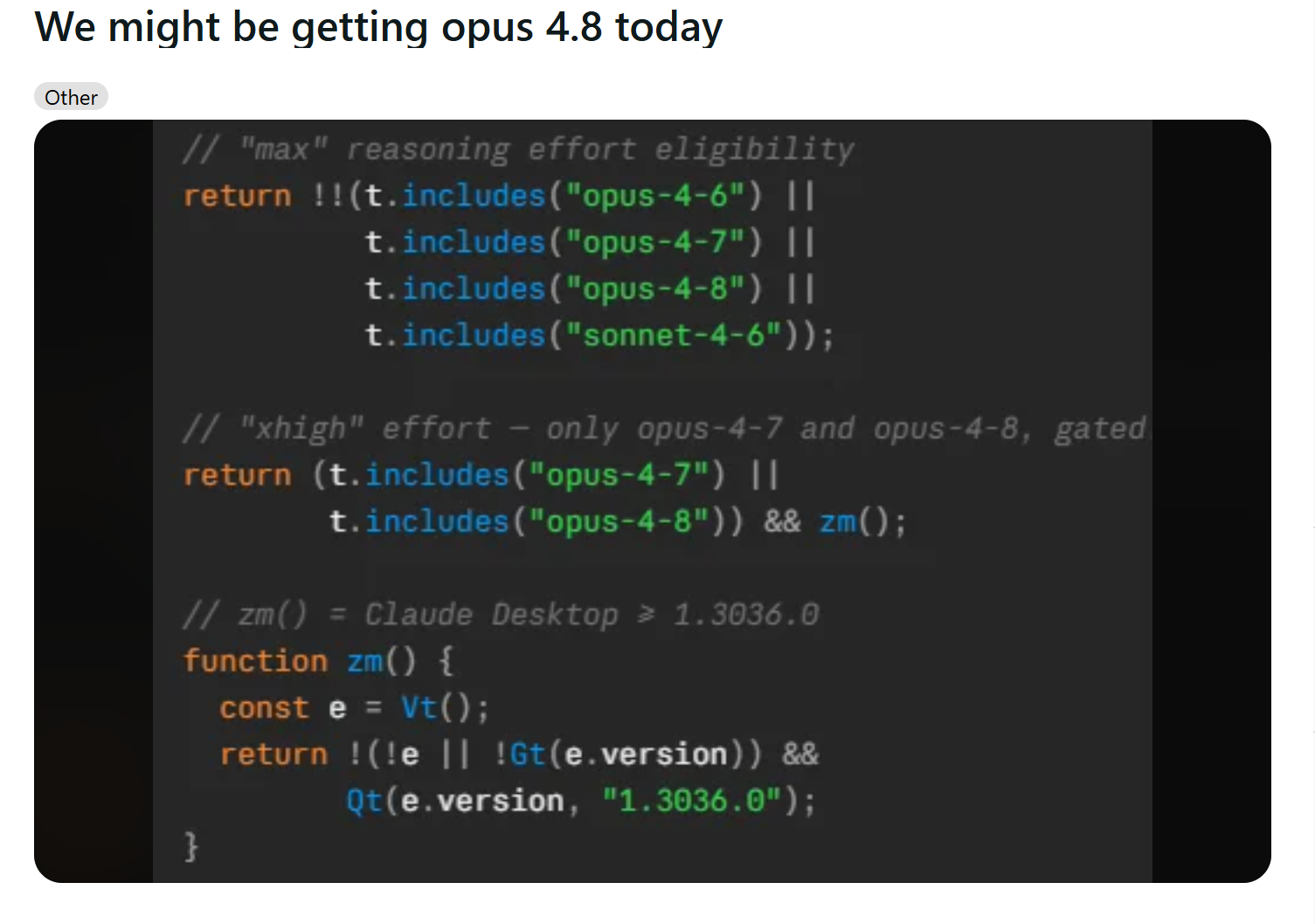
Anthropic has activated Claude Opus 4.8 for users on May 28, 2026, just weeks after Opus 4.7’s April launch.
Fresh code leaks, desktop app sightings, and backend references confirm the rollout, delivering stronger agentic coding and reasoning amid intensifying competition from OpenAI.
Claude Opus 4.8 Launches: Anthropic Upgrades AI Flagship
Anthropic officially released Claude Opus 4.8 on May 28, 2026, delivering measurable improvements over Opus 4.7. The release confirms earlier speculation, after leaks on reddit suggested a planned roll-out.

Notwithstanding, the new model is now available at the same price with powerful new features for coding, agentic workflows, and user control.
Major Capability Gains
Opus 4.8 shows stronger performance across coding, agentic skills, reasoning, and practical knowledge work benchmarks.
Follow us on X to get the latest news as it happens
Early testers reportedly highlight greater reliability, sharper judgment, and significantly improved honesty. The model is four times less likely than Opus 4.7 to miss flaws in code it produces and is less prone to unsupported claims.
Alignment assessments also reached new highs in prosocial traits while showing substantially lower rates of misaligned behavior compared to Opus 4.7.
New features rolling out today include:
- Effort Control: Users on claude.ai and Cowork can now select how much thinking effort Claude applies — from Low (faster, lower rate-limit usage) to Max. Opus 4.8 defaults to High effort for the best balance of quality and experience.
- Dynamic Workflows in Claude Code: This research preview feature enables Claude to tackle massive tasks by planning, running hundreds of parallel subagents, and verifying outputs. It supports codebase-scale migrations across hundreds of thousands of lines of code.
- Messages API Update: Developers can now insert system instructions mid-conversation without breaking prompt cache.
“I think you’ll really like Opus 4.8 It’s as smart as its benchmarks show but expresses and utilizes that intelligence in a warm and collaborative way. Workflows are a great way to utilize it- I’m hooked. Article on that soon,” said Thariq, Anthropic team member focused on Claude Code.
Pricing and Availability
Standard pricing remains unchanged: $5 per million input tokens and $25 per million output tokens.
Fast Mode for Opus 4.8, running at 2.5× speed, is priced at $10/$50 and is three times cheaper than previous fast modes.
The model is available immediately across claude.ai, Claude API (claude-opus-4-8), and major cloud platforms.
Anthropic plans lower-cost models with similar capabilities and is preparing Mythos-class models for wider release in the coming weeks after completing stronger cyber safeguards under Project Glasswing.
Enterprises and developers can begin testing Opus 4.8 today on complex agentic and coding workloads.
Subscribe to our YouTube channel to watch leaders and journalists provide expert insights
The post Claude Opus 4.8 Rolls Out: Anthropic Strikes Back in AI Race appeared first on BeInCrypto.



JPMorgan Chase CEO Jamie Dimon has said banks will oppose the Clarity Act unless lawmakers change provisions that he says give crypto firms bank-like powers without bank-level safeguards.
Summary
- Jamie Dimon said banks will oppose the Clarity Act unless lawmakers add stronger safeguards for stablecoin rewards.
- Dimon argued that crypto firms should not offer bank-like products without AML and Bank Secrecy Act protections.
- SoFi’s stablecoin launch shows how digital tokens and traditional deposit products are starting to overlap.
Fox Business reported that Dimon made the comments on Friday during an interview focused on pending legislation on crypto market structure. The JPMorgan chief said the bill, as written, would allow crypto companies to offer rewards tied to stablecoins or similar products without protections attached to traditional banking.
Dimon says banks reject the current crypto bill
According to Jamie Dimon, the Clarity Act does not go far enough on legal protections, anti-money laundering rules, and Bank Secrecy Act requirements. He said banks would not accept the legislation in its current form because it creates risks around products that resemble deposits.
The dispute has pitted banks and crypto companies against each other in one of Washington’s most closely watched digital asset debates. Banks argue that stablecoin rewards could pull customer money away from regulated deposits. Crypto firms, including Coinbase, have pushed back against restrictions that would limit customer incentives on dollar-linked tokens.
Dimon told Fox Business that firms offering products with deposit-like features should face rules comparable to banks. He said the government must handle stablecoin regulation carefully because poor design could create serious problems later.
Coinbase lobbying draws sharp attack
During the same interview, Jamie Dimon criticized Coinbase CEO Brian Armstrong over the exchange’s political spending. Dimon claimed Armstrong has spent hundreds of millions of dollars in Washington to help move the legislation forward.
“No one is going to bow down to this guy,” Dimon said in the interview, before using an expletive to describe Armstrong. Fox Business noted that Dimon made similar comments about the Coinbase executive earlier this year at the World Economic Forum in Davos, Switzerland.
The fight comes as the Clarity Act faces pressure from several directions. Crypto industry groups want clear rules for digital assets, while banks want tighter limits on stablecoin-related rewards. The bill also faces scrutiny due to President Donald Trump’s crypto interests and the approaching 2026 midterm elections.
Stablecoins move closer to bank deposits
As previously reported by crypto.news, SoFi Technologies launched SoFiUSD, which the company described as the first stablecoin issued by a U.S. national bank. The launch came alongside an earnings beat that helped lift short-term optimism in SOFI shares.
SoFi has longer-term plans for tokenized deposits that could offer interest and FDIC insurance. Those plans show how stablecoin products and bank deposit products are beginning to overlap in practice.
For banks such as JPMorgan, that overlap sits at the center of the current fight. Dimon said he supports blockchain technology and sees stablecoins as useful for cross-border payments. However, he told Fox Business that stablecoin rules must include proper safeguards before Congress moves ahead.
JPMorgan keeps acquisition option open
Away from the crypto bill, Jamie Dimon also said JPMorgan could spend between $10 billion and $20 billion on an acquisition if the right opportunity appears. He made the comments on Wednesday during a fireside chat at the Bernstein Strategic Decisions Conference.
According to Jamie Dimon, JPMorgan may have room to buy another company over the next two years. His comments came as the bank prepares to fight crypto legislation that, in his view, could change how financial firms compete for customer deposits.


SPACEX, a popular perpetual futures contract (perp) on the Hyperliquid leveraged crypto exchange that is loosely connected to the valuation of Elon Musk’s rocket company, lost nearly half its value within 7 minutes yesterday, then recovered almost all of that loss 10 minutes later.
Overnight, some crypto influencers tried to link the flash-crash to the Blue Origin New Glenn explosion that lit up Cape Canaveral later that night. The timing, however, did not align.
The SpaceX market on Hyperliquid is deployed by Ventuals, a pre-IPO perpetuals protocol. Perps are allegedly priced at one billionth of the valuation of the private company.
At 11:37 AM New York time and prior, the unofficial SpaceX contract traded near $2,286, implying a valuation of $2.3 trillion. By 11:44 AM, the perp had crashed to $1,299.10. By 11:54 AM it had snapped back to $2,225.30.
The perp is denominated in USDH, Hyperliquid’s own stablecoin.
A similar SpaceX Ventuals perp listed on BingX denominated in USDT, the world’s most popular stablecoin, dropped harder. It was trading at $2,524.70 at 11:37 AM, then collapsed to $1,269.70 seven minutes later, before recovering to $2,208.40 by 11:54 AM.
Ventuals acknowledges its SPACEX flash-crash
Ventuals acknowledged the incident on X about an hour after the bottom. “The offchain data provider used as a component of the oracle price returned incorrect data, which caused the market’s oracle and mark price to move dramatically.”
According to Ventuals’ documentation, the name of that provider is Notice, whose possibly corrected chart does not contain the flash-crash data that Ventuals used today.
Ventuals said it had taken steps to prevent recurrence across its pre-IPO perps and was evaluating compensation. Hours later, it vowed to pay for its mistake. “Quick update – affected users will be compensated within the next 48 hours.”
By Hyperliquid’s own data, 1,393 positions held by about 400 wallets were force-liquidated for $1.51 million in notional value.
The Blue Origin coincidence that wasn’t
The Hyperliquid-listed SPACEX perpetual contract bottomed at 11:44 AM New York time. In contrast, Blue Origin’s New Glenn rocket exploded around 9:00 PM New York time, during a hot-fire test. More than nine hours separated the two events.
Jeff Bezos posted on X late that night. “It’s too early to know the root cause but we’re already working to find it. Very rough day, but we’ll rebuild whatever needs rebuilding and get back to flying. It’s worth it.”
The two events share a date and a corporate-rival framing, but little else.
Read more: Outdated algorithm caused $650M excess losses on Hyperliquid, report
SpaceX perp broke on Hyperliquid
Ventuals lists the SpaceX token under HIP-3, Hyperliquid’s builder-deployed perpetuals standard. Third parties can spin up new perp tokens on its matching engine.
Because SpaceX is privately held and has no public price, Ventuals constructs its own oracle. The recipe blends a feed from private-markets vendor Notice with a two-hour moving average of the contract’s mark price. Notice’s feed earns one-third weight, although traders are free to weight its feed by any amount when making trading decisions. The Exponential Moving Average (EMA) of Hyperliquid trading prices earns two-thirds weight.
When the Notice feed returned a bad number Thursday morning, both the oracle and the mark price jolted lower. The contract collapsed inside the 20% downward price band Ventuals enforces relative to the oracle. Then it collapsed again as the oracle itself kept moving. Retail traders running 3x leverage — the max leverage available under the perp at the time — were blindsided.
Ventuals’ own documentation is direct about what these markets are. Holders, it states, “do not have any underlying economic ownership in the company – you’re merely speculating on its valuation change.” SpaceX has not authorized the contract, receives no proceeds from it, and has no formal relationship with Ventuals or Hyperliquid.
Protos previously documented how the same Ventuals architecture briefly charged Anthropic-perp longs annualized funding rates of 8,700% over a weekend.
The mechanics of a flash crash are similar. When crypto adds financial leverage to opaque data oracles, even small errors can liquidate markets worth millions of dollars.
Got a tip? Send us an email securely via Protos Leaks. For more informed news and investigations, follow us on X, Bluesky, and Google News, or subscribe to our YouTube channel.

TLDR:
- FalconX confidentially filed a draft S-1 with the SEC, targeting a public listing no earlier than late 2026.
- The crypto prime broker was last valued at $8 billion in its 2022 Series D round, raising $150 million.
- Cantor and other Wall Street banks have been hired to advise FalconX on its potential IPO process.
- Cooling market sentiment and weak post-listing performances have delayed crypto IPO plans across the sector.
FalconX, a crypto brokerage and trading firm, has confidentially filed a draft S-1 registration statement with the U.S. Securities and Exchange Commission.
The California-based company also hired Cantor and other Wall Street banks to advise on its potential initial public offering.
However, the listing is not expected before the end of 2026, as market conditions remain challenging for crypto firms seeking public listings.
FalconX Eyes Public Markets Amid Tough Conditions
FalconX was founded in 2018 and operates as a digital asset prime broker. It serves institutional clients such as hedge funds, asset managers, and market makers. The firm offers services including trade execution, liquidity access, credit, and clearing.
The company was last valued at $8 billion during its 2022 Series D funding round. That round raised $150 million and marked the firm’s peak private valuation. According to a source familiar with the matter, both FalconX and Cantor declined to comment on the filing.
A person with knowledge of the matter, who spoke on condition of anonymity, confirmed the confidential S-1 filing.
The same source noted that the IPO is not expected until the end of the year, given current market conditions. CoinDesk had previously reported that Cantor was among the firms pitching FalconX for its potential listing.
Cooling investor sentiment has pushed the expected listing toward year-end. Weaker trading volumes and lukewarm post-listing performances from recent crypto IPOs have also played a role. The firm is waiting for more stable market conditions before moving forward.
Broader Crypto IPO Sector Faces Delays
The crypto industry entered 2026 expecting a strong IPO year. Successful listings by Circle and Bullish in 2025 had renewed investor interest in digital asset businesses. That optimism has since faded considerably.
Companies like BitGo have seen lackluster trading after going public, cooling enthusiasm across the sector. Several major players, including Kraken’s parent Payward, Consensys, Ledger, and Grayscale, have all postponed their IPO plans. Each is waiting for conditions to stabilize before reengaging.
Blockchain.com said last week that it had confidentially filed for a U.S. IPO with the SEC. That move shows some firms are still pressing ahead despite the broader headwinds. The crypto IPO pipeline remains cautious but active in select cases.
Securitize has taken a different route, agreeing to merge with Cantor Equity Partners II. That deal would make Securitize one of the few publicly traded firms focused on tokenized real-world assets.
FalconX’s confidential filing, meanwhile, keeps its options open while the firm monitors how conditions evolve through the rest of 2026.



Congress has advanced a major crypto market bill that would give the CFTC new power over digital commodities despite fresh concerns about the agency’s staffing and funding.
Summary
- Congress has advanced the CLARITY Act, which would give the CFTC primary oversight of spot digital commodity markets.
- Brookings fellow Tonantzin Carmona warned that the CFTC may lack enough staff and funding to handle the new crypto mandate.
- The bill would require crypto exchanges, brokers, dealers, and custodians to register with the CFTC under new rules.
Brookings fellow Tonantzin Carmona has warned that the Digital Asset Market Clarity Act could create a large regulatory system without giving its main watchdog enough resources to run it. Her concern centers on the Commodity Futures Trading Commission, which would become the chief regulator for spot trading in most digital commodities under the bill.
The legislation, known as the CLARITY Act or H.R. 3633, cleared the House in July 2025. The Senate Banking Committee advanced the measure on May 14, 2026, after bipartisan negotiations over digital asset market rules.
Supporters of the bill say it would end years of conflict between the Securities and Exchange Commission and the CFTC over crypto oversight. Critics, including Carmona, say Congress may be assigning one of the largest new financial-market jobs in years to an agency with limited staff.
CFTC faces resource questions
According to the CFTC’s budget documents, the agency’s FY2026 enacted budget was approximately $365 million. The agency later requested $410 million and 650 full-time equivalent staff for FY2027.
Carmona has argued that those numbers matter because the CLARITY Act would shift significant portions of crypto spot-market supervision to the CFTC. She compared the scale of the new duties to major post-crisis financial rules, while noting that the agency has never operated with the same retail-facing structure as the SEC.
The SEC’s budget remains much larger than the CFTC’s. The comparison has become central to the debate because the bill would reduce the SEC’s role in many crypto markets while giving the smaller commodities regulator a new mandate.
What the CLARITY act would change
Under the CLARITY Act, the CFTC would receive exclusive authority over spot transactions involving digital commodities. Crypto exchanges, brokers, dealers, and custodians handling those assets would have to register with the agency.
The bill gives regulators 360 days to complete rulemaking. It also sets a 270-day effective date for registration requirements, as described in the legislative framework of the proposal.
The Senate Banking Committee said the bill is designed to establish clear rules for digital assets. Committee Republicans, led by Chairman Tim Scott, described the markup as a step toward a national market structure for crypto.
Retail market oversight draws scrutiny
Carmona’s criticism focuses on the difference between derivatives markets and spot crypto markets. The CFTC has long supervised futures, swaps, and options, which are mostly used by professional and institutional traders.
Spot crypto markets involve many retail users. Brookings research has warned that retail-heavy crypto markets raise consumer protection concerns, including fraud, manipulation, and investor losses.
The SEC has historically handled retail investor protection through disclosure rules, enforcement programs, and investor education. Carmona’s argument is that those functions do not move automatically to the CFTC simply because Congress changes the legal label attached to crypto assets.
The proposed framework would treat many crypto assets as digital commodities, placing them outside the SEC’s main trading oversight once they meet the bill’s conditions.
That classification would affect assets such as Bitcoin, Ether, Solana, and XRP if regulators apply the proposed taxonomy in final rules. For crypto firms, the bill offers a clearer path to registration.


U.S. treasuries climbed while the dollar bond index dropped to an intraday low of 98.8, signaling a notable swing in risk sentiment across global markets.
Summary
- Gate data shows U.S. Treasury bond prices rising as the DXY falls intraday
- The dollar index touched 98.8, slipping below the 100 base level for the benchmark
- Moves come as markets reassess Fed policy, inflation path and demand for safe assets
According to Gate market data, U.S. Treasury bonds “continue to rise” while the U.S. dollar index, DXY, “has fallen to an intraday low,” currently quoted at 98.8 against a base value of 100. The move underlines a familiar macro trade: investors buying Treasuries as a haven while the dollar softens against a basket of major currencies.
The DXY is a reference index that tracks the dollar against six peers, including the euro, yen and pound, with 100 set as the benchmark level when the index was created in 1973. A reading of 98.8 implies the dollar is trading roughly 1.2% below that base, extending a decline that recently saw the index oscillate around the 99 to 101 range as traders reacted to shifting Federal Reserve expectations.
Bonds bid as dollar slips
Rising U.S. Treasury prices imply falling yields, a notable shift from earlier in May when the 10 year benchmark climbed toward 4.75%, its highest level of the quarter, pulling capital into the dollar. More recent bond market commentary has highlighted how inflation data and geopolitical shocks had pushed the 10 year yield into the 4.40 to 4.60% band, with moves now reversing as demand for duration returns.
Historically, surges in Treasury yields have tended to strengthen the dollar as higher returns attract foreign capital, helping push the dollar index up from levels near 90 to more than 92 during past cycles. The current pattern flips that script: as bond prices rise and yields ease back, the DXY’s slide toward 98.8 reflects reduced yield support for the greenback and a modest rotation into other currencies.
Macro backdrop and crypto link
The latest leg lower in the dollar index comes against a backdrop of investors debating whether the Fed will keep rates at 5.25 to 5.50% for longer or begin cutting later in 2026, a debate that has already roiled risk assets. In recent weeks, some banks have delayed their expected first rate cut to September 2026 while nudging inflation forecasts nearer 2.9%, a trajectory that keeps policy restrictive but leaves room for yields to drift lower if growth slows.
For digital assets, the dollar’s move matters because DXY has historically shown a negative correlation with bitcoin (BTC), with weaker dollar stretches often coinciding with stronger performance in top cryptocurrencies. As bond markets lean toward lower yields and the dollar softens, traders will be watching whether this creates breathing room for ethereum and broader crypto markets, especially after earlier bouts of volatility tied to Fed repricing.
In a previous crypto market analysis, delayed rate cuts and sticky inflation were flagged as key risks for digital assets, tightening liquidity conditions and pressuring valuations. Other reporting on bitcoin correlation with macro benchmarks and the impact of Treasury market turbulence on crypto suggests DXY’s retreat to 98.8 and a bid in Treasuries could mark an early phase of a more supportive macro backdrop, if it persists.
Coinbase Financial Markets has begun offering US institutional clients access to global crypto options and perpetual futures markets through a regulated futures commission merchant, including connectivity to Deribit’s crypto options platform.
Coinbase said the launch follows guidance from the Commodity Futures Trading Commission (CFTC) that allows a regulated futures commission merchant to connect US clients with global crypto derivatives liquidity. The company said Coinbase Financial Markets is the first CFTC-regulated futures commission merchant to offer such access.
Deribit, which Coinbase acquired in August 2025 as part of its expansion into crypto derivatives, is the largest crypto options exchange by open interest.
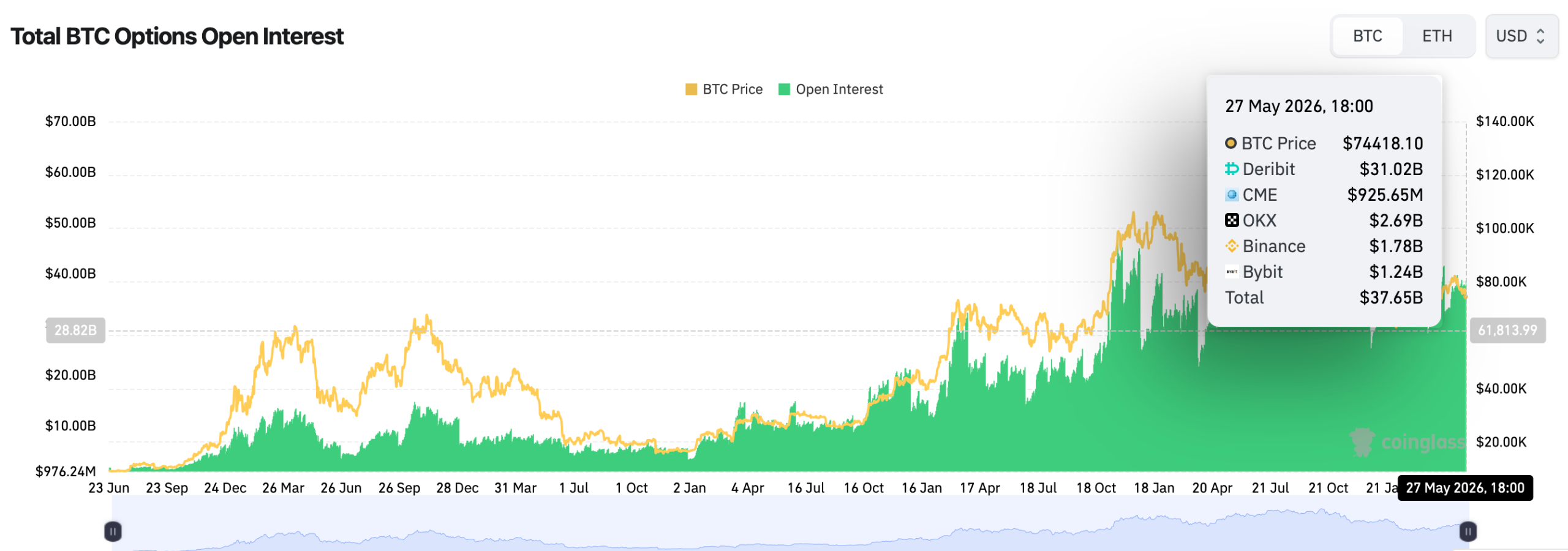
CoinGlass data shows Deribit held roughly $31 billion in Bitcoin options open interest on May 27, compared with $2.7 billion on OKX, $1.8 billion on Binance and $1.2 billion on Bybit.
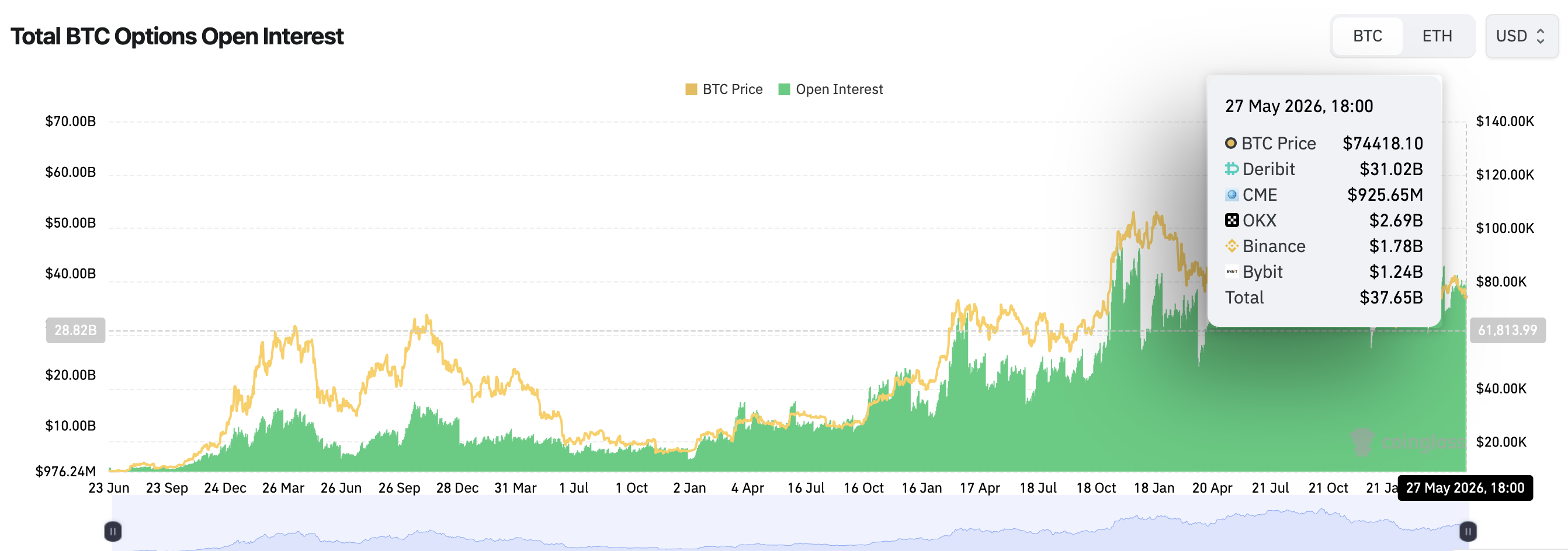
Bitcoin options open interest. Source: CoinGlass
According to Friday’s announcement, institutional clients can begin onboarding immediately, while broader access, including retail, is expected to follow later.
Related: Coinbase CEO’s finance wishlist mirrors company’s product roadmap
Crypto derivatives move deeper into regulated US markets
The launch comes months after the US Securities and Exchange Commission and CFTC said they would explore ways to bring perpetual futures trading onshore. In a joint statement published in September 2025, the agencies said perpetual contracts had been largely confined to offshore crypto markets due to regulatory and jurisdictional constraints.
The agencies added that they could consider steps to “onshore perpetual contracts” and bring activity “now flowing exclusively to foreign platforms” back to regulated US markets.

Source: SEC/CFTC
Since then, US derivatives venues have steadily expanded their crypto offerings. Earlier this month, CME Group announced plans to launch a crypto index futures contract tracking a basket of seven cryptocurrencies, including Bitcoin (BTC), Ether (ETG), Solana (SOL) and XRP (XRP).
The announcement came days after Chicago-based CME unveiled Bitcoin Volatility futures, a regulated crypto derivatives product scheduled to launch on June 1. The futures will settle to a 30-day measure of expected Bitcoin volatility derived from CME options markets.
Other US crypto exchanges have also been expanding their derivatives businesses. In May, Kraken parent Payward completed its acquisition of Bitnomial, a CFTC-regulated derivatives platform that earlier this year launched the first US-regulated futures contracts tied to Injective’s INJ (INJ) token, following a similar launch for Aptos (APT) in January.
On Friday, CFTC staff issued guidance on 24/7 trading, clearing and settlement, saying crypto asset derivatives may be particularly well suited to round-the-clock markets.
Magazine: HYPE chases $100 target, ETH could dump below $1800: Market Moves
TLDR
- Dell’s quarterly revenue soared to $43.8B with an 88% year-over-year increase, while AI server orders reached $24.4B
- Dell stock rocketed more than 30% higher; the Dow Jones achieved a historic milestone by surpassing 51,000
- Strong enterprise AI software demand lifted Salesforce and NetApp shares significantly
- AI infrastructure enthusiasm drove gains in Hewlett Packard Enterprise and Super Micro Computer
- AST SpaceMobile shares declined following complications with Blue Origin’s New Glenn rocket program
Dell Technologies Delivers Massive AI-Driven Earnings Beat
Dell Technologies reported what many are calling one of 2025’s most impressive earnings performances. The tech giant announced quarterly revenue of $43.8 billion, representing an 88% jump from the same period last year, alongside adjusted earnings per share of $4.86. Revenue from AI-optimized servers climbed to $16.1 billion while AI-related order volume hit $24.4 billion. The company’s AI server backlog now exceeds $51 billion. Management upgraded its fiscal 2027 AI revenue projection from $50 billion to $60 billion. The stock responded by jumping more than 30%, prompting numerous Wall Street analysts to raise their price targets.
Dow Jones Achieves Historic 51,000 Milestone
The catalyst for broader market gains came directly from Dell’s blockbuster report. The Dow Jones Industrial Average broke through 51,000 for the first time in its history, while both the S&P 500 and Nasdaq established new all-time highs. Market participants continue viewing AI infrastructure investment as a fundamental growth driver, with Dell’s performance validating that perspective. The rally spread across multiple sectors, as traders sought additional opportunities to capitalize on the expanding AI infrastructure buildout.
Salesforce Gains Ground on Enterprise AI Momentum
Salesforce experienced significant upward movement following earnings that confirmed robust appetite for enterprise software and AI-enabled business applications. The company has emerged as a critical bellwether for investors monitoring practical AI implementation within major corporations. Its encouraging guidance helped broaden the day’s advances beyond hardware manufacturers into software providers, indicating the AI investment theme is expanding throughout the technology landscape.
NetApp and Enterprise Hardware Names Ride Dell’s Wave
NetApp emerged as a top performer, with shares climbing as market participants searched for AI infrastructure opportunities beyond semiconductor companies. The firm’s storage solutions and data management technologies are considered critical elements for large-scale AI system deployments. Hewlett Packard Enterprise and Super Micro Computer also posted substantial gains, as investors interpreted Dell’s strong numbers as a positive indicator for the broader enterprise AI hardware ecosystem.
AST SpaceMobile Drops on Blue Origin Rocket Program Issues
AST SpaceMobile ranked among the session’s weakest performers following news of difficulties with Blue Origin’s New Glenn rocket initiative. While the problem wasn’t directly connected to AST SpaceMobile’s business operations, it triggered widespread selling throughout space and satellite-related equities. Despite impressive performance over the past twelve months, Friday’s trading demonstrated that the space sector continues to face vulnerability from operational challenges and unfavorable developments.
Pi Network (PI) heads into June with a single whale wallet that has crossed 400 million PI. The token still trades near $0.143, close to its all-time low and weighed down by daily unlocks.
The setup frames a clear test for June. Steady accumulation meets daily unlocks, three scheduled protocol upgrades, and a bearish chart with a single hint of a bounce.
MACD Setup Hints at June Bounce Despite Bearish Trend
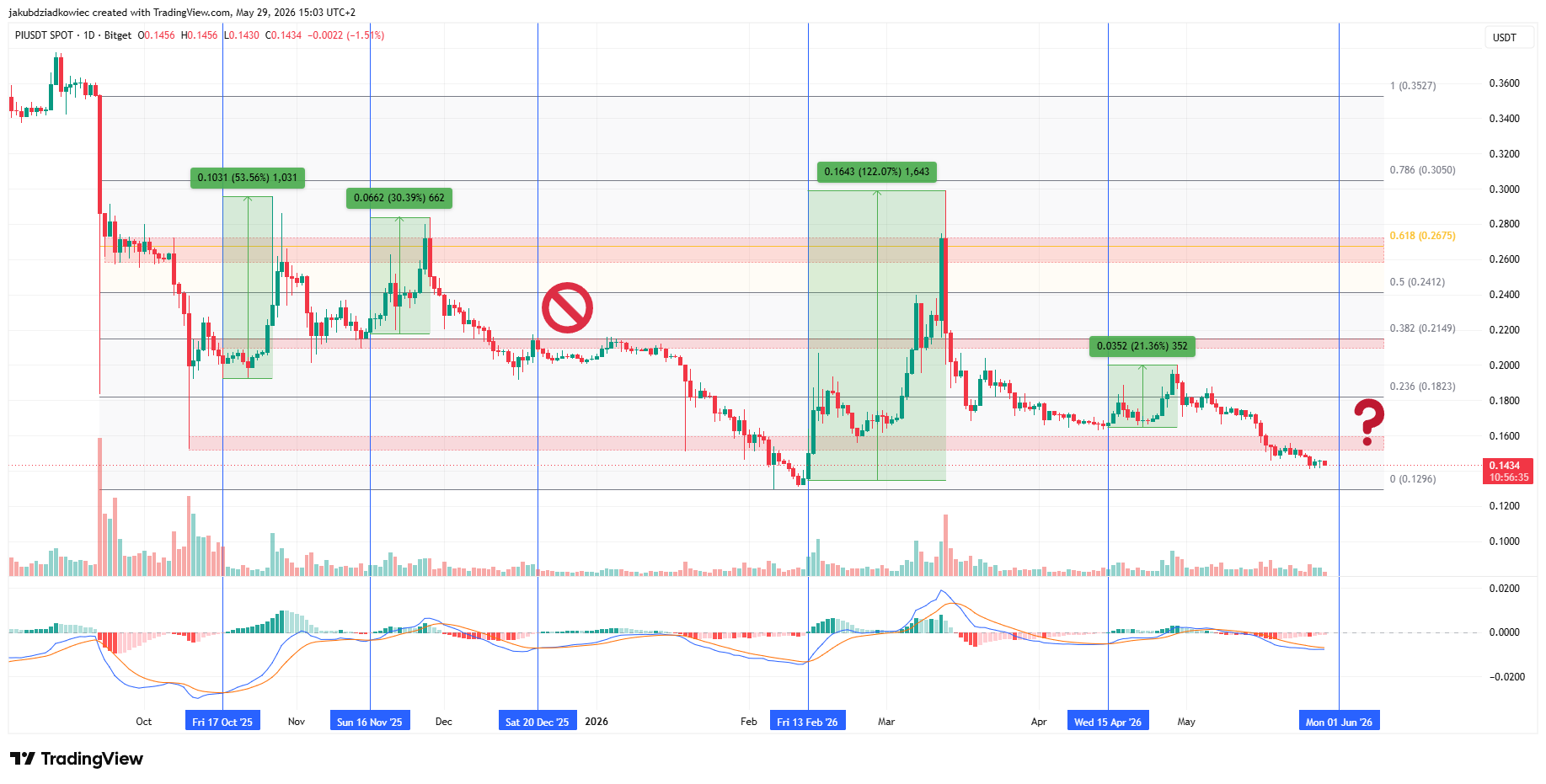
PI’s daily chart leans bearish heading into June. Price action has carved lower lows since the February peak. The token now trades near $0.143, just above its $0.1296 all-time low, with volume tapering through May.
The Moving Average Convergence Divergence (MACD) on the daily timeframe offers a different read. Over the past eight months, each move from negative to positive on the indicator has preceded a sharp short-term rally.
Past bullish crosses on October 17 and November 16, 2025, produced gains of 53.56% and 30.39%. The signal failed on December 20. The February 13 cross delivered the largest move at 122.07%. The most recent crossover on April 15 produced 21.36%.

A fresh MACD cross is setting up for early June. The average of prior successful signals points to a potential 55.65% move, which would lift PI to around $0.22. That level aligns with the 0.382 Fibonacci retracement of the broader downtrend.
The pattern does not guarantee a repeat. December’s failed cross shows the signal can break in low-volume conditions.
Whale Wallet Keeps Buying Through the Drawdown
One PI address tracked as “GAS…ODM” has now crossed 400 million tokens, making it the largest single holder. Recent on-chain data shows the wallet adding more than 1.5 million PI in one day. The pattern of near-daily accumulation has held through May.
Some analysts have speculated the address could serve a buyback or treasury role. No party has confirmed ownership of the mysterious whale wallet. Several Pi commentators have framed it as a form of whale-driven price support absorbing supply during the drawdown.
PiScan data shows tagged exchange wallets now hold about 545 million PI in total, with a net inflow of roughly 1.5 million PI in the past 24 hours. Inflows to exchanges typically signal incoming sell pressure rather than accumulation. The whale’s buying has not been enough to offset the broader supply moving back toward trading venues.

Protocol Upgrades Anchor the Fundamental Calendar
Mainnet usage has expanded as more Pioneers complete Know Your Customer (KYC) verification and second migration steps. Pi Network reports 18.1 million verified users, 16.72 million migrations, and more than 119,000 second migrations completed.
Three upgrades anchor the June calendar. Pi Network has set June 2 as the deadline for Protocol 24 node upgrades. Protocol v25.1 follows on June 8, and v26.0 on June 22. The releases target node performance, scalability, and smart contract maturation after the Protocol 23 rollout in May.
Daily unlocks average around 6.5 million PI, adding roughly $29 million in new supply this month at current prices. The schedule reflects the same monthly token unlock pressure seen earlier in 2026.
June lines up as the first stretch in 2026 where four forces converge. A bearish trend, a building MACD signal, daily supply growth, and a buying whale all hit the same month. Whether the 0.382 Fibonacci level at $0.22 caps any bounce will set the tone for the next quarter.
The post What to Expect From Pi Network in June 2026 appeared first on BeInCrypto.

Bitcoin extended its six-week slide as Wall Street kicked off the week with fresh records, underscoring the growing gap between crypto prices and traditional risk assets. BTC traded around the low $72,000s, with a dip to about $72,395 on Bitstamp marking another test of near-term support as U.S. equity indices surged to new highs.
In a backdrop of upbeat stock performance — the S&P 500 and the Dow Jones Industrial Average both flirting with intraday records — traders weighed the persistence of the crypto weakness versus the risk-on appetite in conventional markets. The market narrative has increasingly centered on whether Bitcoin can hold key technical floors or if a broader rotation into risk assets could push prices lower in the near term. The week’s mood was further shaped by headlines around a potential durable ceasefire in a broader geopolitical front, which has historically fed risk-on sentiment in equities even as crypto liquidity and volatility persisted.
Key takeaways
- Bitcoin hovered around the $72,000 support zone as U.S. stocks touched fresh highs, highlighting a persistent crypto-equities divergence.
- A wide technical battleground exists in the $72,000–$74,000 range; a break below could push BTC toward new lows, while a rally above roughly $77,000 may rekindle the uptrend, according to prominent analysts.
- Trader Michaël van de Poppe warned that the level of support is crucial, suggesting that a break could set the stage for downside, whereas clearing the $77k mark could signal the start of the next leg higher.
- Derivative and risk metrics pointed to potential volatility ahead: long-position pressure and liquidations per market trackers indicate the risk of a squeeze remains elevated heading into weekend closes.
- The 100-day moving average near $72,972 remains a focal technical level, with traders watching for signals from weekly indicators and pattern formations that could guide the next move.
Bitcoin’s price action amid stock strength
Data compiled during the U.S. trading session showed BTC/USD slipping closer to the $72,000 zone, with Bitstamp recording a print near $72,395. Traders noted that the move comes during a period of broad stock-market strength, with a number of indices testing or setting new highs as investors priced in a continued risk-on environment. The discordance between a strong equity backdrop and a softer Bitcoin price has become a recurrent theme, reflecting ongoing debates about sector rotation, liquidity, and the drivers of institutional participation in crypto markets.
From a broader market standpoint, investors have been parsing headlines around a potential lasting ceasefire situation involving major geopolitical players. While such developments can lift stocks, Bitcoin has shown resilience to remain within a defined price corridor rather than breaking decisively in either direction. In this context, traders have been keenly watching how the technical landscape evolves as the weekend approaches.
Analyst views and potential trajectories
“Bitcoin is about to collapse to lows, if this level of support doesn’t hold. That’s just the reality.”
That assessment came from Michaël van de Poppe, who shared a nuanced view on the outlook for BTC in a post on X. While emphasizing the critical nature of support in the $72,000–$74,000 band, he also signaled that a breakout above $77,000 could mark the beginning of the next leg upward. The contrast in these two thresholds underscores the market’s current bifurcation: a construct where the next move is heavily contingent on whether buyers can defend key floors or whether sellers gain the upper hand and push Bitcoin toward new lows, especially if risk appetite shifts again.
Van de Poppe also drew attention to the broader macro setup, noting that even if BTC stabilizes here, price action remains tethered to the path of risk-on assets and macro catalysts. In his view, a sustained break above the $77,000 level could re-energize the bull case, while failure to hold support could expose BTC to renewed downside pressure and a potential widening gap against altcoins.
Derivatives, on-chain signals, and near-term risk
Market-commentary researchers and traders offered a cautionary read on the immediate horizon. CGT Trader highlighted a setup that could precede renewed volatility heading into the weekend, noting that extended long exposure and positive funding, coupled with declining open interest, could foreshadow a “long squeeze” if the price fails to sustain upward momentum. The assessment reflects a broader pattern in which traders appear to be holding risk-on bets even as some participants derisk and reduce exposure ahead of weekly closes.
Meanwhile, data aggregators signaled elevated risk in the near term. CoinGlass tracked more than $200 million in cross-crypto liquidations over a 24-hour window, illustrating persistent risk concentrations in the broader market backdrop. Such figures typically precede heightened volatility, reinforcing the sense that traders should be prepared for abrupt moves during the closing days of the week.
On the technical front, Market intelligence firm Material Indicators emphasized that volatility could spike as Sunday’s cluster of daily, weekly, and monthly closes arrived. In addition, its analytics flagged a potential head-and-shoulders pattern forming, with a possible pullback to the $68,000–$69,000 zone if current dynamics fail to sustain momentum. The note also pointed to the 100-day simple moving average, which sits around $72,972, as a critical pivot for the near term. “The big tells will be whether bulls can rally from the 100 DMA, and how Weekly RSI is trending after the weekly close,” the team observed, highlighting the macro tilt of the current price action.
These signals paint a nuanced picture: while there is still speculative appetite in the market, a constellation of risk indicators suggests a probability of continued volatility and potential retracements if key supports fail to hold or if the market fails to sustain a bid above important technical thresholds.
What to watch next
As the weekend approaches, the immediate focus for traders will be whether Bitcoin can defend the critical support zone around $72,000. A successful hold in this area could set the stage for a bounce toward the next meaningful resistance, potentially near $77,000, where bulls previously signaled a renewed push higher. Conversely, a decisive break below the $72,000 floor could open downside momentum toward mid- to upper-$60,000s, particularly if the broader risk-on backdrop falters or if liquidity conditions tighten further.
Beyond price levels, market participants will be watching the interaction between spot volumes, derivatives activity, and on-chain signals. The combination of high liquidations and positive funding conditions suggests a delicate balance between bullish intent and the risk of a sudden squeeze if the price fails to sustain a directional move. The upcoming weekly close will be a focal point for traders who rely on pattern recognition and moving-average confluences to gauge the next phase of the cycle.
For investors and builders in the space, the key takeaway remains: the immediate path for Bitcoin hinges on defending critical technical floors while macro narratives and liquidity dynamics continue to influence the pace of gains or retracements. The next few sessions could clarify whether Bitcoin resumes its longer-term uptrend or remains ensnared in a choppy range as market participants reassess risk budgets.
As always, readers should stay tuned to market developments and monitor how the price behaves around the 100-day moving average and around the outlined support and resistance thresholds, as the weekend closes and the new week begins.

Global stocks have been making new highs recently, but Bitcoin (BTC), the biggest cryptocurrency based on market capitalization, is trading at almost 42% below its lifetime highs.
This split has left crypto investors searching for answers, especially since the market has lumped the two asset classes together under the “risk-on” label.
Diverging Drivers Between Equities and Bitcoin
According to market researchers at XWIN Japan, the reason for the divergence is simple: stocks and BTC are running on “different engines.”
They noted that equity gains are tied to growth in AI-linked earnings, capital spending from firms like Nvidia, and share buybacks, as well as steady ETF inflows. As such, investors can point to profit growth that is real and visible.
However, Bitcoin does not carry earnings or cash flow, with its price depending on new capital entering the market, which leaves it more exposed to liquidity shifts.
Right now, per XWIN’s assessment, that capital isn’t arriving. Recall that spot Bitcoin ETFs have recorded notable outflows during the second half of May, with data from SoSoValue showing that since May 15, the funds have lost more than $3.5 billion. In that time, the biggest outflows were recorded on May 18 ($648.64 million) and May 27 ($733.43 million). There hasn’t been a single green day since the $131.31 million that flowed in on May 14.
XWIN’s analysts also pointed out that in past strong cycles, the price of Bitcoin was often backed by growing user activity. But currently, the asset is increasingly resembling a market where price is elevated while participation is fading. And that, they said, is the key difference.
“Stocks rise because companies generate profits. Bitcoin rises when new liquidity and new participants return,” they explained.
As a result of the above, investors have been allocating more funds to stocks, which they see as “profit growth assets,” while taking away from those that depend on liquidity, including BTC.
And it’s not all talk. As noted by analyst Ash Crypto earlier today, the Nikkei crossed 66,500 for the first time ever on May 29, with Japanese stocks adding about $3.2 trillion this year alone. The story was the same in Korea, whose KOSPI also hit a new all-time high, adding 150 trillion won to its total market value.
What Bitcoin Needs
As the Nikkei and KOSPI shone, Bitcoin yesterday crashed to about $72,600 per CoinGecko data, with market watchers suggesting it may have been affected by the resumption in hostilities between the USA and Iran, as well as someone offloading a huge $1.3 billion position in BlackRock’s spot Bitcoin ETF, IBIT.
The flagship crypto has since dragged itself back above $73,000, but that’s hardly impressive, considering that it had been trading close to $78,000 at some point in the last seven days. The current price also represents a drop of more than 4% in the past month, as well as a nearly 32% decline year-on-year.
To turn things around, XWIN’s analysts stated that Bitcoin needs stronger ETF flows, a rise in its on-chain activity, and improvement in the Coinbase Premium. They also believe that a weaker dollar could help bring about a more sustained revival for the cryptocurrency.
The post Why Bitcoin Is Falling Behind Record-Breaking Stocks appeared first on CryptoPotato.

Behind the Headlines: Are You Being Lured Into a Financial Trap?

Cain’s gesture in Emmerdale for honorary Dingle Kammy will leave you teary-eyed | Soaps

WHO announces 1st Ebola recovery in Congo


-

 Business5 days ago
NYT Strands Answers May 24 2026 Revealed for Puzzle No. 812 Theme Summer Essentials
-

 Politics4 days ago
Bridgerton Season 5: Cast, Release Date And Everything We Know So Far
-

 Crypto World6 days ago
Robinhood crypto COO Tanya Denisova exits
-

 Tech4 days ago
Microsoft’s quiet Claude Code retreat and the real cost of enterprise AI
-

 Business3 days ago
Selena Gomez Reportedly Upset Over Benny Blanco’s Comments on Her ‘Terrible’ Diet
-
Crypto World3 days ago
Micron Crosses $1 Trillion Market Cap as AI Demand Reshapes Memory Sector
-

 Business4 days ago
BTS Sells Out Four Las Vegas Shows at Allegiant Stadium for ARIRANG World Tour
-
Tech2 days ago
The Samsung pay deal is the moment Korean unions changed register
-

 Tech4 days ago
Westone Audio and Etymotic Acquired by Fidelity Collective in Major IEM Market Move
-

 Tech15 hours ago
Waymo dominates autonomous vehicle registrations as Tesla trails behind
-

 Tech3 days ago
Millions of AI agents imperiled by critical vulnerability in open source package
-
 Crypto World4 days ago
Nvidia (NVDA) CEO Calls on Super Micro to Strengthen Export Controls Amid Smuggling Probe
-
 Tech4 days ago
China assigns ID codes to 28,000+ humanoid robots
-
Crypto World2 days ago
SpaceX’s $2 Trillion IPO: Why Tech Giants Nvidia (NVDA), Apple (AAPL), and Microsoft (MSFT) May Face Pressure
-

 Tech3 days ago
NASA taps Blue Origin to deliver lunar rovers for Moon Base initiative
-
 Entertainment4 days ago
‘Breaking Bad’ Star’s Easy-to-Binge 6-Part Crime Series Spin-Off Is Finally Heading to Free Streaming
-
Crypto World5 days ago
Brian Armstrong Outlines Crypto Vision for the Future Financial System
-

 Business4 days ago
Yatra Online, Inc. 2026 Q4 – Results – Earnings Call Presentation (NASDAQ:YTRA) 2026-05-25
-

 Crypto World3 days ago
Spain blocks prediction markets Polymarket Kalshi
-

 Tech4 days ago
TechCrunch Mobility: Robotaxi reality check
You must be logged in to post a comment Login