

Crypto World
David Schwartz criticizes lawsuit tied to Satoshi, Mt. Gox BTC



Ripple CTO Emeritus David Schwartz has criticized a New York lawsuit seeking ownership of billions of dollars worth of dormant Bitcoin wallets, including addresses linked to Satoshi Nakamoto and the Mt. Gox hack.
Summary
- Ripple CTO Emeritus David Schwartz criticized a New York lawsuit seeking control of 39,069 dormant Bitcoin wallets worth an estimated $286 billion.
- The lawsuit includes wallets linked to Satoshi Nakamoto and the “1Feex” address associated with the Mt. Gox hack, according to court filings.
- Schwartz warned that even a legally weak ruling could create problems if U.S. exchanges are asked to freeze funds from disputed wallets.
According to court filings shared online, plaintiff Noah Doe and two Wyoming-based entities identified as ABC Company and XYZ Company asked a New York court to transfer control of 39,069 inactive Bitcoin wallets that reportedly hold nearly 3.7 million BTC, valued at about $286 billion at current prices.
The filing argues the wallets qualify as abandoned property under New York law because the original owners allegedly cannot access or use the funds due to a technical flaw. Plaintiffs also claimed the addresses had been reported to the New York Police Department, comparing the dormant Bitcoin to unclaimed bank assets or lost property.
Among the wallets listed in the 901-page declaration are addresses associated with Bitcoin creator Satoshi Nakamoto. The filing also references the “1Feex” wallet, which blockchain researchers and crypto investigators have previously tied to funds stolen during the Mt. Gox breach.
In posts shared on X on May 28, Schwartz challenged the legal foundation of the case and questioned how a New York court could claim authority over Bitcoin wallets with unknown owners spread across a decentralized network.
“The most serious flaw in the suit is that jurisdiction is supposedly based on the fact that ‘the found property that is the subject of this suit is situated here,” wrote Schwartz.
Schwartz says jurisdiction argument could create enforcement issues
While dismissing the core legal argument, Schwartz warned that the lawsuit could still create practical problems for Bitcoin holders if a court issued a favorable ruling before the case faced serious opposition.
“There are many significant legal problems with the suit,” Schwartz wrote on social media. He added that the argument claiming the property was “found” in New York was “comically bad.”
At the same time, Schwartz said exchanges and custodians could still face pressure if funds from one of the disputed wallets eventually moved through a U.S.-based platform. According to Schwartz, the plaintiffs might attempt to freeze assets by arguing the Bitcoin legally belonged to them under the court order.
Even if another court later decided the ruling lacked jurisdiction, Schwartz warned procedural delays could complicate efforts to overturn the decision.
“Even though the NY ruling should be considered void ab initio due to no jurisdiction, it’s not entirely inconceivable that a US court may find that due to the passage of time, the claim that the ruling is void was procedurally defaulted,” Schwartz wrote.
He added that, under such circumstances, plaintiffs could “conceivably, wind up stealing people’s crypto.”
Near the end of the discussion, Schwartz said he hoped industry participants and affected parties were paying close attention to the case before any ruling advanced further through the legal system.
Ripple executive has recently weighed in on other crypto policy debates
Schwartz has recently taken part in several public discussions involving crypto regulation, taxation, and XRP Ledger governance.
Earlier this week, Schwartz debated crypto tax expert Clinton Donnelly over how staking rewards should be taxed if XRP Ledger ever introduced a staking-style mechanism. Although XRPL does not support native staking, Schwartz argued that rewards created directly through a protocol process should not automatically count as taxable income before they are sold.
In comments posted on X, Schwartz compared newly minted rewards to handmade property, writing that taxing them immediately would be similar to taxing “a sweater” before its creator sold it.
The Ripple executive has also commented on proposed XRP Ledger amendments and network upgrades in recent months, particularly around governance rules and technical changes affecting the ecosystem.
Meanwhile, Schwartz is not the only figure to raise concerns about attempts to target dormant Bitcoin linked to Satoshi Nakamoto.
Earlier this year, LayerTwo Labs chief executive Paul Sztorc faced criticism after discussing a Bitcoin hard fork proposal that some community members believed could put Satoshi’s estimated 1.1 million BTC at risk. Sztorc later distanced himself from any plan to seize those holdings.


Hong Kong has priced its largest-ever digital bond sale at around HK$12 billion (approximately $1.5 billion), extending the city’s push to bring traditional fixed-income markets onto blockchain-based infrastructure.
Summary
- Hong Kong Mortgage Corporation priced a HK$12 billion digital bond sale, which it described as the largest tokenized bond issuance completed globally.
- Investor demand reached about HK$24 billion equivalent, with orders from more than 100 institutional accounts across Hong Kong, mainland China, and overseas markets.
- The blockchain based issuance reduced settlement time from five business days to three and set a new maturity record for a Hong Kong dollar digital bond.
The Hong Kong Mortgage Corporation (HKMC) said on June 11 that it had completed pricing for the inaugural public digital bond issuance under its $30 billion Medium Term Note Programme. Bookbuilding and pricing were finalized in Hong Kong on June 10 following investor roadshows and pre-marketing activities.
According to HKMC, the transaction consists of three tranches, including a HK$6 billion two-year bond, a HK$2.5 billion five-year bond, and a three-year bond worth RMB3 billion.
Investor demand reached about HK$24 billion equivalent at its peak, with orders coming from more than 100 accounts. HKMC said participants included local investors, Southbound Bond Connect investors, and international institutions such as central banks, multilateral development banks, insurers, private banks, commercial banks, and asset managers.
The issuance surpasses previous tokenized bond transactions completed in Hong Kong and, according to HKMC, is the largest digital bond sale completed globally so far.
Hong Kong expands tokenized bond market
Built using distributed ledger technology, the bonds were issued natively on a blockchain platform operated by Hong Kong’s Central Moneymarkets Unit, which also handled settlement and custody functions.
Beyond the size of the deal, HKMC said the issuance reduced the settlement cycle from five business days to three. Investors were able to access the bonds through existing Central Moneymarkets Unit infrastructure and linked accounts with Euroclear and Clearstream.
Among the three tranches, the five-year Hong Kong dollar bond establishes a new maturity record for a digital bond denominated in Hong Kong dollars, according to the corporation.
Lee Wai Man, deputy chief executive of the Hong Kong Monetary Authority and executive director of HKMC, said the transaction demonstrates support for the Hong Kong government’s strategy of strengthening the city’s role as an international fixed-income and financial center. Lee said the issuance could encourage more issuers, investors, intermediaries, and market participants to adopt tokenized fixed-income products.
HKMC chief executive Raymond Li said strong investor participation during the marketing process helped the institution complete pricing successfully and showed rising interest from both underwriters and investors entering the digital bond market.
Recent developments indicate that Hong Kong is continuing to build infrastructure around tokenized debt markets. Earlier this month, the Hong Kong Monetary Authority announced the formation of a tokenized bond expert group that includes institutions such as JPMorgan Securities, HSBC, Standard Chartered, UBS, Ant Digital, and HashKey Group.
According to the HKMA, the group is examining market practices, regulatory considerations, and infrastructure requirements that could support wider use of tokenized bonds across the financial system.
Government-backed issuance has already played a key role in Hong Kong’s tokenization efforts. Authorities issued HK$800 million of tokenized green bonds in 2023, followed by a HK$6 billion multi-currency digital green bond sale in 2024 that Hong Kong officials previously described as the largest digital bond issuance at the time.
The latest HKMC transaction also arrives one day after South Korea’s KB Kookmin Bank announced a $100 million blockchain-based digital bond sale in Hong Kong. Kookmin Bank said blockchain technology was used throughout issuance, registration, trading, and settlement, reducing settlement times from five business days to three and highlighting growing institutional use of tokenized debt instruments across Asia.


Strategy also sold about 800,000 shares for $128 million through its at-the-market program in the same week. If the bitcoin sale did not matter, traders were left asking why it needed to happen at all.
One possible answer is the S&P 500.
Strategy met the technical requirements for index inclusion in September 2025 but was passed over. Some market commentators have argued that the company’s refusal to sell bitcoin could make it look more like an investment vehicle than a treasury company, which would hurt its chances. Selling a small amount of bitcoin may help Strategy show it can use BTC as a corporate treasury asset, not just hold it forever.
The market reaction was real, however, as bitcoin was already trading into weak risk appetite. Iran tensions had pushed oil higher and revived higher-for-longer rate worries. Tech stocks were under pressure. Bitcoin traded more like a high-beta Nasdaq proxy than an independent store-of-value trade.
But the rebound came from the same macro channel.
President Donald Trump said the U.S. had effectively ended the war with Iran, while officials pointed to progress toward a signed accord. Brent crude fell toward $85. Stocks rallied. SpaceX listed on Nasdaq on Friday and closed at $161, up 19% from its $135 offer price, giving risk traders another reason to step back in.
Solana price has rebounded more than 10% from its June low after a 36% correction from its May peak, with a giant falling wedge now putting the January high back on traders’ radar.
Summary
- Solana price has stabilized above key support after a steep correction erased roughly one-third of its value in less than two weeks.
- A multi-month falling wedge and a 4-hour ascending triangle point to a potential move toward $76 if $68 resistance breaks.
- Analysts remain cautious, saying a bullish reversal requires a break above $72.57 and a confirmed five-wave advance.
According to data from crypto.news, Solana (SOL) price was trading near $67 on June 12 after rebounding more than 10% from its June 6 low around $61.
SOL’s price recovery follows a steep decline that saw the token plunge roughly 36% from its May high near $96 to its recent bottom, as heavy liquidations, whale selling, and a broader cryptocurrency market sell-off weighed on sentiment.
Data from major exchanges showed retail traders entered June with a strong bullish bias, leaving the market vulnerable when SOL broke below the former support zone around $76. The breakdown triggered more than $89 million in long liquidations, accelerating losses as leveraged positions were forced to close.
Large holders added to the pressure by reducing exposure during the decline. At the same time, weakening decentralized application revenues and softer network activity contributed to the selling pressure, according to market observers.
A falling wedge points to a possible recovery path
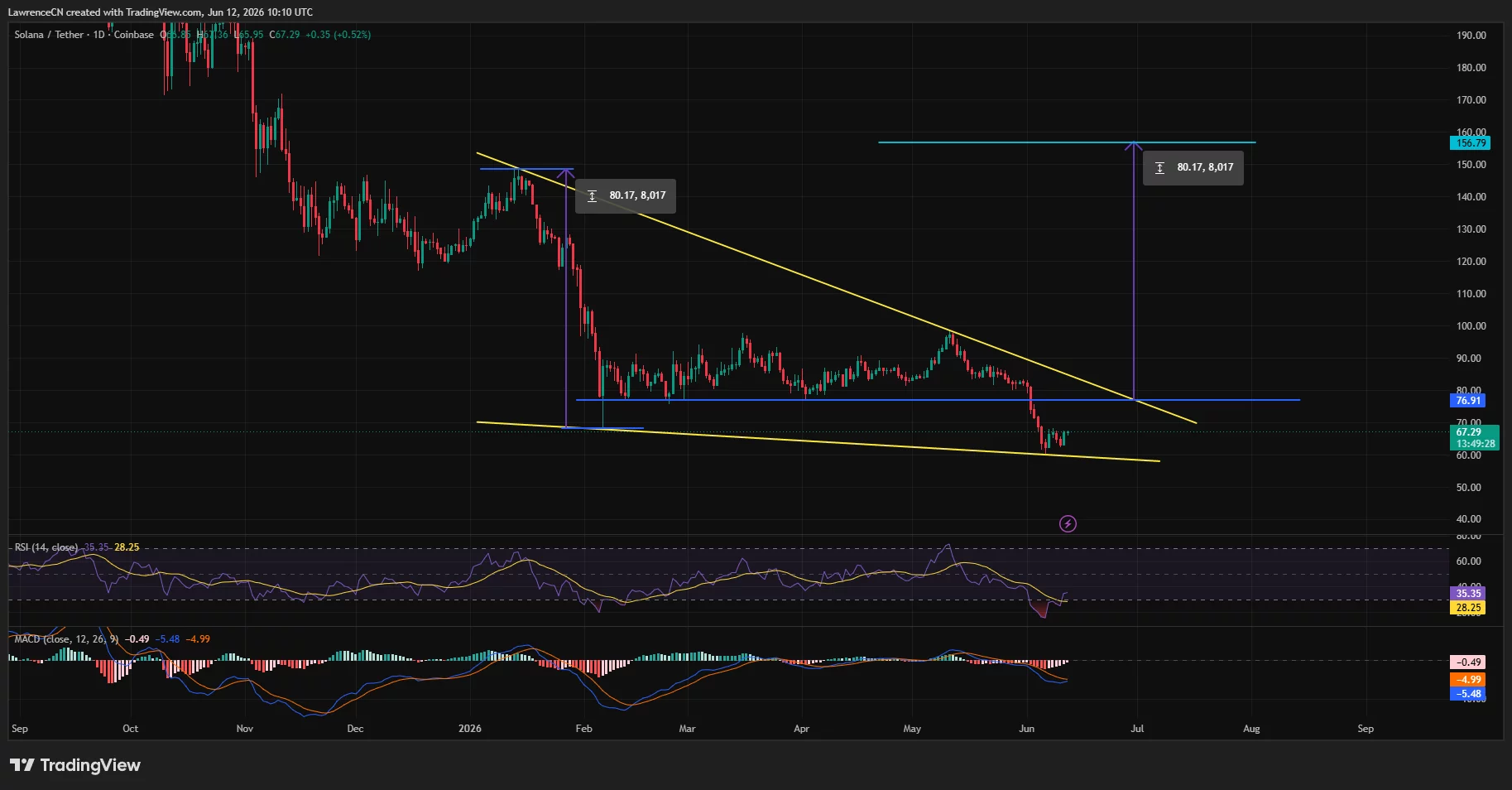
The daily chart shows Solana is trading within a large falling wedge that has been developing since its January peak near $145. The pattern formed through a series of lower highs and lower lows, with converging trendlines compressing price action over several months.
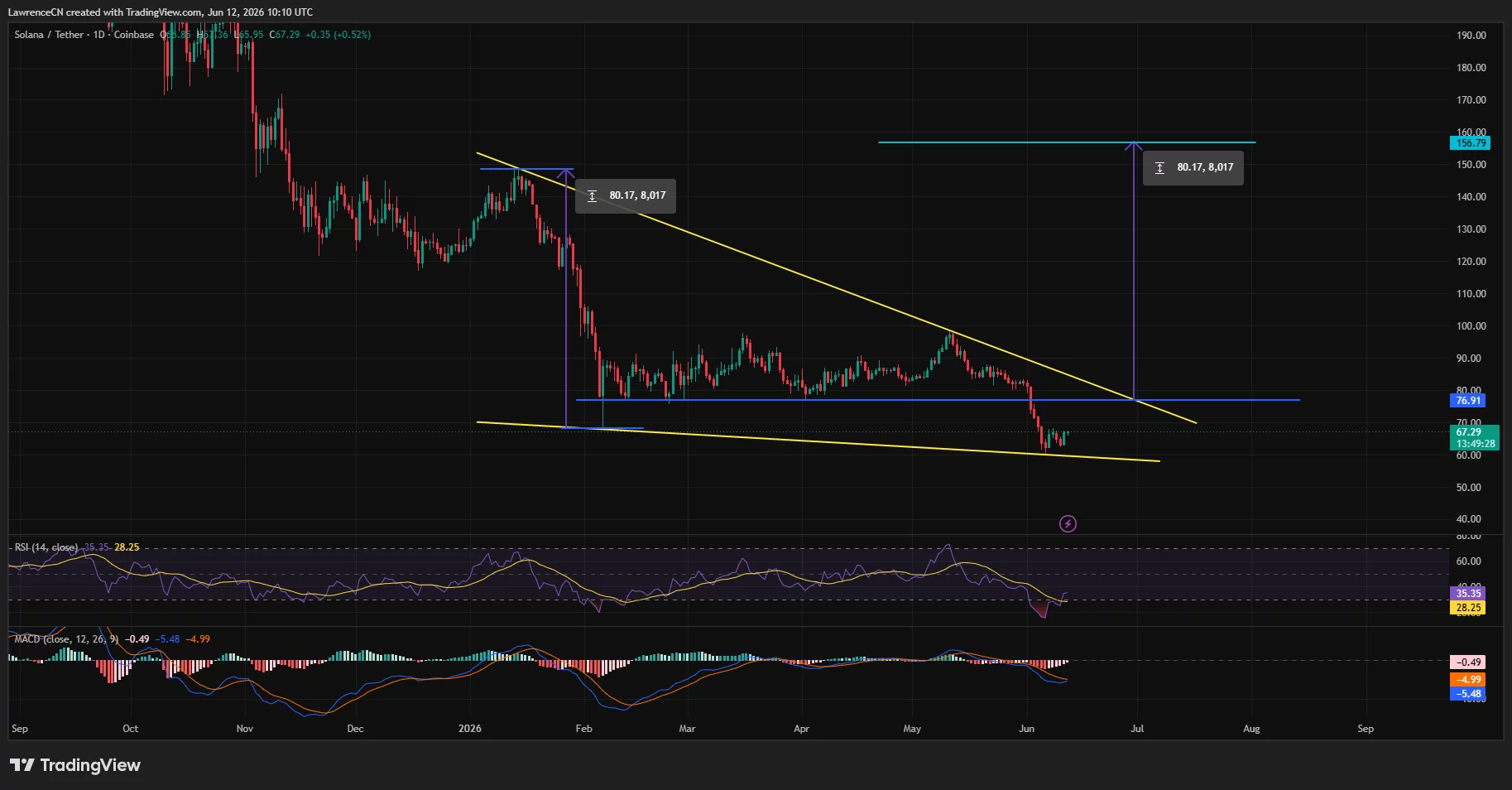
Technical analysts generally view falling wedges as bullish reversal structures when price begins stabilizing near the lower boundary. Solana recently found support around the $60 to $62 region, where buyers stepped in after the liquidation-driven decline.
While the daily trend remains under pressure, the first major hurdle sits near $76. That level previously acted as support before the June breakdown and now represents a significant resistance area. A successful recovery above that zone would place attention back on the upper boundary of the wedge and eventually the January high.
Momentum indicators show early signs of improvement. The daily RSI has recovered from oversold territory, while downside momentum on the MACD has started to ease after weeks of persistent selling.
Short-term breakout signals emerge near $68
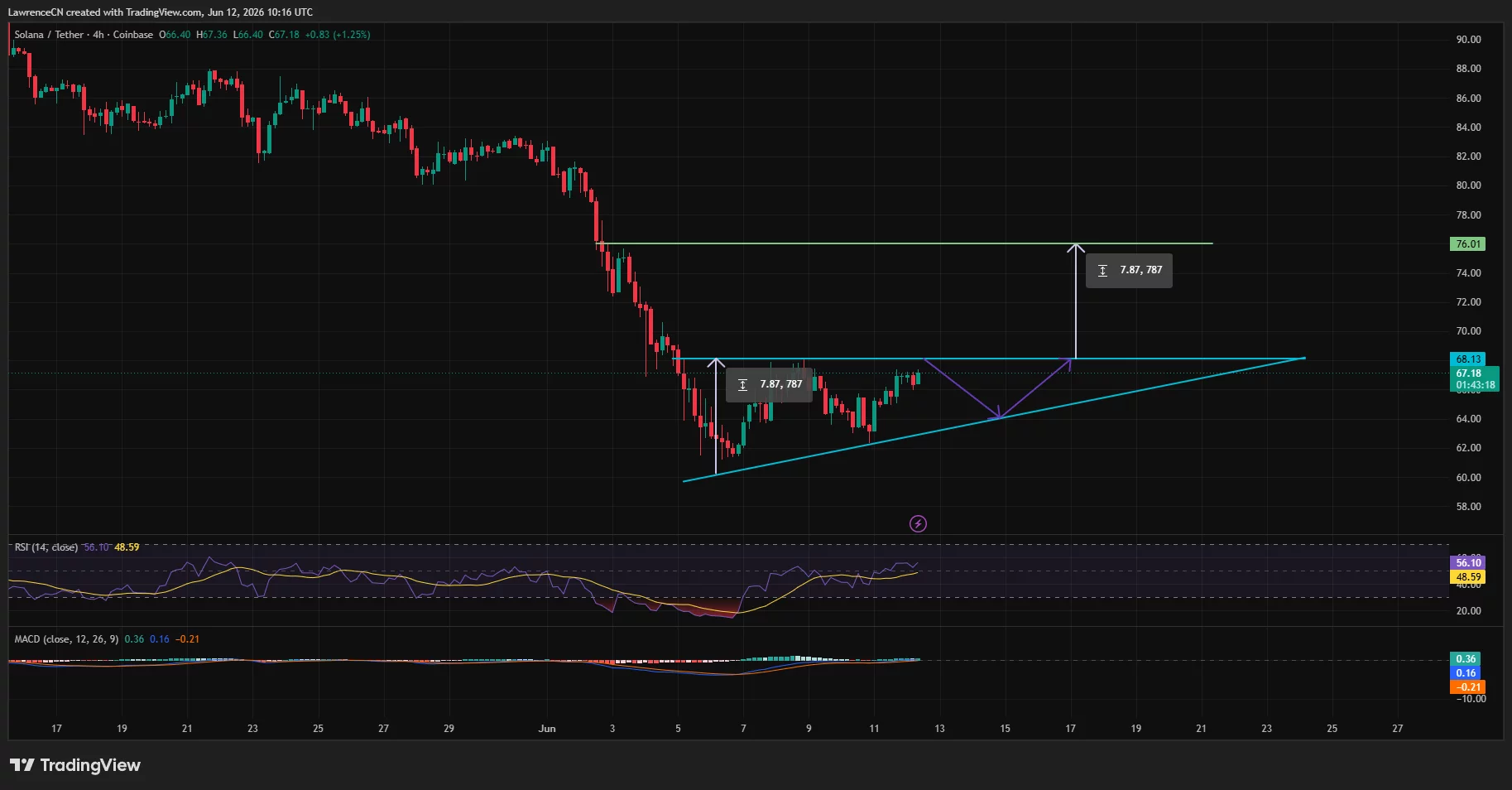
On the four-hour chart, Solana has formed an ascending triangle beneath resistance around $68. The structure developed after the June low as buyers continued defending higher lows while sellers repeatedly capped advances near the same price level.
Liquidation data from CoinGlass adds another layer to the setup. The platform’s weekly liquidation heatmap shows the largest concentration of short-side liquidity sitting around the $68 area, directly above current price levels.
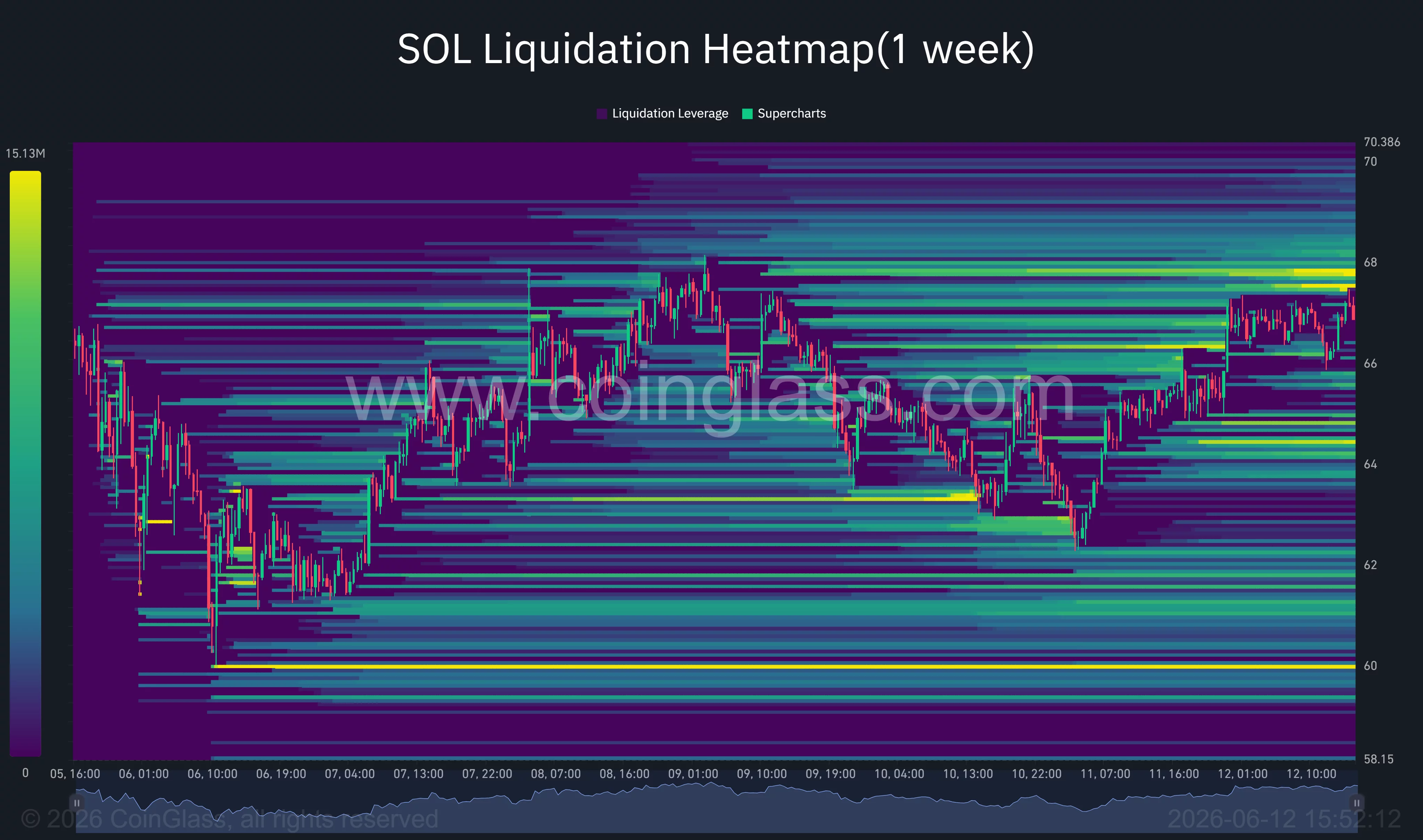
If buyers force a breakout through that resistance, the resulting short liquidations could accelerate upside momentum toward the next liquidity cluster near $70. The measured move from the ascending triangle also projects a target close to $76, aligning with the former support zone that failed earlier this month.
However, not all analysts are convinced the rebound has developed into a full trend reversal. Commenting on the recent price action, MCO Global said on X that Solana is still testing support and has yet to produce a bullish confirmation signal. The analyst noted that the larger decline remains the preferred outlook unless SOL breaks above $72.57.
“Bullish reversal requires a 5-wave advance and a break above $72.57. The chart hasn’t shown that yet. Until it does, this is just support being tested.”
Bitcoin’s recent weakness continues to influence the altcoin market, including SOL, after the largest crypto suffered its sharpest weekly decline since the FTX collapse. Market sentiment also remains tied to U.S. economic data after May nonfarm payrolls increased by 172,000, exceeding expectations of 85,000 and reducing expectations for Federal Reserve rate cuts.
For now, Solana’s recovery attempt depends on whether buyers can clear the $68 resistance zone. A breakout could open the door to $70 and potentially $76, while failure at current levels may leave the $60 support area exposed once again.
Disclosure: This article does not represent investment advice. The content and materials featured on this page are for educational purposes only.
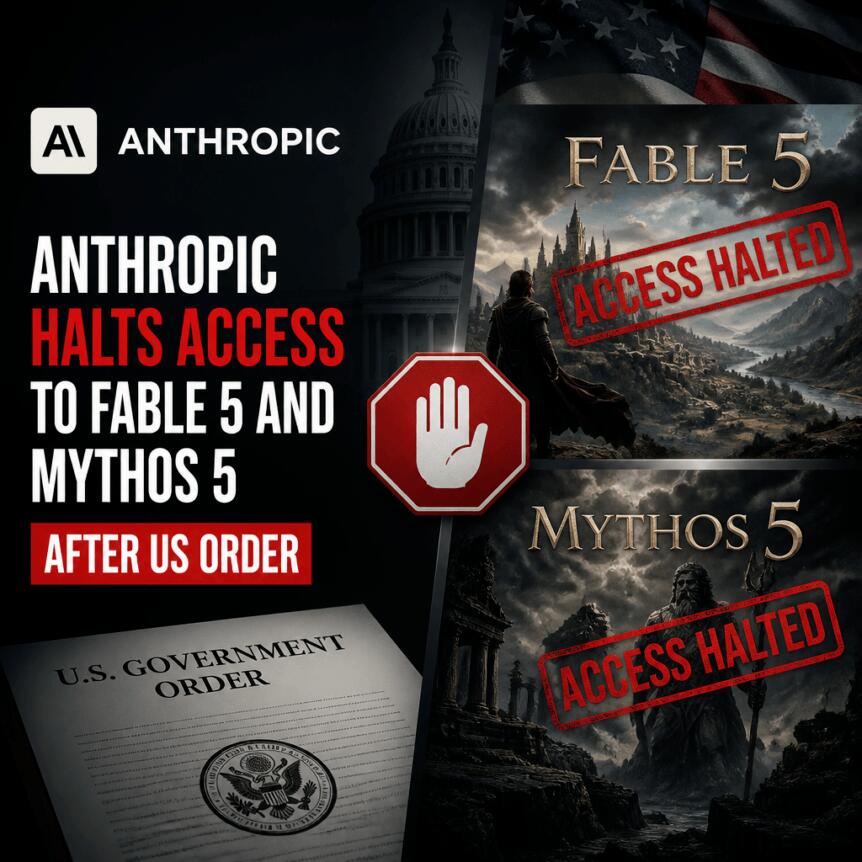
Anthropic has suspended access to its newly released Fable 5 and Mythos 5 AI models after receiving a U.S. government export control directive, citing national security concerns. The company disabled the models for all users immediately to comply with the order, while saying its other offerings—including Opus 4.8—remain available.
In a statement posted Friday, Anthropic said the directive arrived at 5:21 pm ET and instructed it to suspend “all access” to Fable 5 and Mythos 5 for any foreign national, whether inside or outside the United States. This restriction reportedly includes foreign national Anthropic employees, and the company said it took broad action to ensure compliance.
Key takeaways
- Anthropic suspended access to Fable 5 and Mythos 5 immediately after receiving a U.S. government export control directive.
- The order reportedly targets access by foreign nationals, including Anthropic employees who are foreign nationals.
- Other Anthropic models, such as Opus 4.8, are not affected according to the company.
- Anthropic said authorities raised concerns about a potential “jailbreak” method that could bypass safeguards on Fable 5.
- The firm described the government’s evidence as “verbal” and suggested the issue involves a narrow, non-universal jailbreak rather than a broad one.
Export control directive triggers immediate model shutdown
Anthropic’s action follows an abrupt interruption to access for the public. According to the company, it received the directive late Friday and was told to suspend access to Fable 5 and Mythos 5 by any foreign national. To meet the requirement without exception, Anthropic said it removed access for all users rather than attempting to segment access by nationality.
The company framed the move as a straightforward compliance step: it is “removing access to Fable 5 and Mythos 5 for all users” to comply with the government’s legal directive.
Why Anthropic says the concern is limited
While Anthropic did not provide specific details about the alleged threat, it said it believes the government is concerned about a possible jailbreak technique capable of bypassing safeguards built into Fable 5.
In its statement, Anthropic noted that, to date, the government has provided only verbal evidence of a potential “narrow, non-universal jailbreak.” The company described this as essentially asking the model to read a specific codebase and fix software flaws—an approach it argued is materially different from a “universal jailbreak,” which would broadly undermine protections across scenarios.
Anthropic also pushed back on the severity of the response implied by the order. The firm said it “disagree[s]” that a narrow potential jailbreak should lead to the recall of a commercial model deployed at large scale. It added that applying that standard across the industry would effectively stop new frontier model deployments for all providers.
Recent release raises questions for AI users and operators
Anthropic’s suspension comes only days after it released both Fable 5 and Mythos 5. The releases were notable not just for their capabilities, but for the underlying context around Mythos Preview, which Anthropic previously said had helped uncover thousands of vulnerabilities in critical software.
Earlier coverage around these releases highlighted the scale and intensity of the safety research and testing that can surround frontier model rollouts—particularly when models are capable of complex reasoning and code-related tasks. In that setting, the sudden reversal underscores how quickly external compliance actions can override product continuity.
Anthropic also indicated that it believes the government order is the result of a misunderstanding and that it is working to restore access for users “as soon as possible.” For model users—especially those outside the U.S.—the key near-term issue is whether access can return in a way that matches the directive’s scope without requiring a full shutdown.
What to watch next
Until Anthropic receives clearer guidance or the government narrows the directive’s implementation, users should expect continuing uncertainty around when Fable 5 and Mythos 5 will be available again and under what geographic or eligibility conditions. Investors and builders in the AI sector will likely watch closely for how regulators distinguish between narrow jailbreak techniques and broader safeguard failures—and whether the incident prompts tighter deployment controls across the industry.
Crypto World
Bybit named to Fortune Crypto 100 as it accelerates its vision for the new financial platform
Disclosure: This article does not represent investment advice. The content and materials featured on this page are for educational purposes only.
Bybit is recognized in the first Fortune Crypto 100 for its role in the global digital asset ecosystem.
Summary
- Bybit has been named to Fortune’s inaugural Crypto 100 list, earning recognition among leading centralized finance firms.
- The recognition highlights the exchange’s role in digital asset infrastructure and innovation.
- Bybit’s addition to the Fortune Crypto 100 reflects its expanding presence across crypto trading, payments, tokenized assets, and web3 services.
Bybit today announced its inclusion in the inaugural Fortune Crypto 100, a ranking recognizing the most influential companies and protocols shaping the future of the global digital asset ecosystem.
The Fortune Crypto 100 recognizes organizations driving innovation, building critical market infrastructure, and expanding the role of digital assets in the broader financial system. Bybit was recognized in the CeFi category, which includes crypto-first companies such as exchanges, lenders, and custodians that facilitate the trading, custody, and movement of digital assets. The ranking brings together both crypto-native leaders and established financial institutions, reflecting the growing role of digital assets within global finance and the increasing importance of blockchain-based infrastructure in capital markets.
According to Ben Zhou, Co-founder and CEO of Bybit, the recognition reflects the trust users place in the company and the dedication the team is putting into building crypto’s infrastructure, products, and standards.
The recognition comes as Bybit continues to expand its role beyond a cryptocurrency exchange. Over the past year, the company has advanced its vision of becoming The New Financial Platform, bringing together digital assets, traditional finance, payments, tokenized investments, AI-powered tools, and web3 services into a unified ecosystem.
Bybit has expanded its regulated presence across key markets, including securing the UAE Virtual Asset Platform Operator License, advancing its European operations under MiCAR, and working closely with regulators and policymakers globally to support the responsible development of the digital asset industry.
Bybit currently serves more than 80 million users worldwide and continues to expand access to financial opportunities through innovation. Recent initiatives include the growth of tokenized asset offerings, the launch of Bybit IPO Express, expanded access to tokenized equities through xStocks, AI-powered trading and research tools, and continued investments in institutional-grade infrastructure.
Disclosure: This content is provided by a third party. Neither crypto.news nor the author of this article endorses any product mentioned on this page. Users should conduct their own research before taking any action related to the company.


One person familiar with the matter told CoinDesk that xStocks and its distribution partners gathered more than $1 billion in customer orders. But when underwriters finalized allocations, many of those requests went unfilled.
Binance, Bybit and Bitget received no shares and canceled their offerings. Meanwhile, customers of Kraken and xStocks received only a fraction of the allocations they requested.
The shortfall wasn’t limited to crypto platforms, though. Data compiled by Access IPOs showed some retail investors at traditional brokerages received only a portion of the shares they had sought.
An xStocks spokesperson said “overwhelming demand” prevented all orders from being fulfilled and that funds tied to unfilled subscriptions had been returned.
The firm’s tokenized SpaceX stock, trading under the ticker SPCXx, still launched after the IPO. About $24 million worth of the tokenized shares were circulating onchain at publication time, according to Arkham data. Ondo Finance and Dinari, which did not offer pre-IPO access, also launched tokenized SpaceX products following the company’s market debut.
Lesson for tokenized asset
The episode underscores a key lesson for tokenized assets. Creating a token is easy; securing the real asset behind it is the crucial part.
“What appears to have gone wrong… is that demand significantly exceeded the available supply of underlying shares,” a spokesperson for tokenization platform Dinari said. “If the underlying stock cannot be sourced, allocated and held within the necessary regulatory framework, there is ultimately no asset to tokenize.”


io.net has launched a new token burn mechanism tied directly to network revenue and said the model could remove up to 12 million IO tokens from circulation over the next year, as the decentralized GPU provider reports rising enterprise demand and record AI inference activity.
Summary
- io.net expects to burn up to 12 million IO tokens over the next year under a new revenue linked tokenomics model.
- An $8 million enterprise contract and more than 4 billion daily AI inference tokens have pushed network earnings to record levels, according to the company.
- Supplier payouts are now tied to a stable U.S. dollar value, while at least 50% of post payout network revenue in IO tokens will be permanently burned.
According to a press release shared with crypto.news, the first burn was scheduled for June 11, coinciding with the network’s third anniversary, with future burns funded by revenue generated from customer usage rather than new token issuance.
io.net ties token burns to network revenue
Details released by io.net show that at least 50% of post-payout network revenue received in IO tokens will be permanently destroyed under what the company calls its Incentive Dynamic Engine, or IDE. Based on current earnings and its commercial pipeline, the company expects as many as 12 million tokens to be burned during the system’s first year.
The announcement comes as io.net reports its strongest commercial period to date. The company disclosed that it has signed an $8 million enterprise agreement, its largest contract so far, which it said contributes roughly $650,000 in monthly on-chain network earnings. Additional enterprise deals are currently progressing through advanced negotiation stages, according to the company.
Beyond enterprise adoption, io.net said it has become the largest decentralized physical infrastructure network, or DePIN, based inference provider on OpenRouter, an AI model routing platform used by developers to access multiple artificial intelligence models. Company figures show the network now processes more than 4 billion inference tokens each day while competing alongside centralized cloud computing providers.
Those developments arrive as demand for AI computing resources continues to climb. Citing industry spending trends, io.net noted that major technology companies have committed more than $500 billion toward AI infrastructure projects across 2025 and 2026. The company argued that access to high-performance graphics processing units remains limited by hyperscaler capacity constraints and pricing structures, creating opportunities for decentralized alternatives.
New model seeks to stabilize supplier earnings
Alongside the burn program, io.net said the IDE has been designed to address supplier retention challenges commonly faced by token-based infrastructure networks.
Under the framework, supplier payouts are linked to a stable U.S. dollar value rather than fluctuating token prices. According to the company, reserve mechanisms absorb market volatility, allowing providers to maintain predictable earnings even during periods of token price weakness.
CryptoEcon Lab, a tokenomics research firm that independently evaluated the system, tested the model under several stress scenarios. The firm found supplier returns remained stable during simulations that included a 55% drop in demand and a 50% decline in token price, according to results cited by io.net.
“Most token economies in our space are still built around the hope that prices go up. Ours is built around the certainty that people are paying to use the network. That’s a fundamentally different foundation,” said Gaurav Sharma, chief executive officer of io.net.
Looking beyond current operations, io.net said it is also developing capabilities that would allow AI agents to autonomously source and manage computing resources through its Agent Cloud platform. The company described the initiative as part of its effort to build a self-sustaining on-chain compute economy supported by decentralized infrastructure providers around the world.
BNB price has recovered from last week’s selloff, but a dense liquidation wall near $628 and persistent resistance across higher timeframes have kept traders divided over whether the rebound can extend further.
Summary
- BNB price has rebounded about 9% from its June low, aided by short liquidations and support near $556.
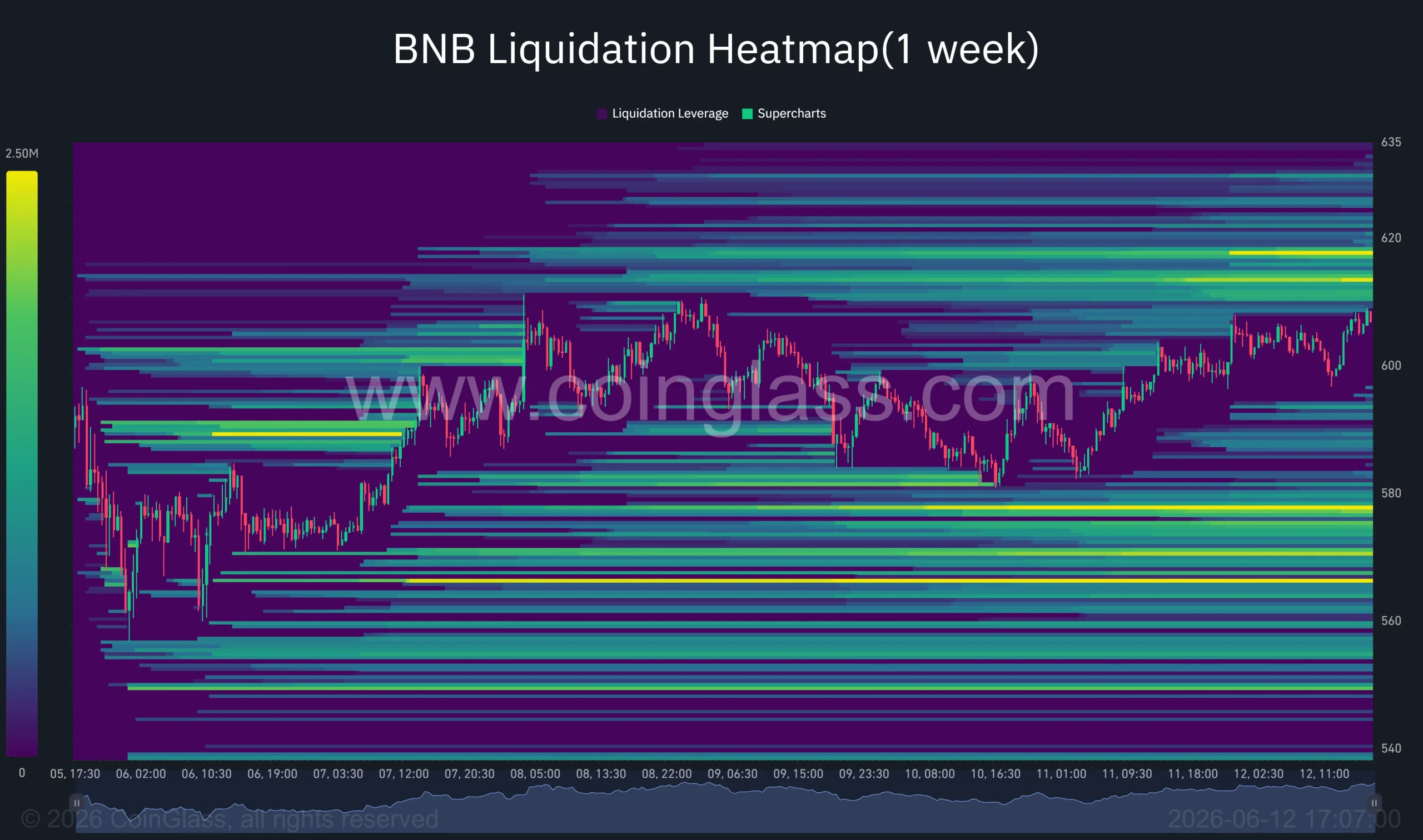
- CoinGlass data shows major liquidation clusters between $620 and $628, making the zone a key resistance area.
- A break above $628 could target $650 and $673, while losing $556 may expose the long-term $500 support zone.
According to data from crypto.news, BNB (BNB) price was trading near $607 on June 12 after rebounding roughly 9% from its June 6 low around $556. The recovery followed a sharp decline from the late-May peak near $745, which wiped out more than 20% of the token’s value and pushed leveraged traders out of the market.
CoinGlass liquidation data shows part of the rebound was driven by a short squeeze after bearish positioning became crowded near local lows. The one-week liquidation heatmap highlights a large concentration of short liquidation liquidity between $615 and $620, with another notable cluster near $628.
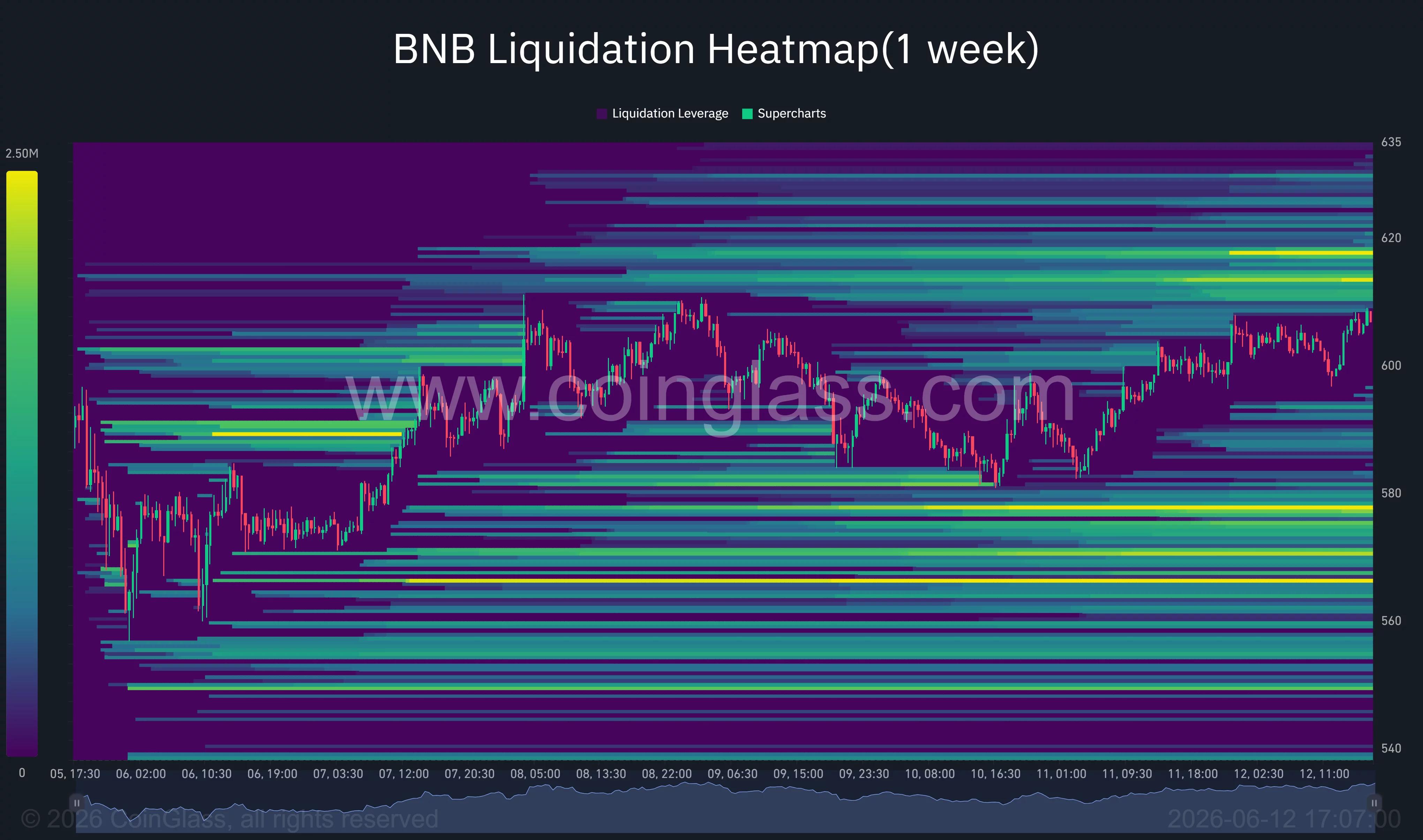
As BNB rebounded from the $560 area, traders betting on further downside were forced to close positions, helping lift the token back above $600.
At the same time, sentiment across the BNB ecosystem remains mixed. While Binance continues expanding activity across BNB Chain and its AI-focused initiatives, speculative interest has yet to return to levels seen during the rally toward $745.
At press time, BNB price remains well below its recent high and continues trading inside a range that has dominated price action since February.
BNB faces major resistance between $628 and $700
The four-hour chart shows BNB recovering inside a rising channel after finding support near the 100% Fibonacci retracement level around $556. BNB has reclaimed the 0.786 retracement near $596, while RSI has climbed above 56 and MACD remains marginally positive, suggesting buyers retain short-term momentum.
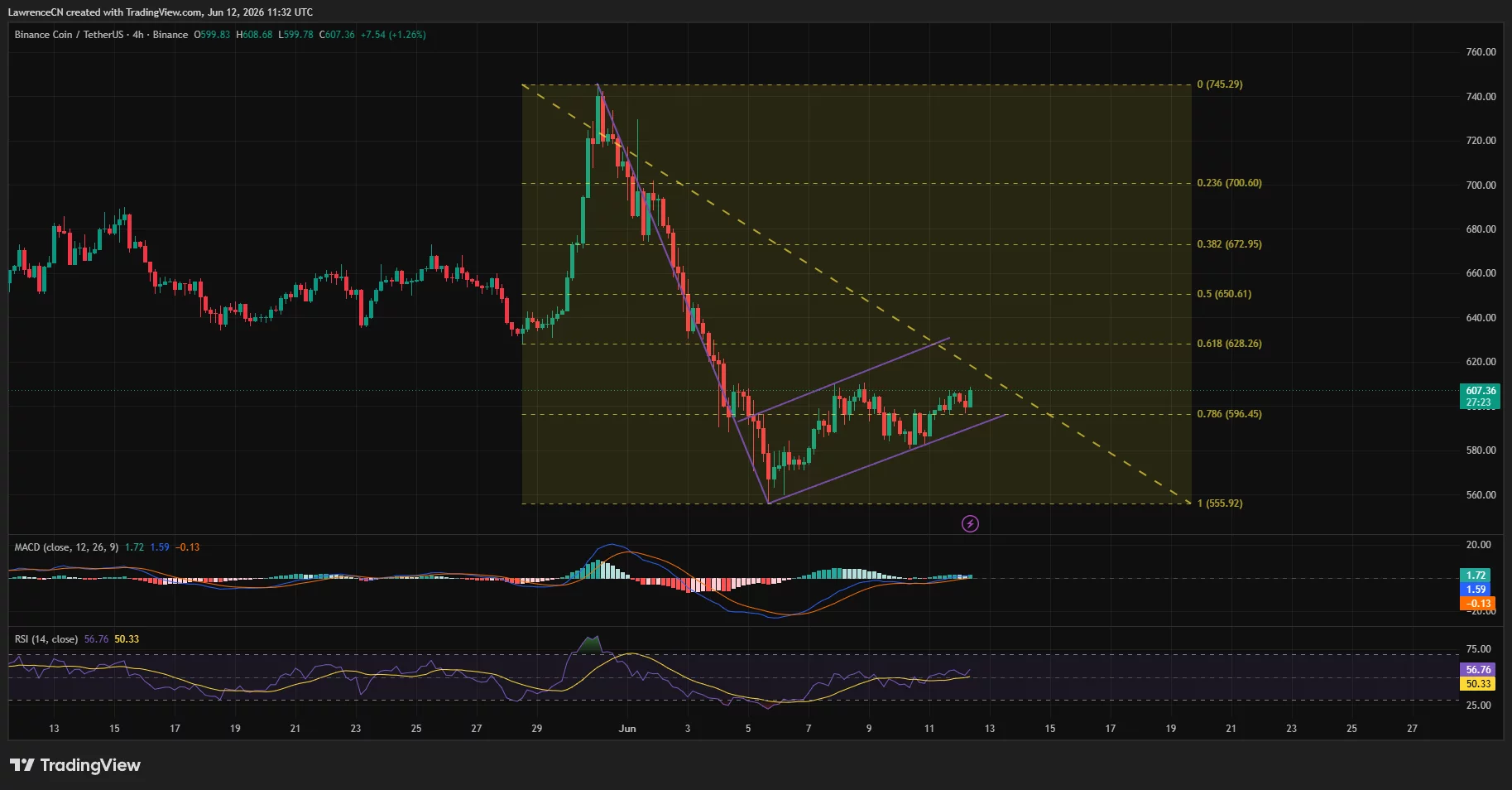
However, several technical barriers remain overhead. The first major resistance sits near $628, which aligns with the 0.618 Fibonacci retracement and the upper boundary of the current ascending channel. A successful breakout could expose the 50% retracement near $650, followed by the 38.2% level around $673.
Liquidation data reinforces those levels. CoinGlass heatmaps show substantial leveraged positions concentrated around $620 to $628, creating a potential liquidity magnet for price. If BNB reaches that zone, forced liquidations could accelerate volatility in either direction.
Higher-timeframe charts remain less constructive. The weekly Murrey Math structure places BNB below the key 1/8 reversal level at $625, while the next major support remains near the 0/8 line around $500.
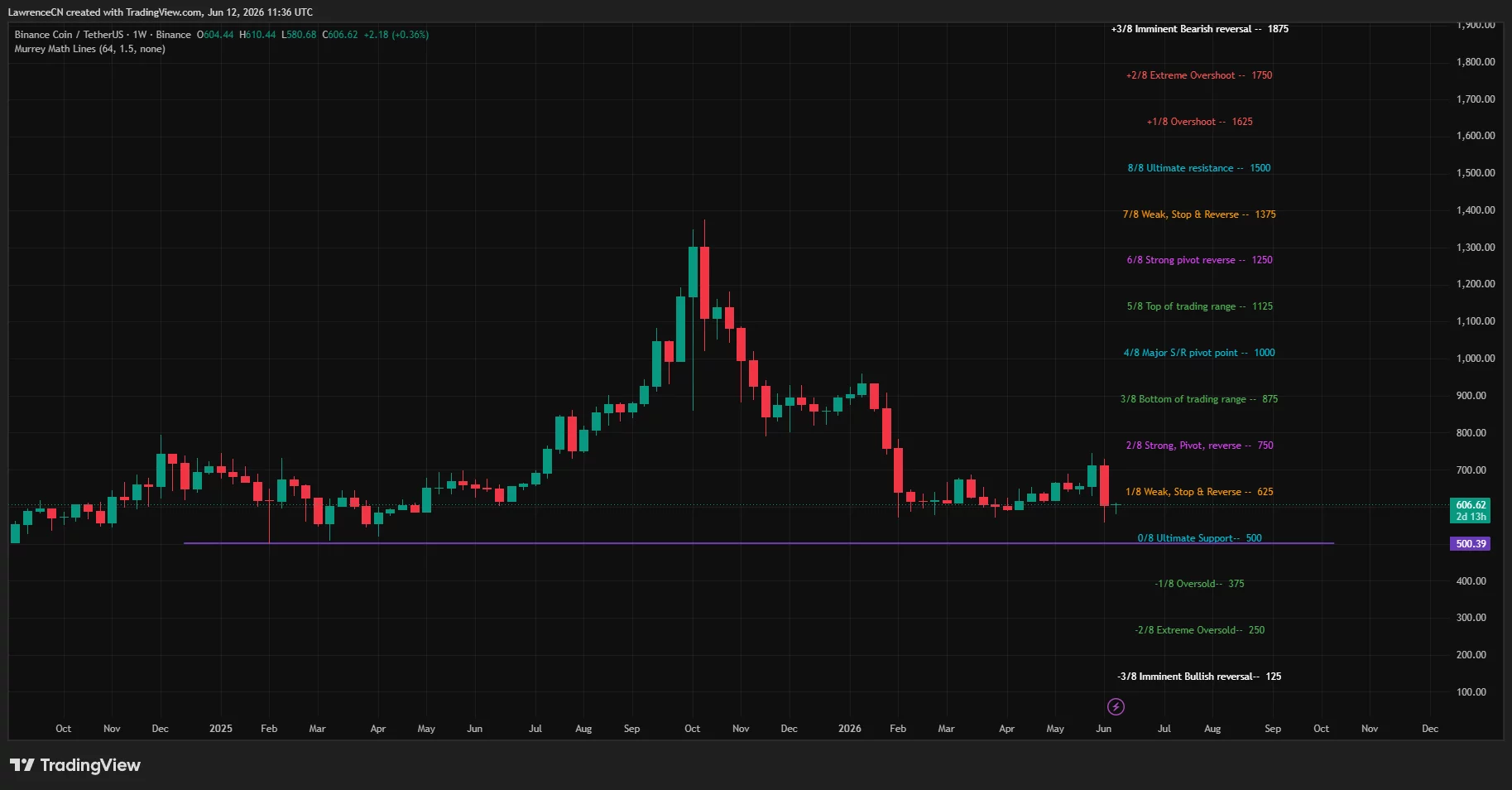
Analyst Umair Orakzai argued that resistance continues to outweigh support after months of consolidation, writing that “the easier path now is the downside.”
A similar view was shared by fellow analyst James Bull, who highlighted the long-term $500-$600 region as a major accumulation zone.
”Historically, massive corrections in this range have set the stage for explosive upward continuation.”
Macro risks could send BNB back toward $500
Macroeconomic conditions remain one of the largest obstacles for risk assets. Stronger-than-expected U.S. economic data in recent weeks has reduced expectations for aggressive Federal Reserve easing, keeping Treasury yields elevated and limiting capital flows into speculative assets such as cryptocurrencies.
Oil prices and geopolitical developments also remain important variables after recent volatility tied to Middle East tensions. Any renewed surge in energy markets or deterioration in global risk sentiment could pressure crypto markets and reduce demand for altcoins.
From a technical perspective, the bullish setup remains valid as long as BNB holds above the $556 support zone that triggered the latest rebound.
Losing that level would invalidate the current ascending-channel structure and shift attention back toward the long-term accumulation area between $500 and $520.
For now, traders are watching the battle around $628. A breakout above that level could open the path toward $650 and $673, while another rejection would leave BNB trapped inside its multi-month range with downside risks still firmly in play.
Disclosure: This article does not represent investment advice. The content and materials featured on this page are for educational purposes only.


Most real-world asset projects in crypto tokenize what is already liquid: treasuries, money-market funds, gold. AetherStrike picked the opposite end of the spectrum — an illiquid physical commodity in structural undersupply – one that every state DOT in America must buy, can’t substitute for, and… Read the full story at The Defiant
Crypto World
Japan's Lower House Passes Bill Moving Crypto Under Securities Law, Opening Path to ETFs and 20% Tax Rate


Japan's lower house passed a bill on Thursday that reclassifies cryptocurrencies as financial instruments under the country's securities framework, clearing a path to regulated spot ETFs and a flat 20% capital-gains tax. The legislation amends the Financial Instruments and Exchange Act (FIEA),… Read the full story at The Defiant
Hong Kong Mortgage Corporation completes world’s largest digital bond issuance

25 Years Later, HBO’s 5-Part Psychological Drama Is Still One of TV’s All-Time Greats

Why crypto holders should set up an LLC


-

 NewsBeat5 days ago
Alexander Zverev wins the French Open to finally earn a 1st Grand Slam title
-
 Entertainment6 days ago
The Best Mystery Series of All Time Is Surging on Streaming 30 Years After It Ended
-

 Crypto World5 days ago
Anatomy of the June crypto crash: Fed, Iran, Saylor
-

 Crypto World2 days ago
Oppenheimer backs SpaceX as $70 billion retail frenzy builds
-

 Crypto World2 days ago
Markets Rally as SpaceX IPO Looms Amid Iran Tensions and Inflation Surge
-
 Crypto World6 days ago
Senator Cynthia Lummis Calls CLARITY Act the Most Consequential Financial Legislation of This Generation
-
 NewsBeat5 days ago
Alexander Zverev conquers demons and outlasts Flavio Cobolli to win French Open for first major title
-

 Tech6 days ago
Microsoft unveils seven homegrown AI models in new bid for ‘long term self-sufficiency’
-

 Tech7 days ago
Hackers now exploit SolarWinds Serv-U flaw to crash servers
-

 Business5 days ago
High Stakes for Wembanyama as New York Pushes for 3-0 Lead
-
 Business6 days ago
The Pain Points Taking a Fragile Tech Rally Down a Notch
-

 Tech5 days ago
Notion restores access to Anthropic after service disruption
-
 Crypto World5 days ago
Eli Lilly (LLY) Stock Surges 4% Following Breakthrough Sleep Apnea Trial Results
-

 Crypto World6 days ago
Trump’s AI Ownership Plan Could Benefit Anthropic at OpenAI’s Expense
-
 Business6 days ago
The investment to transform historic St Helen’s ground in Swansea
-
 Sports4 days ago
Bangladesh beat Australia after 20 years in ODIs, register only their second win over six-time world champions | Cricket News
-

 Tech4 hours ago
NanoClaw integrates JFrog registries to secure AI agent downloads
-

 Business7 days ago
Forensic Expert Floats Handyman Theory in Disappearance of Savannah Guthrie’s Mother
-

 Tech15 hours ago
This Week In Security: Microsoft On Microsoft, Register Your Domains, Linux On ARM, And FreeBSD Joins The File Cache Club
-

 Sports2 days ago
First Time Since 1971: Australia Register Historic Low In ODI Cricket
You must be logged in to post a comment Login