

Crypto World
Tom Lee’s $8 billion Ethereum paper loss turns BitMine into a stress test for ETH maximalism

Tom Lee’s Ethereum treasury vehicle BitMine Immersion Technologies is now sitting on roughly $8 billion in unrealized losses as ether trades near two year lows, yet the Fundstrat co founder is doubling down on his “supercycle” thesis and insists there is “no pressure” to sell.
Summary
Crypto prediction market desks are posting that “Tom Lee’s Ethereum portfolio is now down $8,000,000,000,” capturing a growing sense of disbelief at the scale of losses tied to BitMine’s outsized ether bet.
The move comes as Ethereum (ETH) remains stuck in the low $2000-range, alongside a foundation shakeup and an emerging narrative on social media that the currency is underperforming.
Bit Digital doubles down on Ethereum exposure
Bit Digital purchased 8,568 ETH on May 11 at an average price of approximately $2,334, its first Ethereum accumulation since October 2025 and a clear signal it is prepared to add risk even after a strong cycle. At roughly $20 million for the tranche, the move was large enough to shift the profile of its treasury and invite scrutiny over timing as ETH slid in the days that followed.
As the market sold off, the price of Ethereum fell below $2,000, a drawdown of around 15% from Bit Digital’s entry level and enough to put the company’s new position roughly $3 million in the red on an unrealized basis. The episode underlines just how quickly treasury-style crypto bets can move against listed companies, particularly when they cluster entries around round numbers or key technical levels.
According to ChainCatcher, Bit Digital’s latest purchase lifts its total ETH holdings to about 158,462 coins, which at current prices equates to roughly $313 million on its balance sheet. Those reserves are not just sitting idle: the company is generating yield via staking and liquid staking products, effectively turning the position into a hybrid between a long term asset bet and a yield bearing instrument.
From bitcoin miner to ‘strategic asset’ operator
In recent years Bit Digital has deliberately rebranded itself away from a pure play bitcoin mining outfit and toward what it describes as a “strategic asset company” with a focus on Ethereum reserves, AI infrastructure and mergers and acquisitions. That shift mirrors a broader trend among listed miners and crypto infrastructure firms seeking more diversified, fee generating business lines after the boom and bust of prior bitcoin cycles.
Ethereum’s central role in staking, decentralized finance and tokenization narratives makes it a logical focal point for that kind of treasury strategy, especially as institutions circle ETH exposure through vehicles like spot ETFs and structured products. At the same time, concentrating more than $300 million of corporate value into a single volatile asset class exposes Bit Digital’s shareholders to sharp mark to market swings tied to ETH’s path.
The company’s increased use of staking and liquid staking also introduces protocol, counterparty and smart contract risk, even as it boosts nominal returns on reserves. Any prolonged drawdown in ETH, or stress event in the staking ecosystem, would therefore hit Bit Digital both through price and income channels, underscoring how aggressively the firm is tying its future to Ethereum.

Q2 2026 has become the most-hacked quarter in DeFi history by incident count, according to DefiLlama, which logged approximately 70 separate exploits across April, May and the first two weeks of June. The quarterly dollar total stands at roughly $746 million. The figures reflect a structural shift… Read the full story at The Defiant
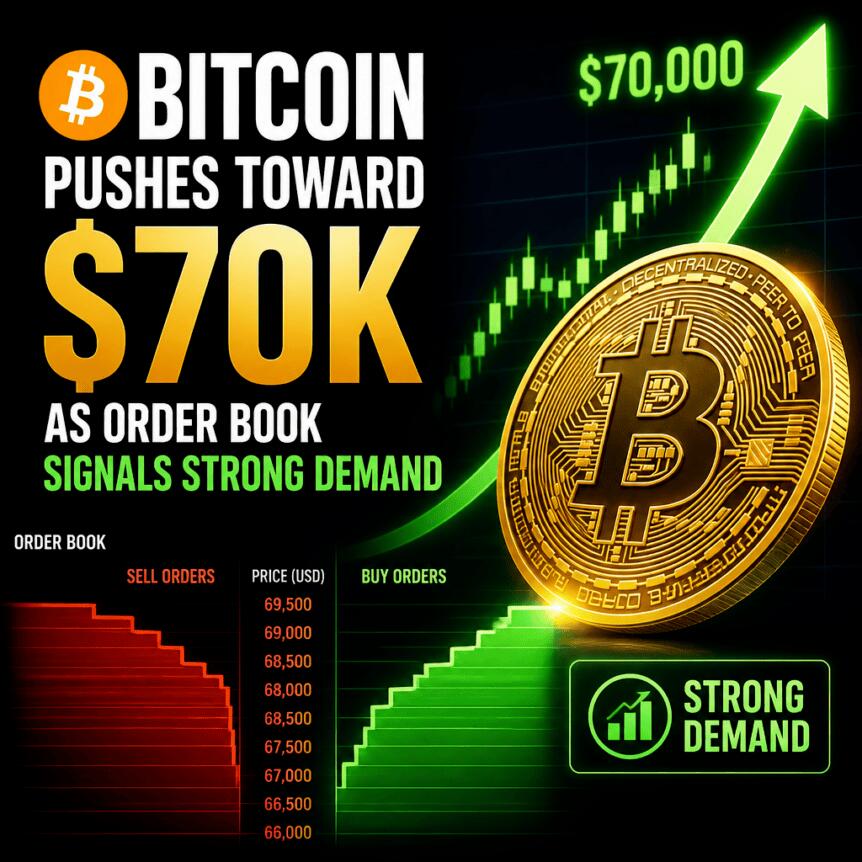
Bitcoin is drawing fresh interest from buyers after printing a new yearly low near $59,000 last week, with market microstructure data suggesting downside momentum may be fading rather than accelerating. Since that low, BTC has rebounded to around $63,500, while several liquidity and positioning indicators point to a potential push higher if key resistance areas are reclaimed.
Order book and derivatives-related signals highlighted in recent analysis also point to a large concentration of short liquidity above current prices—an often-cited setup for a squeeze—while chart structure increasingly resembles patterns traders associate with breakouts toward the high-$60,000s.
Key takeaways
- BTC’s bid-ask ratio stayed positive after the $59,000 yearly low, suggesting buy-side orders are slightly outpacing sell-side pressure (Hyblock data).
- Analysts cite a short-liquidity cluster near $64,600 as a major upside magnet, with an estimated $2.68 billion in shorts.
- On the four-hour chart, divergence between price action and the RSI supported a rebound from the early-June sell-off lows.
- Traders are watching $64,000 and $66,000 as the most important levels to turn the current recovery into a sustained upside move (X analysis by Ardi and PLTR).
- Weekend flows may add volatility, with weekly profit-taking potentially producing opposing order-flow dynamics after long positioning builds (PLTR).
Order book signals hint at a squeeze setup
Following the yearly low near $59,000, Hyblock’s order book metrics showed BTC maintaining a positive bid-ask ratio of 0.05 after the drop, according to the data referenced in this report. In Hyblock’s framework, the bid-ask ratio is used to reflect whether aggressive buy-side market orders are stronger than aggressive sell-side orders. A positive reading indicates that—at least at the time of measurement—buyers were slightly more forceful than sellers.
Further support comes from cumulative volume delta (CVD) observations cited in the same analysis. CVD is used to estimate net buying or selling pressure over time by tracking volume imbalances. The article notes that smaller order cohorts (up to $10,000 and $100,000) showed improving buying activity, with $53 million and $157 million respectively. More notably for momentum traders, the largest cohort ($100,000 to $10 million) reportedly reduced net selling pressure by $900 million, suggesting that heavy participants were not adding to downside pressure.
At the same time, a crypto analyst identified a dense pool of short liquidity higher up. Kripto Holder pointed to a short-liquidity cluster near $64,600, describing it as the primary upside liquidity pool with $2.68 billion concentrated in that area. The practical implication for traders is that if price moves into that zone, it can increase the likelihood of shorts being forced to cover—potentially accelerating the move upward.
Chart structure: divergence and an ascending triangle
Beyond order book mechanics, the rebound also aligns with a technical signal seen on the four-hour timeframe. The referenced analysis describes a bullish divergence between BTC’s price and the relative strength index (RSI): during the early-June sell-off, price made a lower low, while the RSI formed a higher low. Divergences of this type are commonly interpreted as signs that downside momentum is weakening and selling pressure may be losing strength.
The same report also frames BTC’s current positioning within an ascending triangle pattern. If an upside breakout occurs, the analysis suggests BTC could target a daily fair value gap between $67,500 and $70,500—described as a liquidity gap left behind during the recent market correction. Traders often look to these “imbalance” zones as potential areas where price may mean-revert, especially when order book liquidity and derivatives positioning also favor upward movement.
Key levels to watch: $64,000 and $66,000
As BTC attempts to regain control, two horizontal/structural levels are being emphasized by market analysts. Crypto trader Ardi argued that BTC is still trading within a bear pennant after its decline from approximately $83,000 down toward $59,000. In that framing, $64,000 and $66,000 are presented as the most important prices for the current recovery.
According to Ardi, moving above $64,000 would help clear both a horizontal resistance area and the bear pennant structure. That would, in turn, open additional room for upside. The next hurdle is near $66,000, described as a former major range support level that has since turned into resistance.
If BTC can reclaim $66,000, the analysis claims it would strengthen the case for a move toward the liquidity zone above current price and toward the unfilled fair value gap area between $68,000 and $70,000. In other words, the argument is not just for a short-term bounce, but for a continuation if price can confirm its break through the key resistance levels.
Positioning is building—but weekend dynamics could complicate it
Attention is also on how derivatives positioning is evolving. Market analyst PILTR noted that BTC long exposure has been increasing over roughly the past five days, citing a long-versus-short imbalance of 237 long levels against 128 short levels. Based on that distribution, the report estimates a $4 billion positive imbalance.
Yet, the same analyst flagged weekend positioning as a near-term variable. The observation is that weekly profit-taking can sometimes create opposing flows into weekends, particularly after a sustained build-up of long exposure. For readers and traders, this matters because it highlights an uncertainty: even if the technical and liquidity setup is favorable, the timing of follow-through—especially around weekend trading—may determine whether buyers can sustain gains or whether momentum fades.
Ardi and PLTR’s outlooks share a theme: the path upward depends on BTC not only pushing higher, but also holding above specific thresholds long enough to invalidate the prior bearish structure. Until that happens, the market may remain sensitive to fluctuations in positioning and execution quality reflected in order book and CVD behavior.
Going forward, the most important things to monitor are whether BTC can hold above $64,000 and then reclaim $66,000 without losing momentum—since those levels are repeatedly cited as the triggers for a more durable upside move. Even with bullish microstructure signals, weekend positioning and profit-taking could still swing order-flow dynamics, so traders may want to watch how quickly liquidity reacts as price approaches the short-liquidity pool near $64,600.


SEC Commissioner Hester Peirce delivered her farewell remarks on Tuesday at the U.S. Chamber of Commerce Capital Markets Summit in Washington, D.C. The address closed a tenure that made her the agency's most prominent voice for crypto-industry clarity. In the speech, titled "Peirce Out," Peirce… Read the full story at The Defiant


Anthropic disabled access to its Fable 5 and Mythos 5 models on June 12 after the US government issued an export control directive citing national security authorities to suspend availability for any foreign national.
The order forced Anthropic to comply immediately for all users, even though the company publicly disagrees with the underlying reasoning.
What the US Government Directive Actually Requires
An export control directive is a US government order that restricts the transfer of specific technologies to foreign nationals. In this case, the order targets Anthropic’s Fable 5 and Mythos 5 models, including access by foreign national Anthropic employees inside the country.
The company received the directive at 5:21 p.m. ET on June 12. Anthropic confirmed that to ensure full compliance, access had to be disabled for every customer, while reiterating that all other Anthropic models remain available without any disruption.
The letter did not specify the exact national security concern. However, Anthropic believes the government became aware of a method for bypassing, or “jailbreaking,” Fable 5. The company reviewed a demonstration of the technique and called it minor.
Anthropic also noted that the vulnerabilities identified appear simple. Furthermore, other publicly available models, including OpenAI’s GPT-5.5, are able to discover similar flaws without requiring any bypass at all.
Follow us on X to get the latest news as it happens
Why Anthropic Disagrees With the Federal Order
Anthropic emphasized that Fable 5 launched with stronger safeguards than any previously deployed model. Before the release, the company worked with the US government, UK AISI, and multiple third-party teams to red-team the safeguards for thousands of hours.
No tester has yet found a universal jailbreak capable of bypassing Fable 5’s protections across a wide range of cyber capabilities. As a result, Anthropic adopted a defense-in-depth approach combining narrow safeguards, monitoring, and 30-day data retention for Mythos-class models.
So far, the government has provided only verbal evidence of a narrow, non-universal jailbreak. The technique reportedly involves asking the model to read a codebase and fix software flaws, a use case widely available across the industry.
Subscribe to our YouTube channel to watch leaders and journalists provide expert insights
Anthropic argued that pulling a commercial model deployed to hundreds of millions of users over a narrow vulnerability sets a problematic precedent. If applied across the industry, this standard would essentially halt all frontier AI model deployments.
The company is fully complying with the directive but has called the action a likely misunderstanding. Anthropic plans to share more technical details over the next 24 hours and is working to restore Fable 5 and Mythos 5 access as soon as possible.
The post Anthropic Suspends Access to Fable 5 and Mythos 5 After US Government Export Directive appeared first on BeInCrypto.
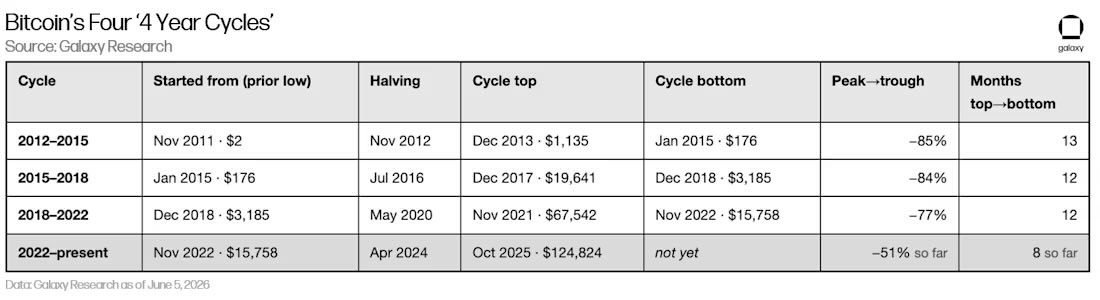
New research from Galaxy Digital suggests that Bitcoin’s cycle low could form at higher price levels than previous bear markets due to the absence of speculation. The analysis places the potential bottom between $62,000 and the network’s realized price at $53,600.
Galaxy head of research Alex Thorn analyzed every Bitcoin cycle top and bottom and noted that the four-year cycle continues to track closely with BTC’s historical timing. The peak-to-trough declines have steadily narrowed across market cycles, falling from 85% and 84% in earlier periods to 77% in 2022 and 51% in 2026.
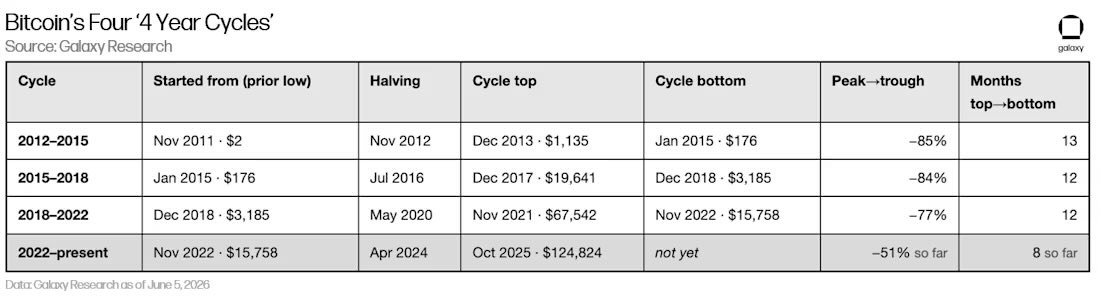
Bitcoin’s four-year cycle peak-trough analysis. Source: Galaxy Research/X
Thorn argued that Bitcoin’s October 2025 top differed from previous cycle peaks. Only two of eleven traditional topping indicators flashed, while the widely followed Pi Cycle Top indicator failed to trigger for the first time. Bitcoin’s MVRV ratio, which compares market value to realized value, peaked at 2.29, compared with 2.93 to 5.91 in prior cycles. The analyst said,
“The key insight: a calm top RAISES the floor. Because October’s top was so muted, the network’s cost basis sits at 43.7% of ATH, vs ~34%, 21%, and 17% in prior cycles.”
The report also found that several key bottoming signals are still absent. Only four of thirteen indicators have triggered so far, with most of the stronger signals yet to appear.
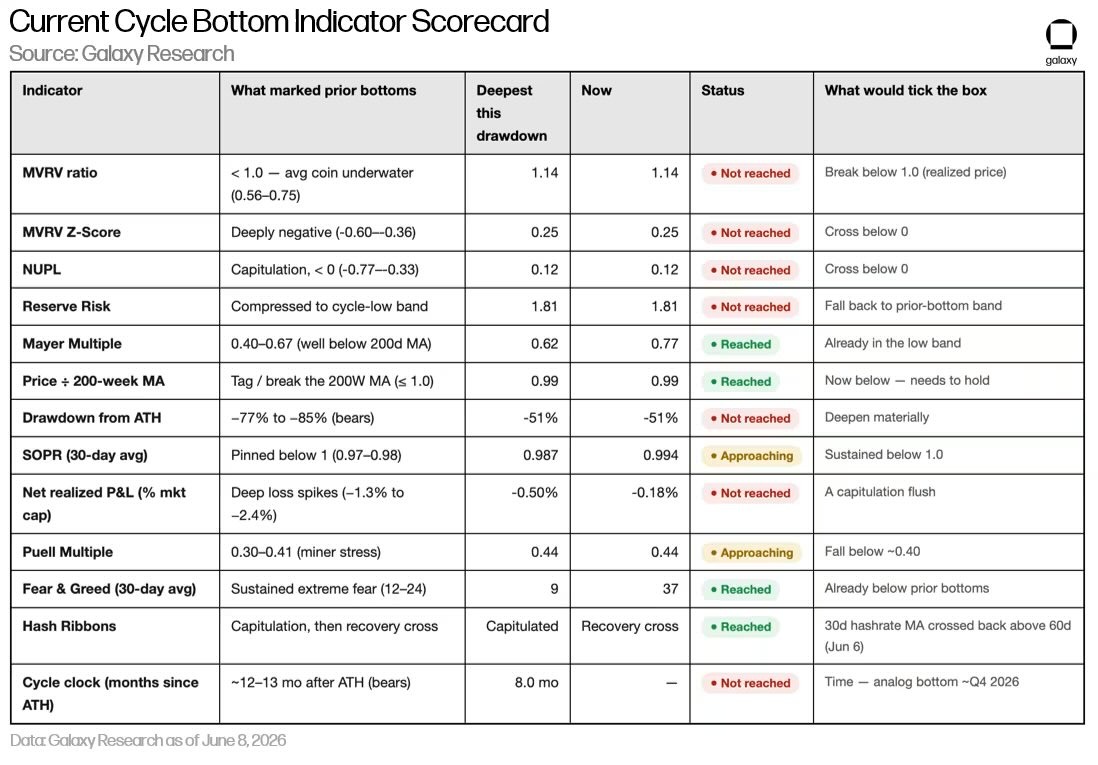
BTC cycle bottom indicator list. Source: Galaxy Research/X
Historical timing also points to the possibility of a bottom ahead. The previous cycle bottoms formed roughly 12 to 13 months after the market peak, while the current drawdown is about eight months old.
Thorn noted that, based on the current cost basis of $53,600, Galaxy estimates a base-case bottom range of $40,000 to $46,000. A deeper “washout scenario” points to $30,000-$37,000, while a shallower decline could hold near $51,000-$54,000. Despite the scenarios, Thorn also warns,
“The catch: the floor can move. cost basis is reflexive. in a real panic, coins change hands at a loss and drag the average down. A 10-30% cost basis decline pulls the implied floor from ~$40k back toward $28k.”
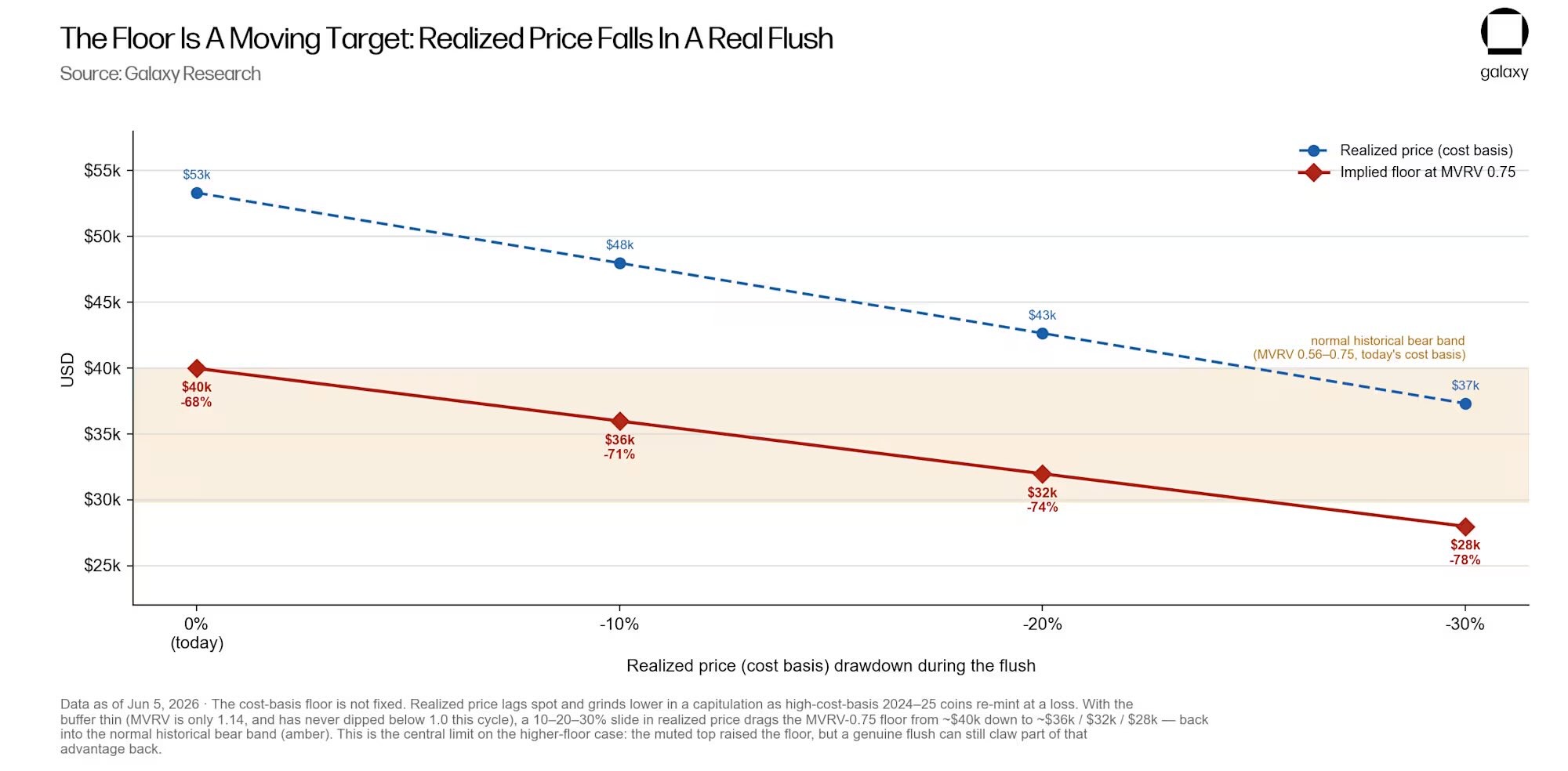
Bitcoin bottom range based on realized price analysis. Source: Galaxy Research
Related: Big Tech crash, oil volatility rattles markets: Will Bitcoin hold above $60K?
Bitcoin demand still trends lower: CryptoQuant
Onchain analysis from CryptoQuant currently places Bitcoin inside a valuation zone historically associated with major bear-market lows. BTC recently traded near $59,000, leaving it roughly 9% above its realized price of $53,600.
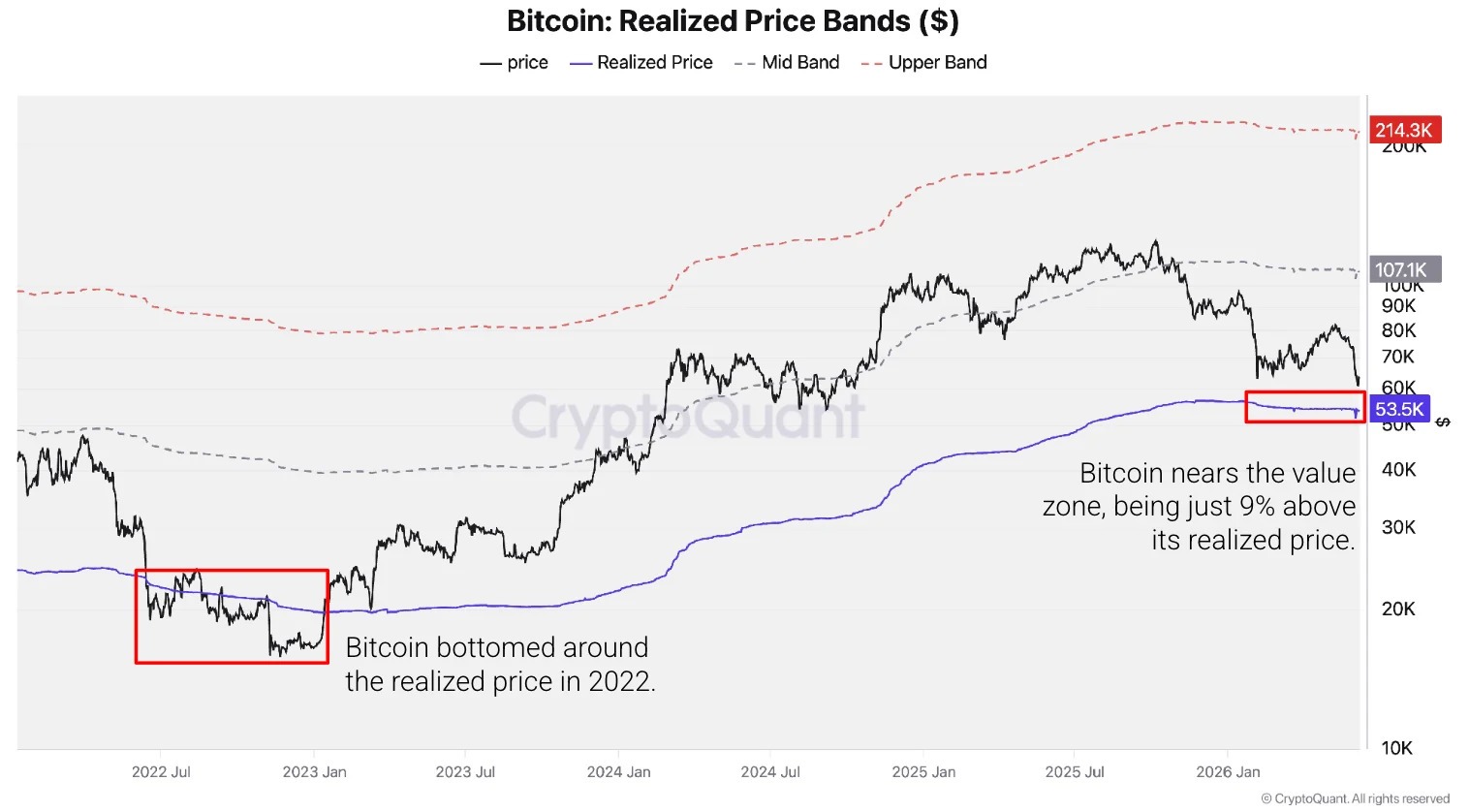
Bitcoin value zone based on realized price bands. Source: CryptoQuant
Past cycle bottoms, including the November 2022 FTX-driven sell-off, formed at or slightly below the realized price, suggesting the bottom range may again fall below the cost basis of $53,600 and overlap with Galaxy’s base projection between $46,000 and $40,000.
Demand data paints a more cautious picture. CryptoQuant reported a combined weekly decline of 652,000 BTC across speculative futures demand and apparent spot demand, marking the sharpest contraction since January 2022. The firm’s one-year demand gauge has also turned negative, signaling fewer BTC buyers than a year ago.
Related: Bitcoin surfs SpaceX IPO at $64K as trader warns key BTC price support may crumble

Blockworks, a crypto data and media company, has acquired Messari in a deal valued at more than $10 million, according to a Wall Street Journal report. The transaction comes at a steep discount to Messari’s prior valuation and highlights how weaker market conditions have reshaped the cryptocurrency research and analytics space.
Messari, which is backed by investors including Brevan Howard Digital and Point72 Ventures, previously raised $35 million in a Series B funding round in 2022 that valued the firm at roughly $300 million. The Wall Street Journal said the purchase price reflects both Messari’s recent operational challenges and broader weakness across the crypto sector.
Key takeaways
- Blockworks acquired Messari for more than $10 million, a figure framed by the Wall Street Journal as a major discount.
- Messari’s earlier $300 million valuation from its 2022 Series B contrasts sharply with the reported deal size.
- The acquisition is intended to expand Blockworks’ combined data, research, compliance, and investor-relations offerings.
- Blockworks says Messari’s existing enterprise users and APIs will continue to operate without interruption after the deal.
- The deal fits a wider pattern of consolidation across crypto market data and research platforms.
Why Blockworks is buying Messari
Blockworks said in a blog post announcing the acquisition that Messari supplies data coverage for more than 40,000 digital assets and operates an API used by investors, exchanges, and developers. Blockworks also positioned the merger as a way to broaden the scope of its market data and research products, while strengthening adjacent areas such as compliance support and investor communications.
For customers, an important practical detail is continuity. In a post on X, Messari said existing users would continue to receive uninterrupted access to its enterprise services and APIs following the acquisition. That matters in a sector where data feeds and analytics workflows are often integrated into institutional dashboards, compliance routines, and trading-related research systems.
A discount tied to shifting company strategy
While the Wall Street Journal attributed the steep discount to Messari’s struggles, the company’s internal changes also point to a strategic pivot. Earlier this year, Messari replaced CEO Eric Turner with Diran Li and reduced headcount as part of a broader transition toward an “AI-first” approach. In a LinkedIn post announcing the leadership change, Li said the company had “parted ways with many teammates” while moving toward an AI-first model.
Messari was founded in 2018 and began as a crypto research and analytics firm, later expanding its footprint across enterprise-grade data and research use cases. The reported acquisition price—over $10 million—therefore suggests that Messari’s ability to maintain growth and market momentum deteriorated after its 2022 fundraising at a much higher valuation.
Consolidation accelerates across crypto intelligence
The Blockworks-Messari deal is part of a larger wave of consolidation among firms that sell crypto market data, research, and analytics to institutional users.
Earlier this month, Paris-based crypto data provider Kaiko acquired Amberdata, a US-focused digital asset data company. Kaiko said the move would expand its derivatives analytics, onchain data coverage, and AI-powered research tools, while strengthening service offerings for institutional clients such as banks, asset managers, hedge funds, and exchanges. Amberdata’s derivatives analytics and options data products were expected to complement Kaiko’s platform.
In January, oracle provider RedStone acquired Security Token Market and its TokenizeThis conference, adding a dataset covering more than 800 tokenized assets across categories including equities, real estate, debt, and funds as RedStone extended its institutional data business.
More recently, the Jito Foundation acquired SolanaFloor, a Solana-focused news, research, and analytics platform, after it shut down following a $40 million treasury wallet breach at parent company Step Finance. The deal reportedly revived the publication and kept its editorial team in place.
Together, these transactions underscore a sector-level dynamic: as budgets tighten and competition for institutional attention grows, scale and integrated data offerings increasingly determine which platforms can stay independent. Even when editorial teams or specialized datasets survive, buyers can consolidate distribution, infrastructure, and product roadmaps under a single umbrella.
What to watch after the deal
For market participants relying on Messari’s enterprise services, the immediate watch item is how Blockworks integrates Messari’s coverage—especially the breadth of its dataset across thousands of assets—and how it aligns that with Blockworks’ research and compliance positioning. More broadly, investors and developers should monitor whether the “AI-first” transition that Messari pursued earlier translates into new product capabilities or remains largely a cost-and-operations realignment under a larger data provider.

TLDR:
- Nearly 3 million ETH is waiting to enter staking, creating an estimated 50-day validator queue.
- Ethereum’s validator exit queue has dropped near zero, showing limited interest in unstaking ETH.
- Bitmine added 125,000 ETH to its treasury as institutional accumulation remains in focus.
- ETH faces resistance below $1,700 while traders monitor major liquidation zones on both sides.
Ethereum’s staking activity is showing continued participation despite recent price weakness. Validator exit demand has nearly disappeared, while millions of ETH are waiting to enter staking. The trend comes as Ethereum trades near $1,667 after a modest recovery from recent lows.
ETH has gained about 2% over the past 24 hours after touching local lows near $1,524. Even so, the asset remains under pressure and is down more than 21% during June. Market participants are also watching key liquidation zones and upcoming network developments.
Ethereum Staking Demand Continues to Rise
Ethereum staking data points to growing long-term participation across the network. The validator exit queue has fallen close to zero, meaning stakers can withdraw their ETH within minutes if they choose.
At the same time, demand to join the validator set continues to expand. Nearly 3 million ETH is currently waiting to enter staking. The backlog has pushed estimated waiting times to around 50 days for new participants.
A post shared by Ethereum Daily drew attention to the trend. The account noted that few validators are leaving the network while more participants continue seeking staking access.
The post stated that low exit activity combined with rising staking demand reflects continued confidence among ETH holders. The growing queue also suggests many investors remain willing to lock their assets despite recent market volatility.
Meanwhile, corporate accumulation has added another layer to market activity. Bitmine reportedly purchased 125,000 ETH in recent days, expanding its Ethereum treasury position.
Bitmine Chairman Tom Lee described the recent market decline as superficial. However, he also indicated that the company’s aggressive buying phase could be nearing its end.
Price Faces Resistance as Developers Prepare New Upgrades
Ethereum remains below the closely watched $1,700 level. The asset is also trading under its 50-day and 100-day exponential moving averages, keeping the broader trend under pressure.
Liquidation data from Coinglass shows large leveraged positions surrounding current price levels. A decline below $1,590 could trigger approximately $767 million in long liquidations.
Conversely, a move above $1,756 may force roughly $701 million in short liquidations. As a result, traders are closely monitoring both levels for potential volatility.
Analysts also continue watching support around $1,600. Failure to secure a daily close above that area could expose ETH to lower targets near $1,365.
Beyond price action, Ethereum developers are preparing the Glamsterdam upgrade scheduled for the third quarter of 2026. The planned hard fork aims to improve scalability, optimize transaction routing, and reduce network data costs.
Development discussions are also advancing around the proposed Hegotá upgrade. Among the proposals under consideration is EIP-8182, which focuses on native privacy transfers.
At the foundation level, Ethereum co-founder Vitalik Buterin recently outlined a framework known as CROPS. The initiative focuses on censorship resistance, privacy, and security while supporting Ethereum’s long-term network goals.
As staking demand grows and development work progresses, market participants continue balancing network fundamentals against ongoing price pressure.



Ethena Labs has planned a $250 million allocation to Securitize’s tokenized AAA-rated CLO fund as the product expands to Solana.
Summary
- Securitize has expanded its tokenized AAA rated CLO fund to Solana, with Ethena Labs planning a $250 million allocation.
- The fund invests in U.S. dollar denominated AAA rated CLO tranches and is supported by BNY as custodian and sub adviser.
According to a June 12 press release, the Securitize Tokenized AAA CLO Fund (STAC) is now available on Solana, extending access to a fund focused on U.S. dollar-denominated AAA-rated collateralized loan obligation tranches sourced from both primary and secondary markets. The company said Ethena Labs intends to commit $250 million to the fund as demand grows for institutional-grade real-world assets that can be used within onchain financial markets.
Developed with BNY, which acts as custodian of the underlying assets and serves as sub-adviser through BNY Investments, STAC follows a fundamentals-based strategy and does not employ leverage. Fund managers invest substantially all assets in floating-rate CLO debt with the goal of generating risk-adjusted returns through exposure to structured credit.
Carlos Domingo, co-founder and chief executive officer of Securitize, said the expansion brings one of the world’s largest fixed-income markets onto one of blockchain’s most active networks.
“Tokenization is most powerful when it combines quality assets with the speed, efficiency and accessibility of blockchain infrastructure,” Domingo said.
“Expanding STAC to Solana brings one of the largest fixed-income markets in the world onto one of the most active blockchain ecosystems. Ethena’s planned allocation further demonstrates how tokenized real-world assets are becoming core infrastructure for the next generation of finance.”
Ethena deepens exposure to tokenized assets
For Ethena, the planned allocation adds another institutional credit strategy to its growing footprint across onchain finance. Guy Young, founder of Ethena, said tokenized real-world assets could become an important component of capital-efficient financial systems as blockchain-based finance continues to mature.
“Our planned allocation to STAC reflects our conviction that institutional-grade credit products can become foundational components of the onchain economy,” Young said.
Recent developments have already increased Ethena’s reach across crypto financial infrastructure. Earlier this month, Coinbase introduced a High Yield USDC vault powered by Morpho and curated by Steakhouse Financial. Coinbase stated that the lending product includes Ethena-related assets within its collateral framework, creating another distribution channel for the protocol through the exchange’s onchain lending services.
At the same time, tokenized asset issuers continue to look for new blockchain networks capable of supporting institutional activity. Nick Ducoff, head of institutional growth at Solana Foundation, said the launch highlights the growing connection between traditional financial products and blockchain-based markets.
“Solana is the premier destination for institutional capital moving onchain,” Ducoff said. “The launch of STAC on Solana highlights the growing convergence between traditional financial assets and blockchain-based markets.”
With global CLO issuance exceeding $1.3 trillion, according to figures cited by Securitize, the company said tokenization can reduce operational hurdles associated with institutional credit investing while improving settlement, ownership tracking, and distribution.
The latest product expansion comes weeks after Securitize secured U.S. Securities and Exchange Commission clearance for its planned merger with Cantor Equity Partners II. The transaction is scheduled for a shareholder vote on June 29 and would allow the tokenization firm to begin trading on the New York Stock Exchange under the ticker SECZ if approved.
Company disclosures show Securitize oversees more than $4 billion in tokenized assets and services roughly 650 funds through its fund administration platform. Partnerships with firms including BlackRock, Apollo Global Management, KKR, Hamilton Lane, and VanEck have positioned the company among the largest infrastructure providers in the real-world asset sector.
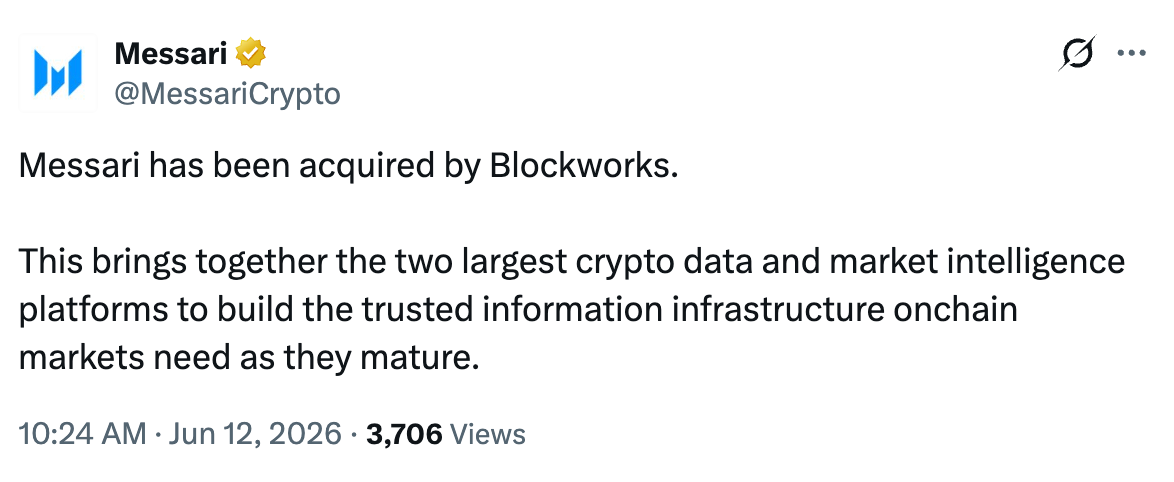
Crypto data and media company Blockworks has acquired analytics firm Messari for more than $10 million, according to a Wall Street Journal report.
Messari is a crypto research and analytics company backed by investors including Brevan Howard Digital and Point72 Ventures. The company raised $35 million in a Series B funding round in 2022 that valued it at around $300 million.
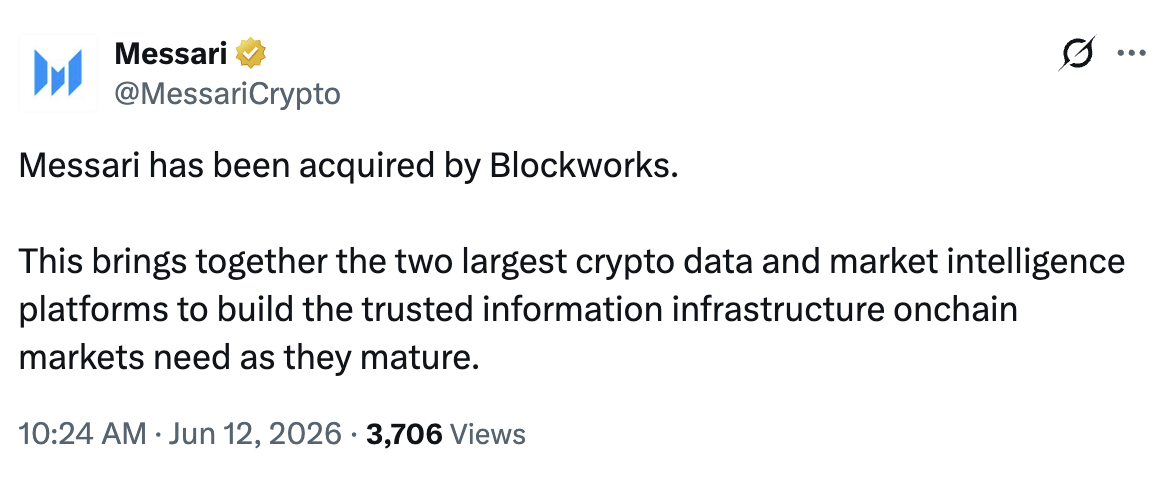
Source: Messari
According to The Wall Street Journal, the steep discount reflects both Messari’s recent struggles and broader weakness across the crypto sector.
Earlier this year, Messari replaced CEO Eric Turner with Diran Li and reduced headcount as part of a broader shift toward artificial intelligence. In a LinkedIn post announcing the change, Li said the company had “parted ways with many teammates” while transitioning to an “AI-first company.”

Source: LinkedIn, Diran Li
Founded in 2018, Blockworks began as a crypto media and events company before expanding into research and data products. In April, the company announced a Series A extension at a $192 million valuation.
In a blog post announcing the acquisition, Blockworks said Messari provides data coverage for more than 40,000 digital assets and operates an API used by investors, exchanges and developers. The company said the combined business would expand its market data, research, compliance and investor-relations offerings.
In a separate post on X, Messari wrote that existing users would continue to have uninterrupted access to its enterprise services and APIs following the deal.
Related: Metaplanet to form securities arm through Siiibo acquisition
M&A activity reshapes crypto intelligence sector
The Blockworks-Messari deal comes amid a broader wave of consolidation across crypto data, research and media platforms.
Earlier this month, Paris-based crypto data firm Kaiko acquired Amberdata, a US-focused digital asset data provider, to expand its offerings in derivatives analytics, onchain data and AI-powered research tools.
Kaiko said the acquisition would help it serve institutional clients including banks, asset managers, hedge funds and exchanges, while adding Amberdata’s derivatives analytics and options data products. The company described the transaction as part of a broader strategy to consolidate institutional-grade crypto market data and analytics.
In January, blockchain oracle provider RedStone acquired Security Token Market and its TokenizeThis conference, adding a dataset covering more than 800 tokenized assets across equities, real estate, debt and funds as it expanded its institutional data business.
A few months later, the Jito Foundation acquired SolanaFloor, a Solana-focused news, research and analytics platform, after it shut down following a $40 million treasury wallet breach at parent company Step Finance. The deal revived the publication and kept its editorial team in place.
Magazine: Bitcoin miners are pivoting to AI, so why is the hashrate near ATHs?
SpaceX has surged as much as 20% after its record-breaking Nasdaq debut, pushing its valuation above $2 trillion and triggering one of the largest waves of tokenized stock activity seen across crypto markets.
Summary
- SpaceX surged as much as 20% after its Nasdaq debut, lifting its valuation above $2 trillion and fueling demand across crypto-linked stock products.
- Analysts warned the record $75 billion IPO could pull capital from crypto, but Bitcoin, Ethereum, and the broader digital asset market moved higher.
- Binance, Hyperliquid, Backpack, Sunrise, and Velvet emerged among the biggest beneficiaries as traders rushed into tokenized and synthetic SpaceX exposure.
After pricing its initial public offering at $135 per share, SpaceX opened at $150 and climbed to as high as $173.22 during early trading. The company raised approximately $75 billion in the largest IPO on record, valuing the aerospace giant at around $1.77 trillion at listing before the market capitalization crossed the $2 trillion mark.
The rally immediately placed SpaceX among the most valuable companies in the United States, ahead of firms including Meta, Tesla, and Broadcom. Investor demand remained exceptionally strong throughout the offering process, with reports indicating orders exceeded $350 billion before trading began.
Crypto markets became a parallel venue for SpaceX trading
While the IPO dominated Wall Street headlines, it also sparked a frenzy across crypto markets as traders sought exposure through tokenized shares, synthetic assets, and derivatives products.
Earlier reporting by crypto.news noted that Backpack Securities and Sunrise launched SPCX, a Solana-based token backed by underlying SpaceX shares that eligible users can convert into actual stock. Binance Wallet also attracted roughly $557 million in subscription funds for its SpaceX-linked campaign, which offered tokens at an indicative price of 135 USDC before fees.
Interest spread beyond tokenized shares into derivatives markets. Hyperliquid’s synthetic SPCX perpetual contract became one of the most actively discussed products tied to the listing, with implied valuations trading above the IPO price before the debut. The activity coincided with HYPE futures open interest climbing to $2.56 billion, allowing Hyperliquid to overtake XRP in futures open interest.
Elsewhere, Velvet became one of the biggest beneficiaries of the SpaceX narrative. The token rallied more than 1,400% over the past week after the platform promoted synthetic SpaceX exposure through its SPCX market.
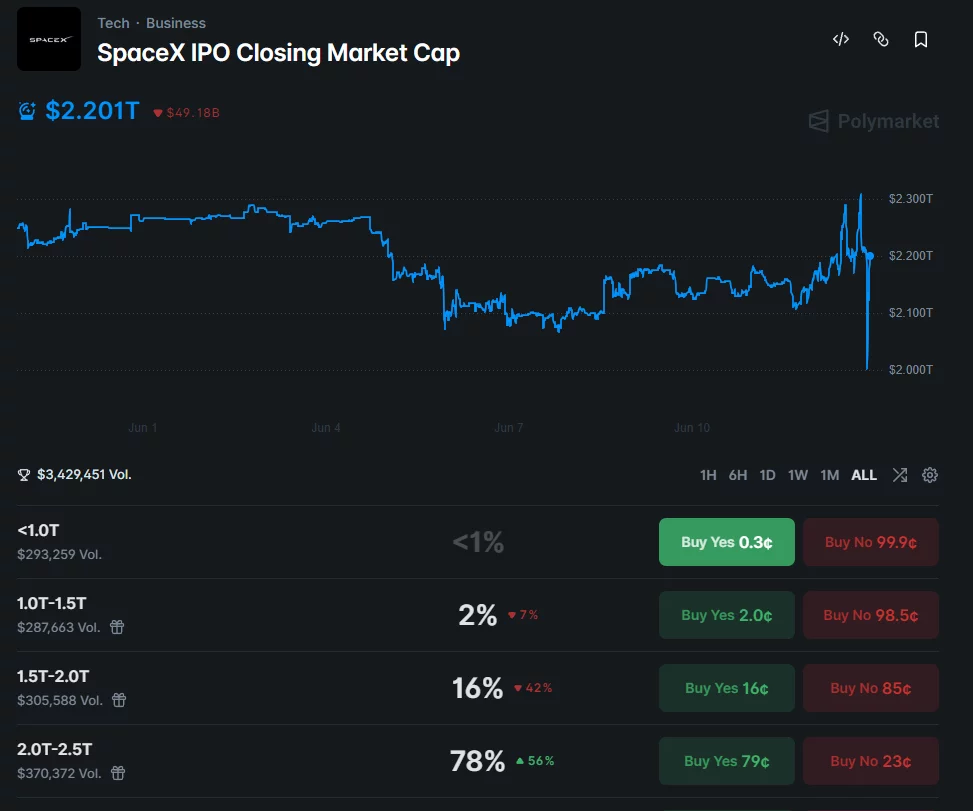
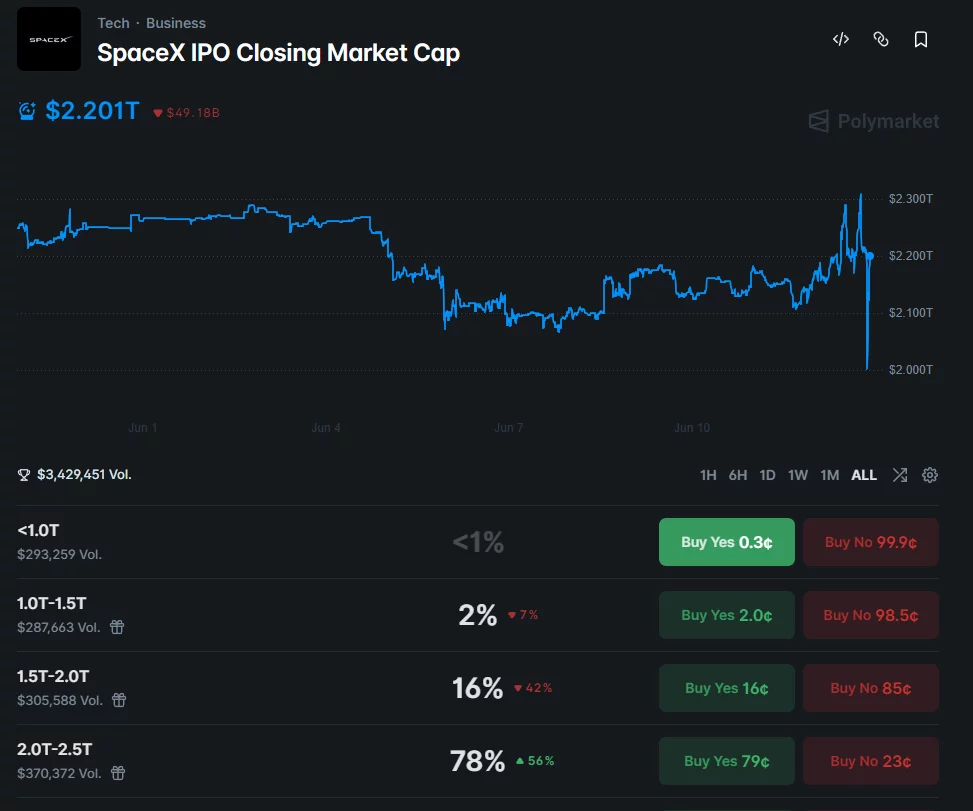
Prediction markets also joined the speculation. A Polymarket contract tracking SpaceX’s closing valuation showed traders assigning roughly 78% odds that the company would finish its debut session with a market capitalization between $2 trillion and $2.5 trillion.
Analysts warned of crypto outflows but markets moved higher
Some market participants had expected the largest IPO in history to divert capital away from digital assets.
Speaking to Reuters, Spencer Hallarn, global head of over-the-counter trading at GSR, said crypto often serves as a funding source for major investments.
“We’ve got to find $75 billion for this IPO, and it’s got to come from somewhere,” Hallarn said.
Thomas Puech, chief executive of crypto firm INDIGO, similarly told Reuters that SpaceX could draw money away from digital assets because both markets compete for the same pool of risk capital. According to Puech, artificial intelligence investments currently represent a more attractive trade for many growth-focused investors.
So far, however, little evidence suggests a broad crypto liquidity drain has materialized. The global cryptocurrency market capitalization rose 1.7% to $2.26 trillion during the session. Bitcoin gained roughly 2%, Ethereum added 1.8%, XRP rose 2.2%, and Solana advanced 3.5%.
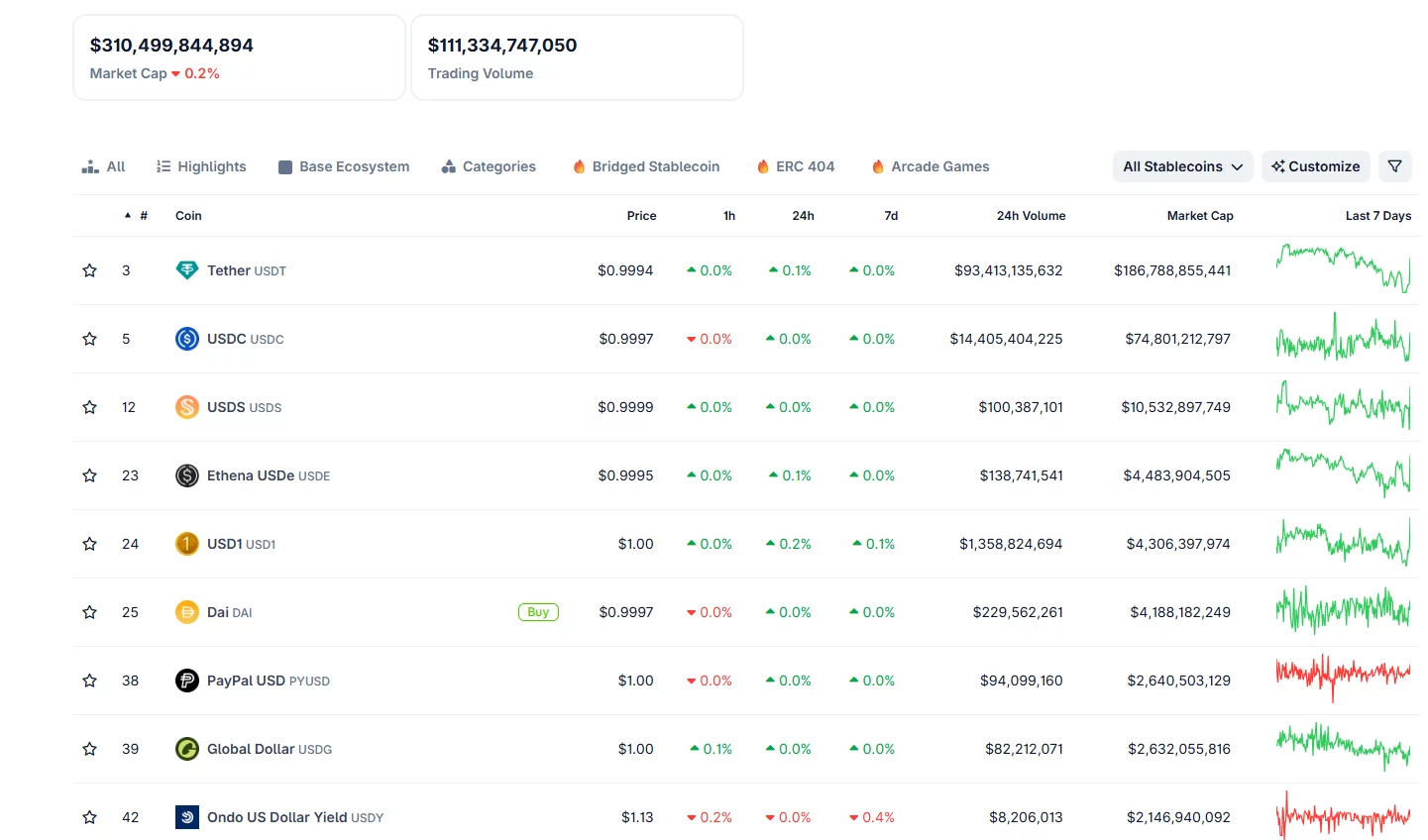
Stablecoins also showed little sign of stress. USDT maintained a market capitalization of roughly $186.8 billion while USDC remained near $74.8 billion, with both assets holding close to their dollar pegs.
SpaceX’s valuation remains a subject of debate despite the strong debut. Morningstar analysts have estimated a fair value of roughly $63 per share, far below the IPO price, while some bullish forecasts have projected a move toward $190.
Senator Elizabeth Warren also urged the SEC to delay the offering, citing what she described as “unprecedented threats to investor protection and market integrity,” while questioning the company’s valuation, governance structure, and reported multibillion-dollar losses.
For crypto markets, the bigger takeaway may be what happened around the IPO rather than the stock itself. Instead of draining liquidity from digital assets, SpaceX helped create a new trading narrative centered on tokenized equities, synthetic shares, and prediction markets.
With options on SpaceX shares expected to begin trading next week and investors already looking toward potential future listings from companies such as OpenAI and Anthropic, market participants are now watching whether the surge in tokenized stock activity can outlast the excitement surrounding the largest IPO in history.
Disclosure: This article does not represent investment advice. The content and materials featured on this page are for educational purposes only.

This Bitcoin Opportunity Everyone’s Missing Right Now

Top GMP officer from Bolton in King’s Birthday Honours

SpaceX IPO raises $75B in largest public market debut in history


![Cardi B - Money [Official Music Video]](https://wordupnews.com/wp-content/uploads/2026/02/1770603085_hqdefault-80x80.jpg)

-
 Entertainment6 days ago
The Best Mystery Series of All Time Is Surging on Streaming 30 Years After It Ended
-

 NewsBeat5 days ago
Alexander Zverev wins the French Open to finally earn a 1st Grand Slam title
-

 Crypto World5 days ago
Anatomy of the June crypto crash: Fed, Iran, Saylor
-

 Crypto World1 day ago
Oppenheimer backs SpaceX as $70 billion retail frenzy builds
-

 Tech7 days ago
Suspicious Polyfill login prompts pop up on Toshiba, Muji websites
-

 Crypto World1 day ago
Markets Rally as SpaceX IPO Looms Amid Iran Tensions and Inflation Surge
-
Crypto World6 days ago
Senator Cynthia Lummis Calls CLARITY Act the Most Consequential Financial Legislation of This Generation
-
 NewsBeat5 days ago
Alexander Zverev conquers demons and outlasts Flavio Cobolli to win French Open for first major title
-

 Tech6 days ago
Microsoft unveils seven homegrown AI models in new bid for ‘long term self-sufficiency’
-

 Business5 days ago
High Stakes for Wembanyama as New York Pushes for 3-0 Lead
-

 Tech7 days ago
Hackers now exploit SolarWinds Serv-U flaw to crash servers
-
 Business6 days ago
The Pain Points Taking a Fragile Tech Rally Down a Notch
-
 Crypto World5 days ago
Eli Lilly (LLY) Stock Surges 4% Following Breakthrough Sleep Apnea Trial Results
-

 Tech5 days ago
Notion restores access to Anthropic after service disruption
-

 Crypto World6 days ago
Trump’s AI Ownership Plan Could Benefit Anthropic at OpenAI’s Expense
-
 Business6 days ago
The investment to transform historic St Helen’s ground in Swansea
-
 Sports3 days ago
Bangladesh beat Australia after 20 years in ODIs, register only their second win over six-time world champions | Cricket News
-

 Business7 days ago
Forensic Expert Floats Handyman Theory in Disappearance of Savannah Guthrie’s Mother
-

 Tech11 hours ago
This Week In Security: Microsoft On Microsoft, Register Your Domains, Linux On ARM, And FreeBSD Joins The File Cache Club
-

 Sports2 days ago
First Time Since 1971: Australia Register Historic Low In ODI Cricket
You must be logged in to post a comment Login