

Business
Asian grocery brands are evolving beyond the ‘ethnic aisle’


When Candice Choi launched her Korean seaweed snack brand, Geem, in 2023, she thought the company would be strictly direct-to-consumer, with its marketing strategy relying primarily on TikTok.
But within three months, the seaweed snacks were on the shelves of grocery stores, including some Whole Foods locations, where Geem chips sit next to kale chips and veggie straws.
“There was so much confluence of people being really excited about our snacks and stores really willing to take us on that was really, really exciting,” Choi told CNBC. “Traditionally, buyers are gatekeepers, and it takes years and years and years to develop those relationships, but they saw the category was growing, and we’ve been performing.”
Because of its explosive demand, Geem will be launching in Whole Foods stores across Southern California, Nevada, Arizona and Hawaii in July, the company told CNBC exclusively.
Geem’s growth is indicative of a larger trend: As demand for global flavors in the U.S. rises, Asian grocery items are getting more of a spotlight in mainstream grocery stores, signaling an evolution beyond the traditional “ethnic aisle” of years past.
Those aisles typically included a limited selection of international products, often offering primarily sauces or oils. Now, grocery stores look much different.
An aisle sign at Whole Foods on May 27, 2026.
Natalie Rice | CNBC
“People are being exposed to newer flavors earlier on, and it’s no longer that weird snack that maybe you try once and you’re like, ‘No,’” Choi said. “It’s really exciting, and we’re seeing that taste profile really influence consumer demand. And you can see it in the numbers. Asian snacking is expected to go to multiple billions in the end of 2030, and that’s just the snacking.”
Research from global investment banking advisor BDA Partners estimates that the “ethnic aisle” generated $8.8 billion in sales in 2024, with Asian products growing nearly four times faster than the overall grocery sales. The U.S. Asian food market is projected to grow to $51.3 billion by 2031, with a 4.7% compounded annual growth rate, BDA said.
According to data from market research firm Circana, sales of Asian grocery items jumped from $1.57 billion in 2021 to over $2.31 billion this year.
That growth is multifaceted, Circana analyst Sally Wyatt told CNBC. The Pew Research Center has reported that the Asian population in the U.S. has more than doubled since 2000, growing to a 7% share of the total population. As that population grows, Wyatt said, so too has its influence, introducing new flavors to the rest of the country.
It’s a trend playing out at restaurants, too, but at a time when eating out is 4.3 times the cost of cooking at home, Wyatt said, the dynamic is most apparent in grocery stores.
“Especially as younger consumers are exploring, as consumers want to travel but maybe can’t, we do see that food and beverage is just a perfect way to get a taste of a culture that you might not be able to do every day,” she said. “So the flavors provide some unique experiences and can allow for culture exploration through food.”
Asian brands going mainstream
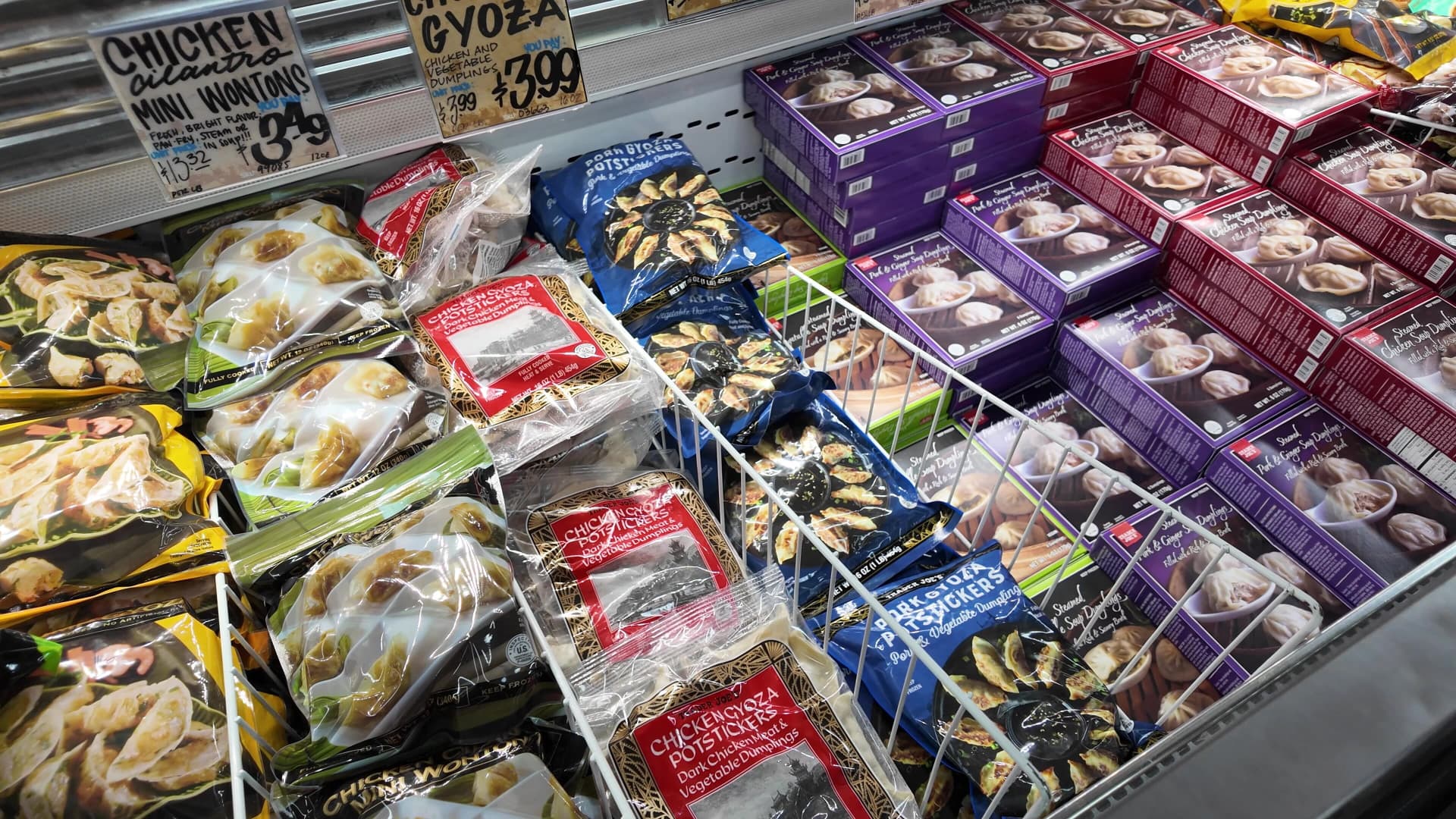
A food display of wontons, gyoza and dumplings is seen at Trader Joe’s on May 26, 2026.
Natalie Rice | CNBC
Some of the segments seeing the most growth are condiments, sauces and frozen foods, Wyatt said. The growth is driving those products out of the traditional “ethnic aisle,” with Asian flavors placed next to American ones as mainstream grocery stores work toward being a one-stop shop for all consumers.
“I could go down each aisle, and all of them have been touched by the ethnicity of different cultures, flavors, combinations,” Wyatt said. “You’ve started to see those go into more mainstream because these retailers are wanting to appeal to not just the Asian consumer, but the consumer that wants to have the Asian exploration and Asian flavor combinations.”
Specialty grocers are expanding rapidly, too. Chains such as H Mart, Patel Brothers and 99 Ranch Market are opening new locations around the country, offering large selections of Asian products.
In the frozen food section, Deep Brands is serving Asian flavors to a diverse customer base that reflects the country, not just an Asian population, according to General Manager Kiernan Laughlin.
“Our overall purpose is to elevate global flavors and make them more accessible to all consumers, regardless of what ethnicity they’re from,” Laughlin told CNBC. “And what’s really interesting about these trends is people initially may think Asian flavors, global flavors, are growing specifically because that population is growing … but it’s agnostic to ethnicity.”
Deep Brands includes Deep Indian Kitchen, a legacy brand available in more than 25,000 stores, and Thai brand Tem Toa, which is available in Target. Laughlin said the Indian frozen food brand has grown exponentially and holds 51% market share of frozen Indian food nationwide, meeting growing demand driven by high-income millennials and members of Generation Z.
Deep Brands products are also sold in mainstream aisles of grocery stores, Laughlin added, serving as easy access points for non-Asian consumers as well. It expects to surpass $110 million in syndicated retail sales this year, he said.
“If you look at the ‘ethnic aisle,’ or you look at the ethnic grocery channel, generally speaking, that’s targeting people of a specific ethnicity, or it’s a multicultural consumer,” Laughlin said. “There’s a business there as well, but what our thesis is on Deep Brands and who we serve is the consumer of all ethnicities who want an authentic, premium, global flavors experience. So that’s where we sit in the store as well, and we’ve had great success with that.”
How Whole Foods and Target are expanding Asian food offerings
Gymkhana sauces are seen on the shelves at Whole Foods on May 27, 2026.
Laya Neelakandan | CNBC
Amazon‘s Whole Foods has also been increasing its investments in Asian flavors. Category merchant Julie Bandin said the grocery giant has seen demand grow “pretty tremendously,” and it’s also an area that’s seeing a lot of innovation.
Bandin said the growing interest is primarily driven by consumers who want to be more adventurous in the kitchen and are seeking out new items to help with that.
“We sell products that they can’t find anywhere else, and that really is a great bridge with our Asian brands,” Bandin said. “Every placement is intentional. It’s designed to spark curiosity … [by] getting that product straight to the consumer’s mouth.”
She added that the store is seeing Asian flavors emerge across categories, including beverages, sauces, frozen foods and more. After Indian sauce brand Gymkhana came to stores earlier this year, Bandin said, its explosive growth lifted the entire subcategory, including some legacy brands that weren’t otherwise seeing gains.
“Radically, across the store with these different categories … you just kind of see them marry up together, and that’s the hope for me — to see more proliferation in these flavor profiles, or in these Asian-specific brands that can be cross-merchandised,” Bandin said.
A Target spokesperson told CNBC that the company has seen demand for the Asian food and beverage category continue to grow. It’s been expanding the number of products and shelf space, including with recent additions such as ramen bowls and Asian Oreo flavors.
Choi, the founder of Geem seaweed snacks, said seeing her products in mainstream grocery stores means coming full circle for her experience as an Asian American.
Growing up, Choi said, her parents frequented both a specialty Asian store and a mainstream grocery store to stock their kitchen.
“Now, I just walk them to Whole Foods, and I’m like, ‘Look, my product! Our flavors are on the shelf,’” Choi said. “To them, that’s a true sign that they’ve made it. … it’s true acceptance from other cultures towards us for being who we are, unapologetically.”
— CNBC’s Natalie Rice contributed to this report.


Money-market funds have a lot going for them right now. Not only do they offer safety from turbulent markets, but investors can also earn an attractive 3.45% yield, according to Crane’s index of the 100 largest money-market funds. That’s down from 3.58% at the start of the year, but stable for the past few months and quite a bit higher than most investors expected for midyear.


World Cup bus set alight as chaotic celebrations erupt in Manhattan after Knicks win

Chipotle and 5 More Restaurant Stocks That Look Appetizing

The Index Says Euphoria. But Don’t Panic.

Robinhood Insider Buys $35 Million in Stock. There’s a Catch.

Quantum Insiders Are Selling Millions Worth of Stock. Does It Matter?

A coalition of state attorneys general has opened an investigation into OpenAI, according to people familiar with the matter, the latest in a series of legal actions by states directed at artificial intelligence companies.
OpenAI was served Friday with a subpoena seeking documents related to a range of its activities and impact on users, including advertising, user engagement and retention, handling of consumer data and health data, activities related to minors and seniors, deep learning models, model sycophancy and company policies, some of the people said. The subpoena, viewed by The Wall Street Journal, was sent by New York’s attorney general.
Copyright ©2026 Dow Jones & Company, Inc. All Rights Reserved. 87990cbe856818d5eddac44c7b1cdeb8

Quanta Services’ AI-Fueled Run Isn’t Done

Bobbie co-founder and CEO Laura Modi joins ‘Mornings with Maria’ to explain raising funds while pregnant, building U.S. manufacturing in Ohio and expanding her formula to new stores.
Federal health officials are urging parents to immediately stop using a popular organic infant formula after three babies were hospitalized with botulism in a multistate outbreak linked to the product.
The Centers for Disease Control and Prevention said all three infants consumed Nara Organics Whole Milk Organic Infant Formula before becoming ill.
The babies, who ranged in age from 2 to 5 months, were hospitalized and treated with BabyBIG, the FDA-approved treatment for infant botulism.
The cases were reported in California, Pennsylvania and Washington, according to the CDC.
POPULAR PET FOOD BRAND HALTS PRODUCTION AFTER FDA WARNS OF POSSIBLE DANGEROUS CONTAMINATION
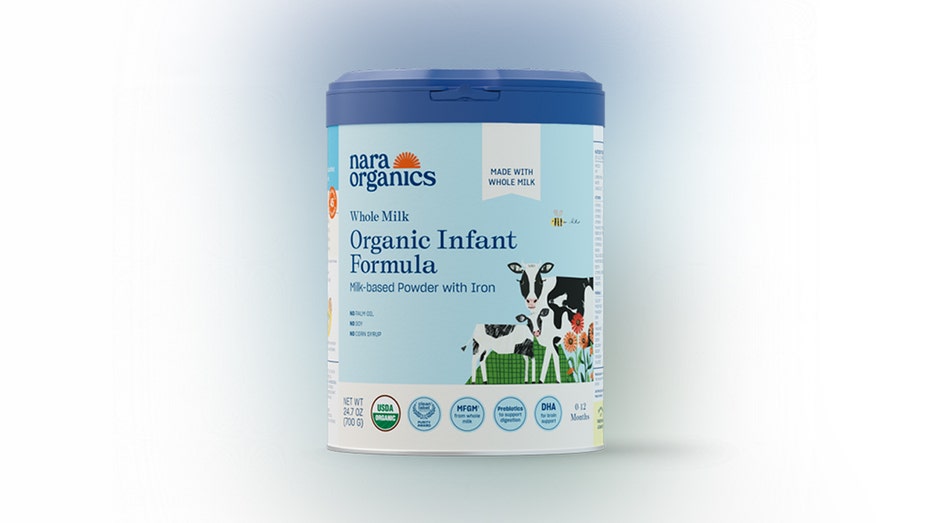
Federal health officials are urging parents to stop using Nara Organics Whole Milk Organic Infant Formula after three infants were hospitalized with botulism. (Food and Drug Administration / Unknown)
Nara Organics on Friday recalled all lots and can sizes of its Whole Milk Organic Infant Formula, and federal health officials are investigating whether the product was the source of the outbreak.
Testing of opened and unopened formula samples is underway, with results expected in the coming weeks.
Nara Organics confirmed the recall in a statement posted on its website.
THREE MAJOR HOSPITAL SYSTEMS ACCUSE CVS OF SECRETLY SIPHONING HUNDREDS OF MILLIONS IN DRUG SAVINGS

Three infants were hospitalized with botulism in a multistate outbreak linked to recalled Nara Organics infant formula, according to the CDC. (Nathan Posner/Anadolu Agency via Getty Images / Getty Images)
“Stop using all Nara Organics infant formula immediately,” the company wrote. “We are heartbroken for the concern and stress this may cause your family.”
The formula is sold nationwide through Target stores, Target.com and Nara.com.
The CDC advised parents and caregivers to throw away or return any unopened cans of the recalled formula.
FDA ISSUES HIGHEST-RISK RECALL FOR ALFREDO SAUCE SOLD IN 41 STATES

Three infants ranging in age from 2 to 5 months were hospitalized after consuming the recalled formula, federal health officials said. (iStock / iStock)
Officials said opened cans may be retained and stored separately if an infant develops symptoms, as state health departments may request samples for testing.
According to the CDC, infant botulism occurs when spores from Clostridium botulinum bacteria enter a baby’s digestive tract and produce a dangerous toxin.
GET FOX BUSINESS ON THE GO BY CLICKING HERE
Early symptoms can include constipation, difficulty feeding, a weak or altered cry and loss of head control.
Parents should seek immediate medical attention if an infant who consumed the recalled formula develops symptoms including poor feeding, difficulty swallowing, decreased facial expression or loss of head control, health officials said.

Business partnerships can try men’s souls—never mind the wallets of those who invest in them. So far, though, the tie-up between super-investors Bruce Flatt, CEO of Brookfield, and Howard Marks, co-chairman of Oaktree Capital Management, seems to be mostly friction-free and fruitful.

Officials rule Haitian asylum seeker’s death a homicide

Amazon Warning Triggered Anthropic’s Shutdown of Claude Fable and Mythos Models

All 8 Movies Are Leaving Streaming Next Month


-

 NewsBeat6 days ago
Alexander Zverev wins the French Open to finally earn a 1st Grand Slam title
-

 Crypto World6 days ago
Anatomy of the June crypto crash: Fed, Iran, Saylor
-

 Crypto World3 days ago
Oppenheimer backs SpaceX as $70 billion retail frenzy builds
-
 NewsBeat7 days ago
Alexander Zverev conquers demons and outlasts Flavio Cobolli to win French Open for first major title
-

 Crypto World3 days ago
Markets Rally as SpaceX IPO Looms Amid Iran Tensions and Inflation Surge
-

 Tech7 days ago
Microsoft unveils seven homegrown AI models in new bid for ‘long term self-sufficiency’
-

 Business6 days ago
High Stakes for Wembanyama as New York Pushes for 3-0 Lead
-

 Tech6 days ago
Notion restores access to Anthropic after service disruption
-

 Sports6 days ago
FIFA WC 2026 Group C: Morocco, Scotland challenge Brazil’s hunt for glory | FIFA World Cup 2022
-
 Crypto World6 days ago
Eli Lilly (LLY) Stock Surges 4% Following Breakthrough Sleep Apnea Trial Results
-

 Crypto World7 days ago
Trump’s AI Ownership Plan Could Benefit Anthropic at OpenAI’s Expense
-
 Sports5 days ago
Bangladesh beat Australia after 20 years in ODIs, register only their second win over six-time world champions | Cricket News
-

 Fashion2 days ago
Weekend Open Thread: Tuckernuck – Corporette.com
-

 Tech1 day ago
NanoClaw integrates JFrog registries to secure AI agent downloads
-

 Crypto World1 day ago
Bitget enters Argentina’s regulated crypto market through PSAV registration
-

 Tech2 days ago
This Week In Security: Microsoft On Microsoft, Register Your Domains, Linux On ARM, And FreeBSD Joins The File Cache Club
-

 Politics3 days ago
Politics Home | Healey Resignation Is “Colossal Failure Of Government”, Says Former Labour Defence Secretary
-

 Sports3 days ago
First Time Since 1971: Australia Register Historic Low In ODI Cricket
-
 Entertainment3 days ago
Donnie Wahlberg & More Heat Up Las Vegas at Circa’s Barry’s Downtown Prime
-

 Entertainment5 days ago
The Ryan Gosling True Crime Thriller On Netflix That Gets Even Stranger, Stream It Now
You must be logged in to post a comment Login