

Crypto World
FedEx Freight (FDXF) Spinoff Goes Live June 1: Everything You Need to Know


Key Takeaways
- FedEx Freight launches as an independent company on June 1 trading under ticker FDXF
- Shareholders of FedEx receive one FDXF share for every two FDX shares owned; parent company maintains approximately 20% ownership
- When-issued trading shows FDXF around $185 per share, though analysts believe fair value could reach $275 based on Old Dominion comparables
- Management projects medium-term revenue growth of 4%–6% with operating profit expansion of 10%–12%
- Parent company FDX carries a consensus Strong Buy rating from 21 Wall Street analysts with a $423.15 average target price
The separation of FedEx Freight from its parent company is finally arriving. The less-than-truckload (LTL) division launches independent trading on Monday, June 1, debuting on the New York Stock Exchange under ticker FDXF.
As the LTL division of FedEx, this business caters to industrial clients requiring freight transportation over shorter routes without needing full truckload capacity. The company competes directly with established players like Old Dominion Freight Line and XPO.
This spinoff represents the culmination of a strategic shift. FedEx has been streamlining operations to concentrate on its primary express shipping and logistics segments. Though consistently profitable, the Freight division represented a relatively modest component of the overall enterprise.
For fiscal 2026, FedEx Freight projects revenue of $8.7 billion alongside operating income of $1.1 billion. To put this in perspective, the remaining FedEx operations are forecast to generate nearly $94 billion in revenue during the same period.
In when-issued trading ahead of the official launch, FDXF shares have been exchanging hands near $185. This represents the market’s preliminary assessment before the stock formally begins regular trading.
The Valuation Opportunity
This is where the situation becomes compelling. Old Dominion, widely regarded as the premier LTL operator, commands a forward earnings multiple approaching 40x. Meanwhile, FedEx as a consolidated entity trades at approximately 18x forward earnings. This substantial valuation disparity provides the fundamental rationale for executing this separation.
Should FDXF achieve valuation parity with Old Dominion’s trading multiple, Wall Street analysts project a fair value near $275 per share — representing nearly 50% appreciation from current when-issued levels.
However, Old Dominion maintains superior profitability metrics. The company is projected to generate approximately $1.5 billion in operating profit from $5.7 billion in revenue during 2026, reflecting materially higher margins than FDXF currently achieves.
Narrowing this margin differential will be critical for FDXF to justify a comparable valuation multiple. Management has established targets for 10%–12% annual operating profit growth over the medium term, which should support margin improvement.
For reference, Old Dominion has delivered roughly 8% average annual operating profit growth over the trailing five-year period. Analysts project this growth rate will accelerate to approximately 11% moving forward — essentially matching FDXF’s stated objectives.
Distribution Details for Existing Shareholders
Current FedEx shareholders will receive one FDXF share for every two shares of FDX held as of the established record date. The parent company will retain approximately 20% ownership in the freight operation following completion of the spinoff.
FDX stock has demonstrated robust momentum leading into this separation event — gaining more than 40% year-to-date and climbing over 80% during the trailing twelve-month period through Friday’s close.
From an analyst perspective, FDX maintains a consensus Strong Buy rating based on recommendations from 21 Wall Street analysts, comprising 17 Buy ratings, 3 Hold ratings, and 1 Sell rating. The consensus price target stands at $423.15, suggesting approximately 3% upside from prevailing price levels.
FDXF commences regular-way trading on Monday, June 1.




Sui (SUI) trades between $1.06 and $1.24 in late May 2026, recovering from a winter that took it 79% below its January 2025 high of $5.35.
Summary
- Sui’s 18% rally in May 2026 followed corporate staking activity, Paga’s $11 billion USDsui integration, CME futures approval, and the launch of gasless stablecoin transfers.
- The bullish outlook depends on USDsui adoption, successful delivery of the S2 roadmap, stronger ETF inflows, and wider use of Sui across payments and developer ecosystems.
- Risks include weak USDsui growth, ongoing token unlock pressure, future network outages, and stronger competition from rival blockchain networks.
Two specific events on May 9 and 10 drove an 18% jump. A Nasdaq-listed company disclosed it had staked roughly 2.7% of SUI’s circulating supply. Paga Group, the Nigerian fintech that processed $11 billion in payments and 169 million transactions last year, announced it would route its enterprise products through Sui using USDsui.
The native stablecoin USDsui launched in March 2026, designed to recycle yield into SUI buybacks, creating a direct value capture mechanism. On May 20, 2026, Sui launched protocol-level gasless stablecoin transfers with Fireblocks support, dropping stablecoin transfer fees to $0.00 without requiring users to hold SUI.
CME Group launched SUI futures on May 29, 2026. Institutional access has multiplied: 21Shares Spot SUI ETF (TSUI) has been trading on Nasdaq since February 2026, Grayscale filed an S-1 for a dedicated Sui Trust, VanEck runs a European Sui exchange-traded product, major custodians including Crypto.com added regulated SUI custody.
Native WBTC bridge and compliant USDsui stablecoin live through BitGo, LayerZero, and payment partners. The S2 (Sui StackStack) roadmap targets evolution from L1 to a unified developer platform with native privacy and gasless stablecoin transfers. DeepBook v3 upgrade introducing margin trading and a referral commission model.
The honest read: Sui in 2026 has the cleanest answer crypto has produced to how a Layer-1 captures value from stablecoin flow rather than ceding it to USDC and USDT. The mechanics are real. The execution risk sits on USDsui actually scaling, on S2 shipping as promised, on the January 2026 mainnet outage not having a sequel, and on Move’s safety advantages translating to developer migration rather than staying a niche pitch.
This piece walks through the mechanics, the bull case ($6 to $15 by 2030), the base case ($2 to $4), and the bear case ($0.50 to $1.20), with the variables that determine which one materializes.
Why Sui is at $1.10 right now
The current Sui price reflects recovery from January 2026 outage damage and broader altcoin weakness, plus specific institutional and consumer adoption catalysts emerging through Q1-Q2 2026.
The starting point: SUI peaked at $5.35 on January 6, 2025. The decline through 2025-early 2026 to current ~$1.10 levels (79% drawdown from peak) reflected broader altcoin weakness, January 2026 mainnet outage damaging institutional confidence, monthly token unlock sell-pressure as vesting schedules continued, and competitive dynamics where Solana captured high-performance Layer-1 institutional attention.
The institutional infrastructure development: 21Shares Spot SUI ETF (TSUI) began trading on Nasdaq in February 2026 as the first spot SUI ETF. Grayscale filed an S-1 registration for a dedicated Sui Trust, providing a U.S institutional vehicle for buy-and-hold exposure. VanEck operates an exchange-traded Sui product in Europe that quietly built liquidity through 2024-2025. Major custodians including Crypto.com added regulated SUI custody. The infrastructure expansion enables institutional access through familiar compliance stacks rather than requiring offshore exchange accounts.
The USDsui native stablecoin: launched March 2026, USDsui is Sui’s native stablecoin designed with a distinctive feature: recycling yield into SUI buybacks. The mechanism creates direct value capture from stablecoin operations flowing back to SUI demand. This is different in kind from typical stablecoin economics where stablecoin issuer profits don’t directly benefit the underlying blockchain token.
The gasless stablecoin transfers: on May 20, 2026, Sui launched protocol-level gasless stablecoin transfers with Fireblocks support. The feature enables peer-to-peer stablecoin transfers on Sui without requiring users to hold SUI, dropping current stablecoin transfer fees to $0.00. The user experience improvement addresses one of the major friction points for stablecoin adoption: requiring users to hold native gas tokens.
The Paga integration: Paga Group’s $11 billion fintech integration with Sui represents one of the most concrete emerging market consumer crypto adoption developments in 2026. Paga processed 169 million transactions in 2025. The integration uses USDsui for emerging market payments and plans to support stablecoin payments and tokenized real-world asset products. The partnership links Sui to real payment infrastructure with substantial existing user base.
The institutional staking catalyst: May 9, 2026, a Nasdaq-listed company disclosed staking approximately 2.7% of SUI’s circulating supply. The institutional staking removes tokens from liquid supply and signals public company comfort with long-term SUI position. The 13% initial price jump on this news showed market sensitivity to institutional staking commitments.
The CME futures expansion: CME Group launched SUI futures on May 29, 2026. The expansion provides regulated derivatives access for institutional traders. CME futures historically correlate with broader institutional adoption patterns (Bitcoin futures preceded ETF approval, Ethereum futures expansion accompanied ETF approval pathway).
The S2 (Sui StackStack) roadmap: 2026 plan to evolve Sui from a Layer-1 to a unified developer platform with native privacy and gasless stablecoin transfers. DeepBook v3 upgrade introducing margin trading and referral commission model. The roadmap addresses developer experience improvements and protocol functionality expansion.
The Move language differentiation: Sui’s foundational technology uses the Move programming language (originally developed for Diem/Libra), designed specifically for safe digital asset programming. The Move advantage is technical: object-oriented design preventing common smart contract vulnerabilities, native parallel execution, formal verification capabilities. While EVM compatibility may be more accessible for developer migration, Move provides genuine technical differentiation for assets requiring safety guarantees.
The bridge infrastructure: native trust-minimized bridge to Ethereum (delivered Q3 2025) plus WBTC and USDsui support provides credible two-way liquidity flows with Ethereum’s DeFi base. Assets can move from Ethereum into Sui’s high-speed environment without relying on opaque multisig bridges.
The competitive position: SUI is consolidating around $1.10 levels, positioned between Solana’s high-performance institutional positioning and Ethereum’s deep DeFi institutional infrastructure. The market is determining whether SUI achieves recognition as a serious Layer-1 alongside SOL and Ethereum L2s or remains in the “narrative alt” category.
What the price action signals structurally: SUI’s recovery from January 2026 lows reflects market repricing for the new institutional infrastructure (ETF, futures, custody) plus USDsui buyback mechanism creating demand. The current $1.10 level reflects partial repricing with significant additional appreciation depending on USDsui adoption scaling and S2 roadmap execution.
The bull case: $6-$15 by 2030
The bull case for Sui requires USDsui scaling plus successful technical execution across the S2 roadmap.
The USDsui adoption: native stablecoin scales from current launch state to $5-10B+ market cap by 2030. The yield-to-buyback mechanism recycles stablecoin operations profits into SUI demand. At $5B USDsui market cap with 4-5% yield, approximately $200-250M annually flows into SUI buybacks. The ongoing buying creates demand absorption comparable to other major buyback mechanisms in crypto.
The gasless transfer dominance: protocol-level gasless stablecoin transfers position Sui as primary infrastructure for stablecoin payments globally. The user experience advantage drives adoption from competitors requiring native gas token holdings. Stablecoin volume on Sui scales to be top-tier among Layer-1 chains. Network effects compound as more applications integrate gasless stablecoin transfers.
The Paga-style expansion: emerging market fintech partnerships expand beyond Paga to additional major fintechs globally. Combining USDsui (compliant stablecoin), gasless transfers (no UX friction), and Move language (safety guarantees) attracts emerging market payment infrastructure. Africa, Southeast Asia, and Latin America fintechs adopt Sui as primary blockchain.
The S2 roadmap execution: Sui StackStack delivers across all phases. Native privacy capabilities attract institutional and high-value use cases. DeepBook v3 with margin trading captures meaningful DEX volume. Gasless stablecoin transfers become protocol standard. Developer platform evolution attracts substantial application development.
The Move language adoption: developer migration from Solana and Ethereum accelerates as developers recognize Move’s safety and parallel execution advantages. Major DeFi protocols deploy on Sui. Sui captures a meaningful share of new DeFi development. The technical differentiation translates to ecosystem traction.
The institutional ETF flows: 21Shares TSUI scales from current AUM to $500M-$1B+. Grayscale Sui Trust receives approval and accumulates significant AUM. Additional ETF products launch. Institutional flows give demand support comparable to other major Layer-1 ETF dynamics.
The CME futures volume: SUI futures attract substantial institutional trading volume following CME launch. The regulated derivatives access enables hedging strategies that support spot accumulation. Open interest growth indicates institutional positioning.
The competitive positioning: SUI achieves recognition as legitimate Layer-1 alongside SOL and Ethereum L2s. Market share among high-performance Layer-1s reaches double digits. Specific use cases (gasless stablecoins, emerging market payments, Move-based DeFi) provide differentiated positioning.
The CLARITY Act benefits: the regulatory framework provides explicit non-security classification. Institutional adoption barriers reduce. Pension funds, insurance companies, and compliance-restricted institutions gain the ability to allocate to SUI.
If multiple bull case conditions materialize, the price targets are:
- 2026 year-end: $2.50-4.50
- 2027 year-end: $3.50-7
- 2028 year-end: $4.50-10
- 2029 year-end: $5.50-13
- 2030 year-end: $6-15
The bull case requires sustained execution across stablecoin adoption, payment partnership expansion, technical roadmap delivery, institutional flow scaling, and competitive positioning maintenance. The wide range reflects uncertainty about how aggressively USDsui scales and how concentrated value capture is among Layer-1 winners.
The base case: $2-$4 by 2030
The base case assumes meaningful but not big progress across catalyst variables.
The USDsui scenario: native stablecoin scales to a $1-3B market cap by 2030. The buyback mechanism functions but at a smaller scale than the bull case. Annual SUI buybacks of $50-150M give structural support without producing supply shock dynamics.
The gasless transfer scenario: protocol-level gasless stablecoin transfers achieve specific use cases without becoming dominant payment infrastructure. Some applications integrate the feature. Others continue using gas-token-based approaches. The user experience improvement is meaningful for specific segments.
The Paga-style partnerships: 2-3 additional major emerging market fintech partnerships beyond Paga. The partnerships are valuable but don’t multiply into a broader adoption pattern. Sui captures specific emerging market niches without dominating global stablecoin payments.
The S2 roadmap execution: most roadmap phases deploy with delays. Native privacy capabilities ship but adoption is gradual. DeepBook v3 launches with moderate user adoption. Developer platform evolution progresses incrementally.
The Move language adoption: continues attracting specific developer segments without widespread migration from Solana or Ethereum. Move advantages appeal to safety-focused use cases. EVM compatibility advantages keep developers on Ethereum and Solana for general-purpose applications.
The institutional flows: TSUI and additional ETFs achieve $100-400M cumulative AUM. CME futures attract moderate volume. Institutional adoption develops gradually without producing big price action.
The competitive dynamics: Sui keeps its position as a significant high-performance Layer-1 alongside Solana, Aptos, and emerging chains. Market share is stable rather than expanding dramatically.
The token unlock pressure: monthly unlocks continue creating sell-pressure overhang. Institutional accumulation offsets some but not all unlock pressure. The supply dynamics remain a structural headwind.
Base case targets:
- 2026 year-end: $1.30-2.20
- 2027 year-end: $1.50-2.80
- 2028 year-end: $1.80-3.20
- 2029 year-end: $2-3.60
- 2030 year-end: $2-4
The base case represents meaningful appreciation from current $1.10 levels plus continued volatility around catalyst developments. The support comes from USDsui mechanism and institutional infrastructure without producing big price action.
The bear case: $0.50-$1.20 by 2030
The bear case requires either Sui-specific setbacks or broader market headwinds disrupting the recovery thesis.
The USDsui failure: native stablecoin fails to achieve meaningful adoption. USDC, USDT, and other stablecoins continue dominating with USDsui captured to specific Sui-ecosystem use cases. The buyback mechanism produces minimal SUI demand at scale.
The technical outage repetition: another mainnet outage similar to January 2026 occurs. Institutional confidence deteriorates. CME futures activity declines. ETF flows reverse as institutions reduce SUI exposure due to reliability concerns.
The competitive displacement: Solana captures high-performance Layer-1 institutional positioning definitively. Aptos or other Move-based competitors capture Move language developer segment. Emerging chains capture specific use cases Sui was positioning for. Market share declines.
The Paga partnership failure: Paga or similar partnerships fail to translate to meaningful USDsui transaction volume. Emerging market crypto adoption uses traditional payment infrastructure rather than blockchain-based alternatives. The partnership pipeline that bull case requires fails to develop.
The S2 roadmap setbacks: significant delays across roadmap phases. Native privacy capabilities fail to attract institutional use cases. DeepBook v3 fails to capture meaningful DEX volume. Developer platform evolution stalls.
The unlock pressure overwhelms: monthly token unlocks continue creating persistent sell pressure. Institutional accumulation insufficient to offset unlock dilution. Plus broader weakness, supply dynamics push price persistently lower.
The Move language adoption failure: developers continue preferring EVM compatibility or Solana’s developer ecosystem. Move advantages prove insufficient incentive for migration. Sui’s technical differentiation doesn’t translate to ecosystem traction.
The institutional withdrawal: TSUI and other ETFs see net outflows. Nasdaq-listed staking position gets reduced or removed. CME futures activity declines. Institutional adoption pathway closes rather than expanding.
The regulatory deterioration: CLARITY Act stalls. SEC takes adverse action under shifting priorities. International regulatory pressure increases. Institutional adoption barriers persist.
The macro deterioration: broader crypto market weakness disproportionately impacts altcoins. Even with strong fundamentals, market dynamics pressure SUI below current support levels.
Bear case targets:
- 2026 year-end: $0.70-1.10
- 2027 year-end: $0.60-1.10
- 2028 year-end: $0.50-1.15
- 2029 year-end: $0.50-1.20
- 2030 year-end: $0.50-1.20
The bear case represents downside from current levels but assumes SUI retains some ecosystem positioning. Complete failure scenarios (price below $0.30) would require severe broader market disruption plus specific catastrophic Sui-related events.
The five variables that determine outcome
Five specific variables determine which scenario materializes.
Variable 1: USDsui market cap and adoption. The single most important variable. Currently in early adoption phase. Bull case requires scaling to $5-10B+. Base case requires $1-3B. Monitor: USDsui market cap growth, transaction volume, integration partnerships beyond Paga, buyback mechanism execution and SUI demand impact.
Variable 2: S2 (Sui StackStack) roadmap execution. Native privacy, DeepBook v3, gasless transfers, developer platform evolution. Monitor: Sui Foundation announcements, technical deliverable completions, specific milestone dates, post-deployment performance, and ecosystem developer activity.
Variable 3: Institutional ETF flows and futures volume. 21Shares TSUI on Nasdaq, Grayscale Sui Trust pending, CME futures May 29 launch. Bull case requires scaling to $500M-$1B+ AUM. Monitor: weekly ETF flow data, additional ETF product launches, CME futures volume and open interest, institutional 13F filings.
Variable 4: Emerging market partnership expansion. Paga $11B integration set precedent. Bull case requires expansion to additional major fintechs globally. Monitor: partnership announcements with fintechs in Africa, Southeast Asia, Latin America; USDsui transaction volume through partner platforms; emerging market regulatory developments affecting crypto-based payments.
Variable 5: Token unlock pressure vs institutional accumulation. Monthly unlocks creating persistent overhang. Institutional staking and ETF flows providing absorption. Monitor: monthly unlock schedule and dollar value, institutional staking growth, ETF flow data, large wallet accumulation patterns, and overall supply dynamics.
The variables interact significantly. USDsui adoption drives transaction volume and buyback magnitude. S2 roadmap execution supports institutional positioning. Partnership expansion increases USDsui utility. Institutional flows offset unlock pressure. All five variables compound to determine SUI’s structural trajectory.
What this means for Sui holders and traders
For current SUI holders, the practical implication is the asset has recovered from January 2026 lows through specific catalyst developments. The five variables framework provides way to evaluate whether USDsui adoption and S2 roadmap execution are translating to sustainable value. The institutional infrastructure (ETFs, futures, custody) gives structural support that previous cycles lacked.
For potential SUI buyers, the practical implication is entry at current $1.10 levels reflects a substantial discount from January 2025 ATH of $5.35 plus concentrated catalyst exposure. The risk-reward depends on assessment of USDsui scaling probability, S2 roadmap execution, and institutional flow trajectory. The Move language advantage and USDsui buyback mechanism give structural differentiation.
For traders specifically, the practical implication is that SUI has shown sensitivity to specific catalysts (institutional staking, partnership announcements, ETF developments, technical milestones). The May 9-10 18% rally showed catalyst-driven move potential. Trading should monitor USDsui adoption metrics, S2 roadmap milestones, and institutional flow data.
For institutional investors evaluating SUI allocation, the practical implication is Sui offers exposure to consumer crypto adoption through a unique combination of native stablecoin mechanics, gasless transfers, and Move language safety. The investment case depends on belief in USDsui scaling plus emerging market partnership expansion. ETF and futures accessibility enables traditional institutional positioning.
For Sui developers and ecosystem participants, the practical implication is that the platform’s technical roadmap (S2, DeepBook v3, gasless transfers) creates an expanded development environment. The Move language provides genuine technical advantages for safety-critical applications. The institutional infrastructure provides a foundation for sustainable ecosystem growth.
The honest bottom line
Sui’s pitch in 2026 is two things at once: a high-performance Layer-1 that already shipped working gasless stablecoin transfers with Fireblocks, and a native stablecoin (USDsui) whose yield buys back the underlying token. Neither thing is unique on its own. Together they’re the cleanest answer crypto has produced to the question of how a Layer-1 captures value from stablecoin volume rather than ceding it to USDC and USDT. The January mainnet outage hurt. The Paga partnership and the Nasdaq-listed staker helped. The price is still figuring out which signal to weight more.
The USDsui mechanism is different in kind. The native stablecoin recycling yield into SUI buybacks creates direct value capture from stablecoin operations. This is different from typical stablecoin economics where stablecoin issuer profits flow to the issuer rather than the underlying chain. The mechanism’s actual scale depends on USDsui adoption, but the framework is sound.
The institutional infrastructure is well-developed: 21Shares TSUI on Nasdaq since February 2026, Grayscale Sui Trust pending, VanEck European product, CME futures May 29, major custodian regulated access. Institutional positioning has been built systematically through 2024-2026.
The consumer partnerships are concrete and substantial: Paga’s $11 billion fintech integration represents one of the most material emerging market crypto adoption developments. The Nasdaq-listed corporate staking shows institutional comfort. The Fireblocks gasless stablecoin support provides enterprise-grade infrastructure.
The main risks are real and material: USDsui may fail to achieve the adoption scale required for meaningful buyback impact. Monthly token unlocks create persistent sell pressure. January 2026 mainnet outage damaged institutional confidence and could be repeated. Competitive pressure from Solana for high-performance Layer-1 positioning. S2 roadmap execution requires sustained delivery.
The 2030 price range across scenarios is wide: $0.50-$15 depending on how the structural variables resolve. The base case ($2-$4) represents meaningful appreciation from current $1.10 levels, assuming USDsui achieves moderate adoption plus continued institutional infrastructure development. The bull case ($6-$15) requires USDsui scaling plus S2 success and emerging market partnership expansion. The bear case ($0.50-$1.20) assumes execution failures or competitive displacement.
USDsui is the thesis. If it scales, the buyback math works. If it doesn’t, SUI is just another high-performance Layer 1 fighting for the same scraps as Aptos and Sei. The distinctive structural feature (yield-to-buyback) is real and verifiable. The actual scale of value capture depends on USDsui market cap growth.
The USDsui scaling is the most important catalyst variable. Growth to $5-10B market cap with sustained buyback execution would validate the bull case. Failure to achieve meaningful market cap would limit upside potential despite institutional infrastructure development.
The S2 roadmap execution is the most important technical variable. Successful delivery of native privacy, DeepBook v3, and developer platform evolution supports institutional positioning. Delays or failures damage credibility.
The emerging market partnership expansion is the most important growth variable. Paga set precedent. Additional partnerships at similar scale would multiply USDsui adoption. Limited partnership pipeline would constrain growth.
For 2026 specifically, expect SUI to trade in the $1-$3 range with significant catalysts around USDsui adoption metrics, S2 milestones, CME futures volume development, and additional emerging market partnerships. The support at $1-1.20 reflects current institutional positioning. The upside ($2.50-$4) depends on USDsui scaling and additional catalyst materialization.
For 2027-2030, the structural variables compound. Sustained execution across USDsui adoption, S2 delivery, institutional flows, and partnership expansion produces bull case trajectory. Deterioration produces bear case. The base case assumes mixed outcomes producing meaningful appreciation.
The Sui story is ultimately about whether combining distinctive technical features (Move language, parallel execution), unique value capture (USDsui buyback mechanism), and concrete institutional infrastructure (ETFs, futures, custody) can translate to sustainable price appreciation despite ongoing token unlock pressure and competitive challenges. The early evidence is mixed but trending positive. The next 12-18 months will determine whether USDsui adoption reaches meaningful scale and whether S2 roadmap execution delivers expected technical advancement.
Frequently Asked Questions
What is USDsui and why does it matter?
USDsui is Sui’s native stablecoin launched in March 2026, designed with a distinctive feature: recycling yield into SUI buybacks. The mechanism creates direct value capture from stablecoin operations flowing back to SUI demand. This is different in kind from typical stablecoin economics. As USDsui market cap scales, the buyback magnitude scales proportionally, creating demand for SUI.
Can Sui reach $5 by 2030?
$5 is within the bull case range ($6-$15 by 2030). Required conditions: USDsui scaling to $5-10B+ market cap with sustained buyback execution, gasless stablecoin transfers driving payment adoption at scale, S2 roadmap executing across all phases, institutional ETF flows scaling to multi-billion dollar AUM, Move language advantage attracting developer migration, Paga-style emerging market partnerships expanding globally. The base case for 2030 is $2-$4.
What are gasless stablecoin transfers?
On May 20, 2026, Sui launched protocol-level gasless stablecoin transfers with Fireblocks support. The feature enables peer-to-peer stablecoin transfers on Sui without requiring users to hold SUI, dropping current stablecoin transfer fees to $0.00. The capability addresses one of the major friction points for stablecoin adoption: requiring users to hold native gas tokens for blockchain interactions.
What is the Paga integration?
Paga Group is a Nigerian fintech that processed $11 billion in payments and 169 million transactions in 2025. In May 2026, Paga integrated USDsui for emerging market payments. The partnership uses Sui as primary blockchain across Paga’s enterprise tools and consumer products, supporting stablecoin payments and tokenized real-world asset products. The integration links Sui to real payment infrastructure with substantial existing user base.
How does Sui compare to Solana?
Both target high-performance Layer-1 positioning. Solana advantages: deeper DeFi ecosystem, broader institutional adoption ($1.12B+ cumulative ETF AUM vs SUI’s smaller scale), longer track record, larger developer community. Sui advantages: Move language safety guarantees (vs Solana’s Rust-based development), parallel execution architecture, native USDsui buyback mechanism (Solana lacks comparable native value capture), distinctive emerging market partnerships. Different competitive positioning rather than direct displacement.
What is the S2 roadmap?
S2 stands for “Sui StackStack” – the 2026 plan to evolve Sui from Layer-1 to unified developer platform. Key elements include native privacy capabilities, gasless stablecoin transfers (deployed May 2026), DeepBook v3 with margin trading and referral commission model, and developer platform evolution. The roadmap addresses developer experience improvements and protocol functionality expansion.
What are the main risks to Sui?
Eight primary risks:
(1) USDsui failing to achieve meaningful adoption scale.
(2) January 2026-style technical outages damaging institutional confidence.
(3) Competitive displacement by Solana, Aptos, or emerging high-performance chains.
(4) Monthly token unlock sell-pressure overwhelming institutional accumulation.
(5) S2 roadmap execution facing significant delays or scope reductions.
(6) Paga-style partnerships failing to translate to meaningful USDsui transaction volume.
(7) Move language adoption disappointing relative to EVM-compatible alternatives.
(8) Regulatory deterioration affecting altcoin institutional adoption.
Should I buy Sui given the recovery?
This piece does not provide investment advice. Current $1.10 represents a substantial discount from the January 2025 ATH of $5.35, plus a developing catalyst stack. The risk-reward depends on assessment of USDsui adoption probability, S2 roadmap execution, institutional flow trajectory, and competitive positioning maintenance. The five-variable framework provides objective monitoring signals for the major catalysts.
This article is for informational purposes and does not constitute financial or investment advice. Cryptocurrency markets are highly volatile, and price predictions are inherently speculative. The figures and analysis described reflect data available as of late May 2026. Always do your own research and consult with qualified financial professionals before making investment decisions.
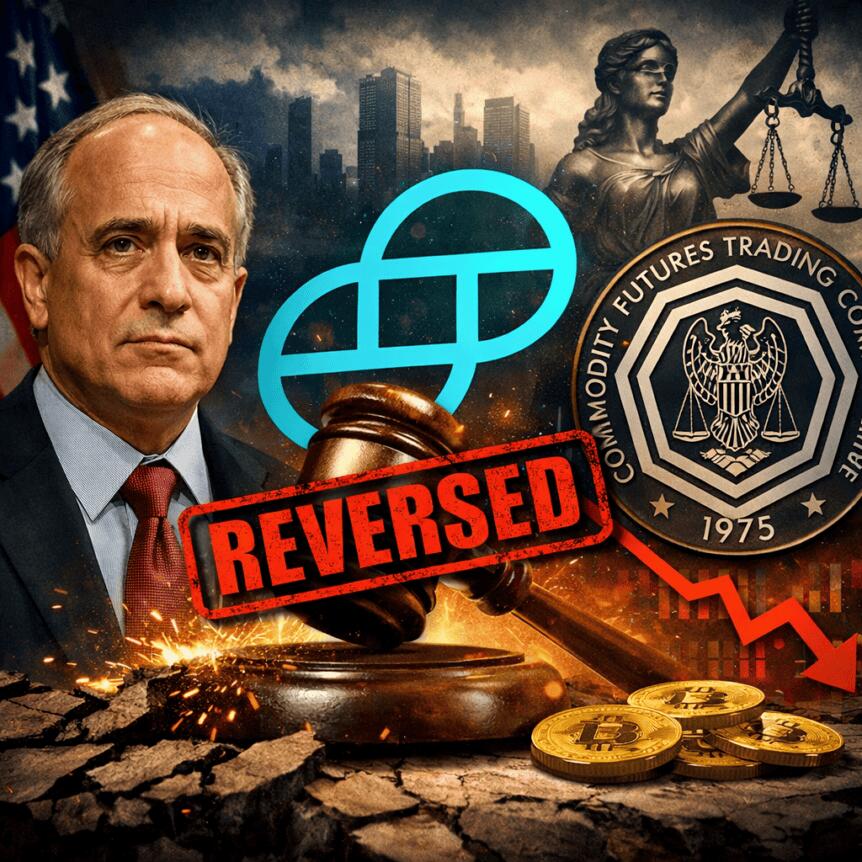
A regulatory dispute is intensifying around a previously resolved case between the U.S. Commodity Futures Trading Commission (CFTC) and Gemini Trust Company. The agency has moved to vacate a $5 million settlement that had been finalized earlier this year, signaling a rare reversal of a settled enforcement matter. The amended filing, submitted in the U.S. District Court for the Southern District of New York, argues that significant deficiencies in the Division of Enforcement’s evidence and concerns about a whistleblower’s credibility undermined the basis for the settlement.
“According to Cointelegraph,” the action underscores a broader moment of scrutiny for crypto firms’ regulatory filings and the precedents governing settlements. The CFTC’s filing asserts that the whistleblower—identified in the proceedings as Gemini’s former chief operating officer—made statements that the agency now contends were false and that important information was concealed by prior leadership. The agency’s complaint against Gemini originally alleged that the firm reported inflated trading activity and volumes and misrepresented user demand during a pre-certification review of Bitcoin futures.
Tim Massad, a former CFTC chair and current Harvard Kennedy School fellow, described the development as extraordinarily unusual. “The explanation seems to be that the staff got it wrong, not that the law was unclear,” Massad told Cointelegraph, signalling the case’s unique posture within federal enforcement history. The amended motion frames the whistleblower credibility issue as central to the CFTC’s bid to relief from judgment.
Key takeaways
- The CFTC joined Gemini in seeking relief from a $5 million settlement, filing an amended motion in the Southern District of New York to vacate the judgment.
- The agency contends there were significant deficiencies in enforcement evidence and that the whistleblower’s credibility was compromised, potentially justifying reopening or reversing the deal.
- The original allegations included inflated trading activity, misrepresented user demand, and other pre-certification misstatements related to Gemini’s Bitcoin futures program.
- The matter sits at the intersection of enforcement culture and governance, with public attention on the motivations and processes behind regulatory decisions.
- Political context surrounding crypto executives and regulators has intensified scrutiny of how regulatory actions align with broader policy objectives and personnel changes at the CFTC.
Legal action and the unsettled settlement
The amended motion to vacate the judgment indicates that the CFTC believes its prior case against Gemini rested on flawed evidentiary underpinnings and questionable witness credibility. The agency’s filing argues that mistakes in the staff’s handling of the whistleblower testimony and related evidence warrant relief from the court’s judgment, effectively reopening or annulling the negotiated settlement reached in January 2025, during the Biden administration.
The core of the dispute centers on whether the CFTC’s whistleblower-based information was reliable and whether material facts were properly disclosed or adequately investigated before the settlement was approved. If the court grants relief, it could lead to renewed litigation or a renegotiation of terms, with implications for how future whistleblower disclosures are weighed in settled cases. Analysts and practitioners will be watching the SDNY proceedings closely for signals about settlement risk and the threshold for reversing resolved enforcement actions.
Enforcement posture, evidence, and credibility concerns
Beyond the procedural dimensions, the CFTC’s filings emphasize substantive questions about the evidence used to support its original complaint. The agency maintains that the pre-certification review of Gemini’s Bitcoin futures program was marred by inflated figures and inaccurate representations of demand. The allegation that critical testimony from a former Gemini executive was unreliable sits at the heart of the motion to vacate, suggesting a broader issue of evidentiary reliability in enforcement actions tied to crypto trading activities.
Massad’s remark frames this as a potential error in agency practice rather than a fundamental interpretation of the statute. The case raises issues about the quality control of enforcement materials, internal disagreements within agencies, and the standards applied when approving settlements in high-profile crypto matters. The balance between timely settlements and the integrity of the evidence underpinning those settlements is likely to become a focal point in the ongoing discourse around crypto-regulatory processes.
Political economy and governance implications
The Gemini matter has drawn attention beyond purely legal questions, intersecting with political dynamics surrounding the U.S. crypto oversight apparatus. Tyler and Cameron Winklevoss, Gemini’s co-founders, have publicly supported political campaigns and engaged with policymakers in various venues. Notably, both founders contributed $1 million to former President Donald Trump’s 2024 campaign, and they met with Trump and attended White House events, including the signing ceremony for a stablecoin-related policy initiative known as the GENIUS Act.
Public discourse on governance is further complicated by governance shifts at the CFTC. A text chain published in September 2025, involving former CFTC commissioner Brian Quintenz, suggested that discussions around Gemini’s litigation were connected to the nomination process for the agency’s leadership. Quintenz’s narration indicated that Tyler Winklevoss’s stance on the litigation intersected with considerations about leadership placement at the CFTC, though Trump’s administration subsequently made different appointments. The relevance of these political dynamics to regulatory discretion remains a point of debate among industry observers and legal analysts.
In the context of the amended motion, Cointelegraph notes that some language in the CFTC’s filing resembles phrases found in the Quintenz-authored text communications, including references to “abuse” of regulatory authority and “false whistleblower.” While the legal significance of these textual parallels is uncertain, they contribute to a broader conversation about transparency, regulatory accountability, and the interplay between industry leadership and enforcement strategies.
Regulatory and policy context for the crypto sector
The Gemini dispute arrives at a moment when several U.S. and international regulatory bodies are recalibrating enforcement norms, settlement practices, and licensing standards for crypto entities. Although the CFTC and the U.S. Securities and Exchange Commission (SEC) paused numerous enforcement actions during the transition between administrations, the ongoing proceedings against Gemini illustrate that critical cases can still proceed or be revived through court processes. The outcome could influence how regulators approach settled actions, the credibility of whistleblower-led evidence, and the evidentiary standards applied in crypto-related cases.
From a policy perspective, the affair touches on several regulatory axes relevant to market participants. Authorities continue to calibrate rules around crypto-asset trading, futures and derivatives, and related disclosure obligations. The discussion extends to licensing and regulatory oversight, AML/KYC compliance, and the treatment of stablecoins within broader banking and payments ecosystems. Beyond U.S. borders, MiCA (Markets in Crypto-Assets Regulation) and other international regimes shape comparative expectations for enforcement, cross-border cooperation, and the risk framework for crypto firms operating globally.
For institutions, the Gemini matter underscores key compliance considerations: the importance of rigorous due diligence in pre-litigation assessments, robust whistleblower handling procedures, transparent investigation workflows, and careful management of settlements that may later come under scrutiny. It also highlights how political context and leadership transitions can influence regulatory perceptions and the pathways for challenge or defense in contested cases.
What this means for the sector and future monitoring
Looking ahead, several scenarios could unfold. If the court grants relief from judgment, Gemini’s exposure may be revisited, with potential implications for related parties and future settlement strategies in crypto enforcement. Conversely, if the court denies relief, the settlement could stand as a settled outcome notwithstanding the agency’s concerns about evidence credibility. Either path will influence how enforcement agencies communicate decisions, how closely settlements are scrutinized, and how firms prepare for post-settlement compliance reviews.
Institutions should monitor developments for implications on regulatory risk assessment, settlement negotiation tactics, and governance practices within crypto firms. The Gemini case also reinforces the importance of robust documentation, independent verification of critical evidence, and clear governance around internal whistleblower information—elements that matter for compliance programs, risk management, and legal strategy in a dynamic regulatory environment.
In sum, the CFTC’s push to vacate a settled judgment against Gemini signals a nuanced shift in enforcement philosophy—one that foregrounds evidentiary rigor, whistleblower credibility, and the potential for regulatory actions to be revisited in light of new information or perceived missteps. The outcome will be watched closely for its implications on enforcement precedent, cross-agency coordination, and the regulatory architecture governing crypto markets in the United States and beyond.
Closing perspective: The Gemini matter emphasizes that regulatory accountability and the integrity of enforcement processes remain central questions as crypto markets continue to mature, stabilize, and integrate with traditional financial systems. The next steps in SDNY will shape not only Gemini’s trajectory but also the contours of compliance expectations for issuers, exchanges, and other market participants navigating a complex, evolving policy landscape.


CME Group announced Friday that its cryptocurrency futures and options products are now available 24/7, eliminating previous trading hour restrictions. The move expands access to CME's crypto derivatives lineup, which includes Bitcoin and Ethereum contracts, to traders seeking continuous market… Read the full story at The Defiant
Morgan Stanley has disclosed holdings in two XRP-focused exchange-traded funds, becoming one of the latest major financial institutions to report exposure to investment products tied to Ripple’s cryptocurrency.
Summary
- Morgan Stanley disclosed holdings in the Volatility Shares XRP ETF and Grayscale XRP ETF, adding XRP exposure through regulated investment products.
- The filing comes as Morgan Stanley expands its crypto offerings, including a proposed spot Solana ETF that would hold and stake SOL under the ticker MSOL.
- XRP investment products attracted $85.8 million in inflows over the past three weeks, while XRP ETFs recorded $1.77 million in net inflows on Thursday.
According to the investment bank’s Form 13F filing with the U.S. Securities and Exchange Commission for the first quarter of 2026, Morgan Stanley reported owning 1,700 shares of the Volatility Shares XRP ETF and 100 shares of the Grayscale XRP ETF (GXRP).
Although the positions are small relative to the firm’s overall portfolio and its larger investments in Bitcoin and Ethereum products, the filing places Morgan Stanley among a growing list of institutions gaining exposure to XRP through regulated investment vehicles.
The disclosure arrives as the bank continues to expand its presence across the crypto sector. Earlier this month, Morgan Stanley submitted an updated registration statement for a spot Solana exchange-traded fund that would trade under the ticker MSOL and hold SOL directly while staking part of the fund’s assets through third-party providers.
Why is Morgan Stanley increasing its exposure to crypto investment products?
Recent regulatory filings show that Morgan Stanley’s crypto activity now extends beyond Bitcoin-related products. The proposed Morgan Stanley Solana Trust would not only track the price of SOL but would also include staking rewards generated from a portion of the fund’s holdings.
According to the preliminary prospectus, the bank plans to select staking providers based on factors such as reliability, performance, uptime, and slashing history. The filing indicates that staking rewards would be incorporated into the trust’s overall returns.
The XRP ETF disclosure follows Morgan Stanley’s earlier efforts to expand digital asset services. After establishing a presence in the spot Bitcoin ETF market, the bank has also been working to launch Bitcoin and cryptocurrency trading services through its E*Trade platform.
Earlier Morgan Stanley had identified Ripple’s payment infrastructure as a faster alternative to the traditional SWIFT network for cross-border transfers. While the bank has not disclosed a direct XRP position, the latest filing shows exposure to XRP through publicly traded ETF products.
Other financial institutions have reported similar positions in recent months. Regulatory filings have shown that Bank of America and UBS also disclosed modest holdings in XRP-linked ETFs.
Are institutional investors continuing to accumulate XRP exposure?
Fund flow data suggests institutional interest in XRP-related products has remained resilient despite weakness across parts of the digital asset market.
Data from SoSoValue showed that XRP investment products attracted $85.8 million in inflows over the past three weeks. During the same period, Bitcoin and Ethereum funds recorded net outflows of approximately $3.56 billion and $693 million, respectively.
More recently, spot XRP ETFs recorded $1.77 million in net inflows on Thursday. Bitwise’s XRP ETF accounted for the entire amount, while Bitcoin and Ethereum ETFs experienced significant redemptions.
In the derivatives market, activity has also remained steady. Data from Deribit showed traders positioning around a $1.60 strike price for XRP options expiring on June 26, while some contracts target a move toward $3.40 by September.
XRP (XRP) price traded near $1.30 at press time after gaining about 4% over the previous 24 hours. The token moved between $1.28 and $1.33 during that period, while trading volume declined by roughly 13%.


Anthropic is set to tap a $36 billion private credit deal led by Blackstone and Apollo to finance Google AI chips backed by Broadcom, in one of history’s largest debt financings.
Summary
- Apollo and Blackstone are syndicating about $36 billion in debt to finance Google TPUs for Anthropic
- Broadcom will backstop payments as Anthropic leases the custom chips to fuel its Claude AI models
- The deal comes as Anthropic’s valuation jumps to $965 billion and its AI revenue run rate accelerates
Private equity giants Apollo Global Management and Blackstone are working to syndicate roughly $36 billion in debt financing that will fund Anthropic’s next wave of AI infrastructure, in what could become one of the largest private credit transactions ever executed. Reuters reported that the debt will be used to buy custom tensor processing unit chips from Google, which Anthropic will then lease as it races to scale compute for its Claude chatbot and related models.
The structure is straightforward but aggressive: Apollo and Blackstone are inviting additional investors into the $36 billion deal while planning to retain “significant portions” of the debt on their own books, according to additional report by Bloomberg, said that Broadcom, which co designs Google’s TPUs, is backstopping payments on the largest tranches, effectively using its balance sheet and its existing role in Google’s chip stack to de risk the financing. Investors have been asked to submit orders this week, with the transaction expected to close as early as next week, though terms could still shift as books are finalized.
Massive private credit bet on AI compute
For Anthropic, the deal deepens an already sprawling web of capital commitments around AI infrastructure, stacking financial leverage on top of earlier equity deals and long term capacity contracts with hyperscalers. In April, Anthropic secured access to around 3.5 gigawatts of TPU compute through an expanded partnership with Google and Broadcom, with deployments slated to begin scaling from 2027 as part of a broader $50 billion push into domestic US compute capacity. The company simultaneously announced it had raised $6.5 billion in new funding at a $965 billion post money valuation, overtaking OpenAI on paper as demand for its Claude models accelerates.
Anthropic’s revenue run rate recently blew past $30 billion annually, more than tripling from roughly $9 billion at the end of 2025 as its share of the enterprise API market climbed from 12 percent in 2023 to 32 percent by mid 2025, our reporting has showed. That growth has been fueled in part by large financial and industrial clients integrating Claude into production workflows, even as regulators and officials scrutinize emerging risks: in April, US Treasury officials convened major bank CEOs over cyber risks linked to Anthropic’s forthcoming Claude Mythos model after internal tests and a code leak highlighted its ability to uncover “unprecedented” volumes of software vulnerabilities.
Broadcom’s role and the chip supply squeeze
Broadcom’s decision to guarantee payments on large slices of the Anthropic chip financing underscores how AI hardware suppliers are starting to act more like structured finance counterparties than mere vendors. The semiconductor firm already sits at the core of Google’s TPU roadmap and is expected to support future iterations of the chips that Anthropic will be leasing, including next generation designs Google is exploring with partners such as Marvell to improve memory bandwidth and model efficiency.
The Blackstone Apollo transaction is only the latest sign that private equity has no intention of staying on the sidelines of AI infrastructure. Earlier this month Anthropic and a group including Blackstone, Goldman Sachs, Apollo and Hellman & Friedman launched a $1.5 billion venture aimed at pushing Claude into portfolio companies across sectors from healthcare to manufacturing, according to CNBC. For crypto markets, the move reinforces a familiar pattern: capital is clustering around a tiny number of AI platforms that already absorb an outsize share of cloud, chip and power budgets, even as tokenized AI projects scramble for scraps on chain.

Ethereum (ETH) briefly plunged below the $2,000 threshold this week for the first time since March 29. While the price has since stabilized and is currently trading near $2,002, it still remains almost 60% below August’s high of nearly $5,000.
But data suggest that ETH’s largest whales are accumulating again
ETH Whales Tighten Grip on Supply
Wallets holding at least 100,000 Ethereum now collectively own 17.41 million ETH, the highest level in nine weeks. These holdings account for 22.03% of Ethereum’s total supply and mark a 10-week high.
The latest findings come after Santiment reported that the asset’s fall below $2,000 triggered a wave of “buy the dip” calls from retail traders. According to the analytics firm, crypto markets typically react to sharp declines in two ways: either fear takes over, and traders begin abandoning the asset, or optimism grows as traders view lower prices as a buying opportunity.
The second reaction appeared to be dominating sentiment around ETH despite the recent weakness, which essentially meant that retail traders were increasingly confident that the decline represented a discounted entry point rather than a warning sign of deeper downside.
However, Santiment warned that excessive optimism from the crowd has historically been a bearish signal, as retail traders often misread market direction during volatile periods. The firm went on to add that a stronger buying opportunity may emerge once the current FOMO fades and sentiment shifts toward panic, which it described as a more typical setup seen near market bottoms.
Downside Targets
Bearish technical signals have not completely disappeared from the market. Crypto analyst Ali Martinez, for one, said Ethereum could see accelerated downside pressure if it records a weekly close below the $1,850 level.
Based on the broader channel structure, Martinez identified two potential downside targets following the rejection. The first target stands around $1,560, which he described as interim structural support, while the second target sits near $1,070, which marks the lower boundary of the crypto asset’s multi-year range.
The post Ethereum’s Largest Wallets Now Control Over 22% of Supply Amid Fresh Accumulation Wave appeared first on CryptoPotato.
Crypto World
Grayscale eyes $115m HYPE seed deal for Hyperliquid staking ETF, will HYPE go parabolic?
Grayscale is negotiating a $115 million HYPE-for-shares seed swap for its proposed Hyperliquid staking ETF, in a move that deepens Wall Street’s exposure to on chain derivatives.
Summary
- Grayscale in talks to seed Hyperliquid staking ETF with roughly $115 million in HYPE
- Product would list on Nasdaq under HYPG and stake the underlying tokens
- Deal follows 21Shares’ HYPE ETFs and intensifying competition for Hyperliquid exposure
Grayscale is negotiating with Hyper Holdings Global LP to seed its proposed Hyperliquid ETF with about 2 million HYPE tokens, worth roughly $115 million at current prices, in exchange for fund shares before listing, according to a report from FinanceFeeds.
ChainCatcher, citing the same report, said the asset manager plans to rename the product the “Grayscale Hyperliquid Staking ETF” and list it on Nasdaq under the ticker HYPG, with staking rewards built into the structure rather than offering only spot price exposure.
Grayscale pivots from plain spot HYPE exposure
Grayscale originally filed with the U.S. Securities and Exchange Commission in March for a spot ETF tied to Hyperliquid’s native token, describing a product “designed to track the price of HYPE” that would trade on Nasdaq under the ticker GHYP, with Coinbase Custody as the designated custodian.
At the time, Grayscale’s S 1 said the fund would not stake its HYPE holdings at launch, and instead included a conditional “staking provision” that could be activated later if the trust could still qualify as a grantor trust for U.S. federal tax purposes, language that reappears in the May amendment described.
The latest revision goes further by rebranding the vehicle as the Grayscale Hyperliquid Staking ETF and explicitly allowing the trust to capture protocol rewards from staked HYPE in addition to any price appreciation, provided the SEC signs off on the structure and associated tax treatment.
Grayscale’s negotiations with Hyper Holdings Global LP over the roughly $115 million seed stake would see the fund issue ETF shares to the Hyperliquid entity in exchange for about 2 million HYPE, using those tokens as initial capital before the product begins trading.
Hyperliquid’s ETF land grab and HYPE market backdrop
The proposed HYPG fund would join a fast crowd of Hyperliquid themed products, coming just weeks after 21Shares launched the first U.S. listed Hyperliquid ETFs, including the 21Shares Hyperliquid ETF under the ticker THYP and a leveraged product trading as TXXH, both tied to HYPE and designed to give investors regulated exposure to the derivatives focused network, according to a statement cited by crypto.news.
21Shares said THYP would “integrate staking rewards tied to its HYPE holdings,” committing to stake a substantial portion of the fund’s assets, a design that Grayscale now appears intent on mirroring by turning its own vehicle into a staking ETF rather than a plain spot tracker.
Hyperliquid’s native token has been one of the cycle’s standout performers, recently hitting an all time high of just over $62 and trading near the low $60s this month, with a market capitalization in the mid ten figure range, according to a May market update from Binance Square and live data on the HYPE price page.
In parallel, on chain activity has intensified around HYPE, with large holders including Galaxy Digital and Loracle repeatedly staking and unstaking eight figure dollar amounts of tokens in recent days, according to a series of network data snapshots, underscoring how ETF issuers are inserting themselves into an already crowded capital stack.
Grayscale’s move also lands in a market where Hyperliquid’s role in on chain derivatives markets has become a recurring theme; as one recent crypto.news analysis argued, the platform’s real story lies in its use of HYPE as staking collateral to spin up permissionless perpetual futures markets, with ETF bids arriving as a secondary layer of financialization on top of that core design.
For now, HYPG remains contingent on SEC approval of both the underlying spot HYPE ETF and its staking mechanics, keeping Grayscale in the same regulatory queue as other issuers pursuing Hyperliquid themed products,neven as the firm quietly lines up nine figure token inventory and tries to ensure it is not late to the one derivatives protocol Wall Street has decided to take seriously this cycle.
What does it mean for Hyperliquid price
Grayscale’s $115m HYPE seed talks put real buy pressure under an already rising token, with 24 hour data showing traders are treating the ETF pivot as a fresh upside catalyst.
Over the past 24 hours, Hyperliquid’s HYPE token is trading around $60.99, up roughly 1.05% on the day, with intraday moves between $56.43 and $61.13.
That means the roughly 2 million HYPE Grayscale is negotiating to receive as seed capital for its planned “Grayscale Hyperliquid Staking ETF” represents about $121.98 million at current spot levels and comes against the backdrop of roughly $1.01 billion in 24 hour trading volume, a non trivial chunk of visible liquidity.
Put differently, the seed deal would soak up the equivalent of more than 12% of one day’s trading volume at current prices, if it were executed on market, which helps explain why HYPE is printing positive daily returns while many majors are flat or slightly red.
In practice, most of that inventory will move over via over the counter arrangements between Hyper Holdings Global LP and Grayscale rather than straight through order books, but the economic effect is similar: a large pool of tokens becomes ETF collateral and, once inside the wrapper, is structurally less likely to hit the open market during normal conditions.
That supply overhang relief is landing at a time when HYPE is already sitting just a few dollars below its recent all time high near $64, leaving the token with a still bullish short term profile despite only a modest 24 hour percentage move.
If the SEC ultimately signs off on the HYPG structure and Grayscale completes the $115 million seed, traders will be looking for whether 24 hour volumes stay near the current $1 billion mark or grind higher, since sustained three comma liquidity tends to support higher equilibrium prices for assets that are still supply constrained.
On the flip side, if today’s 1.05% gain turns into a flat or negative 24 hour print while volumes remain elevated, that would be a sign that speculators are fading the ETF headline and using the bounce to derisk into Grayscale’s structural bid, a dynamic you will see first in the daily percentage change and only later in the longer term chart.


Wintermute is moving into prediction markets as institutional market makers race to dominate event contracts that already clear more than $20 billion a month.
Summary
- Wintermute begins two way market making on major prediction platforms
- Monthly prediction market volume above $20 billion as lifetime flows top $150 billion
- Move follows institutional push into Polymarket and Kalshi style event contracts
Wintermute, one of crypto’s largest quantitative market makers, has begun providing continuous two way liquidity on several “leading” prediction market platforms, extending its infrastructure into event contracts that straddle both digital assets and traditional macro themes, according to The Block.
The firm told The Block it has already been streaming bilateral buy and sell quotes across multiple venues, where aggregate monthly prediction market trading volume has climbed past $20 billion in 2026, even as liquidity remains “early stage” by institutional standards.
Wintermute itself executes more than $3.5 trillion in annual trading volume across spot, derivatives and DeFi markets, and the new business line is pitched as a way to extend that cross asset machinery into event contracts ranging from elections and macro data prints to crypto specific flows.
Wintermute’s thesis on event contracts
Jake Ostrovskis, Wintermute’s head of OTC trading, argued that the underlying demand in prediction markets already resembles traditional asset classes, with structurally similar flows but thinner books and wider spreads than blue chip futures or options.
“There is clear demand for these markets, but liquidity is still insufficient,” he told The Block, saying Wintermute’s goal is to post continuous bilateral quotes that tighten spreads, deepen books and make the implied probabilities more usable for traders and institutions.
Ostrovskis added that “tighter spreads and greater trading capacity” should improve the quality of probability signals coming out of venues like Polymarket and Kalshi, turning them into data sources that more closely resemble established derivatives markets rather than exotic side bets.
That narrative tracks with Wintermute Ventures’ broader view that “everything becomes tradeable” as crypto rails turn prediction markets into financial tooling rather than niche gambling, a theme the firm laid out in a 2026 outlook covered by Yahoo Finance.
Polymarket, Kalshi and institutional liquidity
Wintermute is not the first big trading shop to see an opening in event markets.
The Block reports that firms including Jump Trading and Galaxy Digital already provide liquidity to event contracts, as lifetime trading volume on Polymarket and Kalshi has now crossed $150 billion, based on data cited by CoinMarketCap from The Block’s prediction market trackers.
That $150 billion figure covers all historical trades on both platforms, while their combined monthly turnover has cooled slightly from a record run of growth, according to the same report.
On the crypto side, ultra short event contracts tied to bitcoin and ether already dominate flows on Polymarket and Kalshi, with five to 15 minute “up down” bets on BTC and ETH now accounting for more than half of their crypto volume, as previously reported by crypto.
Regulatory risk is mounting alongside that growth: Spain this month ordered ISP level blocks on both Polymarket and Kalshi over unlicensed gambling concerns, the fifth country to move against them in 2026, as detailed in a recent crypto investigation.
Wintermute’s move effectively treats those markets as another derivatives frontier, with stablecoin settlement, on chain clearing and automated risk management that look increasingly like the institutional DeFi stacks the firm is already building through products such as its new Armitage vault platform, reported earlier by Bitcoin.
If Armitage is Wintermute’s bet that DeFi lending should run on institutional style vaults, the push into prediction markets is its wager that event contracts will mature into a derivatives like infrastructure layer rather than remaining a regulatory gray zone casino.
A former chairman of the US Commodity Futures Trading Commission (CFTC) responded to the agency’s move to vacate a $5 million settlement with cryptocurrency company Gemini.
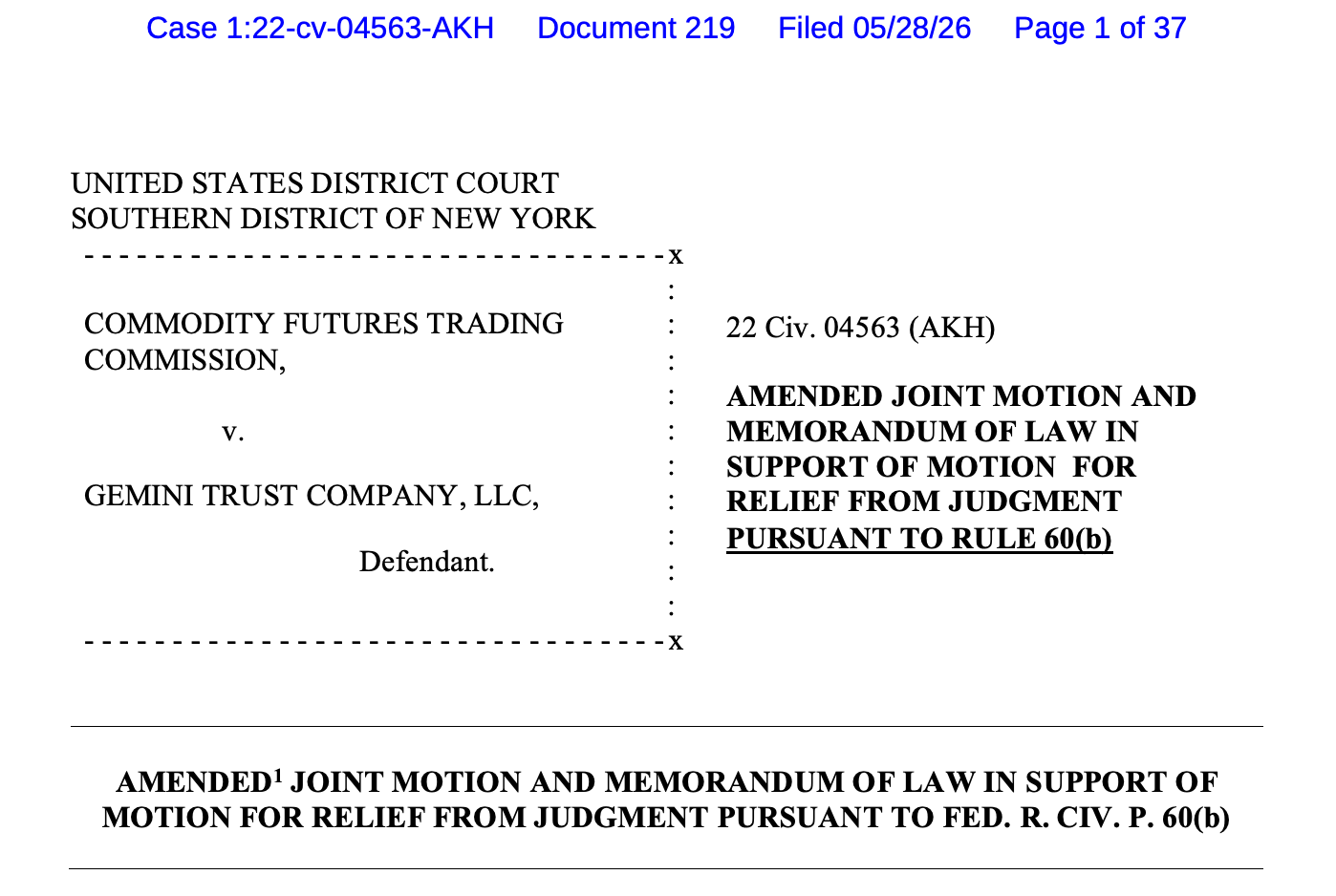
In a Wednesday motion filed in the US District Court for the Southern District of New York, the CFTC joined the Gemini Trust Company in seeking relief from the judgment of a case initially filed in June 2022. The company reached a $5 million settlement with the CFTC in January 2025 while the agency was under former US President Joe Biden.
“[T]he CFTC’s action in reversing itself on a settled case is extraordinarily unusual,” Tim Massad, a former CFTC chair and research fellow at Harvard Kennedy School, told Cointelegraph. “The explanation seems to be that the staff got it wrong, not that the law was unclear.”
According to the CFTC’s motion, the agency sought relief based on claims that a whistleblower was found “not to be credible” and evidence was concealed by the commission’s previous leadership.
The motion alleged that the whistleblower, Gemini’s former chief operating officer, made false statements related to the company’s Bitcoin futures pre-certification review. The CFTC’s complaint against Gemini included allegations that the company reported inflated trading activity and volumes, misrepresenting user demand.
“Based on the CFTC’s comprehensive review, the CFTC concurs that there were significant deficiencies in [the Division of Enforcement’s] evidence and the Complaint should not have been filed,” said the filing.
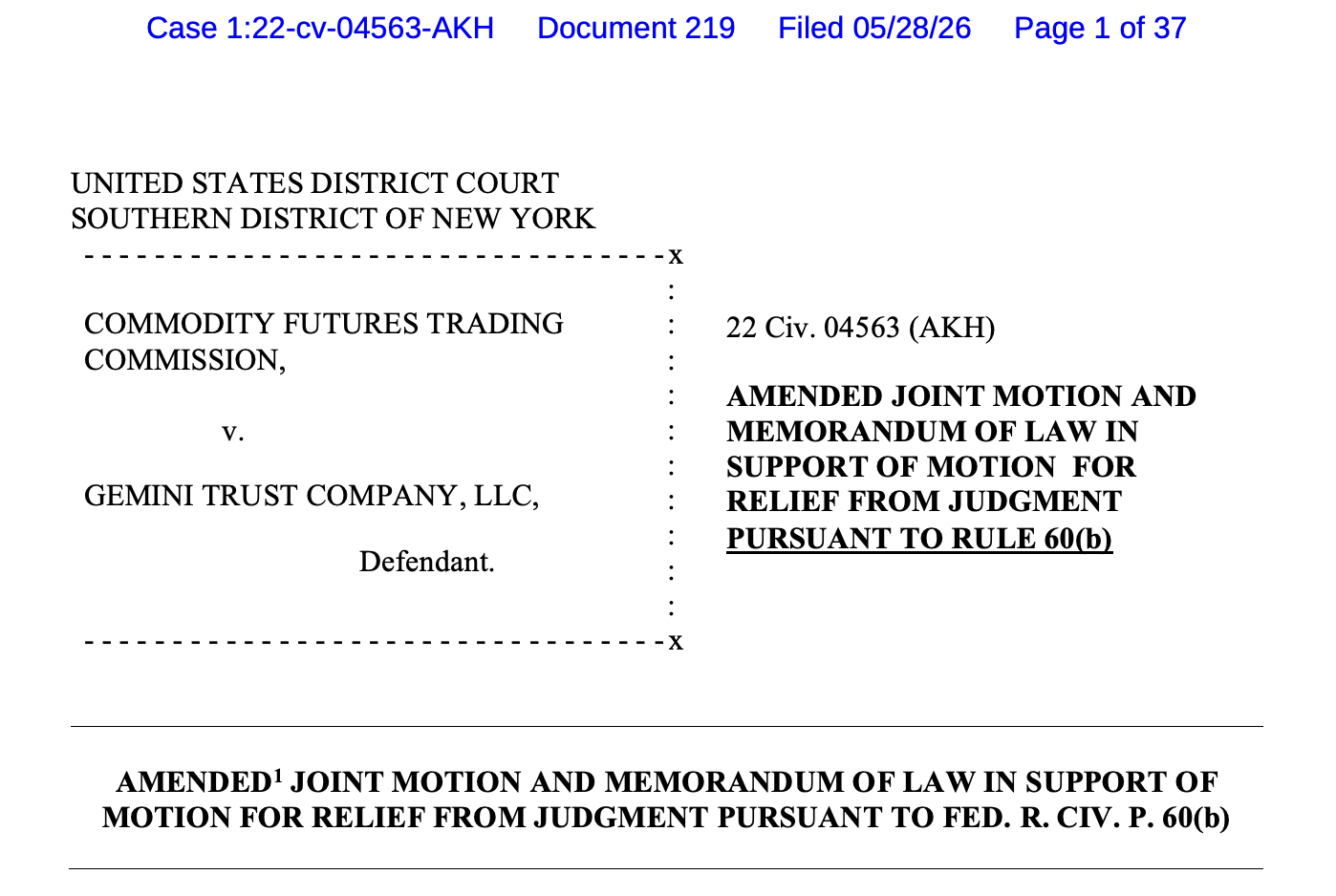
Amended motion by CFTC filed in SDNY on Thursday. Source: PACER
Related: Prediction markets legal battles heat up in Minnesota, Rhode Island
Although the CFTC and Securities and Exchange Commission (SEC) dropped several enforcement actions and investigations into crypto companies after Donald Trump assumed the office of the presidency, there had been no filings on the public docket in Gemini’s case since January 6, 2025.
Massad added:
“I know of nothing like this happening before, and I think the public deserves a better explanation.”
Gemini co-founders tied to the current administration
Tyler and Cameron Winklevoss, co-founders of Gemini, each donated $1 million to Trump’s 2024 election campaign. The two have also met with Trump and attended White House events, including the signing ceremony for the stablecoin-related GENIUS Act.
Source: Brian Quintenz
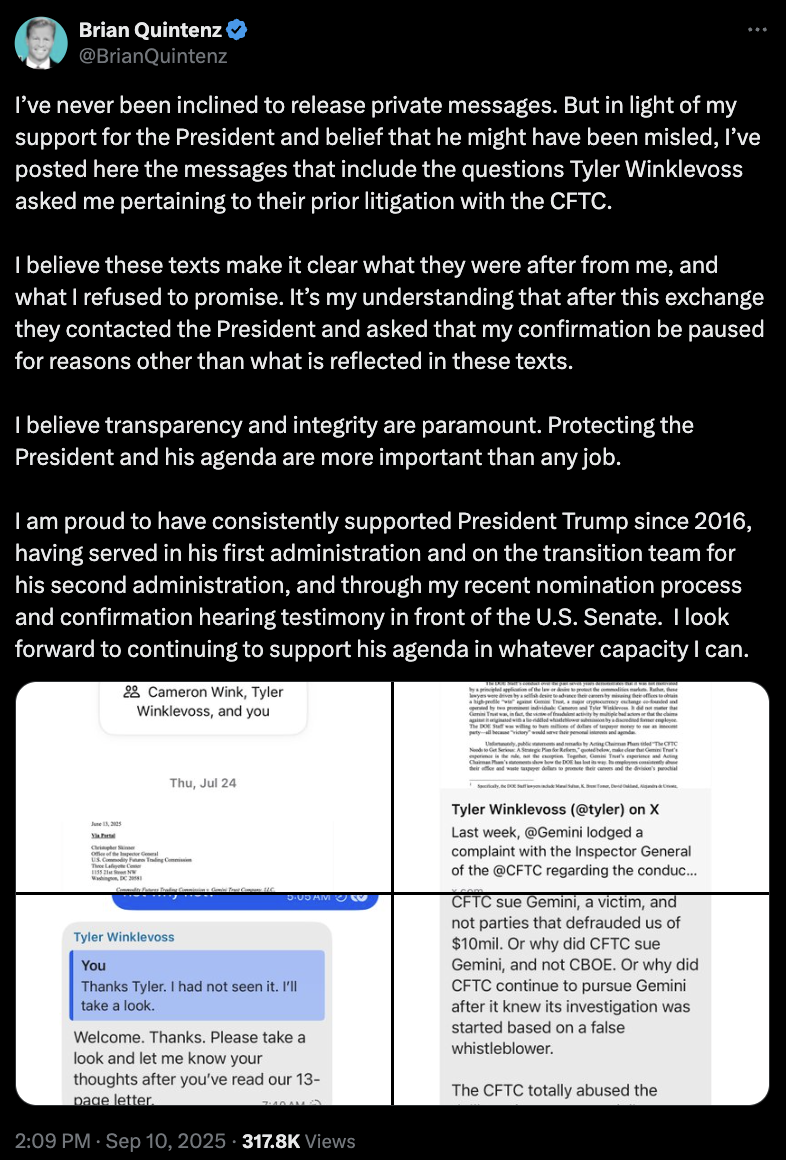
According to a text chain made public in September 2025 by former CFTC commissioner Brian Quintenz, Tyler Winklevoss raised the CFTC’s litigation as Quintenz was set to be considered for Trump’s nomination to head the agency. Trump later withdrew Quintenz’s nomination, leading to his pick, Michael Selig, being confirmed as chair and the agency’s current sole commissioner.
Notably, some of the language in the CFTC’s motion to vacate was similar to that in the Winklevoss text chain, including “abuse” of regulatory authority and “false whistleblower.” Cointelegraph reached out to Gemini for comment but did not receive an immediate response.
Magazine: HYPE chases $100 target, ETH could dump below $1800: Market Moves
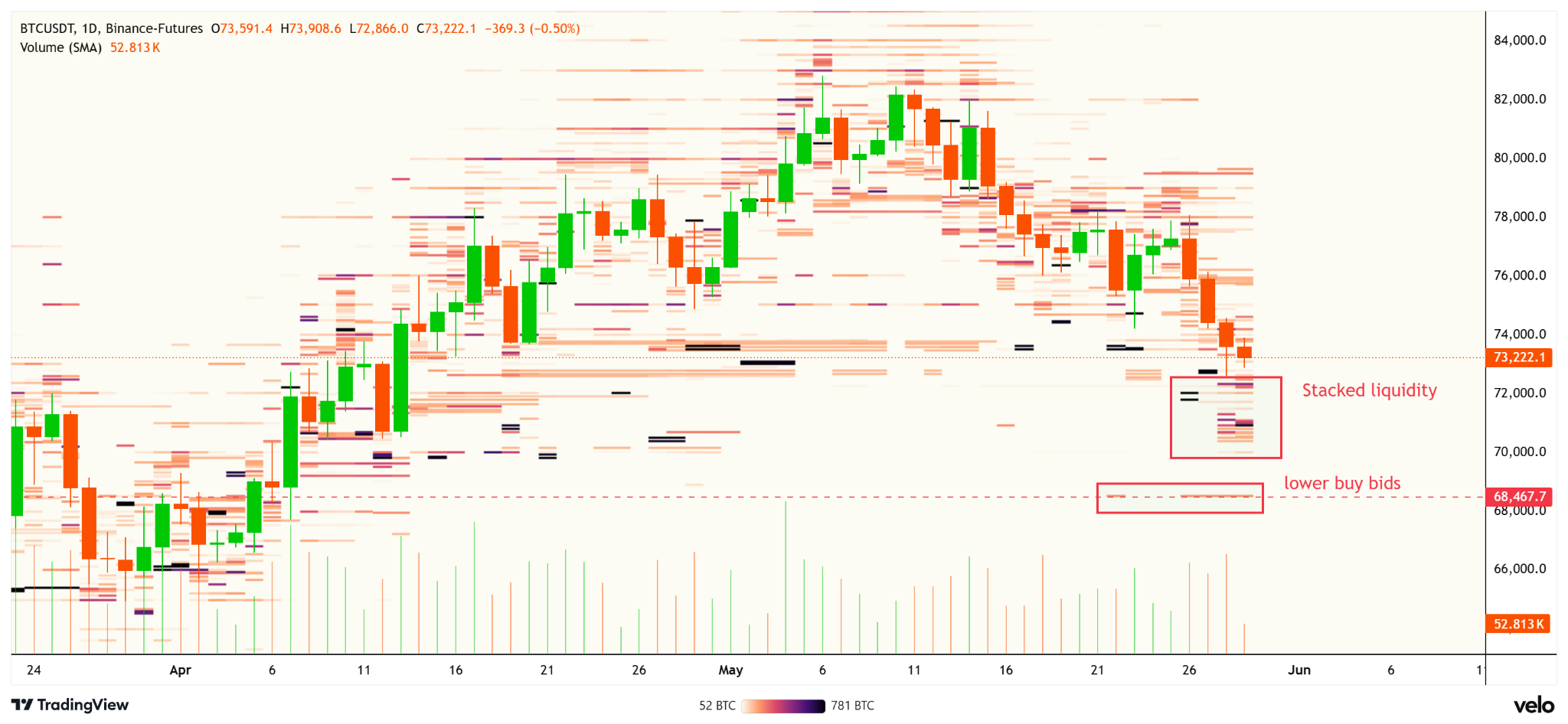
Bitcoin (BTC) traders have placed new buy orders near $70,000 as the price approaches a key liquidity zone. Order-book data shows more than $500 million in bid liquidity between $72,000 and $70,000, creating a demand zone that could shape BTC’s next move.
BTC buy bids form key support zone
Data from CoinGlass shows dip buyers have placed 6,235 BTC in bid liquidity between $72,000 and $70,000. At current prices, the buy orders are worth roughly $443 million.
The largest cluster sits directly above $70,000, where buyers are positioned to absorb the current selling pressure. Bid liquidity refers to limit buy orders waiting below the market price. When price trades into those orders, it can slow a decline and trigger a sharp rebound if demand absorbs available BTC supply.
BTC/USD, one-day chart, buy liquidity analysis. Source: Velo chart
Below $70,000, the next notable pocket of demand sits at $68,505, where traders have placed another 1,012 BTC worth approximately $69 million. Outside that level, the order book thins considerably, with few visible bids below $68,500.
Meanwhile, liquidation heatmap data shows about $2 billion in cumulative long positions at risk near $70,000, compared to more than $5 billion in short positions around $78,000. Once BTC taps the bid cluster near $70,000, the larger liquidity pool may trigger a sharp rebound toward overhead liquidation zones.
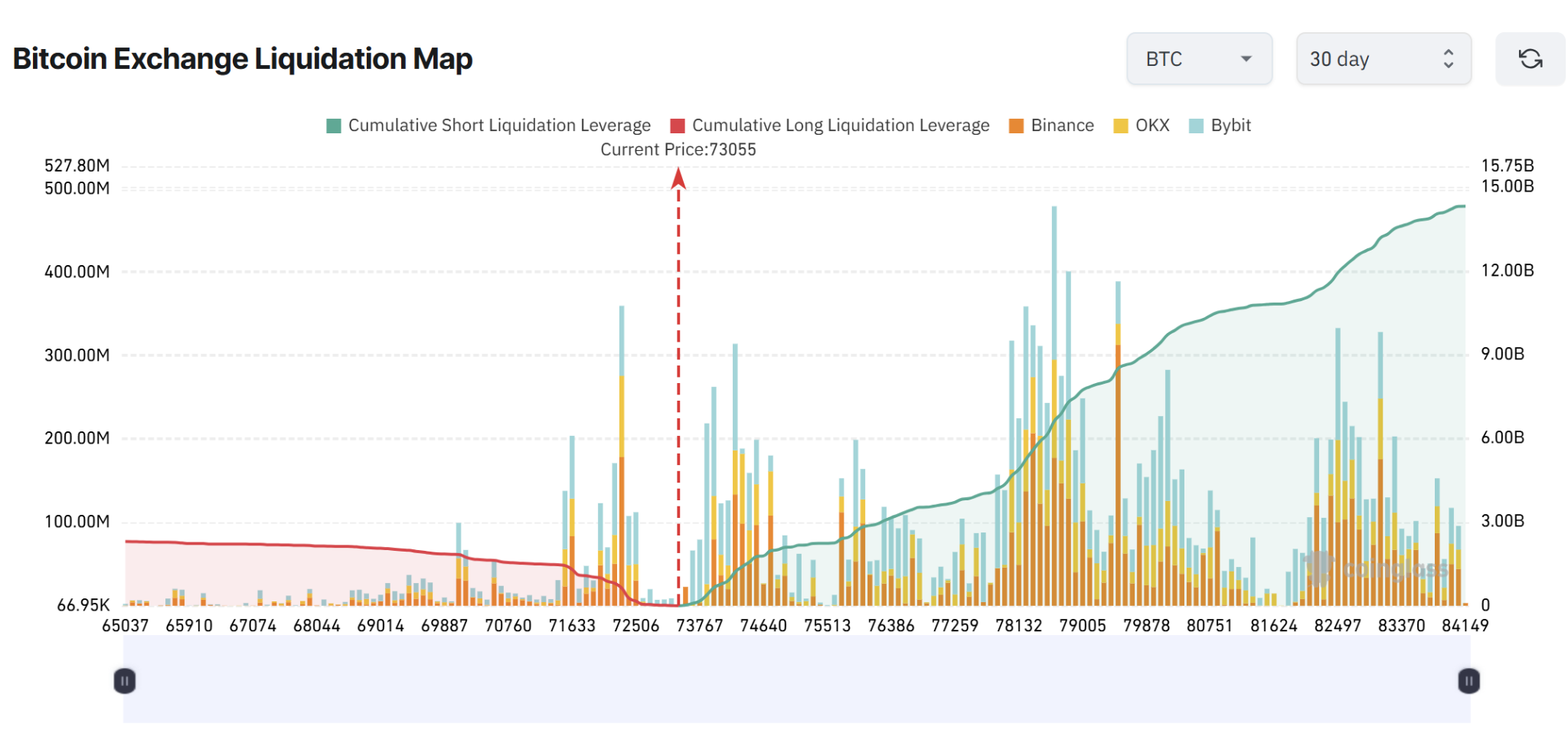
BTC liquidation map. Source: CoinGlass
Related: Bitcoin falls out of the global top 10 assets as market cap dips below $1.5T
RSI hits three-month low as daily BTC trend turns bearish
Bitcoin’s daily trend turned bearish after losing support at $74,800, confirming a pattern of lower highs and lower lows. The price is trading inside a descending channel and is currently testing support near the lower boundary around $72,000–$73,000.
The relative strength index (RSI) has fallen to roughly 33, its lowest level since Feb. 24. Momentum has stayed below the neutral 50 level throughout the recent decline, suggesting sellers still control the short-term price action.
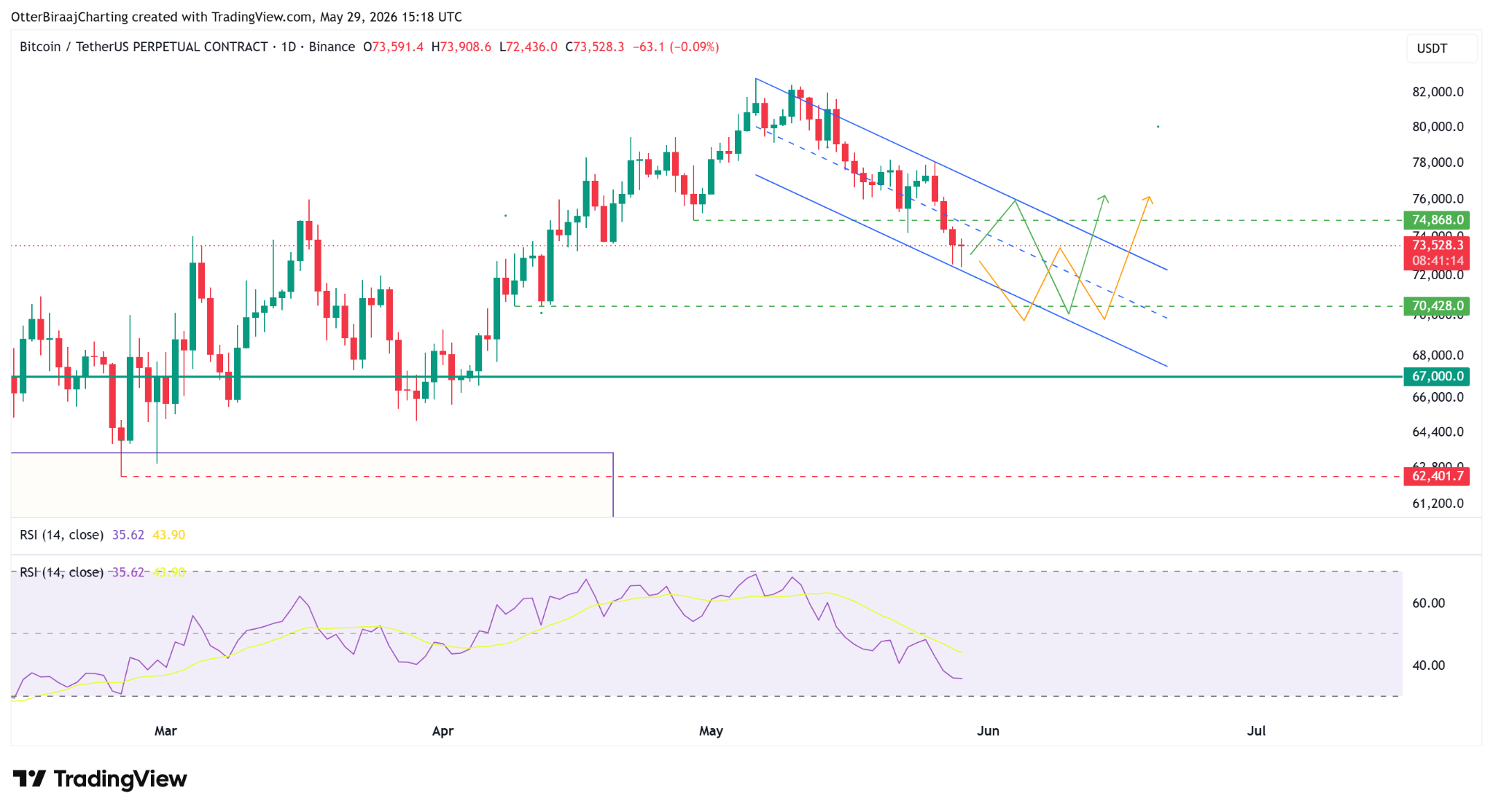
BTC/USD, one-day chart. Source: Cointelegraph/TradingView
Crypto trader Ardi outlined a similar view. The analyst said the $74,500–$75,500 region now acts as resistance across multiple time frames. A rejection from that area could keep focus on the $71,500 region, while a move through channel resistance near $76,000 may challenge the ongoing downtrend.
Options markets show investors have also been preparing for a move toward $70,000. According to Glassnode, traders spent nearly $10 million on put options with a $70,000 strike during the recent dip.
Put options rise in value when prices fall, making them a common hedge against downside risk. Recent flows show some easing in that protection demand as traders lock in profits, though the concentration of hedging activity highlights how closely the market is watching the $70,000 level.
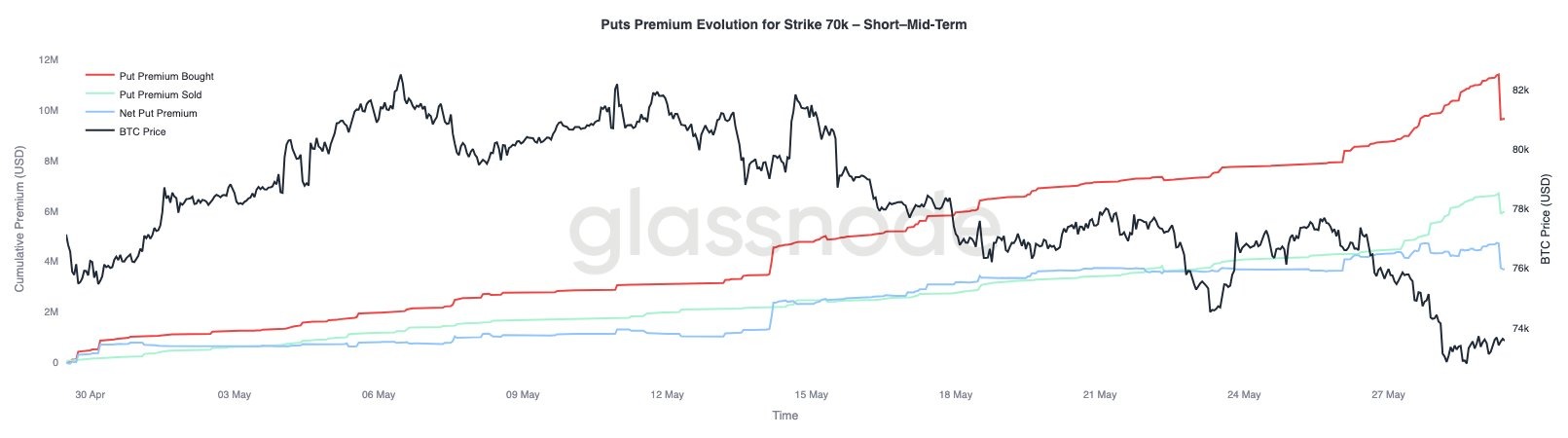
BTC options market analysis at $70,000. Source: Glassnode/X
Related: Bitcoin’s major holders halt buys as demand slows: CryptoQuant

Sui price prediction 2026-2030: beyond USDsui

‘Sex And The City’ Star Reveals Career Change

Ultimate Ears WONDERBOOM 4 is a Take-Anywhere Speaker That Sounds Bigger Than It Looks


-

 Business5 days ago
NYT Strands Answers May 24 2026 Revealed for Puzzle No. 812 Theme Summer Essentials
-

 Politics4 days ago
Bridgerton Season 5: Cast, Release Date And Everything We Know So Far
-

 Crypto World7 days ago
Robinhood crypto COO Tanya Denisova exits
-

 Business3 days ago
Selena Gomez Reportedly Upset Over Benny Blanco’s Comments on Her ‘Terrible’ Diet
-

 Tech4 days ago
Microsoft’s quiet Claude Code retreat and the real cost of enterprise AI
-
Crypto World3 days ago
Micron Crosses $1 Trillion Market Cap as AI Demand Reshapes Memory Sector
-

 NewsBeat3 days ago
Israel says it has killed new Hamas military leader in Gaza City airstrikes
-

 Business5 days ago
BTS Sells Out Four Las Vegas Shows at Allegiant Stadium for ARIRANG World Tour
-
Tech3 days ago
The Samsung pay deal is the moment Korean unions changed register
-

 Tech3 days ago
Millions of AI agents imperiled by critical vulnerability in open source package
-

 Tech4 days ago
Westone Audio and Etymotic Acquired by Fidelity Collective in Major IEM Market Move
-

 Tech20 hours ago
Waymo dominates autonomous vehicle registrations as Tesla trails behind
-
 Tech4 days ago
China assigns ID codes to 28,000+ humanoid robots
-
 Crypto World5 days ago
Nvidia (NVDA) CEO Calls on Super Micro to Strengthen Export Controls Amid Smuggling Probe
-
Crypto World3 days ago
SpaceX’s $2 Trillion IPO: Why Tech Giants Nvidia (NVDA), Apple (AAPL), and Microsoft (MSFT) May Face Pressure
-

 Tech3 days ago
NASA taps Blue Origin to deliver lunar rovers for Moon Base initiative
-
Crypto World5 days ago
Brian Armstrong Outlines Crypto Vision for the Future Financial System
-
 Entertainment4 days ago
‘Breaking Bad’ Star’s Easy-to-Binge 6-Part Crime Series Spin-Off Is Finally Heading to Free Streaming
-

 Crypto World3 days ago
Spain blocks prediction markets Polymarket Kalshi
-

 Business4 days ago
Yatra Online, Inc. 2026 Q4 – Results – Earnings Call Presentation (NASDAQ:YTRA) 2026-05-25
You must be logged in to post a comment Login