

Crypto World
WLFI vs Justin Sun: The Tron-Trump feud explained

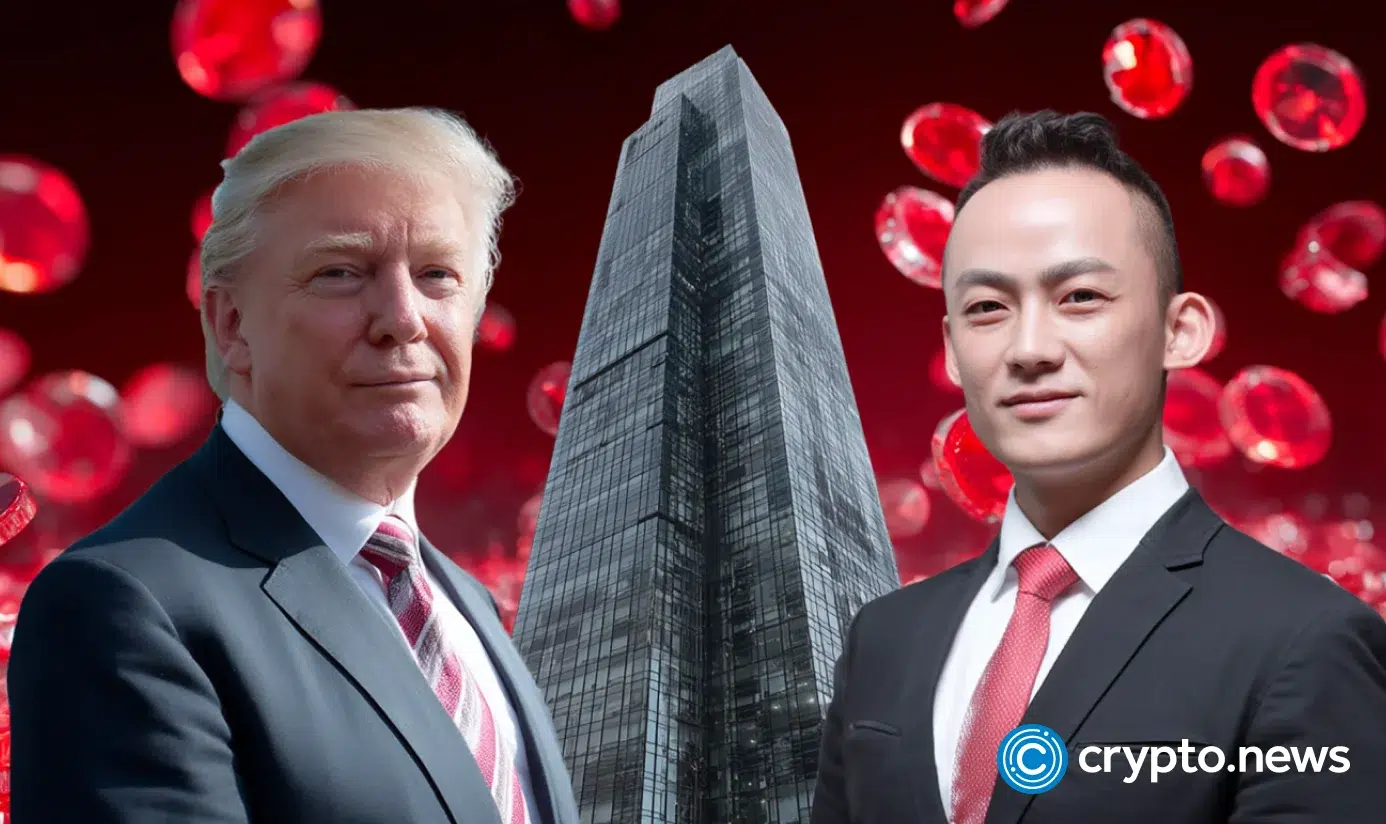
The dispute between World Liberty Financial and Tron founder Justin Sun is one of the most operatic feuds in crypto history.
Summary
- Justin Sun invested about $75M in WLFI before becoming its loudest critic.
- WLFI froze Sun’s wallet after alleging a $9M token-transfer violation.
- Sun sued WLFI in California, while WLFI countersued him in Florida.
- The feud raises larger questions about DeFi governance and token blacklists.
Sun became WLFI’s single largest investor in late 2024, putting approximately $75 million into the project and receiving 1 billion tokens as an advisor. WLFI publicly credited him with rescuing the project from a slow start.
In September 2025, WLFI froze 272 wallets including Sun’s after a phishing incident, alleging he had moved approximately $9 million in tokens in violation of investment terms. Sun denied any intent to sell. By December 2025, his locked position had lost $60 million in value. In April 2026, after CoinDesk reported WLFI’s circular borrowing on Dolomite, Sun broke publicly with the project, calling the team a “personal ATM” and accusing it of extracting illegitimate fees.
WLFI responded with “See you in court” and on May 4 countersued in Florida for defamation, alleging Sun violated contractual limits and engaged in short-selling against the WLFI token. Sun had already filed in California federal court on April 21 for breach of contract, fraud, and conversion, with his claimed losses now exceeding $320 million.
The dispute exposes deep structural questions about smart contract governance, the limits of DeFi decentralization, blacklisting mechanisms in governance tokens, and what happens when crypto’s most controversial figures fall out with its most politically connected project. This piece walks through the full timeline, the actual legal claims, the structural issues the feud reveals, and what it means for the broader WLFI ecosystem.
How Sun became WLFI’s largest backer
The Sun-WLFI relationship started as the kind of partnership both sides publicly celebrated, and the early dynamics matter because they establish how high the stakes became when things fell apart.
Justin Sun is one of the most controversial figures in cryptocurrency. The Tron founder built one of the largest blockchain ecosystems by total value locked and stablecoin transaction volume, made and lost multiple fortunes, faced an SEC fraud and market manipulation lawsuit eventually dropped in February 2025, and has been a constant presence at industry conferences and political events. His investment style is aggressive, his public persona is theatrical, and his willingness to deploy major capital at speed has made him one of the most consequential individual investors in the sector.
According to Sun’s April 2026 court filing in the US District Court for the Northern District of California, Sun invested $45 million in WLFI tokens between November 2024 and January 2025, with additional purchases bringing his total cash investment to approximately $75 million. Sun also received 1 billion WLFI tokens as an advisor to the project. The advisor allocation reflected what was at the time a productive working relationship: Sun’s industry network, Tron’s distribution channels for USDT, and his willingness to publicly champion the project gave WLFI credibility and reach during its critical launch phase.
WLFI publicly acknowledged Sun’s role. The project credited Sun with helping rescue WLFI from a slow start. Sun made statements supporting the venture and President Trump’s broader crypto-friendly policy direction. The early relationship represented something unusual in crypto: a politically connected project receiving major support from one of the industry’s most controversial individual investors, with both sides benefiting from the association.
The structural dynamics Sun’s position created were significant. He became WLFI’s single largest token holder. His Tron network became a major distribution channel for USD1 (the WLFI stablecoin). His public statements moved the WLFI token price. His access to other major crypto investors meant his endorsement carried weight beyond his personal capital deployment. In effect, Sun was not just an investor in WLFI. He was a structural participant in the venture’s growth strategy.
The timing of Sun’s investment matters in retrospect. Sun deployed capital into WLFI starting in November 2024, immediately after Trump’s election victory and before the inauguration. The investment took place while Sun was actively fighting his SEC fraud case. By February 2025, after Trump took office and his SEC appointees began reviewing pending enforcement actions, the SEC dropped its case against Sun. The dropping of the case was widely interpreted as part of the broader administration shift in crypto enforcement priorities, though no formal documentation established direct causation between Sun’s WLFI investment and the case resolution.
Sun himself has been consistent in framing his support for WLFI as ideological rather than transactional. He has repeatedly stated his support for President Trump’s crypto-friendly policy direction. In his April 2026 lawsuit filing and accompanying public statements, Sun stressed he had “always been, and remain, an ardent supporter of President Trump” while specifically criticizing WLFI leadership. The framing matters because it shapes how Sun positions himself within the dispute: as a loyal Trump supporter pushed into legal action by misconduct of project leadership rather than by political disagreement.
What the early relationship established was the structural foundation for how serious the eventual breakdown would become. Sun was not a marginal investor whose departure could be quietly absorbed. He was the single largest token holder, a structural distribution partner, and a publicly endorsed early backer. When the relationship broke down, it broke down with proportional intensity.
The September 2025 freeze
The first inflection point in the WLFI-Sun relationship was WLFI’s decision in September 2025 to freeze Sun’s wallet as part of a broader security action, and the mechanics of that freeze deserve careful unpacking because they established the legal framework for everything that followed.
In September 2025, WLFI announced it had frozen 272 wallets as part of a security response to a phishing incident. According to WLFI’s public statements at the time, the freeze was a defensive measure meant to protect user funds from exploitation following the phishing attack. The 272 wallets included addresses WLFI flagged as potentially compromised, addresses showing patterns consistent with token-sale violations, and addresses linked to suspicious trading activity.
Sun’s wallet was one of the 272. WLFI’s specific justification for including Sun’s wallet was the project’s allegation that Sun had moved approximately $9 million worth of WLFI tokens, an action WLFI characterized as a potential attempt to cash out early in violation of his investment terms. The original WLFI token sale terms included contractual restrictions on token transfers and sales during specific vesting periods, meant to prevent early backers from dumping holdings into thin markets.
Sun denied any intent to sell. His public statements at the time framed the token movements as routine wallet management rather than sale attempts. He argued the freeze was disproportionate to the alleged behavior and lacked due process. WLFI’s response was the freeze was contractually authorized and operationally necessary.
The market impact on Sun’s position was substantial. By December 2025, his locked WLFI tokens had lost approximately $60 million in value as the WLFI token declined sharply from its October 2025 trading peak. The token had already fallen more than 40 percent since trading began. Sun’s inability to sell or move his tokens meant he was structurally exposed to ongoing price decline without recourse.
The legal architecture of the freeze raised structural questions central to the eventual lawsuit. According to Sun’s April 2026 court filing, WLFI’s smart contract for the WLFI token includes a blacklisting function letting the project freeze any holder’s tokens without notice or recourse. Sun’s lawsuit alleges this function constitutes a “secret backdoor” embedded in the smart contract, and the existence of the function was not adequately disclosed to investors at the time of token purchase.
WLFI’s response to this characterization has been the freeze function was disclosed in the token sale documents and Sun’s purchase agreements specifically authorized the project’s ability to enforce contractual restrictions through technical means including freezing. WLFI’s May 2026 countersuit argues Sun’s claims about the freeze are factually inaccurate because the freeze capability was contractually disclosed.
The structural question the freeze raised is fundamental to DeFi governance: can a project marketing itself as decentralized infrastructure simultaneously keep centralized control mechanisms over its own governance token? The WLFI smart contract clearly includes the technical capability to freeze any holder’s tokens. The disclosure question is whether this capability was adequately communicated to investors as material risk. The contractual question is whether enforcement of the freeze against Sun’s specific behavior was authorized by the agreements he signed.
These questions are now in active litigation. Both sides have strong public positions. The eventual judicial resolution will likely set significant precedents for how DeFi projects can structure their token contracts, what counts as material disclosure for governance tokens, and what limits exist on centralized control of supposedly decentralized assets.
The April 2026 breakdown
The relationship between Sun and WLFI deteriorated through late 2025 and early 2026 as Sun’s locked position kept losing value while WLFI made decisions Sun increasingly viewed as harmful to ordinary token holders. The full breakdown came in April 2026 in direct response to the Dolomite controversy.
On April 9, 2026, CoinDesk published its detailed on-chain analysis of WLFI’s Dolomite borrowing activity. The report documented WLFI had pledged 5 billion of its own WLFI governance tokens as collateral on Dolomite (a lending platform whose co-founder is a WLFI advisor) and borrowed approximately $75 million in stablecoins. The borrowing drained the Dolomite USD1 lending pool to nearly 100 percent utilization, meaning other depositors who had supplied USD1 expecting to earn interest could not withdraw their funds because WLFI had borrowed nearly all of it.
For Sun, the Dolomite events represented confirmation of structural concerns he had been developing for months. From his perspective, the project he had backed was now using its own infrastructure to extract value for insiders while ordinary depositors had their funds trapped. The pattern was consistent with concerns about whether WLFI ran as legitimate DeFi or as a value-extraction mechanism for the Trump-affiliated entities controlling the venture.
On April 12, 2026, Sun publicly broke with WLFI. In a series of social media posts and public statements, he accused the project of treating its users as a “personal ATM” and extracting illegitimate fees. His specific language was pointed: “Every action taken by the WLFI team to extract fees from users and to treat the crypto community as a personal ATM is illegitimate.” He called himself “the project’s first and single largest victim” of WLFI’s practices.
Sun’s framing of his criticism was important: he positioned himself as a loyal Trump supporter who had been victimized by misconduct of WLFI’s operational leadership, rather than as a political opponent. He repeatedly stressed his continued support for President Trump while specifically criticizing the people running WLFI day-to-day. The framing was strategically sophisticated. It let him keep political alignment while creating maximum pressure on WLFI’s leadership.
WLFI’s response on April 13 escalated rapidly. The project published a public statement on X accusing Sun of running a pressure campaign with “baseless allegations” meant to “cover up his own misconduct.” The statement ended with the phrase “See you in court,” signaling WLFI’s intent to pursue legal action. WLFI’s specific accusations against Sun included allegations he had attempted to sell tokens in violation of his investment terms, engaged in market manipulation through short-selling activity, and made defamatory public statements.
The public exchange marked the formal end of the Sun-WLFI relationship. Both sides moved from internal dispute resolution to public confrontation. The legal positions hardened. Each side began preparing for protracted litigation. The market response was swift: WLFI token dropped approximately 10 percent in the immediate aftermath as the public dispute compounded concerns about the project’s governance and stability.
The structural breakdown reflected something deeper than just the immediate Dolomite trigger. Sun’s accumulated frustrations included the September 2025 freeze, the ongoing decline in his locked token value, what he viewed as inadequate governance representation despite his position as the largest token holder, and what he characterized as a pattern of insider value extraction at the expense of ordinary participants. The Dolomite events were the visible trigger, but the underlying dynamics had been building for months.
WLFI’s accumulated frustrations included Sun’s perceived violation of token transfer restrictions, his public criticism the project viewed as undermining institutional credibility, and his alleged actions through related entities to short the WLFI token and move tokens through unauthorized channels. From WLFI’s perspective, Sun had become a hostile insider whose continued participation in the project was operationally harmful.
The April 2026 breakdown made resolution through private negotiation effectively impossible. Once both sides committed to public confrontation and legal action, the dispute became a winner-take-all litigation matter with major implications for both parties and for the broader DeFi sector.
Sun’s lawsuit: the legal claims
Sun filed his lawsuit on April 21, 2026 in the US District Court for the Northern District of California. The filing was made by Sun personally along with two British Virgin Islands companies he controls: Blue Anthem Limited and Black Anthem Limited. The defendant is World Liberty Financial. The legal claims and the specific allegations deserve careful unpacking because they will shape the eventual judicial outcome.
The legal claims in Sun’s lawsuit are breach of contract, fraud, and conversion. Sun seeks damages (estimated at over $320 million based on the peak value of his locked tokens) and injunctive relief requiring WLFI to unfreeze his tokens, restore his governance voting rights, and refrain from burning his tokens.
The specific factual allegations include the following. WLFI embedded a “secret backdoor” in the WLFI smart contract giving the project the ability to blacklist and freeze any holder’s tokens. The existence of this backdoor was not adequately disclosed to investors at the time of token purchase. WLFI froze Sun’s tokens twice (initially in September 2025 and again in a subsequent action) without proper justification or due process. WLFI stripped Sun of his governance voting rights despite his position as the largest token holder. WLFI threatened to permanently destroy (“burn”) his tokens, wiping out his investment entirely. WLFI attempted to extort Sun into minting additional tokens or taking other actions through the threat of token destruction.
The contractual basis for Sun’s claims is WLFI’s actions violated the token purchase agreements he signed and the public representations WLFI made about how the governance token would function. The fraud claim is WLFI made representations about decentralization, governance, and investor rights it did not intend to honor or could not honor given the smart contract’s actual technical structure. The conversion claim is WLFI’s freeze of Sun’s tokens constituted unlawful interference with his property rights.
The expert analysis on the lawsuit has stressed the gap between WLFI’s public marketing and the smart contract’s actual technical capabilities. Decrypt’s coverage of the filing quoted experts noting the defensibility of WLFI’s position “weakens sharply” when the public marketing of decentralization conflicts with the smart contract’s actual centralized control mechanisms. If a court finds the freeze function was material to investor decisions and was not adequately disclosed, WLFI faces significant legal exposure.
The damages calculation Sun seeks reflects both the value of his original investment ($75 million) and the appreciation he claims was wrongfully wiped out through the freeze. At peak WLFI token prices (October 2025), Sun’s combined position was worth substantially more than his initial cash investment. The $320 million figure represents Sun’s view of what his position would be worth absent the freeze, including both his purchased tokens and his advisor allocation.
The injunctive relief Sun seeks is in some ways more significant than the damages claim. If a court orders WLFI to unfreeze Sun’s tokens and restore his governance rights, Sun would regain his position as the largest WLFI token holder with full ability to vote on governance proposals, transfer tokens, and exercise the rights of ownership. This would create immediate market pressure as Sun could potentially sell substantial holdings, and would also create governance disruption as Sun could potentially vote against WLFI leadership on key proposals.
The legal strategy reflects Sun’s broader objective. He is not seeking a settlement exiting him from the project quietly. He is seeking full restoration of his rights as a WLFI token holder, with full ability to keep taking part in (or disrupting) the project as he sees fit. This makes the lawsuit more existentially threatening for WLFI than a simple monetary dispute would be.
WLFI’s countersuit: the response
WLFI filed its countersuit on May 4, 2026 in Florida state court. The legal claim is defamation. The specific allegations and the structural strategy behind WLFI’s counter-legal action deserve equal attention because they reveal WLFI’s view of the broader dispute.
The defamation claim is based on Sun’s public statements through April 2026, particularly his “personal ATM” allegations and his characterization of WLFI’s leadership as engaging in deceptive DeFi practices. WLFI argues these statements were factually inaccurate, were made with knowledge of their inaccuracy or with reckless disregard for the truth, and caused measurable harm to WLFI’s business reputation and operational position.
The specific factual allegations supporting WLFI’s countersuit include the following. The freeze function in the WLFI smart contract was disclosed in the token sale documents Sun signed, contradicting his “secret backdoor” characterization. Sun’s freeze was specifically justified by his violation of contractual transfer restrictions, contradicting his claim it was without justification. Sun-linked entities moved WLFI tokens to Binance in violation of contractual limits. Sun-linked entities bought WLFI tokens for other investors in arrangements that may have violated securities regulations. Sun-linked parties engaged in short-selling activity against the WLFI token, creating financial incentive for Sun to publicly attack the project.
The legal strategy behind the countersuit is defensive rather than primarily offensive. WLFI is not realistically expecting to win major monetary damages from Sun. The countersuit serves three strategic purposes. It establishes WLFI’s narrative that Sun is the bad actor in the dispute rather than the victim. It creates legal exposure for Sun that raises settlement pressure on Sun’s California lawsuit. It signals to other potential plaintiffs that WLFI will aggressively defend against legal action including through counter-litigation.
The Florida venue choice is also strategic. Florida state courts are generally considered favorable to defendants in defamation cases compared to California federal courts. The forum split (Sun’s case in California federal court, WLFI’s case in Florida state court) means the dispute will likely be litigated in two jurisdictions with potentially different procedural rules, creating complexity that may favor whichever party has more resources for sustained litigation.
WLFI’s specific allegations about Sun’s market activities are interesting structurally. The accusations that Sun moved tokens to Binance in violation of contractual limits, bought tokens for other investors, and engaged in short-selling against the WLFI token, if substantiated, would establish patterns of behavior that could support securities law violations beyond just the contractual disputes. The countersuit functions in part as a discovery vehicle that may let WLFI obtain documentation about Sun’s broader trading activities through the legal process.
The Consensus Miami appearance on May 7, 2026 by Donald Trump Jr. and WLFI CEO Zach Witkoff served as a public extension of the countersuit narrative. Both Trump Jr. and Witkoff stressed WLFI would not have filed the case without strong evidence, signaled confidence in the legal position, and addressed broader rumors about the project’s stability. The public appearances were strategically coordinated with the legal action to project strength and stability despite the ongoing dispute.
WLFI’s broader strategy appears to be using the litigation to reset the narrative around the dispute. From WLFI’s perspective, Sun is a hostile insider whose public criticism is motivated by personal financial interest (his frozen position) rather than by legitimate concerns about the project’s governance. The countersuit is designed to reframe the dispute in those terms and to create legal exposure for Sun that may force him toward settlement on WLFI’s terms.
What the dispute reveals about smart contract governance
The Sun-WLFI dispute exposes structural questions about how governance tokens actually function in supposedly decentralized projects, and the implications go far beyond just this specific feud.
The first structural question is about disclosure of centralized control mechanisms. WLFI’s smart contract includes the technical capability to freeze any holder’s tokens. This capability is functionally equivalent to a centralized authority keeping the ability to seize assets from individual users. The existence of this capability is not unusual in tokens that have compliance or regulatory requirements. The disclosure question is whether the existence of such capabilities should be prominently communicated to token purchasers as material to their investment decision, or whether burying the capability in smart contract code with limited documentation is adequate disclosure.
The marketing-versus-technical-reality gap is structurally important. WLFI marketed itself as building “DeFi platforms” and stressed decentralization, governance participation, and user empowerment. The smart contract technically includes mechanisms allowing centralized override of holder rights. Whether this represents adequate disclosure or material misrepresentation depends on what reasonable investors should be expected to investigate before purchasing, and what platforms can reasonably claim about decentralization given the technical reality of their contracts.
The Sun lawsuit will likely produce judicial guidance on this question. If a court finds the disclosure was adequate, it establishes smart contract code itself counts as adequate disclosure of all capabilities embedded in it, regardless of how the project markets itself. If a court finds the disclosure was inadequate, it establishes projects need to clearly communicate centralized control mechanisms in plain language to investors. Either ruling will have significant implications for how DeFi projects structure their disclosures going forward.
The second structural question is about due process for blacklisting decisions. WLFI’s freeze of Sun’s wallet happened without prior notice, without a formal hearing, and without an appeal process. From a centralized financial institution’s perspective, freezing an account suspected of misconduct is routine. From a DeFi project’s perspective marketing itself as alternative to traditional finance, applying centralized control mechanisms without due process represents exactly the dynamic DeFi is supposed to avoid.
The legal question is whether token purchase agreements can validly waive due process protections that would otherwise apply, or whether some minimum procedural protections are required regardless of contractual terms. The judicial answer will likely depend heavily on whether tokens are classified as securities (in which case investor protection requirements apply) or as commodities (in which case more permissive contractual flexibility applies). The SEC’s evolving treatment of governance tokens makes this categorization itself contested.
The third structural question is about the nature of decentralization claims. The crypto industry routinely markets projects as decentralized while keeping substantial centralized control mechanisms. WLFI is far from unique in this dynamic. Many major DeFi projects have admin keys, governance multisigs, or other mechanisms letting centralized actors override the supposedly autonomous operation of the protocol. The question Sun’s lawsuit raises is whether the gap between decentralization claims and centralization reality is large enough in WLFI’s case to constitute misrepresentation.
The implications for the broader DeFi sector are substantial. If WLFI’s contract structure (governance token with embedded freeze function) is found to be inadequately disclosed, similar structures across the DeFi sector will face scrutiny. If WLFI’s contract structure is upheld as adequately disclosed, projects will keep maintaining centralized control mechanisms while marketing decentralization, with the legal protection of “the code is the disclosure.”
The fourth structural question is about insider conflicts and value extraction. The Dolomite events Sun cited as the trigger for his public break with WLFI involved WLFI using its own governance tokens as collateral to borrow against its own stablecoin from a lending platform with insider relationships to the venture. This pattern is not necessarily illegal, but it raises questions about whether DeFi projects can simultaneously serve as legitimate infrastructure for outside users and as value-extraction mechanisms for insiders. Sun’s allegation is WLFI prioritized the latter at the expense of the former.
The resolution of these structural questions through Sun’s litigation will likely take years. The immediate dispute will probably be resolved through some combination of settlement negotiations, dismissals on procedural grounds, and partial judicial rulings on specific claims. The broader structural questions about DeFi governance, smart contract disclosure, and decentralization claims will keep evolving through subsequent cases, regulatory actions, and industry practices.
What it means for WLFI and the broader ecosystem
The implications of the Sun-WLFI dispute go beyond just the immediate legal battle and reach into the broader trajectory of the WLFI project and the political-crypto integration story.
For WLFI specifically, the dispute is operationally damaging regardless of the eventual legal outcome. The ongoing litigation creates persistent uncertainty about the project’s governance and stability. Sun’s public statements keep generating critical coverage. Other large token holders may be reluctant to commit additional capital while the legal situation is unresolved. Institutional partners may delay integrations until they can assess the legal exposure. The project’s WLFI governance token has been under sustained selling pressure since the dispute began, falling approximately 76 percent from its October 2025 all-time high.
The narrative impact may be more significant than the financial impact. WLFI has been working to position itself as institutionally credible (BitGo custody, BlackRock reserve management, Chainlink Proof of Reserves, pursuit of national trust bank charter for USD1). Sun’s public criticism that the project treats users as a “personal ATM” is exactly the kind of narrative undermining institutional credibility. Even if WLFI prevails in court, the reputational damage from the sustained public dispute is substantial.
For Sun specifically, the dispute represents both opportunity and risk. The opportunity is regaining access to his frozen tokens (potentially worth substantial amounts even after the WLFI decline) and establishing himself as a champion of legitimate DeFi against insider extraction. The risk is the countersuit, the potential securities law exposure from his market activities, and the reputational damage from being publicly identified as a hostile actor against a Trump-aligned project. Sun’s political alignment efforts (his continued public support for Trump while criticizing WLFI leadership) suggest he understands the political dimensions of his risk profile.
For the broader DeFi sector, the dispute creates several precedents that will shape future project structures. The judicial rulings on the freeze function disclosure will affect how all DeFi projects structure their smart contracts and disclosures. The handling of the cross-jurisdictional litigation (California versus Florida) will influence forum-shopping strategies in future disputes. The eventual resolution will likely become reference precedent in how courts handle disputes between token holders and project teams about governance rights and protocol control.
For the political-crypto integration story, the Sun-WLFI dispute is one of the clearest examples of how crypto’s political alignments can fracture under operational pressure. Sun was politically aligned with WLFI through his Trump support and through the perceived favorable treatment his SEC case received from the Trump administration. The breakdown of his WLFI relationship took place despite, not because of, the political alignment. This suggests political alignment is not a stable substitute for operational alignment in cryptocurrency businesses.
For institutional users evaluating WLFI products (USD1 specifically), the dispute adds another layer of consideration alongside the political and operational concerns previously documented. The institutional architecture of USD1 (BitGo, BlackRock, Chainlink) stays technically credible. The political controversies surrounding WLFI generally stay documented. The Sun litigation adds specific operational and governance concerns separate from but related to the broader political dimensions. Each layer affects different institutional users differently based on their specific risk tolerances.
For crypto.news readers specifically, the practical takeaway is the Sun-WLFI dispute is not yet resolved and will likely keep evolving through 2026 and into 2027. The immediate legal proceedings (Sun’s California case, WLFI’s Florida countersuit) will produce filings, motions, and potentially partial rulings over the coming quarters. The eventual judicial outcomes will affect WLFI’s operational position and broader DeFi precedents. Both parties have substantial resources and strategic incentives to pursue the litigation aggressively. Quick settlement is possible but not the most likely outcome based on the trajectory of public statements so far.
The bottom line
The Sun-WLFI dispute is one of the most operatically dramatic feuds in crypto history, and the structural significance goes beyond just the personal dynamics between Justin Sun and the WLFI leadership.
The timeline is documented. Sun invested approximately $75 million in WLFI tokens between November 2024 and January 2025, plus 1 billion tokens as an advisor allocation. He became WLFI’s single largest backer. WLFI publicly credited him with helping rescue the project from a slow start. In September 2025, WLFI froze Sun’s wallet as part of a 272-wallet security action following a phishing incident, alleging Sun had moved approximately $9 million in tokens in violation of investment terms. Sun denied any intent to sell. By December 2025, his locked position had lost $60 million in value. The relationship deteriorated through Q1 2026.
The breakdown came in April 2026 in direct response to the Dolomite controversy. On April 9, CoinDesk reported WLFI’s circular borrowing on Dolomite. On April 12, Sun publicly accused WLFI of treating users as a “personal ATM.” On April 13, WLFI responded with “See you in court.” On April 21, Sun filed his lawsuit in the US District Court for the Northern District of California, alleging breach of contract, fraud, and conversion, seeking damages over $320 million and injunctive relief. On May 4, WLFI countersued in Florida state court for defamation. On May 7, Trump Jr. and Zach Witkoff defended WLFI publicly at Consensus Miami.
The legal claims are substantive on both sides. Sun’s case turns on whether WLFI’s smart contract freeze function was adequately disclosed and whether his specific freeze was justified by his actual behavior. WLFI’s case turns on whether Sun’s public statements meet the legal standard for defamation given the public-figure nature of the dispute. Expert analysis has suggested Sun’s case is stronger on the disclosure question than WLFI’s is on the defamation question, but both parties have credible legal arguments and substantial resources for sustained litigation.
The structural questions the dispute exposes are bigger than the immediate feud. Smart contract disclosure of centralized control mechanisms is a fundamental question for the DeFi sector. The gap between decentralization marketing and centralization technical reality is industry-wide, not just WLFI-specific. Due process protections for blacklisting decisions are unresolved. The classification of governance tokens as securities versus commodities affects what protections apply. Insider value extraction patterns in projects with concentrated ownership create governance questions independent of the specific WLFI case.
For WLFI as a venture, the dispute is operationally damaging regardless of legal outcome. The WLFI token has fallen approximately 76 percent from its October 2025 peak. The institutional credibility WLFI has been building through USD1’s BitGo/BlackRock/Chainlink architecture is undermined by the ongoing public dispute. Even prevailing in court would not erase the reputational damage from sustained public confrontation with the project’s largest backer.
For Sun as an investor, the dispute represents both opportunity to recover his frozen position and risk of broader legal exposure from his market activities. His strategy of keeping political alignment with Trump while specifically criticizing WLFI leadership is sophisticated and may produce the best available outcome given the constraints of his situation. The dual lawsuits (his California case and WLFI’s Florida countersuit) will likely produce extended litigation through 2026 and 2027.
For the broader DeFi sector, the dispute creates precedents that will shape how projects structure smart contracts and disclosures going forward. The judicial rulings on the freeze function disclosure issue will be reference points for future cases. The handling of cross-jurisdictional litigation will influence forum-shopping strategies. The eventual settlement or judicial resolution will become part of the developing legal framework around governance tokens, decentralization claims, and protocol-level control mechanisms.
For the political-crypto integration story, the Sun-WLFI breakdown shows political alignment is not a stable substitute for operational alignment. Sun was politically aligned with WLFI through his Trump support and the favorable treatment of his SEC case under the new administration. The breakdown took place despite this political alignment because of operational disputes about governance, smart contract control, and value extraction. The implication is crypto projects relying on political relationships for stability are exposed to the same operational risks as any other business.
What happens next depends on factors playing out over months and years rather than weeks. The legal proceedings in California and Florida will produce filings, motions, and rulings that gradually narrow the disputed issues. The market response to each development will affect the WLFI token price and the broader perception of the project’s stability. Political developments around the broader Trump administration crypto policy environment will create context affecting both parties’ strategic positions.
Other major WLFI stakeholders (MGX, the various institutional integrations) will make their own decisions about continued participation based on how the dispute evolves.
The honest read is the Sun-WLFI dispute is not just a celebrity crypto feud. It is a structural case study in how decentralization claims, smart contract control mechanisms, governance token rights, insider relationships, and political alignments interact when major participants in a crypto venture have a serious operational falling out. The specific facts of this dispute will likely produce judicial precedents shaping how the broader sector runs for years to come.
For now, what is established is the dispute is real, the legal claims are substantive on both sides, the operational damage to WLFI is significant, and Sun’s strategic position combines genuine grievances with sophisticated political positioning. Where it ends depends on what courts decide, how the parties strategically maneuver through the litigation, and how the broader political and regulatory environment evolves.
The Tron-Trump feud is the kind of story crypto produces uniquely. Largest backer becomes loudest critic. Political alignment fractures under operational pressure. Smart contract code becomes evidence in federal court. Dueling lawsuits cross jurisdictions. The participants are crypto’s most distinctive figures. The stakes are measured in hundreds of millions of dollars. The implications reach into the foundations of how decentralized finance actually functions.
The story is still being written. The judgments and resolutions will come over the next several years through specific legal milestones rather than through any single defining event. What is certain is the dispute has already shaped how crypto operators, regulators, and investors think about the gap between decentralization marketing and centralization reality. Whatever the eventual resolution, that shift in industry consciousness is already established.
This article is for informational purposes and does not constitute legal or investment advice. The legal proceedings, factual allegations, and operational developments described reflect reporting available as of late May 2026. Both parties have substantive legal positions and the ultimate resolution will be determined by judicial proceedings rather than by media coverage. Always do your own research.

The Core Team behind the controversial project has updated the participation and flow model for the Pi Launchpad in a move to strengthen community ties and engagement.
It has opened the doors for Pioneers to participate in testing a second token called ‘SLICE,’ which will run for two more weeks.
Pi Launchpad Update and SLICE Testing
The latest post from the team on X indicated that Pi Launchpad incorporates data and feedback from the first testnet token that commenced testing on PiDay 2026 (March 14) after the new update. Almost 480,000 Pioneers took part in the Launchpad testing and “generated valuable feedback on the Launchpad mechanism.”
According to the team, the feedback has been incorporated into a simpler participation flow, updated Launchpad mechanics, and an improved user experience. Pi Network has now launched its second such test token called ‘SLICE.’ The testing has now commenced and will remain open until Pi2Day (June 28).
Pioneers who want to participate need to follow these steps:
• Open Pi Launchpad in Pi Browser
• Review the SLICE test token and project
• Choose a commitment amount in Test-Pi
• Confirm participation
• Engage with the Slice of Pi app and provide feedback
The testing will help evaluate if the updates can achieve the major goals and provide Pi Network users with another chance to “learn the new ecosystem token mechanics.” The team asserted that SLICE will never go onto Mainnet, as it will only be a Testnet token.
PI Price Update
Despite some other protocol updates and product launches, the project’s native token has remained highly depressed in its price moves. Recall that the overall market-wide crash harmed it severely in the past few weeks, pushing it to a new all-time low of under $0.12, marked on June 6.
It has managed to recover some ground since then and now sits about 7% higher. Nevertheless, the macro scale remains severely painful, with a 95.7% drop since the all-time high seen in late February 2025.
Some on-chain metrics and the upcoming token unlock schedule, on the other hand, suggest that PI’s worst days might be behind it. The RSI is also deep in oversold territory, which could mean a major reversal is upon it, but there’s no clear breakout attempt yet.
The post Major Pi Network (PI) News: Here’s What All Pioneers Need to Know appeared first on CryptoPotato.
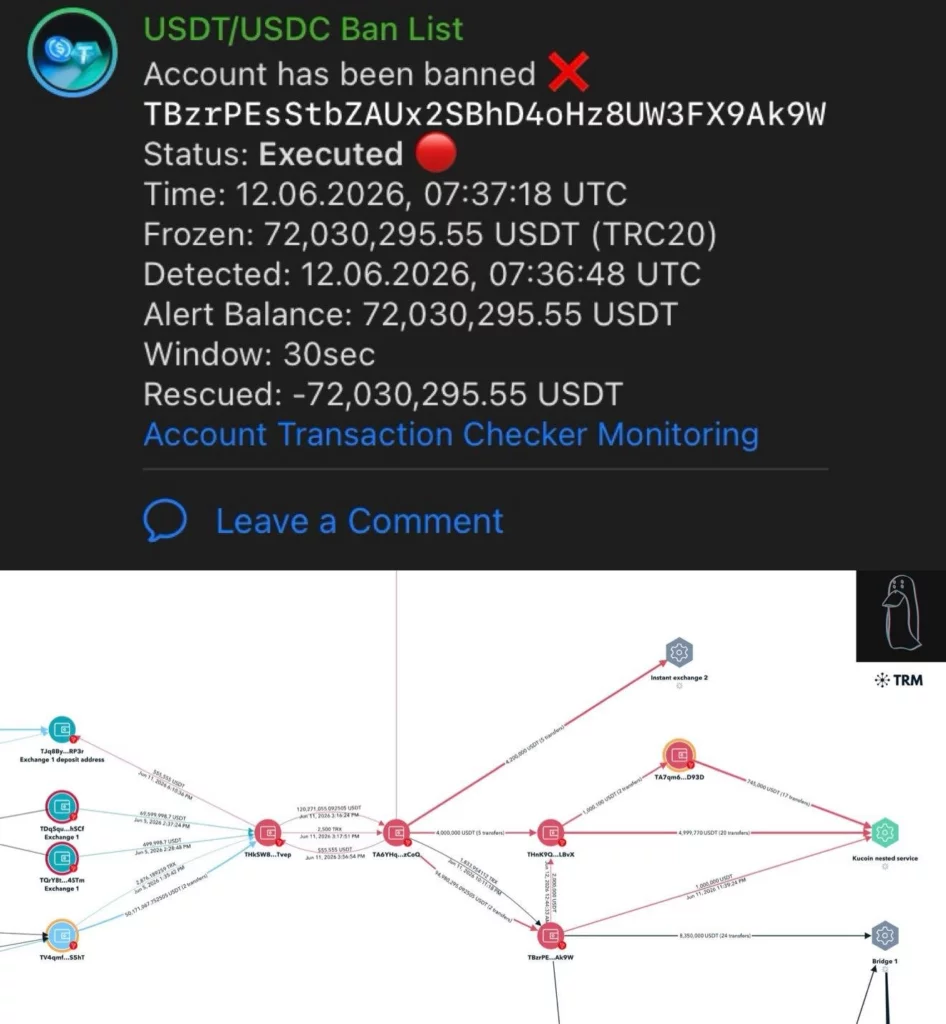
Tether froze more than $72 million in USDT on Tron after ZachXBT linked a large wallet to recent Monero buying and a sharp XMR price spike.
Summary
- ZachXBT traced 120.2 million USDT moving through Tron, KuCoin, instant exchanges, Near Intents wallets.
- Tether froze 72.03 million USDT on Tron after a related address was blacklisted Friday morning.
- XMR traded near $357 after surging toward $438, keeping privacy-coin liquidity in focus today Friday.
ZachXBT traces $120M USDT wallet
On-chain investigator ZachXBT said a Tron address received 120.2 million USDT on June 11 before moving funds across exchanges and cross-chain routes. The address was identified as TA6YHqB2xh5HhfmC7WoLQaWmqq7Vv4zCoQ.
The funds later moved in several directions. ZachXBT said more than $12 million went to KuCoin deposit addresses, while $8 million moved to instant exchanges.
Another $8 million was bridged from Tron to Bitcoin and Ethereum through Near Intents. The activity drew attention because it happened before and during a strong move in Monero.
“Yesterday (June 11) TA6YHqB2xh5HhfmC7WoLQaWmqq7Vv4zCoQ received 120.2M USDT on Tron and began transferring $12M+ to Kucoin deposit addresses and $8M to various instant exchanges,” said ZachXBT.
Monero orders linked to XMR spike
ZachXBT said the same entity created large Monero orders. He linked those orders to a sharp XMR move from $330 to $420.
“The entity created Monero orders which caused the XMR price to spike from $330 -> $420,” said ZachXBT.
Monero later traded near $357.20, according to crypto.news market data. XMR recorded a 24-hour trading range between $345.09 and $438.06, showing how wide the move became.
The token’s 24-hour trading volume stood near $291.3 million, while market capitalization was around $6.7 billion. XMR was still up over 3% on the day and almost 10% over seven days.
The move added fresh attention to Monero’s market depth. Large orders can move XMR quickly because the asset has less exchange access than many top tokens.
Tether freezes related Tron address
ZachXBT said Tether later blacklisted a related Tron address holding about 72 million USDT. Whale Alert data showed 72,030,295 USDT frozen on Tron on June 12.
“A few minutes ago Tether blacklisted an address directly related to Ta6YHq with 72M USDT: TBzrPEsStbZAUx2SBhD4oHz8UW3FX9Ak9W,” said ZachXBT.
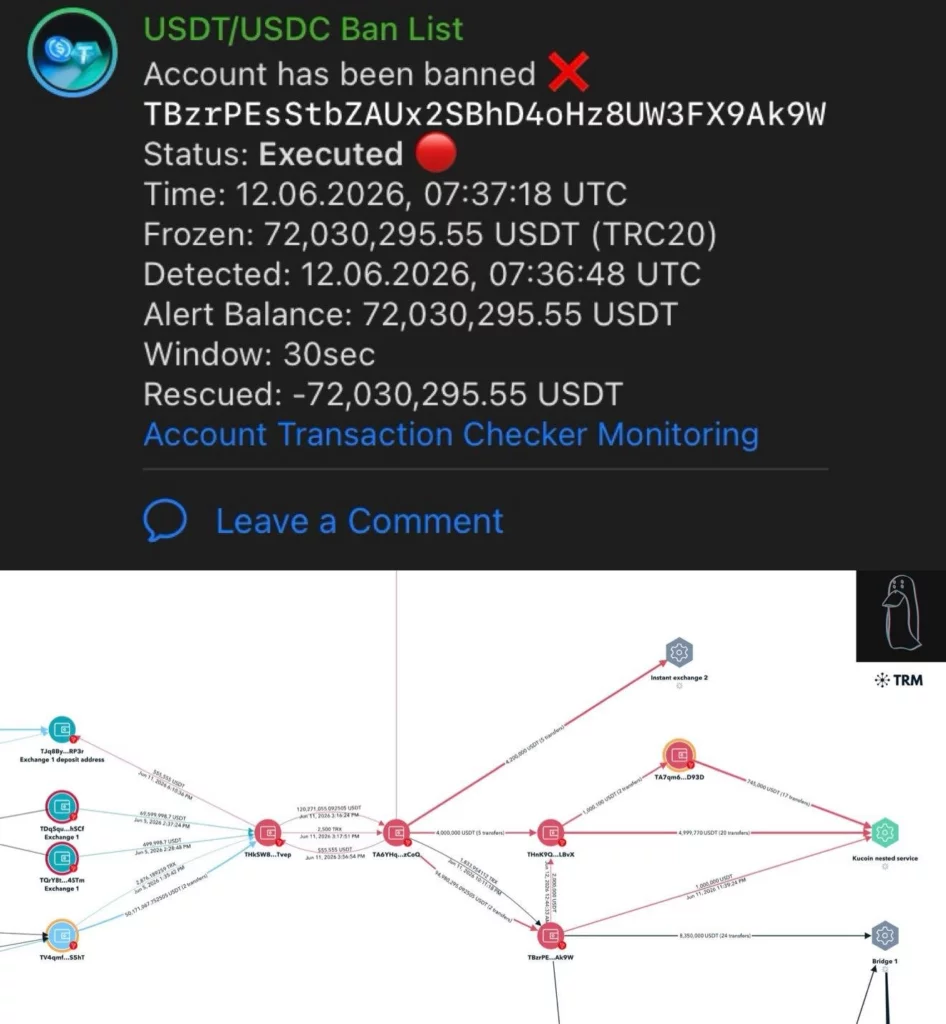
The freeze shows how issuer-controlled stablecoins can be halted at the token contract level. This makes USDT different from assets like Bitcoin or Monero, where issuers do not control transfers.
As previously reported by crypto.news, Tether froze about $515 million in USDT across Ethereum and Tron over a 30-day period in May. Tron accounted for most of those frozen balances.
Monero rally follows earlier demand
The wallet activity came after Monero had already seen stronger market attention. As previously reported, XMR rose above $350 after double-digit daily gains on June 11.
That earlier move was tied to privacy-coin demand, Cake Wallet’s Passport Prime integration, and renewed attention around Monero security audits. The latest ZachXBT report added a separate liquidity-driven angle.
Monero remains one of the largest privacy coins by market value. Its design hides transaction sender, receiver, and amount details by default, which makes it attractive to privacy users and harder for investigators to track.
The latest price action now leaves traders watching whether XMR can hold above the $350 area. A return toward $400 would keep the breakout debate alive, while loss of support could show that the spike was driven mainly by short-term order flow.


TRM Labs has tied four cryptocurrency addresses to live scams targeting 2026 World Cup fans, spanning fake ticket sites and a fixed-match betting scheme as matches play out across North America.
The blockchain intelligence firm says wallets associated with the operations have received less than $1,700 combined so far. However, it warns that scam volume and frequency could ramp up.
How World Cup Demand Fuels Crypto-Based Scams
Major sporting events create concentrated demand spikes for tickets, travel, and merchandise. Scammers build that timing into their planning, seeding fake infrastructure weeks ahead, then promoting it hard near kickoff, TRM research shows.
FIFA-WTO studies estimate that the tournament could draw 6.5 million attendees and add up to $40.9 billion to global GDP. That scale gives fraudsters a deep pool of potential victims.
Watchdogs flagged the risk early. The FBI warned in May about spoofed FIFA websites built to steal personal data and sell fake tickets. The Better Business Bureau echoed the alarm.
Angela Dennis, CEO of the Better Business Bureau of Central Ontario, told reporters why mass demand draws fraud.
“When there is such a mass volume and this high demand, that’s when scammers really get excited because people do fall for the information that they send, whether it’s an email, a phishing email or a text, and having people link to fake sites and providing personal information or payment details to them,” Dennis stated.
Follow us on X to get the latest news as it happens
Inside the On-Chain World Cup Scams
TRM identified several on-chain scam types, led by fake ticketing and fixed-match betting. Fraudulent ticket sites pose as official sellers, list sought-after matches, and demand crypto.
One Polygon (POL) wallet pulled in about $1,562, almost all on April 1. A second operation, tied to a Bitcoin (BTC) address, keeps its phishing page live but has not accepted any payments.
Fixed-match schemes charge an upfront fee for supposed insider results. TRM linked one to a Bitcoin wallet that collected small sums between January and May 2026, then routed them into a custodial account.
A third route runs through tokens. TRM pointed to the $WORLDCUP coin. It trades on LBank as a fan-made commemorative project with no FIFA tie, exposing holders to familiar low-liquidity meme coin losses.
Scammers also lean on bridges to muddy the trail, with TRM counting roughly $1.9 billion in scam funds moved through them over time.
A third scam runs through tokens. A coin called $WORLDCUP trades on the LBank exchange, billed as a fan-made commemorative project with no affiliation with FIFA. Holders face the standard low-liquidity meme coin loss patterns when issuers exit.
“The amounts involved in these cases are modest, but the movement of funds follows patterns commonly seen in consumer crypto fraud,” the report read.
Scammers lean on bridges to move proceeds and complicate tracing. Across all tracked activity, roughly $1.9 billion in scam funds has passed through bridges.
TRM expects to see more typologies as the tournament continues, including gambling pitches, deepfake impersonations of FIFA figures, and fake streaming sites.
Subscribe to our YouTube channel to watch leaders and journalists provide expert insights
The post Crypto Scammers Hit World Cup Fans as Tournament Gets Underway appeared first on BeInCrypto.

TLDR:
- US export control order forced global shutdown of Fable 5 and Mythos 5 models immediately across all users
- Anthropic says restriction stems from alleged jailbreak concern but calls issue narrow and non-systemic in scope
- Other Claude models remain online as company complies with government national security directive requirements
- Firm disputes severity of claims, citing prior red-teaming tests and absence of verified harmful exploits
A US government export control directive has forced Anthropic to suspend global access to Fable 5 and Mythos 5. The order applies to all foreign nationals, including employees outside the United States.
The decision triggered an immediate shutdown of both models across all customer environments. According to internal communication, the directive was issued citing national security concerns tied to potential jailbreak vulnerabilities.
Fable 5 and Mythos 5 Export Control Order Shakes Anthropic AI Access
AnthropicAI confirmed it received the directive at 5:21pm ET from US authorities.
The order required immediate suspension of Fable 5 and Mythos 5 access worldwide. The restriction applies even to foreign national staff working within the company.
The company stated compliance was mandatory under export control rules.
As a result, it disabled both models across its infrastructure. Other Claude models remain fully operational without restriction.
The announcement highlighted that the directive affects users across all regions. Customers outside the United States lost access at the same time as domestic users. The scope of the order reflects broad national security classification.
Anthropic noted the shutdown was abrupt and not pre-planned.
Engineering teams executed global deactivation procedures shortly after receiving the notice. Service disruption affected enterprise users and developers relying on the models.
Fable 5 and Mythos 5 Security Concerns and Jailbreak Claims Explained
The directive reportedly stemmed from concerns about a potential jailbreak method targeting Fable 5.
Authorities believed the technique could expose cybersecurity-related capabilities under certain conditions. The company reviewed the same demonstration internally.
Anthropic stated the identified issue involved narrow vulnerabilities already seen in other models. It added that similar weaknesses could be reproduced using publicly available AI systems. The company did not identify evidence of a universal jailbreak.
Internal assessments showed safeguards were tested extensively before release.
The models underwent thousands of hours of red-teaming with external partners. These included government-linked AI safety institutes and third-party evaluators.
According to Anthropic, no verified harmful deployment resulted from the reported vulnerability. The company said it had not received documentation of a broad exploit affecting model safety systems. It described the issue as limited in scope and non-systemic.
Despite disagreement with the directive’s severity, Anthropic complied with legal requirements.
The firm emphasized ongoing discussions with regulators to restore access. It also reaffirmed that other models remain unaffected and continue operating normally.

Bitget has secured registration in Argentina as a Virtual Asset Service Provider, adding another regulated market to its Latin American footprint as crypto adoption in the country approaches 20% of the population.
Summary
- Bitget has secured Virtual Asset Service Provider registration in Argentina, extending its regulated presence across Latin America.
- Argentina’s crypto market now includes nearly 20% of the population and more than 15,000 businesses that accept digital asset payments.
- The approval comes as Bitget continues expanding tokenized stock and real world asset products across its exchange and wallet ecosystem.
According to a press release shared with crypto.news, Bitget has been added to Argentina’s Virtual Asset Service Provider registry maintained by the National Securities Commission, known locally as the CNV.
The registration allows the exchange to operate within the country’s existing framework for crypto service providers while complying with oversight requirements tied to anti-money laundering and counter-terrorism financing rules.
As part of the registration, Bitget will be subject to reporting and compliance obligations before Argentina’s Financial Information Unit and other relevant authorities. The approval comes as policymakers across Latin America continue building formal rules for digital asset businesses operating in their jurisdictions.
Argentina has emerged as one of the region’s busiest crypto markets, with company data indicating that nearly 20% of the population uses digital assets and more than 15,000 businesses accept crypto payments. Growing participation has turned the country into a key destination for exchanges seeking expansion opportunities across Latin America.
“Regulatory frameworks for digital assets continue developing across Latin America, making compliance and registration increasingly important for platforms operating in the region,” said Gracy Chen, CEO of Bitget.
“Argentina represents an important market within Latin America’s broader digital asset landscape, and Bitget remains focused on supporting sustainable growth by aligning with local regulatory requirements.”
Argentina adds to Bitget’s regional expansion
Coming shortly after regulatory progress in Mexico, the Argentina registration extends Bitget’s presence in markets where crypto adoption and regulatory development are advancing at the same time.
Recent months have also seen the company deepen its focus on products that connect digital assets with traditional finance. Earlier in June, Bitget enabled 15 tokenized stocks and exchange-traded funds, including Apple, Nvidia, Tesla, Microsoft and Amazon-linked assets, to be used as collateral for USDT-margined futures trading through its Unified Trading Account system.
At the time, Chen said users were looking for more ways to put tokenized assets to work across different trading activities as demand for blockchain-based financial products continued to grow.
A separate announcement from Bitget Wallet on June 9 expanded the company’s tokenized asset infrastructure further. The wallet introduced support for direct trading of tokenized real-world assets through its DEX Aggregator API, allowing partner platforms to route trades from cryptocurrencies into tokenized stocks without requiring separate trading systems.
According to Bitget Wallet, the upgrade introduced an RFQ-based routing model designed to secure liquidity before transactions reach the blockchain. Initial integrations included Ondo Finance and xStocks, two of the largest participants in the tokenized asset sector.
Bitget Wallet also reported that its ecosystem now offers access to more than 300 tokenized products spanning equities, commodities, precious metals and other financial instruments. Company figures further show that Bitget’s tokenized equity products have generated more than $30 billion in trading volume since 2025.
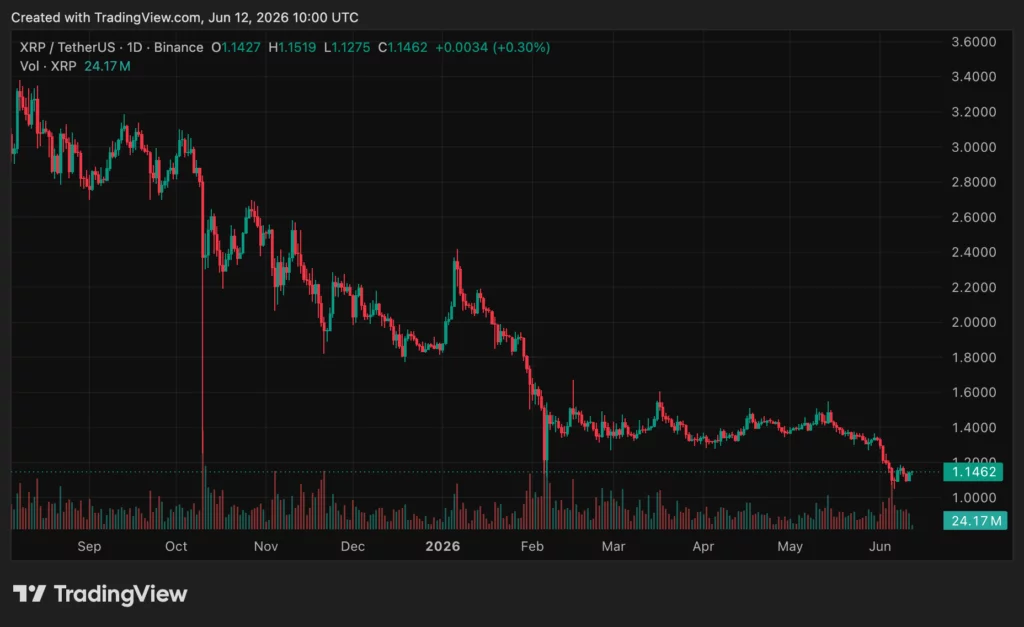
XRP traded near $1.15 on June 12 after a volume-backed rebound from the $1.10 area, but traders still watched whether the move could break the wider downtrend.
Summary
- XRP rose near $1.15 after buyers defended $1.10 and pushed through short-term resistance.
- Weak sentiment and zero ETF outflows kept XRP in focus despite its broader monthly downtrend.
- Ripple’s MXNB launch on XRPL added enterprise payments context as traders watched the $1.20 area.
XRP price rebounds from $1.10
XRP traded at $1.15, up nearly 3% over 24 hours, according to crypto.news market data. The token recorded about $1.68 billion in daily trading volume, while market capitalization stood near $71.24 billion.
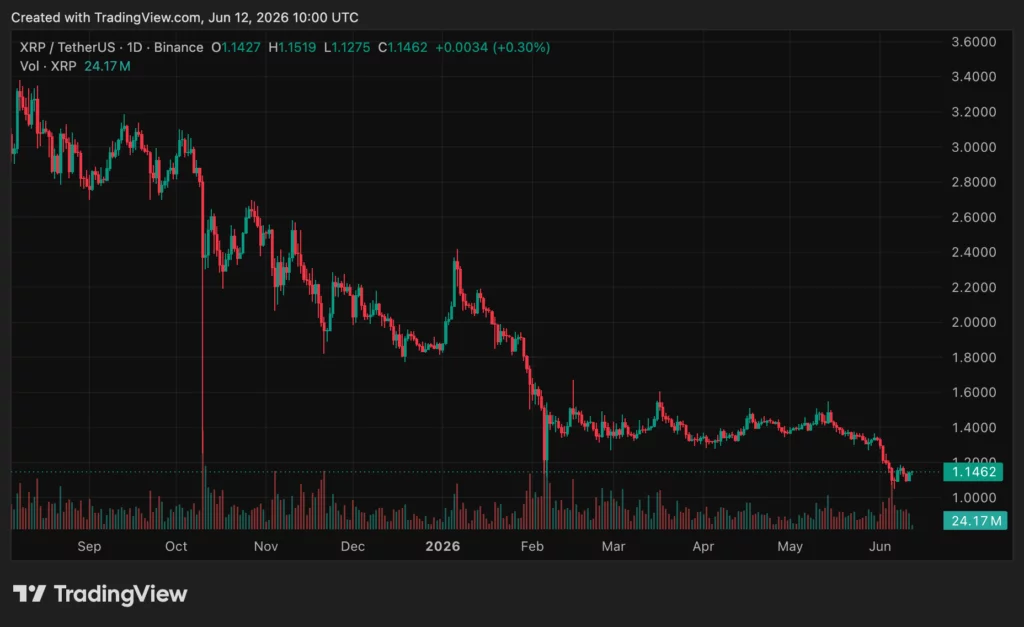
The 24-hour trading range stayed between $1.10 and $1.15. That shows buyers defended the lower end of the range and pushed price back toward short-term resistance.
The rebound followed a weak period for XRP. The token remained down 21.48% over 30 days and 48.73% over the past year, showing that the latest move has not erased the broader decline.
XRP still ranks sixth by market value. Its fully diluted valuation stood near $114.79 billion, with about 62.05 billion tokens in circulation from a maximum supply of 100 billion.
Volume-backed move tests resistance
XRP rose from about $1.1080 to $1.1442 during the earlier 24-hour session, gaining more than 3%. The strongest move came when buyers pushed through resistance near $1.1220.
Volume surged to about 120.2 million XRP during the June 11 17:00 UTC session. That was more than 160% above average and helped confirm the short-term breakout.
The move was notable because recent XRP rebounds had faded quickly. This time, buyers kept bidding into the close and pushed price above $1.14.
The next test sits around $1.20 to $1.25. Every major XRP recovery this year has struggled before that zone, so a clean break above it would be needed to improve the larger structure.
Sentiment stays weak despite rebound
Santiment said XRP’s weighted sentiment has fallen to its lowest level since October 2025. The metric tracks social volume and the ratio of positive to negative commentary.
“XRP’s sentiment at 8-month lows, but this level of FUD tends to spark bull rallies,” said Santiment.
That signal does not confirm a price rally. It shows that crowd interest has weakened while negative commentary has increased, which can sometimes appear near rebound zones.
Santiment also noted that XRP has seen strong rebounds in the past when traders became disinterested. That makes sentiment a useful secondary signal, but not a full trading signal on its own.
ChartNerd also pointed to XRP returning to the lower regression band of the Gaussian Channel on the two-week timeframe near $1.04. The analyst described that zone as a macro opportunity area based on prior cycles.
“One of our XRP signals just fired,” said ChartNerd.
XRP ETF flows and technical levels matter
According to SoSoValue data, XRP spot ETFs recorded zero outflows on June 11, while Bitcoin, Ethereum, and Solana ETFs saw redemptions. XRP ETF net assets were reported near $984.77 million, close to the $1 billion mark.
That matters because steady ETF demand can support price during weak market conditions. It does not guarantee a breakout, but it can reduce the pressure that comes from spot selling.
Technically, XRP is trapped between a short-term rebound and a longer-term downtrend. Price has reclaimed $1.14, but it still trades below the larger descending trendline that has guided the market since early 2026.
Immediate support sits near $1.10. A loss of that area could expose $1.04, where analysts are watching the lower regression band and recent support.
On the upside, XRP needs to clear $1.15 first, then build momentum toward $1.20. A daily close above $1.20 would shift focus to $1.25, where earlier recoveries have failed.
MXNB launch adds XRPL context
Ripple and Bitso expanded their partnership by bringing the MXN-backed stablecoin MXNB to the XRP Ledger. The stablecoin will also integrate with Ripple’s Payments on Decentralized Exchange infrastructure.
The setup is designed to support enterprise settlement between the United States and Mexico. Ripple’s RLUSD and Bitso’s MXNB are expected to provide on-chain dollar and peso liquidity for payment flows.
The launch adds another institutional use case for XRPL. Still, XRP price must confirm strength through the chart, because network growth does not always lead to immediate token demand.
As previously reported by crypto.news, the XRPL 3.2.0 upgrade is also expected on June 15. The upgrade will rename the core software from “rippled” to “xrpld” and may reduce server memory use by around 40%.
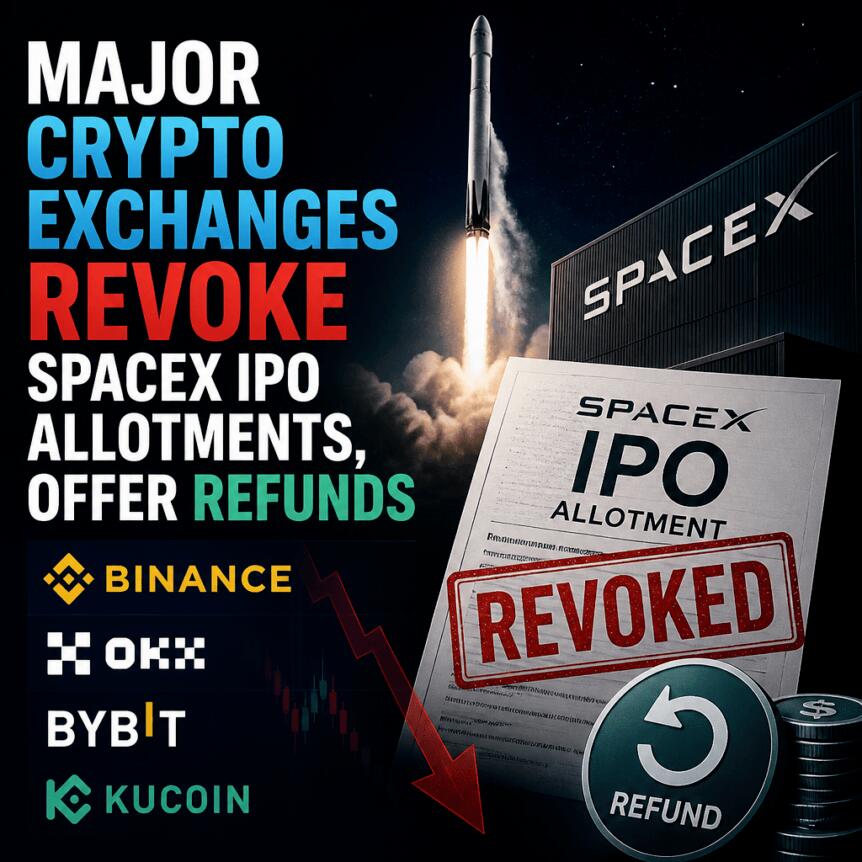
Several major crypto trading and wallet platforms have canceled their tokenized SpaceX IPO campaigns after SpaceX began trading publicly on the Nasdaq. Bybit, Binance, Bitget Wallet and MEXC all pointed to problems in securing underlying allocations, leaving subscribers without the expected access and triggering refunds in some cases.
SpaceX’s IPO, reported as more than four times oversubscribed, raised $75 billion and valued the company at more than $2 trillion on its first day. Shares opened at $150, rose from the $135 IPO price, and closed at $161.11 on Friday.
Key takeaways
- Bybit, Binance, Bitget Wallet and MEXC canceled their tokenized SpaceX IPO offerings once allocations could not be fulfilled.
- Multiple platforms blamed xStocks’ inability to deliver the underlying assets needed to distribute SpaceX tokenized IPO allocations.
- Binance’s campaign had reportedly attracted more than $557 million in USDC deposits before being halted.
- Bitget Wallet and MEXC stated they would refund affected users.
Tokenized IPO campaigns lose the allocation race
As SpaceX transitioned from private markets to public trading, crypto platforms offering tokenized access attempted to translate that demand into participation for their users. But once the IPO went live, these campaigns ran into a practical bottleneck: they could not obtain SpaceX allocations through xStocks, the entity involved in distributing the tokenized exposure.
According to Bybit’s announcement, the firm did not receive any SpaceX allocations due to xStocks’ failure to deliver the underlying assets. In that situation, Bybit said subscribed users would not receive SpaceX allocations despite the earlier subscription process.
Bybit says xStocks delivery issues stopped allocations
Bybit was among the earliest platforms to market tokenized IPO participation with its Bybit IPO Express, which included a SpaceX debut. In its cancellation message, Bybit directly tied the outcome to xStocks’ inability to deliver the underlying assets required for the allocation.
Bybit’s statement indicated that because no allocations were received, the campaign could not proceed as advertised. For users, that meant the tokenized IPO access did not materialize in the form of SpaceX allocations tied to the public listing.
Binance’s deposits were not enough to proceed
Binance also reported that it could not move forward with its tokenized SpaceX IPO campaign after citing circumstances outside its control. Earlier coverage described the initiative as attracting more than $557 million in USDC deposits, reflecting significant interest from Binance users.
Binance Wallet was also described as relying on xStocks for allocation delivery. With xStocks unable to provide the underlying assets, Binance said it was unable to proceed with the campaign, despite the apparent scale of deposits recorded before the IPO date.
Bitget Wallet and MEXC move to refund users
While some platforms framed their cancellation around delivery constraints, others emphasized remediation. Bitget Wallet and MEXC both stated that they would refund users who were affected after they were unable to secure an allocation of xStocks’ tokenized SPCX exposure.
In an X post, Bitget Wallet chief operating officer Alvin Kan said it was “disappointing that this didn’t work out in the end,” adding that the company was sending refunds. Kan also acknowledged that the episode had shaken trust within the industry, while arguing that the platform would continue and “come out of this stronger.”
MEXC similarly indicated that refunds were the next step, aligning with the broader pattern of tokenized IPO campaigns encountering execution risk when upstream allocation mechanics fail.
What this setback signals for tokenized IPO access
This episode highlights a recurring challenge for tokenized access products: they may package participation in high-demand public events for retail or crypto-native audiences, but they still depend on traditional allocation and settlement flows. When the party responsible for sourcing and distributing the underlying exposure cannot deliver, platforms can only cancel or unwind the offering.
That dependency matters now because the market conditions were unusually favorable for such products. SpaceX’s IPO drew massive interest, and reports said it was more than four times oversubscribed. Yet even with demand concentrated around a single, widely watched listing, crypto platforms were still unable to convert subscriptions into allocations.
For investors and traders, the practical takeaway is that tokenized IPO participation should be viewed as an execution-sensitive service—not only a market product. Users should watch for clarity around allocation guarantees, the identity of the upstream allocation provider, and how refunds are handled when delivery fails.
Going forward, the key question is whether platforms and allocation intermediaries can align incentives and operational readiness ahead of the next major high-profile IPO. Until then, users should expect that tokenized IPO offerings may carry additional counterparty and process risk—especially when demand is at the level seen during SpaceX’s public launch.
The government told Anthropic it had become aware of a method to bypass, or jailbreak, Fable 5. Anthropic reviewed the technique and said what it saw was narrow, not a universal jailbreak, and involved identifying a small number of previously known, minor vulnerabilities. It said other publicly available models, including OpenAI’s GPT-5.5, can find the same vulnerabilities without any bypass at all.
The company said the government has so far provided only verbal evidence of a potential narrow jailbreak, which it described as essentially asking the model to read a codebase and fix software flaws, a task defenders use every day.
It said applying this standard across the industry “would essentially halt all new model deployments for all frontier model providers.”
Anthropic built its entire brand around safety-first AI development, and it is now publicly disputing a national security directive on the grounds that the government’s evidence does not clear its own stated bar.
The company will share more details about the specific jailbreak within 24 hours.
The crypto market is now pricing the shutdown as a negative for the IPO case, and the Anthropic perp’s drop from its post-launch highs reflects that. The first question for the company’s public listing ambitions is whether the government’s order gets reversed, narrowed, or extended to other model classes once Anthropic publishes its technical rebuttal.

Many are assumed to belong to Bitcoin’s pseudonymous creator Satoshi Nakamoto and other owners who lost their keys, which means they can never be moved to safety. Another 5 million or so are exposed through address reuse, according to Project11, a research group tracking the issue, though most of those are thought to be active holdings in exchange wallets.
Swapping in quantum-resistant signatures is the easy part, but the fight is over the coins nobody moves. One camp argues for a hard deadline, after which the signature schemes Bitcoin uses today, ECDSA and Schnorr, stop being accepted and any unmigrated coins become unspendable. Leaving them live, this side says, hands a future attacker, potentially a sanctioned state like North Korea, a stash of bitcoin large enough to crash the price and taint the network’s legitimacy.
The other camp calls that confiscation, a violation of the absolute property rights Bitcoin was built on, and warns it sets a precedent for freezing coins under government pressure later.
Between them sit the several proposals CoinDesk has tracked over the past two months.
Hourglass would cap how many vulnerable coins can be spent per block to prevent a supply flood. BIP-361, from developer Jameson Lopp and others, would let migrated holders prove ownership after the cutoff with a quantum-resistant proof that exposes no key. PACTs, from Paradigm’s Dan Robinson, would let owners timestamp a private claim now and move funds later without revealing anything today.


CoreWeave and Nebius have secured places in the Nasdaq 100 after Nasdaq announced that both companies will be added to the index before trading begins on June 22.
Summary
- CoreWeave and Nebius will join the Nasdaq 100 on June 22 following Nasdaq’s quarterly rebalance.
- CoreWeave’s inclusion follows its transformation from a crypto miner into a major AI infrastructure provider.
- While AI firms gain index representation, some crypto miners continue facing financial and listing challenges.
According to Nasdaq’s quarterly index rebalance announcement, CoreWeave and Nebius will join the Nasdaq 100 alongside Astera Labs, Rocket Lab, and Teradyne.
Investors welcomed the news, sending CoreWeave shares up about 7.3% to roughly $102 and lifting Nebius shares about 6.3% to around $233 in Friday trading.
The additions come as companies tied to artificial intelligence infrastructure continue attracting capital and market attention. Membership in the Nasdaq 100 often increases exposure to institutional investors and can generate buying activity from exchange-traded funds and other passive investment products that track the benchmark.
For CoreWeave, the milestone follows a rapid transformation from cryptocurrency mining into one of the most closely watched AI infrastructure providers in public markets.
As previously reported by crypto.news, the company exited crypto mining and rebranded as an AI infrastructure business in 2019 after weakening mining economics following the 2018 crypto market downturn.
AI infrastructure companies gain ground in major indexes
Recent business developments have strengthened CoreWeave’s position within the AI sector. As reported by crypto.news in April, the company signed a multi-year agreement with Anthropic to support workloads for the Claude family of AI models.
Under the agreement, Anthropic will use CoreWeave’s cloud data centers to run AI workloads, with deployment expected to expand over time as demand increases.
The Anthropic partnership followed an $8.5 billion capital raise led by Meta Platforms. According to crypto.news, the financing was backed by deployed computing capacity and projected cash flows rather than graphics processing unit hardware, a structure that differed from financing models commonly used by crypto mining firms.
Meanwhile, Nebius has built its business around AI cloud services and has attracted investors seeking alternatives to larger cloud providers. The company markets itself as a full-stack AI cloud platform and has benefited from rising demand for computing power used to train and operate advanced AI systems.
CoreWeave’s latest expansion plans highlight the scale of that demand. The company recently raised the lower end of its 2026 capital expenditure forecast to $31 billion, citing higher component costs as it continues adding computing capacity.
Crypto miners face pressure while AI spending accelerates
While AI-focused companies move into one of the world’s most closely followed technology indexes, several firms tied to cryptocurrency mining continue dealing with operational and financial challenges.
Canaan offers a contrasting example. As reported by crypto.news, the Nasdaq-listed Bitcoin miner achieved a record fleet efficiency of 17.9 joules per terahash in May and improved efficiency by 11% from a year earlier. The company mined 90 Bitcoin during the month and increased its treasury holdings to approximately 1,867 BTC and 3,952 ETH.
Despite those operational gains, Canaan reported first-quarter revenue of $62.7 million, down from $196.3 million in the previous quarter, while posting a net loss of $88.7 million. Crypto.news previously reported that the company also received a second Nasdaq non-compliance notice after its share price remained below the exchange’s $1 minimum bid requirement, giving it until July 13, 2026, to regain compliance.
Industry projections cited by crypto.news suggest publicly listed miners could generate as much as 70% of revenue from AI-related activities by the end of 2026, up from roughly 30% today. As companies invest in data centers and high-performance computing infrastructure, some miners have sold portions of their Bitcoin holdings to finance that transition.
Against that backdrop, the Nasdaq 100 additions underscore how investor interest has increasingly concentrated around companies supplying cloud capacity, AI data centers, and computing infrastructure, even as parts of the cryptocurrency mining sector continue searching for new growth models.
Disclosure: This article does not represent investment advice. The content and materials featured on this page are for educational purposes only.

There’s another election happening on June 18, and this one is Reform’s last chance saloon

Dollar steadies, set for weekly loss on US-Iran deal talks
Major Pi Network (PI) News: Here’s What All Pioneers Need to Know


-

 NewsBeat5 days ago
Alexander Zverev wins the French Open to finally earn a 1st Grand Slam title
-
 Entertainment6 days ago
The Best Mystery Series of All Time Is Surging on Streaming 30 Years After It Ended
-

 Crypto World5 days ago
Anatomy of the June crypto crash: Fed, Iran, Saylor
-

 Crypto World2 days ago
Oppenheimer backs SpaceX as $70 billion retail frenzy builds
-

 Crypto World2 days ago
Markets Rally as SpaceX IPO Looms Amid Iran Tensions and Inflation Surge
-
Crypto World6 days ago
Senator Cynthia Lummis Calls CLARITY Act the Most Consequential Financial Legislation of This Generation
-
 NewsBeat6 days ago
Alexander Zverev conquers demons and outlasts Flavio Cobolli to win French Open for first major title
-

 Tech6 days ago
Microsoft unveils seven homegrown AI models in new bid for ‘long term self-sufficiency’
-

 Tech7 days ago
Hackers now exploit SolarWinds Serv-U flaw to crash servers
-

 Business5 days ago
High Stakes for Wembanyama as New York Pushes for 3-0 Lead
-
 Business6 days ago
The Pain Points Taking a Fragile Tech Rally Down a Notch
-
 Tech5 days ago
Notion restores access to Anthropic after service disruption
-
 Crypto World5 days ago
Eli Lilly (LLY) Stock Surges 4% Following Breakthrough Sleep Apnea Trial Results
-
 Business6 days ago
The investment to transform historic St Helen’s ground in Swansea
-

 Crypto World6 days ago
Trump’s AI Ownership Plan Could Benefit Anthropic at OpenAI’s Expense
-
 Sports4 days ago
Bangladesh beat Australia after 20 years in ODIs, register only their second win over six-time world champions | Cricket News
-

 Business7 days ago
Forensic Expert Floats Handyman Theory in Disappearance of Savannah Guthrie’s Mother
-

 Tech5 hours ago
NanoClaw integrates JFrog registries to secure AI agent downloads
-

 Tech16 hours ago
This Week In Security: Microsoft On Microsoft, Register Your Domains, Linux On ARM, And FreeBSD Joins The File Cache Club
-

 Politics2 days ago
Politics Home | Healey Resignation Is “Colossal Failure Of Government”, Says Former Labour Defence Secretary
You must be logged in to post a comment Login