Connect with us
DAPA Banner
DAPA Coin
DAPA
COIN PAYMENT ASSET
PRIVACY · BLOCKDAG · HOMOMORPHIC ENCRYPTION · RUST
ElGamal Encrypted MINE DAPA
🚫 GENESIS SOLD OUT
DAPAPAY COMING

Business

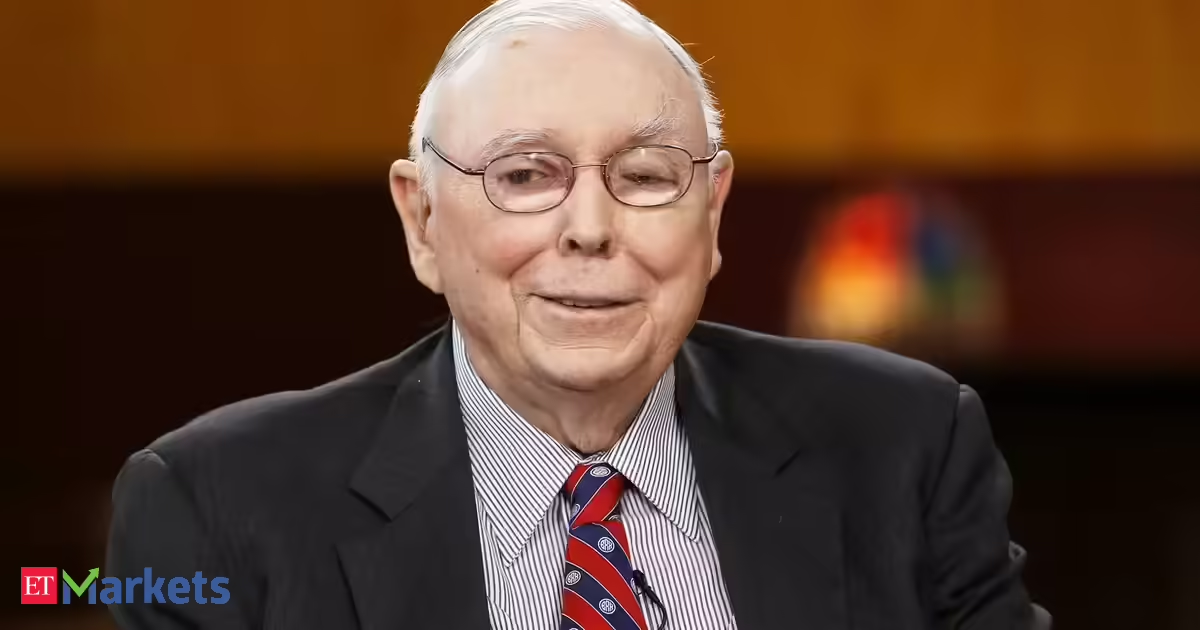
How Charlie Munger’s behavioral lessons apply to today’s market reality

Published

on

How Charlie Munger’s behavioral lessons apply to today’s market reality
In an environment where global equities are swinging between optimism around AI-led growth and anxiety over persistent inflation, elevated interest rates, and geopolitical uncertainty, investors are once again being tested, not on intelligence, but on psychology.

Charlie Munger’s famous list of “human misjudgment tendencies” is not just a philosophical framework. It is, in today’s market, a practical survival guide.

Markets in 2026 are still being shaped by three dominant forces:
(1) higher-for-longer interest rates, (2) liquidity concentration in a few mega-cap stocks, and (3) emotionally driven retail participation.Against this backdrop, Munger’s behavioral warnings feel unusually relevant.

1. The real enemy is not volatility, but emotional distortion

Munger repeatedly warned that investors don’t lose money because they lack information, they lose because they misprocess it.Today’s markets amplify that problem.
Every CPI print, Fed commentary, or geopolitical headline triggers immediate overreaction. Investors are constantly pulled between fear of missing out (FOMO) in AI-led rallies and fear of correction during rate jitters.
This is a classic combination of:

Advertisement
  • Availability bias (overweighting recent news)
  • Social proof (following crowded trades)
  • Stress-induced reaction (panic buying or selling)

In Munger’s language, this is the setup for “avoidable stupidity.”

2. “Envy and FOMO” are silently driving modern portfolios


One of Munger’s strongest warnings was about envy, not as emotion, but as a financial destroyer.

In today’s market, envy doesn’t look like jealousy of a neighbour. It looks like:

  • Chasing AI stocks after they’ve already rerated sharply
  • Comparing portfolio performance with index benchmarks daily
  • Abandoning long-term positions because “others are making faster money”

When liquidity is abundant in a narrow set of names, envy becomes structurally embedded in portfolio behaviour. Investors are no longer asking “Is this a good business?” but “Am I missing this move?”

That shift is dangerous in a market where leadership is concentrated and reversals can be abrupt.

Advertisement

3. The “Lollapalooza effect” is stronger than ever


Munger described the Lollapalooza effect as multiple biases reinforcing each other into extreme outcomes.

Today’s version looks like this:

  • Social media hype amplifies narratives
  • Algorithmic flows reinforce momentum
  • Passive inflows concentrate capital into large indices
  • Retail traders amplify short-term spikes

The result: prices detach from fundamentals faster, and corrections become sharper when sentiment shifts.

This is why today’s rallies often feel effortless, but reversals feel violent.

Advertisement

4. Overconfidence is rising with “easy market memories”


A prolonged period of strong returns, especially in largecap tech, creates what Munger called “excessive self-regard”.

Many investors now assume:

“Buying dips always works”
“Quality stocks never go down much”
“The Fed will rescue markets eventually”

But in a higher-rate regime, that assumption is no longer guaranteed. Valuation compression risk is real, and earnings must now do more of the heavy lifting.

Advertisement

Confidence built in one regime often breaks in another.

5. The biggest risk today: avoiding pain too aggressively


One of Munger’s less discussed but critical ideas is “pain-avoidance behavior”.

In today’s context, it shows up as:

Advertisement
  • Selling winners too early to “lock in gains”
  • Avoiding fundamentally strong but volatile sectors
  • Sitting excessively in cash due to fear of drawdowns

Ironically, in trying to avoid discomfort, investors often underperform the very market they are trying to survive.

6. What works in today’s market: Munger-style discipline

If we translate Munger’s philosophy into today’s environment, a few principles stand out:

(1) Concentrate only when conviction is real

Not based on stories, but on durable cash flows and long-term pricing power.

(2) Expect volatility as a feature, not a flaw

Advertisement

Even high-quality companies will see sharp drawdowns in a rate-sensitive world.

(3) Reduce decision frequency

Most mistakes come from over-trading emotional signals disguised as “information.”

(4) Build a bias checklist

Advertisement

Before acting, ask:

Am I reacting to news or value?
Am I following the crowd?
Would I make this decision in isolation?

7. The current market lesson in one line

If Munger were observing today’s markets, the warning would likely remain unchanged:

“The biggest returns still come from avoiding obvious psychological errors, not from predicting the next move.”

Bottom line

Today’s markets are not irrational, but they are emotionally amplified. Liquidity, technology, and information speed have not removed human bias; they have accelerated it.

Advertisement

That is exactly the environment where Munger’s framework becomes most powerful. Because in the end, investing success is still less about knowing more, and more about misbehaving less.

Continue Reading
Click to comment

You must be logged in to post a comment Login

Leave a Reply

Business

Nearing retirement and invested mostly in FDs? Expert shares diversification roadmap

Published

on

Nearing retirement and invested mostly in FDs? Expert shares diversification roadmap
As retirement approaches, many investors begin reviewing their financial plans to ensure their savings can generate enough income while also keeping pace with rising living costs. Fixed deposits have traditionally been a preferred investment option for conservative investors because they offer stability and capital protection. However, with inflation gradually eroding purchasing power, many pre-retirees wonder whether adding equity exposure to their portfolio can help improve long-term returns without taking excessive risk.

A similar query came from Jagruti who is nearing retirement and has mostly invested in fixed deposits and sought advice on whether it was too late to diversify beyond fixed deposits and include equities in her investment portfolio.

Also Read | Smallcap valuations turn favourable as correction creates fresh opportunities: Bajaj Finserv AMC

Responding to the query, Harshvardhan Roongta said it is never too late to revisit an investment strategy. According to him, investors should not view their past decisions negatively because they were made based on the knowledge and information available at that time.

He explained that the real mistake is not a lack of awareness in the past, but failing to act after becoming aware of alternative investment options.

Advertisement

Roongta noted that every investment product has its own advantages and limitations, which is precisely why diversification becomes important. Fixed deposits, for instance, are primarily capital-preservation tools. Investors who place money with a well-established bank are unlikely to face significant capital loss. However, fixed deposits often struggle to generate returns that comfortably outpace inflation, particularly after taxes.
On the other hand, equity investments can be volatile and do not offer any guarantee of capital protection. However, over longer periods, equities have historically delivered returns that have the potential to beat inflation and create real wealth.
According to Roongta, a well-diversified portfolio combines both growth-oriented and capital-preserving assets. While debt instruments such as fixed deposits help protect capital and provide stability, equities can offer growth potential that helps investors maintain purchasing power over the long term.
He emphasised that there is no universal formula for deciding how much equity an investor should hold. Two investors of the same age could have very different asset allocations depending on their financial goals, income sources, risk tolerance, and overall financial situation.

For example, one retiree may feel comfortable with 20% exposure to equities and 80% in debt-oriented investments, while another may choose the opposite allocation because of different financial needs and risk appetite.

Roongta said the ideal asset allocation should be determined after evaluating an investor’s objectives, future cash-flow requirements, and comfort with market volatility. The goal is to strike a balance between generating inflation-beating returns and maintaining a level of risk that the investor can comfortably handle.

Also Read | Should senior citizens continue investing in equity mutual funds after retirement? Expert explains

He also suggested consulting a SEBI-registered investment adviser to create a customised financial plan. Such advisers can help investors assess their risk profile and determine the appropriate allocation across equities, debt, gold, silver, and other asset classes.

According to Roongta, a professional review can help ensure that an investor’s portfolio remains aligned with retirement goals while also providing the diversification needed to navigate changing market conditions over the long term.

Advertisement

(Disclaimer: Recommendations, suggestions, views and opinions given by the experts are their own. These do not represent the views of The Economic Times)

If you have any mutual fund queries, message on ET Mutual Funds on Facebook/Twitter. We will get it answered by our panel of experts. Do share your questions on ETMFqueries@timesinternet.in along with your age, risk profile, and Twitter handle.

Add ET Logo as a Reliable and Trusted News Source

Continue Reading

Business

Propel Holdings: Lending As A Service While Building Equity

Published

on

Propel Holdings: Lending As A Service While Building Equity

Propel Holdings: Lending As A Service While Building Equity

Continue Reading

Business

11 equity mutual funds offer over 10% in May. Have you invested in any for your portfolio?

Published

on

11 equity mutual funds offer over 10% in May. Have you invested in any for your portfolio?

Around 11 equity mutual funds delivered over 10% returns in May, led by international and technology-focused funds such as Mirae Asset AI ETF FoF, Nippon India Taiwan Equity Fund and Edelweiss US Tech Fund.

Continue Reading

Business

Mahindra Manulife Mutual Fund announces launch of its SIF platform MPOWER

Published

on

Mahindra Manulife Mutual Fund announces launch of its SIF platform MPOWER
Mahindra Manulife Mutual Fund announced the launch of ‘MPOWER SIF’ marking its entry into SEBI’s newly notified investment product called Specialized Investment Fund and reinforcing its commitment to bringing differentiated investment solutions to investors.

With MPOWER SIF, Mahindra Manulife Mutual Fund aims to address the evolving needs of investors, who are looking to complement their existing mutual funds with products that use derivatives and other tools to create different risk return outcomes.

Also Read | Smallcap valuations turn favourable as correction creates fresh opportunities: Bajaj Finserv AMC

The fund house aims to provide a client experience that seeks to meet the investors aspiration, whilst remaining true to the core premise of creating investment outcomes that are consistent and meaningful.

“The launch of MPOWER SIF is a significant step forward in expanding our product suite. As investors and their goals and aspirations evolve over time, there is a clear requirement for investment solutions that offer greater flexibility and use the entire range of tools available to deliver consistent outcomes. This approach is complemented by an investment team with extensive experience anchored by a sound risk management framework,” said Anthony Heredia, MD & CEO, Mahindra Manulife Investment Management.

Advertisement


Mahindra Manulife Mutual Fund intends to roll out a range of differentiated strategies under MPOWER SIF across equity, hybrid, and fixed income categories, aligned with regulatory guidelines and investor suitability.
“MPOWER SIF gives us the flexibility to design more agile and outcome-oriented portfolios by leveraging a wider investment toolkit. This platform will enable us to combine fundamental research with tactical allocation strategies, with the objective of delivering superior risk-adjusted returns across market cycles. We believe it is well suited for investors seeking a more nuanced approach to portfolio construction,” said Krishna Sanghavi, Chief Investment Officer – Equity, Mahindra Manulife Investment Management.Also Read | Should senior citizens continue investing in equity mutual funds after retirement? Expert explains

The SIF category offers strategies that go beyond conventional Mutual Funds, including long-short approaches, derivatives-based strategies, and more focused portfolio construction, catering to investors seeking a different approach to meeting their investment goals.

(Disclaimer: Recommendations, suggestions, views and opinions given by the experts are their own. These do not represent the views of The Economic Times)

If you have any mutual fund queries, message on ET Mutual Funds on Facebook/Twitter. We will get it answered by our panel of experts. Do share your questions on ETMFqueries@timesinternet.in alongwith your age, risk profile, and Twitter handle.

Advertisement
Add ET Logo as a Reliable and Trusted News Source

Continue Reading

Business

Adecoagro SA: Why This Stock Is My Top Commodity Pick For 2026 (NYSE:AGRO)

Published

on

Adecoagro SA: Why This Stock Is My Top Commodity Pick For 2026 (NYSE:AGRO)

This article was written by

My name is David B McMillan and I am an investor interested in fundamental valuation. My philosophy is fundamental investing – I seek to identify underpriced securities relative to their potential future cash flows. I also use tactical allocation, investing more aggressively when equity prices are lower, and more conservatively when they are higher. I have a BS in Physics and BA in Philosophy from UCSB, and am currently a CFA Level 2 candidate. I am mostly interested in covering stocks in the aerospace and defense sector, but I am also interested in retail and tech companies. I have a 12 year investing track record, with documented investments in AI, tech, and crypto themes before they were widely understood – NVDA in 2017, 8000 percent gain; PLTR at IPO, 1870 percent gain; AMD in 2017, 3700 percent gain; TSLA in 2016, 3400 percent gain. Had all of Mag 7 in my portfolio by 2018, before those stocks were called the Mag 7. My current demo portfolio, started in April 2025 with about $8k of my my own capital, is so far achieving a Sharpe ratio of 3.49 compared to IVV of 2.42 in the same time period. My average time-weighted return is 0.30 percent per day vs IVV at 0.14 percent per day.

Analyst’s Disclosure: I/we have no stock, option or similar derivative position in any of the companies mentioned, and no plans to initiate any such positions within the next 72 hours. I wrote this article myself, and it expresses my own opinions. I am not receiving compensation for it (other than from Seeking Alpha). I have no business relationship with any company whose stock is mentioned in this article.

Seeking Alpha’s Disclosure: Past performance is no guarantee of future results. No recommendation or advice is being given as to whether any investment is suitable for a particular investor. Any views or opinions expressed above may not reflect those of Seeking Alpha as a whole. Seeking Alpha is not a licensed securities dealer, broker or US investment adviser or investment bank. Our analysts are third party authors that include both professional investors and individual investors who may not be licensed or certified by any institute or regulatory body.

Advertisement
Continue Reading

Business

FIIs pull out massive Rs 20,637 crore in single day on Friday. What led to this sharp exit?

Published

on

FIIs pull out massive Rs 20,637 crore in single day on Friday. What led to this sharp exit?
Foreign portfolio investors (FPIs) emerged as heavy sellers in Indian equities on Friday, pulling out a net Rs 20,637 crore in a single session, recording one of the sharpest single-day selloffs in recent years, as markets grappled with the impact of the latest MSCI index rebalancing.

Before this, the sharpest fall occurred last month (April 2, 2026), when FIIs pulled out Rs 19,837 crore in a single day, data from ACE Equity showed.

The selloff came as benchmark indices fell 1.5%, with market participants attributing much of the late-session weakness to passive fund flows linked to the index reshuffle. The scale of foreign investor activity stood out not just because of the outflow figure, but also because of the sheer volume traded during the session.

FPIs accounted for Rs 198,465 crore of trading activity out of the NSE’s total turnover of Rs 287,452 crore, representing nearly 69% of the day’s traded value, provisional data on the NSE showed.

Advertisement

Despite ending the day as net sellers of Rs 20,637 crore, FPIs traded nearly 9.6 times that amount during the session. In comparison, domestic institutional investors (DIIs) were net buyers of Rs 16,260 crore and recorded total trades worth Rs 53,772 crore, or around 3.3 times their net purchase value.


The high participation prompted questions over whether the activity was solely driven by MSCI-related portfolio adjustments or whether high-frequency trading (HFT) strategies amplified volumes around the index rebalance. The size of the turnover also sparked debate over how much of the reported foreign outflow reflected actual portfolio repositioning and how much may have been linked to short-term trading activity.
Nilesh Shah, MD of Kotak Mahindra Asset Management, questioned whether the surge in activity was surprising given that Indian equities are currently not a key focus area for FPIs. He also asked whether Friday’s volumes were driven purely by MSCI rebalancing or whether high-frequency trading (HFT) activity around the index reshuffle had amplified turnover. Shah further wondered how much of the reported net FPI outflow of Rs 20,637 crore could be attributed to HFT trades.Market expert Gurmeet Chadha also questioned the sharp rise in trading volumes, arguing that ‘speed and money muscle’ were being used to distort market moves. He further highlighted the addition of 31,000 short contracts even as Brent crude hovered around $90 a barrel and hopes of a weekend deal persisted. Calling the activity suspicious, he said ‘we need to act and trap this cartel’.

According to Abhilash Pagaria, Head of Alternative and Quantitative Research at NuvamaWealth, the rebalancing led to outflows of around Rs 8,000-8,500 crore. He said the figure was somewhat higher than in previous reviews due to free-float adjustments in stocks such as Bajaj Finance, HUL and TCS, among others, describing the impact as a one-time adjustment arising from a new methodology.

MSCI Rejig


MSCI’s latest review saw Federal Bank, MCX, NALCO and Indian Bank added to the MSCI Standard Index, while Hyundai Motor India, Jubilant FoodWorks, Kalyan Jewellers and RVNL were removed. The changes took effect at the close of trade on May 29.

Advertisement

The review also resulted in weight increases for Adani Power, BPCL, Nykaa, Trent and OFFS. Despite the reshuffle, India’s overall weight in the MSCI Standard Index remained broadly stable at around 12.3%, compared with 12.4% earlier. The total number of Indian constituents in the index also remained unchanged at 165.

Beyond the Standard Index, MSCI announced a broader rejig of its Small Cap Index. According to Nuvama, more than a dozen Indian stocks were excluded, reducing the India stock count to 459 from 474. New additions included IREDA, Anthem Biosciences, Fractal Analytics, Pine Labs and Emmvee Photovoltaic, while Cello World, Redtape, Raymond Lifestyle, Indigo Paints, Balu Forge and Blue Jet Healthcare were among the exclusions.

Index review days typically witness elevated volumes as passive funds tracking MSCI benchmarks adjust their holdings to match the revised composition.

(Disclaimer: Recommendations, suggestions, views and opinions given by the experts are their own. These do not represent the views of The Economic Times)

Advertisement
Continue Reading

Business

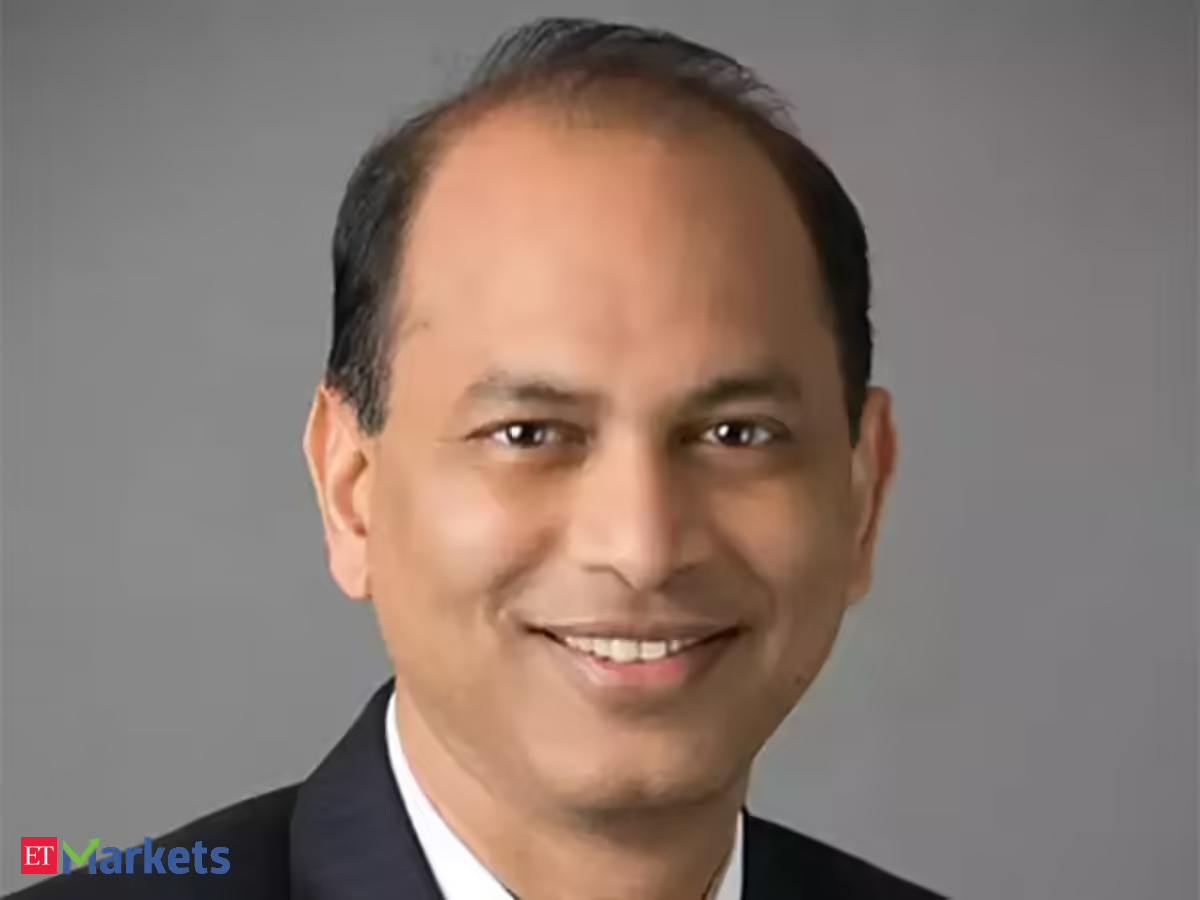
Sunil Singhania’s Abakkus Portfolio: 6 stocks rally up to 75% in CY26; 5 new buys added in Q4 – Abakkus Portfolio Snapshot

Published

on

Sunil Singhania’s Abakkus Portfolio: 6 stocks rally up to 75% in CY26; 5 new buys added in Q4 - Abakkus Portfolio Snapshot

Investors closely track the portfolios of leading market participants on Dalal Street. In this context, ETMarkets analysed the investment holdings of veteran investor Sunil Singhania’s Abakkus Asset Manager, a prominent Indian investment firm. Based on the latest shareholding data for the March 2026 quarter, Abakkus holds stakes in nearly 32 listed companies, with a combined portfolio value of around Rs 2,742 crore as of May 29, 2026. This represents an increase of approximately 6% from Rs 2,577 crore reported at the end of December 2025. The analysis includes only those companies in which the investor holds more than a 1% stake and may not represent the entirety of the portfolio.

A closer look at the portfolio’s CY26 performance reveals that a majority of the stocks have delivered negative returns. Among them, seven stocks have declined by more than 20% in the first five months of the year. On the other hand, a handful of holdings have emerged as strong performers. We highlight the top six gainers in the portfolio, which have rallied between 20% and 75% so far in CY26. The portfolio also witnessed six new additions during the March 2026 quarter. (Data Source: ACE Equity, Trendlyne).

Continue Reading

Business

Demand Conditions Improve In Chemicals Sector In April 2026

Published

on

Demand Conditions Improve In Chemicals Sector In April 2026

Demand Conditions Improve In Chemicals Sector In April 2026

Continue Reading

Business

Moderna, Inc. (MRNA) Presents at Bernstein 42nd Annual Strategic Decisions Conference Transcript

Published

on

OneWater Marine Inc. (ONEW) Q1 2026 Earnings Call Transcript

Moderna, Inc. (MRNA) Bernstein 42nd Annual Strategic Decisions Conference May 28, 2026 10:00 AM EDT

Company Participants

Stéphane Bancel – CEO & Director

Advertisement

Conference Call Participants

Courtney Breen – Bernstein Institutional Services LLC, Research Division

Presentation

Advertisement

Courtney Breen
Bernstein Institutional Services LLC, Research Division

Welcome, everyone. Thank you so much for joining us for this conversation about Moderna. My name is Courtney Breen. I am the U.S. pharma analyst here at Bernstein. And it is my privilege to have Stephane Bancel here with me, the CEO and Chairman of Moderna. He’s been in this role for a decent amount of time as well and has seen Moderna through the ages and through the different eras of the company. So I’m really excited to kind of have an opportunity to dive into kind of Moderna today, where Moderna has come from and where Moderna might be going in the future.

I also know that AI is a super important topic for all investors these days. So we’ll be hoping to touch on kind of the impact and potential of AI and drug discovery and kind of in operating some of these businesses. But I do also want to remind you that if there are other topics that I’m not planning on covering that you’d love to have covered in this conversation, please do send them through the Pigeonhole app. You’ll find a QR code to be able to send them through. I’ll receive them up here and can integrate them into the conversation. So we want to make this as relevant and as impactful for everyone that’s here.

Advertisement

Question-and-Answer Session

Courtney Breen
Bernstein Institutional Services LLC, Research Division

But without further ado, Stephane, again, thank you so much for joining us here today. As I mentioned, you’ve been leading Moderna for a while, I think, since 2011. It

Advertisement
Continue Reading

Business

Discipline, Football and Moving Forward

Published

on

Discipline, Football and Moving Forward

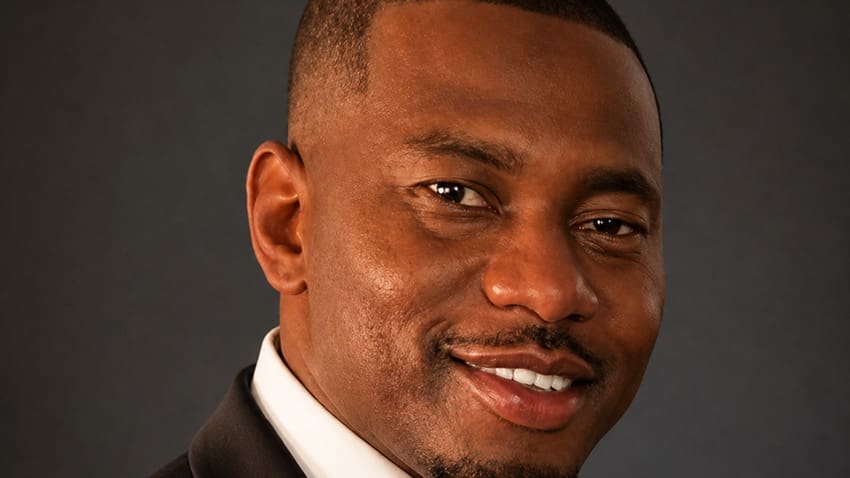
Therrian Fontenot is a former football athlete whose career has been built on discipline, resilience, and leadership.

Born in Louisiana and raised in Los Angeles, California, he developed a strong competitive mindset at an early age through sport. He attended Leuzinger High School, where he became known for his performance on the football field and graduated in 2000.

His success in high school earned him a full scholarship to Fresno State, where he competed at the collegiate level against some of the top athletes in the country. During his time there, Fontenot learned the importance of consistency, preparation, and accountability. He later made the decision to leave college early to pursue a professional football career, gaining experience in a highly competitive environment that demanded focus and mental toughness.

Throughout his journey, football remained more than just a career path. It became the foundation for the way he approaches life, leadership, and personal growth. Today, Fontenot continues to apply those lessons through fitness, discipline, and community involvement.

He is currently focused on developing Help2Others, an emerging charitable initiative centred on encouragement, personal growth, and giving back to others. Alongside his work in the community, he remains active through weight training and golf.

Advertisement

Fontenot’s story reflects perseverance, structure, and the belief that consistent effort creates long-term opportunities.

Q&A With Former Football Athlete Therrian Fontenot

Q: Let’s start at the beginning. What was life like growing up?

Therrian Fontenot:
I was born in Louisiana, but moving to Los Angeles really shaped my life. Growing up there taught me how competitive the world could be. Football became a major part of my identity early on. It gave me structure and something positive to focus on.

Q: When did you realise football could take you further?

Therrian Fontenot:
Probably during high school at Leuzinger. That’s when things became more serious. I started understanding that football could create opportunities for me beyond just playing the game. I worked hard every day because I knew scholarships were possible.

Q: What do you remember most about your time at Leuzinger High School?

Therrian Fontenot:
The discipline. The coaches expected a lot from us. You had to show up prepared. It wasn’t only about talent. It was about consistency and effort. Those lessons stayed with me long after high school ended.

Advertisement

Q: You earned a full scholarship to Fresno State. What did that achievement mean to you?

Therrian Fontenot:
It meant everything. Coming from where I came from, earning a full scholarship showed me that hard work really matters. Fresno State gave me the chance to compete at a high level and challenge myself against great athletes.

Q: How did college football change your mindset?

Therrian Fontenot:
College football teaches you accountability very quickly. Everybody was talented, so the difference came down to discipline and preparation. You learn how to manage pressure and expectations. That environment helped me mature.

Q: You eventually left college early to pursue professional football. What went into that decision?

Therrian Fontenot:
I believed I was ready for the next level. It was a difficult decision, but I wanted to pursue the opportunity while I had the chance. Playing professionally, even for a short time, taught me a lot about focus and resilience.

Q: What lessons from football still apply to your life today?

Therrian Fontenot:
The biggest one is consistency. Success doesn’t happen overnight. Football taught me that showing up every day matters, even when things get difficult. It also taught me how important teamwork is. Nobody succeeds alone.

Advertisement

Q: How would you describe your approach to leadership?

Therrian Fontenot:
Leadership starts with example. People pay attention to actions more than words. Whether it’s fitness, work ethic or helping others, I believe you have to stay disciplined yourself before you can guide anybody else.

Q: You remain very focused on fitness. Why is that important to you?

Therrian Fontenot:
Fitness keeps me mentally sharp and grounded. Weight training has always been part of my life. It helps me stay focused and maintain structure in my daily routine. Golf has also become something I enjoy because it teaches patience and concentration in a completely different way.

Q: Tell us about Help2Others.

Therrian Fontenot:
Help2Others is something I’m building because I want to give back. It’s still early, but the idea is simple. I want to encourage people, especially younger people, to stay disciplined, believe in themselves and keep pushing forward no matter what challenges they face.

Q: Why is mentorship and guidance important to you now?

Therrian Fontenot:
Because I know how much influence the right environment can have. Sports gave me direction. Not everybody has that structure in their life. If I can help somebody stay motivated or focused, that matters to me.

Advertisement

Q: What do you want people to take away from your story?

Therrian Fontenot:
I want people to understand that growth takes effort. There will always be setbacks, but discipline and consistency can carry you a long way. You have to keep moving forward and keep working on yourself.

Advertisement
Continue Reading

Trending

Copyright © 2025