

Business
US probes Reid Hoffman group over funding lawsuits against Trump, source says




Business
Bitcoin retreats to $73K, but ETF inflows and shrinking exchange reserves keep bulls hopeful
In the past 24 hours, Bitcoin and Ethereum were up 0.1% and 0.4% respectively. Among the major altcoins, BNB, XRP, Solana, Dogecoin, Hyperliquid and Cardano gained up to 6% whereas Tron went down nearly 2%.
Also Read | Smallcap valuations turn favourable as correction creates fresh opportunities: Bajaj Finserv AMC
Piyush Walke, Derivatives Research Analyst, Delta Exchange said institutional appetite for Bitcoin exposure appears to be cooling, with US-listed spot Bitcoin ETFs posting their longest run of net outflows since launch.
“After briefly touching $83,000 in May, Bitcoin failed to maintain momentum and quickly lost strength. The rejection created a bull trap, where buyers entered expecting a breakout only for the market to reverse sharply lower.”

Bitcoin turned bearish on the daily chart after losing the $74,800 support, validating a lower-high, lower-low structure and Ethereum is trading under pressure around $2,000 following the loss of support at $2,040–$2,050, Walke said.
The global crypto market capitalisation went up 0.09% to $2.48 trillion, according to CoinMarketCap.
In the past week, Bitcoin fell 1% and Ethereum was up 0.1%. Among the major altcoins, BNB, XRP, Solana, Dogecoin, Hyperliquid gained upto 20.11% whereas Tron and Cardano were down 5% and 1% respectively.
WazirX market’s desk said Bitcoin moved lower through the week, easing from around $77,004 to nearly $73,091, while holding the key $73,000 to $75,000 support zone. Although short-term technicals remained cautious, ETF inflows, long-term holder accumulation, and falling exchange reserves supported Bitcoin’s broader market structure.
Also Read | Nearing retirement and invested mostly in FDs? Expert shares diversification roadmap
It further said that Ethereum also faced pressure, slipping from around $2,096 to nearly $1,998. However, its long-term narrative was strengthened through scaling developments, clear signing, proposed native private transactions, and record-high staked ETH, reflecting confidence in Ethereum’s proof-of-stake ecosystem.
(Disclaimer: Recommendations, suggestions, views and opinions given by the experts are their own. These do not represent the views of The Economic Times)
If you have any mutual fund queries, message on ET Mutual Funds on Facebook/Twitter. We will get it answered by our panel of experts. Do share your questions on ETMFqueries@timesinternet.in alongwith your age, risk profile, and Twitter handle.


AUKUS to develop unmanned undersea vehicles, Pentagon chief says

The Chip Rally Has Gone Parabolic. It’s Time to Separate the Pillars From the Pretenders.

A similar query came from Jagruti who is nearing retirement and has mostly invested in fixed deposits and sought advice on whether it was too late to diversify beyond fixed deposits and include equities in her investment portfolio.
Also Read | Smallcap valuations turn favourable as correction creates fresh opportunities: Bajaj Finserv AMC
Responding to the query, Harshvardhan Roongta said it is never too late to revisit an investment strategy. According to him, investors should not view their past decisions negatively because they were made based on the knowledge and information available at that time.
He explained that the real mistake is not a lack of awareness in the past, but failing to act after becoming aware of alternative investment options.
Roongta noted that every investment product has its own advantages and limitations, which is precisely why diversification becomes important. Fixed deposits, for instance, are primarily capital-preservation tools. Investors who place money with a well-established bank are unlikely to face significant capital loss. However, fixed deposits often struggle to generate returns that comfortably outpace inflation, particularly after taxes.
On the other hand, equity investments can be volatile and do not offer any guarantee of capital protection. However, over longer periods, equities have historically delivered returns that have the potential to beat inflation and create real wealth.
According to Roongta, a well-diversified portfolio combines both growth-oriented and capital-preserving assets. While debt instruments such as fixed deposits help protect capital and provide stability, equities can offer growth potential that helps investors maintain purchasing power over the long term.
He emphasised that there is no universal formula for deciding how much equity an investor should hold. Two investors of the same age could have very different asset allocations depending on their financial goals, income sources, risk tolerance, and overall financial situation.
For example, one retiree may feel comfortable with 20% exposure to equities and 80% in debt-oriented investments, while another may choose the opposite allocation because of different financial needs and risk appetite.
Roongta said the ideal asset allocation should be determined after evaluating an investor’s objectives, future cash-flow requirements, and comfort with market volatility. The goal is to strike a balance between generating inflation-beating returns and maintaining a level of risk that the investor can comfortably handle.
Also Read | Should senior citizens continue investing in equity mutual funds after retirement? Expert explains
He also suggested consulting a SEBI-registered investment adviser to create a customised financial plan. Such advisers can help investors assess their risk profile and determine the appropriate allocation across equities, debt, gold, silver, and other asset classes.
According to Roongta, a professional review can help ensure that an investor’s portfolio remains aligned with retirement goals while also providing the diversification needed to navigate changing market conditions over the long term.
(Disclaimer: Recommendations, suggestions, views and opinions given by the experts are their own. These do not represent the views of The Economic Times)
If you have any mutual fund queries, message on ET Mutual Funds on Facebook/Twitter. We will get it answered by our panel of experts. Do share your questions on ETMFqueries@timesinternet.in along with your age, risk profile, and Twitter handle.
 as a Reliable and Trusted News Source
Propel Holdings: Lending As A Service While Building Equity

Around 11 equity mutual funds delivered over 10% returns in May, led by international and technology-focused funds such as Mirae Asset AI ETF FoF, Nippon India Taiwan Equity Fund and Edelweiss US Tech Fund.

With MPOWER SIF, Mahindra Manulife Mutual Fund aims to address the evolving needs of investors, who are looking to complement their existing mutual funds with products that use derivatives and other tools to create different risk return outcomes.
Also Read | Smallcap valuations turn favourable as correction creates fresh opportunities: Bajaj Finserv AMC
The fund house aims to provide a client experience that seeks to meet the investors aspiration, whilst remaining true to the core premise of creating investment outcomes that are consistent and meaningful.
“The launch of MPOWER SIF is a significant step forward in expanding our product suite. As investors and their goals and aspirations evolve over time, there is a clear requirement for investment solutions that offer greater flexibility and use the entire range of tools available to deliver consistent outcomes. This approach is complemented by an investment team with extensive experience anchored by a sound risk management framework,” said Anthony Heredia, MD & CEO, Mahindra Manulife Investment Management.
Mahindra Manulife Mutual Fund intends to roll out a range of differentiated strategies under MPOWER SIF across equity, hybrid, and fixed income categories, aligned with regulatory guidelines and investor suitability.
“MPOWER SIF gives us the flexibility to design more agile and outcome-oriented portfolios by leveraging a wider investment toolkit. This platform will enable us to combine fundamental research with tactical allocation strategies, with the objective of delivering superior risk-adjusted returns across market cycles. We believe it is well suited for investors seeking a more nuanced approach to portfolio construction,” said Krishna Sanghavi, Chief Investment Officer – Equity, Mahindra Manulife Investment Management.Also Read | Should senior citizens continue investing in equity mutual funds after retirement? Expert explains
The SIF category offers strategies that go beyond conventional Mutual Funds, including long-short approaches, derivatives-based strategies, and more focused portfolio construction, catering to investors seeking a different approach to meeting their investment goals.
(Disclaimer: Recommendations, suggestions, views and opinions given by the experts are their own. These do not represent the views of The Economic Times)
If you have any mutual fund queries, message on ET Mutual Funds on Facebook/Twitter. We will get it answered by our panel of experts. Do share your questions on ETMFqueries@timesinternet.in alongwith your age, risk profile, and Twitter handle.
as a Reliable and Trusted News Source

My name is David B McMillan and I am an investor interested in fundamental valuation. My philosophy is fundamental investing – I seek to identify underpriced securities relative to their potential future cash flows. I also use tactical allocation, investing more aggressively when equity prices are lower, and more conservatively when they are higher. I have a BS in Physics and BA in Philosophy from UCSB, and am currently a CFA Level 2 candidate. I am mostly interested in covering stocks in the aerospace and defense sector, but I am also interested in retail and tech companies. I have a 12 year investing track record, with documented investments in AI, tech, and crypto themes before they were widely understood – NVDA in 2017, 8000 percent gain; PLTR at IPO, 1870 percent gain; AMD in 2017, 3700 percent gain; TSLA in 2016, 3400 percent gain. Had all of Mag 7 in my portfolio by 2018, before those stocks were called the Mag 7. My current demo portfolio, started in April 2025 with about $8k of my my own capital, is so far achieving a Sharpe ratio of 3.49 compared to IVV of 2.42 in the same time period. My average time-weighted return is 0.30 percent per day vs IVV at 0.14 percent per day.
Analyst’s Disclosure: I/we have no stock, option or similar derivative position in any of the companies mentioned, and no plans to initiate any such positions within the next 72 hours. I wrote this article myself, and it expresses my own opinions. I am not receiving compensation for it (other than from Seeking Alpha). I have no business relationship with any company whose stock is mentioned in this article.
Seeking Alpha’s Disclosure: Past performance is no guarantee of future results. No recommendation or advice is being given as to whether any investment is suitable for a particular investor. Any views or opinions expressed above may not reflect those of Seeking Alpha as a whole. Seeking Alpha is not a licensed securities dealer, broker or US investment adviser or investment bank. Our analysts are third party authors that include both professional investors and individual investors who may not be licensed or certified by any institute or regulatory body.
Business
FIIs pull out massive Rs 20,637 crore in single day on Friday. What led to this sharp exit?

Before this, the sharpest fall occurred last month (April 2, 2026), when FIIs pulled out Rs 19,837 crore in a single day, data from ACE Equity showed.
The selloff came as benchmark indices fell 1.5%, with market participants attributing much of the late-session weakness to passive fund flows linked to the index reshuffle. The scale of foreign investor activity stood out not just because of the outflow figure, but also because of the sheer volume traded during the session.
FPIs accounted for Rs 198,465 crore of trading activity out of the NSE’s total turnover of Rs 287,452 crore, representing nearly 69% of the day’s traded value, provisional data on the NSE showed.
Despite ending the day as net sellers of Rs 20,637 crore, FPIs traded nearly 9.6 times that amount during the session. In comparison, domestic institutional investors (DIIs) were net buyers of Rs 16,260 crore and recorded total trades worth Rs 53,772 crore, or around 3.3 times their net purchase value.
The high participation prompted questions over whether the activity was solely driven by MSCI-related portfolio adjustments or whether high-frequency trading (HFT) strategies amplified volumes around the index rebalance. The size of the turnover also sparked debate over how much of the reported foreign outflow reflected actual portfolio repositioning and how much may have been linked to short-term trading activity.
Nilesh Shah, MD of Kotak Mahindra Asset Management, questioned whether the surge in activity was surprising given that Indian equities are currently not a key focus area for FPIs. He also asked whether Friday’s volumes were driven purely by MSCI rebalancing or whether high-frequency trading (HFT) activity around the index reshuffle had amplified turnover. Shah further wondered how much of the reported net FPI outflow of Rs 20,637 crore could be attributed to HFT trades.Market expert Gurmeet Chadha also questioned the sharp rise in trading volumes, arguing that ‘speed and money muscle’ were being used to distort market moves. He further highlighted the addition of 31,000 short contracts even as Brent crude hovered around $90 a barrel and hopes of a weekend deal persisted. Calling the activity suspicious, he said ‘we need to act and trap this cartel’.
According to Abhilash Pagaria, Head of Alternative and Quantitative Research at NuvamaWealth, the rebalancing led to outflows of around Rs 8,000-8,500 crore. He said the figure was somewhat higher than in previous reviews due to free-float adjustments in stocks such as Bajaj Finance, HUL and TCS, among others, describing the impact as a one-time adjustment arising from a new methodology.
MSCI Rejig
MSCI’s latest review saw Federal Bank, MCX, NALCO and Indian Bank added to the MSCI Standard Index, while Hyundai Motor India, Jubilant FoodWorks, Kalyan Jewellers and RVNL were removed. The changes took effect at the close of trade on May 29.
The review also resulted in weight increases for Adani Power, BPCL, Nykaa, Trent and OFFS. Despite the reshuffle, India’s overall weight in the MSCI Standard Index remained broadly stable at around 12.3%, compared with 12.4% earlier. The total number of Indian constituents in the index also remained unchanged at 165.
Beyond the Standard Index, MSCI announced a broader rejig of its Small Cap Index. According to Nuvama, more than a dozen Indian stocks were excluded, reducing the India stock count to 459 from 474. New additions included IREDA, Anthem Biosciences, Fractal Analytics, Pine Labs and Emmvee Photovoltaic, while Cello World, Redtape, Raymond Lifestyle, Indigo Paints, Balu Forge and Blue Jet Healthcare were among the exclusions.
Index review days typically witness elevated volumes as passive funds tracking MSCI benchmarks adjust their holdings to match the revised composition.
(Disclaimer: Recommendations, suggestions, views and opinions given by the experts are their own. These do not represent the views of The Economic Times)
Business
Sunil Singhania’s Abakkus Portfolio: 6 stocks rally up to 75% in CY26; 5 new buys added in Q4 – Abakkus Portfolio Snapshot
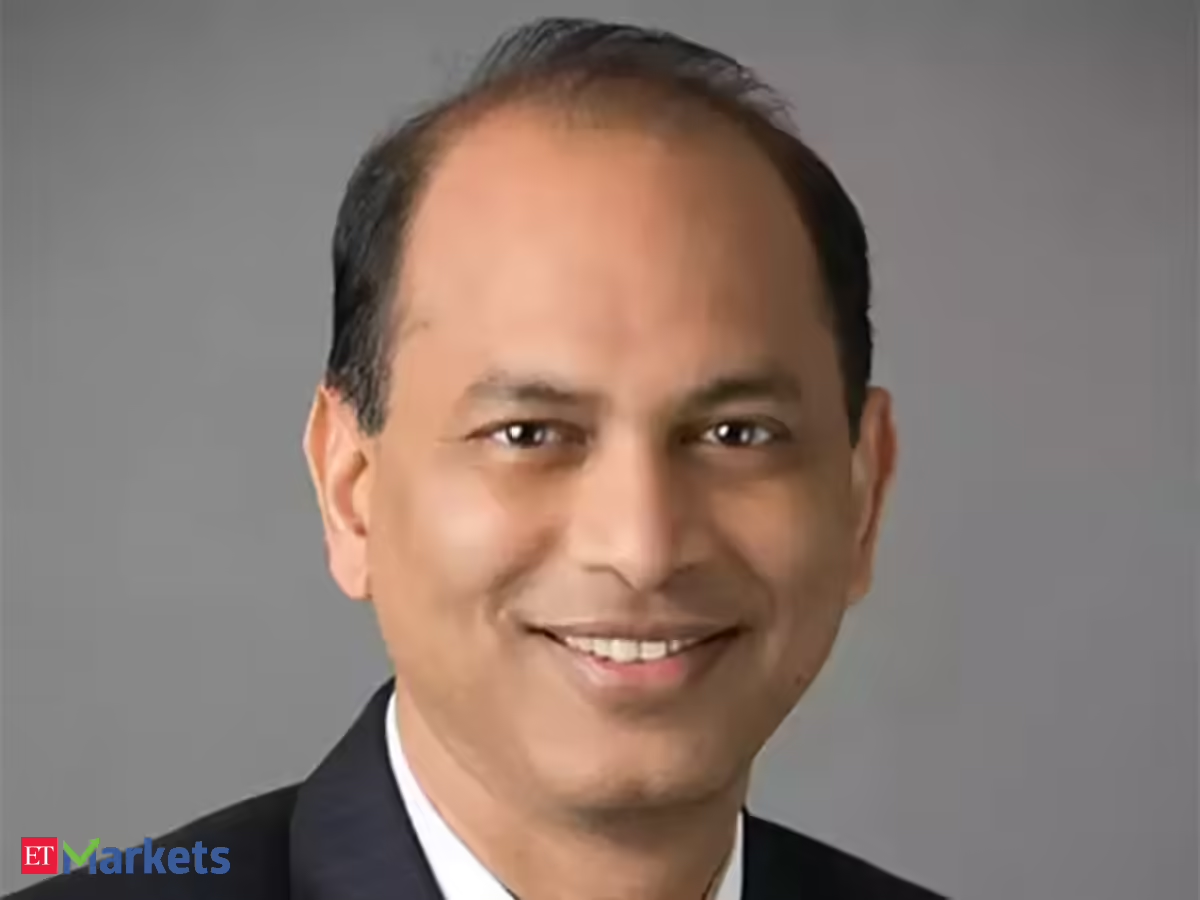
Investors closely track the portfolios of leading market participants on Dalal Street. In this context, ETMarkets analysed the investment holdings of veteran investor Sunil Singhania’s Abakkus Asset Manager, a prominent Indian investment firm. Based on the latest shareholding data for the March 2026 quarter, Abakkus holds stakes in nearly 32 listed companies, with a combined portfolio value of around Rs 2,742 crore as of May 29, 2026. This represents an increase of approximately 6% from Rs 2,577 crore reported at the end of December 2025. The analysis includes only those companies in which the investor holds more than a 1% stake and may not represent the entirety of the portfolio.
A closer look at the portfolio’s CY26 performance reveals that a majority of the stocks have delivered negative returns. Among them, seven stocks have declined by more than 20% in the first five months of the year. On the other hand, a handful of holdings have emerged as strong performers. We highlight the top six gainers in the portfolio, which have rallied between 20% and 75% so far in CY26. The portfolio also witnessed six new additions during the March 2026 quarter. (Data Source: ACE Equity, Trendlyne).
Bitcoin retreats to $73K, but ETF inflows and shrinking exchange reserves keep bulls hopeful

US Seizes Nearly $1 Billion in Iranian Crypto Assets, Treasury Secretary Says

Bear Brown Says Brother Matt Struggled Before Disappearing


-

 Business6 days ago
NYT Strands Answers May 24 2026 Revealed for Puzzle No. 812 Theme Summer Essentials
-

 NewsBeat3 days ago
Israel says it has killed new Hamas military leader in Gaza City airstrikes
-

 Politics5 days ago
Bridgerton Season 5: Cast, Release Date And Everything We Know So Far
-

 Business3 days ago
Selena Gomez Reportedly Upset Over Benny Blanco’s Comments on Her ‘Terrible’ Diet
-

 Crypto World7 days ago
Robinhood crypto COO Tanya Denisova exits
-
 Crypto World4 days ago
Micron Crosses $1 Trillion Market Cap as AI Demand Reshapes Memory Sector
-

 Tech5 days ago
Microsoft’s quiet Claude Code retreat and the real cost of enterprise AI
-

 Business5 days ago
BTS Sells Out Four Las Vegas Shows at Allegiant Stadium for ARIRANG World Tour
-
 Tech4 days ago
China assigns ID codes to 28,000+ humanoid robots
-

 News Videos3 days ago
XRP *JUST* SUCCEEDED!!!! CLARITY ACT EXPOSED!!! (SHE EXPOSED IT)
-

 Tech1 day ago
Waymo dominates autonomous vehicle registrations as Tesla trails behind
-
Tech3 days ago
The Samsung pay deal is the moment Korean unions changed register
-

 Tech5 days ago
Westone Audio and Etymotic Acquired by Fidelity Collective in Major IEM Market Move
-

 Tech3 days ago
Millions of AI agents imperiled by critical vulnerability in open source package
-
Crypto World5 days ago
Brian Armstrong Outlines Crypto Vision for the Future Financial System
-
 Entertainment4 days ago
‘Breaking Bad’ Star’s Easy-to-Binge 6-Part Crime Series Spin-Off Is Finally Heading to Free Streaming
-
Crypto World3 days ago
SpaceX’s $2 Trillion IPO: Why Tech Giants Nvidia (NVDA), Apple (AAPL), and Microsoft (MSFT) May Face Pressure
-
 Crypto World5 days ago
Nvidia (NVDA) CEO Calls on Super Micro to Strengthen Export Controls Amid Smuggling Probe
-

 Tech3 days ago
NASA taps Blue Origin to deliver lunar rovers for Moon Base initiative
-
 NewsBeat5 days ago
Hottest May day ever as London hits 34.8C in 2C leap from previous records
You must be logged in to post a comment Login