

Business
BHP Group Shares Rise 0.27% to $62.48 on June 1 as Copper and Iron Ore Prices Stabilize

KEY POINTS
BHP Group Shares Rise 0.27% to $62.48 on June 1 as Copper and Iron Ore Prices Stabilize
SYDNEY — BHP Group Ltd shares climbed 0.27 percent to close at $62.48 on Monday, June 1, 2026, reflecting modest investor optimism amid stabilizing commodity prices and positive developments in the global mining sector.
The Australian mining giant, one of the world’s largest diversified resource companies, traded in a relatively narrow range during the session, with strong support from its copper operations and steady iron ore demand from China. The modest gain came as broader market sentiment improved slightly at the start of the new month following mixed economic signals from major trading partners.
BHP has maintained a resilient performance in 2026 despite volatility in commodity markets. The company benefits from its diversified portfolio spanning iron ore, copper, nickel, and coal, providing a buffer against price swings in any single commodity.
Recent Operational Performance
BHP reported solid full-year results for the period ending June 2025, with underlying attributable profit reaching $13.7 billion. Copper production showed particularly strong growth, supported by the successful ramp-up of the Spence Growth Option in Chile and continued performance at Olympic Dam in South Australia. Iron ore production remained robust, with the company maintaining its position as a leading global supplier.
The company’s focus on operational excellence and cost discipline has helped offset challenges including labor constraints and weather-related disruptions in Western Australia. BHP’s commitment to disciplined capital allocation has also supported shareholder returns through dividends and share buybacks.
Commodity Market Context
Iron ore prices have stabilized around $100-$110 per tonne in recent weeks, supported by steady Chinese steel production and infrastructure spending. Copper prices have shown resilience amid strong demand from the electric vehicle and renewable energy sectors, though supply constraints continue to influence market dynamics.
Analysts note that BHP is well-positioned to benefit from the global energy transition. Its copper assets are increasingly viewed as strategic holdings as demand for the metal grows with electrification trends. The company has invested significantly in expanding copper production capacity to capitalize on this long-term structural shift.
Analyst Views and Valuation
Wall Street consensus on BHP remains generally positive. Most covering analysts maintain Buy or Hold ratings, citing the company’s strong balance sheet, diversified assets and exposure to future-facing commodities. Average price targets cluster around $65-$70, suggesting moderate upside potential from current levels.
Some analysts have highlighted risks including potential slowdowns in Chinese economic growth, regulatory challenges in key operating jurisdictions and volatility in energy transition metals. However, BHP’s scale, operational expertise and financial strength are frequently cited as mitigating factors.
The stock currently offers an attractive dividend yield, making it popular among income-focused investors. BHP has a long history of reliable payouts, even during periods of commodity price weakness.
Strategic Initiatives and Sustainability
BHP continues advancing its portfolio toward lower-carbon commodities. The company has set ambitious targets for Scope 1 and 2 emissions reduction and is investing in technologies to improve the environmental performance of its operations.
Recent developments include progress on the Jansen potash project in Canada, which is expected to become a significant contributor to future earnings. The company has also explored potential acquisitions and partnerships to strengthen its position in copper and other critical minerals.
Sustainability reporting and engagement with indigenous communities remain central to BHP’s operating model, particularly in Australia where the company maintains large-scale iron ore operations.
Broader Market and Economic Factors
Monday’s trading occurred against a backdrop of cautious global markets. Commodity prices showed mixed signals, with some metals gaining on supply concerns while others faced pressure from demand uncertainty. The Australian dollar’s performance also influenced investor sentiment toward resource stocks.
BHP’s share price movement often serves as an indicator for the broader resources sector on the ASX. Its performance influences sentiment toward other major miners and provides insight into global commodity demand trends.
Investment Considerations for 2026
Investors evaluating BHP shares should consider its exposure to both traditional and future-facing commodities. The company offers a balance of near-term cash flow generation and longer-term growth potential through its copper and nickel assets.
Risks include geopolitical tensions affecting trade flows, regulatory changes impacting operations and potential volatility in Chinese economic activity. Opportunities exist if global infrastructure spending accelerates and energy transition demand exceeds expectations.
Analysts generally recommend a long-term approach to BHP given the cyclical nature of commodity markets. The stock’s defensive qualities and dividend reliability appeal to conservative portfolios, while its growth exposure attracts those bullish on the green economy.
Professional financial advice tailored to individual circumstances is recommended before making investment decisions in the resources sector. Market conditions can shift rapidly based on macroeconomic developments and commodity price movements.
Technical Outlook
Technically, BHP shares are trading above key support levels but face resistance near recent highs. Volume patterns suggest consolidation, with potential for upward movement if commodity prices strengthen further.
The stock maintains a strong correlation with iron ore and copper futures, making it sensitive to developments in those markets. International investors monitor currency fluctuations, particularly movements in the Australian dollar against the US dollar.
BHP Group remains one of Australia’s most important corporate citizens and a bellwether for the resources industry. Its ability to navigate the current environment while positioning for long-term structural changes will be closely watched by investors throughout 2026.
Monday’s modest gain represents normal market fluctuations rather than a significant shift in fundamentals. With strong operational performance and strategic focus on high-value commodities, BHP continues to occupy a leading position in the global mining landscape.
As the new month begins, attention turns to upcoming production reports and any guidance on full-year expectations. For now, BHP shares reflect steady confidence in the company’s diversified business model and long-term prospects in a changing global economy.


CMB.TECH: A Stronger Shipping Platform, But Not A Cheap One

Spot gold was up 0.3% at $4,227.17 per ounce as of 2:15 p.m. ET (1815 GMT), and was down 2.3% for the week.
U.S. gold futures rose 3% to settle at $4,238.80.
“I think that the inflation is going to linger for some time, even if oil prices do come down… we’ve heard this story before and there’s some degree of scepticism,” said Peter Grant, vice president and senior metals strategist at Zaner Metals.
Oil prices fell over 3% after the news that a memorandum between the United States and Iran to halt the war in the Gulf could be signed as soon as Sunday, a Western source told Reuters on Friday. Iran’s Fars news agency, however, denied that speculation, citing a source close to the negotiations. [O/R]

Gold has been under pressure since the conflict began at the end of February, on concerns that oil-driven inflation means central banks will keep interest rates elevated.
While investors regard gold as an inflation hedge, higher rates tend to weigh on the non-yielding metal. Traders are pricing in a 57% chance of a U.S. rate hike by December, according to the CME FedWatch tool.
Data this week showed U.S. producer prices increased more than expected in May, while consumer inflation jumped above 4%.
Attention is also turning to the Federal Reserve’s June 16-17 policy meeting, the first to be chaired by Kevin Warsh, when the market expects the bank to hold rates steady.
UBS has lowered its gold outlook, warning that delayed Fed rate cuts will pressure prices toward the $3,850-4,000/oz range in the near term.
Elsewhere, Rolex raised the global price of its gold watches by an average 5% this month, marking a rare second annual increase for its main markets including Britain, Hong Kong and the U.S., according to two luxury research platforms and two dealers.
Spot silver rose 1.2% to $68.14 per ounce and palladium added 0.7% to $1,281.04, with both metals headed for weekly gains. Platinum fell 0.8% to $1,706.90 and was headed for a weekly loss.

GOF: Lower Your Return Expectations, Not Your Conviction

MicroStockHub/iStock via Getty Images

By Sandra Rhouma
The market is pricing in higher euro rates through 2031. But can the region’s economy take them?
As expected, the European Central Bank (ECB) raised its three key interest rates by 25 basis points (bps) on June

AI's True Costs Limit Its Impact On Job Displacement

Geely to streamline operations, focus resources on Hong Kong-listed unit

Inflation And The Fed
Traders were also digesting unprecedented demand for shares in SpaceX, which raised $75 billion in an initial public offering and jumped about 20% in its Nasdaq debut.
The euro was little changed at $1.15725, hovering near a one-week high and set for a weekly gain after the European Central Bank delivered its first interest rate hike in three years on Thursday.
PEACE DEAL
Leaked terms of a proposed memorandum to end the war in the Gulf, outlined by Western, Pakistani and Iranian sources on Friday, appeared to favor Iran, drawing criticism from U.S. President Donald Trump who called the reports inaccurate. Trump’s announcement on Thursday regarding a deal had prompted Wall Street shares to rally, oil prices to slip and the U.S. dollar to fall.
Markets are pausing as they assess the prospects for peace and the impact of the SpaceX IPO, with investors watching whether funds will shift from equities or cash, said John Velis, FX and macro strategist at BNY.
“The hoped-for good news on the ceasefire in the Middle East had a big reaction overnight and I think we came in this morning and we have the SpaceX IPO and a bunch of central bank meetings next week,” Velis said.
The U.S. dollar was up 0.18% against Japan’s currency at 160.225 yen, holding near a key level that often triggers concern about intervention from Tokyo.
The pound was steady at $1.34145. Data showing the UK economy contracted in April had little impact, with markets focused on Iran talks.
The U.S. dollar index, which measures the greenback against a basket of six currencies, was flat at 99.75 after hitting a one-week low on Thursday.
Investors have tended to buy the safe-haven dollar when tensions in the Iran war flare, and sell it in favor of riskier assets such as stocks when peace talks appear to make progress.
FED IN VIEW
Data on Thursday showed U.S. producer prices increased more than expected in May, ahead of Kevin Warsh’s first rate-setting meeting as chair of the Federal Reserve next week.
Traders expect the Fed to keep rates steady at 3.5% to 3.75%, but see a greater than 50% chance of a hike by year-end. Pricing edged slightly lower on Thursday after Trump’s comments on a potential deal.
Against the Swiss franc, the dollar strengthened 0.21% to 0.79680.
In cryptocurrencies, bitcoin gained 0.40% to $63,595.26. Ethereum declined 0.29% to $1,665.87.

Private market data sector seen reaching $30bn TAM by 2030
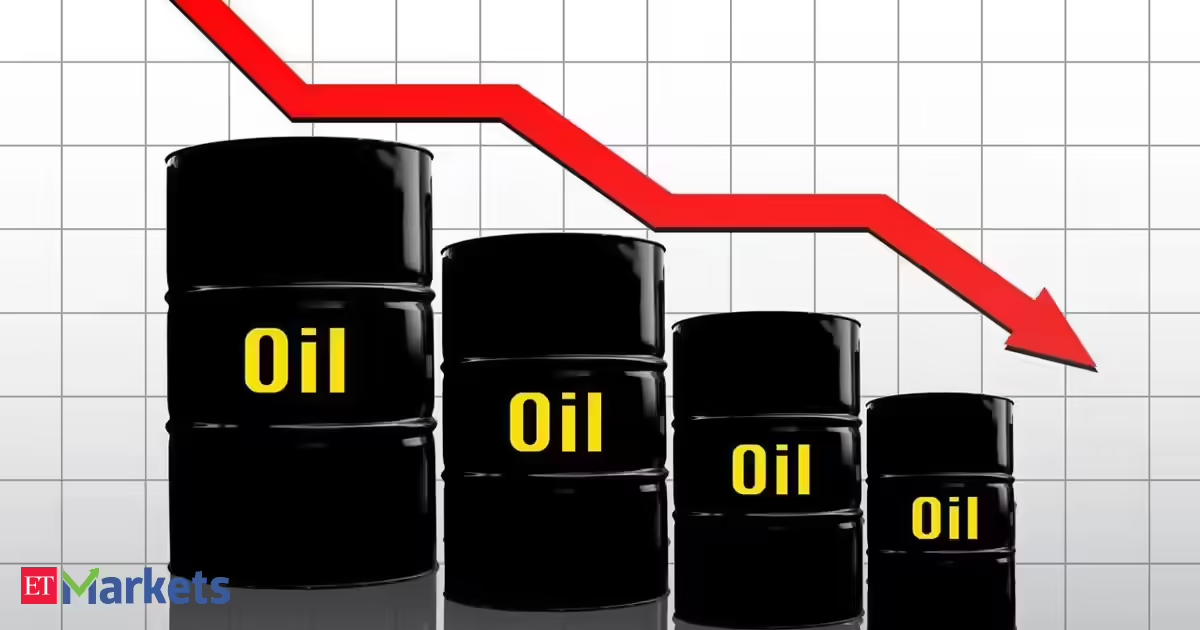
Brent futures were down $3.34, or 3.7%, at $87.04 a barrel by 1035 CDT (1535 GMT), while U.S. West Texas Intermediate (WTI) crude dropped $3.11, or 3.55%, to $84.60. Both contracts were at their lowest prices since April 17.
“The market thinks we’re closer to the deal,” said Phil Flynn, senior analyst with Price Futures Group.
A memorandum between the U.S. and Iran to halt the war in the Gulf could be signed as soon as Sunday, a Western source told Reuters on Friday, with Geneva emerging as the likeliest venue.
Iran’s Fars news agency, however, citing a source close to the negotiations, denied that speculation.
U.S. President Donald Trump called off his threatened air strikes on Thursday, while Iran’s Mehr news agency reported that final negotiations on the memorandum would focus on nuclear and economic issues but would exclude discussions about Iran’s missile programme.
Iran’s IRNA news agency, meanwhile, said nuclear talks would take place within a 60-day period after a memorandum was signed. “Headlines are driving the market once again as confidence grows that an eventual deal will be struck and the Strait (of Hormuz) reopens,” said Tamas Varga, an analyst at PVM Oil Associates.
The caveat, however, is that global and regional oil stocks are still low and could drift lower, even with a deal, as it would take time to ensure uninterrupted oil flows, he added.
On Thursday, Iran announced a complete closure of the strait, saying it would fire on any ship trying to pass through the waterway. Traffic through the strait, which normally carries a fifth of global oil and liquefied natural gas shipments, has been extremely limited as a result of the war.
The U.S. military, however, said on social media that commercial ships continued to transit the waterway.
“We believe the market reaches an inflection point in late July if we do not see oil flows resuming before then,” ING analysts said in a note. “This is when inventory levels and seasonally stronger demand push prices significantly higher towards $120-130 per barrel.”
Goldman Sachs lowered its 2027 average Brent forecast to $80 a barrel on higher supply and lower demand, but expects prices to exceed the 2025 average on stockpiling of OECD commercial oil stocks and a security premium for disruptions.
The Organization of the Petroleum Exporting Countries lowered its forecast for 2026 world oil demand growth to 970,000 barrels per day on Thursday from a previous 1.17 million bpd – its second straight downward revision.
The producer group also said consumption would eventually rebound. It expects oil demand in 2027 to rise by 1.73 million bpd, up 190,000 bpd from its previous forecast.

BITCOIN COLLAPSE IS STARTING

CMB.TECH: A Stronger Shipping Platform, But Not A Cheap One

Treasury Moves to Speed Fraud Detection With New FinCEN Guidance


-

 NewsBeat5 days ago
Alexander Zverev wins the French Open to finally earn a 1st Grand Slam title
-
 Entertainment6 days ago
The Best Mystery Series of All Time Is Surging on Streaming 30 Years After It Ended
-

 Crypto World5 days ago
Anatomy of the June crypto crash: Fed, Iran, Saylor
-

 Crypto World2 days ago
Oppenheimer backs SpaceX as $70 billion retail frenzy builds
-

 Crypto World2 days ago
Markets Rally as SpaceX IPO Looms Amid Iran Tensions and Inflation Surge
-
Crypto World7 days ago
Senator Cynthia Lummis Calls CLARITY Act the Most Consequential Financial Legislation of This Generation
-
 NewsBeat6 days ago
Alexander Zverev conquers demons and outlasts Flavio Cobolli to win French Open for first major title
-

 Tech6 days ago
Microsoft unveils seven homegrown AI models in new bid for ‘long term self-sufficiency’
-

 Business5 days ago
High Stakes for Wembanyama as New York Pushes for 3-0 Lead
-
 Business6 days ago
The Pain Points Taking a Fragile Tech Rally Down a Notch
-

 Tech5 days ago
Notion restores access to Anthropic after service disruption
-
 Crypto World5 days ago
Eli Lilly (LLY) Stock Surges 4% Following Breakthrough Sleep Apnea Trial Results
-
 Business6 days ago
The investment to transform historic St Helen’s ground in Swansea
-

 Crypto World6 days ago
Trump’s AI Ownership Plan Could Benefit Anthropic at OpenAI’s Expense
-
 Sports4 days ago
Bangladesh beat Australia after 20 years in ODIs, register only their second win over six-time world champions | Cricket News
-

 Business7 days ago
Forensic Expert Floats Handyman Theory in Disappearance of Savannah Guthrie’s Mother
-

 Tech6 hours ago
NanoClaw integrates JFrog registries to secure AI agent downloads
-

 Tech17 hours ago
This Week In Security: Microsoft On Microsoft, Register Your Domains, Linux On ARM, And FreeBSD Joins The File Cache Club
-

 Politics2 days ago
Politics Home | Healey Resignation Is “Colossal Failure Of Government”, Says Former Labour Defence Secretary
-

 Sports2 days ago
First Time Since 1971: Australia Register Historic Low In ODI Cricket
You must be logged in to post a comment Login